TheUSDVISTA
Volume 55 Issue 8
Thursday, November 2, 2017
On Newsstands Weekly
◆ The Official Student Newspaper of the University of San Diego since 1968 ◆
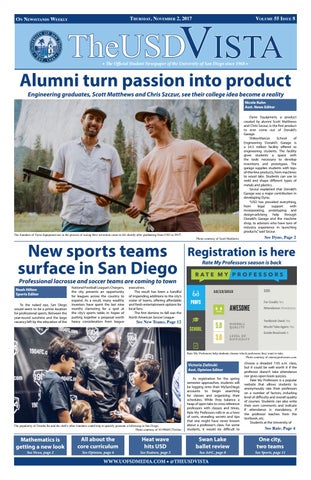
Alumni turn passion into product Engineering graduates, Scott Matthews and Chris Szczur, see their college idea become a reality Nicole Kuhn Asst. News Editor
The founders of Dyno Equipment are in the process of seeing their invention come to life shortly after graduating from USD in 2017.
New sports teams surface in San Diego
Dyno Equipment, a product created by alumni Scott Matthews and Chris Szczur, is the first product to ever come out of Donald’s Garage. Shiley-Marcos School of Engineering Donald’s Garage is a $4.5 million facility offered to engineering students. The facility gives students a space with the tools necessary to develop inventions and prototypes. The garage supplies students with topof-the-line products, from machines to wood labs. Students can use to weld and shape different types of metals and plastics. Szczur explained that Donald’s Garage was a major contribution in developing Dyno. “USD has provided everything, from legal support with incorporating, prototyping and design-advising help through Donald’s Garage and the machine shop, to advisors who have tons of industry experience in launching products,” said Szczur. Photo courtesy of Scott Matthews
See Dyno, Page 2
Registration is here Rate My Professors season is back
Professional lacrosse and soccer teams are coming to town
Noah Hilton Sports Editor To the naked eye, San Diego would seem to be a prime location for professional sports. Between the year-round sunshine and the large vacancy left by the relocation of the
National Football League’s Chargers, the city presents an opportunity for leagues across the country to expand. As a result, many wealthy investors have spent the last nine months clamoring for a spot at the city’s sports table, in hopes of putting together a proposal worth heavy consideration from league
executives. The result has been a handful of impending additions to the city’s roster of teams, offering affordable and fresh entertainment options for local fans. The first domino to fall was the North American Soccer League
See New Teams, Page 12
Rate My Professors help students choose which professors they want to take. Photo courtesy of ratemyprofessors.com
Victoria Zielinski Asst. Opinion Editor
choose a dreaded 7:45 a.m. class, but it could be well worth it if the professor doesn’t take attendance nor gives open book quizzes. Rate My Professors is a popular website that allows students to anonymously rate their professors on a number of factors, including level of difficulty and overall quality of courses. Students can also write their own comments and indicate if attendance is mandatory, if the professor teaches from the textbook, etc. Students at the University of
The popularity of Demba Ba and the club’s other founders could help to quickly generate a following in San Diego. Photo courtesy of @1904FC/Twitter
As registration for the spring semester approaches, students will be logging onto their MySanDiego accounts to begin searching for classes and organizing their schedules. While they balance a heap of open tabs to cross reference professors with classes and times, Rate My Professors rolls in as a hero of sorts, revealing secrets and tips that one might have never known about a professor’s class. For some students, it would be difficult to
All about the core curriculum
Heat wave hits USD
Swan Lake ballet review
One city, two teams
See Opinion, page 4
See Feature, page 5
See A&C, page 8
See Sports, page 11
Mathematics is getting a new look See News, page 2
WWW.UOFSDMEDIA.COM ◆ @THEUSDVISTA
See Rate, Page 4
2
The USD Vista
◆
November 2, 2017
NEWS
Math space to be remodeled
USD receives $1 million grant to expose students to the creative applications of mathematics Tyler Arden Contributor While most are familiar with the concept of an art studio, it might be harder to picture a math studio. Borrowing ideas from traditional art studios and design thinking, the math department at the University of San Diego is reimagining a space for math students to learn and study. Thanks to a $1 million grant from the Fletcher Jones Foundation, construction on the math department in the basement of Serra Hall is tentatively set to begin at the end of the academic year in May 2018. Not only will the project create a modern atmosphere and enhance the student experience, but it may also improve learning outcomes and research. The department considered solutions before Professor Satyan Devadoss, PhD, was hired as the Fletcher Jones Endowed Chair of Applied Mathematics. With the departure of computer science from the math department and a promise in Devadoss’ contract to give him an extra dedicated space, the process to reimagine the physical space of the math department became a priority. “The current space [in Serra Hall] was hacksawed in when the department was asked to move, and the space wasn’t designed for us,” Devadoss said. “It was the space that was here that just had a lot of offices.” Much of this initiative stems from problems with the area that the math department currently occupies. The basement of Serra Hall is akin to a maze of hallways and locked doors, and lacks established spaces for students to study. As a result of the grant, the area where three doors face one another in a secluded hallway will be unrecognizable following the construction. The new space will feature easier navigation, glass
walls, and open spaces, including a dedicated study lounge for math students. Devadoss said plans for the space were largely created with the help of two math students who tackled the project for their thesis. Danielle Latimore and Xiaoye Yang, graduates of the class of 2017, conducted research through surveys to determine student and faculty needs from the space. From there, they built physical and digital models to represent the current space and future possibilities. Though the entire space will see a transformation, the project is centered around the concept of a math studio. With an emphasis on group problem solving, collaborative learning, and faculty research, the studio space is anticipated to satisfy current unmet needs. It’s a concept that Devadoss said he has considered for nearly 20 years, though was only recently able to concretely understand what it would entail. “Math is the queen of sciences,” Devadoss said. “If anyone should have a lab, we should have a lab. I want to use the lab to do really cool math research and push the boundaries of math in a physical space.” As a professor of applied mathematics, Devadoss explores the physical aspect of math. His concept for the lab is built around that notion. Where math is normally something that gets erased and left behind, the new lab would allow students to leave projects out and build on them over time. This also presents the chance for students to fail and improve their thinking skills, while rebuilding models along the way in a physical world. Devadoss sees the lab as an opportunity to meaningfully pull students into the realm of math and its applications. “I didn’t want to do it [design the math lab] just so that students had a great time doing it,” Devadoss said. “I want to do really cool math and that
would attract students to do it. If it’s just a showcase, then they’re going to be like, ‘You’re just PR’ing this so I get excited and that’s dumb.’” Sophomore and math major Andy Nelson is currently in Devadoss’ Discrete and Computational Geometry class. The course is largely project-based, with students taking part in open-ended opportunities to apply and further develop their understanding of the concepts taught in class. Much of Nelson’s work so far has centered around art gallery problems. “It’s a lot more creative than just solving problems like you think of your typical math homework,” Nelson said. “It should be fun to have a place to do that.” Nelson said that most students never see the abstract thinking and creativity that happens in math because they quit before they reach that point. The vision of the studio is to expose students to the creative and applied potential that math holds. “This whole studio is how real math, at least how I envision, is done,” Nelson said. “The classic vision is you got some white-haired dude by himself for hours with a chalkboard full of random equations and stuff you can’t understand. Some of that goes on, but the reality is that mathematicians are trying to solve physical, real-world problems.” The unique concept of a math studio also fits with the university’s Envisioning 2024 strategic plan, focusing on engaged scholarship and liberal arts education for the 21st century. The math department anticipates the studio space will serve as an example of how to make these goals a reality, and isn’t a concept that is in place at other universities. With the departure of computer science opening doors to explore the mission of the math department as its own entity, Devadoss is also hoping to help lead that conversation through his focus on applied mathematics and position
in the department. Notably, the department is exploring introducing an applied math track. Devadoss explained that such a move would place a stronger emphasis on liberal arts, lower the barrier of entry for students, and meet them at their interests. Whether they be studies like architecture or linguistics the move will still teach core math skills. “When I think about applied math, I think about anybody walking into the door of math through any language,” Devadoss said. “I’m introducing new courses, a new major, and what it will look like. I’m not looking at what it has been in a cool way for the past 30 years, but what we could incorporate for our students for the next 30 years.” The sweeping changes and opportunity to make an impact were part of what motivated the Fletcher Jones Foundation to provide such a large grant. The foundation has continued to be a longtime partner for USD, providing over $5 million in support to fund two endowed professorships in addition to other capital projects like the construction of Mother Rosalie Hill Hall. These grants were largely possible because of a close-working relationship developed between the foundation’s Executive Director Christine Sisley and the university over the years. When USD’s Senior Director of Foundation Relations Annette Ketner found out that Sisley was retiring, she jumped into action. “We asked [Sisley] if she would consider one more large request from us, and she agreed to review it,” Ketner said. “I was aware of Dr. Devadoss’ interest in remodeling the math space, so we worked with him to prepare a proposal which we submitted.” Much of the opportunity came from Devadoss’ meeting with the people from the foundation to introduce himself to the organization since he is the Fletcher Jones Endowed Chair of Applied Mathematics. At that meeting,
Devadoss said he highlighted the perfect circumstances and opportunity to make a big difference in the math department. “I drove up to the Fletcher Jones office and I met with the director of the program to introduce myself,” Devadoss said. “And they were like ‘that’s awesome’ and asked if I had any cool plans for the future. I said, ‘Speaking of which,’ and pulled out this [model of the proposed renovations].” From that, the math department secured a grant that Devadoss said exceeded even his expectations. Where he was hoping to raise around $300,000 to start the process of fundraising, the foundation offered a significant grant to cover the entire cost. The redesign of the space will not begin until after classes finish in the spring semester, with construction scheduled to be completed before the start of the fall semester. While the new student lounge and math studio will be open for students, Devadoss suggested a longer outlook for fully realizing the potential of the studio space. Just as a student’s project in the studio would, Devadoss plans to discover the use of the math studio through a process of experimentation filled with trial and error. The space will not be set in stone either, with Devadoss anticipating to replace and rearrange furniture every few years to meet changing needs. “I want a place where getting wrong answers is the norm,” Devadoss said. “We’re going to keep doing this thing until it starts clicking. For me to say I know exactly what a math studio is supposed to be like is dumb. What do I know? It doesn’t exist. I want to fool around with these things.” This space is meant to engage creativity and show that math is not about getting the right answers, but rather about learning through finding wrong answers and innovative solutions.
First small camera slider system State-of-the-art machine shop in School of Engineering contributes to alumni’s innovative product
Dyno from Page 1
Matthews stated that the skills he learned from USD are invaluable, as are the resources given to him as a student to make the product become reality. “From advice from professors to using labs whenever we wanted to being able to take classes in engineering and entrepreneurship,” Matthews said. “USD gave us every outlet we needed to successfully create a product and a business.” The two alumni started working on the project during their junior year at USD. Three years later, they have created the first slider system, a camera-operation device that is specifically designed for small cameras, such as a GoPro, and are easily operated by a smartphone device. They named the product Dyno because of a term used among climbers for jumping from hold to hold, which correlates to how their product moves the camera with one swift motion. Matthews, the design
expert, stated that Dyno relates to the way the product operates similarly to the dynamic motion of the climbing. As the product developer, Szczur explained that they first started developing the product through an idea inspired while scrolling through Instagram. “Scott and I were sitting in class one day watching time-lapse videos where the camera was moving in the frame and we thought, ‘How did they do that?’” Szczur said. “So we googled it and found that people used a device called a motorized camera slider. The only ones that existed were $1000+ and designed for DSLR and cinema-style cameras, so we decided to make an affordable version we could use with our smartphones and GoPros.” Szczur also adds that USD has been a major contributor in developing the product. “The process has been crazy, but really rewarding,” Szczur said. “We are lucky to have a state-of-
the-art machine shop at USD which has given us free access to all the tools and equipment we needed to prototype a product and take it to production. There are lots of ups and downs, sometimes things don’t work as expected, and sometimes things work better than expected, but in the end it’s an awesome experience to see an idea through, from concept to product.” From students to business owners, Matthews explained the moral responsibility they have taken on in creating their business, which is to give back and run Dyno ethically. “We are very aware of the impact we have on the places we love to enjoy,” Matthews said. “Chris and I have always felt that we have a responsibility to do what we can to limit our impact on these places and stay in line with our morals and core values. Now being business owners, we also see the moral responsibility with running Dyno ethically and reflecting our morals in the work we
do and the products we create.” Matthews stated that they will continue to give back because of their passion for the outdoors and the environment. Just five months since graduation, Matthews and Szczur have watched their idea from a classroom turn into reality and a
passion. Going forward, the two expect to grow their business and continue to make products geared toward cinematic-style video for small cameras. The two graduates are currently focused on finishing their campaign, which ends on Nov. 17. Customers should expect their shipment of the Dyno product soon.
The new invention is made for small cameras like a GoPro. Photo courtesy of Scott Matthews
Volume 55 Issue 8
◆
OPINION
◆
3
The USD Vista
OP I N ION
Office hours with Rate My Prof Rate My Professors is a vital tool for students when choosing which professors to take
Rate, from Page 1
San Diego explained that while the website is useful for reference, it is risky to base an entire course schedule on their professor’s ratings due to the anonymity and context of the comments. Senior Elaine Selna explained that she uses the website to pick her professors rather than pick specific classes, because she can get a general idea of the professor’s teaching style. “Rate My Professors affects my decision in some ways, depending on what I was looking at the professor for,” Selna said. “If I was looking for a general lowerdivision core class, it probably wouldn’t affect it as much. In an upper-division class, I would look at Rate My Professors and probably consult with my friends who have taken the class before or have had that professor before and get a second opinion, and use that to get a picture at least.” Although Selna has not written a review before, she may write one to inform others if she had a different experience with a professor than she initially expected. “If the expectation that a professor set in the beginning wasn’t met by the end, I would probably write a review,” Selna said. “I’ve had professors where they set the expectation and they give out the syllabus and they were really organized and prepared, and by the end they were really not. I’ve noticed that I probably would write it. That way someone would have a good understanding of if you expect this professor to be a certain way, just know that this was my experience, but take it with a grain of salt.” Dr. Peter Mena, a professor of Theology and Religious Studies, became aware of the website some years ago when he first began teaching, but he has not read his ratings in a long time. “I felt good about the ratings initially because they were generally positive,” Mena said. “At the time, I felt good about what was being said about me or the score that was being given. It seems students might be going to this website to find out whether they should be signing up for a certain professor’s class, and I have heard dismissive comments from colleagues of the website not being something of value.” Mena pointed out the differences between the student comments on the end-of-semester course evaluation and the comments on Rate My Professors. “Comments on a course evaluation can be very helpful in terms of how I think about my own teaching and assignments and whatnot,” Mena said. “Rate My Professors to me feels slightly like other kinds of social media trolling. Someone who has been dissatisfied can go on there and say anything. I hope students don’t use this as a mechanism to choose a class.” Because of its anonymous nature, it seems as though there is more of a sense of community in the Rate My Professors website
Rita Srekais/The USD Vista
than there would be on other platforms, but the quality of the content that is posted is up for debate. “I think it’s good for students to be able to share their experiences in a way that is helpful to other students about whether or not taking a class is going to be helpful or good,” Mena said. “But I do think that each person learns as an individual learner and learns differently, and something that is helpful for one student may not be helpful for another. Rate My Professors opens itself up to not being useful information because angry students who are dissatisfied with a grade or a student who is angry with a professor are able to comment anonymously.” Mena suggested a Facebook page format might be more useful or successful for students, with information such as “hard grader” rather than insults. He also explained his dissatisfaction with the “hotness” or “pepper” rating feature on the website. “It’s highly problematic along gender lines,” Mena said. “Women professors are surveyed on how they look and what they wear. For Rate My Professors to provide a space or component to rate how they look or hotness level is unacceptable.” The “pepper” icon on Rate My Professors allows students to vote on whether a professor is considered “hot”. The website explains that the “pepper“ appears on a professor’s page based on the sum of positive and negative (hot or not) ratings. Junior Michael Sween has also heard of students using the
website, but has never written a review himself. “My friends talk about using the website — the ones that use it love it, they like to feel they are ‘getting ahead’ of the bad professors or making a more educated decision on taking the class,” Sween said. “Typically if they are using it, they’ll say something like, ‘Dude you’re taking that professor? Check his review on Rate My Professor first!’” Use of the website is common. Rate My Professors reported that users have added more than 19 million ratings, 1.7 million professors, and over 7,500 schools, and that it is the highest-trafficked site for quickly researching and rating professors, colleges, and universities. Professors at USD have an average rating of 3.72 out of 5, and the school has 201 ratings as of Oct. 30. Most of them are positive, as USD has an overall quality rating of 4.1 out of 5, with location being the highest rated factor. However, Sween has found many of the online reviews to be inaccurate. Professors do not always live up to their negative reviews. “I had a couple professors that were general education professors,” Sween said. “People online would say ‘they’re the worst’ and then I met them and they were super sweet and would try to help me with my assignments. I have no idea why they got such bad reviews. The reviews are either really honest, really mean, or really nice, but more often I’ve seen really mean.” Sween further explained that
a professor’s negative ratings generally don’t scare him away. “I would definitely think twice about it if it had a bad rating,” Sween said. “If I could easily switch to an easier professor for the same class I would probably try to switch it, but it’s not that big of a deal to me. I like to make my own judgements.” Selna was interested in whether professors write their own reviews on Rate My Professors to bolster their ratings. “I think if they were to rate themselves they’d have to be much more tech savvy in this day and age,” Selna said. “I think a lot of my professors do see what they get rated but I don’t think they would manipulate their own. But I think they are definitely aware of themselves being rated by students. I’m curious if a younger professor would look at their ratings more than an older one.” Even though the negative comments provide good insight for students, Selna thought about the stress that must accompany professors being anonymously rated. “I’d feel really bad as [a] professor getting rated,” Selna said. “It’s really hard to see, but I feel like there’s also a lot of kind comments. I think if you’re a good professor and you get good reviews it probably is very uplifting because I think in the teacher evaluations it’s harder to know. But if you’re doing your job the best you can and people don’t appreciate it, I think it can be really devastating to see that.” At the end of the semester, professors hand out course
evaluations for students to fill out anonymously to review the professor and the course. Selna explained that the comments on the course evaluations and on Rate My Professors may differ, even though they are both review methods. “I think online it’s more honest or brash than on the course evaluations where people tend to be more polite than vindictive,” Selna said. “On Rate My Professors, the comments are anonymous but they don’t go directly to the professor, so the professor would have to seek out that rating themselves, whereas in the course evaluations they have to have their ratings for their portfolio.” Sween stated that there is a more straightforward element to the Rate My Professors website. “People are way more honest on Rate My Professors than on the end-of-semester assessments,” Sween said. “People only put negative comments on endof-year assessments if they really hate the teacher. Rate My Professors goes into more detail — some people are very honest and really want to talk about how the professor was, and others just use it as a space to vent.” At USD, it seems that while the Rate My Professors website is definitely referenced from time to time, students generally refer to the ratings and then make their own decisions on whether they want to take a certain professor. The website has room to improve, and possibly more filtered and monitored comments could make the ratings more useful to students and more accurate for professors.
Have an opinion? Write a Letter to the Editor to be considered for publication in The USD Vista. Contact vistaeditor@sandiego.edu for more information. The views expressed in the Opinion section are not necessarily those of The USD Vista staff, the University of San Diego, or its student body.
4
The USD Vista
◆
November 2, 2017
Getting to the core of the ‘Core’ General education courses set out to expose Torero’s to various disciplines
Taryn Beaufort Opinion Editor University of San Diego students are no strangers to core-curriculum classes, but the question of what the core curriculum does for a student’s education still remains. Students often wonder what they are supposed to take away from the variety of courses they are required to take. Almost every college in the nation has their own version of the core curriculum. This set of common courses is considered the necessary general education for students, regardless of their majors. Junior Andie ZahariasKern appreciates what the core curriculum attempts to bring to her education, but pointed out some flaws it may have. “I think it has definitely offered a lot of positives,” Zaharias-Kern said. “But at the same time, it has limited my ability to focus on my classes in my major and minor, as well as prohibited me from doing other things outside of school.” When Zaharias-Kern registered for her core classes, she had the expectation that they would not be very time-consuming. “These courses tend to be my most difficult and end up being my lowest grades,” Zaharias-Kern said. “They end up significantly bringing down my GPA. I spend way more time studying for my
core classes than for the courses for my major or minor.” As a transfer student, ZahariasKern has had the opportunity to experience different core curriculums and compare the pros and cons of each. “At my old university, our core was much more well-balanced,” Zaharias-Kern said. “The classes were interesting, but did not require hours and hours of studying. The classes gave me enough information to learn something, but not too much information where it became overwhelming.” USD’s unique core curriculum poses a problem for transfer students like Zaharias-Kern. The university requires additional courses that may not be as common at other schools. As a Catholic university, students are expected to take a minimum of two theological and religious inquiry classes. However, the old core used to require three. Most universities don’t mandate their students to take religion courses, unless the university is religiously affiliated. This fall, USD implemented a new core curriculum that would be effective for all students admitted for Fall 2017. However, students who had already completed one or more semesters of the old core had the option to decide, which core [the old or new] they would like to finish. Professor Kristin Moran, the previous Core Director, shared
USD’s decision to move away from the old curriculum. “There were multiple factors that led to USD updating the core-curriculum requirements, but the primary reason is that we wanted to improve the student experience and improve student learning,” Moran said. “One of the main differences between the old and new core is that the new core is purposefully designed to ensure that students can meet specific learning outcomes across the core curriculum.” The new core curriculum is designed to be more developmental. “We have experiences in the first year that are then enhanced at a later point,” Moran said. “For example, we have integrative learning as an outcome and students are introduced to integrative learning in their first year and then have a more advanced experience before they graduate.” Sophomore Sonia Steen entered USD with the intent to complete the “old core,” but has since switched to the “new core.” “After comparing the two with my advisor, it seemed that the new core would work best with the classes I have taken and am planning to take in the future,” Steen said. “We looked at which courses in my major and minor fulfilled requirements in each core. It ended up being that if I switched to the new core, I would probably have to take a class or two less.”
With the new core curriculum, the logic component has been completely taken out and the requirement for theological and religious inquiry has been reduced from nine units to six units. Although Steen has benefited from the switch to the new core curriculum, she still believed that there is room for improvement. “I think it might be beneficial to widen the variety of courses that can be taken to qualify for core requirements,” Steen said. “Right now we are limited to a select number of courses that could be used for the core curriculum. We don’t have many choices and if we do they are still closely related to one another.” As the current Core Director, Professor Bethany O’Shea was able to lend some input as to why USD’s core curriculum is an integral part of a student’s education. “It’s a chance to explore topics through different lenses and develop your own appreciation of the world around you,” O’Shea said. “I encourage you to think of the core not simply as a graduation requirement or a checklist of courses, but rather as knowledge and competencies you have the opportunity to gain that are grounded in our Catholic intellectual tradition.” First-year Michael Casinelli believed that USD’s core curriculum provides an easy transition from high school to a college-paced education. “‘My experience with the core
requirement is the fact that it just reminds me of a harder version of high school,” Casinelli said. Casinelli believed that it is a good thing that each school has a different core curriculum, since the core curriculum is what sets each university apart from one another. “I do not think all schools should have the same core curriculum because that is what makes USD a school people should want to go to,” Cassienlli said. “We have an almost pre-set first two years of college to complete rather than trying to figure out what classes to take and if it’ll make that person on the right track for their major.” For those worried about core classes taking up too much time, Cassinelli proposed a change in the structure of the core. “In my opinion, the school should adjust the core curriculum,” Cassinelli said. “So incoming students are required to take their religious classes the first two semesters and have more space for major-based courses that’ll benefit their future.” To some students, the core curriculum may appear as just another thing to cross off their checklist on their way to graduation, or something that takes up too much of their already busy schedules. While the university aims to expose students to a new way of thinking through these courses, it may be doing just the opposite.
Max Escutia/The USD Vista
The USD Vista Tayler Reviere Verninas - Editor in Chief Elisabeth Smith - Associate Editor Kelly Kennedy - Managing Editor James Douglas - Copy Editor Kaia Hubbard - Assistant Copy Editor Rita Srekais - Art Director Max Escutia - Assistant Art Director
Editorial – 619.260.4584 Business – 619.260.4714 www.uofsdmedia.com ◆ @TheUSDVista
Lilyana Espinoza - News Editor Nicole Kuhn - Assistant News Editor Taryn Beaufort - Opinion Editor Victoria Zielinski- Assistant Opinion Editor Celina Tebor - Feature Editor Anderson Haigler - Arts & Culture Editor Noah Hilton - Sports Editor
Walker Chuppe - Photography Editor Cyrus Lange - Photo Assistant Ana Contreras Orozco - Photo Assistant Alex Worden - Distribution Editor Bailey Marie Donnelly - Finance Director Gina Lew - Student Media Advisor Marie Minnick - Operations Advisor
The USD Vista publication is written and edited by USD students and funded by revenues generated by advertising and a student fee. Advertising material published is for information purposes only and is not to be construed as an expressed or implied endorsement or verification of such commercial venues by the staff or University. The USD Vista office is located on the fourth floor of the Student Life Pavilion in room 403B. All inquiries should be sent to: The USD Vista 5998 Alcala Park San Diego, CA 92110 The first copies of the newspaper are complimentary, all copies thereafter are a 25 cents charge. Opinions expressed in this publication are not necessarily those of The USD Vista staff, the University of San Diego or of its student body. Letters to the Editor can be submitted to The USD Vista office. Letters should be limited to 300 words and must be signed. For identification purposes, USD identification numbers and writer’s year must be included in the letter. The USD Vista reserves the right to edit published letters. Any content sent to the editor will be considered for publication unless otherwise stated.
Have an opinion? Write a Letter to the Editor to be considered for publication in The USD Vista. Contact vistaeditor@sandiego.edu for more information. The views expressed in the Opinion section are not necessarily those of The USD Vista staff, the University of San Diego, or its student body.
Volume 55 Issue 8
◆
FEATURE
◆
5
The USD Vista
F E AT U R E
Classes moved due to heat wave Temperatures reach mid-90s at the end of October, many classes moved or canceled
Celina Tebor Feature Editor Usually when one thinks of fall, images of warm sweaters and trees changing colors come to mind. Most of the time this is not the case for those living in San Diego and this became apparent last week when temperatures soared, reaching from mid-90s to the 100s. The National Weather Service issued an Excessive Heat Warning for Southern California from Sunday, Oct. 22 to Wednesday, Oct. 25. However, temperatures did not lower until the end of the week. The university’s response to the heat warning was quick, sending out at least four emails to every USD student concerning the heat wave and advising students what to do during the heat wave. The emails gave a list of tips for students to stay cool, as well a list of on-campus buildings with air conditioning. But the discretionary emails failed to mention one detail — classes in buildings without air conditioning like Camino Hall would be moved to other buildings or canceled. First-year Maddie Braun had one of her classes move locations and two of them canceled completely.
The Paseo de Colachis lawn was empty for the majority of the heat wave; soaring temperatures and lack of shade on the lawn resulted in Toreros staying inside. Celina Tebor/The USD Vista
class on Tuesday, and then on Monday and Wednesday my piano class got canceled.” Braun mentioned that last week was the first time Music Theory was canceled. “During the first few weeks of school, our Music Theory teacher almost always ended class early because it was too hot to be in there for a full hour and a half,” Braun said. “So we had an hour-
“It’s a policy that works. These heat waves are unusual in San Diego and public schools adopt a similar policy for the few times this situation occurs.” -Vivienne MacAdam “Choral Scholars was my class that got moved,” Braun said. “They moved it [from Camino] to the French Parlor in Founders because that’s just another room that has a piano and air conditioning.” The east side of Camino Hall does not have air conditioning, and almost every classroom was moved to another location. However, Braun’s two canceled classes were not rescheduled. “All my classes in the Music Department got canceled,” Braun said. “That was my Music Theory
long or 45-minute lectures, and then we’d just leave because it was so hot in there.” Professor Vivienne MacAdam of the English department had three of her classes moved from Camino Hall during the heat wave. “One was moved to SOLES and two to the UC,” MacAdam said. “We were notified 24 hours in advance. [Faculty] are all aware that there are heat-day regulations in effect and what those entail.” Despite the school sending out emails to all students and
professors whose classes were moved, Braun noted that she did not get a notification from her canceled class, since her professor canceled the class and not the school itself. “On Friday, our [Music Theory] professor said it was probably going to be in the French Parlor and on Monday it was confirmed,” Braun said. “But for Music Theory, I got the email as I was walking to class that class was going to be five minutes long.” Braun was happy with the move of her Music Theory class, but acknowledged that it was disruptive to the teaching and learning flow the class usually has. “The way that the room is set up, the chairs had to be rearranged,” Braun said. “And if we wanted to face the piano, then we had to be really close together. So instead, we shifted and were sideways so it was harder to see the piano. It just took extra time.” MacAdam did not believe that moving classes was disruptive to her teaching or her students’ learning, however. “[Moving classes] was necessary and my students did not have any problems with the change,” MacAdam said. “They were automatically emailed by the university and in addition by me
Tips to handle the heat: • • • • • •
Drink water
Avoid alcohol and caffeine Wear sunblock/sun protection
Place lotions or aloe in a refrigerator
Wear loose-fitting, light-colored, cotton clothing and a hat Keep room/apartment windows open, close blinds, and turn on fans to circulate air
so there were no surprises.” Although Braun and MacAdam had different experiences with moving classrooms, both agreed the move was necessary. “[Moving classrooms] really was needed,” Braun said. “That classroom gets really hot even when it wasn’t during the heat wave because it has a lot of windows. And, I think when you’re singing, it builds body heat. “ MacAdam believed that the steps the university took to handle the heat wave were the right decisions to make.
warning that it was something that was going to happen,” Braun said. “We got so many heat-wave emails, and none of them said ‘classes are going to be moved and canceled.’ You just found out when it happened to you.” While the school managed to save students and professors from boiling classrooms during the week, its solution is a short-term one and Braun hoped that the school will adopt a long-term one in the future. “I think the air conditioning in Camino really needs to be fixed,
“I wish that we got more warning that it was something that was going to happen. We got so many heat wave emails, and none of them said ‘classes are going to be moved and canceled.’” -Maddie Braun “It’s a policy that works,” MacAdam said. “These heat waves are unusual in San Diego and public schools adopt a similar policy for the few times this situation occurs.” While Braun said that moving classrooms was a smart idea, she wanted the school to be more proactive when announcing it to staff and students. “I wish that we got more
because it gets really hot in there,” Braun said. As San Diego enters November, the thought of heat waves will most likely dissipate until the spring approaches and temperatures rise again. As for last week, the school might have to consider the idea of air conditioning for the classrooms that cause professors to end class early as a result of the heat.
6
THE USD VISTA
◆
Volume 55 Issue 8
NOVEMBER 2, 2017
◆
FEATURE
◆
THE USD VISTA
Blast from the Past
7
Professors at USD also spent their Friday nights at Mission Beach and ate at Hodads every week
Greg Ghio
Mike Williams
B.B.A in Business Administration, minor in Communication Studies Class of 1988
B.A. Political Science, minor in History Class of 1992
Favorite memories from being a student at USD?
What has changed the most about USD since you went here?
“[USD] keeps getting bigger. Every year, there is a record class of freshmen coming in. But outside of that bigness, it is still a small community, and I like that small atmosphere. We were so tiny before. There was about 4,000 [when I went to USD]. The incoming classes were always well below 1,000 — around 800.”
“I remember that we had a square dancing party in the law school parking lot and that was great. I also remember walking up from the Valley for my 8 a.m. classes and always being struck by the beauty of the Bay.”
What is your advice for current students?
“I had wonderful teachers at USD and they inspired me to want to be a teacher. Coming back to USD was never really the plan, though. When I was writing my dissertation, my former advisor and one of the wonderful teachers, Dr. Dickson, asked me if I could teach one class at USD as an adjunct faculty. After this, I just kept trying to make myself relevant to the department and to USD so I could stay. I feel incredibly fortunate to have been able to come back to USD — I simply cannot think of any other place in the world I would rather teach.”
Why come back and teach at USD?
“Go to sporting events. I wish we had more spirit here. Go to the matches. At one time, we had the number one tennis player in the nation. Catch a tennis match. Catch a soccer game. Go to the basketball games, even though we’re not that great. Rally around it. If everyone does it, it makes it much more fun. “ Photo courtesy of Greg Ghio
Kristin Moran
Photo courtesy of Mike Williams
B.A. Communication Studies, minor in Spanish Class of 1994
What’s changed about USD since you went here?
2. What about this one? 1. Which professor’s baby photo is this?
“I think one important change is the quality of our students — I’m not sure I’d get into USD now.”
What is your #1 tip for USD students?
“As an alum (not a professor), it is to take advantage of the location and enjoy Thursday nights out at the beach.”
Photo courtesy of Kristin Moran
Justine Marzoni B.A. Communication Studies, minor in Visual Arts Class of 2010
What has changed the most about USD?
“The food on campus has gotten a lot better. Freshman year ,I nursed my first real hangover with a greasy plate of chicken strips at The Grill which used to be on the bottom floor of the UC.”
3. Which professor was an assistant director for a play about a lesbian couple who pick up a man at a bar intending to seduce him so they can have his sperm?
What do you recommend for current students?
4. Which professor waited outside Olin Hall at 5 a.m. in order to register for classes? Answers: 1. Mike Williams, 2. Justine Marzoni, 3. Kristin Moran. 4. Greg Ghio
“Don’t look forward to graduation so much. Just enjoy being a college student and take advantage of the opportunity to take classes that may not count toward your major but are interesting. Also take more naps on the lawns. “
Photo courtesy of Justine Marzoni
Spread by Rita Srekais; Content by Celina Tebor
8
The USD Vista
◆
November 2, 2017
A RT S & C U LT U R E
Swan Lake disappoints some The classic ballet falls flat in more ways than one at the San Diego Civic Theatre
The Califorrnia Ballet Company’s staging of “Swan Lake” featured impeccable costumes donated by the Cincinatti Ballet, yet the dancing was not as impeccable.
Elisabeth Smith Associate Editor The California Ballet Company opened their 50th Anniversary Season with a staging of “Swan Lake” last week. Choreographed by Thor Sutowski to the iconic score of Tchaikovsky, the performance brought high-brow entertainment to San Diego. At a preview show last Friday night, the dancers worked out last-minute kinks and nerves for a sparse crowd of journalists and young dancers. The ballet, which was first staged in 1895, transported the audience back in time with the grand score. The music, however, was disappointing to hear through a sound system instead of a live
orchestra, making the experience seem more artificial and amateur. The costumes, donated by the Cincinnati Ballet, were impeccably designed, but the dancers did not deliver the same level of attention to detail. In the opening scenes of the show, at Prince Siegfried’s birthday party, the group numbers looked clustered, and the solos were not impressive. Jumps were landed with heavy feet and dancers wobbled in their landings. Trystan Merrick, who played Siegfried, stayed off to the edges of the stage during most of the first act, not impressing the audience. Then in his solo, Merrick did not embody the choreography, looking lost on stage as if he didn’t know what move came next. It appeared that nerves got the best
The dancers and the staging seemed to lack an attention to detail. Photo courtesy of California Ballet Company
of Merrick, detracting from his performance. Despite Merrick’s lackluster solo, the star of the performance arrived in the second act. Reka Gyulai played the part of Odette, the princess who was turned into a swan by the evil sorcerer. Gyulai brought grace to the stage that was not present in the first act. Her sparkling traditional tutu with a stiff platter skirt lit up the stage and her crown shone throughout the theater. As Odette, Gyulai commanded the attention of the audience, looking like a perfect ballerina from a jewelry box. Gyulai’s movements perfectly embodied her character as a swan, from the extension of her arms to the flutter of her shoulders when she first encountered Siegfried
on stage. The second act was more aesthetically pleasing as the swan corps de ballet took the stage moving in cyclical motions. Spiraling around the stage in perfect harmony then dividing into lines, the swans would break out into smaller groups of two to four and dance as the remaining swans stood still on the sides of the stage. Overall, the ballet was not spectacular with the unsteady first act. Despite this, the arrival of the Swans on stage improved the performance tremendously. For casual audience members the night probably fell flat, as the ballet is over two hours long. But for ballet-lovers, it provided a fine night of classic entertainment. With tickets ranging from
Photo courtesy of California Ballet Company
$25-$125, the California Ballet Company provides the San Diego community an affordable option to experience some culture.
Upcoming shows by the California Ballet Company: “The Nutcracker” San Diego Civic Theatre, Dec. 9-23 Tickets from $25-$125 californiaballet.org/nutcracker/
The second act seemed to be an improvement, though, as the dancers spiraled around the stage in perfect harmony. Photo courtesy of California Ballet Company
Volume 55 Issue 8
◆
ARTS & CULTURE
◆
The USD Vista
9
Matisyahu to play at Music Box Reggae artist shares the methods behind his madness ahead of his upcoming San Diego show Kelly Kennedy Managing Editor Anderson Haigler A&C Editor Reggae artist Matisyahu has been a busy man since the release of his 2009 breakout hit, “One Day.” The Jewish-American singer has since shed his signature beard and formal
through the songs and what is a good direction to go.” His direction is often dictated by what the audience wants to hear. “Sometimes, I might be jamming and feel very loose and I can do something that people will really remember or something that people will get excited about to pull the audience in,” Matisyahu said. “Sometimes, I want to go more in ‘that’ direction or ‘this’ direction, it all
“I try to choose the songs that go into [a show] from a more instinctive place, like what the right vibe is for the next moment of the show, and where the show needs to go.“ -Matisyahu attire in favor of a more mainstream look, desipite his music maintaining the alternative sound he is known for. He is currently touring the US, and is set to make a stop on Nov. 10. at Music Box in downtown San Diego. The show is ages 21 and over only, and doors open at 9 p.m. Matisyahu recently shared what fans should expect from his upcoming show. “When I’m doing my show, I like to mix up the flow and I won’t write a setlist,” Matisyahu said. “However, I have a sense of a lot of the songs that we’ve been playing and what we’ve been working on. And as the show is unraveling, I sort of instinctively will feel a song and think
depends; there are a lot of different factors that go into it. I try to choose the songs that go into [a show] from a more instinctive place like what the right vibe is for the next moment of the show, and where the show needs to go.” The tour has also led Matisyahu in new directions musically. “When we start out our show, it’s like a blank canvas,“ Matisyahu said. “One thing that we’re doing on this tour is a lot of times during soundcheck we have time to rehearse. Once the tour has gotten into a nice fluid motion, and all the levels and the sound is going well, we can use that time to work on new material. A lot of times, I’ve been going back
to older songs and bringing them back up.” He also explained how his music has evolved over the course of his career. “Over the years, I’ve done a lot of different versions of a song, for example we just did this with the song ‘Indestructible’ on the Youth record,” Matisyahu said. “I’ve redone that song like four or five times over the years depending on my band and the style and what direction I was leaning. But then every few years, I like to go back and find a song and try to replay it how I originally did it and then build from it again.” Above all, though, he places an emphasis on staying true to himself and his music. “On a nightly basis, even though there’s different pressures around you or different pressures of what fans might want or what you think fans might want, but what I have to do when I get out on stage is try to forget about all of that and be authentic with myself, my feelings of the music, and the tools I have,” he said. This dedication to authenticity is evident in his music as his style has endured througout his musical career. Fans of Matisyahu and his music are sure to be in for a treat as the artist and his eccentric style come to San Diego in November. Tickets for the show start at $40 for a general admission ticket.
Matisyahu takes pride in being authentic with his music. Photo courtesy of Nechama Leitner
Top box office movies this week Weekend box office totals according to boxofficemojo.com
#1: Jigsaw $16,640,452
#2: Tyler Perry’s Boo 2! $10,052,608
#3: Geostorm $5,903,428
#4: Happy Death Day $5,903,428
#5: Blade Runner 2049 $4,117,395
#6: Thank You for Your Service $3,817,700
#7: Only The Brave $3,502,095
#8: The Foreigner $3,443,433
10
The USD Vista
◆
November 2, 2017
SP ORT S
Football’s “semester at air”
The country’s second-most traveled football team knows a thing or two about life on the road
Linebacker Kim Mahoney (#37) and his Torero teammates frequently cross the country to play away games. Photo courtesy of San Diego Union-Tribune/Twitter
James Douglas Copy Editor At the University of San Diego, football players usually don’t get the opportunity to study abroad. They dedicate their offseasons to honing their position-respective crafts, whether it’s practicing getting off the ball at the line of scrimmage or back-shoulder throws. But just because the football players don’t study abroad doesn’t mean they don’t travel their fair share. KJ Mahoney, a redshirt junior linebacker, acknowledged the connection between how much the football team travels and how much students abroad travel. “We have this joke that a lot of the guys are in on,” Mahoney said. “You know how there’s Semester at Sea? We call football season the ‘Semester at Air,’ because we go all over the place.” Just how much does USD football travel? Approximately 25,000 miles, enough to circle Earth’s entire circumference once. USD is second only to the University of Hawaii’s football team when it comes to travel distance during the regular season. Because USD’s football team belongs to the Pioneer Football League (PFL), a conference in which players don’t receive athletic scholarships, they mostly play teams that also belong to the conference. All of these are in the eastern or central time zones. This season, the Toreros flew to New Jersey, Ohio, and Florida twice. In two weeks, the team will fly to North Carolina. While the Torero players don’t get to rack up frequent-flyer miles for all of the long plane rides they take, they still enjoy the trips and the camaraderie they experience while traveling. Senior defensive end Jonathan Petersen expressed why he likes away games so much. “It’s just fun hanging with the guys, honestly,” Petersen said. “We play cards and board games on iPads and just relax.” But when it comes to traveling across the country to play an away game, there isn’t a whole lot of rest and relaxation for Ben Brunnschweiler, the football
team’s Director of Operations. “The best thing as a director of operations is to go unnoticed,” Brunnschweiler said. “That’s when you know things are going okay. You always have to have a Plan B. This past weekend, with our meal that we give the players on the bus to the San Diego airport — we had Chick-fil-A set up to be the meal, and they [Chick-fil-A] just didn’t show up.” Brunnschweiler didn’t get bogged down by the mishap. Similarly to how quarterback Anthony Lawrence might make a pre-snap adjustment at the line of scrimmage, Brunnschweiler calmly called an audible. “I asked how quickly they could get food to us, but it became clear that they couldn’t rush the sandwiches to campus,” Brunnschweiler said. “Luckily, there was a place at the airport where we went through and I just held out the credit card and said, ‘These are the guys that are going to be getting a burger.’ It turned out to be a pretty good meal, actually.” In regards to the travel budgets and expenses for the football team, both Brunnschweiler and Athletics Director Bill McGillis declined to comment. Brunnschweiler is responsible for all travelrelated issues for the football team. This includes organizing meals, buses, and flights. “I contact one of our travel agents, who works with all of USD Athletics, and he’ll get us our flights,” Brunnschweiler said. “When our schedule comes out, I’ll review it with him and say, ‘We want to get out of here on Thursday and get back on Saturday.’” The team doesn’t charter planes; instead, it flies commercially on airlines such as Southwest, Delta, and American Airlines. Those who travel with the team include 13 coaches, three athletic trainers, the team doctor, a school administrator, and an equipment manager. When one combines the non-player personnel with the 56 players whom the Pioneer League allows teams to travel with, however, it becomes clear that even though they don’t charter planes, the football team transforms the planes on which they travel. Brunnschweiler noted
the interactions that nonUSD passengers typically have with the team. “You get people that aren’t associated with the team in any way but who are on the same plane as us, and they are so interested and intrigued,” Brunnschweiler said. “They’ll start talking to the players and asking what their positions are. It’s even more impressive when they start asking our kids what their majors are — when they start talking about things that aren’t football-related.” Plane seating proves to be a pressing matter for many of the players, including Mahoney. “Seats are actually really interesting, how it gets done,” Mahoney said. “My freshman year — I’m a pretty skinny guy, people call me ‘Slim Kim’ — I was a highly desirable middle-seat candidate. I was perfect for the middle seat — tall and lanky and could fit in between anyone. A lot of people will save rows so that they can play a board game or play cards. There is a lot of trading of seats that goes on, too.” According to Brunnschweiler, the team’s travel requires balancing seriousness and fun. “We focus on it as a business trip,” Brunnschweiler said. “And I think that’s partly why the program is as successful as it is. The guys definitely have fun, but they find ways to have fun that might not be typical. This past weekend was Halloween-themed, so some of the
players dressed up in costumes. It’s a lot of joking around — they’re good teammates to each other.” Mahoney echoed the idea that long plane rides can be fun. The team often engages in shenanigans to keep the mood light. According to Mahoney, an unnamed senior has received renditions of ‘Happy Birthday’ on nearly every flight he’s been on since his first year at USD. “There’s a guy on the team who, in the past, we’ve always said it’s his birthday,” Mahoney said. “The flight attendants aren’t in on the joke. They’ll come on over the loudspeaker and announce ‘Happy Birthday’ to him. Sometimes we’ll tell flight attendants that someone on the team needs a seatbelt extender. We even got a flight crew to sing ‘Happy Birthday’ to our [74-yearold] coach on his ‘95th’ birthday.” Still, Mahoney acknowledged the focus that the team maintains when on their trips. “Whenever we travel, our coaches reiterate that it is a business trip,” Mahoney said. “We’re not here to visit the city. It’s not like, ‘Oh, Disneyland is nearby, we’re going to go to Disneyland.’ No, we have a game. Trips are cool because you get downtime with friends, you get to disconnect from pretty much the rest of the world, and you always eat pretty good. But then at the end of the day, we flew across the country for one thing — to beat who we’re playing.” Petersen, the team’s cocaptain and USD’s all-time leader in forced fumbles, agreed that knowing when to get serious is a key to the Toreros’ success. “I think we are so successful for one major reason,” Petersen said. “Unlike other teams, who probably lose some focus on long trips, Coach Lindsey makes sure we keep it very business-like. Anytime we start losing focus, he makes sure to get us back in the right mindset to play a football game.” Even if it’s across the country, wherever students go — in this case, student-athletes — academic worries linger close behind. Brunnschweiler explained what football players have to do to manage the missed class time that results from leaving California on Thursday morning and returning Saturday night. “Our academic support will write up a letter for the players that
they give out to their professors at the beginning of the semester and that indicates there’s a possibility that they might travel to suchand-such games,” Brunnschweiler said. “I don’t think we have much of a problem in terms of guys missing anything [academicrelated]. They’re supposed to be in touch with their professors and say, ‘Hey, is there something I’m going to be missing this week because I’m traveling?’ And they’ll set it up with the professor and Ron Valenzuela, our academic support guy. If he’s traveling with us, or if it’s any athletic director other than Ronnie, they’ll proctor exams or quizzes for the players.” Mahoney, an engineering major, discussed his experience with on-the-road academics. “It’s pretty exhausting,” Mahoney said. “What’s important, though, is good communication with your professor. You do homework on the plane, you land, and then you have to wait until you get to the hotel to submit an assignment on Blackboard. And I’ve taken tests in hotels and other places — sometimes it just happens to be wherever you can get a moment to take the test.” Even as he juggles school and sports, Mahoney still has time to document on social media the locations where the team stays. He posts photos on his Snapchat, parodying students who study abroad and share on Snapchat the “foreign” places they visit. “I’m poking fun at my friends who have traveled abroad,” Mahoney said. “I always wanted to go and so I was super jealous when I saw everyone abroad. So I’m like, ‘You know, man, I might be in Dayton, Ohio, but I’m going to show it off.’” For the team, traveling across the country multiple times per season doesn’t qualify as an excuse to neglect commitments, whether athletic or academic. In fact, it’s actually an opportunity to execute what the team does best. While USD students abroad might hop from island to island, USD football hops from one American city to the next, dismantling PFL opponents as they go. After USD plays Drake University at home on Nov. 4, 2017 at 2 p.m., the ‘Semester at Air’ carries on, with the team traveling to North Carolina to face Davidson College on Nov. 11.
Rita Srekais/The USD Vista
Volume 55 Issue 8
◆
SPORTS
◆
11
The USD Vista
Op-Ed: One city, two teams
San Diego State slogan is an opportunist method of disregarding the Toreros’ success on the gridiron Noah Hilton Sports Editor Once upon a time, the city of San Diego had three football teams. None were all that noteworthy — the National Football League’s Chargers made just one Super Bowl in their 56 years in the city, while the San Diego State Aztecs and University of San Diego Toreros operated on the outskirts of the college football spectrum. Fans filled the stands to watch individuals, with names like Faulk, Tomlinson, Seau, and Harbaugh, instead of whole rosters. Then, in a much-maligned move last January, Chargers’ owner Dean Spanos decided to relocate his team to Los Angeles. Suddenly, San Diego’s football fans were down to two options — or so they thought. Shortly after the move, San Diego State released a slogan for the upcoming season. The message — four words, five syllables — was a red-and-blackclad lesson to locals that covered billboards, banners, and the city trolley system. “One City. One Team.” The emphasis was simple enough. The city’s sports scene had a gaping hole, and the Aztecs were a readily available replacement. They are a program in possession of the last two Mountain West Conference
championships, and they just graduated the NCAA’s all-time leading rusher to the professional ranks. They are a school with more enrolled undergraduates than USD has alumni living in the local area. They are a brand that dominates local sports coverage at the college level across media mediums. In short, the slogan made sense. But only if you forget about the more successful program in America’s Finest City. For as good as the Aztecs have been in recent years, USD appears to have matched them step-forstep at their own level of Division I football. The Toreros have claimed at least a share of five of the last six Pioneer Football League crowns, and had their own best pro prospect, cornerback Jamal Agnew, selected in the fifth round of last April’s NFL draft. The team has won 17 straight conference games, a PFL record and one of the longest active streaks in the nation. Recent results indicate more of the same. SDSU opened their season with an impressive 6-0 start, rising into the national rankings while vaulting running back Rashaad Penny into the race for the Heisman Trophy, given annually to college football’s best player. Since then, though, they have stumbled badly in losses to Boise State and Fresno State. Meanwhile, USD is outscoring
opponents 198-68 over its last five games. The Toreros sit at 6-2 on the year. The Aztecs are a similar 7-2. Huh. This is neither to say that the Toreros are better than the Aztecs, nor that both programs are on the same competitive plane. The opening game of the 2015 season demonstrated as much, when SDSU rode a playmaking defense to a 37-3 victory over USD. Attend a game at SDCCU Stadium, home of the Aztecs, and the comforting chaos of college football overwhelms you: marching bands that stretch across the field, pregame traditions that inspire excitement, and a sea of red and black filling the stands. SDSU
is, without a doubt, a legitimate college football program. But so is USD, and therein lies the arrogance and irrationality of the “One City, One Team” slogan. Ignoring the accomplishments of a rival school to boost your own might be understandable. Failing to deliver wins when the city decides to support you is most definitely not. Whether it’s USD from the lowest rung of football’s Division I ladder or SDSU from only slightly higher, the reality is that neither school is capable of justifying a sole claim to America’s Finest City, and neither team has yet earned the privilege of representing San Diego to the rest of the nation.
An undefeated 2017 season and a spot in the national rankings may have been enough for the Aztecs to do so, but the last two weeks have rendered those aspirations a distant dream once again. Those same last two weeks have seen the Toreros steamroll opponents without mercy. For local fans, the result is a strange reality where one Division I football team with a ceiling of regional relevance claims civic superiority over another Division I football team with the same ceiling but that is finding more success on the field. One City….One Team? You have to admit the math looks a little off from here.
The Aztecs have struggled at times this season to back up their claim to being San Diego’s only college football team. Photo courtesy of Leading NCAA/Twitter
November Sports Calendar Make sure you don’t miss a minute of exciting athletics action happening this month
3 M ’ S en s
occer
vs. San Francisco
(Senior Night) Torero Stadium 7 p.m.
4 F
4
vs. Drake
Del Mar Racetrack/NBC 5:35 p.m.
ootball
Torero Stadium 2 p.m.
10-12 12 W ’ T M ’ R omen s
ennis
en s
owing
SDSU Invitational
San Diego Fall Classic
18 F
18 M ’
SDSU All Day
ootball vs.
Marist (Senior Day) Torero Stadium 2 p.m.
Mission Bay 7 a.m.
en s
Basketball vs. Norfolk State
Jenny Craig Pavilion 7 p.m.
Breeder’s Cup
5 N Y ew
ork City
Marathon
New York City/ESPN2 6 a.m.
10 W ’
omen s
Basketball Home Opener Sports Center 6 p.m.
15 M ’ B
16 V
17-18 S D
Jenny Craig Pavilion 7 p.m.
Jenny Craig Pavilion 7 p.m.
Monterey Park, CA All Day
en s
asketball
Home Opener
21 V
olleyball vs.
Pepperdine (Senior night)
Jenny Craig Pavilion 6 p.m.
olleyball vs.
Santa Clara
wim and
ive
A3 Invitational
29 W ’
30 M ’
Viejas Arena 6:30 p.m.
Jenny Craig Pavilion 7 p.m.
omen s
Basketball @ SDSU
en s
Basketball vs. SDSU
12
The USD Vista
◆
November 2, 2017
City’s sports scene set to expand In Chargers’ absence, professional soccer and lacrosse are headed to America’s Finest City in 2018
New Teams, from Page 1 (NASL). Currently an eight-team organization with franchises in Canada, Puerto Rico, and across the United States, the league will add two teams in 2018 in Fullerton, California as well as here in San Diego. The additions come even as the league struggles with a demotion to the country’s third tier of professional soccer and the consequential concerns about league-wide demand and financial longevity. San Diego has long been recognized as a market in prime position to add a pro soccer franchise. Research earlier this year by national demographics company Esri demonstrated as much, showing that San Diego has the highest on-field participation and the highest television viewership of the 12 aspiring soccer markets involved in the study. Given the local buzz around the beautiful game in San Diego, the initial announcement from the league generated excitement around town despite the NASL’s long-term outlook. USD senior Bryce Henry described his enthusiasm about the team’s debut. “I’m actually really excited,” Henry said. “I know it’s not going to be super high quality compared to the Premier League or any other European league, but it’ll be great to have a San Diego team.”
it’s simple. For me, the potential ‘Anchorman’ reference doesn’t really matter either. It’s better than Footy McFooty Face [the name proposed by a public vote for the city’s potential MLS team].” The club’s ownership group is headlined by a handful of members of international soccer royalty, as all four of the team’s founders have extensive experience around the world when it comes to soccer. The group is headlined by Senegal striker Demba Ba, who starred for Chelsea and Newcastle United in the English Premier League, and Ba’s former Chelsea teammate, Belgian midfielder Eden Hazard. That duo is accompanied by Frenchman Yohan Cabaye, a midfielder for Crystal Palace, and French striker Moussa Sow. Those four announced last week that they will be joined in the front office by Alexandre Gontran, a French coach credited with developing Ba as a youngster. Gontran will serve as the team’s general manager and director of soccer operations, and will be tasked with helping to build 1904 F.C.’s inaugural roster. Accompanying the announcement of Gontran’s hiring was a decision regarding where the team will play its matches. Currently, the team is slated to move into a 10,000-seat stadium at El Corazon Park in Oceanside in 2019. While the team’s eventual North County home is under construction, though,
“With the Chargers leaving, people will be looking for new teams to root for, especially if those teams end up winning often.” - Justin Braun The team will be named 1904 F.C., a reference to the locations of the letters “S” (19th) and “D” (4th) in the alphabet. Others have wondered if the name may have also been influenced by the movie “Anchorman,” a Will Ferrell film set in San Diego. In the film, Ferrell incorrectly mentions that the city was first discovered by the Germans in 1904. Henry said he was puzzled when he first heard the team’s name. “At first I was confused, but then I did a little bit of research and found out the team is essentially SD FC,” Henry said. “It’s a little cheesy but I like it,
1904 F.C. will introduce itself to locals in Torero Stadium on the University of San Diego’s campus. Given the excitement surrounding the team and the ease of accessibility for students on campus, 1904 F.C.’s debut season could provide a ready source of entertainment for fans like Henry. “This city has a lot of people who enjoy soccer and we will easily sell out the stadium at USD,” Henry said. “It should be a great atmosphere.” Senior Alec Weber agreed with Henry, noting the potential for the team to rise from its current level of the game through a restructuring of the American soccer system.
Recognizing their standing as new kids on the block, 1904 F.C. has made a concious effort to embrace the local community. Photo courtesy of 1904 F.C./Twitter
“Soccer is the fastest growing sport in the US and I think that San Diego is a great market for the sport,” Weber said. “I’m even more excited because now that the men’s national team isn’t going to the World Cup [the team was eliminated by Trinidad and Tobago during the tournament’s qualifying stages], I expect there to be a reshuffling of MLS and the NASL to include promotion and relegation. So for all we know, 1904 F.C. could eventually become an MLS team.” Those without an interest in soccer, however, will have another fresh option next year in the San Diego Seals, a professional indoor lacrosse team founded by Chinese billionaire Joe Tsai. The Seals will be the National Lacrosse League’s (NLL) tenth franchise, with the league adding another franchise in Philadelphia alongside the Seals and expressing plans to add yet another by the time San Diego and Philadelphia begin play next December. NLL commissioner Nick Sakiewicz has told national media outlets that he hopes to expand the league to include 30 or more teams over the next decade. Despite those ambitions, the league has historical hurdles out west that it will try to clear through America’s Finest City. After the Arizona Sting folded in 2007
Locally, lacrosse has seen a growth in popularity in recent years at both the high school and college levels. Photo courtesy of USD Men’s Lacrosse/Twitter
following unsuccessful attempts by the league to catch on in Anaheim and San Jose, the NLL left the southwest to its own devices. The addition in San Diego will be the league’s first attempt at a reentry into the region since then. While those concerns can be counteracted to some extent by the local popularity of the sport (especially at the high school level), the fact remains that the success of the Seals, who will play their home games at the Valley View Casino Center, will hinge on breaking from precedent. Grant Sampson, the captain of USD’s club lacrosse team, likes their chances. “Yeah, I honestly think that San Diego will be different,” Sampson said. “People really just want something to cheer for. Take the Gulls, for example. I wasn’t familiar with hockey, but I went because I love the electric feeling of cheering for the home team. I think a lot of people will feel
the same way about the Seals.” Others such as senior Justin Braun are also intrigued by the inclusion of the Seals in the local sports scene, despite the lack of immediate fanfare surrounding the franchise’s unveiling. “I honestly hadn’t heard about it until now,” Braun said. “I think [the Seals] could be successful though. With the Chargers leaving, people will be looking for teams to root for, especially if those teams end up winning often.” Ultimately, San Diego sports fans looking to replace their longtime football franchise will at the very least be presented with alternative options come 2018. Only the most optimistic of fans could guess that the city would be capable of adding a team in a major sport so quickly after the Bolts’ departure. It remains to be seen, though, whether these fringe franchises might be capable of filling some of that void themselves.
A former lacrosse player, Tsai is also the cofounder of e-commerce company Alibaba. Photo courtesy of XTRA 1360/Twitter