TheUSDVISTA
Volume 55 Issue 3
Thursday, September 28, 2017
On Newsstands Weekly
◆ The Official Student Newspaper of the University of San Diego since 1968 ◆
IN THIS ISSUE Potential spread of hepatitis A at USD See NEWS, page 1
Honoring the Kumeyaay The garden dedication ceremony gives back to the Kumeyaay community
Calm App targets college students See NEWS, page 3
Evaluating “Think About It” course See OPINION, page 4
Lack of school spirit on campus See OPINION, page 5
Rodents in Camino and Founders See FEATURE, page 7
Theta Tau becomes official chapter See FEATURE, page 10
Low Torero turn out at tailgate See ARTS & CULTURE, page 11
Four spooky things to do in San Diego See ARTS & CULTURE, page 12
Trump takes aim at sports world See SPORTS, page 14
Football opens PFL play with win See SPORTS, page 15
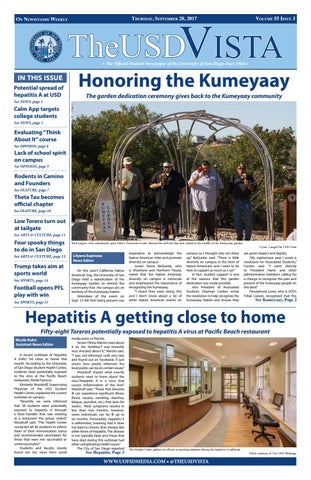
Bird singers, who customarily open Native American events, blessed the artwork that now stands in the middle of the Kumeyaay garden.
Lilyana Espinoza News Editor On this year’s California Native American Day, the University of San Diego held a rededication of the Kumeyaay Garden to remind the community that the campus sits on territory of the Kumeyaay Nation. Attendees of the event on Sept. 22 felt that being present was
imperative to acknowledge the Native American tribe and promote diversity on campus. Junior Sierra BeQuette, who is Shoshone and Northern Paiute, noted that the Native American diversity on campus is miniscule and emphasized the importance of recognizing the Kumeyaay. “I heard they were doing this and I don’t know about a lot of other Native American events on
campus so I thought why not show up,” BeQuette said. “There is little diversity on campus in the form of Native Americans and I want to be here to support as much as I can.” In fact, student support is one of the reasons that this garden dedication was made possible. Vice President of Associated Students Shannan Conlon wrote the resolution to help recognize the Kumeyaay Nation and ensure they
Cyrus Lange/The USD Vista
are given respect and dignity. “My sophomore year I wrote a resolution for Associated Students,” Conlon said. “I went directly to President Harris and other administrative members calling for a change to recognize the past and present of the Kumeyaay people on this land.” Persephone Lewis, who is USD’s Tribal Liaison, recognized that this
See Kumeyaay, Page 2
Hepatitis A getting close to home Fifty-eight Toreros potentially exposed to hepatitis A virus at Pacific Beach restaurant Nicole Kuhn Assistant News Editor A recent outbreak of hepatitis A (HAV) hit close to home this month. According to the University of San Diego Student Health Center, students were potentially exposed to the virus at the Pacific Beach restaurant, World Famous. Kimberly Woodruff, Supervising Physician of the USD Student Health Center, explained the current outbreak on campus. “Recently we were informed that 58 students were potentially exposed to hepatitis A through a food handler that was working at a restaurant the group visited,” Woodruff said. “The Health Center contacted all 58 students to inform them of their immunization status and recommended vaccination for those that were not vaccinated or undervaccinated.” Students and faculty mostly found out the news from social
media posts or friends. Senior Olnita Martini read about it on her timeline.“I was honestly very shocked about it,” Martini said. “I was not informed until very late and found out on Facebook. It just shows how poorly informed the local public can be on certain issues.” Woodruff shared what exactly students need to know about the virus.“Hepatitis A is a virus that causes inflammation of the liver,” Woodruff said. “Those that become ill can experience significant illness (fever, nausea, vomiting, diarrhea, fatigue, jaundice, etc.) that lasts for weeks. Most symptoms resolve in less than two months; however, some individuals can be ill up to six months. Fortunately, hepatitis A is self-limited, meaning that it does not lead to chronic liver disease like other forms of hepatitis. The disease is not typically fatal, and those that have died during this outbreak had other complicating health issues.” The City of San Diego reported
See Hepatitis, Page 3
The Health Center gathers its efforts in assisting students during the hepatitis A outbreak.
WWW.UOFSDMEDIA.COM ◆ @THEUSDVISTA
Photo courtesy of The USD Webpage
2
The USD Vista
◆
September 28, 2017
NEWS
Kumeyaay land restored at USD Native American knowledge and history shared with members of USD community
Kumeyaay Garden’s new sign stands at the heart of the garden.
Cyrus Lange/The USD Vista
USD community members, tribal members, and San Diego residents watched the bird singers bless the garden. Cyrus Lange/The USD Vista
Kumeyaay from Page 1 project was much more than the renaming of a garden. “Being an indigenous person, I saw this as much more than a garden with indigenous plants or more than just a sign,” Lewis said. “I saw this as a decolonizing project. I saw this as a way to reclaim Kumeyaay space.” USD alumnus Mark Montygierd was able to give a brief history of the origin of the garden starting back in 1999. A group of students formed the Environmental Action Group and wanted to display the native plants to the USD community. The group was able to plant “seeds of peace” which became a way to pay respect to those who lost their lives during 9/11. The garden was then named the Tecolote Memorial Garden for that reason. The garden has changed to honor the Kumeyaay people who used the plants in the garden as a means of survival. Professor Michael Mayer was one of the faculty members involved in planting and preparing
the garden. Mayer also helped with the planting of the original garden 16 years ago. He explained why the committee in charge of this garden wanted to change the name. “We thought that, ‘Wouldn’t this be a great way to honor the indigenous people of the area by
information.” The artwork that now resides in the Kumeyaay Garden was designed by Johnny “Bear” Contreras, a native of San Diego and a Native American artist. Bird singers, who usually sing at southwestern Native American ceremonies, chanted stories in
“Being an indigenous person I saw this as much more than a garden with indigenous plants or more than just a sign. I saw this as a decolonizing project. I saw this as a way to reclaim Kumeyaay space.” - Persephone Lewis actually rededicating this garden in their name?’” Mayer said. Mayer noted that he and the committee wanted to share the importance of the Kumeyaay history with the community. “There was a thriving civilization for thousands of years prior to European colonization,” Mayer said. “Also, the knowledge developed by the native Kumeyaay people is very useful. There is a lot of useful knowledge that we would like to disperse again and honor those people who developed that
The USD Vista Tayler Reviere Verninas - Editor in Chief Elisabeth Smith - Associate Editor Kelly Kennedy - Managing Editor James Douglas - Copy Editor Kaia Hubbard - Assistant Copy Editor Rita Srekais - Art Director Max Escutia - Assistant Art Director Lilyana Espinoza - News Editor
Artist Johnny “Bear” Contreras explained his artwork to the USD and Native American community. Cyrus Lange/The USD Vista
the Kumeyaay language to bless the garden. Vice Chairman of the Campo Kumeyaay Nation, Paul Cuero Jr., led the bird singers in their performance. The structure that Contreras made came from a process to make something that resembles a Native American traditional home. Contreras made the sculpture an open structure in order to depict the constellations that are significant to the Kumeyaay culture. Legislator-Ipaay Nation of Santa Ysabel, Stan Rodriguez, recognized
the artwork done by Contreras and explained how it is the greatest way to give back to the Creator. “When you make artwork, when you sing a song, when you dance, when you do all these things, that is the Creator coming out in you,” Rodriguez said. “That is the greatest gift that you can give back, is honoring the Creator and reaching your fullest potential.” At the end of his speech while under the artwork built by Contreras, Rodriguez challenged everyone in the audience. “Each and every one of you, I challenge you to come here and if you are troubled, to look up at this and to remember there are teachings all around us if you are willing to listen, to look, and to learn,” Rodriguez said. At the end of the event, attendees were able to immerse themselves in Kumeyaay culture through various activities led by the the local Native American people. Attendees played Kumeyaay games that incorporated the Kumeyaay language, drank smoothies made with completely indigenous plant ingredients,
Editorial – 619.260.4584 Business – 619.260.4714 www.uofsdmedia.com ◆ @TheUSDVista
Nicole Kuhn - Assistant News Editor Taryn Beaufort - Opinion Editor Victoria Zielinski- Assistant Opinion Editor Celina Tebor - Feature Editor Anderson Haigler - Arts & Culture Editor Noah Hilton - Sports Editor Walker Chuppe - Photography Editor Cyrus Lange - Photo Assistant
Ana Contreras Orozco - Photo Assistant Alex Worden - Distribution Editor Bailey Marie Donnelly - Finance Director Jacquelyn VanDenburg - Advertising Director Gina Lew - Student Media Advisor Marie Minnick - Operations Advisor
participated in garden tours, and made pine needle baskets and necklaces. These activities allowed the community to see Kumeyaay culture, learn some of the language of the Kumeyaay, and appreciation the people who previously occupied this land previously. Mayer stated he is excited that there is more diversity in people interested in the garden because of all it has to offer. “I am excited that there is a range of people now interested in the garden for all the different reasons already mentioned,” Mayer said. “It is a wonderful place to be. You can learn about native culture, learn about native plants, you can relax, you can have a meeting, and it’s just a great place. Sometimes people have walked through the garden for years and didn’t know the significance of this garden and I’m happy we have more signage, a website, and pamphlets with a lot of information people can use now.” The event was meant to be more than the renaming of the garden — it was also a way to give back to the Kumeyaay Nation.
The USD Vista publication is written and edited by USD students and funded by revenues generated by advertising and a student fee. Advertising material published is for information purposes only and is not to be construed as an expressed or implied endorsement or verification of such commercial venues by the staff or University. The USD Vista office is located on the fourth floor of the Student Life Pavilion in room 403B. All inquiries should be sent to: The USD Vista 5998 Alcala Park San Diego, CA 92110 The first copies of the newspaper are complimentary, all copies thereafter are a 25 cents charge. Opinions expressed in this publication are not necessarily those of The USD Vista staff, the University of San Diego or of its student body. Letters to the Editor can be submitted to The USD Vista office. Letters should be limited to 300 words and must be signed. For identification purposes, USD identification numbers and writer’s year must be included in the letter. The USD Vista reserves the right to edit published letters. Any content sent to the editor will be considered for publication unless otherwise stated.
Volume 55 Issue 3
◆
NEWS
◆
3
The USD Vista
App designed for student health Increased concerns for college students’ mental health results in new, convenient ways of meditation Lilyana Espinoza News Editor Many college students lose sleep as a result of high stress levels, but pulling an all-nighter is not something to cheer about. Symptoms of stress are natural and perhaps expected from a college student. The difference between students, however, is the way they handle their stress. Some students are capable of coping with mild to moderate stress without negative effects on their levels of effectiveness and productivity in their daily lives. Others, who contain high levels of stress, seek out ways to balance the life of a busy college student. A 2016 study published in the Biological Psychiatry Journal has shown that mindful meditation has positive effects on individuals. Director of the Counseling Center Dr. Steve Sprinkle said meditation is an excellent way to cope with stress. “I find that a 10 or 15 minute meditation can really calm the mind and provide relief,” Sprinkle said. According to the National Alliance on Mental Illness, a mental illness condition will affect one out of every five young adults. Mental illness in young people has been a growing issue and can lead to lifealtering effects such as depression and suicide. On USD’s campus there are many available resources for students to take advantage of when stress is negatively affecting their productivity. Stress and Anxiety Workshops are available and geared toward managing stress. They are held at the Wellness Center on Tuesday and Thursday and open only to USD students. There are free relaxation exercises on the Counseling Center webpage that students can download for free. The Student Wellness Center provides about six mindfulness exercises that have the potential to reduce stress and help with anxiety and depression. Calm.com, Inc., a company that created an app with the main focus
to make the world happier and healthier through mediation, has also realized the growing concern of mental health in college students and recently launched, their project Calm College. This fall, Calm College has exclusive partnerships with several colleges in which the students, faculty, and staff have access to the app and its features for free. Although USD is not partnered with Calm College, Sprinkle looked at the Calm application and pointed out how he thinks the app is a positive component to a college student with the exception of its cost. “It looks great, but you have to pay for it,” Sprinkle said. “If you have the money and want to do it this is a really slick, nicely designed app which I would recommend to anybody.” The cost is still a factor for students who do not attend a partnered Calm Campus, although the price has been discounted for all college students. College student pricing comes out to $3.74 per month. Sprinkle discussed what it could mean for USD if it wanted to be a Calm College campus. “What we would want to know, as far as student wellness, is how much does it cost and do we want to spend the money on signing up with this and offering this service, but that may take away from counseling hours or some other service being provided to students,” Sprinkle said. “We offer a lot of what they do free but we don’t have something set up where you can get a daily reminder.” The app tracks progress, which Sprinkle finds is a benefit to mental health and by tracking progress the Calm app improves on the resources that USD offers. Junior Molly McGarvey finds that an app such as this one has the potential to be a better for the average college student as a result of the accessibility. “I think because the app is on your phone and more easily accessible than going to the Wellness Center, it would be worth trying to change some of the
The Student Wellness Center, located in Serra Hall, is open to students who wish to find new ways to stay healthy at school. Cyrus Lange/The USD Vista
Wellness Center’s offered resources in order to provide something that I am more likely to use on a day-today basis,” McGarvey said. A busy college student may not be willing to pay the money otherwise. Junior Olivia Greenwood thinks that paying for something that is supposed to help with stress would be even more stressful. However, having the service provided might persuade her to use it. “If it was free I would try and if I found it beneficial I would try to incorporate it more,” Greenwood said. According to the Head of Calm College project, Nate Macanian, although Calm.com is no longer accepting applications this year for the app to be a free resource on more college campuses, they are aiming to build more long-term partnerships with colleges across the world. This partnership also includes a new College Collection, which is specifically made for a college lifestyle. Macanian explained the purpose of the College Collection. “The College Collection was our attempt to really pinpoint the
college student specifically and use languages and examples that really resonate with them,” said Macanian. Macanian also explained how the Calm app helps eliminate the three factors that prohibit students from seeking help for their mental health — cost, time, and stigma. “Calm Campuses provide Calm as a free resource so students don’t have to worry about the financial burden,” Macanian said. “Students don’t have to go in and schedule a meeting with an advisor or counselor and potentially wait weeks for an appointment like you do at many schools. You are accessing the app literally at any time at any place from the comfort of your own pocket. And finally, the stigma, which is a huge element of mental health: by using Calm, you are working with your stress in a way that does not require you to reach out and speak to anybody else.” Macanian further explained that he does not think people should refrain from seeking help if needed. However, having the app allows another option of help for individuals who want help but are too afraid to inform people of the state of their mental health. The app requires the effort of
the user in order to see progress. The meditation sessions range from two to 20 minute sessions, which does take time out of an individual’s day. Greenwood was unsure if she would have the time to use the app. “I feel that it would be beneficial if you put the time in but the time I have is extremely limited.” Macanian said that small increments of meditation every day will make an individual more productive and better at time management. “Ten minutes of meditating is an investment for the 23 hours and 50 minutes of the rest of your day,” Macanian said. Mental health of youth is an issue that is concerning as the numbers of students suffering from stress and anxiety continue to increase. There are different options if someone is looking for ways to handle the stress and anxiety that may come with a college life. The Student Wellness Center provides resources to students now and the Calm app is one option available to students. If desired by the USD community, USD may one day become an exclusive Calm College partner.
Hepatitis A exposure
Hepatitis A exposure increases in San Diego and draws closer to campus Hepatitis from Page 1 on its website that, “The majority of people who have contracted hepatitis A are homeless and/or illicit drug users, although some cases have been neither.” According to city officials, there have been a total of 444 cases, 16 deaths, and 305 hospitalizations since Sept. 19. When senior Michaela Conley found out about the outbreak, she took the time to research the virus. “When I learned about the outbreak, it was scary but it’s also important to be educated and not panic,” Conley said. “Instead, it’s important to do research and try to handle the situation as best as you can.” Conley also considered how the virus has impacted the community. “Right now, I think it’s most important to aid the homeless population of San Diego, since they are most affected by the outbreak,” Conley said. “Vaccinations and proper health care should be made
available to them in order to prevent a more widespread outbreak.” The first initial outbreak known to the San Diego County Public Health Department (SDCPHD) started in downtown San Diego. Within a few days the virus spread to Pacific Beach. A local restaurant, World Famous, was closed down on Sept. 19 due to possible exposure to the
“World Famous shut its doors last Tuesday after being notified of possible exposure,’ the article said. Berkley said county health inspections found no evidence of hepatitis contamination, but the restaurant, in an abundance of caution, hired a private hazardous materials company to perform a deep cleaning.” The City of San Diego has also
“When I learned about the outbreak, it was scary but it’s also important to be educated and not panic.” - Michaela Conley virus from an employee. According to a statement released to the San Diego Union-Tribune from the restaurant’s general manager, Erik Berkley, it is not verified if the employee has hepatitis A. But Berkley confirmed that the employee was possibly exposed to the virus from his or her spouse. The Union-Tribune stated that the restaurant is doing everything in its efforts to protect its employees and customers.
taken action by bleaching the streets of the city, administering and advising citizens to get HAV vaccinations, and issuing weekly updates of cases and information concerning HAV. For students, the Student Health Center serves as a beneficial resource for vaccines, information, and concerns regarding the virus. Woodruff wants students to be informed, stay up-to-date on shots, and, most importantly, stay
updated and know that the virus is preventable. “Hepatitis A vaccine is given in two doses and provides great protection,” Woodruff said. “Check your immunization records to see if you had the two doses. If you have not received the vaccine or only received one dose, you can get the vaccine at the Health Center (cost $40) or you can obtain the vaccine from your doctor’s office, most pharmacies, or minute clinics. The county public health department is offering free vaccines for at-risk populations. To check your eligibility you can call 211 or visit www.211.org. In addition to vaccination, good handwashing practices can reduce your risk of being infected.” Woodruff, along with the Student Health Center and the SDCPHD, plans to continue to work to help students during the outbreak. Woodruff encouraged students to wash their hands frequently and get vaccinated if they have not already done so.
CORRECTION: In last week’s issue, the name of the art exhibit in Founders Hall was misspelled. It should read Xerografia, not Xerographia. The USD Vista regrets the error.
4
The USD Vista
◆
September 28, 2017
OP I N ION
Thinking about ‘Think About It’ Looking at the effectiveness of Title IX training through students’ perspectives
The ‘Think About It’ homepage displayed on a student’s laptop before they begin their required online training. Students are prompted to answer a series of personal questions before the formal training begins. Ana Contreras Orozco/ The USD Vista
Victoria Zielinski Asst. Opinion Editor As the semester comes into full swing, students’ inboxes are flooded with hundreds of emails with club information, newsletters, university announcements, and even a few reminders to complete their yearly Think About It online training. Think About It is a required online educational training course administered to students through the University of San Diego’s Title IX Office. In association with the Federal Campus Sexual Violence Elimination SaVE Act, the program aims to help create a safe environment for students. Hannah Healey, a senior and the Transfer Scholastic Team chair, stated that the online training is not effective in educating students. “I think the training is redundant and too lengthy for students to pay attention,” Healey said. “Many of the scenarios are very long and time-consuming, which causes students to zone out or not pay attention and just click through the slides.” The course examines issues of sexual relationships, sexual violence, and healthy interactions. While some students may want to be more informed about Title IX, the required online Think About It training seems to be ineffective in doing so. Students can just click through slides while watching TV or cooking dinner, but the amount of information they are actually retaining seems to be up for debate. The program takes about 45 minutes to complete and draws on interactive scenarios that students are able to pause and come back to at any time. This year’s program must be completed by Oct. 1, or students will be charged a $250 non-compliance fee. Although Title IX is mentioned via email to students, its significance is not clearly
communicated. According to the overview of Title IX on USD’s website, federal law prohibits discrimination based on sex in educational programs and activities that receive federal financial assistance. Healey noted the possible types of situations where sexual discrimination might be likely to occur on campus. “I think there are always situations where sexual assault is likely to occur,” Healey said. “It can occur at parties, just as it could occur for a woman walking to her car late at night. Although sexual discrimination seems to be less likely to occur here at USD, I think it happens more indirectly than directly. But I do believe there are situations where students can potentially find themselves in sexual discrimination or assault problems.” Within the Think About It training, students follow a series of interactive scenarios and then answer questions based on what
confused or concerned as to why this online training must be completed annually. In a letter to the campus community, President James T. Harris stated that “as a Catholic university, the University of San Diego is committed to creating an inclusive and collaborative community that protects the rights and dignity of all individuals.” This includes respecting one’s own self and others in efforts to prevent sexual violence. Helen Kaiser Smith, J.D., the Deputy Title IX and Equal Employment Opportunity Coordinator, is responsible for monitoring compliance with Title IX and related laws to prevent sexual harassment and discrimination, as well as administering the Think About It online training to students and staff. “The goals of Title IX are equity and ensuring that students impacted by discrimination are able to continue in their
“We all have a responsibility to prevent and respond to sexual violence in our community. No one is immune from sexual assault .” -Helen Kaiser Smith they watched or listened to. Students weighed in on whether the Think About It training helped them to better understand Title IX concepts. Healey suggested that changing up the training would make students want to participate in learning about Title IX. “By shortening the online training, or requiring students to sit in on an interactive course once a year, I think students will better grasp the concepts and actually learn the material,” Healey said. Public Safety reports that on the USD Main Campus from October 2016, there have been five total forcible sex offenses, and zero total non-forcible sex offenses. Students may have been
educational experiences,” Smith said. “When a student is impacted by sexual violence or other forms of sex discrimination, a university has a responsibility to respond to the discrimination, end its occurrence, and remediate its effects.” Smith indicated that over the years, Title IX has expanded to include sexual harassment and sexual assault as forms of sexbased discrimination. Title IX also protects pregnant and parenting students, transgender, and gender-nonconforming students from discrimination. As far as the effectiveness of “Think About It” goes, Smith believes that the required online training is useful for informing students on Title IX and increasing
their awareness of related topics. “The online training is one tool that is helping to increase awareness,” Smith said. “Over the years, the number of reported cases has increased. We attribute this to an increased level of awareness about Title IX and university resources available to impacted students. We also offer many in-person workshops, trainings and events that add to the conversation around these important topics.” However, sophomore Avery Repsher said that there is room for improvement for the Think About It training in order to be more effective. “The online training is more repetitious than it is effective; most people try to pass through the training as fast as possible,” Repsher said. “I do not think that it is a good place for students to learn as it is fairly easy to multitask while completing it. I think that they need to refocus their material as most of it is focused on the most extreme cases, and not everyday cases.” To improve effectiveness, Repsher suggests a more interactive approach would deepen students’ understanding. “I would suggest that we should be required to take a class or go to a seminar about this,” Repsher said. “You are more likely to learn in a class setting rather than being able to complete it on the computer. If you are to continue with the online training, I feel like it would be more effective if they were more than once a year. At this rate, it just is not that effective.” Although the online training may seem effective to the coordinators of the program, students are not satisfied with the way in which the Title IX information is facilitated to them in online training. The Title IX Office also offers many resources that students might not be aware of. Smith explained that the Title IX office at USD offers help to
students, including working with individuals to provide academic, housing, or employment accommodations. The office also provides referrals to on- and offcampus resources, such as the Counseling Center at USD and the Center for Community Solutions off campus. Public Safety also has connections with the office, and they can facilitate on-campus escorts and personal protection devices. “We provide information to students about USD’s internal investigation process and conduct proceedings if they would like to pursue an internal investigation,” Smith said. “I believe that many students are aware of these resources and there is always opportunity to increase awareness on campus.” Because of the multitude of resources that the Title IX Office provides to students, Smith believes that it is appropriate for the training to be mandatory for all students, not just for those involved in certain activities such as Greek life or athletics. “We all have a responsibility to prevent and respond to sexual violence in our community,” Smith said. “While certain groups on campus may be more at risk, no one is immune from sexual violence and we all should be equipped with information to help our peers and community through prevention efforts, such as bystander intervention. Additionally, we should all be aware of how to assist students who are impacted by sexual and relationship violence.” A more interactive course in a classroom setting could perhaps be an effective alternative to the online program. Some relatable and common examples could be placed into the online scenarios to garner students’ interest. Students are looking for a change in the way Title IX information is presented to them, and clicking through slides may not suffice in the years to come.
Have an opinion? Write a Letter to the Editor to be considered for publication in The USD Vista. Contact vistaeditor@sandiego.edu for more information. The views expressed in the Opinion section are not necessarily those of The USD Vista staff, the University of San Diego, or its student body.
Volume 55 Issue 3
◆
OPINION
◆
The USD Vista
Spirit shines in unforseen ways
5
USD struggles to encourage increased participation for school spirit
Taryn Beaufort Opinion Editor At the University of San Diego some students may think they have it all. Between the impressive academics, beautiful campus, and sunny weather, there might still be something missing — school spirit. Traditionally a large part of school spirit comes from supporting athletic teams, something in which USD is heavily lagging. Junior Celesta Loo initially hoped that USD would provide the same level of school spirit as the other universities that her friends attend. “I have been to a couple football games and the amount of students who have showed up was pretty depressing,” Loo said. “I think there were more parents and alumni at the football game than current USD students.” Despite USD’s efforts, the university has trouble encouraging students to attend sporting events. The school hosts tailgates before the football team’s home games, but the lack of awareness leads to a mediocre student turnout. Senior Amanda Zimmerman noted the absence of advertisements for such events on campus. “The week before a game they should have posters or hand out flyers informing students of these
types of events,” Zimmerman said. “It might be a different story if students were more aware of the opportunities the university hosts for us.” However, Loo noted school spirit does not necessarily have to be defined by the amount of students that attend sporting events. “I think we do have a lot of spirit in the sense that during Alcala Bazaar there are many students signing up for clubs and very eager to get involved,” Loo said. “I was able to get involved in other clubs on campus which made me feel proud to be a Torero, even though I wasn’t decked out in blue at every sporting event.” A transfer from University of Alabama, Zimmerman took a different outlook on what school spirit should look like. “When I attended Alabama, students were always decked out in crimson red repping our school,” Zimmerman said. “The energy was so high at football games, too. The stands would be packed and it felt like every single student was in attendance.” Zimmerman’s transition from a high-energy school to USD was a little underwhelming. “Honestly, I don’t believe that there can be a comparison between USD and Alabama,” Zimmerman said. “Alabama is a Division I program with a large student body, which I think increases the attendance of their
The USD Torero store is the central hub for USD apparel and spirit gear.
games. Therefore, students are more involved in school spirit.” It may be unthinkable to imagine a time when stadiums were packed with students on a game day. However, that hasn’t stopped some from thinking of ways to make that a reality. Loo suggested several ways USD can increase attendance. “I think having competitions between grades would have a lot more school spirit,” Loo said. “When people go to sporting events, they can check in with their MySanDiego app and whichever grade level has the most attendance could get free t-shirts or something. Another thing USD could do is just encourage more cheering and see which side of
the bleachers could cheer louder. As the crowd starts to get more pumped up, the athletes on the field get more pumped as well.” Senior Rojin Vafaeian was initially upset by the lack of school spirit, but has been able to find other things to fill that void. “I got over the lack of school spirit very quickly and now I rarely ever think about it nor does it bother me,” Vafaeian said. “I think that’s due to the fact that there really is a lot more here that other schools lack.” Vafaeian instead chose to get involved with other activities that promote school unity. She became a member of a sorority and the President of Lambda Pi Eta, the Communication Studies honor
Walker Chuppe/ The USD Vista
society. “It’s not really the same as the whole student population rallying behind a sports team, but that’s how it is here,” Vafaeian said. “I am able to find a sense of school unity by being involved in campus-wide organizations with other students and that’s what we choose to rally behind.” Although USD would not win the award for the most spirited school, students seem to be okay with that. There are other outlets, such as joining an organization, that can fill that void. For now, current students will have to accept their unspirited school as it is. However, it is in the students’ hands to bring about the change that they are seeking.
Empower Others to Thrive Complete a Master’s Degree in Social Work or Marriage and Family Therapy Become a skilled, professional social worker or counselor with Azusa Pacific’s Master of Social Work (MSW) or M.A. in Clinical Psychology: Marriage and Family Therapy (MFT) programs and graduate equipped to empower others with tools to thrive.
MSW
MFT
Prepare to help others through professional counseling, community-based interventions, and nonprofit leadership. California prelicensure courses are available.
Help couples and families restore relationships through this program that meets current California licensure requirements.
Full-time, part-time, and Advanced Standing options I 60 units
Learn more: apu.edu/mft
2-4 year program options I 66-69 units
Learn more: apu.edu/msw
GET STARTED TODAY!
Call (626) 815-4570 or email gpadmissions@apu.edu.
Have an opinion? Write a Letter to the Editor to be considered for publication in The USD Vista. Contact vistaeditor@sandiego.edu for more information. The views expressed in the Opinion section are not necessarily those of The USD Vista staff, the University of San Diego, or its student body.
6
The USD Vista
◆
September 28, 2017
High costs are put to the test Cost of attendance is ranked at 371 among 700 universities nation wide
Abby Gentry Contributor The University of San Diego is often featured in media articles regarding its beautiful, pristine campus. However, this year USD received a nod in Money Magazine ranking USD as the 371st most affordable school. Considering the rarity that the words ‘USD’ and ‘affordable’ are used in the same sentence, it is important to understand what this conclusion really means. Money Magazine based these rankings on several categories including the quality of education, price tag, and the outcomes for graduates. These categories examine the exact amount a student pays for his or her degree, whether or not the school awards grants and scholarships, how many it awards, how long it takes for students to graduate, and finally, the average earnings of a recent graduate.
the long run and help me after I graduate. I feel confident and comfortable communicating with adults because USD has prepared me in a way that I might not have benefitted from at a larger school.” According to the University of San Diego website, the total annual cost to attend USD is approximately $62,000. This breaks down to $47,000 for tuition, $600 for fees, $2,000 for health insurance, $9,000 for campus housing, and $3,000 for a meal plan. The price tag for those receiving financial aid benefits varies from student to student but averages around $38,000. The final factor mentions early-career earnings for recent graduates. Several schools mentioned on the list scored relatively low because their alumni suffer in the job market. According to the Money Magazine, the average early-career earnings for USD students sit right around $52,000.
“I think I am paying for are the small class sizes and the relationships I have with my professors. That’s what will benefit me in the long run...” -Abigail Beck Senior Abigail Beck stated that although it’s a large sum to pay, the price tag is worth it. “What I really think I’m paying for are the small class sizes and the relationships I have with my professors,” Beck said. “I think that’s what will benefit me in
Sophomore Ellie Meck shared some of the benefits of USD’s expensive tuition. “I do think my time here is worth the amount because I think it’s worth having 15-30 people in each class and getting to know my professors,” Meck said. “It is
According to some, students are not just paying for their education, but also the experiences that come with attending USD. Photo Courtesy of 401(K) 2012/Flickr
better than just being a blip on the screen to the professors.” However, Meck also believes USD could put spend a little more to upgrade on-campus housing. “For the amount we are playing, they should renovate the dorm rooms, and apartments,” Meck said. “The furniture is old, the carpets are disgusting, the showers have zero water pressure, and we do not have air conditioning. I also think we are lacking scholarship opportunities for people of financial need.” Factors such as class size, professor relationships, Career Services, and others were not included in the Money Magazine article. With this in mind, it may be important to consider the benefits of an expensive education from a liberal arts school that stretches beyond the financial rewards. Senior Andrew Stieb argued
that students are not necessarily paying for their education or potential career benefits that come with a USD degree, rather they are paying for the experience. “There’s a certain type of person that really thrives here and for him or her I’d say it [the cost] is probably worth it,” said Stieb. “If you’re here for a fun experience, solid education, and friends, I’d say you’re in the right place, but if you’re looking for a place to really create then you might have better luck at a big-city school. The kids that do well here are the ones that are basically just enjoying themselves.” Neighboring schools such as San Diego State University (SDSU) and University of California San Diego (UCSD) scored noticeably higher on the list. UCSD was ranked number 89 and SDSU was listed at 135.
Senior Nicole Potter believes that her business degree is worth the cost, but is unsure if all majors across the board receive the same benefits. “I feel really lucky with my major because they offer a lot of assistance to help us with our future that I would otherwise have to pay for, such as career fairs, resume reviews, and bringing in firms for introductions,” Potter said. “However, I am not sure what it is like for everyone else and whether they get the same kind of opportunities to network for after graduation.” Although ranking number 371 on the most affordable colleges list is not a great achievement for USD, it does raise the question whether the strong community, relationships with professors, and positive experience are enough to outweigh the hefty price tag.
Rita Sriekas/The USD Vista Have an opinion? Write a Letter to the Editor to be considered for publication in The USD Vista. Contact vistaeditor@sandiego.edu for more information. The views expressed in the Opinion section are not necessarily those of The USD Vista staff, the University of San Diego, or its student body.
Volume 55 Issue 3
◆
FEATURE
◆
7
The USD Vista
F E AT U R E
Rats found in first-year dorms First-years are not the only new residents of Camino and Founders Halls
There have been multiple rodent sightings in Camino and Founders since move-in day. According to Facilities Management, there have been seven total sightings of rodents in the dorms. Walker Chuppe/The USD Vista Walker Chuppe/The USD Vista
Celina Tebor Feature Editor Camino and Founders Hall are some of the oldest buildings on campus, and while their age gives them character and history, some aspects of these first-year dorms aren’t so pleasing. Old furniture and creaky doors are sometimes unpleasant, but the recent sightings of rats around the dorms have brought more than a few groans of irritation. According to Facilities Management, there have been multiple sightings of rodents in Camino and Founders within the past couple of weeks. However, the first rat sighting was long before
something in the corner of the room,” Smith said. “I got up to look, and something bolted off of my food shelf. I picked up the bag and it was completely chewed through.” Smith immediately told a Founders RA about the situation, who then contacted Facilities Management. She and her roommate were advised to not sleep in their room that night, and they had to resort to either sleeping on the floor of their friend’s room or in an empty bed in an open triple in their building. Alysse Hogan, Community Director for Camino and Founders, is actively trying to work out where students can stay if they
“[Sleeping on the floor] is also a little inconvenient when you have an athlete, which is my roommate, who has to get up at five in the morning every day,” Smith said. “And myself, I had a surgery two months ago, and I’m still recovering from that, so it wasn’t too comfortable to be sleeping on the ground.” -Sabrina Smith classes even started, as stated by Founders RA Jayden Yeoman. “We first encountered the rat problem during our RA Training before Olé Weekend,” Yeoman said. We saw a rat in Camino Lounge, and we called facilities and asked them to handle the situation.” Bob Brauer, Director of Building and Grounds Operation, has received reports of sightings from Founders residents since move-in day. The first rodent report in Founders this year was on Aug. 28. According to Brauer, six rooms have reported rodents in Founders during the fall semester. Camino had one actual sighting. “There’s also a terrible smell that we have to chase down, that could be a dead rodent,” Brauer said. Brauer believes that the recent construction of Paseo de Colachis has created a lot of rodent activity. “There’s mice everywhere in the world, but with Colachis work, a lot of their habitat got affected and they probably got displaced in areas,” Brauer said. For some first-years including Sabrina Smith, the sightings caused more than just slight discomfort. Along with other Camino and Founders residents, Smith discovered a new roommate in her dorm room. And unlike her current roommate, this one was small, furry, and unwelcome. “I was sitting doing homework, minding my own business, I heard
have rodents in their rooms. “For residents who feel like they want to stay in another place, I will work that out with them to figure out those options,” Hogan said. Smith, along with her roommate, ultimately ended up sleeping on the floor of her friend’s room, because she stated it would be more uncomfortable to go to a room where she didn’t know anyone. “[Sleeping on the floor] is also a little inconvenient when you have an athlete, which is my roommate, who has to get up at five in the morning every day,” Smith said. “And myself, I had a surgery two months ago, and I’m still recovering from that, so it wasn’t too comfortable to be sleeping on the ground.” While the rodent problem certainly forced some residents into an uncomfortable and inconvenient position, others attempted to bring a laugh to the situation. One room placed a whiteboard outside their room, asking, “Should we get a hall cat to solve the rat issue?” Nearly all residents of the floor placed a tally mark under ‘yes.’ Other first-years in Camino and Founders have simply tried to brush off the situation. Yeoman’s immediate reaction was surprise when she spotted a rat, but she doesn’t necessarily think that rodents at USD are entirely unexpected. “We live right
next to the Tecolote Canyon so I think seeing a rat is somewhat expected with the close proximity,” Yeoman said. Hogan sent out a mass email to the dorm’s residents on Sept. 18, containing information on what USD is doing to solve the problem, what residents can do to be proactive, and what they should do if they see a rodent. Hogan had a meeting with Facilities Management on Sept. 26, to discuss future actions concerning the situation. “We’re going to lay down some actions,” Hogan said. “We’re setting up traps in all of the rooms in Founders, someone in facilities up through the 29 will be checking all of the rooms and the traps.” Hogan sent out an email Sept. 26 informing all Founders residents that Facilities would be entering their room to place traps and checking them every day. “Door sweeps have been ordered to go under the exterior doors to close the gaps underneath the doors,” Hogan said. “If there are holes in any of the rooms, we are asking that residents submit a work order to get those patched up, so there is no enter point into the rooms.” The Facilities Management has been working to solve the issue as quickly as possible. “We’ve put out glue traps at any sighting of rodents,” Brauer said. “We’ve put out bait traps, and Terminex is out two or three times weekly monitoring those traps. Additionally, our in-house crew is monitoring and working traps.” Smith’s experience with university services and Facilities all occurred before the mass email was sent out, but she still hopes the school will be more proactive about setting traps and controlling the rodent problem. Smith believed the university did not quite live up to their promises to fix the rodent problem in her room. “As soon as [Facilites] could, they sent someone over with traps, and he looked around to see if there were any signs of stuff, but it wasn’t a very good look, per se,” Smith said. “He put down two traps and that was it. Nothing ever got caught.” During a search of Smith’s room, university representatives failed to find the location where the rat could have entered the room. However, Smith’s friends easily found a hole in the wall two days later when scanning her room. “When we found [the hole], we
reported it to our RA again,” Smith said. “Our RA put in three different requests to get it fixed in a timely manner. They did repair the hole.” According to Brauer, repairing holes is essential to stopping rodents from entering dorm rooms. “The trouble with gaps is that mice can get through tiny gaps,” Brauer said. “They can basically disjoint all their joints, and get through almost anywhere. They can probably get through a hole a size of a nickel.” Smith believed her RA was the most helpful to her and her roommate. Her RA, Emmalea McNay, filled the hole with steel wool which rats cannot chew
we didn’t see any other signs of the rats but none of them got caught,” Smith said. While no rats in Smith’s room were caught, Brauer stated around five rodents have been caught. The university is taking steps to control and further prohibit rodent infestation. Along with working with Terminex, the school is removing any rodents it sees and trimming trees surrounding Camino and Founders, a recommendation by the pest control company. Yeoman also recommended that first-years in Camino and Founders take precautions to avoid rats in dorm rooms: “I suggest that [residents]
through. Even though Facilities fixed the hole, the steel wool prevented more rodents from entering the room before it was sealed off. The email Hogan sent out additionally noted that USD works with an outside company, Terminex, for proactive pest control through the year. In this case, Terminex will continue to assist USD in rodent reduction in the interior of both Camino’s and Founders’ halls. Smith was told that Terminex would come the following Monday after the initial sighting to manage the situation, but they didn’t show up. She was then told that they could come on Wednesday, but again, a Terminex representative failed to show up. “We kind of just gave up, since
put all of [their] food in closed plastic containers, and I would keep any food [they] have off the floor,” Yeoman said. Facilities Management is attempting to handle the situation quickly, but acknowledges that it is not an emergency. “While it’s a definite nuisance, it’s definitely not what I could classify as an immediate health issue at this state,” Brauer said. “It would have to be a massive infestation to be a huge health issue.” As university officials continue to solve the issue of unwanted rodents, students including Smith continue to be inconvenienced. The university plans on removing the rodents soon, so Camino and Founders residents can go about their living space without worrying about a new rat.
“While it’s a definite nuisance, it’s definitely not what I could classify as an immediate health issue at this state.” -Bob Brauer
What USD students can do to prevent rodents in their room: 1. Don’t prop any exterior doors. 2. Immediately report any rodent sighting to Residential Life staff and submit a detailed work request when and where the rodent was last seen, so USD has the best information to manage these concerns. 3. Do not leave any unopened food around, and keep food secured in plastic containers. 4. Submit a work request for any holes in screens or walls, or work with an RA to get this completed.
8
THE USD VISTA
◆
Volume 55 Issue 3
SEPTEMBER 28, 2017
AS Residential Senators 2017-2018 The campaign for Associated Students’ Residential Student Senate spots kicked off on Sept. 14. Students ran for a chance to represent their residential hall in USD’s student government. The campaign lasted for five days, and the USD students living on campus voted to elect the senators on Sept. 19.
◆
FEATURE
◆
9
THE USD VISTA
Beth Wade: SAPS/San Buen On why she wanted to run for Senator: “On the cross country team, a lot of people have been involved with AS, and hearing them talk about it at practices was really inspiring.” On how she wants to improve SAPS/San Buen: “I’d love to see water filters in San Buen and SAPS, it’s something we should invest in as a sustainability campus and as a health issue as well.”
Eight residential halls: -Maher -Missions A -Missions B -Camino/Founders -UTAs -Vistas (two Senate members) -SAPS/San Buen -Manchester
On how she wants to improve USD: “Create more study rooms, and get staff and students to tutor in specific rooms to help students.”
Charlie Young: Missions A
Rowan Parmenter: Maher
On why he ran for Senator: “I feel very confident speaking in public, and I don’t think a lot of other people feel as comfortable sharing their opinions, and I think I can voice what they want to say.”
On how he thinks USD could improve: “I am on the football team, and one thing I’ve observed is that attendance at events, athletic or non-athletic, could be increased. When an event is full and there’s that crazy atmosphere, everyone has fun.”
On his main goal as a Senator: “Increasing sustainability on campus. We’re already starting a project to make it more clear which bins are trash and recycling with plaques or signs.”
On how he plans to reach Maher residents: “The biggest thing for me is face-toface communication, talking to people, and hearing what they’re thinking. I want to make new friends, because why not?”
On how he plans to make change campus-wide: “It’s just a small project that we’re working on, but small projects come together to influence in the end. We can start with sustainability in one aspect, and move it to another.”
On how he’s qualified to be a Senator: “I was the junior class president in high school, and ASB president the next year.”
Keviān Brown: Camino/Founders
Shanti Stender: Vistas
On how he plans to reach out to constituents: “I’m more of a face-to-face guy. I’m going to talk to people I know whenever I see them.”
On how she can make students’ lives easier: “The mail center needs some help. The system could use some updating, since it affects pretty much everyone’s life.”
On what he thinks USD can fix: “The attendance at events aren’t as large as they should be. We want to have athletes personally talk to people to get them more involved.”
On how she wants to improve student involvement: “Students think there’s not a lot to do on campus, but I want to try and show them TPB events and get the word out about them.”
On how he sees USD at the end of the semester: “A whole new campus. Everything for the students, everything to enhance the students.”
On why she wanted to run for Senate: “I have some ideas and would like to see them put into effect to make this school a better place.”
Reijer den Dulk: Missions B
Brooke Landaiche: Vistas
On how he’s qualified to be a senator: “I had leadership experience in high school, I was in ASB as the Communication Director and was a communication intern for the school district.”
On how she plans to improve the Vistas: “I plan to address inefficiencies in our sprinkler system so the Vistas aren’t wasting water and students do not need to walk through wet sidewalks.”
On how USD can improve school spirit: “The student section can improve, and we can do that with more meaningful pictures at events, by getting cameras and a logo we can use more often on the photos.”
On how she won the election: “I have an amazing network of friends through the nine student organizations I am in, and relied on their support and word of mouth.”
On how he won the election: “I ran a personable election by interacting and engaging with people on a personal level.”
On why she wanted to run for Senate: “I wanted the chance to work directly for the campus in its student government rather than just in student organizations.”
Michael Lyons: UTAs
Shaun Kwon: Manchester
On why he wanted to run for Senate: “Through activities like N.R.O.T.C. and the White House Internship Program, I have developed a desire to serve.” On how he plans to talk to constituents: “I plan to talk with them during residential life events such as Torero Tuesday.” On what he hopes to see improve: “I hope to see organizations utilize the resources provided to them by AS to the best of their ability by the end of the year.”
The Senate deals with these committees and subcommittees: - Academics - Student Organizations -Student Life - Wellness - Sustainability - Inclusion & Diversity
On why he feels like he is the right person to represent Manchester: “This will be my second year living in Manchester and I also plan on living there next year so it just felt right to assume the role as the Senator for the residents there.” On what he feels like USD can improve on: “As a student, I feel there is a lack of school spirit on campus. Associated Students is working closely with the Torero Program Board to come up with initiatives to address this problem.” On what he hopes to change at USD: “[Manchester residents] have reached out to me with things they would like to see change such as bringing cups back to the SLP and fixing issues we have had with the new laundry machines.”
Responsibilities of Senators: - Represent constituents by communicating their wants and needs - Do two hours of weekly office hours - Attend weekly Senate and Committee Meetings (dead hours every Thursday in Solomon Hall) - Volunteer at and support TPB events
Spread by Rita Srekais; Content by Celina Tebor
10
The USD Vista
◆
September 28, 2017
Theta Tau officially joins campus After two years of establishing a presence on campus, Theta Tau joins as a professional fraternity Abby Gentry Contributor
In the fall of 2015, the University of San Diego’s business engineering fraternity, Theta Tau, was established as a colony. Two years later, on Sept. 23, the fraternity became an official chapter on USD’s campus. Since Theta Tau’s introduction to campus, its members have been striving to prove to the national
to host professional events and increase involvement within the USD community. The fraternity hosts events for its members to explore the world of professional engineering, allowing students to see what the profession is like outside of the classroom: last year Theta Tau took a trip to Stone Brewing Company to see what a brewing engineer does. The fraternity also contributes to campus philanthropy events.
“We want to see what we can do about connecting members to alumni who are in the working world.” - Chandler Rogers fraternity that they understand what it means to be an official chapter. In order to do this, they first had to gain a substantial number of members. At the beginning of the colonization process, Theta Tau had roughly 20 members, and is now an organization of about 60 students. Junior engineering major Lauren Kafka joined Theta Tau at the beginning of her sophomore year in 2016 and shares some of the other events and benefits. “As a fraternity, we have social, philanthropic, and career development events,” Kafka said. “Social events include bid day, biglittle reveal, bonfires, game nights, and banquet. Career development events include reviewing resumes, plant tours, guest speakers, and panels. One of our big service events is assisting a local middle school with a science fair.” An increase in the number of members created the opportunity
Theta Tau will have a booth at the annual Relay for Life event and also plans to contribute to the Torero Dance Marathon this year. Their involvement in campus events has and will continue to prove to the national fraternity that they are serious about positively represent -ing Theta Tau on campus. Within Theta Tau there are several different committees to keep the organization running smoothly. The academic committee ensures all members are academically eligible and abiding by the national fraternity rules. The finance committee budgets members’ dues for philanthropy events, professional events, and various other chapter functions. The service committee works with the fraternity’s philanthropic endeavors and involving Theta Tau in campus events. Finally, the brotherhood committee strives to strengthen the relationship between brothers
by hosting brotherhood events and other bonding experiences. The year 2017 had the first graduating class with members of USD’s chapter of Theta Tau. This fresh alumni base has led the alumni committee to connect students to postgraduate opportunities. Additionally, the fraternity hopes graduate brothers will return to Theta Tau meetings to speak with and encourage current, younger members. Chandler Rogers, senior and current President of Theta Tau, shared some of the professional benefits of joining the fraternity. “Since we just had our first alumni group we want to see what we can do about connecting members to alumni who are in the working world,” Rogers said. “I personally got an engineering internship through a previous brother so I know Theta Tau helps connect everyone.” Members of the fraternity must be either a math, computer science, or engineering major. While Theta Tau is recognized as a ‘fraternity’ and refers to members as ‘brothers,’ male and female students are welcome to join. Additionally, in order to become a member, students must be at least a second-semester first-year. “We want to make sure people are serious about engineering and serious about joining Theta Tau,” Rogers said. “You know first semester they might still be excited about an engineering major and then by second semester when classes get harder they might want to drop. We just
want to make sure our brothers are serious about being a member before they join.” Theta Tau cannot deny any members based on their GPA. However, it is important for members to maintain a strong GPA. Potential new members with lower grade point averages will still be initiated and then existing members in the academic
you can become more involved.” Kafka shared reasons why students join Theta Tau in order to enhance their college experience. “People should consider joining Theta Tau because of all it has to offer,” Kafka said. “The brotherhood, philanthropic, and professional aspects of Theta Tau are the reasons people should want to join.”
“People should consider joining Theta Tau because of all it has to offer. The brotherhood, philanthropic, and professional aspects of Theta Tau are the reasons people should want to join.” - Lauren Kafka committee will work with students to boost their GPAs. “Basically every brother is a resource,” Rogers said. “We want to elevate everyone so if you have a low GPA, we may restrict you from certain activities but as long as you show some kind of improvement,
The recruitment process is once a year in the beginning of the fall semester. Recruitment for the 2017-2018 school year has concluded. After recruitment, pledgeship is an eight-month-long process with weekly meetings every Sunday.
Members of Theta Tau pose with their letters at the chartering ceremony on Sept. 23. Photo courtesy of Lauren Kafka/Theta Tau
FALL 2017 SEMESTER
TRANSIT PASS Exclusive student discount. Unlimited rides all semester.
$148 USD Undergraduate • $162 USD Law On sale until October 6 at the University Center Ticket Office. Price includes a $15 University subsidy. Current, valid college student picture ID required. No replacements for lost, voided or stolen stickers.
sdmts.com/college
Volume 55 Issue 3
◆
ARTS & CULTURE
◆
The USD Vista
A RT S & C U LT U R E
11
Low Torero turnout at tailgate Seeb provided the music, but USD students failed to provide the crowds
Strand performed on behalf of Seeb at a tailgate concert hosted by Toreo Program Board prior to the USD football game on Saturday.
Anderson Haigler A & C Editor In an effort to boost school spirit, Torero Program Board (TPB) and the University of San Diego’s football team collaborated to put on a pregame concert last Saturday. The concert, hosted at Eagan Plaza in front of the Jenny Craig Pavilion, featured Nick Strand of Seeb, an electronic music trio hailing from Norway. Seeb’s set was lively and established the energy level appropriate for the ensuing football game against Butler University. Seeb performed original songs such as “Rich Love,” “Breathe,” and “What Do You Love,“ as well as his more well-known remixes of songs including “I Took A Pill In Ibiza,” and The Chainsmokers’ “Don’t Let Me Down.” Seeb’s music was well suited to the tailgate, but the interaction with the audience left something to be desired. Strand went onstage without any sort of introduction, leaving some audience members confused as to what was going on. In addition, he made no use of his microphone during his set, missing out on opportunities to energize the crowd between songs. At times, Seeb’s set seemed like less of a main event for the tailgate and more of background music, which did a disservice to Seeb and the quality of the music. While some of these issues fell on Seeb and the lack of engagement with the crowd, much of it was a symptom of a disappointing turnout of students at the tailgate. The crowd throughout the concert was sparse, and seemed far too small for an artist such as Seeb, who routinely plays
big concerts for large crowds in Europe. However, the students who did show up seemed to have a good time and appeared to enjoy the music. The problem of student attendance lacking at on-campus events and school spirit in general is nothing new at USD, though. Trying to increase school spirit and engage the student body has been a consistent goal of various student and university organizations in recent years. Kalley Kenny, the concert coordinator for TPB, spoke about their vision for the event. “By having Seeb perform in the Eagan Plaza this past Saturday, we wanted to bolster school spirit and support our football team,” Kenny said. “We also wanted to provide a cohesive atmosphere that would bring students together through good music, delicious food, and fun games.” While this event did not have an overwhelming turnout, Kenny said she believes that with better advertising, it could be a compelling event for students to attend in the future. “I think Associated Students can increase student engagement and attendance at events through social media and word of mouth,”Kenny said. “We’ve been discussing how to get involved with people around campus and have decided to start showing our faces in student org and Greek life meetings. Not a single group can spread an event to 2000 people, so we have to find a way to collaborate with those around us.” With the right artist, a pregame tailgate and concert could be a lively destination for students on Saturdays, and could potentially increase attendance at the games following them.
The crowd at the concert consisted of a small selection of students.
Photo courtesy of Kalley Kenny/TPB
Anderson Haigler/The USD Vista
12
The USD Vista
◆
September 28, 2017
Four spooky things to do in SD Haunted attractions spook visitors into the Halloween spirit As fall begins, San Diegans are turning their attention away from the beach, Padres games, and theme parks to more traditional fall attractions, such as haunted houses and other Halloween-themed events. San Diego, as usual, features a wide range of options for locals to get their fill of Halloween fun. Here are four haunted house options to check out this Halloween season!
The Scream Zone
Del Mar
Photo courtesy of The Scream Zone
Taking advantage of the Fairgrounds’ expansive setting, The Scream Zone provides a trio of options for thrill seekers, the first of which is “The House of Horror.” This experience provides a traditional haunted house experience, with actors popping out and scaring attendees. Another popular option at The Scream Zone is “The Haunted Hayride.” This attraction allows participants to experience something similar to the haunted house, but from the back of a moving wagon towed by a tractor. The newest option is “The Running Dead,” which is perhaps the most visceral experience of all at The Scream Zone. This option allows thrill-seekers to physically run from “zombies” as they navigate their way through an obstacle course. Tickets for The Scream Zone start at $33.
The Haunted Hotel
Gaslamp Quarter
Photo courtesy of The Haunted Hotel
Named one of the top 13 haunted houses in America by Haunt World Magazine, The Haunted Hotel truly lives up to its name. Set in a building in the Gaslamp Quarter in Downtown San Diego, the hotel features a haunted elevator dubbed the “hellevator,” a zombie infested alley, and a hillbilly swamp. Actors at The Scream Zone are forbidden from touching participants. Meanwhile the actors at The Haunted Hotel are allowed to, therefore enhancing the frightful experience. Tickets for The Haunted Hotel start at $19.
The Haunted Trails
Balboa Park
Photo courtesy of The Haunted Trails
Located in the historic Balboa Park in south San Diego, this outdoor, expansive haunt features over 3500 square feet of scares. This year the “Purge” themed haunted trails provide a maze for participants to navigate before progressing to the main event. The trails feature scares inspired by characters from horror films, including Pennywise, Leatherface, Freddy, and Michael Myers, as well as a farmhouse haunted by Annabelle and a “Stranger Things” haunted house. Tickets for The Haunted Trails start at $25.
The Whaley House
Old Town
Photo courtesy of Flickr/Alik Griffin
Listed by the Travel Channel’s “America’s Most Haunted” as the number one most haunted house in the United States, The Whaley House’s paranormal history dates back to the 1800s. Formerly the site of a courthouse that housed multiple hangings, the house was known to be haunted by the criminals who were previously hanged there when the courthouse was converted to a private residence. Also the site of a suicide in 1885, the house has been repeatedly reported to contain ghosts, of which some may be criminals and some may be family members of the family who once owned the house. Tickets for The Whaley House start at $50.
Volume 55 Issue 3
◆
ARTS & CULTURE
13
The USD Vista
◆
Top box office movies this week Weekend box office totals according to boxofficemojo.com
#4: American Assassin
$29,757,494
#3: The LEGO Ninjago Movie $20,433,071
#6: Home Again
#7: Friend Request
#8: Stronger
#1: Kingsman: The Golden Circles $39,023,010
#2: It
#5: mother! $3,290,780
$3,232,156
$6,255,617
$2,002,863
$1,611,899
PLAY THE GAME THAT WILL CHANGE YOUR LIFE...
LASER TAG!
“COLLEGE COLLEGE NIGHT”
LATE NIGHT at the ZONE
GROUP EVENTS
Thursday — 3rd Game FREE
Friday & Saturday — Midnight to 2am
Huge Party Area to 150+ Guests
Wanna Hook Up? ...Uh, with sic deals that is. Visit www.ultrazonesandiego.com!
USD Greeks / Student Orgs:
20% OFF your event!
Contact a Group Events Coordinator at lasertag@ultrazonesandiego.com
ULTRAZONE • www.ultrazonesandiego.com • #ultrazonesd ultrazonesd 3146 Sports Arena Blvd. • San Diego, CA 92110
619.221.0100
14
The USD Vista
◆
September 28, 2017
SP ORT S
Trump takes aim at sports world POTUS’s comments over the weekend generate criticism from NFL and NBA players Noah Hilton Sports Editor Donald Trump, the 45th president of the United States of America, has made a habit of sparking a firestorm with just a phrase or two. He demonstrated as much again last weekend, directing criticism toward both the NFL and the NBA during a speech in Alabama. The first targets for President Trump, who was in Alabama to endorse conservative politician Luther Strange, were the NFL’s most politically minded players. Starting with former San Francisco 49ers quarterback Colin Kaepernick early last season, the league has seen dozens of black players raise a fist in the air or take a knee during the national anthem before games. The demonstrations are meant to show support for minorities and especially black Americans facing instances of police violence and other forms of social and racial injustice. Trump made it clear that he believed these players were stepping out of line in speaking out. “Wouldn’t you just love to see one of these NFL owners, when somebody disrespects our flag, to say, ‘Get that son of a bitch off the field right now, out, he’s fired! He’s fired!’” Trump said. The president punctuated the remark with a jerk of his thumb backwards, a gesture left over from his days as host of the reality show The Apprentice. Language aside, the comment was an explicit remark in opposition of the First Amendment’s protection of free speech, and the sports world quickly took to social media to respond. “The behavior of the President is unacceptable and needs to
be addressed,” Seattle Seahawks cornerback Richard Sherman (@ RSherman_25) said on Twitter. “If you do not condemn this divisive Rhetoric you are Condoning it!!” Miami Dolphins safety Michael
were ashamed by the president’s comments, seeing the speech as part of a larger problem within the administration. “Trump makes me embarrassed,” Spilde said.
“Wouldn’t you just love to see one of these NFL owners, when somebody disrespects our flag, to say, ‘Get that son of a bitch off the field right now, he’s fired!’” - President Donald Trump Thomas urged players to continue to speak up. “Continue to use your voices and your platforms for racial equality and to stop injustices in our communities,” Thomas (@Michael31Thomas) said. “This is bigger than us!!!” Others noted discrepancies between President Trump’s vocal treatment of NFL players and his highly-criticized response to violent marches in Charlottesville, Virginia that included prominent white supremacist groups. “So Trumpster is more mad at ‘son of a bi!@&’ athletes than he was the neo-nazi’s in Charlottesville,” former New Orleans Saints wide receiver Lance Moore (@LanceMoore16) said. “How am I not surprised?” Owners across the NFL, many of whom were prominent financial supporters of the Trump campaign last year, also released statements in response to the speech. New York Giants owners John Mara and Steve Tisch, Dolphins owner Stephen Ross, and Green Bay Packers CEO Matt Murphy were among the executives who faulted the president, using words like “inappropriate,” “callous,” and “offensive” to decry his words. Students at USD such as senior Alex Spilde said they
“The president is supposed to represent the people yet continues to use rhetoric that alienates our country’s citizens.” President Trump took to Twitter himself to respond to the criticism. “If a player wants the privilege of making millions of dollars in the NFL, or other leagues, he or she should not be allowed to disrespect our Great American Flag (or Country) and should stand for the National Anthem,” President Trump (@realDonaldTrump) said. “If not, YOU’RE FIRED. Find something else to do!” The tweet created further concern over the president’s political proficiency, suggesting that the monetary wealth of players in the NFL may be used as a means of restricting their right to free speech. He continued his rhetoric on the social media site later in the day, encouraging football fans to stay at home on Sundays. “If NFL fans refuse to go to games until players stop disrespecting our Flag & Country, you will see change take place fast,” President Trump said. “…NFL attendance and ratings are WAY DOWN. Boring games yes, but many stay away because they love our country. League should back U.S.”
Following the president’s comments, several NFL teams kneeled during the national anthem in protest. Photo courtesy of Corynn/Twitter
President Trump inserted himself into the world of sports over the weekend. Photo courtesy of Complex/Twitter
The war of words on social media was followed Sunday by a powerful show of solidarity across the league, as more than 100 players knelt or locked arms during pregame anthems. That number included athletes on several teams, such as the Seattle Seahawks, Pittsburgh Steelers, and Tennessee Titans, who collectively decided to stay in the locker room during the anthem. The demonstrations were met with boos from some fans in attendance. However, kneeling players were not the only targets of President Trump’s inflammatory remarks. While it is traditional for championship sports teams to visit the White House and meet the Commander in Chief after their win, the practice has involved greater deliberation following the election of President Trump. After Stephen Curry, the star point guard of the NBA champion Golden State Warriors, expressed reluctance about making the trip to Washington D.C., President Trump again let his thumbs do the talking, taking to Twitter to make an announcement regarding the Warriors’ impending visit. “Going to the White House is considered a great honor for a championship team,” President Trump said. “Stephen Curry is hesitating, therefore invitation is withdrawn!” In a news conference following the Warriors’ first practice of the preseason, Curry spoke to media members about his surprise over being singled out. “Surreal,” Curry said. “I don’t know why he feels the need to target certain individuals rather than others. I have an idea of why, but it’s kind of beneath the leader of a country to go that route. It’s not what leaders do.” Mere hours after the president’s comments about NFL players, his message to Curry only intensified the criticism from athletes and teams across the country. Cleveland Cavaliers superstar LeBron James offered perhaps the most striking response, taking apparent aim on Twitter at President Trump’s competence as a national leader. “U bum @StephenCurry30 already said he ain’t going!”
James (@KingJames) said. “So therefore ain’t no invite. Going to White House was a great honor until you showed up.” The Warriors organization also released a statement later in the day acknowledging the circumstances of President Trump’s message. “We believe there is nothing more American than our citizens having the right to express themselves freely on matters important to them,” the statement said. “We’re disappointed that we did not have an opportunity during this process to share our views or have open dialogue on issues impacting our communities that we felt would be important to raise.” USD students such as senior Jeremy Rutigliano, meanwhile, were disappointed by the entirety of Trump’s tweet-ridden morning, implying a disregard of other, seemingly larger issues to be handled by the administration. “Shouldn’t the president have more pressing concerns than tweet-shaming Steph Curry?” Rutigliano said. Steve Kerr, an NBA veteran and the Warriors’ current head coach, offered perhaps the best context for the contentious weekend in a conversation with ESPN. “The last time athletes have been this outspoken was with Muhammad Ali and Bill Russell,” Kerr said, referring to the politically charged America of the 1960s and ‘70s. “That’s the last time probably we’ve seen this kind of division in the country and with civil rights issues. Now all of a sudden, our country is in a really weird place, and everything is blending together.” Already a magnet for racerelated tensions, it is clear that President Trump angered many by taking aim this past weekend at two sports with predominantly black demographics. The NFL is almost 70 percent black and the NBA is more than 74 percent black, according to ESPN partner The Undefeated. It is also clear that athletes across the sports landscape, under heavier criticism of late for not sticking to their jobs in sports, are in no hurry to stop standing up for issues they feel deserve a louder voice and a more prominent platform.
Volume 55 Issue 3
◆
SPORTS
◆
The USD Vista
15
USD wins to open PFL schedule Offense explodes as conference home winning streak extends to 28 games Noah Hilton Sports Editor Through three games, the University of San Diego football team had yet to look like a team that won a share of five of the last six Pioneer Football League (PFL) titles. After a come-from-behind win against Western New Mexico to open the 2017 campaign, the Toreros struggled through road losses to UC Davis and Princeton. An offense led by highlytouted quarterback Anthony Lawrence looked no better than average, and a defense that lost starting cornerbacks Devyn Bryant and Jamal Agnew to life after college struggled to slow opposing passing attacks. After Saturday’s showing, however, it may be that USD’s underwhelming start to the season is finally behind them. Opening the team’s conference slate against PFL rival Butler University, Lawrence tied a career high with five touchdown passes and threw for 367 yards as the Toreros toppled the Bulldogs 3817 in front of a crowd of 1,701 baby-blue backers. “The offense wasn’t really clicking the first few games, and I think I was a big part of that,” Lawrence said. “We started to pick it up [last week] against Princeton, and this game I really feel like we were clicking on all cylinders.” Head coach Dale Lindsey seconded his star quarterback’s thoughts.
“I thought he was very average for him over the first three games,” Lindsey said. “Today, I think he got his act together a little bit. He wants to excel so bad that sometimes he’ll get upset with himself if he has a pass that’s overthrown or dropped, and there’s no reason for that because he’s doing a hell of a job. We just have to get him to keep focusing and doing what he’s doing.” Three of Lawrence’s touchdown tosses went to senior wide receiver Justin Priest, who had a game-high nine catches for 148 yards on a day that included several highlight-reel grabs from the northern California native. “Our whole offense was really going well today,” Priest said. “We have a lot of different weapons that the ball can go to, and today it just happened to come to me.” The big day continued what has been a strong start to Priest’s final year as a Torero after spending most of his college career as a part-time player. “The last four years, we’ve had such great players on the field that I’ve just had to accept the role I’ve been given and play that role,” Priest said. “Sometimes it’s not getting the ball every play and other times it is, so you just have to know where you fit into the team and where you can best contribute.” The offense was also helped by the return of redshirt senior Ross Dwelley, who dislocated his finger against UC Davis but managed to recover quickly enough to return after missing just one game. The
physical 6-foot-5, 240-pound tight end, who has drawn some draft attention from the National Football League, finished the day with 101 yards and a touchdown on six receptions. “It’s incredible,” Lawrence said. “He’s like a safety blanket for the whole offense. Even when he’s not getting the ball, other teams have to respect him so much, because obviously he’s an NFL-caliber tight end, and that opens things up for the rest of the team.” Priest, who has played alongside Dwelley since the two were in Pop Warner together, agreed with the quarterback’s evaluation of the tight end’s role on the Toreros. “How can you not be better with him on the field?” Priest said. “I can’t speak more highly about him. You really can’t guard him — he’s too fast, too strong, too big — and his hands are probably second-to-none.” Meanwhile, the defense adjusted over the course of the game to contain the only weapon capable of helping the opposing Bulldogs to a win. By the end of the first half, Butler wide receiver Pace Temple had already amassed 130 yards and two scores. From there, though, he was limited to a mere two grabs and 25 yards as the Butler offense stalled for the rest of the game. “I made a great adjustment,” Lindsey said. “We went after [Temple] because he was the only guy that could beat us. That kid’s a pretty good player, and we knew
Priest continued his strong start to the season, catching three touchdowns in the win. Photo courtesy of USD Toreros/Twitter
that coming in. I told the defense though, ‘This guy doesn’t get the ball, and even if he does, he’s going to get hit on every play.’” Cued by a savvy defensive game plan and an explosive offense, USD never trailed on their way to their second victory of the season. The win stretched the Toreros’ home winning streak in conference games to 28 games, an unbeaten run that has been a significant factor in the team’s recent success against Pioneer League opponents. Coach Lindsey attributed a large part of that streak to a conference schedule that often includes trips across the country. “People don’t understand how hard it is to travel as much as we do,” Lindsey said. “We have to fly across three time zones sometimes. Once we get there, it’s usually 10 o’clock at night, and you have to go to sleep and get your clock right so you can get up and play. It’s tough, and I think you find
the same thing when teams come to us.” The game also marked the first annual Brian Fogarty PFL Classic for the hometown team. The university’s former head football coach, Fogarty played an instrumental role in the Toreros’ acceptance into the Pioneer League in 1993 and spent 34 years as a coach and athletic administrator at USD. Looking ahead to next week, the Toreros will head to Ohio to face a Dayton team whose only conference loss last season came against USD. The Flyers could have some additional motivation after a surprising single-score loss to Morehead State last Saturday. “That didn’t help us at all, because they’re going to be mad as hell,” said Lindsey. “But you know, that’s why you play. It’ll be a good game.” After righting the ship to start PFL play, the Toreros and their high-octane offense appear ready for the test.
Empower Others Through Psychology Various fields within psychology are quickly growing and call for dedicated professionals ready to make a difference in the lives of others. Prepare for these opportunities and advance your career with a master’s degree from Azusa Pacific. Benefit from a blend of classroom learning and practical application led by experienced faculty-mentors who integrate a Christian perspective in the field.
M.S. in Child Life Prepare to become a qualified, compassionate child health care professional and help support children and their families facing challenging experiences, particularly traumatic medical situations.
M.S. in Research Psychology and Data Analytics Cultivate advanced knowledge of social, behavioral, and psychological processes to prepare for the growing field of research and data analysis, and complete your degree in just one year.
Learn more: apu.edu/childlife
Learn more: apu.edu/researchpsych
GET STARTED TODAY!
Call (626) 815-4570 or email gpadmissions@apu.edu.
16
The USD Vista
◆
September 28, 2017
Chargers miss mark with move Team reportedly reconsidering decision to relocate to Los Angeles
Noah Hilton Sports Editor When the San Diego Chargers first announced that the franchise would relocate to Los Angeles for the 2017 season, the decision did not take long to generate intense backlash and criticism around the league. For local fans, the move represented a betrayal, as 56 years of loyalty to America’s Finest City were thrown aside for what seemed to be little more than a higher dollar value attached to the franchise. Years of frustration with the organization’s lack of success on the field and inability to find a stadium solution for their aging home in Mission Valley bubbled to the surface without warning. For the rest of the country, the decision was largely denounced, as marketing blunders plagued the franchise from the arrival of the first moving van at the StubHub Center, the team’s temporary home until a new stadium is constructed in Inglewood. There was the Opening Day program that incorrectly described the role of Chargers vice chairman Michael A. Spanos. “Michael joins his brother — Chairman of the Board Dean Spanos – in steering the direction of the organization, including the ongoing effort to bring a new stadium to the San Diego region,” the program stated. There was the local fan who grabbed national attention by paying for billboards in the Los Angeles area that criticized the move. The fan, who operates under the moniker SD Sign Guy, flew planes over each of the Chargers’ games in Los Angeles as well, carrying banners with messages such as “Free the Chargers. Bring them back to SD. #SpanosSucks.” There was the play on the field as well, a continuation of single-
score defeats and heartbreaking late-game collapses that became the laughable theme of the team’s final campaign in San Diego. The Chargers have lost all three of their regular-season games since the move, falling to the Denver Broncos and Miami Dolphins on missed field goals before struggling through a turnover-
fans in southern California. “I think it’s been a complete disaster,” Braun said. “Now that I’m no longer rooting for them, I enjoy watching the franchise find new ways to embarrass themselves every week.” Fellow senior Nick Roberti, a Los Angeles native, agreed with Braun’s assessment.
“Now that I’m no longer rooting for [the Chargers], I enjoy watching them find new ways to embarrass themselves every week.” - Justin Braun riddled defeat to the divisional rival Kansas City Chiefs on Sunday. It’s not just that the team has been bad since moving. It’s that no one has watched them be bad. The Chargers’ Los Angeles debut on Sept. 17 drew just 25,381 fans, many of whom were clad in jerseys of the opposing Dolphins. The attendance provided an embarrassing optic, especially since the StubHub Center, a converted soccer stadium that also houses Major League Soccer’s L.A. Galaxy, has a capacity of just 27,000 fans. Their game Sunday against the Chiefs produced similar ticket sales, drawing 25,386 fans in what the team announced as a puzzling sellout that was once again dominated by supporters of the away team. A source close to the Chargers, who wanted to remain anonymous because of their role within the organization, provided a glimpse of the team’s concerns over attendance problems. “They block some of the seats with big banners and signs...to make it look full,” the source said. “The thing is that they’re afraid the space will look too empty without them.“ Senior Justin Braun further confirmed the pessimism felt by the organization and football
“I think L.A. is a saturated market with so many other outlets for entertainment,” Roberti said. “It makes it hard for a team that isn’t that great to have good attendance. I think the biggest thing is that I still call them the San Diego Chargers.” Local disgust with the franchise has extended to viewing of the team’s games on television as well. Many locals, including Braun, have refused to tune in since the Chargers’ departure. “Even though it’d be minuscule, I don’t want to contribute to the profit sharing Dean [Spanos] gets from television viewership,” Braun said. “And it’s hard to watch Philip Rivers and Antonio Gates play for a team that’s not the San Diego Chargers.” Rivers and Gates have both spent their entire careers with the Chargers and had established themselves as fan favorites with local supporters prior to the move. Early returns on the move to Hollywood have been so poor, in fact, that some in the league are reportedly considering methods of getting the Chargers back to America’s Finest City. Longtime NFL reporter Don Banks appeared last week on The Mighty 1090, a San Diego sports radio station, to talk about the
The move still compels many fans from San Diego to criticize the team’s decision. Photo courtesy of SD Sign Guy/Twitter
difficulties the franchise is facing. “There are people in this league — including the commissioner — they did not want to see San Diego forsaken,” Banks said. “If there’s anything viable that they could find to put the league back in San Diego, I think they will be in that camp strongly.” While such an announcement might tempt fans in San Diego to allow for some added optimism about the organization’s future, many are hesitant to re-tie themselves to the franchise so suddenly. “Yeah, obviously a small piece of me would love for it to be true,” Braun said. “But I doubt it ever happens unless there’s a forced sale and new ownership brings them back.” Senior Bryce Henry seconded Braun’s comments. “If the Chargers want to come
back to San Diego, they are more than welcome to,” Henry said. “But the Spanos family is not welcome.” Football fans in L.A., meanwhile, seem largely disinterested in whether the team stayed for the long term or not. “I think if they can out the Spanos family, the city would welcome them back,” Roberti said. “They are San Diego’s team. I really only would want the Rams, Raiders, or an expansion team in L.A.” While a move back to San Diego, especially anytime in the near future, remains unlikely, there is little doubt that the Chargers franchise is finding it difficult to win fans in its new Hollywood home. If those difficulties continue, the league may have little choice but to move the team back down the I-5 freeway to their old home in San Diego.
Three games into the new football season, the Los Angeles Chargers are still struggling to find the necessary numbers to fill seats in their temporary home at the Stubhub Center in Carson, California. Photo courtesy of NY Daily News/Twitter