TheUSDVISTA
Volume 55 Issue 22
Thursday, May 3, 2018
On Newsstands Weekly
◆ The Official Student Newspaper of the University of San Diego since 1968 ◆
Madame President Saad
Jhené Aiko in the JCP
Artist Jhené Aiko and opener Kamaiyah give authentic performances at USD
Taryn Beaufort Opinion Editor Over the years, Christina Saad has filled the role of many different positions: a Resident Assistant (RA) in Maher for three years, campus tour guide, leader for Intervarsity Christian Fellowship, and member of the International Student Organization (ISO). However, this past week Saad took on a new challenge in which she switched roles with President Harris for one day as she earned the spot of President for a Day. As President for the Day, Saad had a full day ahead of her, starting at 8 a.m. when Allyson Meyer, digital content coordinator, first met her at her room to begin filming her day. Saad then met her office staff so they could run her through the day. “They were absolutely wonderful to me throughout the whole day,” Saad said. “They were encouraging and supportive, even stocking snacks in President Harris’ desk drawer.” The rest of her day was filled with meetings with several members from the USD community. Saad met with Austin Galy, assistant director for the Student Leadership & Learning at the Mulvaney Center, before lunch. They discussed possible ideas about getting more students plugged in with community engagement. At lunch, Saad also had the chance to meet with Student Affairs administrators. Last week, Jason Belcher, Director of InterVarsity USD, and Saad, got lunch together at the Student Life Pavilion (SLP). Starting with the food-service employee
See Saad, Page 10
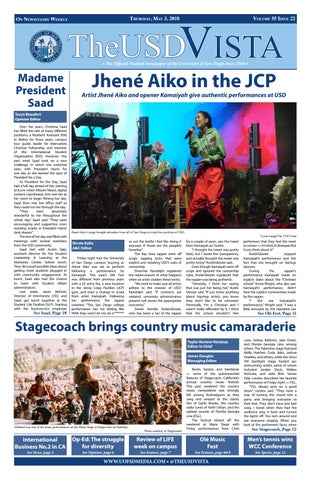
Jhené Aiko’s songs brought attendees from all of San Diego to watch her perform at USD.
Nicole Kuhn A&C Editor Friday night had the University of San Diego campus buzzing as Jhené Aiko was set to perform following a performance by Kamaiyah. This year’s Olé Fest was different from previous years with a $5 entry fee, a new location in the Jenny Craig Pavilion (JCP) gym, and even a change in script from artist Kamaiyah. Following her performance the rapper tweeted: “This San Diego college performance has me feeling like NWA they won’t let me do n*******
or out the bottle I feel like doing it anyways tf those are the people’s favorites.” The Bay Area rapper went off script, rapping lyrics that were explicit and violating USD’s rules of censorship. Shermee Randolph explained the repercussions of what happens when an artist violates these terms. “We work to make sure all artists adhere to the mission of USD,” Randolph said. “If contracts are violated, university administrators present will assess the appropriate outcomes.” Senior Kendra Rudd-Gloster, who has been a fan of the rapper
Cyrus Lange/The USD Vista
for a couple of years, saw the tweet from Kamaiyah on Twitter. “I thought the tweet was pretty bold, but I loved the transparency and actually thought the tweet was pretty funny,” Rudd-Gloster said. Even though Kamaiyah went off script and ignored the censorship rules, Rudd-Gloster explained that the rapper was being authentic. “Honestly, I think her saying that was just her being her,” RuddGloster said. “If you know anything about hip-hop artists, you know they don’t like to be censored. Personally, I’m a Christian and I wasn’t really offended by it. I think that the school shouldn’t hire
performers that they feel the need to censor — it’s kind of disrespectful if you think about it.” Rudd-Gloster enjoyed Kamaiyah’s performance and the fact that she brought on backup dancers. During the rapper’s performance Kamaiyah made an explicit claim about the “Christian school.” Annie Wright, who also saw Kamaiyah’s performance, didn’t hear the explicit commentary made by the rapper. “I did see Kamaiyah’s performance,” Wright said. “I was a little annoyed by the repeated use
See Olé Fest, Page 11
Stagecoach brings country music camaraderie Tayler Reviere Verninas Editor in Chief James Douglas Managing Editor
Midland was one of the many performances on the Mane Stage at Stagecoach on Saturday.
International Business No.2 in CA See News, page 3
Photo courtesy of Stagecoach
Boots, banjos, and bandanas — some of the quintessential features of Stagecoach, California’s annual country music festival. This past weekend the country music camaraderie was strongly felt among festivalgoers as they sang and swayed to the classic hits of Garth Brooks, the country radio tunes of Keith Urban, and the upbeat sounds of Florida Georgia Line (FGL). The festival kicked off the weekend at Mane Stage with Friday performances from Chris
Lane, Kelsea Ballerini, Jake Owen, and Florida Georgia Line, among others. The Palomino stage featured Molly Hatchet, Cody Jinks, Joshua Headley, and others, while the Sirius XM Spotlight stage hosted upand-coming artists, some of whom included Jordan Davis, Walker McGuire, and Jade Bird. Senior Talia Londos described her favorite performance of Friday night — FGL. “FGL always puts on a good show,” Londos said. “They have a way of turning the crowd into a party and bringing everyone to their feet. They don’t have one bad song. I loved when they had the audience sing it back and turned the lights off. You turn around and see everyone singing. When you look at the performers’ faces when
See Stagecoach, Page 12
Op-Ed: The struggle for diversity
Review of LIFE week on campus
Olé Music Fest
Men’s tennis wins WCC Conference
See Opinion, page 6
See Feature, page 7
See Feature, page 8&9
See Sports, page 12
WWW.UOFSDMEDIA.COM ◆ @THEUSDVISTA
2
The USD Vista
◆
May 3, 2018
NEWS
FSL works to stay out of trouble Fraternity and sorority leaders discuss ways to stop patterns of risk violations at USD
Elisabeth Smith Associate Editor In movies, Greek Life seems to be a non-stop party where the alcohol is always present, or someone is jumping off a roof. Yet, no amount of illegal activity seems to ever result in a chapter getting kicked off campus as long as they band together like the brothers and sisters they are. However, at the University of San Diego, Greek Life, officially known as Fraternity and Sorority Life (FSL), is not like the movies because the students’ actions actually have consequences. USD, like many campuses across the nation, has not been immune
the university decided to remove (Lambda) from campus so that we are not recognizing groups that are not also recognized by their organization.” In March, the Pi Beta Phi (Pi Phi) chapter was issued a cease and desist from the FSL office, halting their chapter activity until a full investigation into alcohol misconduct allegations occurred. While Pi Phi has now gone through the FSL hearing process and is reinstated on campus, these consistent, cyclical issues in the FSL community are cause for constant concern for student leaders and university staff. Pi Phi’s president Yasmin Yancy issued a statement regarding her chapter’s conduct.
“I think you can’t teach an old dogs new tricks. Our main focus is new members, so right now we’re revamping new member series, we’re remodifying the rush process, letting people know what they’re getting into.” -Valentin Huerta to the negative press that stems from the Greek community. There may not be a Greek row or Greek houses, but there are social events, and with these events come riskmanagement issues the university and FSL leaders try to prevent. Despite the efforts of the university, Interfraternity Council (IFC), and Panhellenic Council, riskmanagement issues happen fairly often at USD. Just as the spring semester started this February, the Lambda Chi Alpha (Lambda) chapter was removed from USD’s campus. Rumors circulated among the Greek and university community, and Lambda members claimed they were robbed of due process from the university. But the issues surrounding the chapter never made it through USD’s hearing process early in the spring semester because the national chapter revoked their charter before any more damage could be done. Representatives from the former Lambda chapter declined to comment on their removal from campus. However, Assistant Director of Fraternity and Sorority Life DJ Mahoney explained the situation further. “The chapter had violated FSL guidelines several times over the last several years,” Mahoney said. “Some of the things were consistent behavior issues, and in terms of earlier in the semester, for the chapter to be removed, that came from the national organization, not the university. So in support of the board of directors’ decision,
“Our chapter expects all of its members to act in accordance with Pi Phi’s values and policies at all times,” Yancy said. “We are currently receiving additional fraternity support and are executing a strategic plan stemming from a recent risk-management issue. As we move forward, we have found success in partnering with the university, Pi Beta Phi volunteers, and staff through open and honest dialogue to ensure our chapter members better understand the policies in place. We will continue to focus on the safety of our members and our prevention education programming.” Panhellenic president Kate Burnite oversees the Panhellenic Council, a group consisting of the nine sorority presidents and delegates from each chapter. As part of her job as president, Burnite works with IFC president junior Valentin Huerta, as well as staff in the FSL office, to educate chapters about risk management and how to handle issues when they occur. “My job is just the reactive stuff, like when something goes wrong,” Burnite said. “(Now) we are working toward getting proactive, because the history of Greek Life is very much reactive. It’s just, ‘Do what you want and when something goes wrong we’ll deal with it.’ But, the university is totally on board with us changing that and making it a lot more proactive, so we can figure out how to train people, so that these problems don’t happen.” Despite the training that
The USD Vista Tayler Reviere Verninas - Editor in Chief Elisabeth Smith - Associate Editor James Douglas - Managing Editor Kaia Hubbard - Copy Editor Rita Srekais - Art Director Max Escutia - Assistant Art Director
Lilyana Espinoza - News Editor Taryn Beaufort - Opinion Editor Celina Tebor - Feature Editor Nicole Kuhn - Arts & Culture Editor Anderson Haigler - Sports Editor Cyrus Lange - Photography Editor
executive members of Greek organizations are required to attend regarding risk issues, chapter members continue to act in ways that negatively affect their chapters. “We’re college students, and a lot of the problem is that we forget that things are dangerous because we don’t want to think about the negative implications of those things,” Burnite said. “So a lot of (my job) is not fear mongering, but making sure that there is a recognition that bad things happen in the Greek community all over the country, and wanting to make sure that we’re proactive in (preventing) that.” When issues such as underage drinking or hazing occur, the FSL office must determine whether to bring the chapter to a hearing, or refer individual students to the Office of Ethical Development and Restorative Practices. The hearing boards consist of six students, three sorority women and three fraternity men, who are chosen from a group of students that are trained to facilitate the hearings every year. A staff member, the Panhellenic president, IFC president, and Mahoney all preside over the hearings as well. As peer-driven processes, the hearing boards require the chapters in question to present sanctions that they believe are appropriate for their actions, but the Assistant Vice President of Student Life, Cynthia Avery, has the last word on decisions regarding chapters. Burnite and Mahoney emphasized the restorative nature of these hearing boards. “The peer-review process is intended to provide outcomes that aim to correct behavior,” Mahoney said. “Sanctions can include: additional educational programming, and putting social events on pause. It’s much less of a punitive process, it’s really something where we hope we can provide people with the tools to operate and treat one another positively.” Despite the restorative work that the FSL Hearing Board tries to achieve, there is still a distinct cycle of issues that the community faces. These cycles are apparent when looking at past FSL Hearing Board findings, as the FSL office strives to have transparency with their processes and findings on their website. While official guidelines are available for anyone to see, the hearing board findings do not come available until after each semester and are not always updated on time. Currently only findings from fall 2014 to spring 2017 are available to the public. Burnite recognizes those cycles
and said part of the issue is that hearing boards look at allegations as isolated incidents. “There totally are cycles of behavior, a lot of it re-entrenches the idea that, ‘We’re invincible and nothing is ever going to happen to us,’” Burnite said. “One of the hard things about our peer-governance hearing system is that we have to look at reports as isolated incidents. That’s done so we don’t hold chapter reputations against anybody in hearing. But, that also means that even if a chapter was on probation last semester, and they get called back into a hearing, we’re not thinking about why they were on probation, we’re thinking about what happened just then.” Mahoney echoed Burnite’s sentiments, explaining that chapters that go through educational programs in order to make improvements can lose progress when members graduate and new members are recruited. “(For example), what happened in 2012 and 2016 could be for very different reasons, even if the same thing happened,” Mahoney said. “(The hearing board) really does try and look into that specific context, and who else is involved or impacted in the situation.” With the recent removal of Greek organizations at USD, such as Alpha Phi chapter in 2016 and Lambda in 2018, Mahoney noted that the Greek community is starting to have conversations about ways to correct this pattern of behavior. Despite
is trying to move forward from the poor decisions of their peers and implement a culture that creates real change, not just avoidance of the specific actions that got another chapter in trouble. “I think the university is committed to the well-being of the students, and that is more paramount than a chapter celebrating 50 years at USD,” Mahoney said. “If they’re not doing it right, then they don’t need to be here because they’re affecting students’ experience.” In regard to improving the community’s actions, IFC president Valentin Huerta is very positive about the progress in the community. “(We have) all new leadership, and each new class is different,” Huerta said. “My class is leading the community right now, and everything is more positive, more liberal, more progressive. We’re enhancing those risk-management policies, actually taking responsibility for our actions, and being aware that our actions have a lot of consequences and influence on campus.” Huerta said he is focused on teaching new members these expectations for behavior and enhanced policies. This leaves a gap in the membership base where students who are already members but not part of this new generation of leaders, or are older members that are about to graduate, and may still hold onto the leadership mentality
“We’re college students, and a lot of the problem is that we forget that things are dangerous because we don’t want to think about the negative implications of those things.” -Kate Burnite these conversations occurring at the leadership levels within these organizations, the message does not always make its way down to every member. “I think that our sorority community is very mindful that their actions can have consequences, but on the fraternity side — there’s a level of that too — but sometimes groups fall into the mindset that, ‘Oh it won’t happen to me,’” Mahoney said. “It’s the same mindset as students who are using fake IDs at a club, they’re like, ‘Oh the last three people got theirs taken away, but it won’t happen to me so I’m gonna try.’” This mindset that is present in many young adults has greater consequences when they are involved in a Greek organization. But it appears that the community
Editorial – 619.260.4584 Business – 619.260.4714 www.uofsdmedia.com ◆ @TheUSDVista Cameron Fruehe - Photo Assistant Douglas Horn - Distribution Manager Bailey Marie Donnelly - Finance Director Adnan Hassan Nouh - Advertising Manager Gina Lew - Student Media Advisor Marie Minnick - Operations Advisor
of their former members who made poor decisions in the past. “I think you can’t teach an old dogs new tricks,” Huerta said. “Our main focus is new members, so right now we’re revamping new member series, we’re remodifying the rush process, letting people know what they’re getting into.” The new practices that IFC and Panhellenic are attempting to implement may improve Greek Life at USD for now, but if history is an indicator of the future, this cycle of problematic behavior may come around again once these leaders have moved on from the community. With the national narrative of Greek Life continuing to be negative, real systemic change across all chapters is necessary for these organizations to thrive, or merely survive, on college campuses.
The USD Vista publication is written and edited by USD students and funded by revenues generated by advertising and a student fee. Advertising material published is for information purposes only and is not to be construed as an expressed or implied endorsement or verification of such commercial venues by the staff or University. The USD Vista office is located on the fourth floor of the Student Life Pavilion in room 403B. All inquiries should be sent to: The USD Vista- SLP403B 5998 Alcala Park San Diego, CA 92110 The first copies of the newspaper are complimentary, all copies thereafter are a 25 cents charge. Opinions expressed in this publication are not necessarily those of The USD Vista staff, the University of San Diego or of its student body. Letters to the Editor can be submitted to The USD Vista office. Letters should be limited to 300 words and must be signed. For identification purposes, USD identification numbers and writer’s year must be included in the letter. The USD Vista reserves the right to edit published letters. Any content sent to the editor will be considered for publication unless otherwise stated.
Volume 55 Issue 22
◆
NEWS
◆
The USD Vista
Globally minded graduates
3
USD’s International Business Program ranks No. 2 in California and No. 8 in the nation Lilyana Espinoza News Editor Some students select a college institution based on location, tuition, and class sizes. Others, such as senior Emma Nowakoski, selected the University of San Diego after researching and discovering that USD excels in what she is passionate about: International Business. “Part of me always wanted to do International Business because I love to travel,” Nowakoski said. “Ever since I was younger and I had a strong Spanish background. I felt that I could embrace that here. I knew USD’s program was one of the best in the nation, so that persuaded my choice to even come to USD in general.” According to College Factual, a college data analytic site, USD’s International Business Program is now ranked second out of six schools in California as well as eighth in the United States. Jaime Alonso Gomez, dean of the School of Business, clarified what International Business is at USD. “International business is a name that we use to educate globally minded and behaviorally savvy graduates from the School of Business,” Gomez said. “When I say globally minded, it means we have the attitude of thinking about global
School of Business students wait inside of Olin Hall before class.
“We have eight majors in the School of Business,” Gomez said. “One of them is International Business, but also the majors in the other areas — marketing, economics and so on — are also exposed to an international learning experience. 54 percent of the undergraduate
“International business is a name that we use to educate globally minded and behaviorally savvy graduates from the School of Business.” -Jaime Alonso Gomez affairs. For instance, we want our graduates to be able to elaborate on politics, art, economics, and social issues, in a global setting. A global mindset does not just imply to travel as a tourist, but also (to be) able to elaborate on issues. The second issue is being able to behaviorally communicate in two or three languages. Knowing how to eat in France versus in Germany, how to negotiate in Italy versus in Finland. International Business implies a holistic education about global affairs, cognitively speaking, and also behaviorally.” Gomez also recognized that the benefits the International Business major receives helps all of School of Business majors.
level are exposed to an international experience. 100 percent of all graduates students are exposed to an international experience. So the school is by design committed to globally minded graduates.” Senior McKalee Mooney believes the study abroad program is the best aspect of the International Business major. “I love traveling and I think studying abroad provides a unique opportunity to explore new cultures and how different people live,” Mooney said. “Studying abroad was easily one of my favorite parts of college. I also enjoy the language requirement because it helped me decide to minor in French.” Although it is not a requirement
Olin Hall is home to International Business majors at USD.
to minor in a language, some International Business majors found it helpful to engage more fully into a different culture and add to their learning experience. Studying abroad is also not required, however, data for 2017 showed 98 percent of International Business undergraduate graduates participated in USD’s study abroad program. The most popular location is the USD Madrid Center, located in Madrid, Spain. Through the education that Mooney is receiving, she is confident in the life her International Business major will provide for her. “I want to live in Europe for a couple of years after graduation, so learning about different cultures and how they do business will be helpful,” Mooney said. “I also hope to work for a global company in the future, so knowing a lot of things related to International Business will come in handy.” There are several reasons for the School of Business’ success. One reason for this is many of the faculty of the school bring international experience to their students. According to the business school, 76 percent of the faculty have lived or worked outside of the United States, 40 percent speak a language other than English, 45 percent have taught abroad, and 47 percent are currently engaged in internationally focused research.
Lilyana Espinoza/The USD Vista
Cyrus Lange/The USD Vista
Gomez found this to be vital, because according to EIU, Global Firms in 2020, an economist intelligence unit, businesses will require of their employees more international experience. The data showed that by 2020, 48 percent of employees will become more international in composition and 58 percent will have more diverse backgrounds and experience. “We in the School of Business believe that an international education is part of a pillar, the backbone of our education,” Gomez
be exposed to an international learning experience,” Gomez said. “We also not only would like to bring more international but also intercultural or multicultural. You can go to Linda Vista and you have people from Vietnam, from many Asian countries, from Latin America and the multicultural experience also counts as a way to have a more rounded education in business. In fact, many of our MBA students do internships and consultancy projects for small businesses in the Linda Vista community.”
“I want to live in Europe for a couple of years after graduation, so learning about different cultures and how they do business will be helpful. I also hope to work for a global company in the future, so knowing a lot of things related to international business will come in handy.” -McKalee Mooney said. “It is not a patch or addition or a star you include on your diploma. It is all around us.” Gomez spoke about future accomplishments for the School of Business. “The goal is to have all of the students in the school to
Due to the rising desire for internationally competent students, the School of Business not only strives to better their International Business Program but also to continue to improve all other business majors by giving them a global mindset that employers seek.
4
The USD Vista
May 3, 2018
â—†
OP I N ION
Less-than-empty parking lots Commuter Toreros struggle to find parking in one of the few parking structures on campus
Victoria Thomas Contributor The flash of yellow blinking lights as two cars fight over the same parking spot on the first floor of the Mission Parking Structure can be an average morning on campus at the University of San Diego. Parking spots are a hot commodity within the Torero community. Permits for resident students are $290 annually and commuter permits are priced at $280 annually. USD faculty can pay $660 annually for a reserved spot, $255 for an annual regular spot if they are full-time faculty, or $63.75 per semester if they are part-time faculty. Just last year, Paseo de Colachis plaza’s construction removed the option of street parking. Recently, construction has gone underway in the Loma lot, a parking lot by Loma Hall and across from the Hahn University Center. With the Loma construction removing parking spots from students, the topic has been brought to the surface once again. To say that USD has a parking shortage would be an understatement for some students; among them is commuter junior Bailey Jagger. “You have to get here at least before 10 a.m. or 9:30 a.m. just to find a spot on campus,� Jagger said. “If you come here at 10 a.m., you’re just not going to find a spot. You just can’t.� Bailey isn’t the only commuter student who has to make modifications in their daily schedules in order to make it to class on time. Senior Kate Newton also shared these concerns.
“If I have a 10:45 a.m. class I’ll leave from the beach no later than 8 a.m.,� Newton said. “It’s the only way I know I’ll have a parking spot close by.� Limited parking spots for commuter students aren’t just a frustrating inconvenience. For some students, this struggle has caused academic issues not just with being on time for class, but with the desire to go at all. “I feel like I’m unmotivated to show up to school sometimes,� Jagger said. “You have to plan things out. If my first class gets canceled, I can’t go the rest of the day because if I get here at 12 p.m. there’s just no parking. It clears up around three or four, but if my morning class gets canceled I feel like I just can’t get to my afternoon classes.� Newton echoed these concerns but admitted to viewing them in a more positive light, finding that in some ways it brings the community closer. “It’s really annoying,� Newton said. “But I’ve also found it’s something that brings the community together in a weird way. When we aren’t fighting for parking spots, we can complain about it together.� Jagger witnessed a few instances of aggressive parking due to the perceived lack of available spaces. “I have seen people completely knock off side mirrors in order to squeeze into a tiny spot they knew they otherwise couldn’t fit in,� Jagger said. “But since there was no other spot options available, they’ll try.� However, not everyone thinks the parking situation is as big of a problem as others. Senior Bridget
Kidd lives in the Manchester Village Apartments on campus and acknowledged how people might be irritated with the situation, but does not thinks it isn’t as bad as it seems. “There is a sense of scarcity of parking, causing competition between people that can be very heated,� Kidd said. “But honestly, I think there’s enough parking for anyone. Even if you don’t get your ideal spot and you have to look around, you’ll find something.� Wajma Lyons, director of University Parking Services, emphasized this point that there are a surplus of spots. “We take inventory every year,� Lyons said. “We find that we have a surplus of at least 300-400 parking spaces, even during peak times. The West Parking lot has six levels that can be parked in.� Kidd considered USD students to be luckier than other colleges in the San Diego area when it comes to the pricing of permits. She is grateful for it when comparing prices to other universities. “Parking permits at USD are less expensive than other universities, and we also get the benefit of a tram service running from the West Lot to main campus,� Kidd said. “You can always find spots in the West Parking Structure.� Lyons also advised that students should utilize the West Lot Parking Structure more often. “There is ample parking in the West and Mission Structures,� Lyons said. “The West Structure has six levels and there are also trams that run every 15 minutes that can take people to the main part of campus.� Compared to other colleges in the area, USD’s parking permits are
A student waiting in the crowded Olin lot waiting for a parking space. Cyrus Lange/The USD Vista
significantly cheaper. University of California, San Diego’s annual permits are $732 for students and $1,116 for faculty. San Diego State University’s resident student annual parking is $532 and for commuter students it is $336. Faculty permit prices are based on an individual or department level. Both Kidd, Jagger, and Newton seem to agree on one thing: the construction of more parking spots and structures, especially those for commuter students, would be beneficial for the USD community as a whole. “I think it would be smart to have more parking structures for specific groups,� Kidd said. “A parking place for commuters, a parking place for residents, for faculty, that kind of thing. Hopefully that’ll limit the fact that everyone thinks parking is some competition.� Jagger agreed that this might be a nice adjustment for the
school to make. “It would be nice to have a place for commuters to park specifically,� Jagger said. “Some days I wish I could just peel my sticker off and pretend I’m a visitor.� Visiting students from other universities can also take up spots that could be used for USD students and faculty. “There’s no room for everyone who actually goes here,� Jagger said. “Especially during games or special events that take place on campus. It’s so frustrating. Maybe the school could make it so visitors can only park in the West Lot or something.� Parking on campus continues to be a divisive issue. Some students believe that it can be improved upon, but the Parking Services staff sees it as a non-issue. With so many conflicting opinions it is difficult to determine what can and should be done about the situation.
Manion Way
Di
m
Way
as
M ar
Josephine Street
L in d a
V is t a R
b re
go
Cu m
o San Die
Wa y
oad
MAIN ENTRANCE
ian
Go
y Wa
sh en Str ee t
WEST ENTRANCE
Have an opinion? Write a Letter to the Editor to be considered for publication in The USD Vista. Contact vistaeditor@sandiego.edu for more information. The views expressed in the Opinion section are not necessarily those of The USD Vista staff, the University of San Diego, or its student body.
Las
Ca m i n
Torero
Vi a
ADMISSIONS OFFICE
Way Park
Camino San Diego
Way
s
Tore ro
AlcalĂĄ
Ca m
ino
Paz de la
Ana
y Wa
Santa
rian
Ca m i n o S a n D i e g o
Ma
Driv
e
n
Tore ro
Sa
AlcalĂĄ Park Way
Santa
Paula
Manion Way
ay Torero W
Drive
Volume 55 Issue 22
◆
OPINION
◆
The USD Vista
Looking back on the four years
5
Senior Toreros reflect on their time at USD as graduation quickly approaches Victoria Thomas Contributor It is not going to be much longer until the graduating class of 2018 walks across the Jenny Craig Pavilion (JCP) stage to accept their diploma. They will turn to the smiling crowd filled with family, friends, and faculty who have helped them along the way. As summer approaches, the reality of this begins to set in for many of the seniors at the University of San Diego. Some of them take a moment to reflect back on their past experiences as Toreros, consider whether they would apply to the university again as incoming first-years, as well as offer some sage advice to anyone who might be interested in attending USD. Senior Kevin Do noticed how much USD has changed in the last four years since he first enrolled. “USD is literally not the same campus at all when I was touring it in high school,” Do said. “The new nursing building, the new plaza, and the new bookstore — everything is so different. I love it! It’s amazing how much the campus has grown physically.” But it’s not just cosmetic changes the university has gone through. Campus culture has also changed rapidly within the last four years according to senior Elena Goodenberger. “I feel like USD has become more active in standing up against the injustice we see in our community and in our nation,” Goodenberger said. “The campus walk-out is just one representation of this. The campus community, specifically the Greek community, has also tried to bring awareness to the issue of sexual assault on and off of campus through sexual assault discussions.” A few of the seniors also reflected on some of their favorite, and least favorite, memories about their time at USD. Senior Helen Nguyen recalled a time the university re-ignited her love of learning. “Being invited to USD’s scholarship celebration and
meeting my benefactor is one of the many fond memories I have made here at USD,” Nguyen said. “It rejuvenated my desire to learn to know that a complete stranger believes in me enough to invest in my education.” Senior Victoria Maretti also recalled her fondest memory after a rocky transition into college life. “My fondest memory was joining Pi Beta Phi,” Maretti said. “I was able to meet a group of genuine girls who made me feel welcomed on campus. I will never forget the memories I have made within my sorority.” Unfortunately, not every experience can be a good one. Do had an unfortunate mishap during his finals one year that nearly cost him his good grades. “I got the dates of my World Religion and my Chinese finals mixed up and ended up missing my Chinese final,” Do said. “I spent the past three weeks studying for World Religion thinking I had the right date and nope, I was wrong. I still ended up getting a B in Chinese but I could have gotten an A if only if I had my life together.” Reflecting back on his experiences, Do was unsure whether he would apply to USD again if he were an incoming firstyear. “To be honest, no I don’t think I would apply here again,” Do said. “I came to USD as a firstgeneration Asian American and college student from a low-income background and attending a private, Catholic institution has and still (is) difficult to afford. I am grateful for the amount of scholarship money that USD has provided for me but I did not realize the caliber of how much financial burden it was going to be after I move on from USD.” However, senior Cate MacGregor does not agree. She thinks that the resources she’s had access to during her time at USD make up for the financial burden. “Although it makes me sound a bit crazy and my student loans would beg to differ, I would absolutely apply to USD all over again,” MacGregor said. “I just feel that the education — specifically
from the Biology department — I’ve gotten here has been amazing and worth it.” Goodenberger also agrees with MacGregor’s perspective. “USD is very expensive,” Goodenberger said. “But the individualized learning, small class sizes, and the countless academic and extracurricular opportunities make it worth it.” Each of these seniors seemed to be grateful for one thing — the resources USD provides for those graduating to help them in their future endeavors. Some of the resources available to graduating students as they prepare to leave their days as a Torero behind are: Student Support Services (SSS), an academic development program; the McNair program, which provides research opportunities for first generation students in low-income families who wish to pursue graduate degrees; Teach for America, which helps students who wish to be teaching professionals connect with a program; and the Career Development Center (CDev), which offers assistance in job applications, resumes, and other resources for a future job search. Maretti found CDev an extremely valuable place for aid in planning her future. “The Career Center on campus is a very useful resource that helps you prepare for the job market,” Maretti said. “They can help with graduate programs, resumes, etc. Basically anything.” With graduation just on the horizon after four years of hard work, Maretti had a few pieces of advice for any first-years who are worried about the future that’s to come. “My advice to incoming freshmen is to enjoy these next four years because they fly by,” Maretti said. “People always say this, but it is so true. I felt like it was just yesterday I was moving into San Rafael in Missions B, and now I’m finishing up the last couple weeks of my academic career. Enjoy yourself and don’t stress the little things.” Do echoed Maretti’s feelings and encouraged everyone to get
Some Toreros like to take pictures in front of the Immaculta to celebrate graduation. Cyrus Lange/The USD Vista
involved on campus. “Your time at USD will be four years, but the four years will go by incredibly fast,” Do said. “Do not wait until your junior or senior (year) to begin prepping for life after graduation: start now. Even though you are a freshman, act as though you are going to be graduating soon: get an internship, volunteer, and/or get work experience. Whatever you do, start preparing now. There is a big world after graduation and be sure to take up all the resources at your disposal now so that you will be ready to take it on when you leave.” MacGregor knows that she has learned a lot in her last four years, and one thing will stick with her for a long time. “I think the most important thing I’ve learned is how to think,”
MacGregor said. “I realize that sounds very abstract or lofty but what I mean is from the classes I’ve taken (primarily the mixture of science and religion I’ve done with my major & my minor), I now feel like I know how to think for myself. I know how to look deeper into things and really figure out what’s happening underneath the surface.” By the end of May the seniors will officially be graduates. It may be difficult for some Toreros to leave behind the beautiful campus they have called home for the past four years. Despite the ups and downs at USD, there is a general sense of nostalgia from the seniors as they reach the end of their Torero days. There is no denying the experiences they had will influence them as they step forward into the future.
Senior Ariana Farha prepares for graduation by taking senior photos in front of the Immaculata. Friends gather at USD’s 2017 commencement ceremony to celebrate recent graduates. Cyrus Lange/The USD Vista Tayler Reviere Verninas/The USD Vista Have an opinion? Write a Letter to the Editor to be considered for publication in The USD Vista. Contact vistaeditor@sandiego.edu for more information. The views expressed in the Opinion section are not necessarily those of The USD Vista staff, the University of San Diego, or its student body.
6
◆
Volume 55 Issue 22
OPINION
◆
The USD Vista
Op-Ed: The struggle for diversity USD has struggled for years to improve ethnic diversity in its undergraduate population
Celina Tebor Feature Editor As a child of an immigrant who was naturalized 10 years ago, it is frustrating to know that I will never be considered a minority in higher education because of the continent where my mom came from. As someone who comes from Filipino, Polish, Lithuanian, and other backgrounds, it is hard to understand why I will never be considered multicultural by USD. As someone who comes from a country whose culture has been destroyed and colonized by the United States and is now run by a bloodthirsty dictator, it is hard being told that I cannot be oppressed because Asians and Filipinos are “successful.” Multiculturalism is important. Someone’s ethnic culture can be, and is for many people, a huge part of their identity. I know how important it can be — my ethnicity and culture shapes the way I interact socially, how I perform in academic settings, which political issues I care about, and more. While ethnic culture has shaped all these aspects of my life, it does not define me. USD has two issues with multiculturalism. First, the herding of Latino and black high school students led by guides of the same ethnicity causes a misrepresentation of ethnic diversity at USD. Second, by clumping students of
color together, USD is failing to incorporate multiculturalism on this campus — multiple cultures that are integrated into one community. Diversity can be drawn from ethnicity and race, religion, ability, gender, sexual orientation, and socioeconomic status, among other demographics. Here, I focus specifically on diversity in ethnicity and socioeconomic status. It seems as if USD diversity is simply the existence of multiple cultures in the community. Diversity includes the integration of multiple cultures into the already existing community, however. USD is doing its job to accept and acknowledge more cultures and backgrounds, but does not do its duty of incorporating them into the existing community. For example, USD hosts events such as Multicultural Night, but the event only features organizations for cultures of color such as the Folklorico and Mariachi Association (FAMA), Filipino Ugnayan Student Organization (FUSO), and People of the Islands (POI). San Diego State University (SDSU) ranked No. 18 in the nation for campus ethnic diversity in 2012 in U.S. News and World Report. The university also managed to increase graduation rates for ethnically diverse students from 33 percent to 65 percent from 2002 to 2010. This university provides access, but no inclusion. One of the many examples of this can be seen at
ME@USD. This program allows students who are chosen by Multicultural Recruitment through Admissions to experience the life of an undergraduate student at USD. It is problematic for several reasons. First, this program provides an inaccurate representation of USD. The majority of participants in this program (both current and future Toreros) represent much more diversity than present at the university. No race besides “white” makes up more than 10 percent of undergraduates at USD, with Asian being the highest at seven percent. Asians made up six percent of the population 16 years ago, and African Americans made up two percent (now they make up four percent). USD should admit that there is a lack of diversity at the university, but that it is working to increase it. Instead, USD chooses to surround future Toreros with those who look like them in the hopes that they believe that the rest of the school is representative of the tiny percentage of diverse students of color to whom they were exposed. There is a fine line between representing ethnically diverse identities and over-representing them so it appears that there are more than there are. It is good to provide students an environment in which they feel comfortable — it is not okay to ignore the preexisting community and culture USD has to convince future students into
1 Month FREE! Ask for details! Offer valid at Downtown, Fashion Valley, Hotel Circle & Pacific Beach locations only. On select units while supplies last. Excludes car storage at Downtown location. Cannot be combined with other discounts or offers. Expires 5/31/18.
thinking the school is more diverse than it is in actuality. Second, the Me@USD program labels prospective students as their ethnic culture, rather than letting the culture represent a part of the student. By creating a program exclusively for a multicultural experience and picking and choosing which students are qualified to experience multiculturalism at USD, the university is essentially: 1) giving a strict definition to what multiculturalism entails, discouraging Toreros who may see themselves as multicultural but are not seen as so by USD, and 2) telling future Toreros that they were chosen for a special program based solely on their culture, rather than any skills or experiences that they developed themselves. By doing this, USD is basically telling these prospective students, “You are special because of your ethnicity — and only your ethnicity.” There are cultures and ethnicities that are underrepresented at USD, and those cultures and ethnicities deserve more representation. However, ME@USD is not the way to do so. Future Toreros should be recognized for their accomplishments in addition to their background and culture, rather than recognized for solely their culture. It is easy to build connections with people who have similar
backgrounds. And oftentimes, strong and supportive relationships are built that way. However, delegating oneself to only having friends with the same ethnicity helps no one. Education prospers in diversity; diversity only occurs in difference. However, USD will only succeed in increasing diversity if there is a willingness from the community to open the lines of communication across all aspects of USD. The university needs to admit that the school is not as diverse as it should be, but also put in place programs and initiatives directly correlated with increasing diversity through communication with high schools in the local area. This does not mean assimilating into a culture where you do not feel you belong. It simply means that you are willing to be involved in, communicate with, and join in community with all aspects of USD, multicultural or not. Multiculturalism is a great thing. Diversity is a great thing. But placing many diverse groups in one area where they are not integrated with each other will not improve the education or wellbeing of any community member at USD. In order to become a more successfully diverse university, USD needs to take into consideration that it is a school with a lot of white and wealthy students, and that it should not deceive students of color to try to get them to attend.
Race andUSD Ethnicity in USD undergraduates, Demographics, Fall 2017 Fall 2017 International 9% Unknown 2% Two or more 6% Pacific Islander 1% American Indian 1% Asian 7%
a1storage.com/usd
White 50%
Black 4%
Fashion Valley 1501 Frazee Road
619-537-8014
Hispanic/Latino 20%
Access Hours: 7am-8pm, daily
Pacific Beach
Data from US Federal Reports
2740 Garnet Ave.
858-522-9933
Access Hours: 6am-10pm, daily
Hotel Circle
• Quick & easy college storage solutions • Rent your storage unit from a smartphone! Get your completed paperwork by email.
2245 Hotel Circle South
619-621-8951
Other 1% Mixed 3%
Access Hours: 6am-10pm, daily
• Car storage available at select locations • Boxes and moving supplies • Easy payment options: Major credit cards accepted, automatic payments by credit card, pre-payments & online payments
Vista Demographics, 20152015 RaceLinda and Ethnicity in Linda Vista,
Downtown-Little Italy
619-633-3066
Access Hours: 6am-10pm, daily Office Hours: 9-6 M-F, 9-5 S-S
White 28%
Asian 23%
Get 3 FREE Boxes! Don't forget to check in with Yelp! As a token of our appreciation, you'll be rewarded with 3 FREE SMALL BOXES!
a1storage.com/usd
Black 6%
Hispanic 39% Data from Statistical Atlas
Have an opinion? Write a Letter to the Editor to be considered for publication in The USD Vista. Contact vistaeditor@sandiego.edu for more information. The views expressed in the Opinion section are not necessarily those of The USD Vista staff, the University of San Diego, or its student body.
Volume 55 Issue 22
◆
FEATURE
◆
7
The USD Vista
F E AT U R E
LIFE Week: Life Is For Everyone LIFE Week provides the community with insight on different life issues that are sometimes overlooked Amy Inkrott Contributor “Life Is For Everyone.” This phrase serves as the mantra for LIFE Week at the University of San Diego. Life issues are often associated only with debates on euthanasia and abortion rights. However, Students for Life, an on-campus club, works to promote a better standard of life for all individuals. Throughout the week of April 23, Students for Life hosted events bringing awareness to commonly overlooked life issues such as drug and alcohol abuse, human trafficking, mental health, and homelessness. Students were called to reflect on the blessings in their own lives, and consider those who are less fortunate. Monday: Drug and Alcohol Abuse On Monday, April 23, Students for Life kicked off LIFE Week with a discussion on drug and alcohol abuse and their impact on the lives of college students. John Redman, director of the Community Alliances for Drug-Free Youth (CADFY), began the discussion by detailing the realities of the opioid epidemic. First-year student and the event’s coordinator, Razann Rizk, responded to the increasing number of drug-related deaths. “Drugs and alcohol are very prevalent in today’s society, and many students come to college without knowing how dangerous they can be,” Rizk said. Later, motivational speaker and Olympic BMX coach Tony Hoffman shared his personal experience with drug addictions. Students listened intently as he explained that what had started as a fun social activity quickly shifted into a dependency. Hoffman’s story of overcoming drug addictions, homelessness, and incarceration served as a cautionary tale to anyone who experiments with drugs. Throughout his testimony, Hoffman sought to debunk the stigma of drug addicts being weak-minded and lacking in support. The speaker stressed that an addiction can happen to anyone, regardless of their family, wealth, or status. Hoffman gave advice to college
students considering drugs as a means of dealing with the pressures of college. “Being you and different is okay and is important for the rest of your life,” Hoffman said. “The things that you are capable of doing are so much greater than the small moments that we believe are significant in our college years.” Tuesday: Human Trafficking On the second day of LIFE Week, USD students gathered in UC Forum C for Spirituality is Served to build community and discuss the issue of human trafficking. Speakers Emily PasnakLapchick and Nadine Toppozada discussed the prevalence of human trafficking in our world. PasnakLapchick, a former spokesperson and worker for UNICEF, shared that human trafficking is an issue not only globally, but also within the San Diego area. Through UNICEF, Pasnak-Lapchick worked with the End Trafficking Project to raise awareness of child trafficking. Toppozada, a spokesperson from Catholic Charities, shared testimonies from survivors, stressing
Students make sandwiches for the homeless at PB & Jammin.’
relieving objects like stress balls and massages, as well as time with therapy dogs. The fair aimed to
“Being you and different is okay and is important for the rest of your life. The things that you are capable of doing are so much greater than the small moments that we believe are significant in our college years.” -Tony Hoffman their dignity and importance. Junior Elianna Lucas, the event’s student coordinator, commented on how the heartbreaking event had an impact on her. “Learning about the scale of trafficking helps me realize this is an issue that takes place all around us,” Lucas said. “There is always something we can all do to make a difference, no matter how small it is.” Wednesday: Mental Health, Mass and Rosary for Life On Wednesday, April 25, students filled Maher Lawn to partake in the Mental Health Fair. Students were provided with a multitude of snacks, stress-
help students alleviate their stress and promote self-care. Smiles were everywhere as students were able to play games, spend time with friends, pet the therapy dogs, and relax in the sun. Sophomore student coordinator Tomy Vettukallel highlighted the importance of mental health. “All of us are affected by mental health whether we realize it or not,” Vettukallel said. “College students are so involved and want to do a lot. All of the stress and tension that we build up will cause problems for us in the future.” Vettukallel encouraged care for mental health among individuals. “If we practice taking care of our
Elliana Lucas (left), Razann Rizk (middle), and Miranda Rappoldt (right) help package snacks at the Mental Health Fair. Photo courtesy of Amy Inkrott
mental health and helping others to do the same, we will live longer and healthier lives,” Vettukallel said. Later that night, students gathered in Founders Chapel to engage in prayer for all life issues. During Mass, Alison Purpera, class of 2007, provided students with her personal reflection on LIFE Week. Purpera began by recalling the 11 years since her graduation from USD, asking students to ponder where they will be in 11 years. Purpera called attention to those individuals who are unable to imagine their futures as they are plagued by life issues. She encouraged the USD community to advocate for these individuals so that they might have the opportunity to live their lives to the fullest potential. Finishing her reflection, Purpera referenced the week’s mantra “Life Is For Everyone,” emphasizing a belief that every individual is deserving of dignity and respect. Thursday: PB & Jammin’ The final event of LIFE Week focused on the prevalence of homelessness in the San Diego community. At this popular event,
Photo courtesy of Amy Inkrott
students make peanut butter and jelly sandwiches to be distributed to the homeless. Together Toreros worked to make over 400 lunches smiling, laughing, and singing along as they made PB & Js. First-year Madelyn Bass shared the joy and gratitude that she felt at the event. “I like to imagine the smiles that might come from someone simply opening that brown paper lunch bag,” Bass said. “There are so many people living on the margins right down the street from our school.” Reflecting on the blessings in her life, Bass found herself looking for ways she could put aside her privilege and better serve others. “There is a great need for more joy and service in this world, and I think that making sandwiches at PB & Jammin’ is not only fun, but humbling as well,” Bass said. Throughout LIFE Week, students learned that these issues are present not only in our world, but also in our local community. Students were called to recognize the injustices people in our society face and consider the ways they can help. Every individual deserves the opportunity to live their life to the fullest.
First-year Andrew Plaza plays with a therapy dog at the Mental Health Fair. Photo courtesy of Amy Inkrott
8
THE USD VISTA
◆
Volume 55 Issue 22
MAY 3, 2018
O L é
The Jenny Craig Pavilion was filled to the brim with Toreros waiting for Kamaiyah and Jhené Aiko’s performance. Photo courtesy of Jenelle Seguin
Jhené Aiko vibes off of the crowd’s energy during her performance while she sang some of her top hits.
Cyrus Lange/The USD Vista
“(Jhené Aiko) was absolutely perfect from the beginning to the end of the concert. She interacted with people and let us feel connected to her. If I got the chance to see her again on stage, I will. She was awesome!”
M U S I C F E S T
With blaring neon lights and a pounding bass, Oakland rapper Kamaiyah and R&B singer Jhené Aiko took the stage on Friday, April 27 in the Jenny Craig Pavilion (JCP). Before the concert, Toreros flooded the Vistas parking lot and prepared for the jams with pot pies, pineapple smoothies, a silent disco, rock climbing, and more. The JCP was filled to the brim as Toreros danced to the throbbing beat of Kamaiyah’s raps and swayed to Jhené Aiko’s dream-like voice, complemented by a live harp and a set that made students feel as if they were in a wonderland.
FEATURE
◆
9
THE USD VISTA
Toreros sway in awe while listening to Jhené Aiko’s perfmance during Olé Music Fest.
Cyrus Lange/The USD Vista
“(Olé Music Fest) was worth paying five dollars because not only did it give concert access but also free TPB stuff, like t-shirts and caps.”
-Vijay Patel, junior
Kayla Cayanan (left) and Adrianne Nguyen (right) eat sorbet before the concert. Photo courtesy of Kayla Cayanan
“My favorite part was getting to dance on stage with Jhené Aiko. Thank you so much USD for coming out! We hope you enjoyed yourself. See you next year!” -Shermee Randolph, senior, Torero Program Board Vice Chair of Entertainment
Jhené Aiko sings her heart out, with her Alice in Wonderland-inspired set complementing her angelic voice. Cyrus Lange/The USD Vista
-Arielle Adou, junior
Jhené Aiko bathed in the light of her set as dozens of Toreros Snapchat and take pictures of her performance. Cyrus Lange/The USD Vista
◆
Jessica Diaz (left) and Kaitlin Solis (right) enjoy pies at the festival. Photo courtesy of Kaitlin Solis
Kelly Tran and Dai-An Le with their pineapple smoothies and spray-on tattoos. Photo courtesy of Kelly Tran
Torero Program Board joins Jhené Aiko on the stage in the JCP at the end of her performance.
Photo courtesy of Jenelle Seguin
Spread by Rita Srekais; Content by Celina Tebor/The USD Vista
10
The USD Vista
◆
May 3, 2018
Introducing President Saad Senior Christina Saad switched places with President Harris for President for a Day
Saad from Page 1 preparing their lunch, Saad proceeded to engage with almost every person they passed from that point on until they sat at their table. It didn’t stop there — employees and student after student continued to wave a friendly hello as they shared their meal together. Saad’s interactions at the SLP are representative of the connections she has made through her many roles at the University of San Diego. However, her most difficult task as President for a Day began at 9 a.m. during her meeting with Minh-ha Hoang, Director of Admissions, in which she was handed two different transfer applications and given the chance to select one of them. “Both these students were extremely qualified,” Saad said. “Minh-ha pushed me to really think about all the different factors we should take into account. I was able to finally come to a decision by the end.” While President Harris doesn’t typically choose between two applicants for admittance, the administration brought this to Saad as her “executive decision” and to give her insight into how the process works. “When I was going through the process they actually made me think that what I chose would be the final decision,” Saad said. “But when I finally got to the decision she (Minh-ha) was like, ‘Great job, that’s exactly what we were planning on doing.’” Saad has been interested in the opportunity to be president for a day since President Harris introduced this tradition three years ago. She wanted to take the opportunity to meet with administrators to share what she has appreciated most about her time at USD as well as ideas she has for the future. Saad ran on the platform of getting students more interconnected with one another. “While almost all USD students
President for the Day, Christina Saad, and President Harris pose for a picture as they take a break from their busy schedules.
are involved in something, my hope is that each student’s closest group of friends will be made up of peers in the Changemaker Hub, another in University Ministry, another in Greek Life, and another who’s on the tennis team,” Saad said. During her presentation she suggested various events to help promote such interconnectivity that would begin during orientation week. “I think it would be really cool if we did something similar to an event like Mr. U,” Saad said. “But, where students are randomly placed into teams for slightly embarrassing competitions, like lip sync battles.” Belcher echoed Saad’s strong desire to interconnect students throughout campus. “Christina holds a wholecampus view,” Belcher said. “It’s
evident in her wide involvement with student life and her personal relationships. She cares about a wide variety of student communities, individuals, and campus issues.” Belcher commented on how this only added to Saad’s qualifications in being President for a Day. “I would hope that the President for the Day candidate would embody the USD way like Christina does,” Belcher said. “It was obvious that she was not only connected to a diversity of communities on campus, but truly maintained caring relationships with those people.” As Saad’s day began to wind down, she walked over to the weekly Fireside Chat with President Harris. Every Thursday night President Harris hosts a Fireside
Chat, an informal chat with top administrators and students at the fire pits outside of the Torero Store. As President for the Day, Saad was given the opportunity to host the most recent chat. Saad especially enjoyed the Fireside Chat as it gave her the chance to speak with various students, professors, and administrators. During their walk, President Harris and Saad were able to catch up on each other’s day. Throughout Harris’ day as a student, he attended three of Saad’s classes and shared coffee with members of ISO. “I experienced the drive and dedication of our students firsthand,” Harris said. “Whether watching a group presentation, interacting in and between classes with them, or through discovering the ways that they are involved across campus, our students truly
Cyrus Lange/ The USD Vista
are an inspiration.” Although her short-lived time as Madame President came to an end, Saad was able to reflect on her experiences of what a day in the life of President Harris is like and discover the extent of administrators’ duties. “They (President Harris and administrators) truly want USD to be the best institution for their students, a place where they can build genuine friendships and become leaders that positively impact the planet,” Saad said. Saad’s time as a Torero will be coming to an end as graduates this May. However, the memory of switching places with President Harris will stay with Saad as she embarks on her journey to law school. While she is still here, Saad plans on taking advantages that USD offers and spending as much time as she can with friends.
President Harris attended the ISO coffee break as part of Saad’s extracurricular activities. Madame President Saad sitting at President Harris’ desk, ready to take on her tasks for the day. Cyrus Lange/ The USD Vista Photo courtesy of Christina Saad
Volume 55 Issue 22
◆
ARTS & CULTURE
◆
The USD Vista
A RT S & C U LT U R E
11
Annual USD Olé Music Fest Toreros packed the JCP Friday night to see singer Jhené Aiko and rapper Kamaiyah
Olé Fest from Page 1
of the audience about doing shrooms or pouring water down the front of her clothing. But I don’t think that it was particularly controversial. Knowing the artists and the content of her music, it seems that such things were unavoidable.” As a part of Olé Music Fest, TPB had student art galleries, spraypaint tattoos, and tic-tac-toe basketball. Senior Lyanne Dalida was excited to attend her last Olé Fest before graduation in May. “I had a really fun time dancing at the silent disco and playing the festival games,” Dalida said. “They did a really good job with setting up the place that I forgot I was at school.” After Kamaiyah’s performance the stage was set up for Jhené Aiko with numerous plants and light fixtures that created the ambience of a jungle as she swayed on the stage performing top hits “Post To Be” and “Sativa.”Singer-songwriter Jhené Aiko is best known for her EP “Sail Out” which was rated
No.1on Billboard’s R&B chart. The artist has more than 44 million views on YouTube for her famous song “Sativa” feat. Rae Sremmurd and drew great attention when she contributed vocals to Drake’s album “Nothing Was the Same.” Aiko has since been building on her fame as a singer-songwriter and has collabed with artists including Chris Brown and Drake. Dalida’s favorite part of the fest was Aiko’s performance. “The lights (on the stage) were cool because it felt like I was back in Coachella,” Dalida said. “She was amazing on stage. Jhené was giving out advice on how to deal with school stress which I thought was amazing coming from a celebrity. Her voice throughout the performance was simply incredible.” It was Donya Hashemi’s first time at Olé Fest. “(Jhené Aiko) connected with the audience which was very inspiring,” Hashemi said. “I loved her performance and was also impressed by how talented she was and the fact that she added
The anticipated performer Jhené Aiko performed songs like “Sativa” and “Post to Be” Friday night in the Jenny Craig Pavilion. Cyrus Lange/ The USD Vista
the harp.” With a five dollar cover compared to previous Olé Fest which were free, a lot of students, like Hashemi, didn’t mind that
there was a fee. “I think it was worth way more than $5,” Dalida said. “It was great seeing her perform in general and the fact that it was so affordable
was great.” Close to 11 p.m. students slowly trickled out of the gym. Friday’s performances set the bar high for TPB’s next music fest.
Lindsay J. Cropper Series
The English Department celebrates English major completing their creative writing emphasis Nicole Kuhn A&C Editor Every year the English Department prepares their creative writing students for the annual Lindsay J. Cropper Memorial Writers Series. The English Department website states: “This series was created to inspire the creative writer in all of us. The Lindsay J. Cropper Memorial Writers series and The Lindsay J. Cropper Center for Creative Writing were established in 2004 by Barrie and Dorothy Cropper in memory of their daughter Lindsay, an alumna of USD, English major and aspiring writer.” English majors who are completing the emphasis in Creative Writing read a threeminute excerpt of their choice of poetry, fiction, or nonfiction writing. This year’s readers included Grace McDonald, Bee Carucci, Maddison Nelson, Ben Friedl, Elisabeth Smith, Mary Berset, Cait Imhoff, Chris Koo, Teddy Castro, Larissa Rogers, Quinn Cain, Riley Nork, Erin Behrens, and Dom Shank. Senior Teddy Castro read a piece called “Live for You” about his grandmother. “I chose to read that one (“Live for You”) out of all my works because I thought it was one of my only pieces that I could take a section from and have it still make sense,” Castro said. “It’s also about my grandmother, and she’s neat.” Ending the night, Castro reflected that he was glad to have participated in the Cropper Series. “It was nice to have the experience of reading a piece of my own work to people — especially with other graduating
Left to right: Back row: Chris Koo, Maddison Nelson, Cait Imhoff, Ben Friedl, Grace McDonald, Dom Shank, Quinn Cain, Riley Nork, Larissa Rogers. Front row: Elisabeth Smith, Erin Behrens, Teddy Castro, Bee Carucci, Mary Berset. Photo courtesy of Dr. Halina Duraj
seniors within the creative writing This was also the first time I worked on creative writing pieces extensively, and I was able to learn about what worked or didn’t work for me.” Senior Chris Koo explained that the hardest part was reading the excerpt in front of everyone. “I was a bit anxious at both how many people were attending to listen to us, and how many students were reading at the Cropper Series,” Koo said. “I had to practice reading my story a ton beforehand so I wouldn’t mess up, and I’m pretty happy with the way it turned out. Overall, I think it was a great experience, and I’m honored to have taken a part in it.” After graduation Koo will be traveling abroad in Asia and is looking to pursue jobs abroad in teaching. Senior Ben Friedl read an excerpt from a piece called “Piazza.” “The piece was my attempt at
writing travel literature, as I wrote about my study abroad experience in Florence, Italy,” Friedl said. “More specifically, the story was about my experience of being immersed in Italian culture and the huge impact Italian culture and way of life has had on my daily life.” Friedl chose the emphasis in Creative Writing because it contributed to his major in English and was the closest thing to a journalistic major at the school. “While there are definitely aspects of journalism that go into writing long form, nonfiction pieces, I would say that the emphasis was not what I initially expected it to be,” Friedl said. “In journalism, the responsibility to report information is usually at the forefront of the writing. Whereas in nonfiction creative writing, the author is given a lot more authoritative, creative, and artful agency. This freedom from constraint is something I have really enjoyed and believe is
something that has contributed to my improvement as a writer.” Friedl added that the emphasis has been a great attribution to his learning process, especially as a writer. “To me, the emphasis has been a great opportunity to work with other writers who are all striving to improve their own work,” Friedl said. “I have been unbelievably fortunate to listen and learn from the other students in my creative writing classes. They are all fantastic writers and being able to work collaboratively with people as smart as them has contributed to my own writing abilities immensely.” The reading ended with an announcement of the Lindsay J. Cropper Creative Writing Contest Winners. The fiction submissions were judged by Fall 2017 Cropper reader and fiction writer Brit Bennett, and the creative nonfiction submissions were judged by nonfiction writer Nicole
Sheets. The contest included categories of poetry, fiction, and nonfiction. The winners and runners-up included: Samantha Strauss (runner-up, fiction), Maddison Nelson (winner, fiction), Ben Friedl (runner-up, nonfiction), Grace McDonald (winner, nonfiction), Larissa Rogers (winner, poetry), and not pictured: Joe Duffy (runner-up, poetry). The winners of each category were selected to feature their work in Fall 2018 issue of The Alcalá Review. Senior Grace McDonald started off the night by reading a nonfiction piece about her father called “Tell Your Dad the Worst Thing That Has Ever Happened To You.” “It was an emotional story to write but I felt confident reading it because the Cropper Series and the Creative Writing Emphasis give us a celebratory and welcoming platform to share our stories, whatever they may be,” Mcdonald said. McDonald will graduate in May and is still deciding what to do after school ends, but will continue to keep writing. “By nature of what creative writing is, sharing something you’ve worked so hard on with any audience is a very vulnerable place to put yourself in,” McDonald said. “All the students in the Creative Writing Emphasis read such beautiful and honest pieces; I’m glad I read first because I wouldn’t have wanted to follow any one of them.” The annual writers series ended with a room full of students and faculty cheering on the group of creative writers. Everyone celebrated the students’ successes with desserts at a reception that followed their readings.
12
The USD Vista
◆ May 3, 2018
Toreros head back to the desert Florida Georgia Line, Keith Urban, and Garth Brooks headline California’s country music festival
Stagecoach from Page 1 it happens, you can tell that every time it’s gotta be just as amazing as the last.” Sophomore Hollen Herbst shared during Londos opinion, saying that she also had the most fun at the FGL show. “I enjoyed Florida Georgia Line, mainly because I knew all of the songs and the music videos playing in the background gave an added effect to the performance,” Herbs said. “They’re one of my favorite bands and I’ve seen them before, but I’m never opposed to seeing them again.” FGL included guest performances from Jason Derulo and the most recent social media sensation “Yodel Boy,” 11-year-old Mason Ramsay, who debuted his new single for the country crowd. Londos noted how interesting it was to witness a young kid perform at Stagecoach from being famous through social media, and yet many country artists and bands spend years trying to make it on the stages of Stagecoach. Londos has attended every Stagecoach since its first year in 2007. “It’s my family’s thing; we go every year,” Londos said. “I’ve grown up listening to country music with my family so I’ve known these songs since I was little. I’ve noticed country music has a unique bond among fans. I love all music, but there’s something about country music that tells a story that I have found is different than any other type of music. I think it’s an easier connection for me, but that’s because growing up with it it’s become a familiar tune.” A unique bond indeed. This family-oriented festival varies from the desert’s other hit festival, Coachella. At the entrance festivalgoers are met with the same iconic ferris wheel, but the festival experiences are vastly different. Families with young children, grandparents, teenagers, and adults walk the grounds with their lawn chairs and blankets in hand eagerly waiting at the gates to find a special spot to camp out in the audience. Most festivalgoers don’t arrive until around or even after 4 p.m., as they spend the mornings and afternoons prepping for the exciting evening of country music singing. Londos defined the environment of California’s country music fest. “You have the die-hard fans that will yell out every single tune,” Londos said. “You have the ones who go to party. You have the ones who are there with their family and friends. It’s a way to unify people but you don’t have to like the music to like the environment. Stagecoach is a way to get together with your friends and have a good time, and meet new people!” Senior Jack Sheffield described the atmosphere as representative of the art that is performed. “I would say the atmosphere is very much like a country song,” Sheffield said. “What I mean is that everyone is kicking back, drinking a beer, loving the day — just down-south country vibes.” Herbst agreed that for the most part, everyone in attendance is in a good mood. “At Stagecoach everyone’s
really friendly,” Herbst said. “For example, we walked into the festival and a bunch of people wanted to take pictures with us because we were wearing matching jean-on-jean outfits and they were too. We have pictures with so many random strangers.” This past weekend also marked senior Nick Hatton’s third year attending Stagecoach. “I go for the music, but it would have been an awful time alone,” Hatton said. “The music was the best part but being able to do it all with my friends (from the past four years of college) made it even better.” Saturday’s festivities started with performances on the Sirius XM Spotlight stage with bands including Delta Rae and Muscadine Bloodline. The latter band hails from Mobile, Alabama, and is fronted by lead singer Charlie Muncaster and lead guitarist Gary Stanton. The pair commented on their musical influences and how they perceive their own sound. “I still like the Foo Fighters and We Came as Romans and Devil Wears Prada,” Stanton said. “Rolling Stone keeps calling us ‘emo,’ and I don’t know exactly where that’s coming from. Everyone went through that phase I thought. But it’s the guitar and the melodies that they hear in our music; it has a very 2000s alternative rock sound.” Fresh off of a new EP titled “Movin’ On,” which they released the day before their Stagecoach performance and currently sits at No. 14 on the country music charts, the duo from Mobile emphasized that their immediate plan going forward is to promote their new album. “It’s 100 percent tour, tour, tour,” Muncaster said. “We’ve got to push this project that’s just dropped. But then you jump back in the studio as fast as you can. We’re planning on getting back in the lab in August.” Stanton hinted with a wry smile that fans could be in for a treat with the new music they’re recording. “We are leaning toward doing something more pop-y, like James Bay-ish,” Stanton said. “We have a collab that we’re thinking about doing in the future with our buddy John Langston. It will absolutely be a hit.” Performances continued on
the Sirius XM stage with Seth Ennis, who sang his original songs such as “Think & Drive” and included a few throwback songs like “The Middle” by Jimmy Eat World, “Ocean Avenue” by Yellowcard, and “Sugar, We’re Goin Down” by Fall Out Boy. The 80+ person crowd rocked out to the classic hits, sharing the excitement with Ennis as it was his first debut at Stagecoach. Following his show was a heartfelt performance from Carly Pearce, who included Shania Twain’s hit song, “Man! I Feel Like A Woman!” Country fans started piling in as Pearce excited the crowd for the following Mane Stage performance from country music sensation Walker Hayes. Additionally, Stagecoach also hosted the Honky Tonk Dance Hall all weekend which featured DJ performances, and tutorials for country line dancing, west coast swing, round dance, square dancing, and country two-step. Among the several disc jockeys (DJs) throughout the weekend was DJ Bad Ash, a.k.a Ashlee Willis. DJ Bad Ash shared her excitement prior to releasing her new single and performing her DJ setlist Saturday night. “It’s a dream,” Willis said. “I’ve been coming to Stagecoach for
Seniors Taylor Mancebo and Lindsay Fitzpatrick smile in between sets. Photo courtesy of Hannah Talpash
Junior Hannah Huante shows off her Stagecoach festival attire.
Muscadine Bloodline band played at Sirius XM spotlight Saturday duromg the day performing songs “Porch Swing Angel” and “WD-40.”
Photo courtesy of Hannah Huante
Photo courtesy of Stagecoach
Volume 55 Issue 22
◆
ARTS & CULTURE
◆
The USD Vista
The entrance to the desert country festival that took over Palm Springs, Calif.
years and I have always dreamt of being the performer. I do wish that I could be enjoying the festival but I am so excited I can’t even explain it. The anticipation is very nerve-wracking, but I know once I’m up there and it’s going people will love it and it’s going to be
Meanwhile on the Mane Stage, Saturday evening closed with main headliner and contemporary country icon, Keith Urban. Hatton expressed his enthusiasm toward Urban’s iconic performance. “I liked Keith Urban for the same reason I liked Jake Owen —
Photo courtesy of Stagecoach
toward the GA section and gets up on the stage. It speaks to him being engaged with the crowd and seeing everyone and making them feel a part of his performance.” Londos shared a similar viewpoint on Urban’s performance. “Keith Urban has a way of
“You have the die hard fans that will yell out every single tune. You have the ones who to party. You have the ones who are there with their family and friends. It’s a way to unify people but you don’t have to like the music to like the environment. Stagecoach is a way to get together with your friends and have a good time, and meet new people!” - Talia Londos amazing.” DJ Bad Ash took the stage around 8 p.m., jamming with the crowd for two solid hours with various throwback and recent country, rap, hip-hop, and pop hits. Festivalgoers line danced and vigorously shook their boots throughout the night as they enjoyed an overwhelmingly fun dance atmosphere at the Honky Tonk Dance Hall.
he was so engaged in the crowd,” Hatton said. “(This was my) third time at Stagecoach and I’ve never seen a performer come to halfway through the GA (general admission) section. It was nice to be close, really excited and engaged. At one point he (Keith) was up on the stage and ran to the crowd and popped up on a stage in the VIP section. Then he hops back down and goes further
13
going into the crowd and is more audience focused,” Londos said. “He doesn’t perform at you; he performs with you. I liked his song ‘Days Go By.’” Country music fans, especially Keith Urban devotees, passionately sang along to every lyric, shouting lines from hit songs such as “Blue Ain’t Your Color” and “Cop Car.” While Coachella is considered a platform for people to show
off their fashion, attendees of Stagecoach have a different approach. Junior Hannah Huante paid special attention to what people wore at the festival. “Most girls wear shorts and shirts with cowboy boots or cute dresses,” Huante said. “I’m really different and like to be super out there with everything, but most people wear cowboy boots and shorts. Guys usually wear American gear or button-down shirts with shorts or jeans or cowboy boots. And then some guys wear no shirts at all. I did see this guy dressed up as Guy Fieri, which was hilarious because he was actually at Stagecoach this year.” Huante also offered advice to anyone thinking about going to Stagecoach next year who has never been before. “I would say wait to go until around 4 p.m., unless you’re a diehard country fan, because most of the people before 4 p.m. aren’t that famous,” Huante said. “I would also say to for sure try the pulled pork because it’s bomb; also, the lemonade is to die for. And finally, Stagecoach isn’t about trying to make your way to the front and squeeze through people — it’s about being with the people you
toward the end … He played the one signature intro chord and fans knew immediately what was going on. We all had our arms around each other’s hands in the air belting the lyrics. The whole crowd was moving and hands were moving — it was electric!” Londos stated the sentimental value of experiencing the live music of a country legend like Garth Brooks. “Those (are the) classics that I would always sing along in the car with my dad,” Londos said. “I feel like right now there’s so much change happening in my life that it’s nice to go back and feel the excitement of it. I felt like such a kid when he came on stage; I could put a place to it and it reminded me that we are all kids at heart. When Trisha Yearwood, Garth Brooks’ wife, sang ‘American Girl,’ I remember listening to those songs as a kid and was stoked.” But Brooks was not done after what fans thought would be his last song. Hatton shared the unique and memorable encore of Garth Brooks’ performance. “He did ‘The Dance’ and went off stage and came back just him and a guitar,” Hatton said. “He looked out in the crowd into the pit and people had brought signs or posters of songs they wanted to
“Stagecoach isn’t about trying to make your way to the front and squeeze through people— it’s about being with the people you love, listening to artists you love, and dancing around.” - Hannah Huante
University of San Diego students pictured above spent the weekend dancing away.
Photo courtesy of Hannah Talpash
love, listening to artists you love, and dancing around.” The third day of Stagecoach brought memorable performances from artists and bands such as Temecula Road, Lillie Mae, Ashley McBryde, Colter Wall, Aaron Watson, Brett Young, and Lee Brice, among others. Classic country legend Garth Brooks concluded the weekend with an unforgettable performance and a special encore as the final day’s main headliner. Hatton, who considers himself a “huge Garth Brooks fan,” described his most memorable Stagecoach moment. “Being able to sing ‘Friends in Low Places’ was amazing,” Hatton said. “That is his most memorable song and the fact that he saved it
hear. So he was like, ‘Oh you want to hear this?’ and starts playing it on his guitar. The ‘housecleaning session’ plays all songs that he may have missed in his line up (which was) around 9-10 more songs after ‘Friends in Low Places.’” As attendees wash off the dust that coated them during Stagecoach, they face a return to the realities of work, school, and and non-festival life. But whether they were linedancing with friends all weekend, belting out lyrics while their favorite country artists rocked the crowd, or eating delicious barbecue and bonding over beer with strangers, the festivalgoers are sure to think warmly of their weekend in the desert at Stagecoach.
14
The USD Vista
◆
May 3, 2018
SP ORT S
USD softball struggles vs LMU Defensive mistakes and a lack of timely hitting undo Toreros at home
Sophomore Madison Caisano attempts to tag an LMU runner out at home during Sunday’s game, which the Toreros lost 6-0. Photo courtesy of Thomas Christensen
Anderson Haigler Sports Editor At times this weekend, it seemed like the Toreros were their own worst enemy. Though the weekend contained bright spots, the University of San Diego softball team’s conference series against Loyola Marymount University was for the most part characterized by the Toreros’ lapses on defense, and an inability to capitalize with runners on base. This somewhat overshadowed several positive notes for USD. Heading into the series, just four games separated the overall records of the first-place Lions and fourth-place Toreros in West Coast Conference (WCC) standings. The gap between the two squads, however, seemed to be more glaring than the standings suggested this past Saturday and Sunday at the USD Softball
the first three innings of play. In the bottom of the fourth inning, however, the Toreros seemed to break through and figure things out on offense. A double from senior Kailey Hill got things started for USD, followed by a single from sophomore Lindsay Clare. Junior Lauren Kane kept things moving with a two-RBI triple to deep right field, and the Toreros plated their first runs of the day. Kane’s triple brought the score to 3-2 Lions, and set the table for sophomore Madison Caisano to tie the game with a sacrifice fly to center. After four innings of play, the Toreros had tied the game at three. The next three frames saw both teams quiet down a bit on offense. The Lions had a chance to break the tie in the seventh after a double and a sacrifice bunt, but first-year shortstop Katie Vretzos threw out the would-be go-ahead
“We don’t ever give up — we have good fight on our team. It’s just that we need to work on the execution side a little bit.”
-Coach Melissa McElvain Complex. The series began with perhaps the Toreros’ best-played game of the three. LMU quickly jumped out to an early, 2-0 lead over USD behind a single, a double, and a fielding error by junior centerfielder Taylor Spence. This sequence would lead to an early pitching change for the Toreros, and in the top of the fourth inning, USD softball head coach Melissa McElvain looked to right-hander Hannah Boos to take over for sophomore starter Delaney Heller. After surrendering an RBI single from Madison Flores, the first-year settled in for 4 1/3 innings of relief, largely keeping the Lions at bay for the next three innings. While Boos was busy keeping LMU off the board, Lions pitcher Hannah Bandimere was doing the same for her own team, surrendering just one hit through
run at home after fielding a hard ground ball. The game remained tied heading into the seventh. In the last frame of regulation, the Toreros threatened with a single from Caisano that would have represented the winning run for the Toreros, but junior pinch runner Kaity Coleman was caught stealing second base, and the rally sputtered out. Ultimately, seven innings wouldn’t be enough to decide the first game of the series, and the contest headed to extra innings. Extra innings, however, saw Boos run into trouble. The firstyear surrendered four runs on two hits, walking two in the process. Though she was unable to close things out for USD, Boos turned in a solid effort out of the bullpen prior to the eighth, and McElvain stated she was appreciative of Boos’ effort in the
pitcher’s circle. “We have a young pitching staff,“ McElvain said. “Hannah Boos, she’s not used to the relief role, we’ve been using her more as a starter, but to see her come in that relief situation and shut it down, that was good to see, especially in a different role.” Complicating matters in the inning, and likely contributing to the amount of runs LMU scored, were issues with the sun for Katie Vretzos at shortstop. She appeared to completely lose two pop flies in the sun, which was positioned directly overhead during the first game. One fly ball was deemed an infield fly and the other resulted in an additional two runs scoring. Neither was scored as an error. Vretzos, who at the time was not wearing sunglasses, failed to make any contact with either of the pop flies. At the end of the eighth inning of play, LMU led by four runs. The Toreros went down in order in the bottom of the eighth, and lost the first game of the series by a 7-3 margin that belied the Toreros’ gritty performance for the majority of the game. Despite the Toreros’ late-inning woes in the opening contest of the series, McElvain said that she liked her team’s persistence and composure in the game. “We don’t ever give up — we have good fight on our team,” McElvain said. “It’s just that we need to work on the execution side a little bit. We came back and tied it at 3-3, and we gave ourselves a chance to see what we could do, and we just didn’t finish. But it was good fight, and that’s been typical of our team all year. I am proud of that. Our team works hard, they try to stay in the game, they try to make something happen.” The final two games of the series, however, were not played as competitively for USD. In game two of Saturday’s doubleheader, first-year starting pitcher Halle Kyler was touched up for four earned runs on six hits across just 3 2/3 innings of work. The Lions
Taylor Spence consults her playbook while on second base. She was 3-10 in the series. Photo courtesy of Thomas Christensen
continued their offensive attack throughout the game on their way to putting up nine total runs. Offensively, USD couldn’t put anything together, and dropped a 9-2 decision in which they were outhit 15-6. On Sunday, the third game of the series saw early blunders on defense doom the Toreros from the get-go. Though Boos and Heller set forth a strong effort on the mound, combining to not allow any earned runs across seven innings pitched, poor defense behind them allowed the Lions to put up six runs in the game. The Toreros had their chances to get back into the game, but were unable to capitalize on baserunners offensively, ultimately leaving 10 runners on base, and losing by a final score of 6-0. After the game and the conclusion of the series, McElvain spoke about her team’s overall performance. “I think we pitched a little better (on Sunday),” McElvain said. “We gave up 20 hits yesterday in the two games, so for our pitchers to come in today and adjust to the umpire’s strike zone and to limit them to seven hits, I thought that was a big improvement. The defense is really what let us down today; it just dug us a hole. I think all six runs were unearned. And so we make four errors in the first 2 1/3 innings — that’s a big hole to come back from, to ask your pitchers to throw that much more, to have that kind of hole for our offense. We just gotta clean up our defense.” McElvain addressed possible causes for the team’s defensive mistakes. “We have some players in different positions — we have an injury in the infield, so we kind of
had to switch our infielders up a little bit,” McElvain said. “At a tough position like shortstop, it probably has something to do with it, but what we just talked about as a team is that we’ve been throwing people at different positions all season, and so I think we can adapt to that. I just think we’ve gotta be tougher.” With just one week remaining in the Toreros’ 2018 season, McElvain explained the team’s mindset as they prepare for a home conference series against Brigham Young University (BYU). “We have one week left, and I want us to keep improving,” McElvain said. “I want us to keep getting better and that’s really what I think our focus is gonna be on (next week), is cleaning up the defense and playing more to our potential. I think we just have to compete, execute and compete.” McElvain stated that both teams have something to play for in their upcoming series. “We’re in a position where we want to finish strong, and BYU is a position where they want to win a championship.” McElvain said. “I care about how we finish, and so even if we only have three games left this season, four practices, I want us to go all out, for every pitch and every practice and every game. And just put our heart out here on the field. We’ve worked hard all year, and I want to finish that way.” The Toreros begin their final series of 2018 this Friday at 6 p.m.
UP NEXT: USD vs. BYU Friday, May 4 @ 6 p.m. USD Softball Complex
Volume 55 Issue 22
◆
SPORTS
◆
The USD Vista
Toreros take tournament title
15
For the fifth straight season, the USD men’s tennis team wins the West Coast Conference tournament
A dominant, 4-0 victory over Loyola Marymount University in the final round of the conference tournament earned the Toreros the WCC title. The team has now won six straight matches. Photo courtesy of Kyle Terada/WCC
Anderson Haigler Sports Editor In recent memory, very few aspects of USD athletics have been as consistent as the men’s tennis team. In the last four years leading up to the 2018 season, the team has won four consecutive West Coast Conference (WCC) tournament championships, as
University in the semifinal and championship rounds of the tournament, respectively. By week’s end, USD had earned their fifth straight WCC tournament championship and an automatic bid to the NCAA tournament. The Toreros’ week of accolades began with their matchup against the Gaels. Though they would eventually come out on top, USD got off to a slow start in their final
“(This season) has been very special. We work really hard, and we all want to win so badly.” -Nico Borter well as taking the regular season title in three of the last four. This past week, the Toreros continued their success on the court. A comeback win against Saint Mary’s College in their final regular season competition propelled USD to a WCC regular season championship and a berth in the conference tournament. True to form, the Toreros traveled to Claremont, Calif., and prevailed against both the University of Portland and Loyola Marymount
conference game. The Toreros either were trailing, or were tied with Saint Mary’s for nearly the entire match. A tight loss in the doubles point in the number one position from first-year Nico Borter and sophomore Gui Osorio put USD in a 1-0 hole early on. Borter, however, was able to quickly rebound and get the Toreros on the board with a singles victory by scores of 6-0 and 6-1. The Gaels responded with two singles wins of their own, but
would not be able to maintain their then 3-2 advantage. In a flurry of simultaneous success, Osorio and first-year David Norfeldt won their respective singles matches in rapid succession, sealing a come-frombehind, 4-3 win over the Gaels to close out USD’s regular season. USD men’s tennis head coach Ryan Keckley, who was named WCC Coach of the Year earlier this week, spoke about his team’s performance in their final regular season matchup. “The Saint Mary’s match was an interesting one,” Keckley said. “We’ve been playing a man down for the majority of the WCC season, and we actually had to sit Joel Gamerov for the match — and Joel’s one of our best competitors. Not having him in the match made it very interesting. We didn’t play a great doubles point, we played pretty passive and we played pretty uninspired tennis in the four and six positions.” Despite his team’s struggles early on, Keckley emphasized that the young talent on his roster was able to pick up the slack. “We were fortunate to have three freshmen (Gui Osorio, August Holmgren, and David
Norfeldt) step up to the plate when we needed it most,” Keckley said. “Which is really encouraging for our coaching staff to see in a time of need, and in a time of drama. They were really able to step up to the plate to secure a victory for our team.” According to Keckley, the nature of the Toreros’ schedule as a whole in 2018 prepared them well for a high-leverage situation like their final matchup against the Gaels. “We’ve been in those kind of battles all year long, and that’s kinda something we hung our hat on,” Keckley said. “That’s the reason we schedule as tough
“We were fortunate to have three freshmen step up to the plate when we needed it most ... to secure a victory for our team.”
as we do, so that we’re very prepared for the WCC conference and the WCC tournament. It was nice to see all of that experience come to fruition on the road, and in a spot where they were riding us, they were testing our patience, and I thought we did a wonderful job staying composed.” Nico Borter shared his thoughts on his team’s conference victory. “(This season) has been very special,” Borter said. “I was kind of nervous looking down the court, but I looked at my teammates and I knew that they were gonna win. It was the best moment to win the regular season like that with a 4-3, away win.” Borter offered his perspective on the Toreros’ success this season. “We’ve been playing as a team,” Borter said. “We work really hard, and we all want to win so badly.” A week later, USD found themselves playing in yet another high-leverage matchup, this time in the semifinals of the WCC conference tournament. In a matchup against the University First-year David Norfeldt clinched the victory for the Toreros with a 6-0 win in the final set of his singles match. of Portland, the Toreros continued Photo courtesy of Kyle Terada/WCC to rise to the occasion. Though
four of the six singles matches stretched to three sets, USD came out on top in each of them. In a decisive third set, sophomore Joel Gamerov wrapped things up for the Toreros, earning them a 4-3 victory over the Pilots and advancing them to the final round of the conference tournament. That round would prove to be less arduous for USD. The team turned in a complete, and balanced performance in nearly all respects, first getting things done early in doubles with August Holmgren and Joel Gamerov. The pair earned a 6-5 victory to give the Toreros an early lead before Nico Borter won his singles match in straight
-Coach Ryan Keckley sets. Following Gamerov’s singles victory in the number four spot, the spotlight shined on Norfeldt, and he certainly rose to the occasion. After winning his first two sets, the first-year cruised to a 6-0 victory that clinched the championship and began an on-court celebration for the Toreros. The victory marked USD’s sixth straight win this season, and fifth straight WCC conference tournament title. With their WCC conference tournament win, the Toreros advance to the NCAA Tournament. They will take on Texas Tech University (TTU) in the first round, which is hosted by the University of California, Los Angeles. The Red Raiders represent a familiar opponent for USD. The two teams met earlier this season, with the Toreros dropping a 4-3 decision. Additionally, TTU is coached by Brett Masi, who served as the men’s tennis head coach at USD from 2009-2015. Keckley worked as an assistant coach for Masi from 2009-2012. The Toreros‘ match against Texas Tech is on May 12 at 9 a.m. at the Los Angeles Tennis Center.
16
The USD Vista
â—†
May 3, 2018
Scenes from the championship
A look at the Toreros’ WCC tournament victory over Loyola Marymount University in Claremont, Calif.
Redshirt senior Alex Araouzos (top left) is the first player in program history to play on five WCC championship teams.
Sophomore Joel Gamerov (bottom right) won his doubles match. Photos courtesy of Kyle Terada/WCC
Rita Srekais/The USD Vista