TheUSDVISTA
Volume 55 Issue 18
Thursday, March 22, 2018
On Newsstands Weekly
◆ The Official Student Newspaper of the University of San Diego since 1968 ◆
Professor Op-Ed
Michael R. Kelly Op-Ed Contributor
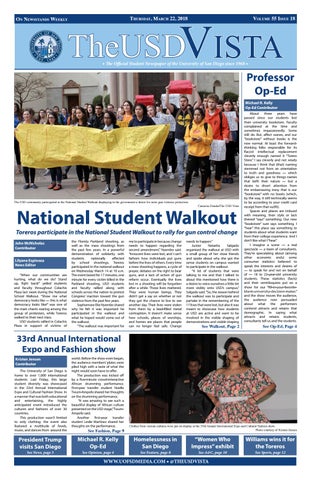
The USD community participated in the National Student Walkout displaying to the government a desire for more gun violence protection.
Cameron Fruehe/The USD Vista
National Student Walkout
Toreros participate in the National Student Walkout to rally for gun control change John McNicholas Contributor Lilyana Espinoza News Editor “When our communities are hurting, what do we do? Stand up, fight back!” yelled students and faculty throughout Colachis Plaza last week during the National School Walkout. “Show me what democracy looks like — this is what democracy looks like!” was one of the main chants roaring among the group of protesters, while Toreros walked to their next class. USD students rallied in Colachis Plaza in support of victims of
the Florida Parkland shooting, as well as the mass shootings from the past few years. In a powerful demonstration of solidarity with students nationally affected by school shootings, Toreros participated in the national walkout on Wednesday March 14 at 10 a.m. The event lasted for 17 minutes, one minute for every victim killed in the Parkland shooting. USD students and faculty rallied along with schools across the nation to protest Congress’ inaction toward the gun violence from the past few years. Sophomore Elie Nyembo shared why he felt it was important he participated in the walkout and what he hoped would come out of the walkout. “The walkout was important for
me to participate in because change needs to happen regarding the second amendment,” Nyembo said. “Innocent lives were lost, and I can’t fathom how individuals put guns before the lives of others. Every time a mass shooting happens, a cycle of prayer, debates on the right to bear guns, and a lack of action of gun reform occur. Eventually the lives lost in a shooting will be forgotten after a while. Those lives mattered. They were human beings. They didn’t get a say on whether or not they got the chance to live to see another day. Their lives were stolen from them by a lead-filled metal contraption. It doesn’t make sense how schools, places of worships, and homes are places that people can no longer feel safe. Change
needs to happen.” Junior Natasha Salgado organized the walkout at USD with a small group of her close friends and spoke about why she got the sense students on campus wanted to participate in the walkout. “A lot of students that were talking to me and that I talked to about this mentioned how there is a desire to voice ourselves a little bit more visibly onto USD’s campus,” Salgado said. “So, the reason behind the walkout was to participate and partake in the remembering of the 17 lives that were lost, but also it was meant to showcase how students at USD are active and want to be involved in the visible shaping of demonstrations and visible shaping
See Walkout, Page 2
About three years have passed since our students lost their university bookstore. Faculty complained at the time and sometimes impassionedly. Some still do. But, affect wanes, and our “bookstore” without books is the new normal. At least the forwardthinking folks responsible for its flaccid intellectual replacement cleverly enough named it “Torero Store.” I say cleverly and not wisely because I think that (that) naming stemmed not from an orientation to truth and goodness — which obliges us to give to things names that befit their nature — but a desire to divert attention from the embarrassing irony that is our “bookstore” with no books (which, by the way, it still technically seems to be according to your credit card receipt from that outfit). Spaces and places are imbued with meaning, their style or lack thereof “says” something. Our new “bookstore” sure says something. I “hear” this place say something to students about what students want from their college experience. And I don’t like what I “hear.” I imagine a scene — a real spectacle — a team of consultants. They’re speculating about (among other economic ends) some consumer statistics believed to speak the interests and desires of — to speak for and not on behalf of — 18 to 23-year-old university students. These statistics (facts) and their ventriloquists put on a show for our “fill-in-your-favoriteblank-university-decision-maker,” and the show moves the audience, the audience now persuaded about what the performers contend attracts and retains that demographic. In saying what attracts and retains students, consultants tell us and the students
See Op-Ed, Page 4
33rd Annual International Expo and Fashion show Kristen Jensen Contributor The University of San Diego is home to over 1,000 international students. Last Friday, this large student diversity was showcased in the 33rd Annual International Expo and Cultural Fashion Show. In a manner that was both educational and entertaining, the highly anticipated event introduced the cultures and fashions of over 30 countries. This production wasn’t limited to only clothing: the event also featured a multitude of foods, music, and dances from around the
President Trump visits San Diego See News, page 3
world. Before the show even began, the audience members’ plates were piled high with a taste of what the night would soon have to offer. The production was kicked off by a five-minute crowd-interactive African drumming performance. First-year transfer student Noelle Twum-Ampofo shared her thoughts on the drumming performance. “It was amazing to see such a beautiful display of African culture presented on the USD stage,” TwumAmpofo said. Another first-year transfer student Leslie Martinez shared her thoughts on the performance.
See Fashion, Page 9
Clothes from various cultures were put on display at the 33rd Annual International Expo and Cultural Fashion show. Photo courtesy of Kristen Jensen
Michael R. Kelly Op-Ed
Homelessness in San Diego
“Women Who Impress” exhibit
Williams wins it for the Toreros
See Opinion, page 4
See Feature, page 8
See A&C, page 10
See Sports, page 12
WWW.UOFSDMEDIA.COM ◆ @THEUSDVISTA
2
The USD Vista
◆
March 22, 2018
NEWS
Voices for gun control change Members of the USD community seek action against gun violence during 17-minute walkout
Walkout from Page 1 of conversations. It was meant to call out to our administration, to our teachers, and say we are here. We want to have a conversation. We want to do something about it. Now (faculty and administration) help us take care of that and actually lead us in that direction.” Students, faculty, and administration attended the event. Starting at the top of Colachis Plaza, the procession walked down toward the west side of campus ending at the Joan B. Kroc Institute for Peace and Justice’s front courtyard. The names of the Parkland victims were chanted out one by one, serving
those 17 lives (that were lost),” Salgado said. “As we were repeating their names throughout the march it was very difficult for us to maintain our composure. Not only were we saying these names and recollecting the fact that they are no longer with us, but we were also saying them with a group of students that were in solidarity with us.” Despite Salgado’s early estimate of about 50 people, a large turnout of more than 100 people attended to make their voices heard. Salgado described the main reason it was important to have this walkout on USD’s campus. “Our main intention with this was to make people feel hopeful and to make them feel that they
“There is hope for us and just because we are a private institution that has this stigma that we live in our little bubble, does not mean that should be a limitation for us not to support the community around us.” -Natasha Salgado as a reminder of the severity of the situation. The names of the victims were chanted and displayed on signs with their ages in bold letters. The visual of just how young these victims were demonstrated the tragedy of the massacre. Salgado reminisced on the emotions that flowed through her during the walkout. “There was already an overwhelming sensation of being distraught and in mourning for
had a voice,” Salgado said. “There is hope for us and just because we are a private institution that has this stigma that we live in our little bubble, does not mean that should be a limitation for us not to support the community around us.” One of the main messages conveyed at the protest was to encourage students to stay active beyond this singular event. The leaders and attendees of the walkout reminded all those present
to call their local representatives and vote to enact legislation that will allow for stricter gun control. It was important to participants at this event that this not be a failed movement to reform the gun laws. Public Safety officers and vehicles were deployed between the Immaculata Church and the KIPJ to ensure the safety of the demonstration. Sociology professor Jessica Magellan participated in the walkout and offered her perspective on student participation in protests on campus. “I believe it is very important for all people to be politically active in a democracy, but especially students,” Magellan said. “Students have been critical agents for change in this country for decades. I believe that part of determining your values and your voice is taking a stand on political issues. In higher learning your purpose is not just to learn and get a degree, it is also to discover who you are and what you have to contribute to our global community.” Few events of political activism take place on USD’s campus. Because of this, some students seemed very new to the idea of a protest. Magellan spoke about how she was happy to see the activism on USD’s campus. “I think the students that spoke and organized the event were very informed and passionate about the issue of gun violence and student activism,” Magellan said. “It also seemed to me that the students and staff there seemed to be ‘new’ to protesting/walkouts. I get the idea that USD does not have a
Sophomore Maya Ramirez spoke out as a voice for the USD community. Cameron Fruehe/The USD Vista
lot of visible activism and that is something I hope to see change in my time as a professor here.” After the protest moved from
“(The walkout) demonstrates that we have students who are committed to using their voices and votes to make our country safer, and that is something that should make us all very proud.” -Andrew Tirrell the Immaculata to the KIPJ, Salgado offered the megaphone up to any student or faculty participant who wanted to speak. Participants
Students wrote signs with the names of the victims from the Parkland shooting, as well as chanted those names during the walk across campus.
The USD Vista Tayler Reviere Verninas - Editor in Chief Elisabeth Smith - Associate Editor James Douglas - Managing Editor Kaia Hubbard - Copy Editor Rita Srekais - Art Director Max Escutia - Assistant Art Director
Lilyana Espinoza - News Editor Taryn Beaufort - Opinion Editor Celina Tebor - Feature Editor Nicole Kuhn - Arts & Culture Editor Anderson Haigler - Sports Editor Cyrus Lange - Photography Editor
voiced that gun violence and school shootings must come to an end. They stressed the importance of taking further action beyond
Editorial – 619.260.4584 Business – 619.260.4714 www.uofsdmedia.com ◆ @TheUSDVista Cameron Fruehe - Photo Assistant Douglas Horn - Distribution Manager Bailey Marie Donnelly - Finance Director Adnan Hassan Nouh - Advertising Manager Gina Lew - Student Media Advisor Marie Minnick - Operations Advisor
Cameron Fruehe/The USD Vista
the walk and contacting their representatives. The walkout concluded with a moment of silence for all the victims of the Parkland shooting. It was the beginning of a movement that’s goal is to incite national change, not just end 17 minutes after the start of the walkout. Andrew Tirrell, political science and international relations professor, said he felt proud after attending the walkout. “(The walkout) demonstrates that we have students who are committed to using their voices and votes to make our country safer, and that is something that should make us all very proud,” Tirrell said. “More than anything, I was very proud to see so many students ensuring that their voices are heard.” This display of activism on USD’s campus is unique and shows that students are willing to “stand up” and “fight back,” as the chants suggested. One of USD’s core values is the idea of being a “changemaker campus.” Students on this campus appear to want change and are willing to have their voices heard in order to achieve that goal.
The USD Vista publication is written and edited by USD students and funded by revenues generated by advertising and a student fee. Advertising material published is for information purposes only and is not to be construed as an expressed or implied endorsement or verification of such commercial venues by the staff or University. The USD Vista office is located on the fourth floor of the Student Life Pavilion in room 403B. All inquiries should be sent to: The USD Vista- SLP403B 5998 Alcala Park San Diego, CA 92110 The first copies of the newspaper are complimentary, all copies thereafter are a 25 cents charge. Opinions expressed in this publication are not necessarily those of The USD Vista staff, the University of San Diego or of its student body. Letters to the Editor can be submitted to The USD Vista office. Letters should be limited to 300 words and must be signed. For identification purposes, USD identification numbers and writer’s year must be included in the letter. The USD Vista reserves the right to edit published letters. Any content sent to the editor will be considered for publication unless otherwise stated.
◆
Volume 55 Issue 18
NEWS
◆
The USD Vista
President Trump’s visit to SD
3
Trump’s first visit to California since his presidency was greeted with protest
San Diego community members gathered together to protest Trump’s arrival to California in locations such as Waterfront Park.
Glenn McDonell Contributor Five miles to the west of the U.S.Mexican border wall, on a hill in San Ysidro overlooking the international border, stands Our Lady of Mt. Carmel Catholic Church, the site of one of the several protests which occurred in the San Diego area in response to President Donald Trump’s first visit as president to California. Last week, President Trump visited the San Diego area to inspect border wall prototypes in the morning before flying up to Los Angeles for a Republican Party fundraiser in Beverly Hills. Trump spoke with several military officials after arriving at the Marine Corps Air Station in Miramar and was then escorted by helicopter to Brown Field near the U.S.-Mexico border where the eight prototypes for a border wall stood on display, according to NBC San Diego. Brown Field is situated near Otay Mesa, one of two major commercial ports of entry between the San Diego and Tijuana urban areas. Sophomore and M.E.Ch.A. co-chair Daniel Rodriguez joined hundreds of others at the rally in the parking lot of the parish to protest Trump’s policies. “I personally wanted to go to the demonstration to show solidarity with the Dreamers and participate in the community,” Rodriguez said. “As someone who has the privilege of citizenship, I feel like it’s important to speak on behalf of our undocumented brothers and sisters who are forced to remain silent.” The gathering at the church was organized by the ACLU of San
Diego and Imperial Counties, and was the largest planned anti-Trump protest which occurred during the presidential visit, as stated by the Times of San Diego. “As we drove up, we noticed there were a lot of news groups surrounding the church and you could see a massive group of people,” Rodriguez said. “From where we were standing you could see all of the security surrounding Trump down at the border.” The event lasted several hours and featured speeches from multiple local policymakers, religious leaders, and union organizers, followed by an open-mic session which gave those in attendance a chance to make their voices heard. “A lot of people were going up to the podium and sharing their personal stories about how they have contributed to the U.S., and some of them even came out as undocumented,” Rodriguez said. “They talked about how they believe themselves to be American and how being American is much more than just a piece of paper — it’s what you carry in your heart.” Rodriguez traveled down to San Ysidro that morning accompanied by other members from the Mulvaney Center, where he works as a student leader in the Beyond Borders program. “A lot of the work we do is regarding immigration, so it was important for us to go down there and see what was going on,” Rodriguez said. “We’re always trying to see what we can do here on campus.” The Beyond Borders program through the Mulvaney Center provides students with the opportunity to visit Tijuana on
immersion trips designed to increase awareness of borderrelated issues. “A lot of people like to talk about the issues but many of them have never actually been down and witnessed these issues in action,” Rodriguez said. “It’s important to take students from USD down to the border to put a human face on the realities of what goes on.” While Rodriguez has chosen to make a difference through the Beyond Borders program, his fellow co-chair in M.E.Ch.A. and sophomore Krystal Alvarez has directed her efforts toward involvement in policy advocacy with the ACLU. She also organized student visits on campus in the past. “I started my work with the ACLU in September of last year with the Clean DREAM Act campaign and the protection of immigrant youth and communities,” Alvarez said. “Last semester, we were able to recruit 40 students from USD to attend a protest in Vista, to bring attention to the importance of saving DACA, and to canvass door-to-door to encourage people to call Congress.” Alvarez, who was not able to attend Tuesday’s protest because of work commitments, expressed her support for those who did. “I’m proud that young people are standing up for the undocumented and for DACA recipients,” Alvarez said. “We need to make sure that Trump knows that we haven’t given up the fight.” The demonstration in San Ysidro was planned to be far removed from any of the pro-Trump rallies closer to the border wall prototypes. According to the San Diego Union -Tribune, the San Diego Sheriff’s Department warned
University Operations and Parking Services would like to thank the 3,754 students, faculty, staff and administrators who provided feedback in the Mobility and Parking Survey. Congratulations to the winners of our iPad drawing: student Miranda Barfield and employee Claudia Gonzales!
Photo courtesy of Glenn McDonell
potential activists to stay off of the parcels of land surrounding the location of Trump’s border visit. This advisory along with the heavy amount of security forced both supporters and opponents to choose separate locations for their demonstrations. Nevertheless, some students felt safer staying away from the scene at the border entirely. Senior and founder of the USD chapter of Students for a Democratic Society (SDS) Eric Kraft did not attend any of the protests or encourage other members to do so because of safety concerns. “My comrades and I chose not to attend any of the protests because we had heard that security might be an issue,” Kraft said. “Fortunately for the protesters that went, these claims were unfounded.” While Kraft did not call upon the members of his group to attend the demonstration, he did express his position on the presidential visit. “I would like to say that I condemn in the strongest terms President Trump’s brutal assault on the rights of people trying to reach a better life in America,” Kraft said. “No human being is illegal.” According to their national website, SDS is a radical multi-issue organization that “leads campaigns to win change” and “builds people power in our schools and communities.” Opinions on Trump’s visit and issues surrounding the potential border wall were not limited to students in activist groups. Sophomore marketing major and law and ethics minor Riya Pandit studied ethical concerns in the realm of immigration policy and takes issue with the Trump
Administration’s agenda. “I absolutely believe that the administration is enacting a very regressive method of immigration policies,” she said. “This country was founded on the backs of immigrants and through the terrible treatment of the natives, and that’s something the administration seems to forget when it comes to modern-day immigration.” Pandit sees this disconnect between the realities of immigration and the Trump Administration’s agenda as something which USD students should actively speak out against. “We (USD students) are grassroots leaders who can make a difference in our communities when they’re hurting,” Pandit said. “It’s your duty not only as a citizen of the United States, but also of the world.” Alvarez expressed similar sentiments and believes that this duty also stems from privilege. “I have a lot of family members who are undocumented, and a couple of cousins who are DACA recipients, and this fight is for them,” Alvarez said. “I have to use my privilege as a citizen to be informed and inform others because the lives of those I love are at risk.” President Trump’s visit to California comes in the midst of an ongoing legal battle between topstate officials and the Department of Justice over policies which allegedly make the state and its municipalities into “sanctuaries” for illegal immigrants. Whether California is able to maintain immigration policies which contradict federal trends may depend on whether those who are legal citizens advocate on behalf of those who are not.
4
The USD Vista
◆
March 22, 2018
OP I N ION
Professor’s Op-Ed continued Professor Michael R. Kelly writes “The Embarrassing Irony Lurking Behind Our Great University” Op-Ed from Page 1 what students want. In giving us the idea of a “bookstore” without books these consultants have said that university students — our university’s students — do not find books important, do not (highly) value books. In giving us a “bookstore” without books, our decision-makers ratified that assessment and poured significant resources into the kind of “bookstore” university students — our university’s students — purportedly want. What these groups have agreed about in the saying is, in essence, that students want swag and gadgets, paraphernalia and devices — but not books. What they’ve said was said obliquely but means — I translate bluntly — that university students — our university’s students — do not prioritize their education among the other goods of their college experience. What these groups have agreed about in the saying is that university students — our university’s students — believe that one of the most necessary conditions for their education (books) are secondary to their college experience. What these groups have agreed about in the saying is, in essence, that their education itself is of secondary importance to their college experience. I do not believe that our students believe such things. Yet, our new “bookstore” stands there as a monument to the purported values of university students — our university’s students. This monument symbolizes paternalism masquerading as care (“We know what you want, we’re listening”). This monument symbolizes the infantilizing of our students, telling them that what they want isn’t the liberating power of books and ideas but toys and identity markers that double as advertising paid for by the consumer. This monument symbolizes condescension and pandering. Students should be insulted. And they should keep aware of the great losses begotten in and through this place that appears to be (but is nothing like) a bookstore. Think about a university with a “bookstore” with no books that likewise by its very structure denies access to the realm of the books. The books are now “sheltered in place” behind the Torero Store. Consider the meaning that emerges from such a place. There’s something ridiculous (literally) about the organization of this place, for we have quarantined the books! Seek (the) truth and (the) truth will make you sick. Does not this structure itself express that certain truism that we hide those parts of ourselves of which we’re ashamed? Stashed in the recesses of our UC (University Center), “sheltered in place,” the books are the bones of the skeleton in USD’s closet (we talk of ourselves as a family, after all). Consider further the process of ordering and collecting books
Photo courtesy of Walker Chuppe
at the start of each semester. The process is more efficient and convenient, I suppose. But, the process by which students acquire books for their courses systematically denies them access to the realm of the books. Students order their books at a distance and then arrive to the dispensary where a functionary of the state delivers the books to them — these allergens and pathogens now adequately sanitized. We cannot have students wandering about a place that may enchant and allure the mind, after all. They could stray off the path! Lose their way, like a child! Let us keep them from their wanderings and give them what they want from this experience — a more timeefficient process that affords more time to shop across the way for what they really want. Something quite fundamental and essential is lost in this arrangement, something without which we cannot form the lifelong learners we promise students they’ll become if they chose to spend some of their most formative years with us:
intellectual curiosity. The experience of wandering about a traditionally structured bookstore — its aisles upon aisles of different books for different courses and different books for the same courses with different sections — provides students with the opportunity — stunted by the structure of our current “bookstore” — to have their curiosity sparked. Waiting in line or moving along an aisle toward books for a course for one’s approaching semester, perhaps a student’s glance accepts a solicitation from the environment: a book on Taoism, another on the economics of elections, another on the history and culture of jazz, another on the virtues of nursing, and another and another and so on and so forth. The student may come to see things in her or his life about which she or he now has an interest where before there was none. Interest — inter-esse — to be among the things. A new world unfolds — at least a glimpse at it and maybe too the desire to travel to it and dwell in it. These environmental solicitations are
there because such affordances just are that environment (a traditional university bookstore). (Maybe a student in a traditional bookstore makes a note to look next semester for that course that uses that book on the economics of elections, or maybe she or he decides to take a different section of introduction to sociology because the texts for one course grab her or his attention over the texts for another.) Bookstores with books spark curiosity. Sometimes to be among the things — inter-esse — one needs to be among the things. A student in an online textbook shopping experience easily can avoid the experience I described above; indeed, the default position of the online textbook shopping experience is to avoid such wanderings. In taking the course that conforms most naturally to the online textbook shopping experience a student doesn’t have to pass by (courses in and books for) theater to get to theology, doesn’t have to pass by one section of introduction to communications to get to another
Photo courtesy of Walker Chuppe
section of that same course. No “browsing,” here. An opportunity to generate new interests is forfeited. An opportunity to unfasten oneself from the harness of schedules — or to choose courses no longer based only on schedules or preconceived paths — is missed. Worse, an opportunity for a student to become more discerning about the courses or sections of courses he or she will sit is missed. What are we doing here? Lost in this new arrangement are opportunities for students to foster intellectual curiosity, to become more self-determining, and to develop new interests. Lost, too, is the opportunity for students to become more discerning and deliberate about the classes they take on the way to — and as a part of — discovering who they want to be. If students should be insulted by the assertions made about what they want from their college experience, they should be angry that one of the very front lines of learning (the “bookstore”) itself — by its very structure — neglects and inhibits a central element of the learning process and college experience. Can you hear the potential responses — if they come? There might be some predictable, formulaic corporate speak telling us that the facts surrounding the loss of our old bookstore and the construction of our new “bookstore” don’t match my narrative, that I’m misinformed and I misinform, for there were no consultants, etc. A defense might be offered, a claim that insists that the intentions of the consulting agency and the deferential college committee that ratified their vision were nothing like those I speculatively express, that these meanings I attempt to express at best capture unintended consequences. Or, we might be told that bookstores are becoming obsolete. Maybe. I doubt it. But none of that would really matter. What matters is this: The symbols of our “bookstore” and its processes surrounding access to books remain, and their meaning transcends the facts about their origin. Facts don’t always exhaust the meaning. Books long have told us this. Michael R. Kelly USD Philosophy Department P. S. Faculty, be the change you want to see. Join me in not using our “bookstore” for your textbooks. For five semesters running, I’ve boycotted our “bookstore” without inconvenience to me or my students. Students, if your faculty will not do this, then you should buy your books elsewhere online. Your experience of book shopping won’t be diminished. Actually, other online book retailers provide recommended titles (although that technomarket construct (echo chamber) reinforces already narrowed perspectives and raises another problem for another time). I am certain that at least one student will be happily moved by what I’ve written.
Have an opinion? Write a Letter to the Editor to be considered for publication in The USD Vista. Contact vistaeditor@sandiego.edu for more information. The views expressed in the Opinion section are not necessarily those of The USD Vista staff, the University of San Diego, or its student body.
Volume 55 Issue 18
◆
OPINION
◆
5
The USD Vista
Insight on being a student-mom Along with being a full-time student, some Toreros have children to care for Tori Thomas Contributor Motherhood is often considered to be one of the toughest, yet most rewarding parts of a female’s life. Raising a child comes with its ups and downs, bringing new surprises along the way. Mixing that with the “on-thego” lifestyle of a student creates a tough balancing act. Some of the mothers at the University of San Diego discussed their struggles being both a student and a mother. Senior Paris Lowe, mother to a five-month-old baby girl, thinks that the stigma surrounding young pregnancy was the hardest part. “I feel like everyone would just stare at you,” Lowe said. “You don’t see a lot of pregnancy on USD’s campus. Once the baby’s here everyone’s asking about them, but when I was pregnant I definitely felt there was a stigma. The health center didn’t even know what to do. They said, ‘Sorry I haven’t dealt with something like this in years,’ so they have nobody well versed in pregnancy. Which is difficult, because then I have to go off campus for all my appointments during pregnancy.” USD’s Student Health Center states on their website that discrete pregnancy tests, parental counseling, and help with general health concerns are available, but the center has to provide referrals for obstetrical care. Lowe isn’t alone in feeling like she was treated differently on campus throughout her pregnancy. Senior Tiasha Rogers, mother to an eight-month-old son, agreed that being a younger mother changed the way her peers perceived her. “Especially being a young black mother, I felt it,” Rogers said. “People on campus assume a lot. They automatically assume I’m a single mother when I’m not. It’s funny to me, but it’s really sad. I also feel like I get counted out often. They assume because I’m a mother I will not be able to participate in certain things, which isn’t true.”
Senior and mother Paris Lowe poses with her smiling five-month-old daughter for a family portrait.
I’ve gotten the entire time I was at USD. I feel like I was really able to overcome all the adversity and proved myself.” Student mothers themselves aren’t the only ones who are aware of this prejudice. Junior Kaylynn Wilkes does not have children herself, but acknowledged the difficulty that comes with raising a child while being a student. She spotted judgmental behavior from her fellow students toward these younger moms. “People are like, ‘What the heck are they doing, they’re only 20,’” Wilkes said. “They kind of have this idea you can’t have a family and school at once. They have this idea that it has to go school, then career, then family.” USD offers various resources such as lactation spaces in Mother Rosalie Hill Hall equipped with chairs, plugs, and other necessities that can be reserved for breastfeeding or pumping
“The goal doesn’t change, the plan just does. He’s along for the ride now and I’m really trying to make sure he’s a part of the journey with me ... ” -Tiasha Rogers Rogers indicated she felt comfortable bringing her son everywhere on campus: to football games, classes, seminars — any place he is allowed in. She even brought him to meet President Harris at his annual Christmas Party last year. “I’m lucky I have such a good baby,” Rogers said. “It’s not hard to bring him class.” It may be easy to assume that having a baby while still being an undergraduate would take a toll on one’s academic life — but Rogers doesn’t let it. “I’m still capable of doing the things I did before he was born,” Rogers said. “I took a lot of leadership roles postpartum. I’m taking 18 units, I’m graduating in May still, and last semester I got all A’s, which are the best grades
mothers. The Women’s Center as well as Student Support Services (SSS) are available to assist with emotional support when they can. There is also the Manchester Child Development Center, located next to the Manchester Village Apartments, which acts as a daycare for the children of students and faculty. Manchester Child Development Center is currently open to the public, but there is no discount. Lowe and Rogers are both grateful for these resources, but raise a few concerns over the accessibility of them. “I didn’t know about most of them until I was pregnant,” Lowe said. “You have to seek them out for yourself, for sure. I started with Student Support Services and they referred me to the
Title IX coordinator for help with professors and classes, financial aid for help with paying for school, and the Women’s Center for volunteer babysitters.” Lowe also mentioned the USD Office of Financial Aid’s willingness to help her find housing on campus. As a non-mother, Wilkes commented on her lack of knowledge for support for mothers on campus. “I’m not aware of any resources for mothers except the daycare,” Wilkes said. “So if I were to get pregnant, I wouldn’t even know where to start looking. I would feel so lost.” Both Rogers and Lowe wish there were a more extensive support system for mothers on campus. But Rogers also shared her appreciation for her current support system. “It’s always nice to have mom friends, especially in your peer group, to have that kind of support,” Rogers said. “One of my advisors, Ophelia Augustine, was a student-mother and an alumni of USD and she is hoping to set up a network of them.” One of the difficulties Rogers faces being a student-mother is the lack of empathy she receives from some professors. “It’s really stressful when I have a professor who doesn’t understand, especially when I also have a husband who’s active duty,” Rogers said. “So sometimes I can’t be flexible going to certain meetings unless he (her son) can come along with me.” They also vocalized their concerns about the childcare on campus and how expensive it is. The Manchester Child Development Center’s monthly full-day attendance, Monday through Friday, is $1,271 per child. There are discounts for faculty and students; however, students receiving tuition remission do not qualify for the student rates. Other childcare facilities in the San Diego Area range from $760 to $900 per month.
Photo courtesy of Paris Lowe
President Harris holding Rogers’ son at the 2017 USD Christmas Party. Photo courtesy of Tiasha Rogers
When student-mothers have infant, finding a safe place for them to go can be difficult. Manchester does not accept children younger than the age of two years old into their program. “It would be nice to have adequate child care, no matter the age of the child, so you can continue to thrive on campus without that conscious awareness and worry about if your baby is okay,” Rogers said. “It would be really nice to know your baby is in good hands.” Lowe echoed this sentiment, in that she wishes there were more resources to help young mothers find daycare options. While Rogers has different responsibilities than most undergraduates, she has kept a
positive outlook and has been able to keep her focus. “The goal does not change, the plan just does,” Rogers said. “He’s (her son) along for the ride now and I’m really trying to make sure he’s a part of the journey with me, so he never has to worry about whether he was a burden for me during my undergraduate experience.” With limited resources, money, and time, it can be difficult to be a student-mother on campus. While there are some resources on campus, the hope is that USD improves their commitment to helping these women who choose to continue on their educational path. Despite these hardships, the consensus is they their children have changed their world.
Have an opinion? Write a Letter to the Editor to be considered for publication in The USD Vista. Contact vistaeditor@sandiego.edu for more information. The views expressed in the Opinion section are not necessarily those of The USD Vista staff, the University of San Diego, or its student body.
6
THE USD VISTA
◆
MARCH 22, 2018
Volume 55 Issue 18
◆
FEATURE
◆
7
THE USD VISTA
Celebrating Women’s History Month As an undergraduate population ruled by women who make up 54 percent of the student body, there is no shock that the University of San Diego is celebrating Women’s History Month, which is called Womxn’s Herstory Month at USD. With 500 more women than men undergraduates at USD, women hold a lot of representation on campus, but are still working to push for more. However, women both inside and outside of USD still have to fight for leadership positions and work to disassemble harmful gendered stigmas. The month of March is Womxn’s Herstory Month and this year’s theme at USD is “We are Here: Community at the Intersections.” Find out some ways to participate in Womxn’s Herstory Month and learn about some powerful women on USD’s campus.
Ways to get involved: Donate menstrual products to the ‘donate. period.’ campaign. All donations go toward Generate Hope. Donation boxes are located in: Women’s Center (SLP 420) Outside Tu Mercado Missions Crossroads Palomar Every Womxn’s Herstory Month on-campus event
Kristina Medina, Program Officer of Joan B. Kroc Institute for Peace and Justice
“It’s hard to imagine that many people still believe that a woman’s place is barefoot and pregnant in the kitchen. It’s even harder still to imagine that some people believe that women are property — to be used, sold, and abused at their leisure. For these individuals, Women’s History Month is an important reminder that many people around the world believe something different. And whatever she chooses, she should not have to fight her way to equal pay for equal work — it should be expected. It should be commonplace.”
On celebrating women beyond Women’s History Month:
“I think it’s critical to pay attention to the #MeToo movement. The privilege that people in power think they have — whether it’s in a doctor’s office, on Capitol Hill, or on a stage — over people who are working for them is ludicrous. I encourage anyone who has experienced this to be loud and courageous and speak up about the injustice. Seek help, seek guidance, and seek support. Because you are not alone.”
Nothing Bundt Feminism Meetings are held every other Friday from 1:30 - 2:30 p.m. in the Women’s Center (next meeting is 4/13)
Evelyn Kirkley, Ph.D., Professor of Theology and Religious Studies, Director of Women and Gender Studies minor
On why studying gender is important:
“I think it’s really important to study gender so that men aren’t considered universal humanity. When we look at how different social norms apply to women, it’s definitely different. So I think looking at women’s and men’s roles in society is really important, because I think it’s really dangerous to see women as not men or men as not women. So, masculinity and femininity are not polar opposites — it’s not a binary.”
On how gender roles affect the way people are perceived:
“Hillary Clinton ran for president. She’s a bitch. She’s a loud-mouth. She’s strident. And so she clearly, in many ways, stepped out of the roles that women are supposed to play. And what happens if a man wears nail polish? If a man wears a skirt? If a man wears high heels? He is immediately ridiculed, usually called a pussy, assumed that he is gay. There are social penalties for stepping out of the prescribed gender norms.”
On how Women’s History Month could be improved:
Photo Courtesy of Evelyn Kirkley
“It would be great to bring speakers on campus, it would be great to talk about contemporary issues. There has been very little talk about sexual assault and how that is brought down. Powerful, political, and media figures. I would love to talk about, ‘What is it like to be a woman (in a nontraditional role)?’ So I think there’s a lot of ways that Women’s History Month could be more visible and could truly be a hallmark of the university and a way that it distinguishes itself as a truly changemaker university. By giving more attention to powerful women, and powerful men. I have no difficulties with having a Men’s History Month, as long as we’re looking at what masculinity is.”
“I come from a long line of incredibly strong women. My mom’s favorite tool is a chainsaw and my grandma wore pants as a young girl when everyone else was wearing skirts. I also come from an incredibly amazing group of men who have always supported me in fulfilling my dreams. Not only do I hold a full-time position at USD, but I am a small business owner and a single mom of two amazing daughters. Where I come from, women are powerful.”
On women’s roles in society:
Sexual Awareness Assault Week, April 9 - 13 April 3 - 6: Self Care & Solidarity Space, Open all week in UC Exhibit Hall April 10: Take Back the Night, starts at Plaza Mayor and ends at KIPJ, 6:30-8:30 p.m.
Reach out to the Women’s Center to find more ways to get involved in Womxn’s Herstory Month and beyond!
Why Women’s History Month is important to her:
Photo courtesy of Kristina Medina
On why women’s leadership is important:
“When women get to hold those formal positions on campus, they get a lot of skills they wouldn’t have gotten otherwise. Kinds of conflict resolution, being authoritative and decisive — which are things we’re not normally taught to be — are really beneficial. And they’re things that I’ve grown into on this campus, especially in working with a lot of male students as my counterparts.”
Kate Burnite, Sophomore, Panhellenic President
On the struggles of being a woman in an executive position:
“As women, we’re told that in a leadership or powerful position, you’re either too submissive or you’re too aggressive. There’s not really a happy balance in leadership positions. So I want women on this campus to start feeling comfortable with being dominant and being active about the things that (they) care about.”
On why Women’s History Month is needed:
“There is a really overarching stigma that women don’t need to build from where we are: that we have the formal types of equality, that we have rights in all the legalistic ways. But Women’s History Month very clearly shows that we’re building off the hundreds of years of struggles of women of color, still working.”
On how sorority plays a factor in women’s history:
“(Gamma Phi Beta) partners with Girls on the Run, which focuses on getting elementary and middle school girls and helping them through those kinds of activities. It’s running, but it’s running with leadership building and confidence building, especially in the early stages. Alpha Chi Omega does domestic violence awareness. So helping build that confidence for women to leave abusive relationships. And, you can really see how passionate they are about changing these things. There are always sorority women working with the Women’s Center, working with the Nothing Bundt Feminism events.”
Photo courtesy of Kate Burnite Spread by Rita Srekais; Content by Celina Tebor/The USD Vista
8
The USD Vista
◆
March 22, 2018
F E AT U R E
“Tony” shows homelessness in SD Director and protagonist of movie about homelessness in San Diego speak at screening at USD Kevin Klein Contributor The Changemaker Hub premiered “Tony” on March 12 at Warren Auditorium with the help of communication studies professor and Associate Director of the Center for Educational Excellence Kristin Scialabba, and Omar Passons, who is a candidate for County Supervisor. “Tony” was premiered to educate Toreros and attendees on the topic of homelessness and how to take action in order to reduce San Diego’s homeless population. “Tony,” filmed and directed by Dennis Stein, features the day-today life of Tony Rodriguez, who is currently homeless in San Diego. Stein filmed Rodriguez’s daily life to document the struggles that plague San Diego’s homeless population. During a Q&A session at the end of the premiere, Rodriguez discussed being constantly harassed by police to move his tent and personal belongings. He has to abide by laws, that according to him, are unfair and make him feel that being homeless is illegal in San Diego. Each location where he lays down his belongings and sets up his tent has mandated days and hours which prohibits homeless people from settling there. If a homeless person does not have a good reason to be on the street, a citation may be given or they can be jailed for six months. “When every time (a) bicycle cop tells you to move along, but doesn’t tell a ‘normal’ person to move along, but he tells you to move along, it’s like another nail in the coffin for your self-esteem,” Rodriguez said. “You feel less human.” Shelters such as Father Joe’s Villages and the Alpha Project in downtown offer beds and food to those who are homeless. Stein said many homeless people do not utilize these resources even though they are readily available to them. Homeless shelters offer food and beds on a first-come, first-serve basis. Rodriguez tried many times to take advantage of those resources but now prefers not to. “We can get (homeless people) into Father Joe’s or Alpha Project tonight,” Stein said. “But, most people don’t want to go to those shelters because they’re not pleasant places to go to or to be in.” Rodriguez said he avoids shelters because of long wait times for food, high levels of noise when he tries to sleep, theft, and policies that add to his anxiety. There are point systems at some shelters and after three points, a person can be kicked out with all their belongings back onto the street. He stated if he doesn’t make his bed properly, leaves clothes out, or breaks a 10 p.m. curfew, he receives points that may land him back on the streets anyway. “I’d rather be on the streets,” Rodriguez said. “There are thieves at the shelters. (They’re) not a nice place to be.” The jailing of homeless people after numerous citations is problematic for reducing the homeless population. People like Rodriguez, who are going through steps to attain permanent housing, are unable to make progress on
“Tony” follows the life and documents the struggles of Tony Rodriguez (pictured above), who finds himself homeless in San Diego. Photo courtesy of Dennis Stein
housing applications while they are jailed and focused on surviving for the day. “There are days I just want to die,” Rodriguez said. “I’m just beat down. I don’t know if I want to be in society. Even if I took the great courage to get a job, I can’t be functional anymore. I want to be functional.” He mentioned he has hope despite the hardships in his life. “I want some meaning in my life,” Rodriguez said. “But, my life isn’t over… I’m alive.” Every day, Rodriguez collects recyclables and returns them for cash deposits and rummages through dumpsters outside of commercial buildings to find items he can resell to thrift stores. After the premiere ended, Stein stated that he filmed the movie because he wanted to bring light to a topic that has many stigmas around it. He described how his investigation through “Tony” unveiled how to reduce, or end homelessness in San Diego by transplanting policies that are in effect in other cities across the United States. “What San Diego needs is outreach workers who go out and help somebody through the process (of acquiring permanent housing),” Stein said. The Regional Task Force on the Homeless (RTFH) is a not-forprofit organization whose goal is to prevent homelessness in San Diego and to alleviate problems there. Stein acknowledged that while these organizations are well-intentioned, they are not doing enough. Outreach to assist homeless people is often done by police, which Stein does not see as beneficial. Additionally, he believes that a portion of people remain homeless because they do not know what resources are available to them. Stein recommended that RTFH add additional outreach workers and service providers to their organization. “The outreach needs to be done by members who aren’t police,” Stein said. “Also, because homeless people don’t trust police, since they’re getting harassed by them. In many cities and regions around
the country, there are social services workers who are employees of different social services providers who will spend time on the streets, and get to know the (homeless) people and learn to trust (the social service workers).” Stein is an advocate for revamping RTFH’s outreach efforts to become more efficient in reducing homelessness rates, rather than applying “band-aid” solutions. “The Regional Task Force (on the Homeless) knows we need this,” Stein said. “They’re doing a lot of work to try to make this happen and to provide more funding for that, and to train those service providers on how to do that.” Stein interviewed Chief Operations Officer at RTFH Tamera Kohler and asked when San Diego would see more outreach workers on the streets. She stated that RTFH is waiting for additional funding but assured him that the organization is doing everything they can with the resources that they currently have. Kohler stated that she is aware of the lack of social service workers at the organization and currently is less efficient in long-term reduction of homelessness, but is committed to making necessary changes. On film, Rodriguez broke down in tears and mentioned how other city’s efforts in ending homelessness reinvigorated his hope for the future. When the movie premiere finished, the USD community rejoiced once they saw Rodriguez walk on stage in Warren Auditorium with Stein and Passons. Rodriguez was asked to reflect on his statement that he felt beat down, to mentioning later in the movie that he had a renewed sense of hope for himself and the homeless community. “Thank you for caring,” he said. “I’m amazed when people care, because people haven’t cared in a very long time. So, thank you.” Rodriguez explained to the audience that being treated differently because he’s homeless wears down his self-esteem and confidence, so he was very excited and emotional seeing the USD audience concerned for him and showing the will to help reduce the homeless population in San Diego. Activism was the main topic of
discussion during the Q&A after the premiere finished. Dr. Mike Williams, director of the Changemaker Hub, asked Rodriguez what students and faculty can do to help end homelessness in San Diego. “I think you have to find your own thing that you do best,” Rodriguez said. “The main thing really, is to call your representatives. To (send them) letters, and to ask them if they’re (going to) support (ending homelessness).” Rodriguez passed the microphone to Passons for comment during the Q&A. “Speak with your vote,” Passons said. “There is an election on June 5, it is as important as the November election. Waiting until the general election lets people choose your candidates for you.” Passons continued to implore the audience to get involved in the voting process, and also to become lawmakers themselves. The candidate for County Supervisor mentioned that voters will have the opportunity to vote in favor of a $900 million housing bond that will fund organizations to provide the homeless with permanent homes. “It is critical that students realize they have power both now at the voting booth,” Passons said. “(Students should also) volunteer on campaigns — and, down the road to run for public office to fight for change … we need to get engaged, and our system desperately needs young people who don’t want to wait for important changes.” The University’s mission statement calls for the “advancing (of ) academic excellence,” as well as, but not limited to “prepar(ing) leaders who are dedicated to ethical conduct and compassionate service.” Williams called on the essence of compassionate service on campus. “The movie is incredibly powerful; I believe this is a movie that we could, and should show each semester,” Williams said. He called for the USD community to continue their involvement in social activities and developmental projects. “(‘Tony’) raises so many important issues, and with so many great events happening at USD, it is sometimes difficult to get students,
faculty, and staff to attend.” Associated Students (AS) and a group of other USD students organized a food service called Pancake Peeps which was created to feed the homeless community in Downtown San Diego. The food service is a volunteering opportunity that USD students participate in that Williams encouraged students to continue to be involved in. It is hosted at 9:30 a.m. on 14th and K. St. near Petco Park, every Saturday morning. “For many years, there has been a growing awareness on campus about the issue of homelessness,” Williams said. “There have been a number of student and faculty projects that have been created to address this issue. The film ‘Tony’ challenges all of us to not only think about the issue of homelessness, but to take action as well.” Williams directed students who want to get involved in communal services to the Changemaker Hub. “The Hub is one resource on campus where students, faculty, and staff can share ideas and think of innovative ways to address this complex issue,” Williams said. The issue of homelessness continues to be an issue for the government, and for private citizens to effect change. It is a complex issue and there is more information to learn about how to help reduce the homeless population through simple efforts, where to volunteer, how to directly participate in policy change, and general information to avoid stereotyping.
Homelessness statistics in San Diego (2017) 9,116 people were counted living on streets or in shelters, a 5 percent increase over the year before More than 60 percent of homeless people were unsheltered San Diego County ranked as having the fourthlargest homeless population in the nation Homeless population has increased from 8,742 in 2015 to 9,116 in 2017 Source: Regional Task Force on the Homeless *Estimate (Daniel Wheaton / UT), San Diego Union-Tribune
Volume 55 Issue 18
◆
ARTS & CULTURE
◆
The USD Vista
A RT S & C U LT U R E
9
A night around the world
USD’s international students host 33rd Annual International Expo and Cultural Fashion Show
Representing the country Mexico in a traditional dress. Photo courtesy of Noelle Twum-Ampofo
ISO from Page 1 “I liked the first performance because it was able to showcase their skills and their outfits as well as represent their country,” Martinez said. The drumming duo acted as a prelude to the rich culture that
Sophomore Mayamiko Matabwa representing Malawi Arianna Farha (left) representing Morocco, Jasmeen Bains Photo courtesy of Noelle Twum-Ampofo (middle) representing India, and Alex Khan (right) representing Pakistan. Cyrus Lange / The USD Vista
traditional berets of France. Lastly the show arrived in Asia and the Middle East, where the models flaunted the eccentric silk patterns and bold colors home to the area. First-year Sidney Tookes described what it was like to represent the country of Pakistan. “I loved that I got to celebrate
“I had a really great time meeting new people, learning the cultures and putting myself out there.” - Rosalinda Puentes would follow, as the bright textiles of the region strode down the runway. The countries showcased in this portion of the show included Kenya, Ivory Coast, and Nigeria, among others. Before each country began their descent down the runway, there was an announcement explaining what each model was wearing and the context in which that outfit would traditionally make its appearance. The show made its way to
the diversity while showcasing it,” Tookes said. Most countries included a variety of models of outside ethnicities. This was a huge hit not only for the audience, but also among the backstage presence. USD alumna Nhi Vu and her husband Arusi Santi represented Vietnam and spoke about the event. “It was awesome to see the inclusivity and all of the countries being represented,” Vu said.
“India has been a really big part of my life and I was happy to show USD my part of heritage.” - Sashi Chhabra Central and South America, where students exhibited the flowing fabrics of the Latino heritage. One of the models representing Colombia, first-year Rosalinda Puentes, gave her insight on the experience. “I had a really great time meeting new people, learning the cultures, and putting myself out there,” Puentes said. The audience found themselves on a tour of the European countryside as the show made its way from the beautiful dirndl dress of Germany to the
“There was an Indian student representing Scotland and that was awesome. I loved the feeling and energy backstage because it was so happy,” Santi said. Sophomore Irina Nadong gave her thoughts as well. “I like how each culture had a variety of individuals representing them,” Nadong said. The show ended with a bang as a Bollywood dance performance took the stage. Sophomore Riya Pandit was a dancer in the production. “Our Bollywood dance team
The event inclucded a professional performance by African drumming groupw Teye Se Thiosanne Afican Drum & Dance Company. Photo courtesy of Noelle Twum-Ampofo
was able to perform in the ISO and this all came from just an idea over Skype, and it’s so great to finally see it in action,” Pandit said. First-year student Sashi Chhabra was also a part of the Bollywood dance team. “India has been a really big part of my life and I was happy to show USD my part of heritage,” Chhabra said. During a time in which strong political divides might present an image of an unwelcoming America, it was heartwarming to witness Toreros happily exchanging cultural sentiments. Seeing the apparel for the different countries around the world was both informative and eye-opening. Students of all races and ethnicities came together to share their culture with one another in a way that was inspiring for all. The next ISO Expo and Cultural Fashion show will be next spring.
Rita Srekais/ The USD Vista
10
The USD Vista
◆ March 22, 2018
Women in printmaking
Katelyn Allen presents printmaking collection, “Women Who Impress: Women Printmakers”
Katelyn Allen’s exhibit is located in the Humanities Center in Serra Hall and will be on view until April 6.
Nicole Kuhn Arts & Culture Editor Senior Katelyn Allen explores feminism through the arts in her exhibit “Women Who Impress: Women Printmakers.” She explained hat printmaking is the art or technique of producing an image through the process of printing. “‘Women Who Impress: Women Printmakers’ from USD’s collection is the product of my involvement in a year-long research fellowship,” Allen said. “As a 2017-2018 Keck Undergraduate Humanities Research Fellow for USD, I had the opportunity to spend a year researching a scholarly topic that I found intriguing. As an art history major, I am particularly interested
directions for future acquisitions here at USD,” Allen said. In Allen’s exhibition brochure she expanded the story behind her work. “‘Women Who Impress’ is a story, one that seeks to embellish the admittedly short history of collecting work by women printmakers at USD,” Allen said. “While the collection started small, it has grown exponentially in the last few years, thanks primarily to the generous support of donors and an over arching strategy on the part of those who have endeavored to diversify the collection specifically by seeking more work by women printmakers.” The exhibit ultimately shows feminism in the world of art through its display of artwork. Allen said that the once male-
Growing up her passion was looking at colorful and dynamic works of art that inspired her to create the exhibit. “I was a big fan of Henri Matisse’s work, as well as the work of Roy Lichtenstein and Gustav Klimt, for the very reason that they were brimming with color and texture,” Allen said. “This gave their work a sort of dynamism and sensuousness, and looking back I think I tried to capture this same feeling with ‘Women Who Impress.’ Walking in, one is initially struck by the work of Sybil Andrews, June Wayne, and Jaune Quick-toSee Smith. While each work tells a unique story and is dynamic and engaging in its own way, together they exude a special liveliness.”
Nicole Kuhn/ The USD Vista
Allen said creating the energy around this exhibit was important to her because she wanted viewers to walk away feeling impacted by the work. “I wanted the community to feel that they had witnessed something extraordinary and powerful — that is, the coming together of women’s voices, many of which have been silenced or absent throughout much of art history,” Allen said. “By creating a space to celebrate the lives and achievements of women printmakers, I hoped that I could lend their stories greater importance within the USD community.” Allen stated she received positive feedback from the
community regarding her exhibit. “Whether or not the project was a success, and I believe it is, I think USD is just really excited to see students engaged in research that they feel so passionate about,” Allen said. “What I’ve learned makes for a successful project is the enthusiasm and energy one has to continue to grow and reconsider their own ideas and beliefs. We all fail. We all make mistakes, but in the end, all that we can do is try and learn from our mistakes so that we can transform them into future successes.” After graduation, Allen plans on taking a gap year and will apply to graduate programs to continue her education in art history. Allen’s exhibit will stay open until April.
“I wanted the community to feel that they had witnessed something extraordinary and powerful, that is, the coming together of women’s voices, many of which have been silenced or absent throughout much of art history.” - Katelyn Allen in the intersection between art and gender studies. I am also very interested in the medium of printmaking, and so with this project, I decided to combine my two passions by researching women printmakers from USD’s collection of prints and drawings.” Allen, who has been on a year-long journey working on the exhibit, began her research in early 2017 for the university as a Keck Undergraduate Humanities Research Fellow, which is a research program set up for students to explore scholarly activities and creative work. This year she is featuring her very own exhibit which is located in the Humanities Center in Serra Hall. Her work for the exhibit explores three main themes which Allen explained in further detail. “The aims of the exhibition were to pay homage to women printmakers and the significant contributions they have made to the history of the graphic arts, to celebrate how far we’ve come in cultivating a strong and diverse collection of works by women printmakers, and to inspire new
dominated world of printmaking has made progress for women with how they are now able to fully participate in the graphic arts. “‘Women Who Impress’ is thus intended to offset some of the lack of recognition that women printmakers have received throughout art history by creating a space for their voices to be heard and for their achievements to shine,” Allen said. She explained that her dedication to art began at a young age. “I’ve been passionate about art for as long as I can remember,” Allen said. “Growing up, I always looked forward to trips I would take with my mom to different museums. However, it was not until my senior year of high school, when I took my first art history course, that I became really passionate about art history and the possibilities of leading a career as a museum curator.” Allen considers herself more as an artist historian — someone looking at the history and development of visual and material culture — than an artist.
Senior Katelyn Allen, who is majoring in art history, hopes to continue her education in art history after graduation. Photo courtesy of USD University Galleries
Volume 55 Issue 18
◆
SPORTS
◆
11
The USD Vista
SP ORT S
Padres poised for year of growth A look ahead at the Padres’ 2018 season as they inch closer to being contenders
Anderson Haigler Sports Editor While the San Diego Padres may be a couple years away from being contenders, Friar fans have a lot to look forward to this year. From a big free-agent signing to must-see prospects, the Padres are working their way to success this offseason, though the immediate on-field results may not show it. This season will be telling for the Padres as their young talent must continue to develop if their rebuild is to proceed as planned. They will look for Manuel Margot, Hunter Renfroe, and Austin Hedges to build on their 2017 campaigns, while Wil Myers will attempt to return to his 2016 All-Star form. Nearly every position on the field is either up for grabs or has multiple players vying for the starting job, creating compelling battles for roster spots across the diamond. Perhaps the most interesting area of the Padres’ roster this year is their outfield. The team has a surplus of talent, which has led to a potential shakeup for the team in this regard. Only centerfielder Manuel Margot is really guaranteed a spot. He posted a .263 batting average with 13 home runs and 17 stolen bases last year in his first full season in the big leagues. His balanced, contact-heavy approach at the plate combined with his defense projects him to be a keystone player in the Padres’ near future. If all goes as planned, this season should see him raise his batting average while maintaining his speed on the basepaths. What is more uncertain is who will play on each side of Margot. Hunter Renfroe, a 26-year-old right fielder, is also entering his second full season in the majors, but his future with the team is more muddled. Renowned in San Diego for his prodigious power — he hit multiple balls over the Western Metal Supply building on his way to 26 home runs last season — the rest of his game has left something to be desired. Batting just .231 on the year, he struck out 140 times while working just 27 walks. In addition, his throwing arm, while powerful, has been prone to inaccuracy. It’s clear that Renfroe has the tools to be a solid major league player, and with just one full major league season under his belt it’s too early to write him off. However, Renfroe will need to make major adjustments this season to maintain his spot on the Padres’ roster. Come Opening Day, though, Renfroe will most likely be in right field for the Friars. In left field, the Padres will feature a newcomer of sorts to the outfield: Wil Myers. With the acquisition of freeagent first baseman Eric Hosmer, Myers will now move back to where he started his career. Myers, who was the American League Rookie of the Year in 2013 as an outfielder, will play corner outfield this season to accommodate Hosmer. Myers stated in interviews that he is onboard with the move, and will do whatever the team asks of him in order to win games.
Freddy Galvis, Eric Hosmer, and Jose Pirela wrap up batting practice during spring training in Peoria, Arizona. All three are expected to be major contributors this season. Photo courtesy of @Padres/Twitter
Concern regarding Myers, though, may be better placed in his approach at the plate. Myers, like Renfroe, showed good power last year, but struggled to maintain a high batting average. Myers batted .243 with 30 home runs and 74 RBIs, and this season will look to return to his 2016 form, a year in which he batted .259 with 28 home runs and 94 RBIs. The biggest story of the Padres’ infield this offseason has been the signing of Eric Hosmer. The former Kansas City Royals first baseman brings a disciplined approach at the plate, great defense at a corner infield position, and proven leadership with a championship pedigree to the Padres. After a contentious offseason of deliberation, he was signed to the largest contract in Padres history: an eight-year $144 million dollar contract. Hosmer, a career .284 hitter, is coming off the best season of his seven-year major league career, a season in which he hit .318 with 25 home runs and 94 RBIs. At 28 years old, he said in an interview that he is looking forward to being a positive presence in a young Padres locker room, and he should provide a sense of leadership that the team has desperately lacked in recent years. Second base also provides an exciting battle between two young players. Carlos Asuaje posted a solid season last year, batting .270, and it seemed that he had set himself up well to be a starter in 2018. However, with the Padres’ recent logjam in the outfield, journeyman utility player Jose Pirela has forced his way into the second base conversation with a strong spring that comes after a stellar 2017 season. Pirela led the Padres with a .288 batting average last season, and is batting a blistering .436 this spring with two home runs. Though Pirela has historically been without a consistent position during his time with the Padres, he has slugged his way into the lineup, and will likely challenge Asuaje for the
position come the regular season. Shortstop is one of the only positions on the diamond that is somewhat finalized for the Padres. They signed former Philadelphia Phillies shortstop Freddy Galvis to a one-year $6.83 million dollar deal in the offseason, and he is expected to be the Padres’ shortstop for at least the 2018 season. Though he does not represent a long-term solution at the position for the Friars — highly touted prospect Fernando Tatis Jr. is expected to be Padres’ shortstop of the future — he will serve as the Padres’ latest stopgap up the middle as their young prospect matures. Third base presents yet another set of tough choices for San Diego. While they have a serviceable short-term solution in Padres-retread and major-leagueveteran Chase Headley, Christian Villanueva has shown significant upside at the hot corner. In 12 games in the majors last year, Villanueva slugged at a .344 clip with four home runs, and has continued his success in spring training this year, batting .297 with three home runs in 37 games. Which of these two players will see more playing time this season remains to be seen, but once again, young talent has forced the Padres into hard decisions
regarding the starting lineup. Behind the plate, however, the Padres’ future is clear. Catcher Austin Hedges has quickly established himself as one of the league’s premier defenders at his position in his three big league seasons. Like many of his young counterparts, though, he has work to do on his approach at the plate. Batting just .214 with 18 home runs last season, he showed promising power, but struggled with his batting average. While the Padres don’t need as much production out of him as they do out of Myers and Renfroe, he will need to increase his production for the Padres to be a complete team. Veteran lefty Clayton Richard will anchor the Padres’ starting rotation, and is set to be their Opening Day starter. Young righties Luis Perdomo and Dinelson Lamet also seem to have spots locked down, but the remainder is unclear. Perdomo and Lamet have significant upside, with Perdomo showing flashes of brilliance pitching to contact utilizing his sinker, and Lamet proving his skills with a devastating fastballoffspeed combo. The Padres’ current rotation, however, is a mix of stopgap measures and developing talent, and will likely limit the team’s
Wil Myers will look to continue his success in the outfield in 2018.
success as they wait for the rest of the pitching prospects to reach the big leagues. As far as the bullpen goes, the Padres locked down crafty all-star lefty Brad Hand, signing him to a three-year, $19.75 million dollar contract extension in January. Hand, the Padres’ lone all-star last season, will look to continue his success as he comes off of a career year in which he posted a 2.16 ERA in 72 appearances. His presence should bolster the Padres out of the bullpen, and he will likely be the Padres’ closer for the foreseeable future. From top to bottom, the Padres have a plethora of young talent that is on its way to being a formidable squad out of the National League West. While the Padres have a ways to go before they are truly ready to win, their roster provides a lot to look forward to this season as they continue their march to contention.
PADRES OPENING DAY: Thursday, March 29 1:10 p.m. Petco Park Tickets: Padres.com TV: Fox Sports San Diego
Photo courtesy of @Padres/Twitter
12
The USD Vista
◆
March 22, 2018
Williams wins it for the Toreros USD battles for a dramatic, 67-64 victory over Portland State University in the CIT
Junior guard Tyler Williams shoots a go-ahead three pointer for the Toreros as time expires in the game. Williams was mobbed by his teammates in celebration after the shot. Left and middle photos courtesy of Anna Scipione; right photo courtesy of Thomas Christensen
Anderson Haigler Sports Editor On a day that is often associated with luck, University of San Diego men’s basketball found themselves in a tough spot. With just 26 seconds to play, the Toreros were tied 64 to 64 with Portland State University in the second round of the CollegeInsider.com Tournament (CIT). They needed a basket, or perhaps a stroke of luck, to win the
Though USD eventually came out on top, Portland State had them on their heels a bit early. Utilizing a full-court press, the Vikings stifled the Toreros’ offense while jumping out to an early lead. By the halfway mark of the first half, USD trailed by 12. As the half continued, though, the Toreros seemed to find their groove. Eight first-half points from junior Olin Carter III brought USD to within two, moving the score to 28-30 in favor of the Vikings.
“It was a rewarding feeling. Especially, you know, just continuing to play with this team in March, is just a great feeling within itself.” -Tyler Williams game and continue their season. Saturday night, however, USD didn’t need luck. They had Tyler Williams. As time expired, the junior guard caught a pass from redshirt junior Isaiah Wright, pulled up, and drained a three pointer to earn the Toreros a 6764 victory on Saint Patrick’s Day.
Acting head coach Sam Scholl spoke about how his team worked to overcome Portland State’s defensive approach in the first half. “We did it just by catching, staying on balance, not getting the ball over our head, and coming and meeting passes,” Scholl said. “We were just being
Isaiah Wright dribbles around defenders. He had the assist on the last play of the game. Photo courtesy of Thomas Christensen
solid with everything. That was the game plan, the guys got a little rattled, but then just settled down and stayed steady.” As USD pulled closer, though, the game began to slow down for both teams. Staunch defense on both sides created a nearly twominute-long scoring drought, and neither team appeared to be able to break through as they fought for momentum heading into halftime. The Toreros would remain on the wrong side of things, going into the break trailing by nine. As the Toreros came out for the second half, they appeared to have continued to make adjustments on offense. They came out of the gates hot, and quickly took a 43-42 lead on Olin Carter III’s three pointer after just five minutes of play. The second half saw USD build upon that lead behind a collaborative effort on offense. With four of their five starters scoring 12 points or more, the Toreros moved the ball effectively as the game went on. Scholl stated that he was pleased with his team’s balanced approach on offense. “When we play connected like that, and everyone’s sharing the ball — whoever’s open just looking to score or trying to find the open man — we’re tough to stop,” Scholl said. The Vikings, however, did not go down without a fight. Coming into the game with a 20-13 (9-9 conference) record that is nearly identical to that of the Toreros, they represented as even of a match for USD as there could be, and it showed down the stretch. They prevented USD from expanding their lead to more than five points as the game wound to a close before battling back to tie it at 64 with 1:13 to play. That tie would set the stage for the Toreros’ biggest moment of the season. Tyler Williams grabbed a rebound after a stop on defense, and quickly dished it to Isaiah
Wright. As Wright dribbled down the court and navigated his way through defenders, the crowd at the Jenny Craig Pavilion (JCP) rose to their feet in anticipation of a USD shot at victory. Wright sent a pass to Williams, who quickly caught and got the shot off without a pause. As the ball swished its way through the net, the Toreros as well as the crowd at the JCP erupted. Williams, however, only offered a sly smile, and held up three fingers as his teammates mobbed him and the celebration unfolded around him. Leaving just half a second on the clock, Williams’ near-buzzer beater locked up the game for the Toreros, leading them to a dramatic 67-64 victory. After the game, Scholl described the final play as
game on an 0-5 streak shooting, his coach stated that he had faith in him to take the last shot of the game. “We told Tyler, ‘Just keep shooting,’” Scholl said. “He was 0-4 in the first half, and we just told him, ‘Hey buddy we believe in you, you’re a great shooter, just keep shooting.’ It doesn’t matter if Tyler misses three, four, five shots, he’s a shooter, he’s worked so hard to improve as a shooter, and he’s got such strong will. He wanted that shot, and we knew it was going down when he took it.” As for the game as a whole, Scholl emphasized his team’s ability to stay poised under pressure. “We just had to stay the course,” Scholl said. “One of our keys to this was to just stay steady, stay steady. They’re a team of runs — they’re
“He wanted that shot, and we knew it was going down when he took it.” -Sam Scholl it
unfolded in front him. “Isaiah Wright just made an under-control, greatbasketball read and play to find our great shooter in the wing in Tyler, who was ready to knock it down,” Scholl said. Scholl said that he had a feeling Williams would make the shot. “When it left his hands, I knew it was going in,” Scholl said. Williams described his feelings on the experience. “It was a rewarding feeling,” Williams said. “Especially, you know, just continuing to play with this team in March, is just a great feeling within itself. So, knowing that I helped my team further the process is just a rewarding feeling.” Though Williams wouldn’t go as far as his coach did to call his shot, he did say that the ball felt good leaving his hands. “Oh yeah, always,” Williams said. “Even when I miss, it feels good.” Though Williams began the
a heck of a basketball team, so they’re gonna make runs, we had a couple of sloppy turnovers, but we just didn’t panic, we just stayed steady through the whole deal.” The Toreros’ relatively lowscoring victory was a contrast to their offense-filled win in the first round of the CIT. Williams described the Toreros’ overall approach and how that resulted in the game. “We built this program on our defensive identity, and we knew right away that if we wanted to win a game, we were gonna have to win it with our defense,” Williams said. “It was all about us staying steady regardless of the runs that we go on, whether it be good or bad.” The Toreros’ victory over the Portland State Vikings advances them to the next round of the CIT. They will take on the University of Northern Colorado Bears in yet another home game at the Jenny Craig Pavilion on Wednesday, March 21 at 7 p.m.