TheUSDVISTA
Volume 55 Issue 11
Thursday, December 7, 2017
On Newsstands Weekly
◆ The Official Student Newspaper of the University of San Diego since 1968 ◆
Toreros come up short
Volleyball, football, and basketball struggle through a disappointing weekend
Point guard Isaiah Wright and the men’s basketball team struggled to find the bottom of the net in a 66-57 defeat at the hands of crosstown rival San Diego State. See page 18. Walker Chuppe/The USD Vista
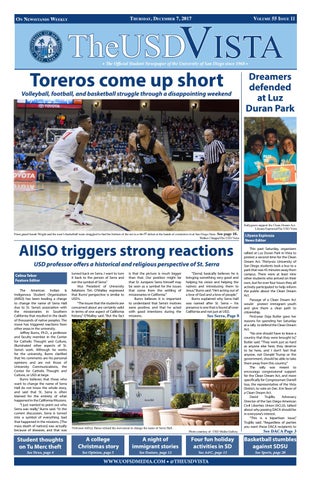
AIISO triggers strong reactions USD professor offers a historical and religious perspective of St. Serra
Celina Tebor Feature Editor The American Indian & Indigenous Student Organization (AIISO) has been leading a charge to change the name of Serra Hall due to St. Serra’s association with the missionaries in Southern California that resulted in the death of thousands of native peoples. The move has triggered reactions from other areas in the university. Jeffrey Burns, Ph.D., a professor and faculty member in the Center for Catholic Thought and Culture, illuminated other aspects of St. Serra’s work. Although he works for the university, Burns clarified that his comments are his personal opinions and are not those of University Communications, the Center for Catholic Thought and Culture, or USD at large. Burns believes that those who want to change the name of Serra Hall do not know the whole story, and said that St. Serra is often blamed for the entirety of what happened in the California Missions. “I just wanted to point out who Serra was really,” Burns said. “In the current discussion, Serra is turned into a symbol of everything bad that happened in the missions. [The mass death of natives] was actually because of diseases, and that was
Student thoughts on Tu Merc theft See News, page 4
turned back on Serra. I want to turn it back to the person of Serra and not the symbol of Serra.” Vice President of University Relations Tim O’Malley expressed that Burns’ perspective is similar to USD’s. “The issues that the students are concerned about are certainly valid in terms of one aspect of California history,” O’Malley said. “But the fact
is that the picture is much bigger than that. Our position might be that St. Junipero Serra himself may be seen as a symbol for the issues that come from the settling of missionaries in California.” Burns believes it is important to understand that Serra’s motives were positive, and that he acted with good intentions during the missions.
Professor Jeffrey Burns refuted the movement to change the name of Serra Hall.
“[Serra] basically believes he is bringing something very good and helping his vision and helping the natives and introducing them to Jesus,” Burns said. “He’s acting out of a love of God and a love of people.” Burns explained why Serra Hall was named after St. Serra – his presence is one that is found all over California and not just at USD.
See Serra, Page 8
Photo courtesy of USD Media Gallery
Dreamers defended at Luz Duran Park
Rallygoers support the Clean Dream Act. Lilyana Espinoza/The USD Vista
Lilyana Espinoza News Editor This past Saturday, organizers rallied at Luz Duran Park in Vista to protest a second time for the Clean Dream Act. Thirty-six University of San Diego students took a bus to a park that was 45 minutes away from campus. There were at least nine other students who arrived on their own, but for over four hours they all actively participated to help inform the public about the Clean Dream Act. Passage of a Clean Dream Act would protect immigrant youth and give them a clear path to citizenship. First-year Deja Butler gave her reasons for spending her Saturday at a rally to defend the Clean Dream Act. “No one should have to leave a country that they were brought to,” Butler said. “They work just as hard as anyone else here, they deserve to be here, and I don’t feel that anyone, not Donald Trump or the government, should be able to take them away from this country.” The rally was meant to encourage congressional support for the Clean Dream Act, and more specifically for Congressman Darrell Issa, the representative of the Vista District, to vote on Dec. 8 in favor of a Clean Dream Act. David Trujillo, Advocacy Director of the San Diego American Civil Liberties Union (ACLU), talked about why passing DACA should be in everyone’s interest. “This is a bipartisan issue,” Trujillo said. “Regardless of parties you want these DACA recipients to
See DACA Page 3
A college Christmas story
A night of immigrant stories
Four fun holiday activities in SD
Basketball stumbles against SDSU
See Opinion, page 5
See Feature, page 12
See A&C, page 13
See Sports, page 20
WWW.UOFSDMEDIA.COM ◆ @THEUSDVISTA
2
The USD Vista
◆
December 7, 2017
NEWS
Travel abroad for a dual degree USD has partnered with international universities to offer an 11-month degree in business
Tyler Arden Contributor For many students, the thought of adding a second major to their degree is a daunting one. However, through a new program offered by the University of San Diego’s School of Business, some students are taking their education to the next level by graduating with a dual degree from an international university. Last year, the School of Business launched an Undergraduate International Dual Degree Program in collaboration with USD’s International Center. Associate Provost for International Affairs Denise Dimon, Ph.D., explained the intrigue that accompanied the introduction of the program. Dimon equated the reaction to the shock that students had when they discovered they could study abroad for a full semester decades ago. “It is a new concept,” Dimon said. “Our students, when they first heard about it were like, ‘Oh, we can do that?’” The Undergraduate Dual Degree Program was introduced in 2016 as an opportunity for students to spend one to two years at an international — partner school and earn a degree from both universities. For students like sophomore Jessica Chen, participating in a program that fits well with her major seemed like an easy decision. Chen will spend two years abroad at John Cabot University in Rome starting next semester. “This program came out, and I was like, ‘Sure why not do it,’” Chen said. “I’m an International Business major, so it’s good to explore other parts of the world and see what I can do in the future. I think that if you’re an International Business major it’s something you want to do because that’s the purpose of international business.” Dimon said that dual degree programs are more popular in Europe where students have more mobility between schools through the structure of the education system. “They make it very easy for students to move from one university to another,” Dimon said. “Part of that mobility are these dual
degree programs where students in a four-year university would spend two years at one university and two years at another.” Dimon explained that these dual degree programs are largely able to work because of a way of counting credits earned in introductory, corelevel courses that students take. “They double-count those credits to meet the degree requirements,” Dimon said. “It’s no different in some ways to things we do here if someone is a transfer student. That’s the idea of the dual degree, although they end up with two degrees where each university is transferring the other’s [credits] so students are meeting the degree requirements of two places but not having to repeat [courses].” As associate provost for International Affairs, Dimon always looks to add and strengthen partnerships that provide more opportunities for USD students to gain international exposure. When the university was approached by the International Partnership of Business Schools to be the only West Coast school with membership in the organization, they jumped on the opportunity. The biggest opportunity came from having a strong network to lean on in implementing such a unique program that most people in higher education across the U.S. haven’t experienced. “It was very beneficial for us because we took the collective knowledge of these universities that were already doing dual degrees,” Dimon said. “It’s not like you have to do something on your own. We really are pioneering something, and having the collective wisdom of the partners to help guide us of what works and how we can advise is a great resource.” From that inclusion in the International Partnership of Business Schools, Dimon explained that the International Center took the knowledge they could glean from that network to reach out to other international schools where USD already had longstanding partnerships to expand the program. Currently five schools participate in the program. If this new opportunity is like a symphony, Dimon would be the conductor. In orchestrating
such a complex and untried program, cooperation between administrative staff in every role from financial aid and the registrar to admissions is needed. Dimon said that arranging such collaboration is largely fostered by USD’s focus on study abroad opportunities. “It takes a lot of cooperation across campus for this to happen,” Dimon said. “The devil is in the detail to make it work and hopefully work smoothly for the students. Nothing’s worse than getting ready to graduate and not be, so we don’t want that to happen.” Common to students like Chen who are participating in the program is a willingness to enter into some sense of ambiguity as the university irons out program details. As an offering that isn’t largely tried in the U.S., that ambiguity comes from stepping into an unknown experience with unestablished processes. Such variables are not holding them back from the prospects of the initiative, though. “I’m an international student myself, so I like to get out of my comfort zone,” Chen said. “I felt like it was time to start a new environment.” Another student participating in the program is sophomore Olivia Perry. As part of her experience, she will spend two years abroad at Universidad Pontificia Comillas in Madrid. Unlike classes at other partner schools, all of Perry’s classes will be taught in Spanish. It contributes to her goal to become fluent in Spanish, though it requires stepping out of what she’s comfortable with. “To be honest, I feel pretty proud of myself for going outside of my comfort zone and trying something no one from USD has done yet,” Perry said. “It is both exciting and nerve-wracking participating in the dual degree program. It’s exciting to work with the advisors and be the first person take part in such an incredible opportunity. However, it can be stressful when you are the first person in a program and the people supporting you are still figuring out how things are going to play out.” International Studies Abroad Coordinator Derek Brendle explained the creation of any international experience is largely
One option for the dual degree program is the Universidad Pontificia Comillas in Madrid, Spain. Screenshot courtesy of @Salterrae_GLC/Twitter
Schools Partnered with USD for new Dual Degree Program: EM Strasbourg Business School Strasbourg, France Dublin City University Dublin, Ireland John Cabot University Rome, Italy Católica Lisbon School of Business & Economics Lisbon, Portugal Universidad Pontificia Comillas Madrid, Spain based on getting feedback from students to determine what works best. With the establishment of such a large and unique program, a focus on gathering student feedback and working out issues is especially a focus. “These are some of our first students,” Brendle said. “It’s going to be very useful for us as advisors to get some sort of feedback to see how we can better prepare them. Really just to get the ball rolling, it is largely based on that feedback from students.” It’s something that students involved in the program have realized about the logistics that come with such a program, but something they accept. “Preparing for the program has been a huge learning experience, not just for me but for everyone involved as well,” Perry said. “Figuring out all the different aspects and dealing with the different challenges of moving abroad for two years has been challenging at times, but I’m grateful to have had the chance to learn about how the process works.” The biggest challenge expressed by those in the International Center will be growing the program and getting students interested in the prospect. Dimon said that while the partner schools already have their five students to send over as part of the exchange from Europe where dual degrees are more common, USD has not met that goal. Currently only four sophomores are set to participate in the program across the five international schools. International Studies Abroad Coordinator Alana Thomas said that while interest has grown from the previous year, they don’t anticipate the program reaching tremendous success until students begin to return and see the results of the
program. “It seems like there is a larger group of students that are interested than last year, and we hope that it continues to gain traction,” Thomas said. “We hope that students will return to USD with this amazing experience that they can then share with other USD students and hopefully get that word of mouth to spread. For our programs really that’s how you gain a bigger following.” The program is also limited only to underclassmen who participate because of the time constraints of earning a dual degree. Brendle explained how eventually the program will be incorporated as a consideration for prospective students before they even apply to USD once the program gets a foothold. “Unlike a study abroad program where you can decide as a sophomore, junior, or later, this is something that students need to decide very early,” Brendle said. “I think in the future it’s going to be a bigger part of the admissions process and even included in campus tours.” Dimon hopes to find extended opportunities to many students as time progresses. “I do hope and see that we’ll have more opportunities across many majors for this to happen in, though the business school is the first to pioneer this opportunity,” Dimon said. Ultimately, Dimon and the International Center have high expectations riding on the success of the dual degree initiative. Long term, they want to continue to pioneer the program within the U.S. and expand both in terms of enrollment and offerings to students.
◆
Volume 55 Issue 11
NEWS
◆
3
The USD Vista
Toreros rally in support of DACA Over 40 USD community members participated at a rally in Vista to pass Clean Dream Act
DACA, from Page 1 remain, to have protection, and you want the Dream Act to pass.” Trujillo recently became a U.S. citizen back in May and said he was happy to have so many people come out to support the cause. “It’s great to see so many young people involved advocating for their rights and advocating for their neighbors’ rights,” Trujillo said. Junior Ayodeji Bandele, before coming to Luz Duran Park, woke up at 7:45 a.m. to drive to Palomar College and give a presentation to a room of local DACA recipients and families on why this issue is so important to him. “I gave a presentation about why I wanted to be an ally, how I got involved, and what it means to me to support my neighbors,” Bandele said. “It is what you do.” Bandele further explained why
consisted of going out into the community and interacting with the voters who have an influence on passing the Dream Act. Sophomore Elia Aguirre explained what she did during the time before the rally took place. “We just spent most of the day canvassing,” Aguirre said. “We were going from door to door, leaving pamphlets and information, speaking to registered voters in the community, and asking them to please call their representative to press them to give support on this very important issue. This is to make sure we have a clean path to citizenship for undocumented youth.” In order to increase visibility of the event, rallygoers stood on the corners of streets and held signs to lead people to the rally and at times answered questions from bypassers about DACA.
encourage them to get involved.” Dr. Juliana Maxim, Architecture Program Director, professor, and an immigrant herself, was also a participant at the Clean Dream Act
to a safe harbor without fear of deportation and with full human rights including not only safety but housing, healthcare, employment, and happiness,” Maxim said. “That is
“Obviously there is a limited effect in just showing your body, but you need to have the people here know that you care about them and will show up when they need you.” -Ayodeji Bandele rally. “I feel very personally about the right of all human beings
enshrined in our Constitution.” Fifteen minutes before the rally, a line of USD students held signs
and chanted as they walked back from standing on street corners to show their support. Once the time for the rally came, at least 300 people gathered around a podium to hear stories of those affected from fear of deportation. There were tears shed, inspirational stories told, and a community that stood together in support of the same cause. Students are taking action to show their support for the passing of a Clean Dream Act and will continue to do so until March. It is in March when Congress will make their final decision on the issue of DACA.
“It’s great to see so many young people involved advocating for their rights and advocating for their neighbors’ rights.” -David Trujillo his actions did not stop at Palomar College, because he then traveled to Luz Duran Park for the rally. “It’s about showing solidarity, support, and doing what you can do,” Bandele said. “Obviously there is a limited effect in just showing your body, but you need to have the people here know that you care about them and will show up when they need you. That’s what being in a community is about. The way we can show that is action, showing up, being there, and I’m prepared to do that.” The first few hours of the event
First-year Alanah Winston was part of the group that participated in visibility. “We walked up the street to a very busy intersection and we all covered the four corners,” Winston said. “We had our posters and our chants and we basically wanted to advertise for passing the Clean Dream Act. We wanted to get the attention of the congressman, Issa, so that he would know this is what his people want. We had a couple people come ask us questions about it so we were able to really explain, help them understand, and
Rallygoers share their stories of why DACA is important to them and why Congress should pass the Clean Dream Act. Lilyana Espinoza/The USD Vista
Over 40 USD students participated in the Clean Dream Act rally held at Luz Duran Park in Vista.
The USD Vista Tayler Reviere Verninas - Editor in Chief Elisabeth Smith - Associate Editor Kelly Kennedy - Managing Editor James Douglas - Copy Editor Kaia Hubbard - Assistant Copy Editor Rita Srekais - Art Director Max Escutia - Assistant Art Director
Photo courtesy of Krystal Alvarez
USD students marched from the streets to the protest, chanting for the safety of DACA. Lilyana Espinoza/The USD Vista
Editorial – 619.260.4584 Business – 619.260.4714 www.uofsdmedia.com ◆ @TheUSDVista
Lilyana Espinoza - News Editor Nicole Kuhn - Assistant News Editor Taryn Beaufort - Opinion Editor Celina Tebor - Feature Editor Anderson Haigler - Arts & Culture Editor Noah Hilton - Sports Editor Walker Chuppe - Photography Editor
Cyrus Lange - Photo Assistant Ana Contreras Orozco - Photo Assistant Alex Worden - Distribution Editor Bailey Marie Donnelly - Finance Manager Adnan Hassan Nouh - Advertising Manager Gina Lew - Student Media Advisor Marie Minnick - Operations Advisor
The USD Vista publication is written and edited by USD students and funded by revenues generated by advertising and a student fee. Advertising material published is for information purposes only and is not to be construed as an expressed or implied endorsement or verification of such commercial venues by the staff or University. The USD Vista office is located on the fourth floor of the Student Life Pavilion in room 403B. All inquiries should be sent to: The USD Vista 5998 Alcala Park San Diego, CA 92110 The first copies of the newspaper are complimentary, all copies thereafter are a 25 cents charge. Opinions expressed in this publication are not necessarily those of The USD Vista staff, the University of San Diego or of its student body. Letters to the Editor can be submitted to The USD Vista office. Letters should be limited to 300 words and must be signed. For identification purposes, USD identification numbers and writer’s year must be included in the letter. The USD Vista reserves the right to edit published letters. Any content sent to the editor will be considered for publication unless otherwise stated.
4
The USD Vista
◆
December 7, 2017
NEWS
Tu Mercado thefts questioned Students continue to share thoughts on the thefts taking place at Tu Mercado
Nicole Kuhn Asst. News Editor When 12 o’clock hits at the University of San Diego, a mob of hungry students floods Dining Services. Everywhere from Tu Mercado to La Paloma to Aromas, Toreros experience long wait times of 10-15 minutes. Not only are long lines something that students complain about, but also the high prices of food products like grab-ngo sandwiches and fruit cups. The long wait times and prices have led to theft across campus, particularly in Tu Mercado and La Paloma. With the issue at hand Donald Godwin, Vice President of Student Affairs, discussed ethical conduct on campus. Godwin expressed that based on the reports received that
students may be required to have a Critical Issues Board hearing. CIBs are comprised of a faculty member, and administrator, and a student. CIBs have the potential for suspending or expelling students.” Senior Dominique Rougeau believes that price contributes a lot to the issue of theft. The price adds up especially when students are on campus all day, balancing classes and eating breakfast, lunch, and dinner. With the budget of a college student Rougeau added that budgeting can be challenging, especially when a majority of students’ days are spent on campus. “For instance, with the new Aromas, everyone was excited when it opened, but that was definitely one of the first things that I noticed is the hike in prices a little bit,” Rougeau said. “Especially the food
“When students are alleged to have violated the Student Code of Rights and Responsibilities, they are required to engage our student conduct process.” -Donald Godwin theft has in fact not increased. But when a student is caught stealing on campus and reported to Public Safety, the student must go through a hearing. “When students are alleged to have violated the Student Code of Rights and Responsibilities, they are required to engage our student conduct process,” Godwin said. “The student conduct process is administered by the Office for Ethical Development and Restorative Practices. Depending on the nature of the alleged violation, students may meet with an Assistant Dean of Students for an administrative hearing. This is a one-on-one meeting between the student and the Assistant Dean of Students. If the alleged violation is egregious,
items more so than the drinks I’d say. I do think it’s tough.” On a recent retreat with other San Diego universities, Rougeau compared USD’s food prices with those she had heard from students at San Diego State University. “I haven’t talked about this topic much,” Rougeau said. “But just recently I went on a retreat through USD and there was a lot of SDSU people there. I got into a couple conversations with students about how even their prices are high and a lot of those students at [SDSU] as well struggle with purchasing food as often as they’d like to.” In an effort to bring prices down, Dining Services provides lunch specials at different locations across campus such as at La Paloma, where
students can purchase a lunch sandwich and a drink for five dollars to combat with this particular issue. Some students have been led to believe that a part of tuition covers Dining Services — this misconception might encourage some to steal. But in an article published by The USD Vista in the last issue, Loryn Johnson, Director of Marketing at University of San Diego’s Auxiliary Services, debunked this myth. Auxiliary Services solely funds and supports themselves to provide food on campus for students. Acknowledging the high prices, Johnson said she and other administrators continue to work to create healthy options on campus such as kombucha and hummus cups. But theft isn’t just happening at Tu Merc and La Paloma. As a residential assistant (RA) Rougeau also noticed theft in the residential areas and has heard a few stories about theft happening on her own floor at the Vistas. “Recently, too, as an RA I’ve heard theft come up in laundry rooms from missing laundry baskets to laptops,” Rougeau said. “Which is disappointing. And I’ll be honest, I’ve been really surprised this semester alone of more stories coming out about theft. Especially my first two years, I wasn’t very aware of theft or at least I wasn’t hearing that many stories about it. I don’t know if it’s just being talked about more now or if it is just more a thing that’s happening now compared to a few years ago.” Senior Julie Lai agreed that some of the prices are expensive and that the issue of theft is something you hear quite often. But it doesn’t just happen at lunch time. “We hear a lot about theft on campus — people break into cars and things like that,” Lai said. “But I think because people think that USD is generally an affluent campus
people will generally leave their stuff around all the time like laptops in libraries. So the thing is, people are stealing from different places, which I don’t have a full understanding of
why that happens.” With the high prices and long lines in mind, Dining Services continues to find new ways to combat these issues.
Tu Mercado thefts are discussed by students and administration. Walker Chuppe/The USD Vista
Volume 55 Issue 11
◆
OPINION
◆
5
The USD Vista
OP I N ION
A college Christmas story Toreros share how they continue to celebrate the Christmas season during finals Taryn Beaufort Opinion Editor Perry Como sang it best, “There is no place like home for the holidays.” Some University of San Diego students may agree with Como, but instead most will be studying away for finals until Dec. 22 — only three days before Christmas Day. This however does not interfere with USD students’ ability to celebrate the holiday season. Junior Andie Zaharias-Kern, from Northern California, can’t help but feel nostalgic for her family’s Christmas traditions she misses while in school. She shared how she feels about getting out for winter break so late and not being able to spend time at home. “It is disappointing that’s for sure,” Zaharias-Kern said. “However, I still do almost everything I would do at home, but there are some things that just are not the same. We have an Advent calendar where my mom puts little gifts in for us everyday and we have an elf on the shelf that moves around every night to tell Santa if we were good or bad. Could you imagine if I filled my own Advent calendar and moved the elf for myself? No, that would just be ridiculous.” Even though Zaharias-Kern would rather be at home for the month of December, she has discovered new ways to bring a little bit of home to San Diego. “It is definitely different when I am at home with a fireplace and our stockings, the Christmas tree with the ornaments, and all that stuff,” Zaharias-Kern said. “But I try to watch the same Christmas movies as I would at home and I try to listen to the same Christmas music constantly.”
Being on her own for the month leading up to Christmas has allowed Zaharias-Kern to develop some traditions of her own to compensate for the ones she is missing from home. “Christmas is my favorite time of year, so you bet I’m going to bring Christmas to my schoolhome,” Zaharias-Kern said. “I always get a Christmas tree, a wreath, and lights — those three are key. This year, my roommates and I have a night planned to decorate the tree and Christmas-ify our apartment. It’ll make it feel a little more like home.” Zaharias-Kern believes that any student can still engage in Christmas activities despite being away from home. “It’s just the little things,” Zaharias-Kern said. “Like for me, it’s making cookies with dough already made. You can have a hot chocolate party with friends, you can make a gingerbread house, have a Christmas party where everyone has to wear an ugly sweater. You can choose to celebrate Christmas.” Senior Madison Samuels is fortunate to live close enough to USD that she can drive back anytime she wants to enjoy the comfort of her own home in Orange County. “It’s a bummer we get out so late but I’m not too bothered by it because I can still go home on the weekends to enjoy my family’s Christmas tree and decorations in the meantime,” Samuels said. “I’m lucky in that way. But what about other students who live on the East Coast or international students? They don’t have that same luxury to just pop in at home.” Samuels mentioned USD’s effort to make the campus more festive for students and faculty.
This year, USD put a Christmas tree in the middle of the Paseo de Colachis Plaza overlook for students to enjoy. Walker Chuppe/The USD Vista
Within the past week USD has enhanced the campus aesthetic with holiday decorations and a lighting ceremony for the tree in Paseo de Colachis Plaza overlook. “I think they [USD] do a wonderful job decorating the campus,” Samuels said. “It looks so magical with the lights, wreaths, and Christmas tree. All they need to do now is play Christmas music around campus.” Students don’t have to stick around campus to engage in holiday-themed activities. Samuels said the city of San Diego offers lots of options. “Last year I went to the December Nights at Balboa Park and I highly recommend it,” Samuels said. “It’s really festive and it’s free so it’s something easy for all students to go to.” Now that Samuels has her own apartment, she takes advantage of the opportunity to make traditions of her own. “My roommates and I are going
to get a real Christmas tree and decorate it with ornaments and lights,” Samuels said. “Having a real tree really makes all the difference. You know, every morning I wake up to the fresh smell of a Christmas tree and I don’t feel like I am missing out on so much.” Senior Payton Dwight finds that enjoying the Christmas festivities can be a little more difficult when away from his NorCal home. “I used to feel the festive spirit a bit more when I was home for a longer period of time leading up to Christmas,” Dwight said. “I would help pick out the tree, eat a chocolate from the advent calendar every morning, watch Christmas movies, and just enjoy the various decorations at home. I could do much of this here [at school], but it’s not quite the same without my family, and I’m also too lazy.” Dwight believed that the short gap in between the end of finals
and Christmas Day leaves little time to enjoy the season. “Christmas can feel abrupt when we’re taking finals all the way up until the twenty-second,” Dwight said. “I just created a Christmas radio station on Pandora and have been enjoying some Mariah Carey and Bing Crosby to help me get in the spirit.” As he gets older, Dwight realizes the importance of taking time to celebrate on his own. “Make the most of it [Christmas],” Dwight said. “We’re young adults now and it is our responsibility to keep the spirit of Christmas alive. Enjoy the magic of the holidays and spread good tidings.” Being at school is probably not the most ideal way for students to spend the month leading up to Christmas. However, with a little planning and motivation Toreros can still celebrate the most wonderful time of the year despite having classes.
USD invited Christmas carolers to attend their tree lighting to bring more holiday cheer to campus. Some students choose to decorate their apartments with Christmas decorations to make it more festive. Kelly Kennedy/The USD Vista Walker Chuppe/The USD Vista Have an opinion? Write a Letter to the Editor to be considered for publication in The USD Vista. Contact vistaeditor@sandiego.edu for more information. The views expressed in the Opinion section are not necessarily those of The USD Vista staff, the University of San Diego, or its student body.
6
The USD Vista
â—†
December 7, 2017
De-stress with colorful images On behalf of The USD Vista, we wish you the best of luck on finals and a Happy Holidays. Take a break from studying to color in our page.
Rita Srekais /The USD Vista
Rita Srekais /The USD Vista Have an opinion? Write a Letter to the Editor to be considered for publication in The USD Vista. Contact vistaeditor@sandiego.edu for more information. The views expressed in the Opinion section are not necessarily those of The USD Vista staff, the University of San Diego, or its student body.
Volume 55 Issue 11
◆
OPINION
The USD Vista
◆
Toreros’ late start to Christmas
7
Some students upset with being let out late for winter break and want the schedule revised Taryn Beaufort Opinion Editor The holidays are quickly approaching and University of San Diego students seem ready to enjoy them, but there is one little catch — students will still be in the midst of finals. This year school will conclude for winter break on Dec. 22, only three days before Christmas. Toreros had mixed reactions regarding the finals schedule. Junior Tia Phillipart remained neutral on the topic and did not question the university’s break schedule. “I believe it is just part of the semester system and what is needed for the curriculum,” Phillipart said. “Since we start the semester in September, it only makes sense that we get out a little bit later in December so there is enough time for us to be in school.” Phillipart acknowledged the benefits of getting out for break so late in December because it means
the long break allows students to take advantage of various opportunities. “It’s nice because USD offers intersession classes during our break too,” Phillipart said. “Students can take that extra class they need, or USD offers study abroad programs during Intersession too.” During the winter break there is a three-week period called Intersession during which USD offers classes on campus or students can choose from several study abroad programs. “The study abroad programs during Intersession are a great option for those students who don’t want to be abroad for a whole semester,” Phillipart said. “I have lots of friends who have done it in the past and they would always come back saying that it was the perfect amount of time — they highly recommend it.” On the other hand, junior Jazmin Gonzales was dissatisfied with how late USD gets out for winter break. “I don’t like getting out so late for winter break,” Gonzales
“I feel like I don’t have enough time to celebrate the holidays with my family or even get into the holiday spirit due to stress of finishing the semester strong.” -Ava O’Brien a longer break in the winter for the students. “I enjoy having almost a whole month off in January; it’s worth being in school so late in December,” Phillipart said. “I go snowboarding in January and it’s nice since everyone is back in school [and] it’s not very busy. I also like having that time to go visit friends at other schools.” USD’s winter break lasts from Dec. 22 to Jan. 28 — a total of five weeks. Phillipart believes that
USD December 2017 S
M
T
said. “I don’t have enough time to visit my friends who are home for the holidays or go Christmas shopping. I have to pack all of these things into a very short period of time, which makes the holidays super chaotic. I just don’t get to enjoy them as much.” Many students who take an intersession course, like Gonzales, don’t have much downtime in between finals ending and intersession courses starting. Gonzales said the current break
Some students attended a festive, on-campus event to enjoy the holidays, despite still being in school for most of December. Kelly Kennedy/The USD Vista
UCSD
Semester System W
T
Gonzales also believes that getting out later compared to some other schools is not only frustrating, but can also lead to distractions while preparing for finals. “It’s hard for me to focus when Christmas is just around the corner and all my friends are already home enjoying their break,” Gonzales said. “My friends will constantly call me to hang out, but meanwhile I’m in school writing term papers and studying. I can’t help but check my Snapchat and Instagram to see what I am missing out on.” Senior Ava O’Brien finds it hard to balance enjoying everything the holidays have to offer with school still being in the back of her mind. “I extremely dislike our schedule,” O’Brien said. “I feel like I don’t have enough time to celebrate the holidays with my family or even get into the holiday
schedule does not benefit students who decide to take an intersession course. “It’s nice to be given a whole month for Christmas break, but for those who are taking intersession classes it doesn’t really matter,” Gonzales said. “Even though getting out late in December is made up for with the whole month of January off, I still don’t get to enjoy it because I will be spending my month of January in classes once again.” These frustrations have led Gonzales to want a change in the break schedule. “I think the administration should consider changing our break schedule,” Gonzales said. “Maybe change it to us starting school earlier [in late August] so then we can get out earlier for the holidays. I’d rather just go to school earlier so I can be on the same school schedule as my friends from home.”
F
S
1
2
December 2017 S
M
T
spirit due to stress of finishing the semester strong.” Like Gonzales and some of the other students, O’Brien thinks that the break schedule should be revised. “I do think the administration should reconsider because it is an inconvenience to many students at USD,” O’Brien said. “The winter break is too long and isn’t necessary. When I come back to school after break it takes me longer to adjust to a school schedule again due to the long winter break.” Whether the USD break schedule will be revised in the upcoming years is hard to say. Some Toreros would welcome this change with open arms since it would allow them more time to spend at home for the holidays. On the other hand, some students like the schedule the way it is because it allows them a whole month off of school.
Quarter System W
T
F
S
1
2
3
4
5
6
7
8
9
3
4
5
6
7
8
9
10
11
12
13
14
15
16
10
11
12
13
14
15
16
17
18
19
20
21
22
23
17
18
19
20
21
22
23
24
25
26
27
28
29
30
24
25
26
27
28
29
30
31
31
January 2018 S
M
T
W
T
F
S
1
2
3
4
5
6
7
8
9
10
11
12
13
14
15
16
17
18
19
20
21
22
23
24
25
26
27
30
31
28
29
Winter Break
January 2018 S
M
T
W
T
F
S
1
2
3
4
5
6
7
8
9
10
11
12
13
14
15
16
17
18
19
20
21
22
23
24
25
26
27
28
29
30
31
Winter Break
Max Escutia/The USD Vista
Max Escutia/The USD Vista Have an opinion? Write a Letter to the Editor to be considered for publication in The USD Vista. Contact vistaeditor@sandiego.edu for more information. The views expressed in the Opinion section are not necessarily those of The USD Vista staff, the University of San Diego, or its student body.
8
The USD Vista
◆
December 7, 2017
F E AT U R E
USD responds to AIISO’s agenda The university has a different view of St. Serra than the one proposed by AIISO Serra from Page 1 “Serra was ‘the apostle of California,’ because he introduced Catholicism to the state,” Burns said. “A biographer called him the founding father of California. You have him everywhere you go.” While Burns claimed Serra may have had the best intentions, Serra’s way of spreading faith through missionaries is not used today. According to Burns, what is being celebrated is not his form of spreading the Word, but his passion and motive behind it. “To be true to Serra is to observe what he was really like,” Burns said. “[The missions were running] 250 years ago, so he’s not a twentyfirst-century person. Catholic work now isn’t the way Serra did it. For his time, he was a very passionate person and had a lot of love for the native peoples, so I hope that
Cobile said. “If my own culture was disrespected with a name of a building, I would support it and want everyone to support it. I’ll support them, but I’m not going to do anything about it.” Although Burns does want the community to see all aspects of Serra’s character, he understood why many want the name of the hall to be changed. “If I were Native American, I would be protesting it too,” Burns said. “I understand where [AIISO] is coming from. I think they’re rational in looking at the effect on the Native American community. It’s clear, there’s no sugarcoating that. I have no problem with what they’re doing.” However, Burns believes removing Serra’s name from the hall would not be the best way to navigate the situation. “The university will probably
“In the current discussion, Serra is turned into a symbol of everything bad that happened in the Missions. [The mass death of natives] was actually because of diseases, and that was turned back on Serra.” -Jeffrey Burns doesn’t get lost.” Junior Maureen Cobile supports AIISO’s campaign, but is not planning on taking action. “It’s just cool that they’re standing up for their culture and I think we should respect that,”
want to keep it as Serra because he was just named a saint,” Burns said. “Taking away that title would be a slap to the Catholic church.” O’Malley explained how the process of changing the name of a building might occur.
“It would have to be a proposal that would go through the central administration of the university to the Board of Trustees,” O’Malley said. O’Malley expressed that there is not a concrete set of steps to change the name of a building, however. “Naming of facilities is generally put to the approval of the institution,” O’Malley said. ”I don’t think that there’s a prescription of steps needed to name or rename a facility.” As an alternative to removing Serra’s name from the hall, Burns suggested adding a name and having two as a compromise. He proposed adding St. Kateri, an indigenous saint. “What I would propose is doing something that includes everyone,” Burns said. “Include missionaries but also acknowledge the indigenous community. So change it to St. Serra and St. Kateri. Or you could pick a local indigenous name and add it to the hall, so then you’re trying to reach some kind of conciliation. We can’t correct the past, but we can move into the future with some kind of community.” O’Malley expressed that a name change would be improbable. “I just think it’s unlikely that the name would be changed,” O’Malley said. “We would not easily take a saint’s name off a building because a group of students object. It would have to be a broader reason than one particular cohort, one particular affinity group, one particular group, objecting.”
Burns proposed adding a name to Serra Hall that would honor the native community. Walker Chuppe/The USD Vista
O’Malley does want students to believe their concerns are being heard, however. “I think that continued dialogue is what would be most helpful,” O’Malley said. “We want students to feel as if their concerns are being addressed, it’s just the matter of how to do it.” While AIISO wants to change the name of Serra Hall, Burns and O’Malley pointed out possible
conflicts and problems that might occur if the hall changed names. They believe Serra was a complex person and want the USD community to acknowledge his complexity before making assumptions about his character. As the fight for the name change of Serra Hall continues, AIISO and others fighting for the cause may receive unanticipated pushback against their movement.
Make-A-Wish Club founded First-year Sana Moezzi founded the club at USD after receiving a wish herself
Kennedy Avery Contributor On Nov. 15, 2016, Sana Moezzi was diagnosed with Hodgkin’s lymphoma cancer when she was still in high school. Since then, Moezzi has been through several treatments, graduated from Carlsbad High School, attended Coachella on a wish from the MakeA-Wish foundation, started her first year at the University of San Diego, and survived cancer. In her first semester at USD, Moezzi started the Make-A-Wish Club on campus. Inspired to give back, Moezzi started the Make-A-Wish Club at USD. “Make-A-Wish really inspired me to give back to others because the amount of joy and kindness they give to kids like me,” Moezzi said. “[Make-A-Wish has] impacted so many lives through their granting of wishes, so I really wanted to do something where I could give back in that sort of way as well. I decided to make the club because of how much it impacted me personally.” Amid her five months of chemotherapy treatment at Rady Children’s Hospital and one month of radiation therapy at UCSD Moore’s Cancer Center, Moezzi’s doctors at Rady Children’s Hospital referred her to Make-A-Wish. Given the opportunity to wish for anything, Moezzi initially
deliberated between a coffee date with Beyoncé or a celebrity performance for her community to enjoy. Moezzi instead decided to attend Coachella in April 2017. Deciding on her wish just three weeks before the music festival, Make-A-Wish was able to provide Moezzi and her family and friends with tickets, all-access passes, travel funds, and even spending money for merchandise and food. Between the run-ins with Ariana Grande, the conversations with Mac Miller and DJ Khaled, and the shared experience with her family and friends, Moezzi’s Coachella wish was fulfilled. “Going to Coachella was one of the greatest experiences I have ever had in my life,” Moezzi said. “Make-A-Wish allowed me to live the happiest life through that time.” Moezzi explained that the work of Make-A-Wish is more than the wish. “It’s not the wish itself, it’s more the power of a wish,” Moezzi said. “For an organization to be able to make people happy and to make them want to live [the] life they want regardless of the obstacles that they’re going through, I think that is really key, just in life in general.” Although the club was unable to table at Alcala Bazaar, Moezzi hopes for more members to join in the spring. Make-A-Wish Club aims to host a variety of fundraisers throughout the year that will go
toward funding wishes for the Make-A-Wish organization. The club has proposed fundraisers at Baked Bear and Chipotle, or a themed party in the UC Forums. These will work in tandem with Moezzi’s direct involvement with the San Diego chapter of Make-A-Wish to give back to children with serious illnesses in the San Diego area. In fact, Moezzi has already gone through training to grant wishes herself, and is in the process of working with a five-year-old girl with acute lymphoblastic leukemia. “[The young girl’s parents mentioned] her friends don’t come to visit anymore and I almost started crying because that’s exactly what I went through,” Moezzi said. “To think that a five-year-old girl doesn’t have anybody is really sad to see. These kids really have nothing at that moment and just knowing that Make-A-Wish can actually do something to change that inspired me to start the club.” The Make-A-Wish Club is not the only group on campus working to give back. Sororities and fraternities also regularly raise money for Rady Children’s Hospital. The Torero Dance Marathon, which will take place on the Colachis Plaza on Feb. 24, 2018, plans to donate all its proceeds to Rady Children’s Hospital. Moezzi is hopeful that the Make-A-Wish Club can collaborate with these other groups on campus.
As a new organization on campus, Make-A-Wish Club is still getting its feet on the ground, and calculating the details of collaborations with other organizations is something Moezzi would love to do.
Moezzi encouraged anyone interested in sharing the power of a wish to get involved with the club. Moezzi personally knows the power of a wish, and through the Make-AWish Club on campus she is sharing that power.
Sana Moezzi’s (left) wish to go to Coachella was granted by Make-A-Wish Foundation. Photo courtesy of Sana Moezzi
Volume 55 Issue 11
◆
FEATURE
◆
The USD Vista
A Letter to the Editor To The Editors of The USD Vista: It was saddening and disappointing to read that an American Indian and Indiginous Student Organization, in an effort to change the name of Serra Hall, has undertaken to “educate” both students and professors about the evils of Serra, including ethnocide. Fr. Serra was considered intellectually brilliant by his peers. He received a doctorate in theology from the Lullian College and gave up his professorship to join the missions. On August 15, the Feast of the Assumption, after Mass, four soldiers went down to the beach. Observing the mission and its neighboring huts sparsely protected, a group of over 20 Indians attacked with bows and arrows. The four remaining soldiers and two workers, returned fire. Serra, clutching a Jesus figurine in one hand and a Mary figurine in the other, prayed to God to save both sides from casualties. Iris Engstrand, an eminently respected professor of history at the University of San Diego, described Serra as: much nicer to the Indians, really, than even to the governors. He didn’t get along too well with some of the military people, you know. His attitude was, ‘Stay away from the Indians’. I think you really come up with a benevolent, hard-working person who was strict in a lot of his doctrinal leanings and things like that, but not a person who was enslaving Indians, or beating them, ever...He was a very caring person and forgiving. Even after the burning of the mission in San Diego, he did not want those Indians punished. He wanted to be sure that they were treated fairly. Undoubtedly, the indigenous people were badly treated by the Spanish soldiers, and the Spanish presence and subsequent ranchers destroyed their way of life. But it was not St. Junipero Serra who harmed them. Faculty at The University of San Diego have their own distinguished peers to educated them about Serra, and don’t need help from amateurs. David S. Moynihan USD Alumnus (LL.M International Law 1998, LLM Taxation 2003.) Editor’s note: The USD Vista reprinted this letter to the editor with no revisions to the original.
9
10
THE USD VISTA
◆
Volume 55 Issue 11
DECEMBER 7, 2017
Jacob Millsap, first-year
◆
FEATURE
◆
11
THE USD VISTA
Emily Norris, first-year Hannah Jacobs, sophomore
“Chapstick.” “My laptop.”
“A hair tie.”
What’s in Toreros’ Mikayla Wood, first-year
bags?
As finals approach, Toreros are bustling around campus while their heavy, stuffed bags pull at their backs. While most students at USD have a backpack, large purse, or messenger bag, students also have their own personal items that they can’t leave home without.
Set Lu, junior
So, what’s the one thing these Toreros always have in their bags?
“My phone.”
Eduardo Contreras, senior
“My laptop.”
“Meal prep.”
Kristopher Schlax, first-year
“Pens.”
Spread by Rita Srekais; Content by Celina Tebor; Photos by Walker Chuppe/The USD Vista
12
The USD Vista
◆
December 7, 2017
A Night of Stories for Peace USD graduate students create event to challenge the community’s perspectives of immigration
Tayler Reviere Verninas Editor in Chief On Wednesday, Nov. 29, Kroc School graduate students at the University of San Diego created a special edition of My Story, an event where speakers from the community have the opportunity to share their life stories. This special edition was called A Night of Stories for Peace: Journeys, and it focused on the journeys of immigrant speakers. Meli Pérez Valdez from Mexico, Ali Rafi from Iran, Womaniala Gerald from Uganda, Riyam Arabo from Iraq, and José Luis Hernandez Cruz from Honduras were the five speakers who presented their immigration struggles, successes, and difficult journeys. Riyam Arabo is from the Chaldean minority in Iraq and a recent graduate of the University of California, San Diego (UCSD) class of 2016. She explained the importance of knowing the stories of immigrants and refugees. “In college, students get access to a lot of information and perspective,” Arabo said. “I am afraid that this info is academicbased or statistics, and are seen as numbers and maybe not necessarily understanding the individual stories behind these numbers. Being able to show a real-life story behind these numbers gives life to the situations where they are not just being passed down as information to make a policy off it. But rather, there is a human being being affected by those policies, and reconsidering what kind of action we should take.” Advertised to the community as a response to the media coverage on topics about immigration, the event focused on stories that would humanize immigrants. A Night of Stories for Peace: Journeys was sponsored by the Peace and Justice Student Association, My Story, Kroc School Trans-Border Institute, Karen and Tom Mulvaney Center for Community, Awareness and Social Action, Center for Inclusion and Diversity, and the Changemaker Hub. USD master’s student Kait Dugan is in the Peace and Justice program at the Kroc School. She described the inspiration behind the creation of the Journeys event. “Last year one of my classmates and I, Andrea who was also a coplanner of the event, interviewed José Luis Hernandez Cruz, the last speaker for a paper that we were both writing,” Dugan said. “My paper was the conflict analysis on the violence of migrants in
The event highlighted personal stories told by immigrants from Mexico, Iran, Uganda, Iraq and Honduras concerning their lives as immigrants. Photo courtesy of Michael Letterieri/Trans-Border Institute
Mexico and their journey north to the U.S. border. And her paper was about why people are leaving the Northern Triangle in Central America, basically. We interviewed Luis and he said he was looking for gigs to talk about his story. We decided it would be a really cool idea to bring together a bunch of people who have stories that have to do with immigration.” Dugan said that the graduate students were originally thinking of focusing the event on immigration in Latin America, but shifted their focus after the explosion of the political landscape in the U.S. in November of last year. “I personally started exploring around a lot with the idea of storytelling as a method of building peace and empathy,” Dugan said. “The lack of understanding in different communities is what is at the root of all the hatred that we have seen explode in the U.S. over the past year or so.” Undergraduate senior Ryan Miranda-Cacdac shared why he attended the on-campus event. “I think I am someone that is not informed on the perspective of immigration, and I think it is important for me to know their story more and let them be heard,” Miranda-Cacdac said. “I think my perspective definitely changed. One aspect is that it really humanized each person and being able to give a story in that way that lets you understand them not as an immigrant but as another human being. I really enjoyed Ali and Jose’s story. I think that Ali gave his story so beautifully and it was really cool hearing José’s story as well.” Those in attendance were
Guest singer Nancy Cordova sang some of her original songs throughout the event. Photo courtesy of Michael Lettieri/Trans-Border Institute
undergraduates and graduates of the university, faculty, staff, a representative from the American Civil Liberties Union (ACLU), and members of Border Angels, a non-profit organization that helps migrants along the U.S. - Mexico border. Arabo explained how the event was more than what she had expected. “In the beginning I thought that we were just going to share our stories and have a little bit of a chat, and maybe be forgotten about and a week later maybe nothing would happen,” Arabo said. “The fact that one of the ACLU representatives was there, it meant that our stories can change perspectives about immigrants and refugees, but they can also be used as cases or evidence for policies of the ACLU that support immigrants and refugees.” Senior Erin Gosen attended the event with some of her friends and shared what messages impacted her the most. “A lot of people who haven’t heard stories of immigration might think that all stories of immigration are similar,” Gosen said. “But hearing these five stories, each one was so different that it shows how unique each story is. I think the story that stood out and tugged on my heart the most was the story of a student from UCSD who is a DACA student. I connected with her the most because she was really bubbly, and she told stories about her friends and family that made it sound like that could be me.” Dugan explained in further detail the long and intense process of preparing these immigrant speakers to present their stories for the special event. “My Story has this methodology where they assign a specific story mentor to a storyteller to just help them guide and pick out the parts they want to further expand upon,” Dugan said. “But the voice of the speaker stays the voice of the speaker. They coach them through the story development process which was about 2-3 weeks.” Dugan shared how she felt after the event came to a close. “I feel freaking amazing, honestly,” Dugan said. “I feel like these sort of things need to happen to get people out and to hear stories that we don’t often hear. Seeing people’s reactions to the stories that they were listening to was one of the most powerful things for me, and I am just so glad to have been able to witness that. And, I would keep
in mind that everyone has a story and before we are so quick to judge or label someone as something, we really need to examine their humanity.” Miranda-Cacdac expressed why events such as these are important
Arabo stated that she wants others to ask her questions about her journey of immigrating to the U.S. “I am not sure if this applies to other refugees and immigrants,” Arabo said. “There has been a lot of generalizations and labeling of
“I personally started exploring around a lot with the idea of storytelling as a method of building peace and empathy. The lack of understanding in different communities is what is at the root of all the hatred that we have seen...” -Kait Dugan for understanding another’s perspective. “All of us have some sort of responsibility to be able to be there for another human being and let them be heard,” Miranda-Cacdac said. “What José’s story was saying — listening isn’t the most important part but it’s also taking action. It’s me trying to figure out where to go from here. I think once you are able to hear a person’s story, you are able to really understand them less on a superficial level and on a deeper, emotional level that you feel called to take action.” Gosen also recognized the significance of this event. “These events are extremely important because every single student has a story,” Gosen said. “Even with topics like immigration that seem intimidating, when each of those five were telling their story I think everyone in the audience was able to connect with one aspect of the story whether it be their family, schooling, or friends. It shows that we all have a lot to connect on, but if we let barriers between us based on these intimidating topics we won’t be able to build relationships.” As an immigrant and refugee,
who I am and people are afraid to ask me questions of my background because they are afraid to offend me. Maybe there are other refugees like me who are willing to answer questions about what we have been through. It is those questions that bring out who we really are even if they think that they are sensitive or cause emotional stirrups.” The night also included two creative boards — one in which attendees wrote words describing their initial perceptions of the word immigration, and then the other with their thoughts after hearing the stories from the speakers, which Gosen appreciated. “It goes to show what change can be made in just an hour of hearing stories, so imagine what could be made if you stayed on top of the news or are constantly open to hearing these stories,” Gosen said. This unique method of storytelling provided valuable insight into the perspectives of those individuals who face immigration struggles throughout their lives. It was an opportunity for members of the USD community to deeply consider the human stories behind the immigration statistics.
Finals are done. Celebrate with a
FREE
SMOOTHIE with the purchase of one of equal or leser value
Offer valid through 12/31/2017 at the participating location only. Valid for a free smoothie with the purchase of another smoothie at regular price. Offer not valid in Hawaii, any Las Vegas Strip, Safeway, Vons, or Pavilions locations, convenience stores, airport or select university Jamba Juice locations. Coupon must be presented at time of purchase. Limit one offer per person per visit. Coupon cannot be used in combination with any other offer, coupon or discount and may not be sold, copied or altered in any way. Only original coupons will be honored. Void if reproduced, transferred, or assigned. Cash value 1/100¢. Consumer must pay applicable tax, if any. Not valid for Jamba Juice employees © Jamba Juice 2017. TEAM MEMBER: Scan code or use Current Promotions Screen, “Promotions Manager” Button, then enter 11-digit code found at the bottom of the QR code.
5175 Linda Vista Rd., #101 San Diego, CA 92110
10/23/17
8020 JJ LSM USD Newspaper Ads Nov/Dec
ROUND 1
Newspaper Ad
Trim: 2.5” X 3.75”, Bleed: 0.125”
Volume 55 Issue 11
◆
ARTS & CULTURE
◆
The USD Vista
A RT S & C U LT U R E
13
Four fun holiday activities in SD
From ice skating to plays, and Christmas lights, San Diego has plenty of options to celebrate the season While San Diego may lack real winter weather, the city has no shortage of fun Christmas activities for residents to take part in as the holidays approach. From winter wonderlands to theater performances, America’s Finest City has plenty of fun things to do. Below are four options to check out this holiday season, as suggested by the A&C Editor. Skating by the Sea Coronado (12 miles from campus)
Global Winter Wonderland SDCCU Stadium (8.6 miles from campus)
Photo courtesy of the Hotel Del Coronado
Skating by the Sea in Coronado provides a unique “San Diego” experience. The event features an ice skating rink set up mere feet from the beach in front of the Hotel Del Coronado. The juxtaposition of the beach and ice skating is something one might only be able to do in Southern California, and it provides a way to get into the holiday spirit while still enjoying San Diego’s balmy winter weather. Skating is $30, and ice skate rentals are included. Be sure to plan ahead and try to make reservations as crowds tend to grow as Christmas approaches. The event runs through Jan. 1. For more information, visit hoteldel.com/activities/skating.
“How The Grinch Stole Christmas!” The Old Globe (7.8 miles from campus)
Photo courtesy of Global Winter Wonderland
The Global Winter Wonderland at San Diego County Credit Union (SDCCU) Stadium has just about everything attendees could ask for from a holiday attraction. The event boasts an extensive array of Christmas lights, rides, performances, and festive food options. This year, the Winter Wonderland will feature lanterns inspired by the four seasons, a Circus of Light, an international food court, and global entertainment, as well as a full carnival. Tickets for the event start at $23, and it runs until Jan. 7. For more information visit globalwonderland.com/public/san-diego/.
Candy Cane Lane Poway (20 miles from campus)
Photo courtesy of The Old Globe
For those seeking something different this holiday season, “How the Grinch Stole Christmas!” provides an excellent option. The play, which is now in its twentieth year running at The Old Globe Theatre in Balboa Park, is an adaptation of Dr. Seuss’ children’s book. The production is polished and professional, and appeals to both adults and children. Tickets start at $46, and the show runs through Dec. 24. For more information visit TheOldGlobe.org.
Photo courtesy of PowayCCL Facebook
When Christmas time comes around each year, this local neighborhood knows how to celebrate. The neighborhood, located on Hickory Street in Poway, features an entire street of houses decked out in Christmas lights and decorations. Dubbed “Candy Cane Lane” because of its festive decor, the street draws hundreds of people every year to appreciate the over-the-top decorations. Candy Cane Lane is free of charge, and the best time to visit is from 5 p.m. to 9 p.m. during the week, with hours stretching later on the weekends. For more information visit facebook.com/powayccl.
The USD Vista
14
◆
December 7, 2017
Student art show for all
Students of all majors and artistic backgrounds display their art in the Humanities Center Anderson Haigler A&C Editor Last Thursday, USD students had the chance to showcase their artwork at the Humanities Center in Serra Hall. The event, organized by the Humanities Center Student Board, gave students of all majors and levels of experience the opportunity to have their work displayed. Senior Kayla Beauregard, President of the Humanities Center Student Board, described her vision for the event. “The whole point of this art show was to let students have a voice and artistic creativity, because there’s a lot of structure in regards to our school and when we’re allowed to do things and what we can share,” Beauregard said. “So this was supposed to be a free flow of thoughts and ideas that student artists could share with other students and cultivate a community of open and acknowledging thought and art.” The theme of the show was identity, and according to Beauregard, part of that was a sense of inclusion. “The show was open to any and all USD students,” Beauregard said. “We had the theme of identity, whatever that means to you and however you choose to interpret that.” Art on display ranged from paintings to poems. First-year Sienna Todd had one of her paintings on display at the art show, and spoke about what inspired the painting. “My inspiration for the painting was actually the Women’s March moment,” Todd said. “It was a part of a concentration I did on justice, equality, and women’s rights issues. The women in the painting are actually four different women that I know who were at the march.” Todd created charcoal portraits of the women, then edited them on the computer. The result was a compelling piece. Junior Chelsea Johnson, a Po-
This piece, painted by junior Chelsea Johnson, was inspired by Toni Morrison’s book “Sula,” and her work is titled “Nel/Sula.”
litical Science major, also had a painting featured in the show. Her painting, titled “Nel/Sula,” depicts a striking portrait of a woman screaming. Johnson, used oil paint on canvas for her painting and discussed her inspiration for the piece. “I actually painted this piece after reading the book ‘Sula’ by Toni Morrison for a political science course,” Johnson said. “I sensed this feeling of outrage in some of the characters, and I wanted to express it visually.”
Senior Stanley Ryan’s work was perhaps the most striking of those on display last Thursday. His piece, which is currently untitled, features a series of paintings depicting a Steel Reserve beer can set against brightly colored backgrounds. For Ryan, inspiration for these paintings came from within. “I am working on a series of paintings, and I’ve been really focusing on my vices, and I drink a good amount of Steel Reserve,” Ryan said. “I was playing with the relationships
between colors. Each of the four [paintings] has the same palette of six colors, and I just sort of changed the way they interact. I used spray paint on masonite, and I used a few layers of stencil for the cans themselves.” The student art show at the Humanities Center featured a diverse range of artwork, and the show appeared a success based on the artists’ reactions. Junior Alex Deddeh, who shared a poem at the art show, said that the inaugural show was a
Anderson Haigler/The USD Vista
good one. “I think it’s great,” Deddeh said. “I love that there’s a ton of different mediums, that there’s poetry included, prints, meanings — I think it’s awesome. I hope that we continue to do it.” According to Beauregard, the Humanities Center plans on hosting more student art shows like this one in the future. If this show was any indication, future shows should feature more creative student art from students of all backgrounds.
Senior Stanley Ryan’s paintings reference his “vices” in the form of a beer can. This painting, by first-year Sienna Todd, was inspired by women she encountered at a women’s march. Anderson Haigler/The USD Vista Anderson Haigler/The USD Vista
Volume 55 Issue 11
◆
ARTS & CULTURE
◆
The USD Vista
Multi-talented Gryffin shines
15
Gryffin’s musical talent proves to be instrumental for his set at The Observatory North Park
Anderson Haigler A&C Editor As a genre, electronic dance music (EDM) often struggles with how to best present its music in concert. Artists of the genre are often plagued with criticisms of a lack of creative presentation, as many DJs have been known to simply “press play” and let the music run. Last month, however, Gryffin brought a show to The Observatory North Park that defied many of these expectations. Gryffin, whose real name is Daniel Griffith, is an American DJ from New York. He rose to notoriety in 2016 with the release of his hit songs “Heading Home” and “Whole Heart,” and is also a classically trained pianist and guitar player. These talents shined during his San Diego show. Gyrffin’s use of instruments sets him apart from other EDM artists. During the transition from the opener’s setup to Gyrffin’s setup, the stage underwent a transformation. As the opener, Autograf used only a laptop and DJ equipment, Gryffin’s setup featured a guitar, electronic drum machine, drum set, and piano in addition to traditional DJ equipment. Gryffin used all of these instruments throughout his performance and often took the lead on songs like “Feel Good” using his electric guitar. The DJ theatrically hammered out drum portions of songs on his drum machine, and didn’t hesitate to play the melodies of his songs on the piano. The use of the
instruments added to the show immensely and gave the audience an opportunity to appreciate the often unseen talent that goes into creating electronic music. Gryffin, sporting a black baseball jersey adorned with his name on the back, was clearly excited for the performance. His energy onstage was visible and authentic, and watching the artist soulfully play the instrumental arrangements of his songs provided a much more fulfilling audience experience than a traditional DJ set. Highlights of Gryffin’s set included his hit songs “Whole Heart,” “Nobody Compares To You,” and “Feel Good,” as well as his remixes of songs such as Troye Sivan’s “Youth.” While he is a relatively new artist, Gryffin featured a broad catalog of songs during his performance and his set spanned more than an hour. However, the artist seemed to truly hit his stride during the second half of his set. Songs like “Whole Heart” and “Feel Good” resonated best with the crowd, and both were punctuated with Gryffin playing the guitar. The crowd was older than those who usually attend rap shows The Observatory often hosts, and the crowd seemed to have more people in their thirties than teenagers and college students. Nonetheless, The Observatory was packed as usual, and the audience seemed to enjoy his set. Gryffin offered a unique take on an EDM set — his use of instruments provided an engaging audience
Gryffin’s black baseball jersey has become a staple at his performances, as seen above during his L.A. show. Anderson Haigler/The USD Vista
experience, and his talent both in composing and playing music was evident throughout. Toward the
end of his set, he played new music and fans seemed to enjoy it. It’s clear that Gryffin has a bright future in
music, and judging by the audience last week, fans are looking forward to more from him in the future.
Now taking art and comic submissions
For more information email:
vistaartsculture@sandiego.edu
16
The USD Vista
◆
December 7, 2017
Tree lights the darkness First campus Christmas tree lighting offers a deeper message for this holiday season
Tayler Reviere Verninas Editor in Chief Torero Program Board (TPB) kicked off its annual Winter Wonderland with the first Christmas Tree Lighting at the Paseo de Colachis overlook on Tuesday, Nov. 28. Speakers from Associated Students (AS), TPB, and President James T. Harris III were in attendance to celebrate the beginning of the holiday season at the University of San Diego. TPB Chair Caitlin Teno introduced AS President Will Tate and the AS graduate student advisor Novien Yarber, who started the night with a speech explaining that the event was more than coming together in community to celebrate the holiday season. “It is also about coming together and bringing light to our campus and to our world,” Tate said. “When I think about tonight’s theme, Light Out of Darkness, I think about people who have dedicated their life to justice, peace, and mercy.” In honor of the Light Out of Darkness theme, candles were passed around to the large group of over 150 people, including students, faculty, staff, and local community members. As people lit their candles, President Harris offered a statement that spoke about the deeper significance for lighting USD’s new Christmas tree. “When the world around us seems hollow, apathetic, and dark
we are able to rise up even in the midst of doubt and strain,” Harris said. “Through the grace of God we rise up and defend the forgotten, the neglected, and the silenced. Confronted by the darkness of injustice, incivility, inequity, and intolerance, we rise up to light the way for others.” Harris stated that as changemakers who confront humanity’s urgent challenges, we are called to be the light. “The light of insight and understanding in the dark places of the world,” Harris said. “The light that not only brings illumination but also brings warmth. Each one of us at this university of beauty, goodness, and truth can be the illumination and warmth that this world so desperately needs. At Christmas, we celebrate the birth of a Savior whose light shines above us all and in turn our light must shine before others for the glory of God. So USD, so Toreros, it is time for us all to shine.” This marked the cue for the lighting of the 20-foot Christmas tree that overlooks Paseo de Colachis. After Harris’ speech, Monsignor Dillabough offered a short blessing. Tate also challenged those in attendance to commit to growing deeper in their understanding to loving one another. “The national issues are complex in nature and a deal of us might not understand them in their entirety,” Tate said. “But that should not deter us from
advocating and standing with our brothers and sisters who are affected. The message of Christmas is that no matter how dark things may get or seem, God can find a way to bring light out of darkness, joy out of sorrow, and life from death. So I invite you to join me in bringing forth light, joy, and life to the world. Thank you!” Attendees were able to enjoy an assortment of holiday treats and drinks, as well as a performance from a group of carolers. Two massive, blue lounge chairs created by members of the USD community were also dedicated to the new space near the Christmas tree. They will serve as comically-large lounge chairs for community members to enjoy at USD, even beyond the holiday festivities. Junior Josh Rementeria stated why he attended the Christmas tree lighting. “I’m a big fan of the Christmas season,” Rementeria said. “It was cool that USD was doing a big thing for it, and I didn’t have anything better to do.” Rementeria reflected on what he thought about the political and religious implications of the speakers’ speeches. “It’s important especially this time of year to think of other people who are less fortunate than us, which can be in terms of being subject to political oppression in whatever form that takes,” Rementeria said. “I think it always a good reminder to have that; it is
The Christmas tree lighting featured an assortment of holiday foods and drinks. Kelly Kennedy/The USD Vista
cool that they could tie that into the holidays.” What passersby may have viewed as a Christmas tree lighting ceremony was actually
much more. The ceremony was a political and spiritual metaphor for members of the San Diego community to consider at the start of this year’s holiday season.
SKATEBOARDING AT USD 1. When riding skateboards on a campus sidewalk, the rider must exercise due care and must yield the right of way to pedestrians and demonstrate courtesy regarding noise. Riding is not allowed on sidewalks west of Degheri Hall and East of Copley Library (in the center portion of the campus) between the hours of 8:00am-4:00pm, Monday-Friday. Riding is never permitted on the steep grades adjacent to the Jenny Craig Pavilion and the steep grade leading to the west gate entrance. 2. Skateboards may not be ridden on campus roadways or parking lots on campus (consistent with San Diego Municipal Code 84.12). 3. Skateboards may not be ridden in any building. 4. Use of these modes of transportation for other purposes (i.e. tricks, jumps, rail sliding, etc) is not permitted on campus. 5. All riders are expected to use good judgment and common sense when riding skateboards on campus. Skateboarding at one’s own risk, and cannot create a safety risk for others. 6. When riding skateboards, riders are asked to be mindful of quiet hours in residential areas of the campus. Riding not permitted between 8 AM - 4 PM Riding permitted anytime
Advertisement paid for by Associated Students
Volume 55 Issue 11
◆
SPORTS
◆
17
The USD Vista
SP ORT S
Sockers worth a second look San Diego’s most accomplished professional sports team offers great value for local fans
Sunit Bhakta Contributor Soccer may not seem as big in the United States as it does in other countries around the world. However, it is among the fastest growing sports in the U.S. according to many reports. While San Diego does not have a Major League Soccer (MLS) team at the moment, they do have a pro team hidden in the city that many people may not be aware of. That team is the San Diego Sockers, a small indoor soccer team that plays their games just down the road at Valley View Casino Center. Before becoming the San Diego Sockers, the team started off as the Baltimore Comets in 1974 before moving to Southern California to become the San Diego Jaws. From there, they moved to Las Vegas for a year, then returned in 1978 as the San Diego Sockers. They made constant moves from the North American Soccer League (NASL) to the Major Indoor Soccer League (MISL) to the Continental Indoor Soccer League (CISL), winning at every level. The franchise was even discontinued twice — first in 1996 and then again in 2004. However, they were reborn again in 2009 under what seems to be the stable and trustworthy ownership of David Pike and Carl
Savoia, and the team now resides in the MISL once more. The MISL consists of 16 teams spread across the nation in four different divisions based on the city’s geographical location. San Diego is in the Pacific Division along with Tacoma, Washington, Ontario, California, and Turlock, California. Under this new ownership, the franchise has stated a commitment to club, culture, and community. They seem to strive to make the experience of watching a game live more than just a sports game, going beyond to make it an event and an affordable family experience at that. They are also committed to fielding a winner every year, with their 14 championships ranking as the most among all indoor soccer teams. Further research also showed that the Sockers have numerous events to help the local community, such as charity golf tournaments, blood drives, and events where players will take a child holiday shopping at the Sports Arena Target for the family. They are committed to making donations as well, focusing all these efforts on assisting organizations that benefit youth lacrosse, disadvantaged youth, children’s medical related causes, and youth educational programs. They are committed to making the games an enjoyable
experience as well. Senior Jason Clapp had an opportunity to attend a Sockers game recently. While he is a huge soccer fan, Clapp admitted he did not know what to expect from the game being indoors and in a smaller venue. Clapp also attributed this to having never heard of the indoor soccer league or the team. However, by the end of the night, he came away impressed by the atmosphere and wanting to attend another match soon. It is 6-on-6, high-paced soccer, which makes it more entertaining to watch for the casual fan than traditional 11-on-11 action. As the game continued, the sport actually had a decidedly hockey-like feel to it. There are boards surrounding a lot of the field, similar to a hockey arena, and the players often kick the ball up the field at the boards on the other side while playing passes off the sides. The substitutions also resembled hockey. Coaches don’t have to wait for the game to stop — it’s a running substitution where players can substitute in at any time, and once a player leaves a game, they can still come back. The biggest thing was that they have power plays as a result of players being sent to the penalty box. The best description for the game is that it’s a blend of the foot
speed and technique of soccer and the in-game strategy of hockey, without the physicality you might find at a hockey game. The announced attendance was around 3,000 people, and the ages of the attendees varied. There were younger children, high schoolers, college students, parents, and grandparents. The atmosphere was very energetic and lively. They had a DJ who constantly played music either to pump up the crowd or to fit the mood. The team even has its own group of avid fans, who are known for their passionate and unceasing support of the home team. They were on their feet the whole time, shouting and chanting regularly, and all decked-out in Sockers blue and yellow. They even ended up creating a fan section for 30-40 kids as well, another indication of the organization’s emphasis toward youth soccer and younger fans. San Diego ended up winning comfortably 8-3, but for Clapp, the biggest takeaways from the game came away from the pitch. “If you are even a casual sports or soccer fan, I think a Sockers game is a must-see event,” Clapp said. “However, it may not be for everyone because you may not be into soccer or have a hard time going because you already support another team.” Senior Mohammed Alfaylakawi
is still more inclined to support bigger and more prominent teams. “I only watch the club I support and big international tournaments,” Alfaylakawi said. “I don’t have an attachment to the San Diego team, so I wouldn’t watch it.” Junior David Rivera and senior Kelsey Carreras disagreed with Alfaylakawi. “They aren’t as big as the Padres, so I probably wouldn’t have gone at first,” Rivera said. “But it sounds very fun, and if the tickets are cheap, then I would definitely check it out.” “If tickets are cheap and I am free on a Friday night, I’d go for sure,” Carreras said. Tickets range from $12-$33, and the $12 general admission seats still offer a clear view of the on-pitch action at closer range compared to many larger-scale soccer matches. Ultimately, as Clapp and others attest, the Sockers offer what seems to be a bargain for local sports fans. Similar to the San Diego Gulls of the minor league hockey ranks, the Sockers offer quality competition and an engrossing environment at affordable prices. Given the rising popularity of soccer in America, teams like the Sockers could become an even bigger draw in seasons to come, whether for the game or simply for a good time with friends and fellow attendees.
The Sockers currently sit atop MISL’s Pacific Division and have yet to lose a game this season. The city’s most accomplished professional sports team, the Sockers have also won 14 league championships in their history. Photos courtesy of Greg Siller/San Diego Sockers
18
The USD Vista
◆
December 7, 2017
Volleyball loses in second round After toppling LSU to open tournament, Toreros’ season ends at hands of host Trojans
Noah Hilton Sports Editor In many ways, the 2017 season is going to be viewed as a successful one for the University of San Diego volleyball team. The Toreros ran off 15 straight wins over the last two months of the campaign, finishing with a record of 25-5 and reaching as high as ninth in national rankings. Their win over Pepperdine two weeks ago clinched the program’s first West Coast Conference title since 2013 and further cemented their standing as one of the top collegiate volleyball programs on the West Coast. There’s just one problem: all of those records and results are already final. Once again, the NCAA postseason tournament will continue on without USD still in the hunt, as the Toreros lost in the second round to Pac-12 powerhouse University of Southern California. As a result, in the one way for those around the program that matters most — a rise to true national prominence — the season can only be seen as another in a succession of letdowns at the finish line. USD entered the opening rounds of the postseason, played at USC’s Galen Center last weekend, with some serious hardware in tow. In addition to their conference crown, the team swept the WCC’s major awards for the season. Senior setter Kristen Gengenbacher took home Player of the Year honors. First-year outside hitter Roxie Wiblin was named the conference’s Freshman of the Year. Senior outside hitter Jayden Kennedy (First Team), junior middle back Addie Picha (First Team), and redshirt junior middle back Kaity Edwards (Honorable Mention) were all named to the all-conference team. Even head coach Jennifer Petrie got in on the act, taking home her fifth career Coach of the Year award. Gengenbacher acknowledged
the pride she feels not only on a personal level, but for her teammates and coaches as well. “Personally, it’s such an honor to have received WCC Player of the Year,” Gengenbacher said. “I can honestly say that I couldn’t have done it without my teammates and coaches though. To see several other teammates and Coach Petrie be recognized as well, it makes me so happy and excited for all of them, too. It’s a testament to the whole program, that we were able to come together and prove a lot of people wrong even after losing three really good seniors last year.” USD’s conference title also clinched the program an automatic bid to the NCAA postseason tournament. Their opponent in the first round: the Tigers of Louisiana State University. With memories of last year’s first-round exit at the hands of Baylor University still fresh in the minds of many on the team, USD battled through a back-and-forth match to win, 3-1. After splitting the first two sets, the Toreros rode a clutch 8-0 run to win the always-crucial third set. That clutch performance allowed USD to ease through a fourth-set victory, 25-21, to claim the match. Gengenbacher noted that the Toreros’ ability to look past last year’s loss and win a close match with LSU was a good example of the tenacity shown by the team all season. “When we’re on a roll, we know we just have to keep that energy and positivity going because changes in momentum are so easy in volleyball,” Gengenbacher said. “It looked grim at times and we fought from behind a lot of the time, and we were ultimately able to come out with a win. It was awesome to be able to get rid of some of those ghosts from last year.” Three Toreros had double-digit kills on the night, with Kennedy (17 kills), Picha (13 kills), and junior outside hitter Lauren Fuller (15 kills) leading the way at the net. On defense, USD was carried by senior libero Lizzy Tardieu’s 21 digs. The victory, and host USC’s
Senior Addie Picha led the Toreros at the net in both playoff games. Photo courtesy of USD Volleyball/Twitter
The Toreros clinched a trip to the playoffs after winning their first West Coast Conference championship since 2013. Photo courtesy of USD Volleyball/Twitter
win later Friday night over Central Arkansas, put the Toreros up against the 10th-seeded Trojans in the second round on Saturday, with the winner advancing to the Sweet 16. Unfortunately, as has long been the story for USD against Pac-12 opponents, the Toreros were unable to come away with a win, falling in five tightly contested sets to USC, 3-2. All five sets were decided by four points or fewer. Kennedy (17 kills) again led the Toreros at the net on offense, while Picha finished one off her career high with 10 blocks. Both sides of the ball seemed to work through Gengenbacher, who finished the night with 51 assists and a match-high 19 digs. Unfortunately, the final score was not as promising for the Toreros as their individual contributions might have been. For the fifth year in a row, USD failed to advance past the second round, and the program remains in search of its elusive first trip to the Elite Eight. The day after the loss, Gengenbacher admitted that there was some disappointment over not being able to take that next step toward national title contention. “Days like this are always really hard,” Gengenbacher said. “It almost feels like someone close to you died. Everything’s
just
sort of sad and dark.” However, she was quick to emphasize that, while the end result was disheartening, the Toreros’ overall body of work during the 2017 season is something to be proud of. “Our coaches were saying that this has been one of the most fun and courageous teams they’ve had the privilege of coaching,” Gengenbacher said. “We fought
next year, including Canadian National Junior Team member and Ontario native Laura Madill, USD is certainly doing everything it can to join the company of the nation’s elite programs. As a point of reference, Gengenbacher pointed to the progress the team has made on the national stage even since the start of the 2017 campaign. “Things really could’ve gone
“We fought all the way to the end and really changed the culture of USD volleyball. I’m so proud of this team.” - Kristen Gengenbacher all the way to the end and really changed the culture of USD volleyball. I’m so proud of this team. We don’t have anything to be ashamed of, and I feel blessed to have been a part of this experience.” As highlighted by the team’s early-season losses to national heavyweights in UCLA and Texas, and illuminated more fully in their early-round playoff exit last weekend, the program remains a few short steps behind the national leaders in the sport. However, with three prep standouts already signed to play for the Toreros
either way against USC, whereas the UCLA match was almost embarrassing,” Gengenbacher said. “It’s tough to always end on such a sad note, but it’s also more motivation for the next class and next generation of players. I think we learned a lot over the course of the year and that the program is only going up from here.” For now, though, even after one of the strongest seasons in school history, the Toreros will spend another December at home as the national championship is decided without them.
The Toreros finish the season at 25-5, and remain in search of the program’s first-ever trip to the Elite Eight. Photo courtesy of USD Volleyball/Twitter
Volume 55 Issue 11
◆
SPORTS
◆
The USD Vista
Football falls in Fargo again
19
For the second year in a row, Toreros’ playoff run ended by FCS juggernaut North Dakota State Eric Boose Contributor Last Saturday’s Football Championship Subdivision (FCS) playoff game featured a familiar opponent, and yielded a familiar result. For the second year in a row, the North Dakota State Bison eliminated the University of San Diego from the playoffs in the second round. NDSU won this year’s game by a score of 383, only a slightly slimmer margin than last year’s 45-7 defeat. The defeat was nothing short of expectations. The secondseeded Bison were 27-point favorites entering the game against the unseeded Toreros. The Bison dominated all four quarters, allowing only 174 yards and forcing three turnovers. Offensively, North Dakota State amassed 472 yards thanks to a handful of big plays from their backfield. Meanwhile, San Diego’s only points came from Patrick Murray’s 48-yard field goal in the fourth quarter – a career long for the senior from Phoenix, AZ. The Bison seemed unstoppable early in the game, producing an 82-yard touchdown drive on their first offensive possession. Bison quarterback Easton Stick found receiver Seth Wilson over the middle for a 19-yard score to put the hosts up 7-0. After a three-andout from the Toreros, the Bison doubled their lead as Stick dashed 51 yards to the end zone with help from a possible holding penalty by a Bison receiver. On their next drive, San Diego fumbled the ball away, but the defense held North Dakota State to a field goal. After Bison kicker Cam Pedersen’s field goal with just over 14 minutes left in the second quarter, the Torero defense refused to let the Bison score again before halftime. Senior defensive end Jonathan Petersen opened the second quarter with a sack on third down, his first of three on the day. After another San Diego punt, Petersen wrote his name in the history books. Petersen entered the game two sacks away from the all-time FCS record, and on a second-and-one from USD’s 35yard line, the senior pass rusher sacked Stick and forced a fumble, which Kim Mahoney recovered for the Toreros. Petersen added a third sack later in the second quarter to put an exclamation point on his
Justin Priest’s spectacular grab in the end zone against Northern Arizona put the senior wide receiver on SportsCenter that night. The catch was the highlight of a 41-10 USD win. Photo courtesy of Anna Bradley/USD Athletics
record-setting performance. He finished his career as a Torero with 44 total sacks, topping the old record of 42.5 sacks set by current Oakland Raiders linebacker James Cowser, who played for Southern Utah from 2012-15. With the Bison only leading by 17 at halftime and the Torero defense playing well, it seemed like San Diego had a chance to pull off the upset. However, the Bison came out of the locker room and hung 21 points on the Toreros in the third quarter, putting the game out of reach. Murray’s fourthquarter field goal came after the Toreros’ first trip inside the North Dakota State 20-yard line, but had little value other than denying the Bison a shutout. Although the score might not suggest it, the Toreros deserved some credit for their performance in the Fargodome. In a post-game interview with ESPN, North Dakota State head coach Chris Klieman avoided describing the game as a rout. Instead, Klieman used the phrase “escape and move on” to describe his team’s victory over USD. USD head coach Dale Lindsey, meanwhile, acknowledged the dominance of the Bison over the years. “They’ve always had monstersized guys up front,” Lindsey said. “This is the Alabama of the FCS [a reference to the University of Alabama football team, a perennial
national title contender].” Despite the loss, USD had plenty to smile about at the end of this playoff run. Three players had personal highlights during the Toreros’ 2017 postseason run – Petersen’s sack record, Murray’s career-best field goal, and senior receiver Justin Priest’s diving catch against Northern Arizona in the the team’s first-round game – a play that made the SportsCenter Top 10. In fact, the entire team can be proud of their performance against a very good Northern Arizona (NAU) team, the win which sent them back to Fargo. The Toreros visited Flagstaff on Nov. 25, and came away with a 41-10 win, the school’s largest margin of victory ever in the playoffs. The Torero defense dominated early, allowing negative (yes, negative) 29 yards in the first quarter. The defense forced three turnovers and allowed only 238 yards on 61 plays, an average of 3.9 yards per play. The Toreros came into the game surrounded by questions of not only their ability to compete, but their ability to do it at 7,000 feet above sea level. The offense answered those questions by doing what they had done every week during the regular season – scoring. Junior quarterback Anthony Lawrence put up 228 yards and three touchdowns on just 16 completions, with no
Record-breaking defensive end Jonathan Petersen (95) celebrates his third sack of the day against the Bison. Photo courtesy of Darren Gibbins/USD Athletics
interceptions. Senior tight end Ross Dwelley was on the receiving end of two touchdowns, but it was Justin Priest who stole the show. With the Toreros leading only 3-0 early, Priest made a spectacular one-handed touchdown grab in the corner of the end zone to make it a two-possession game. The catch also put Priest and the Toreros in the national spotlight. The fully horizontal, Odell Beckham-style catch earned a spot on SportsCenter’s Top 10 plays, as well as a shout-out from former NFL receiver Randy Moss. Aside from a nervous part of the second quarter where NAU started to crawl back into the game, the Toreros dominated after Priest’s catch. The win over the Lumberjacks, only USD’s second ever playoff win, sent the message that the scholarship-free Toreros were ready to compete with the FCS’ top teams. Currently, the win in Flagstaff stands as the Toreros’ best playoff performance. “We prepare every week to play 60 minutes of football and you can’t ask any more than what these guys did today,” Lindsey said after the Northern Arizona game. “Our goal every week is to be as physical as we can be for 60 minutes, establish the running game which helps with our passing game, and defensively out-hit you and not give up the explosive play. If we can do that we feel we have a
good chance to win the game.” Petersen, a defensive captain, was equally complimentary of San Diego’s performance, especially on the defensive side of the ball. “That was the best 11-man effort I have been a part of in my four years here,” Petersen said. “From the top down, to the corners to the D-line, everyone played really well. We knew our offense was going to be able to put up points. We knew if we could hold them under 20 points that we would have a good shot of winning, and that’s what we did.” The Toreros will look to make a third straight playoff appearance again next season, but they will have to do it without many key players. Quarterback Anthony Lawrence will return next season, but Justin Priest, Ross Dwelley, and Jonathan Petersen have all played their final game as Toreros. Priest, Dwelley, and Petersen’s senior class finishes their USD careers with an overall record of 38-10 and a 21-game Pioneer Football League win streak, four straight PFL championships, and USD’s only three trips to the FCS playoffs, including the school’s only two playoff wins. Despite the absence of those key players, the Toreros are likely favorites to win the PFL again next year, meaning another trip to the playoffs could be on the horizon. But Toreros can only hope they will avoid North Dakota State the next time around.
North Dakota State’s defense flexed its muscles against the Toreros all afternoon. Photo courtesy of Darren Gibbins/USD Athletics
20
The USD Vista
◆
December 7, 2017
Hoops stumbles vs. rival Aztecs Poor shooting plagues Toreros as team’s undefeated start to season ends in city championship
Forward Isaiah Pineiro led the Toreros with 19 points on the night. Walker Chuppe/The USD Vista
Noah Hilton Sports Editor Last Thursday night opened with a level of anticipation rarely seen around the Jenny Craig Pavilion. The two best college basketball teams in America’s Finest City were set to square off for the city championship once again. On one side, the San Diego State Aztecs: a usual West Coast heavyweight on the hardwood and winners of 11 of the last 12 city crowns. With a new head coach on the sideline in Brian Dutcher, the Aztecs were coming off a tough seven-point loss to Washington State in the Wooden Legacy tournament and still seemed to be finding their identity after years as a defense-first squad. On the other, the University of San Diego Toreros: off to their best start since 2013-14 and a single victory away from the program’s best-ever start at the Division I level. Always the second choice when it comes to local collegiate athletics, the Toreros finally appeared to be on the upswing of a full rebuild under head coach Lamont Smith. Given the local hype surrounding the game, it seemed as if USD would finally have a chance at a statement win in its annual crosstown match-up. It would step out of the shadow of its public-school neighbor and re-
establish a long-dormant rivalry as worth watching once again. Then the hiccups began. The USD Dance Team failed to begin a halftime performance after technical difficulties with their music. The video boards in the Jenny Craig Pavilion froze near the end of the second half. Most importantly, the Toreros clanged open shots off the rim, shooting just 37 percent from the field and 23 percent from deep. The result: a 66-57 defeat at the hands of the Aztecs in what felt less like a rivalry-game loss and more like a stay-in-your-lane statement from the visiting team. The story for the Toreros was a consistent inability to find the bottom of the net. Stuck at one point in a nine-minute drought on the back of 14 straight misses from the field, the game carried echoes of previous crosstown matchups plagued by poor shooting. Smith expressed his disappointment in the Toreros’ offensive showing after the game. “I thought early on, our flow offensively was not good,” Smith said. “I thought the ball stuck in hands a lot. We started missing shots from three and I thought that really got in our heads. We didn’t shoot the basketball like we’re capable of doing.” Fortunately for the Toreros, USD’s defensive efforts kept the game within
The USD student section showed up in force, filling the Jenny Craig Pavilion with cheers and chants of “Olé.” Photo courtesy of USD Men’s Basketball/Twitter
reach for much of the night. “I thought our defense kept us around a little bit,” Smith said. “In the second half, our defense broke down a little bit. Credit to San Diego State though. I thought Devin Watson was outstanding from start to finish, and they beat us.” Watson, a junior guard from Oceanside, led all scorers by a healthy margin with 26 points on the night. Playing a full 40 minutes, Watson also chipped in five steals and three rebounds while confidently waving off jeers from the USD student section. “I was just in my rhythm tonight,” Watson said. “They were laying off of me sometimes, so I knocked down a jumper, got my teammates involved, and we came out with the win.” The lone bright spot for the Toreros was redshirt junior forward Isaiah Pineiro. Finally on the court after sitting out all of last season because of NCAA transfer rules, Pineiro led USD with 19 points while contributing three blocks and three steals on the defensive end. “Isaiah started us off and got us going really well,” Smith said. “That’s what he’s been doing though. He’s a really good basketball player and we expect big things from him.” Pineiro’s play wasn’t enough to overcome what he described as a concerning lack of energy in one of the biggest games of the year, as the team failed
Alongside his teammates, shooting guard Olin Carter III struggled to sink shots against the Aztecs’ staunch defense. Walker Chuppe/The USD Vista
to match the competitive snarl of their fiery head coach. “I don’t know why, but we didn’t have our bite to us tonight,” Pineiro said. “We didn’t play with as big of a chip on our shoulder as we usually do, and it showed. [Coach Smith] brings great energy every day, and we usually respond to that. Today, though, we didn’t, and we didn’t have the same energy.” The on-court energy was further juxtaposed by the support of the 4,536 fans filling the Slim Gym to the brim. Often criticized for its lack of engagement with university athletics, the campus community showed up in support Thursday night, raining chants of “Olé” down on the court and wearing shirts with “You’re our safety school” printed on the back. The authentically college atmosphere proved to be a positive for both Smith and USD athletic director Bill McGillis. “That’s what college basketball is all about,” Smith said. “Our students are really important for us if we want to be a high-caliber basketball program. It goes hand in hand: we need our students and we need our fans to be there to support us and hopefully next game when they come out we can play a little bit better.” McGillis echoed Smith’s sentiments about the atmosphere. “I thought it was a great event,” McGillis said. “It had a really good buzz, and I think
everybody who came from both schools had a great experience. I think it’s great for the city and great for college basketball.” Unfortunately, those bright spots remained overshadowed by the end result of the night. Although disappointed, Smith emphasized the number of games still to be played on the Toreros’ schedule. “Our guys are disappointed,” Smith said. “But we knew we weren’t going to go 30-0. I think the disappointing thing is that our guys know that we didn’t play our best. Sometimes, you’re okay with losing if you play your best, and we didn’t do that tonight. We’ve got to quickly move forward though and wash this one out.” Ultimately, though, it’s hard to hide the missed opportunities of the night. It went beyond open shots that didn’t fall. It was something more: a chance at competitive credibility in the school’s most visible sport, generating excitement and then falling short with America’s Finest City watching. The campus community showed up. In frustrating and disheartening fashion, the team did not, as a winnable game slipped away from the Toreros. The chants of “little sister” from the SDSU faithful that preceded the final whistle, while small in vocal support, couldn’t have been louder.
The Toreros were often outmuscled in a physical, grind-it-out game. Walker Chuppe/The USD Vista