TheUSDVISTA
Volume 55 Issue 9
Thursday, November 9, 2017
On Newsstands Weekly
◆ The Official Student Newspaper of the University of San Diego since 1968 ◆
Veterans Day with HERO HERO Club raises awareness about veterans in the USD community
Founders Gala to honor veterans
Celina Tebor Feature Editor
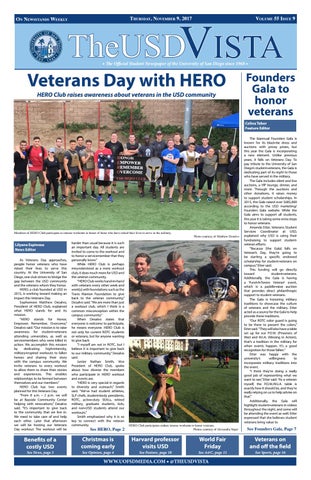
Members of HERO Club participate in intense workouts in honor of those who have risked their lives to serve in the military.
Lilyana Espinoza News Editor As Veterans Day approaches, people honor veterans who have risked their lives to serve this country. At the University of San Diego, one club strives to bridge the gap between the USD community and the veterans whom they honor. HERO, a club founded at USD in 2015, is working toward making an impact this Veterans Day. Sophomore Matthew Desalvo, President of HERO Club, explained what HERO stands for and its mission. “HERO stands for Honor, Empower, Remember, Overcome,” Desalvo said. “Our mission is to raise awareness for student-veterans attending universities, as well as servicemembers who were killed in action. We accomplish this mission by dedicating high-intensity, military-inspired workouts to fallen heroes and sharing their story with the campus community. We invite veterans to every workout to allow them to share their stories and experiences. This enables relationships to be formed between themselves and our members.” HERO Club has two events planned for this Veterans Day. “From 8 a.m. - 2 p.m. we will be at Bayside Community Center helping with renovations,” Desalvo said. “It’s important to give back to the community that we live in. We need to take care of and help each other. Later that afternoon we will be hosting our Veterans Day workout. The workout will be
Benefits of a costly USD See News, page 3
harder than usual because it is such an important day. All students are invited to come to the workout and to honor a servicemember that they personally know.” While HERO Club is perhaps misunderstood as a mere workout club, it does much more for USD and the veteran community. “HERO Club works hand-in-hand with veterans every other week and work[s] with foundations such as the Travis Manion Foundation to give back to the veteran community,” Desalvo said. “We are more than just a workout club, which I think is a common misconception within the campus community.” When Desalvo states that everyone is welcome to participate, he means everyone. HERO Club is not only for current ROTC students or veterans, but for anyone wanting to give back. “I myself am not in ROTC, but I believe it is important to give back to our military community,” Desalvo said. Junior Nathan Smith, Vice President of HERO Club, spoke about how diverse the members who participate in HERO workout and events are. “HERO is very special in regards to diversity and outreach,” Smith said. “We’ve had student athletes, SLP chefs, student-body presidents, ROTC, active-duty SEALs, retired military, graduate students, kids, and non-USD students attend our workouts.” Smith emphasized why it is so key to connect with the veteran community.
See HERO, Page 2
Photo courtesy of Matthew Desalvo
HERO Club participates endure intense workouts to honor veterans. Photos courtesy of Alexandra Super
The biannual Founders Gala is known for its black-tie dress and auctions with pricey prizes, but this year the Gala is incorporating a new element. Unlike previous years, it falls on Veterans Day. To pay tribute to the University of San Diego’s student-veterans, the Gala is dedicating part of its night to those who have served in the military. The Gala includes silent and live auctions, a VIP lounge, dinner, and more. Through the auctions and other donations, it raises money to support student scholarships. In 2015, the Gala raised over $685,000 according to the USD marketing/ Founders Gala website. While the Gala aims to support all students, this year it is taking some extra steps to honor veterans. Amanda Etter, Veterans Student Services Coordinator at USD, explained why USD is using their fundraising to support studentveteran efforts. “Because [the Gala] falls on Veteran’s Day, they’re going to be starting a specific endowed scholarship for student-veterans on campus,” Etter said. This funding will go directly toward student-veterans. Additionally, the Gala is having a ‘Fund-A-Torero Veteran’ event, which is a paddle-raise auction that provides direct philanthropic support to student veterans. The Gala is honoring military traditions to showcase the culture of veterans and the military. Etter acted as a source for the Gala to help provide these traditions. “Our ROTC color guard is going to be there to present the colors,” Etter said. “They will also have a table set up for our P.O.W. (Prisoners of War) and M.I.A. (Missing in Action), that’s a tradition in the military for when events happen. It’s a good recognition for those fallen.” Etter was happy with the university’s willingness to incorporate military traditions into the event. “I think they’re doing a really good job of representing what we want to see,” Etter said. “As a veteran myself, the P.O.W./M.I.A. table is exactly how it should be, and they’re really relying on us to help advise on that.” Additionally, the Gala will highlight student-veterans in videos throughout the night, and some will be attending the event as well. Etter expressed that she believes student veterans bring value to
See Founders Gala, Page 7
Christmas is coming early
Harvard professor visits USD
World Fair Friday
Veterans on and off the field
See Opinion, page 4
See Feature, page 10
See A&C, page 11
See Sports, page 16
WWW.UOFSDMEDIA.COM ◆ @THEUSDVISTA
2
The USD Vista
◆
November 9, 2017
NEWS
Honoring those who serve
HERO Club strives to continue bridging the gap between the USD community and veterans HERO from Page 1 “I think some undergraduate students are intimidated by veterans and fail to realize that they’re just people too,” Smith said. “I think it’s great to recognize veterans for the work they’ve done for this country, but almost every veteran I’ve talked to and become friends with doesn’t want their service to be what solely defines who they are.” Smith further explained why it is so important to have that bridge between veterans and the student body. “Our club serves to be a friendly face to the student-veteran population and help to break down barriers about veterans that come from stereotypes,” Smith said. “Some veterans come to USD not knowing anyone and, often being older than the average undergraduate student, can sometimes feel out of place.” Junior Robert Bock, the founder of HERO Club, wanted to start something that connected more people with the veterans on campus. “I started the club as a way to connect the general student body to the active-duty and veteran communities at USD,” Bock said. “A lot of students don’t realize how many military-connected students are on campus, and our members have made connections and friendship with them at our events. I also wanted to honor those who
Junior Alexandra Super, current Marketing Chair of HERO Club, described her experience just a few weeks ago at Fort Rosecrans National Cemetery during one of HERO’s biweekly workouts. “We completed a ruck (weighted hike) from Point Loma Nazarene University to the cemetery and back,” Super said. “It was one of the most awe-inspiring, humbling, and peaceful experiences. If you have ever been to Arlington [National Cemetery], it had a very similar atmosphere.” Super explained what she saw on that trail. “On one side you have the ocean and the other, a view of downtown San Diego and beyond,” Super said. “Rows and rows of white headstones cover green grass. As you walk on the path, you see the headstones of veterans and their spouses built into the walls. Although we specifically visited the headstone of Michael A. Monsoor, a U.S. Navy Seal Medal of Honor recipient, we remembered all of the fallen soldiers, their families, and those who are currently serving.” Super spoke about what brought her to HERO Club, despite the limited female presence in the club. “What made me hesitate [to join] was the lack of female presence in the club which I think is more of an issue than the ‘rigorous’ workouts,” Super said. “While rigorousness is intimidating, another thing that stops females is lack of confidence
HERO Club members run past the headstones at Fort Rosecrans National Cemetery, and remember the fallen veterans. Photo courtesy of Matthew Desalvo
even if they do not feel as physically strong as other members. “Rigorousness is more about being able to persevere,” Super said. “However, women are extremely mentally tough and [HERO Club tries] to encourage women to see how far they can push themselves. For anyone, it can be surprising how much progress a person can make when they have the right mindset.” Super said how she and Desalvo have worked to modify some workouts to make them more widely achievable by people of all abilities who want to join. “It’s really not about your ability,”
Super said. “It’s about being present, working hard, and pushing yourself. It is also about being uncomfortable and settling into that state. In life,
Members of HERO Club crawl through the mud in order to honor fallen veterans during one of their biweekly workouts. Photo courtesy of Alexandra Super
The HERO Club reflects on their workout.
“We’ve had student athletes, SLP chefs, student body presidents, ROTC, active-duty SEALs, retired military, graduate students, kids, and non-USD students attend our workouts.” -Nathan Smith made the ultimate sacrifice serving our country. I believe it is especially important to ensure that we never forget their stories and we continue to raise awareness for their selfless service.”
in doing the workouts or not being able to do them at the level that the male executive members do them at.” Super went on to explain why it is possible for anyone to participate
its outreach past USD. The club has started a chapter at Purdue University and looks to continue expanding. At USD, HERO Club
“I started the club as a way to connect the general student body to the active-duty and veteran communities at USD.” -Robert Bock there are going to be uncomfortable situations you will encounter and it is important to learn how to deal with and overcome them.” HERO Club has also expanded
continues to grow into a club that serves as a way to build understanding between veterans and the people in the USD community.
Photo courtesy of Alexandra Super
◆
Volume 55 Issue 9
NEWS
◆
The USD Vista
The most for students’ money
3
Several factors considered when selecting a college and achieving postgrad success
Tayler Reviere Verninas Editor In Chief As new data emerges, studies have found that prestigious universities do not always guarantee the highest-earning graduates. The Wall Street Journal (WSJ) recently released an article about which colleges give students the most for their money. The WSJ listed several factors that students take into account when deciding whether to attend a more expensive private university such as the University of San Diego. Graduation rates, student debt, post-graduation earnings, and cost of family incomes are all important factors. When choosing between colleges, senior Chris Miller sought a smaller school with undergraduate research and internship opportunities. “I wanted to end up somewhere I liked for four years,” Miller said. “Someplace that’s growing and has a lot of job opportunities post-grad. A place I wouldn’t mind living and working in after college.” Because Miller received a merit scholarship from the university, his family was able to afford the cost of attendance at USD. “About 20 percent of my tuition costs are covered through my merit scholarship,” Miller said. Although Miller stated he has been fortunate enough to graduate from USD without any loans, that is not always the case for most students. According to the university’s website, 75 percent of current students receive financial assistance with an average financial aid award of about $31,535. Senior Hailey Molden is one of many Toreros who receive financial aid through Free Application for Federal Student Aid (FAFSA). Molden will have to pay off her student loans after graduation. However, for Molden, her psychology major requires three more years of school which means her undergrad loans will be deferred until after graduate school. “I am going to school to go to more school,” Molden said. “It’s hard because I am not going to work after I graduate. I know that when I have the career for what I am going to school for, I will be able to pay it off. It just won’t be when I graduate [from undergrad]. But, I don’t have to pay off the loans yet because I will still be in school.” Vice Provost Thomas R. Herrinton stated that the graduation rate is the most important factor, because it is the goal of every entering student to graduate. “While the federal standard is a six-year graduation rate (for full-time, first-time students), I think the four-year graduation rate is even more important as each additional year a student spends as
an undergraduate is another year of tuition to pay as well as a year of delay in starting one’s career and earning money,” Herrinton said. “Based upon the values I have been able to find online, USD has the highest four-year graduation rate of the non-profit universities in the city of San Diego. Getting a goodpaying job after graduation is the number one reason students attend college these days, so obviously this is important also.” The article advises students to make an honest assessment of their ability to succeed in a college working environment. Molden recognized that the price of her education as an undergrad Torero
“I think during my first semester was when I grasped the concept of how much it costs to go to USD, and that is what motivated me to actually do my homework.”
-Hailey Molden affected her reasons for being successful in school. “I think during my first semester was when I grasped the concept of how much it costs to go to USD, and that is what motivated me to actually do my homework,” Molden said. When it comes to doing more in terms of academic success, Molden explained her experience with balancing schoolwork and outside activities. “I always think there is room for improvement with academics, but I also need to take the opportunities I have here to enjoy San Diego,” Molden said. “I am definitely satisfied with my college experience. I could be studying more, but there are also other things that college has to offer. It is not just about class or tests.” Miller also believes he has done just the right amount of work in order to be successful at USD. “I think if I would have pushed for more classes I would’ve been focusing all of my time and effort in academics solely, and I don’t think that is how you learn as a whole,” Miller said. “You have to socially learn from other experiences and encounters outside of the classroom. Being abroad and learning about another culture or language — things you can’t necessarily learn inside of a classroom. Also, with research you learn a lot of practical things. Within a classroom things are more theoretical and don’t always perfectly apply to what you do outside of the classroom.” However, senior Miranda Rappoldt wishes she would have explored more academically when trying different classes. “In terms of extracurricular [activities], I feel like I am involved in what I knew I wanted to check out coming to school,” Rappoldt said.
The USD Vista Tayler Reviere Verninas - Editor in Chief Elisabeth Smith - Associate Editor Kelly Kennedy - Managing Editor James Douglas - Copy Editor Kaia Hubbard - Assistant Copy Editor Rita Srekais - Art Director Max Escutia - Assistant Art Director
“But academic-wise, I wish I would have branched out and taken some business classes or art classes which would have provided for a slightly more well-rounded education and experience.” Every year, the USD Career Development Center (CDev) compiles data on students completing their undergraduate degrees. The most recent data was collected for the 1,286 students who graduated between August 2015 and May 2016. About 94.2 percent of these graduates are employed, in graduate school, in the military, or participating in full-time volunteer service.
Robin Darmon, Senior Director of the Career Development Center, recognized that USD is an expensive university but that the campus has a unique support system. “I have been on public campuses where it is much cheaper but you don’t get the same support,” Darmon said. “I will give the Board of Trustees and the President and our leadership team a lot of credit though because they make sure you guys have a ton of support given the cost. It’s costly but there are a lot of pluses that go with it.” Darmon shared why this support system is different from other surrounding colleges and universities. “Our career-service team is spread out all over campus and the idea is to make it as easy for you guys to use us and access us,” Darmon said. “The other thing we are really big on is experience. I am all about [students] going on
treks, doing an internship, being a part of the mentorship program, and going to networking events. The more our team can propel you into a networking situation where you get to test drive an internship experience or you get to talk to an alumnus and ask what their experience is, the more valuable it is.” Once students graduate from USD, the door to the Career Development Center never closes. As alumni, Toreros have a lifetime of access to all the resources the CDev offers and can even consult with the center’s dedicated, lifetime career coach if they decide to take on a new job later in life. Another factor the WSJ mentioned is postgraduate earnings, stating that science and engineering majors are top earners at all stages. As a biochemistry major, Miller was pleased to hear this statistic. “It’s comforting to know that this large starting salary will get me started on a life path pretty well,” Miller said. “I’m hoping to go to medical school, so I am going to have a bunch of debt after that. Although I haven’t really looked into it too much, I have an idea of making around $120,000 post-med school. I’m hoping to get a job in the gap year before med school and my target would be around $60-70,000.” As a behavioral neuroscience major, Rappoldt is still unsure what specific job she wants to work after graduation. “Potentially I will go into the healthcare field, but as of next year I don’t want to go to a med-school or grad-school program,” Rappoldt said. “So next year is going to more about figuring out which part of my major I want to use. I don’t know how much I would be making with that because I have not really researched it.” According to Herrinton, of the 978 students from the graduating class of 2017, 51 percent graduated
Students laugh and enjoy their time at USD, trying to make the most of their experience.
Editorial – 619.260.4584 Business – 619.260.4714 www.uofsdmedia.com ◆ @TheUSDVista
Lilyana Espinoza - News Editor Nicole Kuhn - Assistant News Editor Taryn Beaufort - Opinion Editor Celina Tebor - Feature Editor Anderson Haigler - Arts & Culture Editor Noah Hilton - Sports Editor Walker Chuppe - Photography Editor
Cyrus Lange - Photo Assistant Ana Contreras Orozco - Photo Assistant Alex Worden - Distribution Editor Bailey Marie Donnelly - Finance Director Gina Lew - Student Media Advisor Marie Minnick - Operations Advisor
with no debt. For the 479 students who graduated with student debt, their average total debt was $30,854. Rappoldt expects to graduate this May with some student debt. “I think the biggest obstacle will be finding that job that allows me to erase those loans,” Rappoldt said. “USD does have tools such as the Career Development Center. I have looked into them for an internship but I need to put in more time. Now, I feel like at the end of this semester my end goal is finding an internship for next semester that will find me that job that I can hold for a long time. Even if I get a minimum-wage job I will still be able to pay off some of the loans. But I’m not sure if I would sustain otherwise in terms of living comfortably.” However, the real question for Toreros is whether they are getting the most for their money at USD. Molden seems to believe so. “Yes, because I feel like I have received a really good education and I have worked hard in school,” Molden said. “I have also had a really good college experience being able to live at the beach and study abroad.” Miller chuckled when considering the same question. “We’ll see if I get a job,” Miller said. “I feel like you can get the same education and opportunities for a lower cost. I do think it [USD] is rather expensive, but that being said I wouldn’t trade what I have done for anything. But the determinant is what will happen in the future — if the fact that my degree at USD is valuable to people in the workplace, which I think it will be, but I don’t know!” Whatever the factors may be for choosing this university, undergraduate success may highly affect postgrad opportunities. And, it is possible that their success postgrad might also determine whether they “got the most for their money” here at USD.
Photo courtesy of USD Photo Gallery
The USD Vista publication is written and edited by USD students and funded by revenues generated by advertising and a student fee. Advertising material published is for information purposes only and is not to be construed as an expressed or implied endorsement or verification of such commercial venues by the staff or University. The USD Vista office is located on the fourth floor of the Student Life Pavilion in room 403B. All inquiries should be sent to: The USD Vista 5998 Alcala Park San Diego, CA 92110 The first copies of the newspaper are complimentary, all copies thereafter are a 25 cents charge. Opinions expressed in this publication are not necessarily those of The USD Vista staff, the University of San Diego or of its student body. Letters to the Editor can be submitted to The USD Vista office. Letters should be limited to 300 words and must be signed. For identification purposes, USD identification numbers and writer’s year must be included in the letter. The USD Vista reserves the right to edit published letters. Any content sent to the editor will be considered for publication unless otherwise stated.
4
The USD Vista
◆
November 9, 2017
OP I N ION
Christmas time is here
The holidays are around the corner, but is it too early to bring out the decorations? Taryn Beaufort Opinion Editor Students who ventured off campus in the past week may have noticed the sudden holiday takeover around San Diego. Starbucks has their holiday drinks ready to order, Christmas trees are being displayed in malls, and stores have put their holiday decorations on display. Some may welcome this transition with open arms ready to embrace the holiday season, while others might see this as too early of a start to Christmas. Working at Bath and Body Works allows senior Abby Schrader to fully embrace “the most wonderful time of the year.” “I am totally okay with Christmas festivities starting straight after Halloween,” Schrader said. “For me one month isn’t enough time to fully embrace the Christmas season, so I choose to stretch it to two months prior to Dec. 25.” Schrader believes that the longer she has to celebrate the holiday, the more merry her experience will be. “Personally, starting to celebrate Christmas early enhances the holiday season for me,” Schrader said. “I love any reason to be festive or excited about something, so extending this season for as long as possible is a plus.” For those who think starting too early can be repetitive,
Schrader argued that everyday occurrences can also be just as repetitive. “I understand that people might get sick of listening to certain songs or seeing specific commercials that are holiday themed, but if you think about it, this argument could be made any time of the year,” Schrader said. “I have to turn the radio off if ‘Despacito’ comes on.” Singing Christmas songs is an inherent Christmas tradition for some. Buddy the Elf said it best, “The best way to spread Christmas cheer, is singing loud for all to hear,” and Schrader could not agree more. “The decorations, along with the music, are the best part,” Schrader said. “My family has one day set out during the Thanksgiving break where we play Christmas songs and belt them out all day as we hang up our Christmas decorations.” However, not all students are as excited as Schrader to welcome the Christmas spirit this early in the season. Senior Madylin Miller would prefer for the early celebrations to be delayed for a bit. “I personally really enjoy Thanksgiving and it kind of bums me out that people tend to skip over this holiday,” Miller said. “[Thanksgiving] is a wholesome holiday whereas in regard to Christmas people might be eager to celebrate just because of the
Over the years Starbucks has changed their holiday cups several times, sometimes depending on customer feedback. Photo courtesy of Starbucks
presents. Or it could just be that there aren’t a lot of Thanksgiving decorations.” Miller believes that decorations are essential to the holiday, but that there is a time and place for them. “Christmas decorations should be forbidden before Halloween,” Miller said. “People haven’t even had the chance to take down their Halloween decorations before they start purchasing Christmas ones; it’s a weird combination.” Although Miller acknowledged some of the positives of being surrounded by premature holiday decorations while away at college. “My roommate is one of the people who the day after Halloween, I will come back to my apartment and Christmas decorations have exploded
everywhere,” Miller said. “I think it is helpful to have holiday decorations up throughout the year. It makes it feel homier and happy while we are going through hard times at school away from our families.” Meanwhile, there are other Toreros, such as senior Nicole Tellini, who fall somewhere in the middle of the spectrum and have more neutral perspectives of the timing people should start celebrating. “It’s crazy how early you start seeing Christmas-related products nowadays,” Tellini said. “It seems like it gets earlier and earlier each year. But if that’s what you like then okay, I think everyone should celebrate how and when they want to.” The earlier start to Christmas
celebrations only means more time to embrace the holly-jolly holiday. “I love the early start to Christmas,” Tellini said. “I think it is so fun getting into the spirit of the holidays early. Instead of only getting to celebrate it for one month, I get to enjoy it for double the amount of time.” Wherever students lie on the spectrum of holiday cheer, the beginning of November means that Christmas is officially here, so Toreros should be prepared to ‘tis the season. Some students might even call someone a “cotton-headed ninny-muggin” for not willingly embracing the early onset of Christmas festivities. But on the other hand, some may want to take the celebrations one holiday at a time.
Rita Srekais /The USD Vista Have an opinion? Write a Letter to the Editor to be considered for publication in The USD Vista. Contact vistaeditor@sandiego.edu for more information. The views expressed in the Opinion section are not necessarily those of The USD Vista staff, the University of San Diego, or its student body.
Volume 55 Issue 9
◆
OPINION
◆
The USD Vista
Defining hookup culture
5
Today’s generation has a new approach to navigating the dating world Kaia Hubbard Asst. Copy Editor As the traditional bounds of romantic relationships become more fluid, college students today wrestle with labels, and the newly minted term: hookup culture. Armed with the perspective that both the media and their peers provide, students explore whether dating plays a part in their college experience. Professor Lisa Nunn, Ph.D, informs the students in her sociology class about the origins of the latest relationship trend. “It’s really unclear when this new type of romantic relationship, coupling started happening,” Nunn said. “Maybe the 80s, 90s. Today it has a name: we call it hookup culture.” Nunn defined this unorthodox college phenomenon. “Hooking up is when two people engage in some sort of romantic or sexual activity,” Nunn said. “It ranges from kissing to complete intercourse and everything in between. The route to relationships happen quite often these days through hookups.” Although common in today’s world, older generations may find the practice to be drastically different from previous methods of dating. Nunn described the traditional dating style, and pointed out its faults. “In the dating culture of a few decades ago it was almost always the responsibility of the man to invite the woman on a date,” Nunn said. “It was the woman’s role to wait to be asked… to make herself appealing and available, and that kind of sucks.” Despite the widespread stigma, Nunn believes hookup culture has its benefits. “One great thing about hookup culture is that it’s much more egalitarian, although in the data we find that men are initiating more often, there is at least this potential and greater sense that women are not sitting around waiting to be asked out on
a date,” Nunn said. “Women go to parties and they go out with their friends and they have a good time and if they’re interested in having some sexual encounter they can have it. It’s very much an arena of sexual empowerment for women.” Despite the fact that hookup culture has grown side-by-side with gender egalitarianism, some students still acknowledge the existence of a stigma. Although this idea may surprise older generations, the existence of a hookup culture is not a shock to some college-aged students. First-year Lucas Chase understands why the phenomenon exists, but finds some aspects to be a problem. “I think it’s definitely more common for hookups to happen because a lot of college students don’t want commitment, especially first-years like myself,” Chase said. “There’s a lot more hookups and less talking today. There’s a lot less respect. You don’t see a lot of chivalry; dudes holding the door open. I don’t think that’s right, but I kind of contribute to the problem.” Students like Chase are accurate about the commonality of hookups. According to a Stanford University study which included students from 20 colleges, 72 percent of students shared that they have “hooked up” with someone. While some accept the realities of hookup culture, sophomore Rachel Scheumaker commented on the negative implications that come with it. “If anything, hooking up can give yourself a bad name,” Scheumaker said. “When girls hear about guys who don’t hook up with a lot of girls it’s a good thing.” Despite some students’ disagreement with the practice, the culture continues. Junior Christian Yee-Yanagishita described the pressure and expectations behind this new dating culture. “Men are taught to value a body count; that is the expectation,” Yee-Yanagishita said. “People will compare how many people you’ve been with.” However, when asked about
A couple is cozied up to one another as they wait in line for their food at La Paloma.
USD specifically, Yee-Yanagishita concluded that things are different here. “I think USD is actually a little different than what you see in the media or hear about at other schools,” Yee-Yanagishita said. “It seems like a lot of people are in meaningful relationships at USD. That’s not to say that hookup culture isn’t a thing, but I just feel like I see a lot more relationships here.” Meaningful relationships may exist, but many describe hookup culture to be full of double standards. Chase commented on the existence of a double standard and its relation to slut shaming. “I know sometimes girls are slut shamed, but when guys do it it’s like ‘yeah bro, look at you,’” Chase said. Professor Nunn spoke to this double standard, and why it still exists despite a more equitable society. “In hookup culture, women still face the sexual double standard of
Many couples in committed relationships enjoy holding hands as a symbol of their affection. Photo courtesy of Durong Huru/ Unsplash
being slut shamed, while men are almost never slut shamed,” Nunn said. “In fact they’re high-fived for more partners or intensive sexual activity. These old, old ideas about ideal femininity and masculinity die slowly. Both men and women slut shame. It has always been a powerful tool under a patriarchal model to control women’s behavior and to control women’s sexuality, which is why it’s so confusing. The idea of what an ideal woman is just an impossible mix of being sexy and appealing and at the same time also monogamous. ” As society continues to move forward, relationships also change with it. With all of this talk of hookup culture, one may wonder where the traditional date has gone. Scheumaker commented on what traditional dating style says about people. “The people that you would want to be in relationships with are the ones who are asking you on dates,” Scheumaker said. “It says a lot about who they are.”
Cyrus Lange/The USD Vista
First-year Halle Campbell described the common viewpoints on dating and hookups. “Hooking up is more common, unfortunately,” Campbell said. “People think that dating means dating forever and they don’t want to do that at this age; they view it as a death sentence. People just want to have fun.” Over time change has occurred — however, some may wish to return to a more traditional approach to dating life. “I wish things were more old fashioned,” Campbell said. “I want to go swing dancing, I want to go out to dinner, and I would like to go watch the sunset at the beach.” Sophomore Maria Aiello accurately summarized students’ outlook on relationships. “It’s a hooking up generation,” Aiello said. It seems as if college students have their work cut out for them, but starting the conversation about dating culture may be the first step.
Students utilize online dating apps, such as Tinder, to meet up with new people. Walker Chuppe /The USD Vista
Have an opinion? Write a Letter to the Editor to be considered for publication in The USD Vista. Contact vistaeditor@sandiego.edu for more information. The views expressed in the Opinion section are not necessarily those of The USD Vista staff, the University of San Diego, or its student body.
6
The USD Vista
◆
November 9, 2017
News sources have evolved Technological advancements have enabled students to seek alternative news sources
Taryn Beaufort Opinion Editor In today’s modern-day world where social media has captivated the minds of many, the sources of news have changed. A few generations ago, people read the daily newspapers to keep with the latest happenings of society. However, University of San Diego students have drifted away from traditional news sources and have relied more heavily on social media platforms and other types of news. Senior David Fox stays informed by referring to a variety of sources. “I get my news from a couple different sources,” Fox said. “I get it from The Wall Street Journal because I think that is one of the most unbiased mainstream papers. And I hate to admit it, but I get a lot of news through social media.” Social media applications such as Instagram, Snapchat, Twitter, and Facebook have seen an increase in popularity in recent years, making them a viable source for news among USD students. These applications have started to incorporate ‘Discover’ pages that allow news content to be incorporated within personal content. Fox’s tendency to gather news as he scrolls through his newsfeed is not an uncommon action among his peers. But, he noted the necessary level of caution when reading these sources. “I am sometimes skeptical of what’s being posted [online],” Fox said. “I think that’s something that we should all take into consideration and understand the inherent bias that comes with the news through social media, ‘cause everyone has their opinion.”
Between classes, a student takes the time to sit down, enjoy a coffee, and read a newspaper containing the most recent news.
believe, so it’s just creating psychological affirmation of that opinion,” Fox said. “I think the best way to fix this problem of affirmation is to have people read more diverse things and get their news from various sources rather than just social media or one particular newspaper.” On the other hand, junior Marshall Daigle tends not to keep up with the day-to-day news, unless he hears about it through word of mouth. “Since I usually don’t follow [hard] news too closely, I usually hear about it from someone else
“Social media fosters the problem where people are just being fed what they already believe, so it’s just creating psychological affirmation of that opinion.” -David Fox Fox believes that social media as a news source only feeds into the problem of the spiral of silence among students. “Social media fosters the problem where people are just being fed what they already
and then if it’s a big thing I will look into online or TV,” Daigle said. “If there is a new policy being enacted or something terrible happened, I like to be aware, but ultimately there isn’t a lot I can do about it.”
For some students, like Daigle, they may be inclined to think that news does not affect their lives, since the world moves at such a fast pace. Daigle said this is why he puts his focus on other types of news. “I am more into finance, so Yahoo finance I’m on every day just looking at stocks and various things like that,” Daigle said. “The news that goes along with finance, like GDP growth, I pay a lot more attention to than the more everyday news. Financial news actually allows me to take action in terms of investing. So just in terms of having that active involvement with that kind of news, even if I’m not going to invest in that stuff just the fact that I could do something where it would be of direct effect to me makes it a lot more interesting.” Even as Daigle goes through the finance news he is weary of articles that may be influenced through sponsoring. “If an article says something like sponsored ads, I will never click on those,” Daigle said. “I think
Browsing online on computers and phones has become a popular method for students to catch up on news. Ana Contreras Orozco/ The USD Vista
that I would just get one opinion from reading it.” Junior Reid Arno gets his news from a combination of online and
Cyrus Lange/ The USD Vista
perspectives, which could ultimately lead to tangible change. Even though Arno sees the potential to engage in activism
“The prestige in journalistic integrity has been diminished now that every single person can spread their opinion so rapidly.” -Reid Arno print sources. “I generally read headlines on leading news from Reddit and Economist magazine,” Arno said. “I like to know what occurs, but I stay away from strong opinion.” Arno noted that the increased presence of opinion in news makes it hard to distinguish between opinion and fact. “The prestige in journalistic integrity has been diminished now that every single person can spread their opinion so rapidly,” Arno said. “So many opinions, so few facts. It’s hard to reconcile that in a world with so much government and corporate influence lording over us.” News has the power to inform people and help develop
as a result of keeping up with the news, he has decided to keep his thoughts to himself. “News likely encourages activism,” Arno said. “Now that news companies are looking to make almost anything news, this creates another avenue for smaller groups of people to project their voice to a much wider audience.” As technology continues to evolve, so will the sources that students use as a reference. This continuous evolution is accompanied by the difficult distinction between fact and opinion. Whether students are looking to be informed or persuaded, news can offer a pertinent root for both of these. things.
A student checks his social media apps where news sources are found throughout. Cyrus Lange/ The USD Vista
Have an opinion? Write a Letter to the Editor to be considered for publication in The USD Vista. Contact vistaeditor@sandiego.edu for more information. The views expressed in the Opinion section are not necessarily those of The USD Vista staff, the University of San Diego, or its student body.
Volume 55 Issue 9
◆
FEATURE
◆
7
The USD Vista
F E AT U R E
Gala to pay tribute to veterans Biannual Founders Gala falls on Veterans Day honoring veterans at the event Gala from Page 1 the USD community and should be recognized for their work. “We have seven or eight veterans that are on our Associated Students board,” Etter said. “They come with a lot of experience and things like that to be able to add value to those conversations.” Senior Johnny Chinchilla is one of the students that the event will highlight. Chinchilla is the Finance Chair in Associated Students and manages $1.2 million of studentactivity fees. He became the president of the Student Veteran Organization (SVO) during his second year at USD, and was in the Marine Corps for 12 years with four combat deployments before he started at USD. Chinchilla wanted to use his opportunity at the Gala to speak for those who cannot. “My story is a story that a lot of veterans have experienced, and are not here to talk about it, or they don’t have the platform to tell their story,” Chinchilla said. Chinchilla also wanted to set an example for USD student-veterans. “I feel like it’s my obligation to be an example and to encourage other student-veterans to stay involved in school and be active,” Chinchilla said. “Doing these activities is how I got selected to be in the Gala. Through my time in Marine Corps, through my combat deployment, and now being in higher education
Funds from the auctions in the Founders Gala go to general student scholarships. However, this year there will be a special fund that goes to student-veterans. Photo courtesy of Christy Seaver/ USD Media Gallery
“He enrolled at USD in 1972, when the nation was in transition,” Etter said. “He was wounded in war. He’s a distinguished service cross, silver star, and purple heart, so he has kind of that war hero aspect.” While the Gala is saluting veterans worldwide, San Diego has a strong connection to the military, more specifically, the USD
“I feel like it’s my obligation to be an example and to encourage other student veterans to stay involved in school and be active.” -Johnny Chinchilla at USD, that was for me a bigger reason to represent my community well.” Chinchilla will be escorting Major General William M. Matz Jr. (retired), the event’s honorary chair at the Gala. Matz received his Master’s degree from the University of San Diego in 1973. Etter explained why Matz was chosen to represent the USD veteran community.
community. Chinchilla expressed the importance of the military in San Diego. “San Diego is one of the biggest cities that veterans occupy,” Chinchilla said. “As far as bases and training facilities, we are one of the largest in the nation. And USD is right in the middle of that.” The university itself embodies the military connections that the
city holds, and is named one of the best school in the country for veterans by U.S. News & World Report. Etter laid out the numbers of USD’s military-connected student population. Military connected means students are veterans, in ROTC, or are children of veterans receiving benefits from their parents. “As of right now, the militaryconnected student population is 8.6 percent of student body,” Etter said. “That’s a significant population, and with the school still as young as it is working with the militaryconnected population, it’s going to be growing. In the last two years, we’ve grown by 30 percent, so it’s expected to increase.” Chinchilla believes the university took initiative to acknowledge USD’s large military-connected population at the Gala. “I don’t think that studentveterans realize how important it is to be a part of the community, like the one here at USD,” Chinchilla said. “And also I don’t think a lot of the student body understands how
unique we are. And USD embracing [us] demonstrates how USD has understood the importance of supporting the veteran community in San Diego.” Etter offered advice on how students and faculty can support the veteran and military-connected community at USD.
attending the Gala can still honor the veteran community even with thoughts. “On Veterans Day, reflect on what you have,” Chinchilla said. “Reflect on the privileges we all have being at USD, and know that many don’t have those privileges. Being grateful for what we all have
“As of right now, the military-connected student population is 8.6 percent of student body. In the last two years, we’ve grown by 30 percent, so it’s expected to increase.” -Amanda Etter “Students, to pay respects, can just be aware of the culture, just like any other culture on campus,” Etter said. “Veterans don’t always just want to be recognized as a veteran, they want to be recognized as an individual. Being a veteran is just a part of who they are. So like any other culture on campus, I want to kind of support that.” Chinchilla expressed that students not in ROTC or not
is important.” On Nov. 11, the biannual Founders Gala will be recognizing the veteran community for its services. Students walking on campus in uniform every week inform the campus community of its large military-connected population, but the Gala’s support of veterans will also remind students of the sacrifices that have been made to protect the nation.
How to support student veterans: - Attend the Veterans Day ceremony on Nov. 9 from 4 - 6 p.m. in UC Forum C - Participate in the ‘Fund-A-Torero Veteran’ paddle-raise at the Gala - Shop at Operation Hat Trick, a company that supports the recovery of wounded service members and veterans through its merchandise funds
The 2015 Founders Gala Live Auction offered prizes such as Swarvoski Glitterboxes and all-access passes to USD basketball games. Photo courtesy of Christy Seaver/USD Media Gallery
- Donate to charities such as Disabled American Veterans or Wounded Warrior Project
8
THE USD VISTA
◆
Volume 55 Issue 9
NOVEMBER 9, 2017
◆
What are Torero Treks? “Make sure you have good questions for the companies.” - Alexandra Cooley, Sophomore
Torero Treks are opportunities offered to the USD undergraduate community, sending them on trips to visit successful businesses across the nation. The visits may include alumni panels, office tours, and networking opportunities.
How much does a Torero Trek cost?
k e r T o r e r To res
“For p e about ople who a t defini o go on [a T re tely fo rek], l l o w u the co mpan p [with ie - Parker Glaessne s].” r, Senior
Photo courtesy of CDev
What kinds of industries do Torero Treks cover? Biotech Real Estate Sports Marketing
t of n o r f n i put me d me to o t D S , it le “For U s e c a f ] ke it ’s a y t n a n a p c [com here I w n o i m— t e a h u t t i o s t t tha d talk n a ust j e r s i e h y t t i n from portu p o t a h to get t ncredible.” i enior S , h s i n r o C - Britte Photo courtesy of CDev
“Being able to get a feel for a company so young, because I’m only a sophomore, so I think that being able to see who possibly I’d want to work for and intern for, that’s probably the most beneficial part.” - Alexandra Cooley, Sophomore
9
THE USD VISTA
Photo courtesy of CDev
r u t n Adve
Photo courtesy of CDev
◆
“They accep t so much m ore than you think they do , it’s not that big of a deal, and it’s not t hat much wo rk to get in. So just do it. And they we re really generous wit h giving awa y money for funding the trip.” - Britte Cornish, Se nior
Photo courtesy of CDev
Students only have to pay for the refundable deposit, along with travel and accomodations. Treks in the San Diego area have a relatively low price in comparison to other locations. Scholarships are also available to help pay for the Trek.
FEATURE
Upcoming Treks:
Technical Finance Healthcare & more
“I can’t thin k of anothe r experienc where I’ve g e otten to go to three ma companies jor in the San F rancisco are is the secon a, which d biggest jo b market in th I got to pers e U.S. onally meet manageme a n d connect w nt, and bein ith g able to fo them in a ve llow up with ry personal way. The ex that people perience get from th is is immeas urable if yo take advant u ageof it.” - Parker Glaessne r, Senior Spread by Rita Srekais; Content by Celina Tebor/The USD Vista
8
THE USD VISTA
◆
Volume 55 Issue 9
NOVEMBER 9, 2017
◆
What are Torero Treks? “Make sure you have good questions for the companies.” - Alexandra Cooley, Sophomore
Torero Treks are opportunities offered to the USD undergraduate community, sending them on trips to visit successful businesses across the nation. The visits may include alumni panels, office tours, and networking opportunities.
How much does a Torero Trek cost?
k e r T o r e r To res
“For p e about ople who a t defini o go on [a T re tely fo rek], l l o w u the co mpan p [with ie - Parker Glaessne s].” r, Senior
Photo courtesy of CDev
What kinds of industries do Torero Treks cover? Biotech Real Estate Sports Marketing
t of n o r f n i put me d me to o t D S , it le “For U s e c a f ] ke it ’s a y t n a n a p c [com here I w n o i m— t e a h u t t i o s t t tha d talk n a ust j e r s i e h y t t i n from portu p o t a h to get t ncredible.” i enior S , h s i n r o C - Britte Photo courtesy of CDev
“Being able to get a feel for a company so young, because I’m only a sophomore, so I think that being able to see who possibly I’d want to work for and intern for, that’s probably the most beneficial part.” - Alexandra Cooley, Sophomore
9
THE USD VISTA
Photo courtesy of CDev
r u t n Adve
Photo courtesy of CDev
◆
“They accep t so much m ore than you think they do , it’s not that big of a deal, and it’s not t hat much wo rk to get in. So just do it. And they we re really generous wit h giving awa y money for funding the trip.” - Britte Cornish, Se nior
Photo courtesy of CDev
Students only have to pay for the refundable deposit, along with travel and accomodations. Treks in the San Diego area have a relatively low price in comparison to other locations. Scholarships are also available to help pay for the Trek.
FEATURE
Upcoming Treks:
Technical Finance Healthcare & more
“I can’t thin k of anothe r experienc where I’ve g e otten to go to three ma companies jor in the San F rancisco are is the secon a, which d biggest jo b market in th I got to pers e U.S. onally meet manageme a n d connect w nt, and bein ith g able to fo them in a ve llow up with ry personal way. The ex that people perience get from th is is immeas urable if yo take advant u ageof it.” - Parker Glaessne r, Senior Spread by Rita Srekais; Content by Celina Tebor/The USD Vista
10
The USD Vista
◆
November 9, 2017
Recap: Steve Walt, visiting scholar The Harvard professor discussed hard-hitting topics during his lectures on campus
Kennedy Avery Contributor In his Nov. 2 lecture in the KIPJ Theatre ‘Where is U.S. Foreign Policy Headed?’ Stephen Walt, Belfer Professor of International Affairs at Harvard’s Kennedy School of Government, revealed that the idea of ‘America First’ can mean something entirely different than the nativistic aims of President Donald Trump’s rhetoric. In a lecture supremely critical of Trump as a person and leader, Walt nominally advocated for a major feature of Trump’s campaign in a way that was functionally very different, the notion of putting America First.
depicted the course of World War II, and portrayed the Soviet Union as assuming the largest losses of the war. “[My initial reaction was] this [map] is propaganda,” Walt said. However, reflecting back on it, Walt explained that the Soviet Union actually did, as the map illustrated, suffer the highest losses in World War II, and his reaction that the map was propaganda was solely a result of his perspective as an American youth in 1976. In this moment, Walt came to an eye-opening recognition about how perspective plays into the personal element of international relations: that nationality has a noticeable effect on one’s identity and opinions. Walt’s anecdote is a
“We may in fact be getting the worst of both worlds: the United States will still be pursuing a flawed grand strategy but now we also have an erratic skipper at the helm of the ship.” -Steve Walt Before the lecture, Walt shared some personal experiences, which deepened the messages outlined in his lecture. As a university student studying abroad in a divided Berlin, Germany in 1976, Walt explained he had an epiphany in how he viewed international relations. Walt illustrated a visit to a museum in East Germany when he was confronted with a map that
reminder that the individual cannot be removed from the realm of international relations, and sometimes the American perspective can obstruct a practical and realistic viewing of a situation. Although Walt’s lecture further explained his deep-seated loyalty to the realist school of international relations, which sees world affairs as a competition among nation-states, this simple anecdote established
a personal and perhaps relatable reason for such a preference. As a realist, Walt spent much time rejecting liberal hegemony in his lecture and explained this concept in his lecture. “[Liberal hegemony] is a foreign policy that tries to promote the basic principles and ideals of liberal democracy,” Walt said, and has been America’s “basic grand strategy” since the end of the Cold War. Upon outlining a number of recent failures in American foreign policy motivated by a strategy of liberal hegemony such as Russia’s annexation of Crimea, continuing wars in the Middle East, and the expansion of nuclear arsenals in Pakistan, India, and North Korea, Walt concluded that liberal hegemony was not an ideal approach. “This basic strategy is fundamentally flawed,” Walt said. Senior Devin Corea, attended Walt’s lecture and agreed with Walt’s argument that liberal hegemony is ultimately a failure. “America has in many ways, I think, become over-involved… it is not always the best thing for [the countries the U.S. enters],” Corea said. It is this fundamentally flawed grand strategy that Walt declares the Trump administration continues, contrary to its campaign promises of America First. The combination of America’s flawed strategy with the leadership of Donald Trump, whom Walt sees as inept and neglectful of American values such as human rights,
Stephen Walt lecturing about foreign policy in the KIPJ theatre. Photo courtesy of Kennedy Avery
appeared almost disastrous to Walt. “We may in fact be getting the worst of both worlds: the United States will still be pursuing a flawed grand strategy but now we also have an erratic skipper at the helm of the ship,” Walt said. In this way, Walt highlighted that the American perspective is not always right, just as he did when he reflected on his visit to the museum in East Germany. As a result, Walt offered an alternative to the grand strategy of liberal hegemony that has directed American foreign policy for the past 25 years and continues to do so today under the the leadership of President Donald Trump, and an alternative to Trump’s rhetoric of America First. “[It would include] getting out
of the business of nation-building, reducing [the] American military footprint, and seeking more realistic accommodations that would free up additional resources that could be used to improve the lives of Americans here at home,” Walt said. Walt’s alternative view to a Trumpian America First, which rhetorically advocates for strong borders and isolating policies, takes consideration of the importance of the values of democracy and human rights undergirded by liberal hegemony. However, it substitutes the nation-building and foreign-involvement policies of this strategy with a strong domestic front that at once leads from afar and encourages other countries to emulate the US example.
Volume 55 Issue 9
◆
ARTS & CULTURE
◆
The USD Vista
A RT S & C U LT U R E
11
World Fair Friday wows
Multicultural event brings free food, dance, music, and spoken word to campus
World Fair Friday was put on by Torero Program Board, and featured a variety of foods, including Mexican, African, Polish, and Filipino cuisine, as well as performances for Toreros.
Anderson Haigler A&C Editor Torero Program Board (TPB) brought the food Friday night, and Toreros brought their appetites. World Fair Friday, a multicultural event for students, took place in the University Center’s parking lot, and many Toreros were delighted with the wide range of food and cultural performances. Freshman Kathy Xu shared her excitement regarding the event. “It’s really really cool,” Xu said. “It’s different food than the SLP which is nice, and it’s free which is also very nice. It’s a good way to spend your Friday night.” The fair featured food from off-campus vendors ranging from Mexican to African cuisine, and each student was given two tokens provided by TPB that they could exchange for their choice of two entrees from the vendors. The complementary nature of the
food was only part of the appeal for some students. For students who live on campus and have meal plans, World Fair Friday provided a chance for them to experience a diverse range of food they would not normally encounter. Ashley Weiner, a first-year student, explained what was special to her about the fair. “I think it’s super cool how they got a variety of cultures, like the African station, and the Polish station,” Weiner said. “Those aren’t really things you get to try very frequently, so I think it’s really cool that they offered this opportunity.” Aside from providing students with an opportunity to taste a variety of cultural foods, the event’s intention was also to “promote and educate the students of USD about the variety of cultures found both on campus and around the globe,” according to TPB. Sophomore Michaela Tyus, the TPB Multicultural Events Coordinator, explained her vision
First-year student Alanah Winston performed a spoken word poem at the event. Ana Contreras Orozco/The USD Vista
for the event. “The purpose was just to create a multicultural day and fair where students can go to learn about the different cultures that we have in San Diego, and kind of just taste the food, and enjoy different cultures,” Tyus said. Toreros seemed to agree that the event accomplished this goal. First-year student Emily Andrade shared how she felt about the multicultural aspect of the fair. “It’s really interesting, like learning about different cultures and trying their foods and just kind of expanding your horizons,” Andrade said. Performances on Friday were every bit as diverse as the food options . They included music from Vanilla, a duo of USD students, a spoken word poem from first-year student Alanah Winston, and a folk dance performance by members of the Filipino Ugnayan Student Organization (FUSO). First-year Irina Quibelan, a
member of FUSO who participated in the dance, spoke about the event and her performance. “I think it’s a great experience to get connected to my culture,” Quibelan said. “The dance is a traditional prayer dance from the Philippines that farmers would do. It’s kind of interesting in how it is different from normal dances, so it kind of captures people’s attention.” Perhaps the most striking of the three performances on Friday, though, was the impassioned spoken word piece from Alanah Winston. The poem, which focused on Winston’s struggle as a woman of color, was fiery and energetic, and drew a crowd at the event. Following her performance, Winston discussed her feelings about the event. “I think [World Fair Friday] was just a really cool space for people to come together and enjoy food and culture, and you hear mixtures of different talents,” Winston said.
Ana Contreras Orozco/The USD Vista
“I think a lot of times people of multicultural backgrounds don’t get a platform to show their talents, so I thought it was really cool.” In addition to the vendors and performers, student organizations tabled at the event, one of which included the United Front Multicultural Center (UFMC). Sophomore Wendy Martinez is a communications intern at the UFMC and shared her thoughts on World Fair Friday. “I think it brings great awareness to see the different people here on campus,” Martinez said. “The event as a whole helps promote the student organizations here, as well as what we do, which is social justice and cultural orientation.” World Fair Friday brought tasty food, entertaining performances, and culture to USD. Students can look forward to more cultural events on campus throughout the year.
This Filipino dish was one of several cultural dishes provided for Toreros at World Fair Friday. Ana Contreras Orozco/The USD Vista
12
The USD Vista
◆
November 9, 2017
Thank You For Your Service Film raises important questions about the struggles of veterans’ return from war
Anderson Haigler A&C Editor “Thank You For Your Service” tells a story that has become all too familiar in today’s world: a decorated soldier returns from combat and struggles with the transition back to civilian life. The movie, which is based on a true story, details U.S. Army Sergeant Adam Schumann’s
scarred by war in his portrayal of Schumann’s collegue, Tausolo Aeiti. However, Schumann and Aeiti’s story is one of countless stories of veterans struggling to adjust to civilian life, and many do not have the same happy ending that their’s ended up having. When Schumann returns from Iraq, he and his platoon mates find themselves dealing with the effects of combat, both seen and unseen, as
“While ‘Thank You For Your Service’ is a well produced film, the value of the movie lies less in the filmmaking, and more in the message the movie gets across.” search for normalcy following his deployment. The movie is dark, and at times depressing, but it depicts a harsh reality that many Americans go through when they return from combat. While “Thank You For Your Service” is a well-produced film, the value of the movie lies less in the filmmaking, and more in the message the movie gets across. The camera work and visual presentation are polished, but for the most part unremarkable. The timely and compelling nature of the story is what maintains interest throughout the film. Miles Teller plays the role of Schumman well as a young but embattled veteran, and Beulah Koale provides a convincing portrait of a man who has been deeply
the suicide of a fellow soldier leads them to question their own mental health. Schumann slowly realizes that his deployment has left him with Post Traumatic Stress Disorder, while Aeiti comes to terms with a traumatic brain injury suffered after surviving an explosion. Both men try to get help, but struggle with long wait times and limited resources at the Department of Veteran Affairs — an issue that is as timely now as it was in Iraq. During this search for help, the former soldiers spiral into a destructive pattern that threatens to destroy the lives they’ve built for themselves and their families beyond the battlefield. The movie’s portrayal of an overtaxed and inefficient Department of Veteran Affairs is an issue that is all
too real. In the film, the men seek treatment for their issues, but are told that they may have to wait six to nine months for treatment, to which Teller’s character poignantly points is too long of a wait for veterans dealing with serious mental health problems suffered during the war. The film also touches heavily on the subject of veterans committing suicide, with Schumann attempting suicide in the film, even referencing statistics on suicide at one point. Both of these issues remain as pressing as ever, even more than six years after the end of U.S. military presence in Iraq. The Department of Veteran Affairs estimates that 20 veterans commit suicide each day, despite new efforts to prevent it. In addition, USA Today recently reported findings of 126 incidences at VA hospitals that warrant the firing of employees, ranging from critical medical mistakes to sexual harassment. The strength of “Thank You For Your Service” comes from the powerful nature of the film’s subject. The assistance of veterans in their transition from the battlefield to civilian life is something that is as important now as it has ever been. The film does a good job of shining light on that issue. With Veteran’s Day approaching, “Thank You For Your Service” offers a brutal but meaningful look at the struggles veterans go through following their service to the country of the United States.
“Thank You For Your Service” tells the story of U.S. Army Sergeant Adam Schumann. Photo courtesy of IMDb
San Diego Asian Film Festival 17th annual festival will showcase films from November 9-18 Founded in 2000, the San Diego Asian Film Festival will feature over 150 films from 20 countries at six different venues, including UltraStar Mission Valley, the San Diego Natural History Museum’s Kaplan Theater, UCSD Price Center Theater, Marriott Mission Valley, Digital Gym Cinema, and the Museum of Photographic Arts. Since its creation, the festival has become the largest exhibition of Asian cinema in the western United States. Festival passes are $195. Below are three films to check out at the festival.
Kita Kita (I See You)
A Taxi Driver
A Beautiful Star
Romance
Comedy, Drama, Thriller
Comedy, Science Fiction
Directed by Sigrid Andrea Bernardo
Directed by Jang Hoon
Directed by Daihachi Yoshida
UltraStar Mission Valley
UltraStar Mission Valley
UltraStar Mission Valley
Friday, Nov. 10, 7:20 p.m.
Sunday, Nov. 12, 7:40 p.m.
Thursday, Nov. 16, 8:35 p.m. All information and photos courtesy of the San Diego Asian Film Festival
Volume 55 Issue 9
◆
SPORTS
◆
13
The USD Vista
SP ORT S
Basketball backs Puerto Rico Toreros raise money for hurricane relief efforts in home exhibition against Arizona State
Ryan Ferron Contributor The University of San Diego men’s basketball team hosted an exhibition game on Wednesday, Nov. 1 against Arizona State University, with all of the proceeds from the game going to Hurricane Maria relief efforts in Puerto Rico. The biggest story of this game was its cause, as the event served as a chance for the campus to live up to its “Changemaker” name and make a positive impact in helping others. The night was also an emotional one for Torero forward Jose Martinez. A Puerto Rico native, he and his family were heavily affected by the forces of Hurricane Maria. Martinez’s efforts provided huge momentum boosts for the Toreros. His five points in the first half ended a significant run for the Sun Devils and allowed the Toreros to keep the score close at the half, and his three-pointer in the second half brought the game to a one- point deficit after replacing Juwan Gray, who was in foul trouble most of the matchup. Players and staff showed their support of the efforts throughout the night. The Puerto Rican national anthem, “La Borinqueña,” was played along with the “StarSpangled Banner” before the game. A large donor was also honored with the game ball at halftime by USD athletic director Bill McGillis. Lastly, players from the Toreros were vocal in their encouragement of Martinez both on and off the court, and many
wore wrist tape that said “Pray for PR.” Proceeds from the game were estimated to total between $5,000 and $10,000, and will be donated to Catholic Charities USA. Not only was this an opportunity for fans to support a charitable cause, but those in attendance also had a chance to see many familiar and fresh faces on the court for the Toreros in their heavily contested matchup against the Sun Devils. Although the Toreros lost 85-77, they held the game close until the end against one of the better schools in the Pac-12 conference. The familiar faces for the fans began to start a quick first-quarter run, with junior guard Olin Carter III and senior forward Cameron Neubauer each hitting two threepointers in the first four minutes of the game to contribute to an early 14-6 lead. The Sun Devils, however, were able to go on a 20-7 run and take a 26-21 lead heading into the second media timeout. It was mainly a showcase for Carter and Neubauer for the first half until the final minutes, where junior forward Isaiah Piniero, sophomore forward Alex Floresca, and junior guard Isaiah Wright began to get involved, contributing eight of the last 12 points for the Toreros going into the half. The interesting part is that none of them saw much action in a USD uniform last season. Piniero, a redshirt junior, was on the court for the first time as a Torero on Wednesday after missing the 2016-17 season due to transfer rules. The former Portland
Junior guard Olin Carter III led the Toreros with 19 points in the team’s tightly-contested loss to the Sun Devils. Walker Chuppe/The USD Vista
State Viking made the most of his opportunities for the Toreros. He played 28 minutes off the bench, using his versatility to play nearly every position on the floor and helping the team through some early foul trouble. He ended the game as the team’s second leading scorer with 15 points and its leading rebounder with seven. The forward should be a bright spot for the Toreros during the upcoming season. Meanwhile, Floresca, a redshirt sophomore, missed the 2016-17 while recovering from labrum surgery. He won the starting job for Wednesday after impressing coaches at practice. While he
didn’t fill the stat sheet, he did provide a presence in the middle, getting offensive rebounds for the Toreros while preventing Arizona State big men from getting into the paint. Wright, a redshirt junior, also missed the 2016-17 due to transfer rules. A former guard for the University of Utah, Wright started at guard for the Toreros on Wednesday alongside Carter III. Wright’s grittiness on defense and his constant attacks to the basket made it difficult for the Sun Devils to get settled on the court. Wright had seven points, seven rebounds, and four assists on the night. Going into the half, the Toreros
were down 48-45, with much of the production coming from the perimeter. The three-pointers continued to come early in the second half, with three from both sophomore guard Hunter Summy and Carter III, who ended the game with five makes from deep. Even though the Toreros were able to get a lead with six minutes left, foul trouble, stamina, and poor execution down the stretch led to the Sun Devils taking over late and never looking back. Men’s basketball opens their season this Sunday in a road matchup with San Jose State before returning home on Nov. 15 to play Robert Morris.
14
The USD Vista
◆
November 9, 2017
Houston wins 2017 World Series After one of the wildest World Series in recent memory, baseball readies for busy offseason
Sunit Bhakta Contributor Now that baseball season is officially over, all teams will start looking toward free agency and next season. And after watching the World Series, all teams in both the American and National Leagues have a lot of homework to do if they want to catch the Houston Astros and Los Angeles Dodgers. The battle between the two 100-win juggernauts lived up to the hype, going the distance with plenty of dramatic moments and close games. The best way to display how tight this series was is the run differential: zero. Both teams scored 34 runs each. Both were considered the best teams in their respective leagues, having the two best records in baseball for an extended period during the season. It almost seemed to be fate that they met up in a Fall Classic that went the full seven games. With a combination of all these factors, this World Series is considered by many around the sport as one of the best of all-time, and definitely the most exciting in recent memory. While it lacked the dramatic finale that the 2016 season ended with, the first six games were rollercoaster rides of emotion. There were combinations of excellent performances and pressure-packed plays on both sides of the ball for both teams. The 2017 World Series saw some breakout players too. Third baseman Alex Bregman had a great series, hitting two home-runs off Clayton Kershaw and Kenley Jansen, considered the best starter and closer in baseball, respectively, and also hitting a walk-off in Game 5. Throw in his dazzling defense, and his Fall Classic showing may have established him as a star in the making. The biggest takeaway from
this Series, however, might be the return of home runs. This World Series saw a record 24 home runs in the seven games, and both the single-season and single-playoff records for home runs were set this year. Power is back after years of decline of offense. One likely explanation for that return can be attributed to new-age analytics, which have changed players’ swings and approaches at the plate. Others see cause in the possibility that Major League Baseball has altered the interior of the ball, causing these “juiced balls” to jump off the bat faster and travel farther. Because of how great these two teams are, fans may be hoping for a rematch in 2018. However, the odds are against them. There hasn’t been a rematch of a World Series in the following year since 1978. Additionally, no team has won back-to-back titles since 2000, but the Astros are wellpositioned to do so. Shortstop Carlos Correa, second baseman Jose Altuve, outfielder George Springer, and Bregman, the players that statistics and experts consider Houston’s best four, are 23, 23, 27, and 28 years of age, respectively, and are under team control for multiple years still. Other vital supporting players are signed on for multiple years as well. The Dodgers aren’t too shabby either. Their two best position players, shortstop Corey Seager and first baseman Cody Bellinger, are 23 and 22 years of age. Eccentric outfielder Yasiel Puig is 26, all-world lefthander Kershaw is 29, and closer Jansen is 30. Like Houston, their core appears to be set. Additionally, many MLB rankings have ranked the Dodgers minor league system as one of the better ones in the league, promising plenty of young talent still on the way, and they have a couple of youngsters ready to
A 2014 Sports Illustrated cover predicted the Astros’ run to the title this year. Photo courtesy of H-Tine Stros/Twitter
A month after the devastation of Hurricane Harvey, Houston celebrated its baseball team’s first championship. Photo courtesy of Houston Chronicle/Twitter
make an impact on the big league club as soon as next year. And like the Astros, other key players are locked in for multiple years. Result: don’t expect either franchise to go anywhere anytime soon. Both teams are set up for present and future success, so fans might see a creation of another dynasty or two. However, it will be interesting to see how Los Angeles bounces back from such a crushing defeat. It could hang over their heads next season and affect their play negatively, or it could motivate them even more and cause them to somehow improve on this season’s 104-win team. According to the Westgate Las Vegas SuperBook, Houston and Los Angeles are two of the three favorites to win it all next year, with the Dodgers opening up as outright favorites at 5-1 and the Astros tied with the Cleveland Indians for second at 6-1. There are plenty of other teams that can upset these two teams, however, with the Chicago Cubs still around, the Washington Nationals holding onto a talented roster, and the
Indians returning virtually the same players from a 103-win club. The Arizona Diamondbacks, Colorado Rockies, and New York Yankees should all take another step forward too, so the path to the 2018 World Series for any team won’t get any easier. And with the shakiness of both finalists’ bullpens (both cost the Dodgers the title and almost cost the Astros), teams around the league will place an emphasis on improving their bullpens this winter. Speaking of player additions, free agency will have a lot of buzz this winter because there should be plenty of quality players available. For a team in need of an ace pitcher, there’s Yu Darvish and Jake Arrieta. If a franchise needs relief pitching, there’s Wade Davis, Brandon Morrow, Pat Neshek, Greg Holland, and Addison Reed. If an organization wishes for quality hitters, first basemen Carlos Santana and Eric Hosmer, third baseman Mike Moustakas, and outfielder Howie Kendrick should all be available. And lastly, if a lineup wants elite power hitters, outfielders Jay Bruce and J.D.
Martinez, who combined for 81 home runs in 2017, will be waiting. With so much intrigue surrounding free agency, it will be interesting to see how much the landscape of baseball will change. Who will shell out the cash to acquire a big-time player, and who will let them walk away? Baseball is in a good spot right now, with their two biggest markets, New York and Los Angeles, housing title-contending teams. Along with this, there were plenty of breakout stars this year such as Aaron Judge and Cody Bellinger, adding even more players to MLB’s collection of young superstars who, according to popular belief, are the faces of the sport. With all of the excitement promised by that young talent, and the freshness provided by a first-time champion in the Astros, every team in the league is likely to contribute talking points over the course of the offseason as fans and teams alike countdown to Opening Day 2018. And with this year’s thrilling World Series finally and emphatically in the history books, that countdown starts now.
Midseason acquisition Justin Verlander played a significant role in the Astros’ rotation when the games mattered most. Photo courtesy of FanDuel/Twitter
Volume 55 Issue 9
◆
SPORTS
◆
The USD Vista
15
Football tested, not tried in win
Toreros overcome slow start to top Drake University behind explosive offense and Petersen’s historic day
After nearing the end of the first half locked at seven with the opposing Bulldogs, senior tight end Ross Dwelley and the Toreros’ offense came alive to help spark the team to its 30th straight conference win at home. Photo courtesy of USD Football/Twitter
Noah Hilton Sports Editor With three minutes to go in the first half of Saturday’s home match-up with Drake University, the University of San Diego was in an unfamiliar position: an honestto-God competitive football game. Over the past month, blowout wins have become commonplace for the Toreros, who spent October outscoring opponents 190-51. The team is well on its way to its fourth Pioneer League title in the last five seasons, and hasn’t been truly tested since an early-season loss on the road at Princeton. Within that context, the Toreros’ appearing to be ready to close out the first half tied with the opposing Bulldogs, likely their only true competition for that fourth conference crown, came as a surprise to those in attendance. Head coach Dale Lindsey, however, was wary of the threat Drake posed to USD’s title chances from the start. “I was just thinking, ‘Hell, we’re going to be in for a dog fight all day, this is a good football team,’” Lindsey said. “We had looked so good the last two weeks that we were bound to fall off the cliff at some point. We just didn’t play up
to the level we’ve been playing. Some of that is us, and some of that’s Drake.” Leave it to the Toreros, though, to leave no doubt by the end of a given game. USD rode an explosive offense led by standout signal caller Anthony Lawrence to an emphatic 45-15 win at the end of the day. The victory locked up at least a share of the Pioneer League title for the Toreros, who stand one unsolved tiebreaker away from an outright championship and an automatic bid to the Football Championship Subdivision (FCS) playoffs. It also extended the Toreros’ home conference winning streak to 30 games and the team’s overall conference winning streak to 19 games. Lawrence threw for 326 yards and four touchdowns on the day, backed by several outstanding catches from his receiving corps. The performance continued a run of success for the redshirt junior quarterback that has seen him pile up 25 touchdown passes against just one interception on the season. Team captain and offensive lineman Miles McArdle spoke highly of the quarterback’s recent play after the game. “Anthony’s playing amazing
this year,” McArdle said. “He’s always been talented and had that accuracy, but I think this year just shows that his decision-making is even better, especially with that ratio. I mean, he just doesn’t make bad decisions, he’s so locked in.” Lindsey echoed those sentiments, acknowledging the underrated athleticism of the signal caller. “To me, this is just what he does every year,” Lindsey said. “The guy just knows how to play quarterback. He can make some plays, and actually scrambles a little better than people give him credit for.” Lawrence did not provide the only impressive individual performance of the day, however. Wide receiver Justin Priest and tight end Ross Dwelley combined for 186 yards and two touchdowns through the air, while first-year running back Emilio Martinez continued his strong season with 154 total yards and a touchdown on the day. Perhaps the highlight of the game, though, came on a secondquarter play with the Toreros’ offense still on the sidelines. Senior defensive end Jonathan Petersen, who entered the day just one-half of a sack away from the school’s career mark, burst around
Following the win, the Toreros celebrated with fans from Autism Tree, a local non-profit focused on children with special needs. Photo courtesy of USD Football/Twitter
the outside and brought down the Bulldogs’ quarterback to grab the record. Petersen noted after the game that while the memories were fresh following the recordbreaking play, the excitement over the historic mark was short-lived. “After the past couple weeks where I was held without [a sack], it was just good to get back there,” Petersen said. “I wasn’t really thinking about it being a record-breaker or anything. Plus, any elation I had was shortlived, because I screwed up on the punt return afterwards. I got to the sideline and all the guys were really happy for me, but all the coaches weren’t really that pleased.” Petersen would go on to add two more sacks to his name, extending the record and breaking out after a couple of quiet weeks on the defensive side of the ball. “It was a little bit like there was just a road block,” Petersen said. “I had had at least a half-sack in every game up until Jacksonville, so these last two weeks without a sack, everybody was ribbing me, saying ‘Oh, maybe you won’t even break it.’ I didn’t let it get to me, but I definitely thought about it a little bit, so it’s just kind of nice that I won’t have to deal with that
anymore from the guys.” McArdle acknowledged that the record serves as the culmination of a standout college career for his fellow senior. “He’s been a beast since I’ve been here,” McArdle said. “I feel like the only reason he doesn’t get three sacks every game is because of the approach of the offense. I feel like with his motor and his skill set, if you’re dropping back and passing the ball, he’s going to get you, and there’s no way around it.” Despite the slow start, the Toreros ultimately demonstrated once again that they are the class of the Pioneer League. As well-rounded a team as any, and with just two games left on the schedule, the team appears all but a lock for yet another conference crown and the automatic postseason bid that accompanies it. Perhaps, then, it was good for the team to get a little bit of a test ahead of the playoff match-ups that seem all too likely to be on their calendar soon. The Toreros now look ahead to a road match-up with Davidson next Saturday before closing out the season at home against Marist on Nov. 18. A victory in either game is likely to clinch a return to the playoffs for the team.
Petersen recorded three sacks on the day to set a new school record in the statistic. Photo courtesy of PFL News/Twitter
16
The USD Vista
◆
November 9, 2017
Veterans on and off the field
Former and active servicemen find connection and competition in Alcalá Park athletic circles Kristen Gengenbacher Contributor Many collegiate athletes have similar recruiting stories of how they ended up at the school of their choice. They played their sport in high school. They emailed coaches. They went in for a camp. They made highlight videos. They toured the campus on official visits. They signed their letters of intent. They showed up on the first day of season, ready to prove themselves. And then, barring injuries and redshirts, after four years, they graduated and moved on to pursue their post-collegiate careers. Every once in awhile, though, an unconventional athlete finds their way to the
program that grants benefits to military veterans and their families, to get an education after their service is completed. As a result, USD is the school of choice for many veterans who wish to pursue higher education. JP Bolwahnn is one of these veterans. After serving 13 years in the Navy, 12 of those as a Navy SEAL, Bolwahnn graduated from the University of San Diego in 2014. Before that, he attended Mesa Community College for two years. In 2011, he joined the football team at USD as a running back. Although 10 years older than some of his teammates, Bolwahnn credits his maturity and leadership skills to his military experiences and life lessons. “If I would’ve gone straight into college out of high school, I
“[The military] teaches good work ethic. When you’re younger, you think you work hard, but then when you’re in the real world, you realize how much you took for granted.” - Tyler Gulliksen college playing field. Their recruiting stories deviate from the norm, and their experiences inspire those around them. At the University of San Diego, many of these athletes are veterans in more than one understanding of the word. San Diego, home to one of the largest naval bases in the country, is also home to many retired and active duty military. Many of these veterans take advantage of the G.I. Bill, a federal subsidy
wouldn’t have had the discipline or even the gratefulness of being able to play a sport and go to school,” Bolwahnn said. “I had a totally different outlook when it came to practice and working out and that type of stuff. It’s easy to take for granted when it’s never been taken away from you. For me, it was taken away just because I had to put the whole dream on hold.” Originally, Bolwahnn had planned to serve his country for four years — but that quickly
turned into 13. Because he had not gotten recruited for football straight out of high school, Bolwahnn took his physicality and mental toughness to the military, where he excelled as a SEAL trainer. However, his return to college life wasn’t exactly a walk in the park. “It was tough going back to school, having to put time into studying and putting in the effort to get good grades,” Bolwahnn said. “It’s different. Instead of staying up all night moving with a rucksack through the woods and going on missions, you’re staying up all night in books and at the library.” Today, two other USD athletes are following the same path that Bolwahnn forged. Senior Jack Orr of men’s rowing and graduate student Tyler Gulliksen of golf are two other military personnel who are currently bringing their leadership skills and athletic ability to help the Toreros. Orr joined the Navy directly out of high school in 2006. Faced with the challenge of either working his way through school or entering the workforce after graduation, Orr chose to serve his country and use the G.I. Bill upon his departure from the military. Like Bolwahnn, he attended Mesa Community College before ending up at USD. Now in his third year at USD, Orr is serving his second season as an elected captain of the rowing team. Gulliksen, on the other hand, did his undergrad at the Naval Academy. Still active duty, he is now getting his Master’s in international relations, which he will use upon graduation to further serve his country after working in explosive ordinance disposal
during his first tour with the Navy. Both men joined their respective teams for different reasons. Orr, looking for a team to connect with and a sense of community at school, joined men’s crew as a fun and competitive way to meet people. Gulliksen, a golfer his whole life, joined after his coach approached him with
much you took for granted. I appreciate it so much more now.” Additionally, Orr credited his leadership skills largely to his naval training. “My leadership style on the team is to set the example,” Orr said. “I try not to tell people too much of what to do, but instead I’ll just go out there and do it, and lead in that way.”
“I highly encourage other veterans to get involved in programs on campus. It really fills a gap that a lot of people assume veterans have in their lives. I don’t regret anything about it.” - Jack Orr an offer for a spot on the team. Both men are grateful for their military experiences in shaping their mindsets as USD athletes. Patience, mental toughness, and leadership are just a few of the skills that have converted from the military to the athletics world. “Rowing is as mental as it is physical,” Orr said. “Just the mental state to sit there and choose a really hard thing to do and just go out there and do it, I’m totally grateful for that. It takes a lot of mental focus and commitment. I think about my military experience all the time when I commit to a goal.” Gulliksen reiterated this focus and commitment in his time as a golfer for USD. “My military experience taught me to be patient, especially on the golf course,” Gulliksen said. “It teaches good work ethic. When you’re younger you think you work hard, but then when you’re in the real world, you realize how
Orr’s “less talk, more action” mindset transfers both in and out of his sport. As for other veterans looking for community, Orr recommended following the lead that he and other veteran athletes like Gulliksen and Bolwahnn have established. “I highly encourage other veterans to get involved in programs on campus,” Orr said. “It really fills a gap that a lot of people assume veterans have in their lives. I don’t regret anything about it.” For some veteran athletes at USD, it was a dream come true to play a college sport. For others, it was a good way to connect with those around them. Still for others, the opportunity arose out of perfect timing and convenience. No matter why or how they ended up here, though, these student-athletes have shown what it truly means to be dedicated to something. Their hard work and sacrifice does not go unnoticed.
Still active duty, Gulliksen (right) credits his patience and work ethic on the course to his military experience. Photo courtesy of USD Golf/Instagram
Orr, a member of USD’s rowing team, began serving in the Navy in 2006. Photo courtesy of Jack Orr/Facebook
After serving 13 years in the Navy, Bolwahnn (28) joined the USD football team as a running back prior to the 2011 season. Photo courtesy of JP Bolwahnn/Facebook