TheUSDVISTA
Volume 55 Issue 7
Thursday, October 26, 2017
On Newsstands Weekly
◆ The Official Student Newspaper of the University of San Diego since 1968 ◆
IN THIS ISSUE Harvey Weinstein story revealed
McFadden caps career
Long time men’s soccer coach aims for more success in final year on the sidelines
See NEWS, page 1
Housing crisis causes high prices See NEWS, page 2
Conflicting student schedules See OPINION, page 5
Campus care for canines See OPINION, page 6
New minor in changemaking See FEATURE, page 7
SHC and the campus community See FEATURE, page 10
Allah-Las perform at Music Box See ARTS & CULTURE, page 11
Open studios: Jae Pearl feature See ARTS & CULTURE, page 12
NBA tips off 201718 season See SPORTS, page 14
Petersen eyes career sacks record See SPORTS, page 16
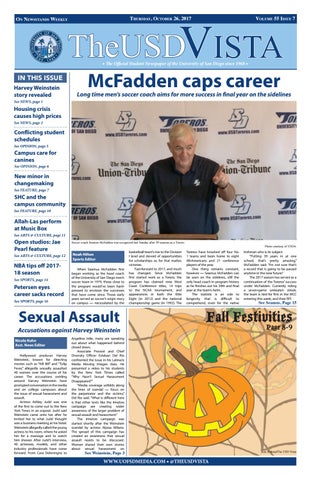
Soccer coach Seamus McFadden was recognized last Sunday after 39 seasons as a Torero.
Noah Hilton Sports Editor When Seamus McFadden first began working as the head coach of the University of San Diego men’s soccer team in 1979, those close to the program would’ve been hardpressed to envision the successes that have come since. Those early years served as soccer’s origin story on campus — necessitated by the
Sexual Assault Accusations against Harvey Weinstein Nicole Kuhn Asst. News Editor Hollywood producer Harvey Weinstein, known for directing movies such as “Kill Bill” and “Tulip Fever,” allegedly sexually assaulted 40 women over the course of his career. The accusations swirling around Harvey Weinstein have prompted conversation in the media and on college campuses about the issue of sexual harassment and assault. Actress Ashley Judd was one of the first to come out to the New York Times in an exposé. Judd said Weinstein came onto her after he invited her to what Judd thought was a business meeting at his hotel. Weinstein allegedly called the young actress to his room, where he asked her for a massage and to watch him shower. After Judd’s interview, 40 actresses, models, and other industry professionals have come forward. From Cara Delevingne to
basketball team’s rise to the Division I level and devoid of opportunities for scholarships or, for that matter, victories. Fast-forward to 2017, and much has changed. Since McFadden first started work as a Torero, the program has claimed nine West Coast Conference titles, 14 trips to the NCAA tournament, and appearances in both the Elite Eight (in 2012) and the national championship game (in 1992). The
Photo courtesy of USDtv
Toreros have knocked off four No. 1 teams and been home to eight All-Americans and 21 conference players of the year. One thing remains constant, however — Seamus McFadden can be seen on the sidelines, still the only head coach in program history as he finishes out his 39th and final year at the team’s helm. The statistic is an ode to longevity that is difficult to comprehend, even for the native
Irishman who is its subject. “Putting 39 years in at one school, that’s pretty amazing,” McFadden said. “I’m not sure that’s a record that is going to be passed anytime in the near future.” The 2017 season has served as a continuation of the Toreros’ success under McFadden. Currently riding a seven-game unbeaten streak, the team is tied for first in the WCC entering this week, and their RPI
See Seamus, Page 15
Fall Festivities Page 8-9
Angelina Jolie, many are speaking out about what happened behind closed doors. Associate Provost and Chief Diversity Officer Esteban Del Río confronted the issue in his Latina/o Media Moving Images class. He presented a video to his students by the New York Times called “Why Hasn’t Sexual Harassment Disappeared?” “Media coverage unfolds along the lines of scandal — focus on the perpetrator and the victims,” Del Rio said. “What is different here is that other texts like the #metoo campaign are creating wider awareness of the larger problem of sexual assault and harassment.” The #metoo campaign was started shortly after the Weinstein scandal by actress Alyssa Milano. The spread of this campaign has created an awareness that sexual assault needs to be discussed. Women shared their own stories about sexual harassment on
See Weinstein, Page 3
WWW.UOFSDMEDIA.COM ◆ @THEUSDVISTA
Rita Srekais/The USD Vista
2
The USD Vista
◆
October 26, 2017
NEWS
Crisis causes costly living in SD Low supply of housing units results in high prices for USD students to live off campus
Lilyana Espinoza News Editor
One of the perks of the University of San Diego is students’ ability to live minutes away from the beach. However, with the current San Diego housing crisis, dreams of living at the beach may be harder to obtain. According to KPBS, the average rent in San Diego has reached an all-time high of almost $2,000 a month, making housing for students financially difficult.
questionable cleanliness.” Many students who live off campus are aware of the crisis, especially when paying their rent month-to-month. “I think that the housing shortage makes sense due to the demand to live in ‘America’s Finest City,’” Ellias said. “It is still unfortunate however, and I know a lot of us students feel the impacts of higher rents.” Ellias currently lives in a fivebedroom house located in Mission Beach with six roommates. She reported the total rent of the house to be about $4700 a month.
“Short-term vacation rentals are really popular in the beach area — for example Pacific Beach — where a lot of USD students like to live.” -Alan Gin Myapartmentmap.com gives further detail to say that rent around $2,000 a month would typically be enough for a two-bedroom apartment. USD students have dealt with the stress of the housing crisis while trying to find a place to live during their academic years. Senior Sarah Ellias reported that even last year, finding housing was very difficult for her and her roommates. “It took months to find an affordable home in the neighborhood that we wanted to be in,” Ellias said. “Last year we were looking to live in Mission Beach and were struggling to find a place. There were only three of us at [that] time. We did end up finding an apartment in our budget, but it was unfurnished and honestly of
Dr. Alan Gin, Associate Professor of Economics at USD, recognized that the economics of supply and demand is the problem. “There is a lot of demand for housing in San Diego, but the supply is not increasing enough to meet that demand,” Gin said. Gin found that short-term rentals of units solely for vacation rentals play a role in why San Diego housing prices are so high. “A lot of units are being taken off of the market in terms of these shortterm vacation rentals, so people that have been buying housing and even buying apartment buildings have been using them and renting them out to people who are here short term,” Gin said. Gin said that people have
realized that they can make more profit by using their houses or apartments as short-term rentals, rather than renting to long-term tenants, especially at the beach. “This is hurting USD students particularly in the beach areas,” Gin said. “Short-term vacation rentals are really popular in the beach area — for example Pacific Beach — where a lot of USD students like to live.” With many potential units taken off the market, it becomes more difficult for students looking to rent a house at the beach that suits their needs and budgets. “Some people estimate that just in the City of San Diego itself, about 5,000 to 10,000 units are these short-term vacation rentals,” Gin said. “If those were back on the market, that would help in terms of places to live being available to both students and other people.” Junior Alicia Taylor talked about her experience with her roommates trying to find a place to live in San Diego. “We knew we wanted to live in Mission Beach, but the quality of the houses compared with the prices was very asymmetrical,” Taylor said. “We looked for a few months and kind of figured out that it wasn’t going to get any better, so we settled for a smaller place with a high price. We didn’t feel like we had many options, particularly with wanting a rental term of nine months.” Taylor reported that her current housing includes two bedrooms and one bath for three roommates. “We definitely wanted something with a little more ‘living’ space,” Taylor said. “For example, a
Homes in San Diego are becoming increasingly scarce. Photo courtesy of @OliverGraf360/Twitter
bigger eating area or a bigger living room. Three bedrooms would’ve been ideal for the three of us but we quickly realized that wasn’t going to happen.” The housing crisis also affects those students who wish to stay in San Diego after graduation. Although only a junior, Taylor is considering remaining in San Diego when her time at USD is over.
in there that are coming for one weekend at a time or just a couple of days. There are problems with things like noise and trash. Shortterm renters don’t take as good care of homes as long-term people.” Short-term rentals, however, are not the sole cause of the San Diego housing crisis. There has also been very little construction to meet the demand for places to live.
“We looked for a few months and kind of figured out that it wasn’t going to get any better, so we settled for a smaller place with a high price.” -Alicia Taylor
Mission Valley, filled with apartment rentals, is a popular place close to campus where students live during their academic year. Photo courtesy of @umpktmag/Twitter
The USD Vista Tayler Reviere Verninas - Editor in Chief Elisabeth Smith - Associate Editor Kelly Kennedy - Managing Editor James Douglas - Copy Editor Kaia Hubbard - Assistant Copy Editor Rita Srekais - Art Director Max Escutia - Assistant Art Director
“After graduation, I’m not sure where I’ll be, but I’d love to stay in San Diego,” Taylor said. “[I’m] not sure how I’m going to approach the housing situation, considering I hate being apart of the ‘rent culture.’ Ideally, I could find some people to come together and put a mortgage down on a house, so we wouldn’t be losing our rent money every month — but that’s probably a long shot.” Gin pointed out that shortterm renters also have an effect on neighborhoods for those living or wanting to live as long-term renters or permanent homeowners. “The other argument against short-term rentals is they really disrupt neighborhoods,” Gin said. “You don’t have long-term renters there, so you don’t get kids in elementary schools, you don’t get families there; rather, you get people
Editorial – 619.260.4584 Business – 619.260.4714 www.uofsdmedia.com ◆ @TheUSDVista
Lilyana Espinoza - News Editor Nicole Kuhn - Assistant News Editor Taryn Beaufort - Opinion Editor Victoria Zielinski- Assistant Opinion Editor Celina Tebor - Feature Editor Anderson Haigler - Arts & Culture Editor Noah Hilton - Sports Editor
Walker Chuppe - Photography Editor Cyrus Lange - Photo Assistant Ana Contreras Orozco - Photo Assistant Alex Worden - Distribution Editor Bailey Marie Donnelly - Finance Director Gina Lew - Student Media Advisor Marie Minnick - Operations Advisor
Currently, the San Diego City Council is making an effort to build more affordable housing with their approval of $125 million for construction, according to NBC 7 San Diego. However, these more affordable units will take years to build. For students who wish to stay in San Diego and are graduating within the next few years, affordable rent and mortgages will be difficult to obtain. This will make finding roommates the most ideal option for affording housing. For the time being, the housing demand is much greater than the supply available, which not only affects USD students, but also others looking for reasonable longterm options. Time will tell what actions will work best for increasing the supply of homes in San Diego.
The USD Vista publication is written and edited by USD students and funded by revenues generated by advertising and a student fee. Advertising material published is for information purposes only and is not to be construed as an expressed or implied endorsement or verification of such commercial venues by the staff or University. The USD Vista office is located on the fourth floor of the Student Life Pavilion in room 403B. All inquiries should be sent to: The USD Vista 5998 Alcala Park San Diego, CA 92110 The first copies of the newspaper are complimentary, all copies thereafter are a 25 cents charge. Opinions expressed in this publication are not necessarily those of The USD Vista staff, the University of San Diego or of its student body. Letters to the Editor can be submitted to The USD Vista office. Letters should be limited to 300 words and must be signed. For identification purposes, USD identification numbers and writer’s year must be included in the letter. The USD Vista reserves the right to edit published letters. Any content sent to the editor will be considered for publication unless otherwise stated.
Volume 55 Issue 7
◆
NEWS
◆
The USD Vista
Weinstein accusations develop
3
Sexual harassment allegations against Hollywood producer flood the media
Weinstein, from Page 1 Facebook, Instagram, and Twitter. For Del Rio, concern for the safety of men and women is not only exclusive to his role as a professor, but also as a father. “First, as a father of two young daughters, I want to instill confidence in them as much as I can, and model what it means to be a feminist as a man, and to join with men and women to contest these kind of consequences of unchecked patriarchy,” Del Rio said. “For me personally, this kind of cultural moment causes me to think about my own behavior, and stay reflective about how my beliefs and behaviors align and misalign.” Harvey Weinstein’s alleged transgressions are not the first case of sexual harassment, but some of many in the professional world. Women like Anita Hill, who brought sexual harassment allegations against Supreme Court judge
about Weinstein should remind us about how such behaviors are shared widely by men in power.” College campuses do their best to require programs such as Title IX, an educational program about sexual harassment on campus enacted by the university. Amanda Luckett, Prevention and Education Coordinator at the Women’s Center, works closely with Campus Assault Resources and Education (CARE), an on-campus resource for students who have been sexually harassed or assaulted. “Many of the students I work with have engaged in conversation about the #metoo movement on social media, which is one of many hashtags used in the past few years to talk about sexual violence within our culture,” said Luckett. “My hope is that students who are engaging in #metoo know that there are people here at USD who care and want to help.” Senior Grace McDonald was
“I have to be scared when I have to walk to my car at night. I have to constantly worry about my friends when we’re out at night.” -Grace McDonald Clarence Thomas to the media, and Ashley Judd were just a few of the women attesting to sexual harassment in the workplace back in the early 2000s. Del Rio shared the concerns on the matter. “Shameful, but not surprising,” Del Rio said. “News about sexual harassment and sexual assault is not really about the person, but about the pattern. The stories circulating
one of the many to respond to the #metoo campaign. “All over my news feed on Instagram, Facebook, and Twitter, were stories of sexual harassment and assault,” McDonald said. “It’s sparked an interesting conversation and acknowledgement that many things can fall under the categories of sexual harassment, abuse, and assault; I saw many women post that
they felt their stories weren’t as bad as others, but still felt that they had been violated at some point. The Weinstein case and the following #metoo campaign have highlighted the ubiquity of sexual harassment, and have certainly shown women that they are not alone in this fight against violation.” The campaign has sparked a movement, and students like McDonald have joined the conversation and have begun to share their stories. “I have far too many stories of times I’ve been sexually harassed or assaulted,” said McDonald. “I’m not the only one. Most women I know have more than a few stories too. I scrolled through social media and I was saddened but unsurprised by the amount of stories of harassment I was reading. I have to be scared when I have to walk to my car at night. I have to constantly worry about my friends when we’re out at night. I have to think actively and consciously about the way I interact with my professors or bosses just so what I’m saying will be taken seriously.” McDonald stated that she isn’t the only one. “If you were surprised by how many women you know or know of that have shared that they’ve been harassed or assaulted, open your eyes,” McDonald said. “Pay attention and stop being complicit. By being silent, by not offering your allegiance to survivors, you are perpetuating the acceptance of behavior like Weinstein’s.” Students and faculty are encouraged to reach out to CARE Advocates at anytime by calling (619) 260-2222. More information can be found at www.sandiego.edu/ care.
Hollywood producer, Harvey Weinstein, has been accused of sexual harassment. Photo courtesy of @PulseGhana/Twitter
Sexual allegations began a trend of women telling their stories of sexual harassment. Photo courtesy of @BOB_EWASHINGTON/Twitter
A hard pill to swallow
Trump’s rollback surrounding birth control affects students and faculty on campus Nicole Kuhn Asst. News Editor On Oct. 6, the Trump Administration made a decision that could affect 62 million women in the US. The Department of Health and Human Services declared that the pill may no longer be covered by insurance. With the rollback enacted, college campuses and employers have the decision to cover their employees and students for the pill. The USD Student Health Center is available for medical counseling
regarding birth control, but due to religious affiliations students will have to get birth control from a family provider or off-campus physician. Sophomore Mina De Guia has been affected by the fact that SHC does not distribute birth control. Living on campus with no car, De Guia’s only option is to get a large supply of birth control pills when she visits home or has her mother in Washington send her pills. “I feel unsupported by my university not being able to fill my legitimate birth control prescription,” said De Guia. “I’m
Healthcare of birth control has been a hot topic on college campuses.
confused, and a little bit upset that I am not able to get my birth control on campus because birth control is a legitimate medical tool. I was prescribed by a licensed doctor. It should be honored by the health center that has the ability to care for its students.” De Guia has her own insurance provided by her family, but still finds that it is difficult to not have a provider nearby or on campus to meet her medical needs. She stated that restricting the pill on campus does not grant anyone freedom, but instead deprives them. “You can’t pick and choose
Photo courtesy of @TheHill/Twitter
what medical concerns you want to support and not support,” said De Guia. The rollback has presented an issue that faces USD students and the SHC. The SHC website also states that because of its religious affiliation, birth control is not distributed on campus. “In keeping with the Catholic tradition regarding birth control, the SHC does not dispense condoms nor prescribe medication for purposes of contraception,” the site states. “However, recognizing that oral contraceptives are prescribed for particular medical conditions, it is advisable that these matters be discussed individually with a provider at the SHC.” Sikes encouraged students to solicit medical advice from the health center. “All conversations are held in the strictest confidence and provided with support and without judgment,” Sikes said. “Students receive medical advice regarding sexual and reproductive health in order to make their own informed decisions regarding healthy relationships.” Following the rollback on birth control administered by the Trump administration, USD students and employees questioned if the mandate affects their insurance plans. The cutback of the pill was initiated on Oct. 6, but it is an
interim decision, and the Trump administration is open to public comments until Dec. 5, 2017. For the time being, employers are discussing matters that surround the issue. “The rollback effect is unknown at this time,” Sikes said. “It may have a significant effect if insurance carriers or those who negotiate plans with them do not provide this benefit. It may have an insignificant effect if the insurance carriers and those who negotiate plans with them do continue to provide this benefit.” For employees on campus, insurance will continue to cover the pill regardless of the rollback. Janie Carolin, Director of Compensation & Benefits for Human Resources, reassured that employees at USD will not be affected. “The University of San Diego strives to provide our employees with comprehensive healthcare options that meet the needs of our diverse employee population,” said Carolin. “There are no plans to make changes to our health benefits as a result of President Trump’s recent ruling.” Over the past few weeks ,lawsuits from states such as California and Massachusetts and bills such as the Protect Access to Birth Control Act, are being passed to try and help block the recent rollback initiated by the Trump administration.
4
The USD Vista
◆
October 26, 2017
OP I N ION
College takes on Halloween The end of trick-or-treating does not mean the end of Halloween celebrations
Taryn Beaufort Opinion Editor Halloween is right around the corner, which brings excitement to people of all ages, including University of San Diego students. The holiday may no longer be filled with trick-or-treating from door-to-door for Toreros, but that doesn’t stop them from celebrating. As a child, senior Marissa Millender’s favorite part about Halloween was going trick-ortreating. “I love candy, so I was always stoked to get a pillowcase full of candy,” Millender said. “At the end of the night I would separate all my candy into different piles then trade with my friends.” Even at the end of her college career, Millender continues to enjoy the holiday but in a different fashion. “Now my favorite part about Halloween is getting dressed up and going out with my friends,” Millender said. “This year I will probably go out to a bar that has a Halloween theme and hopefully get some discounted drinks.” It is likely that Millender’s fellow Toreros will join her on Halloween night’s festivities. “I think Halloween is definitely prevalent in college since it is technically a holiday,” Millender said. “College students will find any reason to get dressed up and party.” Junior Tia Phillipart looks forward to Halloween every year to kick off her fall traditions. “Each October since I can
remember I’ve gone to a pumpkin patch and picked out the perfect pumpkin,” Phillipart said. “After we carve the pumpkin and make pumpkin seeds. We make a whole night of it, eating fall foods and watching Halloween movies.” Although Phillipart carried this tradition with her through the years, her actual Halloween plans have evolved. “I was all about trick-ortreating when I was younger,” Phillipart said. “I would be ready to the second it started getting dark. Now I would still love to go trickor-treating, but I don’t think that it is age-appropriate anymore. I still enjoy dressing up, but I just go to parties instead.” There are a wide variety of options for students to celebrate Halloween, besides attending festive soirées. San Diego hosts plenty of activities for nonpartygoers. Students can attend one of the many local haunted houses. The Haunted Hotel is located in downtown San Diego, The Scream Zone is at the Del Mar Fairgrounds, and the Savage House is located at the Westfield Mission Valley parking lot. The prices of haunted house tickets range from $20 to $30. Other options include pumpkin patches, Día De Los Muertos celebrations, or small gatherings with friends. Senior Dominik Baer acknowledged the temptation of taking advantage of the holiday to attend a party, but doesn’t think he will go to one this year. “This year I can’t quite find the time to go out,” Baer said. “I will probably still dress up and play
some scary video games though.” Baer was not always fond of the concept of ‘dressing up.’ “I wasn’t a huge fan of costumes,” Baer said. “I accepted that if I wanted a taste of the sugary goodness I needed to wear a costume. Nowadays I actually enjoy the costumes a lot more — it’s a lot of fun to dress up once a year.” Baer has his own set of beliefs as to why Halloween continues to be prevalent among the college population. “I think Halloween is prominent in college because it’s another excuse to put off your responsibilities,” Baer said. “Any other weekend you would be seen as non-studious.” Even with the possibility of reigning in unlimited amounts of candy as a child, junior Kathryn Querner fondly remembered the holiday for the sentimental memories she created. “My favorite part of Halloween as a child was making pumpkin bread with my mom,” Querner said. “I loved that the house always smelled like pumpkins and cinnamon in the weeks leading up to Halloween. I still make pumpkin bread all the time; I don’t think I will ever stop loving that smell. But now my favorite part is watching spooky movies, especially with my roommates. My favorite movies are ‘Phantom of the Opera’ and ‘The Nightmare Before Christmas.’” Each year, the Freeform channel puts on ‘13 Nights of Halloween.’ A variety of spooky movies and shows run from Oct. 19 until Oct. 31. Viewers can watch movies ranging from “Hocus
Junior Tia Phillipart poses with a friend after finding the perfect pumpkin. Photo courtesy of Tia Phillipart
Pocus” to “The Addams Family.” Halloween brings each Torero a different reason to celebrate. Whether it’s dressing up in a spunky costume, or staying in for a
night filled with pumpkin-flavored everything, there is something for everyone. Hopefully, every Torero will have a spooky Halloween filled with tricks-or-treats.
Rita Srekais/The USD Vista Have an opinion? Write a Letter to the Editor to be considered for publication in The USD Vista. Contact vistaeditor@sandiego.edu for more information. The views expressed in the Opinion section are not necessarily those of The USD Vista staff, the University of San Diego, or its student body.
Rita Srekais/The USD Vista
Volume 55 Issue 7
◆
OPINION
The USD Vista
◆
Busy schedules lead to conflict
5
How are students supposed to attend on-campus events while balancing a full course load?
Taryn Beaufort Opinion Editor Attending on-campus events are an important part of a student’s college experience, both academically and socially. University of San Diego students have no shortage of opportunities to attend events on campus. They are typically free of charge for students, staff, and faculty, making it an accessible resource. However, the events are known to have a low attendance rate among students. Senior Kirra Bixby stated that she enjoys attending events in which she is interested. “I typically have a busy schedule, so I can only make time for the events that I think might be beneficial towards my future,” Bixby said. “These are typically career fairs and meetings for clubs that I belong to.” Like Bixby, other students share a similar outlook. Campus events often fluctuate in attendance, depending on the topic or speaker. “To be honest, free food or extra credit is probably the main reason students attend events,” Bixby said. “I think that if the university wants to increase student attendance, better promotion of the events could be beneficial. Most of the time I am unaware of the events happening on campus and I would go if I knew about them ahead of the time.” However, Bixby believes that there can be something done to increase students overall attendance of events hosted on campus. “I think these events could be integrated into classes by offering extra credit,” Bixby said. “Or, if an event is specifically beneficial for a class, cancel the class for the day and use the student’s participation
at the event as their attendance grade.” While Bixby would like to to be able to attend, she often can’t find the time due to overlapping schedules. “It should be acknowledged that it is hard for students to attend these events due to conflicting class schedules or other prior commitments,” Bixby said. “Dead hours gives us the available time to attend these events, but I usually try to plan group projects or study groups during this time.” On the other hand, some professors do their best to encourage students to attend such on-campus events. Dr. Jillian Tullis, a Communication Studies professor, regularly incorporates outside events that pertain to her class. “I do think it is important for students to attend campus events,” Tullis said. “They are a great way to be exposed to new ideas — they can help us think deeply about contemporary issues and topics we are already studying. Being a member of the scholarly community includes attending these events, supporting our colleagues, and sharing knowledge with our peers. Learning doesn’t only take place in the classroom.” USD professors also have many responsibilities that they must uphold, which results in busy schedules for them. “Much like students, professors are pulled in many directions,” Tullis said. “We have to think about teaching, which includes preparing for our classes, not just delivering content, research, and service obligations, which help our departments, the college, and university function.” Tullis pointed out that it can be difficult to coordinate the time to attend events and also balance
The Apple Fest had a large attendance of students in search of free food.
class time. “If I attend campus events, chances are I’m not attending to some other part of my job,” Tullis said. “If I encourage students to attend events as part of the class, I’m likely having to eliminate something else from the course. That said, I still find it worthwhile to get outside of the classroom and use the events as part of the class when I can.” Shannon Starkey, an instructor in the Art, Architecture, and Art History department, thinks about on-campus events as additional educational opportunities for students. “I think campus events are best when they are not necessarily tied to a particular class, but
something totally outside,” Starkey said. “Every student has their interests and their major, which is funneling them toward certain kinds of narrow bodies of knowledge. Campus events can be a brief moment when you get to see a little bit of exposure to something else that you can’t formalize. In other words, we can’t all take classes in everything we are interested in, but we can go to an hour-long lecture as a way to say, ‘Yes, I’m interested.’” Starkey hopes to see an increase in overall attendance to on-campus events, but pointed out why that may be unlikely to occur. “The university places a high value on education being more
Walker Chuppe/ The USD Vista
than just what’s being taught in the classroom,” Starkey said. “But at the same time, the requirements of the curriculum are so intense that students are put into a bind in that they can’t attend things that maybe they would want to because their course requirements are too much.” There are many views regarding the importance of on-campus events. It is difficult to determine whether in-class sessions should be prioritized over outside-of-classroom events, or vice versa. The answer may be that they are of equal stature, but students and professors should seek out a system of balance when it comes to deciding what to attend.
USD Student Media
Advertising Manager position available
$ The AMA club meeting had high attendance and offered free food and a Passport point. Photo courtesy of Andie Zaharias-Kerm
Contact: mediafinance@sandiego.edu
Have an opinion? Write a Letter to the Editor to be considered for publication in The USD Vista. Contact vistaeditor@sandiego.edu for more information. The views expressed in the Opinion section are not necessarily those of The USD Vista staff, the University of San Diego, or its student body.
6
The USD Vista
◆
October 26, 2017
Caring for canines on campus Student pet owners discuss challenges and rewards of owning a dog
Victoria Zielinski Asst. Opinion Editor A quick stroll down the University of San Diego’s main campus is bound to provide several sightings of fuzzy, fourlegged friends and crowds of happy students around them. Whether it be a service dog, emotional support animal, or simply a companion dog, students enjoy sharing USD’s campus with all dogs. Many Toreros balance being full-time students and pet owners. USD has specific policies on pets that owners must be aware of when bringing their dogs to campus. Junior Rachel Steinberg’s service dog, Simba, is a Labrador retriever and Carolina mix, and lives with her on campus in Manchester Village. “Having a service dog on campus means having a highly trained dog that is capable of mitigating your disabilities, be it physical or psychiatric,” Steinberg said. “Service dogs are protected under the Americans with Disabilities Act, and because of this they are seen as medical equipment and can accompany a handler anywhere.” Steinberg described the challenges of living with her dog on campus. “You not only have to provide and care about your own needs, you need to keep the dog’s needs in mind at all times as well,” Steinberg said. “Meaning no spontaneous weekend trips unless they are pet-friendly or you have someone to care for the animal while you are gone. Personally, I send my pup to doggy day care if it’s a day when I am unable to focus on him or give him the attention and care he needs, or I have family watch him.” Steinberg stated that she wants to spread awareness that having a service dog is not an excuse for people to take their pets everywhere they go. “Having to take a service dog with you is not glamorous, it’s a medical necessity,” Steinberg said. “People generally know that he [Simba] is a service dog and know either to not bother us or to ask to pet him. But people get excited when they see him off-vest as he is very friendly and loves people!” Sophomore Bethany Van
Baak also has a service animal, a seven-year-old Havanese named Sebastian. Sebastian accompanies Van Baak almost every day while she attends class. But there are certain circumstances in which he can’t tag along, such as her science lab, where dogs could potentially be exposed to dangerous hazards and chemicals. When she does have to leave Sebastian behind it requires additional planning. “I don’t have to leave him alone very often, but when I do leave him alone, my roommates help out,” Van Baak said. “If I’m ever told I cannot have my dog on campus, I inform them that my dog is a service animal.” According to USD Policy 2.11.1, the school prohibits pets in all buildings, residence halls, athletic fields, outside dining areas, or any other facilities that are affiliated with the university. Service dogs are exempt from these rules, and while emotional support dogs are allowed in residence halls with proper documentation, they cannot go everywhere that service dogs are allowed. Service dogs are trained to perform a medical disability related task, while emotional support dogs help to alleviate stress by being in the presence of their owner. Dogs who are not registered as service or emotional support dogs are permitted on campus roads and outdoor grounds, but they must be leashed and under control of their owner at all times. Failure to follow these rules could result in removal of the dog and disciplinary action from the university. Van Baak believes that campus leash requirements are fair. “The rules make everything run smoother, especially if dogs interact on campus, and people generally react with lots of smiles,” Van Baak said. Sophomore Darlene Ngo’s dog is a small black cockapoo named Harvey. Harvey is an emotional support animal, and he lives in oncampus housing with Ngo. As an emotional support dog, Harvey is allowed in outdoor spaces and in Ngo’s residence hall, but he cannot visit shared spaces like lounges, classrooms, and study rooms. “I have to leave Harvey at home when I go to class, because he’s not allowed in buildings or
A playful Ollie runs back to his owner after fetching his ball. Photo courtesy of Rachel Robinson
Owner Bethany Van Baak posing for a photo on the beach with her shih tzu Sebastian.
classrooms,” Ngo said. “I think it makes the whole ‘emotional support’ part a lot less effective if I can only see him early in the morning and at night when I get home from class.” Ngo explained the challenges of having a dog and being a fulltime student. “Harvey is still a puppy, so it’s been extremely difficult, especially with sleep,” Ngo said. “The first month I had to wake up at three in the morning every day to let him out. I’ve also been having to run back to the Vistas in between classes to let him go potty.” Ngo also takes Harvey to training once every two weeks, buys groceries for him, takes him to veterinary appointments, and gets him groomed. “It’s a lot to handle,” Ngo said. “I’ve been really lucky to have a strong support system of friends who can watch him when I need to do something important, but other than that I’m on my own.” Ngo expressed that she wishes the school would be more lenient with their policy on animals. “I would hope that ESAs [emotional service animals] that can pass the Good Canine Citizen Test can come to classes with their handlers,” Ngo said. “That would be such a tremendous help for me and my stress, dealing with running back and forth.” The Good Canine Citizen Test is a ten-step program administered by the American Kennel Club in which dogs must complete a series of tasks such as accepting a friendly stranger and coming when called. Junior Mitch Williams shares the responsibility of a dog with his roommates who live off campus. Mica, a Terrier mix, was rescued when she was just a puppy and was recently registered as an emotional support dog. “I bring Mica to campus a few
times a month,” Williams said. “Balancing school and being a dog owner is pretty easy since Mica is a really great study buddy — she just sleeps on me while I do my homework.” So far, Williams hasn’t run into any issues with bringing Mica onto campus. “I mainly bring her to outside seating areas like La Paloma or near Olin Hall,” Williams said. “I’ve never been told that I can’t bring her on campus, but she is an emotional support dog so that would help if I was questioned.” Senior Rachel Robinson rescued her 14-month-old golden retriever Ollie from the Southern California Golden Retriever Rescue. Robinson shared that while having a dog in college can be rewarding, it takes some adjustment. “My parents weren’t thrilled about it at first,” Robinson said. “Ollie is still a puppy and a naturally very high-energy dog. We spend a lot of time walking and training to keep his mind busy, so when I do have to leave for class he is tuckered out and will just nap until I come home.” Although taking care of Ollie works for Robinson because of her previous experience with animals at home, she didn’t encourage most college students to have a dog. “When the rest of a student’s normal life is already so busy, the dog has to be the priority,” Robinson said. “Ollie and I usually just walk around campus on a leash because he is super excitable and loves to run up to anyone and everyone.” As far as USD’s pet policy, Robinson does not see a need for it to change at this point in time. “I know there are students who don’t like dogs or are allergic, so I think it’s important to respect
Photo courtesy of Bethany Van Baak
those people since Ollie isn’t doing me any service,” Robinson said. “I don’t try to take him into buildings or anything because he is not a service dog. He’s too rowdy — and weighs 75 pounds — to bring inconspicuously into class.” Senior Matt Stockton’s dog Knox is a half-German shepherd, quarter-pitbull, and quarter-corgi mix. Stockton brings Knox to class with him three days a week, and shared that it takes him longer to get out of the house on those days. “I can’t be rushing out of the house because I need to feed him and make sure I’ve packed his food and other items for the day,” Stockton said. “Because I try to spend as much time with Knox as possible, I often have to sacrifice my free time to take him on hikes and keep him busy. I am no longer accountable for just myself, but for another life as well.” Stockton stated that he tries to keep Knox outside of buildings as much as possible when he’s on campus. “I usually only go inside with him when I have class,” Stockton said. “He is very calm when I’m in class, so there haven’t really been any issues yet. I’m also assuming that he’s not allowed inside the Immaculata, but I usually keep him home on Sunday mornings.” Being able to take care of Knox has been a positive experience for Stockton, who wasn’t allowed to have a dog in the house growing up. “I can honestly say that having Knox has really changed the dynamic of my life and I couldn’t be more excited to experience him grow up,” Stockton said. USD students with dogs seemed to agree that while caring for their dogs is a lot of work, the rewards are worth it. Although USD’s policy on dogs isn’t lenient, students still enjoy the company of canines.
Have an opinion? Write a Letter to the Editor to be considered for publication in The USD Vista. Contact vistaeditor@sandiego.edu for more information. The views expressed in the Opinion section are not necessarily those of The USD Vista staff, the University of San Diego, or its student body.
Volume 55 Issue 7
◆
FEATURE
◆
7
The USD Vista
F E AT U R E
New minor comes to campus
‘Changemaking’ is no longer just a USD buzzword, but now offered as a minor starting in Spring 2018 Kelly Kennedy Managing Editor The University of San Diego has a reputation for panoramic views, Spanish architecture, and seemingly perpetual construction. Construction isn’t the only source of change on campus, and yet another one has come to campus this semester — the addition of a Changemaking minor to USD’s course catalog. USD was designated as a Changemaker Campus in 2011 by AshokaU, a network of social entrepreneurs that focuses on education and social change. Approximately 41 universities worldwide have received this title. The launch of the Changemaker Hub, a physical space and organization focused on executing changemaking values, signaled the distinction’s ever-growing presence. ‘Changemaking’ is engrained into almost every aspect of campus life — students are referred to
electives. Courses such as Changemaking 101 offers students opportunities to learn about social change initiatives and strategies. Senior Indira Galvez explained what the word ‘changemaking’ means to her. “I think that changemaking involves really understanding the systems of society that affect everyone,” Galvez said. “Changemaking is understanding [these systems] and being able to pinpoint flaws and changing or improving [them] as needed. It’s very action-based, but in order to have action you need to understand what’s going on.” Galvez expressed that the Changemaking minor is a course of study that would be of interest to her. “I almost wish that I weren’t a senior so that I could look more into the minor,” Galvez said. Professor Mike Williams, Director of the Changemaking Hub, explained how the new Changemaking Minor will incorporate theory and practice.
“Now, students can pursue a social change project that they are interested in while earning units and fulfilling the advanced integration core requirement.” -Mike Williams as ‘changemakers’ in university materials and the Changemaker Hub partners with other campus organizations to sponsor many events and programs, including the Changemaker Block Party, Changemaker Challenge, Social Change Corps, and Changemaker Faculty Fellows. Housed within the College of Arts and Sciences, the Changemaking minor is an 18-unit program that includes a capstone course and interdisciplinary
“Like other interdisciplinary fields in the liberal arts, changemaking and social innovation attempt to merge different theories and to provide case studies for us to understand how social change occurs,” Williams said. “Through the Changemaking 101 course, students will explore this literature and learn the theories and practices that scholars, community activists, and government officials have used to promote social change.”
After four years of planning, the new Changemaking minor is compatible with the new core curriculum that debuted this fall. The minor also includes a Changemaking capstone course in which students will use their knowledge of changemaking principles to create a program, initiative, or social venture. Williams explained that, in the past, students have worked on social innovation projects in their spare time and without receiving academic credit for their work. The Changemaking Capstone would change this gap in course curriculum. “Currently, the Hub works with around 40-50 students per year in our Social Change Corps program where students develop a social change project,” Williams said. “We hope the minor will attract those students who want to have these types of experiences but who are unable to do this outside of the classroom. Now, students can pursue a social change project that they are interested in while earning units and fulfilling the advanced integration core requirement.” While some students are excited about this new field of study, others have expressed skepticism about the minor. Senior Benjamin White believes that the new minor does not add to USD’s reputation. “[USD’s] accolades revolve primarily around its aesthetic qualities that make it the most beautiful campus in the world and highly touted programs in fields like engineering and the humanities,” White said. “Adding an obscure and ambiguous [minor] is unlikely to contribute any significant weight to the school’s prestige, and if the school is looking to add to its prestige, its resources would be
The College of Arts and Sciences has been promoting the new Changemaking minor. Walker Chuppe/The USD Vista
better served hiring an esteemed faculty member or buying stateof-the-art research equipment or commissioning a study with important implications.” Upon reviewing the curriculum of the Changemaking minor, White expressed that he would not be interested in pursuing a related degree. “I would not consider pursuing
The Changemaker Hub is located on the third floor of the SLP and is open to all students who want a place to study, relax, or hang out with friends.
Kelly Kennedy/The USD Vista
a minor in Changemaking if I weren’t about to graduate, because having a minor already adds dubious weight to your diploma and if I were to add one, it would be a minor with a clear educational value behind it that could be discerned by an employer,” White said. “I wouldn’t be sitting in an interview trying to explain why I added 18 more units to my total course load in order to build a park bench.” White explained why the Changemaking minor does not intrigue him. “Additionally, Changemaking is not a field of study that interests me, because it is not really a field of study to begin with, and people’s time and money would be better served in the pursuit of an actual major or minor that adds some real value to their educational portfolio and real, applicable expertise to their skillset,” White said. While Changemaking 101 will launch in spring of 2018, students who have completed other courses that count toward the Changemaking minor are well on their way to finishing the program. LEAD 160 and SOCI 210, SOCI 270, or THRS 231 are all a part of the course requirements. USD continues to expand and refine its core curriculum, and the new Changemaking minor not only fulfills requirements within the new core curriculum, but also appeals to students who have related interests. While not everyone may be interested in such a course of study, Changemaking is undoubedtly a part of USD’s identity that will continue to grow. with the university.
8
THE USD VISTA
◆
Volume 55 Issue 7
OCTOBER 26, 2017
College Horror Horror Stories Stories College
◆
FEATURE
◆
THE USD VISTA
9
Toreros at Pumpkin Patches Emily Pat terson, junior
Emilie Schumaker, first-year: “I had just gone to bed, and my roommates were both asleep. I sat up a little bit, and by the door, I saw a blue translucent ghost. At first I thought I was imagining things, but I did a double take and it was still there.”
Photo courtesy of Emilie Schumacher
Derek Lao, Junior:
Pumpkin patch she went to:
Mountain Valley Ranch Pumpkin Patch Why she likes the Mountain Valley Ranch Patch: “I grew up going to that pumpkin patch every year when I lived in Ramona.” Her favorite part of the trip: “One of my roommates is an exchange student from Barcelona and she had never been to a pumpkin patch before, so it was really cool to see her get excited over something that’s a fall tradition here.”
“This week, we had presentations. My group assumed that if we’re not presenting, then we didn’t have to go to class. I had to make up a quiz for the same class so I went to my professor’s office hours and when I showed up, he asked me where I was in class: it turned out that we actually did have to go even though we weren’t presenting.”
Photo courtesy of Emily Patterson
Kateri Theisen, senior Pumpkin patch she went to:
Pumpkin Station, Del Mar
Photo courtesy of Derek Lao
“The person that sits next to me in class raised her hand to ask a question but I thought she wanted a high five, so I went in for the high five and she was like ‘what are you doing?’”
Why she goes to pumpkin patches: “I’m from Minnesota, and we always used to go to pumpkin patches and apple orchards in the fall for school trips. It reminds me of home.” What she loved seeing at the pumpkin patch: “My favorite part was seeing all the little kids having fun! They had rides and carnival games there, and it was funny seeing them go wild.”
Tessa Bradeen, first-year: “People keep trying to talk to me in the bathroom when I’m pooping. It’s not a social place!” Photo courtesy of Tessa Bradeen
Photo courtesy of Kateri Theisen
Michelle Mogollon, senior Pumpkin patch she went to:
Mission Valley Mall
Pearl Chou, senior:
Why she loves pumpkin patches: “Going to a pumpkin patch is something you can do to make it feel more like fall in San Diego since it’s always so hot during October.” Her favorite part of visiting the pumpkin patch: “Spending time with my friends and picking pumpkins out for our houses.”
“One of my classes, once the professor was late for 30 minutes, and we didn’t know why. He didn’t notify us, so we were like ‘I think there’s a university policy that we can all dip now.’ And one student pulled out her phone, and she called both the professors’ personal and office phone number. He picked up and said he would be there in 15 minutes, so we waited for 45 minutes for a class that we could have left, but the girl ruined it.”
Photo courtesy of Michelle Mogollon Photo courtesy of Pearl Chou Spread by Rita Srekais; Content by Celina Tebor
8
THE USD VISTA
◆
Volume 55 Issue 7
OCTOBER 26, 2017
College Horror Horror Stories Stories College
◆
FEATURE
◆
THE USD VISTA
9
Toreros at Pumpkin Patches Emily Pat terson, junior
Emilie Schumaker, first-year: “I had just gone to bed, and my roommates were both asleep. I sat up a little bit, and by the door, I saw a blue translucent ghost. At first I thought I was imagining things, but I did a double take and it was still there.”
Photo courtesy of Emilie Schumacher
Derek Lao, Junior:
Pumpkin patch she went to:
Mountain Valley Ranch Pumpkin Patch Why she likes the Mountain Valley Ranch Patch: “I grew up going to that pumpkin patch every year when I lived in Ramona.” Her favorite part of the trip: “One of my roommates is an exchange student from Barcelona and she had never been to a pumpkin patch before, so it was really cool to see her get excited over something that’s a fall tradition here.”
“This week, we had presentations. My group assumed that if we’re not presenting, then we didn’t have to go to class. I had to make up a quiz for the same class so I went to my professor’s office hours and when I showed up, he asked me where I was in class: it turned out that we actually did have to go even though we weren’t presenting.”
Photo courtesy of Emily Patterson
Kateri Theisen, senior Pumpkin patch she went to:
Pumpkin Station, Del Mar
Photo courtesy of Derek Lao
“The person that sits next to me in class raised her hand to ask a question but I thought she wanted a high five, so I went in for the high five and she was like ‘what are you doing?’”
Why she goes to pumpkin patches: “I’m from Minnesota, and we always used to go to pumpkin patches and apple orchards in the fall for school trips. It reminds me of home.” What she loved seeing at the pumpkin patch: “My favorite part was seeing all the little kids having fun! They had rides and carnival games there, and it was funny seeing them go wild.”
Tessa Bradeen, first-year: “People keep trying to talk to me in the bathroom when I’m pooping. It’s not a social place!” Photo courtesy of Tessa Bradeen
Photo courtesy of Kateri Theisen
Michelle Mogollon, senior Pumpkin patch she went to:
Mission Valley Mall
Pearl Chou, senior:
Why she loves pumpkin patches: “Going to a pumpkin patch is something you can do to make it feel more like fall in San Diego since it’s always so hot during October.” Her favorite part of visiting the pumpkin patch: “Spending time with my friends and picking pumpkins out for our houses.”
“One of my classes, once the professor was late for 30 minutes, and we didn’t know why. He didn’t notify us, so we were like ‘I think there’s a university policy that we can all dip now.’ And one student pulled out her phone, and she called both the professors’ personal and office phone number. He picked up and said he would be there in 15 minutes, so we waited for 45 minutes for a class that we could have left, but the girl ruined it.”
Photo courtesy of Michelle Mogollon Photo courtesy of Pearl Chou Spread by Rita Srekais; Content by Celina Tebor
10
The USD Vista
◆
October 26, 2017
Behind the health center’s doors Student Health Center provides healthcare, but some students are skeptical of its reliability
Celina Tebor Feature Editor Between the long lines at Aromas and the Mail Center lies the University of San Diego’s Student Health Center (SHC). Located in Maher 140, it serves as USD’s personal primary care medical service. From mild colds to severe allergic reactions, a wide variety of illnesses and health issues can be handled by the SHC. Pamela Sikes, Director of the Student Health Center, has worked at the SHC for 14 years and worked in medicine for over 20 years. “Students think of us as a doctor’s office,” Sikes said. “We’re called primary care services. It is things students would normally go to see their doctor or pediatrician. We provide physicals, routine health care, as well as treatment of illnesses and injuries.” While Sikes believes the health center to be a valuable resource to USD students who seek medical care, she was confused by the campus community’s lack of knowledge about the on-campus service. “It always surprises me how many students didn’t even know we were here,” Sikes said. “This surprised me because we’re involved in orientation and we’re in a great location, but we know that students can really be impacted academically
for same-day services is something that’s a little different from off campus. If you are sick, you can be seen pretty much same day. And you can get often assessed, get a diagnosis, get a medication, and be out the door. So it’s kind of a onestop care.” The health center is relatively small in comparison to most offcampus clinics. While it has its advantages, like same-day and next-day availability, the SHC does not have all the services of a normal off-campus clinic. “A true urgent care can get x-rays on site,” Sikes said. “They can get blood work on site, same day. We don’t have that same day. If we need to draw blood or need cultures or other things, we send that out in the evening and we get the results usually the next day.” The health center can schedule x-rays and labs for students, but because they do not have this equipment on-site, students are often referred to off-campus clinics if they need urgent medical care instead. Additionally, any staff member of the health center can write students a note to get out of class if needed — no appointment or prescribed medication is necessary to receive a note. However, some students go to off-campus clinics for other reasons; in fact, some students believe that the health center does
“In the medical world, providers have way overtreated viral illnesses...And the research, over and over, shows many of these upper-respiratory illnesses are viruses and should not be treated with antibiotics.” -Patricia Sikes if they’re not feeling well.” It seems like the majority of USD students are aware of the SHC, however. The USD Vista conducted a random, unscientific questionnaire of 60 undergraduate students, 57 of which knew where the SHC was located. Approximately 23 percent of full-time students are enrolled in the USD Health Insurance Plan. Yet, there are many differences between the health center and an off-campus clinic. “To get in a door, there’s no charge,” Sikes said. “Our availability
not provide accurate diagnoses and prescriptions. Senior Emily Pitsch visited the SHC to check if she had lice, but was dissatisfied with her visit. “They combed through my hair and were unsure if they saw anything,” said Pitsch. “The nurse said, trying to illustrate her uncertainty, ‘There’s a 40 percent chance that you might have lice.’” Unsatisfied with her diagnosis by the SHC, Pitsch went to the Lice Center of America in Clairemont and it determined she should be treated
The SHC’s on-campus dispensary contains both prescription medications and the over-the-counter medication. Celina Tebor/The USD Vista
for lice. Some students are skeptical about the health center’s propensity to prescribe non-over-the-counter medication. According to Sikes, the health center gives students and faculty prescriptions when appropriate. “Antibiotics are our number one common prescription,” Sikes said. The health center even has a small dispensary on-site that offers both over-the-counter and prescription medications. Sikes explained why she thinks that some students believe they were not treated correctly at the SHC. “In the medical world, providers have way over-treated viral illnesses,” Sikes said. “Especially upper-respiratory viral illnesses with antibiotics. And the research, over and over, shows many of these upper-respiratory illnesses are viruses and should not be treated with antibiotics.” Sikes said that since the USD health center serves a relatively small community, it is easier to take time to explain why a student might not need antibiotics when compared to a busy off-campus clinic. “In the outside world, sometimes
While some students take advantage of the Student Health Center, others prefer to go to off-campus clinics. Celina Tebor/The USD Vista
it takes longer to convince patients that they don’t need an antibiotic than to just write the prescription and and get them out the door,” Sikes said. Pitsch disputed the fact that the health center gives more care and attention than an off-campus clinic would. “I think the SHC is careless in
approaching,” Sikes said. “So we have a pretty strong campaign — we’re taking it out on the road and really just trying to catch students walking by [and giving them flu shots]. We’re partnering with the School of Nursing to get some extra manpower to start getting the word out.” Sikes said that the SHC does not
“I think the SHC is careless in general, and this was just one out of several improper experiences I have had with them.” -Emily Pitsch general, and this was just one out of several improper experiences I have had with them,” Pitsch said. “Once I went with a friend who had extreme stomach pains and they made her take two pregnancy tests — which she had to pay for — even though she ensured them that pregnancy was not the cause of the pain.” Some USD students claimed they tested negatively for strep throat at the USD health center and then tested positively at an offcampus clinic. Sikes said that this is most likely due to the fact that the off-campus clinic did not take the time to do an accurate test for strep. “We’ll ask [students who tested negatively at USD and positively offcampus] if they got a throat culture [off-campus], and they say ‘No, they just looked at it,’” Sikes said. “We hear that 99 percent of the time.” Sikes emphasized that the SHC takes both preventative and reactive solutions to keep students healthy. Part of these efforts are campuswide matriculation immunization requirements. Students need certain vaccinations before coming on campus at the beginning of the year. If students’ vaccines are outdated, or they need the next part of a vaccine, the health center offers all the vaccines needed. Sikes said the health center also tries to prevent illnesses like the common cold and flu with free and accessible healthcare for students. Last Wednesday and Thursday, the health center offered free flu shots to students outside of the Student Life Pavilion (SLP). “In terms of right now, we’re dealing with the flu and cold season
want cost to be a barrier for student wellness. “We’re partnered with undergrad AS, the law school, and athletics, and they help provide some funding that allows for the vaccines to be no cost to students,” Sikes said. “This year the Student Health Center itself has put aside some funds for free vaccines.” Additionally, the health center provides quick, simple care to students who have mild illnesses. Sikes explained that the clinic does this so students do not have to take time out of their day to make an appointment. “Every time someone comes in with a cold or a flu, we have a little cold and flu bag,” Sikes said. “In it there’s some Kleenex, hand sanitizer, Tylenol and Ibuprofen to manage the symptoms, with a flyer to stay healthy and help manage the symptoms. So it’s education with some tangible stuff.” Even though the SHC is easily accessible, students such as Pitsch may not be returning to receive medical care, simply because she did not think it had reliable practice standards. “Initially the SHC was convenient because I did not have a car, but I do not trust their diagnoses,” Pitsch said. While some students question the quality and effectiveness of USD’s Student Health Center, its staff still does their best to provide effective care even though it functions differently from an offcampus clinic. As long as the health center exists, students will continue to receive quick access to the healthcare they desire.
Volume 55 Issue 7
◆
ARTS & CULTURE
◆
The USD Vista
A RT S & C U LT U R E
11
Allah-Las perform at Music Box Eclectic rock band puts on rowdy show in downtown San Diego the stage, and has a modern, urban ambiance. Sound quality was excellent—and not aggressively loud—which is often the case for many guitar-heavy rock or indie rock shows. As expected, drinks were on the expensive side, but not outrageous for downtown San Diego. Overall, the venue was decent, but should receive some criticism as well. The stage itself is not high enough off the ground, nor is the floor sloped at all, and as a result, fans are left with a poor viewing angle of the band or artist. Assuming that the venue controls set times, the Allah-Las started their set far too late into the night. The doors opened at 7, and the show was slated for 8 per the Music Box website, but the band did not start their set until approximately 11 p.m. It is likely the venue delayed the start to sell more drinks, but in any case, it was unacceptable for an 18-andup show. The audience grew increasingly rowdy and inebriated, which led to many spilled drinks, mosh pits, and crowd surfers. For a reasonably mellow band, the crowd behavior was surprising, but likely facilitated by the late start. It was almost like attending a Slayer concert — not a concert for a surf rock band from Los Angeles. Despite the rowdy behavior, which even the band themselves seemed confused about, the show
With a retro, California beach sound, Allah-Las’ music has been likened to that of The Kinks. Photo courtesy of @a__mix/Instagram
Walker Chuppe Photo Editor The atmosphere was that of tweed jackets, flared pants, handlebar mustaches, and the sweet jangle of guitar-driven garage rock. If you didn’t know better, you’d think the year was 1968. However, the scene was at the Allah-Las downtown show at the Music Box venue, and no time machine was needed. Since their founding in 2008, the Allah-Las sound has been likened to 60s rock bands such as The Kinks, The Troggs, and The Byrds—perhaps with a slice of Dick Dale’s iconic surf guitar tone thrown into the mix. Occasional criticism of the band comes
from compartmentalization of their sound as unoriginal 60s rock rehash, but the AllahLas incorporate their signature ,California beach tones into a modern rendition of the vintage genre. Reverberating, twangy guitar riffs, sickly sweet melodies, and raspy vocal harmonies punctuate the Allah-Las’ style. With their unique blend of old and new, the Allah-Las attracted a crowd with a similar vibe. Beanies, denim jackets, floral print, and a pair of beat-up Chuck Taylors seemed to be staples of the goto outfit for the occasion. It was a good thing many of the concert goers donned layered ensembles; the line to get into the Music Box wrapped around the building, and although San Diego is
Despite the mellow nature of the band’s music, the crowd at the concert was rowdy.
experiencing an odd October heat wave, it was a chilly night to wait around for an extended period. The security to get into the venue
“If you didn’t know better, you’d think the year was 1968. However, the scene was at the AllahLas downtown show at the Music Box, and no time machine was needed. “ was a blast. These days, it seems many rock bands are able to sound as good live as they do on their records, and the Allah-Las are no exception. In the good old days, it seemed rockers were notorious for being terrible musicians inperson, but luckily, the Allah-Las left that part of the 60s in the past. The band played many of their hit songs, such as “Catamaran”
was surprisingly strict—metal detectors and full pat downs were mandatory for every individual. However, the Music Box only had two security guards performing the scans for contraband, likely resulting in the long wait to get into the venue. The Music Box venue itself was a nice place to see a show. The club features three levels for viewing
Nicole Kuhn/The USD Vista
and “Busman’s Holiday,” which the crowd thoroughly enjoyed when they were not posting on Snapchat and Instagram. The setlist was full of headbobbing jangles to dance to, and it was a great time from beginning to end. When the band formed in 2008, a couple of the members hardly knew how to play their instruments, but in 2017, the Allah-Las certainly put on a tight performance. The sonic ambiance placed the audience somewhere between sepia-toned downtown Los Angeles, and next to the waves crashing over the evergrimy Venice Beach. It seemed like the crowd could have dispersed off to drive-ins and neon-lighted hamburger joints after the show, like something out of “American Graffiti.” Overall, the Allah-Las played a solid show at the Music Box, and at $18 a ticket, it was certainly worth the cost.
Upcoming shows at Music Box The Bloody Beetroots Live Oct. 27 @ 7 p.m. The Expanders and Passafire Oct. 28 @ 6 p.m. Musiq Soulchild Oct. 29 @ 7 p.m. Gondwana Nov. 2 @ 7 p.m. The Greyboy Allstars Nov. 3 @ 8 p.m.
Allah-Las put on a quality show at Music Box despite being late to the stage. Photo courtesy of @sarahdefnner/Instagram
12
The USD Vista
◆
October 26, 2017
Open Studio: Jae Pearl Senior Jae Pearl describes her work and inspiration as an artist
As a senior at USD, Jae Pearl does the majority of her work in her studio.
Kelly Kennedy/The USD Vista
Artists keep their spare materials wherever they can in their studios. Kelly Kennedy/The USD Vista
On how Open Studios helps her connect with her audience: “It’s really difficult with Open Studios when you’re presenting an installation or sculptural practice, because it’s different than drawing or painting. You can’t see a composition — instead you see fragments, forms, and technological components that don’t make sense yet because they have no context right now. That’s why I’m always present so that I can explain my plans. For example, I’m working on a planter where plants and vines are going to hang overhead. I’m also modeling a heart-rate sensor, but no one would know that just by walking into my studio in the same way that you could see a drawing in progress.” On what she is currently working on: “Essentially, I’m working with various sculptural elements to refract light. I’m really interested in the concept of transcendence — how do I have humans, my peers, and the people that I’m constantly around have a conversation about the fourth dimension. How do I have conversations about what transcends our experience of reality? What does that mean? I’m concerned with otherworldly aspects of our existence when we think about the fact that there are 12 dimensions that exist within our universe but we can only conceive a tiny fraction of them because we’re limited by our sensory perception. I’m interested in manipulating and exploiting our reliance on sensory perceptions and eliciting new meaning and challenging the way that we perceive reality by bombarding and depriving the senses. “ On what materials she has been working with: “I work with mirror, birch, and concrete, as well as aluminum, galvanized steel, and sometimes plexiglass, more for the electronic components. What’s most interesting to me as I push into my work is the relationship between natural wood, mirror, and concrete. I’m interested in Scandinavian interior design — I have this fine art practice but how do I commercialize it, how am I going to make money? But more importantly, how do I make money doing something that I love? I’m going to be creating concrete planters, things that you would see on Pinterest — I actually get a lot of inspiration from Pinterest. I’ve been studying different interior design trends and I love the use of concrete in warm minimalist spaces. “ On her thought process regarding art: “My head’s always in the clouds. I’m not as grounded in reality as most other people are. Everyone is thinking about school, work, careers, their next steps, and I’m thinking about those things too, but what actually inspires me is what we don’t see and experience. What aren’t we thinking about and what is the nature of our existence? What is the problem of God, does God exist? These are things that don’t have practical meaning — I can’t put it on a job application that ‘I’m thinking about God’ — but for me, I want to create a bridge between my professional practice and my philosophy and how I live my life. The way that I flesh out those problems for myself is my work, it’s how they manifest as a material form.”
Pearl works with materials such as mirror, birch, plexiglass, and electronic components. Kelly Kennedy/The USD Vista
Her work is displayed on the walls of her studio, which is located in the basement of Camino Hall. Kelly Kennedy/The USD Vista
Volume 55 Issue 7
◆
ARTS & CULTURE
◆
The USD Vista
13
Students enjoy Farmers’ Market Farmers’ Market on the Immaculata lawn features local companies and student-run businesses
“[The Farmers’ Market] has been great. It’s been great to get the word out, and a lot of USD students have recognized Mush from seeing it in the Farmer’s Market, so it’s been great brand awareness.” - Ryan O’Shaunessy, Mush Oatmeal “It seems like a really good idea just to have [the Farmer’s Market] on campus, because even if you can’t get off campus to a farmers’ market, you can still do a version of it here.” - Tommy Vettukallel, sophomore “[The Farmers’ Market] is awesome. We got a lot of people coming in at first when everybody was getting out of class and cookies seemed to be really popular.” -Makenna Christian, sophomore
“I get a lot of USD sales from the Farmers’ Market. I can do delivery at school so I don’t have to ship. There’s a big USD community that has been buying my jewelry.” - Gabby Meyer, senior, Dakini Jewelry Ana Contreras Orozco/The USD Vista
14
The USD Vista
◆
October 26, 2017
SP ORT S
NBA tips off 2017-18 season After a busy offseason of trades and signings, league is ready to thrill fans once again
Sunit Bhakta Contributor The sports world may be at its peak right now. The NFL and college football are well underway, and Major League Baseball just found out who will play in the World Series. Now, sports fans can add the NBA to that list, as the league tipped off its 2017-18 season on Oct. 17. Last season might have lacked the intrigue and excitement of previous years because everyone knew the Golden State Warriors and their “superteam” would march through the season all the way to a championship. And that they did, losing only one game in the playoffs. However, this offseason was an exciting one, starting with the NBA Draft and a draft class that many scouts and experts tabbed as one of the best in years. It was headlined by former UCLA and current Los Angeles Lakers point guard Lonzo Ball due to the national attention his dad, LaVar Ball, brought upon him and their family. The elder Ball did so by making continuously outrageous claims attacking or disrespecting NBA stars or prominent media members. These statements included a claim that his son, while still in college, was already better than two-time MVP Steph Curry.
The excitement around Lonzo Ball comes from more than just his outspoken dad, however. According to many within the business, Lonzo’s passing ability, court vision, and ability to make teammates better are generational and resemble the skillsets of Hall of Famers Jason Kidd and Magic Johnson. Playing for the Los Angeles Lakers, one of the league’s most visible franchises, will only inflate the hype, which is now so high that many have tabbed Ball as the Rookie of the Year favorite. Meanwhile, others have questioned if he can even come close. Senior Eugene Wackerbarth fits into the former group of NBA fans. “I think he will live up to the hype en route to the 2018 Rookie of the Year,” Wackerbarth said. However, others such as senior Jason Clapp do not think Ball will be able to back it up. “I don’t think Lonzo will win Rookie of the Year, but I think the hype will stay with him throughout the season,” Clapp said. “He will probably play well enough to make the All-Rookie team, but others such as [Dallas Mavericks point guard] Dennis Smith and [Sacramento Kings point guard] De’Aaron Fox have a better chance at the award because of their impact and usage rates on their respective teams.” After the draft came free agency, bringing significant
1. Cleveland Cavaliers 2. Boston Celtics 3. Washington Wizards 4. Milwaukee Bucks 5. Toronto Raptors 6. Miami Heat 7. Philadelphia 76ers 8. Charlotte Hornets
East
1. Golden State Warriors 2. Houston Rockets 3. San Antonio Spurs 4. Oklahoma City Thunder 5. Minnesota Timberwolves 6. Utah Jazz 7. Denver Nuggets 8. Memphis Grizzlies
West
Playoff Predictions
NBA Finals
Warriors over Cavaliers in 5 games Graphic courtesy of Max Escutia/The USD Vista
The feud between LeBron James (23) and former teammate Kyrie Irving (left) forms a main storyline of the 2017-18 season. Photo courtesy of ESPN Stats and Info/Twitter
player movement both via trade and free-agent signings. AllStars such as the Boston Celtics’ Gordon Hayward and the Denver Nuggets’ Paul Millsap left their former teams for chances at a championship elsewhere. On the trade market, franchise players were dealt around like never before. Paul George and Carmelo Anthony were both traded to the Oklahoma City Thunder and now have a legitimate “big three” alongside last year’s Most Valuable Player, Russell Westbrook. Chris Paul chose the Houston Rockets over remaining with the Los Angeles Clippers. Jimmy Butler was shipped out of Chicago to Minnesota. Kyrie Irving was involved in a blockbuster trade that saw him go from Cleveland to Boston in exchange for one of the NBA’s best scorers in Isaiah Thomas, a quality player in Jae Crowder, and a first-round draft pick that belongs to the Brooklyn Nets and could end up being a lottery selection come next June. With all of these transactions, the NBA has an entirely new landscape, which should bring back some of the intrigue it lacked in previous seasons. The Eastern Conference appears destined to be dominated once again by LeBron James and the Cleveland Cavaliers, especially after their main competition, the Boston Celtics, lost star forward Gordon Hayward for the year with a broken ankle suffered during the Celtics’ first game of the season. The Cavaliers have a team loaded with talent. Many experts believe that their bench players could form a starting lineup capable of making the playoffs in the Eastern Conference. Combine that talent with what is viewed as a soft schedule (the Eastern Conference is widely considered to be the lesser conference because of the disparity in talent and quality teams), the Cavaliers should snag a top seed in the playoffs and give LeBron James a good shot at his fifth
career MVP award and his eighth consecutive trip to the NBA Finals. In the Western Conference, meanwhile, the Golden State Warriors are still in a class of their own, but the conference got even stronger with George, Anthony, Butler, and Millsap coming over and improving their respective teams. The Rockets and Thunder are widely viewed as the most significant threats to Golden State because of their firepower. However, some people such as senior Kelsey Carreras still think that the San Antonio Spurs, a longtime Western Conference power, maintain an advantage over the Warriors. “I think the Spurs are the biggest threat because they don’t let the Warriors dictate how they play,” Carreras said. Senior Eugene Wackerbarth disagreed, saying he believed that the Chris Paul acquisition will be the most impactful of the offseason and make the Rockets the Warriors’ biggest challenger. “I think Paul and (James) Harden make a prolific enough backcourt to challenge the Warriors,” Wackerbarth said. “As a whole, the Rockets have more cohesion and depth than the Thunder and more star power than the Spurs. They can shoot a bunch of threes to keep up with the Warriors, and they have a bunch of wing defenders (Trevor Ariza, P.J. Tucker, and Luc Mbah a Moute) to defend the perimeter.” Clapp echoed Wackerbarth’s sentiments about the newest member of the Rockets. “Chris Paul will simply do what he’s done the last few years, except with an elite scorer and MVP-caliber player by his side,” Clapp said. The Oklahoma City Thunder are another team that has generated debate among NBA fans looking to predict this year’s contenders. On paper, they have the talent to compete, but Anthony and Westbrook have a reputation for being players who most excel in one-on-one
matchups and demand the ball. This makes Clapp believe, like those within the industry, it will be hard for Anthony and George to coexist, thus limiting their impact and the team’s success. “I think ‘Melo and Paul George will have trouble gelling together, at least to start the season,” Clapp said. Carreras believes that there is a reason to be excited because of George’s playing style, talent level, and the fact that he has entered his prime. “I think he’s great because he can blend into the offense in many ways,” Carreras said. “For example, he’s a decent catch-andshoot type of guy, but he can also create his own shot. I think he’s an underrated defender as well.” Paul and George join a growing list of MVP candidates in the conference, as Harden, Westbrook, and San Antonio Spurs forward Kawhi Leonard are all threats for the trophy according to industry insiders. One player who has the talent like that of the players listed is forward Blake Griffin, but many believe he will not be in the MVP discussion because his team, the Los Angeles Clippers, figure to take massive steps backward after losing Chris Paul to Houston. It will be interesting to see what Griffin can do now that he is the focal point of the offense. Video game-like numbers are attainable, but the fact that he missed 83 games over the last three years proves that he is injury-prone and he won’t be able to match the usage rate of Westbrook. Ultimately, while the league appears destined for WarriorsCavs Part IV (the teams have met in each of the last three Finals), the path to getting there should be a little more exciting for fans, albeit predictable. There are still other compelling storylines to keep an eye on, from the MVP race to Lonzo Ball’s first season in the league, and it is these stories that should keep fans entertained all winter long.
Volume 55 Issue 7
◆
SPORTS
◆
15
The USD Vista
USD honors McFadden’s career Men’s soccer coach preparing for life after coaching following 39 years on the Toreros’ sideline
A crowd of 2,539 fans filled Torero Stadium to root for the home team and celebrate McFadden’s career. Photo courtesy of Tyler Mariucci/Twitter
Seamus, from Page 1
ranks 24th in the country. McFadden attributes that recent success to the defensive prowess of this year’s team and the way that skillset combines with players’ ability to score goals when called upon. “I think the difference is that we’re not giving up goals, you know?” McFadden said. “Our goalkeeping’s been really good, and defensively we’ve been very good and very hard to break down. That, and then we’re scoring timely goals, which is important.” One of those timely goals came two weekends ago off the foot of sophomore forward Miguel Berry. With the team knotted at a goal apiece in overtime with Gonzaga, Berry found the back of the net to claim the Toreros’ seventh win of the season in thrilling fashion. Berry said the goal came in part from the team’s ability to carry out McFadden’s focus on the pitch every week. “It had been a long weekend, and we knew we needed a win,” Berry said. “Once we got the equalizer, we knew that the winner was coming. We had some chances in overtime, and one fell to me. I knew it was important for Seamus’
last season, because you’ve got to take things one game at a time, and I was able to slot it home.” Besides bringing the fans in attendance to their feet and landing Berry WCC Player of the Week honors, the goal also served as a powerful precursor to the week ahead. Last Saturday, the program hosted a reception to honor McFadden’s career at Alcalá Park, with hundreds of friends and alumni in attendance. The festivities continued into Sunday, when the Toreros played host to Pac-12 power UCLA. Behind goals from Aaron Frey, Djordje Babic, and Freddy Polzer, and in front of a packed house of 2,539 fans, the Toreros downed the Bruins 3-1 while paying tribute to McFadden’s successes during ceremonies both before the game and at halftime. A foil to the frenzied atmosphere of the evening, McFadden appeared bashful and uncomfortable under the shine of the spotlight. His comments afterward indicated as much, as the 65year old struggled to rein in the enthusiasm of local supporters. “I’m just a coach,” McFadden said. “I’ve tried to be a good role model and mold kids by giving
them an opportunity. That’s how I’ve lived my life.” Others such as Miguel Berry, however, were less restrained in their praise of the longtime Torero. “He’s a really good-hearted guy,” Berry said. “He’s one of the nicest human beings I’ve ever met, a really good guy. It’s been an honor to play for him, and he’s done an excellent job for 39 years with the program.” Brian Quinn, McFadden’s longtime assistant and the man
Fans in attendance were treated to a bobblehead of the longtime Toreros coach. Noah Hilton/The USD Vista
Seamus.” Those two objectives — winning a conference title and allowing McFadden to ride into the sunset in style — appear all the more intertwined of late as the team eyes a playoff spot, and that duality is something McFadden doesn’t hesitate to embrace. “I’d love to make it an even 10 in terms of WCC titles, because that would mean we’ve taken a third of the conference championships that have been on the table,
“I’m just a coach. I’ve tried to be a good role model and mold kids by giving them an opportunity. That’s how I’ve lived my life.” - Seamus McFadden who will be tasked with replacing McFadden next year, shared similar sentiments about his colleague and friend. “We’re close friends, and Seamus is leaving some pretty big shoes to fill,” Quinn said. “I always look forward to being around him, and I’ve picked up a lot, a lot of soccer experience from him. I am looking forward to the future, but right now I’m really focused on finishing this year on a big high for
which is pretty good,” McFadden said. “I’m trying to take it in stride though, because it happens so quickly. Soon, it’s going to be poof, and it’s over.” That emphasis on winning is something McFadden said has been a driving force in him being willing to step down at the end of the season. “I think the biggest, overwhelming thing for me is that I don’t want to be burdened by
the wins and the losses anymore,” McFadden said. “I want to be a part of the program, but I don’t want to obsess, because I’m pretty focused in on what I’m doing. Coaching is difficult at the best of times, and I want to be able to take the results in stride a little bit more.” McFadden’s retirement won’t mean the end of his run as a Torero, however. The head coach plans to stay on with the program for three more years, working in the background and helping where he can. “I’ll be the lowly assistant,” McFadden said. “It’ll be Brian [Quinn], and then I’ll be there as a recruiting guy, maybe doing some administrative stuff as well, wherever they need me to fill in. I have no qualms about Brian, he’s been here 10 years and he’s an excellent coach. It’s just that I’m stepping aside for him to be the guy.” Before his head coaching career can officially come to a close, however, McFadden has at least four more games at the helm of the Toreros. After Sunday’s showing, the team appears primed for a playoff push and a chance to make McFadden’s 39th year as head coach one of the most memorable yet.
Seamus McFadden’s Resume • 39 years as head coach • 8th in career wins among active Division I coaches • 9 WCC championships • 14 NCAA tournament appearances • 9-time WCC Coach of the Year • Coached eight All-Americans and 21 WCC Players of the Year
Members of the Toreros fanbase celebrated Freddy Polzer’s second-half goal as the Toreros climbed to a 3-1 victory over UCLA. Photo courtesy of USD Men’s Soccer/Twitter
16
The USD Vista
◆
October 26, 2017
Petersen eyes USD sacks record Toreros’ defensive end remains focused on winning as career accomplishments pile up
Kristen Gengenbacher Contributor Off the field, senior defensive end Jonathan Petersen can be seen joking around with his teammates or relaxing in his hammock before practice. When practice time rolls around though, Petersen flips a switch. He goes from an easy-going, good-natured guy to a tenacious, unapologetic competitor. Petersen practices like he plays, and gives his teammates the will to do the same. By all accounts, Petersen has had a big season thus far. Petersen currently leads the Football Championship Subdivision (FCS) in both sacks (9 total, 1.5 per game) and forced fumbles (5 total, 0.83 per game). Additionally, he ranks second in the FCS in tackles for loss (12.5 total, 2.08 per game). His performance has led to his placement on the STATS FCS Buck Buchanan Award Watch List, an award given to the defensive player of the year in the FCS. Already the University of San Diego’s career leader in forced fumbles, Petersen is one sack away from setting another alltime record for USD Football. But while Petersen’s performance on the field has helped lead the Toreros to a perfect 4-0 record in the Pioneer Football League, his character and leadership off the field has had just as significant an impact on his team. Along with Miles McArdle, Petersen was voted co-captain by his teammates, a role that he has taken seriously. Head Coach Dale Lindsey noticed the role Peterson has taken. “His leadership is ideal,” Lindsey said. “There’s nothing like someone who does it and doesn’t have to talk about it. Talk is very cheap in football and athletics in general. Jon Jon lives the part. He can talk the talk and walk the walk. That’s what good captains do — there’s some people who think captains are guys who yell or give inspirational speeches. You
don’t have to do that. He leads by doing, but he can also motivate. We’ve got the best of both worlds with him and Miles McArdle.” Now an experienced veteran, Petersen has come a long way since his time as a first-year student athlete. Petersen remembered a time when he was encouraged by his older teammates, and now, he hopes to be that same influence for the younger guys on the team. “When I was younger, I focused more on the run game over being a pass rusher,” Petersen said. I took a lot more risks trying to get to the ball and got myself out of position. Now, I’m more of a pass rusher, which has been really helpful. Just understanding the scheme of the defense and my role in that has really made me a better player.” Along with leading by example, Petersen’s dedication not only to physically outlasting his opponent, but also to mentally understanding the game on a complex level, has contributed to his record-setting year. “He has grown in applying practice time to execution in the game,” Lindsey said. “He’s learned by playing how to get better and how to be smarter. He studies. There’s nothing like preparation, so whatever the fans see him do on Saturday, he’s also done that on Tuesday, Wednesday, and Thursday — the same tenacity, the same speed.” His competitive nature and unwillingness to settle for second best is what makes him one of the most statistically accomplished defensive ends in Torero history. “Jon Jon is very smart,” Lindsey said. “He understands the game of football. He understands his position. No one outworks him.” Petersen hopes to keep it that way. With one more sack, he will break the school’s career record set by Eric Bakhtiari in 2007. Although this accomplishment is inevitably close, Petersen remained focused on the task at hand. “I have the same mentality
Already USD’s career leader in forced fumbles, Petersen’s next sack will land him atop the career sacks list as well. Photo courtesy of PFL News/Twitter
going into Stetson [this week],” Peterson said. “Really nothing changes as far as my mindset. I’m going to go out there, follow the game strategy, and do my job for the team.” Lindsey, while aware of the
a team — knowing why we go somewhere and what we’re supposed to do once we get there.” USD, coming off a sizable 63-10 victory over Jacksonville on Saturday, will next face Stetson, currently 1-4 in the
“There’s nothing like preparation, so whatever fans see [Petersen] do on Saturday, he’s also done that on Tuesday, Wednesday, and Thursday — the same tenacity, the same speed.” - Dale Lindsey looming record, reiterated the focus that Peterson displays. “We want the same kind of retention and detail and work ethic we had last week,” Lindsey said. “We’ll prepare and get there and execute on Saturday. We’ll be going there for one purpose. We have a very good focus as
Petersen (#95) makes an impact in the locker room as well, serving as a team captain alongside senior lineman Miles McArdle. Photo courtesy of USD Football/Twitter
Pioneer Football League (PFL). This will be the second of back-to-back road trips to Florida for the Toreros, a 10day span which may present a sizable challenge for the team. This travel schedule may take a toll on the student-athletes, but with Butler upsetting Campbell
this past weekend, the Toreros now hold sole possession of the first-place spot in the PFL. Winning out the rest of the conference season will earn them another PFL title and an automatic berth into the FCS playoffs. Before that though, the Toreros are focused on the game at hand. Petersen, while acknowledging the importance of his all-time sacks record, is more concerned with winning. “At the end of the day, there’s really no pressure on me to get this one more sack,” Peterson said. “It’s not something I’m focusing on — we’re just taking it one game at a time, trying to win a PFL title. But it’s really been a team effort. I’ve got guys pushing me and wanting me to break the record. Everybody is on board and having fun being a part of it.” USD Football returns to the east coast next weekend to play Stetson at 10 a.m. PT.
Petersen is praised for his speed and tenacity on the defensive side of the ball. Photo courtesy of NCAAF Nation/Twitter