EST. 1968 WWW.UOFSDMEDIA.COM
VOLUME 54 ISSUE 9 THURSDAY, NOVEMBER 3, 2016
THE USD VISTA
INSIDE
NEWS 1-5 Trump News Network Trump News Network could be more than a rumor after reports of campaign discussion
2 5
The Senate and the House Both the Senate and the House of Representatives are in a close race ARTS/CULTURE 6-8 Donald Trump stole my lunch money A satirical piece on this year’s political candidates
6 8 10 12 14 17 18 19
2016 ELECTION
SPECIAL ISSUE
TIME TO CAST YOUR BALLOT
Political art and its impact The cultural relevance of street art in this election
FEATURE 9-13 What not to wear to the polls How to avoid getting kicked out of voting booths California’s crowded ballot A guide to the 17 propositions being put before California voters
OPINION 14-17 USD heads to the polls President Harris encourages the USD community to vote Tweeting the election Twitter’s instrumental role this election
SPORTS 18-20 What it would mean to lose the San Diego Chargers An outsider’s view on the team’s potential departure Everything you need to know about Measure C The controversial measure is about more than just a new stadium
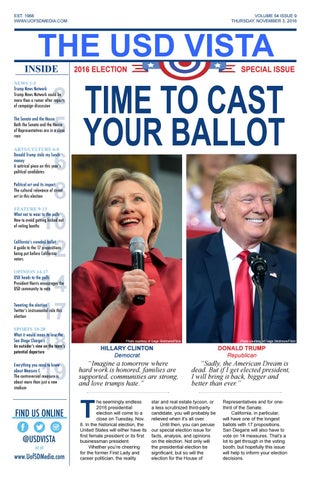
Photo courtesy of Gage Skidmore/Flickr
HILLARY CLINTON Democrat
“Imagine a tomorrow where hard work is honored, families are supported, communities are strong, and love trumps hate.”
T
he seemingly endless 2016 presidential election will come to a close on Tuesday, Nov. 8. In the historical election, the United States will either have its first female president or its first businessman president. Whether you’re cheering for the former First Lady and career politician, the reality
Photo courtesy of Gage Skidmore/Flickr
DONALD TRUMP Republican
“Sadly, the American Dream is dead. But if I get elected president, I will bring it back, bigger and better than ever.”
star and real estate tycoon, or a less scrutinized third-party candidate, you will probably be relieved when it’s all over. Until then, you can peruse our special election issue for facts, analysis, and opinions on the election. Not only will the presidential election be significant, but so will the election for the House of
Representatives and for onethird of the Senate. California, in particular, will have one of the longest ballots with 17 propositions. San Diegans will also have to vote on 14 measures. That’s a lot to get through in the voting booth, but hopefully this issue will help to inform your election decisions.
2T
he
USD Vista
November 3, 2016
NEWS
NEWS
NEWS EDITOR KEVIN NELSON @knel17
Asst. NEWS EDITOR ABBY GENTRY
Trump News Network could become a reality Officials from the Trump campaign have met to discuss creating a news network
KEVIN NELSON News Editor Coming soon to television: the Trump News Network. Out of all the speculations, rumors, and conspiracies throughout this year’s election, the possibility of a Trump News Network sounds more and more promising. The conspiracy has attempted to point to the real reason behind Donald Trump’s presidential candidacy. Some believe that the self-professed billionaire joined the race for president to create enough popularity to develop his own network. The idea may not have been the actual motive for his campaign, but chief executive of LionTree investment bank Aryeh B. Bourkoff gave some insight on the idea. It has been reported that Bourkoff has spoken with Jared Kushner about a possible investment in a Trump network. Kushner is married to Ivanka Trump, Trump’s eldest daughter. A source close to Bourkoff shared that the two met informally about the idea of investing in a news network.
Bourkoff and his firm are known for their investment in media brands and sources, making him a key resource to starting a network.The New York Times reported, however, that the source familiar with both parties said Bourkoff would most likely avoid this investment. Trump would not be the first celebrity who tried to start his own network. Popular talk show host Oprah Winfrey developed her own TV network in 2008. The network didn’t launch until 2011 and cost an initial $500 million investment. The network took close to three years to finally break even and showed that creating a network from scratch could be a very risky idea. It is rumored that the Trump News Network would be a close competitor to Fox News, which would make a strong battleground for viewers. Fox News is considered to be the top conservative news network. The network has bolstered some of the most notable political commentators in the U.S., including Megyn Kelly.
Photo courtesy of Lori Berkowitz Photography/wiki Ivanka Trump’s husband, Jared Kushner, has met with investment banker Aryeh Bourkoff about the idea of a Trump News Network.
THE USD VISTA Editorial – 619.260.4584 Business – 619.260.4714 www.uofsdmedia.com @USDVista
Photo courtesy of Michael Vadon/Flickr Rumors about the Trump campaign creating a Trump News Network after the 2016 election are becoming less of rumor and more possible.
Trump has had several public arguments with Kelly following numerous appearances on Fox News and several debates that Kelly hosted for Fox News. Although Trump has publically stated that he would not be interested in creating a news network, several top aides shared they would be interested in helping to create a network for him. Newly appointed CEO of Trump’s campaign Stephen Bannon operates the right-wing website Breitbart. Brad Parscale, the campaign’s digital director, has close ties to Kushner and the media industry. A Trump News Network could be helped by the already established Trump Productions, LLC. The television production company was established in 2004 and reported revenues of over $4 million in 2015. If the Trump News Network were to be created, the Trump production company could be a major resource in cutting down the initial cost of the network. The network will not only
Brooklyn Dippo- Editor in Chief Matlyuba Nurova - Finance Director Courtney Wong - Advertising Director Sarah Brewington - Associate Editor Diego Luna - Managing Editor Gianna Caravetta - Copy Editor Nora Brewington - Art Director Kevin Nelson - News Editor Abby Gentry - Asst. News Editor
face financial hurdles, but it will also need to be picked up by major broadcast providers. The creation of the network would not guarantee that providers, including Verizon and Comcast, would pick up the network. When Fox News was created over two decades ago, Time Warner Cable did not originally pick up the
Senior Jack Roccato believes the network does not seem realistic, and he would not watch it. “I am very neutral on the idea,” Roccato said. “If you don’t like it, don’t watch it. I would not watch it. But, I don’t think it will happen.” The Trump News Network is still considered
“It has been reported that Bourkoff has spoken with Jared Kushner about a possible investment in a Trump network.” network. Only after Rudolph Giuliani, then mayor of New York City and now adviser to the Trump campaign, brokered a deal between Fox News and Time Warner was the network able to broadcast to a majority of U.S. television viewers. The idea of a Trump News Network could be very controversial, and a large public backlash could prevent a major network from picking it up.
Dani Devries - Opinion Editor Kelly Kennedy - Feature Editor Jennifer Givens - Asst. Feature Editor Walker Chuppe - Arts & Culture Editor Matthew Roberson - Sports Editor Dray Wilson - Photography Editor James Jackson - Distribution Manager Gina Lew - Student Media Advisor Marie Minnick - Operations Advisor
a longshot by many. Investments and hurdles could be hard to overcome, but Trump’s diehard following gained during his campaign could very well provide Trump with enough viewers for a successful network. Americans will have to pay close attention to the aftermath of the election to see if Trump creates his own network to further his political voice.
The USD Vista publication is written and edited by USD students and funded by revenues generated by advertising and a student fee. Advertising material published is for information purposes only and is not to be construed as an expressed or implied endorsement or verification of such commercial venues by the staff or University. The USD Vista office is located on the fourth floor of the Student Life Pavilion in room 403B. All inquiries should be sent to: The USD Vista 5998 Alcala Park San Diego, CA 92110 The first copies of the newspaper are complimentary, all copies thereafter are a 25 cents charge. Opinions expressed in this publication are not necessarily those of The USD Vista staff, the University of San Diego or of its student body. Letters to the Editor can be submitted to The USD Vista office. Letters should be limited to 300 words and must be signed. For identification purposes, USD identification numbers and writer’s year must be included in the letter. The USD Vista reserves the right to edit published letters. Any content sent to the editor will be considered for publication unless otherwise stated.
The USD Vista
NEWS
Volume 54 Issue 9
Trump or Clinton could select four new justices
3
Photo courtesy of U.S. Supreme Court Collection/Wiki From left to right: Supreme Court justices Stephen Bryer, 78, Ruth Bader Ginsburg, 83, Anthony Kennedy, 80, and Antonin Scalia, who died in 2016, could all leave seats open for the next president to nominate new justices.
SARAH BREWINGTON Associate Editor KAREN LEPARULO Contributor and GRIFFON HOOPER Contributor After a long year of political campaigning and fist fighting, voting day is less than a week away. While this election cycle has highlighted many issues, one issue is that of naming future Supreme Court justices. Donald Trump or Hillary Clinton will have the opportunity to potentially appoint two to four Supreme Court justices during his or her presidency. At any given time, there are nine Supreme Court justices sitting on the
York Times, the Senate is waiting on a decision until the next president is in power. That being said, Trump or Clinton will nominate the next Supreme Court justice. But there is a catch. Not only will Trump or Clinton choose Scalia’s replacement, but they may also choose the next three Supreme Court justices. There are currently three Supreme Court justices that could die during the next presidency: Ruth Bader Ginsburg, 83, Stephen Breyer, 78, and Anthony Kennedy, 80. The next President of the United States is left to nominate his or her replacements and the Senate to approve the appointments. If these individuals do die in the next term, many voters suspect that Clinton will
Photo courtesy of U.S. Supreme Court The eight current supreme court justices and Justice Scalia (front row, second from left) who passed in 2016 and whose seat has not been filled
Supreme Court, the highest court in the United States. These justices serve a life term, meaning they have the power to influence litigation over their lifetime. However, one seat has been left empty this past year. Antonin Scalia served as a justice on the Supreme Court from 1986 until his death in 2016. According to the Weekly Standard, President Obama nominated Merrick Garland as Scalia’s successor, but the Senate has yet to make a decision. According to the New
appoint four liberal justices and that Trump would appoint four conservative justices. While justices are supposed to remain moderate, many align with a political party. Citizens are concerned that if Clinton wins and nominates four liberals, the Supreme Court would be comprised of six liberal justices and three conservative justices. Whereas citizens are concerned that if Trump wins, the Supreme Court will be seven conservative justices and two liberal justices. In the third and
last presidential debate, Republican candidate Trump addressed his decision regarding the Supreme Court. “The justices that I am going to appoint will be prolife,” Trump said. “They will have a conservative bent. They will be protecting the second amendment. […] They will interpret the Constitution the way the founders wanted it interpreted, and I believe that’s very important.” At the University of San Diego, some students argue that this is the reason why voting is so important. Senior Brendan Sullivan explained that this ballot goes beyond electing the president. “Americans must recognize that their vote will have an impact far beyond the term limits of any president,” Sullivan said. “Legal precedent and the momentous Supreme Court rulings that could be decided in the near future will determine the trajectory of our country in the 21st century.” Sullivan cited a recent Supreme Court decision and its impact on the nation. “The decisions made by the Supreme Court can have sweeping change on the country as a whole,” Sullivan said. “Last year, the decision in Obergefell v. Hodges made the legalization of same-sex marriage the law of the land. This is one of the most consequential decisions made by the court in recent years, and there are many more issues of similar national prominence that could be decided by the Supreme Court.” Many are concerned about the political stance of the justices. While justices are considered unbiased, they also have political sway. Sullivan explained how this could affect the voting decision as well. “Even more insidious, however, is the notion that our future president could stack the courts with politically-inclined judges,”
Sullivan said. “In this time of polarized politics, maintaining the impartiality of the bench is crucial to ensuring a healthy balance in our nation’s halls of power.” Sullivan explained that, while the Supreme Court is not on the ballot, many other things will be up for decision come November. “Pick an issue, any issue,” Sullivan said. “If you care about it, it’s on the ballot in this election. So get out and vote.” As election day draws nearer, students are trying to grasp the many issues on the ballot this year. Sullivan explained that it is difficult for anyone to grasp the full extent of the choices voters will make. “The long-term impact of this election will likely be the Supreme Court justices appointed to the bench and the future legal decisions they will make,” Sullivan said. “It is impossible for one to fully comprehend the seriousness of this election without accounting for the impending changes to the Supreme Court.” Junior Hunter Parkinson
who becomes president] because the justices appointed are the direct results of our views [as a country],” Parkinson said. “We could experience a rapid shift in how this country interprets the Constitution, or what is even considered constitutional. I’m sure there are many people from both parties that are afraid they won’t have a voice on the issues that matter to them.” Senior Kaylan Rothrock expressed her concern about Trump. “We have made such progress in the past few years, with things such as gay marriage, that if Trump gets elected and brings in at least four conservative justices, our country will be at a gridlock, and the progress our nation is making will diminish,” Rothrock said. Many voters may not align with either presidential candidate, instead preferring to vote to keep the power of the seat within their political party. The strategic positioning of the Supreme Court within the U.S. government’s system of checks and balances
“It is impossible for one to fully comprehend the seriousness of the election without accounting for impending changes to the Supreme Court.” -Brendan Sullivan agreed with Sullivan and said he is worried about the amount of power the open seat offers. “Our parties are at intense extremes,” Parkinson said. “And whoever becomes president will gain the most power for [his or her] party we have seen in a long time.” Parkinson also expressed his concern of being represented in the democratic process. “We should care [about
makes this 2016 election the fiercest battle for the court since President Franklin D. Roosevelt appointed the five “New Deal Justices” in 1937. These justices led the United States on a path of progressive legislation, providing U.S. citizens social security and a federal minimum wage. This coming era of justice may take America in many different directions.
4T
he
USD Vista
November 3, 2016
NEWS
Now hiring political hackers and hecklers
Photo courtesy of zialater/Flickr Both campaigns have reportedly brought protestors and hecklers to attend opposing rallies.
BROOKLYN DIPPO Editor-In-Chief Money isn’t new to politics, but the way people are spending it in this election is borderline unethical. Advertisements, canvassing, and a team of political communication experts are expensive. Now, there seems to be a new part of the budget allocated to hiring hackers and hecklers. Politicians hire experts to dig for dirt on the opposing candidate. Usually, they uncover discrepancies
between a voting record and policy stance or legislation that failed or backfired. In 2016, it’s getting personal between Hillary Clinton and Donald Trump. In Clinton’s corner, founder of the liberal watch group Media Matters for America, David Brock, has offered $5 million to cover legal fees for anyone who leaks damaging videos of Trump from his time as the host of “The Apprentice.” Following the Trump tape, Brock is hoping that with over a decade of tapings the Republican
presidential candidate might have slipped up another time. Campaigning for Trump is Alex Jones, a conservative conspiracy theorist who started the website Infowars. Following the second presidential debate, Jones offered $1,000 to anyone who attended a Clinton rally wearing a “Bill Clinton rape” shirt and could be seen on television for at least five minutes. He upped the offer to $5,000 to anyone who could be heard yelling, “Bill Clinton is a rapist.” Several individuals have entertained Jones’ offer and
received the attention they wanted. In North Carolina, as they were being thrown out of a Clinton rally, President Obama played off their stunt with his own witty banter. “Try to get your own rally,” Obama said. “They were auditioning for a reality show.” Mark Burnett, the producer of Trump’s former reality show “The Apprentice,” has stated that he cannot legally release any unaired footage from the show. Metro-Goldwyn-Mayer (M.G.M.) bought Burnett’s production company and now owns the footage. Based on the contract they have with Trump, insiders at M.G.M. have reported that they cannot legally release any of that footage without his permission. Some entertainment lawyers have refuted this saying that Trump wouldn’t be able to win a case against them in the context of releasing the footage for the purpose of informing the public in an election. Trump’s side also has an interest in obtaining leaked information that could damage the Clinton campaign. Recently some of her e-mails have appeared on WikiLeaks, which publishes secret information from anonymous hackers online. Although inconclusive, United States
officials reported to CNN that there is a substantial amount of information supporting that Russia is behind the attacks. This is unsurprising to some considering Trump’s odd relationship with Russian President Vladimir Putin, a man whom most U.S. presidents have been cautious around since the Cold War. Following an announcement by James Comey, 11 days before the election, the FBI will continue to investigate Clinton’s emails. There might be more of a demand for dirt than ever before. Comey’s timing couldn’t be worse for the Clinton campaign, and his decision to publicize the investigation was heavily criticized considering that it could affect the outcome of the election. With the polls narrowing as Election Day gets closer, there is no telling what other information might be hacked or leaked. In such a personal election, there is an individual investment for the candidates in obtaining harmful information on the other, even if it is obtained illegally. While candidates are managing harassment at rallies and trying to protect digital data, people seem to be searching for the skeletons in their closets.
The USD Vista
NEWS
Volume 54 Issue 9
The Senate and the House: who will take majority? ABBY GENTRY Asst. News Editor
This Tuesday, voters will elect more than the next President of the United States of America. While choosing the next man or woman to take the oval office is important, those who will fill the seats of Congress are just as crucial to the future and direction of the country. According to the U.S. Capitol website, the role of Congress is to make laws that influence the daily lives of the American people. Congress also informs the legislative process, investigates the executive branch, and serves as the voice of Americans in the federal government. Congress as a whole has the ability to make laws,
declare war, raise money and supervise proper expenditure, impeach federal officers, approve presidential appointments, and approve treaties. The United States Congress is broken down into a bicameral legislation. This means that the legislators are divided into two different houses: the House of Representatives and the Senate. Both houses have equal yet different roles in making Congress function smoothly and fairly. HOUSE OF REPRESENTATIVES Nickname “The Lower House” Number of Representatives The number of representatives per state within the House of Representatives is proportionate to the state’s
Most of the House of Representatives will go to the Republicans, but the race is closer than they would like.
population. Each state is granted at least one representative, and one additional representative is given per several hundred
belongs to the majority party represented in the House. The current Speaker of the House is Republican Paul Ryan.
Not all the Senate seats are up for election, but with one-third of them open, both Democrats and Republicans are fighting for the majority. The Senate majority can come down to one senator.
thousand people. There are currently 435 members in the House. Each representative represents one congressional district in his or her state. Election cycle Elections for the House occur every two years and each representative serves for a single two-year term. In contrast, members of the Senate hold office for a six-year term and typically make the decisions regarding big picture issues. Qualifications Representatives of the House must be at least 25 years old, have been a U.S. citizen for at least seven years, and inhabit the state they are to represent. Who is in charge? The House of Representatives is headed by the Speaker of the House, who maintains order with the use of a gavel. The Speaker always
Responsibilities Both the House of Representatives and the Senate hold the power to initiate bills. However, the Constitution states that bills regarding revenue must be initiated within the House. It is the responsibility of the House to raise these bills, but the Senate has the power either to amend or reject them. The House also has the power to impeach officials and nominate the President in the event that there is tie between the Electoral College votes. SENATE Nicknames “The Upper House” Number of Representatives In comparison to the House of Representatives, the number of members of the Senate has nothing to do with population per state. Each state is represented by two senators who serve
5
staggered six-year terms. Election cycle Senators serve a sixyear-long term. However, the elections for seats in the Senate are on a cycle so that about one-third of the positions are open for election every two years. The style of this endless cycle led the Senate to be nicknamed “the house that never dies.” This style of election protects the public from being massively swayed by circumstances within a two year period. Qualifications Senators up for election must be at least 30-years-old, have been a U.S. citizen for at least nine years, and they must be inhabitants of the state they are to represent during the time of the election. Who is in charge? The President of the Senate is also the Vice President of the United States, currently Joe Biden. They also have a majority party leader, Mitch McConnell, and a minority party leader, Harry Reid. Responsibilities The Senate, along with the House of Representatives, shares the duty of all lawmaking within the United States. For an act to pass through Congress, both houses must give authorization. For treaties to be ratified, twothirds majority of all senators must give their approval. For any important public nominations, such as cabinet members of judges of the Supreme Court, there must be a simple majority of senate rule. Additionally, any presidential impeachment proceedings offered by the House of Representatives must be granted with a two-thirds majority from the Senate to convict.
The race to 270 electoral votes and what that means ABBY GENTRY Asst. News Editor
The Electoral College is composed of 538 electors who cast the votes to ultimately decide the President and Vice President of the United States. The 538 electors are derived from the 435 representatives in the House of Representatives, 100 senators, and three electors given to the District of Columbia. The popular votes indicated at the polls are suggestions to the electors for each state on which candidate the people wish to elect. For a candidate to win the election, they are required to win at least 270 of the electoral votes. If neither candidate receives the needed electoral votes, then the
decision is made by the House of Representatives. This has occurred once in 1824 when Andrew Jackson won both the popular vote and the majority of electoral votes. However, Jackson did not receive the needed amount of electoral votes and the House selected Quincy Adams for President. California is the state with the most electors with a total of 55 votes. Maine and Nebraska are the only two states that use an alternate method for Electoral College votes. These two states divide themselves into districts and distribute one of its statewide votes to each district. The winner of the statewide vote is then given the state’s remaining two electoral votes.
6 The USD Vista
November 3, 2016
ARTS AND CULTURE
ARTS & CULTURE
A&C EDITOR WALKER CHUPPE @lord.walker
Extortion allegations against Donald Trump A satire of the 2016 presidential election
WALKER CHUPPE Arts & Culture Editor @lord.walker NEW YORK—A former seventh grader has come forward with shocking allegations against Donald Trump, which could further damage Mr. Trump’s chances of winning the presidency. The now-man, who prefers to be referred to only under the pseudonym William, alleges that Mr. Trump repeatedly stole his lunch money during the year of 1959, while they attended the Kew-Forest School in Queens. William claims that this would occur one to two times per week, when Mr. Trump, overcome by hunger and greed, would corner him with his gang of cronies to extort him of his daily lunch allowance. William reflected that Mr. Trump typically appeared “visibly sweaty” and “redfaced” while ordering his gang to confront him. Rather than escalate the situation, and risk antagonizing a group of five or six good ole boys who were just fooling around, Henry peacefully handed over
Donald Trump points aggressively while asserting his dominance at a press conference.
answer his question directly. However, William noted that Mr. Trump frequently ran out of his own allowance, and he concluded that Mr. Trump likely needed to exploit defenseless people to keep himself afloat after his own financial mismanagement. Due to the severity
win the 2016 election easily. “I’m just thinking to myself right now, we should just cancel the election and just give it to Trump, right?” Trump said. When asked specifically about the incident, Mr. Trump did not see his actions as extortion. Instead, he brushed them off and attempted to bond
of the allegations brought against Mr. Trump, many political pundits believe that his popularity numbers may dwindle at this crucial point in the election race. Mr. Trump, however, remains unconcerned. In fact, Mr. Trump’s confidence in his campaign seems to have reached new heights, even when it seemed impossible for his self-appreciation to grow. In his most recent press conference, Mr. Trump affirmed his belief that he will
with the reporters on-site. “I’m a negotiator, like you folks,” Trump said. “Is there anybody that doesn’t renegotiate deals in this room? This room negotiates them— perhaps more than any other room I’ve ever spoken in.” He also dismissed assertions that he is both slimy and greedy and that he takes advantage of vulnerable people. He chalked up greed to be similar to the desire for success when it comes to business.
“My fingers are long and beautiful, and it has been welldocumented, as are various other parts of my body.” -Donald Trump
his money countless times to Mr. Trump. William alleges that Mr. Trump gave him the nickname “Wussy William” and often verbally abused him after his financial conquests. He cited a specific instance when Mr. Trump triumphantly yelled “Wussy William couldn’t be elected dog catcher if he ran!” as a particularly startling verbal assault. When he asked Mr. Trump why he felt the need to repeatedly take his lunch money, Mr. Trump would not
Photo courtesy of Google Earth The Kew-Forest School where Donald Trump attended until the age of 13.
Photo courtesy of Gage Skidmore/Flickr
“The point is, you can never be too greedy,” Trump said. “I have made the tough decisions, always with an eye toward the bottom line. Perhaps it’s time America was run like a business.” After praising his business sense and negotiation skills, Mr. Trump appeared visibly content. Interestingly, Mr. Trump’s content expression could be likened to that of someone who smells a particularly pungent cheese. To close his press conference, he boasted about his freshly done manicure and manhood, while showing off his abnormally small hands to the room.
has the utmost faith in his ability to gain the presidency and said that he believes his campaign will be unaffected by William’s allegations. At his press conference yesterday, Libertarian Party nominee, Gary Johnson, was asked about his own chances of winning the election, with the new allegations against Mr. Trump. For some pundits, Democratic Party candidate, Hillary Clinton, is the only real competition for Johnson after the latest hit to Mr. Trump’s campaign. Johnson’s response was kept short, as he attempted to influence the minds of the American public. “I just hope my fellow
“I just hope my fellow Americans can refrain from voting for those two nuts.” -Gary Johnson “My fingers are long and beautiful, and it has been welldocumented, as are various other parts of my body,” Trump said. “All of the women on The Apprentice flirted with me— consciously or unconsciously. That’s to be expected.” Perhaps unsurprisingly, Mr. Trump was not at all concerned with the allegations brought against him. He dismissed the validity of William’s case as “just boys having some fun” and that “Wussy William ought to grow up.” William intends to pursue the case against Mr. Trump as far as he is able. As far as his election chances go, Mr. Trump
Americans can refrain from voting for those two nuts,” Johnson said. “They ought to vote for the Johnson instead.” The 2016 presidential election is heating up, and it is impossible to predict what the Nov. 8 Election Day results will be. Although Mr. Trump has no doubts that he will be the winner, even with the recent allegations against him, it is still left up to the American public to decide. William hopes that Mr. Trump loses the election, as it “would set things straight after all these years.” Secretary Clinton could not be reached for comment on the issue, as she was feeling faint.
The views expressed in this satirical article are not those of The USD Vista staff, the University of San Diego, or its student body. This article is a work of parody.
ARTS AND CULTURE
Volume 54 Issue 9
The USD Vista
7
USD first-time voters hit the polls Go to the polls and get an awesome sticker
WALKER CHUPPE Arts & Culture Editor @lord.walker This election cycle, considerable attention has been given to millennials— voters aged 18 to 35—and what impact the younger generation will have on the outcome of this election. Presidential candidates, including Hillary Clinton, Donald Trump, Gary Johnson, and Jill Stein, have made different appeals to millennials, hoping to encourage young people
America’s future, and it will be interesting to see the voter turnout from each age group. As many University of San Diego students have noted, there have been frequent canvassers on campus encouraging USD students to register to vote. In the 2016 election, college students continue to be an important focus for everyone, from the candidates to the media to political activist groups. For a large percentage of USD students, this election will be their first opportunity to vote
“I feel a little cheated about this election. Having been taught my entire life in a somewhat conservative family about the shining example of American democracy, it feels like a bad joke.” -Taylor Burnell to support their respective campaigns at the polls. College-aged individuals are among the lowest voter turnout groups in the United States. According to the Census Bureau, only 38 percent of people aged 18 to 24 casted their vote in 2012. This is in stark contrast with people between the ages of 45 and 64, of whom 63.4 percent turned out to vote in 2012. At age 65 and over, 69.7 percent voted. The reality is each vote counts the same, whether from someone who is 19 or from someone who is 72. In this year’s polarizing election, every vote cast may certainly have an impact on
for a presidential candidate. With the added responsibility of having America’s future in their hands, students have differing opinions on what that responsibility means. Others shared what their first-time voting experience was like. Junior Nikki Potts said she was proud to vote. At the same time, Potts explained that the sheer volume of positions and propositions to vote for was overwhelming. “I was excited when I picked up my absentee ballot—I sent photos to all my friends and family to show them,” Potts said. “One of my friends is an international student at USD, and he
Election day is Tuesday, Nov. 8. Go out and cast your vote!
said that us Americans take so much pride in voting, and I certainly felt that. As I was doing the ballot, I was surprised how many positions I had to vote for, and I realized that being an informed voter actually takes a lot of work.” Senior Christian Corona was also enthusiastic about his opportunity to vote in the election and perhaps make a difference in the outcome. Corona said he also had strong motivation to vote because of his ethnic background. “Being a first-time voter, and coming from a minority
Nora Brewington/The USD Vista
household, I felt that this election was a chance for me to make a difference,” Corona said. “The absurd things Donald Trump says have sparked outrage within minority communities and young people across the nation, and I feel that it will show in the election’s result. The feeling of making a difference in America’s future is what empowers me to vote.” Junior Tamar Tellado explained that she does not have a strong connection with any of the candidates. Tellado said she is disappointed with the options that the American public is able to choose from in 2016. “I think I probably speak for a lot of my peers when I say it’s disappointing that this is our first major voting election,” Tellado said. “In my opinion, neither of the candidates seem to have very good character. Nevertheless, I think voting is an extremely important part of our system, and I can at least look to this as an opportunity to make an impact by voting on the propositions on the ballot.” Senior Taylor Burnell similarly expressed that he is dissatisfied with the candidates in this election cycle. Burnell said he feels that the American democracy has let him down as far as the quality of choices he has for elected officials. “I feel a little cheated
Photo courtesy of SunToad/Flickr
about this election,” Burnell said. “Having been taught my entire life in a somewhat conservative family about the shining example of American democracy, it feels like a bad joke. I don’t feel like I have any reasonable options, even with the state and regional elections. So I’ll try to vote on what is most logical based on the information I’m given.” In a similar vein, Junior Hailey Trawick shared that she thinks that, although the two candidates are quite extreme this election cycle, they are a representation of America’s current political climate. “I feel that the reason we have two candidates like Hillary Clinton and Donald Trump is due to the fact that they are a reflection of the completely polarized twoparty system we have,” Trawick said. “It seems that there is no middle ground anymore—the two candidates are at the extreme opposite ends of the political spectrum, and it makes it difficult to choose one over the other.” For first-time voting USD students, this election has presented both difficulty and reward. The responsibility of voting comes with some research and effort involved, but each vote adds up, and their votes could potentially change America’s path for the future. If you want your voice to be heard, go to the polls on election day.
8T
he
November 3, 2016
ARTS AND CULTURE
USD Vista
Street art as public displays of free speech ALEX KHAN Contributor On the streets of the Friedrichshain neighborhood in Berlin, near the center of town, a towering cement structure stretches over 300 meters long. Bright graffiti and inspiring murals have increasingly adorned its surface since The Berlin Wall’s partial destruction in 1989. Situated in one of the trendier parts of town, the wall is a popular place to take a stroll and bike along, and just beyond the old concrete border runs a picturesque winding river that intersects the city’s center. Now an urban art gallery of sorts, the remains of The Berlin Wall mark one of Europe’s most iconic sites. Following the fall of the wall, several artists from around the world were commissioned to celebrate its demise with uplifting pieces depicting unification and world peace. Among this artwork are images of world leaders, multicolored flags, and edifying quotes. But there is one panel in particular whose surface draws an unexpectedly large number of amused observers. Cameras and selfie sticks in hand, groups can be seen eagerly surrounding the art installation. As it turns out, the object of their fascination is not a historic piece at all,
but rather, a new addition: a scrawled phrase written in white paint that reads, “F*** DONALD TRUMP!”. The expression of political sentiment in the form of urban art is not unique to Europe, nor is it solely a product of recent times. Street artists, from Banksy to Space Invader to hoards of other anonymous urban creators over the years, have dedicated their lives to clandestinely filling the streets with meaningful, and often provocative words and images. Urban art is a powerful platform for conveying messages mainly because of its physical and visual prominence. Typically unsanctioned, urban art installations are created in public places, eschewing the use of museums and conventional venues in favor of direct communication between artists and the masses. The goal is to attract attention and awareness, something that is usually achieved through not only the open location of the piece, but also based on its ability to combine an appealing image with a thought-provoking message. Today, urban art exists in some form in nearly every major city and is classified by many names including “smart vandalism” and “neo-graffiti.” Although the urban art movement has steadily gained popularity since the 80s,
current events have sparked an evolution in the nature and frequency of art installations. Notably responsible for the change is the upcoming American presidential elections. Indeed, Donald Trump and Hillary Clinton have inspired a wave of more political urban art discussing their policies, and at times, satirizing their personalities than ever before. The final announcement of the two candidates was a result as equally surprising as it was historically significant, and has left street artists with culturally relevant subject matter portray with their personal flair. Their public displays of political images have a way of using visuals to express popular sentiment, as well as challenge political beliefs. Their messages, whatever they may be, are broadcast in the form of powerful pictures and words in strategically picked locations. This makes it so that audiences are essentially obliged to listen. After all, not everyone is inclined to read a newspaper article from an opposing point of view, but it is difficult to avoid an image of a tattooed Clinton plastered across the face of a building or a sculpture of a nude Trump in a park. In our increasingly visual society, images tend to carry weight with the potential to evoke emotion or
Photo courtesy of Alex Khan Anti-Donald Trump graffiti on the Berlin wall.
become well-known symbols that people rally behind. Such was the case when street artist Shepard Fairey created and dispersed the immediately recognizable images of Barack Obama titled Hope and Change in his signature pop art style. Whether expressing
personal opinion, imparting a social commentary, or simply finding humor in the current political situation, urban artists in all corners of the globe have clearly been inspired by Trump and Clinton. If you’d like to see some demonstrations, they’re 76948 everywhere from the alleys of Los Angeles to the Berlin Wall.
GET TWICE AS MANY EGGS IN YOUR BASKET. 1
Low fees can mean higher returns for you. Start now at TIAA.org/results
INVESTING
ADVICE
BANKING
RETIREMENT
BUILT TO PERFORM. CREATED TO SERVE. 1
Our assumption of: $100K, with a 6% rate of return, over a 30-year time period, with fees at a constant (.52%), saves an investor $92,523.91 — versus paying fees at the mutual fund industry average (1.25%). This is a hypothetical illustration. These returns are for illustrative purposes only and do not reflect actual (product) performance, which will fluctuate. TIAA-CREF Individual & Institutional Services, LLC. TIAA-CREF products are subject to market and other risk factors. C32769
A TIAA__FALL PRINT_GET TWICE AS MANY EGGS_C__V_.
FEATURE
VOLUME 54 ISSUE 9
FEATURE
THE USD VISTA
FEATURE EDITOR KELLY KENNEDY
9
ASST. FEATURE EDITOR JENNIFER GIVENS
Wrangling reproductive rights Women’s health, abortion, reproductive rights, oh my!
SCOTT DEVELLE TALIA MALLEY RACHEL MCGRATH DAKOTAH QUAYLE with contributions from KELLY KENNEDY Feature Editor Being a college student means making a lot of decisions on your own. An unexpected pregnancy can leave a college woman with a far more difficult decision to make. Abortion is one of the leading issues in the 2016 presidential election. According to a Gallup Poll conducted before the 2012 election, one in six Americans are single-issue voters when it comes to abortion. A candidate’s stance on abortion can be one of the most important stances to take. While ultimately United States’ federal law permits abortion, the next President of the United States could influence the conditions under which they are performed. Each state can make additional requirements of varying degrees concerning age, health, and term requirements. Many students are concerned about the issue of reproductive rights and health, especially considering 53 percent of voters in the 2012 election were women, according to exit polls. At the University of San Diego, women make up 56 percent of students. Jillian Tullis, a communication studies professor, commented on the weight that reproductive rights carry as an election issue. “I think [abortion is] an interesting issue that gets people charged,” Tullis said. “It hits people at their core.” Each candidate has his or her own stance on topics such as abortion and birth control, which can sway voters’ preferences for one candidate or another. Hillary Clinton is prochoice and follows the arguably strong precedent set by the Democratic Party’s political platform. Clinton shared on her website that she is committed to fighting for women’s reproductive rights both in the workplace and at home. “Women’s personal health decisions should be made by a woman, her family, and her faith, with the counsel of her doctor,” Clinton’s website said. According to her website, Clinton also supports the Planned Parenthood Action Fund. Clinton said
“Government has no place in the personal decision a woman makes about whether to bring a child into the world.” - Hillary Clinton
“A woman’s right to choose is a nonnegotiable human right.” - Jill Stein
“It is an intensely personal question, and one that government is illequipped to answer it.” - Gary Johnson
she considers the historic Supreme Court decision Roe v. Wade to be the foundation of women’s reproductive rights. “Roe v. Wade is the touchstone of our reproductive freedom, the embodiment of our most fundamental rights, and no one—no judge, no governor, no Senator, no President—has the right to take it away,” her website said. At the 2009 United Nations Population Fund conference Clinton explained that she strongly believes that women’s reproductive health should not be dependent on government oversight and approval. “Government has no place in the personal decision a woman makes about whether to bring a child into the world,” Clinton said. Jill Stein is the female third-party candidate from the Green Party and aligns with most of Clinton’s policies on reproductive health. One aspect of Stein’s support for female reproductive rights includes the dissemination of information on reproductive health care and family planning programs. The Green Party candidate shared that she believes that in making information available, women will be better informed and that abortion may decline with stronger planning. Stein also has expressed support of accessible clinics, options for contraception, and consultation for and performance of abortions, regardless of age or marital status. “A woman’s right to choose is a non-negotiable human right,” Stein said. The two male candidates, Gary Johnson and Donald
Trump, differ from one another on the issue of abortion. Johnson, the Libertarian candidate in the race, made it clear on his website that there is a difference between his personal opinion on abortion and his political standpoint on the issue. “Gary Johnson has the utmost respect for the deeplyheld convictions of those on both sides of the abortion issue,” the website said. “It is an intensely personal question, and one that government is ill-equipped to answer.” Personally, Johnson shared that he believes in the sanctity of life, but politically, he said he recognizes that the right to choose is necessary within women’s political rights. “That right [to choose] must be respected and, despite his personal aversion to abortion, [Johnson] believes that such a very personal and individual decision is best left to women and families, not the government,” Johnson’s platform stated. Despite his political support for the right to choose, Johnson does not support partial birth or late-term abortions. As the governor of New Mexico, Johnson approved legislation banning these procedures in the state. For minors receiving abortions, Johnson has supported laws requiring parental notification and counseling for the woman. The marked difference between Johnson and his female adversaries is his lack of official platform concerning women’s health and reproductive rights outside of abortion. Issues, such as contraception availability and the morning after pill, are not
outlined in his official platform. In contrast to the other three candidates, Trump has taken a strong stance against abortion rights. Trump avoids any firm stances on women’s reproductive rights. Included in his platform are measures to rewrite the tax code to allow working parents to deduct childcare expenses from their income taxes, implement a child care rebate for low-income households, and incentivize employers to provide childcare in the workplace. Trump also has advocated for six weeks of paid leave for new mothers. In a 1999 interview with NBC, Trump emphasized being pro-choice despite hating the concept of abortion. When interviewed early in his candidacy in 2015, Trump started asserting that he was pro-life with exceptions of rape, incest, and a threat to the life of the mother. In the last debate, Trump said he would appoint pro-life judges to the Supreme Court who would give the decision on abortion back to the states,
“Public funding of abortion providers is an insult to people of conscience at the least and an affront to good governance at best.” - Donald Trump
reversing the landmark Roe v. Wade abortion case. The 1973 Supreme Court decision is what ultimately legalized abortion nationwide at a time when most states outlawed it. The Republican candidate has also called for the government to defund Planned Parenthood. In an opinion article published in the Washington Examiner, Trump decried the possibility of public funding for abortion. “Public funding of abortion providers is an insult to people of conscience at the least and an affront to good governance at best,” Trump said. Voters face the choice between four candidates with various stances on abortion and women’s reproductive health. In this heated election season, reproductive rights, abortion, and women’s health are a few of the many hot topic issues faced by voters and politicians. As college students flock to the polls on Nov. 8, they will hold sway over the election of a candidate that could change the course of reproductive rights in America.
Candidate photos courtesy of Keith Kissel/Flickr, Tar Sands Blockade/Flickr, Gage Skidmore/Flickr (left to right). Photo courtesy of Thomas Hawk/Flickr (above) Each candidate has an official platform concerning reproductive rights.
10
The USD Vista
California’s crowded bal
Students weigh in on the issues Prop.
64
“From a medical standpoint, it’s a shame the FDA won’t accept applications for cannabinoid products demonstrating efficacy. Not to mention the tax revenue that could fund or stimulate projects for the social good. The consumption is clearly all over the place, so I think it’s important to not only regulate the market, but also capture the consumption spending for GDP. The emergence of a new market would have a multiplying effect on consumer spending and help those in the lower incomes see new opportunities.” -Warren Lorenz “Legalization is not the liberation of cannabis. The current proposition is a rushed way to put cannabis on the market that only mandates it in the same way as alcohol, which is not a sufficient equivalent. Although I know legalization is semantically inevitable, I have too much respect for the medical cannabis community to vote yes on Prop. 64, and I use this decision to bring awareness to what actually needs to occur, the descheduling of cannabis.” -Mary Sutton
Prop.
62
Prop.
66
“I’m voting to eliminate the death penalty for several reasons. Primarily because it is totally inhumane; murdering murderers does not justify the crime itself. How can we trust a system that condemns crimes that it then turns around and commits? Also, one of the most expensive aspects of the prison industrial complex is inmates waiting on death row. It’s a waste of money that could be better spent offering legitimate assistance to those who are unjustly jailed because of circumstances tied to their race or socioeconomic status.” -Sam Eller “I am pro expediting [the death penalty] because I am a fan of any way we can reduce costs and make a system more efficient.” -Austin Jacobs
Copy by Brooklyn Dippo/The USD Vista Spread by Kelly Kennedy/The USD Vista Art by Nora Brewington/The USD Vista
November 3, 2016
FEATURE
A guide to the 17 propositions on the ballot this Prop.
51
Bond sales for schools
Prop.
Hospital fees
Prop.
Votes on bonds
H 52
53 Prop.
54 Prop.
55 Prop.
57
Allows California to sell $9 billion in bonds to be used for the construction and updating K-12 public schools, charter and vocational schools, and California community colleges. Estimated to cost $17.6 billion to pay the initial bond fees plus $8.6 billion in interest over the next 35 years.
Indefinitely extends a current charge imposed on private hospitals. If voted against, the charge will expire in Jan. 2018. The fees from these charges are used to fund Medi-Cal health care, care for uninsured, and low-income children.
This proposition requires that California hold an approval vote before selling bonds if it is to fund a project exceeding $2 billion.
Legislative transparency
Before the state legislature can pass a bill, it must be published on the internet for 72 hours. This includes publishing any changes to the bill. The legislature would also be required to record public meetings and make those available online as well.
Income taxes
Extends the temporary increase of income taxes on taxpayers earning over $250,000 for another 12 years. The revenue would be allocated to public schools and colleges and in particular years to healthcare.
Parole for nonviolent felons
Prison inmates who were convicted for nonviolent crimes can be considered for parole earlier than usual. Allows awarding of sentence credit for good behavior, rehabilitation, and educational achievements. Requires that a juvenile court judge decide if a juvenile will be tried in adult court.
Prop.
58
Bilingual schools
Prop.
Federal campaign finance
59
Public schools can have more community control over teaching English to non-native speakers. Requires that students are taught in a way to ensure English acquisition as quickly as possible, whether it is in English-only, bilingual, or other teaching programs.
California voters decide if their federal congressional officials should propose an amendment to the Constitution overturning the Supreme Court decision in Citizens United v. Federal Election Commission. This decision ruled that limiting political spending by corporations and unions is unconstitutional. A reversal of the decision would regulate campaign spending for corporations.
voLUme 54 ISSUe 9
llot in 2016
FEATURE
s Election Day
Prop.
64 Prop.
56 Prop.
60 Prop.
Tobacco taxes
Prop.
Expedites the death penalty
Prop.
61 Prop.
65 Prop.
67
51
Condoms in pornography
Prop.
63
Prop.
Prop.
It mandates that adult film performers use condoms in filming sexual intercourse and mandates posting of the requirement on film sites. Additionally, pornography producers are required to pay for the adult film actors’ vaccinations, testing, and medical examinations.
Prop. 62 repeals the death penalty entirely, replacing it with life imprisonment without parole.
52 53 Prop.
54 Prop.
Prop. 66 changes the procedures for challenging death sentences, limiting the circumstances under which it can be appealed and speeding up the process in which appeals occur so that death row inmates are executed sooner.
Gun regulation
This proposition requires both a background check and authorization by the Department of Justice to buy firearm ammunition. It also outlaws possessing largecapacity ammunition magazines. It creates a new court process to repossess firearms from individuals if they are convicted of certain crimes.
Prescription drug prices
State agencies can no longer buy prescription drugs from drug manufacturers at a price point above the lowest price paid by the U.S. Department of Veterans Affairs. Managed care programs that are funded by Medi-Cal will be exempt from this new standard.
Plastic bags
Prop. 65 requires that money collected in the mandated sale of carryout bags be put into a fund for specified environmental projects rather than used as revenue towards any purpose.
Plastic Bags
Prop. 67 would prohibit most grocers from providing single-use plastic bags to customers and would require a minimum charge of 10 cents for any other bags provided at checkout.
11
Vista voting guide
An increase on state excise tax on cigarettes by $2.00 per pack, bringing it up to $2.87 per pack. This proposition includes an equivalent tax increase on other tobacco products and products containing nicotine including e-cigarettes. The revenue would primarily augment health care spending for lowincome Californians.
62 Prop.
2016-11-08
Legalizes marijuana possession, use, and growing for adults 21 and older with taxes on sales and cultivation. Sets statewide industry standards and licensing and allows for local regulation and taxation. Potential for over $1 billion in tax revenue annually.
Ends the death penalty
66
TABLETS
Marijuana legalization
The USD ViSTa
55 Prop.
56 Prop.
57 Prop.
58 Prop.
59
YES NO YES NO YES NO YES NO YES NO YES NO YES NO YES NO
Prop.
60 Prop.
61 Prop.
62 Prop.
63 Prop.
64 Prop.
65 Prop.
66 Prop.
67
YES NO
YES NO YES NO YES NO YES NO YES NO YES NO YES NO
YES NO
Cut out this voting guide to aid you at the polls
12 T
he
FEATURE
USD Vista
November, 3 2016
What not to wear to the polls How to avoid getting kicked out of voting booths on Election Day
JENNIFER GIVENS Asst. Feature Editor Every election year, candidates try to create the most outrageous and unique t-shirts, hats, and buttons for their constituents. Some of the more popular items this election were Hillary Clinton’s “Love Trumps Hate” and Donald Trump’s iconic “Make America Great Again” trucker hat. Many constituents wear their memorabilia with pride as they do for their favorite sports teams. However, wearing these items to the polls is strictly prohibited according to California voting laws. While it is everyone’s fundamental right to show support for his or her candidate, doing so at the polls is considered electioneering. The California Elections Code section 319.5 defined electioneering as any sort of suggestive support or opposition of a candidate. “[Electioneering is the] visible display or audible dissemination of information that advocates for or against any candidate or measure on the ballot within 100 feet of a polling place, an elections official’s office, or a satellite location under Section 3018,” the code said. California Code 319.5 compiled a list of all the items that are considered electioneering and prohibited from voting booths. These items include anything that displays a candidate’s name, likeness, or logo or anything that shows favor or opposition for a measure on the ballot. This could be something that implies you are for or against a proposition whether it is referred to by title, subject, or logo. Buttons, hats, pencils, pens, shirts, signs, or stickers containing information about candidates or issues on the ballot, and any audible broadcasting of information about candidates or measures on the ballot, are also not allowed at the polling location. Some students at the
University of San Diego support this law, whereas others find it unnecessary. Senior Christine Keelan agreed with part of California voting laws. Keelan said that she felt people should not be allowed to rally for their candidates outside voting booths. “I think that [voters] should keep their opinions to [themselves] because, at this point, everything has already been said and done,” Keelan said. “Now, you should just vote and have [your vote] be it. People do have a right to protest, but I think outside voting booths it should be a silent protest and a far distance from polls.” Similar to Keelan, senior Luzmaria AcevedoBanuelos explained that she agreed with the law. “I believe that whenever someone is going to vote at the polls it should be neutral,” Acevedo-Banualos said. “There is so much going on now with the media in general. You see it everywhere even on bumper stickers. I just personally think when you go to do what you got to do, you don’t need to prove a point.” Junior Dani Aguilar, however, did not agree with voters being turned
“I didn’t even know that was a voting law. I would have probably been turned away from the polls,” - Eddie Utibe away or asked to cover up their attire at the polls. “I don’t think it should be a problem,” Aguilar said. “People who already made their choice should be sure about their choice. I don’t see how wearing a shirt, for example, would affect their decision.” Senior Annalysa Vasquez expressed her agreement with Aguilar. Vasquez said voters showing their support for their candidate should not matter. “I think it is demeaning to tell people what they can and cannot wear when they are going to vote,” Vasquez said. They are just showing support for who they are going to vote for. I think that if they are trying to get them to not wear [politically-affiliated attire] because they are going to sway people’s vote is ridiculous. Because, by the time they are at the polls, I’m pretty sure their mind is already made up. It also goes against their first amendment right to freedom
Photos courtesy of Stephen Velasco (top) & ohheyimdanii/Flickr (bottom) Electioneering is not allowed within 100 feet of polling places. of speech and expression.” I planned on wearing my Junior Andrew Solomon candidate’s shirt. I feel like this also said voters should have is ridiculous. It’s a violation of their minds made up by the my right. I don’t understand time they reach the polls. how wearing a t-shirt to the “If you are going to vote, polls would be against the law.” your mind is probably made While some USD students up,” Solomon said. “If you have expressed that these are going to be influenced, laws are a violation of their first or if you are going to be amendment right, California bothered, I think you shouldn’t voting laws are clear. The best be voting whatsoever.” way to avoid being asked to Senior Eddie Utibe shared cover up, change, or leave the that he was unaware of the law. polls is to adhere to the laws. “I didn’t even know that If wearing your candidate’s was a voting law,” Utibe said. attire is important to you, make “I would have probably been sure you are just over 100 turned away from the polls. feet from your polling place.
Elections Code section 18370: No person, on Election Day, or at any time that a voter may be casting a ballot, shall, within 100 feet of a polling place or an elections official’s office: - Circulate any petition. - Solicit a vote or speak to a voter about their vote. - Place a sign relating to voters’ qualifications or speak to a voter about his or her qualifications. - Electioneer within 100 feet of a polling place or the room or rooms in which voters are signing the roster and casting ballots. Doing so is considered a misdemeanor.
Photos courtesy of Marc Langsam/Flickr Don’t wear a Trump hat or Clinton button to the polls on Election Day.
Elections Code section 18541: - No person shall, with the intent of dissuading another person from voting, within 100 feet of a polling place, do any of the following: - Solicit a vote or speak to a voter on the subject of his or her vote. - Photograph, videotape, or otherwise record a voter entering or exiting a polling place.
VOLUME 54 ISSUE 9
FEATURE
THE USD VISTA
13
10 ways to get your Celebs weigh in candidate elected on the election It’s funny because it’s a joke
Celebrities and their endorsements
“I don’t want to be in the ring with any candidates. I want to be Trump’s running mate.” - Hulk Hogan, former wrestler, actor, and television personality in a 2016 interview with TMZ.
“To me, I’m just like, ‘We gotta try something else,’ and I’m not an expert at political science or anything. Let the business guy in there.”
Photo courtesy of Kevin McShane/Flickr This man wants you to support your country during this election cycle.
1. Sign your dead relatives up to vote Great Uncle Bob and Great Aunt Suzie would have had a strong opinion about this election, and who says that their interests should go unaddressed after they’ve passed through the mortal veil? Do you disagree with your family’s views? Then, fill those ballots out for Harambe. He was more than a gorilla, and he definitely would have voted in this election.
- Kid Rock, rapper, on Donald Trump, in an interview with Rolling Stone.
2. Fire bomb the candidate you don’t like Doesn’t the right to bear arms include the occasional molotov cocktail?
3. Start a comment war on social media The entire world is watching you destroy “@liberal_girl_1992” and “@trump4america1776” on Instagram, Twitter, and Facebook. Try using more relevant sites, like MySpace and Blogspot, if you’ve already vanquished your mainstream enemies. Bonus points with the electoral college if you sweep Tinder and Bumble.
4. Refuse to talk to people with different viewpoints Don’t let them indoctrinate you with their reasonable retorts to your opinion! Stick to your candidate, and don’t let anyone tell you otherwise!
5. When in doubt, involve Russia Put the Cold War behind you and call up your old pal Putin for a presidential pep-talk. After all, he has been such a strong leader for many, many years.
6. Wear your favorite candidate shirts to the polls Let your shirt do the talking, and let everyone at the polls know who you’re voting for this election day.
“I think that [she’s] as smart as can be, I think [she is] qualified, I think [she] stand[s] for everything that I want in a president.”
- Ellen Degeneres, television personality and actress, in an interview with Hillary Clinton on The Ellen Degeneres Show.
7. Think of your ballot like a scantron test Filling in random bubbles helped you pass the 10th grade, so don’t give up on such an effective strategy now!
8. Don’t forget to vote on Nov. 28 After all, Donald Trump is extremely knowledgeable about the election process and all the important deadlines in this election. He definitely knows when election day is.
9. Ask for the opponent’s birth certificate Illinois is close to Canada, right? How can we be so sure that Hillary was born on American soil? On the flip side, Trump’s dad gave him a small loan of a million dollars, which could have gone toward falsifying immigration papers from Willy Wonka’s chocolate factory.
10. Blame someone else if your candidate loses It’s not their fault that the election was rigged by mainstream media, congress, global warming, millennials, broken microphones, and whoever makes the voting machines! The views expressed in this satirical article are not those of The USD Vista staff, the University of San Diego, or its student body. This article is a work of parody.
“There’s no other alternative. We need our issues heard, we need our bodies taken care of, we need all that choice.” - Katy Perry, singer, while campaigning for Hillary Clinton at the University of Nevada.
14
The USD Vista
OPINION
November 3, 2016
OPINION
OPINION EDITOR DANI DEVRIES opinion@usdvista.com
President Harris wants YOU to vote JAMES T. HARRIS III University President
The first time I walked into a voting booth I was six years old. No, I wasn’t violating the election laws of my home state. I was accompanying my grandmother as she cast her vote in the 1964 presidential election. Lyndon B. Johnson was running against Barry Goldwater. I distinctly remember her commenting on how important the election was to the future of our country and why every vote mattered. When she picked me up after school that day to join her as she cast her vote, I noticed that she was dressed in her Sunday-best clothing. To her, voting wasn’t something that she was taking for granted; it was a right and a privilege she had as a citizen of the United States and something she refused to take lightly. It didn’t matter to her how long she needed to wait in line to vote. It was important enough to her that she made the time, and nothing would prevent her from exercising her right. You see, my grandmother was a refugee from Russia, whose family had been
persecuted because of their religious and political beliefs. She vividly remembered hiding under the floorboards of her family home in Russia as soldiers stormed into her living room looking for her father. To her, the freedom she had earned by becoming an American citizen was one of the most cherished gifts she had ever received. This left an indelible impression on me. The passion she felt for our democracy was only surpassed by the love of her family and her faith in God. As I grew up, I watched her steadfast commitment to these values and was inspired by her belief that her grandson would have a better life because she took seriously her responsibility, her privilege to vote. Since the election of 1964, the population of United States citizens who are eligible to vote has more than doubled, yet the percentage of citizens voting in a presidential election year has never been as high as that day that I entered the voting booth with my grandmother. Throughout my adult life, I have made it a point to vote in every national election and have spent considerable time working with colleagues across
the country to encourage young people to vote. Unfortunately, young voters (people between 1829 years old) are less likely to vote in a presidential election than any other age cohort of Americans. What this means is that the concerns and legitimate issues college-age students want addressed are often not attended to by elected officials in DC. They know who votes and who doesn’t, and therefore the concerns of young people often go unheard. At the University of San Diego, we are committed to educating students for responsible democratic citizenship. Our campus is filled with conscientious people who are open-minded, well-informed, and truly seek to bring about positive change in the world. It has been thrilling for me to engage in conversations with so many of you who care about the key issues of our times. You are passionate about the things you value and are willing to commit considerable hours of hard work to accomplish your goals. Yet, too often, I hear students say that they are turned off by politics and don’t believe that voting will make any real difference. Nothing
could be further from the truth. Every vote does count. In your lifetime, you have seen firsthand a national presidential election hang in the balance as individual votes were recounted in Florida. In your lifetime, there have been certain local and state elections that have been won and referendums passed by only a few hundred votes. Clearly your vote does count, and if you choose to sit on the
sidelines, you are forfeiting a precious right that most people in the world do not possess. On the USD Changemaker Hub website, we ask the question: “What will you do while you are at USD to be in the service of an issue that matters to you?” No matter how you answer that question, the best first step is to exercise your constitutional right and vote on Nov. 8. Be a true Changemaker: vote.
The problem with Prop. 65: It’s more than plastic bags DANI DEVRIES Opinion Editor
With 17 propositions on the ballot next week, California voters may have a difficult time voting. Although some propositions are straightforward and easy to understand, others are convoluted and require outside research before you can feel informed enough to make an educated decision. Among their decisions in this election, California voters must decide about legalizing marijuana in Prop. 64 and supporting the death penalty in Prop. 62, to name a few. Other propositions seemingly require less thought, as their implications are less severe. For instance, Prop. 67 proposes a statewide ban on single-use plastic bags. Many students at the University of San Diego may
already be accustomed to bringing their own bags when they go grocery shopping, as San Diego County has a ban on single-use plastic bags. Thus, making a decision about whether or not to vote yes on Prop. 67 might be a simple
redirect money collected by grocery and certain other retail stores through mandated sale of carry out bags [and] require stores to deposit bag sale proceeds into a special fund to support specified environmental
“It gives environmentalism a bad name when people pull the environment card but don’t actually do anything to help it.” - Emma Uriarte choice, since it wouldn’t affect San Diego specifically. Even propositions that seem straightforward should be carefully considered. This can be especially important when policymakers might have an agenda to serve with propositions. One proposition in particular on this year’s ballot seems designed to trick people: Prop. 65. This year’s voter guide provided a basic explanation of the proposition. “[The proposition would]
project,” the voter guide said. However, the proposition is misleading. A little research revealed that Prop. 65 is actually sponsored by out-ofstate plastic companies who rely on the use of plastic bags to make their profit. Although a very small portion of the funds from the proposition would actually help the environment, the majority of the money would go to these plastic companies in North Carolina and Texas, according to the Los Angeles Times. The environmental
impact of making and using plastic far outweighs any good this proposition would do for the environment. Unfortunately, without any research, for those trying to be green, this proposition sounds great. As a result, Prop. 65 might pass because of people thinking they are helping the environment, when in actuality Prop. 65 serves to hurt it, due to the increase of plastic bags likely to end up in the ocean. According to Ballotpedia, an online political encyclopedia, not a single California newspaper has endorsed a “yes” vote for Prop. 65. The Los Angeles Times, The San Francisco Chronicle, The Orange County Register, and The San Diego Union-Tribune are among dozens of California papers that have urged voters to issue a “no” vote for the proposition. No matter how simple a proposition might seem, it’s important to inform yourself of both sides of the issue. One foolproof way of gaining a better
insight about what Prop. 65 will actually do is to see who’s sponsoring it, as it hints at the proposition’s true intentions. Senior Emma Uriarte, an environmental studies minor, said she worries about the ramifications that uninformed voters might have on the environment. “It gives environmentalism a bad name when people pull the environment card but don’t actually do anything to help it,” Uriarte said. “Because of the wording of Prop. 65, it seems like the right thing to do if you support the environment, but, unfortunately, it is not.” If you read deeper into Prop. 65, it becomes clear it isn’t what it seems. Hidden and agendas and complex word choice elicited confusion from voter. This is why it is important to do your part to understand each proposition and what it stands for. A little bit of research can go a long way, and the only way to make sound choices is to inform yourself to the best of your ability.
The views expressed in the Opinion section are not necessarily those of The USD Vista staff, the University of San Diego, or its student body.
Volume 54 Issue 9
The USD Vista
OPINION
A letter from the editor on the election
15
Why America needs to move on after Nov. 8
BROOKLYN DIPPO Editor in Chief It’s no secret that this presidential election has torn the country apart, but it has torn many families apart too, including my own. I come from a conservative family in Texas, and I was raised in a suburb with little diversity and almost zero economic struggle. No one needed social services, so everyone voted against them. With an excess of money and a bundle of investments, the people I grew up with couldn’t even imagine losing it all, so an increase in taxes was just a burden. Then I moved to California for college. I wouldn’t call the University of San Diego diverse, but it was as big step toward it for me. Even though the students here don’t make a microcosm of the general population, they are incredibly accepting of differences. For the first time I recognized my own ignorance that came as a result of a childhood ruled by Fox News. For the first time I had my own views on politics. When I attended the Democratic National Convention in July as a part
of a USD class, the Facebook comments I received were vicious. Longtime family friends couldn’t distance themselves from politics for a minute to be happy for my once-in-a-lifetime experience. I had never unfriended someone for a political difference before because I’ve always found opposing viewpoints on my feed to be interesting, but that week I said goodbye to four of them. I know that it’s just cognitive dissonance, but that doesn’t make things any easier. As the FBI conducted investigations into Hillary Clinton’s email scandals, I had to justify my support for a candidate who could have jeopardized national security with her carelessness. When the Trump tapes broke, the men in my family had to defend it as ‘locker-room talk’ to preserve their increasingly fragile social identities as lifelong Republicans. Everything in this election has been less than ideal. I’d go so far to say that the election has been un-American. Whoever gets elected on Nov. 8 has a daunting task in front of them: helping America move past it. The United
States has been so deeply divided by this presidential race and particularly the hate speech that has surrounded it. I don’t think our country could withstand four more years of it. We need a break from all of the nasty before the 2020 election. We need four years to heal from this campaign. We need four years to mend relationships that have been broken and put families back together. We need four years for America to reunify. This election isn’t the end for America, but it could be the start of a downward spiral. The scandals of both candidates are reminiscent of one of the most corrupt moments in American history: Watergate. What happened after Watergate is what is important though. Gerald Ford made the controversial decision to pardon former President Nixon, not because he thought it was right but because he knew that America couldn’t handle four more years of heavy investigation into its most sacred office. It will take an effort from both sides, but there is light at the end of the tunnel. There is a way for America to dig its way out of
the hole and rebuild its core. Moving forward is what will redeem our international reputation that has been compromised by this election. Showing the world that we can overcome a horrific election will make us a more respectable nation, and, hopefully with a little optimism from the outside, we can begin to feel better about our own internal state. I’m fortunate to have such a unique perspective on the election and to love people who are voting on both sides of the aisle. While it has certainly challenged some relationships, it has kept me grounded in the election and in my own views. I’m able to see that we all generally value the same issues, we just prioritize them diffferently, and that’s okay. Not everyone has the opportunity to leave their roots and be exposed to new political thoughts. Not everyone wants to leave their roots either. It’s just important to repair any views that stem from hatred. What is important is that we restore our sense of humanity after this election. You have to make a personal decision to accept the results of the election. Whether it swings in your
The USD Vista A message about restoring unity after the 2016 presidential election from our Editor in Chief.
favor or not, looking forward is important. Your disgruntlement won’t change the results so take a minute to reflect on where you can personally recover. Make an effort to respect the views of others and understand that everyone has different priorities. We all come from different circumstances, but we are all a part of one amazing country.
Prioritizing voting over class DANI DEVRIES Opinion Editor For many students at the University of San Diego, this election season marks the first time they are able to vote in a presidential election. Historically, the college-aged demographic seems to be one of the least represented at the polls. Given the intense political climate, many students are passionate about casting their vote for one candidate or another. However, many of those students have overloaded schedules, so finding time to vote may be especially difficult. This begs the question: is voting a valid excuse to miss class on election day? Although there are many options for students who wish to vote but can’t find time in their schedule to do so, like mail-in ballots, many first time voters may want the experience of going to a physical polling place. Unfortunately, mail-in ballots don’t include the coveted “I voted” sticker which is sure to be the hottest accessory come Nov. 8. Luckily, scheduling won’t be an issue for many students as Election Day falls on a Tuesday, meaning all students will have the two-hour dead hours period to get to the polls. However, students who have commitments during dead hours will not be able to take advantage of this time and may have to prioritize casting their vote over attending class. Polling places can notoriously take hours because of long lines. Because polls are so unpredictable, going between classes or during dead hours can be tricky. If the polls are busy, even if you allot plenty of time, you can still be late to class or work.
Teresa Elston, a sociology professor at USD, noted that while missing class isn’t ideal, professors should be understanding of unique circumstances. “I’d probably be ok with [students missing class to vote],” Elston said. “Obviously I’d prefer they take care of it another time, like through mail-in ballot, but if this is their first time voting and they’re excited to go to the polls, I’d allow it.” Of course, if you can vote in your spare time, that is a better option. However, issuing a vote is so important that sometimes skipping class is justified. To circumvent this problem in many countries, election day is held on the weekend, allowing as many people as possible the opportunity to vote. These countries include Australia, Italy, Germany, France, Japan, and Brazil. In recent years, the only countries beside America to hold their elections on a Tuesday were Israel and Denmark. The tradition of the U.S. voting on a Tuesday dates back to 1845, when people often had to travel long distances to get to a polling place. These journeys took a long time, and there was often more than a day of travel involved. To counterbalance this, the government made election day on a Tuesday so religious people wouldn’t be forced to travel on Sunday, their day of rest. Now that polls are more accessible, perhaps it’s time to reconsider Tuesday as election day and, instead, opt for something more convenient. In the meantime, since election day only comes around once every four years, missing class or work to cast your vote is merited.
The views expressed in the Opinion section are not necessarily those of The USD Vista staff, the University of San Diego, or its student body.
16
The USD Vista
OPINION
Volume 54 Issue 9
17
The USD Vista
OPINION
Volume 54 Issue 9
Managing political strife in your life DIEGO LUNA Managing Editor
Candidates spew tasteless remarks on national television, and our dinner table conversations revolve around these colorful political assertions. This year’s election is one for the books. Although the University of San Diego has a small student body, it is diverse enough to represent opposing bureaucratic views. This in turn generates political strife and a contention for political superiority among some students and their social circles. One of the recent hotbutton issues students have dealt with is whether they can remain amiable to their friends even though both have opposing political views. Some students believe political strife does not interfere with their relationships. However, there are others who think a fixed political perspective is a deal breaker. Senior Stavros Markakis believes it’s disturbing when someone is regularly pushing their political agenda. “I don’t think it’s a deal breaker,” Markakis said. “But I’d say if someone was constantly shoving those views in my face I’d probably start to get annoyed and might change things.” On the other hand, senior Myléne Macias thinks that this issue of political strife in relationships is more than meets the eye. “I think it’s a complicated
question,” Macias said. “It depends on which parts. For example, if you’re dating, it is probably best to agree on prolife or pro-choice. But overall
strife in your relationships. First, try to tolerate opposing views. Essentially, you are going to have to agree to disagree. We are all wired
“Overall, the biggest part [of dealing with strife] is that the other person be capable of having respect for your point of view.” - Myléne Macias the biggest part is that the other person be capable of having respect for your point of view.” This brings us back to the topic of bureaucracy. All things equal, it seems that most voters want to endorse a candidate that will focus on the well-being of our nation. The problem is that our criteria for electing a president differs from person to person, which is why it can be hard for us to remain calm when our dearest friends denounce our political stance. Senior Miroslava Gomez believes that the stability of a friendship is rooted within each person’s principles. “There’s a different divide in relationships and friendships,” Gomez said. “It usually depends on how long the friendship has been; you’ll know whether it’s ok to talk politics or not. My friends and I actually have the same political values and can agree on many of the same principles which is why we are allowed to talk about it without getting offended.” All things considered, here are three suggestions on how to deal and cope with political
differently and have different motives for why we vote a certain way. You may have to acknowledge that not everyone shares your perspectives, and that’s okay. There’s no need to act hostile about it. Avoid imposing your political agenda on your friends. Political conversations between friends and family aren’t really about who is right and who is wrong. Instead, they’re an opportunity to engage in challenging yet meaningful conversation. Who knows, you might learn from one another. Second, try to focus and hone in on commonalities. Yes, talking about politics can be troublesome and may jumpstart a roller coaster ride of emotions. Ask yourselves the purpose behind your vote. Again, be prepared to listen with an open mind and with curiosity. There is no denying that there might be differences between you and your peers. Political disagreement is not necessarily a bad thing. Lastly, if worse comes to worst, let things cool down.
Allow for some healing time in your relationship. Also, holding grudges against your peers can divide your camaraderie more than it may bridge a friendship. Give your peers the space to say whatever needs to be said, and listen carefully to what they say. I’m not saying that you shouldn’t stand your ground and that you should buy into to everyone’s political agenda. It’s your constitutional right to express yourself just as much as they do. Voicing your opinions is just as significant as listening to others, so don’t opt out. Tolerating political controversies, when it deals with friends and family, depends on the foundation the relationships are built on
and how you handle conflict. Giving mutual respect when you disagree and valuing others opinions, thoughts, and worldviews is absolutely necessary when making critical decisions such as this election. Friendships have more to do with yourself and your character than the other person and his or her character. The next time your friend approaches you and invites you to talk about politics, kindly accept the invitation. Keep in mind that you might not agree, but there’s no need to be bitter about it. Most people do not listen with the intent to understand; they listen with the intent to reply. Don’t be that thoughtless person. Let’s be adults and agree to not stifle dissent but to welcome it.
The 2016 election in 140 characters DANI DEVRIES Opinion Editor Unless you’ve been totally off the grid, you know that the social media site Twitter has played an instrumental role in this year’s presidential election. In the past, Facebook has played a key role in sharing your political views. This year especially, Twitter has taken it a step further, with the candidates themselves battling it out over the platform. Arguably, Twitter has been revived by this election and has gone beyond its typical role as a social media site, and has instead become a valuable political device. This election is unique in its own right, given the personalities of the candidates and the possibility of the first female president. However, this is also the first time that social media has played such an important role. The social media site has been used strategically by both presidential candidates as part of their campaigns. It has also given the public a unique
glimpse into a less polished, more authentic candidate this election cycle. For instance, Donald Trump, despite telling formal press that he found debate questions to be fair, took to Twitter to express his real feelings. He gave his followers a more impulsive and less moderated perspective on the debate questions in the form of 140 character Tweets. Sean Evins, the government and politics manager for Twitter, helps politicians to set up and use their Twitter accounts as a public forum. He discussed Donald Trump’s Twitter use in an interview at the Democratic National Convention. “It’s interesting watching the way that Donald Trump uses his Twitter account to break news and information, live tweet speeches and debates of the opposing party, and to engage with other candidates and elected officials and also voters and supporters,” Evins said. Not only has Twitter given us a flood of information and opinions from the candidates in this race, but it also has
been used as a way for voters to express their ideas about the election in real time. Those unable to watch the debate could simply log onto Twitter and get a comprehensive replay of everything that was said by either candidate, along with thousands of users’ commentary on the
around the site, people were able to get a full recap of what transpired. Twitter wanted to assure that everyone had the information they needed to generate informed tweets and additionally live-streamed the debates on the site. Major news regarding the election was often first seen on Twitter, giving people
Photo courtesy of Donald J. Trump/Twitter Donald Trump voices his candid opinions on Twitter.
comment. While most of this content is meant to be merely entertaining, in many instances, it can also be informative. By reading one of the many “Top 20 things you need to know about tonight’s debate” articles floating
breaking news long before they could hear about it on their local news or read about it in the morning paper. In addition to the site serving as a useful tool to explore various political opinions, Twitter also acted
as a way for voters to declare their own allegiance. By simply retweeting the hashtags #I’mWithHer or #MakeAmericaGreatAgain, users made it clear to their followers what their opinions were and that they weren’t afraid to show it. Aside from just being an outlet for users to get more information or voice their opinions, Twitter served as a link between voters and the candidates. Users were able to submit questions for the debates via Twitter, allowing many people to participate in asking questions that they otherwise would not have been able to. This made the debates seem a lot more accessible, as virtually anyone had the opportunity to ask a question for consideration. This unique accessibility, paired with a more authentic look at the candidates, is arguably what fueled Twitter’s ascent into one of the top spots to get political information. Twitter is sure to play an important role in the rest of the election and certainly a big role on Election Day.
The views expressed in the Opinion section are not necessarily those of The USD Vista staff, the University of San Diego, or its student body.
18 T
USD Vista
SPORTS he
November 3, 2016
SPORTS
SPORTS EDITOR MATTHEW ROBERSON @mroberson22
Everything you need to know about Measure C NOAH HILTON Staff Writer The movement began with the verdict from the National Football League (NFL) owners almost 11 months ago. This Nov. 8, it could come crashing to a halt and steal the San Diego Chargers from hometown fans in the process. Back in January, with three teams competing for approval from the NFL and its owners to relocate to Los Angeles, the now-Los Angeles Rams garnered the necessary votes to make their westward move from St. Louis official. Although the other two teams pursuing relocation, the Oakland Raiders and the hometown Chargers, did not receive enough votes to gain approval for their own moves to Los Angeles, each was given an option to relocate in later years if a new stadium deal in their respective original cities could not be worked out. This agreement gave the Chargers and owner Dean Spanos a year to overcome longtime stagnation in negotiations with the city of San Diego. The threat of relocation also brought a glimmer of hope that the team could find common ground that would provide the Bolts with a new home in America’s Finest City. Most importantly, all of this created an escape route from the increasinglyancient concourses of their current Mission Valley residence, Qualcomm Stadium, where the Chargers have played since 1967. Racing against the clock to get a plan for a new stadium on the ballot this year, the city and the organization soon settled on what has become known as Measure C. The stadium initiative, which calls for an independent expansion of the current downtown convention center in the East Village, is now set to be voted on throughout Election Day next week. As locals prepare to cast
Photo courtesy of Scott Garcia/Twitter
Early mock-ups of the proposed Chargers “convadium” have become common sights on local television and online. their ballots, many still remain by San Diego residents. baseball crowds while failing a new facility altogether. If neither measure is able confused by the politicallyBy virtue of the team both to replace it with anything biased jargon of both sides of missing out on last winter’s similar, meaning the end to survive Election Day, the the debate and continue to look move to Los Angeles and of game day tailgating and Chargers will be left with a for straightforward answers to ultimately working out a deal in potential future headaches difficult decision to make. The questions about the stadium. their current city if the measure for major, multi-day events. organization will have until These drawbacks have Jan. 15, 2017 to decide on a First, the basics: the passes, the NFL has pledged a current design plan would $100 million grant to the team prevented the stadium initiative course of action, but given the build a stadium meant to seat as well as a $200 million loan. from warranting widespread absence of many other viable 61,500 fans, with potential The Chargers organization support from local San options, it would appear all expansion to 72,000 for non- would be expected to kick Diegans. Requiring approval but certain that San Diego’s local sporting events. On game in an additional $350 million day, this would render the of their own money, raised stadium slightly smaller than largely through seat license Qualcomm Stadium’s current sales and sponsorships. capacity of around 71,000. The bulk of the The design also includes financing, however, would a retractable roof and outdoor come from a four percent concourses that would offer increase in the city’s hotel views of the Coronado tax, pulling the remaining Bridge, the San Diego Bay, $1.15 billion of the stadium’s and the downtown skyline. costs from San Diego’s The stadium would sit renowned tourism industry. on a property bounded by K Voters must also consider Street to the north, 16th Street the fact that the uses for the to the east, Imperial Avenue cleverly-termed “convadium” Photo courtesy of Nathan Rupert/Flickr to the south, and 12th Avenue go beyond 10 Chargers home Charger fans in San Diego could soon be without a team. to the west, placing it slightly games each year. The facility inland from the waterfront will be designed to host from a super-majority, or longtime football franchise will and adjacent to both the city concerts, major conferences, two-thirds of voters, recent bolt for Los Angeles, rendering library and Petco Park, home and other non-athletic events, estimates show the measure 2016 the team’s last season of the San Diego Padres. including the continuation of falling far short of these in America’s Finest City. Throughout this season, An event venue of that one of San Diego’s trademark aspirations. In fact, a survey size and scale may put a strain gatherings, Comic-Con. performed in early October the Chargers’ on-field product on the wallets of its financial On paper, an expensive showed that just 36 percent has wavered wildly between supporters, and the Chargers’ multi-use stadium that can of likely voters say they are top-notch and terrible. Off the potential new lodgings are no be built without any increase certain to support the initiative. field though, the team is soon Furthermore, experts set to solidify an answer to different. Projected to cost on local taxes seems ideal. approximately $1.8 billion, the However, concerns about how have said that a rebound one of its longest-standing new digs certainly won’t come the hotel tax increases will from these depressing totals questions. Having ruled out cheap for the hometown team. affect the city’s tourism dampen to those needed for the Qualcomm Stadium as a However, city officials were this excitement somewhat. initiative to pass would be practical long term option, unprecedented. a close vote next Tuesday able to guarantee that none If the tax is unable to raise historically Luckily for hometown would translate to additional of that money will be funded enough money to cover the expected public contribution fans hoping to keep the efforts to find a solution either toward the new stadium, the Bolts in America’s Finest in downtown San Diego or measure offers little protection City, a second initiative, elsewhere in the county. However, if the initiative against any increases in Measure D, could serve local taxes in the future. as a much-needed Plan B. is turned away in a landslide, This alternative would a team that has called Other detractors of the measure express concern also increase the hotel tax, this city home since 1961 about the fact that these although not by as significant of could be gone for good. The stakes are certainly additional funds are being a margin, and privatize stadium used to build a football funding, meaning there would high, and the odds of success stadium instead of going be no chance for locals to certainly appear to be long. toward infrastructure, be on the hook for helping But, as has been proven time construction costs. and again in this controversial educational improvements, cover While this has garnered and head-scratching election and other public concerns. Other negatives are the more promising results in cycle, anything can happen. potential impact of the new predictive polls, it could also Wins and losses of pigskin stadium on local traffic and mean that the Chargers would past aside, Bolts backers parking for stadium events, be unable to afford those extra are ultimately left with a Photo courtesy of Mighty 1090/Twitter as the property would engulf costs themselves, possibly single option once they cast Dean Spanos has been CEO of the Chargers since 1994. a current parking lot used for preventing the building of their ballots: wait and see.
Volume 54 Issue 9
SPORTS
19
The USD Vista
What it would mean to lose the San Diego Chargers
MATTHEW ROBERSON Sports Editor The San Diego Chargers have long been rumored to be bolting for a new home in the Los Angeles area at the end of this season. On Nov. 8, registered voters in San Diego County will vote on Measure C, which, if passed, would build a publicly-funded convadium—a convention center and stadium hybrid— in downtown San Diego. Approval of this measure seems unlikely given the polls that have been conducted about the topic. As reported by USA Today in August, only 25 percent of adults in San Diego are in favor of the new stadium being built to keep the team in America’s Finest City. One caveat, of course, is that the new stadium and convention center combination that has been pitched would be constructed downtown. According to Bob Ponting of Fox 5 San Diego, it would also cost taxpayers a combined $1.8 billion. Try to ignore all of the business and political aspects of this situation for a moment. At the crux of the debate is the fact that if there is no stadium in San Diego for the team to play in, the Chargers will cease to play here. As a sports fan, this is a little bit troubling. Granted, I grew up in the suburbs of Seattle and have no
real attachment or allegiance to the San Diego Chargers. For me, as well as many other fans of the NFL who have no rooting interest in the Chargers, seeing the league continue forward without a team in San Diego would feel incomplete. Senior Alex Cameron grew up in Fresno, Calif. as a fan of the San Francisco 49ers. While he is indifferent about whether the Chargers win on Sundays, he says that Sundays would feel off if the name “Los Angeles Chargers” was constantly associated with them. “The San Diego Chargers definitely feel like such an established thing in my mind, so it would be really weird if all of a sudden they just weren’t here,” Cameron said. “At least when the Rams went to L.A., they had already been there before. The Chargers have been here since the 1960s. I hope they can find a way to stay in San Diego, or at least somewhere in San Diego County.” For University of San Diego students, many of our childhoods coincided with some of the best years in Chargers history. From 2004 to 2009, the team qualified for the playoffs in five out of six seasons. During that same stretch, the Bolts posted a 67-29 record
while featuring an offense that ranked in the top five in the NFL in yards every single year. They employed running back LaDainian Tomlinson and tight end Antonio Gates while both of them were in their prime and arguably the best in the league at their respective positions. They had a young Philip Rivers at quarterback, equipped with a thick Southern accent and a propensity for animated hand gestures and quirky, lovable facial expressions. They had the explosive Shawne Merriman at outside linebacker, known equally for his elite pass rushing and his signature “Lights Out” dance. All of these ingredients made for a fascinating, competitive, but above all else, fun team. The gorgeous powder blue alternate jerseys certainly didn’t hurt the team’s image either. Unfortunately for NFL fans, particularly those who have lived and died with the Chargers since Drew Brees was under center, those days are long gone. While the Chargers certainly have a few bright spots on the roster with the promising recent play of defensive end Joey Bosa and running back Melvin Gordon, the overall state of the Chargers’ brand is nearing an all-time low.
Photo courtesy of Keith Allison/Flickr
LaDainian Tomlinson ran for 12,490 yards as a Charger. Regardless of how a significant the Chargers are person feels about multi- to a large number of people.” Whatever your stance millionaire owners forcing taxpayers to shell out for a is on Chargers’ owner Dean football stadium they may not Spanos, the political minutiae even want, it still remains that of Measure C, or the Chargers the Chargers are a part of the franchise as a whole, this year’s fabric of San Diego as a city. vote could potentially alter the In his short time living in geography of the NFL forever. San Diego, Cameron has come If Election Day ends with “no” to appreciate the team more on Measure C, it would almost than he did as a kid growing definitely be a death sentence professional football up in the Central Valley. for “While they haven’t really in the city of San Diego. For those of us who have been a contending team since I started college here three fond memories of Tomlinson’s years ago, I still feel like San record-breaking 2006 season, Diego has an attachment to former head coach Marty the team,” Cameron said. Schottenheimer’s trademark “I’ve been to a few games at scowl, and the immortal Qualcomm. It’s obvious that Rivers to Gates connection, it’s an outdated venue and that would be much more the team deserves a new than a political decision. Ridding the city of its one. But when you see the people packing the trolley football team might eliminate a in Chargers jerseys and piece of NFL history, but it could tailgating outside the stadium, never erase the memories it makes you realize how of the San Diego Chargers.
20 T
he
USD Vista
November 3, 2016
SPORTS
Political endorsements from the world of sports
TEAM CLINTON VS. TEAM TRUMP LeBron James
Forward - Cleveland Cavaliers
“We need a president who understands our community and will build on the legacy of President Obama.”
Magic Johnson
Former Los Angeles Laker
“She has my vote to be the next president of the United States.”
Carmelo Anthony
Forward - New York Knicks
“The Anthony’s are #MadeForHistory!! @lala @HillaryClinton #NYFW”
Kareem Abdul-Jabbar Former NBA player
“It’s policies that make me endorse Hillary Clinton for President of the United States.”
Laila Ali
World Champion Boxer, daughter of Mohammed Ali
“I’m ready to fight for Hillary the same way Mark Cuban I did in the ring: with Owner - Dallas Mavericks strength, skill, and “Trump scares me. [...] I’m here confidence.”
to support Hillary Clinton.”
Abby Wambach
Former United States soccer player
“There’s a female revolution thing that’s boiling its way to the top, we all have to join hands and we all have to be a part of it.”
Dennis Rodman Former NBA player
“We don’t need another politician, we need a businessman like Mr. Trump! Trump 2016.”
Mike Tyson
Former heavyweight champion
“Let’s run America like a business. [...] He should be President of the United States.”
Terrell Owens
Former NFL wide receiver
“He’s a guy who won’t put up with B.S. and has what it takes to change how government is run. With that being said, Hulk Hogan Professional Wrestler Trump... you’re hired.” “I don’t want Mike Ditka to be in the Former NFL head coach ring with any “I support Trump all the candidates, way, I really do.” I want to be Trump’s running mate.”
John Rocker
Former MLB pitcher
“I think [Trump] has really woken America up.”
Johnny Damon
Former MLB outfielder
“I’m a Trump fan ever since I met him 7 or 8 years ago. Everything he does, he does first class.”