EST. 1968 WWW.UOFSDMEDIA.COM
VOLUME 54 ISSUE 6 THURSDAY, OCTOBER 13, 2016
THE USD VISTA
INSIDE
NEWS 1-4
3 5 10 13 14
Hurricane Matthew hits U.S.
Student vs. USD on assault allegations
After causing damage in Haiti, the category five hurricane reaches Southeastern U.S. ARTS/CULTURE 5-7
Are LEGO sculptures art?
Nathan Sawaya’s exhibit has the answer FEATURE 8-11
Salton Sea crisis
Salton Sea set to release dangerous toxins when lake dries up OPINION 12-13
Historic endorsements
Newspapers make suprising picks for president SPORTS 14-16
Padres primed for future success Hope is on the horizon as prospects arrive
Kevin Nelson/The USD Vista New lawsuit claims USD Public Safety failed to report an alleged sexual assault to the San Diego Police Depatment in a timely manner.
SARAH BREWINGTON Associate Editor Another lawsuit, alleging sexual assault, hit the University of San Diego. In the spring of 2015, a law school student, given the name Jane Doe for privacy reasons, filed a lawsuit and
sued USD for allegedly mishandling her sexual assault case. Eventually, Jane Doe dropped her lawsuit. Not long after, another one emerged. A woman, who is using the alias “Niki” for The USD Vista, is currently suing USD. Niki claimed in her lawsuit
that USD mishandled her sexual assault case against another USD student. Niki claims that the USD Public Safety did not notify the San Diego Police Department of the incident in a timely fashion. Niki said that it happened in Feb. 2014 when she
was an undergraduate student. She agreed to speak with The USD Vista. “It was in my dorm room in [campus housing],” Niki said. “It was [with] my roommates and two or three other guys. [...] We just had a few drinks and See LAWSUIT, Page 4
Debate recap: Trump and Clinton face off Marijuana use The second presidential debate saw heated exchanges rises among students ABBY GENTRY Asst. News Editor
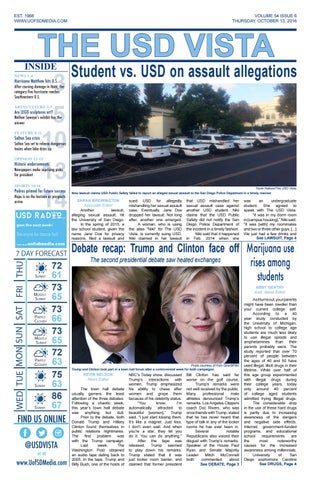
Photo courtesy of Rich Girard/Flikr Trump and Clinton took part in a town hall forum after a controversial week for both campaigns.
KEVIN NELSON News Editor The town hall debate usually garners the least attention of the three debates. Following a chaotic week, this year’s town hall debate was anything but dull. Prior to the debate, both Donald Trump and Hillary Clinton found themselves in public relations nightmares. The first problem was with the Trump campaign. Last week, The Washington Post obtained an audio tape dating back to 2005. In the tape, Trump and Billy Bush, one of the hosts of
NBC’s Today show, discussed Trump’s interactions with women. Trump emphasized his ability to chase after women and grope them because of his celebrity status. “You know, I’m automatically attracted to beautiful [women],” Trump said. “I just start kissing them. It’s like a magnet. Just kiss. I don’t even wait. And when you’re a star, they let you do it. You can do anything.” After the tape was released, Trump seemed to play down his remarks. Trump stated that it was just locker room banter, and claimed that former president
Bill Clinton has said far worse on the golf course. Trump’s remarks were not well received by the public. Many professional male athletes denounced Trump’s remarks. Los Angeles Clippers coach Doc Rivers, who was once friends with Trump, stated that he has never heard that type of talk in any of the locker rooms he has ever been in. Several notable Republicans also voiced their disgust with Trump’s remarks. Speaker of the House Paul Ryan and Senate Majority Leader Mitch McConnell both commented about See DEBATE, Page 3
As it turns out, your parents might have been rowdier than your current college self. According to a 40 year study conducted by the University of Michigan, high school to college age students are much less likely to use illegal opioids and amphetamines than their parents probably were. The study reported that over 70 percent of people between the ages of 40 and 50 have used illegal, illicit drugs in their lifetime. While over half of this age group experimented with illegal drugs during their college years, today only around 40 percent of college aged students admitted trying illegal drugs. The considerable drop in the use of these hard drugs is partly due to increasing awareness of the dangers and negative side effects. Internet, government-funded programs, and educational school requirements are the most noteworthy causes for the increased awareness among millennials. University of San Diego sophomore Caroline See DRUGS, Page 4
2T
he
USD Vista
NEWS
October 13, 2016
NEWS
NEWS EDITOR KEVIN NELSON @knel17
Asst. NEWS EDITOR ABBY GENTRY
Students’ drug use patterns changes DRUGS continued from Front Page was interested to hear about the outcomes of this study. “I feel like you hear people talk about ‘back in the day,’ and you think about Woodstock, hippies, and drugs, and I feel like people were just so much less aware,” Gallagher said. “I don’t think people use hard drugs to the extent of what they did in the ‘70s, but it is definitely still present. People are still going to do them; it might be less of a thing, but it is not totally gone.” Equally noteworthy is the decline in abuse of prescription drugs. In 2003, almost nine percent of college students reported having experimented with prescription drugs. In a 2015 Michigan follow-up study, this percentage dropped to just over three percent. As the percentage of users of illicit drugs, such as amphetamine, cocaine, heroin, ecstasy, and other opioids, has declined, the use of marijuana is on steady
incline. This surge is due to the decrease in the perception of the dangers of using marijuana. Research has shown that the legalization of marijuana has created conflicting messages. While there are various health and medical benefits of the drug, studies continue to show that, if overused or abused, pot can cause memory loss, alter emotions, or lead to dependency. Senior Keely Palla shared that she believes that the evolution of societal behaviors and mentalities have altered the way certain drugs are used. “Our generation is lucky enough to have a society [that] encourages natural freedom of expression and eccentricity,” Palla said. “I believe this provides us with the opportunity to more openly portray ourselves without the need for hard alternative measures to deal with hiding ourselves.” According to the Michigan study, the use of marijuana on a daily basis
among college students is also at the highest rate in almost three decades. At the time of the study, almost six percent of students admitted to using marijuana 20 or more times within a time frame of 30 days. Gallagher explained that she thinks there has been a spike in daily usage of marijuana among college students. “I think so many people think they can be fully functioning individuals while they are high and just go to class and get on with their day,” Gallagher said. “Also, now that it’s legal in so many states, it is becoming such a norm, and it is not as frowned upon as it used to be, so people might still be kind of experimenting with it in a much more open environment.” The generational changes in perception of most drug usage is undeniable. However, this study reported that attitudes toward cocaine have remained somewhat steady. The perceived risk of experimental and occasional
Photo courtesy of Sergey Glayonkin/Flikr Marijuana use in college students is up, but opioid use is down.
usage remained quite low until around 1986 when it became widely known that the drug had the potential to become addictive. After this, the usage of cocaine hit a small decline. After a few years, the perceived risk began to restabilize and returned to the idea that the experimental use cocaine was relatively low-risk.
Factors such as government education, widespread use of internet, and changes in cultural norms have altered the way people use drugs through various generations. While there is a staggering decrease in the use of hard drugs, the consistent use and abuse of marijuana has taken over millennials.
The USD Vista
NEWS
Volume 54 Issue 6
3
Trump and Clinton square off in town hall DEBATE continued from front page how terrible they thought Trump’s remarks were. “As the father of three daughters, I strongly believe that Trump needs to apologize directly to women and girls everywhere, and take full responsibility for the utter lack of respect for women shown in his comments on that tape,” McConnell said. After a discussion with his vice presidential candidate and running mate Mike Pence, Trump released an apology video. In this video, Trump said that his words were wrong and not reflective of who he really is. “Anyone who knows me knows these words don’t reflect who I am,” Trump said. “I said it, I was wrong, and I apologize.” After the so-called Trump tape surfaced, the Trump campaign attempted to shine light on problems within the Clinton campaign. Just 90 minutes before the second debate, Trump appeared with four women who claimed to have been sexually assaulted by Bill Clinton. Although the issue was related to Bill Clinton and not Hillary Clinton, Trump insisted that Bill Clinton’s actions spoke louder about Hillary Clinton’s character than the words he had said. Jennifer Palmieri, Director of Communications for the Clinton campaign, responded to the panel that Trump had put on. Palmieri called the panel a stunt, explaining that it will not affect Clinton’s campaign. “We’re not surprised to see Donald Trump continue his destructive race to the bottom,” Palmieri said. “Hillary Clinton understands the opportunity in this town hall is to talk to voters on stage and in the audience about the issues that matter to them, and this stunt doesn’t change that.” Anderson Cooper and Martha Raddatz moderated the second debate between Clinton and Trump. The town hall debate featured questions from selected audience members and the moderators. The debate started with an arguably awkward exchange
Donald Trump and Hillary Clinton went head-to-head in the second presidential debate for the 2016 election.
between Clinton and Trump, where neither candidate reached to shake the other’s hand as they were presented. Throughout the debate, both candidates seemed to stick to aggressive strategies. During the debate, Trump tried to put to rest the controversy over the Trump tape, but Clinton commented that the tape showed who Trump really is. Clinton further stated that Trump’s panel was an attempt to divert attention from his disastrous campaign. Trump fired back at Clinton stating that he only used words, whereas her husband used actions. “If you look at Bill Clinton, far worse—mine are words,” Trump said. “His was action. Bill Clinton was abusive to women. Hillary Clinton attacked those same women and attacked them viciously.” As the debate pushed on, it seemed that Trump was more prepared this debate than he was for the first debate. Despite his preparation, the fact-checking news site Politico stated that Trump made 13 false statements, compared to Clinton’s two. Throughout the debate, the candidates discussed a
variety of topics, including energy, healthcare, and the United States’ interaction with Syria. During last week’s vice presidential debate, Mike Pence and Tim Kaine also discussed Syria. During the debate, Pence stated that he would consider strong action if Russian and Syrian forces did not stop the bombing of Syrian civilian areas. Trump, however, said that he disagreed with his running mate. “He and I haven’t spoken, and I disagree,” Trump said. As Trump continued to talk about the controversial Russian intervention in Syria, he stated that he is not a fan of Syrian President Bashar al-Assad. Trump explained that he thinks Assad is helping to defeat the Islamic State of Iraq and Syria along with its Russian allies. Trump later brought Cooper and Raddatz into the debate. Trump argued that the moderators were going after his campaign problems, while refusing to address Clinton’s own problems. Trump urged the moderators to ask tougher questions about Clinton’s email scandal. Trump specifically asked them
why they were not bringing up the emails during the debate. “I’d like to know, Anderson, why aren’t you bringing up the emails?” Trump said. When Trump further commented on Clinton’s email scandal, he said that she would be in jail if he was president. Trump also claimed that the debate was often three versus one. Trump argued that he was given strict time limits and that Clinton was allowed to speak past those time limits. At the end of the debate, Trump had talked for 39 minutes and seven seconds, and Clinton spoke for 38 minutes and 28 seconds, almost identical amounts of time. Statistics also showed that Clinton talked over moderators 20 times, while Trump spoke over them 31 times. Trump also interuppted Clinton 13 times throughout the night, where Clinton only interrupted Trump once. At the end of the night, it seemed that most viewers could only agree on one thing: Ken Bone. Bone is a power plant operator and was a crowd member of the town hall debate. He posed a question to both presidential candidates about their energy policies.
Photos courtesy of Gage Skidmore/Flikr
“What steps will your energy policy take to meet our energy needs, while at the same time remaining environmentally friendly and minimizing job layoffs?” Bone said. Both candidates offered Bone significant answers, but it was Bone’s overall demeanor and name that sparked the internet’s love for the man. Although Bone will not play a significant role in the election, he seemed to offer the internet something everyone has been searching for in this election, a glimpse of happiness, fun, and love.
Photo courtesy of Ken Bone/Twitter America seemed to fall in love with forum member Ken Bone during the debate.
Hurricane Matthew touches down in U.S. Hurricane Matthew
Hurricane Matthew hit several states in the U.S. this past week causing mass amounts of destruction. The hurricane was the first category five hurricane since Hurricane Felix in 2005. The hurricane hit the United States between Oct. 7 and 8 and caused evacuations of many areas in Florida, Virginia, Georgia, and the Carolinas. President Obama declared a state of emergency for Florida initially, and extended that state of emergency to the other states later. It is estimated that Haiti, the most impacted area, experienced over $1 billion in damages. According to CoreLogic, a research and consulting firm, Hurricane Matthew currently has a total economic damage between $4 and $6 billion, which will grow upwards of $20 to $40 billion.
Impact area
Death toll
(approximate as of Oct. 11) Haiti 1,000 Columbia 1 Dominican Republic 4 Saint Vincent and the Grenadines 1 United States 36
4T
he
USD Vista
October 13, 2016
NEWS
Photo courtesy of sandiego.edu
A former USD student is suing USD over its alleged mishandling of an alleged sexual assault case.
Student claims USD mishandled assault investigations LAWSUIT continued from Front Page
were playing board games, and he slipped me some drug into one of my drinks. And it escalated from there.” Niki claimed that she woke up in her bed early the next morning. She said that there was a guy next to her sleeping. Niki said she did not give consent to have sex with him. She said that is when she called her friend. “[…] I was picked up by a friend, who called Public Safety,” Niki said. “And Public Safety asked me if I wanted to report it to the San Diego Police Department (SDPD), and I said yes. The public safety officer encouraged me not to do so, as it would interfere with USD’s own investigation.” “Once I connected with Public Safety that morning, they had gone to my dorm room to see if he was still there, which he was,” Niki said. “And they just told him to put his clothes on and leave. Instead of holding him and questioning him, and to find out what really happened, Public Safety just let him go.” Niki said that it wasn’t until she arrived at the hospital that she got a visit from the San Diego police. The USD Vista has obtained the San Diego Police Department report from that incident. In the police report the police said they arrived after being notified by USD Public Safety. “[Niki] was transported to the [...] hospital and USD Officer [...] followed the medic
THE USD VISTA Editorial – 619.260.4584 Business – 619.260.4714 www.uofsdmedia.com @USDVista
unit and called SDPD upon arrival,” the SDPD report said. The report stated that USD Public Safety told the police department that the accused male involved in this incident told USD Public Safety officers that the sex was consensual. The SDPD report also stated that USD Public Safety released the accused male student to his residence off campus. Niki’s lawsuit also claims that during the alleged rape she was also choked. “I couldn’t really move at all,” Niki said. “There were a few times where I was struggling—I guess it was when I was regaining consciousness. When I was moving around, he was either holding my arms down or putting his hands on my throat. He would also strangle me during the forced oral sex as well. Pretty much, he was strangling me the whole entire time.” Niki’s mother also agreed to be interviewed by The USD Vista. The incident rattled Niki so much that her parents came down from Northern California to be with their daughter the same day. Her mother explained that she was frustrated. Niki’s mother said that she believed that, because Niki was 18, she could not get answers from USD staffers in various departments right away. “You start to feel guilty as a parent—should have done this, should have done that,” Niki’s mother said. “I wish I had physically gone into those offices and looked straight into those people’s
Brooklyn Dippo- Editor in Chief Matlyuba Nurova - Finance Director Sarah Brewington - Associate Editor Diego Luna - Managing Editor Gianna Caravetta - Copy Editor Nora Brewington - Art Director Kevin Nelson - News Editor Abby Gentry - Asst. News Editor Dani Devries - Opinion Editor
eyes. [I was thinking] I should just take care of Niki—one minute she is crying, one minute she is sleeping, one minute she is throwing up. There is no book to go to tell you what you should do.” The lawsuit stated that Niki stayed on campus for another month. It alleged that the accused male student had begun stalking her on campus. Niki said that she asked USD Public Safety to escort her to and from classes. “Although USD had promised Public Safety would escort [Niki] to and from classes, they discouraged her from pursuing this option because it would, supposedly, draw ‘unwanted attention,’” the lawsuit said. USD answered Niki’s complaint. “In sum, USD met or exceeded all legal obligations it had to [Niki],” USD’s answer said. The USD Vista also reached out to USD’s public relations department regarding the lawsuit. The Associate Vice President of University Communications, Peter Marlow, was asked to comment regarding allegations of mishandling the sexual assault. He was asked to comment about the charge that USD Public Safety did not notify SDPD of the incident in a timely manner, and that she was dissuaded from following through on her request on getting a Public Safety escort. Marlow explained that USD does not comment specifically about ongoing lawsuits.
“Consistent with the requirements of federal student privacy law, the university does not share specific information with the media about student situations like this one,” Marlow said. “The university is confident that when all of the evidence comes out through the legal process, it will show that the university acted appropriately in its response to the incident.” In March of 2014, Niki withdrew from USD to attend college on the East Coast. A year later, she got her own attorney. It was Niki’s choice to sue, but her mother said she hopes something will come of the lawsuit. “Peace, I just want that whatever happens to bring closure for Niki, so that she can move on, so she knows that it wasn’t her fault, and that she did not do anything wrong,” Niki’s mother said. Carla DiMare is Niki’s attorney. “I believe that USD was unwilling to adequately investigate and adjudicate this violent sexual assault because USD wanted to sweep it under the rug, which keeps their crime statistics low,” DiMare said. “USD should have immediately referred this serious crime to the police and referred it to the police before campus security contaminated the crime scene.” DiMare is seeking damages. “My client has paid a high price emotionally and financially because USD unfairly mishandled her claim
Kelly Kennedy - Feature Editor Jennifer Givens - Asst. Feature Editor Walker Chuppe - Arts & Culture Editor Matthew Roberson - Sports Editor Dray Wilson - Photography Editor James Jackson - Distribution Manager Gina Lew - Student Media Advisor Marie Minnick - Operations Advisor
of drugging, strangulation and rape,” DiMare said. “And then USD did not ensure that she had an equal opportunity to continue her education at USD. My client hopes that USD will change its policies to protect future sexual assault victims.” Because of privacy laws and ongoing litigation, USD officials cannot comment specifically on this case. They want to ensure that they take all of these claims seriously. “We are confident that when all of the evidence comes out through the legal process, it will show that the university acted appropriately and in a manner consistent with its protocols and its memorandum of understanding with the San Diego Police Department in its response to the incident,” Marlow said. The University Communications explained its commitment to ensuring the security of all its students. “USD is deeply committed to and engaged in efforts that promote the well-being and safety of all of our students,” Marlow said. “We also are proactive in our efforts to comply with our responsibilities under Title IX. The university has processes in place to address and encourage the reporting of incidents to the San Diego Police Department and to USD officials.” USD encourages anyone looking for more information about USD’s sexual assault responses should visit the Campus Assault Resources and Education (CARE) website w w w. s a n d i e g o . e d u / c a r e .
The USD Vista publication is written and edited by USD students and funded by revenues generated by advertising and a student fee. Advertising material published is for information purposes only and is not to be construed as an expressed or implied endorsement or verification of such commercial venues by the staff or University. The USD Vista office is located on the fourth floor of the Student Life Pavilion in room 403B. All inquiries should be sent to: The USD Vista 5998 Alcala Park San Diego, CA 92110 The first copies of the newspaper are complimentary, all copies thereafter are a 25 cents charge. Opinions expressed in this publication are not necessarily those of The USD Vista staff, the University of San Diego or of its student body. Letters to the Editor can be submitted to The USD Vista office. Letters should be limited to 300 words and must be signed. For identification purposes, USD identification numbers and writer’s year must be included in the letter. The USD Vista reserves the right to edit published letters. Any content sent to the editor will be considered for publication unless otherwise stated.
The USD Vista
ARTS AND CULTURE
Volume 54 Issue 6
A&C EDITOR WALKER CHUPPE
ARTS & CULTURE
5
@lord.walker
The Art of the Brick WALKER CHUPPE Arts and Culture Editor @lord.walker
The Art of the Brick is a global touring exhibition that uses LEGO bricks as its medium and features recreations of historic art pieces. Created by Nathan Sawaya in 2007, the exhibit also showcases original works done by Sawaya. CNN rated the exhibition as one of the world’s must-see exhibitions, currently featured at the Reuben H. Fleet Science Center until Jan. 29. Located in historic Balboa Park, the Reuben H. Fleet Science Center’s mission is to connect people of all ages with science, encouraging learning through hands-on experience. The science center includes over 100 interactive exhibits, is completely child-friendly, and is a popular weekend spot for families. The science center also features an IMAX theater, and films are incorporated into many of the exhibitions that travel to the center. The Art of the Brick exhibition is $29 and grants admission to the regular science center and its interactive exhibits. The ticket to the exhibition also includes an IMAX film, which is optional to attend, but recommended for the full LEGO brick experience. Although LEGO bricks may seem like children’s toys, the exhibition
was far from child’s play. The exhibition opened with a short three-minute film which described Sawaya’s creative process and the history behind The Art of the Brick. Sawaya was interested in LEGO ever since he was young, and he explained that he even brought bricks with him to college at New York University. At the time, Sawaya was not pursuing LEGO art as a career, and he ended up going to law school and practicing law for a few years. It was not until he realized that his day job was unfulfilling that he decided to pursue his LEGO creation art full-time. In his introductory video, Sawaya stressed the importance of doing what makes you happy, because he said that he believes success will follow. This is a welcomed sentiment for college students looking for what comes next after graduation. There were different sections of the exhibition, each with its own theme. The section when you walk in features art recreations from Leonardo da Vinci’s Mona Lisa to Vincent van Gogh’s Starry Night, all done precisely and realistically. The recreations were instantly recognizable, and Sawaya arguably deserved praise for his attention to detail. At times, it was easy to forget that the pieces were all created from LEGO bricks
Walker Chuppe/The USD Vista A display of a LEGO apple, part of a section containing every day objects, imagined as sculptures.
because of the accuracy and detail in the sculptures. As the exhibit continued, Sawaya explored countless different themes, and his sculptures ranged from bright red apples to menacing wall-mounted skeletons. The relaxed lighting helped the overall ambiance of the exhibit and placed focus on the sculptures rather than the gallery as a whole. Sawaya’s work also included portraits of people rendered in twodimensional LEGO paintings, like some of his recreation pieces, but he included his own flair and more contemporary style. It was interesting to see how Sawaya incorporated his personality in his works, especially since
Walker Chuppe/The USD Vista Bricks from this man are spilling out of his LEGO innards.
he used LEGO bricks as his unconventional medium. Although some fine art critics may find qualms with Sawaya’s LEGO brick medium, his exhibition presented a unique and fresh experience in the world of art galleries. The Art of the Brick is certainly not only aimed at children, and it is enjoyable to experience for people of all ages. There are hundreds of sculptures to check out, enough to entertain for an hour or so. One small annoyance is the price of the exhibition. At $29, it seems a bit steep for the overall experience. In comparison, a ticket to the Louvre Museum in France costs €15, about $16. As expansive and renowned
as the Louvre is, it seems a bit odd that The Art of the Brick costs nearly twice as much. That isn’t to take away from the fun at Sawaya’s exhibition, but it is significantly smaller and does not include original works from prolific artists like the Louvre does. The Reuben H. Fleet Science Center and The Art of the Brick exhibition are both entertaining attractions located in Balboa Park. Sawaya’s LEGO brick exhibition is worth a look, and walking around the park afterward isn’t half bad either. The Art of the Brick is a unique experience to take in for people of all ages, and adds a new dimension to the possibilities of what can be created with LEGO.
Walker Chuppe/The USD Vista A lego man tries to break down a wall, only to be stuck behind it.
6 The USD Vista
Food for thought: plant-based restaurants CASEY HUANG Contributor
San Diego is full of diverse restaurant options, and, with the popularity of sustainable, healthy food on the rise, it’s no shock that vegan restaurants have been garnering their fair share of attention. The University of San Diego has created its own vegan food menu in support of the vegans at school. The vegan station at the Student Life Pavilion is popular among vegans and non-vegans alike. Other dining locations on campus, such as Tu Mercado, La Paloma, and Bert’s Bistro, now all have vegan options in their menus. If you ever find yourself tired of the on-campus restaurants, these local vegan spots are certainly worth a try. Trilogy Sanctuary ($11-$20) Trilogy is a vegan café with a rooftop patio in La Jolla. It is one of the best places to get healthy organic fare with the addition of an amazing view. They serve 100 percent organic food, juice, smoothies, and desserts that are healthy and taste good as well. The “Enticing Eggplant”
October 13, 2016
ARTS AND CULTURE
entree is a perfect example of combining fresh vegetables into a hearty, homestyle dish that will leave your stomach full and a smile on your face. Trilogy also offers both yoga and aerial yoga classes for those who want to squeeze in a refreshing workout before their meal. This stems from the owners’ confidence in achieving balance through mind, body, and spirit. The employees are friendly and helpful, and the entire vibe of the place is soothing and calming.
Veganic Thai Café ($11-$30) A vegan restaurant that just opened in Hillcrest, Veganic Thai Café offers vegan versions of classic Thai dishes, such as pad thai, sticky rice, and rice wraps. Veganic offers a wide variety of mock meats, which are used in dishes such as pad see ew, red curry, and fried rice. For those who are recently starting a vegan or vegetarian diet, Veganic is a great place to try because of the robust flavor of their food. Senior Kristin Sitarz loves the pumpkin curry from Veganic. “Everyone needs to try it,” Sitarz said. “It’s insanely flavorful and satisfies every taste bud.”
Café Gratitude ($11-$30) Perhaps one of the better-known establishments in this list, Café Gratitude is an extension from the Los Angeles chain restaurant. Located in the bustling community of Little Italy, the brightness and coolness of the restaurant makes it an easygoing place to hang out. Apart from the beautiful interior, the restaurant has a great selection of desserts, pastries, and smoothies. With a variety of sandwiches, burgers, and salads to choose from, it’s not easy to decide what to order but you can’t go wrong here. The restaurant’s focus is on sustainability, and Café Gratitude’s food is responsibly sourced and 100 percent vegan. Café Gratitude makes an amazing mexican bowl with black beans, guacamole, pico de gallo, nopales, salsa verde, cashew nacho cheese, and romaine. They also place emphasis on supporting local farmers and integrating with San Diego culture. Moncai Vegan ($8-$15) Located in Normal Heights, Moncai Vegan is a quaint restaurant that you might miss if you are walking by. Small and modest, Moncai
is a cozy place that uses local and organic ingredients to create its dishes. The interior of Moncai is eclectic and rustic, filled with artwork and plants that make the place charming. As it is a smaller restaurant, the menu is also more limited. However, the few dishes that they do have on the menu are delicately crafted. Moncai’s donuts are particularly tasty. Although vegan baked goods can sometimes be tough to execute, Moncai’s donuts are on par with regular ones. On Sundays, Moncai serves vegan brunch as well, which is arguably what they are most famous for.
Peace Pies ($11-$30) The only fully raw ingredient restaurant of this list, Peace Pies is one of the most unique vegan restaurants in San Diego. They use mostly locally-sourced ingredients to make their creative dishes and desserts. They offer a variety of foods from raw pizza to raw wraps and chocolates, and they are constantly on a quest to create new, innovative raw dishes. The raw quesadilla is a popular order, as well as the variety of cakes. Not only is the food insanely good, but it’s insanely good for you
as well. The only common complaint with peace pies is that the prices can seem steep for food that is completely raw.
Plant Power (Under $10) This drive-thru vegan option serves up classic fast food minus the meat. It’s a great place for the plantbased population to indulge on junk food without the guilt. They have a long list of vegan burgers, salads, and childhood classics like mini corn dogs and taco roll-ups. And if you’re thirsty you can choose between almond milk shakes or kombucha on tap. They open for breakfast at 7 a.m. every day and serve up classic diner food like “chicken” and waffles and maple “sausage.” You can eat inside at their Ocean Beach location or you can get it quickly to go. Apart from these six restaurants, there are still many other restaurants around San Diego that are fully vegan. Even more restaurants are beginning to offer vegan sections or locally-sourced ingredients. With the gradual rise in popularity of veganism, there are more and more people who are creating a demand for plant-based restaurants.
The USD Vista
ARTS AND CULTURE
Volume 54 Issue 6
7
USD’s student-run literary journal WALKER CHUPPE Arts and Culture Editor @lord.walker
The Alcala Review is the University of San Diego’s student-run literary journal. The Alcala Review showcases creative student works in a biannual compilation. Established in 2014, the journal aims to become an outlet for USD’s innovative writers through the publishing of poetry, fiction, and creative nonfiction. The journal resembles a magazine in many ways, and it collaborates with writers and artists throughout the university. The Alcala Review accepts a wide range of written submissions, as well as works from other mediums, such as paintings, drawings, and photography. Each journal also features a USD artist, which blends the two worlds of creative writing and the arts. The Alcala Review encourages students to explore their own creativity, and it also provides an opportunity for students’ work to be published and reach larger audiences. A number of professors in the English department have encouraged their students to submit their own works for
possible publication in The Alcala Review. Popularizing the student literary journal aims to encourage students to write more, improve upon their works, and inform more students about creative writing. Malachi Black, professor in the English department, oversees The Alcala Review’s production. He explained the publication’s creation and what its vision for the future looks like. “There was an opportunity to galvanize the creative writing community and literary culture at USD by producing an object that would encourage the creation of a group of young men and women who are excited about building a space for literature,” Black said. “We really hoped that we could add a space for student-created dynamic literature at USD.” Black explained that, while he serves as faculty advisor, he enjoys that The Alcala Review is completely studentrun. The journal is designed by students, for students. “I’m sort of like an airtraffic controller: the magazine itself is being piloted by the students who have their own editorial responsibilities,” Black said. “The writings and artworks featured in The Alcala
Review are done by students, and our target audience is the same as our authorship, which is students at USD.” The Alcala Review strives for creative collaboration among USD students, and any student is able to submit a piece. The journal is currently accepting submissions for the Fall 2016 issue, which will be released in December. The priority deadline for students to submit their work is Oct. 31, and the final deadline for submission is Nov. 11. Before submission, The Alcala Review will be hosting its Writers Workshops so that students may receive feedback on how to improve their pieces before the final deadline. The workshops are conducted by students in a seminar-like fashion with additional help from professors who stand by at the meetings. Senior Savannah Abrishamchian encouraged students to stop by the workshops. Abrishamchian said that they are welcoming and supportive events for any writer. “The Writers Workshop is a great chance for USD writers to collaborate with The Alcala Review team,” Abrishamchian said. “It is an interactive and
creative event for the USD community, and I highly recommend anyone who is interested in getting published for the next issue to join in.”
The next Writers Workshop will be on Saturday, Oct. 15 from 12 p.m.-2 p.m. in the third floor courtyard of the Student Life Pavilion.
“Designated Survivor” thrives in premiere week Kiefer Sutherland finds success in his newest role as POTUS
BROOKLYN DIPPO Editor in Chief
“Designated Survivor” delivers a president we could only dream of in 2016. The political drama follows Tom Kirkman, played by Kiefer Sutherland, in the unlikely turn of events that land him in the oval office. The pilot episode wastes no time providing the audience with conflict. Armed with nothing but the knowledge that Kirkman is the Secretary of Housing and Urban Development, but is being demoted to an ambassadorship by the current POTUS, a terrorist attack leaves everyone else in line for the presidency dead. Kirkman is the designated survivor, the person who stays behind at the White House while the POTUS delivers the State of the Union at the Capitol. After the explosion he is swept away by secret service and sworn into office in a sweatshirt. With the rest of Congress and the executive branch gone, Kirkman has to make a number of important decisions by himself. In a scene that closely
resembles the gut reaction following the 9/11 attacks, Sutherland plays a confused and conflicted leader who just wants to do the right thing. Catapulted into an office that he never wanted to be in, Kirkman seems to be performing the duty much better than real-life politicians. He prioritizes verified intelligence information over partisan views in response to the attack. Sutherland balances the shock of such an attack and the composure of a lifelong politician in a manner that is dreamy to the American electorate. The actors are clearly still growing into their respective roles but the plot is engaging enough that, for now, viewers can overlook the occasional cheesy delivery of a line. Sutherland also brought a large fanbase to the show following his popular lead role in the TV show 24. After the ABC series premiered to 10 million viewers, it tracked a record 7.7 million viewers in the first week of playback. With such great reviews, ABC gave orders for a full season of “Designated Survivor” after the first episode. The popular fictional series is not lost in fact;
it is based on the United State’s real continuity of government plan. There is actually a cabinet member who sits out of each State of the Union Address. The only time the plan has been fully deployed was after the 9/11 attacks when President George W. Bush was put on Air Force One, Vice President Dick Cheney was secured in an underground bunker, and Speaker of the House Dennis Hastert was picked up on a helicopter and flown away from Washington D.C. The plot of the White House being overtaken is not new to Hollywood. However, the high-drama combined with rash accusations made by some advisors, lack of trust amongst the remaining officials, and decisions being made behind closed doors resonates with Americans during this unprecedented election season. In an era when many people want to eliminate career politicians and start over in the Capitol, this series offers an eerie image of what that looks like. The thought of it is so unnerving that viewers keep tuning in to see what will happen and how America will survive.
Photo courtesy of ABC Kiefer Sutherland is sworn into his role as POTUS.
8
The USD Vista
October 13, 2016
FEATURE
Communal Coffee creates community North Park coffee shop’s successful debut interests students KELLY KENNEDY Feature Editor
Walking into Communal Coffee is like walking into the living room you’ve always wanted. Curated by owner Jennifer Byard, the coffee shop has become a popular spot for students and neighbors to sip quality roasts among friends. Byard lived in the North Park/South Park area for eight years before opening the trendy coffee shop on the corner of Texas Street and University Avenue in North Park. Communal Coffee opened last May and received a warm welcome from the community. Byard explained that she and her staff did not expect the shop to be so popular when it first opened. “The first weekend that we opened, we ran out of coffee,” Byard said. “We had under ordered and didn’t think it would be that busy from the get-go.” The shop is flanked by hanging succulents, white walls, and a large mural emblazoned
with the phrase “Coffee + Flowers.” This sign has become an Instagram staple for students and neighbors alike. University of San Diego Sophomore Kateri Theisen visited Communal Coffee after seeing the “Coffee + Flowers” sign on social media. “I found out about Communal Coffee because a friend of mine posted an Instagram of the sign, and I had to see the rest of the place,” Theisen said. “The feel of the shop is so cute. The people are really nice, and I love that they sell flowers too.” The shop is a collaboration between Communal Coffee and Native Poppy, the flower shop housed inside the building. Communal Coffee and Native Poppy are directly next to North Park Nursery, which offers outside seating in a garden setting for coffee drinkers to enjoy. Byard noted that her background in business and design helped her create a unique coffee shop. Her vision was a
place that would not only stand out against others like it, but also offer the community a space in which to interact with one another and its local baristas. “I wanted to take the creative side of the other businesses I’ve worked in and combine that with a product I really care about and believe in, [namely] coffee, and build a place where people can really feel connected to their community,” Byard said. Byard is a Seattle native whose mother owned her own coffee shop in the ‘90s. This close relationship with coffee culture influenced her choice of roaster, San Francisco-based Sightglass Coffee. “Coffee runs through my blood,” Byard said. “Seattle and Portland definitely have a different type of roast than we do down here, so I wanted something that represented what Southern California was producing, which is a little more of a medium roast.” Communal Coffee
is the first San Diego brewer of Sightglass Coffee. Byard explained that the roaster has brought more customers to the shop. “It’s fun serving Sightless here because there are so many people living in San Diego from the Bay Area,” Byard said. “We have some customers who drive across the city for a cup because we’re the only Sightglass account in San Diego right now.” The menu and coffee selection are carefully crafted to maintain the locations unique and quality characteristics. “We want everything to be unique, so we make all the purees and syrups in house,” Byard said. “I’m really proud of our pumpkin spice: it tastes really pumpkiny as opposed to tasting more spicy, like other blends. We’ll introduce two more new drinks closer to Christmas.” As it grows in popularity, Communal Coffee will also add more to its menu, including more
breakfast items and a few lunch selections. S i t u a t e d between the hubs of North Park and Hillcrest, Communal Coffee provides the surrounding community with a coffee shop close enough to walk to. The addition of Native Poppy and the shop’s location next to the North Park Nursery have bolstered foot traffic in the area, benefiting each of the businesses. Byard chose the location and collaborative elements carefully. “Because I have a background in design, I knew that the aesthetic of our place would be unique and different, then you add in the combination of coffee and flowers.,” Byard said. “Our initial success is that a lot of people now have a place to walk to, and our growing popularity on social media brought us a lot of folks from out of the neighborhood.” C o m m u n a l Coffee has become a popular study spot for students and a welcoming place to meet friends and get to
know com said cura whic coul and while food “ feel cafe “We that betw and to m com B Gilbe at C since and expe “ on Gilbe saw on imm wan lived from I le my n whic mos T has seve even Fall craft furth peop S prefe
Volume 54 Issue 6
w the surrounding mmunity. Byard d she specifically ated a space in ch customers ld see the baristas florists work e enjoying quality d and drinks. “I didn’t want it to like an internet e,” Byard said. built the bar so there’s no barrier ween the baristas the customers make it feel like a mmunity table.” Barista Maria ert has worked Communal Coffee e its inception talked about her erience there. “I actually closed the first day,” ert said. “I them working the shop and I mediately knew I nted to work here. I d two blocks away m here, and now egitimately serve neighbors coffee, ch is what I love the st about this job.” The business already hosted eral community nts including their Bash and various t workshops to her welcome ple into the space. Students at USD er to study in the
open, welcoming space of the coffee shop. Theisen also explained that she enjoys venturing off campus to study and explore San Diego. “Because I live on campus, it’s really nice to get away, even if it’s just to do schoolwork,” Theisen said. “I definitely prefer studying off campus.” Sophomore Becca Lancaster also enjoys studying off campus. “I prefer to study off campus because there are fewer distractions and I’m not as tempted to go back to my room and relax,” Lancaster said. “I don’t actually drink coffee, but the tea and food at Communal Coffee is amazing. It’s a great place to hang with friends, and if you prefer to study in a coffee shop setting, Communal Coffee is a great replacement while Aromas is under construction.” Junior Jarinn Uppal also frequents Communal Coffee while Aromas is under construction. “Communal Coffee is one of the most aesthetically pleasing coffee shops I’ve been to,” Uppal
FEATURE
said. “Working on campus is completely different this year since Aromas is under construction and being renovated. I’m really glad I discovered Communal Coffee.” Many students come for the coffee and stay for the ambiance, as the shop is perfect for afternoon studying or relaxing among friends. The prices are close to those of other shops nearby, and the many prefer the drinks to those offered on campus. Theisen noted that her passion for coffee often takes her off campus. “To say I love coffee is sort of an understatement,” Theisen said. “Honestly, the coffee on campus is not the best, so Communal Coffee is a nice deviation from my regular black cup of Folgers.” While it is a few miles away from campus, Communal Coffee is a fantastic study spot that will welcome students back for every midterm review and early morning study session.
The USD Vista
9
Photos courtesy of Kelly Kennedy/The USD Vista, Communal Coffee, Karinn Uppal Communal Coffee is a great space for students to study and relax. Spread & Copy by Kelly Kennedy/The USD Vista
10 T
FEATURE
USD VISTA
FEATURE HE
OCTOBER 13, 2016
FEATURE EDITOR KELLY KENNEDY
ASST. FEATURE EDITOR JENNIFER GIVENS
Student spotlight: A balancing act Dakota Quayle discusses balancing school, work, and an internship
JENNIFER GIVENS Asst. Feature Editor The best way to know if your dream job is right for you is to get an internship. Many University of San Diego students struggle to balance classes, work, and an internship. Dakota Quayle, a USD senior and communication studies major, has found a way to do all that and still have free time to hang out with her friends, dog, and boyfriend. Quayle is currently an intern with Live Well San Diego. The company is part of the Health and Human Services Agency in San Diego. Quayle explained that having an internship is both challenging and rewarding. “I am a full time student, I work about 12 hours a week at my internship, and I also have a nighttime job working in a restaurant,” Quayle said. “It can be really hard to balance everything, get homework done, and hopefully squeeze in a social life while I’m at it. I know it will be all worth while in the end though, so I remind myself of that.” Quayle found her internship after her health communication professor at USD, Julian Tullis, sent students an email about upcoming internship opportunities. “Initially, I hoped to be a health communication major, which isn’t offered at USD, but I have been able to take classes, like Dr. Tullis’, that have helped me realize health communication is the field I want to be in,” Quayle said. “My internship requires a lot of computer work, but
I feel my major has helped me get to where I am today.” Quayle said the process of getting the internship was quite simple. She explained that all she had to do was sign up for an internship class with USD’s communication studies professor and internship coordinator, Greg Ghio, and fill out the proper paperwork. Then, she contacted the company offering the internship. After she completed the paperwork at USD, Quayle submitted her cover letter and résumé to Live Well San Diego. “I heard back from them rather quickly,” Quayle said. “I first had a phone interview, and then an in person interview where they offered me the position. After that, I had to fill out a lot of government paperwork that took a long time to process. About a month and a half later, I was able to start working for them.” So far Quayle said she is enjoying her internship. She shared that she hopes to work someday in the health communication field, so this internship has allowed her to gain necessary training to pursue such a career after graduation. “Being able to work in a real work setting, with the understanding that you are there to learn is a great feeling,” Quayle said. “I feel more comfortable asking for help or clarification on something then I think I would have had this been a job right out of college. This is my first time working in an office, and that is a bit daunting. It is calming to know that, once I graduate in May and go out into the
job market, I will have some experience under my belt that I can use to make a great first impression at an interview or even at my first job.” Ghio said that internships are useful for students. “Internships are a valuable tool to knowing what industry students want to do or do not want to go into,” Ghio said. USD’s Career Development Center (CDev) works with students to strategize about jobs, careers, and internships, along with providing many other job-related resources. CDev also coordinates with each department’s internship coordinators to further prepare students for success during and after college. Kelsey Schultz, a career counselor at USD, said that CDev’s help for students planning for life after graduation is not limited to finding an internship. “We help students learn about self, connect what they have learned in the classroom, and network,” Schultz said. “In the workforce, it is not who you know, but who knows you. Internships are a great way for students to put learning in practice, while setting up students for the future, whether that is grad school, research, or a career. We encourage students to start thinking about internships early and often. We encourage students to have as many internships as they can.” CDev offers undergraduate students support, such as personal assessments, career finder tools, and Torerolink. Schultz also said CDev offers preparation for
applying for a job. “We help students with writing their résumé, cover letter, and prepare them for interviews,” Schultz said. According to CDev, 68 percent of USD students participated in internships between 2014 and 2015. Many students have expressed that they believe an internship is a way to get a glimpse into the job students want to have after graduation. While interning, students can receive college credit, build a résumé, and gain experience in the workforce. While balancing an internship is tough, Quayle shared her thoughts on the importance of having an internship in college. “I think an internship is a great resource for
college students to utilize, and USD makes it so easy to do,” Quayle said. “I often hear about former students getting caught in the circle of, ‘you can’t get a job without experience, but you can’t get experience without a job.’ What better way than to get experience while still in school and get college credit for it? It’s a no brainer to me. I think students at USD should take advantage of their opportunity while at a school that offers so many benefits like this.” As students plan out their schedules for intersession and spring, it is never too early to start thinking about an internship. There are many resources on and off campus for students to use when searching for the perfect internship.
Photo Courtesy of Dakota Quayle Quayle, like many other USD students, balances an internship with classes, work, and extracurriculars.
S a l ton Sea slow ly shriveling All levels of government come together to mitigate environmental and public health issues
KELLY KENNEDY Feature Editor
A man-made toxic lake in the middle of the desert, with the potential to kill thousands of people living around it, is not only an apocalyptic scenario, but also a harsh reality for Southern California. About two and a half hours east of the University of San Diego, spread across Imperial Valley and Coachella Valley, lies the Salton Sea, a portrait of improper land and water management. According to the California Department of Parks and Recreation, the Salton Sea State
Recreation Area was recreated in 1905 after the Colorado River flooded portions of the developing Imperial Valley. High spring flooding created the sea and it grew to cover 130 miles of shoreline before engineers were able to contain the water breach in 1907. The Department of Parks and Recreation’s website for the Salton Sea Recreation Area noted opportunities for kayakers, campers, and hikers to enjoy the area. It only once mentioned the high salinity that has killed a significant portion of the fish population and still contributes to the toxicity of the body of water.
A related page on the Department of Parks and Recreation’s website, titled ‘Salton Sea 101,’ indicated that about 1.3 million acre-feet of water evaporates from the Salton Sea each year, yet it is still California’s largest lake. Mark Ceder, the Program Manager of the University of San Diego’s Outdoor Adventures program, has visited the Salton Sea for the past five years. “The Salton Sea was one of those locations I would see written about in kayaking magazines as one of the most unique places in the country to go
paddle,” Ceder said. “One weekend, I took my kayaks out and paddled across the Sea. It’s definitely a land of extremes and beauty.” Visitors to the region immediately notice the state of disrepair that the surrounding environment is in. Ceder noted that the odd landscape attracts many visitors despite the poor quality of the environment. “There have been a lot of improvements to the Salton Sea’s environment,” Ceder said. “Going out there for the first time, it was really eye opening that I almost felt guilty for wanting to see it, even though a lot of it had been cleaned
up. There are still areas that haven’t been touched, and it’s still shocking to think about families and kids growing up in a house next to abandoned places that haven’t been touched in years.” During the 1950s, developers created tourist towns around the lake, including Bombay Beach. After several detrimental tropical storms in the 1970s, the Salton Sea flooded the surrounding area. The flood destroyed many of the towns before dramatically receding, leaving ghostly skeletons of once prosperous developments. See SEA, page 11
11
FEATURE
Volume 54 Issue 6
The USD Vista
Saline Salton Sea shrinking Imperial and San Diego County dealing with the issue of the toxic Salton Sea
SEA, continued from page 10
The sea lacks any point of outflow and has been largely maintained by a runoff from the surrounding agricultural areas. The runoff has only increased its toxicity and failed to solve the issue of rapid evaporation from the vast areas of shallow standing water. The Atlantic reported in 2002 that the Imperial Irrigation District agreed to provide billions of gallons of water every year for 15 years if the state of California would manage the Salton Sea. As 2016 draws to a close, the deal is ending soon and so is a large source of the Salton Sea’s water supply. Ceder is a graduate of the San Diego County Water Authority’s Citizens Water Academy, a program for San Diego leaders who are passionate about the county’s water issues. Ceder recently spoke with Maureen Stapleton, the General Manager for the San Diego Water Authority. Stapleton emphasized that environmental issues are an important part of the plan. She said that it’s not going to be similar to the Owens Lake and dust mitigation
plan in Los Angeles County. Owens Lake is a primarily dry and dusty lake bed near Lone Pine, California. As the lake receded, large clouds of dust formed, which drastically reduced air quality in the surrounding region. NPR reported in 2013 that Owens Lake is the largest single source of dust pollution in the nation. Ceder explained that the Salton Sea is not as detrimental to air quality as Owens Lake has been in the past, but it still needs to be managed to ensure that Imperial County’s air is safe to breathe. “Imperial County has some of the worst air quality and some of the largest percentages of kids with asthma in the country,” Ceder said. “The Salton Sea is a part of that problem in that the dust that is created by the sea receding has a lot of chemicals, toxins, and minerals in it. The research shows that the Salton Sea contributes about 10 percent of the air pollution in the area, which may grow as the Sea continues to recede. The other problems in the area are unregulated agriculture and Mexico’s lack of regulation on burning and air quality.”
Great clouds of dust rise above the sea during high winds. This dust is made up of dried, toxic silt from the evaporated lake bed. The dust degrades air quality in the surrounding area and could travel to nearby Los Angeles or San Diego if concentrated enough. On Aug. 31, 2016, President Obama included the Salton Sea in his remarks at the 20th Annual Lake Tahoe Summit concerning climate change and environmental preservation. One of goals laid out by Obama included the restoration of the Salton Sea. “In partnership with California, we’re going to reverse the deterioration of the Salton Sea before it’s too late,” Obama said. In Mar. of 2014, the Department of the Interior Assistant Secretary for Water and Science, Anne Castle, signed a Memorandum of Understanding with the Salton Sea Authority to direct collaboration between federal, tribal, and local organizations involving the Salton Sea. The memorandum stated that the organizations involved will pursue renewable energy
resources at and around the Salton Sea in order to mitigate the environmental, public health, and economic consequences of environmental degradation. The San Diego Union-Tribune reported that the California budget for the 2016-2017 fiscal year now includes $80.5 million to fund research and development for the first phase of the Salton Sea Management Plan. The plan is now in its initial stages and is set to continue the ongoing process of restoring both the Salton Sea and the land surrounding it. KPBS reported that, according to Bruce Wilcox, assistant secretary for Salton Sea policy, the entire restoration process could cost up to $2.5 billion. Calif. governor Jerry Brown created a Salton Sea Task Force in May of 2015. According to the Salton Sea Management Program’s website, the task force’s short-term goal is to create 9,000-12,000 acres of habitat and dust suppression projects. The task force has also been given a medium-term plan of 18,000-25,000 acres of habitat and dust suppression projects.
As federal, state, and local organizations work together to improve the Salton Sea, the surrounding communities should take interest in the region and learn more about the importance of the Sea. Ceder recommends that San Diego residents and USD students see the Sea as it is now, as the landscape will change now that the federal government has become so involved in the restoration process. “It’s going to be a multi-generational process to continue to rectify the current situation,” Ceder said. “In 30 years, the Salton Sea is going to look different than it does today. With Outdoor Adventures, we’ve been going to the same places for the past 30 years, and the Salton Sea is one of those places that is not going to look the same. We are running programs out there, and I recommend that people go out there and see it. It means so much to so many people, it’s more than a problem to be dealt with.” Part of changemaking is involvement in local issues. For USD students, the Salton Sea is a major issue for those interested. in water conservation.
Photos courtesy of Mark Ceder/USD Outdoor Adventures The Salton Sea is a beautifully unique area that is changing rapidly as environmental restoration takes place.
12
The USD Vista
OPINION
October 13, 2016
OPINION
OPINION EDITOR DANI DEVRIES @danidevries_
The views expressed in the Opinion section are not necessarily those of The USD Vista staff, the University of San Diego, or its student body.
Volume 54 Issue 6
The USD Vista
OPINION
13
San Diego U-T issues historic endorsement DANI DEVRIES Opinion Editor Recently, The San Diego Union Tribune (UT) turned heads when the historically conservative newspaper endorsed Hillary Clinton, the Democratic candidate for president. This is the first time in the paper’s 148 year history that the editorial board has chosen to endorse the Democratic candidate, deeming Clinton the safer choice for president. The U-T is not alone in its historic endorsement. Other major papers across the country, including the Houston Chronicle, Arizona Republic, and Cincinnati Enquirer, have gone against their traditionally conservative roots to endorse Clinton. Some papers have even broken their own rules, choosing to endorse a candidate when, historically, they have not. The Chicago Sun-Times, which refused to endorse a candidate in 2012, decided to reverse this decision to endorse Clinton in the current presidential race. Additionally, the paper decided to release its endorsement earlier than is typical. “[The] best way to avert a train wreck is to wave a warning flag as soon as possible,” the paper said. USA Today said that
it is sticking with its policy to not endorse candidates from either party. That being said, USA Today did choose to make its opinion clear, by declaring Donald Trump as unfit for being President of the United States. USA Today’s statement strongly advised readers against voting for the Republican candidate. “By all means vote, just not for Donald Trump,” the declaration said. Among newspapers with the largest circulation in the U.S., Clinton has been the main endorsee. The New York Times, The Los Angeles Times, The Washington Post, and The San Francisco Chronicle have all issued their endorsements of Clinton. Three papers have chosen to endorse Libertarian Party candidate Gary Johnson. These endorsements have come from The Chicago Tribune, Detroit News, and The Richmond Times-Dispatch. So far, the Republican Party’s candidate, Donald Trump, has received zero endorsements from major newspapers in the general election. Trump is the first major party nominee who has failed to do so. While some of these endorsements are unprecedented, given the political climate, more and more news outlets are choosing to endorse. The
main motivation for doing so is that their guidance may steer the public in what they claim is the right direction. University of San Diego students haven’t let these endorsements slip by them unnoticed. Senior Abbey Solnet noted the importance of papers and political leaders speaking their minds. “I think it’s telling when a historically republican newspaper comes forth and says they don’t support the Republican [Party] nominee,” Solnet said. “It’s not just major newspapers; it’s major Republican leaders who don’t support Trump, which is concerning [because] he is on the ballot for president without the support of his own party. I personally don’t have
much background knowledge in newspapers and their affiliations with politics, but I found it fascinating that some Republicans are realizing, and publicly sharing, that Trump does not represent the values of the Republican Party or of the American people and should not be elected to lead our country.” Although these endorsements are carefully thought out, for many papers, they come at a price. Those papers that typically lean to the right are facing harsh backlash for choosing to endorse a Democrat or Libertarian Party candidate instead of supporting their party’s candidate. According to The New York Times, these papers have seen subscription rates plummet as
Photo courtesy of Juan-Carlos Delgado/Flickr Democratic candidate Hillary Clinton addresses a crowd in Oregon.
a result. Many of them have also received death threats. Senior Elisa Flores agreed with many of these subscribers that papers should keep their political feelings to themselves. “Newspapers are supposed to be an unbiased source of information for the people,” Flores said. “When they choose to endorse candidates or any political party, they actively violate that duty. Our democracy only works if people are informed, and that cannot happen if their source of information chooses to omit, distort, or take [an] opinion on a fact in order to appeal to one portion of the political spectrum.” While ordinarily many papers may take this into account, under the circumstances, some news sources are choosing to go against regular policies. Whether this means endorsing an opposing party’s candidate, or choosing to endorse when normally they would not, many papers are taking the current presidential race very seriously. They see it as their duty to make their opinions known, and help guide their readers in the right direction. Whether or not you agree with a newspaper’s decision to endorse candidates, one thing is for sure, the importance of voting is being emphasized now more than ever.
Cutting out Columbus Day DANI DEVRIES Opinion Editor Last Monday, classes at some schools across the country were cancelled in observance of Columbus Day. While it is still a federal government holiday, it is becoming less common for schools and businesses to close for Columbus Day. The University of San Diego is one among many schools that don’t take the day off. Although we do not receive time off for the holiday, USD does offer an alternative three day weekend later in October known as Fall Holiday. Many students question why the school opted to create its own holiday, rather than honor one already in place. According to Thomas Herrinton, the chair of the academic calendar committee, it all comes down to scheduling. Students are not given time off for Columbus Day because it would disrupt classes with a lab section and throw off the amount of instructional hours expected for a class that meets Monday, Wednesday, and Friday and classes that meet exclusively on Mondays.
Instead, Fall Holiday falls on a Friday so that labs go undisturbed. Fall Holiday was originally put in place to allow professors time to grade midterms before grades needed to be posted. While the system for midterm grades has since changed, the holiday has remained. Senior Kathlyn Avery questioned this reasoning, because she has had a science lab that falls on a Friday. “If the school’s reasoning for giving us Friday off for Fall Holiday is because labs only occur Monday [through] Thursday, then their reasoning is incorrect because there are, sadly, science labs that take place on Friday afternoons,” Avery said. “Plus, Fridays are the most common day for students to already have off from classes, [...] so those students don’t truly get an extra day.” Although there is some confusion about why the switch was necessary, many students feel that substituting Columbus Day for our Fall Holiday is a fair trade off. However, as Avery pointed out, many upperclassmen and students in the business school already don’t have Friday classes.
The reasoning here seems to make the holiday a moot point. Senior Haley Cwiakala acknowledged that, while Fall Holiday is nice for some, for those without classes on Friday, it isn’t really a break. “I appreciate the Fall Holiday so that my friends have the day off, but it would be much more helpful for travel planning to have Monday off [instead],” Cwiakala said. Although the tradeoff may be frustrating for students who already have Fridays off, others are happy that the school has chosen not to honor Columbus Day. Senior Brooke Cowan carefully arranged her schedule as to not have Friday classes. Despite not getting an extra day off, Cowan said that she understands that Fall Holiday still is a good option and appreciates the school overlooking Columbus Day. “I don’t have class on Fridays, [but] I understand why we weren’t given Columbus Day day off, just because of USD’s value of inclusion [standing against] Columbus’ treatment of indigenous people,” Cowan said. “As for Fall Holiday, it would be nice if we were to
get Monday off as well, but I feel like I shouldn’t be too upset, as every week is pretty much Fall Holiday for me.” In response to this concern about Columbus being honored, many communities have instead dubbed the holiday “Indigenous People’s Day.” This new tradition started in Berkeley, Calif. and has spread to many other cities. Senior Jayda Gonzales, former president of the American Indian and Indigenous Student Organization, noted that she chooses to celebrate “Indigenous Day of Resistance” rather than Columbus Day. “As a member of the Agua Caliente Band of Cahuilla Indians, a federally recognized tribe, I celebrate Indigenous Day of Resistance in lieu of Columbus Day,” Gonzales said. “Native Americans have been here since time immemorial. Christopher Columbus did not discover the continent, but he annihilated indigenous people [...]. Columbus Day celebrates the genocide of American Indian people, and my actions of resistance come from a desire to protest against the forced
assimilation and massacre against Indian country. I am actively reclaiming my culture and indigenous pride through a countercelebration of Columbus Day.” Gonzales pointed out that all students need to understand the importance of indigenous people. “As a student here at the University of San Diego, it is important to acknowledge that we are on Kumeyaay homeland, and we are blessed with the freedom and ability to come study and attend classes on stolen land,” Gonzales said. “I hope that our school can work to dismantle colonization within our own institution and continue to decolonize American educational systems.” Having last Monday off would most definitely have been welcomed by many students. However, in choosing to abstain from honoring the holiday, we are standing in solidarity with the American Indian and Indigenous members of our campus community. While an extra day off would be nice, having an inclusive and respectful campus community should be a priority.
The views expressed in the Opinion section are not necessarily those of The USD Vista staff, the University of San Diego, or its student body.
14 T
USD Vista
SPORTS he
SPORTS
October 13, 2016
SPORTS EDITOR MATTHEW ROBERSON @mroberson22
Padres primed for future success
Photo courtesy of Keith Allison/Flickr
Catcher Derek Norris (right) and his .186 batting average was one of many disappointments for the 2016 San Diego Padres, who finished 68-94.
NOAH HILTON Contributor One of the beauties of Opening Day for many professional sports teams is the hope it provides: the hope that an MVP season could be on the horizon, the hope that a playoff run could be in the cards, even the hope that a championship parade might be visiting nearby downtown streets at season’s end. The 2015 iteration of the San Diego Padres was one such team. Backed by the acquisitions of marquee names like Justin Upton, Matt Kemp, Wil Myers, and James Shields, hometown fans had set their sights on big things from the Friars. Unfortunately, that ultimately was not the case, as the Padres stumbled to a fourth place finish amid struggles to adapt the new roster
pieces to the unique ballpark environment that is Petco Park. With that in mind, the Padres entered 2016 with a far different mindset. The predictions of the previous year were lost in a greater focus not only on undoing the financial damage of that 2015 quick fix, but also on building a sustainably successful ball club that could thrive for years to come. San Diego shifted its attention toward rebuilding the back of a rejuvenated minor league system and smarter signings specifically aimed to find success in San Diego. In terms of immediate results, the prognosticators were spot on. The 2016 San Diego Padres struggled for most of the season, finishing with a record of 68-94 that tied for second-worst in the league. The pitching rotation that so many Padres’ rosters of the past have been built around
was torn apart by trades and injuries. Not one member of the Opening Day rotation was still racking up innings for the team by the end of the year. Incumbent ace Tyson Ross was sidelined with a sore shoulder after throwing just five innings in the season’s first game. The expected bounce-back campaigns of righties Andrew Cashner and James Shields were derailed by a propensity for the long ball, and both were eventually traded to rival clubs. Even Drew Pomeranz, who surprised many with an AllStar caliber first half, couldn’t survive the rebuild and was traded to Boston mere days after the All-Star Game. On the offensive side of the ball, things weren’t much better. Starting catcher Derek Norris batted just .186. Outfielder Jon Jay’s strong campaign was interrupted
by a broken wrist that forced him to miss two months of action. Meanwhile, shortstop Alexei Ramirez, who signed as a short-term stopgap until the organization’s top middle infield prospects arrive, was released by the team in early September. Ramirez was in the midst of a season that saw him ranked by Wins Above Replacement (an advanced metric that attempts to encompass the entirety of a player’s on-field value) as the worst position player in all of Major League Baseball. As bad as the Padres’ present may appear, however, their future looks as bright as it’s been in years. 2016 brought the promising breakouts of a handful of players looking to make meaningful impacts for the team down the road, as well as the arrival of potential difference makers yet to make their big league debuts.
First baseman Wil Myers finally delivered on his topprospect promise, riding a strong first half to a Home Run Derby appearance and a starting spot in the All-Star Game in front of the hometown fans. Myers finished 2016 with an impressive 28 homers, 28 steals, 99 runs, and 98 RBI. At just 25 years of age, Myers will enter the winter as a viable candidate for a long-term contract extension. Second baseman Ryan Schimpf was also a surprise to many members of the Friar faithful. Called up to join the big league club in June, Schimpf quickly established himself as an extra-base machine at the plate, swatting 20 homers and compiling a .533 slugging percentage in just 89 games for San Diego. On the mound,
See PADRES, Page 16
Photo courtesy of Keith Allison/Flickr
Padres’ outfielder Travis Jankowski celebrates with teammate Yangervis Solarte. The speedy Jankowski led the team with 30 stolen bases in 2016.
volume
54 issue 6
The USD Vista
SPORTS
15
Lisa Kramer: USD’s senior leader Toreros’ longtime middle blocker is a vital part of team’s hot streak NAME: Lisa Kramer POSITION: Middle blocker
HEIGHT: 6’2” HOMETOWN: Encinitas, Calif.
YEAR: Redshirt senior
Photo courtesy of USD Athletics
Lisa Kramer and the University of San Diego volleyball team (15-2, 6-0) have won 14 straight matches and climbed up to No. 5 in the AVCA rankings. the Toreros have never Italy, France, or Switzerland. MATTHEW ROBERSON “I have family there, gotten past the second Sports Editor round of the tournament. so that would be nice,” Kramer, knowing that said Kramer. “Anywhere in In many walks of life, being the fifth best results in this will be last season she Europe would be great.” As an outside hitter, nothing more than a footnote gets to wear the Torero that gets forgotten years uniform, is laser-focused on Kramer has been a huge down the line. Not many bringing her team to heights part of the Toreros’ success people remember the fifth they’ve never reached before. this season. The team has “The way we’re playing earned impressive, resumebest concert they went to or the fifth best sandwich they’ve right now, a lot of the team is boosting wins over the ever eaten. Finishing fifth doing it for the seniors, that’s Stanford Cardinal, Colorado in an Olympic event leaves kind of been our motto,” Kramer Buffaloes, and University you on the outside looking said. “This is an extra special of California, Los Angeles in at the medal ceremony. year. We’re definitely playing Bruins, all of whom were Ben Carson, the man for each other right now.” ranked in the top 20 at the time Kramer comes from an of their matchup with USD. who came in fifth in this year’s Republican primary, athletic family and an eclectic The Toreros’ only two losses will go down in history as the background. Born in 1994 in of the 2016 schedule came 3. Minnesota Golden Gophers sleepy doctor who tried to run Bergisch-Gladbach, Germany, in early September to the for president. He will likely the 6-foot-2-inch Kramer later Minnesota Golden Gophers Wisconsin Badgers. fade into obscurity until at moved to America and attended and As of the Oct. 10 version least the next election cycle. high school in Encinitas, Calif. The University of San Her father, Arvid, played of the American Volleyball Association at Augustana Coaches Diego volleyball team is basketball the Gophers and hoping that their current status College in Sioux Falls, S.D., Poll, as the fifth ranked team in before appearing in eight Badgers are two of the top NCAA volleyball will result games for the Denver Nuggets three teams in the nation. Kramer spoke about what in more than just a future during the 1979-80 season. After fizzling out in the her and the team learned from anecdote. Such a high ranking carries legitimate national NBA, he was able to pursue those duels with Minnesota championship expectations, a career professionally in and Wisconsin. She explained Kramer’s older how playing the country’s something that redshirt Europe. senior Lisa Kramer and her brother, Dennis, also was a best teams can prepare them teammates are aware of. student-athlete at Alcala Park. for the NCAA Tournament. “We definitely had that He was a forward for “This is probably the most solid team I’ve been on,” the USD men’s basketball thought that we can beat Kramer said. “We consistently team from 2010 through them,” Kramer said. “It was show up to play. When we 2014. In his senior season, hard because we played them don’t show up all the way Kramer averaged 11.5 points at the beginning of the season we still get the win. Our goal and 6.6 rebounds per game. when everyone is still kind of is definitely to win a WCC In the Toreros’ exhilarating getting to know each other. It’s championship, to win the rest upset over the Gonzaga a great learning opportunity Bulldogs that to know ‘These are the top of our games, and obviously University go really far [in the NCAA year, Kramer chipped in nine competitors. This is who we’d Tournament] and hopefully win points and seven rebounds. have to beat if we were to win While coming from a national championship.’” the national championship.” Moving forward, the With their most recent an athletic gene pool can victory, a 3-0 triumph over the certainly be a boon for any Toreros’ toughest remaining Saint Mary’s College Gaels, athlete, Kramer’s hard working challenge will likely come the Toreros brought their habits have also elevated her on Oct. 28 in Provo, Utah, winning streak to 14 matches. to the elite level she’s at today. when they square up with This year’s team looks primed Last year, she was named as the eleventh-ranked Brigham to challenge the school record an honorable mention for the Young University Cougars. 19 match winning streak set by All-American team and was USD dispelled the Cougars the teams of 1997 and 2004. Of selected for the first team by a score of 3-0 when the course, setting a USD record All-West Coast Conference. teams met on Sept. 30 at Earlier this year, Kramer the Jenny Craig Pavilion. for consecutive wins would The next opportunity pale in comparison to a deep told the San Diego Unionrun in the NCAA Tournament. Tribune that she’s open to to catch Kramer and the Since the inaugural the idea of playing volleyball Toreros at home will be on overseas, Oct. 20, when they will host season of the women’s professionally in Germany, the Loyola Marymount Lions. volleyball program in 1975, specifically
AVCA Coaches Poll (as of October 10)
1. Wisconsin Badgers
2. Nebraska Cornhuskers
4. Texas Longhorns
5. San Diego Toreros* 6. Kansas Jayhawks
7. Washington Huskies
8. North Carolina Tar Heels
9. Florida Gators
10. Penn St. Nittany Lions *Highest ranking for the Toreros since Sept. 2013
16 T
he
USD Vista
SPORTS
October 13, 2016
Group of prospects bring intrigue to San Diego Youngsters Renfroe, Margot, Asuaje, and more look to lead Padres to glory
PADRES continued from Page 14
relievers Brad Hand and Ryan Buchter both enjoyed 2016 campaigns in which they struck out more than 11 batters per nine innings. Rookie and Rule 5 pick Luis Perdomo, after struggling coming out of the bullpen early on, eventually settled in as a starter on the back of a wipeout sinker that should help his development into a viable rotation option in the future. Where the majority of the Padres’ excitement lies, however, is in the the team’s renewed farm system. Devastated by the aforementioned 2015 flurry of trades, general manager A.J. Preller managed to rebuild it almost as quickly in 2016. A heavy dose of international signings, including polished lefty Adrian Morejon and stocky outfielder Jorge Ona, certainly helped. It was also helpful having a draft class that included pitcher and Stanford University product Cal Quantrill, speedy University of Florida outfielder Buddy Reed, and the nation’s ERA leader in 2016, Kent State University left handed pitcher Eric Lauer. The bread and butter of the Padres’ new young talent, however, arrived through midseason trades. The legality of those trades remains in question as Preller is still under suspension for failing to accurately report players’ medical information to rival clubs. However, the influx of talent they brought in for the Friars is undeniable. Closer Fernando Rodney was dealt to Miami in June for righty Chris Paddack, who put up Clayton Kershawesque numbers in Single A before succumbing to Tommy John surgery in July. Andrew Cashner was also sent to Miami prior to the deadline, fetching powerful lefty bat Josh Naylor and up-andcoming major league reliever Carter Capps in return. The crown jewel of the deadline
Photo courtesy of SD Dirk/Flickr
Petco Park, opened in 2004, has hosted just three playoff games since being built, all of which were lost by the Padres. season came in the Pomeranz including rangy outfielder the case that none of these reimagined a plan for itself. trade to Boston, which Travis Jankowski and a youngsters will have an impact Other teams, the Cubs and landed diminutive fireballer quartet of impressive late- at the big league level in the the Astros being chief among Anderson Espinoza for the season call-ups in catcher near future. While the Padres them, have proven that a Friars. Espinoza, an 18-year- Austin Hedges, utility infielder may quietly make some winter few years of inferiority can old who has drawn optimistic Carlos Asuaje, athletic center moves to shore up their depth produce sustained postseason comparisons to Hall of Famer fielder Manuel Margot, and on the mound and in the infield, success. If that ends up being Pedro Martinez, garnered burly slugger Hunter Renfroe. there is little doubt that the team the direction the Padres take, No. 1 prospect consideration The 24-year-old Renfroe’s could be looking at another frustrated fans can find solace immediately after being final-week long ball to leftfield last place finish in 2017. in the soon-to-be attainable That being said, an fantasy of a National League brought in by San Diego. is likely still rattling the roof that lacked pennant making its way to This doesn’t even of Petco Park’s famous organization Metal building. direction as recently as a year America’s Finest City in include the youngsters who Western Unfortunately, it is likely ago finally seems to have the not-too-distant future. started 2016 with the Friars,
Photos courtesy of Arturo Pardavila III and Roger Smith/Flickr
First baseman Wil Myers (left) was the Padres’ best offensive player in 2016. Hunter Renfroe (right) played collegiate baseball at Mississippi State.