EST. 1968 WWW.UOFSDMEDIA.COM
VOLUME 54 ISSUE 4 THURSDAY, SEPTEMBER 29, 2016
THE USD VISTA
INSIDE
NEWS 1-4
4 5 8 11 15
USD embraces debate
Frank’s lounge hosts USD debate viewing party
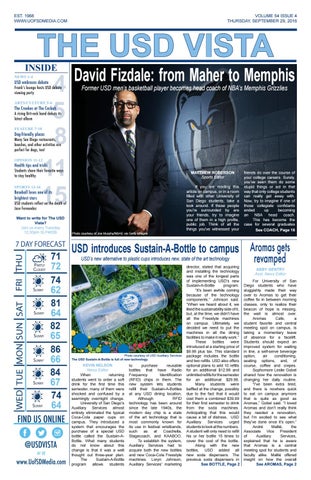
David Fizdale: from Maher to Memphis Former USD men’s basketball player becomes head coach of NBA’s Memphis Grizzlies
ARTS/CULTURE 5-6
The Crookes at The Casbah
A rising Brit-rock band debuts its latest album FEATURE 7-10
Dog-friendly places
Many San Diego restaurants, beaches, and other activities are perfect for dogs, too! OPINION 11-12
Health tips and tricks
Students share their favorite ways to stay healthy SPORTS 13-16
MATTHEW ROBERSON Sports Editor
Baseball loses one of its brightest stars
USD students reflect on the death of Jose Fernandez Want to write for The USD Vista? Join us every Tuesday 12:30pm SLP403B
Photo courtesy of Joe Murphy/NBAE via Getty Images
If you are reading this article on campus, or in a room filled with other University of San Diego students, take a look around. If these people you’re surrounded by are your friends, try to imagine one of them in a high profile, public job. Think of all the things you’ve witnessed your
friends do over the course of your college careers. Surely, you’ve seen them do some stupid things or act in that way that only college students can really get away with. Now, try to imagine if one of those collegiate confidants ended up becoming an NBA head coach. This has become the case for several graduates See COACH, Page 16
USD introduces Sustain-A-Bottle to campus Aromas gets USD’s new alternative to plastic cups introduces new, state of the art technology revamped
Photo courtesy of USD Auxiliary Services The USD Sustain-A-Bottle is full of new technology.
KEVIN NELSON News Editor When returning students went to order a soft drink for the first time this semester, many of them were shocked and confused by a seemingly overnight change. University of San Diego’s Auxiliary Services almost entirely eliminated the typical Coca-Cola paper cups on campus. They introduced a system that encourages the purchase of a special USD bottle called the Sustain-ABottle. What many students do not know about this change is that it was a well thought out three-year plan. The Sustain-A-Bottle program allows students
to purchase reusable bottles that have Radio Frequency Identification (RFID) chips in them. The new system lets students refill their Sustain-A-Bottles at any USD dining location. Although RFID technology has been around since the late 1940s, the modern day chip is a state of the art technology that is most commonly known for its use in festival wristbands, such as at Coachella, Stagecoach, and KAABOO. To establish the system, Auxiliary Services had to acquire both the new bottles and new Coca-Cola Freestyle machines. Loryn Johnson, Auxiliary Services’ marketing
director, stated that acquiring and installing the technology was one of the longest parts of implementing USD’s new Sustain-A-Bottle program. “It’s been awhile coming because of the technology components.” Johnson said. “When we heard about it, we liked the sustainability side of it, but, at the time, we didn’t have all the Freestyle machines on campus. Ultimately, we decided we need to put the machines in all the dining facilities to make it really work.” These bottles were introduced at a starting price of $9.99 plus tax. This standard package includes the bottle and two refills. USD also offers optional plans to add 10 refills for an additional $12.99 and unlimited refills for the semester for an additional $29.99. Many students were baffled at the change, possibly due to the fact that it would cost them a combined $39.99 for their first semester to drink from the soda machines. Anticipating that this would cause a bit of distress, USD Auxiliary Services urged students to look at the numbers. A student will only need to refill his or her bottle 15 times to cover the cost of the bottle. Along with the new bottles, USD added all new soda dispensers. The previous soda dispensers in See BOTTLE, Page 2
ABBY GENTRY Asst. News Editor For University of San Diego students who have sluggishly made their way over to Aromas to get their coffee fix in between morning classes, only to realize their beacon of hope is missing, the wait is almost over. Aromas Cafe, a student favorite and central meeting spot on campus, is taking a momentary leave of absence for a facelift. Students should expect an improved system for waiting in line, a self-serve beverage option, air conditioning, seating options, and, of course, coffee and crepes. Sophomore Leslie Gobel shared how the renovation is changing her daily routine. “I’ve been extra tired, and there is nowhere quick to eat on campus anymore that is quite as good as Aromas,” Gobel said. “I loved Aromas and don’t really think they needed a renovation, but I’m excited to see what they’ve done once it’s open.” André Mallié, the Associate Vice President of Auxiliary Services, explained that he is aware that Aromas is a central meeting spot for students and faculty alike. Mallié offered insight on how the overall See AROMAS, Page 2
2T
he
USD Vista
NEWS
September 29, 2016
NEWS
NEWS EDITOR KEVIN NELSON @knel17
Asst. NEWS EDITOR ABBY GENTRY
Something new is brewing in Aromas AROMAS continued from Front Page ambiance will be changing. “We want to create a very inviting environment for students so that people will want to stay there and have fun with their friends or study,” Mallié said. “We are doing this by creating seating zones, each offering different options and feelings. Some will have high tables to work on, and some will be relaxed and comfortable to stay and have a great cup of coffee or tea. Overall, we want the new seating arrangement to have more of a community focus.” To add to the cozy and creative vibe coming to Aromas, creative students will have the opportunity to hang their art in the more relaxed corners of the cafe. These areas will also be garnished with comfortable couches and carpet to kick back and relax in between classes. If that is not the experience you are looking for, there will still be plenty of tables to buckle down at and get some work done. Aromas will now offer high community tables so groups of students may convene for various group projects or study sessions. What many current students may not realize is that Aromas has historically taken on various personas. Starting as the central dining
hall, Aromas transformed to a dining room for faculty, then a dining room for campus presidents, and eventually into the coffee hub we now know. The new decor will be a nice revamp from the previous accumulation of leftover furnishings from the past. While ambiance is crucial to the success of a student hang out spot, the food and drinks being served are just as important. This is what keeps students coming back. Mallié shared a little about what to expect on the menu in the new and improved Aromas. “It is going to have a change of product,” Mallié said. “We will still have the anchors of coffee and cold drinks, but we want to bring in a lot more breakfast items, some different products, and new lines of drinks.” In addition to these new products, Aromas will offer a self-serve beverage option so students may avoid the line of students waiting for muffins and crepes. This self serve station will have iPads for students to select their drink of choice, pull down a lever, and wait for their drink to be dispensed. The iPads will also display information about the beverage for students to learn various information and facts about their coffee or tea and where it is coming from. Mallié shared how the new
innovative technology will alter students’ coffee experience. “If we think about the new beverage concept, it will be based off of what people are serving themselves and their own desires,” Mallié said. “There will be a system at the iPads where our intent is for the consumer to go over there, get the drink, and pay for it without having to go to the cash register.” Sophomore Goje Casey, a self-proclaimed coffee addict, shared her ideas on the concept of a self serve coffee machine. “I like this idea because Aromas was just so crazy, especially in between classes, so I would usually just avoid it,” Casey said. “Aromas had the best coffee on campus, it was the only place it wasn’t burnt, and it was a good middle place to meet, so I think this new system will help things move along.” Sophomore Faith Hale shared that the virtual coffee machine may change standard coffee shop behaviors. “I don’t like the idea of this,” Hale said. “We need to keep the face-to-face interaction; I like talking to people in line and asking the baristas for their recommendations. If we are focusing on the iPad, we are not paying attention to the people around us, and we are no longer making
Photo courtesy of University of San Diego USD’s favorite coffee hub is slated to reopen for students this November.
connections with people.” In an effort to help USD achieve its goal of being as sustainable as possible, Aromas’ redesign will allow students who choose to stay in-house the opportunity to sip on their coffee or tea from a reusable mug rather than waste another to-go cup. There is also a plan in the works to have a reusable cup system, similar to the new reusable Coca-Cola cup system on campus, for eventual discounts on coffee. Along with improving comfort and efficiency, there are some general maintenance elements that will be taken care of, including the much needed addition of air conditioning. Mallié discussed the remodel needed on the old, traditional building
connected to Maher Hall. “The last significant remodel of Aromas was twenty-nine years ago, so it is time to address certain elements of the building, such as electricity, plumbing, and ventilation,” Mallié said. “We are redoing the building to bring it back to current code, add new ceilings, redo the electricity, and add air conditioning to Aromas.” As the fall semester is officially in full swing, students will soon rely on their morning cup of coffee to get through the demands of the school day. Whether you are waiting for your favorite hangout or study spot to reopen, or just craving your daily crepe fix, have no fear because Aromas Cafe is anticipated to reopen this November.
USD Sustain-A-Bottle is ahead of the curve BOTTLE continued from Front Page the Student Life Pavilion held approximately eight drinks. Over the last year, USD has completely replaced its vending machines to include a Coca-Cola Freestyle system with over 140 possible flavor combinations. The new machines not only offer more sodas, but also contain over 70 flavored waters and low-calorie drinks. They also feature an enhanced water filtration system. A huge reason for the switch to this all new drink system was the idea of sustainability. The idea for the Sustain-A-Bottle program was developed solely by Auxiliary Services, but they have utilized USD’s Office of Sustainability to help promote the idea. Auxiliary Services said that it believes that the bottles may save hundreds of cups from going into the landfill. The new bottle is not the only new technology involved with USD’s beverage system. The dispensing machines themselves have
new technology that make their dispensing packages more sustainable than the previous dispensing systems. The previous system pumped water and carbonation through flavor bags that took up more space and were less efficient. The addition of the new system allows for USD to offer more beverage selections at a higher quality. USD Auxiliary Services confirmed that only students with required meal plans will be given a free bottle. This means that any freshman or sophomore living on campus this year will receive a bottle, as well as any junior or senior with a required meal plan. For the following years, Auxiliary Services explained that every USD student with a required meal plan will receive a free bottle, as long as they have not already received one in a previous year. Auxiliary Services stressed the importance of getting the bottles into the hands of students to establish the bottle as part of USD’s culture. “It was really important to get it into the hands of the first
year students,” Johnson said. “Because that way it becomes part of the culture, and they don’t know anything differently.” The three year development of this project was a lengthy process to plan. Auxiliary Services worked with Whirley drinks, Validfill, and Coca-Cola to develop the strategy. The company, who already has a connection with Coca-Cola, USD’s drink provider, worked with Auxiliary Services to make the transition as beneficial as possible. Auxiliary Services made sure that the bottles could stand up to the day-to-day activities of USD student life. They also had students test the bottles before the bottles were introduced on campus. USD Auxiliary Services mentioned that it has had several returns due to product malfunctions but has given replacements out to those that have brought them back. Senior Kevin Natenstedt bought the new Sustain-ABottle but questions the quality of the bottle. Despite his concerns, however, he thinks the program is a great idea. “The bottle itself doesn’t
seem to be of great quality,” Natenstedt said. “But I like the idea. I think there is a lot that can be done with the idea moving forward too.” One foreseeable problem of these bottles is that there is no link between the bottle and the student and many students are now carrying identical bottles. Unfortunately, USD does not currently have the technology to link the RFID chip to each student account. If a student loses the bottle or has it stolen, there is no way to trace it back to a student or have the refills transferred to a new bottle. USD Auxiliary Services does understand this flaw but has reported only one bottle being turned in after being lost. Currently, USD has sold or given out approximately 1,700 bottles on campus. Auxiliary Services estimated they would have about 2,500 bottles on campus by the end of this year if all students eligible to receive a free bottle picked one up. With an average incoming class of over 1,000 students per year, USD could have over 3,500
bottles on campus come next year, cutting down on its landfill impact significantly. Auxiliary Services is preparing its first major report to show students how sustainable the bottles are. When asked if USD would ever consider going back disposable cups, Johnson said she did not believe USD would ever move back in that direction. “I can’t see USD going back to disposable wear,” Johnson said. “If there is something else better down the road we might switch it up.” Despite the seeming confusion over the new system, as a campus community, USD has not changed how much it is consuming through the drink machines. The current technology USD has is state of the art, and the future possibilities for the school are not all known yet. With USD becoming one of the first West Coast schools with this technology, one thing is for certain, USD is again ahead of the curve when it comes to change, and everyone is watching to see the outcome.
Volume 54 Issue 4
NEWS
DON’T MISS OUT ON THE EVENT OF THE YEAR!
HOMECOMING & FAMILY WEEKEND
OCTOBER 7-9, 2016 FESTIVITIES INCLUDE BIG BLUE BASH CONCERT AND FESTIVAL TAILGATE PICNIC AND FOOTBALL GAME HOMECOMING AND FAMILY MASS CLASS AND AFFINITY REUNIONS, AND MORE!
REGISTER ONLINE AT SANDIEGO.EDU/HFW
The USD Vista
3
4T
he
USD Vista
September 29, 2016
NEWS
USD Votes hosts debate viewing and discussion USD students embrace the presidential debate from both sides of the aisle at debate viewing pizza party
JENNIFER GIVENS Asst. Feature Editor Students and faculty at the University of San Diego filled the Hahn University Center’s Frank’s Lounge and Forum B as they anxiously awaited the historic first presidential debate of 2016. The rooms were at capacity as the USD community watched Republican nominee Donald Trump and Democratic nominee Hillary Clinton debate. Students and faculty were sitting on the floor and standing around the perimeter of the room in anticipation of the event. USD Votes, an organization on campus that educates and encourages students to get registered and involved in this year’s election, hosted the event. USD Votes was established last semester by students and spearheaded by Casey Dominguez, an associate professor in the political science department. The hosts provided pizza for students to enjoy as they watched the debate and had a table setup for students to register to vote. They also provided more information about the voting process. As students settled in their seats, many chatted among themselves about what they expected to hear and see. Junior Scott Develle expressed the topics he was hoping the candidates would debate. “I want to hear their stance on [...] immigration, abortion, and gay marriage,” Develle said. “I anticipate a lot of banter because there’s a lot of friction between the two candidates.” Sophomore Ashley Brown said she was attending the event because of its historical significance. “It is a pretty big moment in history,” Brown said. “It’s getting really heated and interesting. I just want to keep up with what’s going on and don’t want to be out of the loop.” Sophomore Emilio Romero explained his neutral stance on viewing the debate. “I am currently undecided at the moment, and I’m coming here with an open mind,” Romero said. “I am looking for multiple things a candidate will say that I can agree with. I hope to see a candidate that I can see being the
THE USD VISTA Editorial – 619.260.4584 Business – 619.260.4714 www.uofsdmedia.com @USDVista
future leader of our country.” Junior Tamar Tellado expressed that she wanted to get more involved with politics. “I feel like I have not been really engaged in the election lately or politics in general,” Tellado said. “I feel like this would be a good place to start. I’m looking for anything to tip me one way or the other because I really have no idea how I am going to vote in this election.” Senior Lauren Delfin said she is watching the debate because of her appreciation for politics. “Politics is something that really interests me, and I feel like it is really important for people to get involved in,” Delfin said. “I don’t really know what to expect, but I hope to get a better understanding of their platforms. But I’m not quite sure what it will look like for each of the candidates to be president. I’m not too sure who I want to vote for, but I have an idea of who I do not want to vote for.” As the debate unfolded, students were enthralled in the political rhetoric. Some whispered to their friends, others booed and cheered as candidates exchanged jabs and established their stance on issues. Overall, students remained invested in what the candidates were saying. After the debate students weighed in with their opinions of how the debate went. As a prospective political science student, freshman Zion Lashua expressed that the debate had its highs and lows. “A lot of it was about emails, bankruptcy, business models,” Lashua said. “And a lot of the time, candidates didn’t discuss the issues and got off topic of the questions that were actually asked, as well as putting down the other candidate and elevating themselves. There were some points where there was civil discussion, and I really enjoyed that, but I look forward to hearing what they say in other debates.” Sophomore Megan McDonald stated that she had mixed feelings about the debate. “I think the most interesting part of the debate, in terms of what I think the media will be in favor and not in favor of Trump and Clinton, [is]
Brooklyn Dippo- Editor in Chief Matlyuba Nurova - Finance Director Sarah Brewington - Associate Editor Diego Luna - Managing Editor Gianna Caravetta - Copy Editor Nora Brewington - Art Director Kevin Nelson - News Editor Abby Gentry - Asst. News Editor Dani Devries - Opinion Editor
Jennifer Givens/The USD Vista USD students and faculty gather to watch the first presidential debate between Trump and Clinton.
specifically the race debate,” McDonald said. “It seemed to me a lot throughout the debate [that] Trump, as much as he was saying he [supports] police, and he was saying law and order, I think the biggest soundbite the media will pick up is the ‘stop-and-frisk.’ Clinton was right: it was ruled unconstitutional. So I think that is going to be up for a lot of debate through the media. I think when it came to jobs, Trump is going to be seen in the limelight. He hit it hard more confidently than Clinton did. I didn’t really see there was a clear [consensus] of who would be more prepared. There didn’t seem to be a clear feeling in the room [of] ‘This is who we are going to pick, and we feel good about it.’” Senior Marguerite Lehman seemed satisfied with the debate and the candidates’ demeanour. “The debate went better than I thought it would be,” Lehman said. “Both candidates presented more prepared versions of themselves. It was more substantive than I was expecting. I don’t think I learned anything too substantive with their policies but [with] their character.” When the debate ended, many students stayed behind to discuss the debate with friends. Others participated in
a question and answer with USD professor Mary Brinson, who teaches a course in political communication, and Dominguez, who helped host the event. Brinson observed that many students had varying perceptions after watching the same event take place. “People that are already identifying with one side, are likely to engage in selective perception, they are going to see/hear what they want to see/hear. From the undecided students that spoke out tonight, one stated that she thought they were both liars, while another said they both showed their best sides. In general, debates are not going to change anyone’s mind, but they can move undecided voters in one direction or another,” It is unclear which direction the voters will be swayed after the first debate because there was not a unanimous consensus on who won. Some contributors on CNN and FOX News, such as David Gergen, Errol Louis, Frida Ghitis, Bernard Goldberg, Ben Shapiro, and Bill Kristol agreed Clinton won the debate. They attribute Clinton’s win to carefully crafted arguments and facts, even stating that some of her remarks were damaging toward Trump’s
Kelly Kennedy - Feature Editor Jennifer Givens - Asst. Feature Editor Walker Chuppe - Arts & Culture Editor Matthew Roberson - Sports Editor Dray Wilson - Photography Editor James Jackson - Distribution Manager Gina Lew - Student Media Advisor Marie Minnick - Operations Advisor
campaign. Ghitis explained that she believed that Clinton had the upper hand at the debate, especially when she drew attention to Trump’s desire to arm countries with nuclear weapons. Other contributors such as Timothy Stanley, and Michael Hirsh, who weighed in on CNN and FOX, agree that Trump stumbled in some areas but think he ultimately ended victorious. Stanley said he believed that Trump took the victory because he seemed to understand the format of the debate. Dominguez echoed some students’ reactions, explaining that the debate covered substantial topics. “I was afraid there wouldn’t be any substance to it, so I was pleasantly surprised at how much substance there was,” Dominguez said. “It is up to individual voters to figure out whether they were comfortable by what they saw or their predispositions were confirmed. The few who were here seemed to say they haven’t changed their minds by what they were watching.” It is clear that students on campus are interested in this year’s election. Programs like USD Votes are working diligently to inform students about the candidates and future political events on campus.
The USD Vista publication is written and edited by USD students and funded by revenues generated by advertising and a student fee. Advertising material published is for information purposes only and is not to be construed as an expressed or implied endorsement or verification of such commercial venues by the staff or University. The USD Vista office is located on the fourth floor of the Student Life Pavilion in room 403B. All inquiries should be sent to: The USD Vista 5998 Alcala Park San Diego, CA 92110 The first copies of the newspaper are complimentary, all copies thereafter are a 25 cents charge. Opinions expressed in this publication are not necessarily those of The USD Vista staff, the University of San Diego or of its student body. Letters to the Editor can be submitted to The USD Vista office. Letters should be limited to 300 words and must be signed. For identification purposes, USD identification numbers and writer’s year must be included in the letter. The USD Vista reserves the right to edit published letters. Any content sent to the editor will be considered for publication unless otherwise stated.
The USD Vista
ARTS AND CULTURE
Volume 54 Issue 4
ARTS & CULTURE
A&C EDITOR WALKER CHUPPE
5
@lord.walker
The Crookes at The Casbah WALKER CHUPPE Arts and Culture Editor @lord.walker
The Crookes are a fourpiece indie rock band from Sheffield, England, and are touring following their latest album release, Lucky Ones. Known for their melodic riffing and upbeat anthems, it was fitting that the band came to play at one of the most iconic rock clubs in San Diego, The Casbah. The Casbah has hosted bands like The Smashing Pumpkins, MGMT, Blink-182, and The White Stripes. Although The Crookes are not quite at that level of stardom yet, playing a show at The Casbah is a noteworthy milestone. Located at the intersection of Kettner and Laurel, the venue is actually quite unassuming from the outside. At night, you can hear muffled guitar melodies and the kick drum’s thud through the club’s black walls. The Casbah is actually quite small: its maximum capacity is around 200 people or so. Though it is not as large as some of the other famous venues in San Diego, what it lacks in size, it makes up for in atmosphere. The Casbah immediately feels underground and exclusive, and it exudes prestige, perhaps in homage to the many famous acts who have graced the stage.
The doors opened at 8:30 p.m., which is fairly late compared to most shows around San Diego. The opening bands did not go on until 9 p.m. The Crookes did not start their set until around 11 p.m. As soon as The Crookes took the stage, the vibe inside the venue immediately changed. The crowd perked up, people walked away from the bar and onto the dance floor, and waited with anticipation while the bandmates tuned their instruments. The set kicked off with the lead singer, George Waite, establishing himself as a showman from the get-go. His nonstop head bobbing and enthusiastic dancing pumped up the crowd, and it was emblematic of their rhythmic, fast-paced music. The Crookes wasted no time in getting the audience to dance, with their opening few songs featuring up-tempo melodies that had everyone swaying their shoulders at the very least. The band was professional. Whereas some bands sound entirely different from their studio albums, The Crookes sounded just like their recordings, if not better. There were no hiccups, the bandmates all played flawlessly, and, most importantly, Waite is an excellent singer, even after touring for weeks on end. The sound quality from The Casbah also deserves honorable mention, and the
Walker Chuppe/The USD Vista The Crookes, on tour in support of their new album, Lucky Ones, played at the legendary Casbah.
sound engineer did a great job with the overall mix and levels. The volume was not overly loud, and all the instruments and vocals came through crisply from the stage. The Crookes’ set was composed of a medley of songs from across their albums. Most of them were upbeat and designed for dancing, but a few slower, more introspective songs were thrown into the mix as well. It seemed that the audience enjoyed the contrast between fast and slow because, after a slow song, the next up-tempo one garnered an exuberant reaction from the crowd. The Crookes saved their three most popular songs for the end of the show,
playing “Backstreet Lovers,” “Afterglow,” and “I Wanna Waste My Time on You.” Their new single, “I Wanna Waste My Time on You,” from their latest album, Lucky Ones, may have been the highlight of the night. The catchiness of the chorus had the crowd singing in unison with Waite leading the melodies. Junior Cyrus Lange explained that he thought that The Crookes put on an amazing show. “The show had great energy–even the opening bands who have probably heard [The Crookes] set 20 times were getting into it,” Lange said. “Combine that with The Crookes’ easygoing style and infectious sound,
and you’ve got a decent idea of how great they were live.” The set ended on a rather humorous note, with Waite asking the audience members if anybody had an available place for the band to sleep. The band explained that they had spent all their money coming to America and did not have a place to stay after the show. Although their songs have hundreds of thousands of plays on Spotify, and they put on a killer show, it appears that The Crookes have not exactly hit the big time as of yet. The Crookes are certainly an up-and-coming band to look out for, but until they hit Coachella’s main stage and have a luxury tour bus, couchsurfing will have to do.
“Sully” soars to box office success BROOKLYN DIPPO Editor in Chief
“Sully” is the movie that Captain Chesley Sullenberger deserves for his quick thinking and precise actions that saved the lives of 155 people on US Airways Flight 1549. The movie, starring Tom Hanks, is based on the emergency landing of a passenger airline in the Hudson River on Jan. 15, 2009, after a flock of geese took out both engines immediately after take-off from LaGuardia airport. Despite knowing the outcome, which has been hailed as the most successful water landing in aviation history, the audience was tense through the entire cinematic reenactment. The film jumped back and forth between Jan. 15 and the investigation that followed. “Sully” highlights the heavy questioning and
criticism that Sullenberger and his co-pilot, Jeffrey Skiles, endured from the National Transportation Safety Board (NTSB). While all of the passengers miraculously survived, the NTSB was fixated on the results of flight simulations that suggested the pilots could have landed the plane back at either the LaGuardia or Teterboro airport. Tom Hanks delivered in “Sully”, his most recent portrayal of an American hero following a string of similar roles. Hanks also appeared as James B. Donovan in Bridge of Spies, Walt Disney in Saving Mr. Banks, and Richard Phillips in Captain Phillips. The meticulous care he puts into accurately representing each real-life personality behind the script really shows on screen. The cinematography was successful in evoking the heavy emotions of a pilot after narrowly avoiding a crash. The
dim lighting and silence that pervaded the scenes in which Hanks is alone captured the endless thought processing of Captain Sullenberger. Often they were edited next to scenes of Sully running by himself in the winter cold, trying to clear his mind. The computer-generated effects of the plane ditching were utterly realistic, perfectly capturing the contrast between a cold New York day and the force of an Airbus disturbing the glassed-over Hudson River. Supporting actors also contributed to the suspension of disbelief. Laura Linney balanced the shock and concern in her performance as the wife of Captain Sullenberger. Her delayed realization that Sully could have died if the waterlanding wasn’t successful resulted in one of the most genuine scenes in the film. The minor storylines played
Photo courtesy of Warner Bros/Amazon “Sully” is the gripping tale of Captain Sullenberger’s Hudson landing.
out by passengers on board added nearly as much stress to the crash scene as the reaction shots of New York businessmen staring out the window, unsure if this was a crash or another attack on America’s most populated city. Overall, the movie offers a gripping retelling of Flight
1549, and the 96-minute runtime leaves the audience emotionally exhausted from the drama. The end of the film offers a sigh of relief before footage rolls of the real Captain Chesley Sullenberger, a reward to the audience who just experienced the Miracle on the Hudson.
6 The USD Vista
September 29, 2016
ARTS AND CULTURE
A pristine Greece goes beyond the Google photograph TAYLER RV Staff Writer Scenic image searches on Google only encompass a small portion of what Santorini, Greece, is actually like. Santorini is home to unique landscapes of picturesque cliffs and beaches, and it is actually quite different from what I had pictured before visiting. I was surprised to find that the island does not only consist of the pretty blue and white houses that we often see online. The beautiful white and light-toned homes on the hillsides of Greece that we see in a Google image search are actually sparsely dispersed throughout the island. My impression from Google was that the island was completely covered in these exotic-looking homes. However, the island seemed to be mostly desert terrain and looked extremely dry with only a few of these types of homes scattered across the island. The trek down to our little house contained the most remarkable view. We overlooked a majority of the island as it wrapped around in an almost complete circle
in the Aegean Sea. The home we stayed at was at the very bottom of the hill. When we looked up, there was an entire cliff side filled with unique houses in various light tones and bright, exotic doors. It felt strange to be a part of that picturesque moment, a moment that many seem to obsess over on social media or dream to visit one day. It was very odd to be physically present on such a beautiful island—no longer a fantasy but a reality. I found myself in the middle of all the Instagram photos, and it was quite a surreal experience. Our days consisted of relaxing and tanning while looking out at the island, exploring the town of Oia, swimming in the clear blue ocean of Perissa Beach, and eating authentic Greek dishes such as gyros and chicken souvlaki. USD junior Maaron Tesfaye is Greek Orthodox. She explained that she enjoyed her time experiencing the Greek lifestyle. “I loved the sightseeing, the food, and the opportunity to immerse myself in the culture,” Tesfaye said. “My friends and I lived by the
beach that had the clearest water and black rocky sand, which was not as soft, but [it was] still really pretty. I even faced my fear of cliff jumping.” Many of the places we visited in Santorini epitomized the quintessential picture of Greece that would pop up on a Google search. However, as with many places, the beautiful, scenic spots are scattered between some lessthan picturesque locations. Santorini had its fair share of shabby buildings covered in graffiti, but nothing compared to the battered city of Athens. I was shocked to see how many dilapidated buildings populated Athens. Some of the buildings were in such bad shape that they looked as if they were going to fall over. Tesfaye was also surprised by the many impoverished parts of the city. “I was aware of the bad economic state of Greece; however, when I was in Athens, I realized just how underdeveloped some parts of the city are,” Tesfaye said. “It caught me off guard. I wasn’t expecting the buildings filled with graffiti. I even watched someone graffiti a glass window in broad daylight
Tayler RV/The USD Vista
Santorini, Greece is famous for the unique coastal houses.
without getting caught. There seemed to rarely be any police force of some kind, and the city seemed very unstructured.” Many visualize Greece as the place with hillsides filled with unique-looking blue and white buildings. Those who imagine the country as so may not realize the harsh realities of living in Greece after the country experienced severe economic disparities and hardship upon entering the European Union. It seems that the government is more
interested in preserving the backdrops for pristine photo albums than cleaning up its own communities. Every city has another side of the Google image you don’t see. Every beautiful story comes with a darker, less exciting side. For every picturesque tourist hot spot, there was a larger area of Greece that could have used improvement. Experiencing these places firsthand, opens your perspective to the reality behind the picture.
Fall 2016 Semester
TRANSIT PASS
EXCLUSIVE STUDENT DISCOUNT
with unlimited rides all semester long Tayler RV/The USD Vista In Santorini, there are amazing views overlooking the many cliffs and bluffs.
$154*
ON SALE UNTIL OCT 14
at the University Center Ticket Office *Price includes a $15 university subsidy
Tayler RV/The USD Vista
The Greek coast is lined with beautiful homes and scenery.
Visit sdmts.com/college for more details. Current, valid college student picture ID required. No replacements for lost, voided or stolen stickers.
VOLUME 54 ISSUE 4
FEATURE
THE USD VISTA
FEATURE
FEATURE EDITOR KELLY KENNEDY
7
ASST. FEATURE EDITOR JENNIFER GIVENS
Avoiding plagiarism like the plague Students work to ensure that their writing is authentic and meets academic standards
JENNIFER GIVENS Asst. Feature Editor Plagiarism is not something anyone wants to get caught doing— just ask Melania Trump. While Mrs. Trump was not expelled from school for plagiarizing parts of First Lady Michelle Obama’s speech, she was publicly humiliated by the media and criticized on almost every social media outlet. Plagiarism has different implications for students at the University of San Diego. Before starting at USD, every student has to read and sign an Academic Integrity Policy (AIP). In the most recent AIP section 4.8, I, subpart d discusses academic dishonesty and plagiarism. The AIP explains to students the potential consequences of plagiarism. For example, a student could face expulsion, suspension for up to one year, letter of censure, a requirement to complete extra academic classes to graduate, probation as deemed fit by the hearing committee, or failure of class. What students may not know is the varying types of plagiarism. According to unplag.com, a plagiarism detection engine, there are varying types of plagiarism. Direct plagiarism is the word-for-word transcription of a section of someone else’s work, without attribution and without quotation marks. This is the most severely punished kind, which, according to USD’s AIP, will result in a failure of the class and possible expulsion of the school upon meeting with the Hearing Committee. The hearing committee consists of five members, the dean, a professor from the department in which the plagiarism is alleged to take place, two students who are also from the department, and a professor from and outside the department. Self-plagiarism occurs
when a student submits his or her own previous work, or mixes parts of previous works, without permission from all professors involved. Mosaic plagiarism is the borrowing of phrases from a source without using quotation marks. This can also occur when someone finds synonyms for the author’s language, while keeping to the same general structure and meaning of the original. This can be construed as paraphrasing; a way to avoid it is to rearrange ideas and sentence structure. Accidental plagiarism occurs when a person neglects to cite sources or misquotes her or his sources, or unintentionally paraphrases a source by using similar words, groups of words, and/or sentence structure without attribution. A senior communication studies major at USD explained that plagiarism can be difficult to discern. She chose to remain anonymous because she was found guilty of plagiarism. “It can be hard to juggle each professor’s preference for citation use and how assignments are to be turned in,” she said. The student explained that there was confusion over the use of a plagiarism checking site that did not recognize her citations. “Professors should be more specific when informing students what type of citation is necessary,” she said. “It’s not fair that most teachers want a hard copy, while other professors use plagiarism check websites, such as Turnitin, then students have to figure out how to use the site to turn in assignments. If there is so much discrepancy, then there needs to be consistency.” Common issues may arise when students have to balance each professor’s citation preference and how assignments are to be submitted. Citation preferences
change depending on the discipline. Communication studies, psychology, and many social sciences use American Psychological Association (APA) style, whereas English and foreign language studies tend to use Modern Language Association (MLA) style. A study conducted by the PEW Research Center suggests that plagiarism is on the rise. “Most college presidents (55%) say that plagiarism in students’ papers has increased over the past 10 years,” the study said. “Among those who have seen an increase in plagiarism, 89% say computers and the internet have played a major role.” Abraham Stoll, chair and professor of English at USD, claims the reason students struggle with plagiarism is not necessarily issues regarding citation style but sloppy thinking and research. “It can happen that people accidently or insufficiently cite something, and that’s where students need to be very careful how they are handling ideas,” Stoll said. “But, more often, [plagiarism] comes about because somebody is genuinely just trying to take a shortcut and that’s not a style issue.” Stoll explained ways the English department is trying to prevent students from committing plagiarism. “Essentially, one of the main things we are working with students to do is to develop a more disciplined approach to their ideas, to not be sloppy thinkers, to take an idea and really work on the idea,” Stoll said. “Don’t just phrase it once and be done with it, but [...] keep thinking about it, keep thinking about how this particular idea you are working with can develop. And people end up making those plagiarism mistakes— accidental plagiarism—way more often when they are
Changefunding
being sloppy with their ideas.” Stoll explained that he does not put as much weight on their citations as the content. “Fundamentally, it is the ideas and what you’re doing with those ideas and how you talk about them,” Stoll said. “And plagiarism comes in when people are sloppy with their ideas or when people are taking shortcuts with their ideas, when they are not doing the real work of writing a paper. So I think it’s a red herring to say that we should try to understand plagiarism through the lens of people being taught or know how to consult a manual of how-to-do style. Sure, that’s an issue, but a very small one. The much bigger issue is what are your study habits? How much time did you give to write the paper?” With the increase in technology and the abundance of sources now available online, students may find themselves in information overload. This increase in accessibility of sources has affected some students’ ability to determine what is an original idea and what has been influenced by research. Senior Talia Malley, reiterated the difficulty to discern unconscious paraphrasing and plagiarism. “My process for writing research papers, or papers in general, if I want to rephrase an entire paragraph, then I go through it sentence by
sentence rephrasing it. But if I feel like it is too close to the original text still, then I will cite it,” Malley said. “There’s no harm in excessive citing on a paper; I would rather be more careful than have the issue of plagiarism.” If students are still confused on how to cite texts or the proper way to paraphrase, asking the professor is the first step. The Writing Center is also a great resource. It is located in Founders Hall room 190B. Senior Joey Markus, a tutor at the Writing Center for the last three semesters, explained that there are reliable resources that students can use to ensure their citations are accurate and comply with professor’s preferences. “[Writing center tutors] are not indefinitely educated on [citation formats],” Markus said. “We know MLA because we have a lot of English majors in the writing center. APA and Chicago, we are not super versed on. We refer our tutees to the library for reference or Purdue Owl, which is super helpful because it provides examples.” While midterms loom in the distance, students should remember to allot time for proper citation. Plagiarism is taken very seriously at USD and the public humiliation that political figures recieve would probably be preferable to the consequences that students can face for the same offense.
Photo courtesy of Flickr/jeffrey james pacres Plagiarism is a preventable problem.
student
projects
Office of Annual Giving pilots on-campus crowdfunding website for student projects
KELLY KENNEDY Feature Editor A new initiative reached the University of San Diego this fall, which hopes to facilitate a new process for donor gift giving. Annual Giving is an on campus office that provides students, alumni, and other benefactors the opportunity to contribute financially to campus needs. There are many options for those who want to make a donation to
different organizations and departments on campus. Recently, Annual Giving debuted a new opportunity to give called Changefunding, which allows donors to contribute to student projects. University affiliates, including clubs, organizations, sports teams, and departments, can apply to have their projects featured on the Changefunding website to raise funds that they might not have been
able
to access before. Jessie Szumzki is the Assistant Director of Annual Giving. Szumzki described the new program as a vehicle for students to expand their opportunities through fundraising. “Changefunding gives students the opportunity to fund projects that might not otherwise be funded by the university, such as something not covered in tuition and fees,” Szumski said. “This
opportunity bridges the gap between what the university can afford and what the organizations want to do.” Szumzki explained that Annual Giving created the new initiative to allow students to use a crowdfunding platform without the fees associated on other websites. “Offering Changefunding keeps other websites from skimming off the top so that students can have the opportunity to get more funding
for their projects,” Szumzki said. In its most remedial sense, Changefunding is for donors to pick and choose where to put their money. USD students post their projects, go through the necessary channels to get it approved, then appeal to their network of potential donors for funding. First, a student, group of students, or organization develop an idea for a project. There are three aspects of See FUNDING, Page 10
8T
he
FEATURE
USD Vista
September 29, 2016
Torero Talent Job and Internship Fair Career Development strives to include all majors in programming
KELLY KENNEDY Feature Editor As students settle into the semester at the University of San Diego, the question of summer plans begin to creep up again, like an assignment that is never quite finished. The newly revamped Career Development Center (CDev) has given many students the opportunity to plan for the future and find opportunities related to their fields of study. Last week, CDev hosted the Torero Talent Job and Internship Fair, which advertised more than 100 employers seeking USD students to fill positions in their companies. Many students attend such events each semester, and CDev works diligently to appeal to students
of all majors across campus. Niki Barrios, Career Events Coordinator at CDev, explained that all USD job and internship fairs try to balance the companies represented. “All of our fairs limit the number of companies who can come from specific industries to make sure that there are many opportunities,” Barrios said. “There are different Torero Treks for different majors and individual programs put on by counselors that advise specific groups.” There are 11 career counselors employed by CDev, including those who specialize in assisting science, technology, engineering, and math majors, international and graduate students, business and College of
Arts and Sciences majors, and engineering students. CDev reported that 385 students attended this semester’s job and internship fair, a 21 percent increase from last fall’s fair. 72 employers were present to meet student attendees. According to U.S. News and World Report (U.S. News) rankings, USD’s most popular majors of 2015 include business management, marketing and related support services, social sciences, biological and biomedical sciences and psychology. 43 percent of 2015 graduates hold degrees in business, management, and marketing and related support services, while only 11 percent of recent graduates hold degrees in social sciences. USD has a large and reputable business school that attracts many students seeking business-related opportunities upon graduation. According to USD’s Career Outcomes website, about 40 percent of 20142015 graduates are employed full-time in a businessrelated industry: 15 percent in marketing, sales, and consumer products, 13 percent in finance and banking, and 12 percent in accounting/auditing. 68 percent of these graduates participated in an internship during their time at USD. Junior Mallory Banner works for CDev as a Marketing Ambassaros, and enjoys learning more
about career development and helping students. “I love working at CDev because I get to help put on and market the events that connect students to their future jobs,” Banner said. While many students look forward to the job and internship fairs hosted by CDev, others feel that their majors are not always well represented. Senior Claire Flynn is finishing her degree in environmental studies with a minor in sociology. Flynn expressed that she did not attend the career fair due to her disappointment with previous program offerings related to her major. “It makes sense why the career fair is businesscentered, but it doesn’t make sense why it feels like it’s only directed toward the business majors,” Flynn said. “It’s frustrating to be in the College of Arts and Sciences and getting a liberal arts degree but to not have similar networking experiences and opportunities. It seems like the jobs that offer on-campus interviews, Target, FactSet, Geico, and Adobe, are looking for business, finance, and other analytic majors.” According to the CDev’s website, only five companies at this semester’s job and internship fair were looking for students like Flynn, who are studying environmental studies or sociology. All of these San Diego companies were open to all majors. One company listed, Cali Bamboo,
is seeking sales and account representatives, while another listing for the San Ysidro Health Center is looking to hire those with experience in the medical field or information technology. Alana Hollenbaugh, a senior studying English, creative writing, and theology, planned to attend last week’s Torero Talent event but decided against it. “I looked up online what companies were going to be there, and only two were interested in hiring an English major,” Hollenbaugh said. “The County of San Diego and the YMCA were both open to any major, but I didn’t feel like it was worth my time to go to the fair if there weren’t any companies who would be interested in my skills.” CDev has scheduled many events over the duration of the semester that include most majors. There are a variety of Torero Treks, resume and interview workshops, and other events that CDev offers for a variety of majors. According to its website, in the past year, CDev has held 1,818 individual career counseling sessions and supported 52 summer internships with $2,000 each. While some students may not feel represented by CDev, others feel that their resources produce great results for a variety of students. It is clear that the Career Development Center works hard to provide opportunities to students all over campus, and it will continue to do so as they expand.
Upcoming CDev Programming: USD Engineering Career Fair Tuesday, October 4 // 1 p.m. - 4 p.m. Hahn University Center, AB Careers in English Presentation Thursday, October 6 // 12:30 p.m. - 1:30 p.m. Mother Rosalie Hill Hall, 211 Graduate School Fair Tuesday, October 11 // 11:30 p.m. - 2 p.m. Hahn University Denter, Forums FBI Information Session Thursday, October 13 // 12:30 p.m. - 2 p.m. Joan B. Kroc Institute for Peace and Justice, Room B Majors and Minors Fair Tuesday, November 1 // 12:30 p.m. - 2 p.m. Hahn University Center, Forum C Peace Corps Informational Thursday, November 10 // 12:30 p.m. to 2 p.m. Serra Hall, 215 Photos courtesy of CDev Attendees mingled with over 70 employers at Torero Talent.
Veteran Student Career Panel Wednesday, November 20 // 5:30 p.m. - 7:30 p.m. Degheri Alumni Center, 112/113
FEATURE
Volume 54 Issue 4
The USD Vista
9
Dog-friendly places nts a r u a st
Re
AleSmith Brewing Company 9990 AleSmith Ct San Diego, CA 92126 (858) 549-9888
Dog owners: If you are looking for a places in San Diego that are dog
friendly, look no further. According to bringfido.com, a website that connects dog owners with dog-friendly places and things to do in and around San Diego, there are 194 dog-friendly restaurants that provide outdoor tables for your furry friend. Here is a list of a few near USD.
Fig Tree Cafe 5119 Cass St Pacific Beach, CA 92109 (858) 274-2233
Quartyard 1102 Market St San Diego, CA, US 92101 (619) 432-5303
Amplified 4150 Mission Blvd #208 Pacific Beach, CA 92109 (858) 270-5222
In-N-Out Burger 2910 Damon Ave Pacific Beach, CA 92109 (800) 786-1000
Rockin Baja Coastal Cantina 3890 Twiggs St San Diego, CA 92110 (619) 234-6333
Azucar 4820 Newport Ave Ocean Beach, CA 92107 (619) 523-2020
OB Noodle House 2218 Cable St San Diego, CA 92107 (619) 450-6868
Shades Oceanfront Bistro 5083 Santa Monica Ave San Diego, CA 92107 (619) 222-0501
Oscars Mexican Seafood 746 Emerald St Pacific Beach, CA 92109 (858) 412-4009
Station Tavern & Burgers 2204 Fern St San Diego, CA 92104 (619) 255-0657
Pacific Beach Fish Shop 1775 Garnet Ave Corner of Garnet & Kendall San Diego, CA 92109 (858) 483-1008
The Dog 4479 Everts St Pacific Beach, CA 92109 (858) 581-0149
Baja Betty's 1421 University Ave San Diego, CA 92103 (619) 269-8510 Day Break 2296 Bacon St Ocean Beach, CA 92107 (610) 222-0406 Duck Dive 4650 Mission Blvd Pacific Beach, CA 92109 (858) 273-3825 Extraordinary Desserts Little Italy 1430 Union St San Diego, CA 92101 (619) 294-7001 Fred's Mexican Cafe 2470 San Diego Ave San Diego, CA 92110 (619) 858-8226
Phil’s BBQ 3750 Sports Arena Blvd San Diego, CA 92110 (619) 234-6333 Pho Sao Bien 1958 Garnet Ave Pacific Beach, CA 92109 (858) 272-9612 Pier Cafe 885 W Harbor Dr San Diego, CA 92101 (619) 239-3968
The Local PB 809 Thomas Ave Pacific Beach, CA 92109 (858) 263-7475 The Patio on Lamont Street 4445 Lamont St San Diego, CA 92109 (858) 412-4648 Tower Two 5083 Santa Monica Ave Ocean Beach, CA 92107 (619) 223-4059
Other activities Aqua Adventures Kayaks & Paddleboards 1548 Quivira Way San Diego, CA, US 92109 (619) 523-9577 East Village Square 855 J St San Diego, CA, US 92101 Howlistic 930 W Washington St San Diego, CA, US 92103 (619) 255-7317 Pet Zone Tropical Fish 4266 University Ave San Diego, CA, US 92105 (619) 283-1812 Societe Brewing Company 8262 Clairemont Mesa Blvd San Diego, CA, US 92111 (858) 598-5409 Spanish Village Art Center 1770 Village Pl San Diego, CA, US 92101 (619) 233-9050 SUP Pups Stand Up Paddle Board Tour & Playtime 2592 Laning Rd San Diego, CA, US 92106 (619) 365-4225
Beaches Cabrillo Tide Pools Trail 1800 Cabrillo Memorial Dr San Diego, CA 92106 Fiesta Island Off Leash Dog Park 1590 E Mission Bay Dr San Diego, CA 92123 The Original Dog Beach 5156 W Point Loma Blvd San Diego, CA 92107 Copy by Jennifer Givens/The USD Vista Spread by Nora Brewington/The USD Vista Brooklyn Dippo/The USD Vista and Kelly Kennedy/The USD Vista
10
THE USD VISTA FUNDING continued from Page 7 the application to consider for those applying for a Changefunding campaign: a viable project with goals that fit the core values of USD, an appropriate target fundraising amount, and an existing network to appeal to for funding. The target fundraising amount is an important part of the Changefunding application. The Changefunding website indicates that projects should have a fundraising goal between $1,500 and $20,000. “While there are goal parameters, we’re not going to turn away a very good project if their goal is under $1,500,” Szumzki said. In addition to fundraising parameters and project goals, an existing network is vital to the success of a Changefunding project. Project leaders need to have an existing network to push their message to. For any students or organizations hoping to get funding through this new platform, they could potentially be waiting six to eight weeks or longer to reap the benefits of the process. After completing the application, it can take up to two weeks to complete the vetting process. Then, it takes an additional two to four weeks for project leaders to learn the software associated with the fundraising platform and develop collateral materials, such as images, videos, or models. While it takes potentially over a month to get a project properly advertised on the Changefunding site, it could take longer for a donor to actually endorse it. The vetting process
is primarily handled by the Changefunding Campaign Committee, and also includes the approval of the department that a proposed project is related to. “A lot of the vetting process will be through the department of [the] school through which the project will run through,” Szumzki said. “Right now, it’s staff and a lot of people working together [to vet projects]. Eventually, we want to expand and have more of a committee.” The Changefunding Campaign Committee does not currently include students or faculty from a related department or organization. Szumzki also explained that there are two branches of the Changefunding initiative. “Athletics will have their own site, and then there is also a separate site for anything non-athletic, with their own vetting process,” Szumzki said. Joan Garcia, Assistant Director of Athletics for Development, shed more light on the Athletic’s specific portion of Changefunding. “We learned from other Universities that were implementing specific crowdfunding projects for their athletics programs and how successful they were in engaging their constituents,” Fink said. “We felt it would be a positive and exciting tool for our student athletes and coaches to get creative and use the new technologies to fund raise for their goals. Furthermore, we believe it will help to increase the University’s participation rate, a key component in Universities’ rankings which raises the value of a USD’s
FEATURE degree and helps USD Athletics in the recruitment process of top athletes.” The vetting process for Athletics projects will match that of other projects submitted. Though Changefunding applications are open to all university affiliates, the program does not include individual Greek organizations looking to fundraise. Senior Director of Giving, Philip Garland, explained that Changefunding aims to redirect fundraising back onto campus to benefit the school, not outside organizations. “Changefunding does not include fraternities and sororities individually but could be for something that benefits all of Greek life,” Garland said. “It is also not for a fraternity or sorority raising
money for another outlet or for a non-USD organization.” This stipulation is understandable, but it also eliminates a large group of organizations comprised of students known for their fundraising network on campus. Some student leaders who read the stipulations of the Changefunding were concerned about the fundraising goal parameters and time frame required for a campaign. Junior Emma Moran, a co-president of PRIDE, noted that her organization and many others already receive funding from Associated Students. “Associated Students funds most of our events, including our largest event, the drag show.” Moran said. Each year, Associated
SEPTEMBER 29, 2016
Students offers $20,000 to undergraduate students seeking academic grants for research projects. The process to apply is similar to that of the Changefunding initiatives. While Associated Students has a large budget to fund these projects, the grants are available for application every semester, not on a rolling basis. Honors students are also eligible to apply for the Lawrence Hinman Honors Research Grant, which can fund up to $500 for junior or senior students completing their thesis research. While there are many opportunities to fundraise on campus, Annual Giving has added another in order to ensure that students have many options when looking for funding for their projects.
Screenshot courtesy of Annual Giving Changefunding allows students to apply to post a project for crowdfunding to it’s website.
Volume 54 Issue 4
OPINION
The USD Vista
OPINION
11
OPINION EDITOR DANI DEVRIES @danidevries_
The views expressed in the Opinion section are not necessarily those of The USD Vista staff, the University of San Diego, or its student body.
12
The USD Vista
September 29, 2016
OPINION
Tackling sexual assault training in college LINDSEY AIELLO Contributor At the beginning of each year, every student at the University of San Diego is required to complete an online course through CampusClarity. This course is supposed to provide students with precautionary information on alcohol, drugs, and sexual violence in the university setting. In the hopes of lowering the risk of unsafe situations on campus, taking a course on how to navigate drinking, sex and alcohol is now mandatory at many universities. Although many argue that they are important, these mandated training programs tend to have a negative connotation. Many students dread the daunting emails stating it’s time to complete their student wellness program again. Sophomore Brianna Larosiliere explained that she sees the online training as ineffective. “[The program] is dumb,” Larosiliere said. “I don’t even pay attention to half the stuff because it’s boring and the same from year to year.” Although many students see the value of this type of training, others, like Larosiliere, expressed that the sexual assault training is not effective enough. Helen Kaiser, USD’s Title IX Compliance and
Education Specialist, and Nicole Schuessler, USD’s Title IX Coordinator, explained the reasoning behind USD’s approach to sex, drugs, and alcohol. The online training that USD distributes is from a vendor named CampusClarity that was created by faculty, staff, and students from the University of San Francisco. Kaiser explained that USD has concluded this program is the best way to reach the entire campus community. “USD does not tolerate sexual misconduct and relationship violence and has implemented a comprehensive effort that reinforces a culture of prevention, response and accountability that ensures the safety, dignity, and wellbeing of all members of our community,” Kaiser said. In an effort to create this culture of care, USD incorporates workshops, events, and training about sexual violence. For example, earlier this month, USD hosted a workshop called “Only With Consent” to discuss healthy relationships, consent, and sexual assault prevention. Although USD seems to express that this is the best way to educate the student body about hazardous behaviors, there are alternatives that a majority of students at other universities typically enjoy. When comparing USD’s process to other schools on the West Coast
for insight on different ways to approach wellness education, a few stuck out. The University of Southern California (USC) has a similar process to ours. USC senior Moriah Schindle shared a familiar frustration when it comes to this online training. “Your freshman year [...] you have to take an alcohol education course,” Schindler said. “I don’t think it’s effective at all. It’s long and tedious, and everyone dreads it.” Point Loma Nazarene University (PLNU), a small campus on the cliffs of San Diego, doesn’t incorporate training into its required material for incoming freshmen. According to PLNU attendees and its Public Safety report, sexual assault training is never required. However, students that violate conduct policies could face immediate explusion. PLNU sophomore Ashten Stein noted that the school doesn’t believe the training is necessary. “The school assumes sex isn’t happening, and we sign a contract before attending the school saying we will not partake in drugs and alcohol,” Stein said. While an online course tends to be the most common way to introduce wellness education on campuses, the University of Oregon (U of O). has created a new way to bring
awareness to the increasingly large issues of sexual assault, drinking and drugs. The university’s program, Sexual Wellness Advocacy Team (SWAT) attempts to establish a different way of educating the student body about the importance of campus wide respect. SWAT is unique because at summer orientation, students are shown a play portraying real life scenarios. The examples show the right and wrong ways they hope students handle these situations. Charlie Landerose, an active member of SWAT stated that the format of the training sets it apart from programs at other schools. “We are first and foremost sex educators,” Landerose said. “We use theater and other interactive techniques to discuss consent, healthy boundaries, drugs and alcohol, bystander intervention, and sexual assault prevention. We also discuss ways to support survivors and resources on campus and the greater community.” With humor and interesting facts, SWAT provides fun and easy ways to communicate to students. In addition, SWAT goes into classes, creating a more personal interaction. Katie Quick, an incoming student at U of O, enjoyed the training.
“I thought the SWAT [program] was a great way to inform students about the topic because it was entertaining, which kept people watching, while also conveying a message,” Quick said. Junior Alex Wunder said that this type of interactive program could improve USD’s wellness training. “I think [it’s] a great idea because then it’s more useful and more fun than what it is now,” Wunder said. Although many people explained that they feel that an interactive alternative to wellness education would be an improvement, others are unsure. Sophomore Riley Lewis questioned whether this type of approach would work in practice. “I don’t know,” Lewis said. “I picture students going [to the demonstration] with their friends and fooling around the whole time, making a joke about it.” While it’s unclear if this type of approach would be practical to implement at USD, many students stated that there needs to be a change to the way we handle sexual health, alcohol, and drug awareness. Effective training, or a lack thereof, can have a direct impact on the wellness of all students at a university. USD may need to consider reconstructing its seemingly ineffective training program.
Has Apple lost its direction? WALKER CHUPPE Arts and Culture Editor It is safe to say that, over the last decade or so, Apple has cemented itself at the forefront of the tech industry. Currently, MacBooks and iPhones are seen everywhere, and the Torero Store at the University of San Diego even sells exclusively Apple products. Although Apple computers had always had significant market share, and continue to do, the Apple brand experienced an enormous rise in popularity with the 2007 release of the original iPhone. It was an innovation that the world had not experienced before. By 2012, Apple reported its best quarterly earnings in company history, with 53 percent of its revenue coming from 37 million iPhone sales. With the outstanding sales of the iPhone 4 and 4s, Apple was able to take the crown for the most popular cell phone manufacturer from long-time holder, Nokia. Apple’s recipe for success seems to have been built upon innovation and simplicity. In a time that was populated by
hundreds of phone models, from the average flip phone to the businessperson’s Blackberry, the iPhone stood head and shoulders above the competition. While most phones were designed to only complete basic functions, it became hard to see what criteria to base phone selection on. With the release of the iPhone, the consumer’s’ decision changed forever.
because of the exclusivity of the Apple ecosystem. Apple’s thunderbolt and lightning port accessories only work with Apple’s unique port design, rather than traditional USB or Micro USB ports. If you want to buy these products directly from Apple, such as new charging cables or adapters, you can expect to pay its exorbitant prices. Apple also maintains tight control over
“Apple products are pretty, but overpriced.” - Cyrus Lange In a sense, we’ve been living in the golden age of the iPhone. Popularity and sales have been steadily increasing since its release. In the past few years, however, Android phones have been issuing a challenge to Apple after its years of seemingly unrivaled dominance in the high-end cell phone market. Part of this is because Apple has seemingly declined in its innovative practices. Each year, the newest iteration of the iPhone appears to be largely unchanged from the previous model year. Apple has also managed to dissuade some customers from its products
which applications they allow into the App Store, and they have been notoriously rigid when dealing with developers. Some consumers have grown tired of Apple’s constrictive business practices and are glad to see that Android has emerged as a real competitor to its once firm grip on the cell phone market. Junior Cyrus Lange said that he believes Apple might be stagnating as a company. “Apple products are pretty but overpriced,” Lange said. “They are designed using proprietary software and hardware that turns the Apple ecosystem into
a captive market to which they can sell overpriced versions of everything.” With the controversy around the iPhone 7’s release a few weeks ago, specifically concerning the most notable upgrade, the loss of a headphone jack, it is unsurprising that many are speculating that Apple is finally running out of ideas. From the iPhone 6s to the iPhone 7, Apple has improved the screen display, camera quality, battery life, made the product water resistant and added a haptic touch sensor on the phone instead of the traditional home button. These upgrades are a welcome progression, but it does not appear all that different from an iPhone 6s, leaving many asking where the innovation has gone. The haptic touch sensor also received mixed reviews, with some complaining that it felt odd. Many said that they preferred a traditional button because the haptic sensation can make it feel like the whole bottom of the phone is vibrating. Unfortunately for Apple, the largest talking point about the iPhone 7 is the fact that they decided to remove the
traditional headphone jack in favor of its own lightning port. It does come with a lightning to headphone adapter, but, because the regular port is omitted, it means you cannot charge your phone while listening to music without yet another adapter. Although some are perhaps overly outraged about the missing headphone jack, it really is not a reason to pass on the iPhone 7 if you are in the market for a new phone. However, if you already own an iPhone 6 or 6s, there may not be a significant reason to buy the iPhone 7. It is looking like the iPhone 7 is more like a rehashed, slightly upgraded version of the iPhone 6s. It is a great phone simply because it has been built upon an already successful platform. Although, for this year’s update, Apple’s customers may find themselves wondering how they can justify paying another $649 for a phone that is not incredibly different than the last version. This could be Apple’s most underwhelming iPhone release in its history, and they could be leaving themselves vulnerable to competition. Your move, Android.
The views expressed in the Opinion section are not necessarily those of The USD Vista staff, the University of San Diego, or its student body.
Volume 54 Issue 4
SPORTS
SPORTS
The USD Vista
SPORTS EDITOR MATTHEW ROBERSON @mroberson22
13
Torero football picks up huge in-conference victory USD wins 34-22 against the University of Dayton Flyers
MATTHEW ROBERSON Sports Editor
In the always-competitive Pioneer Football League (PFL), one loss within the conference can sink a team’s hopes of advancing to the Football Championship Series (FCS) playoff. Luckily for the University of San Diego, their win on Saturday, Sept. 24 against the University of Dayton Flyers brought the Toreros’ record against conference foes to 1-0. The Flyers entered the game at Torero Stadium as the defending conference champions and winners of 12 of their previous 15 games. They left with the bitter taste of defeat in their mouths after USD pulled out a 3422 win in front of 2,119 fans. Redshirt sophomore quarterback Anthony Lawrence overcame two early interceptions to finish with 371 passing yards and two touchdowns. Redshirt junior fullback Tevin Heyward had a pair of one yard touchdown runs after getting a total of just one carry all of last season. Redshirt senior running back Jonah Hodges also gave the Flyers defense some trouble. He amassed 70 yards on the ground while receiving 23 carries. However, the University of California, Berkeley transfer made his biggest impact in this game as a receiver out of the backfield. One catch in particular, which came with just over two minutes left in the game, sealed the victory for San Diego and sent Dayton back to Ohio with their second loss of the season.
The Torero offense came to the line of scrimmage with 2:12 showing on the scoreboard and a critical third down facing them. They dialed up a gutsy pass play, hoping to catch the Flyers off guard, but also realizing that an incompletion would stop the clock and essentially hand Dayton a free timeout. Lawrence rolled to his left and dumped the ball to Hodges short of the first down marker, but with plenty of green grass ahead of him. Hodges did the rest, blazing down the sideline and reaching the end zone on a 62 yard touchdown that took the spirit out of the red-clad Dayton fans that had invaded Alcala Park. After the game, Hodges made sure to give a shout out to redshirt junior tight end Ross Dwelley for his crucial block that sprung him for the touchdown. He also explained that he had a strong feeling that the play would work out in his team’s favor. “I got the ball, I cut back, and I saw that I had a lot of space,” Hodges said. “We had called that play a couple times before, and it’s been hitting. I knew they were thinking it was a run on third down trying to waste the clock, so we got them off guard.” The Torero defense also shined during this sunny Saturday showdown. They were able to contain Dayton both through the air and on the ground, holding the Flyers to just 227 total yards of offense. By comparison, USD’s offense gained a total of 447 yards. Dayton was also forced to punt the ball eight times. However, it was the Toreros special
teams that looked like they might be story of the game and for all of the wrong reasons. Junior kicker Patrick Murray missed two field goals in the second quarter that could have provided his team with some much needed breathing room. The first miss came on a 33-yard attempt that clanked off the left upright. His next misfire was from 36 yards out. When the teams trotted to their respective locker rooms at halftime deadlocked in a 7-7 tie, the Torero faithful couldn’t help but lament the fact that their his team could have been sitting on a 13-7 lead had the field goals been true. Murray did convert all four of his extra points. The other glaring mishap by the Toreros also came on special teams. With 12:29 to play in the fourth quarter, and the home team clinging to a 21-14 lead, head coach Dale Lindsey elected to send his punter Ryan Belden out on the field in an attempt to flip the field position. Instead, fans watched in horror as the snap sailed through Belden’s hands and onto the Torero Stadium grass. When Belden scooped up the ball and began running for the first down sticks, he fumbled the ball away. In the blink of an eye, Dayton redshirt senior Chris Hagan had gathered the ball and rumbled his way to a 31-yard touchdown. This put the Flyers in a 21-20 deficit as their kicker William Will sauntered out for what he presumably thought would be a routine extra point to even up the score. What happened next could only be described
USD offensive leaders
Passing - Anthony Lawrence: 69% completion
percentage, 709 yards, 5 touchdowns, 236.3 yards per game, 2 interceptions
Rushing - Jonah Hodges: 51 carries, 285
yards, 3 touchdowns, 5.3 yards per carry, 89.7 yards per game
Receiving - Ross Dwelley: 20 receptions, 231 yards, 4 touchdowns, 77.0 yards per game, 11.6 yards per reception *All stats through the team’s first three games as mayhem. Will’s kick was blocked at the line of scrimmage. Never giving up on the play, Will alertly picked up the ball and flung it into the end zone. Miraculously, his heave was caught by tight end Gus Madden. In a span of roughly five seconds, the Flyers went from kicking an extra point to tie the game to being down a point following the blocked kick to holding the lead after Madden hauled in the chaotic two point toss. In the end, the bizarre play was nothing more than a footnote in what could be a momentous victory for USD’s football program. The backyard football-esque play by Dayton’s kicker could have broken the Toreros’ back. Instead, Lawrence calmly led his troops down the field on the ensuing drive. With 6:42 left in the
game, San Diego converted a wildly important third down chance on a pass to Dwelley. A little over two minutes later, Heyward was plunging into the end zone to give the boys in blue a 27-22 lead. It was a lead they would never give back. The magnitude of the win was not lost on Hodges, who is in his final season of eligibility. Knowing that this season marks his last opportunity to win a FCS playoff game, the speedy running back was all smiles after knocking off his team’s toughest competition in the PFL. “It means a lot,” Hodges said. “This is a team we lost to last year. They’re always at the top of the PFL along with us. We’re 1-0 [in conference play]. We’re happy with it.” If the season continues on the trajectory it’s headed, the Toreros will be happy all the way through their PFL schedule.
Photos courtesy of USD Athletics/Brock Scott
Head coach Dale Lindsey is in his fourth season leading the Toreros (left). Jonah Hodges amassed 192 all-purpose yards against Dayton (right).
14 T
he
USD Vista
SPORTS
September 29, 2016
USD volleyball is reaching new heights Toreros start conference schedule with wins vs. San Francisco and Santa Clara NOAH HILTON Contributor
Late season disappointment has been a common theme for the University of San Diego volleyball team in recent seasons. The team has a reputation for dominating during the regular season, only to fall short under the bright lights and stiffer competition of the NCAA Tournament. Let it be known that the team’s legacy may soon be changing for the better. The 2016 version of the team, buoyed by an impressive batch of seniors, has led the volleyball program to new heights this year. Currently holding a record of 11-2 and sitting at No. 7 nationally, the team is now beginning to look like a serious threat to make some noise come tournament time. Their run of success has been most noticeably marked by surprising dominance. The team has swept each of its last five matches, including a snatching of the San Diego throne from the crosstown rival San Diego State University Aztecs last Tuesday and back-to-back wins over the University of San Francisco Dons and Santa Clara Broncos to open up conference play over the weekend. In fact, the team hasn’t even lost a match since an earlyseason matchup on the road
against No. 2 Wisconsin, running off nine straight wins against a variety of quality opponents across the nation. Senior libero Hunter Jennings, whose hustle stands out on each and every play, noted how different this team feels from previous iterations. “This is definitely the most consistent team we’ve ever had,” Jennings said. “To be in the top ten and to keep working our way up is huge.” Unfortunately, when a team is as dominant as the Lady Toreros have proven to be, the tendency is to start to become too casual and rely on talent to get by. As a result, these teams can sometimes lack some of the grit and drive that can take a program to the top. Luckily for the USD faithful, that is not the case with this team. The Toreros opened the season down two sets to the 11th-ranked Stanford University Cardinal in Palo Alto, Calif. Where many teams might have folded, USD dug in, clawing its way back and ultimately pulling off the upset against one of the West Coast’s top programs. Senior outside hitter Lisa Kramer, whose partnership with fellow senior Lauren Schad gets more dangerous with every lofted Torero set, recognized the dangers that can accompany dominance. She explained that she is
Photo courtesy of USD Athletics
Sophomore outside hitter Lauren Fuller (12) celebrates a point with her teammates. confident that the Toreros have traditionally struggled against. on the team that have been what it takes to push through. Aside from the aforementioned there and done that,” Fisher “The biggest thing right upset win over Stanford, the said. “They’re not afraid of the now is to just continue to team has also enjoyed wins big situation, but, even more push ourselves in practice,” over University of California, than that, they believe in our Kramer said. “If we can keep Irvine, University of Colorado, system and in what we’re doing, playing our game and not California State University, and it shows when they play.” lower ourselves[...]when we Long Beach, and, most notably, While they may still play teams that may not be as University of California, Los be battling for attention on good as us, that’ll allow us to Angeles in the championship the sun-soaked campus of maintain our intensity and play game of the USD Invitational USD, the volleyball team has like we’re a top-ten program.” under the friendly roof of no shortage of fans around The biggest difference the Jenny Craig Pavilion. the country. Led by seniors between this season and Head coach Jennifer Schad, Jennings, and Kramer, previous ones, is the success Petrie attributed part of this a truly special season could that the team has enjoyed success to the leadership of be in store for the small, against powerhouse West this year’s graduating class. Catholic school on the hill. Coast programs that they’ve “We have a lot of veterans You won’t want to miss it.
LAUREN SCHAD NAMED WEST COAST CONFERENCE PLAYER OF THE WEEK After helping the Toreros sweep San Diego State University, University of San Francisco, and Santa Clara University, senior middle blocker Lauren Schad was named the Player of the Week for the WCC. Congrats, Lauren!
Photo courtesy of USD Athletics
Schad, pictured here in a match against UCLA, had 29 kills last week.
volume
54 issue 4
SPORTS
The USD Vista
15
Baseball loses one of its brightest stars Jose Fernandez killed in high-speed boating accident in Miami
Photo courtesy of Corn Farmer/Flickr CC
Fernandez had a 1.054 WHIP, placing him eighth on the all time leaderboard. He struck out 31.2 percent of all batters faced, the best rate in MLB history.
NOAH HILTON Contributor
The news broke early Sunday morning. Many of us weren’t even awake yet and only heard about it through friends after the fact. No matter how you heard it though, it devastated you. Jose Fernandez, Miami Marlins pitching extraordinaire, had been involved in a high-speed boat crash just off the coast of Miami. The impact between the boat and the jetty had taken the lives of him and two of his friends. One of baseball’s brightest young stars is no longer with us. It is a jarring and numbing experience for me whenever a ballplayer, active or retired, tragically passes away. When that ballplayer carries the potential and passion for the game of baseball that Jose Fernandez did, its impact is felt just a little bit stronger. Yes, Fernandez was talented. There was never any doubt about that. He was originally drafted 14th overall in the 2011 Major League Baseball draft out of Braulio Alonso High School in Tampa, Fla. Upon arriving in the big leagues just a year and a half later, Fernandez almost immediately established himself as an up-and-coming star. During that 2013 season, the righty went 12-6 with 187 strikeouts and a measly 2.19 earned run average. He was named to the National League All-Star team and won the National League Rookie of the Year award. After suffering an elbow injury that sidelined him for most of 2014 and delayed the start of his 2015 campaign, Fernandez finally returned to full strength in 2016 with his trademark high-90s heat and wipeout slider, garnering an appearance in the All-Star Game again this year in San Diego. He posted a record of 16-8 in 2016 with a 2.86 ERA and a mindboggling 253 strikeouts. It appeared as if there was nothing the 24-year old couldn’t do on a major league mound. What stood out even more than his talent, however, was the way in which Jose Fernandez
approached the game of baseball. A native of Cuba, Fernandez tried and failed three separate times to defect from the Communist country in order to pursue a better life in America. Three times he was caught, returned to Cuba, and imprisoned. Undeterred, Fernandez and his mother tried once more in 2008 and were ultimately successful, landing in Florida and starting their lives anew. It is evident that these humble beginnings taught Fernandez to appreciate every moment of success he and his family enjoyed. His energy on the diamond carried the potential to rub opponents the wrong way: after clubbing his first big-league homer, the righty’s reaction almost sparked a bench-clearing brawl against the Atlanta Braves. Yet, there was no doubt that he loved baseball. On the mound or in the dugout, Fernandez seemed to always have a smile on his face. One moment that stands out came shortly after the last start Fernandez would ever make. After returning to the dugout, after an 8-inning, 12-strikeout performance that ranks among
Fernandez’s best, the young star could be seen laughing and grinning ear to ear as Marlins hitting coach Barry Bonds enthusiastically embraced him and kissed him on the cheek. It was this combination of style and substance that makes such a tragedy so hard to swallow. Almost immediately after news of Fernandez’s passing broke, heartfelt prayers poured out from teammates, opponents, and athletes around the country. His #16 jersey was hung in several dugouts around the league prior to games on Sunday, Sept. 25. Giancarlo Stanton, a member of the Marlins roster for Fernandez’s entire career, shared an Instagram post that day that shared his sentiments. “I’m still waiting to wake up from this nightmare,” Stanton said. “I lost my brother today, and I can’t comprehend it.” His impact was felt here on campus as well. Senior Patrick Morgan echoed the feelings of baseball fans everywhere in describing a feeling of numbness. “It just doesn’t feel real that he’s gone,” said Morgan. “I’m still in shock.” Senior Jake Gray, a member of the University of San Diego
club baseball team, was also troubled by the sudden death. “He was easily one of the best pitchers in the game right now,” Gray said. “The fact that he’ll never have an opportunity to live up to the promise he so clearly had is devastating.” Later Sunday evening, news broke that golf legend Arnold Palmer had died at the age of 87. The juxtaposition of the two athletes’ deaths made for a somber day. You had Fernandez, so young and full of life with his whole career and a chance to leave a legacy ahead of him. Then you had Palmer, whose impact on sports came mostly in the 1950s and 60s, leaving a legacy that spans decades. Fernandez was nothing short of the personification of baseball brilliance. His mastery on the mound could be outdone only by the genuine joy he felt in chasing the American Dream while playing the game he loved. At this time of year, when pennant chases and October aspirations can feel so important, Fernandez, both in life and in death, is a reminder that baseball is just a game, meant to be enjoyed by all who are lucky enough to experience it.
Photo courtesy of Fox Sports San Diego
Fernandez, pictured at the 2016 All-Star Game, with USD alumna Michelle Margaux of Fox Sports San Diego.
16 T
he
September 29, 2016
SPORTS
USD Vista
Fizdale talks dorm life, NBA plans, and more
Photo courtesy of USD Athletics
David Fizdale, head coach of the NBA’s Memphis Grizzlies, played basketball for the Toreros when home games were still played in the Sports Center.
COACH continued from Front Page
of USD. In May of this year, the Memphis Grizzlies hired David Fizdale, a former point guard and later an assistant coach for the Toreros. Over 20 years removed from his own days as a hedonistic college student, the 42 year-old Fizdale reminisced on his experience as a college freshman in 1992. “I lived in Maher as a freshman,” Fizdale said. “If you’re looking up at the building I was on the second tier, me and all my basketball buddies were right there. We used to stand out there all the time and whistle at girls.” While not a lot may have changed about USD from the 1990s to now in terms of freshman year habits, the basketball program has accumulated much more notoriety since Fizdale was wearing Torero blue. Stan Washington of the 1974 Washington Bullets remains the only player to ever log minutes in an NBA game after suiting up for the Toreros. However, the school has sent several graduates to the league as coaches in recent years. Bernie Bickerstaff started the long line of alumni to leave their mark on the NBA when he was named head coach of the Seattle SuperSonics in 1985. Since then, fellow members of what Fizdale has called the USD mafia have received head coaching jobs as well. Eric Musselman, a member of the 1986-87 Torero squad that advanced to the NCAA Tournament, was an NBA head coach for both the Golden State Warriors and Sacramento Kings. Mike Brown played for San Diego from 1990-92 before landing head coaching gigs with the Cleveland Cavaliers and Los Angeles
Lakers. James Borrego, a former player and assistant coach at USD, was the interim head coach for 30 games with the Orlando Magic in 2015. Fizdale is the latest name to be added to that growing list. While his focus is undoubtedly on coaching his team in Memphis, Fizdale has made it clear that he understands the implications that these hirings can have for the Torero basketball program. “I do think that having guys like us who came out of there will be a good selling point in recruiting pitches, and going to get better players,” Fizdale said. “Us being back in the program and giving our input on what we’ve learned along the way from the standpoint of player development, offensive and defensive systems, motivational tactics, things like that, can all contribute to success there.” Not only has Fizdale made and maintained his tight relationship with the USD mafia, which includes current Torero head coach Lamont Smith, he also has lifelong friends in NBA superstars LeBron James and Dwyane Wade. Fizdale was a Miami Heat assistant coach for eight seasons prior to being hired by Memphis. “[James and Wade] were the biggest advocates for me getting a head coach job,” Fizdale said. “We stay in touch. They know I’m here. I know they’re there.” “We’re talking about brotherhood. We’re talking about guys that I’ve bled with, I’ve sweat with, I’ve cried with.” When reflecting back on his time spent in Linda Vista, the hyper-positive Fizdale mentioned the energy of the school multiple times. “The atmosphere was always energetic,” Fizdale said. “Obviously the city of San Diego itself is a beautiful, wonderful place to live and go
to school. When you walk up on that campus and you feel the vibe and the energy, it’s really a good platform for you to learn and grow as a young man. “The overall environment of the campus, and the professors, and the student body was just fantastic. I wouldn’t trade my experience there for anything in the world.” Like any other person who has ever studied under the shadow of the Immaculata, he also has a handful of favorite restaurants around the city. “Now my favorite restaurant is Dirty Birds, a chicken wing spot that is owned by an alum,” Fizdale said. “Obviously Santana’s [too]. Nico’s and Santana’s were the spot when we were coming through there for any kind of California burrito or surf and turf or anything like that. You can see San Diego is still close to my heart.” The Los Angeles resident’s coaching odyssey has taken him away from his home state for quite some time. After starting his coaching odyssey with stints at USD, Fresno State University, and the Golden State Warriors, his last three jobs have all been east of the Mississippi River. 2004 through 2008 were spent with the Atlanta Hawks before being hired away by the Heat. Even as he gears up for a new life and a new job in Tennessee, Fizdale has never lost his affinity for the city of San Diego. “My wife and I, we got married three years ago at the Hotel del [Coronado],” Fizdale said. “That’s still my getaway when I need to disappear in the summers and just kind of go hide out. San Diego is my home away from home, I would say. I’m a Torero through and through.” The Grizzlies opened training camp on Sept. 27 in Memphis. They will be gunning for a seventh straight playoff spot, although Fizdale
is quick to point out that simply reaching playoffs is not the extent of his team’s goals. “I’m not even thinking about the playoffs,” Fizdale said. “We can win the title. I don’t even believe in shooting low. I’d rather aim high and fail trying to do something great than hang low and accomplish that. So we’re going after a championship.” When speaking about training camp, Fizdale shared that newly acquired forward Chandler Parsons is taking the necessary steps to get healthy for the regular season. Parsons tore his meniscus last season while playing for the Dallas Mavericks. The Grizzlies roster is also intriguing because of its age range. 39 year-old Vince Carter is the old head of the group, while the recently drafted rookies Deyonta Davis
and Wade Baldwin are all of 19 and 20, respectively. “A guy like Vince Carter is a great servant to younger players that come into this league,” Fizdale said. “A lot of these guys grew up admiring Vince. So what I ask of Vince and my older guys is to be servants to these young guys. “Show them the way; show them how to be professional. Show them that the team is bigger than anything. The bottom line is we all do have a common goal, and that’s to hold the trophy.” If in fact the Grizzlies are able to win the championship this year, the Larry O’Brien Championship Trophy will make its first trip to Memphis. Given Fizdale’s palpable admiration for the city of San Diego and his beloved alma mater, there’s a chance the trophy could make a pit stop in his old dorm room in Maher Hall.
Photo courtesy of Joe Murphy/NBAE via Getty Images
David Fizdale was hired by the Grizzlies on May 26, 2016.