EST. 1968 WWW.UOFSDMEDIA.COM
VOLUME 54 ISSUE 19 THURSDAY, APRIL 6, 2017
THE USD VISTA
INSIDE
NEWS 1-4
2 5 7 12 14
Newspaper shortage
USD community expresses concern over newspaper shortage ARTS/CULTURE 5-6
Underclassmen shine on softball team
Drake releases latest album “More Life”
USD students give their thoughts on the popular rapper’s latest creation FEATURE 7-10
New core curriculum to debut
Major changes to core requirements OPINION 11-13
The best credentials
Professors explain their jobs prior to teaching SPORTS 14-16
Three reasons to watch the 2017 Padres Things to watch during this rebuilding season
Want to write for The USD Vista? Join us every Tuesday 12:30pm SLP403B
See full story Page 16 Photo courtesy of Brock Scott
Freshman Sara Silveyra plays shortstop for the Toreros.
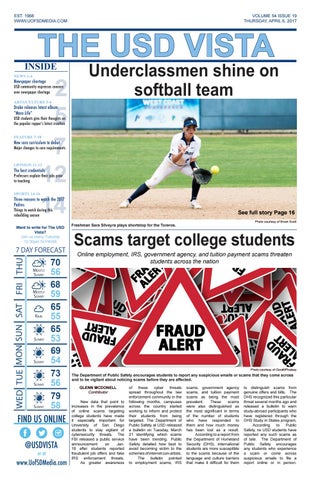
Scams target college students Online employment, IRS, government agency, and tuition payment scams threaten students across the nation
Photo courtesy of Geralt/Pixabay
The Department of Public Safety encourages students to report any suspicious emails or scams that they come across and to be vigilant about noticing scams before they are affected. GLENN MCDONELL Contributor New data that point to increases in the prevalence of online scams targeting college students have made it especially important for University of San Diego students to stay vigilant of cybersecurity threats. The FBI released a public service announcement on Jan. 18 after students reported fraudulent job offers and fake IRS enforcement threats. As greater awareness
of these cyber threats spread throughout the law enforcement community in the following months, campuses across the country started working to inform and protect their students from being targeted. The Department of Public Safety at USD released a bulletin on Tuesday, March 21 identifying which scams have been trending. Public Safety detailed how best to avoid becoming victim to the schemes of internet con-artists. The bulletin pointed to employment scams, IRS
scams, government agency scams, and tuition payment scams as being the most prevalent. These scams were also distinguished as the most significant in terms of the number of students who have responded to them and how much money has been lost as a result. According to a report from the Department of Homeland Security (DHS), international students are more susceptible to the scams because of the language and culture barriers that make it difficult for them
to distinguish scams from genuine offers and bills. The DHS recognized this particular threat several months ago and released a bulletin to warn study-abroad participants who have registered through the DHS Study in States program. According to Public Safety, no USD students have reported any such scams as of late. The Department of Public Safety encourages any students who experience a scam or come across suspicious emails to file a report online or in person.
2T
he
USD Vista
April 6, 2017
NEWS
NEWS
NEWS EDITOR ELISABETH SMITH @elisabethsmith0
Asst. NEWS EDITOR TAYLER REVIERE VERNINAS
Fewer newspapers on campus Members of the University of San Diego community express concern about the shrinking stacks of newspapers around campus
TAYLER REVIERE VERNINAS Asst. News Editor
Several members of the student body and faculty at the University of San Diego have displayed concern for the decreasing number of print newspaper copies distributed across campus. The main news sources provided on the newspaper stands include The USD Vista, the San Diego Union-Tribune, USA Today, and The New York Times. These stands are a part of the Collegiate Readership Program implemented at USD in 2007 by Associated Students. Junior Austin Hammer noticed that the newspaper rack outside of Aromas has been removed. “Occasionally, I like to grab a newspaper as I walk in and read over the daily happenings in Torero land,” Hammer said. “It doesn’t seem right that they don’t have the newspapers outside [of Aromas] anymore because people like to read the newspapers in the coffee shops.” Roger Pace, Ph.D., of the Communication Studies Department stated that the standard of journalism is still the daily paper. “The best of the online news sources are staffed by trained reporters who were schooled in journalistic methods and ethics at daily papers,” Pace said. “Those without such experience often rush to judgement or to post without careful collaboration of their ideas, or a seasoned editor who provides oversight. This disregard to basic journalistic inquiry leads to confusion, misstatements, and often intention fraud. In all news forms and in all news stories, journalistic integrity is paramount.” Pace said he believes
THE USD VISTA Editorial – 619.260.4584 Business – 619.260.4714 www.uofsdmedia.com @USDVista
Tayler Reviere Verninas/The USD Vista
On April 3, the newspaper stand in front of Copley Library features papers from The San Diego Union-Tribune, USA Today, The New York Times, and The USD Vista. this is true within the current political situation. “Most often, the breaking stories out of Washington originate with the NY Times or the Washington Post whose experienced reports are validating their information in time-honored journalistic practice,” Pace said. “Having the papers on campus gives our students the opportunity to
access the original sources of those reports and not just the digital spin of social media.” AS President TJ Hodges
explained the regulation for newspapers, which are stacked and charged by USA Today. “Each day USA Today
“Having the papers on campus gives our students the opportunity to access the original sources of those reports and not just the digital spin of social media.” -Roger Pace
Brooklyn Dippo- Editor in Chief Matlyuba Nurova - Finance Director Courtney Wong - Advertising Director Sarah Brewington - Associate Editor Diego Luna - Managing Editor Gianna Caravetta - Copy Editor Nora Brewington - Art Director Elisabeth Smith - News Editor Tayler Reviere Verninas - Asst. News Editor
Dani Devries - Opinion Editor Taryn Beaufort - Asst. Opinion Editor Kelly Kennedy - Feature Editor Jennifer Givens - Asst. Feature Editor Walker Chuppe - Arts & Culture Editor Matthew Roberson - Sports Editor Noah Hilton - Asst. Sports Editor Dray Wilson - Photography Editor Gina Lew - Student Media Advisor Marie Minnick - Operations Advisor
adds newspapers to all of our racks on campus,” Hodges said. “We don’t get charged for those newspapers. Instead, we get charged for the newspapers that are taken by the end of the day. So if a student does not take a newspaper off the rack, then we don’t pay for it. USA Today’s goal is to provide just the right amount of newspapers so that
The USD Vista publication is written and edited by USD students and funded by revenues generated by advertising and a student fee. Advertising material published is for information purposes only and is not to be construed as an expressed or implied endorsement or verification of such commercial venues by the staff or University. The USD Vista office is located on the fourth floor of the Student Life Pavilion in room 403B. All inquiries should be sent to: The USD Vista 5998 Alcala Park San Diego, CA 92110 The first copies of the newspaper are complimentary, all copies thereafter are a 25 cents charge. Opinions expressed in this publication are not necessarily those of The USD Vista staff, the University of San Diego or of its student body. Letters to the Editor can be submitted to The USD Vista office. Letters should be limited to 300 words and must be signed. For identification purposes, USD identification numbers and writer’s year must be included in the letter. The USD Vista reserves the right to edit published letters. Any content sent to the editor will be considered for publication unless otherwise stated.
there’s not a big surplus, but also not a situation where a student wants a paper but can’t find one [because] they lose potential sales if that happens.” According to Hodges, Associated Students pays USA Today for the Collegiate Readership Program. He stated that USA Today’s ideal situation is to have one NYT, U-T, and USA Today newspaper left on the stand at the end of the day. “If students are noticing that there are no newspapers for them to grab, that could be an issue with USA Today’s forecasting methods, and I can bring it to their attention that it seems there are students hoping to read the paper but not having any available,” Hodges said. “If it just looks like the stacks are smaller, that could be the result of a decline in students reading the paper, which might make sense because we are getting deeper into the year and semester, and students may not be maintaining their readership habits as they did earlier.” Peter Marlow, the Associate Vice President of University Communications, commented on the amount of newspaper available to students. “If there is a perception of a decline in anything, it is certainly not because the university wants there to be a decline,” Marlow said.
The USD Vista
NEWS
Volume 54 Issue 19
3
Dray Wilson/The USD Vista
Before the renovation of Aromas Cafe, a newstand stood outside of the cafe doors, housing The New York Times, USA Today, The San Diego Union-Tribune, and The USD Vista. Since the renovation, the newstand has not been replaced, leaving students without a quick news option on their way into the cafe. “Let’s figure out if there truly is a decline and rectify that. The whole point was to get information in the students’ hands and how do we go about doing that most effectively.” Professor Michael
Canepa of the Communication Studies Department, who had a 33-year career at the UnionTribune, shared his view on having print news on campus. “I always tell my students to gather news from as many
different outlets as possible – print, digital and broadcast,” Canepa said. “Then process the information and form your own opinions. Don’t let anyone – or any one news source – tell you what to think. Having a printed newspaper on campus is important because it supplies another voice.” Canepa stated the need for print media. “There are still a lot of terrific print journalists, both locally and nationally, who are doing phenomenal work,” Canepa said. “We all benefit from what they do, so it’s important that the industry survives. For me, I tend to read more and have much better
university could offer alternative forms of receiving news. “It’s important that students have access to news and keep themselves updated,” Hammer said. “If they don’t have paper media on campus anymore, they should at least supply some kind of digital media via email on a daily basis.” With fewer print copies available to pick up on campus, Toreros might have to resort to paying for papers elsewhere or reading The New York Times online, which students were given a free year-long subscription to by Associated Students. Senior Miri Taylor
“It doesn’t seem right that they don’t have the newspapers outside [of Aromas] anymore because people like to read the newspapers in the coffee shops.” -Austin Hammer
Dray Wilson/The USD Vista
The newspaper stand in the Student Life Pavilion, outside of Tu Mercado, shows the lack of newspapers available to students.
comprehension when looking at an actual newspaper as opposed to a computer or cell phone screen. Print is just easier on my eyes.” As a former page designer for the UnionTribune, Canepa shared some insight on the hard work that goes into print newspapers. “I can tell you first hand that there is a lot of thought that goes into how the paper looks and how the stories are presented,” Canepa said. “We used a lot of visuals—photos, graphics, and charts—to make the paper inviting and give the reader an element they might not get when reading a story on their iPhone.” Hammer shared how the
prefers to read The New York Times papers offered in print on campus. “I think it is important for our students to stay informed, and reading the newspaper is a great way to do that instead of looking at your phone or on Facebook,” Taylor said. “Personally, I like print.” Newspaper stands can be found either inside or outside of campus dining locations, as well as outside of Copley Library and Vistas Residential housing. The missing rack that was previously outside of Aromas Cafe has been brought to the attention of the Associated Students President, who is looking into the issue.
4T
he
USD Vista
April 6, 2017
NEWS
APRIL 5 – MAY 5
THANK YOU! E M P LOY E E G I V I N G C A M PA I G N 2017
We want to thank all employees who are making gifts, big and small, as part of this year’s Employee Giving Campaign.
TO MAKE YOUR GIFT, GO TO: SANDIEGO.EDU / STUDENTSFIRST
SAV E T H E DAT E FO R
A REIMAGINED EXPERIENCE!
UNIVERSITY OF SAN DIEGO
|
OCTOBER 12-15, 2017
Volume 54 Issue 19
The USD Vista
ARTS AND CULTURE
ARTS & CULTURE
5
A&C EDITOR WALKER CHUPPE @lord.walker
Injection of “More Life” in Drake’s discography CYNTHIA YANTZ Contributor
Canadian rapper Drake is not exactly an up-andcoming artist. In fact, he has been a staple in the music scene for quite some time now. His reputation makes the reactions to his new album, “More Life,” impressive but not entirely shocking. “More Life” was released on March 18 and quickly skyrocketed to the top of the Billboard Hot 100, and now it is aiming for No. 1 on the Billboard 200 albums chart for its second week in a row. The Billboard Hot 100 features singles, while the Billboard 200 features albums. Not only has “More Life” reached great results on the Billboard front, but also in its streaming activity.
difficult to enjoy them all. “The amount of songs he decided to put on the album doesn’t allow his listeners to enjoy every song, but every song is pretty good and actually gives you more life,” Fowler said. That being said, Fowler does not understand the hype around the new album. “The album is not worth all the hype it is receiving because it is similar to his recent albums ‘What a Time to Be Alive’ and ‘Views,’” Fowler said. “It is like the two albums ‘What a Time to Be Alive’ and ‘Views’ had a baby and made ‘More Life,’ but it is an album worth listening to.” Fowler also added that the album can give aid in certain life situations, such as dealing with a break up or getting amped up for a sporting event. “The album is a nice mix of music,” Fowler said. “It can take your mood from hyping you up for a game
Photo courtesy of @champagnepapi/Instagram “More Life” debuts as an LP that doubles as a playlist.
Overall, “More Life” gathered 89.9 million streams on Apple Music within its first 24 hours of being released. Among those that tuned in were many students at the University of San Diego. They shared their thoughts on Drake’s new album. Freshman Fayth Fowler found Drake’s new releases to be a hit, with just a few critiques. She has been listening to it often since its release. “The album is like a breath of fresh air and allows Drake to show another side of him musically,” Fowler said. Fowler’s favorite songs on this particular album include “Since Way Back When,” “Blem,” and “Passionfruit.” However, Fowler explained that the number of songs on the album in comparison to Drake’s previous albums makes it
to dwelling in your emotions over a significant other.” On the other hand, junior Justin Hellier had only positive things to say about “More Life.” “I’ve had at least four songs from his new album on repeat. I’m not surprised everyone else likes it too,” Hellier said. Junior Anna Kalfayan also had positive things to say about the new album. “I really like Drake’s new album ‘More Life,’” Kalfayan said. “The fact that this album is set up to be more like a playlist gives it a more laid-back feel.” Her favorites from this album include “Portland” and “Sacrifices.” Drake is bringing something new to his music, according to Kalfayan. “Not only is he honest about his accomplishments, [but he also] admits to his failures,” Kalfayan said. “‘More
Photo courtesy of @champagnepapi/Instagram Since its Mar. 18 release, “More Life” has been a success on a multitude of streaming platforms.
Life’ includes some slowerpaced songs, which is not super common with Drake’s music.” Junior Alex Gaylis had a bit more to offer when it came to analyzing the album completely. “I don’t think it’s anything too special,” Gaylis said. “This album definitely had a different style and sound to it than his other albums. I didn’t feel as if there was a lot of pop in the songs in this album compared to his other ones. However, I did like the fact that many of the songs told a story, particularly regarding relationships.” “Fake Love” strikes Gaylis as his favorite song from this album as he thought it offered a good chorus and rhythm. He noted that a lot of the slower songs in the album contrasted with Drake’s usual style. “I feel like Drake’s other
albums had a smoother pace to the songs, as well as had more of an upbeat rhythm to the songs,” Gaylis said. “I think the songs [on his new album] moved at a slower pace. Some of the songs
is a well-equipped album. From Drake’s new tonal exploration and storytelling playlist style, listeners are able to delve deeper into the music and relate to the different vibes in the album—reminiscent
“I really like Drake’s new album ‘More Life.’ The fact that this album is set up to be more like a playlist gives it a more laid-back feel.” -Anna Kalfayan didn’t sound like Drake’s original music, ‘4422,’ ‘Skepta Interlude,’ for example.” With mostly positive USD student reviews about Drake’s album, it is understandable how this album has risen in popularity so quickly. Although some students think it is receiving too much hype, they do not refute the fact that it
of their own post-breakup feels and pre-game jitters. Which makes this album approachable and likeable to a vast majority of the nation. Kalfayan had a final note of advice to Drake’s future listeners. “Treat this new album like a playlist and you won’t be sorry,” Kalfayan said.
Photo courtesy of @champagnepapi/Instagram Drake performs on tour at Ziggo Dome in Amsterdam, Netherlands.
6
ARTS AND CULTURE
The USD Vista
April 6, 2017
Chance the Rapper inspires with philanthropy WALKER CHUPPE Arts & Culture Editor @lord.walker Grammy winner Chance the Rapper has taken the music world by storm as of late, both for his music and contributions to his community. In a world often dominated by gossip and celebrity feuds, it’s nice to see an influential 23-year-old working to make an impact in his hometown. As University of San Diego changemakers, perhaps we can learn from his example of attempting to change his world for the better, through both hip hop and philanthropy. Senior Christian Corona gave his thoughts on Chance the Rapper and his influence in his community. “I think with everything that he is doing for the city of Chicago and speaks a lot about his upbringing,” Corona
Chicago public schools have been a recent subject of debate since Chance launched his fundraising campaign in support of his hometown public educational system. His early talks with Illinois Governor Bruce Rauner initially seemed positive, but no concrete plans were put in place to aid the impoverished schools. The governor then vetoed a $215 million funding bill in December for Chicago public schools, resulting in backlash from the school board and from Chicagoans that hoped the bill would bring change to the current ailing system. Senior Michele Demaio is a Chicago native and spoke about the rapper’s local impact. “I think it’s great that these influential figures and organizations are making news for wanting to make people more aware of a very serious issue that plagues
“I think it’s great that these influential figures and organizations are making news for wanting to make people more aware of a very serious issue that plagues Chicago.” -Michele Demaio said. “I feel like other celebrities and artists can learn from him about remembering where you came from. What I love most about Chance is that he has been doing good things for his community even before he gained national attention.” On Mar. 31, the Chicago Bulls announced that they will match the rapper’s initial $1 million pledge to the Chicago public school system. Chance made headlines after announcing that he would help Chicago public schools as much as he can, starting with his donation. The Bulls’ announcement comes after the rapper called upon Chicago corporations to give back to the city.
Chicago,” Demaio said. “But if it’s not already apparent from Chance’s unsuccessful meeting with Illinois’ governor, [Chicago Public Schools] is going to need a lot more than just donations and goodwill to fix. We’ll have to see if social pressure and escalating violence will be enough to make the state act.” The rapper met with Governor Rauner again in early March, but was left disappointed in vague answers. Since their meeting, Chance has ramped up his support of Chicago’s schools—a fight that has been well-documented on social media, including support from high profile celebrities
Screenshot courtesy of ABC News/YouTube Chance with the novelty check for Wescott Elementary School.
Photo courtesy of @chicagobulls/Instagram Chance the Rapper with Bulls president and COO, Michael Reinsdorf.
such
as Gabrielle Union. The Bulls’ announcement to support Chance’s campaign comes at a welcome time, after a period of setbacks from the political side. In addition to the announcement of the Bulls’ $1 million donation, the rapper also announced the creation of the Chance Arts and Literature Fund, which aims to target schools with lower than
his music for free—something that is a very different method from many other popular artists. Chance spoke about his decision to release all of his music, including “Coloring Book,” for free. “I never wanted to sell my music,” the rapper said. “I thought putting a price on it put a limit on it and inhibited me from making a connection.”
Chicago public school system and is doing his best to help the schools that he came from. With the support of celebrities, hopeful Chicagoans, and the Chicago Bulls, perhaps he can go from Chance the Rapper to Chance the Philanthropist. From his initial struggles to latest breakthrough, we can see that it is possible to make an impact in our own
Photo courtesy of @itsgabrielleu/Twitter Gabrielle Union lends her support to Chance the Rapper’s fight in her Mar. 3 tweet.
average five-year graduation rates. His organization, Social Works, has previously donated $10,000 to 10 Chicago schools. After the Bulls’ Mar. 31 announcement, the organization donated another $10,000 to 12 schools. Chance the Rapper’s popularity and visibility has risen tremendously since the release of his latest, Grammy award-winning album, “Coloring Book.” However, the rapper is not satisfied with his individual success alone, and shared that he hopes to impact his community in a positive way. On Feb. 26, the rapper bought all the tickets to “Get Out” at Chicago’s Chatham 14 theater so that anyone with photo identification could watch the film for free. He used the opportunity as a nod to a film he thought was incredible and to give back to his hometown. It is also worth noting that he believes in releasing
Apart from making critically-acclaimed and widely popular music, Chance the Rapper is using his visibility to fight for a noble cause. He sees problems with the
communities. Although we may not all have the same influence as Chance, every instance of change starts somewhere, and we all have our own contributions to make.
Photo courtesy of @chancetherapper/Instagram “Coloring Book,” Chance’s free Grammy award-winning album.
VOLUME 54 ISSUE 19
THE USD VISTA
FEATURE
FEATURE
FEATURE EDITOR KELLY KENNEDY
7
ASST. FEATURE EDITOR JENNIFER GIVENS
New core curriculum to debut in fall What you need to know about major changes to core class requirements
JENNIFER GIVENS Asst. Feature Editor Ready for it or not, the new core curriculum will be implemented this fall. Here are a few fast facts to help prepare you for the new transition. In a presentation on Mar. 28, Special Assistant Director to the Dean and Core Director Kristin Moran, Ph.D., discussed the new curriculum with students to help prepare them for the transition. Moran explained that not all currently enrolled students will have to switch over to the new core. Rising seniors and juniors need not worry, the new curriculum is optional for students who enrolled before spring 2017. Students who begin USD fall 2017 or after are automatically enrolled in the new core. “I advise students to take classes that can accommodate both core curriculums,” Moran said. “One thing to remember, if a student opts for the new core, the core and major [courses] have to come from the same course catalog.
Photos courtesy of Alex Read/Unsplash The new core curriculum has four less classes than the old core curriculum. and only one class of this in communication and your really “If I opted for the new advertised well,” type will be required, not two. theme is sustainability, then Lange said. “I think I saw core, it would keep me here Logic is no longer required. you take Natural Disasters in something about it on a poster longer, which I can’t possibly The new core also spring. The idea is when you somewhere, but that’s it.” afford,” Hickerson said. “Also, promotes integration and are taking your spring course Lange has already since I am currently taking changemaking opportunities. your faculty member will give finished the classes for a logic and have spent the time All incoming students you an assignment with what Theology minor, but he worries I’ve been here fulfilling the old you learned in fall and spring.” that the new core doesn’t core, it would be detrimental Only existing students respect those who don’t want for me to switch since the who switch to the new core, and to take classes in Catholicism. classes would not count.” New core fast facts incoming students in fall 2017 - Optional for students enrolled before fall 2017 must do the integration project. “I don’t think it was really advertised well. I - Includes Catholic integration in all Theology and Moran explained that Religious Studies classes changes are meant to align think I saw something about it on a poster USD with the curriculums - Social science will be replaced by social and somewhere, but that’s it.” of other universities and to behavioral inquiry -Cyrus Lange equip students with skills - LLC participation required for new students employers are looking for. - New advanced integration project requirement “We changed core If students opt into the “I did a theology minor because we had too many after my required three new core, and have taken [core classes] compared to religion classes because I logic like Hickerson, the units No one is required to go to must join a Living Learning other universities,” Moran liked it so much, but I did not will only count toward elective the new core unless they Community (LLC) and will said. “We wanted to utilize take one class in Catholicism credit. Students switching to are entering USD in 2017.” participate in an integration an outcome-based model or Christianity,” Lange said. “It the new core will also need The new core has experience in the spring and what we want students to doesn’t make sense to change to re-declare their majors and four fewer classes than are semester of the yearlong LLC achieve. A lot of the new core comparative discourse to may have to take extra classes required in the old core. program. If an existing student appeals to companies and normative discourse with to account for changes in major Students still need 120 units opts into the new core, she or what they are looking for in to graduate, and 48 of those he will be waived from the LLC employees. It’s changing the Old core New core units must be from upper integration classes, but will be way we provide the curriculum.” The new core creates - Logic required - No logic requirement division classes. The new required to participate in an opportunities for other - 3 THRS classes - 2 THRS classes classes to integrate subjects required, any topic required [one must be “Since I am currently taking logic and have into a student’s major. One acceptable related to Catholicism] example of this could be spent the time I’ve been here fulfilling the combining business classes - 2 science classes - 1 science class required + a lab required + a lab old core, it would be detrimental for me to with philosophy or ethics and creating a class such as switch since the classes would not count.” business ethics or legal ethics. The Theology and the new titles in the new curriculum as well. There is a -Taylor Hickerson Religious Studies Department core. It doesn’t make classes “what if” guide available to is also redoing its entire inclusive when you reframe help students find out what curriculum requires two advanced integration project. curriculum to connect each everything from your own classes transfer over as core perspective. and what are now electives. theology and religious studies “[There are] two parts to class back to Catholicism and [Catholic] Current students are While some USD courses instead of three, and the requirement to students how the religion applies to the one science and technology who start next year,” Moran subject being taught. Students skeptical of the offer to switch students are excited about course with a lab instead said. “[In the LLC], students will be required to take one into the new core. Junior the new core, others are of two natural sciences. will get an intro to integration class in Catholic theology. Taylor Hickerson explained unsure. More information Junior Cyrus Lange that, even though the new core regarding the new core can be Additionally some course as a way of problem solving. categories will change. Social For example, if you are a wasn’t aware that the new core isn’t required for her, if she found at sandiego.edu/core, science will be replaced by student in integration and would be implemented so soon. chose to switch, it would alter or you can speak with your “I don’t think it was her expected graduation date. advisor about the changes. social and behavioral inquiry, you take your first course
8T
HE
FEATURE
USD VISTA
APRIL 6, 2017
No ‘chella
Not going to Coachella or Stagecoach?
Festival season is upon us, but attending Coachella and Stagecoach can cost hundreds, even thousands of dollars. Tickets can also be hard to find, as the festivals often sell out. Not all college students can afford to attend the festivals, leaving them with major fear of missing out (FOMO) while scrolling through Instagram and watching Snapchat stories. Coachella 2017 will run April 14 to 16 and April 21 to 23. General admission festival passes start at $399, and VIP passes are $899. Online, tickets can even be marked up by resellers on Facebook and Craigslist. Stagecoach 2017 will run the weekend after Coachella Weekend 2, from April 28 to 30. Stagecoach offers several levels of access passes. General admission for the weekend starts at $329, while Corral reserved seating prices range from $899 to $1199, depending on how close to the main stage festival goers want to be. Ticket prices are only the first cost of attending a major festival weekend—consider the cost of gas, hotels or AirBnbs, food and drinks, Uber rides, shuttle and parking passes. These additional costs can push a three-day weekend budget over $1000. There are many other options that students can consider when combatting the FOMO of Coachella and Stagecoach weekends. Here are a few possibilities.
Kelly Kennedy Feature Editor
Coachella 2017
Stagecoach 2017
April 14 to 16
April 28 to 30
and
April 21 to 23
The Head and the Heart
See Coachella and Stagecoach artists on tour in San Diego
April 9, 7:30 p.m. SOMA San Diego
Broods
April 12, 8:00 p.m. The Music Box
Father John Misty
Banks
April 12, 7:30 p.m. April 13, 7:30 p.m. Humphreys Concerts Humphreys Concerts By the Bay By the Bay
Mura Masa
April 20, 8:00 p.m. The Observatory North Park
Local Natives
April 17, 8:00 p.m. The Observatory North Park
FEATURE
VOLUME 54 ISSUE 19
THE USD VISTA
9
Celebrate Earth Day
Visit The Flower Fields at Carlsbad Ranch
Coachella Weekend 2 falls on Earth Day, April 22, which is a great alternative to three days in the desert. Outdoor Adventures is offering a service trip in the morning, or you could attend the March for Science in Downtown San Diego.
50 acres of beautiful ranunculus have grown here for the past 85 years, and each spring the community welcomes visitors to learn more about the life cycle of the Tecolote Giant Ranunculus. The fields are open seven days a week, from 9:00 a.m. to 6:00 p.m. and are $14 for adult entry.
See the Anza-Borrego “super bloom” About two hours away from San Diego lies the Anza-Borrego Desert State Park, where a “super bloom” of desert flowers has exploded over the normally dry landscape. Camp or stay in a hotel in Borrego Springs, and see a variety of plants and flowers.
Treat yourself By not going to Coachella or Stagecoach, you just saved yourself—or your parents— at least $500. Treat yourself to a fancy dinner downtown or a day by the pool. After all, you deserve it.
Photos courtesy of (left to right): Malcolm Murdoch, Peyri Herrera, Kelly Kennedy, Upsplash, Carmen Hanson, and Kevin Gill Nora Brewington/The USD Vista
10 T
he
USD Vista
FEATURE
Still smoking on campus?
April 6, 2017
Two years after campuswide smoking and tobacco ban, butts still litter certain areas
KELLY KENNEDY Feature Editor In 2015, the University of San Diego became a smoking and tobacco-free campus. Nearly two years later, cigarette butts can still be found on campus where smokers congregate out of sight and out of mind. According to university policy, the prohibition of smoking and tobacco products applies to all employees, students, contractors, vendors, guests, and attendees at any on-campus program or event. Basically anyone that sets foot on USD’s campus cannot smoke or use tobacco products, which includes e-cigarettes, chewing or dipping tobacco, and marijuana. The university considered medical warnings from the Surgeon General of the United States when enacting this policy. The university website encourages campus
86
cigarettes found behind Loma Hall at the top of the stairs leading to campus from Linda Vista on April 3, 2017.
can merit follow up with the Office of Ethical Conduct and Restorative Practices or Human Resources depending on if the smoker is a student or faculty member.
“I wish we did have a designated spot for smoking, because then the canyon and other hidden places on campus wouldn’t be littered with cigarette butts.” -Julia Roccato Despite the campuswide ban, and campus efforts to help smokers quit their habit, cigarette butts can still be found on campus this week. A USD Vista staff member picked up 86 cigarette butts at the top of the stairs, which lead down to Linda Vista behind Loma Hall.
“I think that people are going to smoke with or without a ban, so the ban on campus just forces them to smoke somewhere else, like Linda Vista, or [Tecolote] Canyon.” -Jordan Readyhough
Photos courtesy of Dray Wilson Cigarette butts can still be found across campus.
community members who feel comfortable to approach people violating this policy and ask them if they are aware that USD is smoking and tobacco free, and to please extinguish or discontinue their use. According to Marie Minnick, Assistant Dean of Students, reports of smoking
some smokers congregate around places out of view or directly outside USD property. “I wish we did have a designated spot for smoking, because then the canyon
Because smoking and tobacco products are not allowed on campus, there are no designated smoking areas, and those who choose not to quit must go off campus or risk being detected. Sophomore Julia Roccato has noticed that, instead of smoking directly on campus,
and other hidden places on campus wouldn’t be littered with cigarette butts.” Roccato also noticed that smokers congregate directly outside of campus to smoke. “A lot of people stand in front of the USD signs by the entrance to smoke or go to the canyon instead,” Roccato said. Junior Jordan Readyhough doesn’t think the ban actually lessens the number of people who smoke. “I think that people are going to smoke with or without a ban, so the ban on campus just forces them to smoke somewhere else, like Linda Vista, or [Tecolote] Canyon,” Readyhough said. “Not seeing it around might lead to less people feeling the desire to start smoking, but as for people that already smoke, it’s not actually fixing their issues.” Even though there aren’t designated smoking areas on campus, people continue to smoke despite the ban.
Volume 54 Issue 19
OPINION
11
The USD Vista
OPINION
OPINION EDITOR DANI DEVRIES
ASST. OPINION EDITOR TARYN BEAUFORT
Coolest courses offered at USD Unusual classes to fill your schedule
ALEXIS FAHEY Contributor
Class registration is upon the University of San Diego community once again. For many students, registration is a stressful time filled with planning and panicking. However, it is also an important and exciting time as students are picking classes and professors that they will be spending quite a lot of time with next semester. It is easy to get caught up in what classes you need to take to graduate, the seemingly endless “class full” or “wait list full” labels popping up, prerequisites that
your
core requirements. Great Moments in History with Molly McClain, Ph.D., is an awesome option for those looking to spice up a dull course load. Sophomore Ashley Tanga noted that, by bringing history to life, the class connected her to history in a way she didn’t think was possible. “We would be assigned readings, then we would do role playing for different significant moments in history, like the American Revolution and Boston Tea Party, as well as the Suffrage Movement,” Tanga said. “We were assigned characters and learned about their lives and how each of the events impacted them. It was a really great way to actually connect
“[At Sundance] I saw Al Gore’s film ‘An Inconvenient Sequel’ about global warming the day of Trump’s inauguration and got to hear Al Gore Speak [...] which was surreal and super empowering.” -Kyle Dubian you did not know about, and the extremely popular site, ratemyprofessors.com. During this hectic time, it is easy to forget why students are going through this: to hopefully enroll in really great classes. There are many unique and interesting classes that may not be on every student’s radar, as well as professors that seem to “make or break” these classes. Many students dread core classes as they believe that the subjects are not as interesting. However, if you think all core classes are created equal, think again. There are plenty of interesting courses you can use to fulfill
to historical events, unlike most history classes where you’re forced to memorize random dates and facts and expected to regurgitate it all.” Another great option for a core class is Exploring Religious Meaning with Joel Gruber. Having to take three religious classes while at USD may seem overwhelming to many students, especially if the student is not especially religious. However, this requirement is changing to two classes with the new core curriculum being introduced this fall. Senior Mary Sutton took Exploring Religious Meaning and found it to be one of the
Dani DeVries/The USD Vista Students take a break from screening films to play in the snow.
most engaging classes she has taken thus far at USD. “Rather than learning about facts and figures in religious history, [both] Gruber and Exploring Religious Meaning create a space to delve into the underlying connectivity of religion and spirituality,” Sutton said. “It’s a course that ultimately challenges dayto-day thought and dogma.” This class is also fulfilling for students who are in the process of developing their religious identity. Junior Kiana Dietz said that the professor really made the class enjoyable, as he engaged with the class differently than most teachers she has experienced. “[Gruber] challenges us to think about our own religious views but not within specific religious theories,” Dietz said. “He encouraged us to pose questions but think of the answers to those questions ourselves.” In terms of some thought-provoking upper division classes, some are hard to find, especially if it is not in your major or minor, but worth it once you do. Psychological Factors of Education in a Diverse Society with Michael Campbell is one class that normally slips off people’s radars. Junior Veronica Grosse stumbled upon this class when registering for classes. “The professor doesn’t give grades because he feels they give students stress, so everyone gets an A if they fill all class requirements, and he makes that clear from the beginning of the class,” Grosse said. “[It is] a class primarily for graduate students getting [their] master’s in education, but it doesn’t fill up fast, as no one really knows about it except graduate students. It was just an all-around great experience, and I recommend the class to everyone who needs a random upper division class for more credits.” Every student at USD has to take an upper division philosophy class at some point in their college career. But many students don’t know about the intersectionality of philosophy, shown one way through Biomedical Ethics with Gary Jones, Ph.D. Looking to go into the medical field after graduation, junior Danny Halloran found this class to take an interesting spin on philosophy. “Biomedical Ethics is
teaching me about many aspects of healthcare that are applicable to anyone looking for a future in medicine,” Halloran said. “Dr. Jones has an extensive background within this field, and I feel that I am gaining
over intersession every year. Senior Kyle Dubin went on this trip in January and found it to be one of the biggest highlights of her time here at USD. “I took the class because I want to go into the film
“Biomedical Ethics is teaching me about many aspects of healthcare that are applicable to anyone looking for a future in medicine.” -Danny Halloran so much from this course.” Political science and environmental studies do not seem like topics that normally go together in a class, but there is an upper division political science class called Politics and the Environment with Andrew Tirrell that combines them. Senior Harison Hawkins is an aspiring environmental lawyer and was excited to have found a class that combined both of his interests. “Professor Tirrell made this a very interesting class, as it evaluated the complications that arise when these two fields interact with each other,” Hawkins said. “Also, it was especially engaging as we assessed these issues on both the domestic and international landscape.” If you are a film buff and love to travel, American Independent Cinema in the Communication Studies Department might be the class for you. Eric Pierson, Ph.D., and Roger Pace, Ph.D., take a group of students to the Sundance Film Festival in Park City, Utah
industry, and USD offers very little classes for film or creative outlets. Sundance was the perfect opportunity for me to see what it’s all about,” Dubin said. “My favorite part was hearing the actors and directors talk and answer audience questions after each film. I saw Al Gore’s film ‘An Inconvenient Sequel’ about global warming the day of Trump’s inauguration, and got to hear Al Gore speak as the president was being inaugurated, which was surreal and super empowering. I think any USD students who are interested in creative jobs in the industry or just want to improve their film taste should 100 percent go to Sundance.” Whether it’s the topics, the professors, or the location, these off-the-radar classes have proven to be favorites for many students. As the registration period rolls around, don’t discount some of the unusual classes USD offers. Although they can be hard to find, browsing through the course catalog is sure to turn up some gems, and make for a more interesting semester.
Dani DeVries/The USD Vista Students can take a class while attending Sundance.
The views expressed in the Opinion section are not necessarily those of The USD Vista staff, the University of San Diego, or its student body.
12
The USD Vista
April 6, 2017
OPINION
Before they were professors... TARYN BEAUFORT Asst. Opinion Editor Picturing a professor as anything other than a professor might be like seeing a fish out of water. Believe it or not, professors have not always lived within the realms of academia. At the University of San Diego, it is not unusual for students to have a close relationship with their professors. This is one of the many advantages of USD’s intimate environment. Students have come to recognize professors as sources of knowledge. Let us take this opportunity to recognize our educators for all that they are. USD is home to many professors who bring unique credentials into the classroom. One of these professors is Jerome Hall. Before coming to USD, Hall spent his days hanging out in a wetsuit and exploring the world’s oceans. First, he served as an underwater archaeologist for the island of Puerto Rico. He then went on to serve as President of the Institute of Nautical Archaeology at Texas A&M University. Hall has always been interested in archaeology. After taking a class in Nautical Archaeology at Nova Southeastern University
Photo courtesy of Dennis Clausen Clausen played basketball at University of Minnesota.
in Florida, he volunteered his services for a two-week excavation on the Yorktown Shipwreck Project in Virginia. His professor at the time, Peter Throckmorton, a well-known underwater explorer and photojournalist, asked Hall to go with him to the Caribbean for the summer instead. “I agreed,” Hall said. “The rest, as they say, is history.” Traveling under the surface of the world’s oceans has left Hall with a vault of stories. “Sometimes, I just think back and think about how unbelievable my life has been. Nobody should be this lucky,” Hall said. “I’ve dived on many shipwrecks around the world and met some amazing people, some of them notable celebrities and world leaders.”
Reflecting back on his past career made Clausen evaluate where he stands today. “I like to think of myself as an oldie, but a goodie,” Clausen said. “Well, hopefully a goodie.” Beyond his teaching, Clausen is a man with an unexpected past. After high school, Clausen was recruited to play basketball at University of Minnesota, an NCAA Division III school. Growing up in Minnesota, playing basketball was no easy feat to come by. “We had no open court in my hometown where we could play during the winter months, so my brother and I improvised,” Clausen said. “We would dress up in just about every piece of clothing we owned to keep warm, heat up the basketball on the
“He got in a fight with the bartender, and I, being young, naive, and well-intentioned, tried to break it up. Well, I got stabbed.” -Jerome Hall Hall’s profession wasn’t all glitz and glam. Within the first three hours of his archaeology career, he was flown to the Dominican Republic and picked up by an old Swedish sailor, Henry Lundberg. Lundberg was supposed to drive him to the site to start his first project. Instead, Lundberg detoured to a ratty bar. “There, he got in a fight with the bartender, and I, being young, naïve, and wellintentioned, tried to break it up,” Hall said. “Well, I got stabbed.” It is safe to say he didn’t make it to the site that night and spent the night receiving make-shift medical attention. “The old, Swedish sailor just looked at me and said, ‘Welcome to archaeology, kid,’” Hall said. Hall isn’t the only professor with an impressive resume though. Most of us may know Dennis Clausen as a longstanding professor in the English department.
furnace grate to inflate the air, and then walk the three or four blocks to one of our neighbor’s home who had a hoop attached to his garage.” As an athlete, he enjoyed receiving special recognition from the town and the rest of campus. “Being a basketball player and doing very well in that particular sport at the college level, they put you up on a pedestal,” Clausen said. Out of college, Clausen had two career options to choose from, neither of which was to become a professor. “One of the possibilities for me was to become a basketball coach, believe it or not,” Clausen said. “And the other possibility was to go to law school and become a lawyer.” Clausen mulled over the decision to become a basketball coach, but ultimately chose to pursue his love for literature. It wasn’t an easy choice for Clausen.
L.A. Area Summer Camp Jobs Now hiring fun, caring summer staff in the San Fernando & Conejo Valleys Be a role model. Build your resume. Make a difference in a child’s life.
Counselors, Lifeguards, Instructors, & more! Earn $3450 + for the summer!
Photo courtesy of USD Leeva Chung Chung held many jobs, including a radio DJ.
The chance of continuing his basketball career lingered because of his long relationship with the sport. “My consideration to become a basketball coach was out of the sheer love of the game,” Clausen said. Abby Berk, a business professor, attended Stanford for her undergraduate degree, earned her master’s degree at Northwestern University, and obtained her Ph.D., from USD. She then spent years working in several industries trying to uncover the perfect job. “While I learned something from each of them, my most interesting job was with an e-commerce start-up, ProFlowers.com,” Berk said. Berk began as an analyst and moved her way up to managing the online marketing, all the while the firm made a name for itself. Proflowers.com went from a small start-up to going public to eventually becoming acquired by a large conglomerate. Its new success didn’t come without its own implications. “Despite all my education, I was not very well prepared to be successful in the workplace,” Berk said. “But it was an exciting ride.” Communication studies professor Leeva Chung came from a background different from the previous two. Chung spent six years on her undergraduate degree, two years on her master’s, and five years on her Ph.D. “It’s all school,” Chung said. “Had I had a career? No.
Did I have a life during? Yes.” Before committing herself to a profession in academia, Chung held a total of 30 part-time jobs. “I worked at Planned Parenthood as a pregnancy test counselor, I sold men’s suits, I sold eel skin and golddipped leaves in Tennessee, I worked at a radio station as a DJ and in the news, and I worked in a hotel as a telephone operator,” Chung said. Some of those jobs were harder than others, such as the one in Tennessee. “I flew out there on my own money,” Chung said. “It was $800 to fly out there, and I borrowed $400 from my sister. Because the person who hired me knew I had to work to pay that off, he only paid me $2 per hour for 14 hour days.” Holding various side jobs throughout her lifetime has allowed Chung to bring a different standpoint to the classroom. “It gives me a unique opportunity to invite conversation in my class because of my different skill set in the workforce, granted most of them were part-time,” Chung said. “It’s a different world that most people don’t expect a professor to speak about in a class.” Teachers won’t always tell you about their careers prior to teaching. These are only the stories of a few professors out of the many on staff at USD. Often, their experiences and knowledge go beyond lecturing in a classroom.
UNIVERSIT Y OF SAN DIEGO
RESEARCH WEEK 2017 April 18 – April 21, 2017 Research Week is a celebration of student-faculty research and scholarship. This multifaceted showcase will focus on the importance of research at USD, and will include various events, open houses and demonstrations. For more information, go to www.sandiego.edu/osp.
www.workatcamp.com The views expressed in the Opinion section are not necessarily those of The USD Vista staff, the University of San Diego, or its student body.
OPINION
Volume 54 Issue 19
The USD Vista
Searching for community
DANI DEVRIES Opinion Editor
As a Catholic university, the University of San Diego offers many resources for those looking to explore their faith further during their college years. For students that identify as Catholic or Christian, University Ministry (UM) is an outlet some turn to for help facilitating exploration and growth within their faith. One of the most popular activities that UM puts on is the Search Retreat. Search, as most students refer to it, is a retreat that happens once a semester. It is designed to help students who are “searching” for something more in their lives reflect on their relationships with themselves, their community, and God. The weekend-long retreat includes reflection, small group discussion, and interactive community building activities to help students explore various elements of the Christian faith. The retreat is celebrating it’s 20th anniversary this year, and this weekend’s retreat will mark the school’s Search XL. For those that haven’t been on Search, the appeal
behind giving up one of your precious weekends might be lost. For those who have gone, however, it is clear they have no regrets about trading a weekend of beaches and brunch for a retreat in the mountains with friends. Senior Maddy Platt explained why she made the decision to attend the Search retreat this upcoming weekend. “I wanted to go [on Search] because I felt like a weekend dedicated to self-reflection is exactly what I needed right before graduation,” Platt said. “I guess you could say God hasn’t been much a part of my life during college, and I felt like Search is a great way to reconnect before I graduate.” Senior Kathryn Kelly enjoyed the experience so much that she decided to take her Search journey even further and become a student leader. “It’s been a lot of fun to be part of the Search leadership team this semester,” Kelly said. “I attended the retreat my sophomore year and never really thought I’d be interested in leading, but being part of the UM community has given me a lot of confidence to do things I wouldn’t have thought I’d be capable of.” Kelly explained her
role as a student leader during the weekend retreat. “As for the weekend itself, my role is to lead a small group of ‘Searchers’ through reflections and discussions around topics like Prayer, Who is Jesus Christ, and
Humphreys said. “I think this is one of the reasons Search is so appealing. Aside from having the opportunity to be removed from the chaos of campus life for a weekend, Search gives students the opportunity to listen to witness talks given
“We all come to the retreat at different points in our faith journey but the hope is that the weekend serves as an affirmation that the best is still yet to come.” -Marc Adams Loving and Being Loved,” Kelly said. “Search provides a really nice way to recenter yourself in the middle of the semester, and it allows the ‘Searchers’ to explore their faith and relationships with God in a meaningful way.” This time to reflect seems to be one of the main appeals of the retreat. Senior Molly Humphreys, the student coordinator for Search, explained that the community surrounding Search is also a huge draw for participants. “One of the most unique aspects about Search is the diversity of students who both attend the retreat and who serve on the leadership team,”
by other students on various topics, engage in personal reflection, and build authentic relationships and community with students from all facets of campus life. The Search community is truly what makes this retreat so special to me.” Senior Sarah Shotts referenced this community when explaining her decision to attend this weekend’s retreat. “I’ve always thought about going [on Search], and I kind of just thought it was something I’d do my senior year,” Shotts said. “I wanted to go because, from what I’ve seen, other people who have gone have absolutely loved it, and even if they’re not super religious, which I’m not, there’s
13
something in it for everyone. [I also wanted to find] another different community at USD.” Ultimately, this feeling of belonging is what many hope to achieve by attending Search. Search Coordinator Marc Adams reinforced this idea, noting that the environment of acceptance surrounding the retreat is what helps students open up. “It is a space where we can feel free to be vulnerable with one another, being our most authentic selves, without fear of judgement or ridicule,” Adams said. “Our hope is that students can return from the retreat with a deeper understanding of themselves, of community and of God, embracing all the questions, doubts and ambiguities that may arise. We all come to the retreat at different points along our faith journey, but the hope is that the weekend serves as an affirmation that the best is still yet to come.” As students embark on this weekend’s Search XL, there are sure to be more students singing Search’s praises in the upcoming weeks. With 20 years under its belt, Search seems to have withstood the test of time and seems to be more popular than ever.
Students balance work and heavy course loads TARYN BEAUFORT Asst. Opinion Editor Students are notorious for having a million and one things to balance at once. Academics, extracurriculars, a social life, exercise—the list goes on and on for students at the University of San Diego. Some students even hold a job in the middle of all this craziness. It may seem like these students have a secret of their own that allows them to take on so much at once. As upperclassmen quickly approach the looming day of entering the “real world,” many begin looking for off-campus jobs to add to their resumes and to earn a little extra spending money. Junior Sabrina Tirador has been teaching barre classes at Fit in 60 over the past year while being a full time student. “The hardest part for me is planning my days and making time for school because that is my main priority,” Tirador said. “Although it’s not easy, it’s definitely rewarding.” Tirador works two days a week and a total of six hours per week. She tries to stay organized by planning out her week before it has even begun. On Sundays, Tirador fills out her planner for the upcoming week with what needs to be done and when.
“I think it’s important to prioritize what’s important to you and know you might have to make sacrifices,” Tirador said. “I have had to find someone to take my shift because school has become too much, or I have a test I really need to study for.” Despite all the hard work that comes along with balancing the two, Tirador has a positive outlook. “I am my biggest motivator,” Tirador said. “My main motivation is knowing that I am capable of so many things and continuing to push myself because I know I am able.” For students who are interested in taking on a job during the school year Tirador had some parting words of advice. “Take it easy at first,” Tirador said. “It is important to have your priorities in check before you get a job so you can always remind yourself what’s important, but also why you are pushing yourself to do more.” Junior Khalil Suradi is a general sales manager for his family’s business, New to You Autosales. Besides being a full-time student, Suradi works five days a week. Some of his responsibilities include writing contracts, communicating with banks, transportation, and dealing with mechanical issues. “We are so young, we
are going to have time to do everything. So I say get that experience to set you apart from everyone else right now and worry about those fun things later,” Suradi said. “I don’t have a lot of time. Time is money like my dad always says.” Being disciplined doesn’t always come easy for Suradi. There have been plenty of times Suradi has been invited by friends to enjoy a typical college night out but had to decline. “I went to the Olé Music Festival last weekend for a few hours, and my friends were trying to get me to go to these parties after,” Suradi said. “It sounded nice in theory—I would’ve loved to go—but I had to open the next day. You gotta weigh out the pros and cons.” Suradi noted that the experience he is gaining through working in the car industry goes hand in hand with what he learns in class lectures. “There [are] some things that you learn in class that you can apply to the business world, but then again there are things that you can’t really learn in the classroom,” Suradi said. “There are just some things you have to experience.” While some students find work off-campus, others turn to on-campus opportunities, which can include work-study jobs, to gain experience and
make some extra cash. Oncampus jobs also tend to be more accommodating to student schedules. Senior Ashley Joshi works as a USD campus tour guide for undergraduate admissions and as a telefunding caller. Between the two jobs, Joshi works between four to five days a week, totaling to about 10 to 12 hours per week. With both on-campus jobs being accommodating toward students’ schedules, Joshi explained that she seemed to hit the jackpot. “Telefunding only has hours between 5:30 p.m. to 9 p.m. on weekdays because they account for students’ schedules, and, for tour guides, we fill in an availability schedule at the beginning of the
semester, so you’ll never have tours during class,” Joshi said. That being said, an on-campus job comes with its own set of difficulties. “For my tour guide job, we don’t know the schedule until the week before, so I can’t commit to anything ahead of time,” Joshi said. “It makes it hard to schedule group projects and stuff.” Although it may seem like a daunting task, working in between the chaos of being a full-time student seems to be a beneficial experience. With a great deal of organization and dedication, it is very possible to balance it all. Once you feel confident enough about your academics, you might consider filling your spare time with real world work experience.
Photo courtesy of Sabrina Tirador Tirador teaches barre classes in addition to her course load.
The views expressed in the Opinion section are not necessarily those of The USD Vista staff, the University of San Diego, or its student body.
14 T
he
USD Vista
SPORTS
April 6, 2017
SPORTS
SPORTS EDITOR MATTHEW ROBERSON @mroberson22
ASST. SPORTS EDITOR
NOAH HILTON @thebackseatlamp
Three reasons to watch the 2017 San Diego Padres
MATTHEW ROBERSON Sports Editor
For what will be the eleventh straight season, the San Diego Padres are likely to miss out on baseball’s postseason yet again. Not only is the team’s roster void of big league talent at several key positions, the other teams competing with them in the National League West division appear to be much better equipped for a sustained run toward playoff glory. However, as Padres fans have been hearing for years, brighter days are presumably on the horizon. Losing 100 games this season could be a necessary step in the path toward rebuilding the franchise. In fact, the 2017 Padres, in many ways, are designed to fail. Several of the team’s biggest names from 2016— including starting pitchers Drew Pomeranz, James Shields, Andrew Cashner, and Tyson Ross, as well as position players Matt Kemp, Derek Norris, Melvin Upton, and Jon Jay—are no longer donning Padres hats. Some of these players were granted their release from the team in efforts to save money. Others were traded away for younger players, a common move used by many MLB front offices that signifies a future-oriented approach to winning. Keeping in mind that the Padres are one of the surest bets in the league to finish near the bottom of the standings— Sports Illustrated, ESPN, and Bleacher Report all ranked the team 30th out of 30 MLB teams prior to the season— there are still reasons to pay attention to this team as the gleam of spring turns to the din of summer. Here are three reasons why the 2017 Padres are worth keeping an eye on. 1. The young, athletic outfield Petco Park is notorious for having one of baseball’s most spacious outfields. This creates problems on both offense and defense. When hitting in Petco Park, power hitters often find trouble getting their fly balls to go from warning track casualties to over the fence souvenirs. On defense, teams playing at Petco should ideally field three outfielders who all have above average range, allowing them to traverse the acreage of grass and turn balls headed for the gap into outs. The Padres’ projected outfield for 2017 seems to have been constructed with these ideas in mind. Rightfielder Hunter Renfroe is perhaps the greatest reason
Photo courtesy of San Diego Informer/Twitter
Rookie centerfielder Manuel Margot gives baseball fans a reason to watch the Padres in 2017 and beyond. Padres fans are dreaming of a run of success in the 2020s. Renfroe, the 25-yearold slugger and former 13th overall pick in the 2013 MLB Entry Draft, has the power to make any ballpark look small. In an admittedly small sample size of 35 at-bats with the big club in 2016, Renfroe put together a slash line of .371/.389/.800 with four home runs and 14 RBI. Two of those long balls came against San Francisco Giants’ ace Madison Bumgarner and Los Angeles Dodgers’ crafty righthander Kenta Maeda, who held opponents to a combined .356 slugging percentage in 2016, well below the league average of .431. Essentially, Renfroe got a look at two of the division’s best pitchers, and rudely greeted their pitches with the barrel of his bat. 22-year-old Dominican centerfielder Manuel Margot was touted by scouts last year as one of the best defensive players in the minor leagues. He should get his chance to stick around in the big leagues this year, and his style of play makes him a likely candidate to be a fan favorite in 2017 and beyond. On the traditional baseball evaluation scale of 20 to 80, Margot was graded by scouts as a 70 fielder, a 70 runner, and a 60 grade hitter to go along with a 60 grade arm. In other words, he’s a great fielder who can cover a lot of ground while throwing out base runners and doing enough at the plate to warrant a spot high in the batting order. Pair that with Travis Jankowski, who could potentially take the lion’s share of playing time in left field, and the Padres have a triumvirate of players primed to make Petco’s prodigious outfield their personal playgrounds.
games out of first place in the NL West and tied with the Cincinnati Reds for the worst record in the National League. With that kind of continuous losing bringing a dark cloud to sunny San Diego, one would understand if it had a negative impact on some of the players. One such player who did not seem to be affected by the moribund state of the franchise was first baseman Wil Myers. In his second season in San Diego, Myers started the All-Star game at first base in front of the hometown fans at Petco Park. It was a well-deserved honor for the 26-year-old North Carolina native. Myers’ 115 wRC+ tells us that he was 15 percent better than league average in 2016, as 100 is the baseline for an average player. He was also one of only three Friars with at least 350 plate appearances to deliver an above average season, according to that metric. He mashed 28 home runs and drove in 94 RBI
2. Wil Myers, the hero that San Diego needs In 2016, the Padres lost 94 games, their highest amount of defeats in eight years. They finished the season 23
3. Christian Bethancourt, baseball’s unicorn Baseball’s positions are inherently specialized. Pitchers work for years to devise mechanics that not
only feel comfortable to them, but can be repeated thousands of times over the course of a grueling summer. Hitters are similar, as they must find a swing that allows them to be successful without over exerting themselves or leaving gaping holes in the strike zone for hitters to exploit. The amount of time and effort that goes into both is why you don’t see pitchers hitting .300 or hitters stepping up to the mound and striking people out. This is what makes the Padres’ Christian Bethancourt so captivating. Manager Andy Green has said he plans on using Bethancourt, a catcher by trade, both behind the plate and on the mound this season. Green spoke to USA Today about the experiment during spring training. “We watched him last year on the mound and we were intrigued by the arm strength,” Green said. “Anybody that’s watched him throw, that’s a top arm behind the plate, there’s tons of strength. He’s got a
the league. The team plans on starting Erick Aybar, of the -1.2 Wins Above Replacement (WAR) in 2016, at shortstop. He replaces 2016 starter Alexei Ramirez, who posted a -2.4 WAR in his only season in a Padres uniform. To clarify, yes, Aybar and Ramirez were the two worst shortstops in the MLB by WAR last season. The Dodgers are probably going to win the NL West this year. They may hover around the 100 win neighborhood, and maybe even make their first World Series since 1981. The San Francisco Giants, winners of three of the last eight World Series, will be the Dodgers’ most worthy challenger. The Arizona Diamondbacks and Colorado Rockies, the other two teams in the Padres’ division, project to be better than San Diego as well. The Padres do not have the riches that the Dodgers have, the pedigree of San Francisco, or the overall talent and depth
Photo courtesy of Deadspin/Twitter
Christian Bethancourt will handle both pitching and catching duties in 2017. while clubbing 29 doubles and swiping 28 stolen bases. Those kind of numbers have baseball fans from Mission Beach to Manitoba wondering if he can put together the Padres’ first 30 homer-30 steal season in history, and the first 30-30 season since some guy named Mike Trout did it in 2012.
lot of work to do, but we’ve seen a lot of catcher converts turn into very good pitchers.” The Padres plan on utilizing Bethancourt as a pitcher and catcher, which will produce something mystical that the game has never seen and likely didn’t think could ever exist. Christian Bethancourt is a unicorn in that respect. With all of this information about what could go right and be fun to watch in 2017, there is much more that can go wrong. The pitching staff will almost surely be one of the worst in
of
Arizona and Colorado. What the team does have, though, is two burgeoning superstars in the outfield, a franchise building block at first base, and a unicorn handling the two battery positions. Look past the onslaught of losses that are sure to come, and you can see a team that could be entertaining on some 2017 nights. What fans, players, coaches, and management are hoping, though, is that the woes of today can turn into triumphs in the future.
SPORTS
Volume 54 Issue 19
The USD Vista
15
Raiders’ relocation brings mixed feelings
The Raiders already have plans to construct a new stadium in Sin City worth approximately $1.7 billion. JAKE ELLIS Contributor Another National Football League organization has fallen victim to relocation. The NFL gave its approval on Monday, March 27 for the Oakland Raiders to move to Las Vegas, putting aside all the fears of putting a professional team in the largest gambling market in the world. The 32 NFL team owners held a meeting in Phoenix, Ariz. and voted overwhelmingly 31-1 in favor of the move. Only Stephen Ross of the Miami Dolphins voted no. The owners deduced that having a team in Las Vegas would allow the league to take advantage of the city’s booming tourist trade,
playing in Las Vegas as soon as 2019, with the lease at their current stadium expiring after the 2018 season. Raiders fans seem to be everywhere, including at the University of San Diego. Jayden Yeoman is a student originally from Vegas, while senior Jared Sclar is from the Bay Area. On the subject of the Raiders leaving the city of Oakland, Sclar is shocked. “It is hard to imagine,” Sclar said. “The Raiders are such an integral part of Oakland culture and have been for years. It feels like a bit of betrayal to the city and the fans who have supported the team through so many terrible years in the recent past.” The NFL has been pushing for a team to move to
“The Raiders are such an integral part of Oakland culture and have been for years. It feels like a bit of betrayal to the city and the fans who have supported the team through so many terrible years in the recent past.”
image of commotion, and its willingness to devote hundreds of millions of dollars toward the construction of a new stadium. For years, teams have steered clear of Las Vegas because some owners thought that putting a team there would lead more players and officials to talk with distasteful characters from the world of gambling trying to control and affect the outcome of games. But those attitudes have disappeared with the growth and approval of gambling around the country, and with the city’s reduced dependence on revenue from its numerous casinos. The National Hockey League agreed last year to create a team in Las Vegas, the Golden Knights, that will begin to play next year. The Raiders, who have one of the most passionate fan bases, are likely to begin
Photo courtesy of Business Insider/Twitter
Photo courtesy of ABC Eye Witness News/Twitter
Many Raiders fans are left wishing the team was committed to staying in Oakland. Oakland is not generating a lot Warriors are bringing in a lot, so Fans are not the only of revenue,” Sclar said. “So I I think the city will be just fine.” skeptics of how the city will would say it’s pretty much 100 Yeoman is excited that handle taking in a team, percent profit-motivated by they finally have a team to but professional athletes as the league and the owners.” represent her beautiful city. well. Brandon Marshall, a When it comes to what “I love the fact that Vegas wide receiver for the New -Jared Sclar the city of Oakland will do next, will finally have a team at home York Giants, voiced some Sclar was a little indecisive. that we can go cheer for,” concerns about the Raiders’ “Maybe [Oakland will] Yeoman said. “I love the fact looming move to Sin City. Vegas for a while, and Sclar believes it will benefit the NFL. look for another football team?” that we can go to the ballgame He shared his thoughts to “Vegas is a big market Sclar said. “It will be a financial on Sunday and watch one of NBC Sports in late March. “It can be a tough place and keeping the team in hit, but the Golden State the best teams in football.” With regards to for a player coming out of what it will do for the city, college,” Marshall said. she had high remarks. “It can be overwhelming “I think it is going to create for a young player.” a passionate community of Marshall is a player who people who are really excited,” had his own difficulties in his Yeoman said. “It will be cool early years in the league, to experience that excitement and there’s no shortage in the city on game days.” of other players who have Las Vegas is known similar stories, so trouble as a big city with tons of can be found anywhere a distractions. Yeoman thinks it player might be looking for it. will be rough at first, but will The USD Vista reached benefit them in the long run. out to Torero football players “It will probably be a little who have put their name frustrating at first, as Vegas in the 2017 NFL Draft. The is already always bustling players declined to comment. with tourists and events,” The potential for it in Vegas Yeoman said. “But I think may be more in front of them, once things settle down the however, and that is something Raiders will be just another the Las Vegas Raiders may exciting experience on the be balancing when they start Photo courtesy of Steve Sisolak/Twitter strip that people can either acquiring players to play take advantage of or ignore.” for them in their new home. The iconic Raiders helmet has a new home in Las Vegas.
16 T
he
April 6, 2017
SPORTS
USD Vista
Torero softball powered by youth
NOAH HILTON Asst. Sports Editor
College freshmen seem to have it rough. There’s the adjustment to a new environment, often far from the friendly confines of home, and without many of the friends one grew up with. There’s the added challenge of harder classes and higher expectations for extracurriculars. More than anything, it’s often one’s first real exposure to an independent life. For many, it’s not an easy adjustment to make. Don’t tell that to the University of San Diego softball team, though. For the second straight year, the program’s best players are underclassmen. Outfielder Taylor Spence, a sophomore, is hitting a robust .424 as the table setter of the Toreros’ offense after leading the team with a .391 batting average as a freshman last season. Fellow second-year star Lauren Kane, last year’s West Coast Conference Freshman of the Year, is one of the team leaders in slugging percentage. The only girl ahead of her is freshman
Photo courtesy of Brock Scott
Sophomore infielder Lauren Kane has started in each of the Toreros’ first 29 games of the season. field regardless of age, so I never really separated myself just because I was young.” With their strong 2016 seasons in the rearview mirror, both girls are now looked to as leaders of the 2017 Toreros’ roster despite their relative youth. “Last year showed that I can be a leader regardless of my age,” Kane said. “I learned a lot from the seniors last year
“My coaches and teammates helped me through those early struggles, and if I ever start to doubt myself now, I can go back to those conversations.” One of the foremost mentors in the early going has been Spence, a former teammate of Silveyra’s when both were making their way through the travel ball ranks. “I always try to encourage her,” Spence said. “I always
knowing that she is surrounded by considerable talent here at Alcalá Park. “[Spence has] always been really good,” Silveyra said. “So for her and my other teammates to have that kind of confidence in me makes a huge difference.” That doesn’t mean there haven’t been some growing pains for one of the freshest faces in the Toreros’ lineup.
Photo courtesy of Brock Scott
Sophomore outfielder Taylor Spence leads the team with a .424 batting average and .505 on-base percentage. shortstop Sara Silveyra. Silveyra has burst onto the scene early in the season and claimed Conference Player of the Week honors last month. It turns out that these fast starts are no fluke. Rather, as all three girls alluded to in a recent interview with The USD Vista, the program fosters an environment where age takes a noticeable backseat to talent. It starts with the performances of Kane and Spence last spring. “It was good to get a fresh start in college,” Spence said. “I knew as a freshman I had to prove myself, and that drove me to play well right away.” Kane agreed with the sophomore sensation. “From the start, I looked at myself as one of the players,” Kane said. “Everybody’s the same on the
and their ways of leadership. I know I can help this team, and that gives me confidence to step up and help my teammates when they need it.” One of those teammates is freshman phenomenon Silveyra, who was drawn to USD in large part because of the lack of a class hierarchy within the program. “The environment is really nice here,” Silveyra said. “All of the upperclassmen are very welcoming. It’s more of a family vibe, and I really liked that.” That sisterly vibe is already paying dividends for the young infielder during both slumps and hot streaks. “I struggled at the beginning of the year, especially mentally, and I knew I wasn’t performing the way I could,” Silveyra said.
just remind her to stay humble and to keep working hard and being a good teammate. If you can keep doing that, the results are going to come.” Silveyra takes comfort
Silveyra, a native of Camarillo, Calif., has had some struggles that many college freshmen can relate to. “I would say that the time management aspect of
college has been the hardest,” Silveyra said. “School is really hard sometimes, and especially during the season, there’s hardly any time to get everything done. It’s definitely something I’m still learning how to manage.” On the field, however, there appears to be little that the young shortstop is still figuring out. Thanks to the impressive precedent set by Taylor Spence and Lauren Kane in their own freshman campaigns, and combined with the familial dynamics guiding the Toreros’ chemistry every time they run onto the diamond, Silveyra is thriving in her first season as a Torero. “The girls here don’t make me feel young, and I’m not looked at as a freshman,” Silveyra said. “I feel like they respect me and believe that I can do what they can do.” The notoriously-difficult jump to the college ranks is quickly becoming easy for Torero softballers. A school that each of the last two WCC Freshman of the Year title holders have called home could soon add a third. The USD softball program is already hovering around .500, and the Toreros’ record currently sits at 14-15. The team appears to still have its brightest days ahead of it, a prospect that can make any Torero fan grin about the possibilities for the future.
Photo courtesy of Brock Scott
Freshman shortstop Sara Silveyra is putting together an excellent start to her career.