On newstands weekly
Volume 59 Issue 18
Thursday, April 7, 2022
THE USD VISTA
The Official Student Newspaper of the University of San Diego since 1968
Toreros address SDSU Title IX lawsuit Female varsity rowers face unequal athletic financial aid JAREK MORGAN ASST. SPORTS EDITOR A group of current and former female athletes at San Diego State University (SDSU) filed a federal lawsuit on Feb 7, 2022 alleging that the university violated Title IX gender equity requirements by not providing women’s sports with sufficient scholarship money in proportion to their men’s athletes. The California State University system has repeatedly pledged their commitment to a just and balanced treatment of all student-athletes. The current lawsuit against San Diego State is just one example of this pattern. Title IX of the Education Amendments of 1972 (Title IX) lawsuit was filed against SDSU in addition to the Board of Trustees of The California State University system. This is a sex discrimination class action against SDSU for depriving its female varsity student-athletes of equal athletic financial aid in violation of Title IX. SDSU has not paid its female varsity student-athletes equal athletic financial aid for over a decade, failed to pay them over $1,200,000 in equal
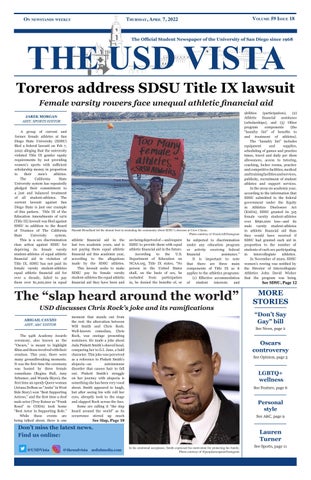
Hannah Broadland led the alumni boat in reminding the community about SDSU’s decision at Crew Classic. Photo courtesy of @zack.bill/Instagram
athletic financial aid in the last two academic years, and is not paying them equal athletic financial aid this academic year, according to the allegations made by the SDSU athletes. This lawsuit seeks to make SDSU pay its female varsity student-athletes the equal athletic financial aid they have been and
are being deprived of — and require SDSU to provide them with equal athletic financial aid in the future. According to the U.S. Department of Education on NCAA.org, Title IX states, “No person in the United States shall, on the basis of sex, be excluded from participation in, be denied the benefits of, or
be subjected to discrimination under any education program or activity receiving federal financial assistance.” It is important to note that there are three main components of Title IX as it applies to the athletics programs: (1) Effective accommodation of student interests and
The “slap heard around the world” USD discusses Chris Rock’s joke and its ramifications
ABIGAIL CAVIZO ASST. A&C EDITOR The 94th Academy Awards ceremony, also known as the “Oscars,” is meant to highlight films and those involved with their creation. This year, there were many groundbreaking moments. It was the first time the ceremony was hosted by three female comedians (Regina Hall, Amy Schumer, and Wanda Skyes), the first time an openly Queer woman (Ariana DeBose as “Anita” in West Side Story) won “Best Supporting Actress,” and the first time a deaf male actor (Troy Kotsur as “Frank Rossi” in CODA) took home “Best Actor in Supporting Role.” While these events are being talked about, there is one
moment that stands out from the rest: the altercation between Will Smith and Chris Rock. Well-known comedian, Chris Rock, was onstage presenting nominees. He made a joke about Jada Pinkett Smith’s shaved head, comparing her to G.I. Jane, a bald character. This joke was perceived as a reference to Pinkett Smith’s alopecia—an autoimmune disorder that causes hair to fall out. Pinkett Smith’s struggle on her journey with alopecia is something she has been very vocal about. Smith appeared to laugh, but after seeing his wife roll her eyes, abruptly took to the stage and slapped Rock across the face. Some are calling it “the slap heard around the world” as its occurrence stirred up much
MORE STORIES “Don’t Say Gay” bill Oscars controversy See Opinion, page 5
LGBTQ+ wellness See Feature, page 6
Personal style See A&C, page 9
See Slap, Page 10
@theusdvista uofsdmedia.com
See SDSU, Page 12
See News, page 2
Don’t miss the latest news. Find us online: @USDVista
abilities (participation), (2) Athletic financial assistance (scholarships), and (3) Other program components (the “laundry list” of benefits to and treatment of athletes). The “laundry list” includes equipment and supplies, scheduling of games and practice times, travel and daily per diem allowances, access to tutoring, coaching, locker rooms, practice and competitive facilities, medical and training facilities and services, publicity, recruitment of student athletes and support services. In the 2019-20 academic year, according to the information that SDSU submitted to the federal government under the Equity in Athletics Disclosure Act (EADA), SDSU granted its 315 female varsity student-athletes over $690,000 less—and its male varsity student-athletes in athletic financial aid than they would have received if SDSU had granted such aid in proportion to the number of students of each sex participating in intercollegiate athletics. In November of 2020, SDSU women’s rowing was notified by the Director of Intercollegiate Athletics John David Wicker that the program was being
Lauren Turner In his emotional acceptance, Smith expressed his motivation for protecting his family. Photo courtesy of @peopleenespanol/Instagram
See Sports, page 11
2
The USD Vista
◆
April 7, 2022
NEWS
“Don’t Say Gay” bill passed in Florida legislature
Disney criticized for lack of immediate response JENNY HAN ASST. NEWS EDITOR Despite its controversial nature, Florida Governor Ron DeSantis signed House Bill: Parental Rights in Education, more colloquially referred to as the “Don’t Say Gay” bill into law on March 28. This bill covers several aspects pertaining to the procedures that district school boards must follow in order to ensure that parents can make their own choices in how to raise their child. This nickname comes from a section in the bill that states, “Classroom instruction by school personnel or third parties on sexual orientation or gender identity may not occur in kindergarten through third grade or in a manner that is not age appropriate or developmentally appropriate for students in accordance with state standards.” This new law will go into effect in July. This bill has been heavily criticized. On Feb. 21, CA Governor Gavin Newsom tweeted: “This is nothing short of a state-sponsored intimidation of LGBTQ children. It will put kids who are already navigating stress - in physical and psychological danger. For the sake of these kids, don’t do this Florida.” President Joe Biden also criticized the bill by tweeting on March 28, “Every student deserves to feel safe and welcome in the classroom. Our LGBTQI+ youth deserve to be affirmed and accepted just as they are. My Administration will continue to fight for dignity and opportunity for every student and family — in Florida and around the country.” The Parental Rights in Education bill is one of many anti-LGBTQ+ bills that were enacted this year. NBC News stated, “State lawmakers have proposed a record 238 bills that would limit the rights of LGBTQ Americans this year — or more than three per day — with about half of them targeting transgender people specifically.” For Pauline Herring, a Queer graduate student who works for both the LGBTQ+ and Women’s Commons as the Graduate Assistant for Gender Identity resources at USD, this is not a coincidence. “I think the reason that’s happening now is that people both feel empowered and terrified,” Herring said. “A lot of heteronormative cis[gender] white men specifically because that’s who’s making these laws are terrified. They both feel super powered because that’s
Florida Governor Ron DeSantis criticized for “Don’t Say Gay” bill.
how they’re getting their voice. And also, they’re terrified that they’re going to lose that power.” Herring believes that one primary reason for this is because of more queer visibility on the internet and mainstream media inherently challenges the standard. “Growing up, think about how cis, white hetero men you have seen in media. Now I want you to think of Queer, Asian men. How many have you seen in the media?” Herring said. “So now, flip it on its reverse: you’re a white person that’s always seeing white people around you. There’s comfort in that right? And now all of a sudden, you see people that aren’t like you. You see Queer people, you see BIPOC people, you see trans people, you see, you see all these non binary people, right? You see this happening, and it freaks you out.” Herring’s main concern is for the future generation of LGBTQ+ kids. “It took me 25 years [to realize I wasn’t straight]. Not because people told me I couldn’t be gay, but because people showed me I couldn’t be gay,” Herring said. Because of her own experiences, Herring expressed fear that current Queer youth will have to go through what she did. “Kids are sponges and we don’t give them enough credit for how smart they are. Kids will observe and they will learn [that being queer is not acceptable],” Herring said. “What I think this is going to do to a lot of our youth is that we’re going to see even more of a spike in a lot of negative statistics. We’re going to see a spike in suicides. We’re gonna see a spike in self-harm. We’re gonna see a spike in drug use and a spike in alcohol abuse.” One major player in the“Don’t
Say Gay” bill controversy is Disney. Originally, Disney’s CEO, Bob Chapek, chose not to speak out publicly regarding the new bill. However, this strategy appeared to backfire when the Orlando Sentinel published an op-ed titled “Florida’s anti-gay crusade is funded by the Disneys of the world” on Feb. 22. This fueled a public uproar and the beginning of what would become active disdain against Disney’s choice to not speak out against the bill. Later on March 9, journalist Judd Legum of Popular Information tweeted an open letter that Pixar employees published titled “A Statement to Leadership from the LGBTQIA+ Employees of Pixar & Their Allies’’ where employees criticized their inability to create diverse stories due to management. Building resentment against the company resulted in major backlash. According to CNBC, hundreds of Disney Employees in Disney’s headquarters in Burbank, CA participated in a fullscale walkout protesting Disney’s lack of action on March 22. There were a series of smaller, scheduled walkouts from March 15-18 and March 21. In an interview with CNN+, Former Disney CEO Bob Iger also spoke out against the “Don’t Say Gay” bill, stating, “When you’re dealing with right and wrong or when you’re dealing with something that does have profound impact on your business, I just think you have to do what is right and not worry about the potential backlash to it.” Eventually on March 11, Chapek released a public statement apologizing for the company’s lack of response and action steps he would take to mitigate the damage he caused. For Dr. Amitkumar Kakkad, a Clinical professor for the USD
Photo courtesy of @tcpalm/Instagram
School of Business and a former Disney intern, although he state that Disney should make a stance for the LGBTQ+, it’s more complicated than it seems. “Disney content is what most kids grew up with: Movies, watch shows, you know, theme parks, all of that. So they have a profound fact in some of them during the formative years of the next generation which increases the responsibility even more,” Dr. Kakkad said. “But as a company, they are going to respond to how they perceive the environment around them is working. If they feel that as a business, they cannot actually lose profit revenue customers by taking what we might consider to be the right stand, it’s unrealistic to expect that.” In contrast, Dr. Abby Berk, Clinical Professor of Management in the Knauss School of Business, stated that Disney absolutely had a moral obligation to make a clear stance in support for the LGBTQ+ community. “Their customer base ranges from little children to families to elderly; they touched so many lives and they even acknowledged that,” Dr. Berk said. “When you look at their documents, their mission statement, their purpose, and what they articulate as their corporate values, they always talk about [being] the positive role on society and who they can impact, and trying to be a positive factor. Their statements say that it’s core to their business.” However, Berk stated that Disney’s current response in condemning the “Don’t Say Gay” bill is largely because of the value Disney has for their employees. “What is meaningful to them [Disney] is when their employees speak up and when their employees voice disapproval, and then their employees say that
they’re going to walk off the job. For consumers there’s a lot of talk, but consumers don’t always follow through with their dollars,” Dr. Berk said. “Disney says they value their employees and they want to create an inclusive respectful workplace. And employees are the ones that call them out on this; you can’t say that about that internally and then operate in an environment that promotes this lack of understanding of tolerance, so from what I’ve read, what I’ve seen, and looking at CEO statements, they’re responding to employees for sure.” Both professors emphasized the importance of looking at Disney, and any other corporation, not as a singular entity, but rather as a part of the bigger picture. “You can’t look at anything in isolation because everything exists as part of a system,” Dr. Kakkad said. “If you look at what Disney is doing by itself, we might feel like passing judgment or, you know, having a view on whether they should do this or that. But if you look at it, from the system’s perspective, in terms of where do they exist? What is their role? What they are doing and what society has made them do?” Kakkad continued to explain his point. “And how their actions are driven by influences around them and how their actions influence others around them, then you’re going to get a much more nuanced picture,” Kakkad said. “And when we do that, it becomes a little bit more difficult to point a finger squarely at a company because they don’t exist in isolation.” But regardless of how Disney stands, Herring finds it pivotal for everyone, even non-Floridians and those who don’t identify as being LGBTQ+, to care about it. “The Queer community and trans community are international. What affects us in Florida, affects us in California,” Herring said. “We can say all that we want that ‘Oh, we made so much progress during Obama’s era.’ We didn’t make jack; We didn’t even scratch the surface of what we should be doing and could be doing. We shouldn’t have to do it; It should just be given. And the fact that we’re having to fight just to be here tells me that our allies aren’t working hard enough.” House Bill: Parental Rights in Education is considered to be controversial due to the section that aims to eliminate conversations about gender and sexuality in lower grades. Although Disney originally funded politicians that enacted this bill, the company has stated that they will do what they can to repeal it.
Volume 59 Issue 18 ◆
NEWS
The USD Vista
◆
Southern California grocery workers prepared to strike
3
USD students likely to see grocery prices rise COLIN MULLANEY ASST. NEWS EDITOR After being heralded for two years as essential frontline workers during the pandemic, grocery store employees in Southern California—specifically Ralphs, Albertsons, Pavilions, and Vons—are prepared to strike, due to stalling contract negotiations about pay raises and benefits. Frustrated by the increased cost of living in California and the stresses they endured during COVID-19, grocery store workers are demanding wage increases, higher minimum hours for part-time workers, and health and safety committees to oversee lingering COVID-19 concerns, the LA Times reported. If grocery employees are granted a substantial wage increase, and they decide to strike this could have lasting consequences for Southern California grocery shoppers and USD students over the next few months. A similar strike in 2003 lasted for four months, cost supermarkets an estimated $2 billion, and cost workers $300 million in wages, according to the LA Times. Grocery stores have struggled for numerous reasons in the last few years—everything from the pandemic to inflation to a supply chain crisis—and the stress to offer affordable groceries to the public could only mount further, given the current pressures applied by unions. Ongoing conversations between parent companies Kroger and Albertsons and the United Food and Commercial Workers Union (UFCW) hit a snag in early March, when the UFCW renegotiated a new contract on behalf of 47,000 workers across 540 stores. According to the LA Times, the UFCW was unsatisfied with the proposed terms of the contract and voted by overwhelming majority at local chapters to authorize a walkout, if its demands cannot be addressed moving forward. Primarily, union workers demand a $5 per hour wage increase over the next three years, which would amount to nearly $141 million in total. Ralphs released an official statement explaining its hesitancy to raise wages by such a sizable amount. “Our three goals throughout
Students are likely to see an increase in grocery prices if strikes are to begin.
Southern California grocery workers at chains like Ralphs, Albertsons, and Vons threaten to go on strike over wages. Photo courtesy of Franki Chamaki/Unsplash
negotiations are to reward and invest in our people, keep groceries affordable for our customers and maintain a sustainable business that creates jobs in the future. Ralphs’ proposal meets all three goals. The current UFCW proposal of $5 an hour [increase],
which is a 22% increase, only meets one of those goals.” Ralphs Corporate Affairs director, John Votava, argued that the UFCW’s pay raise demands “would lead to $400 more in monthly grocery bills for most Southern California
The USD Vista Taylor DeGuzman - Editor in Chief Maria Watters - Associate Editor Samantha Anciano - Managing Editor Yana Kouretas - Copy Editor Marissa Esteban - Art Director Karisa Kampbell - News Editor Maria Simpson - Opinion Editor
Photo courtesy of Nico Smit/Unsplash
Haley Jacob - Feature Editor Anna Valaik - Arts & Culture Editor Mari Olson - Sports Editor Kai Welsh - Distribution Manager Julia Sotille - Social Media Manager Michael Guiterez - Finance Manager Morgan Valent - Advertising Manager
households [and] push customers to nonunion competitors who do not respect collective bargaining.” In other words, the shopper would bear the brunt of these proposed pay raises and many would seek out other grocery chains altogether,
Editorial – 619.260.4584 Business – 619.260.4714 www.uofsdmedia.com / @TheUSDVista Gina Lew - Student Media Advisor Marie Minnick - Operations Advisor
possibly driving unionized companies out of business. However, UFCW leaders refuted this idea that Kroger and Albertsons are operating on razor thin profit margins, suggesting instead that the highest paid employees are collecting pay raises, at the expense of the lowest paid employees. For instance, the UFCW points out that in the currently disputed contract, “top-rate associates would receive a nearly $2 hourly increase to their current industryleading pay,” while in-store employees who earn substantially less already would only receive an additional $1.80 hourly. Furthermore, “Kroger Chief Executive Rodney McMullen was criticized for collecting a $22.4-million pay package in 2020—his largest ever—even as the company ended a $2-an-hour hazard bonus for frontline workers after two months,” the LA Times reported. That same year, Kroger closed five markets, saying they were “financially unsustainable,” even though Kroger’s operating profit nearly doubled to $4.3 billion from 2019 to 2021. All the while, working and middle class employees like Rachel Fournier, 44, worry about providing for their families and paying the bills. “Twenty years ago this was a middle class job,” Fournier said. “But the companies have been squeezing and squeezing us with meager wage increases over the past few contracts.” Due to recent global events, grocery workers are less willing to tolerate perceived slights and abuses from upper management. The pandemic has created “a spirit that we need to stand up for ourselves,” Fournier said. “People are fed up and they’re eager to walk out.” Recent activities at San Diego’s UFCW local 135 chapter reflect Fournier’s sentiments, as employees created picket signs and banners, in preparation for the potential strike. Organized efforts to unionize and negotiate contracts for a living wage have been on the rise across the country, in step with rising inflation. Even national companies like Amazon and Starbucks are currently seeking to unionize, which could have economic consequences for the everyday consumer.
The USD Vista publication is written and edited by USD students and funded by revenues generated by advertising and a student fee. Advertising material published is for information purposes only and is not to be construed as an expressed or implied endorsement or verification of such commercial venues by the staff or University. The USD Vista office is located on the fourth floor of the Student Life Pavilion in room 403B. All inquiries should be sent to: The USD Vista 5998 Alcala Park San Diego, CA 92110 Opinions expressed in this publication are not necessarily those of The USD Vista staff, the University of San Diego or of its student body. Letters to the Editor can be submitted to The USD Vista office. Letters should be limited to 300 words and must be signed. For identification purposes, USD identification numbers and writer’s year must be included in the letter. The USD Vista reserves the right to edit published letters. Any content sent to the editor will be considered for publication unless otherwise stated.
“ c o
4
The USD Vista
◆
April 7, 2022
E DI TOR IA L
Speak up about sexual assault Breaking the taboo and supporting survivors MARIA SIMPSON OPINION EDITOR
Every year we raise awareness for different groups and causes throughout the months, such as Black History Month in February and Women’s History Month in March. These causes are proudly celebrated by many and imperative educational messages are spread. Sexual Assault Awareness Month (SAAM) has occured every April since 2001. Though SAAM has just begun, there is no special Snapchat filter, no heart warming messages online, and no annual discussion in school like we see with other issues that have whole months dedicated to raising awareness. Sexual assualt and sexual violence are seen as taboo topics. No one wants to discuss the reality of this horrific act. Rape culture has been so widely accepted as the way things are for so long that it has become incredibly difficult to break the cycle of objectifying people and ignoring their lack of consent. Not to mention, it has been painted as an inappropriate topic because it involves sex. Victims are made to feel disgusting for participating and the “solution” many people preach is abstinence. But, sexual assault this is not an interaction that is asked for. It is an attack on an individual’s body and mind. The stigma around these issues poses a threat to all survivors as it only makes the problem worse. Everyone should be able to have conversations about sexual assault, recieve proper education, and do their part to tear down the culture we have built that accepts this degradation of individuals. The culture we live in has created a disgusting tolerance for sexual assault. According to the Rape, Abuse, and Incest National Network (RAINN), an American is sexually assaulted every 68 seconds. Women, especially young women, experience sexual assault at incredibly high rates. One out of every six women has been a victim of rape. 90% of adult victims of rape are female. However, this horrifying issue goes beyond just women. Men between the ages of 18 and 24 who are college students are five times more likely to become a victim of sexual assault than a man of the same age who is not in school. 21% of transgender or
USD students protest a case of sexual assault on campus and stand with the survivor.
gender non-comforming college students are sexually assaulted. Victims are at a higher risk of long term effects such as substance abuse, mental health issues, and sexually transmitted diseases. The stats go on and on, each more crushing and revolting than the last. Each statistic, each number represents a real human being whose bodily autonomy was taken away from them. These numbers could easily
of consent continue to allow hideous actions of sexual assault to continue. Whenever someone comes forward about sexual assault or rape, one of the most commonly asked questions is “What were you wearing?” Questions like this are searching for things that the victim supposedly did wrong that caused the attack to happen. This ideology is infuriating and incredibly hurtful.
fears about coming forward, and the support they need could be counseling or even just a listening ear and a trustworthy friend to provide comfort. Consent is a central part of preventing the cycle of sexual assault from living on, but few people are taught what consent truly means. The phrase “no means no” is about as much as high school sex-ed gives us, which in itself is a harmful
“The stats go on and on, each more crushing and revolting than the last. Each statistic, each number represents a real human being whose bodily autonomy was taken away from them.” represent your friends, your classmates, and your family. Right now, our society is turning a blind eye to the true terror of these crimes, despite the clear evidence that it is hurting countless people. Rape culture and the acceptance of sexual violence needs to be dismantled. The way sexual assault is talked about makes it very difficult to dismantle rape culture and create a safer society for everyone. Victim blaming, lack of support for survivors, and a poor overall understanding
Imagine mustering up the courage to speak up about such a despicable act done to you, and everyone comes to the conclusion that it was your fault. With this blame placed on victims it is no wonder that people are scared to some forward and this horrendous cycle remains in place. Better support needs to be given to survivors, and oftentimes, that doesn’t mean forcing them to call the police or press charges in any way. Many people have a lot of valid
practice. Consent should only ever be an enthusiastic yes. Silence, uncertainty, unconsciousness, and actions under the influence do not fall under that guideline. We also are never taught that consent can be revoked at any time. If schools taught students this then younger generations would not only be equipped to stand with survivors, they would grow with a fuller understanding of how consent should work, pushing against the mentality that allows
Marissa Esteban/The USD Vista
rapists and other perpetrators to flourish in the first place. Sexual assault awareness is a topic that is often pushed out of sight. People put stigma on it that allows the toxic culture to remain and attacks continue to occur. We need to start conversations about sexual assault so that victims can feel safe and we can shut down the ideas that allow rapists to exist so easily in our society. This is not a “women only’’ problem. It is not a “survivor only” problem. This is an issue that has the potential to affect every one of us, especially as college students. It is also a problem that requires everyone’s help to make a difference. Sexual Assault Awareness Month is the perfect opportunity to start. Seek education and conversation. Stand with survivors and condemn rapists. Let’s band together to tear down centuries of toleration for sexual assault and create a safer world for everyone. If you are a victim of sexual assault and want to seek support, USD’s Campus Assault Resources and Education (CARE) offers 24/7 services and different paths of support that best help each individual.
The views expressed in the editorial and op-ed sections are not necessarily those of The USD Vista staff, the University of San Diego, or its student body.
Volume 59 Issue 18
◆
OPINION
◆
5
The USD Vista
E DI TOR IA L
Rock and Smith are both in the wrong Groundbreaking Oscar winners are overshadowed KATHERINE ELY ASST. OPINION EDITOR This year’s Oscars will be remembered for the dramatic altercation between two iconic members of Hollywood: Will Smith and Chris Rock. It is easy to choose sides when celebrities publicly provoke controversies. Whenever a topic of debate arises, it is always good to consider where both sides are coming from in their actions. I believe that neither Rock nor Smith are entirely innocent in the part they played during the ceremony’s disruption. The incident began when Chris Rock was introducing the nominees for the Best Documentary category. Rock casually referenced Jada Pinkett Smith, Smith’s wife, in a joke about her recently shaved head: “Jada, can’t wait for G.I. Jane 2.” Jada appeared to look uncomfortable by the joke, prompting Will Smith to walk up to Rock on stage and deliver an unforgettable smack, one that will surely go down in Oscars history. After leaving the stage, the audio cut out as viewers saw Smith shouting to Rock, “Get my wife’s name out of your [expletive] mouth.” For one, Will Smith’s decision to slap Rock was
extremely inappropriate. He should have never reacted with violence, let alone on camera in front of millions of viewers. If he hadn’t slapped Rock, then I’d say he has every right to stick up for his wife. But even then, he should have waited for the ceremony to end and handled it professionally, out of the public eye. Smith’s reasoning for acting the way he did was because of a condition his wife has called Alopecia. An article in the New York Times defined Alopecia as “a broad term that refers to any form of hair loss.” Jada has been open about her condition since 2018 when she first mentioned it on her show, “Red Table Talk.” After Rock’s joke, when Jada appeared uncomfortable by its nature, Smith’s unexpected behavior appeared to be because he was protecting the one he loves. In his acceptance speech after winning Best Actor for “King Richard,” a movie about the father of Venus and Serena Williams, Smith stated, “Richard Williams was a fierce defender of his family.” From this statement, I believe that Smith’s recent portrayal of Williams ultimately played a part in why the actor reacted the way he did. Smith also apologized to the Academy in his acceptance speech for his outburst but
did not include any type of apology directed toward Rock. Though Smith might have believed he was only sticking up for his wife, it does not excuse him from being in the wrong for slapping Rock. Rock believed he was just doing his job as a comedian: telling a joke. But it wasn’t just a joke, and Rock had no place to comment on a woman’s health condition. Though we do not know for sure, Rock alleges that he was unaware of Jada’s condition when he made the joke. Whether it was intended or not, at the end of the day ,Rock was out of line. Though it did not merit the response it received, it should have never happened in the first place. My biggest issue with what went down at the Oscars is that it completely overshadowed all the amazing accomplishments of the night. Only minutes after the slap, Ahmir ‘Questlove’ Thompson was given the Oscar for Best Documentary for “Summer of Soul,” a major accomplishment for his first time being the director of a Hollywood film. And yet, when Thompson took the stage to accept the award from Rock, the moment of celebration was stolen away from him as whispers of what had just happened circulated around audience members, the
echoes of Smith’s outburst still ringing throughout the theater. Later on in the night, Jane Campion won the award for Best Director for the film “The Power of the Dog” being the third woman in history to receive that award. This year was also the first time a deaf nominee was awarded Best Supporting Actor when Troy Kotsur won for “CODA.” The whole point of the Academy Awards is to honor members of Hollywood for their outstanding job in a film. The people who won deserve our attention and we shouldn’t let a brawl between two celebrities overshadow their accomplishments. Rock should not be seen as the victim here simply because he was the one being slapped. Since he played a role in the disruption he should be punished in some sort of way for his poorly-worded joke. I feel that, because Rock is a loose canon when it comes to his words, he should no longer be allowed to tell jokes on the Oscar stage unless it is approved by the Academy beforehand. Otherwise, we might worry that another incident similar to this one may occur again. In the days following the Oscars, Smith released a public apology on Instagram to both the Academy and to Rock for his violent actions.
Additionally, Smith announced his resignation from the motion picture academy. This means that the actor will no longer be included in the Academy’s voting process for future Oscar nominations. Though I believe that Smith should face repercussions for his indecent actions, I feel that his award for Best Actor should not be revoked. Whether or not Smith is wrong for what he did, the actor deserved the award like any of the other nominees for his outstanding performance in King Richard, and we should not discredit him because of his actions. I think, instead of revoking his award, the best course of action is to no longer allow Smith the privilege of participating in the Oscars aside from when he is nominated in the future. He should not be invited to the ceremonies unless he is nominated for an award. but should not be allowed to present awards as well as be included in the voting process. This way, Smith can still be acknowledged for his work in future films, while also being fairly punished for what he did wrong. Hopefully the groundbreaking winners in future award ceremonies will receive the recognition they deserve.
Troy Kotsur’s historical win as a deaf actor was overshadowed by Smith’s actions. Will Smith’s violent reaction to Chris Rock’s joke has taken over the media. Photo courtesy of @raise.the.volume/Instagram Photo courtesy of @theyungp/Instagram
The views expressed in the editorial and op-ed sections are not necessarily those of The USD Vista staff, the University of San Diego, or its student body.
Ho wt h ewe e k l o n gc e l e b r a t i s u p p o r t e dt h ec o mmu n i t y .
F r o mMa r c h28t oA p r i l 1 , USDc e l e b r a t e d “ L BGT Q+We l l n e s sWe e k ”t op r o mo t es t u d e n t we l l n e s sa n dc e l e b r a t et h eI n t e r n a t i o n a l T r a n sDa yo f V i s i b i l i t yo nMa r c h3 1 . T h ewe e kf e a t u r e dv a r i o u se v e n t sf o r s t u d e n t st oa t t e n d , r a n g i n gf r o mwo r k s h o p s , me n t a l h e a l t hc h e c k i n s , a n df r e eHI V t e s t i n g .
Paul i neHerri ng ( Graduat eAssi st antf or t heGenderI dent i t y Resources) “ A ss o me b o d ywh oi sp a r t o f t h ec o mmu n i t y , t h i s r e p r e s e n t a t i o nd i d n ' t e x i s t wh e nI wa sa nu n d e r g r a ds t u d e n t a t myu n i v e r s i t y , s oI ' ms oh a p p y t h a t wec a nh a v et h i sv i s i b i l i t yf o r t h ec o mmu n i t y a n ds p e c i f i c a l l yf o r o u r t r a n sc o mmu n i t y . I t ' s j u s t a na ma z i n gt h i n gt h a t n e e d st ob et a l k e d a b o u t , a n dI t h i n ks oma n yt i me swef o c u so n t h en e g a t i v e , a n dwed o n ' t h a v et h a t c e l e b r a t i o n , s ot h i swe e ki sa b o u t ac e l e b r a t i o n .
TransDayofVi si bi l i t y Wel l nessFai r A t t h e“ T r a n sDa yo f V i s i b i l i t yWe l l n e s sF a i r , ”d i f f e r e n t c a mp u sr e s o u r c e st a b l e dt h ee v e n t t od i s c u s st h e i r r o l e si ns u p p o r t i n gt h eL GBT Q+c o mmu n i t yo nc a mp u s . So meo f t h er e s o u r c e sp r e s e n t i n c l u d e dP e ei nP e a c e , Wo me n ’ sCo mmo n s , St u d e n t We l l n e s s , a n dCA RE( Ca mp u sA s s a u l t Re s o u r c e sa n dE d u c a t i o n ) . T h ee v e n t a l s of t u r e de d u c a t i o n a l a c t i v i t i e sa n dc r a f t i n g .
a t i o n .
HI VTest i ng St u d e n t We l l n e s sa l s op r o v i d e df r e e , c o n f i d e n t i a l HI Vt e s t i n gf o r a l l s t u d e n t s .
Ment alHeal t hChecki ns USD’ sSt u d e n t We l l n e s sp u t o na“ Me n t a l He a l t h Ch e c k i n s ”e v e n t , wh i c ha l l o we ds t u d e n t st op o pi nf o r af r e e1 5mi n u t ec o n f i d e n t i a l c h e c k i nwi t haSt u d e n t We l l n e s sp r o f e s s i o n a l .
r Al exi sCast ro( CARE Graduat eAssi st ant ) “ T h i swe e ki se x t r e me l yi mp o r t a n t b e c a u s ei t ’ s a b o u t h o wr e p r e s e n t a t i o nma t t e r sf o r e v e r y s i n g l ei d e n t i t y . I t ’ se x t r e me l yi mp o r t a n t f o r s t u d e n t st oh a v eas p a c eb e c a u s eI f e e l l i k eal o t o f t h et i me , t h e r ea r e n ’ t t h e s es p a c e sc r e a t e do n t h ec a mp u s , a n dp e o p l ec a n ’ t b et h e ms e l v e s , wh i c hi se x t r e me l yh a r d . ”
8
The USD Vista
◆
April 7, 2022
AR TS & FEATURE
USD School of Engineering’s new master’s program Discussing the program’s holistic approach to social change JESSICA MILLS ASST. FEATURE EDITOR On March 28, the University of San Diego Shiley-Marcos School of Engineering launched the Master’s of Science in Engineering for Sustainability and Health (MESH). The program aims to solve social and global issues holistically by connecting areas of engineering, sustainability, and public health. The 30-unit program is fully online and is designed to be completed in five semesters. The new program will begin during the Fall 2022 semester, and the application is due Aug. 1. Applications are accepted on a rolling basis throughout the year for admission into the spring, summer, or fall semesters. Professor of Integrated Engineering and Academic Director of MESH Dr. Caroline Baillie encouraged students of all degree backgrounds to apply to the program. “We don’t expect those that apply to be engineers,” Dr. Baillie explained. “We invite students of any discipline. If you’re an English major, we also want you.” By incorporating diverse backgrounds, Dr. Baillie hopes to bring students together to invent a variety of solutions for environmental issues. “We need all of us to solve the world’s problems,” Dr. Baillie said. “Problems of climate change, current and future pandemics, poverty, and health gaps, can only be solved if we work together.” Using the online Blackboard platform, students take two sevenweek long courses each semester, covering topics surrounding environmental justice and sustainable energy. Two courses are offered each semester, and students focus solely on one course at a time for a deeper understanding of each topic. While the program is fully online, Dr. Baillie explained
Dr. Caroline Baillie teaching communities in Sri Lanka how to turn waste into products. Photo courtesy of Dr. Caroline Baillie
Women in Sri Lanka working together to turn waste into usable products. that it also includes a project. “Of course, some learning will happen behind a computer, but the project portion is hands-on, and students will either find one themselves or be assigned a project from faculty,” Dr. Baillie said. Students can expect to examine ideas for emerging technologies, equitable health practices, and economically viable transitions for the future. The project allows students to explore their own paths in sustainable solutions
Waste products hanging to dry in Sri Lanka.
for environmental issues, applying the knowledge from their online courses. “When you apply everything from this program to a new project, we truly believe we are creating knowledge for the world, not just the students,” Dr. Baillie said. Dr. Baillie believes MESH students will have a unique edge in the workforce. “We want to give students the skills and confidence to create their own organizations when they graduate, not just join already
Photo courtesy of Dr. Caroline Baillie
Photo courtesy of Dr. Caroline Baillie existing ones,” Dr. Baille said. Despite the online layout, Dr. Baillie explained that faculty will be engaged individually with each student through online simulation games and frequent discussions. According to Dr. Baillie, the diversity among faculty will help students prepare for post-grad life. “We have faculty from social ecology, sociology, environmental justice, public health, and engineering working together and teaching students from various disciplines,” Dr. Baillie said. “This creates innovative ideas for new solutions that can be applied to real world problems.” Associate Professor of Sociology Julia Cantzler is among the faculty members teaching in the master’s program. She believes that current and future generations can help change global issues and is confident in the program’s ability to lead that path toward change. “MESH will cultivate the next generation of sustainability leaders by developing their expertise in a way that is interdisciplinary, applied, and solutionsoriented,” Cantzler said. Dr. Baillie shared the benefits of the MESH program for those interested in global issues yet unsure of their future goals. “This program is so individual
for every student,” Dr. Baillie explained. “Many students that are graduating now are wondering what to do with their lives because we’ve experienced so much during the last two years. We’re in the middle of a pandemic, global warming is increasing, and protests have popularized because people are recognizing the inequities in our society. Now is the best time to take part in real change.” While Dr. Baillie explained the importance of taking part in sustainable changes, she also addressed students’ need for career and financial stability. “MESH is for students that want to make a difference and have a meaningful life,” Dr. Baillie said. “Students that want to help with solutions but also benefit from a successful income.” As more companies shift to implementing greener practices, having advanced knowledge of sustainability will prove beneficial. In addition, Cantzler hopes MESH will emphasize USD’s role in sustainable development. “This program will advance USD’s reputation as a leader in integrative learning with a focus on sustainability and environmental justice,” Cantzler said. The Shiley-Marcos School of Engineering launched the “Women Imagine the Future Fund” on March 31 to pair with the new master’s program. The scholarship raises money for women, particularly women of the Global South, so they can join MESH. Dr. Baillie explained how the global issues that MESH aims to tackle mostly affect several minority groups. Indigenous women, women of color, and women from the Global South are among the many impacted communities. “When women are given the right education, support, and confidence, they are able to understand the environmental issues in their own local environment and then use those solutions in other areas around the planet,” Dr. Baillie said. By including women of the Global South, MESH seeks to generate the necessary changes for sustainable practices. The Master’s Program of Science in Engineering for Sustainability and Health offers a variety of courses and focuses for students interested in a holistic approach to combating global issues. By combining engineering, sustainability, and public health with an added emphasis on diversity, MESH students are provided with varied perspectives and opportunities to address the health of the planet and improve our future.
Volume 59 Issue 18 ◆
ARTS & CULTURE
◆
The USD Vista
A RT S & C U LT U R E
9
Rediscovering your personal style Where to find inspiration and spark creativity
ANNA VALAIK ARTS & CULTURE EDITOR Personal style is a way for an individual to express themselves through clothing. Everyone has a personal style, and it’s something that many people become passionate about overtime. Especially in college, when you see countless people on campus and maybe no longer have to dress in a specific uniform, people want to find their classic looks and play around with their clothing choices. As much as it is a time of experimentation, finding your personal style is also about finding what you feel most comfortable in. Just as your favorite song, your haircut, or your food preferences may convey your personality, clothing has the power to influence many aspects of your life. In the age of social media, we are constantly bombarded with outside influences, which can begin unintentionally influencing the way we dress ourselves. For example, Instagram influencers, ads on social media, and TikTok videos can all give people ideas on what’s in style, new and upcoming brands, and outfit hacks. Although these tips and tricks, outfit photos, and stylish individuals can spark people’s creativity when it comes to personal style, they can also influence someone so much that they lose their individuality. It’s difficult to discover what you like when thousands of outside sources are telling you what to
wear or what you should like. For those who feel they may have fallen victim to being constantly “influenced,” there are countless ways to spark creativity again with regards to your personal style. Keep tabs on what you wear the most. If you entered your closet or dresser, there are surely five or so items that are your tried and true pieces. We all have a favorite sweatshirt, pants, or shoes that we return to time and time again without a second thought. If we want to continue building our wardrobe, begin to pay attention to the type of items you unconsciously turn to. For example, if you love graphic t-shirts or converse sneakers, take note of that because that will then inform your future clothing purchases. This thought process prevents things from entering your closet that you don’t really enjoy or won’t get much use out of. One way to notice your shopping and outfit patterns is by organizing your hangers in a specific way. Keep them all facing the same direction in the closet; then, once you wear an item and go to hang it up again, turn the hanger the opposite direction as the rest. This way, you can easily notice what you have worn recently and what you gravitate towards. Become an outfit repeater. Whoever said repeating outfits is against fashion rules
Suttora dressed in a classic all black fit.
is wrong. Being an outfit repeater truly just means you care about wearing things you know and love. Oftentimes, we choose to repeat the outfit we feel comfortable in, and that’s the most important thing when it comes to dressing ourselves. On top of that, you don’t necessarily have to wear the exact same outfit more than once. Instead, wear the same top and pants, but maybe the next time, change up your shoes or add a jacket. There are always ways to reinvent outfits, and even the outfits that have become your “classic” look. Recognize when you’re convincing yourself that you like something.
Keni believes that fashion is all about the individual and what feels right to them. Photo courtesy of Katin Pesarillo
We know ourselves and our taste the best, so we should always trust and honor when we like or dislike something. Oftentimes, with trends, people can feel pressure to like certain items that simply just aren’t their style. Not everyone is going to enjoy Y2K clothing (think low rise jeans, baguette purses, and lots of accessories), platform shoes, or beanies, for example. USD senior Keni, also known as artist, “keni can fly,” appreciates trends for what they are, but he doesn’t necessarily feel compelled to always strictly follow them. “Trends are fun to look at because they keep things fresh and new ideas coming in and out, but I try not to follow them unless I really feel like the trend resonates with me,” Keni noted. “It’s easy to lose your own originality and taste when you let other people make that for you.” When you feel yourself giving into a trend just because there’s a certain pressure to it, take a
Photo courtesy of Gabrielle Suttora
step back and truly ask yourself if you really like the trend. If you have to convince yourself you like something, especially if it’s over time, then you may just not like it. It’s completely acceptable to not subscribe to certain styles, and instead, just be your own trend-setter. USD junior Gabrielle Suttora tries to find trends that fit into her pre-existing wardrobe already. “I try to keep a capsule wardrobe instead of buying pieces just because they are trending,” Suttora said. “A goal for me is to always look effortlessly put together and timeless so I try to only give into trends that fit that look.” Trendy items can become staples too. Trends can be amazing, too. Furthermore, some trends, if you fall head over heels for them, can become just a staple in your wardrobe. Truly, nothing is ever “out of style,” and whoever made that rule up isn’t appreciating creativity and individuality. So, if you enjoy slip dresses and those were supposedly “so last year,” continue wearing them simply because you enjoy them. We should all be dressing ourselves for ourselves. Look at inspiration separate from social media. Just as much as social media is jam-packed with style inspiration, so are a lot of other outlets. For example, music, books, and different eras can all inform our clothing decisions. Look at interior design books or art, online or in-person, to see how certain patterns and
textures can be combined. Even paying attention to people on the street who are dressed in an interesting way can spark creativity. Keni pays a lot of attention to influential artists in the world like Jaden Smith and Remi Wolf when looking for style inspiration. Keni also suggested just wearing the loudest clothing item you have if you feel uninspired when dressing yourself. It will instantly spark joy and a sense of newness. Suttora, on the other hand, had another good idea when everything in your closet seems boring. “One thing I do when I’m feeling uninspired to dress myself is I pull out a clothing piece I don’t usually wear, and I then make it my mission to style the piece into an outfit I like,” Suttora said. “This reminds me to be creative with my outfits and that it’s not always about what’s trending and more about what you feel good and confident in.” You don’t have to break the bank for a new wardrobe. College students, for the most part, don’t have the ability to spend hundreds of dollars on a new wardrobe, nor should they. When you really think about it, there’s no need to buy twenty new items when feeling uninspired. Instead, gaining a “new wardrobe” can really just be about looking at the clothing you already own with a new, fresh perspective. For example, take the old pair of flare jeans sitting in your closet untouched for months. If you once styled them with sandals and a white tank, see how you can style them differently this time around. Maybe dress the jeans up with a pair of black boots and a leather jacket. Accessories, even, can completely elevate an outfit and change its feel. Add a headband, large pair of earrings, or hat, and notice how completely the clothes feel. All in all, it’s really just about a willingness to see your closet in a new light. Plus, if you really feel so compelled to buy a few more staple pieces, vintage shopping is on the come-up. That way, you will be supporting a sustainable lifestyle and not breaking the bank, either. Style is incredibly freeing when you look at it as a way to express yourself wholeheartedly. Every single day, we dress ourselves, and our clothing has the power to speak volumes about our uniqueness. So, whenever you are feeling a bit down about your closet, take time to reinvent and reimagine your personal style. It’s well worth it.
10
The USD Vista
◆
April 7, 2022
Slap at the Oscars: how far is too far? USD discusses Chris Rock’s joke and its ramifications
ABIGAIL CAVIZO ASST. A&C EDITOR
Slap from Page 1
controversy amongst news organizations, social media, and viewers. Instead of talking about the award winners and their art, the joke Chris Rock made about Jada Pinkett Smith and Will Smith’s reaction became a focal point of the awards show for many. USD professor of “African American Women’s History” Dr. Channon Miller, discussed that the slap should not outshine any of the milestones reached at the Oscars, especially Will Packer’s role in heading the first ever Black produced Oscars. “It shouldn’t overshadow it, and if it does, it suggests that there really isn’t a strong commitment to seeing and valuing Black contributions to the Oscars,” Dr. Miller said. “It shouldn’t take one moment to stop people from having an interest in inviting in Black production. This is a form of anti-Blackness: there’s so many limited opportunities and when you get one, there’s an expectation to be faultless.” For the slap itself, a lot of people are criticizing Smith, calling the slap an “act of violence.” Rock has chosen not to press charges, but Smith has since released a
Jada Pinkett Smith on the Oscars red carpet before the incident. Photo Courtesy of USA Today
public apology via multiple social media platforms to the comedian for his immediate, physical reaction to the joke. Smith also addressed the Williams family. Smith won an Oscar for his role in King Richard as Richard Williams, father of tennis stars Venus and Serena Williams. Some believe the slap garnered more attention than the story of Williams family, so he gave condolences to them for allowing his violence to outweigh the honor that comes with playing Richard Williams. Explaining how he “betrayed the trust of the Academy,” Smith resigned from the Academy of Motion Picture Arts and Sciences about a week after the slap occurred. Dr. Miller compared Smith to Williams in that they are Black
men that are passionate about being fierce, family protectors. “The way that Will Smith is being described, especially by the white media, is very similar to the way that they describe the Williams sisters and their father,” Dr. Miller stated. “Now, folks step aside and honor him, but they didn’t always do that for Richard Williams. Perhaps the grace they took so long to give Richard Williams should be given to Will Smith in real time now in honoring Williams and in honoring that film.” USD senior D. Brose recognized the slap as assault. However, he points out Rock’s choice of words toward Pinkett Smith and his history of questionable comedy should also be acknowledged. “There are so many jokes out there that can be made, and
Chris Rock is known for pushing the line of what is ‘good’ comedy. He has let white comedians say the n-word and has made other hair jokes,” Brose said. “I’m not saying either [Chris Rock or Will Smith] should be ‘cancelled,’ but as a Black comedian, Chris has a responsibility not to punch down on our community.” The question of “how far is too far?” in regards to comedy has been in circulation within the last couple years. Along with the slap drawing attention to Rock and his comedic history, an interview with The Hollywood Reporter from September 2020 in which he revealed his nonverbal learning disorder has since resurfaced. Due to this diagnosis, Rock has trouble sensing social cues. Dr. Miller engaged with other Black women on social media about her personal response to the slap. She expressed the notion that the conversation shouldn’t be centered around them or comedy, but rather around Jada Pinkett Smith and her feelings toward the situation. “On one hand, I think about how the slap was to protect Jada Pinkett Smith and honor her feelings and how many Black women have grappled with ridicule when it comes to their hair. [Smith] saying this isn’t okay is very powerful to me,”
Dr. Miller said. “I want to make space to acknowledge how this action was harmful to Chris Rock, but it’s also important to be mindful of things that influence our assessment of this event— race and gender are factors in how we’re all responding.” Similar to Dr. Miller’s approach to wanting Pinkett Smith’s voice to be heard, USD junior Kaia Morrison discovered there are ways that everyone can uplift Black women. “It’s problematic to reduce Black women to any body part or physical attribute, especially when there is a medical condition, disability, or any type of stereotype attached to it,” Morrison said. “Black women do a lot, much more than I’m sure the average person realizes and in educating yourself, showing up, and supporting the Black community in all its beauty and fullness is a good first step into beginning to uplift Black women.” Viewers and audience members may resonate more with Chris Rock or with Will Smith, but supporting the Black community also means supporting the women within it. For the future of the Oscars, the Black community will be sure to keep Black feminism at the forefront of everyone’s minds— making sure that comedy will not be at the expense of anyone and their health issues.
A guide to San Diego in the Spring Places and activities to take advantage of this season
ISABELLA SANCHEZ ASST. A&C EDITOR Spring is in the air, which means flowers in bloom, sunshine, and lots of exciting things to add to your weekend plans. San Diego offers more than just its warm beaches and flower fields – there are concerts, food festivals, and art displays. With spring being the season of new beginnings, try something new by skipping out on the typical beach day and exploring more of what the city has to offer. These events and activities will help you do so. Hippo
Campus Concert, April 10
The indie rock band will be in town to perform their top hits at The Observatory in North Park. Enjoy and sing along to their catchy tunes “Buttercup” and “Way It Goes” in the standing only venue. As of right now, The Observatory calls for proof of vaccination or a negative test result within 2448 hours of the event. And if ubering isn’t in the picture, the ticket fee includes validation for the parking structure across the venue on 29th Street. Important Details: Time: doors open at 7pm and
the show starts at 8pm Price: $75.00 for general admission San Diego EarthFair, April 24 Set in Balboa Park, the San Diego EarthFair promotes various ways to live a more sustainable life and support a clean and healthy environment. This year is the 31st Anniversary event and will feature more than 200 exhibitors that represent types of environmental organizations. Not only is it informational, but the event showcases products made from natural and organically grown crops, alternative health care products and services, clean air and water products, and more. Grab some vegetarian food from the Food Pavilions and explore the eARTh Gallery, which features works by local artists and craftsmen using recycled materials. Important Details: Time: 10:00am – 5:00pm Admission Price: Free Coronado Flower April 23-24
Show,
Take a break and smell the flowers at the largest tented flower show in the nation, hosted by the beautiful city of
The Coronado Flower Show is the largest tented flower show in the nation. Photo Courtesy of Coronado Flower Show/Facebook
Coronado. Located in Spreckels Park, this two-day event includes floral displays and competitions under tents surrounding a central gazebo. Attendees can also enjoy flower sales, food, and live entertainment. Vendors from across San Diego county will offer arts and crafts activities to participate in and plants to purchase. Lastly, if you love to admire the beautiful homes on the island, there is also a Home Front competition, which awards the best home and business gardens throughout the city. Important Details: Time: April 23 is from 1pm-5pm and April 24 is from 10pm-4pm Admission Price: $5.00
Bird Rock Coffee’s sparkling teas, all spring In order to ring in the new season, Bird Rock Coffee
has added new sparkling teas to their menu. The bubbly teas come in two flavors inspired by Limoncello Liquor and Strawberry Mimosas: Lavender Limoncello and Strawberry Champagne. The non-caffeinated Lavender Limoncello is sweet, citrusy, and floral, while the Strawberry Champagne is a classic white needle tea and floral peony white tea. As the temperature becomes warmer, head to Bird Rock for a perfect midday pick-me-up to feel refreshed. Important Details: Price: $3.50 to $4.00 (depending on cup size) Vote for the best tacos in San Diego, May 7 Love a friendly competition and tacos? Then this event at Golden Hill Park is the perfect Saturday afternoon plan. The
5th annual San Diego Tacotopia brings the very best taco vendors from LA to Tijuana together all in one place to compete for the best taco. From taco chains to taco stands and trucks, there is a diverse selection for every kind of taco aficionado. The general admission ticket allows you to be able to try tacos from all the vendors while supplies last. While you eat your weight in tacos, there is Lucha Libre wrestling, live music, drinks, and more. At the very end of the event, attendees will vote on who wins the Best Taco Award. Celebrate the ultimate taco throwdown by buying your ticket in advance (tickets sell out fast!). Important Details: Age: 21 and older Time: 1pm-4pm Price:$45.00 for general admission With the arrival of spring, exploring fun activities offcampus is a must. It is the perfect time to get outside and kick off a new, sunnier season. With the weather not being too hot or too cold, the flowers blooming everywhere, and the refreshing air, there is no other way to take advantage of springtime in San Diego than truly enjoying what the city has to offer.
Volume 59 Issue 18
◆
SPORTS
◆
11
The USD Vista
SP ORT S
COVID hits one USD athlete hard
Coping with being sick and pausing one’s career as an elite athlete KYLIE PRIES CONTRIBUTOR As a member of the University of San Diego’s nationally ranked volleyball team, the opportunities seemed endless for senior Lauren Turner in the spring of 2020. She had a great season in 2019 as the Toreros finished 25-6 and the future seemed bright as USD Volleyball continued to excel. However, an unexpected Coronavirus diagnosis her junior year quickly changed the course of her athletic career. What seemed to be typical asthma symptoms ended up being more serious than she ever expected. Turner had no idea at the time that she would never be able to play volleyball again. Following a ten day quarantine, Turner visited her doctor to get clearance to return to practice, but instead they noticed an abnormal heart rhythm. “At that point the doctor said I was breathing at the level of an eighty year old,” Turner explained. For the next seven months, Turner began developing symptoms such as immense chest pains, dizzy spells, fainting, and shortness of breath. Even the most simple tasks such as standing up could cause her to pass out. After many visits to the doctor, a number of EKG’s, X-rays, and a heart monitor, no one was able to figure out what
was wrong with Turner until one final test. During the test, Turner was strapped down to a table for nearly three hours and tilted in many different angles to see how her blood pressure and heart rate responded. Her doctors were able to see that Turner’s blood pressure was abnormal, leading to her diagnosis with Postural Orthostatic Tachycardia Syndrome, also known as POTS. POTS is a condition that stems from a viral illness and affects blood flow throughout the body. This disease causes symptoms such as lightheadedness, chest pain, fainting, and rapid heartbeat, all of which Turner developed. Her symptoms were severe enough to make it unsafe for her to participate in activity, so Turner’s doctors had to break the news that she would not be able to finish her college volleyball career. Turner discussed the extreme disappointment she felt following her diagnosis. “The hardest part about everything was letting myself down and letting my team down. As athletes we have such individual goals where we see our careers going, and deep down I had some hope that I would return, so it was very difficult to not end my college career the way I thought I would,” Turner said. When entering her first year at USD, Turner decided to take a redshirt year so that she could have a better opportunity to play later on. As a redshirt, an athlete
opts out of playing in a season to develop their skill and is offered an extra year of eligibility. Many first-year athletes choose this option to give themselves a better chance of playing in their last years of college. Little did she know that after her redshirt year, Turner would only participate in one real season as a collegiate volleyball player. When COVID hit, sports were put on pause at USD and across the country, meaning that Turner couldn’t participate in her junior season. Shortly after, her illness began. POTS has added many new perspectives to Turner’s life, but one thing that stayed consistent is her faith in God. She continues to go to church and to trust in God’s plan for her life. Turner’s faith has now become her identity after losing what she thought was her whole life. “When everything seemed against me, God was the only thing that kept my head above water,” Turner said. After her diagnosis, Turner continued to be a part of the USD volleyball team, although not as a player. She began managing travel trips, took stats at every single game, and became a helping hand for the team’s recruiting committee. Head coach Jennifer Petrie emphasized to Turner that although she was always welcome, she did not have to be a part of the team. However, Turner still chose to be at every practice, every game, and every team event.
The shift from being an athlete to being a supporter was a challenging one for Turner. “Mentally, I had to shift my mindset from a player to someone that just helped the team. There was no place I would rather be, but that didn’t make it any easier,” Turner said. Turner still had the opportunity to be celebrated on the team’s senior night, where she received the Torero award. This is a seasonal award given to an athlete who the coaches and players think embodies what it means to be a Torero on and off the court. To be a Torero is to show immense compassion, strength and commitment. One of Turner’s teammates, junior Leyla Blackwell explained that the decision seemed obvious to the team. “When we had to vote for end of the year awards, it was a no brainer to vote Lauren for the Torero award. She has given so much to this program and her selflessness was inspiring to us all,” Blackwell said. Although POTS initially took a toll on Turner’s mental health, she ultimately grew her relationship with her friends, family and coaches. Her parents were by her side through every step of the way and the support from the people she loves is what helped her get through it. For Turner, the best thing that came out of her experience was appreciation and reassurance from places she couldn’t imagine. She was recently a part of a short
documentary directed by USD volleyball grad assistant Katie Oleksak, which highlighted the stories of some POTS patients. In the film, Turner shared her struggle with the diagnosis and became a resource for a community of people that also have the disease. Turner is working to find different passions outside of volleyball as she begins to figure out her plans after graduation. She is currently volunteering at PATH, a non profit organization that helps homeless people find permanent housing in San Diego. With the position, she is able to connect families and individuals to more sustainable living conditions. Turner expressed her desire to continue being an outreach advocate and improve the common good of society. “I’ve always had a passion for helping others and the way people have shown their love for me has prompted me to also show that same love back,” Turner explained. Turner is currently finishing her last semester at USD and continues to look for treatment. Although there is not a cure yet, Turner is learning to adapt to her new circumstances and find efficient ways to treat her body. While her experience as an elite athlete may be over, Turner’s community of friends and teammates on the USD Volleyball team will be a supportive body for the rest of her life.
Weekly Recap
Baseball, men’s and women’s tennis, continue success over the weekend MARI OLSON SPORTS EDITOR Although last week was a light week for University of San Diego Athletics, some teams continued to push on through their seasons. While softball and golf took a break, baseball and men’s and women’s tennis marched through key match ups. Baseball USD Baseball started off the week with a 7-2 win over California Baptist University (CBU) in Riverside, CA on March 29. Five different Toreros batted in five of USD’s seven runs, while the remaining two were scored on errors by CBU. The score was 6-0 halfway through the second inning. Junior pitcher Jake Reed started the game for USD, marking his first appearance of the season. Reed went two full innings, giving up two hits, two
runs, and striking two out. Over the weekend, USD traveled to the Bay Area to take on West Coast Conference (WCC) opponents, the University of San Francisco (USF). In Friday’s 8-3 win over the Dons, the Toreros again took an early lead, scoring one in the first and five in the second. The pitching staff also put on an impressive performance on Friday, with senior Garrett Rennie making his seventh starting appearance for USD. Rennie went five innings, giving up three runs on three hits and striking out five. Graduate student Ian Churchill finished out the game on the mound for USD, throwing 2.2 perfect innings as he struck out seven to ensure the win. Saturday’s game brought an end to the Toreros’ eight game winning streak as the team went down 5-6 to the Dons. Although USD got themselves out ahead 5-0 by the top of the third inning, USF
was undeterred and marched back through runs in the fifth, seventh, and eighth innings to make the comeback. Graduate designated hitter RJ Teijeiro reached home twice but it wasn’t enough as USD couldn’t hold the lead. Star sophomore pitcher Brycen Mautz gave up two home runs and redshirt sophomore reliever Conner Thurman gave up two more in the seventh to tie the game at five each. USD couldn’t answer after a USF solo home run, going down to the Dons by one run. The Toreros dropped the series on Sunday, going down 2-3 after a ninth-inning rally from USF. First-year pitcher Kyle Carr made his debut for USD, allowing zero runs in the first inning. The Toreros scored both their runs in the second inning. The Dons were down 2-1 until the bottom of the ninth inning, when a two run home run gave the home team the series win.
USD will look to rebound when they take on the University of Portland on the road, starting April 8. Men’s Tennis USD Men’s Tennis took on Brigham Young University (BYU) on April 2, defeating the Cougars 4-0. The Toreros captured the doubles point through the efforts of redshirt sophomore Sacchitt Sharrma and graduate Gui Osorio, along with redshirt senior David Nordfelt and redshirt sophomore Marvin Schaber. The win was a whole team effort. Schaber, senior Alex Stater, and first-year Iiro Vasa won their matches in two sets to seal the victory. The win puts USD’s overall record at 15-2 for the season, including going 14-1 on their home courts and 4-0 in WCC play. Men’s tennis is currently ranked no. 21 in the country, with
Osorio at no. 88 and Schaber at no. 118 in the individual rankings. The Toreros will travel to the Bay Area to take on USF this weekend. Women’s Tennis The women’s tennis team also took on BYU over the weekend. The women beat the Cougars on the road on April 2, taking the victory 4-3. The Toreros dropped the doubles point but were able to make up the difference through four singles victories. Women’s tennis is also 4-0 in WCC play, and 13-3 on the season as a whole. The Toreros play two matches this weekend. On Friday, April 8, USD will take on the University of Southern California in a match that was rescheduled from earlier in the season. The next day, the Toreros will play USF in another WCC showdown. Both games will be played on USD’s home courts.
12
The USD Vista
◆
April 7, 2022
SDSU rowers stage protest
Former athletes express their anger at the SDSU administration JAREK MORGAN ASST. SPORTS EDITOR
SDSU from Page 1 disbanded effective immediately. Hannah Broadland, a senior coxswain on the rowing team for SDSU at the time, could not believe what she was being told. “I got the text that said there was a mandatory meeting in 30 minutes,” Broadland said. The team and their coaches were blindsided by the announcement. “No one saw this coming… This was my life’s passion and to hear that I could no longer do what I loved, it felt like my life was cut in half,” Broadland said. As an athlete who devoted uncountable hours of her life to rowing since she was a freshman in high school, the school’s decision was incredibly disappointing. Broadland competed with the Capital Crew in Gold River, CA for four years and finished her high school career by winning gold at Youth Nationals in the varsity 4+. Broadland continued her success at the collegiate level, being named to the AllAmerican Athletic Conference (AAC) Academic Team five times (2018, 2019, 2020 & 2021) and most recently earned the honor
The SDSU Alumni 8+ used their position to show that they are still angry about the school’s decision to cut the program. Photo courtesy of @hbroadlal/Instagram
of selection to the Under 23 U.S. Women’s National Team. Broadland spoke of the close knit relationship with her teammates, and the long term effects of SDSU’s decision. “Ultimately my experience at San Diego State is hands down negative compared to the experience that other student athletes got to have at SDSU,” Broadland said. SDSU publicly announced that they based the decision to cut the women’s rowing team on an imbalance of female to male athletes at the school, something
which is also disallowed under Title IX. Broadland expressed that the idea that there were too many female athletes at SDSU in relation to Title IX requirements is unacceptable in 2022. On March 26, at the San Diego Crew Classic Regatta, a group of nine alumni women from SDSU, including Broadland, raced in the Alumni 8+ category and finished second. Upon completion of their race, the athletes in the boat held up signs about Title IX and SDSU’s decision to cut their team. They also took it one step further,
writing Title IX on their arms to show a symbol of solidarity for their program. Kamryn Whitworth, a former rower from SDSU, was in the alumni boat during Crew Classic. Whitworth spoke in high praises of her experience during the regatta. “Crew Classic was very accommodating and helpful to the SDSU female alumni. They reached out to let us know they’d love to have us race in the alumni event even though we didn’t have an organization to register under,” Whitworth said.
To show support, the committee at the event also provided additional tools to assist the women. “They also waived our racing fees and that was very kind of them,” Whitworth said. “Other universities questioned our boat because a few gals aren’t ‘alumni,’ but Crew Classic argued in our favor, claiming that our team was cut and they wanted to allow all of us to have a ‘redemption’ race.” The final showing of the rowing community coming together was at the finish line. “They fully supported our signage at the finish line,” Whitworth said. “They gave us a chance to show that though our team was cut, we’re still a group of powerful women who love to row.” While the ongoing lawsuit does not currently have a direct impact on USD women’s athletics, SDSU’s decision could have repercussions for many female athletes, especially the local women’s rowing community. By becoming a smal, interconnected family, USD, UCSD, and SDSU could have the opportunity to support the cause for change and continued progress for female athletes in intercollegiate sports.
CALL ING ALL UNDERGRADUATES
President for a day TRADE PL ACES WITH DR. HARRIS FOR A DAY!
On May 10, see what it’s like to run the university, while Dr. Harris stands in your shoes!
Apply onli ne at sandiego .edu/ Pres4aDa y by April 8 !
COMING UP THIS WEEK
USD WTEN v. USC Friday, April 8 12 p.m. Hogan Tennis Center
USD BSB @ UP Friday, April 8 6 p.m. Watch: wccnetwork.com
USD MROW @ Cal Berkeley Saturday, April 9 9 a.m. Berkeley, CA
Mari Olson/The USD Vista