TheUSDVISTA
Volume 57 Issue 9
Thursday, November 7, 2019
On Newsstands Weekly
◆ The Official Student Newspaper of the University of San Diego since 1968 ◆
ASG called to action
1 car stolen, 2 broken into Mikaela Foehr Asst. News Editor
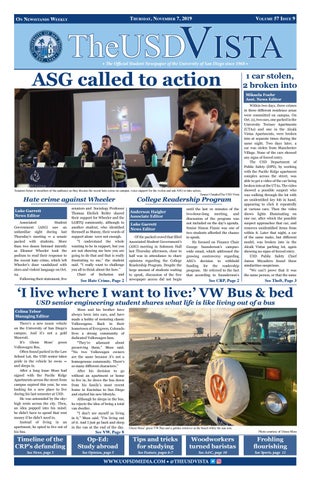
Senators listen to members of the audience as they discuss the recent hate crime on campus, voice support for the victim and ask ASG to take action. Tanner Claudio/The USD Vista
Hate crime against Wheeler
Luke Garrett News Editor Associated Student Government (ASG) saw an unfamiliar sight during last Thursday’s meeting — a senate packed with students. More than two dozen listened intently as Eleanor Wheeler took the podium to read their response to the recent hate crime, which left Wheeler’s door vandalized with slurs and violent language on Oct. 24. Following their statement, five
senators and Sociology Professor Thomas Ehrlich Reifer shared their support for Wheeler and the LGBTQ community, although to another student, who identified themself as Manny, their words of support alone were not enough. “I understand the whole wanting to be in support, but you are not showing me how you are going to do that and that is really frustrating to me,” the student said. “I really want to challenge you all to think about the how.” Chair of Inclusion and
See Hate Crime, Page 2
College Readership Program
Anderson Haigler Associate Editor Luke Garrett News Editor Of the packed crowd that filled Associated Student Government’s (ASG) meeting in Solomon Hall last Thursday afternoon, close to half was in attendance to share opinions regarding the College Readership Program. Despite the large amount of students waiting to speak, discussion of the free newspaper access did not begin
until the last 10 minutes of the two-hour-long meeting, and discussion of the program was not included on the day’s agenda. Senior Simon Finnie was one of two students afforded the chance to speak. He focused on Finance Chair George Saunderson’s campuswide email, which addressed the growing controversy regarding ASG’s decision to withhold funding for the readership program. He referred to the fact that according to Saunderson’s
See CRP, Page 2
Within two days, three crimes in three different residence areas were committed on campus. On Oct. 22, two cars, one parked in the University Terrace Apartments (UTAs) and one in the Alcalá Vistas Apartments, were broken into at separate times during the same night. Two days later, a car was stolen from Manchester Village. None of the cars showed any signs of forced entry. The USD Department of Public Safety (DPS), by working with the Pacific Ridge apartment complex across the street, was able to get a video of the car being broken into at the UTAs. The video showed a possible suspect who was walking through the lot with an unidentified key fob in hand, appearing to click it repeatedly at various cars. Then the video shows lights illuminating on one car, after which the possible suspect approaches that car, and removes unidentified items from within it. Later that night, a car of the same make, but different model, was broken into in the Alcalá Vistas parking lot, again showing no signs of forced entry. USD Public Safety Chief James Miyashiro found these similarities suspicious. “We can’t prove that it was the same person, or that the same
See Theft, Page 3
‘I live where I want to live:’ VW Bus & bed USD senior engineering student shares what life is like living out of a bus
Celina Tebor Managing Editor There’s a new iconic vehicle on the University of San Diego’s campus. And it’s not a gold Maserati. It’s Glenn Moss’ green Volkswagen Bus. Often found parked in the Law School Lot, the USD senior takes pride in the vehicle he owns — and sleeps in. After a long lease Moss had signed with the Pacific Ridge Apartments across the street from campus expired this year, he was looking for a new place to live during his last semester at USD. He was astounded by the skyhigh rents across the city. Then, an idea popped into his mind: he didn’t have to spend that rent money if he didn’t need to. Instead of living in an apartment, he opted to live out of his bus.
Timeline of the CRP’s defunding See News, page 3
Moss and his brother have always been into cars, and have made a hobby of restoring classic Volkswagens. Back in their hometown of Evergreen, Colorado lives a strong community of dedicated Volkswagen fans. “They’re adamant about preserving them,” Moss said. “No two Volkswagen owners are the same because it’s not a homogenous community. There’s so many different characters.” After his decision to go without an apartment or home to live in, he drove the bus down from his family’s most recent home in Encinitas to San Diego and started his new lifestyle. Although he sleeps in the bus, he rejects the idea of being a total van dweller. “I don’t see myself as living in it,” Moss said. “I’m living out of it. And I just go back and sleep in the van at the end of the day.
See VW, Page 8
Op-Ed: Study abroad See Opinion, page 5
Glenn Moss’ green VW Bus and a golden retriever at the beach while the sun sets.
Tips and tricks for studying See Feature, pages 6-7
Woodworkers turned baristas See A&C, page 10
WWW.UOFSDMEDIA.COM ◆ @THEUSDVISTA
Photo courtesy of Glenn Moss
Frohling flourishing See Sports, page 11
2
The USD Vista
◆
November 7, 2019
NEWS
Hate crime addressed at ASG Eleanor Wheeler garners support from ASG and prompts discussion on ASG action
Hate Crime from Page 1
Diversity Committee Jesse Magaña responded to the student’s concern by welcoming all to his committee meetings, and noting that in his opinion, ASG can only do so much. Magaña stressed his view that at the end of the day, the top university administrators are the ones who can make a difference in the campus community. “(Change) has to come not only from the students in this room, but the level of administrators — I am talking about those who are on the executive council: the president, the provost, the vice president — because how often do we see them walking around campus talking with students?” Magaña asked.
He then critiqued administrators for not being available to students, adding that they need to “face the facts.” “I am tired of seeing pictures of President Harris just plastered in specific places on campus where the money is and not where the students are,” Magaña said. “It’s exhausting, because people refuse to come out of their offices and answer questions and face the hard facts. Nobody is answering the really tough questions that need to be answered on a level that is far beyond anyone else’s pay grade.” Multiple senators nodded in agreement to Magaña’s claim. The administrators mentioned in Magaña’s statements declined to immediately comment.
Others within the crowd had their own response to the call to action. Alanna Bledman made mention of an underground network that is able to make immediate change without the speed bumps of bureaucracy. “There is this sort of underground secret network of students who are on call and ready to go whenever and for whatever,” Bledman said. “Me and my friends are infiltrators of systems. We get in these meetings and we get into these buildings and we make sure we do not leave until change happens.” A few other students chimed into the discussion with words of support and the desire to create change on campus.
Eleanor Wheeler speaks to the ASG senate and the dozens in the audience. Tanner Claudio/The USD Vista
Students want the CRP back Two students out of a dozen given the opportunity to address ASG about the CRP
CRP from Page 1
statement, at least one out of five USD students used the nowdefunded digital subscription. “To think that one out of five people on this campus does anything is a feat unto itself,” Finnie said. He went on to address ASG’s assertion that Copley Library’s newspaper database access is comparable to the free subscriptions provided by the College Readership Program. “The access provided by the Copley database satisfies none of the needs of the readers at the university,” Finnie said. “The solutions provided in the email were concessions to us. As if to say, we are taking away something you really really want and giving a few things in return.” In response, Saunderson turned the conversation from the percentage of student usage and instead both minimized the significance of the number of student signatories on the petitions, and seemingly discouraged students from using more meeting time to discuss the issue. “I do want to mention that 350 students is one third, if not less than the number of those who subscribe to the Wall Street Journal,” Saunderson said. “Finance Committee has a meeting in two weeks where we are strictly talking about the College Readership Program. Until something is actually set in stone, there is just, nothing now.” Though Saunderson acknowledged that the contentious debate surrounding the College Readership Program is “a pressing matter on campus,” his plan to address students’ concerns in his meeting next week omitted a significant detail
— finance committee meetings are not open to the public or the media. After Finnie’s statement, the time that ASG allotted for public comment allowed only one more student to offer their opinion. Senior Tyler Arden, who had previously asked ASG for greater transparency, came back to senate
He continued on to challenge ASG to take action on increasing transparency in their organization. “I am urging you to take transparency seriously and pass a resolution within the next couple of meetings to make the whole ASG budget public,” Arden said. “This body is not the Department
is at the top of our list,” Moreno Armenta said. “But I cannot promise you that I can make that my priority as we have heard there have been students being targeted for their identity.” After both Finnie and Arden’s statements before the senate, several students raised their hands in attempts to share their
TOP: ASG senate voting on a motion. BOTTOM: Dozens of audience members sitting through ASG agenda items. Tanner Claudio/The USD Vista
with a similar message. “The College Readership Program is a manifestation of those transparency issues,” Arden said. “You oversee a budget of over a million dollars of our money as students, yet most students could not tell you where that money goes.”
of Defense, and a black budget does not seem necessary in my opinion.” Speaker of the Senate Carolina Moreno Armenta acknowledged Arden’s desire for transparency, but chose to keep her focus on other issues. “Personally transparency, yes,
opinions regarding the College Readership Program. No more of them were heard. Citing the length of the meeting, the end of dead hours and her colleagues’ class schedules, Moreno Armenta allowed any ASG members who needed to leave to depart as students awaited the opportunity
to speak. Since nearly the entirety of the student government left, Moreno Armenta moved to adjourn the meeting due to the subsequent lack of quorum (a minimum level of ASG members present that allows them the opportunity to vote on measures), leaving multiple students frustrated that they were not afforded the chance to voice their concerns, and that ASG did not allocate their meeting time more effectively to allow them that opportunity. Anthony Catanzaro, one of the two petition leaders, was one of the Toreros who did not have the chance to address the student government body on Thursday. “Unfortunately (the College Readership Program) was not on the agenda,” Catanzaro said. “If you tell someone to come to a meeting at least give us some time to talk, which George’s email said.” He also responded to the justification student leaders gave for their decisions. “The library’s (access to newspapers) is incompatible and they have been lying to us,” Catanzaro said. The College Readership Program, which has been present on the USD campus in some shape or form for more than a decade, was dedicated to keeping undergraduate students civically engaged by providing free access to newspapers like The New York Times and The Wall Street Journal. The program has been incrementally defunded over the past two years by ASG. Last year, ASG defunded the physical versions of three newspapers, and this past month, ASG defunded the program in its entirety, which now leaves students without their free digital subscriptions.
Volume 57 Issue 9
◆
NEWS
3
The USD Vista
◆
Timeline: The College Readership Program ASG leadership team No referendum was given defunded physical newspapers to students, although after unofficial 100-person ASG funded two digital poll subscriptions to NYT and WSJ
Summer 2018 2007 - 2017
CRP funded physical copies of the The New York Times, USA Today, and The San Diego Union-Tribune
ASG promised to fund at least one of the two digital subscriptions
October 2018May 2019
September 2019
October 2018
May 2019
ASG senate unnanimously voted for campus-wide referendum to let students decide on CRP
ASG defunded one of the two digital subscriptions.
ASG leadership team defunded the entire College Readership Program
ASG Finance Committee will meet to determine the fate of the College Readership Program
October 17, 2019 October 8, 2019
USD student access to The Wall Street Journal digital subscription ends
November 12, 2019
November 5, 2019
USD student access to The New York Times digital subscription ends Luke Garrett/The USD Vista
Suspect used fob to rob cars USD Department of Public Safety has video of car thief; stolen car was returned
Theft from Page 1
thing happened, but it was very interesting that these incidents happened in the same night,” Miyashiro said. “They happened to two very similar cars, and we have a suspect on video with a suspicious type of key fob that we know worked on one of the cars.” The Alcalá Vistas break in was not captured on video because the victim’s car was parked away from posted cameras. However, according to Chief Miyashiro, the victim was positive that they had locked their car the night before. The car theft occurred some time during the night of Oct. 23, after the car was parked at 10:30 p.m. in Manchester Village. According to Chief Miyashiro, the stolen car was a newer model, which means that it couldn’t have been manually started without a programmed key. Earlier in the day on Oct. 23, the victim had gotten into a minor car accident and ended up losing one of their two keys to the car. “It is unknown if someone possibly picked up the key and followed them to where they parked their car, because there were no signs of forced entry, or attempts to manually start the car,” said Miyashiro. The victim’s car was found by the San Diego Police Department on Oct. 25 in Downtown San Diego and returned to the victim. These incidents raise questions
about security on campus, but Chief Miyashiro does not believe these occurrences are cause for concern. “It is not unusual to have car break ins on campus because this just like any open area with lots of cars,” said Miyashiro. “Our crime rate is actually pretty low because we have lots of well-lit areas, and people constantly walking around, especially since students are always out and about no matter what time it is.” Students can find these crime rates in the 2019 USD Annual Fire and Safety Report published online every year. During the 2018 calendar year there was only one car theft, down from 10 during 2017. There is not an explicit crime section for vehicle break ins, but in all there were eight burglaries. This statistic would also include residence hall and any other reported, nonviolent, theft. However, not all students share Miyashiro’s confidence. Riley Kawananakoa, a sophomore student living in the UTAs, believes that the security guards could be doing a better job. His car was recently broken into off campus. “Speaking as someone who recently had their car broken into, it sucks,” said Kawananakoa. “Also, there is supposed to be a security guard at the UTAs, but whenever I see him he is just
sitting in his car and looking at his phone. So I think that could be better.” Daniel Sarrao’s confidence in Public Safety has also been shaken by these events. Sarrao is a Junior resident in Manchester who is now much more worried about the safety of his car. “It makes me very nervous because I park my car in the same area of the one that was stolen,” Sarrao said. “It’s not a good feeling.” Sophomore Alcalá Vistas
resident Jackie Brown hopes that Public Safety will do more to reduce crimes like these, but also recognizes the shortcomings of students in these situations. “No one should be breaking into cars, but also people shouldn’t leave anything that they’re worried about being stolen in their car and always make sure to lock it,” said Brown. Chief Miyashiro notes the importance of each person doing their best to prevent crimes like these. The best preventative
measures, according to Miyashiro, are to keep valuable objects out of plain sight and to park in well-lit areas whenever possible. He also said that by next month, all of the parking areas on campus will be equipped with security cameras, in an attempt to deter crimes from occurring. Crimes or suspicious persons on campus can be reported to USD Department of Public Safety at (619) 260-7777 for nonemergencies, or (619) 260-2222 for emergencies.
flourishing
According to the 2019 USD Annual Fire and Safety Report, there was one car theft in 2018, compared to 10 in 2017. Mikaela Foehr/The USD Vista
Retraction 10/24 The USD Vista incorrectly reported that The New York Times subscription would end on Nov. 8. The NYT subscription ended on Nov. 5 The USD Vista incorrectly gave photo attribution to Zoé Morales Martinez for the two photos on page 12. Thomas Christensen took the two photos.
The USD Vista Kaia Hubbard - Editor in Chief Anderson Haigler - Associate Editor Celina Tebor - Managing Editor Amy Inkrott - Copy Editor Alee Pingol - Art Director Luke Garrett - News Editor Eric Boose - Opinion Editor
Catherine Silvey - Feature Editor Lizzy Jennings - Arts & Culture Editor Chris Spiering - Sports Editor Zoé Morales Martinez - Photo Editor Connor Buckley - Distribution Manager Molly Feeney - Social Media Manager Jake Schmid - Finance Manager
Editorial – 619.260.4584 Business – 619.260.4714 www.uofsdmedia.com / @TheUSDVista Razann Rizk - Advertising Manager Gina Lew - Student Media Advisor Marie Minnick - Operations Advisor
The USD Vista publication is written and edited by USD students and funded by revenues generated by advertising and a student fee. Advertising material published is for information purposes only and is not to be construed as an expressed or implied endorsement or verification of such commercial venues by the staff or University. The USD Vista office is located on the fourth floor of the Student Life Pavilion in room 403B. All inquiries should be sent to: The USD Vista 5998 Alcala Park San Diego, CA 92110 Opinions expressed in this publication are not necessarily those of The USD Vista staff, the University of San Diego or of its student body. Letters to the Editor can be submitted to The USD Vista office. Letters should be limited to 300 words and must be signed. For identification purposes, USD identification numbers and writer’s year must be included in the letter. The USD Vista reserves the right to edit published letters. Any content sent to the editor will be considered for publication unless otherwise stated.
4
The USD Vista
◆
November 7, 2019
OP I N ION
Thinking outside the lines Political opinions are not out of bounds for professional athletes
Audrey Garrett/The USD Vista
Eric Boose Opinion Editor On Monday, the World Series champion Washington Nationals visited the White House. At least, most of them did. Nationals relief pitcher Sean Doolittle was notably absent from the visit, having declined the invitation on Friday. Speaking to The Washington Post, Doolittle said, “At the end of the day, as much as I wanted to be there with my teammates and share that experience with my teammates, I can’t do it.” Doolittle explained that he made his decision because of the
multitude of issues he takes with the president’s rhetoric. Doolittle and his wife are actively involved in their communities, and the Doolittle family has close ties to many groups Trump has attacked. “My wife and I stand for inclusion and acceptance,” Doolittle said. “We’ve done work with refugees, people that come from, you know, the ‘s---hole countries.’” Doolittle’s comment was in reference to Trump’s comments about Haiti, El Salvador, and African countries from January 2018. “I have a brother-in-law who has autism, and (Trump) is a guy
that mocked a disabled reporter,” Doolittle explained further. “How would I explain that to him that I hung out with somebody who mocked the way that he talked or the way that he moves his hands? I can’t get past that stuff.” To put it simply, Doolittle said, “I don’t want to hang out with somebody who talks like that.” Following his decision, Doolittle was told by swarms of Twitter users that he should “respect the office of the president” and that he should “stick to sports.” That second comment, the suggestion that athletes should “stick to sports,” has become increasingly common since the 2016 election. Doolittle is not the first to hear it, nor will he be the last. It has become so common, in fact, that any athlete making any statement about anything other than sports is almost inevitably followed by at least a handful of people suggesting they stick to sports. The suggestion that athletes stick to sports is as problematic as it is common. First, it implies that athletes are somehow not qualified to have opinions about things other than sports. Second, it is frequently used as a defense mechanism — delegitimizing someone’s opinion rather than taking the time and effort to process a different opinion. Finally, athletes have the power to do some real good off the field. Athletes pay attention to and are involved with things other than sports every day. They have personal lives outside of their job, just like everyone else. They have families and friends other than their teammates. Doolittle’s choice to skip the Nationals’ White House visit was not because of his politics, although he did mention that he disagreed with many of the president’s policy proposals. No, Doolittle passed on
the White House largely because of his family. Doolittle’s wife has two mothers, and he called his decision to skip the White House “an important part of allyship,” not only with his grandmothersin-law, but with his autistic brother-in-law as well. However, even if Doolittle’s decision was purely political, he would still have a right to make it. No other profession is so frequently told to stay out of politics. Rarely, if ever, is someone told that they should just “stick to plumbing” or “stick to accounting.” The founding principles of this country assert that everyone has the right to their opinion on how the country is governed, at least in theory. Professional athletes have as much of a right to make political comments as the Twitter users telling them to stop. Whenever an athlete is told to stick to sports, it never seems to be a bipartisan notion. It seems that the only people telling someone to stay in their lane are people who disagree with them. This knee-jerk defensive reaction is understandable, but unproductive. When we tell someone to stick to sports or otherwise stay in their lane, we end the discussion. While that keeps our feelings intact and protects us from potentially uncomfortable situations, it also keeps us from having those necessary conversations. At this point, it is worth mentioning Nationals catcher Kurt Suzuki. Unlike Doolittle, Suzuki attended the White House visit. While there, Suzuki wore a “Make America Great Again” hat. Suzuki, like Doolittle, has every right to his political opinion. Moreover, we cannot be selective in who gets to speak out. Every athlete gets to share their opinions, whether we agree with them or not.
The intense political polarization in this country is well-documented, and it will not go away if we simply disregard or seek to silence people who disagree with us. At some point, we have to be willing to at least try to understand opinions other than our own. A good deal of athletes are involved in things other than sports beyond just giving their opinions. Houston Texans star J.J. Watt was never told to stick to sports when he was helping the city recover from Hurricane Harvey. Former Philadelphia Eagles player Chris Long was not told to stick to sports when he donated his salary to charity. Doolittle has never been told to stick to sports while working with military veterans and families. In fact, Doolittle received the Bob Feller Act of Valor Award for that work. Athletes doing charitable work off the field is nothing new, nor is it anything condemned. Multiple leagues, including the National Football League and Major League Baseball, have major awards for players who make the biggest impacts on their community. Why is charitable work never met with the suggestion that athletes stick to sports? Because charity is not controversial. Frankly, if athletes truly did stick to sports, the world would be worse off. Professional athletes have some of the greatest power to do good, both in terms of finance and influence. Asking them to confine themselves to sports alone cuts off one of the greatest avenues for charitable work. There is no reason athletes should be expected to diminish their entire existence to only revolve around sports. Good things tend to happen when they go beyond that. Professional athletes have not, will not, and should not just stick to sports.
Sharing the same pack
The assumed rivalry between vape and tobacco companies is actually a partnership Jennifer DeSantis Op-Ed Contributor Warnings about the dangers of smoking, vaping, and Juuling dominate the media, which they should — any of these activities are dangerous to one’s, and others’, health. However, we should not let the news reports about vapingrelated illnesses distract us from the fact that special interest groups in Washington, D.C. that lobby on behalf of predaceous cigarette companies are taking advantage of addicted Americans. What is worse is that these lobbyists are not just working for
traditional tobacco companies, but also for the electronic smoking industry, which benefits from the tobacco companies. If we want to end this health crisis, we have to understand the maneuvers of these companies and their lobbyists and confront the unfortunate truth that America’s capitalist market is working to undermine the nation’s health. A brief, but necessary interlude: what is a lobbyist? A lobbyist is an essential part of our constitutional right “to petition the government for a redress of grievances.” A lobbyist is someone who can represent the
voice of the people and bring their “grievances” to the government. Unfortunately, some lobbyists are not very interested in representing the people; rather, they are more interested in accepting what we will call “legal bribes” to push legislation and rules to favor their, let us say, “sugar daddies” — i.e. tobacco companies and the electronic smoking industry. Yes, traditional tobacco companies and the electronic smoking industry are best friends, even if the tobacco companies want to keep that a secret. Consumers of vape products believe that buying e-cigarettes
and Juuls are effective ways to wean off of cigarettes; they think that they are pulling away from the grips of giant cigarette corporations for a “healthier” option. This is not true. Cigarette companies have bought into the vape industry and actually own large percentages of the companies, so consumers are not escaping the holds of the tobacco industry at all. The assumed rivalry between electric and traditional tobacco products is a farce. Tobacco companies are investing in e-cigarettes to compensate for declining sales of traditional cigarettes. In an article from The
American Prospect about tobacco and nicotine policies, writer David Dayen reveals that Altria — one of the world’s largest producers and marketers of tobacco, cigarettes, and associated products — bought a 35% stake in Juul for $12.8 billion. Philip Morris — another tobacco and cigarette manufacturing company — spent more than $6 billion on the Iqos e-cigarette. When you look beyond the fact that the Juul comes in “cool” flavors like watermelon and is the “safe” alternative to smoking, you will find the wicked truth: their advertisements are
See Vaping, page 5
The views expressed in the editorial and op-ed sections are not necessarily those of The USD Vista staff, the University of San Diego, or its student body.
Volume 57 Issue 9 Vaping from Page 4
lies funded by the very companies that Americans are trying to escape and encouraged by political lobbying. Major tobacco giants have specific lobbyists who use two typical strategies: they either persuade lawmakers to completely kill proposed bills that affect their benefactors, or they will convince lawmakers to weaken the language of a bill so that it opens more loopholes for their companies to manipulate. In the case of the Altria Group, both the tobacco company and Juul benefit from public lobbying in Washington. Bills that limit e-cigarette sales work to boost tobacco sales as people seek to satisfy their nicotine addictions through either method. Weakening any prohibition on vaping allows for better profits for the tobacco companies that hold
high stakes in them. Even if users of Juul and vape products are not inhaling the 7,000 chemicals found in cigarettes, they are giving their money to corporations that design and market cigarettes. Consumers are still providing the
◆
OPINION
◆
and therefore bring up the question, are e-cigarette and vape companies actually anti-tobacco? By analyzing the relationship between Altria and Juul, as well as the integration of Philip Morris into the vaping industry, it is obvious that these companies
If we want to end this health crisis, we have to understand ... and confront the unfortunate truth that America’s capitalist market is working to undermine the nation’s health. tobacco industry with sufficient funds to allow them to maintain functionality and privately invest in other nicotine products in case the cigarette industry falls victim to the newest vaping flavor. For example, Philip Morris International, the producer of the Iqos vape pen, has launched a series of commercials and ad campaigns that are not explicitly against traditional cigarettes,
are working together to keep the American public addicted and buying. It is clear — consumers are stuck in a pit of addiction: they need nicotine to satisfy their craving, yet many people nowadays want to stay away from highly dangerous cigarettes. Yet, as previously described, no matter what products they are buying, they are still spending money on
5
The USD Vista items backed by these cigarette companies. Anti-smoking commercials warn consumers about the health risks of cigarette smoking, yet they do not warn about the stalking nature of the ever-lurking tobacco industry. There is something malicious about these companies as they insert themselves sneakily into government and politics so that their monopolies on the health of America can reign supreme while thousands of teenagers across the country become addicted to nicotine every day. The main issue here is twofold. First, there is the moral implication of tobacco companies’ control over American consumers and how ruthlessly they aim to maintain their profits even when their trade seems to be dwindling by the years. They have rushed in to claim major stakeholder positions in Juuling and vaping
Home sweet Rome
because these are the latest trends in popular culture; they do not care if it is trending in the youth of America. Second, is the problem with lobbyists. Those with the most money have the largest voices and, in terms of the U.S. market, that would be the tobacco corporations who can line the pockets of lobbyists who are then willing to protect their murdering, uncaring backers. What unites these two elements is one thing: greed. But this is also where the American public can step in. If we can recognize the greed that infiltrates marketing and lawmaking, then we can push to get money out of politics. We have to start noticing what is going on behind the glossy ads and sensational news reports; we need to invest time into politics and understanding how to find representation for our voices. We need to pay attention – now.
Culture shock and adjusting to life and school thousands of miles from home Jennifer Mossuto Op-Ed Contributor After my family dropped me off at LAX and I slowly made it onto my plane with baby tears in my eyes, I only had three thoughts: What have I done? What if this plane goes down? And my best case scenario is that I relive the Lizzie McGuire movie and ride around on a Vespa with an Italian boy named Paulo. Eventually, my first two thoughts dissipated and I amazingly made it to Rome (not without bumps of course). My third thought has not come true yet, but I still have 36 days left here and I am choosing to be hopeful. Studying abroad for a semester is one of the most popular things you can choose to do at USD. Being ranked No.1 for undergraduate study abroad participation with 79.6% of undergraduate students going abroad as of Nov. 2018, USD praises itself for how accessible they make this opportunity for all of their students. The study abroad administration was incredible in answering any questions I had, directing me to contacts at my new university, and guiding all of us through our visas and our applications. However, there is simply no amount of study abroad meetings or emails that I could send to the advisors that would have prepared me for what I found in Rome. The reality is that no one could have described to me what culture shock really means, and what it is really like to move to a new country. This is still such an incredible experience and I got all the help I could, but eventually it is another thing in your life that only becomes what you make of it. I am not going to say it is already “changing my life” because realistically, it is still my life but in a different place. I often forget that I am even in
Rome until I walk across the street and a Vespa flies past me so quickly that my roommate has to pull me back onto the sidewalk by the loop in my backpack. Then we proceed to walk across the street carefully to get our daily gelato. My first day of class I was enlightened to the tradition of the cannon. Every single day at 12 p.m. there is a tower that shoots a medieval cannon, and I surprisingly find comfort in
cappuccino. Two older Italians work there and the woman winks at me when I leave. She does not speak good English, but always knows to give me two packets of brown sugar with my coffee — that is the best part of my day. The surreality of living in Rome only hits me at the strangest times. I can walk to the top of the Spanish Steps on a warm Tuesday night, feeling my calves burning, and until I get to the very top, I think I could be
of cats and they are always roaming around, saying their quick “hellos.” As I have been adapting, I have learned a few tips and tricks of being abroad in Rome. You are likely to pay more money if you sit in a cafe than if you buy something and leave with it, and yes, it is cruel and common. You also unfortunately pay for water in Italy, but the trick to that is that you can ask for free tap water, but you have to be
Studying abroad presents many unexpected challenges and new experiences. It also provides views like this. Photo courtesy of Jennifer Mossuto
this as it almost sounds like the Immaculata bells chiming right in the middle of a mesmerizing lecture at USD. The first time I heard this cannon, though, I thought it was a gunshot, but thankfully my professor from the Bronx was quick to tell everyone that noise was simply part of the city’s daily routine. My personal daily routine is pretty similar to my normal routine at home. Instead of getting my iced coffee at Tu Mercado, I go to a little bar off of the main road and order a
anywhere, just walking on some steep steps. Similarly, when I walk home from the mall I catch a small glimpse of the side of the Colosseum, and not a single thought, other than “oh look, the Colosseum again” passes my brain. Many people would think these incredible sights would be the highlight of living here, but my favorite sight is the cat sanctuary at the forum. The sanctuary is a Pompeii-like series of destroyed buildings. They feed and house dozens
persistent. Another big question I am often asked is if you can drink the tap water in Rome. I personally do not, but a lot of my friends here do and they have yet to be found vomiting profusely. I am also constantly asked if I am even going to school. The best way to explain my school is to picture USD but in a Hunchback of Notre Dame setting (animated version) and also picture every school day being the Milan fashion show because Italians really know how to dress. Also, picture lots of stray cats. Oh, and
people drinking straight bottles of Absolut vodka at breakfast. People often ask me if I am missing home yet. I will tell you what I do miss — Mexican food, the beach, and my dog. But the funniest things my friends have told me that they missed would be chocolate milk, pulled pork sandwiches, and a specific creamsicle from the ice cream trucks at the beach. The biggest difficulty of being abroad is deciding whether or not you are going to travel or stick around for the weekend, and also figuring out where the money for this traveling is going to come from. We are all still figuring that out, while having to often remind each other just how special it is to be here in the first place. I have already been swimming in the Mediterranean, eaten pretzels bigger than my head in Germany, ridden in a gondola during a Venice dusk, and walked my way up to the top of Juliet’s tower in Verona. My biggest adventure so far has been enduring Oktoberfest — Germany’s most famous festival. As we entered, we heard the gunshots go off announcing the tapping of the first keg, but that moment was soon cut short as hundreds of horses paraded through the streets without stopping for anyone or anything. Although often unplanned, each weekend brings us new places, new people, and new memories. Is what we all felt at the beginning of a simple culture shock? A fear that maybe we did not make the right choice? Maybe, but it is also just a change in environment, like moving to a new city or school. If you are going to study abroad, my only piece of advice is to have no expectations because we are all still constantly adapting to what each new day brings. You can do all the right things, attend all the meetings, but at the end of the day, it is only what you make of it.
The views expressed in the editorial and op-ed sections are not necessarily those of The USD Vista staff, the University of San Diego, or its student body.
6
The USD Vista
STUDY HABITS
November 7, 2019
◆
Despite different majors, grade levels, and skill sets, all University of San Diego students must encounter evaluations of all kinds throughout their time as Toreros. Because there is no standardized studying or learning process, each student studies differently, with a variety of methods and techniques used to achieve individual success. Below, six Toreros share their personal studying habits and experiences.
ANDREW YATES, Junior Major: Political Science
Photo courtesy of Andrew Yates
Do you prefer to study alone or in a group? ISABELLE GEHRS, Junior
Major: Behavioral Neuroscience
XIAOCONG HAN, Sophomore Major: Undeclared
Photo courtesy of Xiaocong Han
Photo courtesy of Isabelle Gehrs
Do you prefer to study alone or in a group?
Do you prefer to study alone or in a group?
“I prefer to study alone. I’m too social, and I’ll get distracted in a group.”
“Study alone.”
What is your favorite studying method (i.e. flashcards, study guide, reading aloud, teaching others, etc.)? “Flashcards, study guides, and Quizlet.” Are there any studying moments you are very proud of (working hard against a deadline, achieving a grade goal, etc.)? “Working against a clock or staying up all night and then feeling like I aced an exam makes it all worth it.” Have your study habits changed through the transition from high school to college? “Definitely. I didn’t study before college but now I do.”
What is your favorite studying method (i.e. flashcards, study guide, reading aloud, teaching others, etc.)? “Teaching others, making questions to test myself.” Are there any studying moments you are very proud of (working hard against a deadline, achieving a grade goal, etc.)? “I’m proud of the moments that I plan carefully and work accordingly before deadlines.” Have your study habits changed through the transition from high school to college? “Definitely. I was actually very lazy in high school, and I procrastinated a lot. Now I still procrastinate sometimes, but I’m trying to improve. I put a lot more effort in studying now.”
What advice would you give to other students? Do you have a studying tip or trick that helps you to learn?
What advice would you give to other students? Do you have a studying tip or trick that helps you to learn?
“Find what works for you for different subjects and run with it.”
“Previewing before classes and regular revising after classes helps a lot.”
“I prefer to study with other people.” What is your favorite studying method (i.e. flashcards, study guide, reading aloud, teaching others, etc.)? “I create study guides on Google Docs for complex topics and use flashcards for things like vocabulary words.” Are there any studying moments you are very proud of (working hard against a deadline, achieving a grade goal, etc.)? “I am generally proud of the grades I receive, and I feel that they are directly connected to the amount of studying I do outside of class.” Have your study habits changed through the transition from high school to college? “My study habits have definitely changed, I make a serious effort to study ahead of time in college, while in high school I would often study only the day before a test.” What advice would you give to other students? Do you have a studying tip or trick that helps you to learn? “I would advise other students to work together, particularly to make study guides. Having another person’s perspective of what was taught can add to your understanding of the material.”
Volume 57 Issue 9
ANDREA GARCIA, Senior Major: Biology
Photo courtesy of Andrea Garcia
Do you prefer to study alone or in a group? “I prefer studying alone. My productivity plummets to zero when I’m with a group.” What is your favorite studying method (i.e. flashcards, study guide, reading aloud, teaching others, etc.)? “It depends on the subject, but usually once I finish typing up a study guide, I like to handwrite it a couple of times.” Are there any studying moments you are very proud of (working hard against a deadline, achieving a grade goal, etc.)? “I’m really proud of getting an overall 99% in my third semester French class.” Have your study habits changed through the transition from high school to college? “Everything is so fast paced in college so no matter how hard I try, I’m always cramming for an exam. In high school, I always had the time to study at least a week in advance. I do study more content now though, I’m able to get through more information quicker than in high school.” What advice would you give to other students? Do you have a studying tip or trick that helps you to learn? “I really like making my own school-related parodies to my favorite songs. It really helps me remember the information. I think trying to make studying fun is really helpful because sitting there trying to make the information absorb just doesn’t work.”
◆
FEATURE
◆
7
The USD Vista
GRACE CAPONETTO, Sophomore
Major: International Relations, Spanish Photo courtesy of Grace Caponetto
Do you prefer to study alone or in a group? “I like to study in a combination of groups and alone.” What is your favorite studying method (i.e. flashcards, study guide, reading aloud, teaching others, etc.)? “My favorite study method is making a study guide.” Are there any studying moments you are very proud of (working hard against a deadline, achieving a grade goal, etc.)? “Spring semester last year, I worked really hard and was able to end the year with straight As.” Have your study habits changed through the transition from high school to college? “Honestly, in high school I didn’t study much, especially senior year. I would study for the classes that were really demanding but not very much or very productively. In college, I had to re-teach myself how to study and find what is best for me all over again.” What advice would you give to other students? Do you have a studying tip or trick that helps you to learn? “The best study trick I’ve learned is to know when to stop. Make sure you sleep and take care of yourself mentally and physically in the days leading up to the exam. Go into it knowing that one grade won’t change your whole life and that whatever the outcome is, you will be okay.”
MEGAN JONES, First Year Major: Undeclared
Photo courtesy of Megan Jones
Do you prefer to study alone or in a group? “I prefer to study by myself.” What is your favorite studying method (i.e. flashcards, study guide, reading aloud, teaching others, etc.)? “I like using Quizlet or teaching someone not in that same class the topic.” Are there any studying moments you are very proud of (working hard against a deadline, achieving a grade goal, etc.)? “For one of my midterms this year, I started creating a Quizlet at the beginning of the course with all of the notes that were taken and I began studying slowly. I ended up getting an Aon the test so I was very proud of that.” Have your study habits changed through the transition from high school to college? “I feel my habits have changed a bit because I have a lot more time to complete everything throughout the day. Since I don’t have a ton of extracurricular activities like I did in high school, it’s a lot easier to handle everything and stay on top of my work.” What advice would you give to other students? Do you have a studying tip or trick that helps you to learn? “My advice for other students would be to have a routine that you do every day when doing your homework. To stay motivated to do my work, I also like to give myself incentives and rewards for completing assignments.”
Spread by Alee Pingol/The USD Vista; Content by Catherine Silvey/The USD Vista
8
The USD Vista
◆
November 7, 2019
FEATURE AR TS &
The cheapest rent around
Senior Glenn Moss lives out of his Volkswagen Bus during his last semester at USD
VW from Page 1
But I think that distinction is important, because through that distinction, I’ve had a stronger community on the USD campus this semester.” And the most precious moments — the spontaneous ones — come out of that distinction he draws. When Moss was living in an apartment, he’d generally go home after his classes and stay off campus. Now, he doesn’t feel a need to go back to the bus and spends more time with his friends. “I don’t feel like I have to have a living room, because my living room is the people I’m living with,” Moss said. “And the people I’m living with is the community, the people around me.” He goes home to his family, who now live in Encinitas, every week to do what he calls his “weekly reset.” This is when he gets to do some laundry, get some home-cooked food, and say hi to the dog. Living out of the bus has forced a lifestyle change in Moss: he now appreciates getting up early and staying organized. If one thing becomes disorganized
Glenn Moss finds freedom in living out of his Volkswagen Bus after ending a lease agreement with the Pacific Ridge Apartments. Photo courtesy of Glenn Moss
in the bus, everything quickly becomes a mess in the tiny space. “I’m not much of a planner, and you really have to learn to
plan,” Moss said. “Knowing what the week ahead is going to look like and being able to plan it out.” Volkswagen restoration
isn’t just a hobby, however. He plans to take his passions into his career with his mechanical engineering degree.
For his senior design project, Moss converted his 1963 Volkswagen Beetle to an electric car with a team of a few other electrical and mechanical engineers. They took a motor from a crashed Tesla and put it in his car. With his career path, he’s been looking at jobs up in the Bay Area; if he lands one, he’s considering living out of his bus full-time. He says it wouldn’t be that much of a stretch from what he’s doing now: he would just need to add laundry and cooking to the lifestyle. Living out of a bus isn’t the easiest lifestyle in the world. But for Moss, the benefits outweigh any difficulties he faces. “The best thing is how it keeps me outside,” Moss said. “And it keeps my freedom. I can be wherever I want to be, and live where I want to live.” This will be the green Volkswagen Bus’s first and last semester on USD’s campus. But it, and Moss, can teach every USD community member a valuable lesson even long after it’s gone: live life outside the dorm, apartment, or house, and make the community around you home.
Volume 57 Issue 9
◆
ARTS & CULTURE
◆
The USD Vista
A RT S & C U LT U R E
9
A Bite of San Diego: Coffee
Trading Copley for coffee shops; the five best coffee and study spots for students Shelby Todd Asst. A&C Editor With more than half of Copley Library closed due to renovations, students are on the hunt for a new study spot. Coffee shops, to which San Diego is home to many, have always been go-to places for students to get work done. Now, more than ever, finding a great coffee shop that checks all the boxes of a study environment is necessary. Here are five close-tocampus options to choose from. Brick & Bell Cafe 976 Felspar St. San Diego, CA 92019 Iced Vanilla Latte: $3.45 Free Wi-Fi: Yes Brick & Bell Cafe’s Pacific Beach location is the perfect spot for USD students looking for a new place to get work done. The quaint yellow cottage that houses the cafe is spacious and homey, with friendly baristas and tasty food and drinks. The indoor spaces offer a cozy study area with electrical outlets scattered around the benches and tables. Outside, the spacious patio and garden have plenty of seating available to enjoy San Diego’s beautiful weather. The quiet shop is usually filled with students and professionals getting work done, and the drinks and food are good fuel for a long study session. While they offer a typical spread of drinks and pastries, the standout
The unique tropical decor of Grounds Bean Bar makes this coffee shop as aesthetically distinctive as their expansive and innovative menu offerings. Lizzy Jennings/The USD Vista
menu items include their chai tea latte, freshly-baked scones and for fellow hot chocolate lovers, Brick & Bell Cafe is a can’t miss. Two-hour parking is available in the business area, and street parking in the surrounding neighborhood is usually available.
Better Buzz Coffee 3745 Mission Blvd. San Diego, CA 92109 Iced Vanilla Latte: $4.75 Free Wi-Fi: Yes Better Buzz Coffee has been brewing coffee throughout San Diego since 2002. With four of its 10 locations in Mission and
For around $5, students can indulge in a cranberry scone and a vanilla latte while they study outside at Brick & Bell Cafe. Amy Inkrott/The USD Vista
Pacific Beach alone, Better Buzz Coffee is a popular destination for students to catch up on homework. The Mission Beach location of Better Buzz, known as “The Lab,” is a common spot to find USD students working or meeting up with friends. Though it can be crowded at times, the store boasts plenty of tables, booths, and bar seating at the windows for students to work at. The food menu is extensive, including açaí bowls, gourmet toasts, and sandwiches among other options. The drink menu combines classic coffee drinks with specialties and teas. Popular options include the Best Drink Ever, made with their signature vanilla powder, and the Conscious Chocolate protein infused smoothie. Parking is available in the nearby Santa Clara parking lot by the Mission Bay Aquatic Center. The Grounds Bean Bar 1571 La Playa Ave. San Diego, CA 92109 Iced Vanilla Latte: $4.00 Free Wi-Fi: Yes The Grounds Bean Bar combines trendy design and innovative drinks to create a unique coffee shop experience in the heart of Pacific Beach. Walking into the shop, the geometric, black and white tiled coffee bar mixed with botanical wallpaper creates a beautiful and fun atmosphere. The bright colors are accented by unique drinks, like matcha and turmeric lattes. Owner Brynn Neresian’s former work as a bartender served as the inspiration for creating unique beverages, but their classics, like an iced vanilla latte, are still a hit. The
unique toast selection, including honey ricotta or beet, is also a notable items on the menu. This aesthetically pleasing shop offers bar and table seating inside, as well as an outdoor patio with tables for students looking for a space to spread out. The bright colors and comfy seating are great for having a positive attitude while studying for midterms. Street parking here is limited due to the construction currently taking place. Bird Rock Coffee Roasters 829 Garnet Ave. Pacific Beach, CA 92109 Iced Vanilla Latte: $5.90 Free Wi-Fi: Yes The Morena and Pacific Beach locations of Bird Rock Coffee Roasters are both located close to the USD campus. These shops are the perfect study spots for coffee aficionados. Bird Rock Coffee Roasters is an award-winning roaster that strives to produce sustainable coffee through recycling and composting initiatives in their stores and direct trade relationships in their purchasing process. The Pacific Beach location of Bird Rock is a large study-friendly space that offers some indoor seating and a large, covered outdoor patio with plenty of tables to work at. The large open space is flooded with light and has a warm atmosphere that is perfect for students looking to get work done. The store prides itself on its micro-roasted coffee and popular specialty drinks including the Gold Digger and the Trophy Wife. A small parking lot in the back of the shop is available as well as two hour street parking in front.
10
The USD Vista
◆
November 7, 2019
Go off campus for Claro Coffee Just down the hill from USD, an innovative new coffee shop is the place to study Shelby Todd Asst. A&C Editor
Handmade by the lumberworkers, the decor of Claro serves both functionally and as a display for the handiwork of the staff. Photo courtesy of Claro Coffee
Claro Coffee 5334 Banks Street Suite A San Diego, CA 92110 Iced Vanilla Latte: $4.75 Free Wi-Fi: Yes Nestled into the front room of Made Lumber Supply in Morena’s warehouse district, Claro Coffee is not your average coffee shop. This newly opened coffee spot was built by some of the woodworkers employed by the lumber yard it resides in. The small storefront serves as both a functional coffee bar and a showroom for their work. All of the furniture and decor of the shop are pieces handmade by the woodworkers in the shared space, including the barista making the coffee, Jorge Díaz. The idea to open the storefront began in January when Díaz, partner Jon Boyd, and Made Lumber Supply owner, Bryan Grasela, started brainstorming ways to utilize the space. They eventually decided that a coffee shop would be a unique way to showcase their work and add to the business. “They were proud that they could build everything themselves, and it is wood related,” Angie Díaz, Jorge’s wife and business partner said. After a month of planning, the team began working on designing and building the space, and in August, Claro Coffee was open to the public. The menu at Claro combines simple classics and Cuban specialties, and is inspired by the Díaz’s Cuban heritage. “We added some Cuban
items to the menu because we are trying to bring a little bit of the flavor of our country to you guys, and we think that Cuban coffee is really good,” Angie said. Though it at first appears like an unlikely pair, the name of the shop, Claro Coffee, represents the unique combination of lumber and Cuban coffee. “Everything is built in Claro Walnut, which is one of the most beautiful trees you will find in Northern California,” Angie said, “And, what you call drip coffee in the U.S. is called Café Claro in Cuba.” The mix of these two items is representative of the merging of the two businesses, making it the perfect name for the new shop. The minimalist style of the space highlights the beauty of the Claro Walnut furniture and provides students with a sophisticated place for studying. The large seating area is often filled with students and workers, and the unique location offers a quiet environment perfect for getting work done. If you are in need of a study break while in the coffee shop, guests are often welcome to walk back into the woodworking space to see the work being completed by Made Lumber. For now, Claro Coffee is just starting out, but as the business grows, the Díazes say they hope to begin adding more hours of operation and expanding their menu to offer more food options beyond the variety of pastries they serve now. Limited street parking and a dirt lot at the end of the street are available for students looking to stop by Claro Coffee.
Perfect for an Instagram story, the minimalist decor of Claro Coffee keeps the shop on trend, attracting visitors who are looking for more than just a place to grab a quick cup of coffee.
Photo courtesy of Claro Coffee
Volume 57 Issue 9
◆
SPORTS
◆
11
The USD Vista
SP ORT S
Frohling flourishing
First year Grace Frohling talks about her decision to play volleyball at San Diego Eli Roberts Contributor Most first-year athletes at NCAA Division I schools would be happy to even step foot on the court or the field. Some might get occasional minutes and others might even work their way into starting lineups. But very few have impacted the game so heavily in their first year as University of San Diego volleyball player Grace Frohling. The numbers in themselves are impressive. As an outside hitter, Frohling is among the team leaders in kills, points and blocks. Her biggest games have come against ranked opponents, tallying 14 kills against No. 13 Washington, and 17 kills each against No. 2 Nebraska and No. 20 USC. Yet, Frohling’s arrival at USD may be even more impressive. She came into USD as the team’s only 2019 recruit and the only first year on the team. Frohling acknowledges that her position is a rare one. “I think it’s really unique that I am the only freshman on the team,” Frohling said. “I remember all of my friends when I was about to come here, they were like ‘that’s so weird, you’re the only one.’” Frohling also says that it might be her unique position that allows her to stay so poised and mature in the big moments. “It has kind of helped a lot to make it less pressure because then I just pretend like I’m older than I am,” Frohling said. “So I really don’t even feel like I’m a freshman. I feel like I’ve been here for a while.” Growing up in Oklahoma,
Frohling recorded 17 kills against both No. 2 Nebraska and No. 20 USC. She has a total of 185 kills on the season thus far.
Frohling learned to love volleyball at an early age, following in the footsteps of her older sister Hannah. It wasn’t until her family moved to California in 2016, however, that Frohling knew volleyball was what she wanted to pursue in college and possibly beyond. While many of her friends crumbled under the pressure of the California competitive volleyball circuit, Frohling flourished. She relished the competition and the pressure. It was Hannah’s relentless support that Frohling says helped her succeed in the competitive volleyball world. “She’s always just wanted the best for me,” Frohling said. “We talk all of the time and she just wants me to have the best career I can. She’s always looking out
for me.” That doesn’t mean that there is not a fierce sibling rivalry between the two. Hannah, who is three years older than Grace, is currently a senior outside hitter on the Pepperdine women’s volleyball team. Since both Pepperdine and USD play in the West Coast Conference, the teams and sisters play each other twice per year. “We played with each other my freshman year of high school and that was really good,” Frohling said. “We had our first match up (in college) and it was weird looking across the net and seeing her face. I think the next time we play, though, it will be a little more bittersweet because it will be the last time.” Frohling is quickly becoming one of the most talked about
figures in the Torero sports world. Yet her spot as a major contributor on the team was not a foregone conclusion. In the Toreros’ first game of the season, Frohling was left on the bench. She quickly got her chance against No. 13 Washington, however, when preseason AllWCC member outside hitter Katie Lukes was forced to sit out. “I kind of went into this not knowing whether it would go really well for me or really bad. I remember our first match against Hawaii I didn’t get to play, and I remember I was kind of mad at myself,” Frohling said. “Then I went into practice the next day and just killed it best I could at practice and then I got my shot the next day (against Washington) and I have been playing since then.”
Photo courtesy of USD Athletics
And there seems to be little doubt in the minds of USD sports fans that Frohling will continue to play. As she looks toward the future, Frohling is excited to see the kind of player she can turn herself into. The ultimate goal is to play after college as well, she says. Right now, however, Frohling’s focus is on this season and this team. “We were so close to having some matches that would have put us in the top rankings,” Frohling said. “We want to make a statement and I think we could make it really far this year.” Students can catch Frohling and the Toreros at home against Brigham Young University (BYU) on Friday, Nov. 15 at 7 p.m. in the Jenny Craig Pavilion. Tickets are free for all USD students.
12
The USD Vista
◆
November 7, 2019
Overtime goal stuns USD Pepperdine spoils Senior Night with an overtime goal from a penalty kick
Chris Spiering Sports Editor It was Senior Night for the University of San Diego women’s soccer team as they hosted the Pepperdine University Waves (9-6-2, 5-2 West Coast Conference) at Torero Stadium. The Toreros (6-9-1, 2-5 WCC) are winless against the Waves since 2015. It was a hard-fought game for USD as strong defense and goalkeeping kept the Waves scoreless, forcing overtime. Entering the game, the Toreros had a home win streak of six games dating back to October 2018. That streak ended as USD was stunned in overtime. The 90 minute game ended in a 0-0 tie, on what seemed like it was going to be a high-scoring game from all the shot attempts. Pepperdine outshot the Toreros 31-4 in regular time. Thirty one shots did not find their way into the back of the net, thanks to redshirt-senior goalkeeper Amber Michel. Just a few minutes into overtime, the Torero defense was called for a penalty, which allowed the Waves to get a penalty kick to win the game, giving Pepperdine a 1-0 victory due to the WCC’s “sudden death” overtime rules. Despite the loss, USD women’s soccer head coach Louise Lieberman was encouraged by her team’s perseverance that evening. “I’m really proud of their effort,” Lieberman said. “We have been working on being more consistent and they showed that tonight. They showed it against BYU, so two games in a row of really individual and collective consistency and hard work, so I am proud of them because of that.” The game started slow in the
The Toreros were undefeated at home prior to their loss to Pepperdine University. USD’s overall record on the road is 1-8-1 with one game remaining. Zoé Morales Martinez/The USD Vista
first 10 minutes, but the pace quickly sped up as Pepperdine kept finding ways to get a shot off. The forwards for the Waves were on the attack all night as they were determined to get out
just couldn’t find their offensive rhythm. The Toreros did a great job of staying composed throughout the first half. It was clear that Pepperdine seemed to be the
great saves by Michel. When the second half started, Pepperdine was right back where they left off getting closer and closer to a goal. But she wasn’t going to let that happen. In the 49th minute, Michel made a great “I’m really proud of their effort. We have save on what had seemed to be a wide-open attempt by the Waves been working on being more consistant player, but she didn’t let it get and they showed that tonight.” past her. The save of the night came - Coach Louise Lieberman in the 60th minute when Michel was forced to extend her whole to an early lead. Juniors Joelle better team early on, but that body for a diving save. The Anderson and Brie Welch had didn’t stop San Diego from crowd erupted into cheers when some great shots early in the continuing to fight. The Toreros she saved that goal. Even the first half for Pepperdine as about couldn’t find a way to get more Pepperdine fan base was getting four to five shots hit either the than one shot off in the first half excited for her. Comments crossbar or the post of the goal. but their defense kept them in it. from the Pepperdine fan base The Waves outshot the Toreros The story of the night for included: “That goal keeper is 14-1 in the first half, as USD the Torero defense was the way too good,” and “That goalie is unstoppable.” Michel was truly unstoppable against the Waves. She had 12 saves that all seemed to be critical, and the Torero defense also made it difficult for the Waves’ offensive attack. “I think our defense came out with a 100% focus tonight,” Michel said. “I think everyone got into tackles where they could stop shots and I think everyone wanted to win it tonight.” Coming into the game, Michel was already USD’s alltime saves leader during her four years at USD. Her 12 saves on Friday will only add on to her remarkable record and career. “I am super blessed by it, honestly,” Michel said. “The coaches have let me be able to play in games to be able to achieve this record and it’s not just me, it’s the team as well. I can’t get these shutouts and saves without them working hard to get these wins, so I am definitely grateful for all of it.” She reflected on her time as a Torero over the past four years. “Amazing, I wouldn’t change it for the world,” Michel said. “It Redshirt-senior Amber Michel finishes her career as the all-time saves leader for the University of San Diego. Zoé Morales Martinez/The USD Vista has definitely been challenging,
but also the biggest reward. From playing with these girls and making relationships, it’s been a trip of a lifetime and I am so thankful to be here.” The final ten minutes of the second half were electrifying. Both fan bases were getting into it by either cheering at the players or even yelling at the referee for a couple missed calls. It was clear both sides wanted the win badly. Both teams just couldn’t find a way to get a shot in the back of the net. The Toreros had one last hope in the final 30 seconds as senior forward Milan Moses shot the ball, but it went right to the Pepperdine goalie. Moses finished with three shots with that last one being the only shot on goal. After seven minutes into overtime, the Waves quickly got to the Torero penalty area and attempted a shot but was tripped by the Torero defender, allowing them to attempt a penalty kick for the win. Madi Cook, redshirt-sophomore midfielder for Pepperdine, put the ball in the back of the net for the win. USD is graduating six seniors and according to Lieberman, every single one of them left their mark here at San Diego. “They are phenomenal,” Lieberman said. “They have taken our information and really tried to help build the culture we want here. They are just incredible individuals with great characteristics and leadership and I love them and I am going to miss them.” The Toreros have one game remaining on their schedule. USD will finish up the 2019 season at the University of Portland on Saturday, Nov. 9 at 7 p.m. The Pilots are 6-5-4 (2-32 WCC) on the year. The Pilots defeated USD 4-1 last season. The game will be streamed on the WCC Network via Stadium.