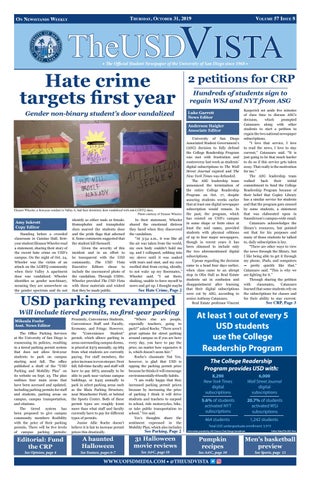
TheUSDVISTA
Volume 57 Issue 8
Thursday, October 31, 2019
On Newsstands Weekly
◆ The Official Student Newspaper of the University of San Diego since 1968 ◆
Hate crime targets first year Gender non-binary student’s door vandalized
2 petitions for CRP Hundreds of students sign to regain WSJ and NYT from ASG
Luke Garrett News Editor Anderson Haigler Associate Editor
Eleanor Wheeler, a first-year resident in Valley A, had their dormitory door vandalized with anti-LGBTQ slurs. Photo courtesy of Eleanor Wheeler
Amy Inkrott Copy Editor Standing before a crowded classroom in Camino Hall, firstyear student Eleanor Wheeler read a statement, sharing their story of the recent hate crime on USD’s campus. On the night of Oct. 24, Wheeler was the victim of an attack on the LGBTQ community when their Valley A apartment door was vandalized. Wheeler identifies as gender non-binary, meaning they are somewhere on the gender spectrum and do not
identify as either male or female. Homophobic and transphobic slurs marred the students door and the pride flags that adorned it. Some comments suggested that the student kill themself. Given the severity of this incident and in an effort to be transparent with the USD community, The USD Vista Executive Editors chose to include the uncensored photo of the vandalism. Through USDtv, Wheeler provided The USD Vista with these materials and wished that they be made public.
In their statement, Wheeler shared the emotional distress they faced when they discovered the vandalism. “At 3:34 a.m., it was like all the air was taken from the world, my own body couldn’t hold me up, and I collapsed, sobbing into my sleeve until it was soaked with tears and snot, and my eyes swelled shut from crying, silently, to not wake up my floormates,” Wheeler said. “I sat there, shaking, unable to force myself to move and get up. I thought maybe
See Hate Crime, Page 2
USD parking revamped
Will include tiered permits, no first-year parking The Office Parking Services at the University of San Diego is reassessing its policies, resulting in a tiered parking permit system that does not allow first-year students to park on campus starting next fall. The office published a draft of the “USD Parking and Mobility Plan” on its website on Sept. 25. The plan outlines four main areas that have been accessed and updated, including parking permits for staff and students, parking areas on campus, campus transportation, and citations. The tiered system has been proposed to give campus community members flexibility with the price of their parking permits. There will be five levels of campus parking permits:
Proximity, Convenience Students, Convenience Staff and Faculty, Economy, and Fringe. However, the “Convenience Student” permit, which allows parking in areas surrounding campus dorms, is priced at $375 annually, up $85 from what students are currently paying. For staff members, the price increase is even steeper. Next fall, full-time faculty and staff will have to pay $875 annually to be able to park near various campus buildings, or $425 annually to park in select parking areas such as the Main Parking Structure, near Manchester Field, or behind the Sports Center. Both of these permit types are roughly $200 more than what staff and faculty currently have to pay for different types of permits. Junior Allie Roche doesn’t believe it is fair to increase permit prices this drastically.
Editorial: Fund the CRP
A haunted Halloween
Mikeala Foehr Asst. News Editor
See Opinion, page 4
See Feature, pages 6-7
“Where else are people, especially teachers, going to park?” asked Roche. “There aren’t great options for street parking around campus so if you are here every day, you have to pay the price, no matter how expensive it is, which doesn’t seem fair.” Roche’s classmate Nat Yee, however, is glad that USD is upping the parking permit price because he thinks it will encourage environmentally-friendly habits. “I am really happy that they increased parking permit prices because by increasing the price of parking I think it will drive students and teachers to carpool to school, ride motorcycles, bike, or take public transportation to school,” Yee said. Yee’s thoughts share the sentiment expressed in the Mobility Plan, which also includes
See Parking, Page 2
31 Halloween movie reviews See A&C, page 10
University of San Diego Associated Student Government’s (ASG) decision to fully defund the College Readership Program was met with frustration and controversy last week as students’ digital subscriptions to The Wall Street Journal expired and The New York Times was defunded. The ASG leadership team announced the termination of the entire College Readership Program on Oct. 17, despite assuring students weeks earlier that at least one digital newspaper subscription would remain. In the past, the program, which has existed on USD’s campus in some shape or form since at least the mid 1990s, provided students with physical editions of up to four major newspapers, though in recent years it has been slimmed to include only the two aforementioned digital subscriptions. Uproar regarding the decision came to a head four days earlier, when class came to an abrupt stop in Olin Hall as Real Estate students sat in confusion and disappointment after learning that their digital subscriptions were cut by ASG, according to senior Anthony Catanzaro. Real Estate professor Vincent
Kasperick set aside five minutes of class time to discuss ASG’s decision, which prompted Catanzaro along with other students to start a petition to regain the two national newspaper subscriptions. “I love that service, I love to read the news, I love to stay current,” Catanzaro said. “It is just going to be that much harder to do so if this service gets taken away. That really is the motivation for me.” The ASG leadership team walked back their initial commitment to fund the College Readership Program because of their belief that Copley Library has a similar service for students and that the program goes unused by some students, a statement that was elaborated upon in Saunderson’s campus-wide email. Catanzaro acknowledges the library’s resources, but pointed out that for his purposes and many of those students he talked to, daily subscription is key. “There are other ways to view the news through the library, but I like being able to get it through my phone, iPads, and computers — pretty quickly like that,” Catanzaro said. “This is why we are fighting for it.” Through sharing the petition with classmates, Catanzaro learned that some students rely on the subscriptions for classes and for their ability to stay current.
See CRP, Page 3
At least 1 out of every 5 USD students use the College Readership Program The College Readership Program provides USD with: 8,290 New York Times digital subscriptions
6,000 Wall Street Journal digital subscriptions
5.6% of students activated NYT subscriptions
20.7% of students activated WSJ subscriptions
464 students
1,242 students
Total USD undergraduate enrollment: 5,919 Information provided by ASG Finance Chair George Saunderson
Pumpkin recipes
See A&C, page 10
WWW.UOFSDMEDIA.COM ◆ @THEUSDVISTA
Celina Tebor/The USD Vista
Men’s basketball preview See Sports, page 11
2
The USD Vista
◆
October 31, 2019
NEWS
Victim speaks against crime Targeted student speaks out against hate crime on social media and on campus
Hate Crime from Page 1
I’d stay there forever and give up and give in. Finally, I stood up and the blood in my body was replaced by pure and utter terror. I ran to the bathroom and threw up out of sheer revulsion.” The USD Department of Public Safety notified the entire campus community three hours after the incident was reported, although they did not specify the nature of the hate crime at first. The targeted community was not identified until later that day, when President James T. Harris III, D.Ed. sent out a campus-wide email concerning the reported hate crime. “Today we were informed of a hate crime on our campus that strikes at the core of our campus values,” Harris said in the email. “This deplorable act targeted a member of our LGBTQ+ community and is antithetical to our belief in the respect and dignity of every individual on our
campus.” USD officials did not provide information regarding the specifics of the hate crime committed. Wheeler’s statement describes the hate crime’s direct impact on their life at USD. “Did you know that I spent an entire day planning on dropping out? Did you know that when I walk on campus now it feels like I can’t breathe?” Wheeler said. “You may be able to move on and forget this happened in a week, but I will never have the privilege of forgetting. This incident’s scars will be there forever.” Despite the hate crime, the student is standing strong in their identity. “I will never let you take my pride from me,” Wheeler said. “I have fought too damn hard for it.” However, this is not the first time the LGBTQ community has been targeted at USD in recent memory. In March, the SLP’s all-
gender bathroom was vandalized in an act of intolerance. The bathroom’s paper towel dispensers were ripped off the walls. President of Diverse Sexuality and Gender Alliance (DSGA), Paulina Sierra, noted a marked difference between this reported hate crime and the act of intolerance. To Sierra, the vandalism of a first year’s apartment is more serious. “What needs to be understood about this situation is that this student’s home got vandalized,” Sierra said. “This is where a student lives. And now whenever that student has to exist in what is supposed to be the safest of all places, there is fear.” The incident’s classification as a hate crime by the university also highlights the severity of this act. The suspect of the hate crime faces both university and legal ramifications. “Harassment of others because of a person’s race,
religion, ancestry, national origin, disability, gender, sexual orientation, or because he/ she perceives that the other person has one or more of these characteristics is against the law and will not be tolerated by the University,” USD’s webpage on hate crimes reads. “Severe disciplinary action and possible criminal prosecution will follow.” The reported hate crime is currently under investigation by the Department of Public Safety and San Diego Police Department, neither of which have made any arrests. The day after the hate crime, Associate Director of the LGBTQ+ & Allies Commons Stacey Williams sent out a message to members of the community. “As an institution, we need to not only take these more extreme acts seriously, but see them as the symptoms that they are,” Williams said. “We need to take seriously the daily indignities and
oppression that permeates our culture. And we need to grapple with the distance between our espoused values and our lived experiences.” The Commons held a meeting Tuesday, in which members of the USD community had a discussion about the hate crime. Some students expressed shock at the situation given that the university promotes a culture of diversity, tolerance, and acceptance. They also were surprised by the university’s response, given that there were only two emails addressing the situation. Wheeler will be addressing the situation at the Associated Student Government meeting on Thursday at 12:15 p.m. in Solomon Hall. A candlelight vigil will also be held that night. Luke Garrett and Althea Ulin contributed reporting. Resources: USD Counseling Center On-Call Counselor: 619-260-4655 24-hour San Diego Access and Crisis Line: 1-888-724-7240 National Suicide Prevention Hotline: 1-800-273-8255 Trevor Hotline (LGBTQ Specific): 1-866-488-7386 or Text START to 678678
A screenshot of the USD Department of Public Safety email sent out to the USD campus concerning the reported hate crime.
Luke Garrett/The USD Vista
The GLBT National Youth Talkline (through age 25): 800-246-7743
Parking set to change next fall
USD alters parking plan along side construction and renovations of Renaissance Plan Parking from Page 1
a campus bike rental program that will be available at no charge to students. However, while the Mobility Plan supposedly offers many more parking options and alternatives to students, faculty and staff parking options seem to diminish. Casey Dominguez Ph.D., professor in the Political Science Department, wishes the new parking plan would take into account the difficult schedules some faculty have to manage. “I just don’t think these changes are flexible enough for faculty members who teach at multiple schools or who have kids,” Dominguez said. “On top of paying significantly more, there will be a higher chance of having to park further away and be late for class if I can’t get to school early because of other, mandatory commitments.” Beyond the higher price points, first-year students will no longer have the opportunity to park on campus. This is a radical shift from previous years, focused
on opening up more spaces for the growing community. Currently, nearly all of the parking in the Valley is reserved for resident students. With growing class sizes, most of these residents, even in the halls traditionally reserved for older students, are first years. So, disallowing first years to park on campus will open up many areas for the rest of the community. Although this is a big change for USD, many other colleges do not allow first-year students to have cars on campus, as sophomore Ellie Steinbrook pointed out. “A lot of schools do that,” Steinbrook said. “At (SDSU), for example, you aren’t allowed to bring a car until your second year. So I think it is kind of fair.” Junior Hunter Pflueger understands that the parking systems need to be reevaluated, but acknowledges how this change will make life more difficult for first years. “I think it would be frustrating as a freshman, coming in and not being able to park on campus,”
he said. “I understand that commuters should have priority, but as a freshman that would have been a big challenge for me.” This plan is years in the
Services, in conjunction with the school’s administration, has decided to make these changes next year for three reasons. First, the school’s parking systems and
A sign posted by parking services notifying students that the Main Stucture is full. Zoé Morales Martinez /The USD Vista
making, according to the draft, with over two years of research going into the changes. Parking
pricing have not been updated in 20 years, according to the Mobility Plan. Secondly, USD’s enrollment
has been consistently increasing, creating a need for more efficient parking practices to ensure the campus has enough space for everyone. Lastly, the university is already in a time of transition with the Renaissance Plan (a building maintenance plan in connection to the 75th anniversary of the university) underway, so it may be a logical time to revamp campus parking policies. Balancing parking policies that will work for resident students, commuters, staff, faculty, and visitors is a difficult task. Any given set of rules is likely to make life more difficult, financially or convenience-wise, for at least one other group. In recognition of this, Parking Services included in its plan that the parking policies will routinely be reevaluated. This opens the door for changes that could come from community feedback. The Parking Services office is located in Hahn University Center 102 and its office hours are from 8 a.m. to 5 p.m. Monday through Friday.
Volume 57 Issue 8
◆
NEWS
◆
3
The USD Vista
Program set to end on Nov. 8 Associate dean says Saunderson’s email has inaccurate assertion about the CRP
ASG from Page 1
To this senior, the petition is not self-serving. “I am not even fighting to keep this for the last few semesters I have here,” Catanzaro said. “I am mainly fighting to keep this for the grades below me. I feel like it’s such a valuable tool.” He is not alone. Another petition, similar to Catanzaro’s, has also sprung up within the business school. The second petition was started by a pair of business school students — Easton Griffin and Christian Oertli. As of Oct. 29, the two petitions have raised over 250 signatures. On Monday, ASG Finance Chair George Saunderson sent an email to all USD students explaining the decision, including usage statistics regarding the program and the subscriptions purchased. The numbers showed that at least 20.7 percent of USD students, or 1,242 total persons, activated their subscriptions to at least one of the two newspapers. The email also included a justification of the decision. Saunderson’s statement addressed the petitions, and elaborated on the rationale behind the move. His, and the rest of ASG’s collective justifications centered around their prior assertion that Copley Library’s
The WSJ subscription cancellation email sent to 1,242 USD students on Oct. 29. Luke Garrett/The USD Vista
database research access to the newspapers is sufficient to replace the full newspaper access provided by the College Readership Program. As previously reported by The USD Vista, though, this assertion is false, as the library’s access is intended for academic research, not daily, breaking news consumption. While the library’s access does provide students with the ability to read all of the same articles (as Saunderson mentioned), the library access is only a list of articles without pictures or any form of coherent
organization, as well as taking nearly double the time to access through the research database. His Monday-night email on behalf of ASG also contained a new rationalization for the lack of funding. In the 742-word statement, the Finance Chair detailed how ASG leadership consulted “a dean from the School of Business” in their decision, later asking him to fund the program through the USD School of Business’s budget rather than through the biannual $121 Student Activity
Fee, a request that was denied. After the business school dean declined to fund the program, Saunderson described how “the dean suggested that ASG should not renew the subscriptions if we could not afford the program, suggesting that students pay for the subscriptions themselves.” However, the “business school dean” that ASG met with, Associate Dean and Professor of Marketing David Light, denied that he made that suggestion, and rejected ASG’s accounts of the meeting. In a email to The USD Vista, Light said that he “did not make that statement,” adding that Saunderson’s email “contains the inaccurate assertion
year’s senate unanimously voted to leave the decision up to students through a referendum, although this never happened due to infighting within last year’s student government. ASG Finance Committee met on Tuesday to vote on the defunding of the College Readership Program. The committee voted to defund the program, but held off on reallocating the $13,000 formerly allocated to The New York Times until Nov. 12. Officials said student input will decide where the funds will be reallocated. Though the program has now been fully defunded at USD, the program still exists at several
(Dean) Light said that he “did not make that statement,” adding that Saunderson’s email “contains the inaccurate assertion that I recommended the ASG defund the College Readership Program.” that I recommended the ASG defund the College Readership Program,” and that his account of the meeting was “unfortunate.” These two petitions, the campus-wide controversy, and Saunderson’s lengthy defense of the ASG decision come after a year-long and incremental defunding of the program. Last
California colleges similar to USD. According to The New York Times’ customer service department, the University of Southern California, Chapman University, Pepperdine University, and Loyola Marymount University all maintain current subscriptions to the NYT for their undergraduate student body.
LEFT: Access to The New York Times website, with articles, podcasts and videos is provided by the College Readership Program RIGHT: The New York Times access provided by the Copley Library. Luke Garrett/The USD Vista
The USD Vista Kaia Hubbard - Editor in Chief Anderson Haigler - Associate Editor Celina Tebor - Managing Editor Amy Inkrott - Copy Editor Alee Pingol - Art Director Luke Garrett - News Editor Eric Boose - Opinion Editor
Catherine Silvey - Feature Editor Lizzy Jennings - Arts & Culture Editor Chris Spiering - Sports Editor Zoé Morales Martinez - Photo Editor Connor Buckley - Distribution Manager Molly Feeney - Social Media Manager Jake Schmid - Finance Manager
Editorial – 619.260.4584 Business – 619.260.4714 www.uofsdmedia.com / @TheUSDVista Razann Rizk - Advertising Manager Gina Lew - Student Media Advisor Marie Minnick - Operations Advisor
The USD Vista publication is written and edited by USD students and funded by revenues generated by advertising and a student fee. Advertising material published is for information purposes only and is not to be construed as an expressed or implied endorsement or verification of such commercial venues by the staff or University. The USD Vista office is located on the fourth floor of the Student Life Pavilion in room 403B. All inquiries should be sent to: The USD Vista 5998 Alcala Park San Diego, CA 92110 Opinions expressed in this publication are not necessarily those of The USD Vista staff, the University of San Diego or of its student body. Letters to the Editor can be submitted to The USD Vista office. Letters should be limited to 300 words and must be signed. For identification purposes, USD identification numbers and writer’s year must be included in the letter. The USD Vista reserves the right to edit published letters. Any content sent to the editor will be considered for publication unless otherwise stated.
4
The USD Vista
◆
October 31, 2019
E DI TOR IA L
Poor choice, poor reasoning
Associated Student Government makes a weak decision with a weaker justification Eric Boose Opinion Editor The New York Times says “the truth is worth it.” The University of San Diego’s Associated Student Government (ASG) clearly thinks otherwise. On Oct. 17, the ASG leadership team announced its plan to pull all remaining funding from the College Readership Program, canceling USD students’ free online subscriptions to both The New York Times and The Wall Street Journal. The decision still requires approval from the ASG Senate, but the leadership team seems to be banking on receiving that approval. Earlier this year, ASG pledged to defund only one of the two subscriptions — the one to The Wall Street Journal — leaving students with some, albeit minimal, access to the news. They have broken that promise. Cancelling online subscriptions is the final step in the year-and-a-half-long defunding of the program, which used to not only fund online subscriptions, but provide physical copies of USA Today, The New York Times, and The San Diego UnionTribune to students free of charge. That defunding process has taken place almost entirely in disregard of the democratic process and regardless of students’ wishes. In the summer of 2018, without students or ASG senators present, the ASG leadership team decided to stop funding free access to physical newspapers on campus. To support the decision, then-ASG President Natasha Salgado referenced an Instagram poll which received 94 responses, representing only 1.5 percent of the USD undergraduate student population. 1.5 percent of students is nowhere near enough for ASG to have claimed a mandate to remove the papers from campus. Worse still, once students and ASG senators returned to campus, ASG promised students a chance for students to vote on the future of free physical newspapers at USD in a referendum. That vote never came. In defending their most recent decision, the ASG leadership team claimed that students, while being deprived of subscriptions, would not be denied free access to the news. ASG President Marion Chavarria Rivera said “we have decided to not fund the College Readership Program this year because of the resources Copley Library offers students,” asserting that Copley Library’s database is similar to the access provided by the online subscriptions. ASG also defended their decision by saying that the $13,000 spent to provide subscriptions to The New York Times would be better spent on
other things. ASG Vice President Greyson Taylor suggested putting the money toward increasing the amount of Lyft credit available to students, printing, or even free pens. While it is admirable that they had a justification for their decision, the ASG leadership team’s defense is lacking in both areas. First, Chavarria Rivera’s assumption that the resources available in Copley Library are comparable to a subscription to The New York Times is plainly wrong. While Copley Library does provide students access to articles from The New York Times, it would be incorrect to claim that Copley’s access is the same as a subscription. Copley Library librarian Catherine Paolillo, while pledging that the library will work to better promote the research access they provide, also stated that Copley’s access differs from the subscription access which students stand to lose. “It doesn’t look like the online subscription,” Paolillo said, about Copley’s news access. Copley’s access is a database of articles, intended for research purposes, not casual reading. While the library also receives a hard copy of eight different newspapers every morning, those papers cannot leave the library, and there is only one copy of each. To consume the news, students would have to take time to go to the library and either navigate the database or read the newspaper of their choice essentially in one sitting. Reading the news should not require someone to go out of their way. What makes the Copley Library research access so different from an online subscription is that the two services serve different purposes. Copley’s research access is intended for precisely that. If a student knows what information they are looking for, they can search for it across multiple news publications. However, if a student does not know what they are looking for, they will be lost in a maze of titles sorted alphabetically, not by recency or importance. An online subscription to The New York Times, for example, is not intended for research purposes, but to inform readers of the news of the day. The online site is meant to be easy to navigate for someone who wants to know the top stories of the day and the most recent news. Subscriptions also incorporate multimedia access — from print journalism, to podcast storytelling, to photojournalism. Copley Library’s database has only the text of articles. Do not be fooled. In losing their subscriptions, USD students are losing easy access to the news. According to ASG, this loss
is worth the $13,000 they gain back. They might be right, if those $13,000 did not account for approximately one tenth of one percent of ASG’s $1.2 million budget. To put that into perspective, if ASG had a budget of $100, paying for The New York Times subscriptions would cost little more than a penny. ASG, in claiming that the subscriptions are not worth the money, implies that their new plans for that $13,000 are worth it. Of the three alternatives Taylor mentioned, free printing and Lyft rides are the least offensive. However, those options are not clearly better uses of the money, nor do they inherently require the defunding of the readership program. Printing was free through the Creative Zone as recently as 2018, when ASG still provided physical copies of newspapers on campus. Since then, the fee students pay to fund ASG’s expenditures has not decreased, but rather increased, from $117 per semester in 2017 to $121 per semester this year. Clearly, free printing and free newspapers are not incompatible. Second, the university already funds multiple Lyft discount programs. One is a one-time discount code offered to students, and is funded by ASG. The other, a far more expansive program, is the “Lyft Torero Ride,” funded by the USD Department of Public Safety and the Center for Health and Wellness Promotion. This program was “created to give current USD students a ride to campus, to their residence, or to a location that they need to get to for urgent purposes.” Lyft initiatives are important, especially ones like the Lyft Torero Ride, which creates a safety net for students. However, the Lyft Torero Ride has successfully established that safety net, without ASG’s help.
While Taylor’s suggestions of free printing and more Lyft codes are slightly underdeveloped, there are few suggestions more insulting than the notion that ASG should not spend $13,000 on giving the student body access to the news, but instead on free pens. The ability of USD undergraduate students to obtain writing utensils of their choice has never been in doubt. While it is true that ASG’s alternative spending plans, with the exception of free pens, would provide noticeable benefits to students, taking money from the College Readership Program to fund them would be inappropriate. ASG asserts that they can cancel students’ subscriptions because the money would better benefit students if used elsewhere. If ASG is going to defund programs which they claim do not benefit the student body as a whole, they should make sure that the programs they do plan to fund all meet that standard. Additionally, the implication that free subscriptions to The New York Times do not benefit students is plainly false. Being informed about current events is crucial, especially in such politically polarized times as today’s. The New York Times is a credible news agency, and the College Readership Program puts it at every student’s fingertips for no cost. Now, should a student want to subscribe to The New York Times, it will cost them $3.75 a week. That amounts to $195 out of a student’s pockets in a year. Even at the current sale rate of $1 per week, ASG’s funding saved students a minimum of $52 a year. That seems to be significantly beneficial. It was even more beneficial for those students who would not subscribe to the paper unless they had to for a class. Some classes in the business school require students
to subscribe to The Wall Street Journal — which ASG also provided for free until the end of last year. Now, those students have to pay a minimum of $39 for a subscription over a 15-week semester. At most, those students will pay around $73 in a semester. In monetary value alone, the free subscriptions that ASG seeks to cancel clearly benefit students. This is also not a benefit that is going unused. According to ASG Finance Chair George Saunderson, 7.8 percent of the USD undergraduate student population — 464 students — have activated their free subscription to The New York Times. Beyond that, a whopping 1,236 Toreros — 20.9 percent of USD undergrads — utilized the free subscriptions to The Wall Street Journal, the first subscription that ASG defunded. ASG would like you to believe that these numbers are small. However, even 8 percent student engagement would be impressive for USD students. Think about Torero Program Board events. Do those consistently bring in attendance of more than 500 people? 1,200 people? As much as ASG would like you to think otherwise, the College Readership Program benefits an impressive amount of students. ASG’s decision to cancel students’ free subscriptions to The New York Times and The Wall Street Journal is the wrong one, and they defend their decision poorly. The only way to save the subscription is if the ASG senate votes against the leadership team’s decision. The ASG Senate meets every Thursday at 12:15 p.m. in Solomon Hall in Maher. Hopefully, when the senators hear the support for the subscriptions that exists on campus, they will fill their duty as representatives of the students and do what is best by voting to preserve the College Readership Program.
Starting Nov. 8, USD students will have to pay for their own subscriptions to The New York Times.
Anderson Haigler/The USD Vista
The views expressed in the editorial and op-ed sections are not necessarily those of The USD Vista staff, the University of San Diego, or its student body.
Volume 57 Issue 8
◆
OPINION
◆
The USD Vista
Starving for information
5
Loss of College Readership Program will deprive USD students of crucial information Eric Boose Opinion Editor Editor’s note: This editorial is an updated re-publishing of an editorial originally published in The USD Vista on Mar. 21, 2019 titled “The importance of being informed.” I have updated the piece to reflect the current situation and further develop my argument, but my sentiment remains the same. There is something special about a newspaper. In an increasingly digital world, nothing delivers the news in the way a physical newspaper does. On our computers and cell phones, we can choose the stories we read, and we can tailor the news we receive to fit our individualized interests. Convenient as that may be, it is not how the news was meant to be consumed. Journalists are not waiters in a restaurant, serving you the stories you want, just the way you would like them prepared. Our job as journalists has always been to report the news and to report all of it. Where our computers and phones allow us to pick and choose what to read, a newspaper directs us to the most important stories, issues that impact our state, our country, and our world — issues that will impact our future. As college students, we have reached an age where we can no longer remain blissfully ignorant. We are the generation that will have to solve problems that exist today. In that pursuit, there is no power like knowledge. In this country’s infancy, Thomas Jefferson wrote that a well-informed electorate is key to any democracy. As such, the First Amendment guarantees a free press in this country. However, what good is a free press if people do not have easy access to it? There is no doubt that journalism is under threat in the U.S. As more people turn away from print media in favor of their cell phones, small newspapers have to downsize or shut down entirely. At the University of San Diego, our Associated Student Government (ASG), having already turned their backs on print media, has now chosen to turn their backs on the news as a whole. Two years ago, USD students had access to a wealth of journalism, free of cost beyond the student activity fees students pay. Starting Nov. 8, The USD Vista will be the only newspaper available to USD students for free, whether in print or online for the first time since at least 1999. Gone are the days when Toreros not only had free online subscriptions to The Wall Street Journal and The New York Times, but could also pick up a free copy of The New York Times, USA Today, or The San Diego Union-Tribune. In the summer of 2018, with students
and ASG senators away from campus, the ASG executive team — composed of the President, Vice President, Speaker of the Senate, Finance Chair, and Public Relations Chair — decided to stop paying for physical newspapers on campus. On Oct. 17, 2019, the ASG executive team announced plans to completely defund what remained of the College Readership Program — online subscriptions to The New York Times and The Wall Street Journal. No matter how many students take the time to pick up a paper and read it, the readership program is a crucial resource for students. Journalism, including the papers and subscriptions formerly available to students serve two major functions for American citizens. First, it helps voters make informed decisions. Accurate and in-depth reporting makes it possible for voters to choose a candidate who they truly believe will best represent and protect their interests. Even as college students, we are voters. We have to make important choices, not just about who we vote for, and we have a right to have the information we need to make the best choices possible, just like everyone else. As much as The USD Vista, the only remaining free news publication on campus, endeavors to help inform students in some of those decisions, we can only do so much. We simply do not have the resources that The New York Times, or even The San Diego Union-Tribune have. Unlike those professional papers, we are hyper-local. The USD Vista serves the campus community at USD. To do this, we focus almost exclusively on USD itself. We do not have a White House correspondent, or even a Washington correspondent. Even on our best days, we cannot provide the breadth of information that The New York Times or The San Diego UnionTribune can. By removing physical papers in 2018 and ending digital subscriptions this year, ASG is actively hindering students’ ability to make informed decisions. Second, newspapers help frame the news by emphasizing the most important stories. By limiting free news on campus to The USD Vista, ASG does students another disservice. Rarely is there only one way to effectively report the news. Rarely does one journalist provide a perfect story. Rarely can opinions be fully informed by only one source. When students had access to The USD Vista, The San Diego UnionTribune, USA Today, The New York Times, and The Wall Street Journal, students had access to five journalistic approaches, five ways of reporting the news, five newsrooms deciding what stories are most important
This editorial cartoon was originally published Mar. 21, 2019, acompanying the editorial titled “The importance of being informed.” Audrey Garrett/The USD Vista
to the public. Now, only one, student-run, perspective on the news sits on those same stands around campus. The USD Vista’s journalistic perspective, then, will always focus on this campus community. We will prioritize stories that affect USD students over some national stories. In fact, our front page story has not once been a national story without a USD connection — even when the impeachment inquiry into President Trump was announced. If students want to read journalistic perspectives that prioritize national stories, they will have to go to professional journalism outlets like The New York Times and The Washington Post. Now, to access those publications they will have to pay for it out of pocket — a cost which may be enough for students to choose not to access that journalism. As college students in our late teens and early twenties, there has not been a time in our life when journalism has been more important. Helping voters make the most educated decision possible is part of journalists’ duty to seek truth and report it to the public, as is holding those in positions of power accountable. The president of the U.S. is facing an impeachment inquiry, and the 2020 presidential election is right around the corner, with primary elections beginning in February. Never in our lives have we needed access to good, credible journalism more. Essentially, the access to the newspapers which used to be free for students was stolen by ASG,
regardless of students’ wishes. In a similar vein, there is no student mandate crying out for ASG to cancel free subscriptions to The New York Times. That is not representative government. Free access to high-caliber professional journalism is crucial for college students. At the very least, that access provides a free resource for information students will use in their classes or in their research. However, it goes beyond that. We are at a time in our nation’s history where the country is arguably more polarized than during the Civil War. The way to replace partisan shouting matches with productive discussions is for everyone involved to be informed. The way to keep everyone informed is to provide them with easy access to the news, ideally from more than one source. When students had subscriptions to both The New York Times and The Wall Street Journal, they had access to highly-renowned journalism from two sides of the aisle — The New York Times leaning moderately left, and The Wall Street Journal leaning moderately right. Now, students stand to lose that access entirely, having already had it whittled down to just one side of the aisle. If that access vanishes, it leaves a void of information, one which students may fill with information from more polarizing sources. At the very least, student subscriptions to The New York Times must be saved, and student subscriptions to The Wall Street Journal ought to be reinstated.
However, simply reinstating free online subscriptions is the bare minimum. By returning newspapers to stands around campus, the breadth of information available to students will be restored to its former strength. As Jefferson said, information is required for the survival of a democracy. The 2020 presidential campaign is already well underway, and it has the potential to be one of the most important presidential elections in the history of American democracy. That election will likely be the first time that many USD students cast a ballot. Those first-time voters and all members of the USD campus community deserve the opportunity to gather as much information about candidates with as little difficulty as possible in order to cast a vote that truly represents their interests. There is something about a newspaper. Newspapers strive to discover the truth and reveal it to the public. Newspapers help frame the discussion around issues that impact our world every day. Newspapers present informed opinions and ask their readers to think about complex societal issues. Newspapers create the wellinformed electorate Jefferson called the key to a democracy. Newspapers help us know, and as The Washington Post puts it, “Knowing empowers us. Knowing helps us decide. Knowing keeps us free.” The College Readership Program must be restored to campus at its full capacity, print newspapers and all.
The views expressed in the editorial and op-ed sections are not necessarily those of The USD Vista staff, the University of San Diego, or its student body.
6
The USD Vista
◆
October 31, 2019
EVER SINCE SHE STARTED READING ABOUT UNEXPLAINED AND MYSTERIOUS OCCURRENCES IN THE EARLY 1990S, UNIVERSITY OF SAN DIEGO ENGLISH PROFESSOR LISA HEMMINGER HAS BEEN ENAMORED WITH ALL THINGS PARANORMAL. SHE HAS SINCE TAKEN UP PARANORMAL INVESTIGATION AND BELIEVES SHE HAS DISCOVERED THE PRESENCE OF GHOSTS HERE AT USD.
While some people feel uneasy about paranormal activity, Hemminger sees it as an opportunity for connection. “I have never felt anything that would be deemed as evil,” Hemminger said. “I think it is more about the person trying to communicate.” Hemminger also noted that the terminology typically used for paranormal investigation doesn’t accurately describe her intentions. “I don’t like the verb ‘hunting,’” Hemminger said. “I am visiting or helping, and if I can bring them something I will.” In the world of paranormal investigation, sound frequencies are typically used to detect a supernatural presence. Because these pitch energies, called Electronic Voice Phenomena (EVPs), cannot be heard in real-time, special recording devices are used to capture these ghostly sounds. Hemminger uses both a digital recorder and an app on her phone, and has detected what she describes as notably irregular frequencies in both Palomar Hall in the Alcalá Vista apartments and Founders Hall. Hemminger’s goals while investigating are to foster a connection with the entities she discovers and to develop a deeper understanding of the unmapped territory that lies beyond the human world we know.
ONE OF TH IS VISITIN DURING T NOV. 2, T A TERRIFY OF HORRO TANNER C DIEGO, W ACTOR.” LOOK AT PL AYS AN
How lon “It usually
What ch “For the pa Elm Street.’ What is “Using my
Do you g “I feel like
Do you l “I do watch help me co
Do you e “I don’t rea aggressive is on the tra
Do you e “I really en have had s
Photo courtesy of Lisa Hemminger
Volume 57 Issue 8
◆
FEATURE
◆
7
The USD Vista
HE MOST POPUL AR FALL ACTIVITIES IN SAN DIEGO NG THE HAUNTED TRAIL OF BALBOA PARK. OPEN HE NIGHT ON TUESDAY THROUGH SUNDAY UNTIL THE HAUNTED TRAIL PROVIDES PARTICIPANTS WITH ING MILE-LONG TREK FILLED WITH FAMILIAR FACES OR LEGENDS AND ADRENALINE-PUMPING SCARES. CL AUDIO, A JUNIOR AT THE UNIVERSIT Y OF SAN WORKS AT THE HAUNTED TRAIL AS A “SCARE BELOW, HE SHARES A BEHIND-THE-SCENES HIS JOB, INCLUDING THE CHARACTERS HE ND HIS FAVORITE PART ABOUT SCARING GUESTS. Tanner Claudio/The USD Vista
ng does it take you to get ready? takes anywhere from 15 to 30 minutes depending on which character I am playing for the evening.”
haracters do you play? ast weeks I have been playing Pennywise from the ‘It’ movies a lot, but I also got to spend some time as Freddy from ‘Nightmare on ’” your favorite part about scaring people? creative abilities to find new and innovative ways to scare people and get them to scream and squirm louder every time.”
get scared easily? I don’t get scared that easily, but when I did go through the haunted trail last week, the actors did scare me pretty well a few times.”
like scary movies? h the occasional scary movie, but haven’t watched a lot in a while because of work. I definitely think watching scary movies could ome up with good lines to scare people with and improve my characters.”
ever get scared on the job? ally get scared on the job because I know my rooms so well that they don’t scare me. The only thing that scares me is super patrons that try and hit me or when people try and damage the rooms. Somebody punched a hole in the back window of a bus that ails and we had to stop for 10 minutes to clean up the shards of glass.”
enjoy working as a Scare Actor? njoy my job, despite the long hours. The people that I get to work with are so cool and fun to be around, especially in character. I some fun experiences going to get fast food or coffee at 11 p.m. and people look at me funny when I still have makeup on.”
Spread by Alee Pingol/The USD Vista; Content by Catherine Silvey and Mayella Vasquez/The USD Vista
8
The USD Vista
◆
October 31, 2019
F E AT U R E
More than meets the eye
Student-produced podcast features personal narratives from the USD community Catherine Silvey Feature Editor Last year, the University of San Diego Humanities Center debuted a project they had been developing for years — “There’s More,” a fusion of the traditional podcast format and live monthly storytelling shows created by and for the USD community. The podcast offers an opportunity for storytelling during which faculty members and students alike are welcome to come share their personal narratives. Their stories are recorded during the event and later edited by the podcast’s team of producers, which is led by Jonathan Bowman, Ph.D., a professor of Communication Studies and the faculty producer of the series. Bowman emphasized the importance of storytelling within a community, and the impact it can have on both the storyteller and the listener. “The whole goal with narrative storytelling is to let people better understand and know one another by sharing our stories,” Bowman said. “Stories help us to
make changes in our lives, stories change how we interact with other people, and stories influence our connection to a bigger, more important story that moves through our culture.” Bowman supervises a production team consisting of five students from a variety of backgrounds and prospective career paths. The team diligently works to transform student narratives into finalized podcasts accessible on listening platforms such as iTunes, the Apple Podcasts app, and the USD “There’s More” website. Sophomore Lily Yates shared how she became a student producer when she saw and responded to an advertisement for the podcast. “Immediately, I knew to apply because I absolutely love podcasts and I have a lot experience with different software, but not with sound software,” Yates said. “I was really interested and I applied and was later interviewed with Dr. Bowman and Dr. Keeling. Now, I’m part of the team and it’s awesome.” Daryan Gomez, a senior and student producer, recognized
learning about and sharing stories from the USD community as a deeply fulfilling component of her position. “I absolutely love being a part of the producing team,” Gomez said. “I get the opportunity to hear so many different stories from so many different people who do not necessarily have the same background. To have a podcast series where different people could come to share their stories is important because the stories that are told are very unique and are very powerful to hear, especially when the stories are coming from members of our tight-knit community.” Senior student producer Ryan Gentry explained the podcast’s mission to include perspectives from as many different individuals of the USD community as possible. “I think college is a unique social setting because it combines so many different people in one centralized location,” Gentry said. “You have bright-eyed teenagers, grad students that have grown as people and adults, professors trying to pass on both academic knowledge and life experience, and so many others. ‘There’s
The production team works hard to convert personal narratives into podcasts. Photo courtesy of Daryan Gomez
More’ shows exactly what its name is — there’s more to the college experience than just the perspective of one type of student. Each student and professor brings something unique to the table.” Professor Bowman agreed with this sentiment, emphasizing the podcast’s ability to represent both unique and shared experiences of USD students. “The best part of this program is that it features our local community with stories that have impact and importance beyond our community,” Bowman
said. “Although the message is important to everyone, it holds particular weight for people affiliated with the University of San Diego.” The “There’s More” storytelling events are held once a month in the Humanities Center in Saints Tekakwitha and Serra Hall Room 200 and are open for all to attend. The theme for November’s show is “Call.” Stories from previous live events can be found on iTunes, the Apple Podcasts app, or the “There’s More” website.
Volume 57 Issue 8
◆
ARTS & CULTURE
◆
The USD Vista
A RT S & C U LT U R E
9
31 days of Halloween movies
Follow along as senior Madison Casiano watches a movie a day to celebrate October Madison Casiano Contributor The 31 Days of Halloween celebration, in short, is a 31day scary movie spree through the month of October. This year my friends and I embarked on our second annual 31 Days of Halloween celebration. It was initially started because it is “technically” unacceptable to trick-or-treat in your 20’s, so I had to find another way to thoroughly relish the Halloween spirit. Of course, Halloween is my favorite holiday, so it’s a bit of an ode to All Hallows and October as well. In carrying out the effortful task of watching a scary movie every night, I have realized it is only slightly about watching the movie, and more about something to look forward to after long and tireless days of being a college student. It’s a gathering of sorts, where everyone can enjoy each other’s company whilst being absolutely terrified. Along with this, I rate each movie by both quality and scare factor and post the ratings to Instagram. Thus, I am doing
the job of weeding out the notso-cinematic masterpieces, from the quality films worth watching, or the ones that leave you scared witless from the ones that give you a taste of the Halloween spirit. With October coming to a close, I can reflect on great scares and even better memories, and absolutely say goodbye to scary movies for at least a few months. It is not a task without mental repercussions, but worth it nonetheless. So carve a pumpkin, eat some candy, scare your friends, and have a happy Halloween.
Some of the classic, and creative, movie posters for the featured horror flicks are almost as scary as the movies they’re advertising. Photos Courtesy of Global Panorama, jdxyw, Andrew Kitzmiller, junaidrao/Flickr
Madison’s monthly movie schedule is laid out above in this infographic, which highlights the films she watched and her ratings for each indvidual film. Check out her Instagram page to see the live updates for the final films. Kaia Hubbard/The USD Vista
10
The USD Vista
◆
October 31, 2019
A Bite of San Diego: Pumpkins
Explore how this popular and festive fall squash can be used for more than just decor Lizzy Jennings A&C Editor As October and the spooky season come to a close, the pumpkins purchased by the dozen during a trip to one of San Diego’s pumpkin patches are going to need to be dealt with. Though perfect for achieving the quintessential fall aesthetic, finding a way to use the pumpkins you have might start to feel like a burden. What many people don’t realize is how useful these pumpkins can be, and for more than just decoration. So instead of throwing your pumpkins away wasting a perfectly good squash, this week’s edition of A Bite of San Diego will lay out just a few of the many ways a pumpkin can be used.
later use. Once you have cleaned the cavity of the pumpkin, you can begin on the carving. Draw your design on the face of the pumpkin first for guidance, then cut through the pumpkin again following your design. ROASTING Put to use the seeds you extracted from your pumpkin by roasting them and making them into a delicious and easy snack. Start by preheating the oven to 300 F, then rinse the seeds, making sure they’re free of any of the remaining pumpkin residue. Then, spreading them out on a baking sheet or tossing them in a dish, season them as you see fit. You can cover the seeds with butter, cinnamon and sugar or go more simplified with some olive oil and salt. Then, place
splitting the pumpkin in half or fourths and sticking it in the oven at 375 F for about 15 minutes, so the insides are softened and easier to scrape away. Use a food processor or even a cheese grater to prepare the pumpkin to be mixed with your favorite baking ingredients, and you’re on your way to a delicious fall dessert. Bakers will taste the difference from those store-bought cannedpumpkin wannabes — as the real pumpkin offers a less sweet and more complex flavor. Pair the fresh pumpkin with all the best spices, like cinnamon, ginger, and a dash of cardamom, to capture the essence of fall itself. COOKING Try a fun twist on the typically-sweet flavor by whipping your pumpkin up
Roasted pumpkin seeds are one of the easiest ways to make use of your leftover decor. Kaia Hubbard/The USD Vista
Laying down some newspaper, that has already been read obviously, can help keep the mess to the minimum. Kaia Hubbard/The USD Vista
CARVING Begin carving your pumpkin by placing it on a steady surface, preferably a stable table or countertop. We recommend laying down newspaper or paper towels to minimize mess (put your old copies of The USD Vista to work, after you’ve finished reading of course). Taking a sharp knife, cut around the top of the pumpkin, between four and six inches away from the stem. Once you have made it around the pumpkin and returned to where you began cutting, remove the top portion of the pumpkin, exposing the insides for easier access. Scoop out the insides of the pumpkin, setting the seeds and the “guts” aside for
the pan in the oven and cook for 45 minutes, or until golden brown. We recommend mixing the seeds around occasionally for a more even bake. BAKING Pumpkin muffins, bread, cookies and more are all a beloved marker of the fall season. Break away from box mixes and bake with your own pumpkins easily. Select a recipe you would like to follow off the internet, for pie, bread, or whatever other pumpkin creation you wish. Then, harvest the necessary parts of the pumpkin to begin your baking. If jack-o’-lanterns aren’t for you, then consider turning your pumpkin into a delicious treat. We recommend
into a creamy, savory soup. It’s much easier than it sounds, and with minimal ingredients. To the surprise of some, curry powder pairs well with pumpkin, enhancing its flavor and adding a subtle kick. Sauté some aromatics for flavor, like shallots and garlic, add in the fresh pumpkin, curry powder, cinnamon, and a can of coconut milk, and watch as this unlikely combination bubbles into a savory, flavor-filled delight. After bringing the liquid to a low boil, throw the mixture into a blender where it will become a creamy soup before your eyes. Garnish with roasted pumpkin seeds and enjoy this warming addition to any meal.
Pumpkin muffins are just one of the many delicious confections that can be created at home with fresh pumpkin. Kaia Hubbard/The USD Vista
Splitting the pumpkin in half and cooking is a helpful tip for easier collection. Kaia Hubbard/The USD Vista
e r
i
Volume 57 Issue 8
◆
SPORTS
◆
11
The USD Vista
SP ORT S
Men’s basketball preview
The Toreros get ready for the start of the season after graduating four senior starters Chris Spiering Sports Editor The University of San Diego men’s basketball team is excited for the start of the 2019-2020 season. After a solid season last year, finishing with a record of 21-15 (7-9 West Coast Conference), the Toreros are looking to improve on that conference record to have a chance at the WCC title. In last season’s conference tournament, the Toreros were able to make it all the way to the semifinals, but lost to Saint Mary’s College (SMC) 69-62. Leading up to the semifinals, USD defeated the University of Portland 67-47 in the first round, Santa Clara University 62-45 in the second round, then Brigham Young University (BYU) 80-57 in the third round. However, the loss to SMC was not the end of the season for USD. After winning three games in the WCC tournament last year, USD received an at-large bid to the National Invitational Tournament (NIT) at the end of last season but lost to the University of Memphis, 74-60. “Being able to make an NIT run was big for our program,” USD men’s basketball head coach Sam Scholl said. “We had to win some games late to be able to make the NIT, and the first game matters just as much as the second game and even the 33rd game. So every day you just have to be on the process of getting better. I think that is the biggest thing we learned from the NIT round.” The last NCAA tournament run for the Toreros was back in 2008, when USD defeated the University of Connecticut 7069 in overtime. They lost in the next round to Western Kentucky University 72-63 to end their season. The biggest story of the offseason for USD was the four starters they lost due to graduation last spring. Isaiah Pineiro, Isaiah Wright, Olin Carter III, and Tyler Williams all left their mark on the
Last season, USD hosted the Gonzaga Bulldogs during WCC play. The Bulldogs defeated the Toreros 79-67.
program as great teammates and leaders. They have all continued to play professionally, both internationally, and in the U.S. Most notably, Pineiro had the opportunity to play for his home country of Puerto Rico in the Federation of International Basketball Association (FIBA) Tournament this past summer. He was selected as one of 12 players to make the roster. Pineiro was able to get some playing time during the tournament and scored eight points in the game against Iran. Pineiro also signed a contract with the Sacramento Kings in the National Basketball Association (NBA) this past offseason. “It’s big because every recruit wants to know if you have anyone in the pros,” Scholl said. “I told him the other day that he is one in 650 guys in the world that are in an NBA training camp and he’s in that ballpark so that does a lot for our program considering his development when he was with us.” Given the talent they lost due to graduation, this year’s team will have a majority of
underclassmen who are thrilled to have the opportunity to play. “I’m excited about this group getting a chance to step up.” Scholl said, “We feel the doubt, these guys are fueled by that and they are excited about that challenge to prove that (doubt) wrong. It’s going to be a fun ride watching them do that.” Senior forward Alex Floresca expects the new players to fill in nicely. “I want to see them compete and play hard to the best of their ability,” Floresca said. “They are well prepared and they are going to surprise some people.” The Toreros were picked to finish tied for eighth in the WCC preseason coaches poll. “There are a lot of people who
(JCP). Last season, the Toreros came out on top against the Aztecs 73-61 as USD defeated them on the road for their only matchup of the season. The Toreros scored 47 points in the second half to the Aztecs 22, to help complete the comeback victory. After finishing 7-9 in the WCC last season, USD will look to improve on that this year. The star-studded Gonzaga Bulldogs come into town on Jan. 9; the Zags were picked to finish first in the coaches poll for the eighth straight season, followed by Saint Mary’s and BYU. San Diego was picked to finish eighth. USD will host SMC on Feb. 6 and BYU on Feb. 15, both in the JCP. Before every season starts,
“I’m ready to play someone else and stop practicing so much. It’s been a while and I miss playing.”
say we lost a lot,” Sophomore forward Yauhen “Squirrel” Massalski said. “But nobody is looking at the things that we got, so just seeing the satisfaction on their faces after we start playing will be the best thing ever.” The Toreros have a tough non-conference schedule this year as they host and travel to play against a few 20-plus win teams. USD will host Fresno State, UC Irvine, and San Diego State this season, all teams that had at least 21 wins last year. The Toreros will travel to the University of Washington, the University of Colorado, and to Stanford University for a chance to play some bigger schools on the road. Mark your calendars for the game against cross-town rival SDSU on November 20, at 8 Senior forward Alex Floresca started in seven games last year for the Toreros. Photo courtesy of USD Athletics p.m. in the Jenny Craig Pavilion
-Alex Floresca the team practices against each other for weeks until they play another opponent. That being said, the players are glad the season is finally here. “I’m ready to play someone else and stop practicing so much,” Floresca said. “It’s been a while and I miss playing.” A few weeks ago, Scholl hired Jerry Brown to serve as assistant coach. Brown comes from Stanford University as the former Director of Player Development. He also spent time as the video coordinator for the Detroit Pistons in 2017. Brown will replace former assistant coach Chris Gerlufsen, who took a job as an assistant coach at the University of Hawaii earlier this fall. “USD is a place with a lot of tradition,” Brown said. “Sam has
Photo courtesy of USD Athletics
done a great job of building the program in the right direction and I’m happy to be here and be a part of it.” As a former Player Development Director, Brown will use that experience to help coach, and will also help recruit in the offseason. “I think just player relations (is what I bring to the table),” Brown said. “You know, just somebody who has been in their shoes, who can kind of relate to them and to give them some type of inspiration to grow as young men and athletes.” Scholl had some high praise for his new assistant coach. “Jerry is awesome,” Scholl said. “I coached Jerry for a year when I was at Santa Clara, and I knew then that he was going to be a great coach. He just has all the talents and all the tools, he is outstanding with people and is going to bring a great dynamic to our coaching staff.” The season starts for the Toreros on “Sixth man night” on Nov. 1 as the team will host a fundraiser for the program. There will be a Q&A with head coach Sam Scholl and ESPN’s Fran Fraschilla who covers college basketball. The special evening starts at 5:30 p.m. with a reception at the Garden of the Sea, will be an opportunity for Torero basketball supporters to meet the 2019-2020 team. Ticket prices range from $75$175. Attendees will have an opportunity to take part in a live and silent auction for VIP access, autographed memorabilia, and tickets to the home game against SDSU on Nov. 20th. The Toreros are ready to set the tone early against the nonconference opponents. The first game of the season is against the UC Irvine Anteaters on Nov. 5 at 7 p.m. in the JCP.
12
The USD Vista
◆
October 31, 2019
Toreros upset by Bulldogs
Men’s soccer loses to Gonzaga University 2-1 moving the Toreros down in the WCC Maria Watters Asst. Sports Editor The University of San Diego men’s soccer team dropped to fifth place in the West Coast Conference (WCC) after a shocking loss to the Gonzaga Bulldogs (3-8-1, 2-1 WCC) Saturday night at Torero Stadium. After a tough 0-3 loss against ninth-ranked Saint Mary’s College the previous week, the Toreros were eager to bounce back with a victory against Gonzaga. Having scored nearly three times as many goals as the Bulldogs, the Toreros entered into Saturday’s contest as the clear favorite. Despite their impressive record, the Toreros came into the game ready to fight hard. “You can’t go into any game thinking you’ve already won,” senior forward Miguel Berry said. “As much as we’ve won this season, we are a hard working team and that’s how we win games. We are not just going to show up and play and win.” The Bulldogs kicked off to start the first half in front of an energetic crowd of nearly 400 fans. The game started off slowly, with neither team able to take control. Both teams traded attacks with the first shot of the game coming from Gonzaga’s junior midfielder Joe Corner missing wide of the goal in the fourth minute. The Toreros responded with a shot of their own by junior defender Aidan Marmion in the ninth minute. Possession continued to shift back and forth as the shot by Marmion was followed by a foul on USD and two on Gonzaga, leading to a shot by senior forward Miguel Berry that missed just wide in the 13th minute. The Bulldogs countered with a strong offensive effort with Corner taking his second shot of night, sailing just past the reach of USD’s redshirt sophomore goalkeeper Matt
USD’s leading scorer Miguel Berry (9) was held scorless against the Bulldogs.
Wiher, and hitting the post. Collective sighs of relief came from the Torero fans, as the near goal for the Bulldogs shocked the crowd. The Toreros, however, seemed less fazed than their fans as they quickly regained possession and went on the attack. Sophomore midfielder Paul Ramlow looked to take a shot inside the Gonzaga box late in the 18th minute, but was swarmed by the Bulldog defense. The ball was cleared by the defense, but Ramlow remained on the ground, stopping play while the USD trainers helped him off the field and did not return. Despite losing a key member of their offense, the Toreros continued to relentlessly attack the Gonzaga defense for the rest of the half. USD took seven more shots by five different players. The first came from redshirt junior defender Chase Van Wey that missed wide in the 24th minute, followed by the shot by junior midfielder
Amit Hefer that was saved by Gonzaga redshirt-freshman goalkeeper Johan Garibay in the 28th minute. Seconds later, it seemed like the Toreros would be the first on the board as Berry lined up inside the box at center field with only one defender to get past. Though Berry’s shot hit the post, he would get another chance in the 31st minute as he made a run down the left side of the field. But with a difficult angle and the Gonzaga defense barreling down on him, Berry missed wide once again. More scoring chances for the Toreros came from redshirt junior midfielder George West in the 32nd minute, Miguel Berry with his fourth of the game in the 33rd, and junior midfielder Ross Meldrum in the 45th. Though the Toreros outshot the Bulldogs 9-2, the first half ended with the score tied at 0-0. Though he didn’t see much action in the first half, Wiher knew he had to stay focused going into the second half.
USD’s Redshirt-junior forward Chase Van Wey scored his first career goal in the 2-1 loss to the Bulldogs. Zoé Morales Martinez/The USD Vista
Zoé Morales Martinez/The USD Vista
“I could feel that they were dangerous in the first half,” Wiher said. “Even if they might have had more shots than they did, I could definitely feel that the opportunity would be coming.” USD fans were perhaps nervous and surprised by the score after the first 45 minutes of play. They were not expecting the high-scoring Torero offense that averages more than two goals a game to be shut out by the Gonzaga defense. But with another half left to play, Torero fans remained hopeful, and the players were determined to get the win. The Toreros took the field first after the break and kicked off to start the second half. Unlike the first, the Toreros quickly took possession and earned a corner kick in the first 30 seconds of the half. But while USD held the ball, the Bulldogs came out of the break even more aggressive than before, giving the Toreros a free kick 30 yards from the goal in the 52nd minute. The ball found the head of Berry, but missed wide. Gonzaga quickly played the ball to freshman defender Cole Rovegno, who sent a long pass down the field to junior midfielder Theo O’Malley. O’Malley beat the Torero defense and launched a bullet into the right side of the goal past Wiher in the 53rd minute. The Gonzaga bench jumped to their feet in celebration while the Torero fans went silent. The Bulldogs were winning 1-0. This game was not going to be the decisive victory Torero fans had anticipated. The Bulldogs were putting up a fight, and the pressure was on USD to score. A close chance for the Toreros came in the 55th minute when Van Wey fired a shot past the Bulldogs’ goalkeeper, only to be deflected away at the last minute by a Gonzaga defender. As the first 15 minutes of the half ticked away, the Toreros were desperate for a goal as the Gonzaga bench furiously
cheered on their teammates on the field. Several substitutions for the Toreros and a save by Wiher in the 62nd minute set up a free kick for Miguel Berry in the 65th. Though the Bulldog defense cleared the ball, senior defender Henry Lander was able to recover and hit Van Wey on the left side. With an open lane, Van Wey struck, sending a perfect shot past Johan into the top right corner. The stands erupted as Torero fans leapt to their feet. The score was tied 1-1. The Toreros were back in the game. The celebration was shortlived, however, as the Bulldogs won possession after the kickoff. A long pass to Gonzaga sophomore forward Demitrius Kigeya set up a one-on-one opportunity against Torero junior defender Aaron Frey. With incredible speed and quick footwork, Kigeya beat Frey and then Wiher, leaving an open goal, and he easily passed the ball into the net, giving the Bulldogs a 2-1 lead over the Toreros in the 66th minute. With 25 minutes left, the Toreros had time to tie up the game, but the Bulldogs weren’t going to give up the lead without a fight. Taking advantage of poor passing by USD, Gonzaga was able to continue to pressure the Torero defense and shut down the offense. As time continued to slip away, the game grew more and more aggressive both on the field and in the stands. An aggressive tackle by the Toreros in their box sent Gonzaga fans and bench into an uproar as the referee awarded a corner kick instead of a penalty kick in the 81st minute. Huge saves by Wiher in the 82nd and 84th minutes kept the Toreros in the game, but they still needed another goal to tie the score. In the final minutes, USD fans desperately tried to rally their team by chanting and heckling the Gonzaga players. Both teams battled until the very end. In the last minute of play, a Gonzaga forward tackled Wiher, giving the Toreros one last chance to score. But as the countdown reached the final seconds, the Toreros were forced to accept the defeat. Despite the tough loss, USD soccer head coach Brian Quinn was happy with how his players performed. “I was really disappointed in the result but not the team,” Quinn said. “I’ve trusted them when the game has been on the line and they’ve won a lot of close games, and then tonight the ball didn’t fall for us.” After the loss, USD dropped to a 10-3-1, 1-2 WCC record, but with four conference games left in the regular season, the Toreros know there is still a lot of work left to be done. The Toreros look to their next opponent Loyola Marymount University (8-4-3) (3-0 WCC). The game is at Torero Stadium on Wednesday at 7 p.m.