On newstands weekly
Volume 59 Issue 19
Thursday, April 21, 2022
THE USD VISTA
The Official Student Newspaper of the University of San Diego since 1968
Aminé performs at Olé Music Festival USD students gather together to watch artists perform for spring ABIGAIL CAVIZO ASST. A&C EDITOR SPENCER BISPHAM ASST. NEWS EDITOR
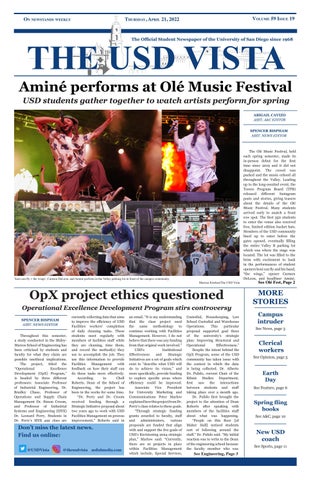
'keni can fly + the wings', Carmen DeLeon, and Aminé perform in the Valley parking lot in front of the campus community.
Marissa Esteban/The USD Vista
OpX project ethics questioned Operational Excellence Development Program stirs controversy SPENCER BISPHAM ASST. NEWS EDITOR Throughout this semester, a study conducted in the ShileyMarcos School of Engineering has been criticized by students and faculty for what they claim are possible unethical implications. The project, titled the “Operational Excellence Development (OpX) Program,” is headed by three different professors: Associate Professor of Industrial Engineering, Dr. Bradley Chase, Professor of Operations and Supply Chain Management Dr. Simon Croom, and Professor of Industrial Systems and Engineering (ISYE) Dr. Leonard Perry. Students in Dr. Perry’s ISYE 492 class are
currently collecting data that aims to improve the efficiency of USD Facilities workers’ completion of daily cleaning tasks. These students meet regularly with members of facilities staff while they are cleaning, time them, and record the method(s) they use to accomplish the job. They use this information to provide Facilities Management with feedback on how their staff can do these tasks more effectively. According to Chell Roberts, Dean of the School of Engineering, the project has been in the works for some time. “Dr. Perry and Dr. Croom received funding through a Strategic Initiative proposal about two years ago to work with USD Facilities Management on process improvement,” Roberts said in
Don’t miss the latest news. Find us online: @USDVista
@theusdvista uofsdmedia.com
an email. “It is my understanding that the class project used the same methodology to continue working with Facilities Management. However, I do not believe that there was any funding from that original work involved.” USD’s Institutional Effectiveness and Strategic Initiatives are a set of goals which exist to “describe what USD will do to achieve its vision,” and more specifically, provide funding to explore specific areas where efficiency could be improved. Associate Vice President for University Marketing and Communications Peter Marlow explained how this project from Dr. Perry’s class relates to these goals. “Through strategic funding grants awarded to faculty, staff and administrators, various proposals are funded that align with and support the five goals of USD’s Envisioning 2024 strategic plan,” Marlow said. “Currently, there are 10 projects in place within Facilities Management which include, Special Services,
Custodial, Housekeeping, Law School Custodial and Warehouse Operations. This particular proposal supported goal three of the university’s strategic plan: Improving Structural and Operational Effectiveness.” Despite the intent behind the OpX Program, some of the USD community has taken issue with the context in which the data is being collected. Dr. Alberto Dr. Pulido, current Chair of the Ethnic Studies Department, first saw the interactions between students and staff taking place over a month ago. Dr. Pulido first brought the project to the attention of Dean Roberts after speaking with members of the facilities staff about what was happening. “People on this floor [of Maher Hall] noticed students sort of following around the staff,” Dr. Pulido said. “My initial reaction was to write to the Dean of the engineering school because the faculty member who was
See Engineering, Page 3
The Olé Music Festival, held each spring semester, made its in-person debut for the first time since 2019 and it did not disappoint. The crowd was packed and the music echoed all throughout the Valley. Leading up to the long-awaited event, the Torero Program Board (TPB) released different Instagram posts and stories, giving teasers about the details of the Olé Music Festival. Many students arrived early to snatch a front row spot. The first 350 students to enter the venue also received free, limited edition bucket hats. Members of the USD community lined up to enter before the gates opened, eventually filling the entire Valley B parking lot which was where the stage was located. The lot was filled to the brim with excitement to bask in the performances of student openers keni can fly and his band, “the wings,” opener Carmen DeLeon, and headliner Aminé.
See Olé Fest, Page 2
MORE STORIES Campus intruder See News, page 3
Clerical workers See Opinion, page 5
Earth Day See Feature, page 6
Spring fling books See A&C, page 10
New USD coach See Sports, page 11
2
The USD Vista
◆
April 21, 2022
NEWS
Olé Music Festival kicks off the spring Students enjoy free live music in the Valley parking lot Olé Fest from Page 1
USD sophomore and Vice Chair of TPB Elizabeth Albizati was the lead coordinator for the concert committee in planning the Olé Music Festival. They have been planning the event since December 2021. “Planning this event has been such a fun journey and the TPB team have all been so supportive,” Albizati said. “I’m looking forward to seeing all the smiles on the students’ faces as it all comes together, especially for the performers; I know everyone’s been really looking forward to that.” Similar to Albizati, TPB Marketing Manager Marco Jimenez waited to relish the night. “It’s honestly so fulfilling to see everything come together and so validating to see all of our hard work come together,” Jimenez said. “On the marketing side, finding fun and creative ways to get the students engaged was super fun.” To open up the night, student performers keni can fly and the wings covered songs such as “Loving Is Easy” by Rex Orange County. They also performed some of their original songs, such as “idk eplitive but colors” and “life – saba.” Dawson (@soundbydawson), an audio engineer who worked with Kanye West, Jack Harlow, and others, also worked on one of the songs keni performed during the set. “I mixed Keni’s next project that he has coming out, ‘mr. wednesday,’” Dawson said. “He’s a really dope artist. He told me he was opening for Aminé and I thought that was really dope. I’m just out here to show support.” Their performance received a lot of crowd participation, complete with keni can fly crowd surfing at the end of their set. The student performers have performed in front of live audiences before, but the Olé Festival was special because it was for the USD community, and also because they opened for Aminé. “It was really cool to see all my friends out there and I’m honestly a little speechless,” Keni expressed. “Since he dropped his first album in 2017, Aminé has been one of my favorite artists, so I don’t know if there’s a better artist to open for honestly.” Following the student opener, up-and-coming Venezuelan artist Carmen Deleon took to the stage before Aminé. Even if the crowd didn’t know all her songs, she won them over with her charisma, sound, and relatability to everyone, at only 20 years old. Isabela Zerpa, mother of Carmen Deleon, was beaming with pride throughout Carmen’s whole
“keni can fly”and the wings engage the crowd during their 30 minute set at the music festival.
Marissa Esteban/The USD Vista
performance, front and center. “It’s incredible because we didn’t know what to expect because the crowd doesn’t speak Spanish, but everyone could feel her when she got up there. She’s just starting, but the best thing she does is when she stands [on stage] and gives the people what she has: her voice and her energy,” Zerpa said. “People were so happy, telling me backstage, ‘You’re the mom, congratulations!’ And I was facetiming her father the whole time.” A majority of the audience was most looking forward to Amin é, including USD sophomore Cameron Traylor. “Front row at the concert was insane,” Traylor said. “Shoutout to TPB for putting together such a great show, [I] can’t wait to see who they bring out next year.” USD sophomore Sacheen Tipnis was enthusiastic about Aminé’s performance – so much so that he “spammed” his Snapchat story. “I was recording all my favorite songs,” Tipnis explained. “It just ended up being a lot more favorites than expected.” Altogether, Olé Music Festival 2022 fostered an amazing space for music with very talented performers and students’ enjoyment.
Marissa Esteban/The USD Vista
Students excitedly wait for the performers to take the stage.
Volume 59 Issue 19 ◆
NEWS
The USD Vista
◆
Engineering project in the hot seat
3
Industrial and Systems Engineering Project questioned for ethics Engineering from Page 1
identified was in the engineering school. I didn’t write to the faculty member directly because the Dean is in charge of the college.” Dr. Pulido also mentioned that this a sensitive topic. “I was fairly upset, for a lot of reasons,” Dr. Pulido said. “The real difficult thing about talking about this, which the Provost assured me not to worry about, is that I don’t want to identify anyone from facilities because I don’t want them to be penalized or terminated. The facilities people don’t want to share; they have jobs.” In an email (not addressed to the Dean) obtained by The USD Vista, Dr. Pulido outlined specifically what upset him. “Maybe you haven’t noticed but the majority, if not all of our facility staff at USD is stratified along racial and gender lines,” Dr. Pulido wrote. “They are predominantly women of color, Latina/Mexicana (with the exception of management), and they have dedicated their lives to keeping our campus clean and safe in a COVID world. Many of them commute daily from Tijuana to keep food on the tables for their families. I know because
I talk to them on a daily basis. They are not meant to be studied.” In the same message, Dr. Pulido questioned if the appropriate steps had been taken before beginning the project. “My next question for you is did this professor file for a human subjects review?” Dr. Pulido asked. “I have received mixed messages that such a step is not required if the research is not going to be published. Is this the USD policy and for all I know maybe it did go through a human subjects review and was approved which is an even greater concern.” The human subjects review process, also referred to as an Institutional Review Board (IRB), is a standard review process in the United States for any research project that involves human subjects. According to USD, the role of IRB is “to safeguard the rights and welfare of participants in research activities conducted or supported by the University and ensure that the project complies with federal standards.” The question of whether or not IRB was used in this OpX project was brought up at a meeting on March 2 and again when the Association of Chicanx Activists (AChA) presented their perceived
issues with OpX project to Associated Student Government (ASG) the next day. However, it was not fully addressed until a third meeting, open to the public, held on Friday, March 4, in the University Center Room 128. During that third meeting, students, faculty, and administrators from all over campus took the opportunity to address the concerns over how the Facilities workers were and are being treated. When asked how the workers were being informed about the specifics of the OpX Program, USD’s Interim Vice Provost Dr. Roger Pace, clarified the position of the university during the meeting. “This isn’t research, so consent isn’t something that you need to obtain with this stuff, understanding the work that’s being performed,” Dr. Pace said. “But it’s still appropriate to explain what’s happening to the employees, so that the employees realize their specific performance is not being evaluated. We’re trying to understand the overall job and how it applies in other areas.” Dr. Pace specifically addressed why the project is not considered research and thus why IRB is not required.
“The distinction is the generalizable knowledge piece,” Pace said. “The things that you learn by watching workers in one workplace isn’t generalizable to other places, and that’s the distinction. That is why [it] did not require IRB approval at this time.” Also during the meeting, Associate Dean of the School of Engineering Dr. Rick Olson added that following some ethical guidelines would still be helpful. “Just because it wasn’t in IRB doesn’t mean we shouldnt apply the principles and ethics to the human participants,” Dr. Olson said. “IRB is a specific process, but it’s not the only ethical guide we have. Whether it went through IRB or not, we should have a sensitivity to the people we’re dealing with. There’s historical context we need to take into account.” Three days after the March 4 meeting, Professor of Operations and Supply Chain Management Dr. Simon Croom sent out an email to the School of Business to address the controversy. In the email, Dr. Croom came to the defense of the study. “At the heart of my very serious concern about the accusations being made, is the
implication that the program is being conducted with less than desirable motives, demonstrating behaviors that are not only not within the community of care we enshrine at USD, but most disconcerting, that there is malicious intent,” Dr. Croom said. When The USD Vista reached out for individual comments on the controversy surrounding the OpX Program, Dr. Croom, Dr. Perry, and Dr. Chase all declined. In the weeks following these exchanges, the discourse surrounding the Operational Excellence Development Program has calmed. Facilities Management repeatedly referred the Vista to Dr. Peter Marlow when asked to speak with the employees who are involved in the study, despite our ability to obtain the following quote. Adelberto, an employee of USD Facilities who is participating in the study, said that the experience has been good so far. (Translated from Spanish) “It’s been good,” Adelberto said. “There are two or three men and women who are participating; they [the students] take notes.” The students in Dr. Perry’s class continue to collect data from Facilities staff.
Reckless driver enters campus Suspect punches PSAFE officer in the face
KARISA KAMPBELL NEWS EDITOR MARIA WATTERS ASSOCIATE EDITOR Students living in the Valley were disrupted on Tuesday, April 5, when a reckless driver entered the USD campus and began speeding through the streets, doing donuts outside of Mata’yuum Crossroads. The sound of tires squealing alarmed many students as they began to look out their windows and leave their dorms to figure out what the commotion was. First-year student Riley Land explained what made her initially leave her room. “He came over here and he was doing donuts. I heard the tire screeching for at least five minutes,” Land said. “I went to go get food, and I came back and I saw an ambulance and all these cop cars and I asked my friend what happened and she said
that he (the suspect) punched a PSAFE officer in the face and made him bleed. And that he is having a mental crisis. He tried to get in the building right there (San Antonio de Padua).” Chief of Public Safety Chief James Miyashiro further explained what happened leading up to the incident and how the university got involved. “Originally, this person entered our campus and was driving erratically, with no regard for anybody. He was actually doing burnouts and donuts down over by the resident halls in the valley,” Chief Miyashiro said. “We tried to stop him, he went around one of our units and ended up going down the road to where the seminary is and somehow entered there.” According to Chief Miyashiro, the reckless driver caused commotion as he was getting detained by the officers. “He got in there (the lot by the seminary) and started circling. So when we contacted them, they
The USD Vista
Taylor DeGuzman - Editor in Chief Maria Watters - Associate Editor Samantha Anciano - Managing Editor Yana Kouretas - Copy Editor Marissa Esteban - Art Director Karisa Kampbell - News Editor Maria Simpson - Opinion Editor
saw drug paraphernalia in his car and he was non-cooperative, he didn’t know where he was and he was refusing to leave,” Chief Miyashiro said. “So the officers attempted to take him into custody for trespassing and other violations. He got combative and actually assaulted one of our supervisors, our sergeants.” At the time of the interview with Miyashiro, the Public Safety officer who was assaulted was still on leave, but recovering well. The Vista attempted to obtain a comment from San Diego Police Department (SDPD) officers at the scene, but were referred to their public relations office for information. Due to a criminal complaint being filed against the suspect on behalf of the State of California, SDPD Public Information Officer Lieutenant Adam T. Sharki referred reporters to the San Diego District Attorney’s Office. Following his removal from campus, the suspect was identified as 28 year old Larry D Doss II.
Haley Jacob - Feature Editor Anna Valaik - Arts & Culture Editor Mari Olson - Sports Editor Kai Welsh - Distribution Manager Julia Sotille - Social Media Manager Michael Guiterez - Finance Manager Morgan Valent - Advertising Manager
Students gathered outside of San Antonio de Padua to see what was going on. Maria Watters/The USD Vista
Doss was arraigned on April 8 and pleaded not guilty to one count of assault by means likely to produce great bodily injury, one count of battery on school employee – inflicting injury— and one count of resisting an officer according to the criminal complaint filed with the Superior Court of California, Country of San Diego Central Division and
Editorial – 619.260.4584 Business – 619.260.4714 www.uofsdmedia.com / @TheUSDVista Gina Lew - Student Media Advisor Marie Minnick - Operations Advisor
the San Diego County District Attorney’s Office Communications Director, Steve Walker. These three counts can amount to two felonies and one misdemeanor should Doss be found guilty. Doss’s preliminary hearing has been set for April 26, 2022, and the case will be handled by Deputy District Attorney Justin Sanek.
The USD Vista publication is written and edited by USD students and funded by revenues generated by advertising and a student fee. Advertising material published is for information purposes only and is not to be construed as an expressed or implied endorsement or verification of such commercial venues by the staff or University. The USD Vista office is located on the fourth floor of the Student Life Pavilion in room 403B. All inquiries should be sent to: The USD Vista 5998 Alcala Park San Diego, CA 92110 Opinions expressed in this publication are not necessarily those of The USD Vista staff, the University of San Diego or of its student body. Letters to the Editor can be submitted to The USD Vista office. Letters should be limited to 300 words and must be signed. For identification purposes, USD identification numbers and writer’s year must be included in the letter. The USD Vista reserves the right to edit published letters. Any content sent to the editor will be considered for publication unless otherwise stated.
“ c o
4
The USD Vista
◆
April 21, 2022
E DI TOR IA L
ASG election controversy Student presidential elections turn ugly MARIA SIMPSON OPINION EDITOR
Our nation is in an intense state of political divide that is unlikely to dissipate any time soon. College students, especially at a university that claims to be a “changemaker” campus, should be the new generation attempting to fix the divide we see so much of today so that everyone can work together for a brighter future. Unfortunately, this year’s Associated Students Government (ASG) presidential election events have created more division and shoved out any chance at collaborative growth. It deeply saddens me to see the same divide and unaccepting attitudes shown toward each other in a student election that we see on Capitol Hill. I’m not writing this to endorse one candidate or another, or even to support a particular side within the 2022 ASG presidential election. I believe that both sides trea ted each other and the election with petty attitudes and formed pointless division. Student reactions and actions taken by the candidates demonstrates this. A presidential election, especially a student one that is not guided by party lines of any kind, should be conducted with more grace. The ASG 2022 presidential election kicked off a few weeks ago with campaigning across campus and social media. April 5 was the ASG presidential primary election, narrowing the competitors down to two candidates: fourth year Logan Tucker and transfer junior Melissa Joy Tumlos. Both candidates seemed perfectly qualified to take on the role; both have previous ASG experience and most recently Tucker as Chief of Staff and Tumlos as an At Large Senator. Both candidates shared platforms based on building community for marginalized groups on campus and promoting better wellness practices at USD. Their presidential debate occurred April 8 in front of the Student Life Pavilion, and a live stream was filmed and posted to ASG’s Instagram account. This is when the election went south. The final student question of the debate asked Tucker how she plans to serve marginalized communities while also recognizing her privilege and holding back
where appropriate. The question transpired as a result of Tucker listing the Black Student Union (BSU) and Filipino Ugnayan Student Organization (FUSO) as items of involvement on her resume for presidency. The student asking the question addressed Tucker’s lack of active involvement in these organizations, suggesting that Tucker listing them was an act of tokenization. Tokenization is when a person or organization performs an action that appears to promote diversity, but it is only done to make them appear that way, not as an actual means to create inclusivity or participate in it. Tucker responded that she has class during BSU meetings and is also studying for the Medical College Admission Test (MCAT) which has limited her involvement in all organizations that she is a part of due to its immense study load. Tucker also acknowledged that because she is a cisgender white woman she holds certain privilege and a certain place in these groups designed to bring community to marginalized groups. Tumlos also jumped in to share her thoughts on the situation as a member of FUSO after Tucker made her statement. Both sides addressed the situation and the issue could have been resolved then and there. However, students then took to Instagram to comment on the debate recording. The initial comment addressed Tucker and gave a clear and educational explanation of tokenizing from the perspective of a member of FUSO. Tucker responded by sharing again what she said in the debate, although her Instagram account has since been deleted, and with it her comments responding to student concerns. Then, the comment section opened up more. Many students, including Tumlos, continued to reiterate themselves, some using professional statements such as the USD People of the Islands Club, but some less so. Word of the tokenizing issue flew around campus and soon Tucker seemed to be canceled. She was deemed a “failed presidential candidate” by some, and many students who were supporting her were also painted as discriminatory and in the wrong. Tokenizing, to put it plain and simple, is an inappropriate and offensive
act that occurs far too often to marginalized communities who have repeatedly shared exhaustions and frustrations about this continually occurring. This issue occurs a lot when people make performative efforts claiming to support or be involved with marginalized groups in order to make themselves look better. It takes away from very real needs of marginalized communities to receive support and diminishes the dicrimination that those communities face. As a predominantly white woman myself, I know I will never know how it feels to be tokenized and I will not defend that action. However, there is no doubt that we have all seen the sky rocketing trends of cancel culture, a downright toxic phenomenon, and it is shameful to see those trends occur within the USD community. USD prides itself as a changemaker campus, but how can change be made if the second someone makes a mistake we shut them down entirely and refuse to open up a chance for growth and education. How are we, the next generation of leaders and the current “changemakers” at USD, supposed to create a more equitable world if we never offer people an opportunity to learn first. The push back after the ASG debate was overly harsh and rash. I have read and heard comments that Tucker is racist, performative, and unfit to serve as ASG’s new president, even after she addressed concerns and removed FUSO from her candidate resume. Instead of providing a second chance and growing the community, many people are shutting her down and making bold statements about the kind of person they think she is. I believe our campus community can do a better job listening to all sides of an issue and providing helpful education instead of shutting people down without a second chance. Many issues rose during the 2022 ASG presidential election that I hope our community can learn from for future elections. Neither side supporting a candidate was fully in the right or wrong. Both made mistakes, but I think we should all learn from them rather than build a pointless grudge. I know we can do better and demonstrate the intellectual and collaborative democracy that we hope to see.
Tucker and Tumlos’ debate ended problematically on both sides of the issue. Photo courtesy of @usd_asg/Instagram
The 2022 ASG elections have provided lessons we should learn from in the future. Photo courtesy of @usd_asg/Instagram
The views expressed in the editorial and op-ed sections are not necessarily those of The USD Vista staff, the University of San Diego, or its student body.
Volume 59 Issue 19
◆
OPINION
◆
5
The USD Vista
E DI TOR IA L
USD staff look to unionize Clerical workers take to social media to spread awareness MEGAN VALADEZ ASST. OPINION EDITOR A new Instagram account was created recently called @usdclericalworkers. This anonymous Instagram account announced that they plan to unionize. According to their account, they believe this labor movement aligns with the values of the university and will benefit USD by strengthening an essential workforce at the foundation of university operations. A clerical worker ensures that an office or other location runs smoothly and efficiently. USD “clerical workers” include positions such as executive assistants, administrative assistants, program coordinators, program managers, office managers, and many others. USD clerical workers are truly the blood, sweat, and tears of this campus and do not receive
a livable wage. I’ve worked in a department office on campus for the duration of my four years at USD where I have learned what truly goes into the behind the scenes of running a department. I work 12 hours a week and make $15 an hour. It’s unbelievable to think that someone in a position higher than mine almost makes the same amount of money per hour, despite their tasks being much more time consuming and difficult. From a job listing of Executive Assistants (EAs) posted to insidehighered.com, Executive Assistants duties and responsibilities include: being responsible for monitoring all incoming documents and cases for the department; completing and distributing electronic forms via the USD website and student portal; supervising and training Student Assistants; reviewing files to ensure completion; maintaining office supply inventory and maintenance of office machinery; updating staff
The clerical workers Instagram has informed many students of this issue. Photo courtesy of @usdclericalworkers/Instagram
directories; and maintaining and monitoring student files in storage facilities. For this job, a bachelor’s degree and a minimum of two years office support experience is required. The main issue USD clerical workers are facing is a systemic undervaluing of the essential labor they do around campus. Because of this undervaluing, USD clerical workers have begun to use UCSD’s clerical workers collective bargaining agreement as a roadmap for what they believe is necessary and reasonable for USD clerical workers. Most of UCSD’s staff, 115,172 employees to be exact, are represented through one of fifteen unions on campus. UCSD has committed to providing fair compensation and benefits to its employees, therefore they are able to join bargaining units that currently exist in America, depending on their line of work. For comparison, from the powerpoint slides linked on the @usdclericalworkers Instagram bio line, UCSD EA’s starting wage ranges from $24.50-$29.50 per hour, whereas USD Executive Assistants are making anywhere from $18.50-$23.50 per hour. Similarly, at another private college, Loyola Marymount University, Administrative Assistants make around $24.50 per hour, or $32,114 per year, according to glassdoor.com. USD only pays its clerical workers for 37.5 hours per week of work, despite working overtime or completing tasks on their own time. USD clerical workers are also demanding a wage adjustment for folks who have worked their jobs for several years and a yearly raise of at least 3%. Right now, raises are dependent on performance evaluations completed by bosses. USD is supposedly all about inclusion and changemaking, but the treatment of clerical workers is not reflective of that whatsoever. If USD wants to continue to expand access and demonstrate inclusivity to all students and advance educational equity, they need to ensure that not just students and professors are well taken care of, but all staff. If USD wants to continue to be a changemaker campus, one that is focused on social change, innovation, and empowerment, then they need to put their money where their mouth is and create positive
@usdclericalworkers Instagram posts information explaining their action plan. Photo courtesy of @usdclericalworkers/Instagram
change for their employees. According to propublica. org and nonprofitlight. com, President Harris made over a million dollars in the 2019-20 fiscal year, which is more than the chancellor of University of California, Los Angeles (UCLA) makes. While our world and USD community was suffering due to the COVID-19 pandemic, President Harris took a $462,000 pay increase in comparison to the previous fiscal year. At the same time, essential workers on campus were stuck with stagnant wages. I am engulfed with rage knowing that President Harris is a millionaire while I know for a fact that clerical workers on campus work 100 times harder than he does. According to testimonies posted on @usdclericalworkers Instagram page, EA’s find themselves having to live with multiple roommates if they are single because San Diego rent is exponentially increasing. USD Executive Assistants make around $38,000 per year, which is not a livable wage whatsoever, in San Diego or in California. According to job postings posted to USD’s website and from the @usdclericalworkers story highlight posted on April 16th, USD also wants most office employees, such
as EA’s, to have a bachelor’s degree, only to make anywhere between $18-$20 an hour. In another testimony posted to the Instagram account on April 10, despite receiving great performance reviews, an employee has only had less than a dollar raise after working at the position for almost four years. This employee stated “merit raises do not account for cost of living and after a continuous increase in minimum wage, my student worker is almost catching up to my pay! The increase in workload without consent or even ability to say how we feel or think about the changes adds to a stressful work environment.” Times are changing and USD needs to treat their employees with more respect and pay them what they deserve to be paid. They do all of the hard work, always greeting students with a smile on their faces, while on the other hand, I have never seen President Harris or any of the Deans or Provosts on campus. Clerical workers on campus deserve to be paid fair and livable wages and if you do not agree with me, think again before you walk into an office and give attitude to the person behind the desk, or before you get up from a table at the SLP without cleaning up after yourself.
The views expressed in the editorial and op-ed sections are not necessarily those of The USD Vista staff, the University of San Diego, or its student body.
8
The USD Vista
◆
April 21, 2022
AR TS & FEATURE
How USD clubs and orgs advocate for our common home Student-led efforts toward sustainability and environmental health HALEY JACOB FEATURE EDITOR With an increase in concerns surrounding environmental issues such as climate change, pollution, and natural resource depletion, it’s important to be mindful and proactive about how our individual actions contribute to the decline in the Earth’s health. Taking small steps to incorporate greener, more eco-friendly practices into our everyday lives can create positive change for the future of our world and improve the quality of life for current and future generations. There are many studentled clubs and organizations on campus leading important conversations around sustainability and environmental justice. The valuable information, perspectives, and actions taught by these groups have the potential to carry on into the broader world off campus, fostering a culture of young leaders eager to fix the problems magnified and dangerously neglected by those before. While many people fear the direction the health of our planet is heading, thoughtful and driven action is the solution to ensuring a safe, habitable Earth for everyone. The Sustainability Club is one club on campus that aids in making the University of San Diego a more eco-conscious institution. The club focuses on bringing undergraduate students together to find solutions that make USD more economically, ecologically, and socially sustainable. Through hosting events and prioritizing community service and outreach, the club generates necessary attention to pressing environmental issues and works to limit USD’s contribution to such problems. Senior and President of the Sustainability Club Hannah Phelps discussed the importance of student involvement in promoting sustainability and holding higher institutions accountable. “It is imperative for students in a university setting to be exposed to and aware of the environmental impact of not only their own lives but also of those around them,” Phelps said. “Involvement is necessary at all levels for an institution to function sustainably because everything impacts everything else. Decisions made by my admin set a precedent for other decisions, and if the students can push the admin to make more decisions around sustainable practices, investments, and initiatives, it sends a message to the admin that this is something important to students in their college experience.”
Different on-campus environmental clubs teamed up for USD’s first ever “March for Climate” in 2019. Photo courtesy of @usdclimateaction/Instagram
The Association of Environmental Professionals (AEP) tabling at the Spring 2022 Alcalá Bazaar.
Photo courtesy of Isabela Bidaburu
The USD Herbivores Club supports local vegan restaurants by serving their food at club meetings. Photo courtesy of sandiego.edu/sustainability
Phelps also shared ways students can practice sustainability individually. “Small decisions in our dayto-day lives can add up, not only by making greener choices but also by demonstrating to other students that sustainability is important,” Phelps said. “Students can have a big impact collectively by making choices such as eating fewer animal products, using less single-use plastics, carpooling with friends and classmates, being conscious about where we buy clothes and food, and being mindful of water and energy usage.” Another club on campus
that promotes sustainability is the USD Herbivores. The club advocates the benefits of a plant-based diet while educating students on the broader impact these eating habits have on environmental issues. Sophomore and USD Herbivores member Giacomo Battaglia discussed the environmental harms of the meat industry and its unsustainable practices. “Animal agriculture is horribly inefficient in terms of its use of water and fossil fuels because it is really difficult to produce livestock at the capacity to which we’re doing it,” Battaglia
said. “We’ve bred so many cows, so many chickens, so many pigs to a completely unnatural level, and we’ve also made them so engraved in our culture that the demand for these products is just so high, although they are incredibly difficult to upkeep.” The club’s first president is responsible for creating the vegan station at the Student Life Pavilion, and succeeding members have continued to collaborate with USD Dining to incorporate more veganfriendly food options for the USD community. Additional educational actions include hosting local guest speakers
to talk at club meetings about vegan eating. One example is Domaine Santé, a company that sells a vegan sugar alternative. The club also serves vegan food from local vegan restaurants at every meeting. Battaglia expanded on the impact of introducing vegan food to the USD community. “It shows people that you can have good food without these products, and I think that’s one of the best things this club has done,” Battaglia said. “You know, you can give as much information as you want, but what it comes down to is the satisfaction somebody gets when they’re trying vegan food. I just think the club is doing great stuff by showing people how to eat vegan, not just talking about it.” The USD chapter of the Association of Environmental Professionals (AEP) is an organization on campus educating and preparing students for environmental professions. AEP is a valuable resource for students interested in careers addressing environmental crises and protection because of the organization’s assistance with internships, resume workshops, and volunteer opportunities. Sophomore and Lead Journalist and Photographer of AEP Bela Bidaburu shared the organization’s mission. “The mission of AEP is to help students develop professional skills and build lasting relationships in the environmental community,” Bidaburu said. “As a club, we value social justice, inclusivity, and sustainability, not only in the environmental sector but throughout the entire USD community.” AEP’s focus on preparing students for a future in environmental and sustainability work is rooted in the organization’s priority to proactively promote sustainability in the local community. “Practicing sustainability on campus is important because these responsible behaviors and attitudes create a more enjoyable campus lifestyle,” Bidaburu said. “Life is better when we care about others and the planet. AEP actively promotes sustainability along with other organizations to ensure a better life for all of us.” USD is home to many incredible student-led clubs and organizations advocating for a healthier future. Groups like the Sustainability Club, USD Herbivores, and AEP are vital for continuing conversations around environmental justice and finding solutions toward sustainability. These young leaders demonstrate the power of accountability, collaboration, and concrete action, providing hope that a greener tomorrow is still in reach.
Volume 59 Issue 19 ◆
ARTS & CULTURE
◆
The USD Vista
A RT S & C U LT U R E
9
Coffee culture in SD
Where to find the best brew around the city ANNA VALAIK ARTS & CULTURE EDITOR College students treat coffee like an upgraded version of water; it’s their elixir to life, providing them with the energy necessary to get through each school day and every weekend. For most, it’s the adrenaline boost that keeps them coming back for more and more coffee. Everyone needs a kick of caffeine, and coffee does just that — makes it that much easier to open your eyes and get the day going. Sometimes waking up at 7 or 8 a.m. isn’t always the most pleasant, so looking forward to a delicious beverage is just what people need to start their day. For others though, the taste of fresh brewed coffee is irresistible. The slightly bitter, yet sweet scent can fill up an entire room. The smell of coffee is enough to make someone feel alert and at peace. Coffee has become the staple in almost everyone’s morning routine, and most people have created their perfect coffee beverage, determining exactly their coffee’s ideal milk-to-coffee ratio, sugar preference, and temperature. Furthermore, coffee culture is only growing in most cities, especially in San Diego. There’s always a new place to check out and always a new coffee beverage to try, which is something a coffee lover should celebrate. So, rather than exclusively heading to Starbucks each morning, check out these unique spots around the city. Some are new and some are old, but they all have one thing in common; their drinks will surely fuel a coffee addiction.
The pastries are worth the wait at Blackmarket Bakery. Photo courtesy of @blackmarketbakerysd/Instagram
Heartwork Coffee Bar Located in Mission Hills, a beautiful neighborhood perched on top of a hill overlooking the city, Heartwork Coffee Bar doesn’t skimp on the good vibes. The cafe is located near a plethora of restaurants, independent shops, and beautiful homes. It’s also a ten minute drive from USD, making it the ideal location to grab a coffee before or after class. Park along the main road, or turn down one of the neighborhoods to search for a spot. As you drive by, their mural will come into view, and the pink heart decal will beckon you to
come inside. They are open daily from 7 a.m. to 2 p.m., so you can always count on them to be ready and willing to serve you fresh drinks and food. They also have large iced coffee drinks, which is nice for people who want a 16 oz cup of coffee without the judgy looks found at some other more pretentious cafes. On top of that, you can order all their standard drinks (lattes, hot coffee, cold brew) and then choose to add various flavors at no additional cost, which is something that a lot of other coffee shops do not promise. A latte starts at $5 and non-dairy milk is extra. However, as previously mentioned, adding vanilla or caramel will not cost extra. The daily brew goes for as low as $2.50. Some other things to note beforehand are that there is no inside seating, and they don’t have extensive food options. They have a few baked goods, but they are equally delicious. Rarely can you find a deal like that in San Diego, so make sure to take advantage of this hidden gem up in Mission Hills. James Coffee
Take home a jar and cup sleeve next time you visit James Coffee. Photo courtesy of @jamescoffeeco/Instagram
You’ve probably heard of James Coffee, as it is a tried and true coffee spot in San Diego, but it deserves to be on this list because it’s just that good. Their lattes, arguably, are the best in the city. They are a no nonsense cafe, sticking to the coffee basics and doing them exceptionally well. However, this doesn’t mean they don’t have fun with the caffeinated beverage either. Try their condensed milk drink or coffee soda for a special treat. James Coffee is a bit on the pricier side, so make sure
An iced coffee a day keeps the doctor away. Photo courtesy of @heartworkcoffeebar/Instagram
you are willing to splurge on a beverage before coming here. A regular latte costs $5.15, and if you are looking to get a flavor or non-dairy milk replacement, that will cost you around $1.50 more or so. However, the countless positive reviews on Yelp don’t lie; this coffee is worth the extra few dollars. Also, make sure to note they serve all their drinks in reusable jars. You can either buy one of their jars for an added $1.25 to your beverage or bring your own reusable cup. When you pay for a deposit for their glass jars, you do get to keep them, though. They also come with a cup sleeve, as well. Then, next time you visit James, you can exchange the jar for a new one. James instituted this program as a sustainable solution to the plastic waste problem prevalent in cafe culture. They have three locations across the city in Little Italy, Bankers Hill, and North Park. James Coffee makes for the perfect place to enjoy a drink, work alongside other productive individuals, and take part in a movement to improve sustainability. Blackmarket Bakery If food and drink are equally important to you, then Blackmarket Bakery in North Park should be next on your list. Known for their mouth-watering breakfast sandwiches, named “eggywiches,” and huge pastries, you will be satisfied no matter what. Their pecan roll and cookie
monster bread pudding are fan favorites. The “eggywiches” range from $6.50 to $9.50, which is similar to the prices for their sandwiches. The pastries are mostly under $6 each, especially the smaller items like cookies and muffins. Come around brunch time, so you can take advantage of their entire menu. Additionally, they cater to all food preferences, including vegetarians and vegans. As for coffee, their menu is fairly straightforward. They have all the options a coffee snob may need, and a latte starts at $4, which is not bad for San Diego.They have indoor and outdoor seating, making this a great place to go with a few friends or on a daytime date. Also, make sure to check out the surrounding area around Blackmarket Bakery. North Park is full of interesting stores, food spots, and beautiful murals. However, because this cafe is located in a lively area, parking can sometimes be difficult on the street. Be sure to check out the surrounding neighborhoods for parking. Lines can get long on the weekends, too, so try to beat the rush by visiting on a weekday. People who don’t believe in coffee culture haven’t been to a good cafe where the atmosphere, quintessential coffee smell, and service all add to the experience of drinking a morning cup. As San Diego keeps embracing new and old cafes as important institutions within the community, the more locals will be able to support and enjoy something as simple as coffee.
10
The USD Vista
◆
April 21, 2022
The history of Earth Day
How the USD community can further the movement ABIGAIL CAVIZO ASST. A&C EDITOR April 22 marks the 55th birthday of Earth Day. Although it is not technically a national holiday, this day celebrates the modern environmental movement started in 1970. Before the birth of the movement, Americans across the country engaged in activities that damaged the environment without thinking about the consequences on the future of the planet. The smell of smoke was just a product of innovation. According to Forbes, air pollutants have plummeted by nearly 75% since 1970. The impact water pollutants had on medical problems wasn’t a major concern. The Earth Day movement resulted in policy changes such as the Clean Air Act and within the next two years, the Clean Water Act. Before this, people didn’t understand that their actions could have major effects on their community. At the time, junior senator from Wisconsin, Gaylord Nelson, wanted to educate younger generations about being environmentally conscious because he knew they could be passionate about making real change after witnessing
2019 protest for environmental issues.
student-led anti-war protests. Partnering with Congressman Pete McCloskey and activist Denis Hayes, Nelson chose April 22 as the day to spread awareness to college students about the negative ramifications of air and water pollution. Due to its success and how an environmental movement impacts more than just collegeage students, Hayes inspired various groups nationwide to participate in what’s now known as Earth Day. Since 1970, Nelson’s vision changed more with each decade. Now, it’s about more than just anti-pollution: it’s
Photo Courtesy of Callum Shaw/Unsplash
making recycling the norm, it’s the acknowledgement of climate change, it’s bringing together people everywhere to rally and advocate for worldwide policy changes. Wisconsin native and Environmental and Ocean Sciences (EOSC) minor Sean McAllister doesn’t see a huge difference in environmental policies in his hometown, but his own interest in what nature has to offer pushes him to advocate for environmental issues. “Madison, in general, is a more environmentally conscious area, so I’d say a lot of people at my school and all the people I
interacted with always made a big deal about Earth Day,” McAllister recalled. “I decided to minor in EOSC because I’m genuinely interested in the environment and what it naturally has to offer. We’re going down a road right now in which it’s especially important to preserve it or else we’ll lose those valuable spaces.” Furthermore, McAllister recognized the beauty of the outdoors and pointed out easy ways of following natural parks’ guidelines. “Sometimes, people use Earth Day as an excuse to show off a post on Instagram of them outdoors,” McAllister said. “Whenever I enjoy nature, I make sure to follow their policies like ‘Leave nothing but footprints, take nothing but pictures.’ I try to take [trash] out and not mess up any of the natural landscapes.” For the USD community, Torero Program Board (TPB) and Associated Student Government (ASG) partnered up to put together an “Eco Fair” during dead hours from 12:15-2:15 p.m. on April 21 at Colachis Plaza. The event offers a variety of food and drinks, discussions of green topics, and green giveaways open to undergraduate students that would like to participate. At the event, the USD Climate Alliance will discuss food injustices, oat milk initiatives,
and regenerative farming. USD sophomore and member of the Climate Alliance, Natalie Wright, is specifically tabling a booth about factory farming and its discriminatory practices in regards to animals and humans. “Each of our groups are focusing on spreading the most amount of information about each of our topics at the Eco Fair and we’re going to have our own events following the tabling after Earth day, so each person can find their own ways to make a difference,” Wright said. “It takes all of us to make a change and each little step is what adds up. For me, I try to limit my meat consumption by pushing vegetarianism and veganism and even though it’s hard in college, just taking it one meal at a time is better than nothing.” Attending the Eco Fair is a great first step to having environmental awareness in the USD community. The USD Climate Alliance is another resource when considering ways to reduce your carbon footprint. By utilizing USD’s resources, the first step to helping the environment starts here. The true purpose of Earth Day can be easily lost amongst the sea of nature-themed social media posts, but these topics need to be continuously discussed for change to happen.
Looking for a (book) spring fling? Five books to satisfy your romance needs
ISABELLA SANCHEZ ASST. A&C EDITOR Love is in the air this season. As the flowers bloom, so does new romance – whether that be found on-campus or on a page of a book. If there is no interest in searching for a special someone, then a book is a better (and painless) alternative. So, take a break from assigned reading and dive into these must-reads. Here are five books to have a spring fling with. “People We Meet On Vacation” by Emily Henry If you are in the mood for a lighthearted and fun read, “People We Meet On Vacation” should be your first pick. Poppy and Alex are as different as people can be and yet became best friends after a fateful car ride home from college years ago. After graduating and going off to live different lives in different parts of the country, the pair reunited every summer for over ten years for a weeklong vacation until they didn’t. It has been two years since they have spoken but Poppy is determined to win Alex back. When he agrees to a road trip, Poppy knows she only has a week to make everything right and restore their friendship… or ignite something more.
Monique sees this as an opportunity to jumpstart her career and listens to Evelyn’s tales of the loves she lost, longheld secrets the public could never imagine, and the risks she took to rise to the top. Available on Amazon for $9.42 “Verity” by Colleen Hoover
“Verity” is gaining much popularity amongst book lovers. Photo Courtesy of @readsofruby /Instagram
This mystery thriller will keep you on your toes the entire time. Photo Courtesy of @thelibraryofmadison /Instagram
Available on Amazon for $9.98
name and everything changes.
“The Invisible Life of Addie LaRue” by V.E. Schwab
Available
From best selling author V.E. Schwab comes this timeless and unique story about a young woman who makes a deal with the devil to live forever and is cursed to be forgotten by everyone she meets. Over the course of 300 years, Adeline visits countless centuries and continents, across history and art, trying to make peace with being unable to leave a mark on the world. That is until she stumbles upon a young man in a hidden bookstore, and he remembers her
on Amazon $16.19
from
“Reckless Girls” by Rachel Hawkins One island, six visitors, and countless secrets. This mystery thriller is set on an isolated Pacific island where six, twenty somethings think they are about to have a blissful adventure; but rather, are in store for something much darker. When one person goes missing and another turns up dead, the remaining friends start to discover the dark undercurrents of this paradise.
This mystery thriller will keep you on your toes the entire time. Photo Courtesy of @thelibraryofmadison /Instagram
Described as spine-tingling with sexy suspense, this gothic island mystery will leave you holding your breath until the last page.
Available on Amazon for $19.10. “The Seven Husbands of Evelyn Hugo” by Taylor Jenkins Reid Although published in 2017, this historical romance recently blew up for its gripping plotline and Old Hollywood glamor. Reclusive Hollywood starlet Evelyn Hugo is finally ready to tell the truth about her glamorous yet scandalous life and chooses reporter Monique Grant to tell her story.
Any book list would be incomplete without the queen of romance, Colleen Hoover. Beyond her popular reads “It Ends With Us” and “Ugly Love,” is “Verity,” which stands out as a romantic thriller following main character Lowen Ashleigh. As Lowen takes the incredible opportunity to finish bestselling author Verity Crawford’s book series, she begins to undig horrifying secrets about Verity herself. Now Lowen must decide whether or not to keep those secrets to herself or reveal them to everyone. Available on Amazon for $11.26 There’s nothing sweeter than a spring romance, whether that is with a special someone or a good read. These books have you covered for a no-stringsattached season of spring flings. Just pick up any of these books to invest your emotions in a storyline – not a person.
Volume 59 Issue 19
◆
SPORTS
◆
11
The USD Vista
SP ORT S
Steve Lavin hired as men’s basketball coach Meet the University of San Diego’s newest coach
JAREK MORGAN ASST. SPORTS EDITOR The University of San Diego Men’s Basketball team played a hard fought battle against the University of Portland in the West Coast Conference (WCC) tournament quarterfinals on March 4, in Las Vegas, NV. With a final score of 55-73, the Toreros saw their 2021-22 season come to a disappointing end. Within 48 hours, a difficult decision was made by USD Executive Director of Athletics Bill McGillis to let go of the team’s head coach, Sam Scholl, and his entire staff. The decision, however, was not unexpected, as San Diego finished the season 15-16, their third straight losing season in four under Scholl. And so the search began. After a 31 day process, it was announced by McGillis and the athletic department on April 7 on the USD athletics website that Steve Lavin would be the new men’s basketball head coach. McGillis is confident he made the right decision to hire Lavin. “I very intentionally took the time to canvas the market place, study prospective candidates,” McGillis said. “The timeline of the media or of a candidate or the timeline of another institution has no bearing on making the right decision for the University of San Diego. It’s easy to hire a coach in two or three days. What’s really important is hiring the right coach.” Steve Lavin walked into the Jenny Craig Pavilion (JCP) with a stellar resume in collegiate basketball. Lavin coached for
Lavin threw out the first pitch at the baseball game against SDSU on April 12. Photo courtesy of @usdmbb/Instagram
seven seasons at the University of California Los Angeles (UCLA) from 1996 to 2003. In those seven seasons, the Bruins took five trips to the Sweet 16 and one trip to the Elite Eight at the annual March Madness college basketball tournament. He was one of two coaches to take a team to five Sweet 16 appearances in six seasons. The other: Duke University’s recently retired and legendary head coach Mike Krzyzewski. Lavin was fired by UCLA in 2003 after the Bruins finished 10-19. He then went on to become a broadcaster for seven years before beginning a five-year head coaching run at St. John’s University. St. John’s advanced to the National Collegiate Athletic Association (NCAA) tournament and National Invitation Tournament (NIT) twice under Lavin. He finished
his career at St. John’s with a loss to USD’s cross city rival San Diego State University (SDSU) in the 2015 NCAA Tournament. In sum, Lavin’s collegiate coaching experience to date: 12 seasons, eight NCAA tournaments, two NITs and a 237-150 overall record. Graduate student Jase Townsend had one word to say about Lavin’s resume: “Impressive.” The presence of the strong leadership Lavin brings to the table has impacted USD’s athletes already. Sophomore guard Wayne McKinney III entered the NCAA transfer portal, the platform through which college athletes declare that they are looking for a new school, shortly after Sam Scholl was fired last month. Just one day after announcing the new head coach, McKinney,
who started over 20 games last season, removed himself from the portal. “After I heard the big news, who we hired, the big hopes, I wanted to stay with this team and do some things,” McKinney said. “I liked what I heard and felt I needed to stay.” San Diego officially introduced Lavin as head coach to the campus and city community at a press conference on April 8. Prior to the press conference, players held individual meetings with Lavin. Townsend and McKinney were not the only ones impressed. “Real cool dude,” Joey Calcaterra said, USD’s thirdleading scorer last season. “I’ve got high hopes and strong faith he’ll take this program where it needs to go.” Like McKinney, Calcaterra put his name in the transfer portal after Scholl’s firing. He said he’ll continue the recruiting process while considering returning. “(Lavin) said to do what’s best for me, and he’s rooting for me,” Calcaterra said. Prior to Steve Lavin, USD was previously coached by Bill Grier, Lamont Smith, and Sam Scholl. None of the three previous coaches had any head coaching experience when they were hired by USD. This time, McGillis chose not only an experienced coach, but one who had familiar ties to the West Coast. “He’s a proven commodity,” McGillis said. Following the hire, on April 6, Lavin took to Twitter before the official announcement had been made, in a tweet that was deleted for a brief moment. McGillis confirmed the hiring
Weekly Recap
and Lavin restored the deleted tweet. “I think I told him his Twitter account got hacked,” McGillis joked. “He just decided to subtly share the good news before the rest of us.” Players, coaches, and sports media personalities also took to social media with statements regarding the hire by USD. One of Lavin’s former players and current TV analyst, Sean Farnham, gave a personal reflection of just how much Lavin has impacted his life. In 2018, Farnham, who had not seen Lavin in three years, was delivering the eulogy for his father-in-law, who passed away after a 14-year bout with cancer. “As I got up there, looking at a packed church, I saw Steve Lavin sitting in the next-to-last row, on the aisle,” Farnham said. “I said, ‘Coach is here,’ and I just started crying. That’s the best way I can tell you that Steve Lavin is authentic, a true friend, a true teacher, a leader for life.” Legendary college basketball analyst Dick Vitale complemented the Torero program on the hire of Steve Lavin. “His energy and enthusiasm will be perfect in building this program,” Vitale said. With all eyes watching, USD may have just landed its best chance at returning to basketball glory in the WCC and beyond. The sky’s the limit for Torero basketball, and the current and future players at USD have a lot to look forward to. This program has so much potential, and with Lavin at the helm there is no telling what will happen in the coming seasons at the JCP.
Softball and baseball find ways to win; women’s tennis gets tough MARI OLSON SPORTS EDITOR With only a few weeks left until the spring season begins to wind down, University of San Diego athletes are starting to feel the heat. Softball, baseball, and women’s tennis all took part in key West Coast Conference (WCC) contests last weekend, while men’s rowing took on next door neighbors University of California, San Diego (UCSD). Softball USD Softball picked up their WCC schedule again last weekend, taking on the University of the Pacific (Pacific) on the road on Friday and Saturday. The Toreros beat the Tigers in the first game on Friday, April 15, coming out on top 6-3. USD took an early lead in the
second inning after an error by Pacific allowed two runs to score on an RBI single by redshirt junior utility player Izzy Owen. Redshirt sophomore Courtney Rose started the game on the mound, throwing four scoreless innings. Rose struck out four batters and walked two. After three innings with no scoring from either team, the Toreros picked up the attack again in the sixth. Four runs, including a two-run home run by redshirt junior Alexia Torculas, put USD up 6-0. Pacific tried to answer in the seventh, plating three runs of their own, but they weren’t able to make the full comeback, and the Toreros ended the game on top. USD also reigned victorious against Pacific on Saturday, April 16. The Toreros went up in the third and fourth innings 3-0 and never looked back, even as
the Tigers attempted a comeback in the sixth. The final score was 3-2. Sophomore pitcher McKenna Braegelmann played five dominant innings for the Toreros and earned the win, her third of the season. Redshirt junior AJ Kaiser notched her first home run of the season, driving in two runs in the fourth, and redshirt senior Noelle Hee registered her 23rd RBI in the third to push the Toreros to the win. Next up for the Toreros is another WCC series against Brigham Young University at home on April 22 and 23. Women’s Tennis No. 42 USD Women’s Tennis traveled to Los Angeles on Saturday, April 16, to take on no. 27 Loyola Marymount University (LMU) in conference play. The Toreros dropped the
match, 1-5. LMU took the doubles point to start the match as the USD teams on courts one and three went down 6-2 and 6-1, respectively. In singles play, sophomore Jordyn McBride registered the Torero’s lone point of the afternoon, taking down her LMU opponent 6-4, 6-1. USD couldn’t overcome LMU’s firepower, however, and the other singles matches finished in favor of the Lions. The Toreros’ conference record now sits at 4-1. USD has one final WCC matchup against Pepperdine University in Malibu on Saturday, April 23, before conference championships. Men’s Rowing USD Men’s Rowing took on Temple University and UCSD on Friday, April 15, on Mission Bay.
The teams each raced a first varsity 8+ and a second varsity 8+ over the 2,000 meter distance. The races were live streamed by head coach Bart Thompson on the men’s rowing Instagram page. Conditions were good on the Bay, with mostly flat water and only a slight wind for the crews to adjust to. Temple’s first eight finished just ahead of UCSD, with a time of 5:57.09. UCSD was second in 5:57.89, and USD’s top boat came third in 6:03.35. The placement was the same for the second eights’ race, with Temple in first, UCSD in second, and USD in third. USD was just over two seconds behind UCSD with a time of 6:25.56. Men’s rowing will continue their season at the Western Intercollegiate Rowing Association championships
See Recap, Page 12
12
The USD Vista
◆
April 21, 2022
Catching the Waves
Men’s Tennis takes down no. 23 Pepperdine to top WCC on Senior Day MARI OLSON SPORTS EDITOR Emotions and energy ran high at the Skip and Cindy Hogan Tennis Center last Saturday, April 16, as the no. 22 University of San Diego Toreros faced off against the no. 23 Pepperdine University Waves. The battle was hard fought and lasted nearly three hours, but the Toreros came out on top, 4-1. Pepperdine was picked to finish first in the West Coast Conference (WCC) in the preseason coaches’ poll, while USD was predicted to come in second. The Toreros have been challenging that placement all season, coming into the match on Saturday undefeated in conference play and ready to work hard to overtake the Waves. Head coach Ryan Keckley discussed the team’s expectations before the contest. “We’ve talked a lot about taking punches, about receiving punches, about giving punches, and we knew it was going to be that kind of match. We knew it was going to be tough,” Keckley said. The three doubles matches were the first to be played, and they were nothing if not entertaining. Fifth years August Holmgren and Gui Osorio were on court one for the Toreros, senior Will Davies and first-year Iiro Vasa played on court two, and rounding out the doubles teams were redshirt senior David Norfeldt and redshirt sophomore Marvin Schaber. All three doubles contests were hard fought and high energy. Schaber and Norfeldt took their set 6-4, but the tough competition from the Waves saw Davies and Vasa drop their set, 4-6. Holmgren and Osorio fought it out until the very end, but Pepperdine ended up with the first point of the match as the fifth-years went down 6-7. Keckley was happy with his team’s resilience during the doubles matches.
Recap from Page 11 (WIRA) on April Sacramento, CA.
30
in
Baseball USD Baseball began the week on April 12 in a headliner match up against crosstown rivals San Diego State University Aztecs. The Toreros took an early 2-0 lead in the first inning, but fell behind 2-3 in the third. The USD pitching staff found their groove, however, and held the Aztecs scoreless for the rest of the game. USD, meanwhile, found the plate six more times, scoring in the fifth, sixth, and eighth innings to put the game well out
Senior Will Davies was tackled by his team after securing the winning point. Photo courtesy of @usd_tennis/Instagram
No. 5 redshirt senior August Holmgren won a hard fought point on Saturday. Photo courtesy of @usd_tennis/Instagram
“I thought we did a great job with doubles, we came out firing, and I was a little disappointed we didn’t get it,” Keckley said. After a quick break, the singles matches began. Redshirt sophomore Sacchitt Sharrma and Norfeldt won their matches on courts three and four, respectively, relatively quickly. Sharrma won 6-1, 6-4 while Norfeldt was successful over Vasa’s older brother, Pepperdine graduate student Eero Vasa, 6-3, 6-1. USD was up 2-1 after Sharrma and Norfeldt’s wins, but the other matches were still in full swing. No. 5 Holmgren, on court one, was involved in a tough battle against Pepperdine’s senior Daniel De Jonge, currently ranked no. 15. Holmgren jumped out to an early 3-0 lead in the first set, but De Jonge managed to get himself back into it by winning the next three points in a row. Holmgren was able to exploit De Jonge’s tense style of play and won the first set 7-5. The second set had a similar initial profile, with Holmgren going up 3-0 early, but De Jonge didn’t give up easily and fought his way back yet again. Holmgren stood his ground, played his game, and won the second set 6-3 to give
USD a 3-1 lead on the day. Davies and Vasa both had to play three sets. Vasa won the first set 6-3 but dropped the second set 5-7, while Davies went down in set one 1-6 but stormed back to win the second set 6-1. The back courts were electric as Vasa and Davies fought through the third sets. The rest of their teammates chanted and cheered, yelling, “whose house? Our house!” and singing their signature ditty as the San Diego boys did “make all the noise.” Finally, after nearly three hours of play, Davies won the final point for the Toreros, beating his opponent 1-6, 6-1, 6-1. Davies collapsed on the court as his teammates, exhilarated, ran over and jumped into a pile on top of him. Davies was thrilled to provide the winning point for USD over their closest conference rivals. “It’s obviously an amazing feeling,” Davies said. “After the first set I definitely didn’t expect to be in that position. I knew the rest of the guys were doing a great job, and just had to kind of ride the wave, no pun intended!” Keckley was also very pleased with how his team bounced back after the doubles loss. “I always talk to my guys about how there’s four quarters of tennis, there’s the doubles
point and then there’s the initial second quarter momentum push,” Keckley said. “That second quarter we stormed it and we made it a little bit too uncomfortable for them to storm back.” Keckley did recognize that the Toreros had a small leg up on Pepperdine during the match, even if the Waves were an incredibly tough team to play. “We just knew at home, with the fans, on senior day, that those little advantages would push us over the edge,” Keckley said. “This is an extremely well coached team, disciplined team, they embody a lot of the same items that we really value in this program. So we knew it wasn’t going to be easy, but those little advantages that we didn’t give away really helped us get this one.” Davies talked about how important the whole team has been in getting the Toreros to where they are at this point in the season. “We’ve got a great team culture here and I think that’s brought us quite a few wins along the way. Everyone puts in so much hard work throughout the week. I think hard work pays off in the end and we’ve managed to be on top in a lot of the battles that we’ve had,” Davies said.
After the match, the team and the fans recognized the five graduating members of the men’s tennis team for Senior Day. Osorio, Holmgren, Davies, Norfeldt, and Alex Stater were all celebrated with framed photographs to commemorate their time at USD and their contributions to their team’s success. USD Men’s Tennis will look to keep their momentum going as the season winds down and WCC Championships on April 28 through 30 get closer. Keckley knows that the hardest part of the season isn’t over yet. “We’ve got a target on our back, that’s for sure. We’ll see Pepperdine in the conference championships, hopefully, if we can both get there, and it’s going to be an absolute war,” Keckley said. “I’ve always said it’s hard to beat a good team twice, and there’s no exception for that.” Before the championship games, though, the Toreros have two final WCC matches on the road. USD will take on the University of the Pacific on Saturday, April 23, and Saint Mary’s College the following day. The Toreros are currently 7-0 in WCC play, and will work hard to finish the regular season undefeated in conference.
of SDSU’s reach, winning 8-3. Last weekend, the Toreros took on LMU in WCC play. Thursday night’s contest was a drawn out affair. LMU got out to a very early 6-1 lead, after scoring five in the third inning. The Toreros fought their way back on offense, after a six-run fourth inning tied the game at 7-7. One final run scored by the Lions in the fifth put the game at 7-8, and USD looked like they were struggling in offense until graduate student RJ Teijeiro put up an RBI single in the bottom of the ninth to send the game to extra innings. Dominant relief pitching in the form of graduate student
Ian Churchill sent the game to the 13th inning, after which Fowler Park’s 10:30 p.m. curfew suspended the game at 8-8. It took USD only one frame to pick up the win the next day, when a walk off RBI single from sophomore Dustin Allen gave the Toreros the final 9-8 lead. Friday’s game couldn’t have been more different. Both teams played excellent defense, and saw unprecedented pitching performances from their starters. Sophomore Brycen Mautz, on the mound for the Toreros, threw a complete game, the first of his collegiate career and a season high for USD. Eight scoreless frames for both
teams seemed like they might send the game to extra innings again, but the Toreros found a way through in the bottom of the ninth. A clutch double from junior catcher Caleb Ricketts put a runner in scoring position for USD with two outs left in the game. Sophomore Angelo Peraza stepped up to the plate and turned in an RBI single to score Ricketts, giving USD their second walk off win in a row, this time 1-0. In the final game against LMU on Saturday, April 16, the Toreros couldn’t find the Fowler magic to sweep the Lions and went down 1-8.
Although Ricketts started the first inning with another clutch double and sophomore Kevin Sim was able to plate him for an early 1-0 lead, USD couldn’t hold on in defense. LMU tied it up in the next inning and then held onto a 2-1 lead for seven innings. The final nail in the coffin for the Toreros was a ninth inning grand slam by LMU that put the game at 1-8, firmly out of USD’s reach. With the series win, San Diego moves into second in the WCC with a record of 9-6. USD will travel to Utah to take on Brigham Young University, April 21 through 23.
COMING UP THIS WEEK
USD MBB @ BYU Thursday, April 21 5 p.m. Watch: wccnetwork.com
USD SOF v. BYU Friday, April 22 5:30 p.m. USD Softball Complex
USD MTEN @ Pacific Saturday, April 23 1 p.m. Stockton, CA
Mari Olson/The USD Vista