On newstands weekly
Volume 58 Issue 22
Thursday, May 6, 2021
THE USD VISTA
The Official Student Newspaper of the University of San Diego since 1968
Indigenous artifacts uncovered at USD
Questions arise after 320 boxes of artifacts are found in Saints Serra and Tekakwitha Hall JENNIFER MOSSUTO ASSOCIATE EDITOR CATHERINE SILVEY MANGING EDITOR MIKAELA FOEHR COPY EDITOR For 15 years a closet on the third floor of Saints Serra and Tekakwitha Hall sat full of boxes, no questions asked. For 15 years, the University of San Diego’s administration was unaware they were sitting on a collection of artifacts that could place them in violation of federal law. In Feb. 2020, a collection of Indigenous artifacts in Serra 308 was brought to the attention of USD administration by Jan Bernstein, owner of Bernstein and Associates NAGPRA (Native
American Graves Protection and Repatriation Act) consulting firm. The university hired Bernstein’s office to “provide NAGPRA implementation services,” such as verifying artifacts that USD was in possession of. According to Bernstein, outside of some anthropology department faculty, USD was unaware that this collection, named the Hubbs Collection, existed on campus, including shells, animal bones, and human remains. The Native American Graves Protection and Repatriation Act (NAGPRA) is a federal law passed in 1990, requiring institutions to compile inventories of collections of Native American artifacts, publish these records on the federal registrar, and consult with all tribes associated with the artifacts to ensure the repatriation
of specific items. Artifacts required to be repatriated to their rightful tribes under NAGPRA are objects of cultural significance and any objects related to burial sites. These can range from human remains to objects left at burial sites as offerings, to any item that was used in the burial process. This law is significant to Indigenous communities because it gives them legal claim over pieces of their culture and ancestry that were taken from archeological sites, often under the pretense of academic research. It was in a conversation with the chair of Anthropology, Jerome Hall Ph.D., that Bernstein determined elements of the Hubbs Collection likely fell under NAGPRA jurisdiction. It is unknown whether or not Hall knew what specifically was in the collection. Before this
discovery, USD was known to be in possession of two other collections, the May Collection and the Spencer Rogers Collection, which were both being processed for NAGPRA compliance. Eva Trujillo, cultural resource manager for NAGPRA at the Museum of Us, is familiar with the NAGPRA process and shed light on its intricacies. “Basically this law, anybody who receives federal funding has to participate in NAGPRA. That includes teaching universities, they are the big offenders right now,” Trujillo said. According to NAGPRA law, any institution found to be in violation of NAGPRA can potentially lose federal funding, although this provision is rarely enacted. Once artifacts are discovered,
See Artifacts, Page 2
USD is (almost) back to normal What housing, dining, and campus life may look like next year
Designated hitter Thomas Luevano led off the bottom of the ninth inning Sunday with a walk. Four runs and two outs later, he strode to the plate again, the bases loaded, needing only to get on base to finish the inning he started and make the Toreros walk-off winners. Luevano didn’t need to swing his bat. The first pitch from Pepperdine reliever Dane Morrow hit USD’s slugger square in the back, sending Luevano to first and the Toreros into delirium. Before Luevano took the game winning slider to the spine, his teammates had put together an impressive string of hits. After Luevano’s lead-off walk, second baseman Will Worthington and right fielder Tora Otsuka both got on with a walk and a hit-by-pitch, respectively. Sophomore first baseman Caleb Ricketts drilled a double into the left field corner to bring them all home and bring the Toreros within a run. Firstyear infielder Chase Meidroth hit a single through the Pepperdine third baseman to put runners on the corners, and first-year left fielder Jack Costello singled to
MORE STORIES
TYLER PUGMIRE NEWS EDITOR
Indigenous artifacts See News, page 2
Letter from an editor See Opinion, page 4
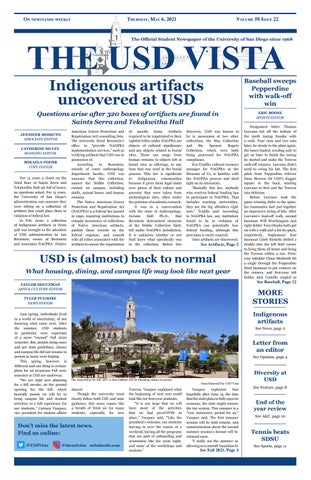
The expectation for Fall 2021 is that students will be attending classes in person.
shared. Though the university must closely follow both CDC and state guidance, this news comes like a breath of fresh air for many students, especially for new
Don’t miss the latest news. Find us online: @USDVista
ERIC BOOSE SPORTS EDITOR
See Baseball, Page 12
TAYLOR DEGUZMAN ARTS & CULTURE EDITOR
Last spring, individuals lived in a world of uncertainty, of not knowing what came next. After the summer, USD students in particular were expectant of a more “normal” Fall 2020 semester. But, amidst rising cases and per state guidelines, classes and campus life did not resume in person as many were hoping. This spring, however, is different and one thing is certain: plans for an in-person Fall 2021 semester at USD are underway. “We are right now planning for a full on-site, on the ground opening for the fall; which basically means we will try to bring campus life and student activities to a full experience for our students,” Carmen Vazquez, vice president for student affairs
Baseball sweeps Pepperdine with walk-off win
@theusdvista uofsdmedia.com
Toreros. Vazquez explained what the beginning of next year could look like for first-year students. “It is our hope that we will have most of the activities that we had pre-COVID in place,” Vazquez said. “Like the president’s welcome, our students moving in over the course of a weekend, having all the programs that are part of onboarding and orientation like the neon night, and some of the workshops and sessions.”
Anna Behrens/The USD Vista
Vazquez explained that hopefully after June 15, the date that the state plans to fully open its economy, the state might remove the tier system. This summer is a “very instructive period for us,” Vazquez said. The first summer session will be held remote, and communication about the second summer session’s format will be released soon. “I really see the summer as allowing us a smooth transition to
See Fall 2021, Page 3
Diversity at USD See Feature, page 8
End of the year review See A&C, page 10
Tennis beats SDSU See Sports, page 11
2
The USD Vista
◆
May 6, 2021
NEWS
USD’s skeletons in the closet
Artifacts belonging to indigenous communities found on USD’s campus Artifacts from Page 1
whether through excavation or a campus search, the NAGPRA process needs to be enacted so the correct tribes and landholders can be notified to regain their cultural artifacts. This process is timeconsuming and can be drawn out even more when questions of legal ownership come into play, as it did with this collection. The collection of artifacts from Serra 308 is known as the Hubbs Collection, named after Carl L. Hubbs, the man who unearthed and collected the Indigenous artifacts. Hubbs was a professor at the University of California San Diego’s Scripps Institute who collected the artifacts during his time of employment. According to Bernstein, Hubbs bequeathed the collection to the Museum of Us upon his death in 1979. Later, in 2004, the collection was donated to USD’s anthropology department by the museum where it has remained in Serra 308 ever since. Through detailed legal review, it was determined that the Hubbs Collection is still under the legal control of UCSD, despite its meandering path “Carl Hubbs was employed by Scripps, which is part of the university (UCSD), and therefore anything he collected was under the control of that university, even though he had transferred legal ownership through a bequest to the Museum of Us (located in Balboa Park),” Bernstein said. “A determination was made that he never had the authority to do that and University of California San Diego retained legal control and therefore had NAGPRA compliance responsibility.”
Even though the Hubbs Collection is under legal control of UCSD, all three institutions associated with the collection are working together to ensure NAGPRA compliance according to statements by Bernstein and Dean of the College of Arts and Sciences, Noelle Norton Ph.D. Despite the collective cooperation of these institutions, there was an apparent lack of communication here at USD between involved faculty. For 15 years, no one outside of the situation knew about the Hubbs Collection. The Hubbs Collection is still not public knowledge at the university. The anthropology department is the physical custodian of the collection, but Jerome Hall insists they were left in the dark during this repatriation process. Hall explains that the communication has been lacking, considering there is a biological anthropologist, Dr. Jennifer Parkinson, in the anthropology department, and she was never consulted on any of this. “We have NAGPRA specialists within our own department,” Hall said. “Perhaps they’re (the university) just trying to keep it independent, but there are questions at least in my mind surrounding the timetable of all this and the extent of all.” Hall noted that he had been introduced to NAGPRA consultant Jan Bernstein in February 2020 in the context of an investigation into the history department she was involved in. While he was willing to cooperate and show Bernstein the Hubbs Collection under his supervision, concerns quickly cropped up
when he discovered that Associate Dean Kristin Moran had given Bernstein access to the Hubbs Collection without informing Hall. “This raised issues about the integrity of the collection,” Hall said. “If we are responsible as custodians for the collection, we can’t just have somebody opening it up and letting someone not even associated with the university, other than on the payroll, access
department chair Angelo Orona corroborated the claim that the Museum of Us had checked the collection before deaccessioning, noting that items were found that fell under NAGPRA jurisdiction during the search and that they were removed before USD received the collection. “They went through it and there was one site in which the Hubbs group found human remains,” Orona said. “Those
artifacts in the 320 boxes that constitute the Hubbs Collection that still need processing and identifying. “You’ll open a box and there will be 60 bags of shells or open another box and it will be a big bag of soil,” Lewis said. “He (Hubbs) took bones, projectile points, they took everything that would be at a site.” A human tooth was also found in one of these boxes. A formal consultation process
“You’ll open a box and there will be 60 bags of shells or open another box and it will be a big bag of soil. He (Hubbs) took bones, projectile points, they took everything that would be at a site.” - Persephone Lewis, USD tribal liasion to it.” After the collection was removed in February 2021, Hall also noted inconsistencies in what the contents of the collection were thought to be among the parties involved. While he reported that examinations by both the Museum of Us and the anthropology department found no human bone, Trujillo and Persephone Lewis, USD tribal liaison and professor of ethnic studies, both assert that human remains were found in the collection. “If you have found human remains and sacred objects in the Hubbs Collection, I want to know from which component of the Hubbs Collection,” Hall said. “From the component that you took from us? Because everything we have indicates that those were looked at not only by us, but by the Museum of Us, and there was no human bone.” Former anthropology
Saints Tekakwitha & Serra Hall is filled with students attending classes, which is where the boxes of artifacts are held. Jennifer Mossuto/The USD Vista
bags, the museum kept them, they kept the human remains. And then there was another object that was considered sacred that was found up in maybe Washington, up north, and it was determined sacred. So the museum then did follow the NAGPRA ruling. And so it was now repatriated.” Hall noted that his own examinations of the collection only turned up rock and shell, which he believes to be from trash heaps formed when people extract meat from shells. However, Lewis stated that shells may fall under NAGPRA if they came from Kumeyaay land because “we know that they (Kumeyaay people) gave shells and faunal bones as offerings,” which would classify them as associated funerary objects. While he is open to taking accountability if the anthropology department mishandled artifacts, Hall asserts that he can no longer verify the legitimacy of the collection starting the day it was taken from Room 308 in Saints Serra and Tekakwitha Hall. “I am the person that is fully responsible for the collection and the buck stops with me,” Hall said. “But I can no longer make that claim because the collection is no longer with us.” The Dean of Arts and Sciences, Noelle Notron Ph.D., claimed that all information about the material being stored was turned over to the provost office when she was first alerted that there was a collection on campus that had not been inventoried in July 2019. The extent of Dean Norton’s place in this process is to attend meetings and “show support for the process.” On Feb. 23, 2021, a letter summarizing the current findings was mailed to tribes and landholders associated with the found artifacts explaining the discovery of this collection. This is the first step in the NAGPRA process and according to Lewis, the findings are still preliminary due to the large number of
with associated parties has not yet begun, and although UCSD is the legal owner of the Hubbs Collection, UCSD, the Museum of Us, and USD are holding monthly meetings to discuss where they are in the repatriation process. The Hubbs Collection will remain at USD while it is being inventoried. Associated tribes and landholders are invited to every meeting, although Lewis said there was not much participation from them yet. Moving forward through this process, Bernstein will stay on contract to make sure everything the university does is in compliance with the law according to Lewis. Lewis also acknowledged how students may react to learning about this situation. “A lot of times it is really easy to get mad at the institutions, and we had failures and need to take responsibility for that, but we are doing our best job to make sure the tribes are centered in this process,” Lewis said. She went on to say that, in her opinion, there should be more awareness and education about NAGPRA law and processes and the ethics that go into research among both students and faculty. “If faculty don’t know, then students don’t know,” Lewis said. Lewis wants to see USD grow from this experience and create policies that aim to make sure collections like these do not go unnoticed and unprocessed for years on end. “We need to be able to show (the tribes) that we are doing our due diligence, and education is imperative to that,” Lewis said. “Universities love to be aspirational but when you have to do the work, it is hard. But USD is doing work to live up to those expectations.” As forensic anthropologists work to determine what tribes the artifacts belong to, more information and questions will arise. This is a long, ongoing process.
Volume 58 Issue 22
◆
NEWS
The USD Vista
◆
USD en route to normalcy for Fall 2021
3
In-person instruction expected for all students attending USD next semester Fall 2021 from Page 1
a full opening in the fall,” Vazquez said. “And as we move toward July and August, hopefully we’ll see less of the restrictions and more of an opening.” Part of the planning for next year puts a great emphasis on the attention and care that rising sophomores need. These sophomores had a unique first-year experience dissimilar to others because they lack experience with on-campus and student life. Vazquez believes that creating specific events and experiences for rising sophomores will be conducive to their time at USD. According to Vazquez, classes are expected to be on-site in the fall. “The idea is to really have as many classes on campus and to have a full, robust, vibrant campus life, given the guidance,” Vazquez said. “We’re always going to follow either CDC or state guidance, because that’s what we’ve done, throughout this yearplus of the pandemic.” Fraternity and Sorority Life (FSL) and student organizations on campus are what bring USD and its student body to life. From philanthropy talent show events to the Alcala Bazaar and club meetings, students experience USD’s community through events. However, this past year, with restrictions in place, no largescale in-person FSL or student organization events were held. Vazquez added that as of right now, larger scale in-person events are contingent upon state restrictions. “Let’s just assume that there are no capacity restrictions. If
there are no capacity restrictions, we will work with student organizations to schedule their events and activities, the way that they have in the past. If there are any capacity restrictions, then we’ll work within them.” USD will remain diligent in prioritizing student health and wellness concerning anyone who may be symptomatic. The student health center on campus will continue to test those who feel as though they have symptoms of COVID-19. The university has plans to remove the temperature screening stations on campus in the fall, however Vazquez added that no concrete decision is in place yet. In planning for the fall, Vazquez speaks on behalf of not only herself, but her community of student affairs and the staff that she works with, that everyone is looking forward to what is to come for USD. “What I miss so much is just being with our students. I mean, that’s where I get energy from. That’s where I get inspiration from and that’s where I feel joy,” Vazquez said. One concrete difference from last Fall to this year is that teachers no longer have to feel worried about being in a classroom with 20 college students, who typically have been less worried about the pandemic than others. Julia Cantzler, Ph.D., has said, “The requirement for students to be vaccinated is going to change everything in terms of comfortability for staff on campus.” According to an email from President James T. Harris III D.Ed, 67% of all faculty, staff, and
The USD Vista Celina Tebor - Editor in Chief Jennifer Mossuto - Associate Editor Catherine Silvey - Managing Editor Mikaela Foehr- Copy Editor Tori Tanigawa - Art Director Tyler Pugmire - News Editor Alena Botros - Opinion Editor
Technology implemented in classrooms to prepare for hybrid classes can be used to record lectures if a student is sick. Tanner Claudio/The USD Vista
administration have been fully vaccinated. Any students who come on to campus after Aug. 1 will be required to be either fully vaccinated, or follow the guidelines if they choose to be exempt from the vaccine. The expectation is that all enrolled students will be in San Diego, as they would in the past, for classes. What may change is the use of technology that was provided in order to help facilitate the transition to hybrid learning. James Bolender, Ph.D., who is on the faculty advisory committee, stated that “If you’re feeling sick, whether that’s COVID or the flu, you shouldn’t be coming to class … if I get an email from a student saying that they’re not feeling well and want to stay home, I can turn the cameras on and they can watch from home.” Recently, the CDC stated that if you are vaccinated, a mask is
no longer required for outdoor activity unless there is a large gathering. As more people become fully vaccinated, mask mandates around the country will be lifted, as they have in Florida and Texas. Regardless, some classes may still require the use of masks while in the classroom, and it is at the discretion of the professor to dictate such, according to Bolender. One thing that USD’s campus isn’t the same without is the togetherness and community that campus recreation fosters. It’s one thing to attend virtual spin or virtual yoga classes in order to stay active, but to utilize USD’s range of fitness facilities or join an intramural team with one’s best friends is something that many are missing. Serena Gandara, director of Campus Recreation, shared her hopes and plans for what indoor and outdoor campus recreation could look like in the fall. “We do hope to open our facilities, both indoor and outdoor: the Bosley fitness facility, the sports center facility, the beautiful outdoor pool, outdoor tennis courts, outdoor functional training, as well as our indoor facility, and the Bosley fitness center — all should be open pending guidelines,” Gandara said. The future of intramurals, club sports, recreation classes and outdoor adventures looks bright for the Fall 2021 semester. “We hope to return to all in-
Editorial – 619.260.4584 Business – 619.260.4714 www.uofsdmedia.com / @TheUSDVista
Brittany Lang - Feature Editor Gina Lew - Student Media Advisor Taylor DeGuzman - Arts & Culture Editor Marie Minnick - Operations Advisor Eric Boose - Sports Editor Sean Butler - Distribution Manager Regan Ferarri - Social Media Manager Austin Piona - Finance Manager MaryCatherine Smith - Advertising Manager
person activities which would include intramurals, sport clubs, fitness programs, like recreation classes and personal training group X classes,” Gandara said. “We also hope to run our outdoor adventure programs as well; outdoor adventures typically run day trips and overnights trips throughout the semester.” Outdoor adventure programs during the Fall 2021 could look like local day trips — biking and hiking trips — as well as a program called “Love San Diego” where students could go coffee tasting, gelato tasting, and learn about the different areas in San Diego. Through these outdoor experiences, students are gaining this “outdoor piece, wellness piece and socialization piece,” Gandara said. As far as special events go, Gandara expects events like glow in the dark yoga, glow in the dark spin, paddleboard yoga, and more will be offered in the fall. “Most of the activities that we have planned are typically socially distanced. So if there is still that requirement we can safely adhere to that guideline and still run our programs,” Gandara said. “We’re paying really close attention to both the CDC and the county and what the university wants us to do in order to support the health and wellbeing of our community.” Regardless of the expectations, it is almost certain that next year will surely involve more activities in all capacities for students next year.
The USD Vista publication is written and edited by USD students and funded by revenues generated by advertising and a student fee. Advertising material published is for information purposes only and is not to be construed as an expressed or implied endorsement or verification of such commercial venues by the staff or University. The USD Vista office is located on the fourth floor of the Student Life Pavilion in room 403B. All inquiries should be sent to: The USD Vista 5998 Alcala Park San Diego, CA 92110 Opinions expressed in this publication are not necessarily those of The USD Vista staff, the University of San Diego or of its student body. Letters to the Editor can be submitted to The USD Vista office. Letters should be limited to 300 words and must be signed. For identification purposes, USD identification numbers and writer’s year must be included in the letter. The USD Vista reserves the right to edit published letters. Any content sent to the editor will be considered for publication unless otherwise stated.
“ c o
4
To the USD community,
The USD Vista
◆
May 6, 2021
E DI TOR IA L
Letter from an editor
Typically the Editor-in-Chief of The USD Vista writes a letter from the editor at the end of the academic year. Our Editor-inChief, Celina Tebor, is unable to do that at this time. She currently still is, and always will be, our trusted Editor-in-Chief. I would like to note that she is the bravest and strongest leader I have had the pleasure to work with. To The USD Vista staff, Most of the USD community does not know the extent of the work you do each week, but I am well aware; the interviews, the last-minute stories, the long days, and everything in between. Your drive, your energy, and your passion for our paper keeps us going every week. You tell the important stories. You tell the sad stories. You share our wins with the community, as well as our losses. I have worked at this
publication for the past three years. This past fall and spring semester, our publication has had the strongest staff I have seen in my time at USD. Coming into the newsroom the first week of the fall semester, with no prior training due to the COVID-19 pandemic, our staff proved themselves while virtually creating a paper, and continued to prove themselves in person in the spring. Our Sports Editor managed to report on sports while sports were continuously canceled for COVID-19 cases. Our Arts & Culture Editor brought diversity and fun to her section. Our Feature Editor covered more staff and students than ever before and wrote their stories beautifully. Our News Editor stepped into big shoes and filled them with an incredible energy and attitude every single day. Our Opinion Editor shined and brought many new voices and opinions to her section. Our Managing Editor led our team and has been a great
colleague of mine for years. Our Copy Editor went from rookie of the year to leader of the year. I know every single person on this team will thrive in whatever future endeavors they choose to pursue. You all chase the truth. You chase good stories. You share what needs to be shared. Most importantly, you all remain authentically yourselves while balancing what it means to be a journalist. I believe that The USD Vista has proven itself as a publication worth reading. After breaking the news first last year that students were being sent home for COVID-19, we became the paper to read. That provided us with a responsibility we always had, but that was not always seen by others. Our small but mighty publication is the strongest it has ever been. That is because of our staff. I feel bittersweet to leave this publication to my dear friend and colleague, Taylor
DeGuzman. I know you will do incredible things with the responsibility that comes with running this publication. Thank you to our readers, our friends, and our community for following us all this time and for trusting us to give you your much-deserved news.
We couldn’t do it without your support. And finally, thank you to Celina Tebor for creating the best newsroom team and guiding us along the way. Sincerely, Jennifer Mossuto Associate Editor/The USD Vista
From left to right, The USD Vista Team: Eric Boose, Alena Botros, Catherine Silvey, Taylor DeGuzman, Mikaela Foehr, Celina Tebor, Brittany Lang, Jennifer Mossuto, and Tyler Pugmire.
Maria Watters/The USD Vista
The views expressed in the editorial and op-ed sections are not necessarily those of The USD Vista staff, the University of San Diego, or its student body.
Volume 58 Issue 22
◆
OPINION
◆
5
The USD Vista
E DI TOR IA L
Conservative Supreme Court takes on gun rights On April 26, the Supreme Court of the United States agreed to hear a second amendment case — something they have not done in over a decade BAYLYNNE BRUNETTI ASST. OPINION EDITOR The fear of an ideologically conservative Supreme Court has made its way to the forefront as the Court takes on a case backed by the NRA. The case being heard, NY State Rifle &. Pistol Assoc. v. Corlett, challenges a New York state law, which was upheld by the lower courts, that
amendment appeal cases. Now, a year later, they are ready to take on a case that would affect gun laws across every state — a case they denied hearing last year. The difference lies in the fact that last summer, the Supreme Court was ideologically liberal. Now, we have an ideologically conservative court who feels the need to wade into a very hot debate. It is glaringly obvious that
that would make it legal to carry a handgun in public without a permit, background check or training. With a Supreme Court likely willing to back-up gun rights, the state of Texas clearly felt empowered to create the wild, wild west all over again. I do not find it pertinent to give much of my opinion on the second amendment. However, what I will say is that I do not find comfort in allowing people to
These types of decisions affect all of us—especially in the wake of another onslaught of mass shootings here in the U.S. requires gun owners to obtain a license if they want to carry a gun outside their home. The New York law requires those wanting to obtain a license to carry a good reason to — aside from self-defense. The concerning question plaguing people’s mind is, why now? Last summer, the Supreme Court denied ten second
the Supreme Court has become so politicized that they are even now willing to take on highly politicized issues — which is something they once overtly tried to avoid. The implications of this potential ruling are already being felt. This week in Texas, the state Senate created a special committee to push forward the state’s House bill
walk around with a gun strapped to their hip, especially without any permits, background checks, or training. I do not find solace in having a Supreme Court who is so openly conservative that they decide to take on controversial subject matter to appease their originalist desire to make the United States the way it was in 1789. When
the Court begins to take on controversial political questions because of the majority rule, it becomes dangerous. The justices will not likely be exposed to the reality of their NRA buyout, but the American people will. These types of decisions affect all of us — especially in the wake of another onslaught of mass shootings here in the U.S. There were 160 shootings between Jan. 1 and April 26 this year in which four or more people were injured or killed. These upward trends in gun violence do not spark much reassurance that now is the time to be laxing up on gun laws. These potential new regulations could ultimately affect everyone if the wrong people have more easy access to firearms. The NRA (National Rifle Association) put 3.2 million dollars into congressional lobbying in 2019. On the contrary, Everytown for Gun Safety put forth 1.3 million
dollars in lobbying in the same year. Looking at the amount of money the NRA puts into congressional lobbying shows a direct correlation to the conservative justices that get put on the bench. When you have this much money in politics and you combine that with a hyperpartisan Senate, you receive a recipe for disaster. These are the real-life implications of having a nineperson Court making decisions for over 300 million people. These are the repercussions warned about when we began to make the Supreme Court highly politicized. There are reasons that the Republican party fought tooth and nail and (ironically) unconstitutionally for, a major reason being the second Amendment and the amass of power and money behind it. We should be gravely concerned for what the Court is becoming and the controversies they are now willing to take on.
The closet doesn’t define you
Although coming out of the closet is a significant event for many who are part of the LGBTQ+ community, it shouldn’t be what defines their sexuality or gender identity JENNY HAN ASST. OPINION EDITOR December 27, 2020: This is the day that I officially came out to my parents and, subsequently, the rest of the world as bisexual. I originally wasn’t planning on coming out until I turned 21 and permanently moved out of my house so that I didn’t have to deal with the backlash that I knew would follow. But in
the days leading up to the new year, the thought of having to start the 2020s hiding away a fundamental part of my identity terrified me. So in a fit of rage
Several months have passed since I’ve officially entered the greater outdoors as my “true self.” And I don’t regret the way that I came out or the fact that
event isn’t all that important. The metaphor of “coming out of the closet” derives itself from the idiom “skeleton in the closet.” A “skeleton” refers to a
To many LGBTQ+ members, coming out is a way of celebrating their sexuality or gender identity and reclaiming what was formerly a negative identity marker into a more positive one. during a heated argument on that fateful December night, I flung open the closet doors.
I came out in the first place. However, the biggest lesson that I’ve learned is that this hallmark
negative secret that one wants to hide from others. Due to the stigmatization that came — and still comes — with not being straight or cis-gendered, one’s LGBTQ+ identity would be seen as a “skeleton.” And since people are generally assumed to be heterosexual and cisgender,
know about it which is simply not the case. You are part of the LGBTQ+ community when you realize that you’re attracted to someone of the same gender. You are part of the LGBTQ+ community when you realize that you aren’t attracted to anyone at all. You are part of the LGBTQ+ community when you realize that your gender doesn’t quite align with your sex. This list goes on and on but the bottom line is that being a part of the LGBTQ+ community has nothing to do with changing your label for the convenience of those around you. Rather, it has everything to do with your journey of discovering yourself.
Being a part of the LGBTQ+ community is about finding yourself. someone would have to explicitly disclose otherwise to the people around them. To many LGBTQ+ members, coming out is a way of celebrating their sexuality or gender identity and reclaiming what was formerly a negative identity marker into a more positive one. I’m not here to diminish the significance of coming out; it is undeniably an act of immense courage. However, the emphasis on coming out implies that your sexual or gender identity Photo taken at a Pride Parade in Calgary, Canada protesting for equality for the LGBTQ+ community. Photo courtesy of Toni Reed/Unsplash is defined by how many people
Sexuality and gender expression are huge spectrums and where you decide to place yourself on said spectrums are completely up to you. And the way that you show your labels (if you even want to) is also up to you. All in all, being a part of the LGBTQ+ community has to do with finding communities where you can flourish. Being a part of the LGBTQ+ community is all about letting these new experiences into your life. Being a part of the LGBTQ+ community is about finding yourself.
The views expressed in the editorial and op-ed sections are not necessarily those of The USD Vista staff, the University of San Diego, or its student body.
6
The USD Vista
◆
May 6, 2021
Vista Editors Pick Their Favorite Stories of the Year Tyler Pugmire, News Editor: “USD president and general counsel uninvite Maddox Lyons from SDSX event 24 hours beforehand” “Taylor and I both got woken up by phone calls telling us that there was a story to write. We ended up working on the story from 7:30 a.m. until we sent in our final draft at 8:30 p.m. It was such a team effort and staying in the newsroom, contacting faculty from around campus all day. It felt like a journalistic marathon. The whole experience was the reason why I will be so attached to this story.”
Taylor DeGuzman, Arts and Culture Editor: “What makes you proud to be Asian American/Pacific Islander?” “This piece holds such a special place in my heart. Not only am I proud of this story as a Filipino-American, but I am proud of the story because each individual shares their pride and love for Asian-American and Pacifics Islander culture so vulnerably, genuinely, and honestly. The world yearns for stories like this, that highlight the beauty of diversity.”
Photo courtesy of Crystal Nguyen
Photo courtesy of Nathan Chang
Alena Botros, Opinion Editor: “What Kamala Harris means for women” “I wrote this article six months ago, and now Kamala Harris is the Vice President of the United States. Her victory represents all women and our ability to strive for greatness and reach it. We can all learn from her resilience and passion, and become the women we want to be.”
Volume 58 Issue 22
◆
FEATURE
◆
7
The USD Vista
Brittany Lang, Feature Editor: “From imposter syndrome to the White House” “I will never forget the feeling I had while writing this story as imposter syndrome is not only something I have felt in my life, but something I know many college students especially struggle with. Writing about Deesha Dyer’s nonlinear journey that led her to become one of the most important people in the Obama administration reminded me that there is no time limit on finding your career calling, and that the entire course of our lives can change in an instant if only we seize the opportunities in front of us.”
Photo courtesy of Deesha Dyer Photo courtesy of Deesha Dyer
Eric Boose, Sports Editor: “Toreros sweep Pepperdine with walk-off win” “The series against Pepperdine materialized basically out of thin air after Gonzaga had COVID issues, postponing the originally scheduled games in Spokane. The spontaneity of getting ready to cover a series in person (rather than from my couch) in a matter of hours was such a thrill. Even better, having my last story for the Vista being about a walk-off win feels as close as I’m going to get to a storybook ending, and I’m immensely grateful for that.” Photo courtesy of David Bernal/USD Athletics
Spread by Tori Tanigawa/The USD Vista; Content by Brittany Lang/The USD Vista
8
FEATURE The USD Vista
May 6, 2021
Students discuss diversity at USD Although USD claims to be a university that advocates for diversity, many students think the community and administration needs to do more JENNY HAN ASST. OPINION EDITOR As a Changemaker campus, the University of San Diego identifies itself as a university dedicated to diversity and inclusion. In their 2020 Strategic Plan for Diversity & Inclusive Excellence, they aim to “justly represent the breadth and beauty of God’s creation in our own community, embracing the values of both pluralism and equity.” However, many students have mixed feelings regarding how well USD upholds their commitment to diversity. Several presidents of multicultural clubs shared their thoughts in a series of interviews. As of Fall 2020, out of the 8861 students enrolled, 49% identified as White. This makes USD a predominantly White institution. This dynamic has shaped the experiences of many student leaders. There have been highs and lows associated with USD’s response to different instances of intolerance and diversity issues, as explained by these student leaders. Samantha Wane, sophomore president of the Jewish Student Union, recalled how she felt supported, by USD after the Poway synagogue shooting, despite the campus having a history of anti-Semitic incidents. “There have been some instances of recordings of like swastikas around campus or just like anti-Semitic points of view that have been displayed on USD,” Wane said. “But I think that that (the Poway service and remembrance) was a really prime moment that I remember, and I really appreciate it from USD.” Unfortunately, most student leaders who were interviewed communicated negative experiences with the USD community in terms of diversity. Brittany Le, a junior at USD and one of the copresidents of the Asian Student Association (ASA) reflected on how the way she was treated by members of Greek life made her feel unwelcome. “I noticed when I was coming on campus that made me kind of arrow away from
Greek life was when you pass by these tables, these recruitment tables, they would go to white girls who have the blonde hair, have the brunette hair, and give them posters. But whenever I passed by, I never got that type of interaction,” Le said. “I wasn’t entirely interested in the beginning because I think I’m more of an introvert. So, I was a little bit out of my comfort zone. But just that gesture in itself I think already made me feel more disconnected from that like that institution.” Although not every USD student is involved in Greek life, it is an institution and cultural presence that plays an important role for many students at USD. Meredith Wiggins, senior and president of the Black Student Union (BSU), recounted her perspective on the USD’s community’s response toward the Instagram page @ blackatusd and activism for BLM during the past year. “People are like, I’m so exhausted. I’m like, you’re tired? Like you’re tired, like all you did was post a little black square,” Wiggins said. “I’m tired, I don’t get to take a break. I will always be Black and I’ll always be a Black woman. That’s my experience until I die.” Inclusion in the community goes beyond race and skin color. Christina Ledford, sophomore and one of the presidents of the Alliance of Disability Advocates (ADA), explained how her learning disability has negatively affected how she has felt in the USD community. “As a white woman I obviously have an immense amount of privilege, especially going to USD,” Ledford said. “I can be perceived as being welcomed, but I don’t necessarily feel welcomed.” As a result, many people feel the need to stay within their smaller communities to feel safe and accepted at USD. However, this has its limitations. “USD does need a lot more work I think with kind of recognizing diversity and kind of really doing more initiative for that because, I mean, if you think about like the UFMC or the Commons in general, it’s just literally one floor on the fourth
floor that SLP and that’s kind of all we have to kind of share amongst all the BIPOC students,” Lord Mark Bautista, senior and president of the Filipino Ugnayan Student Organization (FUSO) said. “Like, even though we do have it, I’m super grateful for having that space, but I don’t know. It just feels weird to be all crammed up there.” Junior Sara Gardener, and one of the presidents of ADA, expressed the importance of having the entire campus feel like a safe space rather than just having a safe space within the campus. “It’s good to have those spaces, but when you’re in classes when you’re in, whatever it is, if you’re in your dorm setting or whatever, you don’t always have those people around,” Gardener said. “So the overall community has to be welcoming and that’s where I think USD is lacking.” Unanimously, all of the student leaders interviewed believed that although USD is on the right track, it most definitely is not doing enough in terms of diversity. “I don’t know too much about USD’s efforts in diversity,” Bautista said. “And maybe that does show that they do need to do a little bit more work.” For junior Rhonda Papp, President of the American Indian Student Organization (AISO), it goes beyond informing the students what they are planning on doing; it requires concrete action. “The system at USD almost seems against promoting the Native community on campus,” Papp said. “First of all, they could create a Tribal Office and Native community space. With the rise of spaces and buildings on campus, why don’t we have a gathering place for Natives already? With that, they could have a safe space to study, gather, and get the help they need from the Office of the Tribal Liaison because of how unique Native issues can be. It has already been brought to the attention of university that some students don’t feel comfortable at the counseling center because the counselors simply don’t understand their issues.” Although Papp’s criticisms
Out of the 13 people interviewed, all thought that USD is not doing enough in terms of diversity. Jenny Han/The USD Vista
are from a Native American perspective, the lack of BIPOC counselors is a concern echoed by many others. It goes to show that Papp’s initiatives aren’t just limited to the Indigenous community. “There are many things that USD can do to welcome the Native community more, but also all underrepresented communities,” she said. The USD community has many students from different
backgrounds, racially, culturally, financially, and cognitively. As the trends in enrollment show, this will continue to be the case, and therefore issues like those raised here will remain present unless both the community and administration are willing to listen and make changes.
An extended version of this article is published online on The USD Vista’s website.
Volume 58 Issue 22
◆
ARTS & CULTURE
◆
The USD Vista
A RT S & C U LT U R E
9
End of the year review: 10 of our best
Reflecting on the year’s most popular, most important, and most memorable stories TAYLOR DEGUZMAN A&C EDITOR This year, the USD community turned to beautiful stories of diversity, stories of hope, stories that highlighted the beauty of San Diego, and stories that captured the arts and culture of USD, to bask in moments of joy. The Arts and Culture section of The USD Vista offered readers an escape — whether that be an escape through online dating culture, delicious food and drinks, gorgeous sights and surroundings, tips and tricks for how to navigate life, and more. With the end of the school year and the last issue of The USD Vista drawing near, here are 10 of our best Arts and Culture stories for the year 2020-2021. “The land was already beautiful before”: A Look Into the History Beneath USD’s Surface This story illuminates the history and significance of the land beneath USD — a story that often goes unnoticed or recognized to the USD community. The creation story of USD often paints the narrative that our campus was built on unused land, but the truth is that thousands of years of habitation, history, and life resided here, long before USD was born. Crush culture during COVID-19: Pinning your Zoom crush
An end of the year review for The USD Vista’s Arts and Culture section.
A year of online classes forced students to find unconventional ways to shoot their shot at their crushes; oftentimes, individuals pinned their Zoom crush in an attempt to distract themselves from lecture. Without in-person interactions and the ability to dress and impress a crush, the culture around crushing and finding the “one” drastically changed. The
Bachelorettes and Bachelors of USD
The saying goes: “There are plenty of fish in the sea.” And with that being said, a lot of people at USD are quite the catch. Some of USD’s most sought after bachelorettes and
bachelors were featured — and as a result, some bachelorettes and bachelors received a few DMs from secret admirers. What makes you proud to be Asian American/Pacific Islander? To combat the hate, racism, and prejudice in the world, especially the heightened fear amongst the Asian American and Pacific Islander community amidst anti-asian hate crimes, stories of love and stories of pride from the USD community remind others all the reasons why one should be proud to be AAPI. The culture of new year’s resolutions
“It’s a time to reminisce on the past while dreaming about and planning for the future.” USD students came together to reflect on a year of uncertainty and how they planned to move forward and create a year that looked different than last. Best and worst dates of USD “The worst date I ever went on was at Raising Cane’s in Honolulu. I’m pretty sure she just wanted a free meal and a ride home. We never talked again,” junior Luke Bradley recounted. We’ve all experienced the good, the bad, and the ugly when it comes to memorable dating experiences. Sometimes, the worst dates are the funniest memories looking back.
Taylor DeGuzman/The USD Vista
Time to zoom away from Zoom: Coronado With students’ screen time increasing by the minute, 10hour Zoom days feel almost routine. However, when you live in one of the most beautiful cities in the world, a mini picturesque getaway to a small island “away from the real world” is more than possible. 5 good outcomes of the worst year ever: why 2020 wasn’t all bad Despite 2020 being one of the most unforgettable years (and not in a good way), there was still some good that came out of the bad; whether that be a win for the environment, resources for mental health, or TikTok not getting banned, the year created small moments for individuals to feel at least some sunshine throughout the fog. #FreeBritney: USD students help the movement gain momentum This story put a spotlight on the “Free Britney” movement — a movement centered around Britney Spears’ conservatorship, by which her father controls her finances and namely, everyday life. An incredibly important and eye opening story, this piece highlights the late 90s mental health stigma that painted women in the limelight as crazy. How to be (lowkey) TikTok famous
Taken from one of the first Arts and Culture pieces: “What We Lost: Multicultural organizations reflect on canceled Spring 2020 events.” Photo courtesy of People of the Islands Club
USD may be small, but some of the stars and influencers that come from our school are far from it. One USD student featured has over 150k followers on TikTok. If one person from USD can become TikTok famous, anyone can.
10
The USD Vista
◆
May 6, 2021
Where to tackle finals season How to create or find a productive study space, for finals season nothing stuffy or pretentious about this coffeehouse. There’s both indoor and outdoor seating, and the indoors seating upstairs is especially quiet and secluded. Their specialty drinks stand out on the menu, especially the mocha. However, they supposedly go heavy on the sweetener in their drinks, so keep that in mind. The Living Room provides a great space to sip on coffee, enjoy a pastry, and get some muchneeded homework done.
ANNA VALAIK ASST. A&C EDITOR During finals, it becomes increasingly important to find an apt study space to work from. For every student the perfect study spot looks different, but there are normally some key factors that stand out as must haves: peace and quiet, room to spread schoolwork out, and very little distractions. With Zoom university, where people are rarely leaving their main work space or desk, it’s important to change up some study habits and get out of the mundane routine students fall into during the semester. A new place to write, study, or do homework from always provides much needed inspiration and motivation, which is especially necessary during exam time. Whether it be writing a research paper or studying for an important history final, there are some awesome places in San Diego that will help get the job done.
Young Hickory
Moniker Coffee A place frequented by many USD students, Moniker Coffee has a large building within Liberty Station, which is about a ten minute drive from campus. With varying tables, sofa arrangements, and outdoor seating, Moniker has enough options for any study habit. Whether a student wants to study with a roommate or write a paper alone, Moniker has the seating and vibe for both. Their beverages are always good, providing that much needed caffeine boost to get through a long day of finals. The Hawaiian latte and toast flight are a must try. However, they do play loud music and it’s normally quite busy, so if easily distracted, this is not necessarily the place to go. Parking is readily available, as the coffee shop is within Liberty Station. Learning Commons The USD Learning Commons, a new building on campus, is a great place to dedicate a few hours to school. Students can rent classrooms, work in single rooms, or set-up in the common space throughout the building. It’s quiet, and they have a full snack/beverage area. Also, it’s right on our beautiful campus, which makes it the perfect place to walk around during a study break. Parking is available around campus, but just make sure to get a temporary parking pass on the USD website. Holsem Coffee Located in North Park, Holsem Coffee is the perfect place to sit alone and work. There are multiple single tables, oftentimes filled with people on
A delicious matcha latte for a caffeine boost.
their laptops or reading. It’s a small enough space that it’s rarely too distracting to focus on a task. The lighting is wonderful; huge windows make the space feel so natural and homey, which is always lovely to experience when studying. Holsem Coffee provides ample options for food and drinks, which are great for a midday snack or caffeinated beverage. The mint matcha latte tastes out-of-this-world. There is metered street parking, as well.
Anna Valaik/The USD Vista
Young Hickory, located in North Park, does not lack in space. With an open floor plan and open windows, the space feels bright and welcoming. There are seats with outlets everywhere, just in case a computer or phone is about to die. It’s never too loud or rowdy, but has the perfect amount of background noise to be productive and feel surrounded by hard-working individuals. Their coffee is loved by many, and their food stands out as one of the best when compared to other coffee shops; it’s truly a win-win. Try their paninis or breakfast sandwiches, which some reviews claim are “to-die-for.” However,
beware of the parking because it can be difficult to find a spot. Your home/Own desk For those not in San Diego, or even for those who do their best work at home, there are many ways to switch up your regular workspace and feel inspired to finish exams. Here are some tips to creating an ideal workspace: 1. Look for natural light when designating a space. 2. Remove all distractions (phone, random knick-knacks, etc.). 3. Sit in a comfortable chair. 4. Have a favorite beverage, whether that be coffee, tea, or water, on hand. 5. Organize the space, making sure everything is tidy and in its place. 6. Don’t be afraid to hang inspiring pictures or light a candle to truly make it a comfortable setting. Studying for finals is never easy, especially when it seems all college is nowadays is sitting on the computer and working all day long. However, these places, and many more, should inspire anyone to push through these last few weeks and finish with a bang.
Lestat’s Lestat’s has three locations around the University Heights and Hillcrest area and is another great option for studying. Parking is available directly in front, but it’s on a busy road in Hillcrest, so the availability may vary depending on the date and time. The walls are covered in local artwork, the rooms are spacious, filled with various sized tables perfect for any study group, and the overall environment is quite quirky. Their coffee has high ratings, and their large food menu will satisfy almost any food craving. Take note of their sandwiches, which receive high praise from those who frequent this coffee shop. It’s the perfect lowkey, comfortable workspace to get any task done. The Living Room The Living Room, just like Lestat’s, is serving up great drinks in a relaxed atmosphere. There are locations in La Jolla and near SDSU. It’s designed, quite literally, to feel like a living room, so there’s truly
The yogurt bowl and matcha latte from Holsem Coffee.
Anna Valaik /The USD Vista
Volume 58 Issue 22
◆
SPORTS
◆
11
The USD Vista
SP ORT S
Men’s tennis finishes season with win over rivals SDSU Toreros, short-staffed because of injuries, overcome early deficit to beat Aztecs
MARIA WATTERS ASST. SPORTS EDITOR The University of San Diego’s men’s tennis team competed in their final match of the season at home on Saturday, May 1 against their cross-town rival, the San Diego State University Aztecs. Already down 0-1 due to a lack of eligible players, the Toreros entered the match trailing behind the Aztecs. With only five players, USD had to forfeit the third doubles court, requiring them to win the remaining two matches in order to clinch the doubles point and level the team score. Though the Toreros dominated their opponents on court two with a 6-2 victory, it was the Aztecs that secured the doubles point with a 6-3 win on court one. USD entered the round of singles matches with a 0-2 deficit. The Toreros proceeded to dominate the rest of the competition,
have been crippled by injuries. The Toreros suffered an early loss when redshirt senior Gui Osorio was forced to sit out the season due to leg and back injuries. Once competition began, their numbers continued to dwindle as players got injured and one left the program. Just a week before facing the Aztecs, USD was forced to take on WCC opponent Loyola Marymount with only four players. The personnel issues appeared to have a drastic effect on the reigning WCC champs as they were caught in a fourgame losing streak in March. But the Toreros refused to let the circumstances of their season affect their fighting spirit and desire to uphold their powerhouse reputation. “We had some tough luck with injuries, but we found a way,” redshirt senior Nico Borter said. “We had to come together as a team in order to achieve our goal of beating State.”
“When we were playing, we heard throughout the match that we had won the first five sets in singles and I think that was just a really positive motivating factor for us.” - Garrett Kurtz winning the first set on every court. Ultimately, USD emerged victorious after four straightset victories, concluding their season with a 4-2 victory over SDSU. The 2021 season has been nothing short of a rollercoaster for the USD men’s tennis team. The six-time defending West Coast Conference champions
The deck was stacked against the Toreros entering Saturday’s contest. Since the Toreros had no choice but to forfeit the sixth singles match, they were behind 0-1 in the team score before they had even played a single point. On top of that, having also forfeited the third doubles match, they would have to win both remaining doubles matches
in order to clinch the doubles point, while the Aztecs would only need one win to claim it. With a formidable hill to climb and the additional pressure of wanting to end their season on a high note, the Toreros took the court against the Aztecs in what was essentially a sudden death contest. The second doubles court was the first to finish. USD’s redshirt first year Marvin Schaber and redshirt junior David Norfeldt defeated SDSU’s senior Ignacio Martinez and first year Judson Blair 6-2. The Toreros were less successful on court one, where redshirt senior Nico Borter and redshirt junior August Holmgren were locked in a highly competitive back and forth battle with first year Johannes Seeman and senior Ignacio Martinez. Ultimately, Seeman’s powerful serve proved too much for the pair of Toreros to handle as the Aztecs clinched the doubles point with a 6-3 victory. USD had it all to do if they were to emerge from the season’s last contest victorious. “We lost the doubles point and we were down 0-2, but I think we all had a genuine belief that we could win the game,” redshirt senior Garrett Kurtz said. “Especially because it’s San Diego State and we don’t want to lose to the Aztecs.” Trailing 0-2, the Toreros would need to win at least four singles matches to claim the win. However, because they only had five players, USD had little room for error as more than one loss would seal their defeat. On court one, 77th-ranked Holmgren was set to face off
against Seeman, but unlike in doubles, this contest would be between just the two of them. Having tasted the speed of Seeman’s serve before, Holmgren was able to neutralize his opponent’s strengths and ultimately walked away with an impressive straight-set win 6-2, 6-1.
on court five as Schaber put away first year Roni Rikkonen in straight sets. Though he was unable to finish his match, Borter was looking to be on his way to a victory over Castro in his last match as a Torero on court two. Having won the first set 6-3, the senior was leading in the second
“This match meant a lot to these boys and our alumni base, so to walk away with a win is a memorable finish for Nico (Borter) and Gary (Borter) on senior day.” - Head Coach Ryan Keckley Having cut the Aztecs’ lead in half with Holmgren’s victory on court one, the Toreros were quickly gaining ground. And they didn’t trail behind on the team score for much longer as Norfeldt was making quick work of Martinez on court three. Ultimately, Norfeldt would leave with the win, defeating Martinez 6-1, 6-2, leveling the overall score 2-2. After winning the first set on all five courts, the Toreros never took their feet off the gas. “When we were playing, we heard throughout the match that we had won the first five sets in singles and I think that was just a really positive motivating factor for us,” Kurtz said. On court four, Kurtz faced off against SDSU’s graduate student Rafael Gonzalez in his last match at USD. Despite sustaining an ankle injury in the match against LMU, Kurtz battled his way to a 6-2, 6-2 victory, putting his team ahead 3-2. The Toreros secured the win
5-3 with three match points. At the end of the day, USD capped off their season by battling their way back from a 0-2 deficit to defeat their San Diego rival SDSU with only five players. On top of that, the Toreros said goodbye to two seniors, Kurtz and Borter, whose efforts helped lead USD to multiple WCC championships. “I was extremely proud of how they competed against their cross town rival San Diego State,” Head Coach Ryan Keckley said. “This match meant a lot to these boys and our alumni base, so to walk away with a win is a memorable finish for Nico (Borter) and Gary (Kurtz) on senior day.” Their season concluded, the Toreros head into the offseason and begin preparing for competition to start again next year. The new season will bring in new faces and USD tennis veterans alike with the goal of returning the program to its championship-winning status.
Men's Tennis season highs and lows Feb. 5: win season opener, 6-1
March 16: lose fourth straight match
April 23: defeat LMU with only four players
April 10: swept by BYU
May 1: win season finale vs. SDSU
April 25: swept by Pepperdine Mikaela Foehr/The USD Vista
12
The USD Vista
◆
May 6, 2021
USD earns comfortable, close, and comeback wins in sweep The three wins put San Diego into joint first place in conference standings
Baseball from Page 1
score Ricketts and tie the game. A walk to sophomore shortstop Cody Jefferis loaded the bases, and the rest was history. After the win, Head Coach Rich Hill credited his team’s mentality and the sheer number of quality at-bats they strung together in the final inning. He also noted that his team has quite the impressive record at home at Fowler Park. “That was just Fowler magic at its best,” Hill said. “I think we’re like 26-2 over the last two years at Fowler, and our guys just believe that we’re going to find a way to win whenever we’re at home.” Hill’s squad is not only strong at home, but San Diego is no stranger to comeback wins. In their first home game of the season, the Toreros overcame a nine-run deficit to beat crosstown rivals San Diego State. Jefferis said that games like that one gave USD the confidence to pull off their five-run ninth inning on Sunday. “It’s always tough when you’re down, but we know as a team we’ve been in that situation before, so it’s honestly not that big of a deal for us,” Jefferis said. “Whether we’re down one run or five runs, we always know that we have a chance to come back, no matter what the situation is, and we proved that today, in the end.” The Toreros’ rally didn’t just decide Sunday’s game, it clinched the Toreros’ fifth series sweep this year, with San Diego winning a nervy affair on Saturday, 7-6, after a comfortable 8-3 victory on Friday. Sophomore pitcher Jake Miller started Friday’s game for USD, and while he wasn’t perfect, he kept the Waves off the board for six innings, striking out eight Pepperdine batters in the process. While Miller stymied the visitors, the home team wasted no time scoring. Costello hit a one-out single to get on base, and junior catcher Shane McGuire almost homered to right center right afterward. While the ball stayed in the park, it didn’t stay in the Waves’ outfielder’s glove, and McGuire got a double. With two outs, Luevano smacked a base hit to left field, and while Costello scored easily, McGuire was tagged out at home, so the Toreros had to settle for just the one run. San Diego added to their lead in the bottom of the fifth inning as three straight hits, including an RBI double by Otsuka, scored a run and put runners on second and third. Jefferis hit a fly ball deep enough to center field that those runners could each move up a base, scoring a second run of the inning.
San Diego’s walk-off victory over Pepperdine on Sunday was the Toreros’ third walk-off of the year, the other two coming against CSU Fullerton and UC Riverside. Photo courtesy of David Cohen/USD Athletics
Now with a three-run lead, Miller got into trouble in the top of the sixth inning. He gave up back-to-back singles before recording the first out of the inning, but still had runners on first and third with only the one out. But Miller struck out the next two batters, including Pepperdine’s hard-hitting first baseman, Justin Lutes. Hill mentioned his Friday starter’s work as one of the key moments from the series. “That’s why a Friday starter is so important to a college program, it sets the tone for the weekend,” Hill said. “When you have a Friday guy that can go deep in a game, it can really set you up for the weekend, so that’s huge.” In the bottom of the sixth inning, the Torero bats came alive to put the game out of Pepperdine’s reach. Jefferis started the scoring with a twoRBI single past the Waves’ second baseman, and Costello brought Jefferis home. Costello launched his team’s only home run of the series over the wall in left field to stretch the Toreros’ lead to seven. They would get one more run in the inning, as, with two runners on, Pepperdine catcher Joe Caparis missed a throw to first so badly that USD third baseman Adam Lopez came home from second base. But with Miller’s evening on the mound done after his efforts in the top of the sixth, San Diego’s relief pitchers were not as steady. First year Ivran Romero gave up one run in the top of the seventh inning, and fellow first year Jack Hyde was responsible for two in the eighth. Even so, the Waves never got close enough to pose a threat. The same could not be said in Saturday’s game. Pepperdine shortstop Wyatt Young hit the first pitch of the game into left centerfield for a double, and he
would come around to score by the end of the first inning. But the Toreros answered with an explosion of runs in the bottom of the first, scoring five. Jefferis led off the inning with a walk, and Costello’s grounder was too hot for Young to handle at shortstop. Lopez singled to drive in Jefferis, and Luevano doubled to bring home Costello and Lopez. Luevano got to third base after a pitch got away from Waves’ catcher Ryan Johnson, and Ricketts brought him home with a single. Ricketts got to third himself on another wild pitch, meaning Worthington’s fly ball to right field was enough to bring Ricketts home. San Diego’s lead lasted, but was never as large. A walk and a double brought Pepperdine another run in the top of the second, and they picked up a second after Ricketts couldn’t handle Jefferis’s throw for what would have been the third out. USD put up two more of their own in the bottom of the third, but that was it for the Toreros’ scoring output on Saturday. Quickly, the visitors went about closing the gap. Lutes led off the top of the fourth inning with a home run to right center field, and outfielder Billy Cook made it back-to-back jacks with a homer to left field to bring the Waves within two. San Diego’s starter, redshirt first-year Connor Thurman, got out of the inning, but that was the end of his night. First-year pitcher Carter Rustad took over starting in the fifth inning, a planned move, according to Coach Hill. Hill chose to “go for the gut punch,” using Rustad, who could have started Sunday’s game, to clinch the series win for the Toreros Saturday night. Rustad did his job, pitching four scoreless innings. Graduate student Kieran
Shaw took over in the ninth inning and would have finished it unscathed, had a pitch just on the outside of the strike zone been called a strike. Instead, it was called a ball, and the batter walked. The very next guy up, designated hitter Connor Bradshaw, hit a double to score Pepperdine’s sixth run. Before the Waves could score any more, Jefferis threw a laser from shortstop to first to record the final out of the game. While Rustad’s work Saturday night had been crucial, it left USD without a starter on Sunday. Romero, a reliever, started the game but only made it through two innings, in which he gave up a three-run home run to Cook. Hyde relieved Romero, only made it two innings himself, and also gave up a three-run homer. Off Romero and Hyde, Pepperdine scored three runs in the second inning and four in the third. Redshirt sophomore reliever Ryan Robinson relieved Hyde in the middle of a messy fifth inning, but couldn’t fully stop the bleeding, as the Waves put up their final two runs in that frame. In the early stages of the game, USD had kept with Pepperdine in terms of scoring. Jefferis hit a single to start a string of hits that gave the Toreros a run in the first inning, and he hit an RBI triple as part of a three-run second inning for San Diego. But, until the ninth inning, that was pretty much it. USD picked up a solitary run in the fifth, but that was mostly thanks to Pepperdine errors rather than San Diego hitting. After the game, Coach Hill pointed out an unsung hero of the Toreros’ comeback: firstyear relief pitcher Lucas Braun. Braun entered the game in the seventh inning, with one out and runners on the corner. Not only did he get out of the jam, he
finished the game for San Diego. “If there’s one story of this game, it’s Lucas Braun,” Hill said. “That’s a big weekend series where he threw two and two-thirds scoreless, sat at 91 (MPH), threw his curveball for a strike, and allowed us to get back into the game and have that big inning at the end.” With the sweep, USD moves to 28-8 overall, 14-4 in West Coast Conference play, making them tied with Gonzaga for first place in the conference. The Toreros were originally scheduled to play the Bulldogs in Spokane over the weekend, but GU had to postpone due to COVID-19 issues. The two teams will now meet at the end of May in a series with potential conference title and postseason implications. Since there is no WCC Tournament this year, the regular season champion will receive the conference’s automatic bid to an NCAA Tournament Regional. But Coach Hill isn’t looking toward the season finale yet. There are still two series for USD to get through before they take on the Bulldogs. “Hopefully it will come down to that weekend,” Hill said. “We’re both 14-4, tied for first, but we’ve both got work to do. We’ve got BYU, who presents a real challenge, they can really pitch, and that’s all I’m really thinking about right now … Our guys are so locked in on the moment that Gonzaga doesn’t exist, neither does Portland, really. It’s just all about preparing for BYU. I’m actually focused on Tuesday, having a good practice, more than anything else.” That preparation will have to be quick, as the turnaround for USD to host the Cougars will be one day shorter than usual, as the series starts today, May 6, at 6 p.m.