On newstands weekly
Volume 59 Issue 22
Thursday, May 12, 2022
THE USD VISTA
The Official Student Newspaper of the University of San Diego since 1968
A year to remember
Reflecting on the accomplishments of Torero athletics JAREK MORGAN ASST. SPORTS EDITOR This past year has seen remarkable achievements from the talented student-athletes at the University of San Diego. Both on and off the field and court, fans have witnessed incredible moments that will leave lasting memories for years to come. As the community says thank you and farewell to an amazing group of collegiate athletes, we take a look back at some of the most memorable moments that fellow students, faculty, coaches, and athletes from other sports alike will remember for a lifetime. In no particular order we reflect on the many great things that have been witnessed by our fellow Torero athletes. ESPN names head coach Cindy Fisher as “Coach of the Week” In December 2021, as students were home enjoying the end of the fall semester, the women’s basketball team embarked on a week of adversity and commitment to the game they love. Head coach Cindy Fisher displayed a stretch of hard work and dedication. On Saturday, Dec. 17, San Diego
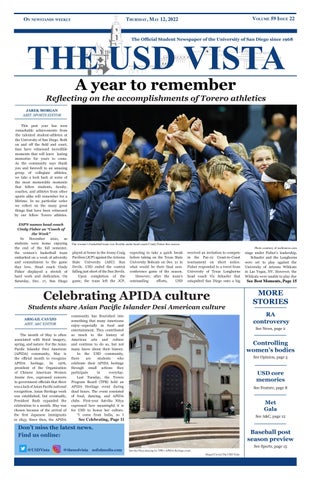
The women’s basketball team was flexible under head coach Cindy Fisher this season.
played at home in the Jenny Craig Pavilion (JCP) against the Arizona State University (ASU) Sun Devils. USD ended the contest falling just short of the Sun Devils. Upon completion of the game, the team left the JCP,
expecting to take a quick break before taking on the Texas State University Bobcats on Dec. 21 in what would be their final nonconference game of the season. However, after the team’s outstanding efforts, USD
received an invitation to compete in the Pac-12 Coast-to-Coast tournament on short notice. Fisher responded to a tweet from University of Texas Longhorns head coach Vic Schaefer that catapulted San Diego onto a big
Celebrating APIDA culture
Students share Asian Pacific Islander Desi American culture ABIGAIL CAVIZO ASST. A&C EDITOR The month of May is often associated with floral imagery, spring, and nature. For the Asian Pacific Islander Desi American (APIDA) community, May is the official month to recognize APIDA heritage. In 1976, president of the Organization of Chinese American Women Jeanie Jew, expressed concern to government officials that there was a lack of Asian Pacific national recognition. Asian Heritage week was established, but eventually, President Bush expanded the celebration to a month. May was chosen because of the arrival of the first Japanese immigrants in 1843. Since then, the APIDA
community has flourished into something that many Americans enjoy–especially in food and entertainment. They contributed so much to the history of American arts and culture and continue to do so, but not many know about their history. In the USD community, there are students who celebrate their APIDA heritage through small actions they participate in everyday. Last Tuesday, the Torero Program Board (TPB) held an APIDA Heritage event during dead hours. The event consisted of food, dancing, and APIDA clubs. First-year Satvika Nitya expressed how meaningful it is for USD to honor her culture. “I come from India, so I
MORE STORIES RA controversy Controlling women’s bodies See Opinion, page 5
USD core memories See Feature, page 8
Met Gala See A&C, page 12
See Celebrating, Page 11
@theusdvista uofsdmedia.com
See Best Moments, Page 15
See News, page 2
Don’t miss the latest news. Find us online: @USDVista
Photo courtesy of usdtoreros.com
stage under Fisher’s leadership. Schaefer and the Longhorns were set to play against the University of Arizona Wildcats in Las Vegas, NV. However, the Wildcats were unable to play due
Baseball post season preview Satvika Nitya dancing for TPB’s APIDA Heritage event.
See Sports, page 15 Abigail Cavizo/The USD Vista
2
The USD Vista
◆
May 12, 2022
NEWS
Resident Assistants call for change
Some RAs are frustrated with the Residential Education program KARISA KAMPBELL NEWS EDITOR Resident Assistants (RAs) are a group of student leaders designated to help and be a source of support for residential students. Many find the large time commitment and responsibility rewarding, while others feel the RA program has serious flaws that need to be addressed. As outlined in the RA Student Leader Application, “An RA is a dedicated and committed student that helps to establish and maintain a positive and inclusive living environment that supports students of diverse backgrounds, fosters student growth and development, and promotes academic and co-curricular success.” The application also states that an RA is tasked with building a strong community, and facilitating interactions and engagements with their residents, both formally and informally. In exchange for their commitment to the role, RAs receive financial award for room and board. However, many RAs feel that the Resident Assistant program
is not considerate of the RAs themselves, or keep the residential students as a priority either. Junior Patrick Gallagher, an RA in Valley A, shared his frustrations, and the time commitment that goes into being an RA, especially for firstyear students. He emphasized the complexity of working with first-year students. “These are human problems, that aren’t just something you can write a report on and go away,” Gallagher said. “We have to as RAs because of the intimacy and because of the priority and emphasis we have on human decency, we have to constantly be in contact and work these things out with these residents to make sure that we do everything that the mission and vision of residential life says we should do.” One area of frustration for Gallagher is the lack of recognition he thinks RAs receive from the program as a whole. “The issue is with all that hard work, there doesn’t seem to be a lot of recognition… We are people who are fueled by value and validation regardless of where you are at in your life,” Gallagher
said. “We need these things throughout our lifetime and it just demoralizes you and discredits all the hard work you do.” Gallagher explained some of the variety of tasks he has done as a first-year RA including taking residents to the airport, writing RA reports until 4am. He described how frustrating it is to not receive any sort of reward for going above and beyond to ensure his residents are supported. “What’s the point of doing all of these things if you don’t seem to reward those who do well, and you don’t seem to punish those who do bad. There’s no reward system,” Gallagher said. “And that’s an issue if there is no reward reward system, then there is no point in behaving in any sort of positive behavior.” Specifically, one area of frustration is how RAs are assigned their housing assignments, and how the reward system seems opposite in this scenario. After a discussion with Allie Polk Community Director of the Valley Apartments, Gallagher shared that assignments are based on strengths and weaknesses as a leader. Therefore, those strongest
in building community, offering support and best meeting the mission of the RA program, as outlined in the application are often assigned to first-year housing. However, being a firstyear RA is less desirable than being an upperclassman RA to many for a variety of reasons. Gallagher outlined the difference between being a firstyear RA and being an RA assigned to upperclassmen housing, and how there is significantly more work for first-year RAs. “There’s more work overall done by first-year RAs than apartments,” Gallagher said. “And there’s less accommodations in terms of your living space in first year housing. There are more Maxine (disciplinary reports) reports in first year housing, there’s more day to day interaction because of the communal feel of first-year housing, and you have to do more checkups and intentional interactions with first year students because they are impressionable and need that.” Gallagher emphasized the disparity between accommodations for first-year RAs and all other RAs, especially
how receiving the same meal plan is unfair, considering such drastic differences in kitchen accommodations. “In first year housing, we get the same scholarship plan if you’re in an apartment. So if you’re in an apartment, you have a kitchen to yourself, or maybe you share with another RA, you have a room to yourself that is a bigger room. You have a living room to yourself and a bathroom to yourself,” Gallagher said. “I live in a 10 by 15 foot room by myself, I share a bathroom with three of my residents, and I share a common room with seven of my residents. All I get is a mini fridge and a microwave, and they (apartment RAs) get the same meal plan. There doesn’t seem to be enough attentiveness to the RA’s health and their needs.” Senior Tina Tran and Coaching Resident Assistant (CRA) of Valley B, shared similar sentiments to Gallagher, in addition to how she would like to see the program change as a whole. “I think for me, I think it would be more on the structure of Residential Life is what I would like to see change,” Tran
See RAs, Page 4
DEMAND
Every industry is collecting a wealth of data, but companies are desperate to hire professionals that know how to apply it to solve important problems.
EARN YOUR MASTER’S IN
BUSINESS ANALYTICS IN JUST
10 MONTHS.
✓ Learn high-paying skills: Python, SQL, Tableau and SPSS ✓ Complete three hands-on consulting projects and study abroad ✓ $5,000 scholarship available for USD graduating seniors
APPLY BY JUNE 15 sandiego.edu/msba
Volume 59 Issue 22 ◆
NEWS
The USD Vista
◆
Understanding the possible overturning of Roe v. Wade
3
Initial draft leak sparks heated debate regarding abortion JENNY HAN ASST. NEWS EDITOR An article published by Politico titled, “Supreme Court has voted to overturn abortion rights, draft opinion shows,” added more tension to the legality of abortion. Published on May 2, the piece showed a leaked draft majority opinion written by Justice Samuel Alito that highlighted the 1973 landmark Supreme Court case Roe v. Wade which legalized abortion on a federal level. This is the first time in history that a drafted opinion was leaked to the public. It was officially confirmed by President Joe Biden on May 3 that the leaked majority opinion was legitimate. In a statement before the majority opinion was validated, President Biden condemned the Supreme Court’s decision. In an official statement delivered in the Briefing Room on May 3, President Biden said, “If the Court does overturn Roe, it will fall on our nation’s elected officials at all levels of government to protect a woman’s right to choose. And it will fall on voters to elect prochoice officials this November.” This 1973 court case originated from two attorneys Sarah Weddington and Linda Coffee, filing a lawsuit against Henry Wade (a local district attorney in Texas) on behalf of Norma McCorvey (who went by Jane Roe). Roe wanted an abortion but was unable to do so due to a Texas law stating that abortions were illegal except when necessary to save the mother’s life. Weddington and Coffee argued that Texas’ abortion laws were unconstitutional and won the original case at the U.S. District Court for the Northern District of Texas. However, Wade then appealed directly to the U.S. Supreme Court which ruled in favor of Roe. Originally, Roe v. Wade’s constitutionality was justified from the Due Process Clause of the Fourteenth Amendment which states “nor shall any State deprive any person of life, liberty, or property, without due process of law.” In other words, the Due Process Clause ensures that the federal or state government does not take away someone’s life, their liberty, or their property without a proper trial. How “life, liberty or property” is interpreted is up to the Justices.
According to an Associate Dean of Faculty and Professor of Law Mila Sohoni, the 14th Amendment ensures that all of the rights protected by the Bill of Rights on a federal level also apply on a state level as well. “What that means is that California can make no law abridging freedom of speech under the First Amendment of the Constitution, even though the First Amendment only speaks to Congress,” Sohoni said. Sohoni also stated that the Due Process Clause was commonly used during the 20th century to protect rights that weren’t explicitly covered in the Bill of Rights. However, what is being debated is if abortion should be considered to be one of the rights implictly protected by the Constitution. The 1973 majority opinion argued that abortion is one of the rights that should be protected under the Due Process Clause. Justice Harry Blackmun argued that privacy is one of the liberties protected by the amendment. More specifically, he argued that the choice pregnant women make in regards to their pregnancy falls within that right of privacy. As a result, Justice Blackmun states that legally persecuting someone trying to get an abortion “without regard to pregnancy stage, and without recognition of the other interests involved” is a violation of that privacy and her liberty. However, the 2022 draft majority opinion states otherwise. Justice Alito wrote, “That provision [the Due Process Clause] has been held to guarantee some rights that are not mentioned in the Constitution, but any such right must be ‘deeply rooted in this Nation’s history and tradition’ and ‘implicit in the concept of ordered liberty (freedoms that are limited to ensure order in society).’” Professor Sohoni clarified that Justice Alito brought up these two clauses to create guidelines for which rights, not explicitly mentioned in the Bill of Rights, should be protected by the Constitution. “What Justice Alito was saying was that if you look back at what rights were traditionally protected in this country, especially around the time that they enacted the 14th Amendment, the right to have an abortion was not one of those rights,” Sohoni stated. “In fact, the access to abortion was heavily regulated and/or criminalized in
lots of places. So, what Alito is saying is that [abortion] can’t be a right that is deeply rooted in our country’s history and traditions. It was not recognized to be your right at all, either at the time the original Constitution was enacted or at the time that the 14th Amendment was promulgated.” The draft majority opinion doesn’t aim to criminalize abortion. Rather, Justice Alito wrote that, “It is time to heed the Constitution and return the issue of abortion to the peoples’ elected representatives.” According to the NY Times, this would likely result in a situation where, “33.6 million reproductive-age women live in states at risk of losing access to abortion,” more than half of the women from ages 15 to 44 in the US. In contrast, CA Governor Gavin Newsom tweeted “We are proposing an amendment to enshrine the right to choose in the California constitution. We can’t trust SCOTUS to protect the right to abortion, so we’ll do it ourselves. Women will remain protected here.” In the draftf, Justice Alito also stated that “to ensure that our decision is not misunderstood or mischaracterized, we emphasize that our decision concerns the constitutional right to abortion and no other right. Nothing in this opinion should be understood to cast doubt on precedents that do not concern abortion.” Earlier in the draft majority opinion, Justice Alito noted that the Supreme Court enacted several landmark cases to overrule former precedent and that overturning those court cases now would result in the U.S. becoming a different country. However, many are skeptical. On May 3, President Biden stated in an interview, “If it becomes a law [the overturning of Roe v. Wade] and if what is written is what remains, it goes far beyond the concern of whether or not there is the right to choose. It goes to other basic rights: the right to marry, the right to determine a whole range of things. Because one of the issues that this Court — many of the members of the Court — a number of the members of the Court have not acknowledged is that there is a right to privacy in our Constitution.” Some of the landmark cases Biden is referencing are Griswold v. Connecticut (the right to use contraceptives), Obergefell v. Hodges (legalizing same-sex
The USD Vista Taylor DeGuzman - Editor in Chief Maria Watters - Associate Editor Samantha Anciano - Managing Editor Yana Kouretas - Copy Editor Marissa Esteban - Art Director Karisa Kampbell - News Editor Maria Simpson - Opinion Editor
Haley Jacob - Feature Editor Anna Valaik - Arts & Culture Editor Mari Olson - Sports Editor Kai Welsh - Distribution Manager Julia Sotille - Social Media Manager Michael Guiterez - Finance Manager Morgan Valent - Advertising Manager
Supreme Court Justice Samuel Alito wrote the leaked opinion. Photo courtesy of @s_alito1954/Instagram
marriage), Loving v. Virgina (legalizing interracial marriage) and Lawrence v. Texas (legalizing sodomy and samesex intercourse). This is because the court cases that President Biden mentioned are also justified using the Due Process Clause of the 14th Amendment. Professor Sohoni also explained that if Roe v. Wade is overturned, it could possibly undermine the results of other landmark Supreme Court Cases as well. “Those [the court cases mentioned earlier] are rights that have been held to be protected by the 14th amendment’s Due Process Clause, but they’re not listed out in the Bill of Rights,” Sohoni said. “And they have not historically been shielded by laws and traditions either. So if you take the reasoning of the [majority opinion draft] to its logical conclusion, those other precedents would also be vulnerable.” There is a clear divide in public opinion regarding the possible overturning of Roe v. Wade. Some students, such as USD sophomore Alyssa Jackson, are in favor of this possible ruling. “Roe v. Wade has allowed the deaths of over 60 million plus children,” Jackson said. “As a pro-life woman myself, I believe that women deserve so much better than abortion. Women are told that they are not able to both raise a child and have a career, but I believe that they are strong enough to have both. There are also countless pregnancy centers that are ready and able to support women who find themselves in
Editorial – 619.260.4584 Business – 619.260.4714 www.uofsdmedia.com / @TheUSDVista Gina Lew - Student Media Advisor Marie Minnick - Operations Advisor
crisis pregnancies, so women will not be alone in a post-Roe America. Millions of innocent lives will be saved with this decision.” However, others such as USD senior Ellie Stainbrook are disheartened by this possible decision. “It is frustrating, as a woman and as a person, to be so ignored and misrepresented by governing bodies that have no other interest than social control and personal, inequitable gain,” Stainbrook said. “The blatant and willful oppression of bodies is an egregious affront to humanity and emphasizes both the divisiveness of conservative ignorance and the insidiousness of reactionary rhetoric. Abortions are healthcare. Healthcare is a human right. Abortions save lives.” Stainbrook also stated that banning abortions will not have the intented effect others may want. “Making abortion illegal does not prevent abortion, it only prevents safe abortions,” Stainbrook said. “At the end of the day, being pro-choice is not being pro-abortion. You don’t have to like abortion; it can be something that is deeply sad and really damaging. Despite this though, it is of utmost importance to allow people the dignity to choose what happens to their body.” According to Politico, the content of the draft and the vote for controversial court cases are subject to change. The published version of the leaked document with the final opinion of the Supreme Court regarding the future of Roe is likely to be released in two months.
The USD Vista publication is written and edited by USD students and funded by revenues generated by advertising and a student fee. Advertising material published is for information purposes only and is not to be construed as an expressed or implied endorsement or verification of such commercial venues by the staff or University. The USD Vista office is located on the fourth floor of the Student Life Pavilion in room 403B. All inquiries should be sent to: The USD Vista 5998 Alcala Park San Diego, CA 92110 Opinions expressed in this publication are not necessarily those of The USD Vista staff, the University of San Diego or of its student body. Letters to the Editor can be submitted to The USD Vista office. Letters should be limited to 300 words and must be signed. For identification purposes, USD identification numbers and writer’s year must be included in the letter. The USD Vista reserves the right to edit published letters. Any content sent to the editor will be considered for publication unless otherwise stated.
“ c o
4
The USD Vista ◆
NEWS
◆
May 12, 2022
USD OpX study part II
Students react to controversial engineering school project SPENCER BISPHAM ASST. NEWS EDITOR The USD Vista recently published a story about a study within the Shiley-Marcos School of Engineering that some Toreros claim is non-inclusive. The study falls under the umbrella of the Operational Excellence Development (OpX) Program and is overseen by Dr. Leonard Perry, a professor of Industrial Systems and Engineering (ISYE). He is one of three contacts for the OpX Program and is the instructor of the ISYE 492 class where a group of students have been observing Facilities employees while they clean, timing them,and recording the results. This information is then shared with Facilities Management to help improve the employees’ efficiency. Associate Vice President for University Marketing and Communications, Peter Marlow, clarified the intent behind the study. “The program’s intent is to identify areas of improvement to make the operations of the university more efficient,” Marlow said. “It also supports the Living/Learning environment for students, giving them a real life application of their Kaizan/Six Sigma training, consisting of tools and methods that are essential to define, measure, analyze and improve projects. It also helps our staff to suggest and implement new ideas in order to simplify their work. The staff feel that they are a part of the improvement process, and that the students appreciate what it takes to give them a clean and safe learning environment.” Associate Professor of Industrial Engineering Dr. Bradley Chase and Professor of Operations and Supply Chain Management Dr. Simon Croom are the contacts for the OpX Program. In an email to the School of
Business, Dr. Croom addressed the study and its controversy. “I believe, but have not been told directly, that the current situation arose from one team of students and custodians conducting a trial in some new procedures which sadly led to a member of faculty viewing this as an intrusive observation of employees rather than a team exercise involving both students and custodians analyzing standard operating procedures,” Dr. Croom wrote. USD sophomore and Ethnic Studies major, Sofia Hart, described what she saw on Thursday, March 31, when she witnessed students observing a Facilities employee as part of the OpX study. “I walked into Maher and I saw a group of maybe four students observing one of the custodial workers,” Hart said. “She was cleaning the bathroom and they were standing outside watching her clean the bathroom and said, ‘Ya he terminado,’ ‘I finished,’ and they started writing things down.” Word about the OpX study also spread to the USD Association of Chicanx Activists (AChA). On March 2, leaders in the student organization sent an email to fellow community members with criticisms of the project as well as a request to meet on that same day. Ashley Gonzalez and Brianna Jacome, USD juniors and co-chairs of AChA, used the email to address what they knew about the project. “This morning we had an urgent meeting with the Department Chair of Ethnic Studies, Dr. Alberto Pulido,” Gonzalez and Jacome wrote. “He informed us about a classist and unethical project that is emerging from the School of Engineering. … Students from the class were speaking with the workers through a translator and asked the workers to clean the toilets to test their efficiency of work.”
The two co-chairs also outlined a plan of action. “We want to invite you to collectively have a meeting this week to write an email urging the Engineering School and Department Chair to answer our questions and concerns,” Gonzalez and Jacome wrote. Two days after the email was sent, a meeting was held in UC 128 between students, faculty, and administrators to discuss concerns over the OpX Program study. At the meeting, Jacome specifically asked about the compensation for workers who were translating (English to Spanish and vice versa) for the students involved. “Do you think that there should be some form of compensation?” Jacome asked. “They’re custodial staff first, and on top of [the] translation of complicated topics and understanding these things, do you think there should be someone else brought in or do you think that the staff members who are translating should be compensated?” Humberto Castaneda, USD Supervisor of Housekeeping, chimed in to speak on behalf of the workers directly involved in the project. “We’re real happy to help you, but we’re learning,” Castaneda said. “We’re really happy to be included in something like this, cause we’ve never done something with the kids. We start to know people and new ideas; we enjoy somebody else’s knowledge.” In a separate email, Associate VP Marlow confirmed that the eagerness expressed by Castaneda was the only compensation necessary. “There is no additional financial remuneration, as this is a process-improvement initiative, which is a part of every employee’s role at USD,” Marlow wrote. Finally, toward the end of the meeting, USD sophomore
and Environmental/Ethnic Studies major, Jessica Fernandez, addressed the administration’s differing perspectives. “From what I’m understanding, you guys didn’t consider this perspective of how it might’ve looked unethical and that’s okay, we’re all at very different points in our lives with our experiences,” Fernandez said. “But as a science major, as a woman of color, and as an Ethnic Studies major, it’s not hard to include these people in conversations.” Since that meeting in early March, public discussions surrounding the OpX Program have died down quite a bit. However, President James Harris III attended the USD Associate Student Government (ASG) meeting on March 31 to address the controversy. ASG Senator and USD junior, Ariadne Sambrano, asked President Harris for clarity when it came to the consequences of the OpX Program. “I expressed in University Senate and many other students also expressed the disconnect in terms of the harm that is being done with the unethical research,” Sambrano said. “When it comes to occurrences like this, what type of repercussions will the institution take forth to ensure that things like this don’t happen again?” President Harris responded in defense of the OpX Program. “I understand what you’re saying, I don’t understand why you say it’s unethical,” President Harris said. “I understand it’s insensitive, [but] it is not violating any policies with regards to research at the university; it is not a research project, it’s a project to help improve processes on campus.” President Harris also explained why stopping the project could do more harm than good. “I think there is a bit of insensitivity here, I also think there
is also misunderstanding here,” President Harris said. “Should we just stop all those projects? You have students who are engaged in this as a project as part of the class, students who are watching, so now you’re going to say to the students they cannot do that.” Other students agreed with Sambrano that the project needs to come to an end. USD sophomore and AChA programmer, Shayla Rodriguez, said it is time to be “shutting it down” as well as increasing diversity, equity, and inclusion awareness. “The way I feel in my College of Arts and Sciences classes compared to business… I can feel it,” Rodriguez said. “It’s weird to see that they [USD Schools of Business/Engineering] don’t have ethnic classes and I feel like that’s the basic class that everyone at USD should take.” USD junior and fellow AChA programmer, Victoria Melendez, echoed Rodriguez’s call for change. “They say they have diversity, inclusion, and social justice in all the schools, but it’s different,” Melendez said. “The school of Engineering and the school of Business have their own classes, but I think it’s so important for everyone to actually be educated in these issues. If you go to a school that has so much money and has the power to make all these changes, why aren’t they enforcing this education on every student?” Currently, there are no plans for the OpX Program to slow down anytime soon. As the end of this particular study and the semester draws near, the partnership between the School of Engineering and USD Facilities remains intact. Administration has not released any statements on possible consequences or changes to USD’s management, curriculums, or communication in relation to the project at the time this article was written.
RAs speak out against program Student leaders feel undervalued as RAs
RA from Page 2
said. “There’s an issue with the structure of residential education. Not like who is it, not just who is in it, but it’s like what we guide our RAs, our community directors.” Tran continued by specifically stating she hopes for a more understanding and validating experience to be created for future RAs. “I’m hoping to see that you actually truly validate what an RA is saying and what their experience is... I’m sitting here wondering, why don’t you ever put the RA first, knowing that you are supposed to advocate for us as well,” Tran said. One of the most frustrating parts for Tran was the lack of support she felt from the people in charge of Residential Life. After reaching out to various members of the Residential Education, she
felt that she was not being heard. “It’s like if you truly care about me and you truly want to say that you understand my situation, then please support me. Because at this point, RAs are starting to reach out to other people outside of the department for support,” Tran said. Tran herself decided to reach out to Vice President of Student Affairs, Charlotte Johnson, to express some of her concerns on the program and her frustrations with the lack of support she believes RAs receive. Overall, Tran believes this was a positive meeting, however she remains frustrated that she had to go this far to receive support. “The fact that I had to try and reach out to set up a meeting with Vice President (VP) Charlotte Johnson of Student Affairs blows my mind that I had to go that far
when it is obviously a departmental issue, and going to someone highest in the department should have been enough,” Tran said. VP Johnson shared her takeaways from the meeting. “My understanding is that several RAs wanted to voice their specific concerns to me to ensure that I am in the loop. I appreciate their candor and also want to be clear that I rely on the Residential Life Team to manage issues arising under Residential Life,” VP Johnson shared. “I do not always know everything that is going on in an area and rely on deans and directors to keep me apprised. Dr. Crisman has spoken with me about how we can better support RAs. I also appreciated hearing directly from students.” Ultimately, Tran believed that she was always undervalued in her role, however she
stayed in an attempt to try and ensure that other RAs received the support they needed. “At the end of the day, no matter how it affects you, you can always know that the doors open for you to leave, that there will be someone to replace you,” Tran said. “That’s how I’ve always felt. That’s how I constantly feel. I care about my community, I care about my residents. I love the RAs I have worked with. And so even though I would love to walk out of the door, I don’t because I would hate to see RAs ever feel like I feel all the time.” Despite several attempts to reach out to Residential Life, The USD Vista was unable to receive a comment from Residential Life. Tyler Crisman, Director of Residential Education, PhD, and the contact given to the Vista, was unresponsive to emails.
After reaching out on both Thursday, May 5 and Friday May 6, no response was received. The Vista then reached out to Brandon McCreary Director of Residential Administration, who referred The Vista back to Dr. Crisman on Monday May 9. On Tuesday may 10, The USD Vista still had not received a response from Dr. Crisman, so they reached out to Vice President Charlotte Johnson to receive comment. Dr. Tyler Crisman eventually responded to The USD Vista’s initial email, however did not respond to the questions, incorrectly assuming the nature of the article. Additionally, after Gallagher and Tran spoke to The USD Vista, Resident Assistants were told not to speak to the media and refer all media requests to Dr. Tyler Crisman.
Volume 59 Issue 22
◆
OPINION
◆
5
The USD Vista
E DI TOR IA L
We wouldn’t dare control men’s bodies Everyone with a uterus is a human being; our rights matter
JESSICA MILLS
ASST. FEATURE EDITOR
MEGAN VALADEZ
ASST. OPINION EDITOR
Cw: (abortion/sexual assault) In our world and current society, those with a uterus are often seen as secondclass citizens. Most people with a uterus know what it feels like to have a period every month, have dreadful cramps, take birth control that messes with hormones and even give birth. Yet, they are expected to go on with their day as if nothing is happening. On Monday, May 2, 2022, Politico published a leaked Supreme Court draft opinion that was written by Justice Samuel Alito in Feb. 2022, which would overturn long-standing abortion rights set by Roe v. Wade in 1973. According to NPR, draft opinions are written after a case is heard in order to explain the reasoning for the majority or minority decision of a case and does not represent a final decision by the Court. In the leaked draft opinion, Justice Alito said “Roe was egregiously wrong from the start” and that “it is time to heed the Constitution and return the issue of abortion to the people’s elected representatives” meaning that states would choose whether or not to regulate abortion. According to a Politico article published on May 2, 2022, Justices Thomas, Gorsuch, Kavanaugh and Coney Barrett “had voted with Alito in the conference held among the justices after hearing oral arguments in December [2021].” Though this is just a first draft and not a final decision, it is still concerning that the rights of those able to become pregnant are being threatened. All we ask is, as citizens of this nation, that our right to make decisions about our own bodies is not stripped from us – abolishing Roe vs. Wade would do far more harm than good. Abortion is not just a health issue. Whether we are willing to allow people capable of becoming pregnant to control
their own bodies, for health or any other reason, it is an equity issue. It is a question of who we deem deserving of bodily autonomy and the freedom to reach their full potential. Instead of the government controlling the bodies of those assigned with a female reproductive system at birth, what if we were to just stop abortion at the source and make every man get a vasectomy. According to Stanford Health Care, the effectiveness of a vasectomy reversal is up to 9095% and doesn’t come with long — lasting side effects like female birth control methods can. Those utilizing contraceptives, such as the pill, are at risk of blood clots, stroke, liver cancer and even heart attack. Those with an assigned female reproductive system at birth should not have to worry about these side effects. Instead, men should just be more responsible when it comes to having sex, and get a vasectomy. We don’t believe prolife people want to hear this, though. The idea of regulating a man’s body makes people uncomfortable. But male governmental officials don’t seem to be uncomfortable with controlling the reproductive rights of those able to become pregnant. The Washington Post reported that recent studies on male contraceptive pills have halted, because side effects like weight gain and depression occured. But people who take female contraception have put up with these symptoms for decades. For those with a uterus, one consequence of not taking birth control is pregnancy. Whereas men don’t suffer any consequences if they don’t take birth control. It seems that female birth control can get away with more serious side effects than male birth control, because the consequences are greater for those able to give birth. In our opinion, strict antiabortion legislation is all part of a strategic frontal assault by male government officials on those assigned with a female reproductive system at birth. Those that are prolife argue that a fetus is a person starting at conception, therefore, having an abortion would be
murder. We believe these laws are not about whether a fetus is a person – they are about ownership and control over the sexual autonomy of women and those able to become pregnant. Parenthood entails setting aside your wants, needs and desires for someone else. It requires financial obligations from birth through age 18, at a minimum, if one decides to keep the child. We believe the government is directly controlling the earning potential of anyone able to give birth, making it more difficult to escape poverty. Simply put, abortion is a means of freedoom. The choice of if and when to have children is central to one’s future and autonomy. Pregnancy creates lifelong emotional and physical alterations to one’s body, especially if the conception occurs via assault. An important step for many survivors involves regaining their freedom. Coercing someone to carry an unwanted pregnancy, no matter the circumstances of conception, takes away any freedom they once had. In our opinion, despite living in a country that claims to support the idea of freedom, our capitalist nation refuses to allow this. More births means more workers to enter the labor force, to fight in wars, to act as chess pieces for our country. For a state to have total power, it must control its people. Overturning Roe vs. Wade is an example of this dictatorial power our government can hold. We are tired of men following this built-in presumption that those able to become pregnant will bear nearly all of the reproductive burdens, including birth control and its side effects, even though reproducing takes two. Why should those able to give birth have to deal with all of this? Because men simply won’t. Because society has put the responsibility solely on those with a uterus, because they are the ones who have to deal with the consequences. If men aren’t willing to take responsibility and take measures to prevent impregnating a person with a uterus, they need to back
off of our reproductive rights. This is about so much more than abortion. Agendered, trans, non-binary and all gender non-conforming and gender conforming individuals need safe reproductive health services, including abortion. Not only will this legislation make this process more difficult, we believe it furthers the outdated and harmful gender binary narrative. Justice Alito claimed that this decision only regards abortion. We believe this is a false and misleading statement. Overturning Roe, rolls out the carpet for reversing other laws targeting human rights issues, especially the rights of the LGBTQ+ community. We think their fear is warranted. If the government can easily reverse reproductive health care, what’s stopping them from encroaching into other areas? In a PBS article, Laurie Betram Roberts, co-founder and Executive Director of the Mississippi Reproductive Freedom Fund, explained that women of color in states with restrictive abortion laws often have limited health care and choices for effective birth control. Let’s be honest, overturning Roe doesn’t equally affect those that can become pregnant. The financially successful will still have access to the health care they need. Persons of color, minorities and those in and below the working class are marginally affected. If Roe is overturned, people may have to travel hundreds of miles to access safe health care. Those most affected include young and low-income individuals, many disproportionately of color. Some may already have children and not have access to childcare, time off work or travel costs. We believe this decision only makes it that much harder to escape poverty. CBS reported that the average cost for vaginal birth is over $21,000. The price increases significantly with birth complications and cesarean section delivery. The caregivers then have to pay for the child’s healthcare, food, clothing, education, etc. for a minimum of 18 years. For those who argue that those capable of pregnancy
can put their child up for adoption, that decision often sends children into the foster care system, which seems to create more harm than good. Foster America, a group that focuses on child welfare, explained that those in the foster system are more likely to become homeless, suffer abuse, enter the criminal justice system and many never graduate highschool. The Children’s Defense Fund, an organization that advocates for federal policy improvement in the foster system, reported that the number of children in the system has increased in recent years, while the number of potential foster families has declined. The system is already overpopulated; adding more children will only increase these issues. Putting a child up for adoption does not guarantee that said child will find a healthy home. Child Welfare explained that costs of care and services for foster children were major obstacles for parents wanting to adopt, many unable to go through with the process. According to The Washington Post, foster children often have specific emotional and physical needs many families are not equipped to handle. Placing a child in a home that is unable to offer necessary care is not an effective alternative, and America’s current foster care system does not guarantee that level of care. CNN reported that the U.S. has the highest maternal mortality rate while giving birth. Forced birth in a country with these statistics, no paid maternity leave, no universal healthcare or subsidized child care and frequently inaccessible mental health care is completely outrageous. Perhaps male government officials should focus on larger problems at hand and step back from their control over our reproductive rights. Bottom line, we want others to stay out of ours and others’ reproductive rights. Having a uterus should not dictate the lack of rights one has in our country. You don’t have to like abortion, but dictating what others do with their body is cruel and unjustified.
The views expressed in the editorial and op-ed sections are not necessarily those of The USD Vista staff, the University of San Diego, or its student body.
The USD Vista
6
◆
May 12, 2022
E DI TOR IA L
Letter from the Editor-in-Chief To my dearest and the USD
Vista staff community,
If you told me four years ago, before attending USD, that my senior year of college would lead to me being the Editor-inChief of the student newspaper, I wouldn’t have believed you. Not because I undervalued or underappreciated journalism itself, or because I didn’t enjoy writing or storytelling, but simply because I never would have thought that student journalism, such as The USD Vista, was as necessary, as intrinsic to an individual’s understanding of the life that so intimately surrounds them. That is exactly what The USD Vista is to our campus community, it is necessary, it is important — it always has been and I believe it always will be. As Editor-in-Chief, I’ve witnessed that journalism at this level has the power to highlight underrepresented voices, bring the truth to light, hold our leaders accountable and uncover and tell stories that will undoubtedly leave the impact of a lifetime. From commending football
players for locking an armed burglar in the closet, to inciting major change with both dining services’ versatility in food options and Tu Mercado’s price disclosures; from an exciting, new sports “Weekly Recap” story; to parking problems and colorful concert stories; to USD ghost stories — The USD Vista has done it all this year. After being completely virtual for nearly two years, this incredible staff navigated returning to campus and inperson learning, all the while printing 3000 copies every Thursday, and showing up each Tuesday to the newsroom with a fervor and passion to keep this community informed. At the end of the day, every person on staff is a full-time student, involved in extracurricular activities and organizations across the entire map, and yet still, they prioritize and work diligently every single day of every week to bring the USD community necessary and important news. Though few see the 20 hours you put in each week, the sweat and (whole lot of) tears you cry, and the super late nights and restless mornings
you have, please know that I have had the absolute privilege to witness every second of it, and be there with you through it all. It hasn’t been easy; you all know and are aware of that. But, I would be remiss not to include all of the good that each and every one of you has contributed to this paper. I have never seen so many students reading our paper, picking up our paper, talking about our paper, than this year. That is a testament to all of you. To our Feature Editor, you and your section shined a light on incredible efforts happening all around campus, as well as featured people who deserved to have their voice heard — may you continue to shine. To our Opinion Editor, you and your section lead with boldness this year, unafraid to bring different issues and different perspectives to life in a meaningful, significant way. To our Arts & Culture Editor, you brought color to this paper, you brought the much needed joy and light that this community so desperately needed after such an isolating time off of campus. To our Sports Editor, you and your
section brought a refreshing life to the sports section — you made it your own, you transformed it and you showed that athletes have incredible stories to tell off the court. To our Art Director, you brought every single vision to life effortlessly, and with every week our readers eagerly waited to see the spread. To the greatest exec team I could’ve ever asked for — The USD Vista wouldn’t be what it is today without your help. Both of our Associate Editors led fearlessly and went out of their way to make everyone on staff, from assistants to contributors, feel supported. To our Managing Editor, without your tenacity and your commitment to this paper, writers wouldn’t feel as motivated and as passionate about this paper without your leadership. And to our Copy Editor, your attention to detail, your kind leadership and the focus you brought to the newsroom did not ever go unnoticed. And lastly, to our News Editor and our incoming Editorin-Chief, Karisa Kampbell, there is not a doubt in my mind that
you will continue to chase the truth, and that you will lead this paper with such grace and confidence. You have everything you need to succeed. And you have the best group of people who have your back until the very end. I know that for a fact. To our readers and the USD community, thank you for trusting us with your stories, with your voices and with your concerns. You all are the reason why we have the privilege of publishing this paper — as the years pass, and time moves forward, never forget how necessary, how important student journalism is to this community. We could not do this without all of your support. Thank you for trusting me as your Editor-in-Chief. I will never forget how meaningful this work is. The USD Vista will always be the pride and joy of my senior year, and I can’t wait to follow the success you all will inevitably have moving forward. Best, Taylor DeGuzman, Editor-in-Chief 2021-2022
From left to right, The USD Vista team; Taylor DeGuzman, Yana Kouretas, Maria Watters, Sam Anciano, Maria Simpson, Anna Valaik, Karisa Kampbell, Mari Olson, Haley Jacob, and Marissa Esteban. Photo courtesy of Marissa Esteban/The USD Vista
The views expressed in the editorial and op-ed sections are not necessarily those of The USD Vista staff, the University of San Diego, or its student body.
Volume 59 Issue 22
◆
FEATURE
◆
The USD Vista
7
FEATURE
The science of cramming: does it work? USD psychology professors analyze the study technique
JESSICA MILLS ASST. FEATURE EDITOR As the semester draws to a close and final deadlines approach, many students will spend the coming weeks preparing for assigned papers, projects and exams. Among students, study habits vary in technique, location and even preferred proximity to others — some also favor studying over longer periods of time, while others save their studying for the night before a due date. This last minute technique is known as “cramming,” a popular method for college students prone to procrastination or who have too much on their plate. However, according to Psychology Department lecturer J. de Belle, PhD, cramming is not a useful study method for students. “Cramming or ‘massed’ learning is not an efficient strategy for committing information to memory,” Dr. de Belle said. “This is especially true when it becomes the last resort for studying on a late evening prior to an exam.” Dr. de Belle explained that cramming often heightens stress for students, which impacts test performance. “Stress inhibits learning and interferes with recall and performance during an exam,” Dr. de Belle said. “Instead of walking into the exam feeling
The cramming study technique is popular among students, especially during busy exam weeks. Photo courtesy of Jeswin Thomas/Unsplash confident, alert, and energized, sleep. Any repeated action, Appleton-Knapp said. “This the cramming student is thought, or behavior becomes mimics the retrieval that you’ll do more likely to be confused, hardwired into the brain for during an exam in order to answer unresourceful, and exhausted.” easy recall at a later time. a question or write an essay.” Instead, Dr. de Belle “This rewiring only happens When reading notes or recommends students study if you actually sleep,” Dr. de Belle assigned text, the brain only throughout the semester by testing explained. “During an exam, reorganizes the information, and retesting their knowledge information will be more readily and it isn’t hardwired for future with flashcards or problem sets. available because it has been recollection. Unlike quizzing “This type of ‘spaced’ consolidated in an organized way.” oneself, reading doesn’t build learning is highly effective,” Dr. Psychology Department the necessary recall memories. de Belle said. “It’s based on the Adjunct Assistant Professor “You should test yourself on principle that recurrent exposure Sara Appleton-Knapp, PhD, what you’ve learned when it is to information in between believes testing oneself on difficult, but not impossible for you gaps, like sleep cycles, promote material prior to an exam is to retrieve the information,” Dr. long-term memory formation.” an effective study method. Appleton-Knapp explained. “You The brain reorganizes “When doing so, you retrieve can accomplish this by studying a and recharges itself when we information from memory,” Dr. chapter one day and then testing
yourself on it the next day.” Sophomore and psychology major Alana Bowyer uses the cramming technique only when necessary. In some cases, a heavy workload prevents Bowyer from getting ahead on studying for certain exams. “If I’m cramming for a test, it’s normally not by choice,” Bowyer explained. “Usually, it’s because I have several deadlines that I have to prioritize before a test.” Bowyer noted that her test performance improves when studying for longer time frames. “Normally, I perform decently, but I definitely do better if I have more time in advance to prepare,” Bowyer said. “It all depends on the subject, how hard the class is, and whether I naturally grasp the content.” Although Dr. de Belle and Dr. Appleton-Knapp explained that repeated studying over longer time spans is preferred, both agree cramming is better than not studying at all. Studying in advance for finals week can help lessen stress for students and even improve test performance. With deadlines approaching, making flashcards and problem sets ahead of finals may prove beneficial for one’s grades and stress. However, if you find yourself resorting to cramming this finals season, try to get in restful sleep whenever and wherever you can.
USD President for a Day 2022 Winner
The University of San Diego chose senior Miguel Hornedo as the 2022 President for a Day winner, who temporarily took over for USD President James T. Harris III, DEd, on May 10. Photo courtesy of USD News Center
Sophi a Romei( Fi r st year )
USD C e M e m ie s Unl ocked
“ On eo f myf a v o r i t en i g h t st h i sy e a r wa smy 1 9 t hb i r t h d a yp a r t y . I l o v et h i sme mo r yb e c a u s e n o t o n l ywa sI s u r r o u n d e db ymyc l o s e s t f r i e n d s , b u t t h a t n i g h t wea l s os c a l e dan e a r b yb u i l d i n g , j u mp e do f f ad o c ki n t ot h ewa t e r , a n dmo r e . I a d o r ea l l t h en e wp e o p l ewh o ’ v ec o mei n t omy l i f es i n c ec o mi n gt oUSDa n dh a v ef o u n dt h a t f r i e n d s h i p sa r ewh a t ma k et h ec o l l e g ee x p e r i e n c es os p e c i a l . ”
Ma A“ c o r eme mo r y ”i sas i g n i f i c a n t me mo r yi ny o u r l i f et h a t i st h ee p i t o meo f u n f o r g e t t a b l ea n dr e s o n a t e s wi t hy o uy e a r sd o wnt h er o a d . I t ’ s i mp a c t f u l , mo v i n g , a n df o n d . As t h es e me s t e r d r a wst oac l o s e , USD s t u d e n t sr e f l e c t o nt h e i r f a v o r i t e me mo r i e sf r o mt h i ss c h o o l y e a r .
Ni na Pi gnat el l o( Fi r st year ) “ At t e n d i n gi n t r a mu r a l g a me swa sd e f i n i t e l yo n eo f my f a v o r i t ep a r t so f t h i ss e me s t e r ! Myf r i e n d sp l a y e di n t r a mu r a l s o c c e r , f l a gf o o t b a l l , a n dv o l l e y b a l l , a n dwe wo u l dwa t c ht h e me v e r ywe e k . We ’ db r i n gb l a n k e t s a n do u r h o me wo r kt ot h ef i e l do r c o u r t sa n dc h e e r t h e m o n . I t wa sa l wa y ss owh o l e s o mea n dc u t et owa t c h , a n d I mi s si t a l r e a d y ! I ’ ml o o k i n gf o r wa r dt owa t c h i n gt h e m a g a i nn e x t s e me s t e r . ”
)
Ki ar a Di as ( Seni or ) “ On eo f myf a v o r i t eme mo r i e st h i s y e a r wa sg e t t i n gs u r p r i s e dwi t h FI NNEASt i c k e t sa n dmyr o o mma t e ss u r p r i s i n gmewi t hmyb e s t f r i e n d sf r o mh o me . Ev e r ys i n g l e o n eo f myf r i e n d sme mo r i z e dt h e s e t l i s t , a n di t ma d emer e a l i z eh o w l u c k yI a mt ob es u r r o u n d e db y s u c ha ma z i n gp e o p l e . ”
ason Tunbr i dge ( Juni or ) “ Mymo s t me mo r a b l emo me n t wa swh e n t h eme n ' ss o c c e r t e a mp l a y e da g a i n s t Sa n Di e g oSt a t eUn i v e r s i t yi nal o c a l r i v a l r y g a me . Al t h o u g hwel o s t , i t wa sag r e a t e x p e r i e n c e , a n dt h e r ewe r el o a d so f f a n s t h e r e . We ’ r ee x c i t e dt og e t r e v e n g en e x t y e a r . ”
Ri l ey Li m ( Sophomor e) “ On eo fmyf a v o r i t emo me n t st h i sy e a rwa s wh e nmyr o o mma t e sa n dIr e t u r n e df r o m wi n t e rb r e a ka n dwe n t o u t t oe a t d i n n e ra t t h e Du mp l i n gI n n&Sh a n g h a i Sa l o o n . Weh a v e a l l b e c o mes oc l o s et h i sy e a r , a n do u rf r i e n d s h i ph a st r u l yb e e no n eo ft h eb e s t t h i n g st h a t h a v eh a p p e n e di nmyl i f e . Ir e me mb e rmi s s i n gt h e ms omu c hb e f o r es t a r t i n gt h es p r i n g s e me s t e r , a n dt h i si ma g er e a l l ye n c a p s u l a t e s a l l t h eb e a u t i f u l mo me n t sweh a v eh a dt o g e t h e r . ”
10
The USD Vista
◆
May 12, 2022
AR TS & FEATURE Remembering Ian Trautwein
Students and faculty honor the life of beloved student and friend HALEY JACOB FEATURE EDITOR Ian Trautwein came onto campus last semester as a bright-eyed, eager first-year student ready to immerse himself in everything college life and the beautiful city of San Diego had to offer. Trautwein came to the University of San Diego from his home state of Colorado, where he grew up very athletic, adventurous and always humorous and caring in nature. His time at USD lasted only three months, from the start of the school year in September to his departure back to Colorado in November, but to friends and faculty, their time spent with Trautwein felt like a lifetime. Trautwein was diagnosed with Alveolar Rhabdomyosarcoma (ARMS) his junior year of high school in 2019, which is a rare type of cancer that affects muscle tissue. He received extensive chemotherapy treatment when he was home and while attending college, putting up a strong fight against the unexpected, tough diagnosis. On April 26, Trautwein passed away at home, surrounded by family. Despite Trautwein’s battle with cancer, his friends described him as always “doing something.” Whether it was going to the beach, playing frisbee on the Valley field or hosting bonfire nights with his friends, Trautwein was always thinking about what was next. First-year and close friend of Trautwein, Elliott Gorsuch, attested to Trautwein’s ability to make the most out of his time. “I’d say he grew up really fast because he’s had cancer for so long,” Gorsuch said. “He never expected, or at least the doctor’s never expected, for him to even make it to college-age when he first got diagnosed. So, I don’t think he ever took a moment for granted, he really lived in the moment, and anything he did, he put his all into it. There was no half-assing anything with Ian, which was incredible to see. He and I would leave stuff together. He always just knew when it was the right time to leave, call it quits, and go back and live for the next day.” Close friend and fellow firstyear, Caroline Donahue, admired Trautwein’s commitment to making time for friends all while enduring treatment. “He wouldn’t openly complain about anything ever,” Donahue said. “He would just say little things, so we all knew what he was going through, but it wasn’t ever him complaining. He just wanted to do a bunch, and he was always on the go. He had a job, he was going to the gym every day, he was getting treatment,
and then school, and then he was always like, ‘Hey, let’s go to the beach, let’s go to a bonfire.’ I think the way he looked at life is really cool because I think he just wanted to do a bunch and knew maybe he didn’t have all the time in the world, so he just did what he wanted.” Trautwein’s positive energy and care for others are two of his most memorable attributes. Assistant Director of Outdoor Adventures (OA) Mark Ceder worked with Trautwein through the campus program and shared about Trautwein’s selflessness. He remembered his first interaction with Trautwein fondly, noting his bright, welcoming smile. “I mean, it starts with a smile, and he just has this infectious smile,” Ceder said. “And, he was so concerned for others, and would kind of hide what he was dealing with and really express his care and concern for other people he was around. He was very intentional about what he was sharing and what he wasn’t sharing. I just really see him as a protector as well. He didn’t want to hurt others, and he knew that them really knowing what was going on with his cancer would’ve been hurtful for them.” Those that knew Trautwein told many stories that highlighted his loving character. Donahue shared that the first week she met Trautwein, everyone started to call him “Dad” because of his jokes, demeanor, and the feeling of security he emulated. Ceder shared the “big spooning” story from OA’s firstyear pre-orientation trip with Trautwein. He explained that while on camping trips, the goal is not to waste any food. When there is food leftover, everyone grabs a spoon to finish it, hence the tradition of “big spooning.” One night during the pre-orientation trip after dinner, Trautwein took the tradition to another level. “After everyone finished off the leftover rice and corn, there was leftover salsa, maybe like half a jar, and all of a sudden, Ian just starts drinking the salsa,” Ceder said. “And I’m like, ‘You don’t have to do this. We can put a cap on it and save the salsa for another day,’ and he responded like, ‘It’s whatever. We’re big spooning. We’re finishing off the leftovers. I got this.’” Ceder had never seen anyone commit to “big spooning” to the same level as Trautwein. The context of the tradition is similar to the saying “taking one for the team.” Ceder sees it as a selfless act, doing something for others despite one’s already full appetite. “Nobody wants to do it. You’ve already eaten your dinner, you’ve already gotten your seconds, you’ve already filled yourself, and this act is doing something
Ian Trautwein loved being outdoors, whether he was at the beach or on a trip with Outdoor Adventures. Photo courtesy of Willa Letscher for the good of the group,” Ceder said. “Sometimes it inflicts pain on yourself, but you still do it for others, and he embodied that.” This year, Trautwein will be the inaugural recipient of OA’s “Big Spoon of the Year” award, dedicated to the guide who embodies selflessness and the willingness to promote the betterment of others. One unique aspect about Trautwein was his talent for singing. He was a member of his high school’s choir back in Colorado and enjoyed singing for his friends here at USD. When his friend hosted bonfire nights, Trautwein would often pull out his guitar and serenade the group. Gorsuch would sometimes accompany Trautwein by playing his bongo. When Trautwein moved back home in November, his father set up a recording studio in their house for Trautwein to continue singing and recording songs for his friends. Trautwein’s friends have four song recordings to listen to and remember him by, including an older recording of “Let it Snow,” which he performed with his high school choir, the 90s hit “No Diggity,” “Hold My Girl” by George Ezra, and “Rubble to Rubble” by Wilderado—which is
the most sentimental to the group. Trautwein made sure every song was perfect for his friends. “We would tell him to keep practicing and to send us recordings,” Donahue said. “His dad told us a few days ago that Ian would always be in there practicing but never really recorded anything because he’s such a perfectionist and was just working so hard to get those three songs to us. But, we wanted more.” Trautwein’s friends hosted a bonfire at Ocean Beach to celebrate his life on Saturday, April 30. Ceder felt convinced that Trautwein created this experience for him and everyone who attended due to the beauty of the sequence of events. As everyone watched the sunset, dolphins jumped out of the water beyond the surfers, creating a remarkable sight. The group then moved to the bonfire and began sharing stories about Trautwein and playing and singing along to his song recordings. Fireworks at SeaWorld lit up the night sky, ending a very special night. Ceder shared his sentiments and takeaways from Trautwein’s celebration of life. “It was because of Ian that we just had this really special, really unique experience with
each other,” Ceder said. “I think if you look for it, you’ll find him impacting or influencing your life. So, it’s not that he’s gone, he’s just influencing your life in a different way if you’re open to it. Go do the things that you don’t want to do. Now you have a reason. Either Ian would’ve done it, or Ian would’ve wanted you to do it, so why not just go and do things. You’ve always got a reason now.” Gorsuch shared the one word he would use to describe Trautwein’s impact and legacy, attesting powerfully, yet simply, to how Trautwein moved others. “Unforgettable,” Gorsuch said. Trautwein brought profound comfort, inspiration, and enthusiasm for adventure into everyone’s lives, and his light will continue to shine on through his songs, his stories, and in the hearts and minds of those who knew him. While Trautwein’s time spent at USD was short, he had the ability to fit a month’s equivalence of memories into a day, into a night, into an hour. Trautwein will be remembered for the way he made people feel, but most significantly, his unwavering courage to be the big spoon no matter what curveball life threw at him.
Volume 59 Issue 22 ◆
ARTS & CULTURE
◆
The USD Vista
A RT S & C U LT U R E
11
Celebrating Asian Pacific Islander Desi American culture APIDA students celebrate their cultural pride
ABIGAIL CAVIZO ASST. A&C EDITOR Celebrating from Page 1 think my representation here is very important to me because I have never seen anyone like me involved in anything,” Nitya said. Similarly, USD first year Soniya Malla also celebrated her culture through dance at TPB’s APIDA Heritage event. “Getting to perform here in front of everyone means a lot to me,” Malla said. “I’m the only Nepali undergraduate student, so getting to share my culture with others is so great especially through events like these because people are usually really fascinated since they’ve never heard about it before.” Another reason why celebrating underrepresented cultures is important is because
people deserve to feel welcome. A part of embracing culture has to do with embracing oneself first. Sophomore Christopher Padlan explained that this semester was a turning point in opening up to his culture. “Up until recently, I never really got the chance to explore what my [APIDA] heritage means, but the Filipino Ugnayan Student Organization has given me the opportunity through all the events I’ve been going to,” Padlan expressed. “I just recently gained a new sense of pride in identifying as APIDA, specifically Filipino. There are a lot of people who don’t identify as my culture and that’s super cool too–to see everyone celebrating together.” Likewise, Nitya believes that the only way for APIDA students (and other students of color) to feel welcome is for the white majority to make the first step.
“You don’t have to belong to a culture to appreciate it,” Nitya said. “Yes, there’s social media, but you don’t really get first-hand experience unless you interact with someone from that culture. Being able to reach out will give you such a different worldview because there’s so much more than just you and the [American] culture.” While May honors APIDA heritage, celebrations of different cultures aren’t meant to be isolated to one month. Instead, the month represents what the entire year can be about. USD’s APIDA students will continue to educate others about their heritage through fun events with food, songs, and dance. In return, other USD members should also reach out their hands to immerse themselves in cultural experiences and activities on their own time.
FUSO members enjoying TPB’s APIDA heritage event. Marissa Esteban/The USD Vista
Take yourself on a date How a day by myself revolutionized my semester
KARISA KAMPBELL NEWS EDITOR The semester started out in (what I thought at the time) the worst way possible: I got dumped. Five days before returning to campus after doing five weeks of long distance with a 17 hour time difference, my ex called me to tell me he was breaking up with me, after texting me earlier that day that he wasn’t going to break up with me. I felt betrayed and backstabbed, to say the least. For the first time in eight months, I was forced to navigate what being alone was like. The breakup came in the midst of trying to find my place at USD, and I really didn’t have many friends outside of my ex and the people that he surrounded himself with. My biggest fear became being alone, and I hated to think that I no longer had a “person” to do mundane things with like going to the grocery store, or doing laundry. I hated the fact that I would have to do these things alone now and that I couldn’t just walk down the hall and knock on his door whenever I was bored. I had to accept that there would be times where I would be lonely and would just have to be by myself. It sounded like the worst thing in the world until I did it; I took myself on a date. On a Friday in February, I had nothing to do and decided that I would go on an adventure by myself. I did the things that I wanted to do and fearlessly led the way to my own happiness that day. I felt exhilarated, independent and proud of myself for being able to have fun just by myself. Instead of being something that
Koalas cuddling at the San Diego Zoo.
I dreaded, it started to become something I looked forward to. I began to brainstorm things that I wanted to do the next opportunity I had, and was excited by the opportunity to take myself on a date over and over again. I started sitting at restaurants by myself, laying on the beach alone, and explored some of the gems of San Diego solo. This time alone allowed me to reflect, decompress and find myself again for the first time in what felt like forever. Taking myself on a date was the best decision I ever made because it reminded me that I am brave, I am strong and that I am wholly enough just by myself. I was happy again. I firmly believe that in order for the magic of dating yourself to work, you have to do something that you want to do. Go somewhere you have always wanted to go, research places that peak your interest and do that. However, for some ideas, here are some examples of some of my favorite dates I have taken myself on.
Photo courtesy of @sandiegozoo/Instagram
Date #1 Downtown San Diego This is the first date that I took myself on and is what made me want to do it again and again. I went to San Diego Central Library, got a library card and explored the giant nine-story library Downtown. I made friends with an international grad student who was also trying to figure out how to get a library card. We spent two and a half hours together walking around the library, learning about events and learning about each other. Afterwards, I went to In-N-Out, got myself a Double-Double, went back to my apartment and watched Jersey Shore. Date #2 Verbatim books and Point Loma Seafood Two of the things that I love most are books and seafood. For this date, I decided to explore two places that I had only ever
A North Park staple, Verbatim Books.
Photo courtesy of @verbatim.books/Instagram
heard amazing things about. First I went to Verbatim books, a used book store with tons of charismatic charm. I spent around 45 minutes wandering the store, looking at books, and taking in the atmosphere. I purchased a couple of Nancy Drew books, as I could not pass up the opportunity to re-read some of these books for only $2 each. I then drove to Point Loma Seafood where I ordered delicious clam chowder in a bread bowl. I sat by the pier and when I finished eating, I took a walk around the boatyard at sunset. It was my ideal day. Date #3 San Diego Zoo
If you ever have an extra $100 lying around, I cannot recommend buying a San Diego Zoo membership enough. A one day ticket is $67, whereas a yearlong membership is $119 (before student discount) and includes admission to both the San Diego Zoo and the San Diego
Safari Park (where I plan to take myself on a date next). I found myself at the zoo so often this semester whenever I wanted to have a fun day to myself where I was able to unwind, relax and look at all the amazing animals. Plus, the San Diego Zoo is very active in conservation efforts, so your membership contributes to helping save endangered species through integrating wildlife, healthcare, science and education to create conservation solutions. While the thought of being alone terrified me at the beginning of the semester, the break up revolutionized my life by forcing me to be alone. After spending time with myself, I am happier, more confident, and more energized by life than I ever have been. These dates make me feel independent and proud of the person I am. The only relationship that is guaranteed in my life is the relationship I have with myself, and taking myself on dates made me realize how truly amazing I am.
BEST
Unpacking the 2022 Met Gala USD STUDENTS SHARE THE
Actress Blake Lively wearing New York
Influencer Emma Chamberlain wearing
City inspired dress by Versace.
Louis Vuitton. Photo courtesy of @louisvuitton/Instagram
Photo courtesy of @versace/Instagram
BEST AND WORST LOOKS FROM THIS YEAR’S EVENT Every
first
Monday
of
May,
the
Metropolitan
Museum
of
Art,
alongside Vogue, hosts the annual Met Gala. The streets of New York City fill with reporters, paparazzi and fans waiting to see
who
is
in
attendance
and
how
attendees
interpret
and
embody the gala’s theme.
The Met Gala was created back in 1948 as a fundraising event for the museum’s new exhibit at the Costume Institute, which changes every year. Since then it has been considered a grand Singer-songwriter
affair where the top achievers within the fields of music, art, fashion,
film,
sports,
politics
and
now
even
social
Billie
Elish
wearing
Telemundo reporter Genesis Suero stole
corset gown designed by Gucci.
media
the show wearing Lucia Rodriguez.
Photo courtesy of @metmuseum/Instagram
Photo courtesy of @genesiscamilas /Instagram
influencers, all gather under one roof to celebrate this night.
WORST
This iconic event made its mark within the realms of fashion and entertainment due to the ensembles that are showcased at
the
affair.
Vogue
mentioned
that
the
Met
Gala
is
considered to be the “Oscars for the world of fashion” where people from all parts of the world watch in anticipation for this benefit.
As
the
theme
of
the
Met
Gala
changes
every
year,
fashion
designers and artists collaborate with attendees to come up with
their
exhibit’s
interpretations
theme
Fashion.” Bolton,
own
In
the
an
was
called
online
curator
of
“In
Vogue this
of
the
theme.
America:
article
year’s
by
An
Steff
exhibit
This
year,
the
Anthology Yotka
described
of
Andrew that
this
theme “centers on the tenets of American style and prizes the anonymous and unsung heroes of U.S. design,” and is actually
Kylie Jenner wears Off-White gown as a
Kourtney Kardashian and Fiancé Travis
tribute to brand’s founder Virgil Abloh.
Barker wearing Thome Browne.
Photo courtesy of @off____white
Photo courtesy of @thombrowne
the second part to last year’s theme “In America: A Lexicon of Fashion.”
Following became
the
theme
“Gilded
of
the
Glamour,”
exhibit,
where
the
dress
attendees
code
were
then
asked
to
embody the “Gilded Age of New York.” Think of the fashion from
“My
Fair
Lady,”
“Age
of
Innocence,”
“Hello
Dolly,”
even
“Bridgerton” and other similar films.
During this time, combinations of textiles and prints were being explored
in
fashion.
Women
were
seen
wearing
silhouettes
lined with sequins and rhinestones, or even big layers of tulle, lace, fringe, and/or feathers. Men commonly wore suits with Sarah
top hats and pocket squares, or even dress shirts with vests and
Jessica
Parker
pays
homage
to
Singer
black designer Elizabeth Hobbs Keckley.
high boots. Inspired by these times, designers and attendees
Camila
Cabello
wears
Prabal
Gurung for this year’s Met Gala.
Photo courtesy of @christopherjohnrogers
Photo courtesy of @camila_cabello
came up with ideas on how to best embody this theme.
Fashion can be interpreted in many different ways. Some might
With different interpretations, looks at the Met Gala can either
agree with these choices, others might not. No matter what may
be iconic or an absolute flop. The USD Vista asked students
be
through an Instagram poll what they thought to be the best
events in the year. It brings together the biggest names in the
and
world
worst
ensembles
from
this
year’s
event.
USD
Students
shared their thoughts on the fashion looks from this year’s Met Gala.
the
case,
to
the
bring
Met
light
to
Gala
serves
important
as
one
historical
of
fashion’s
and
biggest
cultural
events
within fashion. Seeing the looks from this year and last, makes us excited for what the Met Gala has to offer us in the future.
Design and content by Samantha Anciano/The USD Vista
USD VISTA WRAPPED 2021-2022 Curated The
USD
Vista’s
highlights most
of
memorable
year
It’s official – it’s a wrap on another school year USD students and for The USD Vista. As the final weeks of the semester fly by, so will all the memories from the past school year—stressful study sessions, beach trips or late nights with friends. For the past and current semester, The USD Vista has documented some of those key memories on and off campus, like the Pitbull concert or parking nightmares on campus. As students reminisce on their first time back on campus in over a year, The USD Vista team reflects on the best of the best in all 22 issues of the 2021-2022 academic year.
Top stories of the year “Lessons from same sex parents” by Jessica Mills Jessica Mills, an assistant editor at the Vista, reflects on what it was like growing up with two moms.
“The Haunting of USD: nightmare on Linda Vista St.” by Abigail Cavizo USD students share their scary, paranormal experiences that have happened around campus.
All of the “Weekly Recaps” by Mari Olson The go-to article to find out how the USD sports teams fared every week in their games, matches, and races.
Top quotes of the year “We at the hotel, motel, quarantining,” from "The Pitbull plague strikes USD” by Colin Mullaney
“This is not a ‘women only’ problem. It is not a ‘survivor only’ problem. This is an issue that has the potential to affect every one of us, especially as college students. It is also a problem that requires everyone’s help to make a difference,” from “Speaking up about sexual assault” by Maria Simpson
“I’m learning what it’s like to be in a state of joy and happiness. I used to think you have to be happy all the time to consider yourself a happy person. But happiness is a process. To have hope for myself is something I’m learning to sit with,” from “25 Questions with ASG President Melissa Joy Tumlos” by Jessica Mills
Top spreads of the year Empowered Women Empowering Women Highlighting powerful women around the USD campus and the inspiration they find within their lives.
The hidden heart of USD: Staff Members It’s important to thank and appreciate those that oftentimes aren’t acknowledged enough around campus: the staff members. We couldn’t function without them.
Halloween is the new Christmas Ways to celebrate Halloween around San Diego. From last minute costumes to haunted trails around the city, the Vista wanted
Top photos of the year Olé Fest photos from “Olé Music Festival kicks off the spring” taken by Marissa Esteban from Issue 19 Olé Fest is a major celebration of music and community, and this year’s concert was no different.
Lightning photo from “Lightning strikes throughout San Diego” from Issue 6 Flashes of lightning could be seen all around campus on one stormy October night, causing a fire to erupt in a nearby neighborhood.
SDSU athlete holding the “Too many female athletes” sign from Issue 18 During a protest at a rowing race, SDSU students stood up for Title IX rights and privileges.
With another unforgettable year for The Vista, this can only mean that next year will be even better. It is bittersweet, but there is so much to look forward to. Although this semester and all the experiences that came with it are coming to an end, there are always more memories to be made next semester, and The USD Vista will always be there to continue documenting and sharing those memories with the USD community.
Design by Samantha Anciano/The USD Vista; Content by Isabella Sanchez/The USD Vista