EST. 1968 WWW.UOFSDMEDIA.COM
VOLUME 53 ISSUE 18 THURSDAY, MARCH 10, 2016
THE USD VISTA
INSIDE NEWS 1-3
3 5 8 11 12 14
Public safety report
Crimes near campus and at Mission Beach. ARTS/CULTURE 4-6
Frolicking in Firenze
Study abroad as a second semester sophomore. FEATURE 7-9
Spring Break hot spots
Where to go and what to do over Spring Break. OPINION 10-11
Driving service is not Uber safe
Weighing the risk of a bad driver with the convenience of the service. BUSINESS 12-13
The business with Girl Scout cookies
Taking a look at the marketing behind the popular treats. SPORTS 14-16
Baseball team off to a slow start Several first years are expecting early struggles.
Students are Uber cautious about ridesharing ELISABETH SMITH Asst. News Editor It’s Friday night and a University of San Diego student wants a quick ride down to Mission Beach. She opens up her Uber app and requests a ride, hoping she can trust the stranger pulling up outside her dorm. Services such as Uber and Lyft are popular among college students who use the apps to safely and inexpensively travel around town. Recently the safety of those rides has been called into question as headlines continue to pop up, painting Uber in a dark light. An off-duty Uber driver was arrested March 3 on the suspicion of driving under the influence in the Gaslamp Quarter. The driver, who claimed to be driving downtown to pick up a fare, crashed into a tour bus and his car burst into flames, according to a NBC 7 San Diego article. The article said only the bus driver was in the bus at the time of the accident and
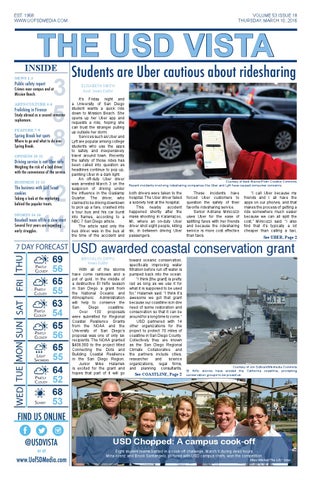
Courtesy of Mark Warner/Flickr Creative Commons Recent incidents involving ridesharing companies like Uber and Lyft have caused consumer concerns.
both drivers were taken to the hospital. The Uber driver failed a sobriety test at the hospital. This nearby accident happened shortly after the mass shooting in Kalamazoo, MI, where an on-duty Uber driver shot eight people, killing six, in between driving Uber passengers.
These incidents have forced Uber customers to question the safety of their favorite ridesharing service. Senior Adriana Minicozzi uses Uber for the ease of splitting fares with her friends and because the ridesharing service is more cost effective than taxis.
“I call Uber because my friends and I all have the apps on our phones, and that makes the process of getting a ride somewhere much easier because we can all split the cost,” Minicozzi said. “I also find that it’s typically a lot cheaper than calling a taxi,
See UBER, Page 2
USD awarded coastal conservation grant BROOKLYN DIPPO News Editor
With all of the storms have come rainbows and a pot of gold. In the middle of a destructive El Niño season in San Diego a grant from the National Oceanic and Atmospheric Administration will help to conserve the San Diego coastline. Over 130 proposals were submitted for Regional Coastal Resilience Grants from the NOAA and the University of San Diego’s proposal was one of only six recipients. The NOAA granted $408,000 to the project titled Connecting the Dots and Building Coastal Resilience in the San Diego Region. Junior Mike Halamek is excited for the grant and hopes that part of it will go
toward oceanic conservation, specifically improving water filtration before run off water is pumped back into the ocean. “I think [the grant] is pretty rad as long as we use it for what it is supposed to be used for,” Halamek said. “I think it’s awesome we got that grant because our coastline is in dire need of some restoration and conservation so that it can be around for a long time to come.” USD partnered with 14 other organizations for the project to protect 70 miles of coastline in San Diego County. Collectively they are known as the San Diego Regional Climate Collaborative and the partners include cities, researcher and science organizations, legal firms, and planning consultants.
See COASTLINE, Page 2
Courtesy of Jon Sullivan/Wikimedia Commons El Niño storms have eroded the California coastline, prompting conservation groups to be proactive.
USD Chopped: A campus cook-off Eight student teams battled in a cook-off challenge, March 8 during dead hours. Mina Krenz and Brook Santangelo, pictured with USD campus chefs, won the competition.
Miles Mitchell/The USD Vista
2T
he
USD Vista
NEWS
Pass the Purell
March 10, 2016
NEWS
NEWS EDITOR BROOKLYN DIPPO @brooklyndippo
Asst. NEWS EDITOR ELISABETH SMITH @ellie_smith13
Do background checks guarantee safety? UBER continued from Front Page
BROOKLYN DIPPO NEWS EDITOR Welcome to the season of compromised immune systems. When the semester picks up, students sleep less and drink more. It’s all good fun until one person gets sick and it spreads across campus like a wildfire. The problem is that some students don’t have time to be sick, myself included. Between work and school I don’t have any time to spare which means I have to make a very intentional effort to stay healthy. I make sure I sleep for eight hours, I exercise four times a week, I eat a balanced diet, and I drink Emergen-C every day. I am aware that my exposure to germs in a college environment is inevitable but I do everything in my power to keep it to a minimum. Yet all of those efforts are thwarted when another student or teacher shows up to class sneezing and coughing or pale as a ghost. If you are sick, stay home. Your attendance is not wanted. You don’t contribute anything to the class but your gross, nasty germs. You might call me a germaphobe but I call that disrespectful, to yourself and the people who have to sit around you for an hour. The only thing you are going to gain anything from a class if you are feeling like crap is an attendance mark. I understand that teachers have stricter attendance requirements at USD than other universities but I also think they would understand and appreciate your staying home, since they don’t want to get sick either. Teachers who come to class sick, you are just as bad. You’re all on salary too so I don’t understand why you do it. Your students will worship you for cancelling a class, an email with the powerpoint attached will cover the material and you will feel better much quicker if you stay home. So please, if you are sick, just stay at home and watch some Netflix until you are better. I don’t have time for your stupid cold, much less the flu. Get the shots when the Health Center gives them for free, too. It’s all about herd immunity. Wash your hands, with both soap and water. Cough into your elbow, sneeze into a tissue. Please just keep your germs to yourself.
and it’s more convenient to have the app automatically charge me on my phone rather than to pay a taxi with cash or a card in person.” Despite the recent violence associated with Uber, Minicozzi does not anticipate switching to other ridesharing services. “Although the Kalamazoo incident in particular was very scary and concerning, I wouldn’t say that I would stop calling Uber altogether because of it,” Minicozzi said. “I think it was a pretty rare incident that Uber cannot necessarily be totally blamed for, and I think that something like that could happen just as easily with any other driving service, especially a regular taxi.” Minicozzi expressed that Uber drivers should treat all all passengers, including students, professionally when on duty. “I think that Uber drivers should be held to high standards regardless of whether or not students have been drinking,” Minicozzi said. “But I definitely think that if Uber riders are drunk or have been drinking that the driver should try and take extra caution when picking customers up and taking them where they need to go. I always find it helpful when an Uber driver makes sure that we’re being safe in the car or that we’re being dropped off at the right place when my friends or I have been drinking.” Sophomore Wade Pacheco had an experience with an Uber driver that he believed to be under the influence of drugs. “I had an Uber driver last year I thought was high on pills,” Pacheco said. “We said USD and he took us to SDSU. I thought it was funny and he didn’t charge us for the ride.” First year Christina Sargent doesn’t think that these isolated incidents should define the ridesharing
Photo courtesy of Uber Patrons have questioned the security of ridesharing companies like Uber, following several incidents with drivers who have criminal records.
companies. “You can’t base your judgment of an entire company because of a few bad incidents,” Sargent said. “There are thousands of Uber drivers and these things are just as likely to happen to any kind of driver -- including Lyft or just regular taxis. Even though the companies run background checks, it doesn’t mean every single driver is 100 percent safe to get in a car with. The company does what they can to prevent these things from happening but in reality you can’t predict the unpredictable and you can’t blame the company when things like this do happen.” According to the Uber website, the company is dedicated to keeping drivers and passengers safe on the road. Their safety precautions include: passenger insurance from pickup to drop off, a driver and passenger code of conduct, driver and passenger profiles, and driver background checks. “All drivers in the U.S. must provide their license and vehicle documentation before being able to drive with Uber,” the Uber website’s safety page stated. “They’re also required
to go through a pre-screening process that includes a review of their motor vehicle records and a search through criminal records at the county, state, and federal levels.” According to a Time article from August 2015, Uber hired 25 drivers with criminal records in both San Francisco and Los Angeles. The criminal records included property crimes, sex offenses, and murder. The article stated that San Francisco district attorney George Gascon claimed Uber was presenting false and misleading information to clients about driver screening. “Uber has said in the past that the limited scope of its background-check providers is required by some state laws, and is in fact a way for the company to help rehabilitate offenders,” the Times article stated. In an August 2015 New York Times article following the situation in San Francisco, Uber pushed for their business to grow across the nation, turning a blind eye to some safety regulations. “Uber has aggressively pushed its service into cities around the world, often not waiting for permission from
local regulators, it has faced hostility from local taxi drivers who fear it is undercutting their business, as well as increasing skepticism regarding the trustworthiness of some of its drivers,” the New York Times article stated. According to a Cato Institute Policy Analysis study, ridesharing company’s background checks are stricter than the requirements for American taxi drivers. The Cato Institute is a public policy research organization, or think tank, that values individual liberty, small government, and free markets. Cato researchers conduct independent, and nonpartisan research on policy issues. The study also cited that those background checks only go back seven years, which is still stricter than the typical taxi driver requirement. Overall there is no surefire way to guarantee that any ridesharing service is 100 percent safe. USD students have to decide whether they trust companies such as Uber and Lyft, or if they’d rather call a taxi cab or have a friend drive them back and forth from the beach.
proposal was selected for
places like San Diego,” Skalley said. “San Diego could use better infrastructure to diminish toxic runoff, too. Flooded streets close to the ocean is horrible for the ecosystem and fragile marine environments.” The grant will fund information gathering as well as legal, scientific, and economic analyses of problems and possible solutions. They will combine their efforts
with public communication to increase engagement in coastal resilience initiatives. Altogether, this should reduce vulnerability to harsh coastal conditions and heavy storms throughout San Diego county. A strong El Niño has already impacted San Diego. The results of this grant should preserve the coastline that has drawn so many students to attend USD in the first place.
NOAA grants over $400 thousand to USD for coastal conservation efforts COASTLINE continued funding. Similar to Halamek, from Front Page he thinks that this is an
The purpose of the grant is to help coastal communities prepare for and recover from extreme weather and ocean conditions. San Diego County is vulnerable to rising sea levels, coastal flooding, and extreme weather. Junior Beau Skalley was impressed to hear that USD’s
opportunity to improve coastal communities and marine environments simultaneously. “I think that it’s an awesome opportunity and a great way for USD to offset its carbon footprint and make an impact on an ever encroaching environmental problem along the overpopulated coastlines in
Volume 53 Issue 18
NEWS
The USD Vista
3
Kelly Kennedy/The USD Vista
4T
he
USD Vista
ARTS & CULTURE Separation by association
March 10, 2016
ARTS AND CULTURE
A&C EDITOR TAYLER REVIERE VERNINAS
ASST. A&C EDITOR MILES MITCHELL
Picking up the tempo on broadcasting USD Radio’s Exec attempts to amplify the hype for student DJs
MILES MITCHELL A&C Assistant Editor
TAYLER REVIERE VERNINAS Arts & Culture Editor We sit on the benches behind IPJ to enjoy a wonderful view of San Diego. We gather in the study rooms of Copley Library the night before our heavily weighted midterm. We feast on Mongolian BBQ dishes, SLP Pho, Nutella crepes, and Uptown Funk sandwiches. We join organizations such as the Changemaker Hub, Fraternity and Sorority Life, United Front Multicultural Center, and Torero Program Board. We participate in team activities through athletics, intramurals, and on-campus events. We are the Toreros that make up the undergraduate label at the University of San Diego and we like to associate ourselves. A couple of weeks ago in my Communication Theory class, my group and I had to construct theories based on our observations of USD culture. We observed that USD is a system of various groups of people who identify themselves with certain organizations in order to have some kind of commonality with others. Our findings were based on observations we made at the SLP throughout the day. We noticed that various athletic teams, Fraternity and Sorority Life chapters, as well as members of other organizations sat and ate with the members of said organization. We concluded that these groups spend their extra hours time around those they spend a majority of their time with because it is what they have come to know and familiarize themselves with. We have associated ourselves with labels that have created a comfortable space for us to feel welcomed and have enabled us to create relationships with others. But have these labels further divided how we view those in other organizations we are not apart of? It’s ironic to think communities of commonality could, in a sense, directly divide our Torero community as a whole. But then maybe being a Torero is the one commonality that unites all of us on campus, and therefore separates us from other universities. The cycle seems to continue when it comes to comfortability and association of certain groups. To me, the best solution might be to keep challenging ourselves to engage with those outside our associated communities so we can have a better understanding of the many ways others go about living their lives.
USD Radio has officially begun public, live broadcasting out of their small, hidden studio on the fourth floor of the Student Life Pavilion. The student organization has undergone many changes since people have been able to tune in to the station last year. The club has overcome many challenges, but some obstacles remain in the way of their success. Founded in 2009, USD Radio has seemingly had a rebirth since it was last broadcasting. The student organization had difficulty implementing some of the plans it had last semester and therefore was unable to broadcast. The studio went quiet for the entire semester and the stagnation swept the club under the rug and nearly out of the minds of the student body. However with a new executive team, equipment, schedule, rules, along with many new DJs, USD Radio has recently resurfaced. USD Radio’s executive team consists of Jackson Yeung, station director; John Barnum, editor-in-chief; Michele Demaio, social media; Jae Pearl, marketing; Bailey Marie, finance; and Set Lu, communications. Sophomore Janek Bielski has recently joined USD Radio to run a show with his fraternity brother, sophomore Tadzio Dlugolecki. Inspired by England radio, such as BBC Radio 1, Bielski and Dlugolecki launched a show of their own, featuring many different styles of EDM. One new feature of the radio station is their block schedule, which stylistically groups DJs’ shows into segments at different times of the day and throughout the week. Now students will know when to tune in to listen to Oldies/Classic Rock, Hip-Hop/ Rap/R&B, Electronic, Talk, Indie/Alternative, Pop/Top 40, Classical/Jazz, or Variety. The studio has also had a moderate makeover, revamped with updated equipment and broadcasting software. DJs can take advantage of the studio now fixed with a new mixing board, mics, and even a DJ controller rig for those who wish to perform their mixes live as if they’re headlining a music festival. DJs may now host live performances in the studio. With studio training sessions, new DJs like Bielski and Dlugolecki are easily able to begin broadcasting.
Kevin Nelson/The USD Vista The new sound board is one of the many additions to USD Radio’s equipment in the room on fourth floor SLP.
“The computer software and applications that we run to broadcast are easy to use, which helps new DJs like us,” Bielski said. Also new to the operations of USD Radio is 24-hour broadcasting. DJs won’t necessarily be on air at every moment, but there will be some sort of sound emitting from the studio and into the public realm at all times. In addition to music, the student organization also provides a variety of content including concert and event coverage, album reviews, and even artist interviews. Still, there are issues
and Soundcloud. However, USD Radio has combated this issue by making the broadcasts available to listen to through an app, TuneIn Radio. Before students had to listen to the live stream on their computers. With the ability to listen on the go, there is hope for increasing listenership. Cotton believes that there are other factors, such as lyric censorship, that may also be hindering persuading students to tune in. “The concept of listening to the radio has been at a decline due to options like Spotify and Apple music where we can have custom
“I’m in that booth because I love music of all kinds and want to give off that love to the listeners, regardless if there was one person listening to our show or 1000.” - Janek Bielski, Sophomore that inhibit USD Radio from widespread success. Listenership, which is the total number of people tuned in at any given time, and the retention rate, which estimates the average amount of time a listener is tuned in to the show for, have always been primary issues for the radio station. Marketing for USD Radio falls short at creating large awareness amongst the student body. Sophomore Cameron Cotton is a new DJ to USD Radio and runs a music show called “Curated DYN4$TY Radio.” “If there is a focus on marketing the DJs and their shows then students may explore the ones they want to keep up with,” Cotton said. Even if awareness levels were higher, it is still difficult to lure in listeners with the ease of access to streaming services like Spotify, Apple Music,
playlists,” Cotton said. “So it’s hard to get people to listen to a show for an hour given their schedule. Another challenge is having to censor the lyrics to songs. Current popular genres contain explicit lyrics so there would have to be some flexibility in that area.” However, not all shows have equal listenership. Effective marketing, a compelling show, the time and genre of the show, or strong support of friends and family could attract a larger audience. Bielski exemplifies that the student radio shows could still show some success against the heavy competition from music streaming services. He discussed the surprising success of his and Dlugolecki’s first broadcast of their show “Jin and Tadek.” “We actually only had our first broadcast last Wednesday, but our listenership was pretty astounding,” Bielski said. “I
must’ve had 40-50 people message me from far and wide, one even as far as New Zealand, saying they loved tuning in. And of course our mothers are big fans.” For some DJs it’s less important how many people are listening and more about having a medium of expression and a space to create something they enjoy. Bielski spoke positively about the opportunity to collaborate in the space of the USD Radio’s studio. “We are just trying to have as much fun with it as possible; we genuinely love going in that booth once a week for an hour and collaborating on a creative front,” Bielski said. “It’s where we want to be. Bottom line though, I’m in that booth because I love music of all kinds and want to give off that love to the listeners, regardless if there was one person listening to our show or 1000.” Since last semester, USD Radio, along with The USD Vista and USD TV, consolidated under one parent site, USD Student Media. USD Radio executives explain that the conjoining of the three media outlets benefits all facets of media down the road. Being independent entities the radio team worries that working together with USD TV and the USD Vista will be biggest challenge. USD Radio claims that there is more to the station than offering a place for them to broadcast and play music. While the club is invested in increasing its influence on campus, they also emphasize on the success of their DJs as well as the USD student community. The team states that they are collaborating with the Communication Department to bring in professionals from the news, TV, and radio industry to inspire current students that would like to work in those fields.
Volume 53 Issue 18
ARTS AND CULTURE The USD Vista
5
Toreros’ tales of traveling abroad: Florence Life in Firenze as told by a second semester sophomore
JACK BONACCI Contributor My decision to go abroad in the spring of my sophomore year as opposed to the fall of my junior year was met with a fair amount of skepticism and inquiry. I must begin by thanking my parents for their love and support with which I have been blessed to make my dream semester a reality. James, my travelcompanion and roommate from USD, and I set our minds to study abroad second semester of sophomore year, regardless of the norms at USD. Spending a semester abroad is a critically formative three and a half month span. However, doing so a year earlier than the majority of students who go their junior year presents a unique set of quandaries, but also benefits.
study and scratching a semester of forced on-campus living are among the incentives of being a trailblazer. Also, this city of Florence is awe-inspiring on a daily basis. My walk to class involves a trek past the plush hills of the Boboli Gardens concealed by the brick façade of Palazzo Pitti, followed by a stroll across the famed heart of the world of jewelry — the Ponte Vecchio. Regularly encountering one of the five largest churches in the world, Santa Maria del Fiore, I am constantly reminded of the rich history of architecture and religion that is ever-present in the city. But none of this compares to the intellectual prowess of Florence’s philosophers, scientists, and artists, many of whom are buried throughout the city, and whose work is on display in the nooks and crannies of the timeless cobblestone
“My walk to class involves a trek past the plush hills of the Boboli Gardens concealed by the brick façade of Palazzo Pitti, followed by a stroll across the famed heart of the world of jewelry — the Ponte Vecchio.” Whether it’s finalizing housing for the ensuing fall semester, finding a summer gig, or returning to the states as a minor, uprooting a semester earlier than most USD students has thrown a few curveballs at me. On the contrary, being able to return to USD with two full years to delve into my area of
streets.The city is historically unequivocal and unparalleled. However, on a different front, there is more to this place. Living in a relatively local area of the tourist-infested town, my roommates and I are fortunate enough to be tested with cultural challenges such as communicating to buy produce
Photo Courtesy of Jack Bonacci USD sophomores Jack Bonacci (left) and James Douglas (right) pose in front of the famous Palazzo Vecchio.
at the local market or simply having a conversation in a combination of broken Italian and broken English with a passerby. Then there is the nightlife. Score one for the going abroad as a sophomore deal. Being tossed into the social culture of bars and clubs provides ample learning opportunities outside of the classroom. Florence nightlife is constantly thriving with numerous activities. If I were so-inclined, I could go out every night of the week because the countless clubs and bars thrive on the vehement social nature of the overwhelming amount of study abroad students who call Florence home for a semester. There is almost too much to do here, and we still have the rest of the continent to explore.
Centrally located both in Italy and Europe, Florence grants frequent and diverse travel prospects. This creates a degree of nomadism in those who study here. My travels have taken me, thus far, to London, Edinburgh,
promises to be one for the books. Believe it or not, amid all the memorable moments and busy schedule, I find time to miss San Diego. That may be what makes this whole experience so sweet: the prospect of returning
“Centrally located both in Italy and Europe, Florence grants frequent and diverse travel prospects. This creates a degree of nomadism in those who study here.” Glasgow, Dublin, Siena, Pisa, Lucca, Venice, and Budapest — all in one month. With places like Amsterdam, Vienna, Madrid, and Prague on the list for the future, the rest of the semester
to my favorite city in the world, being intellectually stimulated on a daily basis, and fostering the life-long friendships that I am so fortunate to have begun in my first three semesters. Ciao, USD.
Photo Courtesy of Jack Bonacci The city of Florence has plenty to offer students studying abroad including eating gelato while looking at the Duomo, walking along the Arno River, and hiking up to Piazzale Michelangelo for the view.
Editorial – 619.260.4584 Business – 619.260.4714 www.uofsdmedia.com @USDVista
Hunter Jameson- Editor in Chief Matlyuba Nurova - Finance Director Emily Norris - Advertising Manager Sara Butler - Associate Editor Kevin Nelson - Managing Editor Kelly Kennedy - Art Director Brooklyn Dippo - News Editor Elisabeth Smith - Asst. News Editor Abby Gentry - Opinion Editor Diego Luna - Business Editor Henley Doherty - Asst. Buisness Editor Jamie Eddy - Feature Editor Dani DeVries - Asst. Feature Editor
Tayler Reviere Verninas - Arts & Culture Editor Miles Mitchell - Asst. Arts & Culture Editor Matthew Roberson - Sports Editor Laura Tressel - Copy Editor Ian Lituchy - Photography Editor Alexis Zink - Asst. Photography Editor Christina Ingell - Asst. Photography Editor JJ Stavola - Distribution Manager Gina Lew - Student Media Advisor Marie Minnick - Operations Advisor
The USD Vista publication is written and edited by USD students and funded by revenues generated by advertising and a student fee. Advertising material published is for information purposes only and is not to be construed as an expressed or implied endorsement or verification of such commercial venues by the staff or University. The USD Vista office is located on the fourth floor of the Student Life Pavilion in room 403B. All inquiries should be sent to: The USD Vista 5998 Alcala Park San Diego, CA 92110 The first copies of the newspaper are complimentary, all copies thereafter are 25 cents charge. Opinions expressed in this publication are not necessarily those of The USD Vista staff, the University of San Diego or of its student body. Letters to the Editor can be submitted to The USD Vista office. Letters should be limited to 300 words and must be signed. For identification purposes, USD identification numbers and writer’s year must be included in the letter. The USD Vista reserves the right to edit published letters. Any content sent to the editor will be considered for publication unless otherwise stated.
6T
he
USD Vista
March 10, 2016
ARTS AND CULTURE
Upcoming Torero Events This Week Check out the last of the Diversity Week events, along with other exciting opportunities for campus involvement.
Inclusive Education Series
Thursday, March 10 12:15 p.m.
Student Mariachi Showcase
Friday, March 11 6:30 p.m. Shiley Theatre
8th Annual
March of the Toreros
Thursday, March 10 12:15 p.m. - 2:15 p.m. SLP to KIPJ
Creed Movie Night Friday, March 11 8 p.m. - 10 p.m. SLP Plaza Mayor
Lunafest Film Festival
What I Be Project Talk
MeChA Fiesta Night
Day at the Bay
Mariachi Showcase Concert
Lenten Penance Service
Thursday, March 10 6-9 p.m. UC Forum C
Saturday, March 12 7 a.m. - 7 p.m. Mission Bay Aquatic Center
Thursday, March 10 6:30 p.m. - 8 p.m. KIPJ Theatre
Saturday, March 12 6:30 p.m.
Friday, March 11 6:30 a.m. -10 p.m. SLP Courtyard
Monday, March 14 7 p.m. Immaculata
FUSO presents Pilipino Culture Night: Remember Me FUSO (Filipino Ugnayan Student Organization) hosted their annual Pilipino Culture Night with their very own production, Remember Me. Every year FUSO aims to celebrate and recognize the success of their culture while raising awareness of the social injustices that their community faces. The play was was created by one of their members, Carlo Garrido Patenia, and the storyline was loosely based on the life of a fellow member. The night also included a pre-show with a guest performance, food, music, and the enthusiasm of the FUSO community. Photo Courtesy of Maurissa Sayama
March 10, 2016
FEATURE
FEATURE
The USD Vista
FEATURE EDITOR JAMIE EDDY @jamieddyy
ASST. FEATURE EDITOR DANI DEVRIES @danidevries_
7
Ready to chill out
JAMIE EDDY Feature Editor I browsed through each of my syllabi the other day thinking I would stumble upon a laundry list of unforeseen obstacles. These obstacles may include term papers, tests, reading assignments, and group projects, all due just before the start of Spring Break. To my surprise, for once, I was relatively wrong. I’ve always had a busy midterm and finals schedule, however this semester I’ve noticed my load is lighter. It’s about damn time considering I’m a graduating senior. In my opinion, it should be a right of passage to have an easier, more breezy closing spring semester. Of course, I, similar to other seniors, am not completely immune to school work. I still have two tests, two papers, and some busy work to hand over, but that’s minimal and very doable. I am thankful I don’t have a lot of work to comlete and will do my best to not hold off until the last minute. My goal is to get it all finalized within the next week in order to avoid scrambling and cramming before March 17. The approach of Spring Break is always exciting; memories are in the works, plans are finalized, and parents inevitably get a bit nervous. I’m looking forward to Spring Break. It separates the semester into two halves quite nicely and the length of time given to students is generous. USD students are given almost two full weeks if you include the weekends. That’s a substantial amount of time to relax, have fun, and maybe get in a bit of trouble, but not too much trouble. My plans are still very much up in the air, which is standard for me. However I believe I will be road tripping with some friends, camping, taking in all that nature has to offer, drinking a nice cold one (or five), hiking with my dog, telling stories, and visiting family and friends along the way. In my book, nothing comes close to the joy I get out of those activities, and that most definitely does not include Cabo. I hope all USD students, faculty, and staff have an unforgettable holiday break. Most importantly, stay safe, stay cool, and make some epic lasting memories!
Photo Courtesy of sunlightfoundation.com Countable app aims to directly inform Congress and political figures about the most noteworthy topics based on public opinion.
Toreros get political with Countable app Smartphone app brings public opinion to the forefront of the congressional agenda BROOKLYN DIPPO News Editor If you are an individual who is at all interested in a digital platform that allows for voicing your concerns and opinions relating to Congress, bills, and the most prevalent issues concerning politics, check out the Countable App. Every four years U.S. citizens take a stance on the issues that are important to them when they are deciding who to vote for in the presidential election. A more hidden population of the country pays attention to congressional actions on a more regular basis. However, a new app is making it easier and more efficient to participate in the political atmosphere. Countable is a mobile and digital web app that expedites political participation for the everyday person. The app allows users access to a number of themes associated with the most recent, upcoming political agendas. Some of these include the ability to review summaries of bills that are likely to be voted on in Congress, the arguments for and against it, which political figures are voting on one side or the other, and eventually decide for themselves if they support the bill. After siding for or against the bill, the app automatically shares that opinion in an email to the user’s elected officials
and notifies the user later about how their representative voted. The company chooses which bills to feature on the app based on two criteria. The first is if the bill is likely to be voted on in Congress and the second is whether the bills pose meaningful and stimulating political questions that create public discourse. This particular feature
choosing issues that are most important to them, similar to the concept of a subscription. Senior Taylor Washington, communication studies major, was thrilled to see that the app was created, because it is directly relevant and beneficial to her life. “I’m not surprised this [app] exists, I’m relieved,” Washington said. “Especially
working to make members of Congress more accessible and accountable based on public perception. It is free to use and less time consuming than writing an email or a letter. In fact, after you vote yay or nay on a bill, writing a customized message is completely optional. Otherwise your vote is sent to your lawmaker along with your
Photo Courtesy of Kevin Nelson/The Vista Easily scroll and swipe through different bills, political candidates, polls, and public commentator opinions.
assists in minimizing the chances of showing users repetitive bills or bills that are unlikely to make it past committee hearings. If push notifications are turned on for the app, it will send users a daily reminder to look at and vote on whichever bill is trending that day. Users can also customize which bills will come up on their feed by
because other generations get down on us for being so wrapped up in silly things. They see our social media as just cat videos, less serious topics, when in actuality we have the potential to be making things like this that inform the general public on such a simple platform. I think this app is really great.” Ultimately, this app is
contact information in case they want to reach out to you. Countable has moved civic engagement into the 21st century and removed access barriers for the average citizen. By assembling the bills into an interactive platform that is easy to use and understand, users can share their opinions with their representatives in less than a minute.
Photo Courtesy of Countable website. The Countable app allows users to view, acknowledge, and publicize the most relevant and talked about issues on a daily basis.
8T
he
USD Vista
Spring Break Destinations FEATURE
Road Trip You’re looking for: A laidback Spring Break on a budget You should: Take a road trip up the coast Map it out: Be sure to hit Malibu, Santa Barbara, San Luis Obispo, and Big Sur before rounding off the trip in San Francisco. Tips: Have everyone chip in for gas and snack food, and don’t forget to switch off driving. Try to stay with friends or family along the way to cut costs. Don’t forget: Sunglasses, a killer playlist, and lots of car games
Volume 53 Issue 18
Catalina
You’re looking for: A laidback Spring Break on a budget You should: Take a road trip up the coast Map it out: Be sure to hit Malibu, Santa Barbara, San Luis Obispo, and Big Sur before rounding off the trip in San Francisco. Tips: Have everyone chip in for gas and snack food, and don’t forget to switch off driving. Try to stay with friends or family along the way to cut costs. Don’t forget: Sunglasses, a killer playlist, and lots of car games
Mexico
Hawaii You’re looking for: A laidback Spring Break on a budget You should: Take a road trip up the coast Map it out: Be sure to hit Malibu, Santa Barbara, San Luis Obispo, and Big Sur before rounding off the trip in San Francisco. Tips: Have everyone chip in for gas and snack food, and don’t forget to switch off driving. Try to stay with friends or family along the way to cut costs. Don’t forget: Sunglasses, a killer playlist, and lots of car games
You’re looking for: A true college Spring Break experience You should: Head south of the border Map it out: Whether you’re hitting Cabo, Cancun, or somewhere more off the beaten path, Mexico’s beautiful beaches and warm water are sure to satisfy your Spring Break cravings. Tips: What other time besides college are you going to be able to party on the beach with thousands of your peers? Enjoy yourself, but remember to make smart choices. Drink plenty of water, always be aware of your surroundings, and never go swimming while intoxicated. Don’t forget: Your bathing suit and lots of sunscreen
Photos Courtesy of John Cooke, Mark Fischer, Jonathan Gross, Andy, Ilirjan Rrumbullaku, Sergejf/ Flickr CC
FEATURE
The USD Vista
San Diego You’re looking to: Stay local You should: Take the ultimate staycation Map it out: We live where you Spring Break, so why leave? Spend the day lying on the beach in Coronado, exploring Hillcrest, snorkeling in La Jolla, or meandering the farmers markets in Little Italy or North Park. Tips: Check sites such as Groupon for great deals on local activities. Rent beach cruisers or paddle boards, or try a new restaurant. Don’t forget: Reach out to other friends that will be staying here because everyone needs a good beach buddy.
Snowcation
You are looking to: Get deep in powder You Should: Travel to Colorado, Mammoth, or any other snowy locale Map it out: If you’re someone that loves the snow and is looking to get away from the sun, head to where the snow is falling (Surprise: it definitely still is). Tips: Organize and pack up all your gear ahead of time. Also, make sure to look up ticket prices for any student discounts. Don’t Forget: Pack some extra layers just in case it’s colder than the forecast predicted. If you are skiing or snowboarding, always have a buddy, or at the very least someone nearby who can come to the rescue if something bad does arise.
Dani DeVries/The USD Vista
9
Volume 53 Issue 18
OPINION
Procrastination station
10
The USD Vista
OPINION
OPINION EDITOR ABBY GENTRY opinion@usdvista.com
ASST. OPINION EDITOR JOAN O’LEARY opinion2@usdvista.com
FBI takes a bite of the Apple Apple fights to uphold their privacy priviledge
ABBY GENTRY Opinion Editor I, along with many other college students, fight a daily battle with procrastination. There are always better things to do than what actually needs to be done. Especially at USD where the beach is six miles away it is often difficult to force yourself to do school work on a beautiful day. There is nothing worse than the frustration of the clock striking midnight on a Sunday, with a stack of work to do, and no one to blame but yourself. I’ve recently adopted two methods to try to handle my procrastination. First, I remind myself, “You’re going to have to do it eventually so you might as well do it now.” This actually works most of the time. If I force myself to think about that dreaded moment on Sunday night, I can relatively efficiently knock out an assignment when needed. If that fails, I try multitasking. When this works, it’s great because I get the best of both worlds: I feel accomplished and did something enjoyable in the process. However, I often find myself bringing books to the beach only to use them as a headrest. Right now I’m trying to find the balance between getting my work done in a timely manner and still enjoy the perks of being a college student. Sometimes I convince myself that I don’t need to stress about school and should just enjoy being where I am. Then I remind myself that technically the only reason I am here is because of my education. For me, the stress of sitting through class with no idea what is going on is not worth the extra hour at the beach. If I can just get myself to buckle down and do my work, my day the next day is always much better and I am actually able to enjoy the things I am doing. If I sit around, procrastinate, and do everything other than what I need to do, I spend the whole time thinking about the fact that I have to go back and sit in the library. Rather than being stuck in this mentality, I should just knock out my school work and enjoy myself afterwards. The next time you are stuck fighting between doing your work and something else, I recommend knocking out your school priorities so you are able to enjoy yourself later.
ABBY GENTRY Opinion Editor Apple recently denied the FBI and the U.S. Department of Justice assistance to access the information on a found iPhone of one of the San Bernardino shooters. The FBI claims that Apple is hindering an ongoing investigation with U.S. national security concerning the December shooting and that Apple should comply and help break the iPhone’s passcode. It is unclear what exactly the FBI believes is on the phone that will help with the progression of the case. In rebuttal to the Department of Justice, Apple is claiming that it is not right
to the public, Apple explained their reasoning for not allowing the FBI to access the information on the cell phone. “We are challenging the FBI’s demands with the deepest respect for American democracy and a love of our country,” Apple’s letter said. “We believe it would be in the best interest of everyone to step back and consider the implications.” If there was proof and evidence of exactly what was on this phone and how it would help the progression of the case, I would consider sympathizing with the FBI. The FBI has been very vague about what they are searching for, possibly for security reasons. Yet with no evidence or pull, it
tech
company’s decision. “These situations are so hard because obviously we want to ensure national security and for everyone to be safe,” Rodriguez said. “It’s scary though because if this power fell in the hands of the wrong person it could be detrimental to so many people’s lives in such a scary way that I don’t know if it’s really worth it.” The FBI is accusing Apple of using this situation as a marketing strategy by advertising the strength of privacy in Apple products. I think it is definitely possible that Apple is capitalizing on this opportunity to prove the high standards of their company. It seems odd for them to turn down helping the FBI
Photo Courtesy of FlickrCC/EFF Photos On February 23, 2016, protestors rallied in support of Apple to uphold their security standards.
for the government to demand that a company violates the First Amendment especially when the benefits are unclear. The argument here is not about unlocking a singular phone; it is about something much bigger. Apple is taking a stand for American democracy and the privacy of American citizens as a whole. By unlocking this one phone, it questions the standards and limitations of when it is okay to infringe on the privacy of others. In a letter
is hard to stand behind the FBI. This case is also tricky because the shooters are already known. From an outsider’s perspective, the case seems closed. Knowing the conclusion of this case and that these people are no longer a direct threat to American civilization makes it hard to see the benefit in unlocking a cell phone. Sophomore Alyssa Rodriquez shares how she sees both sides but ultimately agrees with the
as a promotional technique. I genuinely believe Apple understands the importance of privacy and respecting personal property and the information in their cell phones. However, even if it was a marketing strategy, would that be so wrong? Apple is a company trusted by many that prides itself on the high profile security of their technology. As a company, Apple is free to choose what they want to do and consider the repercussions of whatever
decision they make. If Apple announced that they made a decision to comply with the FBI and create a weakened version of their operating system, many users would probably refuse software updates or any further upgrades with the company. Junior Hannah Winterbottom understands the importance of allowing companies to play by their own rules and uphold their own standards. “As a company, Apple has the right to keep withhold their customers privacy if that’s what they want to do,” Winterbottom said. “Even the FBI should not be able to force them to do anything.” Adding to the conversation, Junior Bella Andrie shares the importance of protecting the privacy of American citizens. “I don’t think the FBI should break into the phone if they do not know exactly what information is on there because then anyone could just say that anytime they want to get into something,” Andrie said. “It is ultimately an invasion of everyone’s privacy. If they come up with a code to break it anyone can get into anything all the time.” Apple is constantly expanding the diverse use of iPhones and it is expected that in the near future iPhones will have the ability to replace passports and other valuable, important, and personal information. In short, the iPhone is taking over society. With this should come the increase in security and assurance that your information is private, not the opposite. In opposition, Junior Jamie Borer shares why she believes the importance of national security trumps the protection of privacy. “I think the FBI is way more powerful than Apple and that they should be able to be able to break into the phone in the case of a mass shooting,” Borer said. “I think since it’s pertaining to such a nationally known and tragic event, the FBi should be able to break into the phone.” While there may be some security benefits of the FBI and national security having access to the information on personal cell phones, I do not think that the benefits outweigh the risks. As American citizens, we are allowed to expect that our personal information remains private. Once this trust barrier is broken, it will be incapable of being rebuilt.
The views expressed in the Opinion section are not necessarily those of The Vista staff, the University of San Diego, or its student body.
11
The USD Vista
March 10, 2016
OPINION
Driving service is not Uber safe Is the risk of a bad driver worth the convenience of the popular driving service?
JOAN O’LEARY Asst. Opinion Editor For many Toreros, the phone application Uber has become the superior alternative to taxi services. The app is easy to download on any smartphone, much cheaper than a taxi, and students can get a ride anywhere, at any time. Whether it is a freshman without a car trying to get around the San Diego area, or a group of friends leaving Mission Beach on a Saturday night, many University of San Diego students consistently choose to use Uber. Uber has grown rapidly since its creation almost seven years ago. Currently it has cars driving in 204 cities in 45 countries around the world. Uber even claims to cover 55 percent of the U.S. population with its ride-sharing services. Recently, there has been a lot of controversy surrounding how Uber hires their drivers and how safe the service actually is. Many feel that the company’s background checks are not thorough enough. The 39-year-old CEO of Uber, Travis Kalanick, who has led the company for seven years now, claims that his company always puts safety first. “Safety is No. 1 at Uber... so we make sure the system is in place so riders get the safest ride possible,” Kalanick said. “With that said, Uber is in the limelight. When things happen, if there’s claims of any kind in any city in any car, we take those claims very seriously.”
According to reports, there have been over a dozen cases of assaults by Uber drivers in the last few years. Just last year, an Uber driver by the name of Alejandro Done, was sentenced to 10 to 12 years in prison for the aggravated rape of his Uber passenger. Before
been numerous accounts of Uber drivers attacking and assaulting their passengers. Another case includes a sixth grade teacher in North Carolina who worked as a part time Uber driver who raped a 23-year-old passenger. In 2014 prosecutors in
Photo Courtesy of Abby Gentry/The USD Vista
this incident, Done had been charged with five unsolved sexual assaults between 2006 and 2010. However, according to Uber, Done had passed through their background check procedure. This case was not a freak occurrence; there have
California filed a complaint against the alternative taxi service for failing to give thorough enough backgrounds. According to CNET, regulations for taxi companies are more accountable for instances similar to the ones described
above than companies like Uber. Many states in the U.S. are now requiring that Uber demands better and more in-depth background checks for their drivers. Uber defends their service sharing how their company provides safe rides for those under the influence. “In almost every city that we operate, our rush hour is when bars close,” Uber’s website stated. “By providing a reliable ride at the tap of a button, we’re empowering people to leave the keys at home and make the safe choice at the end of the night”. This is one of key reasons Uber is popular among the college crowd. No matter where you are, or what time you need a ride, you will always be able to find an Uber. Junior Alexis Dachs shares how she believes the convenience of Uber trumps the potential risks of an unsafe driver. “Uber is more convenient because it’s right on your phone,” Dachs said. “No matter where I am I can always call an Uber to come get me. It takes the stress out of planning a night out.” Although there is a strong argument for why Uber is unsafe, many college students would disagree. If someone gets separated from their crowd or caught in an unfortunate situation where they may not have someone to go home with, an Uber is just a click away. Being under the influence of alcohol and alone is a scary
experience and situation to be in. Uber’s quick and direct location service solves this the problem of potentially being stuck in a tricky situation. If you choose to call a taxi, you may have to wait 20 to 30 minutes for it to arrive, whereas a typical Uber would arrive in about half that time, maybe less. In Philadelphia, 91 percent of all UberX rides since October 2014 arrived in less than 10 minutes. Uber also allows students to split fares amongst their friends making it cheap and easy to share rides with large groups when needed. This convenience makes choosing Uber a nobrainer for college students looking for a cheap ride. Sophomore Connor Scott shares how the timeliness of Uber actually makes her feel safe in the event of a sticky situation. “Uber is awesome,” Scott said. “I’ve never had to wait more than five or 10 minutes for my Uber to arrive. It’s really nice to know that if I was ever in a situation where I needed to leave quickly, I could count on Uber.” While choosing Uber runs the risk of having an unsafe driver, students may face that same risk taking a cab. The convenience, pricing, and timeliness of Uber trumps the potential risk of an unsafe driver in the situation of most college students. The amount of benefits that stem from the application outweigh the smaller chance of potential risks.
The views expressed in the Opinion section are not necessarily those of The Vista staff, the University of San Diego, or its student body.
12 T
he
BUSINESS
USD Vista
BUSINESS Let’s level the playing field
March 10, 2016
BUSINESS EDITOR DIEGO LUNA @diegotothemoon
Asst. BUSINESS EDITOR HENLEY DOHERTY @hensolo_
The business with Girl Scout Cookies Toreros weigh in on the popular treats of their childhood
HENLEY DOHERTY Asst. BUSINESS EDITOR @hensolo_
DIEGO LUNA BUSINESS EDITOR @diegotothemoon Last week I wrote an article expressing student’s gratitude towards the career exposition that was hosted by the University of San Diego’s Career Development Center. However, I suspect that my interviews, research, and conclusions may have been biased and thus flawed in ways that need fixing. Yes, I believe the career expo is a useful tool for all students who choose to adopt it as one. But there are students who opted out of participating because the scope of employers and jobs available at the career expo were limited, heavily in favor of business majors, and did not accurately represent the entire USD community. This is a narrow-minded way of helping the entire USD community. If business has taught me anything, it is that if there is a problem that needs fixing, we must search for the root cause. Putting a small bandage on a bigger problem won’t get us anywhere. With this in mind, I’d like to clarify last week’s career expo article by discussing a very valid point that many of my colleagues brought up to me. Business is the most impacted major at USD. Intuitively, it makes sense that USD should focus on business majors because in many ways it yields a higher return on investment for the university’s business students. The businesses, jobs, and industries at the events should truly favor and represent the entire USD community and the diverse areas of study, not just a select few. In my opinion, it’s the right thing do. The point of going to college is not to get just any job; a college degree proves to employers that you have acquired a certain level of competency in a particular field or fields. You should then exercise that discipline, and I believe you’d be foolish not to. Although I am currently a marketing major, I stand with my peers and I encourage the entire USD community to also support diversity. This will ensure we have a cohesive, and diverse group of young professionals that the world needs and companies want.
Girl Scout Cookies are an incredibly popular treat amongst students at the University of San Diego. Samoas, Thin Mints, and Tagalongs are names that are familiar to most people across the entire United States. Girl Scout troops are often found on campus selling the cookies to passing students in front of the University Center each Spring semester. The Girl Scouts seen on campus work through the local Girl Scouts San Diego chapter. At the 2016 Oscars, host Chris Rock brought in a local Los Angeles-based Girl Scout troop during the show, including his own daughters, to sell Girl Scout Cookies to the celebrities in attendance. They sold the cookies at the show at about $4 per box. A whopping $65,243 worth of the cookies were sold during the night, leaving many people skeptical. However, according to Adweek, the Girl Scouts headquarters confirmed this amount, although they specified that a large portion of these proceeds also came from direct donations made to the Girl Scout troop during the show; thus, not all of the $65,243 came from the cookies sold to celebrities. They also affirmed that all of the proceeds received that night would remain with the local troop that sold them. Since the stunt at the Oscars, Girl Scouts have also experienced a slight increase in cookie sales nationwide, as well as a major boost in the organization’s brand recognition. While the Girl Scouts organization is not just based on selling the famous cookies, the business provides the young girls with the opportunity to learn new skills that can benefit them in the future. Through the business, the young Girl Scout members are taught leadership, selling, and finance, and marketing management skills. They are also taught to set both individual and business-minded goals. According to the Girl Scouts website, the Girl Scout Cookies business constitutes the largest allfemale run business in the world, and the girls selling the cookies range in age from about six to 12 years old. According to Fortune magazine, in the past year revenue from cookies sold by troops around the U.S.
totaled to about $776 million. An adult typically oversees the Girl Scouts as they sell cookies at stands that they set up at local grocery stores and school campuses, such as at USD. However, it is always the young girls themselves that are responsible for the entire selling process; it is they who are in charge of attracting all of the customers, counting the money, and keeping track of cookie inventory. First year Lauren Borchart recounts her time as a Girl Scout and how the cookie selling business benefits the girls. “Being a former Girl Scout myself, I know how important selling cookies is,” Borchart said. “It not only helps teach money management and leadership but helps build confidence in being independent and a self starter.” According to the LA Times, Girl Scout Cookies are produced by two major manufacturers, ABC Bakers and Little Brownie Bakers. In fact, this has led to two slightly different versions of each cookie, which are aimed to target different markets in different states in the U.S. For example, the cookies that San Diegans know as Samoas are given the name Caramel deLites in states
including Nevada and Texas. Tagalongs are known in other states as Peanut Butter Patties. These cookies, along with Thin Mints, also have slightly different ingredients and tastes depending on which of the two companies the cookies are manufactured from and which region they’re marketed towards. Therefore, which version of the cookie you’re getting is based on the region you purchase them from. This has led to some confusion and dissatisfaction amongst customers. Senior Maxine Velez shared her thoughts on the different versions of Girl Scout cookies that are produced around the U.S. “Well they do that on purpose to appeal to their target markets in geographic areas,” Velez said. “I think it’s unfair because it can mislead a consumer and might even cause a loss of sales especially for someone who just moved to the area and is misinformed on the product names,” Velez is upset about the differences between cookies of different regions. “Picture this: you just moved from California to Nevada and are craving a Samoa, you look at the different packages and see there are no Samoas so you decide to settle on these deLites
The Girl Scouts organization now has their own cookie locator app.
against your will because the photos are similar but to your surprise it tastes nothing like the California Samoas,” Velez said. “Bam! The little Girl Scouts just misled you into wasting five dollars of unsatisfying cookies.” Either way, Girl Scout cookies currently cost about $5 per box in Southern California. Prices have gone up over time and vary in different regions of the country. As for where the money generated from the cookies goes, well over half of the proceeds remain with the local Girl Scout branch and council to fund events, training, and philanthropic service projects for the girls themselves. The rest of the money, adding up to about one dollar, covers the cost of production of the cookies. Girl Scouts has now even come out with their own smartphone app, Girl Scout Cookie Finder, that allows you to locate the nearest stand where the cookies are being sold. You can also order cookies online through a program called Digital Cookie, but you still must first consult either a Girl Scout or the local Girl Scout council. Girl Scout members are still actively involved in the selling process and management of the popular cookie business.
Photo courtesy of Photo Giddy/ Flickr CC
Volume 53 Issue 18
13
The USD Vista
BUSINESS
Tw i t t e r ’ s $ 2 b i l l i o n d i l e m m a Twitter’s current deficit can be attributed to the declining user base
DIEGO LUNA Business Editor @diegotothemoon Twitter is a popular social networking app that is commonly used by Toreros, as well as young professionals, athletes, and entertainers. Currently, Twitter has over 300 million active users but is struggling to make profits. Consequentially, Twitter is also facing a staggering $2 billion deficit. By definition a deficit is the difference between the money taken in and the amount being spent. This is not to be confused with debt, which can be defined as something that is owed or that one is bound to pay; debt is basically accumulated deficits. There are some students at the University of San Diego that are avid Twitter users and were shocked to find out that Twitter is not making financial progress. Others are more passive about Twitter’s dilemma because according to them, there are better social networking platforms. Since Twitter’s launch in 2006, the company has not made any profits. In fact, Twitter claimed that its future revenue growth will largely depend on new users
and
overall engagement. Because of the development of mobile apps, social networks set to outrun their competition by making their apps more valuable and costeffective to their consumers. According to Time
a big hot mess when it comes to sorting out your news feed.” Moore goes on to explain why he prefers using other social network platforms. “I prefer using LinkedIn, Instagram, and Snapchat,” Moore said. “LinkedIn lets me meet people in a professional
of revenue is data licensing, which is another substantial revenue stream. Twitter sells something known as firehose, which is simply jargon for public data. On average Twitter adds up to about 500 million tweets each day. If each tweet had
Kevin Nelson/ The USD Vista Twitter is currently facing a $2 billion deficit, experts say this has been a re-occuring issue with Twitter.
Magazine, there are serious doubts that Twitter has the ability to reach a global audience which has been attributed to their declining user base. Senior Colton Michael Moore discusses Twitter’s leaky news feed. “I barely keep up with Facebook,” Moore said. “I made a Twitter account, but I only logged in a couple of times, and I feel like Twitter is
setting, Instagram lets anyone be a photographer, Snapchat lets me see where in the world my friends are, but Twitter gives me random news that are sometimes not relevant to me.” Time magazine reports that Twitter’s shares have tumbled from a whopping $70 to below $20 per share since the beginning of 2016. Almost all of Twitter’s revenue comes from advertising. Another source
Business app of the week: Staance
Staance is a new app that aggregates current controversial issues in a simple, easy to use platform. Staance also allows you to pick topics that are relevant to you, whether you’re interested in science, politics, or television. Staance has topics for everyone, thus eliminating extraneous news feed. After you’ve chosen your topics, Staance will toss a variety of news in single bitesize statements. You may then choose to agree or disagree with the statement by swiping right or left, you also have the chance to say why you did or did not agree. In a sea of information, this app lets your voice be heard. The app will also let you know exactly who agreed or disagreed with what you said, and what percentage of all users share your viewpoints. Staance is designated to empower all voices. This app is now available on the Apple Store and Google Play Store.
significant value to marketers, they’d have an unbelievable amount of data that could be used to target consumers. The companies that buy the firehose can dive deep into the data to analyze consumer trends and sell that information to other companies. Twitter is a publically traded company, thus a lot of their financial statements are available online. The tweets are also public, so
the has
general public also access to this data. The ability to reach the market at a rapid speed is one of technology’s greatest features. According to Forbes magazine, many companies lack the commercialization resources needed to take advantage of market opportunity which is where speed to market may come in handy, especially since it can dictate success or failure. This is certainly not the case for Twitter since they are primarily an app-based platform. This platform allows them to have speed to market. Junior Alexis Merz has a busy schedule, and Twitter’s speed of information is able to give her the latest news at a moment’s notice. “I’m always going somewhere,” Kissinger said. “I don’t really use Facebook that much, because my friends post useless statuses; I’d rather have ESPN, tell me the latest and greatest, it’s just quicker that way.” Twitter CEO Jack Dorsey once said, “Twitter is what you make of it.” It’ll be interesting to see what Dorsey’s plans are to fix their staggering sales. With the growing deficit, it’s becoming more difficult to make a clear case for its existence.
14 T
he
USD Vista
Volume 53 Issue 18
SPORTS
SPORTS Baseball team
UFC: not for me
SPORTS EDITOR MATTHEW ROBERSON @mroberson22
off to slow start
Toreros stumble out of the gate, lose six of first 11 games
MATTHEW ROBERSON Sports Editor On Saturday night I stumbled into a friend’s apartment to find that they were watching a stream of UFC 196. While I know next to nothing about ultimate fighting, except that the goal is to viciously knockout or force the submission of your opponent, I sat down and began to watch what can best be described as an organized street fight littered with energy drink and protein powder sponsorships. I arrived just in time to watch the women’s bantamweight championship brawl between Miesha Tate and Holly Holm. The fight ended with Tate literally choking the life out of Holm, rendering her unconscious and me a bit surprised that something like that was allowed to happen. Chalk it up to my naivete, but I always thought that when choking someone you should at least periodically check in to make sure your victim isn’t actually going to die. It turns out that’s not how things work in a UFC octagon. They actually hire a referee to monitor that sort of thing so that the athletes getting paid to legally assault each other can dedicate all of their energy to destroying the other person. I guess you could say I was slightly taken aback. Tate was being celebrated for her calculated brutalization of another woman, while Holm was lauded for not tapping out and instead nobly embracing the full impact of a chokehold. It was the first time I had ever heard of someone being choked like a true champion. After trying to dissect what I had just watched, the main event quickly started. The notorious Conor McGregor, an unapologetic Irishman whose devastating trash talk can only be topped by his punches and kicks, entered the ring to a song named after legendary drug lord El Chapo. Because, why not? The man already has a tattoo of a gorilla eating a human heart taking up the greater portion of his chest. When he lost to Nate Diaz, a native of Stockton, CA, I was surprised. It’s not often you see a man with a gorilla-eating-a-human-heart tattoo get his butt kicked on live television. But then again, it’s not often that you see two people willingly fight each other for a large sum of cash and a shiny silver belt.
Photo Courtesy of USD Toreros/YouTube Junior first baseman Ryan Kirby, pictured here playing ping pong in the team clubhouse, is hitting .333 this season with a .462 slugging percentage.
MATTHEW ROBERSON Sports Editor Baseball is a sport that is riddled with inherent failure. Even the best hitters to ever play the game don’t reach base every single time they step up to the plate. In fact, no one ever comes close to doing anything like that. If you only get a hit three out of 10 times that you step into the batter’s box, you’re still considered an excellent hitter. Three out of 10 times, just 30 percent, or an F if you’re taking an exam. In a sense, failing in school is equal to getting in the hall of fame for a baseball player. These individual failures are part of the game, and a team must navigate the slumps and bad outings that plague every group to turn poor performances from individuals into team victories. The University of San Diego baseball team is currently coping with an early season slump that has largely been a product of slow starts by several key members of the team and a schedule stuffed with top flight competition. A three game sweep at the hands of the Vanderbilt University Commodores to open the season was a sign that the Toreros needed to improve their game if they were to have any hopes of making the College World Series appearance they so openly dream of. After coming back to Southern California and earning a second place finish in the Tony Gwynn Classic,
parlayed with a ninth inning rally to beat the neighboring San Diego State University Aztecs, the Toreros looked to be gaining momentum before another litmus test series against the Oregon State University Beavers. The Beavers arrived at Fowler Park with the No. 4 spot in several national rankings and a 7-1 record. When they left, they did so without any doubt that they are deserving of their seat at college baseball’s big boy table. In the two games played on March 4-5, Oregon State outscored USD 14-4 thanks to a staggering 13 walks issued by Torero pitchers. Head Coach Rich Hill was optimistic about the direction of his pitchers despite their early wildness. “The pitching is a work in progress,” Hill said. “Injuries are playing a part in who we are running out there. We are finding our way however.” The walks have already become one of Hill’s team’s most pressing issues of the young 2016 season. USD pitchers have walked 61 hitters in the team’s first 11 games, while Torero hitters have drawn just 45 free passes of their own. This has resulted in a troubling trend of empty bases when the Toreros are batting, and cluttered base paths when the Toreros are on defense. USD has a collective on-base percentage of just .330 while their opponents reach base at a much steadier .440 clip. This number has also been lowered by the
recent absence of sophomore shortstop Bryson Brigman, who required surgery for a hernia prior to the pair of games against Oregon State. Hill mentioned that there is no timetable for his return yet. A huge part of Hill’s approach to run scoring is centered around sacrifice bunts and moving runners, something that is obviously impossible to do when no runners are out there to be moved. He noted that the collective youth of his typical starting lineups has played a role. “We are starting four freshmen position players most games,” Hill said. “There’s a learning curve that’s taking place, especially against pitching staffs from Vanderbilt and OSU [Oregon State].” On top of the walks, another ingredient in the struggle soup has been the lackluster performances by several freshmen. While no one was expecting any players in their first year of collegiate baseball to immediately mash prodigious home runs or hit 98 mph on the radar gun, the poor beginnings by a handful of freshmen has undoubtedly contributed to some of the losses. Freshman outfielder Kevin Collard has started 10 of the Toreros’ first 11 games but registered just five hits versus 14 strikeouts. He did, however, hit a homerun in his first at-bat at Fowler Park during the Feb. 26 game against the University of Nebraska Cornhuskers. Freshman second
baseman Brhet Bewley has also been bitten by the strike out bug. The Winchester, CA native has been punched out 16 times in his first 47 at-bats as a Division I baseball player. Sophomore relief pitcher Matt Kirk says many of the freshmen are simply trying to do too much. “Our freshman at the plate have been very aggressive,” Kirk said. “To settle in they just need to swing at more strikes and take the balls. They need to trust their hand eye coordination in the box rather than out thinking themselves.” On the mound, freshmen pitchers Paul Richan and Nick Sprengel have been greeted to college baseball hitters with a rude awakening. The duo has surrendered 23 earned runs over 18.2 innings of work. That adds up to an ugly 12.12 ERA. The entire pitching staff has been relatively roughed up by the fierce competition they’ve been facing. Kirk offered his ideas on why the Torero pitchers haven’t been missing many bats so far. “As a staff we need to keep the ball down,” Kirk said. “We have some great arms but when we leave it up balls get hit hard. Also we need to allow less free bases. When we challenge hitters we’ll do just fine because we have good defense.”
See BASEBALL, PAGE 16
March 10, 2016
SPORTS
15
The USD Vista
The legend of the yellow line KEVIN NELSON Managing Editor @knel17
The famous yellow line: this is the line that appears during every football game showing audiences at home how far the offensive team has to go to get a first down. As kids, fans looked on in amazement and now regular viewers count on it as a basic necessity for watching football. But how did the yellow line become a staple of every game? The yellow line has come a long way since it was first introduced in 1998. Today we also see the line of scrimmage, play clock, field goal distance, and much more. These are all computer generated on the field for a more enjoyable viewing experience at home. And this technology isn’t just limited to the football. In fact, the NBA just introduced their newest feature which illuminates the three point line anytime a three point shot is taken. But when and how was the yellow line created? For that we have to go back to the mid 90s and NHL hockey. Believe it or not the NHL was in fact the first sport that introduced added graphics for TV viewers. The NHL teamed up with Fox Sports and developed a software that showed a small blue ring around the puck that would light up with a red trail if shot over 70 mph. Fox was able to do this by putting several sensors inside each game puck which was then tracked by a computer
Photo Courtesy of NFL/YouTube Many NFL broadcasts today include graphics for the down and distance, line of scrimmage, first down marker and play clock.
program. However, the idea was met with great criticism by hockey purists and was eventually scrapped when Fox lost their broadcasting rights to NHL games. Luckily for football fans the team of engineers that created the glowing puck weren’t discouraged and eventually split off to create their own company called Sportvision. In 1998 the company came to an agreement with ESPN and introduced the yellow line for the first time. The yellow line is a complicated program that took a dedicated team of engineers to make. This line appears at all times from all different angles, but at its root it’s a pretty simple idea. Engineers at Sportvision created a way to track the angle and zoom of each camera fixed to the field. By combining this data with a survey of the field, the Sportvision team
was able to create a 3D map of the entire field and consistently produce a the yellow line. While the yellow line was met with great reviews and the fans loved it, the line as we know it almost disappeared in 2001. At that time Fox held the rights to most football games and needed to cut costs. Fox announced that it was going to cut the yellow line which at the time cost them $25,000 per game. However after an outcry of fans Fox decided to keep the yellow line. Senior Telly Korbakes thinks the yellow line not only enhances how regular fans watch, but also makes it easier for new fans to get into the game. “I think it enabled new fans to understand and learn about the game” Korbakes said. “It is an amazing thing they can do.” Since the creation of the yellow line companies such as Sportvision
have influenced how almost every sport is broadcast. From the pitch tracker in the MLB, to finish line in Olympic rowing and sailing competitions, the technology has had a great effect. The technology has gone past just helping viewers watch the game however. Now when you watch soccer and baseball games you can see advertisements generated on the side of the field or on the walls. The technology that was once viewed with great skepticism has become a staple in everyday televised sports. The innovation of sports television by Sportvision won them an Emmy and has changed a fan’s viewing experience forever. Although the NFL has refused to allow advertisements to this day one thing is for certain, the yellow line is here to stay.
SPORTS
Volume 53 Issue 18
16
The USD Vista
Walks and low on-base percentage hurting Toreros BASEBALL continued from PAGE 14 Of course there are bright spots among this mostly dim start to the season. Sophomore catcher Riley Adams is flaunting a robust .486/.596/.811 slash line that has given merit to the early season hype he received from prospect rankings and draft experts. Adams has also launched two home runs in the season’s early going. Junior first baseman Ryan Kirby has provided more than adequate support behind Adams in the lineup. Kirby’s .333 batting average and sweet left-handed swing are a nice complement to the right handed bats of Brigman and Adams. Junior pitcher Nathan Kuchta has impressed in his first year since transferring from Cypress Community College. The right hander has posted a tidy 3.38 ERA and fanned 10 hitters in his first 13.1 innings as a Torero. Similar to many of his teammates, control has been his downfall. Kuchta has walked seven batters and uncorked four wild pitches already. For USD to right their ship, they would benefit from a strong showing in Waco, TX. From March 11-13 the Toreros will be there for two games against the New Mexico State University Aggies and one against the Baylor University Bears.
Photos Courtesy of USD Athletics Sophomore catcher Riley Adams has been USD’s best offensive player (top). The Toreros celebrate a home run by freshman Kevin Collard (bottom).
TORERO SPORTS UPDATE Men’s basketball lost its first game of the West Coast Conference Tournament to the Loyola Marymount Lions, by a score of 64-61. It marked the last game in the careers of Duda Sanadze (left) and Jito Kok.
Women’s basketball suffered a similar fate, losing their first WCC Tournament game to the San Francisco Dons. USF needed overtime to beat the Toreros, winning by a final score of 84-80. Senior Malina Hood (below) finished her career by earning a spot on the All-WCC First Team.
Men’s tennis has defeated three ranked teams in the last three weeks, collecting wins over the No. 55 South Carolina Gamecocks, No. 65 San Diego State Aztecs, and No. 29 Rice Owls. The March 8 edition of the Intercollegiate Tennis Rankings has the Toreros at No. 29 in the country. Senior Jordan Angus (top left) and junior Josh Page (top right) were paired for doubles vs. Rice.
Softball has gone 8-12 over their first 20 games. Junior outfielder Olivia Sandusky (right), was named West Coast Conference Player of the Week on Feb. 29. She is the second Torero to earn Player of the Week honors, joining senior utility player Tatum Schulz, who won on Feb. 16. Photos Courtesy of USD Athletics