Report & Financial Statements
Year ending 31 July 2025
Our mission is to:


Year ending 31 July 2025
Our mission is to:

The external challenges that prevailed last year continue to cause uncertainty and anxiety across the globe. International conflict is echoed by discord within the country and this creates an environment which impacts on every aspect of people’s lives. We encourage our students to recognise that conflict and change are a wholly expected part of life, and that with resilience and determination, they can navigate these challenges to play their part in making a difference to create a stronger and more cohesive world. It is to their great credit that despite the many pressures facing them – cost of living continuing to be a key concern for most – they nonetheless work hard and succeed.
This year we signed a partnership agreement with Zhytomyr Ivan Franko State University in Ukraine. Over the last three years we have worked together on peer-to-peer mentoring, run guest virtual lectures and undertaken collaborative research projects. The spirit and determination of staff and students at Zhytomyr is nothing less than awe-inspiring. Zhytomyr lies two hours due west of the capital Kyiv and has been subject to repeated air raids and missile attacks since the Russian invasion in February 2022. Despite this, and with water, power and other services regularly disrupted, the work of the University continues, and lectures regularly take place in underground bomb shelters.
The enduring power of the human spirit is an

inspiration and a reminder that great obstacles, in the life of a nation or an individual, can be successfully overcome.The higher education sector has also continued to face growing challenges this year.
The financial crisis, following years of frozen tuition fees and rising costs, has intensified. This year we have had to take significant action to ensure our financial sustainability. We have streamlined processes, reduce unnecessary spending and deferred all but essential improvement schemes.
We have taken the difficult decision to undertake both voluntary severance and compulsory redundancy schemes. Alongside these cost saving measures, we have taken a whole University approach to ‘doing things differently’ - a positive focus of changing our way of working, identifying sometimes small but important changes which have had a significant cumulative effect. This combined approach has had a significant impact on the University. It has delivered the necessary cost savings and returned us to an operational surplus – but there is now a need to ensure that we give the changes the time to properly take effect and to have a period of stability.
This year we have been focused on a number of key areas of growth. For 2024/25, our student recruitment was better than anticipated, as the impact of earlier work on the portfolio became embedded. However, we know that the coming year will bring with it great challenge. To mitigate the impact of falling

England for graduate employment and further study, continuing a consistently excellent performance in graduate employability over the past five years. This achievement is underpinned by a whole-university approach to developing excellent work-ready graduates, who go on to live lives of meaning and fulfilment.
We are also celebrating the completion of the reimagining of our Martial Rose Library into a welcoming and inspiring place to study and meet. We are grateful that this was made possible by a £5.8m capital grant from the Office for Students. It will have such a positive impact on the working lives of the University community, who will enjoy using it for many years.
We would like to thank everybody who has contributed so much to the University over the past year. Thank you to colleagues for their hard work and dedication during the academic year. Thank you too to our many partners across the region, who work so closely with us to help us in our educational mission, and whose needs we will continue to endeavour to serve, by producing outstanding graduates, ready for the world of work.
Thank you to our governors, who bring to their role their expertise and enthusiasm, working closely with the University’s executive leadership team to help to navigate the very real challenges that the higher education sector is facing in the current climate.
Never has there been a greater need for a strong and effective higher education sector. Only by looking forward, by educating and equipping our students for the future, can we meet the challenges that face us, and avoid repeating the mistakes of the past.
Our mission is as true today as it was in 1840, the year of our foundation. Whatever the challenge, we continue to work tirelessly to change the world through education.
Mary Edwards - ChairoftheBoardofGovernors Professor Sarah Greer CBE - Vice-Chancellor
The academic year 2024–2025 marked a transformative period for the University of Winchester, driven by the strategic priorities set out in its Strategic Plan and the need to respond to the considerable external financial challenges facing the higher education sector.
The University has continued to deliver one of the aims set out in the Strategic Plan to transform the way it works, in particular, through the efficiencies and innovations secured through the ‘Doing Things Differently’ approach adopted in 2024/25.
As part of this, the University has had to undertake a considerable organisational change programme, whilst continuing to deliver its mission to educate, advance knowledge, and serve the common good.

Transformational education is at the core of the University’s mission and Strategic Plan – to deliver exceptional learning experiences that prepare students for successful careers and meaningful lives.
The University has also continued to develop and invest in existing areas of research excellence and innovation and to serve the community, through initiatives designed to foster inclusivity, civic engagement, and regional development.
This report provides key highlights and notable achievements in each of these areas over the past year.
Throughout the year, the University has continued to deliver its vision for transformational education, producing outstanding graduates – including nurses, teachers, police officers, professionals in business and the creative arts – who go out and make a difference in the world.
The academic experience at Winchester is built around developing students’ Curiosity, Confidence and Capabilities. These attributes are at the heart of the University’s vision for transformational education, by nurturing and developing them within each and every student.
A growing area for the University in the past year has been its creative sector courses. The Film Production course has produced students and graduates who have built their confidence in the art of film making through an industryfocused course and connections within the creative industries.
A film called ‘25%’ made by a group of Film Production students won the prestigious Judges Award (the top prize) at the Future BAFTA Winners Short Film Competition. The judges described the eight-and-half minute film as “conceptually unique” and added “the themes you explored were distinctive and fresh”.
The University builds students’ curiosity by creating a learning environment in which they can discover and explore their subjects and passions. Students are given opportunities throughout their course that bring their learning to life, from the live crime scene house and black box theatres, to the simulation hospital wards and new mock courtroom. These opportunities, combined with teaching delivered by dedicated academic colleagues and workplace experiences provided by employer partners, help to develop students’ curiosity, deepen their love of learning and prepare them for the world of work.

Another group of third year Film Production students won a prestigious award at the International Film Festival Manhattan in New York, for their short film Children of the Valley. The enterprising students entered the film into the Festival after meeting a representative of the New York event at the Cannes Film Festival in May, a trip organised and run as part of the Film Production course. Film students also helped local theatre charity, Blue Apple Theatre, make a telling contribution to Holocaust Memorial Day, editing a documentary by theatre members about the 250,000 people with disabilities sent to their deaths by the Nazis.
The film was seen worldwide online and featured on Meridian TV news.
MembersofBlueAppleTheatre,who helpedmakethedocumentary,watchthe editingprocesswithUniversityof WinchesterFilmProductionstudents HopeandVasili(seated)inthe University’sMultiMediaCentre.
The Accounting and Finance undergraduate degree, which ranks highly both in student satisfaction and graduate prospects, has embraced new technologies within its teaching and learning. As part of their learning experience, students on the course have used AI to compose songs to help build their understanding of the subject. National Teaching Fellow and Senior Lecturer, Lim Keong Teoh, who uses gaming technology and real-world scenarios in his teaching, was shortlisted for the Most Innovative Teacher of the Year award in the 2024 Times Higher Awards. The Accounting and Finance Programme Team was also shortlisted for the Public Sector Accountancy College of the Year at the PQ Magazine Awards for the second year running.
LimKeongTeoh,SeniorLecturerinAccountingandFinance, receivingthePQAward

The University builds students’ confidence by giving them the tools and support to advance into whatever career they choose. Every student has a dedicated Personal Academic Tutor who, together with a supportive Academic Success Team, works with students to develop their academic skills to help them succeed in their studies.
The University’s Careers and Opportunities Team help to develop students’ professional skills, building their confidence when applying for jobs, interviewing and launching a successful career. Students are supported throughout their studies by the Student Support and Success team, who help them get the most out of their time at the University, including those facing particularly challenging circumstances.
This year, the effectiveness and professionalism of the Student Support and Success team were again recognized in the reaccreditation of their Customer Service Excellence Award.
Alongside building and nurturing curiosity and confidence, transformational education at Winchester is about growing students’ capabilities.
From their arrival at the University, there is a clear focus on building students’ employability skills and awareness, enabling students to feel fully prepared for their next steps in life. Benefitting from work placements to internships to guest lecturers and class trips, students are fully equipped with the tools they need to thrive.
Following support from academic colleagues, a Registered Nurse Apprentice learner at the University, Bronwyn Flower-Bond, was selected as part of a competitive process to join the national leadership scheme run by the Council of Deans for Health. The programme aims to promote and develop leadership skills among the future generation of nurses, midwives and Allied Healthcare Professionals by working with first and second-year students. Bronwyn, who began her nursing apprenticeship in 2023, works as a healthcare assistant at the Royal Hampshire County Hospital in the acute assessment unit. Bronwyn,right,duringhervisittoSriLankawithastaffmemberatKarapitiyaTeachingHospital

The University continues to deliver on the Strategic Plan objective to see an expansion of professional education and postgraduate taught provision – responding to regional needs and working in partnership with employers. In the last academic year, 800 students (up from 700 the previous year) graduated with professional degrees including nursing, teaching, social work, law, physiotherapy, psychology and policing.
A new partnership with the College of Legal Practice, signed this year, has enabled the University to deliver new courses providing a direct pathway into the legal profession for
students. The LLM (Law Masters) and Law (Conversion) masters, will include preparation for the Solicitors Qualifying Exams (SQE), allowing students to progress into the legal profession.
Alongside this, the Faculty of Law, Crime and Justice has launched a new masters in Criminal Justice and Investigation.
The course covers a range of contemporary criminal justice subject areas, with a focus on the professional skills required within the criminal justice sector at a local and national level.
DrGilesProctor,CEOofTheCollegeofLegalPracticeandBill Davies,DeanoftheFacultyofLaw,CrimeandJustice(centre) withstaffandstudentsfromtheLawDepartmentatthe University

The University’s professionally focused, transformational education – building students’ curiosity, confidence and capabilities – continues to place us amongst the top in the country for graduate success.
The latest graduate employability figures, released by the Higher Education Statistics Agency in July 2025, place the University of Winchester 12th in the country for graduates going into employment and further study.
This year, the University introduced a new placement programme for first year Physiotherapy students, receiving glowing reviews from participating organisations. Students are provided with a 10-week placement with local organisations and charities – not all in a clinical environment – to give them early practical experience with a focus on demonstrating professionalism and enhancing communication skills through working with people with healthcare and challenging social needs.
Partners involved in the programme included Southern Health (now Hampshire and Isle of Wight NHS Trust), Hampshire Hospitals Foundation Trust and Everyone Active. Salisbury NHS Foundation Trust, Ronald McDonald House in Southampton, Headway, Lanterns Nursery School, dance charity Move Momentum, Communicare, the Memory Box Foundation, and the Boaz Project.
The new placement scheme is part of an innovative curriculum which has recently been reviewed, enhanced, revalidated and reaccredited by the Chartered Society of Physiotherapy (CSP) which commended the course for its inclusive approach, addressing student support needs and valuing stakeholder involvement.
KayteWestfromtheMemoryBoxFoundationwithhergroupof studentvolunteers.

In March 2025, the University hosted an event for students on Humanities and Social Sciences courses.
More than 300 students attended the Futures Fair which featured stands from 20 organisations including BBC Archives, Civil Service Fast Stream and English Heritage, all offering advice on career and placement opportunities. It was an opportunity for students to meet industry professionals face-to-face and build their confidence and connections.
Two well-attended panel sessions at the event – one focusing on History and the other on Psychology – were held as part of the fair.
The History panel featured Jake Smith, a Strategy Advisor for The Cabinet Office, Matthew Bowers, a Graduate Manager with De Vere Hotels and Laura Fildes, Assistant Heritage Consultant for construction firm Berrys. All three had studied History at Winchester.
They were joined by Elaine O’Shea Phillips, Lead Curator, BBC Archives, and Emily-Jayne Aldridge-Snell who recently completed a Classical Studies degree at Winchester and is now studying to be a solicitor.

The event demonstrated the broad range of opportunities available to students and graduates in the humanities and social sciences. The University’s Careers and Opportunities work with academic teams to build links with organisations, bringing them onto campus to allow students to meet them face-to-face and build connections.
Historyeventalumnipanellists(fromleft):JakeSmith, MatthewBowers,Emily-JayneAldridge-Snell,ElaineO'Shea PhillipsandLauraFildes

In 2024-25, the University launched its Research and Innovation Enabling Strategy, which aims to further the University’s transformational education, providing educational credibility through the expertise and experience of teaching staff, underpinning external networks and contributing to changing the wider world through engagement, impact and knowledge exchange.
It aims to make the University ready and open for business and seeks to ensure that its research and innovation activity is informed, influenced by and contributes to the health of communities regionally, nationally and internationally.
With this focus, the University aims to maximise the quality and impact of its research and innovation footprint and grow its income and reputation, while enhancing its educational offer through highly credible, well-networked staff, and research and practice informed teaching.
Despite the challenging external financial environment, the University has made significant progress in advancing research excellence and fostering a vibrant, inclusive research culture. The Research Excellence
Acceleration and Development (READ) Programme supported successful academic colleagues across two tailored streams, providing protected research time, mentoring, and development opportunities. The scheme has been praised for its fairness, transparency, and innovative use of Narrative CVs, which recognise a broader range of research contributions including leadership and mentoring.
The Research and Innovation (R&I) Academy delivered a comprehensive programme of development pathways aligned with the Vitae Framework, engaging over 95 researchers across themes such as Research Impact, Leadership, and Open Research.
A new Early Career Researcher (ECR) Network will be launched in September 2025 to support progression, peer connection, and talent retention, reinforcing the University’s commitment to inclusive research environments.

Holly Marsden, now working as an assistant research curator at Historic Royal Palaces, based at Kensington Palace, recently undertook a Collaborative Doctoral Partnership PhD programme, jointly supervised with Historic Royal Palaces and the University of Winchester.
Her supervision by Dr Elena Woodacre and Dr James Ross in the University’s History Department gave her the confidence and support to pursue a career in the heritage field. Being a PhD student at Winchester provided her with academic rigour and teamworking skills that are necessary for a job of this kind – which combines academic research and planning exhibitions and displays for the public.
The encouraging and enthusiastic environment of the PhD community meant Holly was listened to, challenged, and encouraged to pursue further
avenues of research and take career opportunities that aided her securing a position in a competitive field.
Whilst a PhD student in history at Winchester, Holly audited and completed modules in early modern queenship, palaeography, research skills, early modern Dutch language, and teaching. These practical skills aided Holly in the application stage and are used every day in her position as curator at Kensington Palace.


Susan Birch is a part-time PhD student at the University of Winchester. Her research focuses on the role of the Family Planning Association in Birmingham and Winchester from 1945-1955. Despite the fact that research placements are mostly suited for full-time students, Susan successfully applied for a placement at the Wellcome Collection, a museum and library that is part of the Wellcome, a global charitable foundation. Her placement ran from July 2024 until February 2025. Susan used the Wellcome Collection for the majority of her doctoral research. During her placement, Susan was supported by the directorate of Research and Innovation at the University of Winchester and by GuildHE.
During her placement Susan focused on another women’s organisation: the National Birthday Trust Fund. Researching the collection gave her a wider sense of how women’s organisations operated during the twentieth century. She presented the findings at the Wellcome in December 2024. Susan created a trail of her sources so that the audience could see the research material she had consulted. The talk was well received

PhDstudent,SusanBirch,outsidetheWellcomeCollectioninLondon.
A project funded by the Higher Education Innovation Fund has seen a collaboration between the University, the National Centre for Domestic Violence (NCDV), and Women’s Aid, aimed at improving support for victims of Violence Against Women and Girls.
Through the project, the University has leveraged its research expertise to analyse sensitive data provided by the charities, including anonymised witness statements from NCDV and case management data from Women’s Aid.
In return for their staff time and expert advisory input, the charities will be compensated. The findings will inform the co-development of specialist training guidance and toolkits to enhance evidence-gathering and victim support.
by the audience. This gave Susan the confidence to organise two further events for postgraduate students on her placement at the Wellcome alongside other presentations on teaching and postdoctoral opportunities, she is due to present at the European Association for the History of Medicine (Berlin) in August 2025. graduates in the humanities and social sciences. The University’s Careers and Opportunities work with academic teams to build links with organisations, bringing them onto campus to allow students to meet them faceto-face and build connections.


The University is proud to have widening participation at the core of its mission. It is part of the University’s DNA, stemming from its origins in 1840 as a teacher training college, training teachers to educate children in the most deprived areas of the local region.
In more recent years, the University has been recognised for its sector-leading work to support the access and participation of emerging underrepresented student groups, in particular Care Leavers, Young Adult Carers, Service Children, and Asylum Seekers.
Many University of Winchester students come from backgrounds that make them less likely to enter into higher education:
• 40+ % of students are the first-in-family to attend higher education
• 30+ % of students eligible for student finance come from low-income households (under £25k)
• 26+% of students have a declared disability, with over 8% declaring a mental health condition.
In 2024/25, the University introduced the Discover Winchester Scheme to provide additional support to applicants from specific backgrounds, who may have faced additional challenges in their lives and might otherwise struggle to access higher education.
The scheme supports applicants across nine different criteria, including those who are firstin-family to attend university, disabled, careexperienced, recipients of free school meals or from a military service
The University works to improve the educational opportunities of children from Services families, who are disproportionately less likely to progress to higher education than their peers. The Service Children’s Progression Alliance (SciP), which was founded by the University in partnership with the Ministry of Defence in 2016, has enabled UK-wide, cross-sector collaboration and driven researchled practice improvement for professionals in all education phases, youth work, health and wellbeing, and more, securing over £2.4 million in external grants from government, private sector and charitable funders.
The SCiP Alliance’s ten current projects include novel research, practitioner training and tool development, service evaluation, stakeholder consultation, impact measurement and the development of an online community space to enhance collaboration between the hundreds of professionals in the SCiP Alliance Community across the UK and overseas. To date, the SCiP Alliance’s Thriving Lives Toolkit has been accessed by schools supporting over 20,000 Service children, and first-of-its kind research published recently laid the foundation for a similar toolkit for universities. This year, SciP was awarded £250K in funding from the Forces in Mind Trust to set up an Impact Centre that will transform the understanding of activities that support Service children and help equip the community to take evidence-based action.
This award followed a £174K grant from the Office for Students to support the Alliance’s development of a Thriving Lives Toolkit for colleges.


In July 2025, a University of Winchester student, Liana Wilson, won the Academic Success category at the upReach 2025 Student Social Mobility Awards in recognition of her remarkable journey back into education. The awards recognise further and higher education students who have overcome significant obstacles on their path to success. The Student Social Mobility Awards citation praised Liana and her fellow winners’ “… truly outstanding profile, characterised by consistent academic excellence, impactful leadership and commitment to their university community.”
The University creates value across the city and region in numerous ways. The University’s transformational education prepares students to succeed in their chosen career and make a significant contribution to employers across the region. With around 40% of the University’s students staying in the region after graduation, Winchester graduates are having a real impact on the cultural and economic prosperity of the region, bolstering the output of regional employers and as the educators, healthcare providers and professionals across a range of sectors.
The strategic partnership between the University and major local arts and culture charity, Play to the Crowd, continues to thrive as it enters its second year. The five-year partnership provides unrivalled opportunities for Winchester students at Theatre Royal Winchester and the Outdoor Arts Festival, Hat Fair, providing vital learning and experience for future theatre makers and performers.
In October 2024, academics from several different subject areas within the University’s Faculty of Humanities and Social Sciences ran a sell-out public lecture event at the Theatre Royal the night before Halloween, called ‘Dissecting Dracula’. The successful event was followed up with another, For the love of…, on the eve of Valentine’s Day, delving into the romance genre across literature and film.
A cornerstone of the partnership is that students from the University’s School of Creative Production and Performance present, on the theatre’s historic stage, their end of year showcase performances as well as having the opportunity to perform some work
The expenditure of the University – one of the largest employers in the region – along with the spending of its staff and students, further supports the regional economy through the output and employment generated by regional suppliers.
The University has continued to deliver the Strategic Plan’s objective to make an ever-greater contribution as an anchor institution in the city. Through its work in the community and with partners, the University is helping meet the needs and aspirations of local communities, supporting economic prosperity through graduates meeting workforce needs, and developing a vibrant, entrepreneurial business community and a flourishing cultural life as the following case studies demonstrate.
in progress pieces in the theatre’s foyer event space. This year, students from the University’s BA Musical Theatre course presented Pippin and the BA Acting final year students presented Earthquakes in London, directed by Dr Marianne Sharp, Senior Lecturer in Drama.
DeanoftheFacultyofHumanitiesandSocialSciences,Michael Bradshaw,withmembersofFacultystaffattheTheatreRoyal PublicLectureevent.

Chairman of Winchester City Football Club, Ken Raisbeck, and Pro Vice-Chancellor (Engagement), Sam Jones, signing the new partnership at the Winchester City Football ground.
In August 2024, the University of Winchester formed a new partnership with Winchester City Football Club to boost youth and community involvement in sports and higher education, with a particular focus on deprived communities.
A three-year agreement was signed at the Winchester City’s home ground to the accompanying noise of heavy machinery hard at work on the new £1m 3g astroturf pitch, funded by the FA Foundation and Winchester City Council.
The collaboration will benefit both the local community and provide University of Winchester students with valuable hands-on learning experiences. Students and staff from the University’s Faculty of Health and
In partnership with Winchester City Council, the University has successfully delivered a series of workshops designed to provide local businesses with practical advice on how to develop their businesses. Nearly 60 businesses from the Winchester area took advantage of the workshops.
The programme was designed to complement the business support offer from the Council and aligned
Wellbeing will carry out pre-season tests on players, and each year there will be placements at the club for Physiotherapy and Sports and Exercise Science students.
ChairmanofWinchesterCityFootballClub,KenRaisbeck,and ProVice-Chancellor(Engagement),SamJones,signingthenew partnershipattheWinchesterCityFootballground.

to the University’s ‘Help To Grow’ programme within the Faculty of Business and Digital Technologies. The University has provided expertise throughout these workshops from colleagues within Research and Innovation and the Faculty of Business and Digital Technologies.
The partnership has proven to be successful, and the outcomes of the programme have led to a joint bid aimed at securing funding to develop a broader offer for the local business community based on their needs.
HeadofInnovationandCollaborationattheUniversity,JoStark,with membersofthelocalbusinesscommunity.

The University is taking a leading role in the establishment of a creative corridor in the central south. A recent report from Arts Council England, The Royal Society of Arts (RSA) and the Creative Industries Policy & Evidence Centre highlighted the economic and societal benefits from joining hotpots of innovation across large geographical areas.
The University is now working directly with The RSA and VentureFest South to establish a creative corridor across the central south. So far there has been a series
As part of its ongoing mission to engage the local community in public debate, in October 2024, the University hosted a series of events shedding light on the criminal justice system as part of the Winchester Cathedral Law Week Festival. Behind Closed Doors, hosted by the University, took a close look at today’s criminal justice system, following the progress of the accused from charge to conviction and beyond. The event, which brought together practitioners from various parts of the criminal justice system, was chaired by Amelia Riviere, a former magistrate and High Sheriff of Hampshire. The panel event was complimented by a community engagement event at the Cathedral, led by members of the University’s Policing, Criminology, Forensics and Law departments.
of events to celebrate the breadth of talent across the region and raise awareness of the concept of a creative corridor, with over 200 innovation-led businesses expressing interest in the first three months of the initiative.
Additionally, the University has gained support and investment from Hampshire County Council. With Creative Corridors being explicitly referenced in the Government’s recent industrial strategy and Creative Industries sector growth plan, this will be an important structure that will attract funding in the coming years.
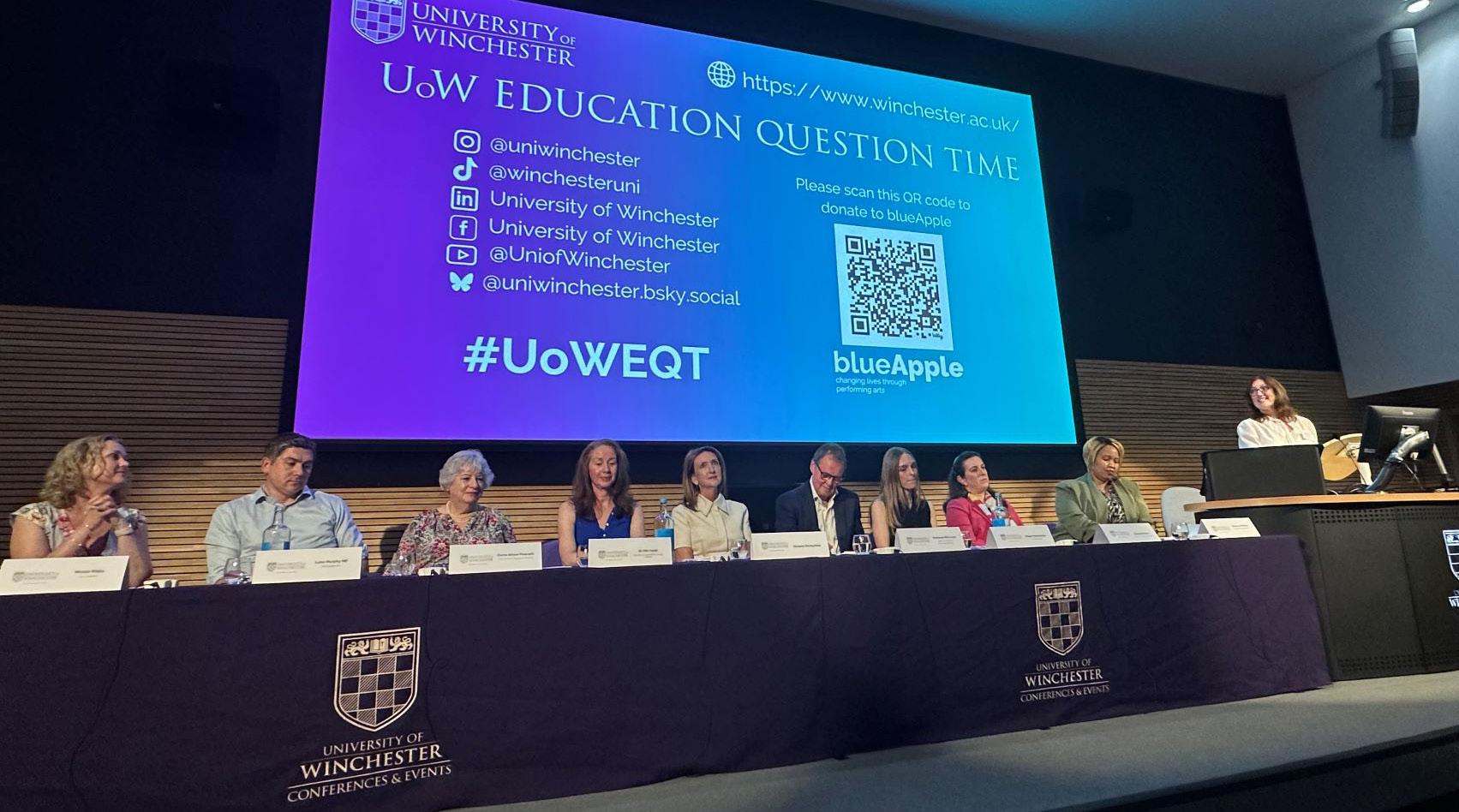
In May 2025, the University hosted Education Question Time, an event hosted by BBC Newsnight presenter Victoria Derbyshire together with a panel of educational experts. The event, which was co-created by University staff and students, was attended by over 200 guests from the community and covered topics including banning mobile phones in schools; funding for Higher Education; the number of children ‘missing’ from full-time education; VAT on fee-paying schools; lack of support for pre-schools: and underprovision for pupils with special educational needs and disabilities (SEND).
The event brought together a wide-ranging panel, from educators to politicians, as well as staff and students from the University.
FormerHighSheriffofHampshireandmagistrate,AmeliaRiviere, chairsapanelofcriminaljusticeprofessionalsoncampus
The University of Winchester Legal Advice Centre runs weekly legal advice sessions in partnership with the Winchester office of Dutton Gregory LLP Solicitors, offering legal advice on family law matters to members of the public.
Now in its second year, the Legal Advice Centre provides an opportunity for the law students to gain real world experience and client contact to complement their academic learning, whilst also making a difference in their local community. The expanded role of the Legal Advice Centre will also be a major benefit to our growing number of postgraduate law students on the University’s new LLM Legal Practice Master’s course.

Winchester Fashion Week, a key week in the city’s retail calendar, was this year run entirely by University of Winchester students. Third Year students on the BA Fashion Business and Marketing, organised the event which was embedded into their course as part of the University’s commitment to practical, real-world learning. First- and second-year students were also involved in supporting events, many of which took place on campus.
The highlight of the week, which had an underlying theme of sustainable fashion, was an evening event, Fashion Reset, held in the West Down Centre. It brought together industry leaders, innovators, and changemakers to explore the theme of sustainability and what it means across the fashion industry including retail, second-hand markets, beauty, and beyond.

The University continued its partnership with TEDx Winchester, hosting the event for the fourth consecutive year.
TEDx provides a unique opportunity for the University to showcase its academic expertise and student talent with a broad range of people from across the region. Over 230 people from across the country came to the West Downs Centre to listen to talks from inspiring leaders from across the region. This year Natacha
Harding, Senior Lecturer in Criminology, gave a thoughtprovoking talk about the role of storytelling in criminal justice.
Alongside this, Event Management students from the University were involved in the planning and successful delivery of the event.
They were joined again this year by students from Film Production who were responsible for all digital content for the event, producing video marketing pre-event, filming the entire day, and producing content for the TEDx video channel.

The University continues to make strides in reducing its carbon footprint and improving environmental sustainability on campus. The table below provides detail of the University’s performance for the 2024/25 academic year.
Energy Intensity Ratio (kWh/m2)
Total Scope 1 and 2 emissions in metric tonnes
In 2020/21, the University was awarded a grant of £3.12m from the Public Sector Decarbonisation Scheme, for the replacement of 35 gas boilers with low energy air source heat pumps; a lighting upgrade to replace existing older-style lighting with low energy LEDs; an upgrade to the Building Management System to optimise energy consumption in buildings; and the installation of two large solar photovoltaic arrays designed to produce on-site electricity generation at peak times. This project was completed in 2022/23.
The installation of heat pumps on campus has helped realise a large reduction in gas consumption over the last two years. There was a 10% decrease in gas consumption in 2024/25 compared to the previous year and a 23% decrease in gas consumption over the last two years. Electricity use has increased, as expected with the new heat pumps, with a 3% increase in electrical consumption in 2024/25 compared to the previous year (4.6% over the last two years). This increase would have been slightly higher, but there
was also an unexpected electrical power cut to the University campus and surrounding area in November/ December 2024. This was due to an issue that occurred in the local SSE substation voltage transformer that left the campus without mains electricity for just under two weeks. During this period, a stand-in generator was used, which ran off diesel.
Although there has been a slight increase in total energy consumption in 2024/25 compared to the previous year, carbon emissions have reduced by 7% for scope 1 and 2 and reduced by 5% for scope 1, 2 and known 3 emissions. This reduction in carbon emissions is mainly due to a reduction in the electricity carbon conversion factor in 2025. The UK electricity carbon conversion factor fluctuate from year to year as the fuel mix changes. In 2025, the electricity grid factor reduced by 15% compared to the previous year. This is due to the electricity supply becoming cleaner through less use of fossil fuels, more imports and higher renewable mixes.
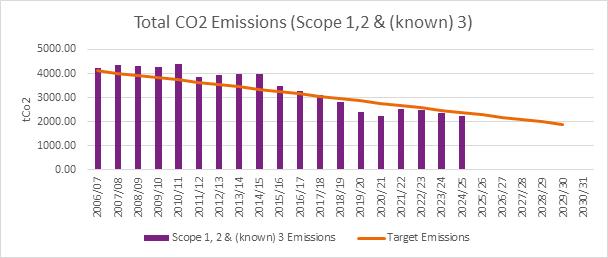
The University has been using 100% zero carbon electricity since 2008. The University also has solar panels installed on nine of its buildings which generate
approximately 3.5% of the University’s total electrical consumption.
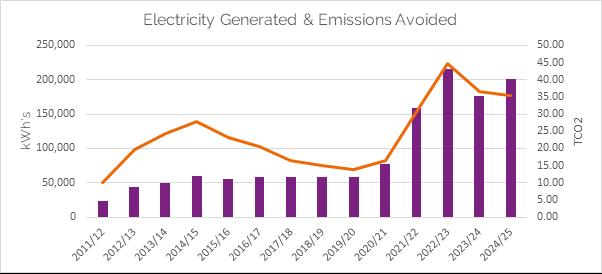
Electricity Generated & Emissions Avoided
By the end of 2024/25, 80% of University’s fleet vehicles had been switched to electric vehicles as part of our journey towards net-zero carbon emissions from fleet vehicles by the end of 2025/26. This calculation has been based on fleet vehicles only, not including grounds utility vehicles, currently unsuitable for replacement by electric vehicles.

The University took part in the British Heart Foundation Pack For Good scheme, a partnership that encourages students to donate unwanted items at the end of term.
Students and staff donated a total of 394 Bags of donations; this equated to 3.15 tonnes saved from waste and £5,910 raised in funds for the British Heart Foundation.
In August 2024, the University launched the Water You Waiting For campaign, a water saving campaign aimed at reducing the number of leaks across campus.
Across the academic year, 268 active leaks were reported, and it estimated that over £120,000 saved in avoided water costs.

TOTAL INCOME
2024-25
£79.9m
2023-24
£84.1m
CAPITAL EXPENDITURE
2024-25 £5.8m
2023-24
£6.3 m
TOTAL STUDENT NUMBERS (FTE)
2024-25
6,081 2023-24
6,491

ACADEMIC STAFF (FTE)
2024-25
287 2023-24
333
PROFESSIONAL SERVICE STAFF (FTE)
2024-25 430 2023-24 478
EBITDA*
2024-25
£8.5m 2023-24 £4.4m
* EBITDA = earnings before interest, tax, depreciation and amortisation (and adjusting for capital grants released and changes to pension provision within staff costs as reported by the Office for Students).
The University defines risk as uncertainty that may cause negative impacts or create unexpected opportunities. Risks are present in all activities, and the University accepts them to achieve its strategic goals.
Effective risk management is about ensuring all significant, relevant risks are understood and prioritised as part of the University’s standard management practice. To create long-term value, the University must anticipate and manage the risks that will create threats for us and our stakeholders, whilst capitalising on new opportunities offered by an ever- changing world. To effectively manage our risks, the University maintains a dialogue with internal and external stakeholders. The current risks are reported in the University’s Risk Register, which includes the most significant business and sector risks, as well as those that are specific to the University.
1 Financial Sustainability
2 Student Recruitment
Failure to adequately respond to external financial challenges
3 Business Continuity
Failure to recruit the planned number of students
The Board of Governors has delegated authority to the Risk and Audit Committee to oversee risk management, including monitoring of the University’s Risk Register.
This ongoing review enables us to identify material issues that are most likely to affect value creation, strategic objectives, service delivery and assets. We undertake a systematic and methodical identification of key risks, and we identify measures to mitigate them.
Whilst risk cannot be completely eliminated, the approach of the Risk and Audit Committee is to be ‘risk aware’ rather than ‘risk averse’, by accepting risks to protect strategic objectives. Included in this Report is the most recent update of our Risk Register with the top seven risks, presented to the Board of Governors on 2 July 2025.
• Re-prioritisation of capital and revenue spending to remove non-critical spends or those with low return on investment
• Where spend is required, review of all suppliers to ensure best cost is being achieved
• Efficiency review of all operational spend areas
• Voluntary severance schemes for staff
• Strategic focus with underpinning plans to drive growth in academic provision with potential for growth
• Integrated financial planning, forecasting and performance reporting in place to achieve necessary financial performance
• Application of increased fees as per the increased Government cap
• Strategic Plan focused on Transformational approach to the student experience making Winchester an attractive option
• Focused international recruitment strategy
• Focused schools and colleges strategy
• Strong presence in Apprenticeship provision with the ability to respond to changing learner and business needs
• Development of online provision to support flexible learning
Failure to manage significant impacts on the University’s ability to deliver core business functions
• Business continuity working group undertaking exercises to test and improve plans and response readiness across cyber and utility outage events
• Contract in place for supply of backup electrical generators and maintenance of high voltage infrastructure
• Utilisation of external services to augment critical services
• Single points of reliance offset by strong deputy cover, resilience training and centralised processes and procedures
4
5
Cyber Security Failure to manage the security of University systems and network compromised leading to loss of critical services and/or loss or exposure of sensitive data
Compliance Failure to comply with ongoing conditions of OfS registration
• On-going regular internal and external cyber security audits with actions plans
• Minimum security requirements required for all new software and hardware implementations, monitored and managed through Governance Group
• Management of core infrastructure conforms to good practice
• Plan in place moving to managed devices for all
• Internal cyber security team regularly upskilled
• External support from sector partners JISC and contracted experts provide on-going updates
• Continued on-going monitoring of changes to the Office for Students Conditions of Registration, to ensure existing and new requirements are met
• Ongoing updating of all compliance areas and reported to Senate and Board of Governors
• Proactive inclusion of expected new requirements related to harassment and sexual misconduct regulations
• On-going engagement on data futures requirements to anticipate and meet data reporting needs
• Guidance and training in place for colleagues and students to manage the impact of emerging and evolving technologies such as Artificial Intelligence on Academic Integrity
6
Student Outcomes Failure to deliver student outcomes and experience that are acceptable to stakeholders
• Continuous monitoring of course performance with improvement plans in place
• University is a signatory to the Mental Health Charter with a cross-institutional programme
• Multi-layered support system to identify and support students with mental health challenges with the University ‘At Risk’ Group in place to directly support students who present a high level of risk
• Weekly communication to students to communicate opportunities and explain changes
• Creation of emergency regulations to support student progression and completion if students are impacted by disruptions to their learning
7
Extremism Failure to manage the threat of radicalisation and extremism on campus
•University aligned with Government strategy
•Annual compliance audit with OfS review, advice and information from Ofsted
• Social Media channels for staff and students cover all awareness requirements
•Safeguarding, Prevent and Mental Health in-person training package/delivered as a rolling programme to Faculties and Professional Services; reporting mechanisms for raising concerns publicised, maintained and regularly reviewed for effectiveness
•Maintenance of a culture of preparedness to respond
• Documented plans for the Seven Tasks
• Practice exercise/s for Emergency Response Team/s
The Trade Union (Facility Time Publication Requirements) Regulations 2017 require the University to collate and publish, on an annual basis, a range of data on the amount and cost of facility time.
The information below covers the relevant period of 1 April 2024 – 31 March 2025 and includes the University’s recognised trade unions: UCU and UNISON.
PERCENTAGE OF PAY BILL SPENT ON FACILITY TIME
Total cost of trade union facility time
Total pay bill (1 April 2024 to 31 March 2025)
PAID TRADE UNION ACTIVITIES
*Calculated as: (total cost of facility time / total pay bill) ** Calculated as: (total hours spent on paid trade union activities by relevant union officials during the relevant period / total paid facility time hours) x 100
The Financial Review puts the year in perspective and outlines our financial environment, financial strategy, financial performance and our future outlook.
We report a pleasing set of results this year, particularly when viewed within the context of the extremely challenging external environment that is currently facing all universities. The measures that have been undertaken to rebalance and resize the University have resulted in us being able to record an operating surplus of £2.6m in 2024/25, which compares to a £1.3m deficit in 2023/24. The return to surplus is also reflected in the strong cash position (represented by cash and short-term investments), which has increased to £35.4m at the 31st July 2025, and has therefore retained its real value after accounting for inflation. These cash reserves will be key in enabling us to navigate us through what continues to be a challenging financial period, as detailed in the Financial Environment and Future Outlook sections (pages 26-30).
During the year a major refurbishment of the Martial Rose Library was completed, representing an £8.7m investment (which included a £5.8m grant from the Office for Students), and results in the transformation of the student learning experience within the building, as well as being aesthetically pleasing and improving the environmental sustainability and reduced energy usage.
The table below provides the University’s key financial performance indicators (KPIs), and reflect those used by the funding bodies and banks.
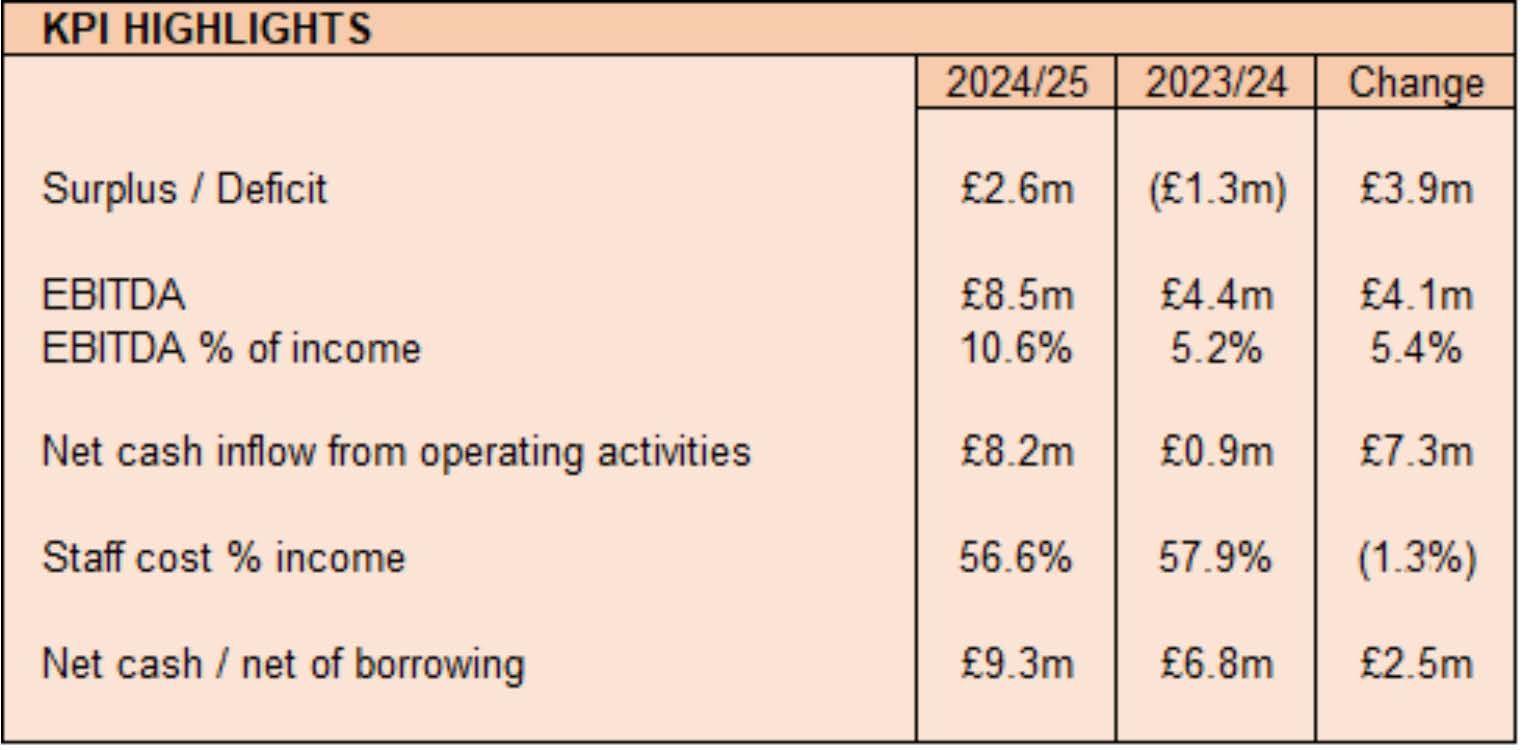
Earnings Before Interest, Tax, Depreciation and Amortisation (EBITDA) is an important financial metric and widely used when assessing financial health. EBITDA is a key measure for calculating the University’s ability to generate cash and is less susceptibl e than total surplus / (deficit) to changes in non-cash movements (such as depreciation). The EBITDA outturn of £8.5m represents 10.7% of income, compared to £4.4m and representing 5.3% of income in 2023/24.
Whilst EBITDA can be used as a measure of cash generation, net cash inflow from operating activities provides a clear indicator of the cash the University is generating each year to service its investing and financing activities. The net cash inflow from operating activities for 2024/25 is £8.2m (£0.9m in 2023/24).
Staffing costs as a percentage of income is reported widely within the HE Sector. The headline figures decreased to 57% in 2024/25, compared to 58% in 2023/24.
The net cash to borrowing is derived from the total of cash and investments less the capital amount of bank debt outstanding at the year end. At 31st July 2025, we had a net cash position (i.e. cash exceeding borrowing) of £9.3m, an improvement on the £6.8m at the 31st July 2024.
All bank loan covenants have been met in this year and are expected to be met in the coming year.
The financial environment in which we operate is challenging and is likely to remain so in 2025/26 and beyond.
The issue of the level of tuition fees continues to be a sensitive topic for politicians, with opinions differing as to whether the fee is at an appropriate level, and the HE Sector highlighting that the headline tuition fee has not kept pace with inflation, despite the fee being increased by 3% in autumn 2025 to £9,535, the first increase since 2017.
The level of immigration is a key topical issue and is having a significant impact on universities. As international students are included within the official figures, these students have come under the political spotlight, with measures taken being focused on how to reduce their numbers.
We have been significantly impacted by recent changes in the immigration rules, in particular the visa changes introduced in January 2024, which prevented family dependents of students from being able to enter this country. This resulted in a significant reduction in our international student numbers, particularly postgraduate, which had hitherto been increasing, and was helping to offset the effects of the ‘frozen’ tuition cap. A knock-on effect is that the market for home students has become increasingly competitive, as universities have increased their offerings to home students to help mitigate reduced international student numbers. This is making it even more challenging to retain our current levels of students.
Other aspects of the financial environment seem, at least at the time of writing, to have stabilised. In recent years, we have been challenged by the effects of Brexit, Covid, and the Russian invasion of Ukraine, with the consequences including a period of high inflation and rocketing energy costs. However, inflation, although well above the Bank of England 2% target, is forecast to decrease during 2026, and the Bank of England Base rate is also expected to fall in the coming year.
The financial environment is such that it emphasises the importance of our strategy in reviewing every aspect of our offering to the students, on how they are taught and the
support offering we provide. This is to ensure that they are provided with the very best experience, and one that is based on a sustainable financial model.
The financial strategy is designed to empower the University to exceed its potential and achieve our Strategic Plan 2028. The strategy contains these five principles:
1. Long-term viability through matching resources with objectives
2. Maintaining productive capacity to meet current objectives
3. Financing development and investment
4. Evaluating strategic alternatives to harness opportunities and manage risks
5. Integrating financial and other corporate strategies
In light of the current financial environment the Finance Strategy outlines four strategic priorities for the year ahead.
Financial sustainability - to remain financially sustainable, generating sufficient cash to support strategic objectives and provide institutional sustainability.
Operational efficiency – to continuously improve efficiency and effectiveness by managing the cost of operations and delivering value for money whilst continuing to maintain a sustainable recurrent investment in academic, corporate and support operations.
Capital investment – to ensure the maintenance of the physical and digital estate alongside future strategic investment to continually support the delivery of excellence in education. To also ensure capital investment is at a level that will not put the University at financial risk.
Treasury Management – to assess and manage risk in all of University’s growth and development activities and to operate sound treasury management as outlined in the Treasury Management Policy.
Total income for the year is £79.9m, a £4.2m (5.0%) reduction on 2023/24 (£84.1 million)
Tuition fee income has decreased from £61.8m in 2023/24 to £57.0m this year, a reduction of 7.8%, with income from both home and international students reducing.
The changes to the student visa regulations for international students introduced in January 2024 resulted in far fewer international students in 2024/25. As these students are predominantly on a one-year postgraduate course, any changes in these students have a more immediate effect on our income than for undergraduate students where the course income is spread over 3 years.
In our core market, full-time home undergraduate students, first-year recruitment increased by 5.8% to 1,775 FTE students, with strong recruitment in the humanities and social sciences. However, this was insufficient to offset larger cohorts completing their studies. Full time postgraduate taught students decreased in 2024/25. Much of this change was driven by a reduction in postgraduate teacher education as the national market settled, a reduction in credit bearing qualified teacher continuing professional development and a reduction in those wishing to study humanities at postgraduate level.
Funding body grant income, research grants and contracts income, and investment income remain relatively unchanged from the previous year. Other income has increased by £0.7m to £15.8m and this is predominately owing to income from accommodation.
Total expenditure for the year is £772m, a £8 2m (9 6%) reduction on 2023/24 (£85 4m), and reflects the outcome of measures that have been taken to reduce our cost base in order to return our income and expenditure into balance.
Staff costs have reduced by 9.8% from £50.1m to £45.2m, excluding the release of the USS pension provision in the prior year, following a restructure. In the last two years, our full-time equivalent staff FTE has reduced by 17% (717 in 2024/25; 866 in 2022/23).
Other operating expenditure has decreased by 13.5% to £24.4m (2023/24 £28.2m) and is the result of robust cost control measures.
In 2024/25 The University ceased to offer University Managed Housing, which resulted in a reduction in residences costs of £0.8m. Energy costs are £0.6m lower than in 2023/24, due to a combination of lower energy prices and measures undertaken to reduce consumption (e.g. the transfer to Air Sources Heat Pumps). Repairs and maintenance expenditure was £1.4m lower than in the previous year as fewer major estate projects were undertaken and a provision for Reinforced autoclaved aerated concrete (RAAC) was released as it is now intended that the segment of the affected building will be demolished. The reduction in other expenses includes a decrease of £0.9m in international agents’ commission as a result of fewer international student being recruited in 2024/25.
Depreciation in 2024/25 is £5.7m (2023/24 £6.5m). The reduction is because the mechanical and electrical elements within buildings included within the 2014 revaluation of assets, and based on a 10-year asset life, are now fully depreciated. Partially offsetting this reduction, this year includes a depreciation charge for the major Martial Rose Library refurbishment which came into use during the year.
The reduction in interest and other finance costs reflects lower interest payments on the £10m variable loan, which is linked to the Bank of England Base Rate, and a lower interest element within the fixed rate loan repayments.
Capital additions during the year are £5.8m, of which £3.9m relates to the final construction and fit out costs of the major refurbishment to the Martial Rose Library. Replacement of the windows in the West Downs Student Village has continued in the year (£1.3m). No other major works have been undertaken during the year.
Current assets increased by £1.2m to £42.0m during the year, reflecting the increase in cash reserves (represented by Investments and Cash and cash equivalents).
Overall, the creditors figure is £1.1m lower this year at £74.8m (2023/24 £75.9m), primarily due to in-year repayments of the principal on the Triodos Bank loan.
These are detailed in Note 16.
Our cash and investment position remains healthy, increasing by £1.5m to £35.4m in the year (2023/24 £33.9m), and is well above that needed for our day-to-day operational requirements. As the first 25% instalment of home tuition fee income is not received from the Student Loans Company until mid-October, a cash balance of approximately £15m is required at the 31st July date to ensure that sufficient operational cash is maintained prior to receiving this first instalment.
Cash and investments continue to exceed the outstanding principal on our Triodos loan by £9.3m (cash and investments £35.4m; outstanding bank loan £26.1m).
“This strategic plan is all about transformation. Transforming how we teach and inspire our students. Transforming how we operate and work together. Transforming how we work in partnership across the city and region”. (Strategic Plan 2023-2028.
In January 2023 we published our Strategic Vision for next five years. It was shaped by our original mission – to educate, advance knowledge and serve the common good – and was guided by our reimagined values, and focuses on the importance of people, place and partnership in delivering our mission.
In conjunction with achieving the ambitions of our vision, a Finance Enabling Strategy was developed with the focus on the following steps:
• Assess the current financial position
• Define goals and objectives
• Identify revenue growth opportunities
• Control costs and optimize operations
• Cash generation for investment
• Managing risks
Over the past 2 years measures have been taken to reduce the University’s cost base in line with an anticipated reduction in tuition fee income. In 2024/25 priority was given to student retention and the development of both a significant increase in postgraduate student recruitment and a new approach to international student recruitment. In the year ahead, the focus will turn to strengthening home student recruitment following a review of the University’s brand and media strategy. Opportunities to increase revenue are being explored including new models for course delivery and preparing for the Lifelong Learning Entitlement funding system. The University will continue to maintain robust cost control measures to safeguard financial sustainability amid a challenging economic environment.
In recent years we have been very successful in generating cash to enable future investment in teaching and the estates and IT infrastructure. A programme of investments has been developed for the next 12 months, and work has begun on scoping longer term projects including a digital transformation which will change the way students engage with the University and enable staff to work in a more efficient way.
The University has prepared income and expenditure, statement of financial position, and cash flow forecasts for the five years ending 31 July 2030. The forecasts take account of student recruitment challenges, the impact of inflation and changes in interest rates. A number of scenarios have been modelled The University has no undrawn lending facilities, and the budgeted cash flow does not require any additional facilities within the next 12 months. The approved forecasts do not breach any covenant thresholds on our existing borrowing facilities.
Having reviewed the scenario modelling, the Board of Governors is confident that the University will have sufficient funds to continue to meet its liabilities as they fall due for at least 12 months from the date of approval of the financial statements (the going concern assessment period). The Board of Governors have therefore prepared the financial statements on a going concern basis.
The University’s Board of Governors (“the Board”), whose members, for the purposes of company law, are the directors of the University. The Board is responsible for preparing the University’s Strategic Review, the Directors’ Report and the financial statements in accordance with the requirements of the Office for Students (OfS) terms and conditions of funding for higher education institutions, Research England’s terms and conditions of Research England grants, and other applicable law and regulations.
The University prepares its financial statements in accordance with applicable legislation and UK accounting standards, including FRS102, the Financial Reporting Standard applicable in the UK. The terms and conditions of funding also require the University to prepare its financial statements in accordance with the Statement of Recommended Practice (SORP): Accounting for further and higher education institutions.
In approving the financial statements, the Board is legally required to be satisfied that the financial statements provide a true and fair view of the University’s financial position.
In preparing the financial statements, the University is required to:
• select suitable accounting policies. and then apply them consistently.
• make judgements and estimates that are reasonable and prudent.
• state whether applicable UK accounting standards have been followed.
• assess the University’s ability to continue as a going concern.
• use the going concern basis of accounting unless this is not appropriate.
Company law requires the University to maintain adequate accounting records that are sufficient to disclose with reasonable accuracy at any time the financial position of the University. The Board is also responsible for such internal controls as they determine necessary to enable the preparation of financial statements that are free from material misstatement, whether due to fraud or error. The Board also has a general responsibility for taking such steps as are reasonably necessary to safeguard the assets of the University and to prevent and detect fraud and other irregularities.
The Board is also responsible for ensuring that:
• Funds from whatever source that are for specific purposes are properly applied for the specific purpose.
• Funds provided by the OfS, or any other body, are applied in accordance with the terms and conditions attached to the funds.
• The University has appropriate financial and management controls in place to safeguard public funds, and funds from other sources, and secure the economic, efficient and effective management of the University’s resources.
The Board is responsible for the maintenance and integrity of the corporate and financial information included on the University’s website. Legislation in the UK governing the
preparation and dissemination of financial statements may differ from legislation in other jurisdictions.
The individuals who served on the Board of Governors (“the Board”) in the period from 1 August 2024 to the date of approval of these financial statements is set out below:
Members of the Board of Governors Appointed on Resigned on
Mary Edwards (Chair)
Andrew Robinson (Vice-Chair) 31 July 2025
Professor Sarah Greer, Vice-Chancellor (exofficio)
Gavin Hunter, Chief Operating Officer (exofficio)
The Right Revd. Philip Mounstephen, Bishop of Winchester
Magnus Bashaarat
Jonny Brason
Bill Davies (Academic Staff Governor)
Alison Evans
Professor Chris Gaskell
Deepa Korea (Vice-Chair, from 01.08.25)
Jane Northedge 1 August 2025 01 September 2025
Dr Emma Page 31 July 2025
Professor Edward Rochead
Andrew Smith 31 July 2025
Mark Thistlethwayte
Rae Tooth
Thura KT Win
Alexandra Wilson (Students’ Union President & Student Governor)
Clerk to the Governors
Stephen Dowell
Delegation of Authority
The Board of Governors (“the Board”) believes governance of the University is best achieved by delegation of its authority for the executive management of the University to the Vice-Chancellor (Accountable Officer), subject to defined limits and monitoring by the Board.
The Board routinely monitors the delegation of authority, ensuring that it is regularly updated, while retaining ultimate responsibility. The Board has adopted a long-standing corporate governance framework which is outlined in more detail in our Statement of Corporate Governance and our Statement of Internal Control.
The following corporate governance statement provides information about the University’s governance, management and legal structure in the period from 1 August 2024 to the date of signing these financial statements.
The University of Winchester (registered company number 05969256) is a company limited by guarantee and is an exempt charity under the terms of the Charities Act 2011 with its Governors as managing trustees. It is therefore exempt from certain requirements of charities legislation including the need to register with the Charity Commission. Since 1 April 2018, the Office for Students (OfS) has been the “principal regulator” for charity law purposes of those English universities that are exempt charities.
In accordance with Section 124 of the Education Reform Act 1988, the principal objectives of the University are related to the provision of higher education and the conduct of research. To support these objectives, the University also undertakes other activities including knowledge exchange, consultancy, and the provision of accommodation, catering and conference services.
In setting and reviewing the University’s strategy and activities, the Board of Governors (“the Board”) takes into consideration the Charity Commission’s guidance on the reporting of public benefit and the supplementary public benefit guidance on the advancement of education. The University takes steps to ensure that it satisfies the Charity Commission’s public benefit requirements.
As an exempt charity, the University’s Board have had due regard to the guidance on public benefit published by the Charity Commission in exercising their powers and performing their duties. The Board has due regard to any detrimental harm that may arise from the University’s activities and particularly the impact of campus developments on its immediate locality. The University aims to minimise this impact through extensive community discussion and consultation, in addition to working closely with Winchester City Council.
The Board recognises that students are the principal beneficiaries of the provision of higher education whilst the public at large are beneficiaries of the University’s Research & Innovation, and Knowledge Exchange activities and community engagement events. The University does not receive private benefit from its activities undertaken in pursuance of its purposes.
The Board meets at least five times a year and is responsible for the overall governance of the University. It has a strategic role in forming the character and mission of the University and is responsible for ensuring compliance with the OfS terms and conditions of funding, standards of institutional quality and student experience. The Board is also responsible for the University’s financial sustainability and ensuring the effective and efficient use of resources.
The Board comprises individuals appointed under the University’s Memorandum and Articles of Association, which were adopted in March 2011 and revised in July 2025.
The Board comprises of at least 14 people (but not more than 18 people), with members drawn from the general public, the private sector, the Winchester Diocese, and from University alumni. Members of the Board are also elected/appointed from the Academic and Professional Services Staff of the University. The nominated governors are expected to be independent and not to act as representatives of those who elect/ appoint them.
There are four ex-officio governors being the Lord Bishop of Winchester, the ViceChancellor, the President of the University Students’ Union, and a member of the Senior Staff nominated by the Vice-Chancellor.
With the exception of ex-officio governors, governors hold office for an initial term of three years. They are eligible for reappointment and can serve a maximum of two further terms of three years. The Students’ Union Governor holds office for a maximum of two years and serves until the end of the academic year for which they were appointed or until their appointment by the students comes to an end, whichever is sooner.
The role of the Chair of the Board is separate from the University’s Vice-Chancellor. The Chair is elected from the external non-executive members of the Board. No member of the Board receives remuneration for work they do for the Board.
Under the OfS terms and conditions, the Board has determined that the Vice-Chancellor shall be the Accountable Officer of the University.
The Board is satisfied that all conditions of receiving and using funds provided by the OfS, UK Research and Innovation (including Research England), Education and Skills Funding Agency and the Department for Education have been applied in accordance with the relevant terms and conditions for the year to 31 July 2025. The University’s constitution places responsibility for its operations with the Vice-Chancellor, who is supported by the Executive Leadership Team.
The University endeavours to conduct its business in accordance with the seven principles identified by the Committee on Standards in Public Life (selflessness, integrity, objectivity, accountability, openness, honesty and leadership) and with guidance to institutions of higher education which has been provided by the Committee of University Chairs (CUC).
In executing its duties, the Board maintains a comprehensive system of risk management, control and corporate governance, including the prevention and detection of corruption, fraud, bribery and irregularities. The Board receives adequate and regular information to monitor performance and track the use of public funds to enable it to identify any material change in its circumstances, including any significant developments that could impact the mutual interests of the University and the OfS. For the purposes of this statement, public funds include funds received from the Student Loans Company, UK Research and Innovation (including Research England), Education and Skills Funding Agency and the Department for Education.
The University obtains assurance over the adequacy and effectiveness of the arrangements for corporate governance, risk management and oversight of statutory and other irregularities through its external and internal audit assurance process.
Each year, aspects of its corporate governance arrangements are tested by the internal audit function, and the experience of the Board is annually reviewed by its Nominations
Committee. The University’s risk management and regulatory reporting are approved by the Board through a formal committee structure.
The primary responsibilities of the Board include:
• determining the University’s educational character and objectives and overseeing its activities
• the effective and efficient use of resources
• ensuring the University’s solvency and the safeguarding of its assets
• approving annual estimates of income and expenditure
• the assignment of duties and the appraisal of the Vice-Chancellor
• determining the identity of the designated staff and their selection, appraisal, remuneration and monitoring of their performance
• setting a framework for the pay and general conditions of employment of the staff who are not designated staff
• after consultation with the staff, making the rules relating to the conduct of the staff
• the appointment of an auditor.
In accordance with its Memorandum and Articles of Association, the University has appointed a Clerk to the Governors who provides independent advice on matters of governance to Board members.
Governors are required to complete a ‘Fit and Proper Person’ declaration prior to their appointment. Upon appointment, governors must complete a ‘Declaration of Office’ and an individual ‘Register of Interests’ which must be updated as necessary. The Register of Interests is open for inspection by arrangement with the Clerk for the Governors.
Forvis Mazars LLP were first appointed as auditor in 2023 and their Audit Strategy Memorandum for the audit of the 2024/25 financial statements was considered by the University’s Risk and Audit Committee meeting in June 2025.
The Governors who held office at the date of approval of this report confirm that, so far as they are each aware, there is no relevant audit information of which the University’s auditor is unaware, and each governor has taken all the steps that they ought to have taken to be aware of any relevant audit information and to establish that the University’s auditor is aware of that information.
The Board is responsible for maintaining a sound system of internal control, which supports the achievement of the University’s policies, aims and objectives, whilst safeguarding the public and other funds and assets for which it is responsible. This is in accordance with the responsibilities assigned to the Board in the OfS terms and conditions of funding for higher education institutions.
This Statement of Internal Control (SIC) relates to the period covered by the financial statements (1 August 2024 to 31 July 2025, and the period up to the date of approval of the financial statements).
The University complies with the OfS conditions of registration. This includes giving due regard to relevant guidance about the compliance with relevant consumer protection law when developing and implementing policies, procedures and terms and conditions, and adopting a Student Protection Plan.
In the period covered by this SIC the Board can confirm that the University has complied with both:
• the Terms and Conditions of Funding issued by the OfS; and
• the Higher Education Code of Governance issued by the Committee of University Chair (CUC), published in September 2020.
The system of internal control is designed to manage the risk of the University failing to achieve its policies, aims and objectives. It is not possible to eliminate this risk and accordingly the system of internal control can only provide reasonable, but not absolute, assurance about its effectiveness.
The system of internal control is based on an ongoing process designed to identify risks to the achievement of the University’s policies, aims and objectives. The University evaluates the nature and extent of those risks to manage them to achieve economy, efficiency, and effectiveness in the use of the resources.
The Board has responsibility for reviewing the effectiveness of the system of internal controls and has established the following procedures:
• The Board meets at regular intervals throughout the year to consider the University’s plans and strategic direction.
• The Board has delegated some of the responsibility for providing oversight of risk management to the Risk and Audit Committee (RAC).
• The RAC obtains regular reports from management on the steps being taken to manage risks, including progress reports on key projects and reports on internal control activities.
• The RAC receives regular reports from the University’s internal audit service provider on the areas that have been subject to internal audit review and containing recommendations for improvement. The internal audit reports prepared for the RAC also include the Internal Auditor Annual Report containing the internal auditor’s opinion on the adequacy and effectiveness of the University’s system of internal controls.
• The Chair of the RAC will periodically report to the Board of Governors on internal controls.
• A regular programme of review is undertaken to identify and keep up to date the record of risks facing the University.
• Risk management is embedded in all University operations through a system of key performance and risk indicators. A University-wide risk register is maintained, with risks ranked according to how they may prevent the University achieving its strategic priorities. Risk awareness is enabled at operational levels within the University and as appropriate to specific risks.
The Board’s review of the effectiveness of the system of internal controls is informed by the University’s internal audit service. This service confirms compliance with relevant professional standards relating to the provision of internal audit services to a university. The University’s internal audit provider submits regular reports to the RAC on the adequacy and effectiveness of the University’s system of risk management, internal controls and corporate governance.
The Board’s review of the effectiveness of the system of internal controls is informed by the University’s management who are responsible for the operation of the internal control framework, the work of the internal auditor, and by comments made by the external auditor in their reports to the University.
After making appropriate enquiries, the Board is satisfied that the University has adequate resources to continue in operation for the foreseeable future: for this reason, the going concern basis has been used in preparation of the financial statements.
Governors’ liability on dissolution
In accordance with the Memorandum and Articles of Association, if the University is dissolved while they are a governor, or within one year afterwards, every Governor undertakes to pay up to one pound sterling (£1) towards the costs of dissolution and the liabilities incurred by the University.
Signed on behalf of the Board of Governors
Mary Edwards Chair of the Board of Governors

Professor Sarah Greer CBE Vice-Chancellor

Date: 26th November 2025
The Companies (Miscellaneous Reporting) Regulations 2018 (Reporting Regulations 2018) require that large private institutions include additional corporate governance reporting disclosures in their strategic report and directors’ report.
Large private institutions are also required to include in their strategic report a separate statement describing how the directors have had regard to the matters set out in section 172(1)(a) to (f) of the Companies Act 2006 when performing their duty under section 172.
The Board of the University consider, both individually and collectively, that they have acted in the way they consider, in good faith, would be most likely to promote the success of the University for the benefit of its members as a whole (having regard to the stakeholders and matters set out in s172(1)(a-f) of the Act) in the decisions taken during the year ended 31 July 2025.
We have audited the financial statements of University of Winchester (the ‘University’) for the year ended 31 July 2025 which comprise the Statement of Comprehensive Income, the Statement of Changes in Reserves, the Statement of Financial Position, the Cash Flow Statement and notes to the financial statements, including a summary of significant accounting policies.
The financial reporting framework that has been applied in their preparation is applicable law and United Kingdom Accounting Standards, including FRS 102 “The Financial Reporting Standard applicable in the UK and Republic of Ireland” (United Kingdom Generally Accepted Accounting Practice) and the 2019 Statement of Recommended Practice: Accounting for Further and Higher Education.
In our opinion, the financial statements:
• give a true and fair view of the state of the University’s affairs as at 31 July 2025 and of the University’s income and expenditure, gains and losses, changes in reserves and the cash flows for the year then ended;
• have been properly prepared in accordance with United Kingdom Generally Accepted Accounting Practice; and
• have been properly prepared in accordance with the requirements of the Office for Students’ Accounts Direction (OfS 2019.41)
We conducted our audit in accordance with International Standards on Auditing (UK) (ISAs (UK)) and applicable law. Our responsibilities under those standards are further described in the “Auditor’s responsibilities for the audit of the financial statements” section of our report. We are independent of the University in accordance with the ethical requirements that are relevant to our audit of the financial statements in the UK, including the FRC’s Ethical Standard, and we have fulfilled our other ethical responsibilities in accordance with these requirements. We believe that the audit evidence we have obtained is sufficient and appropriate to provide a basis for our opinion.
In auditing the financial statements, we have concluded that the Board of Governors’ use of the going concern basis of accounting in the preparation of the financial statements is appropriate.
Based on the work we have performed, we have not identified any material uncertainties relating to events or conditions that, individually or collectively, may cast significant doubt on the University’s ability to continue as a going concern for a period of at least twelve months from when the financial statements are authorised for issue.
Our responsibilities and the responsibilities of the Board of Governors’ with respect to going concern are described in the relevant sections of this report.
The other information comprises the information included in the Annual Report, other than the financial statements and our auditor’s report thereon. Our opinion on the financial statements does not cover the other information and, except to the extent otherwise explicitly stated in our report, we do not express any form of assurance conclusion thereon.
Our responsibility is to read the other information and, in doing so, consider whether the other information is materially inconsistent with the financial statements or our knowledge obtained in the course of the audit, or otherwise appears to be materially misstated. If we identify such material inconsistencies or apparent material misstatements, we are required to determine whether this gives rise to a material misstatement in the financial statements themselves. If, based on the work we have performed, we conclude that there is a material misstatement of this other information, we are required to report that fact.
We have nothing to report in this regard.
As explained more fully in the Statement of Responsibilities of the Board of Governors set out on page 31, the Board of Governors are responsible for the preparation of the financial statements and for being satisfied that they give a true and fair view, and for such internal control as they determine is necessary to enable the preparation of financial statements that are free from material misstatement, whether due to fraud or error.
In preparing the financial statements, the Board of Governors are responsible for assessing the University’s ability to continue as a going concern, disclosing, as applicable, matters related to going concern and using the going concern basis of accounting unless the Board of Governors either intend to liquidate the University or to cease operations, or have no realistic alternative but to do so.
Our objectives are to obtain reasonable assurance about whether the financial statements as a whole are free from material misstatement, whether due to fraud or error, and to issue an auditor’s
report that includes our opinion. Reasonable assurance is a high level of assurance but is not a guarantee that an audit conducted in accordance with ISAs (UK) will always detect a material misstatement when it exists. Misstatements can arise from fraud or error and are considered material if, individually or in the aggregate, they could reasonably be expected to influence the economic decisions of users taken on the basis of the financial statements.
The extent to which our procedures are capable of detecting irregularities, including fraud is detailed below
Irregularities, including fraud, are instances of non-compliance with laws and regulations. We design procedures in line with our responsibilities, outlined above, to detect material misstatements in respect of irregularities, including fraud.
Based on our understanding of the University and its industry, we considered that noncompliance with the following laws and regulations might have a material effect on the financial statements: OfS requirements, UK tax legislation, pension legislation, employment regulation, health and safety regulation, anti-bribery, corruption and fraud and money laundering
To help us identify instances of non-compliance with these laws and regulations, and in identifying and assessing the risks of material misstatement in respect to non-compliance, our procedures included, but were not limited to:
• Inquiring of management and, where appropriate, those charged with governance, as to whether the Univeristy is in compliance with laws and regulations, and discussing their policies and procedures regarding compliance with laws and regulations;
• Inspecting correspondence, if any, with relevant licensing or regulatory authorities;
• Communicating identified laws and regulations to the engagement team and remaining alert to any indications of non-compliance throughout our audit; and
• Considering the risk of acts by the University which were contrary to applicable laws and regulations, including fraud.
We also considered those laws and regulations that have a direct effect on the preparation of the financial statements, such as tax legislation, pension legislation, and the OfS Accounts Direction.
In addition, we evaluated the Board of Governors’ and management’s incentives and opportunities for fraudulent manipulation of the financial statements, including the risk of management override of controls, and determined that the principal risks related to posting manual journal entries to manipulate financial performance, management bias through judgements and assumptions in significant accounting estimates, in particular in relation to defined benefit pension Scheme Assets, revenue recognition (which we pinpointed to the cut-off assertion) and significant one-off or unusual transactions
Our audit procedures in relation to fraud included but were not limited to:
• Inquiring of management and, where appropriate, those charged with governance, as to whether the University is in compliance with laws and regulations, and discussing their policies and procedures regarding compliance with laws and regulations;
• Gaining an understanding of the internal controls established to mitigate risks related to fraud;
• Discussing amongst the engagement team the risks of fraud; and
• Addressing the risks of fraud through management override of controls by performing journal entry testing.
There are inherent limitations in the audit procedures described above and the primary responsibility for the prevention and detection of irregularities including fraud rests with management. As with any audit, there remained a risk of non-detection of irregularities, as these may involve collusion, forgery, intentional omissions, misrepresentations or the override of internal controls.
A further description of our responsibilities for the audit of the financial statements is located on the Financial Reporting Council’s website at www.frc.org.uk/auditorsresponsibilities. This description forms part of our auditor’s report.
Opinion on other matters prescribed in the OfS Audit Code of Practice issued under the Further and Higher Education Act 1992
In our opinion, in all material respects:
• Funds from whatever source administered by the provider for specific purposes have been properly applied to those purposes and managed in accordance with relevant legislation;
• Funds provided by OfS, UK Research and Innovation (including Research England), the Education and Skills Funding Agency/Department of Education have been applied in accordance with the relevant terms and conditions; and
• The requirements of the OfS’s accounts direction have been met.
In light of the knowledge and understanding of the University and its environment obtained in the course of the audit, we have not identified material misstatements in the strategic report or the Board of Governors’ Report.
We have nothing to report in respect of the following matters in relation to which the OfS Audit Code of Practice requires us to report to you if, in our opinion:
• The provider’s grant and fee income, as disclosed in the notes to the accounts, is materially misstated; or
• The provider’s expenditure on access and participation activities, as disclosed in the accounts, has been materially misstated.
This report is made solely to the University’s members as a body in accordance with section 124B of the Education Reform Act 1988. Our audit work has been undertaken so that we might state to the University’s members those matters we are required to state to them in an auditor’s report and for no other purpose. To the fullest extent permitted by law, we do not accept or assume responsibility to anyone other than the University and the University’s members as a body for our audit work, for this report, or for the opinions we have formed.
Wakefield (Nov 28, 2025 12:51:53 GMT)
Nicola Wakefield (Senior Statutory Auditor) for and on behalf of Forvis Mazars LLP
Chartered Accountants and Statutory Auditor
6 Sutton Plaza, Sutton Court Road, Sutton SM1 4FS
28th November 2025
Year ending 31 July 2025
UNIVERSITY OF WINCHESTER Statement of Comprehensive Income
Year Ended 31 July 2025
All items of income and expenditure relate to continuing activities.
The accompanying notes form part of these financial statements.
Statement of Changes In Reserves
Year Ended 31 July 2025
The accompanying notes form part of these financial statements.
A company limited by guarantee and registered in England and Wales.
Registration number: 05969256
Statement of Financial Position at 31 July 2025
were approved by the Board
Governors on 26 The financial statements on pages 45 to 80 November 2025 and signed on its behalf by:
M Edwards Chair of Board of Governors Vice-Chancellor
Professor S Greer
The accompanying notes form part of these financial statements.
Cash Flow Statement
For the year ended 31 July 2025
The University’s financial statements have been prepared in accordance with United Kingdom Accounting Standards including Financial Reporting Standard 102 (FRS 102) and the Statement of Recommended Practice: Accounting for Further and Higher Education (HE SORP 2019). They have also been prepared in accordance with the “carried forward” powers and duties of previous legislation (Further and Higher Education Act 1992 and the Higher Education Act 2004) and the powers contained within the Higher Education and Research Act 2017, the Accounts Direction issued by the Office for Students (OfS), the terms and conditions of funding for higher education institutions issued by the OfS and the terms and conditions of Research England Grant.
The financial statements are prepared in sterling which is the functional currency of the group and rounded to the nearest £’000.
The University is a public benefit entity and has applied the relevant public benefit requirement of the applicable UK laws and accounting standards. The University is registered with the OfS.
The University’s financial statements have been prepared under the historical cost convention (modified by the revaluation of certain financial assets and liabilities at fair value).
The University’s activities, together with the factors likely to affect its future development, performance and position, are set out in the Public Benefit statement which forms part of the Board of Governors Annual Report. The Board of Governors Financial Review also describes the University’s financial position, its cash flows, liquidity position and borrowing facilities.
The financial statements have been prepared on a going concern basis which the Board of Governors consider to be appropriate for the following reasons.
The Board of Governors has prepared income and expenditure, statement of financial position, and cash flow forecasts for the five years ending 31 July 2030 The forecasts take account of student recruitment challenges, the impact of inflation and changes in interest rates.
The Board of Governors approved the revisions to the current year forecast and the basis for the outer year forecasts to 2029/30 which form the basis for the OfS December 2025 submission, at the November 2025 meeting. A number of scenarios were modelled and considered by the Finance and Resources Committee before making the recommendation to the Board of Governors.
The University has no undrawn lending facilities, and the budgeted cash flow does not require any additional facilities within the next 12 months. The approved forecasts do not breach any covenant thresholds on our existing borrowing facilities.
Having reviewed the scenario modelling, the Board of Governors is confident that the University will have sufficient funds to continue to meet its liabilities as they fall due for at least 12 months from the date of approval of the financial statements (the going concern
assessment period). The Board of Governors have therefore prepared the financial statements on a going concern basis.
At 31 July 2025 the University held a controlling interest in UW Services Ltd, Winchester Business School Limited (dissolved 12 August 2025), Winchester Management School Limited (dissolved 12 August 2025) and Inspirational Classrooms Limited. These companies have been dormant since incorporation.
The University’s financial statements do not include the income and expenditure of the University of Winchester Students’ Union as the University does not exert significant control or influence over the policy decisions of the Students’ Union.
Income from the sale of goods or services is credited to the Statement of Comprehensive Income (SCI) when the goods or services are supplied to the customer or where the terms of a contract have been satisfied.
Tuition fee income is stated gross of any expenditure which is not a discount and is credited to the SCI over the period in which the student is studying.
Where the amount of the tuition fees is reduced by a discount for prompt payment, income receivable is shown net of discount. Bursaries and scholarships are accounted for gross as expenditure and not deducted from income. Income from education contracts is recognised when the University is entitled to the income which is the period in which the students are studying, or where relevant, when performance conditions within the contract have been met.
Investment income is credited to the SCI on a receivable basis.
Funds that the University receives and then disburses as a paying agent on behalf of a funding body are excluded from the SCI where the University is exposed to minimal economic benefit related to the transaction.
The University is an exempt charity within the meaning of Part 3 of the Charities Act 2011. It also is considered to conform with the requirements of Schedule 6 of the Finance Act 2010 and meet the definition of a charitable company for Corporation Tax purposes. Accordingly, the University is potentially exempt from taxation in respect of income or capital gains received within categories covered by section 478-488 of the Corporation Tax Act 2010 (CTA 2010) or section 256 of the Taxation of Chargeable Gains Act, to the extent that such income or gains are applied to exclusively charitable purposes.
The University receives no similar exemption in respect of Value Added Tax (VAT). Irrecoverable VAT on inputs is included in the cost of such inputs Any irrecoverable VAT allocated to tangible fixed assets is included in their cost.
Government revenue grants including research grants are recognised in income over the period in which the University recognises the related cost for which the grant is intended
to compensate. Where part of a government grant is deferred, it is recognised as deferred income within creditors and allocated between creditors due within one year and due after more than one year as appropriate.
Grants (including research grants) from non-government sources are recognised in income when the University is entitled to the income and performance related conditions have been met. Income received in advance of performance related conditions being met is recognised initially as deferred income within creditors in the Statement of Financial Position (SOFP) and released to income as the conditions are met.
Non-exchange transactions without performance related conditions are donations and endowments. Donations and endowments that do have donor restrictions imposed are recognised in income when the University is entitled to the funds.
Income is retained within the restricted reserve until such time it is utilised in line with any restrictions at which point the income is released to general reserve by way of a reserve fund transfer.
Donations with no restrictions are recognised in income when the University is entitled to the funds. Investment income and appreciation of endowments is recorded in income in the year in which it arises and as either restricted or unrestricted income according to the terms or restrictions applied to the individual endowment fund.
Government capital grants are recognised in income over the expected useful life of the asset. Other capital grants are recognised in income when the University is entitled to the funds subject to any performance related conditions being met.
The principal pension schemes for the University’s staff are the Local Government Pension Scheme (LGPS) and the Teachers’ Pension Scheme (TPS). Both are defined benefit schemes.
Under defined benefit schemes the University’s obligation is to provide the agreed benefits to current and former employees and the actuarial risk (that benefits will cost more than expected) and investment risk (that returns on assets set aside to fund the benefits will differ from expectations) are borne by the University.
The TPS is a multi-employer scheme where it is not possible to identify the assets of the scheme that are attributable to the University. Accordingly, the TPS scheme is accounted for on a defined contribution basis and contributions to the scheme are recognised as expenditure in the period in which they are payable.
The University is, however, able to identify its share of the assets and liabilities of the LGPS and accordingly the University recognises its share of the scheme’s assets and liabilities in its SOFP
Short term employment benefits such as salaries and compensated absences are recognised as an expense in the year in which the employees render service to the
University. Any unused benefits are accrued and measured as the additional amount the University expects to pay as a result of the unused entitlement.
The actual cost of any enhanced on-going pension to a former employee of staff is paid by the University annually. An estimate of the expected future cost of any enhancement to the pension of a former of staff is charged in full to the University’s SCI in the year that the member of staff retires.
Leases in which the University assumes substantially all the risks and rewards of ownership of the leased asset are classified as finance leases. Leased assets acquired by way of finance lease and the corresponding lease liabilities are initially recognised at an amount equal to the lower of their fair value and the present value of the minimum lease payments at the inception of the lease.
Minimum lease payments are apportioned between the finance charge and the reduction of the outstanding liability. The finance charge is allocated to each period during the lease term to produce a constant periodic rate of interest on the remaining balance of the liability.
Costs in respect of operating leases are charged to the SCI on a straight-line basis over the lease term.
Land and buildings
Land and buildings are capitalised at cost on initial recognition. After initial recognition land and buildings are subsequently measured at cost/deemed cost less accumulated depreciation and accumulated impairment losses.
Certain items of land and buildings that were owned by the University at the FRS 102 transition date of 1 August 2014 were valued at 1 August 2014 with the valuations being undertaken by Alder King. The basis of the valuation for specialised buildings was depreciated replacement cost and for non-specialised assets, market value was used where this was reasonable to obtain.
In valuing the land and buildings at 1 August 2014 the University followed the FRS 102 transitional arrangements and does not intend to carry out regular revaluations of these assets in future. For the revalued assets held by the University at 1 August 2014, depreciation and impairment losses have been calculated using the revalued amount at 1 August 2014.
Costs incurred in relation to land and buildings after initial purchase or construction are capitalised to the extent that they increase the expected future benefits to the University.
Freehold land is not depreciated as it is considered to have an indefinite useful life.
Buildings, plant and machinery are depreciated on a straight-line basis over the expected useful economic life (UEL) of the asset as follows:
• Buildings, between 10 and 60 years
• Plant and machinery between 5 and 25 years
Where an item of land and buildings comprises two or more major components with substantially different UELs, each component is accounted for separately and depreciated over its individual UEL. Expenditure relating to subsequent replacement of components is capitalised as incurred.
Only items of capital expenditure with a value of £5,000 or more are recognised as tangible fixed assets.
No depreciation is charged on assets in the course of construction.
Depreciation methods, useful economic lives and residual values are reviewed at least annually and at the date of preparation of each Statement of Financial Position.
Equipment, including computers and software costing less than £5,000 per individual item are recognised as expenditure. All other equipment is capitalised.
Capitalised equipment is stated at cost and depreciated over its expected useful life as follows:
• IT equipment 3 years
• Motor vehicles 5 years
• Fixtures and fittings 10 years
Where an item of equipment comprises two or more major components having a significantly different UEL, each component is accounted for separately and depreciated over its individual UEL. Expenditure relating to subsequent replacement of components is capitalised as incurred.
Depreciation methods, useful lives and residual values are reviewed at the date of preparation of each SOFP
A review for potential indicators of impairment of all assets is carried out at each reporting date. If the review identifies that the carrying amount of any asset may not be recoverable, a calculation of the impact is completed. The asset value is then reduced to the impaired value, and the subsequent charge is recognised in the SCI.
Borrowing costs are recognised as expenditure in the SCI in the period in which they are incurred.
Intangible assets are recognised in the SOFP at cost and amortised over a period of between 3 years and 10 years representing the estimated useful economic life of the asset.
Investment property consists of land and buildings held by the University primarily for the purpose of generating rental income or for capital appreciation (or both) rather than for use in delivering services. Investment properties are valued at 31 July each year at market value with changes in the valuation recognised in the SCI.
Non-current asset investments are held in the SOFP at fair value unless it is not possible to determine an accurate value in which case, they are held at amortised cost less any impairment.
Current asset investments are included in the SOFP at fair value.
Stocks are valued at the lower of cost and net realisable value.
Cash and cash equivalents include short term, highly liquid investments that can be readily converted to known amounts of cash. An investment is deemed to be a cash equivalent when it has a short maturity of three months or less from the date of acquisition and is subject to an insignificant risk of change in value.
Provisions are recognised in the financial statements when the following apply:
a) The University has a present obligation (either legal or constructive) resulting from a past event; and
b) It is probable that there will need to be an outflow of economic benefits to settle the obligation; and
c) A reliable estimate can be made to value the obligation.
A contingent liability arises from a past event that gives the University a probable obligation whose existence can only be confirmed by the occurrence or otherwise of uncertain future events not wholly within the control of the University. Contingent liabilities also arise in circumstances where a provision would otherwise be made but it is either not probable that an outflow of economic benefits will be required, or the amount of the obligation cannot be measured reliably.
A contingent asset arises where an event has taken place that gives the University a possible asset whose existence will only be confirmed by the occurrence or otherwise of uncertain future events not wholly within the control of the University.
Contingent assets and liabilities are not recognised in the SOFP but are disclosed in the notes to the financial statements.
The University has elected to adopt Sections 11 and 12 of FRS 102 in respect of the recognition and measurement, and disclosure of financial instruments.
Financial assets and liabilities are recognised when the University becomes party to the contractual provision of the instrument, and they are classified according to the substance of the contractual arrangements entered into.
A financial asset and a financial liability are offset only when there is a legally enforceable right to set off the recognised amounts and an intention either to settle on a net basis, or to realise the asset and settle the liability simultaneously.
Basic financial assets include trade and other receivables, cash and cash equivalents, and investments in commercial paper (i.e. deposits and bonds). These assets are initially recognised at transaction price unless the arrangement constitutes a financing transaction, where the transaction is measured at the present value of the future receipts discounted at a market rate of interest.
Financial assets are assessed for indicators of impairment at each reporting date. If there is objective evidence of impairment, an impairment loss is recognised in the SCI.
Financial assets are de-recognised when the contractual rights to the cash flows from the asset expire or are settled or substantially all of the risks and rewards of the ownership of the asset are transferred to another party.
Basic financial liabilities include trade and other payables and bank loans. These liabilities are initially recognised at transaction price unless the arrangement constitutes a financing transaction, where the debt instrument is measured at the present value of the future payments discounted at a market rate of interest. Debt instruments are subsequently carried at amortised cost using the effective interest rate method.
Fees paid on the establishment of loan facilities are recognised as transaction costs of the loan to the extent that it is probable that some or all of the facility will be drawn down.
Trade payables are obligations to pay for goods and services that have been acquired in the ordinary course of business from suppliers. Accounts payable are classified as current liabilities if payment is due within one year or less. If not, they are presented as non-current liabilities. Trade payables are recognised initially at transaction price and subsequently measured at amortised cost using the effective interest rate method.
Financial liabilities are de-recognised when the liability is discharged, cancelled, or expires.
Reserves are classified as restricted or unrestricted. Restricted endowment reserves include balances which through endowment to the University, are held as a permanently restricted fund which the University must hold in perpetuity.
Other restricted reserves include balances where the donor has designated a specific purpose for the donation and therefore the University is restricted in the way it can use these funds.
The preparation of the University’s financial statements requires management to make judgements, estimates and assumptions that affect the application of accounting policies and the reported value of assets and liabilities, income and expenses. These judgements, estimates and associated assumptions are based upon historical experience and other factors, including expectations of future events that are believed to be reasonable under the circumstances.
In preparing these financial statements the following key judgements have been made:
• Tangible Fixed assets
Assets have been reviewed to assess whether there are indicators of impairment at 31 July 2025. Where it was identified that an asset should be impaired, the value of the asset was reduced to the impaired value in the SOFP with an expense recognised in the SCI.
• Local Government Pension Scheme
The present value of the Local Government Pension Scheme defined benefit liabilities depend upon several factors that are determined on an actuarial basis using a variety of different assumptions. Any changes in the assumptions used (and which have been disclosed in note 21 to the financial statements) would impact upon the net pension asset.
Year ending 31 July 2025
Notes to the Financial Statements
Note 1: Tuition fees and education contracts
Note 2: Funding body grants
Note 3: Research grants and contracts
Note 3a: The sources of grant and fee income are as follows:
Note 4: Other Income
Notes to the Financial Statements
Note 5: Endowment and Investment Income
Note 6: Staff costs
The highest paid employee of the University is the Vice-Chancellor and in 2024/25, the role was performed by Professor Sarah Greer.
The Vice-Chancellor's basic pay and total remuneration expressed as a multiple of the median of all other employees of the University are:
for Vice-Chancellor
Notes to the Financial Statements
Note 6: Staff costs (continued)
The median salary and remuneration calculations for the year ended 31 July 2025 were calculated in accordance with the methodology prescribed by the OfS in Accounts Direction 2019.41, where the median pay is calculated on a full-time equivalent basis for the salaries paid by the University to all its employees. The methodology is based on all staff employed at any point during the financial year, including all part-time staff and agency workers, which have been converted to a full-time equivalent cost.
The University has incorporated the OfS threshold as a reasonable basis for excluding lower paid part-time staff on variable hours, casual or temporary contracts from the pay multiple calculations. The threshold reflects employees that are not required to be included in real-time reporting to HMRC who should be excluded from the calculation, as requested by the OfS.
In accordance with the OfS Accounts Direction 2019.41 paragraph 12(c), the University is required to provide an explanation of the process adopted for judging the performance and total remuneration package for the head of the institution, the Vice-Chancellor. The remuneration of the Vice-Chancellor is based on robust evidence, comprising a combination of:
• Performance against personal objectives
• The performance of the University against its KPIs and targets
• Relevant benchmarking comparators
In relation to benchmarking, particular attention is given to comparator data for the heads of providers of similar sized higher education sector institutions. Account is also taken of the outcome of higher education sector pay negotiations for staff on the national pay spine.
The University's Remuneration Committee is responsible for determining pay and reward for designated senior staff, including the Vice-Chancellor. During 2024/25 the Committee met once, in July 2025. During this meeting, and following a review of relevant information, the Committee made the decision to award a 1.4% consolidated pay increase to designated senior staff, including the Vice-Chancellor, effective from 1 August 2025. No non-consolidated pay awards were made.
The level of pay award for designated staff, including the Vice-Chancellor, was therefore equal to that confirmed through national higher education sector pay negotiations, as set out by UCEA in their full and final offer to the Joint Higher Education Sector Trade Unions on 4 July 2025 .
For the Vice-Chancellor, the 1.4% consolidated pay increase awarded in 2025 followed a pay freeze during 2024 (as part of wider pay freeze for senior leadership roles at the University). The Vice-Chancellor previously declined consolidated pay awards granted by the University’s Remuneration Committee in both 2022 and 2023.
Notes to the Financial Statements
Note 6: Staff costs (continued)
The number of employees (inclusive of the Vice-Chancellor) with a basic salary that exceeded £100,000 in the year, excluding pension contributions, was:
£100,000 to £104,999
£110,000 to £114,999
£120,000 to £124,999
£135,000 to £139,999
£165,000 to £169,999
By member of full time equivalent staff (FTE)
In 2024/25, the University recognised severance costs of £736K for 75 employees (2023/24: £902K for 79 employees). These costs are included in the analysis of staff costs set out above.
Amounts for compensation for loss of office and redundancy for all staff are approved by the University's Executive Leadership Team (ELT) in accordance with delegated authority.
The University has created an Executive Leadership Team (ELT) comprising the Vice-Chancellor, the Chief Operating Officer, three Pro Vice-Chancellors and the directors of Finance, Estates and Human Resources. The ELT is responsible for planning, directing and controlling the University and therefore meets the definition of Key Management Personnel for the purposes of the University's external reporting. The aggregate remuneration paid to members of ELT is disclosed below.
Notes to the Financial Statements
Note 6: Staff costs (continued)
There was no compensation for loss of office payable to any key management personnel in the
(2024: nil).
Note 7: Other Operating Expenditure
Notes to the Financial Statements
Note 7a: Access and participation
Of the costs related to Access and Participation, £1.2 million are included in the staff costs disclosed in note 6 (2024: £874k).
The University’s 2024/25 Access and Participation estimated expenditure of approximately £1.6 million (exclusive of disability support) and the total expenditure incurred by the University in 2024/25 in connection with access and participation activity was approximately £1.3 million. The main area of underspend related to the cost of providing financial support to students as fewer students applied for support than estimated in the Access and Participation Plan approved by the Office for Students. The costs reported comprise direct financial support to students plus direct staff costs and direct expenses incurred in respect of the University’s access and participation activities. There has been no allocation or appointment of overheads to this area of the University's activities.
The University's Access and Participation Plan for the period to 31 July 2028 is available using the link below: University-of-Winchester-Access-and-Participation-Plan-(2024-28).pdf
Note 8: Interest and other finance costs
The University is an exempt charity and as such is not subject to corporation tax on its charitable activities. The University has reviewed its non-charitable trading activities and has determined that there is no corporation tax liability for the year ending 31 July 2025.
Notes to the Financial Statements
Note 9: Tangible Fixed Assets
The University's freehold land and buildings were revalued as at 31st July 2014 by Alder King LLP. The valuations were prepared in accordance with the RICS Valuation - Professional Standard December 2014 ('Red Book'), FRS102 and the HE SORP. The University took the transitional provision under FRS102 section 35 to elect to use fair value as deemed cost. The valuation of each part of University of Winchester was on the following bases of value and assumptions:
• Owner-occupied property - to Fair Value ('FV') assuming that the property would be sold as part of the continuing business
• Specialised property - to FV using the depreciated replacement cost ('DRC') approach and assuming that the property would be sold as part of the continuing business
Notes to the Financial Statements
Note 10: Investment Property
The investment property fair value gain is for a single property and is based on a 31 July 2025 valuation undertaken by Savills (UK) Ltd, 33 Margaret Street, London, W1G 0JD. The valuation was prepared in accordance with the RICS Valuation - Global Standards (incorporating the IVSC International Valuation Standards) effective from 31 January 2025 together, where applicable, with the UK National Supplement effective 1 May 2024, together the "Red Book". The valuation has also had specific regard to the requirements of VPGA 1 Valuation for financial reporting and VPGA 1 Valuation for Financial Reporting: general matters.
Note 11: Trade and other receivables
falling due within one year:
Trade and other receivables include a non-current prepayment of £1.5 million (2024: £1.5 million).
Note 12: Current Investments
Note 13: Cash and cash equivalents
Notes to the Financial Statements
Note 14: Creditors : amounts falling due within one year
Mortgages and unsecured loans
During the financial year the University had the following borrowing arrangements in place: A loan from Triodos Bank raised specifically for the purpose of funding the University's West Downs development and amortising as follows:
a) £10 million amortising from May 2018 to July 2043 at 3.09%, fixed until June 2028.
b) £10 million amortising from January 2021 to July 2043 at 2.025%, fixed until January 2028.
c) £10 million on a variable rate of interest, amortising to July 2043.
Note 15: Creditors : amounts falling due after more one year
Note 15a: Maturity of Debt
Notes to the Financial Statements
The finance lease obligations that the University is committed to are as follows:
Note 16: Provisions
The enhanced pension provision relates to an arrangement that was agreed with staff that have previously left the University's employment and the University cannot reasonably withdraw from this agreement. The provision has been recalculated in accordance with guidance issued by the funding bodies.
The principal assumptions for this calculation are:
Other provisions primarily relate to the estimated cost of making severance payments to staff who will be leaving the University at an agreed date that is after 31 July 2025. The provision also includes the University's estimated legal costs in connection with these settlements.
Notes to the Financial Statements
Note 17: Operating lease obligations
Note 18: Capital commitments
Note 19: Contingent liabilities
There are no significant contingent liabilities to be reported (2024:nil).
Note 20: Events after the reporting period
There are no events that have occurred since 31 July 2025 that are required to be reported in these financial statements.
Note 21: Defined Benefit Obligations
The University's employees belong to two principal post-employment benefit plans: the Teachers’ Pension Scheme England and Wales (TPS) for academic and related staff; and the Hampshire County Council Pension Fund which is part of the Local Government Pension Scheme (LGPS) for nonteaching staff. Both are multi-employer defined-benefit plans.
Notes to the Financial Statements
Note 21: Defined Benefit Obligations (continued)
The Teachers' Pension Scheme (TPS) is a statutory, unfunded, defined benefit occupational scheme, governed by the Teachers' Pensions Regulations 2010 (as amended), and the Teachers’ Pension Scheme Regulations 2014 (as amended). These regulations apply to teachers in schools and other educational establishments, including academies, in England and Wales that are maintained by local authorities. In addition, teachers in many independent and voluntary-aided schools and teachers and lecturers in some establishments of further and higher education may be eligible for membership. Membership is automatic for full-time teachers and lecturers and, from 1 January 2007, automatic too for teachers and lecturers in part-time employment following appointment or a change of contract. Teachers and lecturers are able to opt out of the TPS.
Although members may be employed by various bodies, their retirement and other pension benefits are set out in regulations made under the Superannuation Act (1972) and Public Service Pensions Act (2013) and are paid by public funds provided by Parliament. The TPS is an unfunded scheme and members contribute on a ’pay as you go‘ basis – contributions from members, along with those made by employers, are credited to the Exchequer under arrangements governed by the above Acts.
The Teachers' Pensions Regulations 2010 require an annual account - the Teachers' Pension Budgeting and Valuation Account - to be kept of receipts and expenditure (including the cost of pension increases). From 1 April 2001, the Account has been credited with a real rate of return, which is equivalent to assuming that the balance in the Account is invested in notional investments that produce that real rate of return.
Employer contributions were increased in April 2024 to 28.68% of pensionable salary which includes a 0.08% levy to cover administration costs.
The valuation of the TPS is carried out in accordance with regulations made under the Public Service Pensions Act (2013). Valuations credit the TPS with a real rate of return assuming funds are invested in notional investments that produce a real rate of return.
A copy of the latest valuation report can be found by following this link to the TPS website: https://www.teacherspensions.co.uk/news/employers/2023/10/valuation-result.aspx
The next valuation is expected to take effect in 2027.
The TPS pension costs to the University in the year amounted to £4.3 million (2024: £4.4 million).
Notes to the Financial Statements
Note 21: Defined Benefit Obligations (continued)
Teachers’ Pension Scheme (continued)
In line with the requirements of the Public Service Pensions and Judicial Offices Act 2022, the Department for Education laid regulations which came into force on 1 April 2022, closing the legacy scheme to any further accrual which prevented any further discrimination.
The regulatory changes, along with the ongoing Transitional Protection remedy, are being implemented in response to the McCloud-Sargeant discrimination ruling. The retrospective remedy offers members in scope a deferred choice of benefits, legacy or reformed, in respect of pensionable service during the remedy period (1 April 2015 to 31 March 2022).
Under the definitions set out in FRS 102 (28.11), the TPS is a multi-employer pension plan. The University is unable to identify its share of the underlying assets and liabilities of the plan. Accordingly, the University has taken advantage of the exemption in FRS 102 and has accounted for its contributions to the scheme as if it were a defined-contribution plan. The University has set out above the information available on the plan and the implications for the University in terms of the anticipated contribution rates.
The LGPS is a funded defined-benefit plan, with the assets held in a separate fund administered by Hampshire County Council. The total contributions made for the year ended 31 July 2025 amounted to £3.7 million of which employer’s contributions totalled £2.9 million and employees’ contributions totalled £0.8 million. The agreed contribution rates for future years are 23.9% for employers and range from 5.5% to 12.5% for employees, depending on salary.
The funded nature of the LGPS requires participating employers and their employees to pay contributions into a fund, calculated at a level intended to balance the pension liabilities with investment assets. The most recent actuarial valuation was at 31 March 2022.
The assets allocated to each employer member of the fund are notional and are assumed to be invested in line with the investments of the fund for the purposes of calculating the return over the accounting period. The assets are invested in a diversified spread of investments and the approximate split of assets for the fund as a whole is shown in this disclosure note.
Notes to the Financial Statements
Note 21: Defined Benefit Obligations (continued)
Local Government Pension Scheme (LGPS) (continued)
An allowance has been made for the full increases on GMP equalisation for individuals reaching state pension age from 5 April 2016. The additional liability includes an allowance for equalisation between sexes.
An allowance has also been made for the retrospective impact of the McCloud judgement in Past Service Costs with the current service cost including an allowance for potential McCloud related liabilities.
The following information is based upon a full actuarial valuation of the fund at 31 March 2022.
Life expectancy is based on the S3 tables with improvements in line with the CMI 2023 model, with a 15% weighting of 2023 (and 2022) data, a 0% weighting of 2021 (and 2020) data, standard smoothing (Sk7), initial adjustment of 0.25% and a long term rate of improvement of 1.5% per annum for both males and females. Based on these assumptions, the average future life expectancies at age 65 for the University are summarised below:
Notes to the Financial Statements
Note 21: Defined Benefit Obligations (continued)
Local Government Pension Scheme (LGPS) (continued)
Asset Allocation
The major categories of plan assets as a percentage of total plan assets is set out below:
The amount included in the Statement of Financial Position in respect of the defined benefit pension plan is:
The fair value of the University's share of the assets and liabilities resulted in a net surplus at 31 July 2025 which the University did not recognise in its Statement of Financial Position.
Amounts recognised in the Statement of Comprehensive Income in respect of the LGPS are as follows:
Notes to the Financial Statements
Note 21: Defined Benefit Obligations (continued)
Local Government Pension Scheme (LGPS) (continued)
The employee membership data at 31 March 2022 is set out below:
Notes to the Financial Statements
Note 21: Defined Benefit Obligations (continued)
Local Government Pension Scheme (LGPS) (continued)
to Statement of Financial Position - -
Note 22: Financial instruments
The University has chosen to adopt Sections 11 and 12 of FRS 102 in full in respect of financial instruments.
Financial assets and financial liabilities are recognised when the University becomes a party to the contractual provisions of the instrument.
Financial liabilities and equity are classified according to the substance of the financial instrument's contractual obligations rather than the financial instrument's legal form.
All financial assets and liabilities are initially measured at transaction price (including transaction costs), except for those financial assets measured at fair value through the profit or loss, which are initially measured at fair value (which is normally the transaction price excluding transaction costs), unless arrangement constitutes a financing transaction. A financial asset or financial liability that is payable or receivable in one year is measured at the undiscounted amount expected to be received or paid net of impairment, unless it is a financing transaction. If an arrangement constitutes a financing transaction, the financial asset or liability is measured at the present value of the future payments discounted at a market rate of interest for a similar debt instrument.
Notes to the Financial Statements
Note 22: Financial instruments (continued)
The financial instruments may be analysed as follows:
Financial assets that are debt instruments measured at amortised cost
Financial liabilities measured at amortised cost (54,121) (55,141)
Financial assets measured at amortised cost comprise cash and cash equivalents, investments and receivables.
Financial liabilities measured at amortised cost comprise mortgages, unsecured loans, finance leases, trade payables, accruals and other payables.
Note 23: Related party transactions
Due to the nature of the University’s operations and the composition of the Board of Governors being drawn from local public and private sector organisations, it is inevitable that transactions will take place with organisations in which a member of the Board of Governors may have an interest. A Register of Governors’ interests is maintained by the University and updated at least annually. All transactions involving organisations in which a member of the Board may have an interest are conducted at arms length and in accordance with the University’s Financial Regulations and follow standard procurement procedures.
The following transactions have been identified for disclosure in relation to those organisations related to senior staff and members of the Board of Governors. The transactions have occurred in the normal course of the University's business.
Name of organisation
Cathedrals' Group
University of Winchester Academy Trust
Nature of interest
One of the University's senior managers is an executive member of the Cathedrals' Group.
One of the University's senior managers is a member of the University of Winchester Academy Trust.
5
96 Winchester Business Improvement District (BID)
One of the University's senior managers is a board member of the Winchester Business Improvement District (BID).
8 (1)
Notes to the Financial Statements
Note 23: Related party transactions (continued)
Name of organisation
Nature of interest
Winchester Cathedral Sever have connecti al of the Univer ons wi sity' th Wi s g nches overnor ter s
Cathedral.
Winchester Students' Union The student governor on the Board of Cathedral.
Governors is also a member of the University of Winchester Students' Union, which receives an annual grant from the University. All other transactions between the two parties are conducted on a commercial basis. are conducted on a commercial basis.
The University has reviewed the sector guidance in relation to linked charities and has not identified any additional disclosure that is needed.
During 2024/25, no governor received any remuneration from the University for the work they do as a member of the Board of Governors (2024: nil). Governors do receive compensation for out of pocket expenses such as travel costs. Members of the Board of Governors who are also members of staff of the University receive remuneration in their capacity as members of staff only.
In the year to 31 July 2025, £1,084 was paid to governors to reimburse them for expenses that they had incurred (2024: £1,039).
Notes to the Financial Statements
Note 24: Financial Responsibility Supplemental Schedule for the U.S. Department of Education
In satisfaction of its obligations to facilitate students' access to US Federal Financial Aid, the University is required, by the US Department of Education, to present the following Supplemental Schedule in a prescribed format.
The amounts within the schedules have been:
• prepared under the historical cost convention, subject to the revaluation of certain fixed asset
• prepared using United Kingdom generally accepted accounting practice, in accordance with Financial Reporting Standard 102 (FRS 102) and the Statement of Recommended Practice: Accounting for Further and Higher Education (2019 Edition)
• presented in pounds sterling
The schedules set out how each amount disclosed has been extracted from the financial statements. As set out above, the accounting policies used in determining the amounts disclosed are not intended to and do not comply with the requirements of accounting principles generally accepted in the United States of America.
Property , plant and equipment, net (incl construction in progress)
Property, plant and equipment, netpre-implementation (less construction in progress)
Property, plant and equipment, netpost-implementation (less construction in progress), with outstanding debt for original purchase
- -Notes - Property, plant and equipment, net - postimplementation with outstanding debt for original purchase
Notes - Property, plant and equipment, net - postimplementation without outstanding debt for original purchase
Property, plant and equipment, netpost-implementation (less construction in progress), without outstanding debt for original purchase
Notes to the Financial Statements Primary Reserve Ratio
Note 24: Financial Responsibility Supplemental Schedule for the U.S. Department of Education (continued)
Construction in progress
Statement of Financial Position -
Lease right of use assets, net
Notes - Lease right of use asset preimplementation
Notes - Lease right of use asset postimplementation
Statement of Financial Positiongoodwill
Statement of Financial Position - post employment and pension liabilities
Statement of Financial Positionnotes payable and line of credit (current and long-term) and Line of Credit for Construction in progress
Statement of Financial Position -
notes payable and line of credit (current and long-term) and Line of Credit for Construction in progress
Statement of Financial Positionnotes payable and line of credit for long term purposes (both current and long term) and line of credit for CIP
Statement of Financial Positionnotes payable and line of credit (both current and long term) and line of credit for Construction in progress
Statement of Financial Positionlease right of use asset liability
Statement of Financial Positionlease right of use of asset liabilitypre-implementation
Statement of Financial Positionlease right of use of asset liabilitypost implementation
Statement of Financial Position -
- Statement of
Lease right of use asset, net
Lease right of use asset - preimplementation
Lease right of use asset - postimplementation
Intangible assets
Post-employment and pension liabilities
Long-term debt - for long-term purposes
Long-term debt - for long-term purposes pre-implementation
Long-term debt - for long-term purposes post-implementation
Line of credit for Construction in Progress
Lease right of use asset liability
Pre-implementation right of use leases
Post-implementation right of use leases
Annuities with donor restrictions
Term Endowments with donor restrictions
Life
- Statement of Financial PositionPerpetual Funds
45 Statement of Activities - Total
operating expenses, prior to adjustments
Statement of Activities - Nonoperating (Investment return appropriated for spending), Investments net of annual spending gain / (loss), Other components of net periodic pension. Change in value of split interest agreements and Other gains / (losses). (Total from Statement of Activities prior to adjustments)
45 Statement of Activities - (Investment return
Expendable Net Assets
Net assets with donor restrictions: restricted in perpetuity
Total expenses without donor restrictions - taken directly from Statement of Activities Non-Operating and Net investment (loss) Net investment (gain) Pension
(gain) / loss
Statement of Activities (net assets released from restriction) total operating revenue and other additions and sale of fixed assets gains / (losses)
Lease right of use asset - preimplementation
Pre-implementation right of use leases
Intangible assets
Secured and Unsecured related party receivable
Unsecured related party receivables
Administrative Information
Registered Office
University of Winchester Sparkford Road
Winchester Hampshire SO22 4NR
The University of Winchester is a private charitable company limited by guarantee in England and Wales. The University is registered with the Office for Students.
Company Registration Number 05969256
University Registration Number
UKPRN: 10003614 OP EID: 02149700
Senior Officers
Vice-Chancellor and Accountable Officer: Sarah Greer
Chief Operating Officer: Gavin Hunter
Pro-Vice Chancellors
Sam Jones, Angus Paddison and Matthew Webster
Principal Banker
NatWest Bank plc 105 High street Winchester Hampshire SO23 9AW
External Auditor
Forvis Mazars LLP 6 Sutton Plaza
Sutton Court Road
Sutton Surrey SM1 4FS
Internal Auditor
TIAA Ltd Artillery House Fort Fareham Newgate Lane Fareham PO14 1AH
Solicitors
Blake Morgan New Kings Court, Tollgate Chandlers Ford Eastleigh Hampshire SO53 3LG