THE THE TRIBUNE TRIBUNE
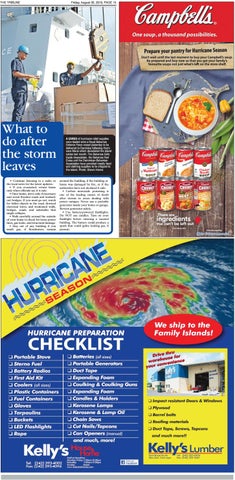
What to do after the storm leaves • Continue listening to a radio or the local news for the latest updates. • If you evacuated, return home only when officials say it is safe. • Once home, drive only if necessary and avoid flooded roads and washedout bridges. If you must go out, watch for fallen objects in the road, downed electrical wires, and weakened walls, bridges, roads, and sidewalks that might collapse. • Walk carefully around the outside of your home to check for loose power lines, gas leaks, and structural damage. • Stay out of any building if you smell gas, if floodwaters remain
Friday, 30,2019, 2019,PAGE PAGE15 15 Friday,August June 28,
A CARGO of hurricane relief supplies were loaded onto a Royal Bahamas Defence Force vessel yesterday to be delivered to Dominica following Hurricane Maria which devastated the island nation last month. The Bahamas Girls Guide Association, the Bahamas Red Cross and the Dominican-Bahamian Association have provided mostly food and clothing supplies to be shipped to the island. Photo: Shawn Hanna
around the building, if the building or home was damaged by fire, or if the authorities have not declared it safe. • Carbon monoxide poisoning is one of the leading causes of death after storms in areas dealing with power outages. Never use a portable generator inside your home or garage. Review generator safety. • Use battery-powered flashlights. Do NOT use candles. Turn on your flashlight before entering a vacated building. The battery could produce a spark that could ignite leaking gas, if present.
PAGE 16, Friday, August 30, 2019
THE TRIBUNE
THE TRIBUNE
Friday, August 30, 2019, PAGE 17
PAGE 18, Friday, August 30, 2019
THE TRIBUNE
THE BAHAMAS Humane Society at the time of Hurricane Irma - when the shelter was soon full and could not take in any more animals. Make your plan for caring for your pet.
CREATE A PET SURVIVAL KIT
RED CROSS APP HELPS YOU MONITOR THE STORM THE American Red Cross has an app designed to help people through the dangers of hurricane season. The app includes features such as a one-touch “we’re safe” button that can send a message to designated friends and family, a flashlight tool, plus a great deal of practical advice. It also allows you to track storm progress, including local alerts, and advises what to do in the event of a natural disaster. The Multi-Hazard App is available for both iPhone and Android devices and can be downloaded from Google Play, 3 Sided Cube and iTunes App Store. ‘‘The Multi-Hazard App is a key tool that will enhance communication and coordination to prepare and respond to multiple disasters in the region, an important achievement as we start a new hurricane season.’’ said Lorraine Mangwiro, regional representative of the International Federation of the Red Cross and Red Crescent Societies.
‘‘We want people to know there are many practical precautions they can take and simple strategies they can employ to lessen the dangers.’’ At the start of each tropical storm season, The Bahamas Red Cross Society appeals for donations of canned goods and clothing for potential hurricane victims, especially those on the Family Islands. Director General Caroline Turnquest told The Tribune said that the Red Cross’ plan for disaster and emergency
relief for this
season is in place, but that “people only react if they have a reason to” and said when the app was launched in 2014 that it would help to keep the country constantly informed. The Red Cross holds regular meetings at its John F Kennedy Drive, New Providence, location to ensure that staff members and volunteers are prepared to provide relief such as food, clothing and shelter for hurricane victims. During these meetings, refresher courses are provided for team members. In addition, the staff also perform a careful examination of all of the shelter’s equipment such as handheld radios, flashlights, etc. Ms Turnquest offered the public some tips for hurricane preparation. “Don’t wait until the last minute to start preparing,” she said. “Have a back-up plan in case something happens. Stay tuned in to your radio for the latest updates. Secure your home and make sure there is always an emergency supply kit available.”
PET owners are responsible for disaster planning for their animals so, if you plan to evacuate in the event of an approaching storm, plan for your pet as well. Take your Pet Survival Kit if you go to friends, relatives or a hotel. Shelters cannot accept pets. If you plan to go to public shelter, make other provisions for your pet. Limited space is available at traditional “pet shelters” (kennels, veterinarians, etc). After the storm has passed, be careful when allowing your pet outdoors. Familiar scents and landmarks may have changed and your pet could easily be confused and become lost. Downed power lines, and animals and insects brought in on high water, could present real dangers to your pet. Take care not to allow your pet to consume food or water, which may have become contaminated. For more information, call the Bahamas Humane Society at 323-5138. PET SURVIVAL KIT • Proper ID collar and rabies tag/licence • Carrier or cage, leash • Ample food supply • Water/food bowls (at least two weeks) • Any necessary medication(s) and specific care instructions • Newspaper, cat litter, scoop, plastic trash bags for handling waste • Proper ID on all belongings • Make sure your pets have had all their shots within the past 12 months. • Pets shelters will require proof of vaccination
How to board up your home
THE TRIBUNE
Friday, August 30, 2019, PAGE 19
A BAHAMIAN home being boarded up ahead of Hurricane Irma. Photo: Terrel W Carey Sr/Tribune Staff
CERTIFIED, impactresistant devices make for the best protection - but sometimes if a storm is coming quickly, boarding up can be the only option. Here is a step-by-step guide to how to do it. Step One: Plan the Project Count and measure each window and door that has glass including French doors, sliding glass doors as well as skylights. You might also want to include roof and gable end vents or any opening that if damaged would allow wind to enter your home. Measure each opening horizontally inside the exterior trim and vertically
from the sill to the bottom of the top trim. Add eight inches to both the height and width to provide a fourinch overlap on all sides. When measuring a window with an extended sill measure from the top of the sill to the top of the window and add four inches instead of eight. Sheets of plywood are generally 4 feet by 8 feet. This will help determine how many sheets to buy. Be sure to purchase plywood that is 5/8 inch or greater, exterior grade (CDX). Step Two: Assemble Your Tools and Hardware You will need a circular saw, drill and drill bits, hammer and wrench, work
gloves and safety goggles for this project. You will also need an assortment of hardware including bolts, wood or masonry anchors, nuts and large washers. A range of bolts may be used because different bolts will be needed for wood frame versus masonry homes. Wood Homes use lag screws and plastic coated permanent anchors. Masonry Homes use expansion bolts and galvanized permanent expansion anchors. Step Three: Get Started Having someone help you with this project will make things a lot easier. First drill holes in the
same diameter as the bolts or screws, 2-inches in from the edges of the plywood at each corner and at 12-inch intervals around the panel. Next hold the plywood firmly in place over the opening to mark where to drill mounting holes. If the window sill is flush to the wall, secure the plywood on all four sides. If the window sill extends out at the bottom, secure the plywood on the top and sides. For windows 3 feet by 4 feet or smaller installed on a wood frame house, use 1/4-inch lag screws and plastic coated permanent anchors. The lag screws should
penetrate the wall and frame surrounding the window at least 1 3/4 inches. For larger windows, use 3/8-inch lag screws that penetrate the wall and frame surrounding the window at least 2 1/2 inches. For windows 3 feet by 4 feet or smaller installed on a masonry house, use 1/4 inch expansion bolts and galvanized permanent expansion anchors. The expansion bolts should penetrate the wall at least 1 1/2 inches. For larger windows, use 3/8inch expansion bolts that penetrate the wall at least 1 1/2 inches. If a window or door is larger than a sheet of plywood, you will need to
join the panels with 2x4 bracing along the entire seam. Attach the 2x4s to the outside of the plywood panel with 10 gauge, 2 inch long galvanized screws (exterior deck screws) spaced every 4 inches. Use the widest side of the 2x4 to run the length of the entire seam. When you’re done, mark each panel with the name of the opening so you will quickly know where to install it when a storm is approaching. Store the panels, washers and nuts together in a location away from the elements. Consider waterproofing the panels with paint or a sealant.
PAGE 20, Friday, August 30, 2019
THE TRIBUNE