MONDAY i’m lovin’ it!
HIGH 81ºF LOW 72ºF
The Tribune Established 1903
24/7 BREAKING NEWS ON TRIBUNE242.COM
Biggest And Best!
VOLUME:116 No.6, DECEMBER 31ST, 2018
HO US E & 16 THE PEOPLE’S PAPER: $1
INSIGHT: DESPITE EVERYTHING, WE’VE STILL GOT HOPE PAGES
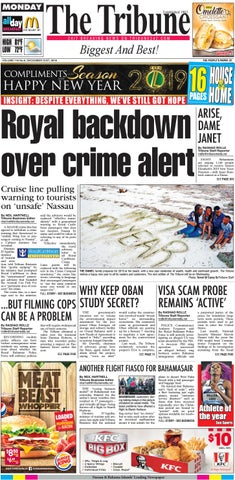
Royal backdown over crime alert
HOME
ARISE, DAME JANET
By RASHAD ROLLE Tribune Staff Reporter rrolle@tribunemedia.net
EIGHT Bahamians are among 1,148 people selected to receive Queen Elizabeth’s 2019 New Years Honours - with Janet Bostwick named as a Dame. SEE PAGE SIX
Cruise line pulling warning to tourists on ‘unsafe’ Nassau By NEIL HARTNELL Tribune Business Editor nhartnell@tribunemedia.net A MAJOR cruise line has agreed to withdraw a crime warning that threatened to “unduly bring fear to passengers coming to Nassau”, a Cabinet minister has revealed. Dionisio D’Aguilar, minister of tourism and aviation, told Tribune Business that “gentle nudging” by his ministry had prompted Royal Caribbean to drop the “unwarranted” passenger advisory that branded the Arawak Cay Fish Fry as a “particular area of concern” for crime. The cruise line, in a message sent to the minister,
said the advisory would be replaced “effective immediately” with a generalised warning to Royal Caribbean passengers that does not mention Nassau by name and could be taken as referring to any of its ports of call. “Effective immediately, the travel advisory letter to all Royal Caribbean Cruise Lines guests will be replaced with the following text in the Cruise Compass newsletter,” the cruise line wrote, referring to language that encouraged passengers to “use the same common sense you would in any major city”. FULL STORY - SEE BUSINESS
THE DANIEL family prepares for 2019 at the beach, with a new year resolution of wealth, health and continued growth. The Tribune wishes a happy new year to all its readers and customers. The next edition of The Tribune will be on Wednesday. Photo: Terrel W Carey Sr/Tribune Staff
WHY KEEP OBAN ...BUT FILMING COPS STUDY SECRET?
VISA SCAM PROBE REMAINS ‘ACTIVE’
By RASHAD ROLLE Tribune Staff Reporter rrolle@tribunemedia.net
POLICE Commissioner Anthony Ferguson said the Royal Bahamas Police Force is still actively investigating an alleged US visa scam unearthed by the FBI. A two-year FBI sting operation uncovered an alleged bribery ring between senior Bahamas immigration officials and
CAN BE A PROBLEM RECORDING on-duty police officers can have violent consequences some residents say, raising questions about whether the Royal Bahamas Police Force will embrace policies
that will require widespread use of body cameras. The Tribune obtained a video over the weekend from Damian Roberts, a man who recorded police arresting a suspect on Parliament Street earlier this year. SEE PAGE FIVE
THE government’s intention not to release the environmental impact assessment for the proposed Oban Energies oil storage and refinery facility on Grand Bahama until a new Heads of Agreement is signed is “fishy”, according to activist Joseph Darville. Mr Darville, chairman of advocacy group Save the Bays, again raised the alarm about the project, saying “even an idiot”
would realise the construction involved would “wreak havoc” on surrounding ecosystems. His comments come as government and Oban officials are gearing up for a January 7 meeting to negotiate a new agreement for the controversial project. Last week, The Tribune exclusively revealed the project’s EIA is complete, SEE PAGE 11
By RASHAD ROLLE Tribune Staff Reporter rrolle@tribunemedia.net
a purported justice of the peace for fraudulent longterm work permits. These permits were used to get visas to enter the United States. Last month, National Security Minister Marvin Dames told the press the FBI would brief Commissioner Ferguson on the findings of its investigation stemming from the fraud SEE PAGE FIVE
ANOTHER FLIGHT FIASCO FOR BAHAMASAIR By NEIL HARTNELL Tribune Business Editor nhartnell@tribunemedia.net THE “vexing business model” of Bahamasair was yesterday blamed for the airline’s latest troubles that resulted in 17 passengers and virtually all bags - being thrown off a flight to Marsh Harbour. Dionisio D’Aguilar, minister of tourism and aviation, last night told Tribune Business that the national
BAHAMASAIR customers during holiday delays in this picture circulated on social media. The latest problems have affected a flight to Marsh Harbour. flag carrier had “no choice” but to take such action after an electrical malfunction meant it was unsafe for the
plane to depart West Palm Beach with a full passenger and baggage load. He warned that Bahamasair’s “lack of scale”, with a fleet featuring just eight planes, meant “customer service disasters” such as those that have occurred repeatedly over the Christmas period are bound to “persist” with no good options available for resolving them. FULL STORY - SEE BUSINESS
Athlete of the year
See Sports
10
$
(INCL. VAT)
• • • •
2Pc. Thigh & Leg 2 Spicy Wings Coleslaw Individual Fries
• Biscuit • Cookie • 22oz. Pepsi®
Nassau & Bahama Islands’ Leading Newspaper
PAGE 2, Monday, December 31, 2018
THE TRIBUNE
Tickets still available for New Year’s Day parade
ALL the fun of the Boxing Day Junkanoo parade. Photos: Shawn Hanna/Tribune Staff By RIEL MAJOR JUNKANOO Corporation of New Providence officials said on Friday ticket sales are down for the 2019 New Year’s Day parade. “(Ticket sales) are at 30 percent,” Silbert Ferguson, chairman of JCNP said in an interview with The Tribune. “We are hoping we will be able to do a little better than that as we move into the parade for January 1.” After criticism over a delay during the Boxing Day parade, Mr Ferguson said parade participants work hard all year to achieve one common goal, which is to have a great parade. He reminded the public of the “inclement weather” on Boxing Day that affected the parade. “A lot of people still don’t understand and the news has not reported we had
inclement weather. Any time you have inclement weather anything can happen. This isn’t an excuse (but) unfortunately we got a report that we would have some showers in the hours of 2am and 4am but it rained the entire day on Christmas Day. “That prevented groups from mobilising and getting into the parade but, of course, some of things we agreed to with the police…we agreed with the police to bring the containers in on the western side, we will then off load them and we will then push them to the east side of Elizabeth Avenue. “Unfortunately the groups had a challenge when they bought their costumes in…they felt uncomfortable moving them to the east so they kept them at the west and, of course, that is what triggered the blockage.”
Mr Ferguson also apologised saying “it’s not their fault that we had that kind of situation.” “So we are looking at New Year’s morning to make sure that we ask the police to enforce the laws of the streets because what happened, happened outside of the arena which is out of our control…totally out of our control and we have to rely on the police to make it happen,” said Mr Ferguson. Lead sponsors for the parades include BTC, the title sponsor, as well as Kalik, and Rubis. Tickets for Rawson Square are on sale for $50.40; Scotia Bank (Parliament Street to Charlotte Street) tickets for $39.20, and John Bull (Charlotte Street to Frederick Street) tickets for $16.80. The 2019 New Year’s Day parade will start on January 1 at 2am.
HELPING HAND FOR GRANTS TOWN YOUNGSTERS THE Lend A Hand charitable organisation and Bahems, a new footwear line, joined forces for the holidays to ensure a group of youth from the Grants Town community had a merry Christmas. Thirty youngsters were treated to a party at the Neville and Nora Dorsett Community Centre. The event featured a Junkanoo rush-out, face painting, food and drinks, and gifts to place under the Christmas tree. “Incorporated in 2014, Lend A Hand Bahamas, its board members and volunteers work tirelessly to provide the community’s inner-city youth with more exposure and opportunities they would not normally be afforded,” a press release noted. “The non-profit organisation (NPO) is the brainchild of three individuals who shared the vision of a creating a vibrant community centre in Grants Town. In 2013,
Edmund Dorsett, Valentino Brown and Lucas Metropulos embarked on a mission to fundraise and plan for just such a facility. Collectively, they decided to establish an independent NPO to manage and operate the centre.” The holiday event was meant to bring together individuals from different walks of life who share the common goal of bringing positive opportunities and activities to economically disadvantaged children. Faces lit up with excitement when Bahems founder Nathan Arnett and the organisation’s volunteers came carrying large gold and white shopping bags at the pre-Christmas party. Each child got a new pair of shoes as part of the event. “I partnered with the Lend A Hand organisation because their vision, mission, and goals are truly geared toward bettering and developing these kids to have
BAHEMS donated 30 pairs of shoes to Grants Town youngsters attending the Lend A Hand Christmas Party.
opportunities that they would not normally have in the Grants Town community,” said Mr Arnett. “I just wanted to bring a smile and spread some holiday cheer to these kids and that’s exactly what we did.” The shoe designer spent two years perfecting his Bahamas designed, people inspired, Espadrille-style footwear created for everyday wear and comfort. The canvas shoes launched exactly one year ago feature a pig leather insole with memory foam for those who prize comfort and style in their footwear, a press release noted. Although presently manufactured abroad, Mr Arnett is working to have the durable, waterproof footwear made locally.
THE TRIBUNE
Monday, December 31, 2018, PAGE 3
DOMINICAN FISHERMEN STOPPED BY RBDF FACE COURT FOUR Dominican fishermen were charged in court on Friday after being apprehended earlier this month for fisheries violations by a Royal Bahamas Defence Force patrol craft in waters south of Great Inagua. In Friday’s hearing, Oneil Garcia, Ediberto Awduzar, Franklyn Carbera and Jose Gomez all appeared before Magistrate McKinney and were charged with illegal fishing within an exclusive fishery zone. All of the Dominicans pleaded guilty and were subsequently convicted and fined $10,000 each or spend six months behind bars. On December 22, a US Coast Guard Operation Bahamas and Turks and
Caicos (OPBAT) helicopter spotted a suspicious vessel south of Inagua. The RBDF was informed and P-128, under the command of Petty Officer Edison Rolle, subsequently apprehended the 20-foot vessel with four Dominicans on board. According to the RBDF, during the month of December alone, a total of 18 Dominican fishermen have been apprehended for fisheries violations in Bahamian waters. In 2018, the RBDF apprehended a total of 190 Dominican poachers, four Dominican fishing vessels and five small gofast type boats with over 100,000 pounds of fisheries products on board.
DOMINICAN fishermen heading to court to be charged with poaching.
Photo: Marine Seaman Michael Turner/RBDF
Canadian man detained after nine pounds of heroin found By RIEL MAJOR A CANADIAN man was taken into police custody when $90,000 worth of dangerous drugs were found in his possession at Lynden Pindling
International Airport on Thursday. Police said shortly after 3pm, Drug Enforcement Unit officers, acting on information, conducted a search of the man’s luggage and uncovered six packages of what was suspected to be
heroin. The estimated weight of the heroin, police said, is nine and a half pounds. The man is expected to appear in Magistrate’s Court this week to be formally charged. Meanwhile, police
recovered two illegal firearms in two separate incidents and have taken two men and a woman into custody. In the first incident, shortly after 3pm Thursday, officers from the Drug Enforcement Unit searched
a home and vehicle on Third Street, Coconut Grove, and uncovered a .9 mm pistol and six rounds of ammunition. A man was taken into police custody in connection with this incident. In the second incident,
shortly after 5am on Friday, Flying Squad officers searched a home on Hay Street off East Street and discovered a .40 pistol with nine rounds of ammunition. A man and woman are in custody in connection with this incident.
29-YEAR-OLD SUSPECT ACCUSED OF MURDER A 29-YEAR-OLD man was arraigned in the Magistrate’s Court on Friday in connection with a murder that happened on December 21. Phillip Michael Farquharson is accused of using unlawful harm to kill Elcartha Murphy on Malcolm Road on the night in question. He was also charged with
PHILLIP Michael Farquharson outside court on Friday.
MARIJUANA FIELD FOUND A MARIJUANA field was discovered in the eastern end of Grand Bahama by Bahamian and US law enforcement officers last week. ASP Terecita Pinder reported that officers of the Drug Enforcement Unit, along with US law enforcement officers, were on aerial
patrol in east Grand Bahama on Thursday when they found five plots of suspected marijuana plants and a quantity of marijuana seeds. ASP Pinder said the plants ranged between two and six feet in height with an estimated street value of $120,000. No arrest was made in the matter.
attempting to murder Malanado Lightbourne and for having a firearm intending to endanger the life of Archelus Lewis Jr on the same date. Farquharson did not enter any pleas to the charges and was remanded to prison. He will return to court on March 4, 2019, to be served with a voluntary bill of indictment.
PAGE 4, Monday, December 31, 2018
THE TRIBUNE
The Tribune Limited NULLIUS ADDICTUS JURARE IN VERBA MAGISTRI “Being Bound to Swear to The Dogmas of No Master”
LEON E. H. DUPUCH,
SIR ETIENNE DUPUCH,
jamaaltheartist@gmail.com
Publisher/Editor 1903-1914 Kt., O.B.E., K.M., K.C.S.G., (Hon.) LL.D., D.Litt .
Publisher/Editor 1919-1972 Contributing Editor 1972-1991
EILEEN DUPUCH CARRON,
C.M.G., M.S., B.A., LL.B. Publisher/Editor 1972-
Published daily Monday to Friday
Shirley & Deveaux Streets, Nassau, Bahamas N3207 TELEPHONES
News & General Information Advertising Manager Circulation Department Nassau fax Freeport, Grand Bahama Freeport fax
(242) 322-1986 (242) 502-2394 (242) 502-2386 (242) 328-2398 (242)-352-6608 (242) 352-9348
WEBSITE, TWITTER & FACEBOOK www.tribune242.com
@tribune242
tribune news network
Report card on this divisive president NEW Year’s Eve is rightfully a time for reflection on the year just past and a time to look ahead. We hope that for each Bahamian, and for our many seasonal visitors, this thoughtful pause brings both a smile at the recollection of joys and pleasures from 2018 and a renewed sense of optimism for what may lie ahead in the coming year. And as we reflect on our personal and family circumstances, we may consider one blessing. However we may regard our current prime minister and his government, we can at least take some satisfaction in the fact that, unlike our American neighbours, we are not led by a reckless demagogue whose unmoored administration has led his nation into chaos and uncertainty. Now as a year dawns, nearly one million American government workers remain furloughed due to Donald Trump’s stubborn adherence to a campaign promise to build a barrier wall along the southern US border with Mexico to deter illegal immigration from Central and South America into the United States. Trump has demonstrated in this as in other matters a persistent disregard for the opinions and advice of experienced advisers, members of Congress and even sober political pundits. Most realise that illegal immigration into the US is more often a matter of visa violations by air travellers. So while Trump blathers on about his wall, it wouldn’t address the concern he identifies. The unlikelihood of border wall completion begs the question of just what Trump has actually accomplished in his two years in office. There appear to have been four areas in which he has made a difference. The first and probably the most consequential of these accomplishments is the massive 2018 American tax cut, certainly one of the areas where Trump and the Republican majorities in both houses of Congress could philosophically and politically agree. Derided by Democrats and liberals as a gift for the rich and the corporations they lead, the tax cut is nevertheless credited for helping to stimulate the dazzling and almost suspicious upward propulsion of the value of publicly traded stocks on the Dow Jones Industrial Average.
It may be some comfort to concerned investors to recall that when Trump took office two years ago, the NYSE index stood just below 20,000. At the close of business on Friday, that index remained above 23,000. Of course the appreciation of stock values only benefits those whose wisdom or economic situation allow for the possibility of stock ownership. But the 15 percent rise has happened. Trump has also placed on the US Supreme Court two avowedly conservative justices who fill vacancies created by the death of Antonin Scalia and the retirement of Anthony Kennedy. Conservatives exult in this development, and Trump characteristically boasts about it, but these changes may represent little of significance. Scalia and Kennedy were hardly liberals, and one can hope that the new justices remember their sacred oath to the American constitution and the rule of law. The key on the high court is likely to be its chief justice. John Roberts has consistently decried the actual or perceived influence of politics on the judiciary. Perhaps he will emerge as a voice of reason and moderation, though that is largely hope and not practice so far. American trade policy has certainly appeared to change under Trump and to diverge from Republican orthodoxy in the president’s clear move toward tariffs and away from free trade principles. The NAFTA reset may or may not turn out to be significant, but the direct confrontation with China is real, meaningful and perhaps represents what may be Trump’s enduring contribution to the arc of world affairs. There is evidence that many nations do not really disagree with the pushback against China’s aggressive economic and commercial posture. As China deals with some internal issues in its own dynamic economy, this standoff among behemoths is one of the big stories for 2019. Finally, there is Trump’s shifting foreign and military policy, tilting away from overseas engagement and in the direction of an isolationism that can benefit no one, especially the United States. Senate Republicans may yet restrain Trump’s foolish impulses in this area, but only if political benefits in doing so become apparent.
Visitors love Fish Fry EDITOR, The Tribune
LAST week, Royal Caribbean Cruise Lines released a letter warning its passengers aboard the Anthem of the Seas about levels of crime in Nassau. The letter suggested that they specifically avoid heading to the Sand Trap, Over-the-Hill and the Fish Fry after sunset. Like any growing city, Nassau certainly has pockets of crime – we all know this. But for a cruise line that is part of a group that is bidding to manage our port to tell its passengers to essentially stay on the ship when in Nassau perfectly demonstrates the
conflict that would exist if the cruise lines controlled the port. Of course, they want their passengers to be safe when they are here - Bahamians want the same thing – but a port operator is supposed to encourage MORE passengers to visit the destination, not LESS! By the way, everyone who I’ve spoken to who works at the Fish Fry reports that visitors are still loving it and crime is down in that area. Also, isn’t the Sand Trap closed? A VERY CONCERNED CITIZEN Nassau December 30, 2018
A different take on democracy EDITOR, The Tribune IT IS the Christmas season and new year is approaching. It is a time of reflection and improvement. Some improve their home by repairs, painting and decorations. Some improve themselves by being generous and making new year resolutions. In this vein I suggest an improvement for The Bahamas’ political system which is a representative democracy. The next level of democracy is direct. Democracy in which all people make the decisions as a group, without intermediate representatives. The earliest direct democracy is said to be the Athenian democracy in
the 5th century BC, although it was not inclusive: women, foreigners, and slaves were excluded. It is a way to limit the influence of the rich and powerful who dominated most, if not all, representative democracy through campaign funding, lobbying and sometimes bribery. I suggest all laws or constitutional change must be approved by the people by referendum. After one year an elected representative could be recalled with a petition of 30% of the votes. This could be used to curb corruption by removing corrupt representatives. The present system has become ineffective in improving the life of Bahamian citizens and needs an
upgrade. Examine the level of poverty and crime in The Bahamas. People are influenced by their environment and the political system creates the social and material environment in a country. People need to keep engaged after an election. The present system encourages citizens to not be a part of the decision-making process and not to take ownership and responsibility for the development of The Bahamas. This is an attempt to start the discussion and eventually implementation of direct democracy. BRIAN PLUMMER Nassau December 19, 2018
Marley’s lasting legacy to people of The Bahamas EDITOR, The Tribune THIS month of December marks the 39th anniversary of the United Nations Educational, Scientific and Cultural Organisation’s International Year of the Child Bob Marley benefit concert at the Queen Elizabeth Sports Centre. Tuff Gong, as the Jamaican reggae artiste was nicknamed after Gong Guru Maragh, better known as Leonard Percival Howell, was invited by International Year of the Child Commission members the late Beryl Hanna, Rubie Nottage and Telzena Coakley. Amid concerns that Marley and the Wailers would use their massive platform to proselytise Bahamians to their Rastafarian faith, Marley said he would be ‘‘giving a regular concert” and that he had “no intention of teaching concert-goers about the Rastafarian faith.’’ Marley also unapologetically stated to the press that he ‘‘smoked marijuana because it is a herb like banana.’’ Despite the noble goal of commission members, the Bob Marley concert encountered stiff opposition from then Bahamas Christian Council President Rev Dr Philip Rahming and prominent Baptist clergyman Simeon Hall, who, in an ironic twist of history, heads the Free National Movement (FNM) administration’s cannabis commission. Hall, I believe, is now a proponent of medical marijuana. His position regarding the recreational use of the drug is unknown to the writer. However, who would’ve thought that 39 years ago a prominent member of the Christian community would one day be batting for marijuana? Hall has already demonstrated his willingness to buck the evangelical status quo by overtly championing the cause of web shop gaming. Hall’s main bone of contention with Marley was his massive influence in potentially promoting the Rastafarian faith along with its dreadlocks
LETTERS letters@tribunemedia.net hairstyle to thousands of Bahamians. A reported 6,000 Bahamians attended the concert at the Queen Elizabeth Sports Centre. While the concert would be the only time Marley would perform in The Bahamas, he lived in Nassau during the month of December in 1976 in a house owned by Island Records founder Chris Blackwell. Blackwell played a massive role in giving the Wailers, Jimmy Cliff and other Jamaican reggae artistes an international platform to promote their craft. The Marley family had fled Jamaica in December 1976 after a gang of nefarious thugs, who were rumoured to have been connected to the opposition Jamaican Labour Party (JLP), had attempted to assassinate Bob and Rita Marley at their Hope Road mansion in Kingston. The JLP was reportedly incensed that Marley had agreed to perform at the Smile Jamaica Concert. The opposition viewed this kind gesture by the Wailers as an endorsement of the People’s National Party administration of then Prime Minister Michael Manley. Despite the assurance by Marley, Hall had legitimate reasons to be concerned about the dreadlocks hairstyle. The hairstyle, along with marijuana, was sacramentalise in the 1950s by second generation Rastafarian members of the Youth Black Faith. The issue of ganja is what many Bahamians in 1979 feared about the Marley event. The Bahamas in the 1970s was an immensely conservative country. Marley once said that ‘‘when you smoke the herb, it reveals you to yourself.’’ He also famously stated that ‘‘herb is the healing of a nation, alcohol is the destruction.’’ With the last quote, Marley obviously had Revelation 22:2 in mind, although one
is hard-pressed to find an unequivocal reference to the cannabis plant in the text. Marley, along with Peter Tosh and Bunny “Wailer” Livingston, had joined the Rasta sect in the early 1960s and had probably started smoking marijuana around the same time. I think it was Rasta historian Helene Lee who stated that the late Rastafarian elder Planno Mortimer had played a pivotal role in converting Marley to the religion. When the Wailers came to The Bahamas in 1979, the Rasta population was minimal at best. Today, Rastas still comprise a very small fraction of the population. That said, there are 10,000 adherents of the sect, according to an Ethiopian Africa Black International Congress representative in July 11 edition of The Tribune. How many Bahamians embraced Rastafari due to Marley’s influence will never be known this side of eternity. However, to deny that individuals were influenced by him would be naïve, as the many Rasta and Marley paraphernalia worn by Bahamians throughout the 1980s have amply demonstrated. In closing, it wouldn’t be farfetched to state that thousands of Bahamians today smoke marijuana. Subsequent to Marley’s concert, many started using the plant, although Bahamian historians would tell you that the major issue that The Bahamas faced during the early 1980s was the cocaine drug trade, which nearly wiped out an entire generation and brought international shame and condemnation to this country. Bahamians were so preoccupied with the cocaine drug, that they paid very little attention to marijuana. I believe Tuff Gong served as an impetus for The Bahamas’ love affair with the ganja plant. Marley’s role in this regard cannot be overstated. KEVIN EVANS Freeport, Grand Bahama December 16, 2018
THE TRIBUNE
Monday, December 31, 2018, PAGE 5
Visa scam probe remains ‘active’ from page one
investigation at the US Embassy in Nassau. He said local enforcement would then determine whether any Bahamian laws were broken and take necessary measures. Yesterday, Commissioner Ferguson was tightlipped on details about the matter, insisting he would only go on record to say the matter is being actively investigated. “As soon as we get to a point then we’ll say something,” he said. “You’re dealing with two countries so we have to investigate thoroughly.” Recently, a Bahamian mother of four was sentenced to time served and deportation in a federal court in connection with the matter. Pauline Pratt, 43, was convicted of one count of conspiracy to commit visa fraud for her involvement in the scam, which saw her and deceased activist Pierre Parisien bolster visa applications with false information and fraudulent documentation. She further claimed she could create fraudulent bank letters to support applications and forged the signatures of bank officials during a recorded meeting shortly before her arrest in September. The matter became public after an affidavit was filed by special agent Kevin Gounaud who detailed conversations the scam’s alleged lead conspirator, Edward Israel Saintil, had with undercover FBI informants concerning his ability to obtain fraudulent Bahamian work permits to shore up US visa applications. Saintil is alleged to have boasted of having relationships with top immigration officials. Saintil will be deported to the Bahamas following his sentencing early next year. Court fillings state he pleaded guilty to one count of encouraging and inducing an alien to come to the United States for the purpose of commercial advantage or private financial gain. He consented to a forfeiture order for a Samsung Galaxy S8, and any property derived from or traceable to the proceeds obtained directly or indirectly from the offence. A forfeiture money judgment for $7,100 has been entered, and the $1,329.80 in cash that was seized at the time of his arrest will be credited towards the judgment.
COMMISSIONER of Police Anthony Ferguson.
Photo: Shawn Hanna/Tribune Staff
FILMING COPS CAN BE A PROBLEM from page one
Before the clip ends, an officer can be seen charging toward him as he recorded the video. “He slapped me,” Mr Roberts, a civil servant who requested his real name not be used, said yesterday. “When he saw I was recording, that’s when he ran toward me and asked me for my phone. I told him he can’t have it. He was shorter than me so I held the phone up high. Out of frustration, that’s when he hit me. I was very surprised. I’m a grown man and I didn’t expect someone to run up on me like that. “I felt embarrassed and defenceless because I know if I did swing back it had to be like eight of them there so that wasn’t going to do in my favour. I felt violated.” The incident in question occurred around 2am on July 20. Mr Roberts chose to record because he felt police officers were inappropriately handling a suspect. “They were like two steps from slapping one fella and they were wailing another guy,” he claimed. He filed a complaint with the Complaints and Corruption Branch in the days after the incident. Nearly five months later, nothing has come out of the matter. “I’m continuously calling Complaints and Corruption and all they say is it’s under active investigation,” he said. Earlier this month, a woman similarly complained about a regrettable encounter with police after recording them. “Officers literally break my phone because I was recording them ‘do their job’ – in a barbaric and unprofessional way – with guns drawn around my infant child,” the woman claimed in a Facebook post, adding: “Is there a law against recording a police
officer in the open public? I think the entire RBPF, including the new recruits need a whole new training, they lack professionalism, respect and they have no order!” She also claimed: “(The officer) forced me to open my phone to make sure I didn’t post it and went through my WhatsApp to see if I sent it out.” In a recent interview with The Tribune, National Security Minister Marvin Dames acknowledged that the culture of the RBPF has been a “closed one” and said officers will have to move with the times. “We are living in an era where the public demands greater accountability and responsibility of the officers,” he said. “When the police are out there and conducting the business of the people, there’s no secrecy there. That’s why training is important. I’ve seen some very good pictures where people have taken photos of police officers helping an old lady or helping a little school child. But then there are negative photos that really kind of aid us in our training. If a police officer for no apparent reason slaps a member of the public, because he or she is angry or gets flustered, these are unfortunate situations but what we can do is use a picture like that, videos like that as training tools of what not to do and how not to conduct yourself as a police officer. “The vast majority of police officers are appalled when they see their colleagues behaving in such ways because it is a reflection on them. It evokes anger internally. No one wants to be painted as rogue or unprofessional.” The government has completed a request for proposals to acquire body cameras, Mr Dames said. He expects the request to be presented to Cabinet in January 2019 before it is released to prospective bidders. He hopes the cameras
will help settle disputes about police actions. “We’re living in an era where there is distrust to some extent between the police and the public because of the nature of their duties,” he said. “With a greater degree of transparency, what it does
really is it gives all sides a true reflection of what happened, how it happened and who was responsible.” Mr Dames said once body cameras are acquired and distributed, policies will be created to regulate their use. In other jurisdictions,
officials have been stumped trying to find the right policies. According to the New York Times, some, but not all, American states have passed laws regarding public access to footage filmed by body cameras. It took months for officials in
New York to draft a policy for the use of cameras, dealing with questions like when and where should police officers be required to turn their cameras on and which, if any, videos should be available under public records laws, the New York Times said.
PAGE 6, Monday, December 31, 2018
THE TRIBUNE
Arise, Dame Janet from page one Cabinet Secretary Camille Johnson has been chosen to receive the Order of St Michael and St George (CMG) for outstanding service to education and to politics. The award is given to people who render important nonmilitary service in a foreign country. Former Attorney General Janet Bostwick, the first woman elected to the House of Assembly, has been chosen to receive the honour of Dame Commander of the Most Excellent Order of the British Empire (DBE) for services to politics. The award is given to people who contribute to the arts and sciences, work with charitable and welfare organisations and public service outside of the civil service. Three men have also been selected for the Order of the British Empire (OBE): former Commissioner of Police Reginald Ferguson for services to the civil service, Reverend Leon Wallace for services to religion and the community and Reverend Alfred
FORMER Attorney General Janet Bostwick, who is to become a Dame, and Cabinet Secretary Camille Johnson, who is to receive the Order of St Michael and St George. Cedric Culmer for services to religion. Three people have been chosen to receive a British Empire Medal (BEM): Jason Harrison Hanna for services to business and the community, former Bahamas Hotel Catering & Allied Workers Union President Nicole Martin for services to industry and former Housing Minister
Alfred Kenneth Russell for services to politics and business. The British Empire Medal is given to people for meritorious civil or military service worthy of recondition by the Crown. One award recipient, Ms Martin, shared her delight yesterday of receiving an award. “I am probably for the first time in my life
speechless but I am very humbled by it,” Ms Martin said. “It’s a good feeling but it’s strange to me. It’s strange because normally in the field that I operate there is not a lot of recognition and we don’t do it for recognition, certainly I don’t so I’m trying to balance the recognition against what I actually did and it was not for anything more
GN 2159
than seeing people treated fairly.” Recalling how she learned of her award, she said: “I received a call from the Office of the Governor General sometime last week and they delivered the letter. When I opened it I was very surprised. I didn’t know the listing had come out already. I was only aware my name was proposed for the recognition until yesterday some people started calling.” Ms Martin said she will celebrate the award––she just doesn’t know how yet. “My children are very thrilled about it, as are some of my friends, as am I,” she said. The list of New Year’s Honours was published in international press reports. The government of the Bahamas has not made an official statement on the matter. A spokesman yesterday said the government has not been pleased by how the awards were announced this year, with countries not given the opportunity to make the announcement before the list was published in the London Gazette, as is usual. An official statement from the Bahamas government is expected today. Eighteen Bahamians were given the Queen’s 2018 New Year’s Honours. In January, Father Sebastian Campbell urged Bahamians on the list to reject the honour. Father Campbell, the chairman of the National Heroes Committee, has long called for an end to the colonial honours in favour of a Bahamian system. He has previously said the Queen’s Honours “belittle” the service and contributions
NICOLE Martin will receive the British Empire Medal.
FORMER Commissioner Reginald Ferguson will receive the OBE.
FORMER MP Kenneth Russell will receive the British Empire Medal. of the men and women named. This year, for the first time, the government announced the recipients of Bahamian National Honours. Thirtyeight Bahamians were on that list.
OBE recipients Reverend Leon Wallace and Reverend Alfred Cedric Culmer.
MONDAY, DECEMBER 31, 2018
THE STORIES BEHIND THE NEWS
EMMA GONZALEZ, a student and shooting survivor from the Marjory Stoneman Douglas High School in Florida, addresses the crowd at the ‘March for Our Lives’ rally in Washington, DC
THIS photograph of a young Honduran girl sobbing instantly came to symbolise the Trump administration’s hard-line immigration policy.
Of the millions of photos taken in 2018, which ones will we remember? By NICOLE SMITH DAHMEN Associate Professor, School of Journalism and Communication, University of Oregon
journalists as their 2018 Person of the Year, partly in response to the Khashoggi killing.
Devastation in Yemen
W
HAT makes some images memorable and others easily forgotten? It’s a question I’ve been studying for nearly 20 years. Estimates suggest that more than one trillion photos were taken in 2018. With so many in circulation, it’s difficult for any single photo to capture our attention and become a famed iconic image. In the golden age of photojournalism, news photographs became iconic largely because they appeared on the front pages of newspapers around the world – think Iwo Jima and the Hindenburg. But that age has come to an end: Digital journalism and social media have changed the way we consume images. Each day, audiences are bombarded with photos. Many are shocking, inspiring and heartbreaking. But in their overwhelming volume, they’re easily forgotten. Nonetheless, some do rise to the top. Two colleagues and I developed a model to help predict when and how certain images may become widely known. The model shows that certain characteristics of an image – such as its timeliness, its cultural resonance, its political potency or its likelihood of being turned into a meme – can influence its rise and reach. Images that exhibit these qualities can quickly go viral, turning them into what communication scholars call “instant news icons.” While these images don’t typically endure to become truly historic, they nonetheless help citizens navigate and understand complex events. So which images did this in 2018?
Enough is enough On Feb. 14, a gunman opened fire at Marjory Stoneman Douglas High School in Parkland, Florida, killing 17 people and injuring 17 others. Following such a mass shooting, there’s a predictable pattern of news media coverage – breaking news reports filled
ABOVE, Supreme Court nominee Brett Kavanaugh testifies before the Senate Judiciary Committee; below, CCTV video obtained by the Turkish newspaper Hurriyet shows Saudi journalist Jamal Khashoggi entering the Saudi consulate in Istanbul.
A devastating war in Yemen has led to economic instability and widespread food shortages. On October 26, The New York Times published photojournalist Tyler Hicks’ gut-wrenching images of starving Yemeni children. A few days later we learned that Amal Hussain, the sevenyear-old girl in Hicks’ haunting photo, had died. Journalists have continued to document this humanitarian crisis. In mid-December the Senate voted to end US military support to Saudi Arabia in Yemen. But the crisis continues, and millions of people still face starvation.
The politics of immigration
RICHARD Tuggle went to check on his home, saw three firefighters taking a break, snapped a photo and posted it online, where it quickly went viral. with speculation, details about the perpetrator, elected officials responding with “thoughts and prayers” and debates about mental health and gun control. But after the shooting at Stoneman Douglas High School, we saw something new: images of resistance. The students there spoke fervently, demanding action from elected officials. These images of resistance spurred school walkouts and nationwide protests, culminating in the March For Our Lives.
A photo of firefighters goes viral Forest fires continued to rage in 2018. During the devastating Carr Fire that burned more than 200,000 acres and claimed the lives of three firefighters, Redding, California resident Richard Tuggle captured a photo of five firefighters resting in a backyard
in his neighbourhood on July 27. The firefighters were clearly reeling from the exhaustion of battling the deadly fire. What’s particularly interesting about this photo and its rise to prominence is that it was captured by a citizen rather than a journalist. The photo went viral on social media and was ultimately picked up by news outlets across the country, showing how instant news icons can come from citizens as well as journalists in this new age of photography.
Kavanaugh confronts #MeToo Amid controversy and protests, the Senate narrowly confirmed Brett Kavanaugh’s nomination to the Supreme Court on October 6. The contentious confirmation hearings pitted the image of an incensed Kavanaugh against
images of impassioned protesters standing in solidarity with a calm, composed Christine Blasey Ford.
Security cameras upend the Saudi narrative In early October, Saudi journalist Jamal Khashoggi disappeared. The Saudis initially denied they had anything to do with his disappearance. But security-camera footage emerged showing Khashoggi entering the Saudi Consulate in Istanbul. It served as evidence to support the claim – later confirmed – that he was killed inside. In this case, the image was captured by a security camera, rather than a photographer. Nonetheless, it became an instant news icon. It’s just another example of the changing nature of the production and consumption of news imagery. Time magazine named
Political, economic and ethical debates about immigration dominated the year, with two photos driving the conversation. Getty photographer John Moore’s image of a two -yearold Honduran girl in a pink shirt sobbing as US Border Patrol agents searched her mother became the face of Trump’s “zero tolerance” family separation policy. The image was even modified for a Time magazine cover under the headline “Welcome to America”. The image continued to spur discussion after it was made clear that the mother and daughter were not actually separated. However, hundreds of other children have been separated from their parents and recently a seven-yearold girl in Border Patrol custody died. Then, on Nov 25, Reuters photojournalist Kim Kyung-Hoon snapped a picture of a mother and her twin daughters fleeing tear gas at the border wall between the US and Tijuana, Mexico. Appearing in news outlets and on social media feeds across the country, it spurred further public and political outrage. Some said the photo effectively contradicted Trump’s narrative that refugees were dangerous. Others noted the photo evoked the iconic image of a naked Vietnamese girl screaming in pain following a napalm attack. *theconversation.com
PAGE 8 MONDAY, DECEMBER 31, 2018
T
HE English-speaking Caribbean has just emerged from a season manifesting the spirit, intrinsic to Christmas, of ‘peace on earth and goodwill to all’. Not even the no-confidence vote that was carried against the APNU-AFC coalition government in Guyana on Friday, December 21 disrupted the festive celebrations of the period. Bitterness, felt by faithful supporters of the main political party, the Peoples’ National Congress (PNC), was contained in sterile argument about whether the Constitution was correctly interpreted, and, therefore, the possibility of overturning the vote. In the coming weeks, that argument might be tested in the Court, which is the appropriate place to settle disputes peacefully and legally. In Barbados, despite the stringent austerity programme upon which the seven-month-old Mia Mottley government has had to embark to put on an even keel an economy left in shatters by the predecessor regime of Freundel Stuart, there was a sense of optimism amid strenuous conditions for many. The point is that people in these two countries have not been encouraged to march in the streets, nor have they been manipulated to attack one another based on party political support. Instead, the debates have been rife in the media with no restrictions, no political demonstrations, no deployment of police to tear gas protesters, no arbitrary arrest or detention of real or suspected organisers. In other parts of the region, particularly in Antigua and Barbuda, Grenada and St Lucia, dissent and disagreement are being been expressed and rebutted within the law. The media – both traditional and social – are replete with discussion on all sides of arguments, including, unfortunately, what has come to be known as ‘fake news’ - the deliberate distribution of false and harmful information. But no media has been silenced by government action and no protest suffocated. All ideas are contending, as they should. But, this maturity of managing dissent; of responding to it with counter arguments, with challenges to its veracity; and by acknowledging shortcomings and acting to correct them, continues to elude parts of the Caribbean region where recent protests
INSIGHT
EMAIL: insight@tribunemedia.net
Time that Caricom used the voices of all its members PROTESTS against the Ortega regime in Nicaragua earlier this year. Above, President Daniel Ortega.
against a government have been suffocated by tear-gas and arbitrary arrests and draconian use of laws not meant for this purpose. This is an ugly scar on the Caribbean’s face of human, civil and political rights. It will attract to the region the strongest condemnation and eventual intervention by way of sanctions by the international community if it continues. In the sub-region of the Caribbean Community (CARICOM), the member-states have collectively shied-away from criticism of excessive behaviour in individual member states. Similarly, CARICOM members have not pronounced collectively when regimes in other countries in the Western Hemisphere have assaulted their people, imprisoned politicians and detained champions of human rights. In part, this studious silence arises from the notion that events in neighbouring
counties are “not our business’ and we would best serve ourselves by not getting involved. But within the region, neighbourhood business is local business. For events in one country quickly infect the other. Because CARICOM has been collectively silent, member states have joined other groups to express their concern, voice their condemnation and even vote against actions by governments within the Western hemisphere that have sought to maintain themselves in power through constitutional manipulation, rigged elections including partisan election machinery, stifling dissent and the excessive use of force by the police and military. This has weakened CARICOM as an agency for advancing Caribbean interests. This ought not to be the case. Rising-up from a history of slavery and indentured labour, of worker exploitation and human rights atrocities whose scars continue to mark the region today, Caribbean countries should be the strongest defenders of political, civil and human rights. It is by winning those rights that Caribbean countries emerged into political independence and into some degree of economic self-determination. These are values that form part of the ethos of the Caribbean civilisation and they should be defended and upheld. For their erosion elsewhere could eventually spread to the corrosion within CARICOM states of the values of freedom of speech and expression, of political and trade union association, of human equality and of the institutions that preserve them. These are the very things that have occasioned high regard for the majority of Caribbean countries by their citizens, their visitors and their investors. The CARICOM region, therefore, has a large stake in ensuring democracy and human rights are upheld everywhere. In doing so, they ought not to apply double standards such as the world has
witnessed by some powerful governments. Justice is not served by narrow political and economic interests. But CARICOM silence should not be an option. The region should be steadfast in upholding principles of justice in political, human and economic rights globally, even as it stands-up for international respect for those principles in relation to itself. Within the hemisphere, over the last eight months, 322 people have been killed and 565 others jailed in Nicaragua. Today, many of its citizens from cities across the country are hiding from the wrath of President Daniel Ortega and his wife, Vice President Rosario Murillo. Earlier this year, hundreds of thousands of people marched against the Ortega regime and were met by a repressive response. The Ortega family now control virtually every aspect of government, including the National Assembly, the Supreme Court, the armed forces, the judiciary, the police and the prosecutor’s office. Ortega caused an amendment to the Constitution to keep himself in office, and presumably to maintain power that has allowed his adult children to manage everything from gasoline distribution to television stations. The excesses continue, worsened this week by a raid on the country’s leading human rights organisation and the expulsion of international human rights observers. Among those expelled was Paulo Abrão, the executive secretary of the Inter-American Commission on Human Rights of which all CARICOM countries are members. CARICOM countries may continue to respond in different ways to events in Nicaragua, but acceptance cannot be one of them. The Ortega regime has gone too far. (The writer is Antigua and Barbuda’s Ambassador to the United States and the Organisation of American States. He is also a senior fellow at the Institute of Commonwealth Studies at the University of London and at Massey College in the University of Toronto. The views expressed are his own. Responses and previous commentaries: www.sirronaldsanders.com)
EMAIL: insight@tribunemedia.net
INSIGHT
MONDAY, DECEMBER 31, 2018 PAGE 9
THE BAHAMAS at its best. One Family in action at the Boxing Day Junkanoo. Photo: Shawn Hanna/Tribune Staff
Despite everything, we live in hope of better days BY MALCOLM STRACHAN
W
ITH a new year less than 24 hours away, the year 2018 will be behind us. A year filled with political blunders highlighted by the Oban fiasco, the surprise introduction of a 60 percent increase in value added tax, national tragedies as a result of a lack of impetus by successive governments to fix systemic problems, and - on the brighter side – a long-desired reduction in murders in the country. Although the theory of Bahamians feeling safe can be argued until the cows come home, it no less looks like a win on paper for the Minnis administration – an administration that could certainly use some victories as this past year was not the smoothest of rides. Despite the country still facing many of the same ills, this race must be broken into smaller segments rather than being thought of as a marathon. Otherwise, we will only be left feeling hopeless staring up the mountain of problems we face as a country. Every year, we should be willing to reset our expectations as the idea of a new year alludes to new beginnings, or at least another chance to give it our best shot. Assuredly, our expectations should not only involve what we desire to see from government. Equally as important, if not more, the standards we set for ourselves should also be renewed. How do we
envision The Bahamas becoming the best place in the world to live – more than a marketing ploy to entice tourists? But truly, how can The Bahamas become a place where the generation of scholars that are opting to stay abroad rather moving back home to join the young Bahamians trying to find their way? Sadly, far too often parents kiss their kids goodbye as they embark on their educational journeys abroad with one request – “Do not come back”. How unfortunate! At the same time, can we blame them? Also, why are we so complacent and not fiercely fighting to make it different? Why do we continue to believe our only way out of this mess is on the backs of successive government administrations? Never has a notion been more self-limiting. Realistically though, thus, is the state of affairs in the country: an existence whereby the majority of us agitate for change but are still not angry enough - not desperate enough - to evoke real change. Understandably, we are fatigued. We are exhausted by pandering politicians eager to secure our votes, only to later forget they ever sat in our homes and broke bread with us. The taxing nature of this type of politics can easily cause a populace to become stuck in a cycle of monotony. We are simply tired of fighting, only to feel we’ve gotten nowhere. It is even more disheartening when a movement loses its momentum because those among the leadership have ulterior motives of advancing their own self-interests. This unfortunately only substantiates the self-fulfilling prophecy that Bahamians can’t come together and make our lives better, and instead we must
PRIME Minister Dr Hubert Minnis. continue to rely on our political parties that have not done so for decades. When will we learn? Nonetheless, it is incredibly important for us to renew our mindsets and continue to hope that if we can unite as a people behind common loftier goals, then anything is possible. While the issues still plaguing the country remain the same, perhaps our methods for how we try to increase government accountability and transparency should be tweaked? When I think of a movement that worked well in the country – We March always comes to mind. It was timely, it was driven by passion and most importantly, it sought to bring together Bahamians from all walks
of life. Everyone that participated and supported the movement – thousands of them – felt a commonality of wanting better for our country. Certainly, this was a rarity, as what is often seen is that Bahamians have a difficulty with not being able to get out of their own way. A popular book by an American writer called Ego is the Enemy discusses how in many situations in life, ego is one of the major contributors to things falling apart. This is evidenced by what we know to be interests that have obvious alignment hardly ever coming together because those at the top refuse to submit to the other. Similarly, the We March movement is a shell of what it was after its leader became an FNM senator. While as great a disappointment as this was, it still presents a great case study of what can be done if we were to truly unite as a people and take back the power that is rightfully ours. It simply comes down to this: How bad do you want it? That is the question. Are you prepared to do the dirty work – the work that will demand the most of you? We have to perform internal audits and see how we contribute to the ills in our society, and once we diagnose our problems, we have to work feverishly to find permanent solutions. We have to enter 2019 with the intention to love one another more, love ourselves more, and finally, love our country more. This year can be a great one for The Bahamas. That is my hope. But first, we must remember the change begins within you and me. Happy New Year, brothers and sisters!
PAGE 10 MONDAY, DECEMBER 31, 2018
INSIGHT
EMAIL: insight@tribunemedia.net
As operators of one of the world’s leading shipping registers and a country on the frontline when it comes to the threat of rising sea levels, The Bahamas should be attentive to all debates on tackling climate change. Commercial vessels - many flying flags of convenience like The Bahamas - are among the worst polluters on the planet. Here, HENRIK SELIN and REBECCA COWING examine what may lie ahead for these commercial fleets and for countries like ours under whose banner they sail.
them soar unchecked. Maersk, the world’s largest shipping company, announced several months later that it aims to reduce its emissions to zero by 2050. This is great news, but neither the IMO nor Maersk have provided any detailed information about how these goals will be achieved. Both support more research into fuelefficient technologies for shipping, but the IMO itself admits that this is not going to be enough. So far, no country has taken ownership of any emissions from international shipping. Only emissions from domestic shipping, such as cargo hauled across Lake Michigan, are counted. The first electric vessels are only now beginning to be made. These ships would most likely have much smaller carbon footprints than those in use today, but they can now only travel short distances before having to charge their batteries again. The technology does not yet exist for long maritime voyages for large vessels.
M
ARITIME shipping transports 90 percent of the goods traded around the world by volume. Moving large amounts of goods such as oil, computers, blue jeans and wheat across oceans drives the global economy, making it cheaper and easier to buy almost anything. But hauling goods around by sea requires roughly 300 million tons of very dirty fuel, producing nearly 3 percent of the world’s carbon dioxide emissions, giving the international maritime shipping industry roughly the same carbon footprint as Germany. At summits like the COP24 meeting held in Poland in December of 2018 and in agreements such as the one struck in Paris in 2015, national governments have largely ignored the carbon dioxide emissions from international shipping entering the atmosphere. This is a real problem because if no country is held responsible for emissions, no government will try to reduce them. We believe as scholars of global environmental cooperation that one way forward is to make international maritime shipping emissions the responsibility of specific countries with the goal of increasing pressure to encourage emission reductions. Rebecca Cowing and David Dunn have produced a video which illustrates what’s wrong with the way the world keeps track of carbon dioxide emissions from international cargo ships.
A globalised industry In international climate change negotiations, countries are in charge of reducing their own greenhouse gas emissions. Carbon dioxide emissions from international shipping could be added to this responsibility. Figuring out whose emissions they are, however, is no easy task. Perhaps no industry is as globalised as maritime shipping. The ships themselves have international webs of owners,
Not mine
What price to pay for a flag of convenience? operators and registrations. They carry goods sourced in multiple places as they traverse the high seas, stopping in many countries. A single ship might be connected to dozens of companies. It can be built by one company, owned by a group of other companies, and operated by a group of yet more companies. It may carry cargo for many hundreds
of businesses destined for many ports run by different companies, be crewed by an outsourced staffing firm, and insured by another company. The United Nations Conference on Trade and Development expects trade to continue to grow in the coming decades. The International Maritime Organization, the international body that
regulates shipping, predicts that as trade grows, carbon dioxide emissions from international shipping could increase by as much as 250 percent by 2050. To date, that organisation has done little to address climate change even though it did announce in April 2018 that it aims to halve emissions from shipping by 2050 rather than letting
There are several ways that emissions from international shipping could be allocated to specific countries. In 1996, the countries that had ratified the United Nations Framework Convention on Climate Change – the first global treaty on climate change – identified eight options to get this done. Over two decades later, there has been no progress with any of them. The eight options include allocating carbon dioxide emissions to countries based on where the fuel ships use is sold, where ships are registered, or the origins or destinations of the ships. Each option would lead to radically different emissions responsibilities for individual countries, making it even harder for everyone to reach consensus. We believe that a critical first step no matter what approach prevails would be to create a comprehensive and open database of international shipping routes and maritime emissions. That would establish a shared baseline for quantifying and allocating carbon dioxide emissions to countries. Given all that is at stake in a warming world, it is high time that countries stop ignoring a big chunk of the human produced carbon dioxide entering the atmosphere. To avoid dangerous climatic changes, it must be all hands on deck. * theconversation.com
PUBLIC NOTICE The Utilities Regulation & Competition Authority (URCA) wishes to advise the general public of its opening hours during the holiday season. URCA will be operating under normal business hours until 21 December 2018. URCA’s offices will then be closed as follows: • Monday 24 December 2018 to Tuesday 1 January 2019 URCA will resume its normal operating hours on Wednesday 2 January 2019. URCA extends best wishes for the holiday season and 2019! The Utilities Regulation and Competition Authority Frederick House, Frederick Street, Nassau, New Providence, The Bahamas info@urcabahamas.bs www.urcabahamas.bs Tel.: 242.392.0234 Fax: 242.393.0237
The Tribune Always uncovering more
THE TRIBUNE
Monday, December 31, 2018, PAGE 11
Keeping Oban study secret is fishy, says activist Darville from page one however Labour Minister Dion Foulkes, who heads a Cabinet subcommittee looking into Oban negotiations, told this newspaper the document will not be made public before a new agreement is inked. “With much consternation, we are learning that an EIA for the proposed Oban Industries has been completed, but will not at this time be made public for scrutiny,” Mr Darville noted in a statement. “This, in itself sounds most fishy. Even an idiot, without the least understanding about our marine ecosystems, would realise that even the minimum incursion for establishing an oil refinery, storage facilities and mega ships birthing, even with the most sophisticated and modern machinery, would wreak havoc on some five ecosystems comprising the proposed areas. Presently, those areas are home to a multitude of varieties of sea life; all will all be wiped out with the very first application of dredging machinery. “Why are we even entertaining any discussions related to such activity, when worldwide we are seeing dramatic departure from digging into the belly, bosom and breasts of Mother Earth to bring up outdated and damaging sources of energy? We should instead, like wise and sensible small nations are now doing, utilise the natural resources daily available to us to not only obtain energy for our own consumption, but also be in a position to supply it to other entities in the region. “If we are in the very least concerned about
leaving an environmentally sound and safe country for future generations, we must cease forthwith from selling their birthright for the proverbial pot of porridge. It would take one accident, explosion or oil spill to further destroy the area, as well as the entire extent of the south shore of Grand Bahama. The putrid smells from the refineries will forever create health problems, resulting in deaths, across the entire island,” Mr Darville said. “Finally, why are we venturing into the destruction of our natural protections against ever increasing and dramatic climate change effects by damaging or destroying the very first barriers against storms and rising seas? We tout the serious consequences on small island nations at the United Nations, yet at the same time we are inviting entities to come in and obliterate protections that they cannot impinge upon in other places. Greed and avarice bring these entities to our shores and we fall prey to their dangling trinkets and magnified false promises of great wealth. It simply must stop.” On Saturday, December
ACTIVIST Joseph Darville. 22, on the sidelines of a $25,000 contribution to Grand Bahama’s Superstar Rockers Junkanoo group, Alexander Grikitis, managing director of operations at Oban Energies, said the company is still committed to this country and its people. “We are looking to show our support and showing we are here to support more jobs, and in the long-term Oban has now completed its EIA for our project,” Mr Grikitis said. “We are hoping to get our permitting going in the New Year, and early January we have a meeting with the government.” Mr Grikitis said company officials are looking to provide new jobs hopefully this time next year. “We will have hundreds of jobs for Bahamians, and
LABOUR Minister Dion Foulkes, who heads a Cabinet subcommittee looking into Oban negotiations.
Heinz Wszolek, 79
Heinz Wszolek passed away on Friday, December 28, 2018 at Doctor's Hospital surrounded by his loved ones. He is survived by his wife, Rebecca Ball Wszolek, daughters Chantelle Ann Euteneuer and Monique Marguerite Wszolek and their husbands Joseph Euteneuer and Bryan Boddy. Sons William Blake Loveless and Jonathan Patrick Loveless and his wife Alexandra Mercedes Loveless. Grandsons, Alexander and Oliver Euteneuer, Sebastian and Maximo Loveless. Granddaughters, Emma Euteneuer, Isabella Boddy, Paloma Loveless, Tessa Mercedes Loveless and Avery Alexandra Loveless. A celebration of his life will be held at Old Fort Bay Club, Wednesday, 2nd January 2019 from 10:30 am until 12:00.
we can continue community support going forward to the Superstar Rockers, and other community programmes,” he said. “But we saw what they (Superstar Rockers) did and what they are looking to do, and we want to be part of the community, and we thought this would be a good way to start.” Oban Energies is proposing to build a $5.5 billion oil storage terminal and refinery project in East Grand Bahama. The government’s initial agreement with Oban sparked intense criticism, including points of opposition from several environmental organisations that took issue with lack of an EIA, given the project’s risk factors. There were also concerns about the background and capabilities of some Oban executives. The fallout prompted an admission from Prime Minister Dr Hubert Minnis that there were gross missteps in the government process. “While our heart was in the right place, these missteps should not have happened. We must, we can and we will do better,” Dr Minnis said in March. In the months following that admission, various Cabinet members have hinted at key improvements that would be made with a new HOA, but nothing concrete has been presented. While in Grand Bahama, Mr Grikitis revealed to The Tribune that Oban would be meeting with the government on January 7. When asked whether there would be any changes to the project, Mr Grikitis said: “I can’t really disclose that now until we talk to the government and then we will kind of get there.”
The Oban executive also said company officials have found office space in Freeport. “We have identified a location at Grand Bahama Highway, and right after we get through the January 7 meeting with government, we plan to get the lease
signed and move the project forward and open the office,” Mr Grikitis said at the time. “As well as once we get through permitting, we plan to clear the first 100 acres to get an office up and going right away,” he added.
Recruiting Trainee Health, Safety and Environmental Manager and ISO Internal Auditor Qualifications / Requirements: • Graduate In Occupational Health and Safety or Engineering • Advanced computer literacy essential • Effective social skills to interact with staff, clients, customers, officials and contractors • Detailed orientated person • Strong communication skills • Ability to work independently Job Description We will provide training to the recruit. 1. Protect Employees, customers and the environment 2. Conduct risk assessments 3. Inspections 4. Manage training processes and identify requirements 5. Make recommendations for improvements 6. Draft Health, Safety and Environmental policies, procedures 7. Maintain records and reporting of 8. Investigate incidents to find root cause and implement improvements. 9. Conduct internal audits for company Health, safety, Environment and QA/QC Compliance to its procedures. 10. Develop audit plans and schedules 11. Evaluate processes / improvements for compliance with requirements Location Based in Nassau, but travel to the islands will be required. Please send your resume to jobvacancybs@gmail.com by January 4th 2018.
PAGE 12, Monday, December 31, 2018
THE TRIBUNE
UNION THREAT DID NOT AFFECT SCHOOL DELAY By RICARDO WELLS Tribune Staff Reporter rwells@tribunemedia.net
EDUCATION Minister Jefferey Lloyd has denied reports that a threat by the Bahamas Union of Teachers influenced his ministry’s decision to reopen public schools on January 7, 2019 – five days later than originally planned. In an interview with reporters outside of Cabinet on Friday, Mr Lloyd maintained that the decision was made exclusively by the Ministry of Education following a review of
its calendar. The South Beach MP said education officials realised that teachers would not observe their usual “two week break” between terms, adding that officials viewed it as “unfair” to withhold the usual break period given the current workload of public school educators. “You remember that on December 14, students left and the teachers had to return for the following week to mark papers and prepare for report cards,” Mr Lloyd said. “That would have brought them back up to almost December
20, or something of that nature. Of course, that is only a couple of days before Christmas and that wouldn’t have been fair for them, so we decided that we would make the adjustment.” This comes in the face of claims by BUT President Belinda Wilson, who on Thursday informed media outlets that the move came after she protested the January 2, 2019 reopening date. More directly, she told The Tribune when contacted that plans were in place to have “some level” of action if the BUT was
unsuccessful in getting a postponement. Her comment came in response to questions over a leaked communication between herself and members of her team, in which she attempted to solicit support for a potential sitout for teachers to force the government’s hand in delaying the January 2 date in favour of January 7. One well-placed source with knowledge of the situation told The Tribune that the Ministry of Education had rebuffed an initial request made by the BUT for the same earlier in the week. This ultimately led to BUT officials to making a direct request of the Office of the Prime Minister, resulting in a meeting with Prime Minister Dr Hubert Minnis and an official decision to delay the re-opening of public schools, it was claimed. That same source claimed the decision was made given the current “union climate,” insisting Dr Minnis opted to relent in hopes that the move would be seen as a “step towards peace.” Addressing the entire dispute on Friday, Mr Lloyd said: “(There were) no threats of industrial action, the union and I, and the Ministry (of Education) continue to have our conversations.”
EDUCATION Minister Jefferey Lloyd He continued: “There is no secret that there are concerns that the unions have expressed and those issues are being addressed to the extent that we are able to address them; but no threats. The union has expressed their concerns on a variety of issues and those issues, as we are able to, have been addressed.” When asked about the criticism the delay has attracted since its announcement, Mr Lloyd contended that there is nothing unusual about the time teachers and students will have off, adding that the current school calendar does offer a sufficient number of days and class hours to cover all essential curricula. “Students are not being deprived,” he said. “Now, if there is something that comes up, whether it’s because of weather or whatever other situations that may cause a delay, then teachers are
committed, and they have done this over the years, teachers are committed to making up that time. “Whether it is conducting classes after school or conducting classes on Saturday. In fact, there are a lot of teachers right now, I mean you can go throughout the school system and you can see the teachers on campus on the weekends doing class work, helping students with tutorials and extra classes and so on. They are a very dedicated group of professionals we have in the teacher’s core and I think it is only fair that they have (some additional time off).” He said: “I was in the classroom and I know what it means to have time off so you can recoup and regenerate and recreate, and also, teachers will use this opportunity, you can go next week and you will see them in the classroom preparing their classes and preparing themselves for the new school year.” Mr Lloyd added: “So this isn’t, as such, like a holiday where they aren’t doing anything. These are very dedicated professionals and I am privileged to have this team to work with and I am very privileged to give them this opportunity, again, for them to have some pause so that they can be really fresh for 2019.”
Japanese grant helps disaster management
FOLLOWING donation of equipment by the Japanese government to aid The Bahamas’ disaster management programme, training sessions on use of the equipment were held earlier this month at NEMA on Gladstone Road. Pictured far left is Director of NEMA Captain Stephen Russell along with Japanese training instructors and participants. Photos: Patrick Hanna/BIS THE National Emergency Management Agency has received the remainder of equipment which is part of a $1.8 million Japanese grant aid project to The Bahamas in support of the country’s disaster management programme. The equipment includes four balloon lights, eight water pumps, 40 VHF base radio stations, and 200 hand-held radios. Some 25 employees from NEMA, personnel of the Royal Bahamas Defence Force, the Royal Bahamas Police Force and the Ministry of Works underwent training from December 17-20 in basic operation and maintenance of the equipment. Expert trainers were Derrick Holder and Ronald Alleyne from Barbados, and Takuro Nagai, manager of the Technical Department and Hiroshi Ohbo, manager/ service and maintenance section of COMFORCE Japan. In October, The Bahamas government through NEMA accepted a wheel crane, a tractor head truck, along with two 40-foot trailers, two freezer containers and two flatbed cargo trucks from the Japanese government. Over the next six months, NEMA, in collaboration with its public and private partners, will aim to instal a base radio and a number of hand-held radios in each of the Family Island-designated emergency
operations centres (EOC), to support the local disaster consultative committees with their emergency communications. The water pumps and balloon lights will be strategically placed among the three emergency relief warehouses in Grand Bahama for the Northern Bahamas, New Providence for the Central Bahamas, and Great Inagua for the Southern Bahamas to be readily available for use in those areas, as necessary. “Again the National Emergency Management Agency is pleased to see this programme successfully executed,” said NEMA director Captain Stephen Russell. The programme commenced in April 2016 with the signing of a grant agreement, the formation of a local committee for the product selection and specifications, the tendering process and production of goods in Japan, and the eventual shipping to the Bahamas. This also included the support of two local companies – Five Stars Brokers and Four K’s Cargo – in clearing the shipment and delivering them to NEMA on Gladstone Road. “The equipment and training should tremendously enhance the country’s disaster preparedness and response mechanism, particularly in the areas of inter-island communication, logistics and transportation,” said Captain Russell.
THE TRIBUNE
Monday, December 31, 2018, PAGE 13
Bahamasair takes 33 children on trip to Exuma By RIEL MAJOR BAHAMASAIR and the Ministry of Social Services and Urban Development jointly flew 33 children to Exuma for a one-day getaway. The national flag carrier and the ministry continued their annual tradition of spreading joy to the less unfortunate during the Christmas season. Tommy Turnquest, Bahamasair Chairman, said the event was fully supported by the airline’s board of directors, management, and staff and is an example of the company’s commitment to good corporate citizenship. “Christmas is special for the national flag carrier and despite being very busy with passengers this gives the company a chance to pause and really give back
to the less fortunate in society,” the former Cabinet minister said. “Thanks to the hardworking men and women at Bahamasair who really go above and beyond to put on the annual event that continues to provide such a positive experience for the children.” The group of children started their day with a “hearty down-home” breakfast followed by an island tour, which included the Pompey Monument and the settlement of Barraterre. The children played exciting games, ate food and received a gift from Santa Clause. Two successful young men from Exuma, Samson Colebrooke and Hanzel Rolle, shared their success stories with the children, encouraging them to never give up. Frankie Campbell, the Social Service & Urban
Development Minister, accompanied the children and shared his experience on the one-day trip. Mr Campbell said: “This is a wonderful gesture from Bahamasair, where our children can realise that being in a home does not limit them from experiencing what the Spirit of Christmas is all about. “The children experienced firsthand what it is to be cared for and given a reason to say ‘thank you’, and in the end I’m looking forward to next year. I wish Christmas would come early. “I am impressed with the effort and time put into organising this fly-out, and grateful on behalf of the children who can’t speak for themselves. There is hope that we will breed a group of productive citizens in this lot.”
PAGE 14, Monday, December 31, 2018
THE TRIBUNE
TRUMP BACKED AWAY FROM WALL MONTHS AGO, SAYS KELLY WASHINGTON Associated Press
PRESIDENT Donald Trump long ago backed away from his campaign pledge to construct a wall along the US-Mexico border, his outgoing chief of staff said, as the president’s demand for “border security” funding triggered a partial government shutdown with no end in sight. John Kelly, who will leave his post on Wednesday after a tumultuous 17 months in the job, said in an interview with the Los Angeles Times that Trump abandoned the notion of “a solid concrete wall early on in the administration.” It marked the starkest admission yet by the president’s inner circle that his signature campaign pledge,
which sparked fervent chants of “build that wall” during Trump’s rallies and is now at the center of a budgetary standoff, would not be fulfilled as advertised. “To be honest, it’s not a wall,” Kelly said, adding the mix of technological enhancements and “steel slat” barriers the president now wants along the border resulted from conversations with law enforcement professionals. The partial shutdown began on Dec 22 after Trump bowed to conservative demands that he fight to make good on his vow and secure funding for the wall before Republicans lose control of the House on Wednesday. Democrats have remained committed to blocking the president’s priority, and with neither side engaging in
substantive negotiation, the effect of the partial shutdown was set to spread and to extend into the new year. In August 2015 during his presidential campaign, Trump made his expectations for the border explicitly clear, as he parried criticism from rival Jeb Bush, the former Florida governor. “Jeb Bush just talked about my border proposal to build a ‘fence’,” he tweeted. “It’s not a fence, Jeb, it’s a WALL, and there’s a BIG difference!” But yesterday White House counsellor Kellyanne Conway called discussion of the apparent contradiction “a silly semantic argument.” “There may be a wall in some places, there may be steel slats,
there may be technological enhancements,” Conway told “Fox News Sunday.” “But only saying ‘wall or no wall’ is being very disingenuous and turning a complete blind eye to what is a crisis at the border.” Meanwhile, neither side appeared ready to budge off its negotiating position. The two sides have had little direct contact during the stalemate, and Trump did not ask Republicans, who hold a monopoly on power in Washington until Thursday, to keep Congress in session. Talks have been at a stalemate for more than a week, after Democrats said the White House offered to accept $2.5 billion for border security. Senate Democratic leader Chuck Schumer told
Vice President Mike Pence that it wasn’t acceptable, nor was it guaranteed that Trump, under intense pressure from his conservative base to fulfill his signature campaign promise, would settle for that amount. Conway claimed Sunday that “the president has already compromised” by dropping his request for the wall from $25 billion, and she called on Democrats to return to the negotiating table. “It is with them,” she said, explaining why Trump was not reaching out to Democrats. Democrats maintain that they have already presented the White House with three options to end the shutdown, none of which fund the wall, and insist that it’s Trump’s move.
Putin scores a few wins but tensions mounting MOSCOW Associated Press
IT’S BEEN a mixed year for Russian President Vladimir Putin. Putin may look like a winner after an abrupt US decision to pull out of Syria. But Russia’s leader faces massive challenges in Syria and elsewhere, and he hasn’t moved an inch closer toward throwing off the Western sanctions that have emaciated Russia’s economy. The Russian military campaign in Syria has achieved the Kremlin objective of shoring up Syrian President Bashar Assad’s rule at a relatively modest cost and made Moscow an essential player in the Middle East. However, Syria lies in ruins after nearly eight years of fighting and Moscow has failed to persuade the West to help foot Syria’s multibillion reconstruction bill. Even though the hasty pullout ordered by US President Donald Trump could further bolster Moscow’s clout in Syria, it leaves Russia pitted against Turkey, which is eager to expand its zone of influence. Moscow will also be saddled with the delicate task of trying to balance the conflicting interests of Israel and Iran in the region. “It could be seen by some as Putin’s success, but in fact it means trouble for Putin,” Alexei Malashenko, a leading Moscowbased Middle East expert, said about the planned US withdrawal. “The situation may change drastically, and Russia will be responsible for that. Bickering with the Americans was better than being left face-to-face with Turkey, Iran and others.” Trump’s plan to halve the U.S. troops’ presence in Afghanistan by the summer could spell more potential problems for Russia. Putin has mocked the US failure to stabilise the country despite a 17-year campaign, but the reduction of the US military presence in Afghanistan could foment dangerous instability by Islamic militants in Russia’s underbelly of Central Asia. Moscow may now find it necessary to invest more in Tajikistan, where it has a military base, to help seal the porous border with Afghanistan and try to expand its presence elsewhere in Central Asia.
RUSSIAN President Vladimir Putin gives his annual state of the nation address in Moscow. Left, US President Donald Trump.
Those challenges come as the Russian economy is still reeling from a combined blow of low oil prices and Western sanctions. Western support for antiRussian sanctions has remained unwavering. The US and the European Union sanctions came in response to Russia’s 2014 annexation of Crimea, its support for separatist rebels in
eastern Ukraine, Moscow’s meddling in the 2016 US presidential election and the nerve-agent poisoning in March of a former Russian spy in Britain. The sanctions have restricted Russia’s access to international capital markets, limited imports of Western energy and military technologies and spooked international investors.
• VLADIMIR Putin has told Donald Trump in a New Year’s letter that the Kremlin is “open to dialogue” on the myriad issues hindering relations between their countries. The Kremlin published a summary of Putin’s “greeting message” to Trump yesterday. The summary states the Russian leader wrote: “RussiaUS relations are the most important factor behind ensuring strategic stability and international security.” Trump cancelled a formal meeting with Putin scheduled for December 1 at the G20 summit in Buenos Aires, tweeting “it would be best for all parties” given Russia’s seizure days earlier of three Ukrainian naval vessels. Since then, the Kremlin has repeatedly said it is open to dialogue. The message to Trump was among dozens of holiday greetings Putin sent to other world leaders, each tailored to reflect a bilateral theme.
GROWING PAINS OF CALIFORNIA POT MARKET LOS ANGELES Associated Press
IT WAS supposed to be a great year for marijuana entrepreneur Brian Blatz. When California broadly legalised pot on January 1, the lawyer with a background in banking and health care had been working for a year to set up a trucking company that would whisk fragrant marijuana buds, infused juices and other products from fields and production plants to store shelves. On its website, Long Beach-based Verdant Distribution said the company’s goal was to be the United States’ pre-eminent business for transporting cannabis. But it’s all gone. The trucks were sold to cover debt, a warehouse vacated, its licence expired. The choppy rollout of California’s legal market saddled the company with costly delays, but it was undone by an abrupt state rule change that allowed just about any marijuana business to become its own distributor, undercutting the need for stand-alone companies like Verdant. In California’s emerging market, “the challenges are tremendous,” said Blatz, who is now advising clients in the fledgling industry. “Suddenly, the whole game changes on you.” In a nation increasingly embracing legal cannabis, California stands out as the country’s biggest pot shop . Top-shelf marijuana, concentrates, balms and munchies are being produced and sold. Some companies are doing well, especially those with deep pockets that can handle the market’s twists and turns. But many are not. And some, like Blatz’s company, already are casualties At year’s end, California’s effort to transform its longstanding illegal and medicinal marijuana markets into a unified, industry remains a work in progress. It’s a mix of success stories, struggles and crashes.
SIXTEEN DEAD IN BANGLADESHI VOTE OPPOSITION CALLS ‘FARCICAL’ DHAKA, Bangladesh Associated Press
MORE than a dozen people were killed in election-related violence in Bangladesh yesterday, as voters went to the polls to decide whether to give Prime Minister Sheikh Hasina a third consecutive term amid opposition claims that her leadership has become
increasingly authoritarian. The leader of Bangladesh’s opposition alliance called yesterday’s vote “farcical,” saying any outcome would be rejected and demanding that a new election be held under the authority of a “nonpartisan government.” The election campaign was marred by allegations of arrests and jailing of thousands of
Hasina’s opponents. Opposition leader Kamal Hossain said a few hours after voting ended that about 100 candidates from the alliance had withdrawn from their races during the day. He said the alliance would hold a meeting today to decide its next course. “We call upon the Election Commission to declare this election void and demand a fresh
election under a nonpartisan government,” Hossain told reporters at a nationally broadcast news conference. Bangladesh’s leading English-language newspaper, the Daily Star, said 16 people were killed in 13 districts in electionrelated violence. In the run-up to the election, activists from both the ruling party and the opposition
complained of attacks on supporters and candidates. Yesterday, The Associated Press received more than 50 calls from people across the country who identified themselves as opposition supporters complaining of intimidation and threats, and being forced to vote in front of ruling party men inside polling booths.
PAGE 16, Monday, December 31, 2018
THE TRIBUNE HAITIAN migrants boarding the bus to be transported to the Carmichael Road Detention Centre. Photos: Chief Petty Officer Jonathan Rolle/RBDF
RBDF holds 134 Haitians
BUCKETS 10 PIECE CHICKEN 2 LARGE SIDES 4 BISCUITS
8 PIECE CHICKEN 1 LARGE SIDE 4 BISCUITS
15 PIECE CHICKEN 3 LARGE SIDES 6 BISCUITS
20
STARTING AT
$
(INCL. VAT)
MORE than 100 Haitian migrants were apprehended by the Royal Bahamas Defence Force yesterday morning. The RBDF said the group of 124 migrants were picked up around 3am when Patrol Craft P-125, manned by Petty Officer Patrick Donald, intercepted a 40 ft sail sloop approximately eight miles south of New Providence. HMBS Rolly Gray, under the command
of Lieutenant Commander Stephen Rolle, also assisted with the apprehension. The migrants – 107 males, 17 females – have all been turned over to Department of Immigration officials for further questioning. The RBDF has apprehended or assisted in apprehending over 400 Haitian migrants for the year. Those migrants have since been charged before the courts for illegal landing, the RBDF noted in a press release.