MONDAY i’m lovin’ it!
HIGH 80ºF LOW 65ºF
The Tribune Established 1903
24/7 BREAKING NEWS ON TRIBUNE242.COM
Biggest And Best!
VOLUME:115 No.263, DECEMBER 10TH, 2018
HO US E & 16 THE PEOPLE’S PAPER: $1
INSIGHT ARE WE REALLY THAT SAFE, DR MINNIS? PAGES
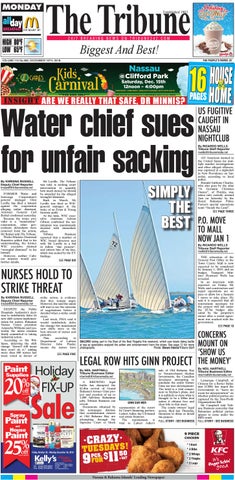
Water chief sues for unfair sacking
By KHRISNA RUSSELL Deputy Chief Reporter krussell@tribunemedia.net
FORMER Water and Sewerage Corporation’s general manager Glen Laville has filed a lawsuit against the corporation alleging unfair dismissal, Attorney General Carl Bethel confirmed yesterday. Because the water provider is a “stand-alone” corporation, other government defendants were removed from the action, Mr Bethel told The Tribune. Works Minister Desmond Bannister added that to his understanding, the former WSC executive claimed “wrongful dismissal” in his lawsuit. However, neither Cabinet minister would give further details.
Mr Laville, The Tribune was told, is seeking court intervention to quantify how much money he should be awarded for the alleged wrongful dismissal. Back in March, Mr Laville was fired as WSC general manager in the wake of an Ernst & Young forensic audit. At the time, WSC executive chairman Adrian Gibson confirmed the termination was unanimously decided with immediate effect. Tribune Business reported that a number of WSC board directors met with Mr Laville in a bid to follow “due process”, and inform him of his fate, which was sealed by the EY findings. SEE PAGE SIX
SIMPLY THE BEST
DESPITE the Public Hospitals Authority’s decision to indefinitely defer its new shift system implementation for nurses, Bahamas Nurses Union president Amancha Williams said yesterday the union remains firmly committed to taking industrial action. According to Ms Williams, deferring the shift change “doesn’t still mean they won’t do it,” adding more than 600 nurses last week voted in favour of
strike action, is evidence that they remain angry. However, she said the union will wait to see the outcome of negotiations before it decided when a strike could occur. Last week, PHA said it would indefinitely defer the change but maintained new shifts were in the best interest of nurses and patients. This, according to Department of Labour Director John Pinder, means the nurses have SEE PAGE FIVE
US FUGITIVE CAUGHT IN NASSAU NIGHTCLUB By RICARDO WELLS Tribune Staff Reporter rwells@tribunemedia.net
AN American wanted in the United States for multiple murder investigations and other alleged offences, was captured at a nightclub in New Providence on Saturday, according to local police. Ronald Anthony Charles, who also goes by the alias “St Germain Christian Osures”, of Florida, was taken into custody around 2am on Saturday by the Royal Bahamas Police Forces’s special operations team “Steady the Land”. SEE PAGE THREE
P.O. MOVE TO MALL NOW JAN 1 By RICARDO WELLS Tribune Staff Reporter rwells@tribunemedia.net
THE relocation of the General Post Office to the Town Centre Mall is now expected to be completed by January 1, 2019, and on budget, Transport Minister Renward Wells has revealed. In an interview with reporters on Friday, Mr Wells said construction and repair operations are on pace to allow for a January 1 move to take place. He said it is expected that all renovations necessary for the project will fall under the $3.5m budget allocated by the property’s owner after a rental agreement was reached with the government. SEE PAGE 13
NURSES HOLD TO STRIKE THREAT By KHRISNA RUSSELL Deputy Chief Reporter krussell@tribunemedia.net
HOME
SAILORS taking part in the Best of the Best Regatta this weekend, which saw boats doing battle at sea as spectators enjoyed the action and entertainment from the shore. See page 12 for more photographs. Photo: Shawn Hanna/Tribune Staff
LEGAL ROW HITS GINN PROJECT By NEIL HARTNELL Tribune Business Editor nhartnell@tribunemedia.net
A BREWING legal battle has disrupted the $2.8bn revival of Grand Bahama’s former Ginn project and creation of up to 1,400 full-time Bahamian jobs, Tribune Business can reveal. Documents obtained by this newspaper disclose that condominium owners at Old Bahama Bay are attempting through the Supreme Court to block
GINN SUR MER repossession of the resort by Ginn’s financing partner, Lubert Adler, the US-based real estate financier. The repossession is vital to Lubert Adler’s
sale of Old Bahama Bay to Toronto-based Skyline Investments, the Canadian developer attempting to purchase the entire former Ginn sur mer development. The hotel is a vital component in Skyline’s plans, and it is unlikely to close what is thought to be a $40m deal unless it obtains free and clear title to that asset. The condo owners’ legal action, filed last Thursday, threatens to delay or derail the project. FULL STORY - SEE BUSINESS
CONCERNS MOUNT ON ‘SHOW US THE MONEY’
By NEIL HARTNELL Tribune Business Editor nhartnell@tribunemedia.net
Lemarque Campbell, of Citizens for a Better Bahamas (CBB) has urged the Government to “leave no room for interpretation” on whether political parties are captured by the Non-Profit Organisations Bill. Mr Campbell told Tribune Business yesterday that Bahamian political parties appear to come under the Bill’s remit. FULL STORY - SEE BUSINESS
9 PIECE CHICKEN
50
+VAT
Nassau & Bahama Islands’ Leading Newspaper
• 1 Keel • 2 Ribs • 2 Wings • 2 Thighs • 2 Legs
PAGE 2, Monday, December 10, 2018
THE TRIBUNE
Volunteers aim to exterminate waste
MOUNDS of trash were collected as part of clean-up efforts in Yamacraw on Saturday. Photos: Voltar’s World/Barefoot Marketing
FOR the past two years, Voltar’s World, a service organisation targeting inner-city communities, has worked with one mission in mind – to shift the way the public views waste disposal. Since inception, the company has been supported by local waste management company Bahamas Waste Limited, which provides Voltar’s World with 20ft dumpsters, dumpsters and other equipment needed to aid in the removal of debris. Bahamas Waste also collects and disposes of all the debris and trash for the group, at no cost. This year, the group’s members have targeted coastal and inner-city communities and most recently the group converged on the Yamacraw Shores area, where the cleanup efforts began along with assistance from area residents. “What we’ve found is that residents in the area are often keen to join in the cleanup work,” explained Voltar’s World president Craig Lowe. “We couldn’t be more pleased with the feedback we get every time we visit a new area, once they see our
BAHAMAS Waste team members and service group Voltar’s World cleaned up trash from the Yamacraw area on Saturday. team working, persons who Bahamas Waste, to comlive in those communities plete the cleanup. “This time, we took jump in to assist – which is reinforcements and joined what we want.” This year, Voltar’s World forces with a service group has held clean-ups in from the Anatol Rogers Golden Isles, Bain Town, High School to complete Millar Heights, Lewis the work just in time for the Street and now Yamacraw holidays.” Project “Exterminate Shores. “Even with a small team the Waste” which is now a of six, we were able to little over five months old, remove so many bags and has brought together volunbins of debris,” said Mr teers from all walks of life, Lowe, who also revealed all with a singular goal – to that there was still a signifi- give back to the community. Persons interested in joincant amount of work to be ing the Voltar’s World club done in Yamacraw. Voltar’s World members as a volunteer can do so by went back into that eastern emailing voltarsworld242@ New Providence commu- gmail.com or by visiting nity on Saturday, thankfully the club’s Facebook page at with more support from Voltar’s World 242.
10
$
(INCL. VAT) (INCL.
®
• • • •
BIG BOX
2Pc. Thigh & Leg • Biscuit 2 Spicy Wings • Cookie Coleslaw • 22oz. Pepsi® Individual Fries
THE TRIBUNE
Monday, December 10, 2018, PAGE 3
‘Please help to pay for Tarique’s treatment’ By RICARDO WELLS Tribune Staff Reporter rwells@tribunemedia.net A LACK of money has kept Tarique Miller, a nineyear-old boy diagnosed with hereditary angioedema (HAE), away from “critically important” medicine for almost six months. Angelica Miller, Tarique’s mother, said her son’s lifelong condition had now progressed to the “scariest” she has ever seen it. According to Ms Miller, Tarique has been hospitalised twice a month for much of this year, as the family’s limited financial resources have left the youngster without his medicine since June. “Without financial assistance, getting his medication is hard and scary. It’s the scariest we’ve seen it,” she said. “Since June to no longer than two weeks ago, Tarique has been admitted to the hospital twice a month. His attacks have been happening more often now.” Ms Miller added: “I have been trying to get another dosage for him but I simply can’t afford it. I am still waiting on Social Services to assist, but there has been no clear answer with that.” US doctors have advised both the family and local health officials to keep at least two vials of the medication on the island every year.
In cases where the drug is not available, Ms Miller is required to raise the funds needed to purchase the medicine. Over the past year, Ms Miller has resorted to water drives, cookouts and letters of support to assist her son as best she can. She told The Tribune that despite her best efforts, things have not gone well. HAE is caused by a low level or improper function of the C1 inhibitor protein, the result of which causes the rapid swelling of the hands, feet, limbs, face, intestinal tract, voice box, or windpipe. During flare-ups, the body experiences major swelling, particularly in the chest cavity, resulting in restricted breathing. Patients suffering with the condition are unable to produce the necessary protein needed to reduce swelling and fluid retention in the body. To combat attacks – which can last up to six days – Tarique requires a synthetic protein that could cost anywhere between $3,500 and $4,000 per dose. Tarique was formally diagnosed by doctors at the Joe DiMaggio Hospital in Florida in November of 2014. Anyone willing to assist Tarique can do so by contacting Ms Miller at 4479311 for more information on ways to help.
NINE-year-old Tarique Miller.
TARIQUE Miller was diagnosed in 2014 - and medication costs between $3,500 and $4,000 per dose.
US FUGITIVE CAUGHT IN NASSAU NIGHTCLUB from page one
RONALD ANTHONY CHARLES
According to police reports, the unit, acting on intelligence, went to a local night club on Carmichael Road where they identified Mr Charles and took him into custody. He will be handed over to US authorities at some point this week, according to officials. Police said yesterday they did not know how, as a wanted
To advertise in The Tribune, contact 502-2394
suspect, he was able to gain entry into The Bahamas. This comes days after The Tribune reported that a Bahamian man living in Atlanta has been declared a fugitive in the United States, going missing days before a jury found him guilty of rape, aggravated sexual battery, child molestation and cruelty to children in the first degree. Don Martin, 45, committed the crimes against a 13-year-old child. He is said
to have fled five days into his trial. Martin was released on a $15,000 bond with an ankle monitor shortly after his arrest in 2014. A purported Facebook profile with his image suggests he has more than a dozen Bahamians as Facebook friends. Bahamian police have not said if they are on the look-out for him. US authorities have said Martin is originally from The Bahamas.
THE TRIBUNE
Monday, December 10, 2018, PAGE 5
Nurses hold to strike threat from page one “They really don’t have an issue,” Mr Pinder told The Tribune yesterday. “They filed on the shift system and the PHA cancelled so there is really nothing to strike about.” However, he said the BNU would still be given a strike certificate which is expected to be issued at some point today. He said as long as the union did not withdraw its grievance they could still take action.
When she was contacted yesterday, Ms Williams said she was assured by Prime Minister Dr Hubert Minnis that he would make an intervention on their behalf, but she suggested there was yet to be a satisfactory resolution. “Deferring doesn’t mean they won’t bring it on,” the BNU president said. Asked if there was planned industrial action this week, Ms Williams said: “We intend to lay all of our cards on the table. The same thing as the doctors
and if there is no reply you move forward. So I can tell you we are firm in our decision to move forward, but we won’t strike without negotiation. They will have to meet all our demands. “We showed them we had the majority during the vote and they still want to show their colours.” She continued: “The Bahamas can see who is the bully here. They are the bullies.” Ms Williams further questioned why the Department of Labour had not
issued the strike certificate since they took the vote last Tuesday. “Tuesday will make a week we are waiting for the certificate. We don’t have anything. We should have had it in less than two days. John Pinder signing off on it means nothing to us. It being signed and in our hands is in our interest. “That same talk could go on for weeks,” she also said, referring to Mr Pinder’s remark that it had already been signed off on. Last Wednesday, the PHA
issued a press statement maintaining the shift change was best, maintaining a new system would “improve the delivery of healthcare to our patients and ensure better patient outcomes through better nursing coverage and reductions in nurse related accidents and errors; eliminate inequities caused by the ‘four nights on/four nights off’ system which resulted in night duty nurses working 157 days per year on average, compared to 234 days per year on average for nurses assigned to
day shifts; establish a standardised five-day, 40-hour work week with 8-hour daily shifts; and provide compensation for nurses scheduled to work between the hours of 6pm to 6am by way of a night duty premium of $1.75 per hour which would be paid in addition to their standard hourly pay.” The proposed shift change from four on/four off to five on/two off is the only dispute the Bahamas Nurses Union has with PHA, the governing body said.
NO CONTRACT FOR CHRISTMAS DECORATIONS By KHRISNA RUSSELL Deputy Chief Reporter krussell@tribunemedia.net
WORKS Minister Desmond Bannister said yesterday this year’s Christmas decorations were the result of “direct orders” and not contracted work, as has been the case previously. Christmas decorations around the capital this season feature lights at major roundabouts in addition to the familiar pole lights, which are usually placed each year. Mr Bannister told The Tribune what Bahamians are seeing this year is “new”, adding lights used before had “come to the end of their useful lives.” However, he was unable to state how much money was spent. “The Christmas decorations on the poles were ordered by BPL (Bahamas
Power and Light),” Mr Bannister said. “The old ones had come to the end of their useful lives. “The decorations at the roundabouts were ordered by the Ministry of Public Works.” Asked to reveal the cost associated for purchase, he said: “I will have to check tomorrow. However, as far as I am aware these are direct orders, not contracts.” Bahamians have taken special interest in Christmas lights and decorations since 2016’s horrendous display. A company owned by former Minister of Youth, Sports and Culture Neville Wisdom was given a contract to erect Christmas decorations in down town Nassau and Arawak Cay. Florarama, a company owned by Mr Wisdom, who
served in the first Christie administration, provided the Christmas decorations at a cost of $334,000.16. The Ministry of Tourism at the time revealed the cost after a wide range of reaction, mostly negative, was fielded about the decorations. Among the critics was East Grand Bahama MP Peter Turnquest who, while in opposition, said: “Didn’t we just have to borrow millions? Where are they getting the money from?” Others criticised the aesthetics of the display on social media, calling the decorations a “catastrophe”. “I passed through there this morning... they look horrible,” one resident wrote on Facebook. Another person wrote: “They spent all the VAT money. That’s all they could afford.”
THE CHRISTMAS tree in Rawson Square.
THE Royal Bank of Canada property in Freeport.
Photo: Vandyke Hepburn
BREAK-IN AT BANK - BUT NO CASH TAKEN By DENISE MAYCOCK Tribune Freeport Reporter dmaycock@tribunemedia.net
THE Royal Bank of Canada in Freeport was broken into by culprits who shattered a large glass window gaining access into the bank early Friday morning.
According to reports, shortly after midnight police were alerted to an incident at a financial institution on Explorers Way and the Mall Drive. When officers arrived at the bank, they discovered that an eastern window of the building had been smashed. During a search of
Photo: Shawn Hanna/Tribune Staff
the premises, officers found that the culprits had caused extensive damage. Assistant Superintendent Terecita Pinder said that a representative of the bank reported that no cash was stolen. She said the matter is under active police investigation.
www.ub.edu.bs
New Student Orientation Spring 2019 Wednesday, 3rd January 2019 Oakes Field Campus WELCOME CEREMONY & STUDENT SUCCESS SEMINARS Keva M. Bethel Building Performing Arts Centre
Check In 8:00 a.m. – 9:00 a.m. Performing Arts Centre Campus Tours 9:00 a.m. – 10:00 a.m. Oakes Field Campus Welcome Ceremony 10:00 a.m. – 11:00 a.m. Performing Arts Centre Student Success Seminars 11:00 a.m. – 12:30 p.m. Performing Arts Centre Spring Blue Fest 12:30 p.m. – 2:30 p.m. Independence Park, Oakes Field Follow us on
- www.ub.edu.bs
PAGE 6, Monday, December 10, 2018
THE TRIBUNE
Water chief sues for unfair sacking from page one
GLEN LAVILLE, former general manager at the Water and Sewerage Corporation.
Mr Laville’s firing was the first tangible action in the fall-out from the EY report, which disclosed how too much politicallymotivated interference and the ‘friends, family and connections’ network had undermined basic corporate governance and established protocols. This resulted in multimillion dollar losses and cost overruns that, ultimately, have to be covered by Bahamian taxpayers. Mr Laville had previously told The Tribune he disputed numerous findings of the EY report against him while arguing that the report’s disclosure had caused morale at WSC to plummet. EY’s investigators found that Mario Bastian, a “close friend” of Mr Laville, secured a $3.2m contract with the corporation despite being fired twice. The auditors concluded that the tendering process for the contract
gave the appearance of bid manipulation, and noted that the company, ACO JV, was awarded the contract despite displaying characteristics that had disqualified other potential vendors. Mr Laville said he lacked the power to ensure anyone is awarded such a contract, noting that such decisions are made by the Cabinet after input by Water & Sewerage Corporation’s board. He added that the contract was approved by the Caribbean Development Bank (CDB) as well, although EY’s report showed the CDB rarely dissents when government officials recommend someone to receive a contract. Mr Laville also questioned the relevance of a communication highlighted in the report between him and Dave Taylor, a surveyor who performs services for WSC as a sub-contractor. In the correspondence, Mr Taylor wrote to Mr Laville: “Can I stop in to drop off the cash to you now?”
Mr Laville told investigators the message referred to membership dues for the Bahamas Association of Land Surveyors, for which he is treasurer. EY, however, said Mr Laville provided no documentation supporting that the money was deposited in BALS’ bank account. Mr Laville said: “I advised that going to the bank to deposit $100 doesn’t make any sense. I don’t go to the bank and deposit it every time I get a membership dues. Furthermore, it was just $100, to even raise it as an issue… “I admonished the auditors not to make conclusions and seek information to support it. By the inference that somehow this was an improper activity or whatever, in this small country, it would call into question any time anyone anywhere brought me membership dues.” Mr Laville and his attorney did not give a comment to The Tribune on the lawsuit despite multiple requests.
MUNROE CONCERN OVER CONFIDENTIAL SETTLEMENTS By RASHAD ROLLE Tribune Staff Reporter rrolle@tribunemedia.net
AS governments around the world come under fire for confidential settlement agreements, their use persists in The Bahamas in the absence of public scrutiny, alarming transparency advocates. Attorney Wayne Munroe said secret agreements potentially expose the public to abuse. His comment came after The Tribune revealed last week the government has reached a mutual agreement with former Christie administration advisor Sir Baltron Bethel over contracts the government initially declined to honour. Prime Minister Dr Hubert Minnis terminated Sir Baltron’s contract last year and insisted he would not
honour its terms. He said Sir Baltron’s contract was extended two weeks before the last general election, his salary increased from $140,000 to $200,000. When contacted recently, Attorney General Carl Bethel declined to reveal terms of the agreement with Sir Baltron, citing confidentiality. The Office of the Attorney General is in talks with other people seeking payment related to their departure from public office. Historically, the public has not been given details of settlement agreements and is not told how much a person is paid. The secrecy involving taxpayer funds prohibits accountability, according to Mr Munroe, QC. “The reason (to disclose settlement agreements),” he said, “is it permits you scrutiny to see if there has
been even-handed application of a policy. It also prevents politicians talking tough in public about somebody, then settling quietly behind the scenes. Disclosure will also tend to expose if a government or a politician is using public funds improperly either to benefit persons of a particular class, to give money to your boys or to discriminate against other persons and to make other people go through a lot of challenges.” Mr Munroe said some matters should be subject to a degree of disclosure, such as police misconduct cases, hospital negligence cases and employee disputes. He called for a vigorous debate about what class of settlement agreements should be revealed to the public and what should be kept secret. He said: “In a settlement
agreement, a confidentiality clause is usually to advance a commercial interest. If the company is a private company or the defendant is a private person, that’s simple. But when the defendant is the state or the government, you have accountability and transparency issues. Should the government be made to disclose raw data? Should they disclose how much is the value of settlements by confidentiality agreements? Should they be made to individualise them as to the amounts of individual ones and the next step is should they be made to identify the recipients or the plaintiffs in the cases that cannot be proven to be commercially sensitive? “There will be some matters where you don’t want people to know you settled a case, for instance where there is mould in a
building then everyone and their mother would file an action that you would have to settle. But there should be run of the mill things like employment matters and personal injury matters that wouldn’t fall within that class. We should at least have the debate, the discussion like they do in other jurisdictions to say you have a disclosure obligation and this discussion should be in the context of a Freedom of Information Act.” In Missouri last year, the state’s Attorney General Josh Hawley committed to releasing monthly reports detailing settlements, according to Pew Research. He said the state’s “citizens deserve transparent and accountable government, especially in the expenditure of their tax dollars”. In states around the US, disclosure of payments in agreements is the norm for some class of cases. Secret agreements have come under attack in the United Kingdom. In 2013, the National Audit Office of the UK, an independent parliamentary body, said “the lack of transparency, consistency and accountability” around compromise agreements and special severance packages “is unacceptable”. “With the public purse under sustained pressure and services increasingly delivered at arm’s length, it is important that compromise agreements do not leave staff feeling gagged or reward the failure either of an employee or an organisation,” the NAO said. Critics are careful to note settlement agreements themselves are not bad policy. “Settlement is a good thing,” Mr Munroe said. “For instance, in some cases I have done, I’ve done one where you might end up with an award of $50,000 whereas if the government offered $10,000 my client
would have accepted it. People say ‘oh you say you didn’t do it,’ but that’s all well and good if the court sides with you, you pay nothing, but if the court rules against you, you pay $50,000. So offering $10,000 is a gamble but litigation is that way generally.” Matthew Albury, executive director of the Organisation for Responsible Governance, said it’s unclear if the Freedom of Information Act, which has not fully come into force, mandates disclosure of settlement agreements. “In theory,” he said, “in Freedom of Information they may be released unless there is some judicial mandate that a file must be closed or because of national security or something like that. The independent information commissioner would be the ultimate adjudicator around whether that information would be available. It goes back to one, we need to push to be clearer about how to use this law, and we need to push for independence and strength in the information commissioner. At the moment the commissioner is going to be appointed by virtue of a process that is not outside political influence.” It is not clear if settlement agreements involving the government contain confidentiality clauses or if government officials simply avoid discussing them in public by citing the need for confidentiality. “It’s part of the culture,” Mr Albury said, “so deeply entrenched that people can’t speak to it. A changed culture and mindset is needed so we understand that information isn’t just about a ‘gotcha’ moment but much more of a learning opportunity for us to ask if we are doing things not only above board but as effectively and efficiently as possible.”
CAVES VILLAGE Premium Office Space for Lease 850 sq.ft. 3 offices, reception, conference room, kitchenette and bathroom, IT closet $2,975.00 pm. Inc. CAM + VAT 1,056 sq.ft. 4 offices, conference room, reception, kitchenette and bathroom, IT closet. $3,696.00 pm. Inc. CAM + VAT Contact Mr. Simon Chappell on 327 1575 or 477-7610 Email: simon@cavesvillage.com
MONDAY, DECEMBER 10, 2018
THE STORIES BEHIND THE NEWS
LEFT: Ashlee Hilton and Neil Deveaux who were killed during a double shooting outside Sandilands Rehabilitation Centre. Photo: ICandy Photo Mansion. Right: Prime Minister Dr Hubert Minnis.
By MALCOLM STRACHAN
W
ITH the nation on pace for its lowest murder count in a decade, the government has much to be proud of with regard to its crime fighting efforts. The previous government campaigned and won the 2012 election largely on an empty promise to eradicate crime. Unfortunately, we all know how that panned out. Successive murder records were set under the former administration and fear was at an all-time high with rapes, robberies and murder rampant throughout the country. Now, as the victims of homicides are mostly being confined to a group of prolific offenders - many out on bail for serious crimes - there is a notion that the vast majority of the killings are retaliatory. Certainly, as the holiday season approaches, so the level of fear increases a few notches. The month of December, opening with two double murders – one in particular, a gruesome slaying in broad daylight of a man and woman on the premises of Sandilands Rehabilitation Centre – have many in the nation feeling anxious. While murders have decreased by around 30 percent from last year, the criminal element in the country is still very frightening. The prospect of being in the wrong place at the wrong time when bloodthirsty killers exist among us is an ever-present reminder of how dangerous the times are. This causes much concern when we hear the prime minister – not once, but twice – claim the fear of crime is down. For one to suggest the Bahamian people are no longer scared of crime is an absolute absurdity, and any fairthinking person would not be off-base to question the mental faculties of one who makes such an utterance. Sadly, Prime Minister Minnis’ suggestion that the decrease in murders is a barometer for the Bahamian people’s level of fear for all crime is either an intentional misrepresentation or an indictment on his senses. The prime minister certainly ought to be careful of making such irresponsible statements. When he spoke to the media at the end of last week, the prime minister said: “Now when you talk to the average Bahamian yesteryear, there was great fear of crime. They were fearful of coming out of their homes, fearful of driving around, etc. That fear has been relaxed. They’re no longer fearful of crime. They’re no longer fearful of going to shopping centres, environments, etc, and we will even decrease that even further.”
Feeling safer? I’m amazed Minnis could sayThe that with Tribune Weekend a straight face A1MAIN
FRIDAY
Established 1903
i’m lovin’ it!
HIGH 81ºF LOW 68ºF
Volume:115 No.262, DECEMBER 7TH, 2018
THE PEOPLE’S PAPER: $1
art books theatre film fashion
music fitness gardening
Weekend
WEEKEND: WHEN TWO CULTURES COME TOGETHER
PM: Public’s not afraid any more He was responding to a question from The Tribune, which drew his attention to fear Bahamians say they feel in the aftermath of the killings. Dr Minnis also repeated he remains an advocate for capital punishment by way of hanging as a deterrent to crime. However, he said he remains confined by Bahamian law. Hanging is on the law books for murder, however rulings from the London-based Privy Council have made it hard for the punishment to be carried out. The last hanging took place in 2000. SEE PAGE FIVE
THE PRIME TRIBUNE’S front page last Friday Minister Dr Hubert Minnis is convinced Bahamians are no longer fearful of crime under his
administration as was thethe prime minister Indubitably, prime minister’s declaration of the case in years past, adding yesterday he wasonly pleased had conversations must have citizenry no longer being fearful with the accomplishments authorities have achieved in with his constituents in Killarney, of crime: Why would he politicise a short timeframe. Two days after the second as his this issue just to voice support of double assertion homicide this week is not in line with occurred, Dr Minnis conone murder is stillthe majority of the thetended thinking of the RBPF, as if both are mutually too much, but said the general feeling of fearpeople. which Bahamian Commentary exclusive? Rightfully, the Bahaexisted before has “relaxed”. underneath the digital publica- mian people are fearful of crime. tion of The Tribune’s article, as Especially if you live in Nassau you would imagine, did not take where the majority of crime takes so kindly to the prime minister’s place (on an island seven by 21 Centre, Mr Dames also said pronouncement. miles) - unless you live in a gated By MORGAN ADDERLEY he is working with a team Tribune Staff Reporter to create a “robust policy” Commenters did everything community, the threat of crime is madderley@tribunemedia.net to improve security at “all government properties”. NATIONAL SecurityDr from question always a near and present danger. MrMinnis’ Dames also mental conMinister Marvin Dames said yesterday law enforce- firmed that Sandilands’ aptitude tovigorously” suggesting he attempt Perhaps the prime minister surveillance cameras were ment will “go not working at the time after those responsible of Monday’s after incident. Hedark. going inhomi-Nassau wants only to highlight the good for the out two double cides that occurred in the made these remarks yesterTHE FIRST graduates from the Citizen Security and Justice Programme at The Bahamas following a graduation capital this week.prime As Mon- day While the minister’s disconjob thewithpolice isPearson. doing to- seecontinue Department of Corrections instructor Shirley Full story Page 2. day’s shooting occurred at ceremony for inmates at Photo: Terrel W Carey Sr/Tribune Staff SEE PAGE FIVE Sandilands Rehabilitation nectedness with the sufferings of to deflect from the conversation the people have come into ques- of capital punishment. While in tion before, it is quite alarming opposition, was aAND fervent DOCTORS CALL AheHALT DO advoDEAL By RASHAD cate ROLLE However, the CPSA that he would make such a sugof “popping the necks of Tribune Staff Reporter declined to give details rrolle@tribunemedia.net about the agreement, gestion with a straight face. murderous scumbags”. Yet, upon saying some minor matters SENIOR public doctors must be resolved before a Surely, he must be kidding ended us, becoming prime minister, he has their industrial action formal signing is reached. yesterday after signing an In the past year, the agreement-in-principle right? not shown the impetus to change doctors have fought for that boosts their terms of an increase to their base employment. the salary, health insurance Actually, a greater question constitution and remove Consultant Physicians DOCTORS protesting outside benefits and a pension plan. PMH in September. Association treasoperations comes about as a result of Staff the power from the PrivyEmergency Council as urer Dr John Dillett critical in resolving the dis- protocol was in effect at
CAMERAS BROKEN AT MURDER SCENE
VERY GOOD, FELLAS
credited Prime Minister Dr Hubert Minnis’ intervention on Monday as
pute that ended with an agreement reached on Wednesday.
NOVICE RUNNER TIPS Pages 20 & 21
Cultures interwoven
Combining African fabrics
Despite 83 dead Minnis believes we all feel safer
By KHRISNA RUSSELL Deputy Chief Reporter krussell@tribunemedia.net
Friday, December 7, 2018
history
Public Hospitals Authority SEE PAGE SEVEN
and Bahamian colours
pages 14&15
it relates to our ability to hang the
USnation’s COURTmost violent offenders. Rather, ORDERS VISAthe tango continues. Additionally, technology such SCAM MUM as CCTV and gunshot detecDEPORTED tion devices are still seemingly a By RASHAD ROLLE Tribune Staff Reporter rrolle@tribunemedia.net
moving goal post. Since requestfor-proposals were put out by the ministry of national security a few months ago, we have yet to hear anything else on the matter. Aside from the perpetual call from the Bahamian people to bring more preventative crime-fighting measures on stream, we’ve not heard much from the government. Moreover, while we celebrate the small victory that exists in the lowest murder total in the past decade, we can just as easily see when a spike occurs as a result ‘OECD of a RULES series of retaliatory killings DISASTER taking place. Case in point – the FOR FINANCE series of shootings that took place last week. While no connection SERVICES’ Bywas NEIL HARTNELL made by the police, it must Tribune Business Editor nhartnell@tribunemedia.net be acknowledged we have seen THE Bahamas will score a “false victory” if domino it avoids similar effects in the past. Europe’s latest “blacklist”, a former finance minister One killing begets another and argued yesterday, as it represents another step in the another. “slow death” of financial services. after the carJamesNonetheless, Smith said The Bahamas continues to “give nage under both of the previous away” its second-largest industry without offering anyadministrations, resistance and “getting murder became nothing in return” from either the European Union commonplace in our society. or Organisation for Economic Co-Operation and Likewise, the notion of murder Development (OECD). While the government being asitselflow as it is in comparison continued to “pat on the back” for complying was a dream. with these groups’ anti-tax evasion demands, Mr Smith argued Again, that The Bahamas while we laud the numwill ultimately “have no business becausethe year after bers, fact 80-plus lives have year we will be shrinking” due to the new regulatory been taken as a result of violence regime forced upon it. He added that the OECD wasstill advancingforces towards its us to put things in goal of “obliterating” The perspective. Bahamas and other international financial centres, and forcing the financial One thing the prime minister services business they once attracted has back saidonshore that is true is that one to its member states by “stripping” these nations is too much. As we round of murder their former competitive A BAHAMIAN mother of four, who was caught up in the FBI’s two-year undercover operation into US visa fraud in Nassau, was sentenced to time served and deportation in a federal court yesterday. Pauline Pratt, 43, was convicted of one count of conspiracy to commit visa fraud for her involvement in the scam, which saw her and deceased Haitian activist Pierre Parisien bolster visa applications with false information and fraudulent documentation. She further claimed she could create fraudulent bank letters to support applications, and forged the signatures of bank officials during a recorded meeting shortly before her arrest in September. SEE PAGE THREE
advantages.
FULL STORY - SEE BUSINESS
off the year and usher in 2019, it is our sincere hope that not just murders, but all crime will continue to decrease. At the same time, The Bahamas is suffering socially, and that must be addressed as a proactive and preemptive measure to crime. Fighting crime, in its essence, denotes reaction by the police force, and they’ve been doing a great job. However, the level of fear, while it may have not increased, has certainly not decreased. The job we do before a crime is committed is far more important than what we do in the aftermath. The years of murder records being crushed as blood painted our streets has arguably left the citizenry experiencing mass PTSD. And certainly, there is a sense that gang violence is a powder keg that can explode at any moment. This isn’t anything that we’ve never seen before. That said, the prime minister has provided his assurance that they intend to decrease crime even further. This is certainly most welcomed and supported, as we hope that Minister of National Security Marvin Dames and Commissioner of Police Anthony Ferguson can build upon what has made them successful this past year. Perhaps, one day, we can all experience the utopia of not being afraid of crime on our streets anymore. Until then, let’s do our best to keep ourselves, as well as our families, safe.
PAGE 8 MONDAY, DECEMBER 10, 2018
INSIGHT
EMAIL: insight@tribunemedia.net
THE FAMILY of Byron Ferguson at Nirvana Beach during a press conference after the pilot went missing
Photo: Shawn Hanna/Tribune Staff
The little things all added together which could mean so much A
By FREDERICK R M SMITH, QC
MONG the many poignant testimonials following the loss of well-known pilot Byron Ferguson in a plane crash last month, one touched a particularly important nerve. Lamenting the fate of his colleague – and especially the fact that Byron seemed to have been abandoned by the powers-that-be – Captain Philip Armbrister told of the earlier struggles he, Ferguson and others had to secure commonsense industry reforms like proper radar systems, night lights on Family Island runways and a comprehensive emergency response plan. Little things really in the grand scheme, but together they could have saved Ferguson’s life and the lives of many other pilots and passengers over the years. Even at Freeport International airport there is still no radar! It still operates on a flow control reporting system. What Captain Armbrister
pinpointed is more than just a problem with aviation. In fact, it is a key deficiency in our approach to national development on the whole, a glaring oversight that has tainted our efforts towards progress as a society for a very long time, at least since independence. Over the past five decades, politicians have overwhelmingly focused on the big ticket items: large-scale foreign direct investment, sweeping legislative reforms, wholesale overhauls of the revenue collection system and the creation of mammoth institutions like National Health Insurance. While hugely significant in theory - especially when announced in grand dramatic style and to the resounding applause of partisan fanfare - the truth is in practice these sweeping initiatives end up having very little immediate impact on the everyday lives of Bahamians; especially when the public service, charged with putting into effect
what is often very good legislation, are starved of funding, human resources or technical skills or worse still, neutered by ministerial political interference at every level, corrupt or not!
The Little Things Count Concern for the big picture is of course necessary. But it should always be tempered by a regard for the little things – the countless mundane details that, in the final analysis, make all the difference in the dayto-day life of the average civilian. Small, everyday considerations that, when taken together, amount to the all-important question of a society’s quality of life. Wouldn’t it be grand, if The Bahamas ranked as one of the ten most desirable places to live in the world because of the quality of life here? The temptation to focus on grandiose symbols of success is understandable. Politicians are in the popularity business and don’t often see the value of spending time and energy on initiatives too modest to generate headlines. And a big hotel or industrial project is seen as just the thing to define a term in office or distract the public from a high profile failure. But the politicians are fooling themselves. Ultimately, every administration lives and dies not upon its record of big announcements, but rather according to people’s experience of everyday life on its watch. Was it easier or harder to get a job or start a business? Do I feel my children’s education is up to par? Do I feel safe in my own neighbourhood? Do I feel the public sector is professional and efficient? Are the businesses and services I interact with well regulated? How bad is the traffic on my way home from work? It is these sorts of questions that determine people’s perception of their own level of happiness and it is this which in turn guides their hand at the polls. A general sense of
opportunity, satisfaction and safety is far more likely to lead to votes for an incumbent party than any announcement of a new hotel or industrial development. People vote with their emotions, not with their intellect. In half a century, for some reason, no Bahamian government seems to have appreciated this fundamental reality.
Frustration in Da’ Land In the meantime, Bahamians have grown more and more jaded by the petty frustrations and barriers to self-empowerment that mark their everyday experience. We sense that we exist within a system that simply does not have our back. For all the bright lights and huge crowds of the megaresorts, people feel they are really on their own and that at the most fundamental level, the system does not work in their interest. There is no helping hand being extended and no safety net should they need support. Due to chronic negligence and oversight, there is a sense any of us could easily end up just like with no help in sight. How can we accept, as a maritime nation of 700 islands, that we do not have an efficient civil coast guard network? For a government like the FNM, which ran on the slogan “It’s the People’s Time” the message of Captain Armbrister’s letter is particularly potent. Having coasted into office on a powerful wave of disgust with the PLP, they promised to do something fundamentally different, and tied their credibility as an administration to fulfilling the dream of a better basic existence for people within a more responsive system, one that is a support rather than a hindrance to their aspirations. To fulfil this mandate, the FNM must absolutely resist the temptation to revert to the bankrupt old model of reliance on grandiose promises and announcements. They must commit
to paying close attention to the less spectacular minutiae – the little things that really matter in each and every facet of public and private life.
Empower, delegate, decentralise and hold accountable! But where to begin? The list is virtually inexhaustible. For starters, Cabinet ministers should make it their personal mission to identify and address the issues, concerns and anxieties affecting all the consumers and professionals that interact with the services for which they are responsible. This could be as simple as making sure teachers have the tools necessary to be effective in the classroom, that social workers are well trained or, as Captain Armbrister noted, the technology is in place to ensure pilots feel safe while flying at night. MPs should be doing the same in their constituencies, with a view to introducing commonsense solutions that will impact the average citizen immediately. Are the roads well paved? Do people feel safe in their homes? Is the garbage collected on time? But by far, the most important commitment any government could make to improving individual quality of life for the average citizen is to decentralise, to the greatest extent possible, the decision-making process, thereby allowing communities to raise their own revenue and fund their own future in according to the wishes and aspirations of the inhabitants. Meaningful local government is the real key to improved quality of life across The Bahamas. Once people are in control of their own destiny the little things, politicians would soon find, have a curious way of taking care of themselves.
A Piece of Da’ Pie! Likewise, Bahamian businessmen should be freed from the shackles of exchange control. In this day and age, it is absolutely unconscionable that government would continue to hold our hard earned money hostage, preventing us from exporting all but a pittance for use out of the country, thereby preventing any growth in our prospects beyond these shores. Virtually all the key players in the tourism industry are internationally traded companies, yet citizens and residents are prevented from investing in any of these enterprises. Bahamians can aspire to no more than employment in what is
essentially, a foreign-owned industry in their own country. Any administration that wants to grow employment and opportunity need only get itself out of the way and leave the details to those with the most to gain from seeing local business flourish. The same is true of professions and services, the greatest possible number of which should be allowed to self-govern and be overseen by trade associations, according to transparent industry-devised and enforced standards. These bodies should be respected by the authorities as the real source of expertise about any given field. If, instead of fighting against Captain Armbrister and Byron Ferguson for years, successive governments had respected their observations as professionals, many of our lost pilots might have been alive today.
Let Go Of Obsessive Cabinet Control People, when given the freedom to do so, will almost always act in what they perceive to be their own best interests. The results may not always be as intended, but the mere ability to succeed or fail on their own steam and in collaboration with their close neighbours is often a meaningful reward and form of validation in and of itself. This is the true meaning of the term empowerment – the freedom to control one’s own destiny for better or worse. Somehow, this lofty concept has become eroded in the Bahamian consciousness, gradually degraded to the point that it signifies nothing more than potential access to a job. Employment is of course critical to a person’s circumstances, sense of worth and quality of life, but it alone cannot ensure happiness, a feeling of safety or a sense of belonging within a political or social system. At the heart of the matter is really the question of control: will we ever have a government with the courage stop seeking to control the national message with grandiose announcements and focus instead on the little things that really matter to people’s lives? The “Executive” branch of government is supposed to “execute” the will of “Parliament; Da’ people Dem! Will a government ever be brave enough to recognise the myriad little things it cannot fix on its own, and allow people the freedom to act in their own best interests? The Bahamian people continue to wait and hope.
EMAIL: insight@tribunemedia.net
INSIGHT
THE OPENING of the 24th annual UN climate conference in Poland and, below, the United Nations Secretary-General, António Guterres.
H
AD the meeting of CARICOM governments on the Caribbean Single Market and Economy (CSME) been the only event affecting the Caribbean in the first week of December, it would have been a week to celebrate. But, it was also a week when global emissions of carbon dioxide reached such high levels that the future of Caribbean countries is now almost irreversibly endangered. The last sentence is not hyperbole. The United Nations Secretary-General, António Guterres took one glance at the frightening increase by 1.6 percent of global emissions in 2017 and a terrifying projected rise by 2.7 percent in 2018, to declare: “We are in deep trouble”. He was speaking at the opening of the 24th annual UN climate conference in Poland. These figures put the entire Caribbean – island states and countries with vulnerable coastal areas – at greater risk than has been forecast. The commitment adopted in 2015 in Paris, by nearly 200 governments, to limit the rise in global temperatures to between 1.5 and 2 degrees Celsius above pre-industrial times, has become the nightmare many feared. There has already been an increase of about 1 degree Celsius; a rise in just one more degree will drown many small islands and coastal areas, wiping-out tourism and important aspects of maritime production. Human habitats will also be disrupted, creating refugees both from states and within them. No doubt, with this knowledge deeply implanted in his mind, Antigua and Barbuda’s Prime Minister Gaston Browne was unhesitant in telling a high-level meeting at the United Nations on middle-income countries, also this week, that: “Climate change must be recognised as the demon that it is. The world’s worst polluters must admit that it is they who have unleashed this demon and it is they who must commit to containing and stopping it; not just in words but in deeds, especially by delivering the necessary adaptation and mitigation financing.” He was clear that “unless such a commitment becomes a binding commandment and climate change is halted, no amount of resilience building will help.” But, over the last three years since the Paris Accord, about which there were many critics (me included), for its non-binding and mostly aspirational nature, key governments have openly withdrawn from their pledges to limit greenhouse gas emissions and the promise of the necessary funding to build resilience and adaptation-infrastructure has not been fulfilled. Undoubtedly, the global
MONDAY, DECEMBER 10, 2018 PAGE 9
The Caribbean: Confronting its demons climate conference running from December 2 to 14, will declare itself a great success in a lengthy declaration. However, to be truly successful, legally enforceable commitments must be made by every country not only to cutting current global emissions by more than half by 2030, but also to put up the money that is urgently required. I doubt that will happen. The UN Secretary-General and his battery of climate scientists and experts don’t appear to hold out much hope for the Poland meeting either. They are already organising a UN Climate Change conference for September 2019 under the title: “A race we can win; a race we must win.” The desperation suggested by the second half of the title, contradicts the optimism expressed in its first half. Interestingly, coincidental with the opening of the Climate conference in Poland, Jamaica’s
Prime Minister Andrew Holness and France’s President Emmanuel Macron, published a joint letter in the US newspaper, The Wall Street Journal, calling for the private sector “to get in the front seat with world governments to avert a climate crash”. Laudable as that appeal might be, there are far too many powerful private companies whose profits depend on greenhouse gas emissions. They will not readily get into any ‘front seat’ unless constrained to do so by regulation and penalties, or enticed by even bigger profits. Neither is likely to happen. It is against that background, that, at last, the engine of the Caribbean Single Market and Economy (CSME), which has been on “pause” for a decade, was revved into action at a Heads of Government Conference held in Trinidad. At least on paper. The conference, at which it appears only six of the 14 CARICOM heads of government were present, issued a most impressive declaration that, if nothing else, reasserts the CSME as “the most viable platform for supporting growth and development in the member-states of CARICOM”. For me, it is not a coincidence
that this renewed recognition of the CSME has come under the stewardship of Mia Mottley, the new Prime Minister of Barbados. CSME had withered and was in danger of a lamentable death under her indifferent predecessor, who, like she now does, had the lead responsibility for it among the CARICOM heads of government. Now, it has been imbued with a new sense of relevance and importance, and its decision-making council has been expanded to include the long-overdue participation of the private sector and labour. In the heyday of CARICOM, such participation was the norm, later abandoned by insecure governments on the mantra that “the people elected me, not you”, as if election, by itself, accords wisdom and knowledge in all things. Apart from restructuring the dormant Commission on the Economy “to advise member states on a Growth Agenda for the Community”, the declaration
indicates that “full free movement of people” has, once again, risen to a priority of government action, even though there is an ominous reference to “those member states so willing”, suggesting that not all have come to terms with the limitations on employment, investment and growth in which smallness entraps them. What the declaration says the governments have agreed to do are small steps; some may not be achieved, but it is crucially important to this region of small, vulnerable states that the governments have returned, in any measure, to an agenda of regional integration which, they say, they are committed to advance at the national level. The countries of CARICOM need integration in today’s hostile world more than ever before. The dark clouds that threaten ravaging storms are not only about climate change. There is more besides. The writer is Antigua and Barbuda’s Ambassador to the United States and the Organisation of American States. He is also a Senior Fellow at the Institute of Commonwealth Studies at the University of London and at Massey College in the University of Toronto. The views expressed are his own. Responses and previous commentaries: www. sirronaldsanders
PAGE 10 MONDAY, DECEMBER 10, 2018
INSIGHT
EMAIL: insight@tribunemedia.net
Princeton’s proof of W just what’s possible GAIN AN EDGE
GAIN AN EDGE A NATIONAL DIALOGUE ON HIGHER EDUCATION
A NATIONAL DIALOGUE ON HIGHER EDUCATION
HEN Princeton Boston entered the gates of the Bahamas Technical and Vocational Institute (BTVI) in 2010, he was focused. By summer of the following year, he had earned a certificate in auto mechanics with his sights set on college abroad. Today, Princeton is a mechanical engineer at Benteler Automotive, a German manufacturer for exhaust systems in Michigan. Princeton, pictured right, is an example of the quality of students BTVI continues to churn out and embodies the institution’s vision, which is “To provide learning opportunities that enable individuals to be globally competitive and economically independent.” “The education I received from BTVI was priceless because I took full advantage of the opportunities given to me by my instructors. I continually build on the education I got from BTVI which was second to none in my field; that’s how I became so successful, in addition to determination to always do my best to represent my BTVI and The Bahamas,” said Princeton, who is now based in Grand Rapids. “With this education, it is safe to say it made me one of few people of colour to be in an engineering department of a German company and the only foreigner here at Benteler. Due to my in-depth knowledge of cars and how they function, I am able to design and improve on the current model,” he added. After BTVI, Princeton attended New England Institute of Technology in Rhode Island, obtaining an Associate’s degree in Advance Automotive Technology. The young man who was a Lyford Cay Scholar, a Ministry of Education National Technical Scholar and had a scholarship from Albany, then matriculated to Ferris State University where he graduated with a Bachelor of Science degree in Automotive Engineering in 2017. “One of my greatest moments at New England Institute was when I received the highest score ever recorded for the Electrical subject with an overall 98.9% and the president came down to give me a mini scholarship for my
achievement at the institute,” he reminisced. BTVI has had Memoranda of Understanding with New England Institute of Technology (NEIT) for several years, with the latest one in Information Technology being signed in 2017. Designed to link the two institutions, the partnership includes scholarships for BTVI students to attend NEIT to complete Bachelor level studies. Princeton, who also studied Auto Mechanics as an elective at Doris Johnson Senior High School, spoke highly of BTVI, stating that the institution prepared him to systematically address car problems. “With the hands-on knowledge, I could find the problem in the car and fix or address the issue which ends up being a huge factor for most engineers, due to the fact that
some engineers cannot troubleshoot a problem in a car because they don’t know how it functions; some only design and manufacture the car parts,” he revealed. The young man, whose goal is to become a Senior Engineer, has already been afforded the opportunity to train for a Benteler
Mercedes Engineering Training programme in Stuttgart, Germany for six months. “The experience was great because not many people of colour are seen around there and they always laughed when I tried to speak German which was a bit of a challenge for me,” he recalled. Meanwhile, Princeton encourages others to choose the path of technical vocational education and training (TVET). “This is due to the fact that technical training is always advancing. It has led me to a career of an engineer at a wellknown German company. Now more than ever, America is recruiting more technical professionals,” he stated. Furthermore, Dean of Construction and Mechanical Trades, Alexander Darville said Princeton’s success speaks to the quality
of BTVI’s instructors. “Our foundation prepares students for the world of work, wherever that world might be. Princeton knew exactly where he wanted to go from day one even though he was offered a scholarship to another local institution. He opted to come to BTVI. He embraced it and BTVI became the vessel to help push him with our connections to New England Tech. He is a beacon for BTVI and we have more Princeton Bostons,” said Mr Darville. “Gain An Edge” is a biweekly collaboration of Lyford Cay Foundations, Bahamas Technical and Vocational Institute and University of The Bahamas aimed at promoting a national dialogue on higher education. To share your thoughts, email gainanedge@tribunemedia.
FOLLOW THE RULES TO KEEP THE TEARS AWAY AT CHRISTMAS
THE Christmas season is upon us and we are in the midst of one of the happiest times of the year. Unfortunately it is also the time of year when people are more likely than not to bring harm to themselves and others through accidents that could be prevented. While you enjoy precious moments with family and friends this festive season, I implore you to focus on your safety and the safety of others. Stay mindful of potential hazards and dangers that bring unwanted tragedy to our lives. As we celebrate let us remain diligent in our efforts to protect the safety of all. During times like
this be more alert of what is going on around you. If you are travelling, DO NOT post your travel plans online. Make sure to keep travel plans off your social media networks. Do not post where you are going, when you are leaving, or when you will be back, because you are basically
just making a thief’s job easier. Let a trustworthy neighbour know if you are planning to go out of town for the holiday season, so that they can keep an eye on your house. Do not hide a key outside the house! Remember to keep travel documents secured at all times while travelling.
Shopping safety • While you are out shopping, remember to roll up all of your car windows and lock your doors. • Take valuables with you or hide them in your glove compartment, trunk or under your seat. • Do not leave items with personal information in plain view. • Park in well-lit areas. • Remember to activate the alarm on your car and • Do not shop alone. There is safety in numbers. • Carry your wallet in your front pockets. Carry your purse in the front with your strap across your shoulder. • Avoid unnecessary distractions, such as texting or
cell phone calls when you are out in a parking lot. • If you are shopping on line check a company’s background if you are not familiar with it. Remember, if it seems too good to be true, it usually is. When using credit and debit cards • Practise basic credit and debit card security. • Keep your account number private. • Keep your information current. • Be careful with your receipts. • If some looks suspicious, cancel your transaction and leave the ATM. • Secure your devices and networks. • Protect yourself online. • Keep your passwords secret. • Check your account often. Business safety Armed robbery is a serious and dangerous crime. Business owners can avoid becoming a victim of such crime by adopting the following measures. • Greet everyone who enters your business. • Keep doors and windows clear of signs and posters to allow good twoway visibility. • Use video surveillance and make it well known. • Install an emergency (panic) alarm. • A clean environment is good for business and uncomfortable for robbers. • Keep your business well-lit inside and outside. • in the event of robbery, stay calm and do not resist. Traffic safety Be responsible while driving. For your safety and the safety of others, you must follow these rules: • Never drink and drive. • If you are intoxicated, choose a designated driver. • Be vigilant while driving at night, keep all doors locked and windows up. • Always wear seat belts. • Do not pick up strangers.
• If you feel as if you are being followed, drive to the nearest police station and ask for assistance. • Allow people waiting at pedestrian crossings to cross safely. • While driving remember your safety and the safety of others. Home safety • Ensure your doors and windows have security locks. • Keep landscaping trimmed back so that you can see easily around your property. • Keep gifts and expensive property out of plain view from the outside. • Keep blinds and curtains closed while away from home and at night. • If travelling, have a trusted neighbour, family or friend watch your home while you are away. • Ask your neighbour to occasionally park their car in your driveway Fire safety • Water fresh trees daily. • Check all holiday decorative lights before decorating. • Make sure there is a working smoke detector in your home. • Develop and practice a fire escape plan. • Use a surge protector or extension cords to connect Christmas lights. • Do not over load extension cords. • Turn all pot handles inward while cooking. • Do not fall asleep with the stove and oven on. If you feel sleepy turn both off and continue cooking when you awake. • Do not leave children unattended in the kitchen with hot pots and sharp objects easily accessible to them. • Keep matches and lighters out of the reach of children. • Encourage smokers to smoke outdoors. If under the influence of alcohol or medication, avoid cooking. Remember, safety is all of our responsibility.
THE TRIBUNE
Monday, December 10, 2018, PAGE 11
Campaign finance laws to come this term, pledges PM By RICARDO WELLS Tribune Staff Reporter rwells@tribunemedia.net
PRIME Minister Dr Hubert Minnis said campaign finance legislation and the full implementation of the Freedom of Information Act are still being prioritised by his administration, insisting the implementation dates for both will come during this term. In an interview with reporters on Friday, Dr Minnis said he had more than three years to fulfil his government’s promises and again spoke of his confidence of being elected to serve another term. “I promised,” Dr Minnis said, referring the promises the Free National Movement made on the campaign trail to implement campaign finance laws once elected. “… You also promise me five years. My five years ain’t up yet and you will promise me another five years. So, I have five years to put in the campaign
PRIME Minister Dr Hubert Minnis. finance reform, and I have hopefully very soon.” He continued: “I don’t another five years for you want to give a date because to see it working properly.” In a follow-up question you will hold me to that. on the implementation of Hopefully very soon the freedom of information commissioner, we are looklaws, the Killarney MP ing for individuals to fit that added: “That is an ongo- role, so we will get the coming process. We should, missioner first.”
Dr Minnis concluded: “It is an ongoing process. It is not something that is just going to happen like that overnight, you have access to this and that. There are a lot of agencies and different areas that has to be put in place.” In recent months, various activists have expressed concerns about a lack of campaign finance laws and the fact that FOIA has not been fully enforced. The government’s last mention of campaign finance legislation came in July, when press secretary Anthony Newbold said he was unsure if the Minnis administration would bring the legislation this term. When told Dr Minnis promised it this term, Mr Newbold told reporters: “The prime minister says he’s going to do a lot of things. He also says he wants nine more years, we’ll see what happens. The Fiscal Responsibility Bill is designed primarily to hold the government to account.”
As for the FOIA, Attorney General Carl Bethel in April revealed that a separate line item will be added to the 2018-2019 budget to fund intense and widespread training needed at every department, agency or corporation that has a substantial government interest. That effort was to come in preparation for the full enacting of FOIA. “Full implementation is not a one-day experience,” Mr Bethel said at the time, “there has to be extensive training at every level in the public service and civil society. Every single government administrator’s office, in every Family Island no matter how remote, will have to have an information officer who has to be trained.” Meanwhile, it has been reported that the government intends to borrow $30 million from the InterAmerican Development Bank (IDB) to support the rollout of the Freedom of Information Act.
This was revealed by Deputy Prime Minister and Minister of Finance Peter Turnquest who tabled a resolution in the House Wednesday night. He said the loan will help in “providing support for the implementation of the Freedom of Information Act (FOIA) which includes: developing and implementing a master plan for the rollout of FOIA; providing technical support for the set-up and operation of the office of the information commissioner; conducting training to information managers to enhance transparency in public sector entities; and enhancing inter-institutional coordination to effectively implement FOIA provisions.” The loan is also expected to help in “designing and implementing a government cloud computing service that will allow government agencies to access a shared e-government infrastructure and applications,” Mr Turnquest said.
NON-PROFIT BILL ‘DOES NOT EXCLUDE POLITICAL PARTIES’ By RASHAD ROLLE Tribune Staff Reporter rrolle@tribunemedia.net
THE Non-Profit Organisations Bill that passed the House of Assembly on Wednesday does not explicitly exclude political parties from its financial disclosure requirements, Official Opposition Leader Philip “Brave” Davis has said. Meanwhile, the Bahamas National Trust weighed in on the NPO Bill yesterday, saying it has reviewed the legislation and has concerns about the confidentiality of the reporting requirements. The bill demands NPOs disclose information about financing and other things. The bill would bring The Bahamas in compliance with the European Union’s antimoney laundering directives and must be passed by January or the country could be blacklisted. The bill’s definition of NPOs is more expansive than the definition in the Companies (Non-Profit Organisations) Regulations 2014. It refers to an NPO as a “body of persons whether incorporated or unincorporated or a trust formed and established for the purpose of promoting public policies or objects that are religious, charitable, educational, scientific, historical, fraternal, literacy, sporting, artistic or athletic, and whose profits, if any, and other income are applied to the promotions of those objects, or for which there is a prohibition of any dividend or refund of contributions to its members”. The reference to “promoting public policy” is new. Its inclusion has prompted observers to ask whether political parties have inadvertently become subject to disclosure requirements for the first time in history since they are often defined as groups organised to support certain public policies. “In the absence of campaign finance reform, how is this to be dealt with?” Mr Davis asked. “I don’t think it was envisioned that this would pertain to political parties.” He said to remove doubt, the Minnis administration should have made it explicitly clear in the bill that its provisions aren’t applicable to political parties. “In the absence of clear campaign reform, which is a peculiar aspect of democracy, you’d expect it would be more expressive that it doesn’t pertain to political parties instead of expecting it to be implied,” Mr Davis said. “I think ‘promoting public policy’ is one thing as opposed to implementing and executing them. As a political party, I might help my group to win, and once I win I will execute and formulate public policy.” However, he said this view relies on making a
“very fine distinction”, one that may not be definitive. Bahamas Christian Council president Delton Fernander said on Thursday it is “duplicitous” for political parties not to be captured in the bill. “If we want to inquire into all nonprofits, it should be all,” he said. “It cannot be that you are more concerned about the churches than the tremendous amount of finances that go through parties and elections that have no accountability to the nation. The church can’t be seen to be in need of scrutiny and politicians in need of none. If there is to be a separate category for politics shouldn’t there be a separate one for religious organisations?” Mr Davis expressed a similar view in the House on Wednesday. “You promised it,” he said at the time. “You marched for it. We March marched for it. Well, I wasn’t among the ‘we’ there but the prime minister was. He marched with We March and promised campaign finance reform. It’s been 18 months since that glorious day and still crickets on the subject.” Legislation governing the finances of political parties was an important plank for the FNM leading to the 2017 general election, though little has been said about it since. The lack of legislation governing monies political parties receive has long disturbed transparency advocates. On Friday, Prime Minister Dr Hubert Minnis told reporters campaign finance laws were still on his administration’s agenda. Yesterday, the BNT said it has a few issues with the bill that it plans to discuss. “Deputy Prime Minister and Minister of Finance Peter Turnquest has explained that the overriding objective of the bill is to provide for regulations to ensure that non-profit organisations are operating in a transparent manner and are not engaged in activities that involve corruption, money laundering or financing of terrorism,” the BNT noted in a press release. “Some civil society organisations have expressed concern over confidentiality with regards to some of the reporting requirements and the BNT does share some of those concerns. “The Bahamas National Trust has reviewed the bill and has determined that by virtue of the BNT Act, the organisation is compliant with most of the conditions in the legislation. BNT does have a few issues which we will discuss with other civil society organisations and bring to the attention of the government. The BNT understands the need for transparency and proper regulation of the nonprofit sector.” The bill is due to be debated in the Senate today.
$40,000 IN PRIZES TO BE WON Enter to win with every $100 spent at participating stores. Follow us on Facebook and Instagram where winners will be announced daily.
PAGE 12, Monday, December 10, 2018
THE TRIBUNE
Best of fun for sailing fans
HUNDREDS of sailing fans enjoyed the Best of the Best Regatta at Montagu Bay yesterday, including Prime Minister Hubert Minnis, below. The event included the Star Sailors League Boat Race finals. Photos: Shawn Hanna/Tribune Staff
THE TRIBUNE
Monday, December 10, 2018, PAGE 13
WE NEED TO CUT OUR ENERGY COSTS, SAYS MINNIS By RICARDO WELLS #Tribune Staff Reporter #rwells@tribunemedia.net
HIGH energy costs and a lack of efficiency in the sector continues to stifle major segments of critically important and budding industries, according to Prime Minister Dr Hubert Minnis. In the keynote address to close the Bahamas Hotel and Tourism Association’s annual meeting, Dr Minnis on Friday proposed developing water and electricity supplies as key cogs in building platforms for development in Family Island communities. Addressing energy-reform strategies, Dr Minnis said he envisions a system that would allow for business establishments to act as an energy and internet nervecentre for their surrounding communities, contending that the strategy would be the only way to “force” efficiency into the country’s energy generation sector. Dr Minnis told the conference: “We must transition as quickly
as possible to renewable energy, and to solar energy in particular. (Thursday) I visited a business entity in the Centreville area, Palmdale area, Nassau Agencies, and I was amazed, astonished and happy that that enterprise, Nassau Agencies, had gone totally green, solar. And I challenged the owners of that enterprise to commence what I term in The Bahamas, the internet energy revolution. Meaning that if he has sufficient supplies of energy in his establishment, there is no reason why the inter-connected community, or homes or businesses, cannot connect to him so that he supplies energy for that particular environment.” He continued: “So let us start in The Bahamas the internet energy revolution. BEC will try to stop us, because they don’t want us to come off of the grid, but the time has come when hotels and other establishments must come off the grid. That is the only way to force efficiency in BEC.” Following the address, Dr Minnis was asked by reporters to
clarify his comments on Bahamas Power and Light/BEC, to which he said the entire country must plot a course towards reliable energy production independent of legacy energy producers. “We have to move towards green energy, and the cost is very high,” he said. He added: “(As it relates to) businesses, I don’t see why they should not be encouraged to move toward green energy. We want to do our part in terms of carbon emissions. Now obviously, there will be the concern ... there will be concern that you are taking so much revenue away from the power station, but let’s be efficient, let’s be efficient, if we are efficient, then that may not have the great impact that we expect.” Dr Minnis theorised that a base fee or minimal fee structure could be utilised, asserting that persons that partially or completely leave the grid for varying periods of time pay a fee to, as he said, “ensure the stability for everyone.”
“But I think,” he continued, “we should push towards that, especially in Family Islands. We cannot, it is not cost-effective to run transmission lines for 10, 12 miles, to reach one home, when we can solarise and cut our costs by as high as 90 percent. But we will bring it down.” The plan encouraged by Dr Minnis has been mentioned in political and economic spheres for much of the past decade. Most recently, the Inter-American Development Bank (IDB), in outlining the terms of reference (TOR) for a consultant who will produce a “framework” for renewable energy and investment, reiterated that The Bahamas ranks last in the Caribbean for “penetration” of its generation mix “despite possessing ample resources” when it came to solar. A recent Tribune Business article that referred to the IDB report, noted a segment of the document that pointed out that while multiple companies have inquired about renewable self-generation
projects able to produce one megawatt of energy or more, and sell any excess power to BPL’s grid, the corporation’s small scale renewable generation (SSRG) initiative falls far short of what is necessary. The National Energy Policy (NEP) has listed as one of its goals to, by 2030, have 30 percent of all energy produced in the Bahamas be by renewable sources, such as solar, wind and biomass. All this comes in the face of widespread energy fee increases and disconnections. Late last month, Works Minister Desmond Bannister revealed that 5,412 households across the country are “off the grid,” as a result of not paying energy bills for 60 days or more and collectively owe Bahamas Power and Light more than $5m. He also revealed that at that time, BPL had balances in receivables of $91,796,126; asserting that the state owned energy provider is too cash strapped to make any immediate fundamental changes.
Post Office move to Town Centre Mall now looks set for January 1 from page one Officials had initially promised the post office relocation would happen before Christmas. Mr Wells said: “We have had to relook at the design for the post office . . . it was our intention to just simply look at moving the boxes, the existing boxes from the post office down to the Town Centre Mall, but in looking at that we realise that was not going to be possible, so we are actually buying, well the government isn’t, but the actual owner of the post office is buying the post office boxes and we are looking at increasing the number of post office boxes at the Town Centre Mall by some 10 percent so there will be availability for additional boxes for Bahamians.” He added: “So now our time-line is for January 1 for the move to take place. And it is important that we get that done because at the end of the day, the Bahamas is going to be reviewed by the International Postal Organisation who audits every country in regards to its postal operation, and the last time they were here, the Bahamas didn’t fare very well. “So, we are looking to be able in February, at being able to pass that audit with flying colours. That is one of the reasons why we took the decision that we took, in regards to the post office, to ensure that we meet our international obligations.” Mr Wells also revealed that in the lead-up to that move, staff at the General Post Office will stay on halfday work schedules as a result of continued adverse working conditions at the present East Hill Street complex. He said workers have done their best to brave the hazardous working environment, insisting they need not be in those conditions more than is necessary to keep postal operations functioning ahead of the move. “The staff is still on halfdays and rightfully so,” he said. “I mean we can’t expect, like I said to you all during the debate (in Parliament), we can’t expect for folks to work in the kinds of environment that I have seen.
“The conditions of that post office is horrendous and so at the end of the day, we don’t want folks in that environment any longer than they have to. “And really, I would have to say, becoming minister of transport and local government, with responsibility for the post office, I so appreciate the hard work and dedication the persons in that post office department who, regardless of the circumstances under which they are working, are still coming in and seeking to sort all of that mail,” Mr Wells said. “They are doing a fantastic job in trying to get ahead with even those half days. The post persons are putting in an awful lot of time, even on the weekend. That is my outside time-frame now, for the entire move to take place by January 1. And I invite you to go down there… t is an active construction site, but you will be able to see the renovations that are taking place in terms of the paving of the yard, the external works and even the internal works that is taking place within the Town Centre Mall. “We are still on budget for what we had anticipated. The outside budget was, as I said, some $3.5m and we are on target to still be within that. “But the government of the Bahamas isn’t bearing that cost, as a part of the agreement with the owners, they agreed to give it to us at the price that they were giving it to us and to do all the renovations work necessary for the move,” he furthered. Construction efforts at the Town Centre Mall commenced early last month. In October, the government brought a resolution to the House of Assembly to lease portions of the mall, which is owned by Minister of Financial Services Brent Symonette, which caused some backlash. The lease agreement signed by the government allows for the use of portions of the mall at $12 per sq ft. Town Centre Mall, at 203,000 sq ft, was once listed for sale at a cost of $16m.
TOWN Centre Mall.
Photo: Shawn Hanna/Tribune Staff
PAGE 14, Monday, December 10, 2018
THE TRIBUNE
CLIMATE TALKS PAUSE AS BATTLE OVER KEY SCIENCE REPORT LOOMS KATOWICE, Poland Associated Press A DIPLOMATIC standoff over a single word could set the stage for a bigger showdown during the second half of this year’s UN climate summit. Negotiators took time out yesterday to rest after the first week of talks ended on a sour note the previous night, when the United States sided with Russia, Saudi Arabia and Kuwait in blocking endorsement of a landmark study on global warming. “I think it was a key moment,” said Alden Meyer of the Union of Concerned Scientists. “The fact that a group of four countries were trying to diminish the value and importance of a scientific report they themselves, with all other countries, requested three years ago in Paris is pretty remarkable.”
The Intergovernmental Panel on Climate Change’s special report on what would happen if average global temperatures rise by 1.5 Celsius, and how to ensure they don’t go higher, was widely regarded as a wake-up call for policy-makers when it was released in October . As diplomats wrapped up a week of technical talks on Saturday, almost all 200 countries present in Katowice, Poland, had wanted to “welcome” the IPCC report, making it the benchmark for future action. But the US and three other delegations objected. “The United States was willing to note the report and express appreciation to the scientists who developed it, but not to welcome it, as that would denote endorsement of the report,” the US State Department said in a statement. “As we have made clear in the IPCC and other bodies, the
United States has not endorsed the findings of the report.” Russia, Saudi Arabia and Kuwait also called for the study to be “noted” but not “welcomed”. While none of the four-oil exporting countries spelled it out, their objection to the report likely included its suggestion that fossilfuel use needs to be phased out by 2050. Oil, gas and coal are major sources of carbon dioxide, which traps heat in the atmosphere. The 2015 Paris agreement set a target of keeping global warming well below 2 degrees Celsius, ideally 1.5 C by the end of the century. “A 1.5 C and a 2 C worlds are very different in terms of mean climate, extremes, sea level rise, and climate-related risks,” said one of the report’s leading contributors, Valerie Masson-Delmotte. The higher threshold increases the likelihood of “climate change
A WOMAN holds up a globe during a demonstration in Montreal at the weekend. hot spots challenging basic water, food, economic security and the risk of irreversible loss of wildlife,” she said.
Observers at the talks said the two Gulf countries’ objection to the IPCC report came as no surprise. “The Saudis with their sidekicks the Kuwaitis have long been troublemakers in this in this process,” said Meyer, who has followed international climate negotiations for many years. Russia’s intentions were unclear, he said, while the US position appeared to be driven by what he called President Donald Trump ‘s “cavalier attitude toward science in general and climate science in particular.” “It’s really an embarrassment for the world’s leading scientific superpower to be in this position of having to disbelieve a report that was written by the world’s scientific community including a large number of pre-eminent U.S. scientists,” Meyer said.
French president facing mounting national protests PARIS Associated Press PRESSURE mounted on French President Emmanuel Macron to announce concrete measures to calm protests marked by violence when he addresses the nation this silence widely seen as aggravating a crisis that has shaken the government and the whole country. The president will consult in the morning with an array of national and local officials as he tries to get a handle on the ballooning and radicalising protest movement triggered by anger at his policies, and a growing sense that they favor the rich. Macron will speak from the presidential Elysee Palace at 8 pm, an Elysee official said. Government spokesman Benjamin Griveaux said earlier on LCI TV station he was “sure (Macron) will know how to find the path to the hearts of the French, speak to their hearts.” But, he added, a “magic wand” won’t solve all the problems of the protesters, known as “yellow vests” for the fluorescent safety vests they often wear. Last week, Macron withdrew a fuel tax hike — the issue that kicked off protests in mid-November — in an effort to appease the protesters, but the move was seen as too little too late. For many protesters, Macron himself, widely seen as arrogant and disconnected from rank-and-file French, has become the problem. Calls for him to resign were rampant on Saturday, the fourth weekend of large-scale protests. “Macron is there for the rich, not for all the French,” 68-year-old retiree Jean-Pierre Meunuer said Saturday. Retirees are among the categories to be punished by his policies. Labor Minister Muriel Penicaud dampened any notion that the minimum wage would be raised, telling LCI that “there will be no boost for the Smic (minimum wage),” because “it destroys jobs.” Paris tourist sites reopened yesterday, while workers cleaned up debris from protests that left
Among myriad demands was increased buying power. French media reported 136,000 protesters nationwide on Saturday, similar to the previous week. However, the number of injured in Paris and nationwide was down. Still, TV footage broadcast around the world of the violence in Paris neighborhoods popular with tourists has tarnished the country’s image. Several tourists questioned at the Eiffel Tower, which reopened Sunday after closing on Saturday, said they were avoiding the Champs-Elysees, Paris’ main avenue that is lined with shops and cafes and normally a magnet for foreign visitors. “Yes, we’re very concerned with security ... but we couldn’t cancel the trip,” Portuguese tourist Elizabet Monteero said. But, she added,
“We don’t go to dangerous zones like the Champs-Elysees.” Foreign Minister Jean-Yves Le Drian politely chastised US President Donald Trump for mocking France in tweets over the 2015 Paris climate accord, which the US is leaving and which Macron has championed worldwide. “We don’t take part in American debates. Let us live our own national life,” Le Drian said in an interview on the LCI TV station. He said Macron had told Trump the same thing. Trump tweeted twice on the issue over the weekend, saying in one that “the Paris agreement isn’t working out so well for Paris,” referring to Macron’s predicament. Nearly 1,000 people, almost 100 of them minors, were being held in custody after the Saturday protests in the French capital.
PENCE AIDE OUT OF RUNNING TO BE TRUMP’S NEXT CHIEF OF STAFF WASHINGTON Associated Press
PRESIDENT Donald Trump’s top pick to replace chief of staff John Kelly, Nick Ayers, is no longer expected to fill the role. Ayers, who is chief of staff to Vice President Mike Pence, was seen as the favorite for the job
when Trump announced Saturday that Kelly would leave around year’s end. But a White House official said yesterday that Trump and Ayers could not reach agreement on Ayers’ length of service and that he would instead assist the president from outside the administration. Ayers confirmed the
decision in a tweet thanking Trump and Pence for giving him the opportunity to work in the White House. “I will be departing at the end of the year but will work with the #MAGA team to advance the cause,” he said. It was not immediately clear whether Trump had a new favorite for the
post. The official was not authorised to discuss the personnel issue by name and spoke on condition of anonymity. Ayers and Trump had discussed the job for months. The new hire was to be key to a West Wing reshuffling to shift focus toward the 2020 re-election campaign and the challenge of
WELLINGTON Associated Press
NEW Zealand police said yesterday they found a body they believe to be that of missing 22-year-old British tourist Grace Millane. Police said the body was in a forested area about 10 meters from the side of the road in the Waitakere Ranges near Auckland. Tourist Grace Millane has been missing since December 1, and failed to contact her family on her birthday December 2. On Saturday, a 26-yearold man was charged with murder in her case after he was detained for questioning. He is due to make his first court appearance today. Millane was on a yearlong trip abroad that began in Peru. She arrived in New Zealand last month and was last seen entering a central Auckland hotel with a man on the evening of Dec. 1. Detective Inspector Scott Beard told reporters near the crime scene that police believe Millane’s body was taken to the area in a rental car that was later left in the town of Taupo.
DEMONSTRATORS stand behind a burning car during clashes in Marseilles this weekend. widespread damage in the capital and elsewhere. At least 71 were injured in Paris on Saturday. The economy minister, meanwhile, lamented the damage to the economy. “This is a catastrophe for commerce, it’s a catastrophe for our economy,” Bruno Le Maire said while visiting merchants around the Saint Lazare train station, among areas hit by vandalism as the preChristmas shopping season got underway. After the fourth Saturday of nationwide protests by the grassroots movement with broadening demands, officials said they understood the depth of the crisis. Le Maire said it was a social and democratic crisis as well as a “crisis of the nation” with “territorial fractures”. However, the president must also speak to protesters’ pocketbooks.
NZ POLICE FIND BODY BELIEVED TO BE MISSING BRITISH TOURIST
governing with Democrats in control of the House. Trump wants his next chief of staff to hold the job through the 2020 election, the official said. Ayers, who has young triplets, had long planned to leave the administration at the end of the year, and had only agreed to serve in an interim basis through next spring
PERU VOTE IN REFERENDUM ON FIGHTING CORRUPTION LIMA Associated Press
PERUVIANS voted yesterday in a referendum aimed at curbing corruption as the South American nation tries to put an end to a scourge that has landed lawmakers, judges and even former presidents behind bars. The four questions on the ballot include measures that would prohibit legislators from immediate reelection, create stricter campaign finance rules and reform a scandal-tainted council charged with selecting judges. All but one of the proposed measures is expected to pass in a nation where trust in elected officials is abysmally low. Yet analysts caution that the referendum isn’t an end-all fix to reverse decades of deeply entrenched political misconduct.