MONDAY i’m lovin’ it!
HIGH 85ºF LOW 72ºF
The Tribune Established 1903
24/7 BREAKING NEWS ON TRIBUNE242.COM
Biggest And Best!
HO US E & 16
VOLUME:115 No.258, DECEMBER 3RD, 2018
THE PEOPLE’S PAPER: $1
HOME
INSIGHT PRESIDENT BUSH - WHO MADE AMERICA BELIEVE AGAIN PAGES SUSPECT SHOT AS COPS TRY TO ARREST
Osborne - show me the money
By RASHAD ROLLE Tribune Staff Reporter rrolle@tribunemedia.net POLICE shot a man yesterday while trying to arrest him for a domestic complaint. The man is in stable condition in hospital, according to the Royal Bahamas Police Force. Police said at 10.30am yesterday officers responded to a domestic complaint at Sandilands SEE PAGE 13
Sacked BPL boss sues with her two ex-directors By RASHAD ROLLE Tribune Staff Reporter rrolle@tribunemedia.net FORMER Bahamas Power and Light chairwoman Darnell Osborne has hired attorney Alfred Sears to secure payment from the government for defamation and breach of contract relating to the dissolution of BPL’s board in August. The defamation claim springs from comments Works Minister Desmond Bannister made after the board disintegrated. Among other things, Mr Bannister claimed Mrs Osborne submitted personal bills for BPL to pay,
including make-up bills to the tune of hundreds of dollars. Mrs Osborne has insisted Mr Bannister’s claims were false and that the make-up service was for a BPL photo shoot which involved other employees. Mr Sears, a former attorney general, is representing her as well as Nick Dean and Nicola Thompson, the two other board members who were forced to resign in August. The Tribune understands that Mr Sears sent a “letter before action” to Mr Bannister about five weeks ago, hoping to settle the matter without going to court. SEE PAGE FIVE
MINNIS FACES UNIONS AS DOCTORS FIGHT ON By RASHAD ROLLE Tribune Staff Reporter rrolle@tribunemedia.net
THE Public Hospitals Authority is maintaining its emergency operations protocol today as senior doctors press on with their industrial action before a key meeting with Prime Minister Dr Hubert Minnis
this morning. Dr Minnis is said to be concerned that tensions surrounding the dispute have been ramped up too high and has asked the CPSA to stop talking about the matter in the press. A source - who spoke on the condition of anonymity because he did not want SEE PAGE SIX
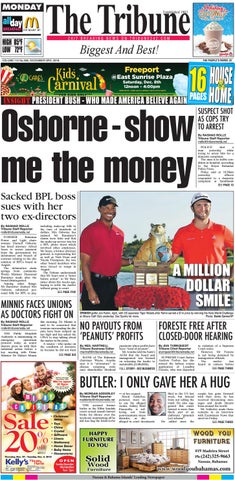
A MILLION DOLLAR SMILE
SPANISH golfer Jon Rahm, right, with US superstar Tiger Woods after Rahm earned a $1m prize by winning the Hero World Challenge at Albany Golf Club yesterday. See Sports for more. Photo: Dante Carrer/AP
NO PAYOUTS FROM ‘PEANUTS’ PROFITS
FORESTE FREE AFTER CLOSED-DOOR HEARING
By NEIL HARTNELL Tribune Business Editor nhartnell@tribunemedia.net
By AVA TURNQUEST Tribune Chief Reporter aturnquest@tribunemedia.net
BANK of The Bahamas chairman Wayne Aranha says it is “premature” to discuss resuming ordinary shareholder dividend
payments when profits have been “kind of peanuts”. Mr Aranha told the bank’s AGM that the board and management was focused on returning the lender to sustainable profitability. FULL STORY - SEE BUSINESS
SUPREME Court Justice Andrew Forbes has dismissed the habeas corpus application of Louisbin Foreste, who was deported
in violation of a Supreme Court order. However, Mr Foreste is not being detained by immigration officials. The matter was heard in camera before SEE PAGE THREE
BUTLER: I ONLY GAVE HER A HUG By MORGAN ADDERLEY Tribune Staff Reporter madderley@tribunemedia.net
THE accused former butler in the $30m Sandals resort sexual assault lawsuit broke his silence over the weekend, maintaining all he did was hug the bride-to-be
— at her request. Moral Adderley, pictured, went on to say his alleged victim, Ashley Reid Pascarella, is suffering not from post-traumatic stress disorder, as she alleged in court documents
filed in the US last week, but instead from not telling the truth. He also suggested this entire lawsuit is more than likely part of an elaborate “gimmick (or) scheme”. He added since the
Nassau & Bahama Islands’ Leading Newspaper
couple has gone forward with their story, he has received threatening messages and death threats from around the world. Mr Adderley made these remarks in an interview with Eyewitness News that aired on Friday. SEE PAGE THREE
THE TRIBUNE
Monday, December 3, 2018, PAGE 3
MORAL Adderley speaking to Eyewitness News.
Butler: I only gave her a hug from page one On Wednesday, The Tribune reported Mrs Pascarella and her husband John Pascarella filed a lawsuit against Sandals in the Supreme Court of the state of New York last Tuesday for $30m. According to court documents, Sandals assigned Mr Adderley to the couple as part of their “dream wedding” package. On April 15, 2016, the lawsuit alleges Mr Adderley “stealthily entered the bedroom of (Mrs Pascarella) and undertook surreptitiously to fondle, grope, and take sexual liberties of (her) beneath her bed-clothes and clothing.” Mr Adderley, however, is vigorously denying that such an attack ever took place. Instead, he maintained that he was “nothing but professional, nice, kind, humorous, (and) decent to them at all times”. The former Sandals employee admitted to pleading guilty to indecent assault in a Magistrate’s Court, but said he changed his initial “not guilty” plea in an effort to escape serving prison time and thus missing his father’s funeral. “I am just here to clear my name… to tell the Bahamian people my side because they have only heard their side,” Mr Adderley told the TV station. “The night before the wedding, (the couple) had a cocktail party round the pool. They introduced me
to their entire family. “Towards the end of the cocktail party, Mr and Mrs Reid* said they were going to turn in for the night. Being a butler, I never left any of my guests until they turned in for the night, that’s when I know service is completed,” Mr Adderley continued. “Upon them saying they were going to bed, Mr Reid asked me if I could bring a couple of bottles of water to the room which I went... to find. “Completing what he asked me to do, I went to the room and I did proceed protocol — which is you knock, assert your name as the butler, within a few seconds if no answer you enter the room. “When I knocked on the door, Mr Reid opened the door, I then asked him where he would like me to place the bottles of water. He said both sides of the bed. “As I proceeded to do that, Mrs Reid was laying down in her bed. She was awake. I asked if she was happy about getting married the following day. She replied she was. “Before leaving the room, I asked Mrs Reid if she would like to place her breakfast order which they did every night. “She placed her breakfast order (and) she said ‘Moral, you’re the best. Can I have a hug before you leave?’ “Mr Reid was in the bathroom area. When I hugged her, he walked out and when he walked out, I said
FORESTE FREE AFTER HEARING from page one Justice Forbes on Friday with McKell Bonaby representing Mr Foreste, and Gary Francis representing the crown. Mr Bonaby told The Tribune: “As Mr Foreste was released from detention before today’s (Friday’s) hearing, there was no requirement for arguments to be given by me for his release or the Crown for his continued detention. His appearance in court spoke for itself.” He added: “I have no comment on why the matter was heard in camera today.” Mr Foreste, 24, returned to the country last Wednesday after having spent just over a month in Haiti. Prior to his deportation, he had been held at the Carmichael Road Detention Centre for three weeks. His return was confirmed by Attorney General Carl Bethel, who said it demonstrated the “reasonable” nature of the government. “If someone apparently has strong documentation and if a procedural error
was made, we address any apparent error, “ Mr Bethel said last week. On Friday, Mr Bonaby said: “Mr Foreste was granted re-entry to The Bahamas two days ago and is no longer being detained by the Department of Immigration. “The attorney general has already issued a statement with respect to procedural issues regarding the deportation. In my view, the application was successful.” The Tribune exclusively reported on Mr Foreste’s case last week. The 24-year-old was born in Abaco to Haitian parents, and later moved to Nassau with his siblings. He was arrested by immigration officials on October 5, and deported on October 27. Of Mr Foreste’s five siblings, his three sisters hold Bahamian citizenship while he and his older brother did not apply. Under the Constitution, persons born in The Bahamas to non-Bahamian parents are entitled to apply for Bahamian citizenship between the ages of 18 and 19.
‘Mr Reid, would you like to place your breakfast order as well?’ He said, ‘Sure’. “After I took his order, he let me out of the room. There was never any issue.” “I proceeded to the butlers’ lounge on the first floor. As I was completing my night duties, I heard a big commotion outside and I walked out and saw Mr Reid. I said. ‘Mr Reid, is everything okay?’ “He said, “No everything is not okay, my wife said you touched her butt.’ “I said ‘That’s obscene. Your wife asked me for a hug which I did... It’s hard for me to touch someone’s butt if they’re sitting in a bed and I’m hugging them.” Mr Adderley also claimed: “The night manager came and said this wasn’t the time or place to deal with this and that they would settle the issue in the morning. “...In the morning, I called their phone in their room to say breakfast was on its way. I was just doing my butler’s job despite the accusation. “The general manager said he needed to see me in his office. I explained everything to them and they told me to go to Cable Beach Police Station and make a report.” Two members of Sandals staff accompanied Mr Adderley to the station when it dawned on him what the situation really was. “I was fired immediately,” he said. Mr Adderley decried the
ASHLEY Reid Pascarella and her husband, John Pascarella. treatment Sandals meted out to him, despite his years of dedicated service. “When I went to the police station, I was arrested immediately. I never had a fair opportunity. “Sandals took the oath of their guests over one of their star employees, someone who had won numerous awards.” Mr Adderley then explained why he went on to admit a charge of indecent assault. “My initial plea was not guilty,” he said. “I made a hasty, unwise decision at the time by not taking a lawyer with me to court because I didn’t know the extent of this case. “My plea was not guilty but when I was in court the magistrate remanded me to prison for three months. Because I am the sole provider for my family, I was a newlywed as well, three months into my marriage. “My father had passed away at the same time. He was cremated by mistake at
Princess Margaret Hospital. “There was so much going on at the time. I would have missed my father’s memorial, my wife and daughter, because I would have been remanded. “When I made the not guilty claim and (the judge) remanded me… I asked her if I was to change my plea what would happen? “She said it would go on my record and I would have to pay a fine to the Crown. My family told me not to but when my father passed away I did not have the chance to see him on his dying bed, the next chance would have been the funeral. “It was unfair but easier for me to plead guilty, pay the fine and walk. To this day, if I could go back there I still wouldn’t change it.” Mr Adderley then addressed the Pascarellas. “The couple as of today are rejoicing, they feel they have a case because I pleaded guilty. “The allegations are devastating because I was nothing but professional,
nice, kind, humourous, decent to them at all times,” the former butler said. “She claims she is suffering from (PTSD) … one day the truth is going to come out. I will have my innocence back and the Bahamian people will see me for who I am and who they really were. “Sooner or later - could be one of their family members is going to come forward and say it’s just a gimmick, a scheme. “I have been getting calls at all times of the night. I have been getting threats on Facebook - from New Jersey, from Dallas, Canada – people have been sending me death threats because they have listened to her side. “I didn’t have a fair chance from the moment they claimed these false allegations.” • Throughout the interview, Mr Adderley referred to the couple as “the Reids” and Ashley Reid Pascarella’s husband as “Mr Reid”. However, the husband’s name is John Pascarella.
PAGE 4, Monday, December 3, 2018
THE TRIBUNE
The Tribune Limited NULLIUS ADDICTUS JURARE IN VERBA MAGISTRI “Being Bound to Swear to The Dogmas of No Master”
LEON E. H. DUPUCH,
SIR ETIENNE DUPUCH,
jamaaltheartist@gmail.com
Publisher/Editor 1903-1914 Kt., O.B.E., K.M., K.C.S.G., (Hon.) LL.D., D.Litt .
Publisher/Editor 1919-1972 Contributing Editor 1972-1991
EILEEN DUPUCH CARRON,
C.M.G., M.S., B.A., LL.B. Publisher/Editor 1972-
Published daily Monday to Friday
Shirley & Deveaux Streets, Nassau, Bahamas N3207 TELEPHONES
News & General Information Advertising Manager Circulation Department Nassau fax Freeport, Grand Bahama Freeport fax
(242) 322-1986 (242) 502-2394 (242) 502-2386 (242) 328-2398 (242)-352-6608 (242) 352-9348
WEBSITE, TWITTER & FACEBOOK www.tribune242.com
@tribune242
tribune news network
The Bahamian workforce is today’s challenge IT WAS indeed a below-the-belt blow to learn from the World Bank that it is easier to do business in the war-torn West Bank and Gaza Strip than it is to do business in The Bahamas. Deputy Prime Minister PK Turnquest himself seemed alarmed, complaining The Bahamas was frequently “short changed” by assessments from the World Bank and other international agencies, which often failed to account for improvements and reforms enacted by this nation. In an interview with Tribune Business recently Mr Turnquest said there will be some legal changes and the implementation of technology solutions “that we think will bring about drastic improvements that warrant a significant upgrade.” However, although technology is a way forward, it is not the full solution. There has to be major improvement in The Bahamas’ workforce. In a letter published in The Tribune earlier this year the writer complained of expatriate staff appearing in hotels while hotel managers were ignoring the large pool of Bahamians available from which to choose. An exasperated reader replied: “Always the same tired argument. Why would they pay more for a foreigner to come in and do the job when there are Bahamians available? The answer is simple, ‘qualified’ Bahamians are not available. If they were they would get hired. This should be a wake up call that we need to better educate and train our population. We are woefully unaware of just how unqualified we are as a nation.” Before we go any further we must acknowledge there are many well qualified and responsible Bahamians in our country. However, there are not enough of them to fill strategic areas to maintain the standards a nation requires to deliver results efficiently. There are also many qualified Bahamians, who have settled abroad, many of them in executive positions. So there is nothing wrong with Bahamians who have a good education - and the right attitude - to see a job to efficient and timely completion. However, there are not enough of them. Too many Bahamians believe that because they are Bahamians they are entitled — with or without effort — to the first pews in the nation — it would seem the only qualification needed is being born in The Bahamas. How many times — especially during the debate on whether Haitian children should be in Bahamian schools - have we not heard the argument that Haitian children should be removed from the classroom to give a Bahamian child a chance to win some of the prizes. While after school the Bahamian child can be seen sitting on the blocks wasting time with his friends, the Haitian child, is at home studiously doing his homework. Of course, it is only commonsense as to who will be better disciplined and better educated to qualify to walk away with the prizes at school and eventually the responsible positions in the country. That’s the law of nature — those at the bottom, who work hard, naturally move into life’s top positions. While those who waste time enjoying themselves because they feel entitled are the loudest complainers about being cheated out of their birthright — something to which they were born, but failed to nurture. Everyone knows the civil service is top heavy with too many staff who do not appreciate the fact that hard working Bahamians pay their salaries, Bahamians to whom they give indifferent
service. Of course, there are exceptions to this statement. However, there are not enough exceptions to cover up the weaknesses of those who are not pulling their weight. As a result our nation trails behind the war-torn Gaza Strip for the ease of doing business – and it will continue to do so unless we understand that much of the fault lies with indifferent Bahamians. As another letter writer spoke for many businesses —both Bahamian and foreign—when he wrote: “I have to take blood pressure pills and Ativan before I enter any government office. They work harder at not working than if they just did their job.” This is the basis of the problem in a nutshell. There is no appreciation of time. In Immigration, for example, when a Bahamian cannot be found to hold a certain position, the business owner has to advertise abroad to search for a suitable applicant. When one is found, interviewed and a contract tentatively agreed, all negotiations are held in suspense awaiting a reply from Immigration as to whether it will issue a work permit so that he can be employed. Meanwhile the Bahamian businessman is not the only employer interested in the applicant, and it depends upon who can close the contract first as to who employs him. We understand there is now a shake-up in Immigration. It must be remembered it is not numbers that are required in that department, but people who understand the need of efficiency and that time is of the essence in business — maybe not to them, but to employers who are searching for the best personnel to keep their businesses competitive. Today a teenager’s life hangs in the balance because of the indifference of Immigration. The 15-year-old needed urgent medical attention — she’s now in the US after much precious time has been lost — because of Immigration’s either indifference or incompetence, which started before the child was born. The child’s mother was born in The Bahamas of two Haitian parents. On attaining the age of 18 she was entitled to apply for Bahamian citizenship. This she did. However, she had to wait another 13 years — thanks to the indifference of immigration staff – before she was granted citizenship. In the meantime her daughter was born before she got her Bahamian nationality and on birth the daughter inherited her mother’s Haitian nationality. Being only 15 the teenager was told she had to wait until she is 18 before she would be considered for Bahamian citizenship. Meanwhile, her life was hanging in the balance as time was ticking away. Eventually, concessions were made. Although too much time has been lost, the teenager is now receiving the medical care in Miami that is not available in Nassau. The question is: has too much time been lost to save her life? And, if so, where should the finger of blame be pointed? We have concentrated on Immigration. But Immigration is not the only government Ministry failing in its duties. We could comment on each government department, starting with the Princess Margaret Hospital, but space will not allow it in this article. However, unless and until there is a change of attitude in more of our Bahamian work force, the war-torn West Bank and Gaza Strip with continue to leave us trailing behind. It is the human factor with which government now has to wrestle.
Climate change a threat to us all EDITOR, The Tribune NO DOUBT the issue on everyone’s lips is the cost of electricity. Recently, a major significant climate change report was issued in the US…deny all you might are we going to sit back and be stupid? Small states like us can do little but if the US - China - India continue to pollute our air with CO2 and we add an LNG generation
plant which is not as clean as the fuel suppliers argue a 45% increase in our local CO2 level will be evident and the associated health issues with that. Gasification needs a lot of water…where is that going to go? President Trump might not agree but for sure we cannot continue pouring gases which are not supposed to be into the atmosphere without a grave danger of causing
problems…simply put we are burning the protective ozone layer and getting too much sun. Prime Minister please be exceptionally cautions not be had - taken for a ride on the contention that LNG is the panacea to resolve our issues. W THOMPSON Nassau, November 24, 2018
The day Chrissy lacked the love EDITOR, The Tribune. THE Old Testament Book of Ecclesiastes 3:8 says that ‘‘there’s a time to love, and a time to hate; a time of war, and a time of peace.’’ The overwhelming majority of Bahamian politicos are standing in solidarity with the Progressive Liberal Party (PLP) as it continues to mourn the passing of its former chairman, Bradley Roberts. He was a worthy opponent of the FNM. He was severely critical of the Ingraham and Minnis administrations. As a PLP, it was his job to keep the FNM’s feet to the fire. However, in light of his passing, it would be uncivil to drag Roberts’ name through the mud in order to score political brownie points. But not everyone is willing to demonstrate political solidarity. Within 24 hours of Roberts’ passing, former ZNS Radio personality Christina “Chrissy Love” Thompson posted a Facebook video of her giving a five minute profanity laced broadside against the fallen PLP chairman emeritus. Mincing no words, Chrissy Love gloated over Roberts’ demise, despite admitting during the rant that she knew several of his children. Despite the hate she gleefully demonstrated, the Facebook video received well over 300 likes from Bahamians, who apparently endorsed its message. It was a new low for a woman few would otherwise expect to show anything remotely resembling civility. The tirade would’ve made the late irreverent American
LETTERS letters@tribunemedia.net stand-up comedians George Carlin and Richard Pryor blush. Chrissy Love’s political hatred of the PLP and Roberts was on full display. Considering the fact that The Bahamas is a social and religious conservative bastion, I always felt that Chrissy Love was not a good fit for Bahamian radio, despite her talent and erudition. Her unconventional message coupled with one of her oft repeated Marxist quotes about religion being the opium of the masses suggests that she would’ve been more at home with the now defunct Air America radio network in the USA where she currently resides. Chrissy Love is probably bitter about being unceremoniously removed from ZNS Radio by the Christie administration in 2012 and from Guardian Radio in 2016. The late Coretta ScottKing once said that ‘‘hate is too great a burden to bear. It injures the hater more than it injures the hated.’’ This was a woman whose husband, Dr Martin Luther king Jr, was assassinated in April of 1968 in Memphis, Tennessee by James Earl Ray. Nine years prior to King’s passing, Mike Wallace and Louis Lomax produced the groundbreaking documentary film The Hate that Hate Produced in 1959, which was about Elijah Muhammad’s controversial and racially divisive Nation of Islam. Throughout the 1960s, the
Nation of Islam’s ideology was juxtaposed to the ideology of King, at least in the minds of millions of Americans. And in the end, the love that King preached triumphed over the hate that Muhammad and Malcolm X preached. Had Muhammad’s ideology of hate prevailed, the US would’ve been gripped by sectarian and racial violence today. In closing, Chrissy Love and those who endorsed her message would do well to emulate Sir Arthur Foulkes and the late Bahamian journalist, Lionel Dorsett – both of whom suffered political and economic victimisation by the Pindling administration. Yet when Sir Lynden died in August of 2000, neither Foulkes nor other prominent FNMs gloated over his demise. The entire country rallied around the PLP and the Pindling family. Despite what transpired between FNMs and PLPs between 1970 --1992, FNMs today still consider Sir Lynden to be the father of the nation. When the FNM under Ingraham toppled the PLP in August 1992, Dorsett did not seek retaliation against those PLPs who caused him and his family unnecessary hardship. Love prevailed. Whatever Chrissy Love believes that the PLP did to her and her once promising career in journalism in The Bahamas, it was simply classless of her to broadside the deceased. I believe she is better than that. She went way too far. KEVIN EVANS Freeport, Grand Bahama November 4, 2018
Time for minister to resign EDITOR, The Tribune I have long been a political and fraternal supporter of the Hon Doctor Duane Sands (FNM-Elizabeth). He is a skilled medical practitioner but, in my view, a ‘bad’ politician and people’s person. The now ongoing ‘strike’ by the major doctors’ union and the public utterance by the equally medically adroit Prime Minister, that he would have ‘a word’ with the President of that union are severe indictments on the effectiveness of Dr Sands remaining Minister of Health.
Dr Sands seems to be unique in antagonising personnel who fall under his permit as minister.. He also seems to be prone to verbal and political gaffes. The other month he admitted that ‘waste’ within the PHA system was endemic. He lamented that medical personnel were abandoning our health care system for greener pastures. He also has been a bit slow on rolling out a sensible and saleable National Health Insurance Plan. Maybe he does not know what the hell he is doing?
The PM slapped Dr Sands straight in his face and on his semi-bald head (like mines) when he announced that he would get directly involved in negotiations. Where is the Director of Labour? Where are the rest of those FNMs who crowed ‘ It’s the People’s Time?’ To God then, The Great Physician, Who said : ‘Physician heal thyself...’ , in all things be the glory. Jr
ORTLAND H BODIE Nassau, November 29, 2018.
THE TRIBUNE
Monday, December 3, 2018, PAGE 5
SPECIAL BLESSING CARRIED OUT AT PMH
FATHER Sebastian Campbell blessed the newly-renovated Corey Newbold Ward and Radiology Department at Princess Margaret Hospital last week. A SPECIAL blessing ceremony was held last week at the newly renovated 24-bed Corey Newbold Ward and the recently renovated Radiology Department at Princess Margaret Hospital. Both units were a part of comprehensive upgrades undertaken over the past six months. Apart from the reintroduction of bed space at the Corey Newbold Ward, renovations included new flooring, a new air conditioning system with cross ventilation and air flow exchange, newly installed piped gases, air and medical gases at each bed station, the introduction and installation of a new nursing call bell system at each bedside. The new ward also features two patient isolation rooms,
with proper airflow exchange, enhanced life safety infrastructure, access to the new digital imaging and laboratory systems, along with a complete resourced nurses’ station, a staff lounge and a consultation and examination room. Renovation works in the radiology department included improvement works to the patient waiting room, which features new wooden flooring, and the installation of a focal scenic pictorial wall. The evolution from analog to digital for the unit involved the upgrade and installation of a new digital x-ray and a digital fluoroscopy machine, with the introduction of the new picture archiving and communications system (PACS), along
Osborne show me the money from page one
Attorney General Carl Bethel confirmed to The Tribune yesterday his office is in talks with representatives for the trio. Mrs Osborne declined to comment when asked recently. Her willingness to pursue legal action against the Minnis administration highlights how much her relationship with the Free National Movement has frayed. She resigned as a member of the party this summer, having served as a major fundraiser who, a source said, raised thousands for the party ahead of the last general election. Mrs Osborne resigned as BPL’s board became increasingly dysfunctional, disintegrating into two factions, one involving her, Mr Dean and Ms Thompson and the other involving Patrick Rollins, Ferron Bethel and Whitney Heastie. Prime Minister Dr Hubert Minnis promised in August he would launch an investigation into the saga. Three months later, he has failed to fulfil his pledge. Mrs Osborne, Mr Dean and Ms Thompson are only the latest to seek payment from the Minnis administration because of circumstances surrounding their departure from public office. This list includes former Christie administration consultant Sir Baltron Bethel, former financial secretary Simon Wilson and former
DARNELL Osborne is pursuing legal action acgainst the Minnis administration. Water & Sewerage Corporation chairman Glen Laville. Mr Wilson and Mr Laville have both sued the government, The Tribune understands. As for Sir Baltron, he told The Tribune yesterday he and the government came to a “mutual agreement” in his matter but he declined to elaborate. Dr Minnis revealed last year that Sir Baltron’s contract with the government had been extended and significantly increased before the 2017 general election. He told parliamentarians he cancelled the contract and refused to honour its terms. The Attorney General declined to reveal the government’s arrangement with Sir Baltron, citing confidentiality.
It is unclear how much money the former BPL board members are demanding, however Mr Sears has experience seeking substantial payments for people who have had bad breaks from the government. In 2013, he initiated wrongful termination proceedings on behalf of Algernon Cargill, the former National Insurance Board director who was fired by the Christie administration following an audit by Grant Thornton. Under the Minnis administration, Mr Cargill reached a settlement of $300,000. Mr Sears also represents Mr Wilson. Mr Bethel said yesterday that the administration is in talks with Mr Sears concerning Mr Wilson’s matter.
with enhanced renovation works for two examination rooms. Recently, PMH’s Children’s Ward also received a significant donation from British American Financial Global Group (BAF) with the gift of a Nellcor pulse oximeter. The presentation was led by Deborah Parker, VP human resources at BAF and Astrid Rolle, manager BFG Services Ltd, both of whom were instrumental in identifying the hospital’s Children’s Ward as the beneficiary. The equipment donated allows for real time reporting of pulse rates, blood pressure and oxygen saturation on one device resulting in better management of the patient. According to Ms Parker, “BAF
Photos: BIS
held a fiesta to give back to our community back in August and encouraged members of the public to make small donations toward a charitable contribution to the PMH Children’s Ward. Today’s donation is the result of BAF Global Group’s commitment to give back and the donations of members of the public.” Receiving the pulse oximeter on behalf of the staff of Children’s Ward was Consultant Paediatrician Dr Marcia Bassett along with Sister Rebecca Johnson. BAF Global Group has committed to making this an annual initiative; and is continuing a dialogue with Children’s Ward staff to tailor future donations to other needs the unit may have.
PAGE 6, Monday, December 3, 2018
THE TRIBUNE
Free clinics help those affected by doctors’ industrial action By MORGAN ADDERLEY Tribune Staff Reporter madderley@tribunemedia.net AFTER hosting two free clinics on the weekend for patients affected by doctors’ ongoing industrial action, Dr Harold Munnings expressed gratitude yesterday to the team that helped him. Dr Munnings, a gastroenterologist, offered the special clinics outside his Grosvenor Medical Centre office in the wake of senior physicians at Princess Margaret Hospital (PMH) withdrawing their services last week. The clinics were offered last Friday and Saturday to accommodate patients affected by the doctors’ actions. They ran from 10am-1pm on Friday and 9.30am12.30pm on Saturday. Priority was given to elderly and Family Island patients. “I want to thank the team that helped me to pull off the two free clinics. We did have two free clinics, Friday and Saturday as advertised - at least, we put out on social media,” Dr Munnings told The Tribune yesterday. “They were open to anyone who was displaced from a public clinic at PMH due to their troubles, the industrial action going on.” Dr Munnings said he is not part of the industrial action, having retired from PMH over the summer after 33 years of service. “I want to thank the team of doctors that helped me to pull off the free clinic…Dr Timothy Barrett, Dr Sheena Antonio-Collie, Dr Judson Eneas,” he said. “I want to thank my brother, Leslie (Munnings) who provided (a) tent and chairs and ice and bottled water to hand out to anticipated overflow. And then the 10 members of my staff who came out to provide…support for the clinic, security, and so on.” Dr Munnings added the three doctors who participated are Doctors Hospital consultants who are also not part of the industrial action.
DR HAROLD MUNNINGS, second from left, rear, and a team of healthcare professionals held two free medical clinics on the weekend. Last Tuesday, 115 senior doctors of the Consultant Physicians Staff Association (CPSA) went on ‘work-to-rule,’ meaning they would only provide limited services, in a move seen as crippling to healthcare. Senior doctors are fighting for a base salary increase from $48,000 to $75,000. However, the Public Hospitals Authority
reportedly would only agree to an increase of up to $60,500. PHA activated its emergency operations centre in the wake of the action, declaring all outpatient specialty clinics and elective surgeries have been cancelled until further notice. On Wednesday, Prime Minister Dr Hubert Minnis commended the actions of Dr Munnings’
clinic. “The last thing any doctor wants to do is jeopardise patients’ care,” Dr Minnis told reporters. “That is not our training. I’ll give an example. “There is a particular doctor who, because he feels that patients may possibly be delayed in receiving their healthcare, he has offered services at his private office, but once an individual has
a booking for any particular clinic and they cannot be seen, they can come with that appointment plan to a private facility and be seen by him, free of charge. “That’s how doctors are. We are not driven by money. We are driven by our profession, which is to care for people. The last thing a doctor will do is compromise individual’s care.”
MINNIS FACES UNIONS AS DOCTORS FIGHT ON from page one
to jeopardise the pending talks - said Dr Minnis wants to use the influence of his office to provide a resolution. The doctors will continue their service withdrawal until their issues are resolved, however. For them, the meeting with the prime minister will go a long way to determining how long their protest lasts, and whether it should be ramped up. Meanwhile, the Medical Association of the Bahamas, which represents over 300 doctors in the country, knocked the PHA yesterday for failing to negotiate with the CPSA last week. In a press statement, MAB President Dr Marcus Cooper said: “It is unfortunate that the PHA has chosen to gamble with the healthcare of Bahamians by disregarding the value of senior physician input in the management of ambulatory and hospitalised patients. All physicians have taken an oath to help the sick and prevent harm, it is deeply troubling when we are portrayed as insensitive and uncaring.” He also said: “While physicians continue to work in unfavourable conditions with minimal resources and inadequate support, management repeatedly fails to improve efficiency and create a culture of accountability. For years there has been no substantial attempt to improve billing and collections or to enhance public private partnerships to generate additional income, but physicians are labeled as under-performers.” Dr Cooper said the MAB will do what it can to mitigate the inconveniences that have resulted from the CPSA’s industrial action until the dispute has been resolved.
PRIME Minister Hubert Minnis is expected to meet with leaders of unions across the country today. The dispute comes as Dr Minnis is expected to meet with leaders of unions across the country today, though it’s not clear how many union heads will attend. Trade Union Congress President Obie Ferguson told the Nassau Guardian last week that he will not attend the meeting because he has a court matter to deal with. A CPSA source said the association will not be represented at that general meeting either, finding it unlikely that its unique concerns could be dealt with in a such a setting. The group will meet with Dr Minnis separately, this newspaper understands. Paul Maynard, president of the Bahamas Electrical Workers Union, said yesterday that he will attend the general meeting. Bahamas Union of Teachers President Belinda Wilson also said she will attend. Most other union heads could not be reached before press time.
CPSA doctors have no industrial agreement and have not had a salary increase in ten years. They have agitated for a base salary increase from $48,000 to $75,000, for health insurance benefits and for a pension plan. Last week, CPSA President Dr Locksley Munroe said the PHA identified provisions for a $28,000 increase for doctors that officials wanted to divide between an increase in base salary and bulk payments. The CPSA found the $28,000 inadequate and the two sides disagreed on how the money should be distributed. At some point last week, however, the doctors reluctantly agreed to the $28,000, saying they would accept a base salary increase of less than $75,000 along with health insurance benefits and a pension plan. The PHA has said it will not negotiate with the doctors while they are engaged in industrial action.
THE STORIES BEHIND THE NEWS
MONDAY, DECEMBER 3, 2018
GEORGE HW Bush is greeted by Saudi troops and others as he arrives in Dhahran, Saudi Arabia in November 1990. By JAMES GOLDGEIER American University School of International Service
THERE are many reasons to miss George HW Bush, the 41st President of the United States who died at the weekend. A World War II hero, he later served his country with great distinction in a number of important positions before becoming vice president and then president. The outpouring of warm feelings first for his wife, Barbara Bush, who passed away earlier this year, and now for him, reflects not only the role President and Mrs Bush played in American history but also the decency they represented in a political system that now has become full of indecency. Strikingly, George HW Bush was also the last person elected President of the United States with any prior foreign policy experience. He entered office with one of the most impressive resumes of any President, having served as director of the Central Intelligence Agency, ambassador to the United Nations and Ronald Reagan’s vice president. He left office with an impressive list of achievements, including the unification of Germany within NATO. As historian Jeffrey Engel has reminded us in his excellent recent book When the World Seemed New, this was far from assured. British Prime Minister Margaret Thatcher and French President François Mitterand were deeply opposed to Germany’s unification, while Soviet leader Mikhail Gorbachev opposed not only unification but the incorporation of the former East Germany into NATO. Germany’s leadership in Europe as a force for democracy and human rights since those years has clearly vindicated President Bush’s instincts to support West German Chancellor Helmut Kohl in his efforts in 1990. A major high point of the George HW Bush presidency, pictured below with his wife, however, was also the harbinger of disappointments to come: the swift military victory that reversed Saddam Hussein’s invasion of Kuwait and seemed to herald a new era in world affairs – but left Saddam Hussein in power. In 1991, it seemed America could do anything it wanted to in the world – politically, diplomatically and militarily. But no one could have imagined 27 years ago the role that Iraq would come to play in American foreign policy in the ensuing years and the loss of American lives, money, standing and self-confidence that resulted from U.S. involvement in that country. A month after Iraq’s invasion of Kuwait, in September 1990, Bush and Gorbachev issued a joint statement noting that “no peaceful international order is possible if larger states can devour their smaller neighbours.” That same month, Bush declared, “We’re now in sight of a United Nations that performs as envisioned by its founders.” The problem was that while the United Nations was set up to prevent powerful states from invading weaker neighbours, as Germany and Japan had done in the 1930s and 1940s, the main challenges of the postCold War world – prior to Russia invading Ukraine in 2014 – were different. They were mainly internal challenges: failed states and civil wars in places like Somalia, Rwanda, the Balkans, Afghanistan and eventually Iraq after the disastrous US occupation following the 2003 war. The US effort to put together an international coalition against Iraq in 1990 was
A president who delivered a moment to America when anything felt possible stunning. Secretary of State James Baker met with every head of state or foreign minister whose country held a seat on the UN Security Council. That meant not just meeting with those countries that had permanent seats like the Soviet Union and China, but also those holding rotating seats such as Ivory Coast, Romania and even Cuba. Baker’s efforts were successful. The Security Council passed UN Resolution 678 on Nov. 29, 1990 and established Jan 15, 1991 as the deadline for Iraq to withdraw its troops from Kuwait or face a US-led international coalition to force its withdrawal. The coalition made good on the threat. As Colin Powell told my co-author Derek Chollet and me in an interview for our book on the period: “The Gulf War was the war against the Russians we didn’t have. There were no trees and no hills, but that’s what we were trained to fight. The Iraqis sat there and we kicked the shit out of them.” For those who had suffered through the morass of Vietnam and the crisis of American confidence that followed, it was the ultimate feel-good moment. An estimated 800,000 people packed the National Mall to cheer their military heroes. Bush came out of the war with a 90 percent public approval rating. And yet, the following year, a candidate with no foreign policy experience who had avoided military service in Vietnam won the presidency. By 1992, the Cold War was over, and Bill Clinton campaigned with the mindset that it was “the economy, stupid”. But while Clinton defeated Bush, he inherited the Iraq problem from his predecessor, who had chosen not to remove Saddam Hussein in order to keep his UN coalition together. Clinton was faced for eight years with patrolling the no-fly zones established over the north and south of Iraq to protect the Kurdish and Shiite populations. Clinton passed the Iraq problem off to George W Bush, who in the aftermath of the attacks of Sept. 11 made the fateful decision to go to war in 2003 – this time without UN authorisation. Bush and his “coalition of the willing” removed Saddam Hussein, leaving the United States as an occupying power. And while Barack Obama promised – a promise on which, for a fleeting moment, he seemed to deliver – a US withdrawal from the country, he was forced to go back in militarily with the rise of the Islamic State, handing off the Iraq problem to his successor to manage. Even as Donald Trump
presided over tremendous military success against ISIS, Iraq remains a diplomatic and military challenge for the United States. The 2003 war left Iran ascendant in the region, and it cost the United States not only significant blood and treasure, but so much of the standing and legitimacy it gained in 1991. Thus the promise of the Gulf War – the US dominant like no other since ancient Rome, confident that it could rule the world on behalf of freedom and democracy – gave way over time to doubt and confusion. In the post-Cold War world, the US military was largely called upon to handle internal conflicts – in Somalia, Bosnia, Kosovo, Afghanistan, Libya and, throughout it all, Iraq – and the results have proved deeply dissatisfying. In 1991, George HW Bush declared victory and celebrated with a parade. In 2011, there was no parade for Libya. There will be no parade for Afghanistan. If Donald Trump ever holds a military parade in Washington, DC as he once discussed, it will take place in an America exhausted
from its long wars and feeling far less confident in its role in the world than it was back in the George HW Bush years. It’s fitting that George HW Bush, World War II military hero and Cold War veteran, is the last president to preside over what at the time felt awesome: a major military victory fought on behalf of the entire world against a dictator. His successors, none of whom served in the military and all of whom have wrestled with post-Cold War challenges, have been vexed not only by Iraq, but by challenges posed by non-state actors while trying to manage regional threats emanating from China, Russia and Iran. While Bill Clinton, George W Bush, Barack Obama and now Donald Trump have each in their own way tried to define American leadership, George HW Bush’s presidency represents the moment at the end of the Cold War when anything seemed possible for the United States in world affairs, and the underlying challenges were only just beginning to become visible. * theconversation.com
PAGE 8 MONDAY, DECEMBER 3, 2018
By MALCOLM STRACHAN
R
ECENT weeks have unfolded with labour relations fracturing across various sectors, but one in particular has the potential to destabilise the nation. While threats have lingered over the past few months, senior doctors walked off the job leaving a monumental strain on the public health sector as negotiations failed yet again between the Consultant Physicians Staff Association (CPSA) and the Public Health Authority (PHA). The PHA, left with no other choice, had to temporarily cancel emergency services last week. Imagine that. Had we been hit by a disaster, we could have faced a doomsday scenario. And for what – the buck continually being passed down the line? Surely, successive administrations would have known that doctors in the public health sector are grossly underpaid. When one takes into account the time and money invested in training in the medical field, they are only able to make a gratifying return when able to open a private practice. Let’s not fool ourselves – when governments want to find the money to pay for something, particularly when it is politically expedient, they find a way. This much is true - we’ve seen an introduction of VAT and a subsequent increase in July of this year, yet the CPSA still endures the same plight. Now, with the junior doctors and quite possibly the Nurses’ Association soon to follow suit, we may be on the brink of a fullon collapse, which we dare not imagine. Although the prime minister has stepped in and supposedly made attempts to bring all parties to a mutually beneficial middle ground, this hasn’t been the first time he’s indicated he would speak to the CPSA. And with no ebb in the tension that has existed for quite some time, it may be safe to assume a raise is not in the cards at this current juncture. This has perhaps become most evident with the prime minister’s invitation to a meeting at the
INSIGHT
EMAIL: insight@tribunemedia.net
Who’s really left to suffer as doctors dispute goes on?
DR Locksley Munroe and Dr Melisande Bassett, right, are campaigning for a better deal. Office of the Prime Minister that was extended to all unions that have had tense labour relations over the past few months. With the CPSA and PHA dispute possibly having the greatest impact on society if progress isn’t made, the decision to not focus solely on one union issue at a time has been befuddling to say the least. Certainly, Trade Union Congress president Obie Ferguson shared these sentiments last week. While noting that he, as well as all unions, would be open to meeting with the prime minister at any time, he seemingly prefers to avoid being party to an elaborate
publicity stunt when lives can possibly be at stake. And who can blame him? This is the time to simply present yourself to the people as a prime minister interested in hearing the issues. Minnis needs to strictly be about solving the issues, and a prudent person would know that trying to examine all the issues at once as opposed to prioritising them is a fool’s errand. The prime minister, a doctor by profession himself, who is fully aware of the hard work and dedication it takes to perform in this role, should be able to appreciate how undervalued these men
and women must feel. However, on the occasions he’s commented on the dispute, there seems to be no impetus on his part to address their concerns. Instead, his only retort is that as doctors, they would be unable to allow Bahamian people to suffer, as it is not a part of their nature. While this may be true, in last week’s column, the question was asked: “What happens when enough becomes enough?” When people have had their fill of poor treatment, they feel that it is time to take a stand. And the reality is caving in under pressure now will never get them the
respect they feel they deserve. But where does that leave us? Prime Minister Minnis may be practising his best poker face, but he is certainly playing a dangerous game. Strictly by the numbers, out of 2400 deaths that took place in The Bahamas in 2016, 74 percent of them were as a result of non-communicable diseases such as diabetes, heart disease, respiratory diseases and cancer. Alarmingly, over 50,000 people (approximately 30 percent) suffer from diabetes across the archipelago. Additionally, 32 percent of adults and 15 percent of children are suffering from obesity. This list can go on and on, and one thing will not change, we are on a very risky path if the trend persists – that’s with or without the doctors going back to work. With these realities in mind, the prime minister should fully be aware of the severity of the nation’s health issue. Likewise, he ought to know that while focusing on balancing the budget may prevent an immediate remedy, they must commit to increasing the pay and providing other benefits such as insurance and pension to the CPSA at some point in the very near future. It seems as if the medical professionals simply want to be valued, and there’s no secret they have gone unappreciated for eons. In all likelihood, these parties will come to some form of an agreement, as politically, the prime minister cannot afford for this to continue any longer. We certainly hope so because it will be the nation’s most vulnerable with the most to lose.
EMAIL: insight@tribunemedia.net
INSIGHT
MONDAY, DECEMBER 3, 2018 PAGE 9
CARICOM must not sit idle as Haiti’s torment drags on
H
AITI continues to be an unsettled country politically. Demonstrations against successive governments have become almost normal, and so too, tragically, are the deaths associated with them. No one should be surprised at the continuous unrest in Haiti. It has been an impoverished country for too long, exploited by external forces and mismanaged by internal administrations. The latest unrest flowed from citizens demanding an accounting for $31 million provided by Venezuela under its “Petrocaribe” arrangements. Reported police violence against demonstrating civilians led to the deaths of several people and the injury of others. Amnesty International rejected “excessive use of force” and declared that “police security operations must be carried out with a focus on the prevention of violence and guaranteeing the rights to peaceful assembly and freedom of expression, rather than repression”. Rightly, the Secretary-General of the Organisation of American States (OAS), Luis Almagro, issued a statement cautioning the government to uphold the right to free association and expression, while condemning violence; urging it to hold an inclusive dialogue on governance “to ensure greater social peace and growth”; and reiterating the OAS’ readiness to assist in efforts to strengthen democracy and the institutions of governance. Unlike other statements on Venezuela by which Mr Almagro compromised the good offices role the OAS could have played in that country, his statement on Haiti was exactly what is expected from the Secretary-General of a crucial hemispheric organisation. Given that Haiti is a member of the Caribbean Community (CARICOM), it would have been beneficial if that organisation’s Secretary-General had also publicly commented on the situation in Haiti in terms akin to Mr Almagro’s. Haiti’s membership of CARICOM comes with commitments to the values of the community upon which CARICOM should insist. The OAS Secretary-General dispatched a team to Haiti to assess the situation and to reaffirm the Organisation’s willingness to help promote dialogue and avoid further violence. At the very least, CARICOM should have done the same. Respecting the rule of law and democratic rights is as much an obligation of governments as it is of all other sectors of society. The allegations of corruption related to the Petrocaribe funds, have not dissipated. Having found traction among the community, the organisers of the protests are unlikely to allow the momentum to dissipate. Their concerns assume greater importance because an investigation by the Haitian Senate suggested malfeasance and corruption by several high-level officials in previous administrations and perhaps the present one. The continuous political confrontations in Haiti and the readiness of governments to deploy police without constraint to suffocate dissent, are fed by the desperate economic circumstances of the country. Deprivation, inequalities and intense frustration forge the collective fuse that can be easily ignited. Most of the people of Haiti exist in dire conditions. Eighty-seven percent of the population is desperately poor; life expectancy is 63 years; infant mortality is 55 per 1,000 births; two-thirds of the 11 million people do not have regular employment; only 50 percent of school-age children attend school; and the level of literacy is just 61 percent. The country’s debt is huge, estimated at roughly $3.5 billion and its debt service is high. The government’s annual budget is approximately $2.3 billion. Over the last few months, the Haitian currency has devalued by 11 percent and the financial situation of the government
SECRETARY-General of OAS, Luis Almagro.
HAITI’S President Jovenel Moise, right, walks past national police after being sworn In at Parliament in Port-au-Prince, Haiti in February 2017.
treasury and some government entities is dire. Contemplating how to address the condition of Haiti in order to promote economic development and improve the standard of living, is more than a head-scratching exercise; it is almost mind-numbing. Yet, the nations of the hemisphere, Caribbean countries particularly, cannot simply decide to leave Haiti to its own devices. Historically, politically and culturally, Haiti symbolises the Caribbean people’s struggle to free themselves from slavery and oppression and to stand up as the equal of all. The Caribbean owes it to itself as much as to Haiti to never abandon it and always to be engaged in seeking its advancement. Beyond this, Haiti’s circumstances have driven a large number of its people to flee continually. The United States, Canada, the Dominican Republic and the Bahamas have borne the brunt of Haitian refugees. If nothing is done to improve the conditions in Haiti, refugees will also reach the shores of other CARICOM countries, especially now that Haiti has been admitted to the Single Market, granting its nationals the right to enter and remain for six months. The beginnings of a solution to all this resides in a compact between the political parties in Haiti. Writing those words is easy; achieving their meaning is a Sisyphean task as I know from the tortuous experience of leading an OAS delegation to Haiti in 2016 that helped to avoid civil war and chaos. Yet, however, daunting the task, it must be pursued vigorously and encouraged diligently by the countries of the OAS, including the Caribbean ones. President Jovenel MoÏse won a supervised election in March 2017. In the interest of instilling Haitian respect for democracy and of maintaining political stability, he should be allowed to complete his term in office – a term that should adhere to the rule of law and respect for human and political rights. But he must be willing to see “governance” beyond “government” and be open to inclusionary dialogue with other political players that is purposeful, not perfunctory. The Prime Minister, Jean-Henry Céant, stated recently he would appoint to his cabinet leading opposition personalities such as Mirlande Manigat and Jean-Bertrand Aristide. He has also floated the idea of a Club of former Presidents “to facilitate the smooth functioning of the State”. Whether members of the opposition will take-up either of these offers or propose their own ideas for national consultation and action is left to be seen. What is certain is that Haiti cannot afford instability and further economic decline. The governing and opposition parties must be encouraged by all to sit at the table of governance, and CARICOM must play an active role. The writer is Antigua and Barbuda’s Ambassador to the United States and the Organisation of American States. The views expressed are his own. Responses and previous commentaries: www.sirronaldsanders.com
PAGE 10 MONDAY, DECEMBER 3, 2018 As the Bahamas takes its first tentative steps in the debate on legalising cannabis for medical use, one of our northern neighbours shows how we are light years behind other societies in recognising the medical and economic benefits of the drug. By AMANDA SIEBERT
W
HEN Canada fully legalised recreational cannabis on October 17, the internet giddily reimagined the CN Tower in Toronto peeking out from a thick haze and swapped the flag’s red maple leaf for its jagged-edged green cousin. Outsiders might titter about an entire populace turning into potheads, but legalisation means some of the country’s brightest can now turn their minds to pot. As the first G-7 nation to slacken cannabis laws, Canada has bolted to the front lines of the plant’s methodical scrutiny and investigation. No longer at risk of censure or lacking access to specimens, researchers can transcend the narrow parameters of scientific study once considered acceptable, namely, clinical research, to explore social, biological, genetic and agricultural questions. From botanists to phytochemists, microbiologists to epidemiologists, scientists of all sorts are free to openly pursue a greater quantity and quality of cannabis science than ever before. Ninety-five years of prohibition has made for a rather brief encyclopedia entry, meaning what we do know mainly comes from anecdotal observation and short-term studies. But Canadian laboratories aren’t starting from scratch. It was Canada, in 2001, that became the first country to sanction the medical use of marijuana. It was a Canadian team, in 2011, that published the first sequence of the cannabis genome. Yet these landmark contributions, and the array of peer-reviewed studies that were spurred, rarely strayed past lines of inquiry that ran parallel with social norms. Research lurched forward with the early legal steps, offering sick and suffering Canadians a new option to manage chronic pain, treat symptoms of PTSD and boost their overall quality of life. It dwindled under Prime Minister Stephen Harper, a Conservative who slashed health and drug policy budgets and slammed cannabis as “infinitely worse” than tobacco (experts say it’s the other way around). Research multiplied again in 2014, when commercial growers got clearance to supply mail-order medical marijuana to Canadian patients, commodification that simultaneously energized corporate interests. Canada’s brand-new legislation, the Cannabis Act, replaces a restrictive system that treated researchers like would-be drug dealers. Scientists intending to cultivate their own plants can now simply apply for a specific class of licence rather than toil for an exemption from the retrograde Controlled Drugs and Substances Act, which, among other demands, required criminal record checks. The Canadian government, once unwilling to touch the stuff, has stepped up to properly examine how cannabis affects the body and brain. It’s funding 14 new studies and has set aside millions more for research grants that could ask questions like -Will a pregnant mother using cannabis harm her baby’s development? Does smoking affect drivers’ reaction time behind the wheel? And at what threshold does teenagers’ pot consumption become destructive? Canada’s private sector is even more frenzied over the business case for audacious research. In the lead-up to legalisation, producers rushed to get medical licences so they could formulate novel cannabis-based products. Already, more than 130 companies have been approved, with hundreds more in line. The industry’s leaders have opened large-scale trials, including exploring the plant’s power to alleviate chemotherapy-induced nausea and reduce seizures in epileptic children. A multimillion-dollar university professorship has been established to investigate a cannabis solution to the opioid overdose epidemic.
INSIGHT
EMAIL: insight@tribunemedia.net
Canada’s grand cannabis experiment has set scientists free
REPRESENTATIVES from cannabis companies rang the opening bell for the Toronto Stock Exchange when it opened on the first day of trading.
Legalisation will vastly expand our understanding of the ancient drug plant and how it can improve lives Smaller businesses are dabbling in the renegade development of infused creams and potent concentrates. And academia and non-profits are leveraging industry to fund more daring studies and advocacy work, for instance, realistic educational programming to develop teenagers’ “cannabis literacy.” With the legal barriers torn down, a path has been cleared for Canadians to stake a global claim in the emerging field of research. New science projects are taking shape in Europe, Israel and Australia, many the fruit of joint ventures with Canadian companies, others made possible only with imported dried medical marijuana and cannabis oil from Canada. The country has become “the de facto source of researchgrade cannabis around the world,” contends Philippe Lucas, who is the head of research for the Canadian producer Tilray, which has completed exports to 10 countries. Canada’s grand experiment has already been a catalyst for smarter science in the United States, where its federal prohibition has choked research. Although 33 states have relaxed their marijuana laws, only one facility in Mississippi is federally licensed to supply dried cannabis, and its product is often derided by researchers as lacklustre. Enter Tilray, which, in a rare first this September, was approved by the Drug Enforcement Administration to supply cannabis extract from Canada to a California
neurologist who’s developing a treatment for tremors in the elderly. (Tilray has also built a greenhouse in a Portugal research park, expanding the science into the European Union). America’s cannabis entrepreneurs, however, aren’t so keen on the prospective northern pot pipeline. One multi-state medical grower has pleaded with President Donald Trump for domestic regulation in a full-page Wall Street Journal ad, fretting that “America is rapidly losing its competitive advantage to Canada!”
A
S bidding wars replace the drug war, legalisation promises empirical evidence for policymakers caught between popular sensibilities and a paucity of data. Canada’s statistical agency and the country’s health ministry are already gathering information from a newly visible population of cannabis users. The metrics could enable jurisdictions worldwide to devise policy reforms and public health programmes that minimize legalization’s potentially negative impacts. The scholarship on cannabis will finally advance now that a developed, Western society has welcomed back an ancient drug plant, says Jonathan Page,
a Vancouver-based plant biologist and a leader of the cannabis genome project. Therapeutic marijuana application dates back thousands of years, according to archaeological and historical records. In June, Page sold his laboratory Anandia to one of Canada’s largest growers, Aurora Cannabis, for 115 million Canadian dollars ($88 million), and last week he was appointed its chief science officer, overseeing some 40 PhD and MS-level researchers. He envisions Canadian scientists conducting a cornucopia of taboo-defying research, from decoding cannabis’s sensory appeal to testing whether it can be used as a substitute for alcohol. Science, he says, could even settle the perennial debate over whether there are, in fact, two types of cannabis: sativa, said to provide uplifting, cerebral sensations, and indica, considered to be sedating. “Marijuana’s hard-won return to the Canadian mainstream suggests that psychoactive plants matter to modern lives and will continue to shape human culture,” he said. “Prohibition was just a blip on the timeline of civilisation and a dark age for science.” In an age of global paranoia, Canada’s decisive leadership has produced a veritable green-field opportunity. It’s incumbent on our scientists to do the ploughing. * Copyright The New York Times
THE TRIBUNE
Monday, December 3, 2018, PAGE 11
Investigations by police into ‘appalling’ slap incident drag on By RASHAD ROLLE Tribune Staff Reporter rrolle@tribunemedia.net THE Royal Bahamas Police Force is still investigating a recent viral slapping incident involving one of its officers. In the video, made public nearly two weeks ago, a man accused of loitering downtown was slapped in the head after taking a document from a police corporal. National Security Minister Marvin Dames called the incident “appalling”. Deputy Commissioner of Police Emrick Seymour, the person responsible for disciplinary matters, told The Tribune it “shouldn’t take an extraordinary time” to investigate the incident although he couldn’t say exactly when the investigation will be completed. Despite public outrage over such videos, police rarely make a point of revealing its findings to the public. In September, DCP Seymour told The Tribune an
A VIDEO grab of the two people involved in the ‘slapping’ incident.
MOTORISTS ANGRY AFTER POWER OUTAGE CAUSES MAJOR DELAYS By RIEL MAJOR SCORES of disgruntled customers criticised the Road Traffic Department’s automated cashier system process on Friday after processing times were delayed for nearly five hours due to a power outage. The last day of the month is known as the department’s busiest time, with motorists having to renew their driver’s licences, registration renewal and inspection of their vehicles. Unfortunately, RTD customers were forced to wait over three hours just to pay the cashier for their service. The Tribune canvassed queued motorists, who spoke on the condition of anonymity and complained about the long lines for
their cars to be inspected, and the longer line to pay for their new licence or vehicle disc. “This is ridiculous,” said one woman. “People have things to do. They tell us the electricity was off and we must go to the Carmichael Road branch…just to come back here to pick up your licence because that branch can’t print your licence.” Another woman said: “I been here all day waiting to be served and the security attitude was disgusting. They try tell us go to Carmichael Road after waiting almost two hours people have things to do… I had to call into work now when payday come my pay will be a day short.” One angry man said: “If I leave and get stop by the (police) I can’t tell the police Road Traffic light was off.
BPL and Road Traffic need to get it together. An entire day wasted.” “They have a generator but I was told it was used to keep the place cool,” said a disgruntled woman. “What kind of mess is that? Why have a generator that can’t power up the machines?” “Today was a big mess. Something has to be done so in the future it’s a smoother process,” said another man. Another angry woman said: “The security guard’s attitude is deplorable. She don’t know how to talk to people in a respectable manner. But, I’m so relieved to be served after waiting almost five hours.” The Tribune tried to contact Bahamas Power and Light officials for an explanation for the power outage but efforts were unsuccessful.
incident that went viral that month was under investigation, but the findings of that probe is not known. In that instance, a video showed a bloodied man in handcuffs crying for help as a police officer knelt on his chest. The clip was shared a few thousand times on Facebook. When the suspect said “all my hand and thing bleeding, real talk,” the officer said “shut up, shut up.” As the suspect heightened his pleas, complaining his hands were bleeding, the officer said: “Yeah your (expletive) neck gon’ be bleeding soon.” In May, DCP Seymour told The Tribune an incident that went viral that month was also under investigation, but police have not yet disclosed the findings from that investigation either. In the one minute clip that went viral, a police officer struck a man in the face at least twice. The caption of the video read: “Two police officers were caught on camera moments ago, beating down
a young man in public. He was even beaten more as his friends watched because he began crying from getting slapped.” At one point, an office in a khaki police uniform asked the man, “What you crying for?” He then struck the man in the face again. In April, Police Commissioner Anthony Ferguson told the press a video that went viral that month was under investigation. A 14-second clip in that case showed an officer steadily walking up to a man and slapping him across the face, using enough force to cause the man to stumble more than once. It was apparently not the first time the officer struck the man, as the person recording the video could be heard shouting, “N**** slap him again, bey!” On Friday, DCP Seymour told The Tribune he would have no problem disclosing the results of investigations if asked about specific cases. “They can’t be under investigation for ever,” he said.
PAGE 12, Monday, December 3, 2018
THE TRIBUNE
ROLLE DEFENDS ‘EASY TARGET’ OF CIVIL SERVANTS AFTER CRITICISM By MORGAN ADDERLEY Tribune Staff Reporter madderley@tribunemedia.net
PUBLIC Service Minister Brensil Rolle defended civil servants against critiques while also underscoring the Minnis administration’s commitment to improving the public service sector after Cabinet Secretary Camille Johnson was quoted in a recent Inter-American Development Bank (IDB) report calling some key workers “weak”. In a statement released yesterday, Mr Rolle described his ministry as an “easy target” that was badly affected by the “unnecessary and unprecedented hiring” of workers by the Christie administration. In the IDB report “Building State Capacity in the Caribbean: The State of the Civil Service in The
Bahamas,” The Bahamas scored only 19 out of 100 for civil service development and quality — ranking only higher than Suriname and behind countries such as Barbados, Jamaica, and Trinidad and Tobago. According to the report, Ms Johnson “indicated that the public service is overstaffed by as much as 40 percent” and “described the cadre of deputy permanent secretaries (DPS) as ‘extraordinarily weak’.” During a Senate debate last week, Senator Fred Mitchell raised alarm about Ms Johnson’s comments. He described her remarks as “shocking” and “damning” and warned against such “blanket statements”. In defence of his ministry, Mr Rolle yesterday wrote: “The Bahamas public service has some of the more dedicated and productive citizens in the Commonwealth
of The Bahamas. There are scores of public officers who have given a lifetime of outstanding service. “Unfortunately, as in many other areas of Bahamian life, there is a tendency to paint all members of any group with the same brush,” he continued. “The public service has often been an easy target. “There is an ongoing and perennial need for public sector reform. Unfortunately, the last administration engaged in various poor practices, including the unnecessary and unprecedented hiring of more individuals than required in the public sector.” Noting the IDB study has “garnered considerable attention,” Mr Rolle said its “broader message” was on the type of measures needed to improve weaknesses within the sector and to help make it more
PUBLIC Service Minister Brensil Rolle. efficient, effective, and productive. “The current administration is committed to improving the public service in order to better serve the Bahamian people,” Mr Rolle continued. “Indeed, this is a priority for the Minnis administration. “Even as improvements are made, it is essential that we acknowledge and
Photo: Terrel W Carey Sr/Tribune Staff
celebrate the many fine and dedicated public officers, who serve, protect and defend our country on a daily basis, including those in the uniformed branches, who have been critical in reducing crime over the last year and a half. “As minister of the public service, I am also committed to ongoing reform in my ministry in order to better
serve the public service and the Bahamian people. “Having spoken to the prime minister, Dr Hubert Minnis, on this matter, I take this opportunity to yet again express the gratitude of the prime minister and the government, to the many public officers who serve the common good and our Commonwealth with integrity and distinction.”
Cox accused after being spotted sitting on a forklift at scrapyard By NICO SCAVELLA Tribune Staff Reporter nscavella@tribunemedia.net FORMER Renew Bahamas CEO Michael Cox being spotted sitting on a forklift at a local scrapyard without a valid work permit ultimately led to him being charged with a criminal offence, though the immigration officer who spotted him did not say whether he was actually operating the machine. Immigration officer Corey Bonaby said he spotted Cox from a distance on the forklift at Sanasha’s Development and Heavy Equipment on October 5, but by the time the
officials reached the UK native, he had already dismounted the machine. Furthermore, the officer said Cox was dressed in “rugged” and “dirty” attire at the time, suggesting that the 41-year-old was engaged in some kind of physical labour. However, Officer Bonaby admitted during cross-examination that he couldn’t say whether or not the forklift in question was actually in operation when he first spotted Cox, much less if it was actually swtiched on, and could only say that it wasn’t running by the time he approached him. Cox’s uncle, Maurice
Cox, told the officer that he (Maurice) was working, that he was teaching other people on the site how to load scrap metals into shipment containers to be exported, and that he was assisting his nephew in loading the containers. Notwithstanding the allegations that both men were engaged in gainful occupation without leave of an immigration officer, Officer Bonaby admitted he did not arrest the man allegedly responsible for hiring them, Sanasha’s owner Ronald Miller, despite his evidence placing Mr Miller near the worksite the day both Michael and Maurice Cox were arrested.
The evidence was unearthed during the pair’s trial before Senior Magistrate Carolyn Vogt-Evans over a single charge of engaging in gainful occupation stemming from their alleged actions on October 5. It is alleged that on the date in question, the two Newcastle, United Kingdom, natives were caught working in Summerset Estates without leave of the director of immigration to do so. According to Officer Bonaby, on the date in question he received certain instructions from one of his superiors, Peter Joseph, to investigate a matter in the area of Summerset Estates. He said he had received a complaint that two Caucasian males, who persons thought were foreigners, were working at a heavy equipment site. Officer Bonaby said he was thus instructed to lead a small team of officers to the area. When the bus he and the other officers were in pulled up to the rear, he saw a Caucasian male sitting on a forklift. He said the officers got out of the bus and splintered into different groups, with himself and three other officers approaching the man on the forklift. By the time they got to the man, he was already off the forklift. According to Officer Bonaby, the Caucasian man he saw had on “highly worn-down” steeltoe boots, rugged jeans and a buttoned-down shirt. Officer Bonaby said he questioned the man about his immigration status, to which he answered by identifying himself as Michael Cox and stating that he was a visitor, and that he had a work permit, but it had expired. Officer Bonaby said when he asked the man to provide proof that he was a visitor, he could not. Officer Bonaby said Michael Cox told him that he wasn’t working, and was only at the location in question to visit a friend who owned the property, but said Mr Miller wasn’t in the area at the time. Officer Bonaby said based on what Michael Cox was wearing at the time, he was cautioned and told that he was suspected of
engaging in gainful employment and placed under arrest. After that, two other officers took Michael Cox to the front of the yard while he searched for other persons in the area. After finding no one, Officer Bonaby said he then made his way to the front area of the area in question, where he observed Maurice Cox, donned in dirty blue overalls and rugged boots, who was already under arrest. Officer Bonaby said he subsequently asked Maurice Cox what he was doing, to which the 51-year-old responded by saying he was working and teaching other persons in the area how to load scrap metals onto containers for export, and that he was assisting his nephew in loading them. Fellow immigration officer Kyle Edwards subsequently testified that while Officer Bonaby was dealing with Michael Cox, he went to the front of a building on the Summerset Estates site, where he saw Maurice Cox standing behind a metal container wiping his hands. Officer Edwards said Maurice Cox was dressed as if he were involved in “industrial” activity of some sort, clad in dirty jeans, boots, gloves and a construction jacket. Officer Edwards said he approached Maurice Cox and asked him if he had any legal status to be in the country. The officer said the man said he did have legal status, and went to his car to retrieve a foreign driver’s licence which he showed the officer. Officer Edwards said he then asked Maurice Cox if that was all the proof he had, to which the man replied by saying he had no other proof of status. After that, he said he turned Maurice Cox over to Officer Bonaby. Officer Bonaby said before the two were placed on the bus, he took pictures of them with his cellphone, which he later had printed off for possible evidential purposes. He said the two were ultimately transported to the Carmichael Road Detention Centre where they were further questioned and processed. Checks were made of the Department of Immigration’s Permit Issuance System, which
CAVES VILLAGE Premium Office Space for Lease 850 sq.ft. 3 offices, reception, conference room, kitchenette and bathroom, IT closet $2,975.00 pm. Inc. CAM + VAT 1,056 sq.ft. 4 offices, conference room, reception, kitchenette and bathroom, IT closet. $3,696.00 pm. Inc. CAM + VAT Contact Mr. Simon Chappell on 327 1575 or 477-7610 Email: simon@cavesvillage.com
revealed that Michael Cox’s work permit to function as CEO of Renew Bahamas was granted in July 2016 and expired in July of last year. The system showed that he applied for a renewal but a decision has yet to be made by the DOI’s board. Maurice Cox, meanwhile, entered the country as a visitor for 90 days, and has no application pending. At the close of the prosecution’s case, Wayne Munroe, QC, attorney for the accused, made a no-case submission on behalf of his clients, arguing that no evidence was led to show that either man was gainfully employed, and that none of the statements attributed to them suggest they were working for any gain, profit or reward. Additionally, Mr Munroe submitted that there was no evidence to show that either of his clients were working for Mr Miller, and argued if there was, that man was also to be charged before the courts. Firstly, Mr Munroe argued that at no time were the passports of the two men produced as evidence, which he said would serve as first-hand evidence of their respective statuses in the country. To that end, and concerning Maurice Cox, Mr Munroe submitted that without his passport to confirm, there is no evidence that he is not a Bahamian citizen. Mr Munroe said that is because according to The Bahamas constitution, every person born in the Bahamas who was a citizen of the United Kingdom on July 9, 1973, became a citizen of The Bahamas on July 10, 1973, the date of independence. Mr Munroe said as Maurice Cox was purported to be born on May 9, 1967, he could be a Bahamian citizen if in fact he was born here. However, the senior attorney suggested that without the accused’s passport’s being provided for evidential purposes, there is no way to confirm or deny that assertion. In response, immigration prosecutor Avia Beckford noted that based on the evidence, both Michael and Maurice Cox were landed as visitors by immigration authorities, and stressed that no immigration officer would, in light of the Immigration Act, land a Bahamian citizen as a visitor. She also submitted that based on the evidence of what the two men were wearing on the date in question, she knows of no instances where people who aren’t engaging in physical labour would be casually clad in such attire. Ms Beckford also submitted that the fact that Michael Cox was spotted on a forklift in a scrapyard would raise suspicions that he was engaged in some kind of gainful employment. The matter continues on January 17. Both men are on $10,000 bail.
THE TRIBUNE
Monday, December 3, 2018, PAGE 13
Suspect shot as cops try to arrest from page one Village Road. As the officers were affecting an arrest, the suspect became aggressive and a struggle ensued, resulting in the suspect being shot. None of the officers were injured, police said. There have been ten fatal police-involved shootings
in 2018, according to this newspaper’s records. Sunday’s shooting came more than a week after an armed man, who was reportedly chasing a woman while threatening harm, was shot by police. Police said sometime around 9pm on Monday, November 19, officers responded to Wilkerson Street after
receiving reports that a man was at a home armed with a firearm and threatening residents. Police said a few minutes later, they received additional information that the man had moved to Rupert Dean Lane and was in the process of chasing an unidentified woman. As officers approached the man, he discharged his
weapon in the direction of officers, putting them in fear for their lives, police said. Officers returned fire, injuring the assailant. He was taken to hospital but his current condition is not known. No one else was injured in the incident. That incident came after a man who was shot by
police after he attacked an officer’s partner with a machete died of his injuries. According to police, officers responded to a disturbance call at a residence on Fox Hill Road shortly after 1pm on Thursday, November 15. While attempting to defuse the situation, one of the officers was attacked by
a man with a machete. A police statement said, “A second officer being in fear for the life of his partner, discharged his service weapon, injuring the male.” The injured officer and his attacker were both taken to hospital. The attacker later died. The officer was treated for his injuries and discharged.
many reptiles (which is improving), freshwater fishes and even the iconic Queen Conch. “The BNT and the LLNPP acknowledged a serious deficiency on the
QUEEN CONCH Bahamian plants that were globally listed as threatened or endangered and made it a priority for the next five years to get most species assessed under the Red List. This will put The
Bahamas on track for meeting international obligations under the (United Nations) Convention on Biological Diversity (CBD) and the Sustainability Development Goals (SDG).”
BAHAMIANS GIVEN HAND IN FIGHT TO SAVE SPECIES FOURTEEN Bahamian and eight Caribbean experts took part in a week of training in Nassau on how to assess threatened and endangered species, known as the International Union for the Conservation of Nature (IUCN) Red List training. The workshop focused on how Red Listing is done, and then went through the process of Red Listing Bahamian species. The training took place in the week of November 12 at the Bahamas National Trust’s Retreat Garden and included Bahamians from government and non-governmental organisations including staff from BNT, Island Conservation, the Forestry Unit,
the Department of Marine Resources and the Bahamas Environment Science and Technology Commission. Also attending were botanists from Cuba, Jamaica, Dominican Republic, Haiti, Barbados and Florida. The group. “The IUCN Red List of Threatened Species is the world’s leading authority on the conservation status of all species and is an important tool in assessing a country’s biodiversity status and conservation priorities,” the BNT said. “The Bahamas sits on the edge of the what is known as the Caribbean Biodiversity Hotspot, named for the high concentration of different species many of which are found nowhere
CAREER OPPORTUNITIES Managers & Assistant Managers We are looking for Managers and Assistant Managers to be responsible for efficiently running the restaurant in its day-to-day operations. Responsibilities Include: • Meeting sales and profit targets. • Inventory management and product preparation. • Team management, recruiting and retention of team members. • Financial accountability. • Ensuring that the highest quality products and services are delivered to each customer. • Other duties as required or assigned. Ideal Candidates Should Possess: • 3 years minimum experience in restaurant management or similar position. • Dedication to providing exceptional customer service. • Good communication skills and strong interpersonal and conflict resolution skills. • Exceptional team building capacity. • Basic business math and accounting skills and strong analytical/decisionmaking skills. • Computer literacy. Salary commensurate with experience and qualifications.
Please send résumé to: humanresources@restaurantsbs.com
else in the world; also referred to as endemic. “Many of these unique species are not listed on the Red List at all; whether threatened or not. This can be problematic for acquiring funding for projects and research for these species as much funding is aimed at species listed as threatened or even data deficient by the IUCN. “Many species found in The Bahamas that have no assessment mostly include plants, many invertebrates like butterflies and snails,
PAGE 14, Monday, December 3, 2018
THE TRIBUNE
HIT BY America prepares to say its PARIS WORST RIOT farewell to George HW Bush IN DECADE PARIS Associated Press
WASHINGTON Associated Press AMERICANS will begin saying goodbye to former President George HW Bush today when his body arrives in Washington for public viewing in the Capitol Rotunda — a rare honour that will be bestowed on a man who earned the respect and admiration of many with his leadership, bravery and grace. The public viewing will kick off four days of events that will include a state funeral at Washington’s National Cathedral on Wednesday and a private service at Bush’s longtime church in Houston on Thursday. But tributes from leaders around the world have been pouring in since his death Friday night. Former Secretary of State Colin Powell called him “a perfect American” for how “he served the country in so many capacities.” “He never forgot who he was,” Powell, chairman of the Joint Chiefs of Staff during Bush’s presidency, told ABC’s “This Week”. “He never let it all go to his head. He was a man of great humility.” Bush, who died at his Houston home at age 94, will be buried on Thursday on the grounds of his presidential library at Texas A&M University. In Washington DC, he will lie in state in the Capitol Rotunda from 7:30 pm today to 8:45 am Wednesday. President Donald Trump, who ordered federal offices closed for a national day of mourning on Wednesday, is to attend with first lady Melania Trump and other high-ranking officials. James Baker, Bush’s former chief of staff and secretary of state, called his boss’ tenure in office “a consequential presidency” because of his
GEORGE H W Bush, second left, pictured in October 2017 with former presidents, from right, Barack Obama, Bill Clinton, George W Bush, and Jimmy Carter at the opening of a hurricane relief concert in Texas. foreign policy achievements. “Yes, he’s a one-term president . but he is going to be and was a very consequential one-term president. And I would argue far and away the best one-term president we’ve ever had,” Baker told ABC’s “This Week.” At the Group of 20 summit in Argentina, German Chancellor Angela Merkel, who was raised in East Germany, told reporters she likely would never have become her country’s leader had Bush not pressed for the nation’s reunification in 1990. A humble hero of World War II, Bush was just 20 when he survived being shot down during a bombing
run over Japan. He enlisted in the Navy on his 18th birthday. Shortly before leaving the service, he married his 19-year-old sweetheart, Barbara Pierce, in a union that lasted until her death earlier this year. “He knew what combat was all about,” Powell said. ‘’He knew that combat meant the death of people, people on your side and people on the other side. And so he wanted to avoid a war.” Bush turned his attention to politics in the 1960s, being elected to his first of two terms in Congress in 1967. He would go on to serve as ambassador to the United Nations and China, head of the CIA and
chairman of the Republican National Committee before being elected to two terms as Ronald Reagan’s vice president. Soon after he reached the zenith of his political popularity following the liberation of Kuwait, the US economy began to sour and voters began to believe that Bush, never a great orator, was out of touch with ordinary people. He lost his bid for re-election to then-Arkansas Gov Bill Clinton, who would later become a close friend. • A president who delivered a moment to America when anything felt possible - Page 7
FRENCH President Emmanuel Macron asked for an evaluation of possible protest security measures yesterday, a day after a Paris demonstration against increased taxes and living costs devolved into France’s worst urban riot in a decade. Hours after he flew back to the French capital from the G-20 summit in Argentina, Macron held an emergency meeting at the Elysee presidential palace while crews worked to remove charred cars, broken glass and graffiti from several sites in Paris. Paris police said 133 people were injured, including 23 police officers, as crowds trashed the streets of the capital Saturday. Officers fired tear gas and used water cannon to tamp down the violence as protesters torched cars, smashed windows, looted stores and tagged the Arc de Triomphe with spray paint. Paris police chief Michel Delpuech said some officers described encountering “unprecedented” violence, including protesters using hammers, gardening tools, bolts, aerosol cans as well as rocks in physical confrontations. Some radical far-right and far-left activists were involved in the riot, as well as a “great number” of protesters wearing yellow jackets.
COAL QUESTION LOOMS LARGE AS CLIMATE TALKS BEGIN IN POLAND KATOWICE Associated Press
NEGOTIATORS from around the world opened the United Nations’ annual climate change conference yesterday in a Polish city built around mining coal, widely seen as a main culprit behind global warming. Arriving for two weeks of talks on tackling climate change, conference participants cast off hats, scarves and heavy coats as they entered cavernous halls in Katowice heated by coalfired power plants nearby. Coal is centre-stage at the UN summit, which is taking place three years after a landmark deal in Paris set a goal of keeping global warming well below 2 degrees Celsius. While the Polish government claims Katowice is in the process of transforming into a green city , power plant chimneys pumped plumes of smoke into a dull December sky and monitoring sites showed elevated levels of air pollution.
Poland, which is presiding over the meeting, plans to use today’s official opening event to promote a declaration calling for a “just transition” for fossil fuel industries that face cuts and closures amid efforts to reduce greenhouse gas emissions. Environmental activists have expressed concerns about the non-binding declaration, arguing that it could be cited as justification for propping up dying industries instead of investing in renewable energy sources. Some also have questioned why coal companies are among the meeting’s sponsors. Poland’s deputy environment minister, Michal Kurtyka, who is chairing the conference, urged envoys from almost 200 nations to use the time between Sunday and Dec. 14 to make progress on fleshing out the 2015 Paris agreement. “We are here to enable the world to act together on climate change,” he said. With further meetings
next year meant to build on what’s decided in Katowice, Kurtyka urged all countries to “show creativity and flexibility.” “The United Nations secretary-general is counting on us, all of us to deliver,” he added. “There is no Plan B.” The meeting, known as COP24, received a boost over the weekend when 19 major economies at the G-20 summit affirmed their commitment to the Paris accord. The only holdout was the United States, which announced under President Donald Trump that it is withdrawing from the climate pact. “Despite geopolitical instability, the climate consensus is proving highly resilient,” said Christiana Figueres, a former head of the UN climate office. “It is sad that the federal administration of the US, a country that is increasingly feeling the full force of climate impacts, continues to refuse to listen to the objective voice of science when it comes to climate change.”
PAGE 16, Monday, December 3, 2018
THE TRIBUNE
CUBANS RESCUED AFTER BOAT OVERTURNS By DENISE MAYCOCK Tribune Freeport Reporter dmaycock@tribunemedia.net SIX Cuban migrants who risked their lives to reach Florida were rescued by a fishing vessel after their boat overturned in Bahamian waters near Cay Sal. The migrants were turned over to a US Coast Guard vessel and taken to Grand Bahama on Thursday where they were taken into custody by Bahamian authorities. According to Department of Immigration
officer Napthali Cooper, the migrants had reportedly left Cuba eight days prior in a rustic vessel destined for Florida. During the journey, the vessel overturned some 40 miles east of Cay Sal. A passing fishing vessel rescued the men from the water, and contacted the Royal Bahamas Defence Force, which requested assistance from the US Coast Guard in transferring the migrants from the fishing vessel to Freeport. The US Coast Guard Cutter Robert Yared
arrived at Freeport Harbour with the migrants around 7.30am on Thursday and handed them over to Bahamian immigration officials. The men were taken to the Department of Immigration in Freeport for processing. They were examined by the Disease Surveillance Unit of Public Hospitals Authority. On Friday, they were flown to New Providence where they are being detained at the Detention Centre to await repatriation to Cuba.