business@tribunemedia.net
WEDNESDAY, DECEMBER 1, 2021
$5.40
$5.44
$5.45
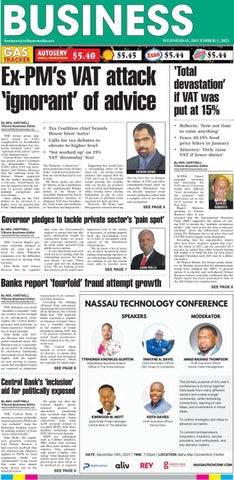
Ex-PM’s VAT attack ‘ignorant’ of advice By NEIL HARTNELL Tribune Business Editor nhartnell@tribunemedia.net
The Bahamas “a disservice” when politicians from all sides make “emotional statements” that are not backed up by acts or data. Mr Bowe spoke out after Dr Minnis, in his contribution to the supplemental Budget debate in the House of Assembly, slammed the Davis administration’s decision to eliminate VAT-free breadbasket food items and medicine as “heartless and disgraceful”.
Suggesting this would have a “devastating effect on the inner city”, the former prime minister also argued that the VAT rate’s cut to 10 percent would provide the wealthy with tax breaks on products such as caviar and champagne while forcing lower income Bahamians to pay an extra 10 percent to purchase items essential for daily survival. However, Mr Bowe said this ignored research showing
GOWON BOWE that the best way to mitigate the impact of VAT and other consumption-based taxes on vulnerable Bahamians was via directly targeted social security assistance rather than a complex web of tax breaks and exemptions.
SEE PAGE 6
Governor pledges to tackle private sector’s ‘pain spot’ By NEIL HARTNELL Tribune Business Editor nhartnell@tribunemedia.net THE Central Bank’s governor yesterday pledged to tackle the “pain spot” suffered by many Bahamian companies over the difficulties encountered in opening bank accounts. John Rolle told Tribune Business that the regulator
may seek the Government’s support to ensure that due diligence information sought by commercial banks on potential corporate customers can be more easily accessed from public sector entities. “A very important near-term work for us is dealing with the relationship process for business clients,” he said. “That’s a pain spot for the domestic sector. We are looking at how that process can be much more
improved even to the extent, if necessary, of getting support from the Government level as to how to strengthen some aspects of the information infrastructure. “We do know a lot of layers are, in effect, involved in establishing relationship and have to do with getting documents. We are pushing to get the system more able to provide more
SEE PAGE 7
JOHN ROLLE
Banks report ‘fourfold’ fraud attempt growth By NEIL HARTNELL Tribune Business Editor nhartnell@tribunemedia.net THE Bahamas can stand “shoulder to shoulder” with any country on the strength of its anti-financial crime regime, the Central Bank’s governor said yesterday, as banks reported a “fourfold” rise in fraud attempts. John Rolle told Tribune Business that evolving global standards mean The Bahamas has to “constantly up our game” in enhancing its anti-money laundering and counter terror financing regime, with the regulator now moving to ensure actual and attempted frauds are reported as suspicious
transactions by its commercial bank licensees. Unveiling the findings obtained from anti-money laundering data provided by all its licensees, the Central Bank said: “The domestic banks reported a number of instances of fraud. There was a fourfold increase in the number of frauds attempted during 2020, but a 64 percent reduction in actual fraud occurrences, when compared to the previous year. “The Central Bank intends to review industry practice, to ensure that these actual and attempted fraud occurrences, which are typically for small sums,
SEE PAGE 8
Central Bank’s ‘inclusion’ aid for politically exposed By NEIL HARTNELL Tribune Business Editor nhartnell@tribunemedia.net THE Central Bank is moving to ensure politically exposed persons (PEPs) are “not excluded” from the Bahamian banking system by making scrutiny of them “more client friendly”. John Rolle, the regulator’s governor, yesterday told Tribune Business it had received feedback that the enhanced due diligence applied to PEPS by local commercial banks was “problematic” to the extent that some were almost being driven out of the financial system.
He spoke out after the Central Bank’s newlyreleased analysis of anti-money laundering data revealed that Bahamian commercial banks collectively hold some 4,249 accounts related to so-called PEPS, with these facilities containing some $358.34m in total deposits. PEPS are individuals such as Cabinet ministers, MPs, senior civil servants and their close families and relatives. They automatically attract a higher “risk rating” from financial institutions given that they are perceived as more likely to be involved in, or targeted
SEE PAGE 6
‘Total devastation’ if VAT was put at 15% • Roberts: ‘Now not time to raise anything’ • Fears 10-15% food price hikes in January • Attorney: ‘Only raise VAT if lower duties’
• Tax Coalition chief brands House blast ‘naive’ • Calls for tax debates to elevate to higher level • ‘Not worked up’ on 15% VAT ‘doomsday’ fear
THE former prime minister’s attack on VAT’s reapplication to breadbasket foods and medicines was yesterday branded “naive” and “ignorant of the advice” given to his administration. Gowon Bowe, who headed the private sector’s Coalition for Responsible Taxation (CRT) when VAT was introduced, told Tribune Business that the criticism from Dr Hubert Minnis neglected all the studies showing that a low-rate, broad-based tax was far superior than the present 12 percent model with multiple exemptions and zero-ratings. And, calling for the VAT debate to be elevated to a higher level, he warned that it was “misleading” - and does
$5.44
By NEIL HARTNELL Tribune Business Editor nhartnell@tribunemedia.net SUPER Value’s principal yesterday said increasing the VAT rate to 15 percent would have inflicted “total devastation on the economy” with food prices set to rise 10-15 percent in the RUPERT New Year. ROBERTS Rupert Roberts, speaking to Tribune Business after it was revealed that the International Monetary Fund (IMF) suggested the option of raising VAT to sustain the “multiple exemptions model”, said “now is not the time to increase anything” given the inflationary pressures facing The Bahamas due to oil price rises and COVID-related supply chain disruption. Revealing that the supermarket chain’s sales have been “negative against last year” for the whole of 2021, and are currently off 5 percent, he added that while forward buying will enable it to hold the line on food prices through Christmas early 2022 may be a different matter. Dr Hubert Minnis, the former prime minister, on Monday denied that his administration would have adopted the IMF’s 15 percent option if re-elected, and well-placed Tribune Business sources yesterday confirmed that the Fund’s report was never presented to him or the full Cabinet for consideration.
SEE PAGE 8
PAGE 2, Wednesday, December 1, 2021
THE TRIBUNE
TREASURER RETIRES AFTER 45 YEARS SERVING PUBLIC MARY Mitchell vividly recalls the day she first entered the Public Treasury Department. Some four-plus decades later, she is now ‘hanging up her hat’ and retiring after reaching the top post. “It’s been a journey; an awesome experience,” she said. Starting as a trainee accountant, then moving up to financial controller, Ms Mitchell climbed the corporate ladder to reach the top post of treasurer of the Commonwealth of The Bahamas at end-2017. After obtaining the Certified General Accountants Association of Canada professional qualification, she sought to gain practical experience and accepted a position at Panell Kerr Foster. “At that time the public service was the place to be, but it did not have the internship that we currently have with accounting firms, so I left to take that position,” Ms Mitchell explained. “While [there] I applied at the public service and the Royal Bank of Canada. The position of financial
controller was available at the Ministry of Health and I was accepted.” Ms Mitchell later returned to the Public Treasury Department to lead the accounts section. She played a key role in major projects that included offices in the Family Islands and the relocation of the Treasury Department’s headquarters to facilities at East and North streets in 2011. “One of the first offices that we sought to develop was the office in Abaco. We found a location, recruited staff and opened the office in November of 2006. I had a good team working with me - Cyril Knowles, Brenda Butler and Marie Bain,” Ms Mitchell recalled. In 2013, she was seconded for one year to the Ministry of Finance for the Central Revenue Agency project (CRA). “A part of the project was ValueAdded Tax (VAT) that we know of today,” she added. “We focused on the CRA, which comprised all the revenue agencies in government coming together under one umbrella. At
the end of the project the Government decided they would focus on VAT, and implemented VAT in 2015.” Among Ms Mitchell’s major projects as treasurer is the implementation of accrual-based accounting. “We’ve progressed very well; it’s a phased-in approach,” she said. “As a result of some of the work we were able to achieve a clean audit report (an unqualified audit report) - the first in 25 years. “‘Unqualified’ means a clean and acceptable audit. Prior to that we got a ‘qualified’ audit, which is not a good audit. The 2017 and the 2018 accounts were ‘unqualified’ accounts – good audits. This means we’re headed in the right direction.” More recently, Ms Mitchell, was among the team responsible for the new accounting and audit officers career path. “We call it revised, but it’s more like a new career path where accounting staff are in a better place,” she added. “They can move more quickly through the levels and more opportunities are
there for them to advance. We finished it off, tidied it up and got approval. We will leave the accounting and audit staff in a better place than they were.” Remembering her posting as deputy director of finance at the Bahamas Maritime Authority (BMA) in London, Ms Mitchell described it as the most “interesting” time in her career. “I got exposed to how things operate in a large city, and worked with professionals from different walks of like – ingratiating in the culture and rich history,” she said. With a staff complement of 300 spread throughout ministries and departments, and about 100 at the Public Treasury’s headquarters, Ms Mitchell said she views herself as a no-nonsense, authoritative leader. “I think I’m also democratic, I involve persons in the process. I seek to engage the staff a lot,” she said. “I’m a firm individual. My door is always open.” Eugenia Cartwright was Ms Mitchell’s predecessor but, more importantly,
her mentor. “As treasurer for 19 years, I understudied her. I came back in 1999 and served with her for 18 years before she demitted office,” Ms Mitchell said. “She empowered me in terms of the work. She assigned a lot of special projects to me. Whatever she assigned to me I was up to the challenge, and would carry it out to the best of my ability. I certainly look up to her it was indeed a privilege to be able to work with her.” Encouraging persons interested in joining the public service to “be willing to learn, be respectful,follow guidelines, rules and procedures, Ms Mitchell expressed her appreciation for the opportunity to have worked and served the employees of the Public Treasury. “I am grateful for their support over the years and, in particular, the last three-and- a-half years as treasurer,” she said. “Without them I could not achieve some of the things we did as a department; it was their pulling together and making it happen.
“I hope that they continue to progress some of the projects we’ve started, serve with a spirit of excellence and move the department from strength-to-strength.” As Ms Mitchell retires after 45 years’ public service, she will transition into something she is passionate about – Student Youth Advisory Services Bahamas - a non-profit organisation that offers advice, mentors young persons on scholarships, colleges, careers and starting new businesses. “That’s where my passion is. I like to work with young people,” she said. The outreach ministry, free of charge, will be officially launched in December. Public Treasury staff in ministries, departments and agencies throughout The Bahamas, including Freeport and Abaco, will celebrate ‘Mary Mitchell Day’ tomorrow. They will hold a banquet in her honour, and in recognition of former treasurers of the Commonwealth of The Bahamas, on Friday.
DPM attends top aviation summit CHESTER Cooper, deputy prime minister and minister of tourism, investment and aviation, is leading a Bahamian delegation at a major aviation conference in Zurich, Switzerland. The GAD World Event Airport Development & Finance Forum 2021, which ends today, is regarded as one of the largest global gatherings of airport operators and investors. It brings together groups involved in airport management, concessions and financing models.
Mr Cooper will address conference delegates on The Bahamas’ aviation and airlift outlook plus the Family Island airports privatepublic partnership (PPP) programme and associated investment opportunities. He will also hold a series of meetings with industry stakeholders. Accompanying the deputy prime minister is his wife along with Dr Kenneth Romer, executive director, Ministry of Tourism, Investments and Aviation; Algernon Cargill, director of aviation; and Sergeant Kevin Duncombe.
Christmas
HIGH-END CONTRACTOR MEETS WITH MINISTER EXECUTIVES from a company specialising in the construction of high-end homes on Abaco this week met with the minister of labour and Immigration. Endeavor Development International officials paid a courtesy call on Keith Bell at his Monarch House office on East Bay Street. The company addressed
its plans to build highend homes on Abaco and its ongoing efforts to recruit qualified Bahamians to join its team. Mr Bell praised Endeavor for its confidence in the Bahamian economy and attempts to train and engage Bahamians at all levels.
BELOW from L to R : Trevor Carey, logistics; Edward Hanna, president; Michael Campian, vice-president of construction; Mr Bell; Erin Alberte, human resources manager; and senior officer, Ernest Burrows. Photo:Kristaan Ingraham/AP
BISX adding two icons to listings THE Bahamas International Securities Exchange (BISX) yesterday said it has added two more investment funds to its listing roster. The exchange, in a statement, said the APQCA Investments Fund ICON and The PP Investments Fund ICON have successfully completed its mutual fund listing process and been listed on the Exchange. Both funds are registered as Investment Condominiums (ICONs) under the Investment Condominium Act 2014. They
are also registered under the Smart Fund 002 template, as required by the Smart Fund rules under the Investment Funds Act 2019. Holland Grant, BISX’s chief operating officer, said: “We are pleased to list the APQCA Investments Fund ICON and the PP Investments Fund ICON on the exchange. Since the passage of the Investment Condominium Act (ICON Act) in 2014, we have been fortunate to see these used as a tool that helps clients in the financial services industry meet their goals. We
applaud Credit Suisse AG, Nassau Branch, and Caystone Solutions for their work and look forward to more listings of ICONs in the future.” Credit Suisse’s Nassau Branch served as the BISX sponsor member that brought the funds to the exchange. Caystone Solutions has been appointed as the governing administrator, and Credit Suisse’s Nassau branch is the general administrator for the funds.
THE TRIBUNE
Wednesday, December 1, 2021, PAGE 3
CREDIT UNION ‘OVER GRADING’ MIGRATES TO MEDIUM RISKS By NEIL HARTNELL Tribune Business Editor nhartnell@tribunemedia.net CREDIT unions’ “overgrading” of the financial crime threat posed by customers has gone too far in the opposite direction with the percentage classified as “medium risks” near tripling in 2020. The Central Bank of The Bahamas, unveiling its analysis of anti-money laundering data collected from its licensees, revealed that the industry had previously been automatically “over-classifying” clients - especially those with $30,000 or more in their bank accounts - as “high risk” prior to 2019. While that issue was corrected last year, with the percentage of clients deemed “high risk” dropping from 3.1 percent in 2019 to just 0.7 percent, those rated as posing a “medium risk” increased threefold year-over-year rising from 5.4 percent to 16.2 percent. A significant number of “low risk’ account holders were moved into the “medium risk” category, with those enjoying the former classification dropping from 91 percent to 82.7 percent year-over-year.
“Given its focus on personally known natural persons within The Bahamas, the credit union sector is not inherently a high risk,” the Central Bank said. “As at 2019, the sector was over-classifying its account holders as high risk. “One reason for this outcome was that many credit unions automatically classified moderate balance account holders (such as exceeding $30,000 in deposits) as high risk. This “‘over-grading’ issue was largely corrected by 2020.:” However, the Central Bank added: “In 2020, the majority of customers (83 percent) were rated low risk, reflecting a decrease from 2019 when approximately 91 percent of customers were in this category. “The proportion of medium risk increased threefold from 2019, while the proportion of high-risk customers decreased. It seems that largely solving the problem of too many high risk customers has migrated into very many medium risk customers. The Central Bank will continue to work with the sector on these issues.” The credit union sector filed just three suspicious
transactions reports (STRs), covering a collective $81,000, in 2020 compared to six reports involving a cumulative $721,000 in 2019. “The reasons given for these STRs being filed included negative news, structuring transactions to avoid reporting requirements and unusual or suspicious transaction involving cash,” the Central Bank said. “All these STRs were filed by one credit union. The credit unions reported taking an average of 2 days or less to file a STR with the FIU. “There were 275 unusual transactions reports (UTRs) reportedly received internally by money laundering reporting officers (MLROs) of the credit unions, which represents a conversion rate of one percent. “One credit union reported the vast majority of these transactions, but filed no STRs. Comparing the above numbers to the banking sector suggests that credit union STR and UTR practice has considerable room for improvement. The Central Bank will work with credit unions to improve their transaction reporting practices.”
FISHERMEN URGED TO RESPECT NASSAU GROUPER SEASON END By YOURI KEMP Tribune Business Reporter ykemp@tribunemedia.net BAHAMIAN fishermen were yesterday urged to respect the Nassau Grouper’s closed season and focus on other species so that fisheries stocks can replenish. Paul Mailis, a National Fisheries Association director, told Tribune Business of the closed season, which lasts from today until February 28, that fishermen needed to focus on other fish such as snapper, lobster and tuna. “I just want to make sure that, for this grouper system, if fishermen have pots out to sea, make sure you pick them up and don’t leave them out during the breeding season so they don’t kill groupers inadvertently,” he said.
“Just make sure you respect the grouper season and find alternatives. This is red snapper season. The winter time is red snapper time, and it is very profitable for fishermen. There is lobster and there are various jack species. There is mahi-mahi and there is tuna. “So there are lots of different fish out there, and there are other species of grouper. We have the black grouper, we have the red grouper, we have the yellowfin grouper. So there are other species of grouper that fishermen can catch instead of the Nassau Grouper.” Nassau Groupers this year averaged between $15 to $20 per pound based on how fishermen decided to market their catch. “It really depends on the fisherman’s quality and his desired market, and if he
wants to sell to private customers or high end restaurants,” Mr Mailis said. “I noticed that where the groupers normally would be prepared to breed this moon, this December moon that is coming, I noticed that there was still a considerable amount of large Nassau Groupers that didn’t have any spawn, which means there will be breeding in the next moon. “But that’s natural. Sometimes it fluctuates. Sometimes they breed earlier in the moon, sometimes they breed in the later moons, you know. That’s just nature.” Despite the change in breeding schedules, Mr Mailis reassured that it was not abnormal to see such patterns with groupers as they could simply be moving on to other spots in the Atlantic.
Turning to the credit union industry’s growing size, the Central Bank report said: “As at year-end 2020, the credit union sector reported 49,686 customers, 79,279 accounts, deposits of $418m and loans of $226m. In comparison to 2019, the credit union sector experienced increases in each of these categories.... “Credit unions reported 17,299 inactive accounts amounting to $15m, and 5,616 dormant accounts of $1.9m in 2020. The number of inactive and dormant accounts increased by 73 percent and 78 percent, respectively. “Of note is that approximately 22 percent of accounts were categorised as inactive. These large increases are likely due to more attention by the credit union sector to accurate reporting, rather than an increase in actual dormant or inactive accounts.” As for the money transmission businesses (MTBs), the Central Bank said there was an 89 percent increase in inbound transmissions that were rejected in 2019 due to anti-money laundering issues. Some 418 transactions, involving a collective $304,000 or less than percent of He added: “I just think that moving forward there needs to be good protection of the grouper schools this breeding season. So that, you know, our sacrifices in keeping the grouper season in place are not wasted, because of poaching - and that means local poaching and foreign poaching. “We need to make sure we have proper policing of the major grouper school areas, High Cay down south. Some of the famous and big group of schools, they need to be properly monitored and properly policed, so that people aren’t fishing the grouper school and they will have a successful spawn.” Mr Mailis acknowledged that one vessel was caught poaching this year, and added: “We’re still having problems. There are still fishermen that compressor dive the grouper school. They still pot the grouper school. It’s just a matter of getting more people to accept the grouper school is protected, and that it is protected for a good reason.”
CYBER MONDAY YET TO CATCH ON FOR LOCAL RETAIL By YOURI KEMP Tribune Business Reporter ykemp@tribunemedia.net BAHAMIAN electronics retailers yesterday said “Cyber Monday” means little to them, with several instead believing a preChristmas clearance event will generate better economic returns. Andrew Sweeting, owner/ operator of the Computer Store, told Tribune Business - a sales concept that has taken off in the US - does not equate to increases sales for his store. He is instead advocating that Bahamian electronic retailers promote a “preChristmas clearance event” so they can take advantage
of reduced rates from their suppliers. “I don’t see much of an uptick for Cyber Monday, or Black Friday, for that matter,” Mr Sweeting said. “We have more back to school business than anything, but I think for The Bahamas the Thanksgiving Day period goes better for places like Kelly’s or CBS, and all of those places that sell little gift items. “For gadgets they don’t think about computer stores when it comes to gift items. We can’t have a Cyber Monday sale on the same day that the US has Cyber Monday sales, because we get our goods from the US. If we order from them we won’t be able to get our goods until another two weeks for us
to take advantage of the savings. “So, if anything, we need to have a sale about two weeks after Thanksgiving Day. Maybe we should have a pre-Christmas clearance event. Black Friday and Cyber Monday does nothing for me, but maybe two weeks down when we have a chance to get the stuff.” Latoya Miller, retail store manager for Custom Computers (CCL), said: “Black Friday and Cyber Monday genuinely don’t make a difference. This is just a
CALL 502-2394 TO ADVERTISE IN THE TRIBUNE TODAY!
normal day for us. It is just a steady flow of people, nothing significant.” Craig Pyfrom, managing director of DC Technology, added: “It is extremely slow. I hope it picks up today some time. I haven’t seen anything yet. It’s normally not a big event for us.”
transmissions received, were impacted. “This represented an almost threefold increase from the previous year,” the Central Bank said of the value involved. “There were 115 outbound transactions suspended by the MTBs due to anti-money laundering issues (an eight-fold increase from 2019), valued at $550,000 (less than 0.5 percent of the value of transactions sent). “In 2020, the MTBs reported terminating 58 customer relationships due to anti-money launderingrelated issues, valued at $501,000, a reduction of 18 percent from 2019. Two MTBs reported such terminations. There were no sanctions hits reported.” As for suspicious transactions reports, the Central Bank added: “The MTBs reported filing 86 STRs, an increase of 19 percent from 2019. The aggregate value associated with those STRs was $105,000 compared to $437,000 in 2019. “One MTB reported 63 percent of the STRs for 2020. The MTBs reported that 288 unusual transaction reports (UTRs) were reported internally, which represents a conversion rate of 30 percent.
“The MTBs reported taking between five to 45 days to file their STRs. Two MTBs reported taking seven days or less to file these STRs, while 2 MTBs reported taking between 30 to 45 days. The Central Bank will work with the industry on this point.” As to the sector’s size, the Central Bank said: “During 2020, the MTBs collectively reported serving 162,769 customers (2019: 165,807), conducted 484,540 transactions (2019: 696,000), sent funds totalling $125m (2019: $152m), and received funds totaling $ 36m (2019: $39m). Transaction volumes were probably somewhat depressed due to COVID-19 unemployment, and somewhat increased due to inter-family support payments across borders. “During 2020, the majority of the value of transactions were sent to Haiti, Jamaica and the United States of America, similar to 2019. Inter-island Bahamian transfers accounted for approximately 5 percent of transactions sent by the MTBs. There was a small increase in the value of transactions sent to the US, and there was a slight decline in the value of transactions sent to Jamaica.”
SECURITY FIRMS STRUGGLING TO ‘KEEP UP’ WITH DEMAND By YOURI KEMP Tribune Business Reporter ykemp@tribunemedia.net BAHAMIAN security firms yesterday said they “can’t keep up” with demand for their services ahead of the upcoming Christmas season that typically coincides with a spike in crime. Chris Adderley, Westech Security’s managing director, told Tribune Business:“There has always been an uptick for security services towards the end of the year. The most people can do is take personal responsibility to not leave their personal equipment, devices and things in their car, and just take necessary precautions.” Last year’s COVID19 lockdowns and associated restrictions resulted in increased demand for touch-less and remote systems, as opposed to a physical security guard presence. This has not changed subsequently, but businesses and homeowners are now asking for “both” security guards and remote system installations. “They’re getting both the guards and the system. That’s the unusual part but you know how that goes,” said Mr Adderley. “The police are doing their best, and the Government is trying all it can, but all I can say to people is take personal responsibility.
“As far as I’m concerned, if you leave your car open or your home unprotected, you really can’t blame the Government or the police. We all must take personal responsibility.” As for the current spike in demand for security services, Mr Adderley said: “It’s so much, I can’t even keep up with it. Everyone knows what’s going on and it’s no point in trying to bury your head in the sand. Just take the necessary precautions so you don’t become a victim.” Andrew Thompson, Infinite Security Company’s managing director, said: “There is an uptick now. Everybody wants to be more security conscious, but it isn’t abnormal now. It’s just too early to tell. Usually the first week of December, and coming down towards the holiday season, you would start to see security picking up and people wanting more protection. Regular surveillance equipment, as opposed to motion sensors, are in demand. Mr Thompson said. “A lot of people want to see their businesses while they are out of town, so they want to view it from their cell phones. “I do mostly commercial installations and not so much residential. People just want to be able to watch their properties while they are away on holiday.”
PAGE 6, Wednesday, December 1, 2021
THE TRIBUNE
CENTRAL BANK’S ‘INCLUSION’ AID FOR POLITICALLY EXPOSED FROM PAGE ONE
with, corrupt practices such as bribes due to their posts. Efforts to conceal the proceeds of such activities result in money laundering. “What we have as a special work programme is improving the customer due diligence standard around PEPS so that the system can work in ways that are more business and client friendly,” Mr Rolle disclosed to this newspaper, suggesting existing guidance - and its application by Bahamian financial institutions - has been too onerous in some cases. “We think, in our domestic system in particular, there’s room for improving the guidance around how one deals with politically exposed individuals. We don’t want being classified as a PEP to frustrate or exclude anyone from access to financial services.
“We are getting some feedback that this is problematic. We want to make certain improvements to the guidance and practices. The system establishes the identity of the individual, and uses that to gauge how to monitor them, but we’re not using it as a means to exclude individuals from access to financial services. We want to make sure the system doesn’t lead to exclusion.” Based on the data obtained from its licensees, the Central Bank said the number of accounts held in the commercial banking system by PEPS rose by 10 percent or almost 400 in 2020, rising from 3,852 in 2019 to 4,249. The latter figure, though, represented just 1 percent of all domestic bank accounts in The Bahamas. And the total deposits in PEP-related bank accounts dropped by 5 percent yearover-year to $358.34m, as
opposed to $375.614m in 2019. PEPS accounted for just 4 percent of domestic banking system deposits, and an equal proportion of its outstanding loans. Loans to PEPs, according to the data, fell by 45 percent yearover-year, dropping from $362.467m to $198.665m in 2020. “While the number of PEP accounts and relationships increased since last year, the deposit and loan values decreased,” the Central Bank report said. “SFIs (supervised financial institutions) were required to report PEPs separately and provide a breakdown of the risk rating of the PEPs in the client database. “Approximately 75 percent of the accounts were rated high-risk, 23 percent were rated medium-risk and 2 percent were rated low-risk. In terms of relationships, approximately half of these were rated
high-risk, while approximately one quarter of these were rated medium-risk and low-risk each.” Some 92.5 percent of accounts in the domestic banking system were rated by the banks as posing a “low risk”, or threat, of being used for money laundering or other financial crimes. This compared to 92 percent a year earlier. The proportion of “medium risk” accounts declined from 6.5 percent to 5.2 percent, while “high risk” accounts rose only slightly from 0.7 percent to 1.3 percent of the total. “As at December 31, 2020, domestic banks reported having approximately 495,000 customers and 580,000 accounts, which represents a contraction of 9 percent and expansion of 2 percent, respectively, when compared to 2019,” the Central Bank said. “The balances associated with these customers at
EX-PM’S VAT ATTACK ‘IGNORANT’ OF ADVICE FROM PAGE ONE Dr Minnis, whose administration hiked the VAT
rate to 12 percent, as well as introducing the exemptions and zero ratings that moved The Bahamas away from
NOTICE IN THE ESTATE of ALLAN JAMES C. NAIRN late of #9 Baillou Hill Estate Subdivision in the Western District of the Island of New Providence, one the Islands of The Commonwealth of The Bahamas, deceased. Notice is hereby given that all persons having any claim or demands against the above named Estate are required to send their names, addresses and particulars of the same duly certified in writing to the undersigned on or before the 23rd day of December A.D., 2021, and if required, prove such debts or claims, or in default be excluded from any distribution; after the above date the assets will be distributed having regard only to the proved debts or claims of which the Administrator shall then have had Notice. And Notice is hereby given that all persons indebted to the said Estate are requested to make full settlement on or before the aforementioned date. MICHAEL A. DEAN & CO., Attorneys for the Administrator Alvernia Court, 49A Dowdeswell Street P.O. Box N-3114 Nassau, The Bahamas
the broad-based tax model, did not mention this in his House of Assembly speech. Dissecting the former prime minister’s statement, Mr Bowe told this newspaper: “Whilst this may seem like a very harsh statement, that’s a position that’s been taken naively with the empirical information and ignorant of the actual advice given to both the Christie administration and his administration on the most appropriate VAT system. “To argue a case not grounded in empirical data is misleading and unhelpful to educating the population. When political parties make statements without backing them up with some empirical data, it does a disservice to our country. “I would only ask that whenever they do that, don’t make emotional statements without evidence to support it. When you add exemptions and take the rate to 12 percent, however you look at it in bringing it down to 10 percent with no exemptions, 12 percent doesn’t make it cheaper for the poor.” Describing the arguments as akin to “shuffling deck
chairs on the Titanic”, the Coalition chief said that rather than use tax breaks which also benefit wealthy Bahamians who can afford to pay VAT, the Davis administration was instead planning to “redistribute” the monies collected on breadbasket foods and medicines “to persons on the margins”. “It’s far better to charge everyone and redistribute Robin Hood style from the rich to the less fortunate,” he told Tribune Business, asserting that the arguments should instead focus on whether the Government will provide the appropriate level of social security support in time. “I’d much rather charge all and redistribute to those in need so the innocent do not suffer for the guilty,” Mr Bowe said, adding that the Oxford Economics research commissioned by the Coalition, as well as the Compass Lexacon study for the Government as well as Inter-American Development (IDB) modelling had all recommended The Bahamas adopt such a VAT structure. “Too often we give too much publicity to idle
December 31, 2020, were as follows: Deposits of $8.9bn, loans of $6.2bn and off-balance sheet/fiduciary assets of $447m.” As for the Bahamian international financial services industry, which holds the bulk of the assets, some 15 percent of bank accounts were rated as “high risk” at end-2020. For banking relationships, the proportion deemed “high risk” was even greater at 20 percent. “This represented a slight increase in the proportion of accounts held by high risk customers in the sector. The majority of the relationships (55 percent) and the accounts (59 percent) reported by the international sector were associated with low-risk customers,” the Central Bank said. “High risk” accounts held the so-called offshore sector rose from 12.9 percent in 2019 to 15.1 percent last year. “In the international
sector, 5 percent and 4 percent of the relationships and accounts, respectively, were associated with PEPs, which is consistent with the results reported in 2019,” the Central Bank report said. “Of note is that 12 percent of the total number of relationships in the restricted SFIs peer group had some PEP association.” The number of PEP-related accounts in the international financial services sector rose by 9 percent year-over-year in 2020, jumping from 1,316 the year before to 1,439. Total deposits held in these accounts also increased, this time by 49 percent, from $1.115bn to $1.661 - an increase of almost $550m. And loans from Bahamian international financial institutions to politically exposed persons soared by an even greater margin, 76 percent, to $382m from $217m.
statements,” he added. “We need to get very critical of those who utter nonsense words, and if they are without validity or credibility they should not be rebroadcast or published. “At least have an informed basis when you make statements. That goes for all persons in positions of authority. We live in a time where it is so volatile that any emotional statement that touches the right channel gets people to close their minds to facts. We have to stop that. We need to have a debate about fact not merely emotions. “When we start forcing them to participate in a structured manner it stops what I call idle chatter and we get back to a learned position, and that’s what we all have to strive for.” The Davis administration has justified the planned VAT rate cut, from 12 percent to 10 percent, and the return to a broad-based model that eliminates multiple exemptions on the basis that this will make the tax easier to administer and more efficient. Compliance will likely increase as there is less room for errors and omissions, and evasion, due to the exemption removal. “Having a complex VAT system does not benefit The Bahamas,” Mr Bowe said. “The simpler it is, the better it is. KISS. Keep it simple stupid.” As for the International Monetary Fund’s (IMF) suggestion that The Bahamas raise VAT to 15 percent to sustain
the exemption structure, the Coalition chief added that he was not getting too worked up over it. “When they talk about the impact on the economy and doomsday predictions, I don’t get too worked up about that,” he told this newspaper. “If done, would it have been effective and efficient? No. Would people have adjusted? Yes. Let’s not go into hypotheticals and set aside the theatrics. “The empirical data shows that a VAT system with a limited number of exemptions and zero ratings is the most effective and efficient tax system, and most suited to growing the economy on the back of it. “I think then change in the VAT system to add exemptions and increase the rate beyond 7.5 percent was based on would that benefit the average household as opposed to empirically studying it.” K Peter Turnquest, former deputy prime minister, at the time said the VAT rate hike was needed to pay off $360m in arrears bills for which there was no funding allocated. Calling on the Government to publish the models justifying the VAT rate cut to 10 percent, Mr Bowe added: “It takes away all the back and forth in Parliament. Are you challenging an empirical study or talking off the top of your head?”
THE TRIBUNE
Wednesday, December 1, 2021, PAGE 7
GOVERNOR PLEDGES TO TACKLE PRIVATE SECTOR’S ‘PAIN SPOT’ FROM PAGE ONE secure, reliable information to financial institutions. “There are parts of the public information infrastructure that we will also be looking at, and how we can address some of the issues involved in establishing business relationships. It comes back to two parts of customer due diligence,” Mr Rolle continued. “We’re focused on having financial institutions focus on establishing the relationship, the practices of the customer, and then how they monitor the activity of the customer so the due diligence doesn’t lead to unnecessary barriers or exclusion from financial services. We kind of call it the financial inclusion element.” Agencies such as the Department of Inland Revenue (DIR), National Insurance Board and public utilities such as Bahamas Power & Light (BPL) all hold information that could assist Bahamian commercial banks in performing the necessary Know Your Customer (KYC) scrutiny when opening bank accounts for local companies.
The Bahamas’ first credit bureau, which is close to fully launching, may also be able to assist in this process as it will act as a repository that collects much of this information to enable it to produce “scores” on borrowers’ creditworthiness. Any information sharing, though, will have to comply with the Data Protection Act’s provision. Complaints about the red tape, bureaucracy and delays in establishing Bahamas-based bank accounts have been constant ever since this nation was forced to implement its present KYC structure as part of legal reforms to escape the country’s 2000 ‘blacklisting’ by the Financial Action Task Force (FATF). Philip Galanis, the HLB Galanis & Company managing partner, recently blasted the commercial banking industry for “treating Bahamians like criminals” when it comes to opening account facilities. He argued that many felt they were treated as guilty until proven innocent, with protracted KYC scrutiny and associated delays undermining the ease of doing business. “I can walk into any bank in the US and Canada and
come out 15 minutes later with a bank card having opened an account,” the former PLP MP and Senator told the Bahamas Institute of Chartered Accountants (BICA) accountants’ week seminars. “Bahamians are treated like criminals at the bank. “I think it’s wrong, it’s unconscionable and certainly doesn’t help businesses incorporate and assist in opening bank accounts for our clients. There must be something we can do to remedy the situation.” And, after Charles Littrell, the Central Bank’s inspector of banks and trust companies, responded by saying Bahamian banks had improved the account opening process, Mr Galanis replied: “With all due respect, I think the banks are not paying attention to the Central Bank’s recommendations and directives because they have not relaxed their account opening requirements.
“Canadians in Canada do not have to face the scrutiny we face here in The Bahamas. Canadians do not have to face the difficulties we do. It makes it very difficult to do business in The Bahamas, and leaves a bad taste in our mouths that we’re almost criminals until proven otherwise.” Mr Rolle spoke as the Central Bank yesterday unveiled results from an anti-money laundering survey of its licensees, which include money transmission businesses and credit unions, as well as banks and trust companies. The regulator said the findings showed Bahamasbased financial institutions are “considerably less impressive” in training their Boards and directors on anti-money laundering and counter terrorism financing issues than they are their staff. “The domestic banks are effectively maintaining their required staff training, but are considerably
NOTICE
less impressive on director anti-money laundering training,” the Central Bank noted. “In 2020, 98 percent of bank staff received the relevant training, compared to 95 percent in 2019. “Although 82 percent of directors of the domestic banks received the relevant training in 2020, one bank reported that none of their directors received training during this period. All other domestic banks reported that all of their directors were trained. The Central Bank will work to ensure that staff training intensity is maintained, while director training is improved. “In common with the domestic sector, the supervised financial institutions reported high compliance on staff training, and less successful compliance on director training. Well over 90 percent of staff within the sector had some type of the required training during 2020. Only one [institution] did not conduct the relevant training during 2020.”
A similar conclusion was reached for the credit unions. “Over 90 percent of staff received the required training in both 2019 and 2020. On the other hand, only 75 percent of directors received training in 2020,” the Central Bank added. “This is another area where COVID-19 issues may have made 2020 an outlier.” Similar issues were uncovered at money transmission businesses (MTBs). “During 2020, the MTBs trained 94 percent of their staff and 79 percent of their agents’ staff,” the Central Bank said of the data collected. “One MTB reported that only 22 percent of their agents were trained during 2019. One MTB indicated that none of its directors received training. All of the other MTBs reported that all of their directors received training during 2020.”
NOTICE
NOTICE is hereby given that MAIMUNA MOHAMED of#7 Manchester Street, Blair Estates, P.O. Box N3623 Nassau, Bahamas, is applying to the Minister responsible for Nationality and Citizenship, for Registration Naturalization as a citizen of The Bahamas, and that any person who knows any reason why registration/naturalization should not be granted, should send a written and signed statement of the facts within twenty-eight days from the 1th day of December, 2021 to the Minister responsible for nationality and Citizenship, P.O. Box N-7147, Nassau, New Providence, The Bahamas.
NOTICE is hereby given that YVETTE ANDREA SCOTTGREENE of South Beach, P.O. Box CB-12676 Nassau, Bahamas, is applying to the Minister responsible for Nationality and Citizenship, for Registration Naturalization as a citizen of The Bahamas, and that any person who knows any reason why registration/naturalization should not be granted, should send a written and signed statement of the facts within twenty-eight days from the 1th day of December, 2021 to the Minister responsible for nationality and Citizenship, P.O. Box N-7147, Nassau, New Providence, The Bahamas.
LEGAL NOTICE
LEGAL NOTICE
Legal Notice
NOTICE
NOTICE
DAPHNE Consulting Advisory Ltd. In Voluntary Liquidation
CHAGRESS OCEAN INC.
PUBLIC NOTICE
INTENT TO CHANGE NAME BY DEED POLL The Public is hereby advised that I, ELVISTINA PHORONICA GREENE of Millers Tuck Close, Carmichael Road P.O. Box EE15024, Nassau, The Bahamas, intend to change my name to ELVISTINA PHORONICA BROWN. If there are any objections to this change of name by Deed Poll, you may write such objections to the Chief Passport Officer, P.O.Box N-742, Nassau, Bahamas no later than thirty (30) days after the date of publication of this notice.
Notice is hereby given that in accordance with Section 138(4) of the International Business Companies Act. 2000, DAPHNE Consulting Advisory Ltd. is in dissolution as of November 26.2021 Lighthouse Corporate Services Ltd., office situated at Old Fort, Building 2, Suite A, Lyford Cay, Nassau, Bahamas is the Liquidator.
In Voluntary Liquidation
Notice is hereby given that in accordance with Section 138(4) of the International Business Companies Act. 2000, CHAGRESS OCEAN INC. is in dissolution as of November 26.2021 International Liquidator Services Ltd., situated at 3rd Floor Withfield Tower, 4792 Coney Drive, Belize City, Belize is the Liquidator.
NOTICE
NOTICE IS HEREBY GIVEN as follows: (a) NEWALD INVESTMENTS LTD. is in dissolution under the provisions of the International Business Companies Act 2000. (b) The Dissolution of said Company commenced on November 30, 2021 when its Articles of Dissolution were submitted and registered by the Registrar General. (c) The Liquidator of the said company is Zakrit Services Ltd. of 2nd Terrace West, Centreville, Nassau, Bahamas. (d) All persons having Claims against the above-named Company are required on or before December 30, 2021 to send their names and addresses and particulars of their debts or claims to the Liquidator of the company or, in default thereof, they may be excluded from the benefit of any distribution made before such debts are proved. November 30, 2021
ZAKRIT SERVICES LTD.
LIQUIDATOR ______________________
LIQUIDATOR ______________________
LIQUIDATOR OF THE ABOVE-NAMED COMPANY
LEGAL NOTICE
LEGAL NOTICE
LEGAL NOTICE
NOTICE
NOTICE
APOLO CAPITAL LTD.
NORTHSTAR CARIBBEAN HOLDINGS LIMITED
PASCADEL INC.
NOTICE IS HEREBY GIVEN that pursuant to section 138 (8) of the International Business Companies Act 2000 the dissolution of Apolo Capital Ltd. has been completed and the company has been struck from the Register on the 26th day of June 2020.
NOTICE IS HEREBY GIVEN that pursuant to section 138 (8) of the International Business Companies Act 2000 the dissolution of Northstar Caribbean Holdings Limited has been completed and the company has been struck from the Register on the 9th day of July 2020.
NOTICE IS HEREBY GIVEN that pursuant to section 138 (8) of the International Business Companies Act 2000 the dissolution of PASCADEL INC. has been completed and the company has been struck from the Register on the 9th day of July 2020.
Delco Investments Ltd. Liquidator
Delco Investments Ltd. Liquidator
Delco Investments Ltd. Liquidator
LEGAL NOTICE
LEGAL NOTICE
LEGAL NOTICE
NOTICE
NOTICE
COIN FLOW LIMITED NOTICE IS HEREBY GIVEN that pursuant to section 138 (8) of the International Business Companies Act 2000 the dissolution of Coin Flow Limited has been completed and the company has been struck from the Register on the 9th day of July 2020.
Delco Investments Ltd. Liquidator
NOTICE
BALATON CORPORATION
NOTICE
AZURE SEA LTD.
NOTICE IS HEREBY GIVEN that pursuant to section 138 (8) of the International Business Companies Act 2000 the dissolution of Balaton Corporation has been completed and the company has been struck from the Register on the 17th day of February 2021.
NOTICE IS HEREBY GIVEN that pursuant to section 138 (8) of the International Business Companies Act 2000 the dissolution of AZURE SEA LTD. has been completed and the company has been struck from the Register on the 17th day of February 2021.
Delco Investments Ltd. Liquidator
Delco Investments Ltd. Liquidator
PAGE 8, Wednesday, December 1, 2021
‘TOTAL DEVASTATION’ IF VAT WAS PUT AT 15% FROM PAGE ONE
However, its disclosure by the current Prime Minister provides a glimpse of the potential austerity measures that may soon come, in the form of new and/or increased taxes and spending cuts, if The Bahamas is to drag itself out of its debt crisis and hit the Davis administration’s 25 percent revenue-to-GDP target by the time it leaves office in 2026. “The market is devastated now. That would be totally devastating on the economy and the poor,” Mr Roberts said of any increase from the present 12 percent rate. “They’d not be able to stand that. On top of the 15 percent inflation ahead of us, that would be strangling the working man, the grassroots, the poor. “They might need to fund the Budget, but that wouldn’t be the place. After what we’ve been through, Hurricane Dorian and the pandemic, I cannot see them acting on that. This wouldn’t be the time to go increasing anything; VAT or anything else.” A 15 percent VAT rate, with multiple exemptions and zero ratings,
was ironically the model initially adopted by the Christie administration in early 2013 when it rolled the new tax out. However, the private sector - backed by research and empirical data - ultimately persuaded the then-government to go with a low-rate, broadbased structure when VAT was implemented in 2015. There is no evidence to suggest the Minnis administration, if re-elected, would have accepted the IMF’s advice to go with a 15 percent VAT - especially since it would likely have chokedoff the post-COVID recovery by depressing consumer spending while also further eroding fragile business and consumer confidence. There is nothing compelling acceptance of IMF advice. Philip Davis QC, the newly-elected prime minister, on Monday sought to suggest the IMF’s advice was evidence of the former administration’s post-election tax raising plans - as alleged by the Progressive Liberal Party (PLP) when in Opposition. However, he later appeared to back track, agreeing there was nothing that indicated Dr
Minnis would adopt the 15 percent option. The current government has instead elected to cut the VAT rate to 10 percent, and go back to the broadbased model with few exemptions and zero ratings, in the belief this will boost revenue compliance and be easier to administer, thus making the Government’s main revenue source more efficient and effective. Meanwhile, a wellplaced source, speaking on condition of anonymity, yesterday backed Dr Minnis’ assertion that there were no plans to raise VAT to 15 percent. They disclosed that the IMF report was received by the Ministry of Finance around two weeks before the election, and never presented to - or discussed by - the thenprime minister and Cabinet. The source added that the Government had requested IMF assistance as part of its May Budget pledge to conduct a comprehensive study on the whole Bahamian tax structure, and potential reforms, which would lead to the release of a so-called “White Paper” for consultation with the Bahamian people.
The IMF was asked to look at The Bahamas’ various tax options, and the source said: “They completed a report in early September. Cabinet didn’t see it, and the then-prime minister didn’t see it. It didn’t feature in any consideration of the Government at the time. The Government didn’t have a chance to contemplate doing anything with it.” This newspaper was told that Kwasi Thompson, then-minister of state for finance, had received a copy of the IMF report but this could not be confirmed as he did not return this newspaper’s calls and messages before press time last night. Mr Roberts, meanwhile, said consumer spending remained depressed due to continued high unemployment and reduced incomes resulting from the pandemic. “Our sales are negative against last year for all periods, down close to 5 percent,” he told Tribune Business. “We’ve been running that way the whole year. “We’ve been trying to stock up. We’ve been working on this throughout the pandemic, and when
the food chain started to weaken we tried to stock up up to six months’ supply. We got up to three months’ inventory and found the warehouse could not hold it. It hasn’t moved too much beyond a month’s supply. “Some of the merchandise we bought, cooking oil went up 60 percent. I told them to hold until we say ‘ship it’. Mackerel went up 40 percent. If ten items go up 40-50 percent, that will take the whole mass of supermarket items up 3-4 percent.” Mr Roberts said Super Value’s forward buying meant it will be able to “hold current prices until after Christmas”, but he forecast increases of between 10-15 percent come January when new stock is required. “Price increases from inflation are nothing to do with us,” he added. “It’s rising costs worldwide and freight costs. It’s really anybody’s guess. I was talking to a major supplier: Do we stop buying or do we go out and rent extra warehouse space to protect the country’s food supply for the next six months? Tough times never last, but tough people do.”
BANKS REPORT ‘FOURFOLD’ FRAUD ATTEMPT GROWTH FROM PAGE ONE are reported as suspicious transactions.” The regulator added: “Domestic banks reported filing 506 suspicious transaction reports (STRs) with the FIU (Financial Intelligence Unit) during 2020, which was twice the previous year’s filings. One bank, for which there is no reason to believe it would have a higher risk customer base, filed roughly 70 percent of these in both reporting periods. “This is an instance of inconsistent industry practice, where the Central Bank intends to follow up as a supervisory matter.
Compared to the 566 unusual transaction reports received internally by bank money laundering reporting officers (MLROs) for 2020, this represents a conversion rate of 89 percent for the domestic banking sector. “The commercial banks required between seven and 23 days to file an STR from the initial point at which the unusual or suspicious transaction/activity was detected internally. This is, in global terms, reasonably good, but the Central Bank will encourage the slower end of the banking system to tighten their response times.”
Bahamian commercial banks reported no transactions in 2020 involving individuals and companies subject to international financial sanctions, and the Central Bank added that it was “only aware of one Bahamian citizen and one Bahamian company on two of the recognised international sanctions lists”. “The domestic banks reported receiving 996 production orders from the Financial Intelligence Unit (FIU) in 2020, which represents a 13 percent decrease compared to 2019. These were spread roughly evenly among the retail banks,” the regulator added.
“A total of 2,365 accounts reportedly became dormant in 2020, which represented a 43 percent decrease when compared to 2019. On the other hand, there was a 10 percent increase in the number of inactive accounts over the same period. “Approximately 11 percent of the total number of accounts were considered to be inactive, while less than half of one percent of accounts were considered to be dormant. One bank reported a disproportionate share of inactive and dormant accounts. The Central Bank is working with this bank to better understand their position.”
Overall, the Central Bank hailed the efforts made by the commercial banks, saying they “have made substantial progress in lifting their anti-money laundering risk management and governance to world class standards”. This was echoed by Mr Rolle, who told Tribune Business: “We see ourselves as being shoulder to shoulder with others. We think relative to understanding risk in our jurisdiction that we have a good understanding and grasp of what is going on. “The nature of financial transactions is evolving so rapidly that we know we have to constantly up our game to keep up with what is happening globally. Global standards keep us focused on new areas where risks can present themselves.” Elsewhere, the Central Bank said cash deposits have almost been completely eliminated from the international banking sector. “The international sector’s use of currency is both vanishingly small and appropriate,” it said. “During 2019 in the international sector, one institution reported accepting a cash deposit in The Bahamas, reportedly due to a client having to refund money credited to their account in error. “Two institutions reported taking in 35 and eight cash deposits, respectively, outside of The Bahamas during 2019. No
THE TRIBUNE
Carey Leonard, the Callenders & Company attorney, told Tribune Business that increasing the VAT rate to 15 percent would be more acceptable if it was accompanied by Customs duties being slashed by a similar proportion. “You could go up on VAT if you come down on duty,” he argued. “They’d be better off bringing down duty. You cannot go up on VAT and leave duty where it is. If you want to go to 15 percent, go to 15 percent, but drop duty on what you bring in.” As to the economic impact of a 15 percent VAT, Mr Leonard added: “It’s really difficult to say. To say what it would have done all depends on how they would have executed it. I don’t think it would have been very beneficial, and it may well have impacted on the economy in a very negative way. “I must say the cut to 10 percent all sounds good, but if you put 10 percent on basic foods and medicines I don’t see how that benefits the little man. I just think they have to be careful. It shouldn’t be on medicine.” international institutions reported taking in cash deposits in The Bahamas during 2020. One institution reported taking one cash deposit outside of The Bahamas.” As for potential financial crimes activity, the Central Bank said: “There is more potential for true positive sanctions hits in the Bahamian international sector than in the domestic sector. However, during 2019 only one institution reported two positive hits, both positive against the OFAC sanctions list. Both of these instances generated appropriate de-risking and STR (suspicious transaction reporting) actions. “The results for 2020 indicated that two institutions had 12 positive hits, one of which led to de-risking and STR actions. The other 11 were generated by attempting to transact with a sanctioned intermediary or beneficial financial institutions. All these transactions were rejected. “False positive alerts generated by screening tools continue to plague systems and the compliance function. Approximately 112,000 false positive alerts were reported by 11 institutions for 2020, which usually require manual review to be cleared. As advancing technologies are leveraged and models used are continually optimised, it is expected that false positive alerts will be minimised.”
NOTICE NOTICE is hereby given that MARVIN LUBIN of, Marsh Harbour, Abaco, is applying to the Minister responsible for Nationality and Citizenship, for Registration Naturalization as a citizen of The Bahamas, and that any person who knows any reason why registration/naturalization should not be granted, should send a written and signed statement of the facts within twenty-eight days from the 24th day of November, 2021 to the Minister responsible for nationality and Citizenship, P.O. Box N-7147, Nassau, New Providence, The Bahamas.
NOTICE NOTICE is hereby given that CHRISTOPHER JOHN KILVINGTON of Ocean Club Estates, Paradise Island, Bahamas is applying to the Minister responsible for Nationality and Citizenship, for Registration Naturalization as a citizen of The Bahamas, and that any person who knows any reason why registration/ naturalization should not be granted, should send a written and signed statement of the facts within twentyeight days from the 24th day of November 2021 to the Minister responsible for nationality and Citizenship, P.O. Box N-7147, Nassau, New Providence, The Bahamas.
PAGE 10, Wednesday, December 1, 2021
THE TRIBUNE
STOCKS SINK AS OMICRON, RATE WORRIES RATTLE WALL STREET By DAMIAN J. TROISE AND STAN CHOE AP Business Writers NEW YORK (AP) — Already unnerved by the newest coronavirus variant, Wall Street's losses deepened on Tuesday after the head of the Federal Reserve said it will consider shutting off its support for financial markets sooner than expected. The S&P 500 fell 1.9%, erasing its gains from a day earlier. The sell-off accelerated after Fed Chair Jerome Powell told Congress the central bank may halt the billions of dollars of
bond purchases it's making every month "perhaps a few months sooner." It had been on pace to wrap up the purchases, meant to goose the economy by lowering rates for mortgages and other long-term loans, in June. An end to the purchases would open the door for the Fed to raise short-term interest rates from their record low of nearly zero. That in turn would dilute a major propellant that's sent stocks to record heights and swatted away concerns about an overly pricey market. As investors moved up their expectations for
the Fed's first rate hike following Powell's remarks, yields on short-term Treasurys rose. Losses for stocks mounted quickly, with the drop for the Dow Jones Industrial Average more than tripling in half an hour as it sank 711 points. The blue chip index ended down 652.22 points, or 1.9%, at 34,483.72. The Nasdaq composite held up slightly better than the rest of the market, shedding 245.14 points, or 1.6%, to 15,537.69. Higher interest rates tend to hurt stock prices broadly, but they hit hardest on those seen as the
most expensive or banking on big profit growth the furthest in the future. Such companies play a bigger role in the Nasdaq than other indexes. Microsoft fell 1.8% and chipmaker Nvidia slid 2.1%. The whammy on interest rates came after stocks were already weak in the morning due to concerns about how badly the fastspreading omicron variant of the coronavirus may hit the global economy. The CEO of Moderna predicted in an interview with the Financial Times that existing COVID19 vaccines may be less
effective with omicron than earlier variants. Regeneron also said Tuesday that its monoclonal antibody treatment may have reduced effectiveness on omicron. Shares in Moderna fell 4.4%, while Regeneron dropped 2.7%. Much is left to be determined about the variant, including how much it may slow already gummedup supply chains or scare people away from stores. That uncertainty has sent Wall Street through jagged up-and-down jolts as investors struggle to handicap how much economic
damage omicron will ultimately do. "There will be heightened volatility around any piece of information," said Kristina Hooper, chief global market strategist at Invesco. She said markets will likely remain cautious "before we know more." The S&P 500 dropped 88.27 points to 4,567. The benchmark index sank 2.3% Friday for its worst loss for February, only to rise 1.3% Monday as investors reconsidered whether the reaction was overdone, before giving way to Tuesday's loss.