business@tribunemedia.net
MONDAY, NOVEMBER 11TH, 2019
$4.52
$4.57
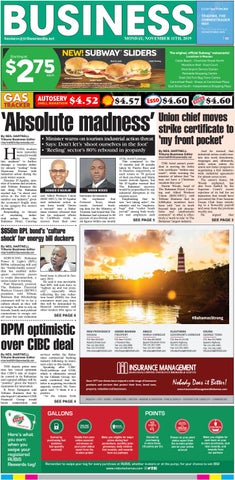
‘Absolute madness’ By NEIL HARTNELL Tribune Business Editor nhartnell@tribunemedia.net
H
OTEL workers were yesterday warned it would be “absolute madness� to further damage a tourism industry already “reeling� from Hurricane Dorian with industrial action during the peak winter season. Dionisio D’Aguilar, minister of tourism and aviation, told Tribune Business the last thing The Bahamas needed was “to shoot ourselves in the foot in our number one industry� given the economy’s fragile state in the category five storm’s aftermath. Responding to threats of escalating industrial action from the Bahamas Hotel, Catering
• Minister warns on tourism industrial action threat • Says: Don’t let’s ‘shoot ourselves in the foot’ • ‘Reeling’ sector’s 80% rebound in jeopardy
DIONISIO D’AGUILAR
DARRIN WOODS
and Allied Workers Union (BHCAWU), Mr D’Aguilar said industrial action in any form would “throw a wrench� into a Bahamian tourism rebound that has far outpaced efforts by Caribbean rivals to recover from their own
hurricane devastation. He explained that Forward Keys, which tracks forward booking data for the Ministry of Tourism, had found that The Bahamas had returned to 80 percent of pre-Dorian arrivals figures within one month
of the storm’s passage. This compared to the 15 months and 20 months taken by Puerto Rico and St Maarten, respectively, to each return to 70 percent of their pre-Irma and Maria tourist arrivals figures, but Mr D’Aguilar warned that The Bahamas’ recovery would be jeopardised by any industrial disruption in the tourism sector. Emphasising that he was “not taking sides�, the minister said he “implores, begs� that “cooler heads prevail� among both workers and employers such
SEE PAGE 5
$4.60
$4.60
Union chief moves strike certificate to ‘my front pocket’ By NEIL HARTNELL Tribune Business Editor nhartnell@tribunemedia.net THE hotel union’s president is moving his strike vote certificate “within easy reach�, while warning the minister of labour that “he may not have a Christmas vacation this year�. Darrin Woods, head of The Bahamas Hotel, Catering and Allied Workers Union (BHCAWU), told Tribune Business that its 6,000-plus members have been told “not to work beyond their job descriptions and employment contracts� in what is effectively a ‘work to rule’ in The Bahamas’ largest industry.
And he warned that industrial action could escalate into work slowdowns, stoppages and, ultimately, strike action unless the union saw faster progress in negotiating a first industrywide industrial agreement for almost seven years. The union’s stance, Mr Woods explained, has also been fuelled by the Supreme Court’s recent rejection of its bid for an injunction that would have prevented the Four Seasons Ocean Club from switching to a bi-weekly payroll and away from the previous weekly one. He argued that
SEE PAGE 3
$650m BPL bond’s ‘culture shock’ for energy bill duckers By NEIL HARTNELL Tribune Business Editor nhartnell@tribunemedia.net SERVICING Bahamas Power & Light’s (BPL) $650m refinancing will end the “buddy-buddy system� that has enabled delinquent electricity payers to evade disconnection, a union leader is warning. Paul Maynard, pictured, The Bahamas Electrical Workers Union’s (BEWU) president, told Tribune Business that bill-ducking customers will be in for a culture shock as they will no longer be able to rely on friends, family and political connections to escape cutoff once the rate reduction
bond issue is placed in January 2019. He said it was inevitable that BPL will now have to “tighten up and run properly�, especially when collecting the rate reduction bond (RRB) fee that consumers must pay, since this will be demanded by financial institutions and other lenders who agree to
SEE PAGE 6
DPM optimistic over CIBC dealÂ
By NEIL HARTNELL Tribune Business Editor nhartnell@tribunemedia.net
THE deputy prime minister has voiced optimism that CIBC’s sale of majority control in its Bahamian and regional affiliate will be “positive� given the buyer’s reputation for innovation. K Peter Turnquest told Tribune Business that he also hoped Colombia’s GNB Financial Group would boost competition and
services within the Bahamian commercial banking industry following its imminent entry to this market. Speaking after CIBC FirstCaribbean and GNB, which is ultimately owned by the Gilinski Group, formally confirmed that the latter is acquiring two-thirds majority control, Mr Turnquest said: “I think it is a positive. “As the release from
SEE PAGE 4
’ ‰ ‰
† ‡ ˆ ‰
† † ƒ
 �  �� �   € �
‚ ‚  ƒ „ ‚  � � …
� �   € �
‹�  “   ” • – –  �  € � �   € �
Š ‚ ‹Â?  ‰ ÂŒÂÂŽ „ ‚‚  Â? Â?  Â? Â?   € Â?
‘ ‹Â?  ‰ ÂŒÂÂŽ „  Â? Â?Â? Â? Â?   € Â?
INSURANCE MANAGEMENT
(BAHAMAS) LIMITED. INSURANCE BROKERS & AGENTS Since 1977 our clients have enjoyed a wide range of insurance products and services that protect their lives, loved ones, property, valuables and businesses.
Nobody Does it Better!
 �  � �
PAGE 2, Monday, November 11, 2019
THE TRIBUNE
Making Bahamians the guests, not the workers A FORMER CHAMBER OF COMMERCE DIRECTOR DETAILS WHY DOMESTIC TOURISM IS 'SO NECESSARY' BY RODERICK A SIMMS II | ADVOCATE FOR SUSTAINABLE FAMILY ISLAND GROWTH | RASII@ME.COM
C
ARIBBEAN Nobel Laureate, the late Derek Walcott, had very strong and emotive opinions against modern-day tourism. While his personal convictions bemoaned the industry in some respects, there is an unheralded kind of tourism here in The Bahamas - one not marketed or encouraged to its maximum - that Walcott may have graciously tipped his hat to. Domestic tourism has been a slogan for some years, but how many Bahamians have really taken advantage of the unspoiled beauty of these islands, the hospitality of their own people, and the myriad accommodations that the Family Islands have to offer? Bahamians not only need to experience the entirety of their country, but they have to - through their lifetime - become domestic tourists, island explorers and active participants in the economics of the tourism sector, not its labourers.
Access The first barrier to domestic tourism often faced by Bahamians is the cost of travel from island to island. While the duration of flights is in many cases similar to, or far less than, a trip to Miami or Fort Lauderdale, the round-trip ticket price per passenger can sometimes be about two-thirds the total cost. And the airlines that service many of these islands, given the size of their planes and their operation in general, are restrictive in their scheduling and passenger capacity. If more Bahamians are to get down - or up - to the Family Islands, air fares must become more competitive. But airlines are beholden to the airport fees, taxes and high fuel costs that come along with their operations. For the adventurous domestic tourist without time-sensitive plans, a mail boat trip to a Family Island is indeed a viable option. The allure of the mail boat is the opportunity to
experience the vastness of The Bahamas’ blue real estate, or in some cases how very small the aquatic borders between major islands can be. Many mail boat services offer sleeping accommodations on those long-haul island trips, while services such as Bahamas Ferries’ early morning Harbour Island run gets you there before lunchtime. The mail boat is a slow chug from one island to the next, but at a fraction of the price of a plane ticket. Another plus for mail boat services is the ability to carry a vehicle along. Any trip to one of our longer Family Islands - for the consummate explorer - requires a vehicle. And if vehicle rental is not in your budget, the mail boat gives you the option of carrying your own. Accommodations Another barrier to the lifestyle of a domestic tourist in The Bahamas is seemingly the cost of accommodation. But along with the many hotel options on the Family
Islands has now come the added possiblity of vacation home rentals. One of the laregest purveyors of these rentals is AirBnB. Domestic tourism budgets have become even more manageable with the option of these privately-owned homes and apartments available for rent, while the luxury and celebrity of hotels and resorts are there for those who can afford it. For the more intrepid domestic tourist who favours the mail boat and vehicle option, there are many unspoiled beaches and areas to maybe stay for one-night, especially if your plan is to explore the many towns and settlements of an island. Camping, for one reason or another, has not taken off in this country, but for a nature enthusiast it can be an option. While there is an unfounded feeling that Family Island hotels and resorts favour foreign tourists over domestic tourists, nothing can be further from the truth. These properties generously open their doors, kitchens, arms and, in many cases with help from the Ministry of Tourism,
offer discounts and travel packages not available to foreigners. Many Bahamians, if they are lucky, have family and friends to put them up, lend them a vehicle, and cook them some of the food the Family Islands are known for. Domestic tourism has never been so easy for such an individual. The Domestic Tourist A number of Bahamians have taken to Family Island travel during regattas, homecomings and festivals. In any given year Exuma‘s regatta attracts Bahamians en masse, and leads to sold-out hotels, fully-booked flights and a boon for businesses on that island. The same goes for Harbour Island during its regatta, Long Island during its regatta, Cat Island for its rake and scrape festival, and many more similar events. The economic impact
for these islands during those weekends is indisputable. The importance of the domestic tourist in The Bahamas, therefore, should not be overlooked and has to be increased. While the Ministry of Tourism has created a model for domestic tourism marketing, many properties on the island must be proactive and do more on their own to lure Bahamians to their properties. What better way to fill rooms unoccupied by Americans, Canadians or Europeans than to fill them with people only 20 to 30 minutes away, whose plane or boat fare is not as restrictive? They just need to be encouraged. For example, there is a promotion where Bahamian residents fly or cruise free from Nassau or Freeport for pre-booked two-night hotel stays or prebooked four-night or longer hotel stays. Many Bahamians however, choose to spend their vacation time and vacation money shopping in Florida for a week. But domestic tourism does not require that level of planning. Domestic tourism often does not require that level of financial commitment. And domestic tourism does not require that amount of time. The weekend getaway seems to be the right scale for the domestic tourist. And that scale allows for multiple trips during a calendar year. That is part of what makes domestic tourism in The Bahamas so attainable and so necessary. The geographic nature of The Bahamas is such that every island has myriad natural attractions to offer. No island is the same. That same geographic nature has also led to nuances in the culture of each island. Bahamians across the length and breadth of The Bahamas have unique dishes, a unique vernacular, unique accents and unique stories. All those are worth exploring and worth the experience.
THE TRIBUNE
Union chief moves strike certificate to ‘my front pocket’ FROM PAGE ONE the Paradise Island resort had introduced the new payroll system at the worst possible time during the low point of the tourism season, with workers sometimes working just one to two days per week now having to wait 14 days for their pay. Besides establishing a precedent that could be followed by other resorts, Mr Woods said the Ocean Club’s move also showed how resort industry employers were exploiting the absence of a valid industrial agreement to push through changes they desired in anticipation that the union will have limited recourse. However, the union’s ‘work to rule’ action, with the threat of more to follow, comes at a time when the Bahamas Hotel and Tourism Association (BHTA) yesterday revealed to Tribune Business that occupancy levels for the upcoming Thanksgiving and Christmas holidays - which kickstart the peak winter season were “slightly off pace” for many Nassau resorts postDorian compared to prior years. The BHTA added, though, that many hotels were now “gaining ground” following an “acceleration” in booking pace over the past few weeks, and most were projecting “they will meet, if not fall slightly short” of 2018 comparatives for the two holidays. This, though, could be endangered if there is any further or expanded industrial action in the resort industry. “As of today, occupancy levels for the Thanksgiving and Christmas periods are slightly off-pace for many hotels in New Providence,” the BHTA told this newspaper. “However, the Thanksgiving Holiday as of recent years has not been as robust as peak holidays such as Christmas. “Overall, bookings have accelerated significantly following the immediate weeks post-Dorian, and properties are gaining ground as the peak season approaches. Most properties
ROBERT SANDS anticipate they will meet, if not fall slightly short, of last year’s performance figures for Thanksgiving and Christmas.” The Association added: “Forecasts for the New Year are cautiously optimistic. However, it is important to note it is not anticipated that Nassau/Paradise Island will see the same increase in year-over-year performance indicators, considering the destination will not have the same significant injection of room inventory into the... market with the full opening of Baha Mar. The 2019 comparative performance indicators will be calculated with existing, steadied room inventory levels.” Robert Sands, Baha Mar’s senior vice-president of government and external affairs, told Tribune Business that industrial action in the resort/tourism industry was “not warranted at this time” for the same reasons given yesterday Dionisio D’Aguilar, minister of tourism and aviation (see other article on Page 1B). “We would be very concerned,” he told this newspaper, “and be hopeful that cooler heads will prevail, negotiations continue and all industrial action is put aside in light of coming off a difficult period with Dorian. And, in this time, that we all work together to get business levels back to pre-Dorian. The booking pace is beginning to rebound. It’s definitely picked up in the last couple of weeks.” However, Mr Woods confirmed that the union is nursing - and aiming to obtain redress for - grievances relating to the industrial agreement negotiations and Justice Keith Thompson’s verbal October
Monday, November 11, 2019, PAGE 3 28 decision over the dispute with the Ocean Club. “We went to court with the Ocean Club seeking an injunction to prohibit them from moving to bi-weekly from weekly [payroll] because the hotel industry is a weekly industry, “the union president told Tribune Business. “They implemented this during the slow period, so can you imagine employees working two weeks to get four days’ salary? “I am very concerned. Again, the industry is a weekly paid industry, and to move from one thing to the next... We now have to take the position of galvanising the members to protect themselves. They sent a loud message in May when they came out to vote to strike.” Mr Woods said Justice Thompson’s ruling effectively sent the message that there in an industrial relations “free for all” in the hotel industry given that the union and Bahamas Hotel and Restaurant Employers Association (BHREA), the group that negotiates on the industry’s behalf, have not had a signed and registered industrial agreement since 2003. “He said the union now needs to do what is necessary to get a contract,” he added. “He said that in the absence of a contract the union has no voice except for collective bargaining. He said the only thing the union is for is industrial negotiations.” Mr Woods added that the BHCAWU disagreed with the Supreme Court, pointing out that articles eight and nine of its recognition agreement enable it to negotiate contracts with the employers’ association on pay, working terms and conditions, and individual properties where its members are impacted individually. “Since it’s a ‘free for all’, the employers are going to do what they want to do, and for the employees they need to be able to reciprocate,” he told Tribune Business. “We told our members to write to human resources requesting a copy of their job description and contract of employment. “We said to work within the confines of your jobs description and contract of employment because if you work outside it, it may form a precedent for what you have to do. The other thing we’re talking about is work to rule, go slow, and if
it happens, a withdrawal of labour. “The employers, in the absence of a contract, are going ahead and making all kinds of changes even though we’re the sole bargaining agent for these people.” The last valid agreement between the two sides expired in January 2013, and negotiations on a new deal only began this year after the union under former president Nicole Martin missed the deadline to submit a proposal for a new one. Mr Woods accused hotel employers of “moving the goal posts” constantly in a bid to thwart negotiations. He added that the former Christie administration’s failure to amend the Industrial Relations Act as the union wanted, so that agreements with employers were considered binding whether they were registered or not, had also hurt its position. “We’re ready to wrap this thing up,” Mr Woods said of the current talks. “We told the people on the other side that we were not negotiating for more than four months. Some of them said it might take 12 months, but we’re not going to waste no time given that a contract has not been in effect since 2013. “We were trying to improve the language, but
this thing put a new spin on it. We were talking about possible changes, and then said: ‘Let’s move on to the financial package and get it done’.” Warning that the union’s further moves depend on the approach of hotel employers, Mr Woods told Tribune Business: “Everybody’s pretending to play dopey, but we’re going to shine a light on them in short order. We will put a light on the hole where they’re hiding. “I’m starting to put them [strike vote certificate] in the front pocket because they’re in easy reach. There’s never a good strike, never a good time to hold a ‘go slow’, never a good time to rule to work. The time is now. The Bible tells you that when you have God on your side at the end of the day it has to work out. No storm I’ve been in lasts for ever. “The minister of labour [Dion Foulkes] is going to have to find a way to get us into negotiations, put us in a room and we don’t come out until we have a signed and registered agreement. He’s done it before with Restaurant Bahamas (KFC). The only difference is here we have five [agreements] that need work. He may not have a Christmas vacation this year.”
Bahamas-based family office in Fintech move A BAHAMAS-based multi-family office has entered the Fintech (financial technology) space through the November 1 launch of its digital finance platform. Holt Financial, which is based in Albany’s Financial Centre, said in a statement that the new facility will provide users with a smooth, secure medium through which to convert cash to crypto assets and store multiple currencies. “Our digital financial solutions are the natural response to a world in which banks and financial institutions are becoming increasingly mobile and digital”, said Brendan Holt Dunn, chief executive of Holt Financial. “And it comes with the personalisation, convenience and ease of use that consumers have come to expect from contemporary digital services.” Holt Financial is the latest venture stemming from the Holdun Family Office, which features a team with a combined 150 years’ experience in international finance and wealth management.
PAGE 4, Monday, November 11, 2019
THE TRIBUNE
GB WATER SUPPLIER SETS OUT POST-DORIAN STRATEGY GRAND Bahama’s water supplier is seeking out new fresh reserves and aiming to revive an old wellfield after virtually all its existing sources were compromised by Hurricane Dorian’s storm surge. The Grand Bahama Utility Company Limited (GBUC), in a statement, said storm-damaged pumping stations were brought back on line within five to seven days of Dorian’s passage to restore the island’s running water “distribution”. However, the category five storm compromised the island’s‘supply of fresh salt-free water in Wellfields one, three and six. Some 220 wells in total were impacted, accounting for 35 percent, five percent and 60 percent (respectively) of water being supplied throughout the island. Wellfields one and three were flooded with four feet of sea water, while Wellfield six was flooded with 21 feet of sea water for a period of 36 hours during and after the storm. The flooding destroyed the entire vertical infrastructure, including utility poles, wires, electrical components, control and motoring systems. Prior to Hurricane Dorian, tap water provided to the community of Grand Bahama was below 600 ppm (salt particle content per million parts of water). This bettered by a large margin the 1,000 ppm World Health Organisation (WHO) standard for consumption. Remington Wilchcombe, Grand Bahama Utility Company’s utility engineering manager, said: “Once
DR YAKOV LIVSHITZ, senior member of the Hydrological Service of Israel, visited Grand Bahama and toured our wellfields with the Grand Bahama utility team to gauge salinity levels and the pace of aquifer recovery. His initial findings were very encouraging. Pictured are Remington Wilchcombe, left, utility engineering manager, and Dr Yakov Livshitz. the flood water had subsided at Wellfields one and six, our team immediately enacted an action plan to restore water supply. An assessment was conducted to determine the impact to the systems. “One of the wells tested at 25,000 ppm, which is close to the salinity of sea water at 35,000 ppm. Results a few days later revealed that the average reading per well was 8,000 ppm in both Wellfields one and three, and 9,000 ppm in Wellfield six.” Mechanics were recruited to bring back-up systems into service. Once backup systems were restored, the Utility Company was able to begin rationing fresh water reserves into the system five days after Dorian. Simultaneously, the Grand Bahama Utility Company began working with Sanitation Services to conduct clean-up efforts within the wellfields. Grand
Bahama Power Company conducted repairs to repair the power systems at wellfields one and six, while the Grand Bahama Shipyard, Bahamas Industrial Technologies, Martin Marietta Aggregates – Bahama Rock and Freeport Container Port all provided technical services, manpower and equipment to return the plant to service. By September 30, the average salinity reading per well had improved with wellfield one at 4,000 ppm; wellfield three reduced to 2,000 ppm; and wellfield six still showing the highest salinity content of 6,000 ppm. Mr Wilchcombe said: “In an effort to ensure the speediest process for restoring potable water, we enlisted international services to perform a first phase hydrological study to provide further testing and recommendations relating to the movement, and physical and chemical
composition, of the water.” Water & Earth Sciences conducted a Resistivity Test, which assesses the level of salt water existing in the water lens. The results confirmed that 99 percent of the wellfields were inundated with sea water, which compromised the water quality. Further, it was determined that all of the wellfields had varying layers of salt water, brackish water and fresh water. A second assessment was conducted by the United Nations Educational, Scientific and Cultural Organisation (UNESCO), which included the areas of Freeport city and East End. The results confirmed findings provided by Water & Earth Sciences that the wellfields had significant sea water incursion. A third assessment was conducted by Dr Yakov Livshitz from the Hydrological Service of Israel, which again included the areas of Freeport City and East End. His team visited the island to gather samples for testing to determine the porous nature of the limestone, and a detailed assessment to locate fresh water lenses in the current wellfields was carried out. Flow rates were tested to determine the time frame and restoration rate. Finally, a survey was conducted to find additional fresh water lenses outside of the wellfields to extract or supply fresh water. As a result, fresh water was found in some high elevated areas. However, the capacity is not known at this time. Geron Turnquest, the Grand Bahama Utility Company’s general manager, said: “A second phase
hydrological study must be carried out to validate and confirm the capacity of the fresh water lenses that were found for the development of new wellfield locations. “The most feasible approach, currently underway, is to bypass various higher salt content wells in wellfield six with additional fresh water reserves further east, and to revive and develop wellfield four, which has been out of service for a number of years.” The Grand Bahama Utility Company has also discussed the possibility of investing in a reverse osmosis (RO) System. Mr Turnquest said: “We have considered the possibility of introducing a large-scale reverse osmosis system. But we are advised that this presents challenges. “Despite it being an expensive investment that will impact the cost of water to the consumer, it will also take a minimum of three to four months to develop. By this time we aim to have resolved this salinity issue with new measures in place. “A reverse osmosis system on this scale would only be needed if the possibility of having no fresh water exists. That said, smaller backup reverse osmosis systems in small modular units are very likely to be part of our plan to provide drinking water in the event of a future hurricane.” Assessments to date reveal a continuing decline in salinity levels. Wellfield one is now 2,400 ppm, Wellfield three is now ‘potable’ at 500 ppm, and wellfield six is 3,600 ppm. Ian Rolle, the Grand Bahama Port
Authority’s president, said: “The GBUC is committed to resolving the issue of salinity levels as a result of the tidal surge. “The actual water pressure and the volume pumped per day is back up to pre-storm levels, which is reassuring. Key infrastructure works are in progress, and we continue to confer with the experts to bring about the best and speediest return to our pre-storm highest quality fresh water”. Residents have been advised through public notices that the water can be used for sanitary purposes only and not for consumption. GBPA chairman, Sarah St George, added: “We wish to emphasise that the water is clean and bacteria free. While we work to restore potable water, we have established a partnership between GBPA, GBUC, NEMA and several non-governmental organisations to provide free drinking water to local communities at water distribution sites island-wide. “We are grateful to our NGO partners, Isra-Aid, Samaritan’s Purse, Mercy Corps, Siemens, Resolve Marine, Water Mission, International Medical Corp, Operators without Borders and ADRA. As salinity levels decrease naturally through rainfall and new wells come on line, we look forward to restoring a potable water supply through the island of Grand Bahama in the near future. We thank everyone in the community for their patience and understanding. We are on the right path to bringing our water back to its erstwhile pristineness.”
YACHTING GROUP COMES TO BAHAMAS’ ASSISTANCE
DPM optimistic over CIBC deal
YACHTING enthusiasts have moved to aid Hurricane Dorian relief efforts by employing eight private yachts to provide help to Abaco and Grand Bahama. YachtAid Global (YAG) is a non-profit organisation (NGO) dedicated to undertaking conservation, humanitarian and disaster relief work in communities that are located on the cruising routes of private yachts. After Hurricane Dorian demolished much of Abaco and Grand Bahama in September, officials of YachtAid contact edthe Bahamas’ National Emergency Management Agency (NEMA). “We are the only yachting disaster response NGO to co-operate with the United Nations around the world. During disaster relief work we have three guiding principles: the right aid, the right people and at the right
FROM PAGE ONE CIBC said itself, it is a vote of confidence in The Bahamas that this group is interested in investing. CIBC is not exiting totally, which is also an important consideration. We’ll see, at the end of the day, how the due diligence works out, whether this is a good partner for us and go from there.” He added: “The little bit that I’ve learned about the YACHTAID Global offloading relief supplies. group is that they are innovatime,” explained founder donations of water, lifesav- tive, so we’ll see. Competition and executive director of ing, comfort, rebuilding and is always good, and obviously we are continuing best pracYachtAid, Mark Drewelow. school supplies. Nearly two months later, tices and complying with the “We operate on the pull, not the push system, which Mr Drewelow said the banking industry rules. “Certainly, any group means that we take action group continues to provide based on verified needs aid and hopes to continue bringing innovation and a fresh look at the market has assessments and we don’t assisting with the rebuildthe potential to improve coming of Abaco and Grand take guesses at what people petition and bring a general need to push supplies into Bahama. improvement in services.” “We continue to work the system.” GNB is to acquire a 66.73 Before Hurricane at the UN level and incor- percent equity stake in Firstporate industry best Dorian even made landCaribbean, taking majority fall, YachtAid crafted practices in all that we do. control from CIBC to enable Using those guidelines, we Operation Topaz. The inithe Canadian bank to begin tiative netted thousands of collaborate with our on- its long-awaited Caribbean the-ground partners, then exit. The latter will retain a find volunteer boats that 24.9 percent minority position offer to move the cargo. in its former regional affiliate We expect to be involved once all necessary regulatory in various types of ongoing approvals in The Bahamas recovery and rebuild work and other jurisdictions are in Grand Bahama and the received. Abacos for months and Colette Delaney, CIBC years to come,” he said. FirstCaribbean’s chief execuMr Drewelow added that tive, told employees in an YachtAid officials are cur- internal e-mail confirming the rently in talks with 12 other deal that the bank will have to yacht owners to assist with rebrand - likely through droprelief efforts. ping the CIBC portion of its
K PETER TURNQUEST name at the very least. Its reliance on its former Canadian parent for back office and technology systems support will also end, she added, with such services likely transitioning to independent services providers. GNB’s plans for the business will only become fully known in time, yet it will be heavily reliant on The Bahamas and Turks & Caicos to produce the bulk of its profits - at least in the near-term. While the Bahamian unit produced 32.3 percent, nearly one-third or just over $188m, of CIBC FirstCaribbean’s $581m top-line in 2018, its $85m in net income generated 84 percent of the bank’s regional $101m bottom line. James Smith, the former finance minister and exCentral Bank governor, told Tribune Business recently that GNB was entering the Caribbean and Bahamian market at “a challenging time” for commercial banking give the combination of regulatory pressures, low economic growth and high unemployment, and high debt. Describing the economic environment as “at best, it’s sanguine, at worst, it’s dreadful”, Mr Smith questioned whether a GNB-controlled FirstCaribbean would find it as easy to maintain the correspondent banking relationships so vital to The Bahamas’ international economy as CIBC. US and other risk-averse international banks have been exiting such ties on the
basis that the perceived risks outweigh the rewards, and the former governor said: “They’re taking it at a time of increased regulatory challenges with correspondent banking, and increased oversight and regulation. “The Canadian banks have been able to withstand the OECD because their parents are their correspondents and close to the international settlements system. I don’t know if by itself this Colombian group is an international clearer or is clearing through big banks like Citibank or JP Morgan. “It has to convince those banks that the risk is no higher than when CIBC was doing it. The worst case scenario is if it is not clearer, or does not have strong correspondents, the problem for The Bahamas and region is another retail bank that has difficulty clearing US transaction. That’s not helpful to the economy.” However, the Gilinski Group has banking operations in Colombia, Peru, Paraguay, Panama and the Cayman Islands with approximately $15bn in combined assets. “FirstCaribbean will remain the strong entity it is today, committed to servicing its clients in the region,” said Jaime Gilinski, chairman of GNB Financial Group. “I have been impressed by the strength and stability of FirstCaribbean, and am excited about its prospects for the future.” “FirstCaribbean is a strong, well-performing business that continues to grow across the region. FirstCaribbean remains laser focused on delivering on its strategy – providing its clients with first-class service through a modern, every day banking experience and providing its employees with the best possible work experience,” said Ms Delaney, its chief executive.
THE TRIBUNE
Monday, November 11, 2019, PAGE 5
BAHAMIANS LEAD TALKS AT COMPLIANCE SUMMIT BAHAMIAN panelists focused on disruptive risks to the financial services industry, and how to manage change through strategic communications and compliance leadership, at a regional conference. Attending the 13th annual Caribbean Regional Compliance Association (CRCA) summit, Tanya McCartney, the Bahamas Financial Services Board (BFSB) chief executive, said: “Compliance professionals remain critical to the adherence of global expectations and demands relevant to client relationships and regulatory governance. “As we manage change within the industry, we must remain alert to regulatory risks, customer expectations’ risks, and emerging risks. These three areas require the focused attention of the compliance professionals charged
FAREDA SANDS, immediate past president of the Bahamas Association of Compliance Officers (BACO). with protecting the reputation of their firms and, ultimately, their respective jurisdictions.” The CRCA conference was held from November 7-8 at the Royalton Saint Lucia Resort and Spa. The event attracted nearly 200 participants from The
VALDEZ K RUSSELL, principal of VKR Insights. Bahamas, Barbados, Bermuda, the British Virgin Islands (BVI), Cayman Islands, Curaçao, Trinidad and Tobago, the Turks and Caicos and other countries. Delegates also discussed brand reputation management with Valdez K Russell, principal of VKR Insights, a Bahamianled communications firm.
TANYA MCCARTNEY, chief executive of the Bahamas Financial Services Board (BFSB). Mr Russell reiterated the importance of building and protecting individual and business reputations through an effective communications strategy. He explained: “The difference between crisis and disaster is preparation and communication. It is vital for
‘Absolute madness’
FROM PAGE ONE
that any action is avoided given that it would undermine the combined efforts by the Ministry of Tourism and private sector to promote the message that The Bahamas is open for business post-Dorian. Mr D’Aguilar spoke out after Darrin Woods, the union’s president, told Tribune Business on Friday that he was moving the strike vote certificate obtained in late June 2019 from his “back pocket to the front pocket so that its easy to reach” (see other article on Page 1B). He added that the union had told its members, who work at properties such as Atlantis, the British Colonial Hilton and the Lyford Cay Club, to not go beyond their employment contracts and job descriptions - in effect a “work to rule” - due to unhappiness with the progress in reaching a new industry-wide industrial agreement. Also fuelling the discontent, Mr Woods revealed, is the Supreme Court’s rejection of the union’s bid to prevent the Four Seasons Ocean Club from switching to a bi-weekly payroll as opposed to the previous weekly one. Arguing that the change was implemented during the lowest point of the annual tourism season, with workers forced to wait two weeks to receive pay for working just two to three days, Mr Woods
said the union feared it establishes a precedent that will swiftly be followed by other Bahamian resorts. He also questioned why the Ocean Club made the move in the midst of the union and industry’s negotiations, and suggested it further highlighted how employers were exploiting the absence of a registered industrial agreement to push through the changes they want. Mr Woods indicated that the “work to rule” could escalate to slowdowns and, ultimately, strike action if workers remained dissatisfied, and argued that there was “no good time” to follow such a course. However, Mr D’Aguilar blasted: “It would be absolute madness for there to be industrial action in the hotel sector as we approach the Thanksgiving weekend and the Christmas break. The Bahamas has taken a substantial blow from the effects of Hurricane Dorian, and our arrivals numbers are obviously down because of two things. “First, the hurricane impacted our inventory in Abaco and Grand Bahama, and second, the negative public reaction that was wrought on the entire Bahamas as a result of the hurricane has also dropped arrivals to other destinations in the country. “We are reeling from the effects of Hurricane Dorian and, as we mobilise all our available resources
to counter this effect, we are having a modicum of success in doing that,” the minister continued. “If you look at the effects of hurricanes Irma and Maria on Puerto Rico and St Maarten, for example, it has taken Puerto Rico some 15 months to reach 70 percent of pre-hurricane arrivals, and taken St Maarten 20 months to reach 70 percent of prehurricane arrivals. “In the case of The Bahamas, Forward Keys expects the recovery to take a lot less time. In one month, The Bahamas is back to 80 percent of pre-Dorian arrivals. We’re having success in getting the message out that The Bahamas is open for business, but to throw a wrench in that rebound - to take industrial action now - would be extremely detrimental.” The Bahamas’ faster rebound has been aided by the fact it has multiple islands and destinations, including the major tourism destination of New Providence, that were unscathed by Dorian whereas Puerto Rico and St Maarten only have one island. However, the Thanksgiving holiday that arrives in two weeks’ time marks the start of the peak winter tourism season. Together with the Christmas and New Year’s period, it provides the lead-in to the FebruaryEaster period when resorts and sector operators typically earn the big profits that carry them through the rest of the year. Thus any
disruption at this time would have far-reaching financial ramifications. Mr D’Aguilar further warned: “The economic impact of a ‘work to rule’ or slowdown in the delivery of services would compound an already negative situation. I would hope that the union would not consider strike action or a ‘work to rule’ at this particular time. “Everybody has to realise the country has been substantially negatively impacted by Hurricane Dorian, and for there to be even talk of strike action now would compound an already unfortunate situation. I hope that cooler heads prevail. This is not the time to be talking about industrial action given the effect of Hurricane Dorian on the economy. “We are in a completely
compliance professionals to build reputations that inspire confidence and trust. This helps to foster trustworthy relationships that lead to reputation success.” Mr Russell acknowledged that throughout the Caribbean region and globally there are multiple case studies that distinguish successful entities from struggling businesses because of effective brand reputation management. He said: “Work diligently to identify opportunities for improved media and communication relationships to assist in managing your personal and organisation’s brand. Secondly, identify key messages that will resonate with local and global audiences during periods of triumph and challenge.” The panel discussion, entitled Disruptors: Shift Happens was moderated by
Fareda Sands, the immediate past president of the Bahamas Association of Compliance Officers (BACO). It also included Alma M. Angotti, a managing director and co-head of global investigations and compliance at Navigant. Ms Sands said: “This panel was designed to connect participants with experienced speakers to examine what happens within the field and what’s critical to staying ahead of the curve in the ever-changing world of compliance. “It was compelling for the audience to learn from Bahamian leaders in compliance leadership and strategic communications. The disruptors panel was a highlight for our delegates, and we know that they all benefited from the meaningful contributions of Bahamian thought-leaders.”
different economic environment today than we were three months ago. It’s very important for people to step back and realise how tender the economy is right now. The country is reeling from reduced arrivals and less economic activity,” the minister of tourism added. “We don’t want to now compound that by affecting our number one industry ourselves. We shouldn’t shoot ourselves in the foot by doing anything right now that effectively impedes tourism. That’s the engine of the economy. As quick as we can get back to where we were, we will look at situations like we did three months ago, but everything has changed. “We need as many visitors as possible to come to this country to help our brothers and sisters in the north, and to do anything that affects people coming to our country, spending their money and creates the resources to rebuild Abaco and Grand Bahama would be most unfortunate.”
Mr D’Aguilar said Bahamian hotel employers were “unaware of any issues” that might spark the union into industrial action, while “the court ruling is the court ruling”. He added: “I implore, beg... employers and employees to settle their differences because this is not the time for the economy to be slowed by industrial action in our number one industry. This is just not the time.” The minister also expressed concern that any impact to visitors’ experiences from industrial action will undermine the ‘Bahamas open for business’ promotion tag-line. “Now you’re confusing the market, especially at a time when everyone will come to see if everything is as you say it is. If not, that is most unfortunate,” Mr D’Aguilar said. “I’m not taking sides. I’m not saying either is right or wrong. I’m saying let’s not try to negatively affect or negatively impact an already negatively impacted.”
PAGE 6, Monday, November 11, 2019
$650m BPL bond’s ‘culture shock’ for energy bill duckers FROM PAGE ONE purchase the bonds. Warning that failure to properly collect could result in a default on the bond repayments, which would then enable the lenders to seize the “property” pledged as security/ collateral for their investment, Mr Maynard said this would also have the effect of compliant BPL bill payers “carrying” the financial burden of servicing the debt. Describing the proposed BPL refinancing as “a big gamble”, the line staff union chief said it was critical that the government - as well as the state-owned utility monopoly’s Board and management - provide specific details on what consumers can expect. He argued that Bahamians “don’t mind paying” extra as long as they are convinced there is “value
for money”. In this case, Mr Maynard said it meant BPL eliminating the summer’s daily blackouts and outages through greater reliability and, ultimately, reducing electricity costs to the extent that this offset the RRB servicing fee and lowered customers’ total bills. “They’ve got to come out with the specifics first,” Mr Maynard told Tribune Business of the bond refinancing. “People don’t mind paying as long as they know they’re getting something for it. If people know they are getting something that’s value for money, whatever it is they don’t mind paying. “They [the government] need to clearly define what they’re doing and how they’re going to do it, what the company projects and how much extra per month the consumer will have to absorb.
THE TRIBUNE None of these details, especially the amount of the RRB servicing fee that BPL’s household and business customers will have to pay, has been disclosed publicly yet. The government will likely argue that such details are presently unknown and being worked out, given that senior BPL executives and those representing the vehicle that will issue the bonds were in New York last week. The group, including Dr Donovan Moxey, BPL’s chairman, and Geoffrey Andrews, head of The Bahamas Rate Reduction Bond Ltd vehicle, were in the city to meet with financial institutions and major investors in a bid to work out the bonds’ pricing and other conditions and terms that will be attached to their issuance. Mr Maynard told this newspaper that the servicing fee had initially been proposed at three to four cents per kilowatt hour (KWh) when BPL’s bond refinancing was first conceived under the former
Christie administration. “That in and of itself is fine,” he added, “and if you reduce the price of electricity by half people won’t have a problem with that.” However, besides the actual size of the RRB fee and the date when it will first be charged, it is also unclear when BPL customers can expect to see a fall in their electricity tariffs. BPL, and the government, will likely be hoping that its new 132 megawatts (MW) of generation capacity via Wartsila, and the planned Shell North America multi-fuel plant that is due to be constructed and operational by 2021, will reduce fuel and other costs sufficiently that this more than offsets the additional bond servicing fee added to consumers’ bills, resulting in a net decrease in electricity costs. The Wartsila engines are supposed to come into service by mid-December, and it is likely that this timeline - and the hope they may produce some lowering of customer bills - together with Hurricane Dorian’s impact pushed the bond’s issuance back to January from the previously-planned November launch. Desmond Bannister, minister of works, has voiced optimism to Tribune Business that the price (interest rate) attached to the new bonds will be less than BPL is paying on its current $321m debt despite the absence of a government guarantee. Yet observers, including Mr Maynard, have expressed scepticism that the Wartsila engines will be ready by mid-December. And the union chief also
agreed with Tribune Business’s analysis that failure to crack down on BPL’s delinquent bill payers will penalise compliant consumers by resulting in higher bond servicing fees that the latter will increasingly be relied on to pay. A “back of the envelope” calculation by this newspaper, assuming a six percent annual interest coupon for the bonds, shows that BPL consumers would have to come up with an extra $39m collectively per annum to service the debt. “The other thing they’ve got to do is get the consumer to pay their bill and, if they don’t, turn them off,” Mr Maynard told Tribune Business. “You have to have a system where you turn people off unless they pay. People can’t continue to run bills up to $3,000, $4,000, $5,000. “You have to make sure your receivables are tight. You have to tighten up. If people don’t pay their bills for two months you have to collect or turn them off. You can’t have money outstanding. Otherwise people paying their bills are the ones who are going to be carrying the rate reduction bill as you have to get so much per month. “You have to tighten up the situation and run properly. If you don’t run properly you’re in trouble. That’s the problem.” Describing BPL’s accounts receivable woes, with between $90m-$100m owed to the utility at one time, as “terrible”, Mr Maynard added: “You’ve got to pay attention to it. “If you have a consumers that does not pay their bill, and has not paid for two to three months on
that bill, you’ve got to collect. This one and that one going to friends, that has to stop and you have to be serious about it. They have to, or the people lending the money are going to take over the security. “This could work, but your situation has to be very tight. You have to have very serious, stringent collection systems. The buddy-buddy system is not going to work any more.” On that point, at least, Mr Maynard and Mr Bannister appear in agreement. The latter told Tribune Business last week that the state-owned utility monopoly had to “be more efficient” in collecting sums owed by household and business consumers so that it is “not a burden” on those who pay their bills on time. This will become increasingly important once the bonds to refinance BPL are placed, given that the fee customers will pay to fund the interest and principal payments due to investors will fluctuate depending on various factors that include how many are not paying their bills and to what extent. Mr Bannister yesterday conceded this could penalise compliant consumers, while acknowledging that BPL’s history in collecting sums due was not a good one. “I’m very concerned, especially for the poor people in this country as there’s only so much they can bear,” Mr Maynard told Tribune Business. “You’re going to have to have town meetings to educate the consumer. Hopefully it will work. It’s a big gamble they’re taking, a very big gamble. That’s the problem.”
Fledgling brewery is SBDC’s highest raise A FLEDGLING brewery has received $300,000 in financing through the Small Business Development Centre (SBDC), making it the latter’s highest-funded client to-date. Royal Bank of Canada (RBC) Bahamas has provided 2 B Investments Ltd with $211,000, or almost twothirds, with a private investor generating the $89,000 balance to ensure Christine Albury can bring her brewery ambitions to life. Ms Albury wanted to honour her husband’s memory following his death, and the fun times they enjoyed on Rose Island as a family, by concocting his
favourite brew. “We named it Rip Ty’d to pay homage to (my husband) Tyrone and his talent of brewing, as well as his love of the ocean,” she said. “Our nautical theme was a concept generated on Rose Island, The Bahamas in 2014. It is reflective of the Bahamian waters and our beaching past time with family.” Remaking his favourite drink soon moved from a hobby to an experience Ms Albury believed could be shared commercially. “That was the hardest part,” she said, “deciding to transition from a hobby to a commercial set-up. We were faced with multiple hurdles
throughout the years, which we refer to as growth experiences.” Ms Albury’s ability to grow through those experiences helped significantly as she went through the SBDC process. She recommends using the Centre to those companies who, as she says, “have the perseverance and willingness to commit your time and effort at a fairly intense level as required by the SDBC”. Ms Albury will use the new financing to obtain equipment and continue building. Long term, she hopes to take Rip Ty’d to every island in The Bahamas and, eventually, the world.
THE TRIBUNE
Monday, November 11, 2019, PAGE 7
Stocks push past latest tradewar confusion to more records NEW YORK Associated Press
PRESIDENT DONALD TRUMP
Trump pushes back on reports US will remove China tariffs WASHINGTON Associated Press PRESIDENT Donald Trump on Friday dismissed a Chinese official’s assertion that his administration has agreed to roll back some of the higher tariffs it’s imposed on Chinese goods. The Chinese official said Thursday that the two sides had agreed to a phased cancellation of their tariff hikes as part of an emerging agreement. Trump’s pushback suggested that negotiations haven’t progressed as far as hoped as the world’s two biggest economies struggle to negotiate an end to their trade war, which has hurt both economies. “They’d like to have a rollback,” Trump told reporters at the White House, referring to the Chinese. “I haven’t agreed to anything.” The two sides have been working on an initial “Phase 1” deal that was announced Oct 12 but that still isn’t final. Financial markets in the US and globally rallied on Thursday at the prospect of an agreement to wind down the US-China trade fight, but then stumbled Friday on Trump’s comments before eking out small gains. The Dow Jones Industrial Average finished up 6.44 points, or less than 0.1%, after shedding as many as 96 points earlier in the day. Trump repeated his claims that China wants a deal more than the United States and that the United States benefits from extra tariff revenue. The president says the tariffs are paid by China, but studies conducted since the duties were imposed find that Americans businesses and consumers are paying them. “Frankly, they want to make a deal a lot more
than I do,” Trump said. “I’m very happy right now. We’re taking in billions of dollars.” A private sector source with knowledge of the talks said on Thursday that the United States had agreed to suspend the duties Trump threatened to impose December 15th on about $160bn of Chinese imports as part of the agreement. But there is dissension in the White House about whether and by how much to roll back 15% duties on another $112bn of goods imposed Sept 1. White House economic adviser Larry Kudlow also told Bloomberg News on Thursday that if a deal were reached, it would include reduced tariffs. “The White House never speaks with one voice,” Mary Lovely, a trade economist at the Peterson Institute for International Economics, said on Thursday. Despite Trump’s cavalier comments, analysts say the administration has plenty of incentives to reach a deal soon. Trump said last month that the “Phase 1” pact would include the purchase of tens of billions of dollars of US farm products by China, which would benefit farm states, many of which supported Trump in 2016. The tariffs imposed in September covered clothes, toys, and shoes, raising prices for many widely used consumer goods. And the Dec 15 tariffs would mostly hit popular consumer products such as smart phones and laptops. Not only would that also raise consumer costs, but those tariffs would affect many products designed by US companies, for which China gets relatively little of the economic benefit. “The December tariff round would largely hit products designed and
marketed by multinational firms, mostly with components from the United States and its allies, and assembled in non-Chineseowned factories,” Lovely wrote on the Peterson Institute’s website . The trade war stems from the Trump administration’s complaints that China is seeking to unfairly boost its high-tech industries by stealing US technology or forcing American companies to share it as a condition of doing business there. Most business groups and China trade experts agree that China has violated trade rules and have largely supported the administration’s tougher line. Still, the tariffs have hurt both countries’ economies. China’s growth slowed to an annual rate of 6% last month, a healthy pace for more advanced economies but China’s slowest in three decades. In the United States, businesses are dealing with the tariffs’ higher costs and are uncertain about their international supply chains. They have responded by cutting their investment spending in new plants and equipment for two straight quarters. That’s lowered US economic growth to 1.9% at an annual rate in the July-September quarter from 3.1% in the first three months of this year. A report released Wednesday by a trade group opposed to the duties found that Americans paid $7.1bn in tariffs in September, a record high for a single month. Once a “Phase 1” deal is reached, the two sides will still need to decide where the two leaders — Trump and China’s Xi Jinping — will sign the pact. Trump said Friday that they could hold a summit in Iowa or elsewhere in US “farm country”.
THE stock market capped another week of healthy gains on Friday, but it ended on more of a befuddled note than a bang as confusion about the USChina trade war hung over the market. Stocks wobbled between small gains and losses through the day amid conflicting signals about the progress being made by US and Chinese negotiators. President Donald Trump said he has not agreed to roll back any tariffs, just a day after a Chinese official said the two sides had agreed to do just that if talks progress. Stocks and bond yields dipped immediately after Trump told reporters at the White House, “I haven’t agreed to anything.” But after flip-flopping through the day, the S&P 500 turned higher in the last hour of trading and closed at a record 3,093.08, up 7.90, or 0.3%. It’s the fifth straight week of gains for the index, which matches its longest winning streak in the last two years. The Dow Jones Industrial Average edged up 6.44 points, or less than 0.1%, to 27,681.24, and the Nasdaq composite gained 40.80, or 0.5%, to 8,475.31. “The general tone of the market will continue to be very cautiously optimistic,” said JJ Kinahan, chief market strategist at TD Ameritrade. Even with the conflicting signals on the trade war, momentum has seemed to be in the direction of a stopgap deal. Wall Street hopes only that it will keep the trade war from worsening: Another round of tariffs on Chinese goods is scheduled to begin next
month. Investors aren’t expecting a grand bargain anytime soon that solves all the problems between the world’s two largest economies. Economic reports, meanwhile, have been encouraging recently and show the job market remains strong. Interest rates are low following three cuts by the Federal Reserve, and corporate profits haven’t been as bad as Wall Street feared. Rising confidence can be found not only in recordhigh stock prices but also in a sharp rise for Treasury yields. When investors feel less need for safety, they sell government bonds. And when Treasury prices fall, their yields rise. The ten-year Treasury yield climbed to 1.94% from 1.92% late on Thursday and from a low of 1.50% just last month. Not only are yields on the rise, so is the gap between short- and longterm Treasurys. That’s seen as a vote of confidence in the economy by the bond market, and it means a closely followed warning bell about recession has turned silent. The ten-year Treasury yield dropped below the two-year yield in late August and early September. It’s a relatively rare thing, and it’s often correctly predicted recessions in the past, though it doesn’t have a perfect record. Since the summer, though, increased optimism in the economy and the odds of a US-China trade deal have flipped the yield curve back to normal. The gap between the twoand ten-year Treasurys is back at its healthiest level since July. Confidence may have gotten so high recently that stock prices have become
too expensive, said George Young, portfolio manager at Villere & Co. He sees so few stocks attractively priced that he now has 15% of his clients’ money at mutual funds and separately managed account sitting in cash. In June, when worries about the economy and trade war were higher, Young had only 5% in cash given the many bargains available. “I wouldn’t say I’m negative on the market,” Young said, “but when stocks get ahead of themselves, it’s incumbent upon me to balance against the long term.” Walt Disney jumped 3.8% for one of the biggest gains in the S&P 500 after it reported stronger profit for the latest quarter than Wall Street expected, thanks in part to its “Toy Story 4”and “The Lion King” movies. The company also said it received a positive response from a test of its planned streaming service, Disney Plus. On the losing end was Gap, which sank 7.6% for the largest loss in the S&P 500 after the retailer slashed its profit forecast for the year. It also announced the resignation of CEO Art Peck. Benchmark crude oil rose nine cents to settle at $57.24 a barrel. Brent crude oil, the international standard, rose 22 cents to $62.51 a barrel. Wholesale gasoline fell one cent to $1.63 per gallon. Heating oil was unchanged at $1.92 per gallon. Natural gas rose two cents to $2.79 per 1,000 cubic feet. Gold rose $2.90 to $1,461.30 per ounce, silver rose 19 cents to $16.78 per ounce and copper fell fourcents to $2.68 per pound. The dollar fell to 109.15 Japanese yen from 109.31 yen on Thursday. The euro weakened to $1.1024 from $1.1048.
PAGE 8, Monday, November 11, 2019
THE TRIBUNE
Bloomberg to pass on Iowa, NH, focus on Super Tuesday states WASHINGTON Associated Press MICHAEL Bloomberg plans to skip early voting states like Iowa and New Hampshire if he launches a presidential bid and instead focus his efforts on the crush of states that vote on Super Tuesday and beyond. It’s a strategy that acknowledges the limitations of entering the race at this late stage and the opportunities afforded by the billionaire’s vast personal wealth. Bloomberg adviser Howard Wolfson says other candidates already have a big head start in the first four states to vote — Iowa, New Hampshire, Nevada and South Carolina — and Bloomberg needs to be realistic about where he can make up ground. “If we run, we are confident we can win in states voting on Super Tuesday and beyond, where we will start on an even footing,” Wolfson said. Nearly a quarter of primary delegates up for grabs in the March 3 Super Tuesday contests. Bloomberg qualified on Friday to get on the ballot in Alabama, one of the Super Tuesday states. His team is
also making plans to file in Arkansas, which has a Tuesday deadline. Bloomberg’s candidacy has the potential to upend the Democratic race less than three months before primary voting begins. The billionaire businessman initially ruled out a 2020 run, but began to reconsider in recent weeks, citing concerns about the ability of the current crop of contenders to defeat President Donald Trump. Bloomberg himself has called prominent Democrats to alert them to his likely run, and his staff is scrambling to meet fastapproaching primary filing deadlines. Among those Bloomberg has reached out to: Tom Vilsack, the former Iowa governor who remains popular in the state. Vilsack told The Associated Press that Bloomberg called him on Thursday evening and left a voicemail indicating he plans to run. “He is in,” Vilsack said of Bloomberg’s message. Despite the outreach to Vilsack, advisers say Bloomberg would not make a serious play for votes in Iowa and the other early states. Other candidates
LEGAL NOTICE
NOTICE Pursuant to the provisions of Section 138 (4) of the International Business Companies Act ,2000 of the Commonwealth of The Bahamas, Notice is hereby given that:-LINDUM Holdings Ltd is in Dissolution; the commencement date is 11th.day of November 2019 and the Liquidator is Trevor D.A. Sunderland, Pilot House condo – Apt 508, East Bay Street, (P.O.Box SS 6290) Nassau, Bahamas, TREVOR D.A. SUNDERLAND Liquidator
FORMER New York City Mayor Michael Bloomberg speaks at a news conference at a gun control advocacy event in Las Vegas. Bloomberg has opened door to a potential presidential run, saying the Democratic field ‘not well positioned’ to defeat Trump. Photo: John Locher/AP in the crowded field have spent months courting voters there and building campaign operations. The early states offer just a small percentage of the delegates needed to clinch the Democratic nomination. But victories there typically give candidates crucial momentum that helps carry them into bigger states with more delegates on the line. Bloomberg is calculating that he could build an advantage in those states now with his ability to quickly pour money into staff, television advertising and other campaign operations while other candidates are competing elsewhere. Bill Carrick, a veteran Democratic strategist based in Los Angeles, said he doesn’t think skipping the early voting states is ever a viable strategy. “I don’t think you can just hopscotch around the calendar to suit your own
political purposes,” Carrick said. “You skip the early states, you’re going to have a difficult time. I don’t see any evidence that strategy ever works.” Officials in Iowa and New Hampshire said they were disappointed in Bloomberg’s decision. New Hampshire Democratic Party Chair Ray Buckley said it was unfortunate that Bloomberg won’t “be tested the same way that the other Democratic candidates have been and will be.” Bloomberg has spent the past few weeks talking with prominent Democrats about the state of the race, expressing concerns about the steadiness of former Vice President Joe Biden’s campaign and the rise of liberal Massachusetts Sen Elizabeth Warren, according to people with knowledge of those discussions who spoke on condition of anonymity
NOTICE NOTICE is hereby given that EDDREA DONNELL EDWARDS, of Family Street off Solider Road, Nassau, New Providence, The Bahamas is applying to the Minister responsible for Nationality and Citizenship, for Registration Naturalization as a citizen of The Bahamas, and that any person who knows any reason why registration/ naturalization should not be granted, should send a written and signed statement of the facts within twentyeight days from the 4th day of November 2019 to the Minister responsible for nationality and Citizenship, P.O. Box N-7147, Nassau, New Providence, The Bahamas.
to relay details of private conversations. Biden, campaigning in New Hampshire on Friday, welcomed Bloomberg to the race. “Michael’s a solid guy, and let’s see where it goes,” he told reporters. “I have no problem with him getting in the race.” Bloomberg’s moves come as the Democratic race enters a crucial phase. Biden’s front-runner status has been vigorously challenged by Warren and Vermont Sen Bernie Sanders, who are flush with cash from small-dollar donors. But both are viewed by some Democrats as too liberal to win in a general election faceoff with Trump. Trump told reporters Friday that Bloomberg might well spend “a lot of money” but “doesn’t have the magic to do well”. Trump suggested he’d easily beat the former mayor and fellow billionaire. “Little Michael will fail,” Trump said at the White House, adding, “There is nobody I’d rather run against than Little Michael, that I can tell you.”
Despite a historically large field, some Democrats anxious about defeating Trump have been looking for other options. Former Attorney General Eric Holder and former Massachusetts Gov Deval Patrick have quietly had conversations with supporters urging them to consider a run, but neither appears likely to get in the race. Bloomberg, a Republican-turned-independent who registered as a Democrat last year, has flirted with a presidential run before but ultimately backed down, including in 2016. He endorsed Hillary Clinton in that race and, in a speech at the Democratic Party convention, pummeled Trump as a con who has oversold his business successes. Bloomberg instead plunged his efforts and his money into gun control advocacy and climate change initiatives. He again looked seriously at a presidential bid earlier this year, traveling to early voting states and conducting extensive polling, but decided not to run in part because of Biden’s perceived strength.
NOTICE
NOTICE
NOTICE
NOTICE is hereby given that ROSELOURDE LOUNISE D’HAITI, of Mackey Street, Nassau, New Providence, The Bahamas is applying to the Minister responsible for Nationality and Citizenship, for Registration Naturalization as a citizen of The Bahamas, and that any person who knows any reason why registration/naturalization should not be granted, should send a written and signed statement of the facts within twenty-eight days from the 4th day of November 2019 to the Minister responsible for nationality and Citizenship, P.O. Box N-7147, Nassau, New Providence, The Bahamas.
NOTICE is hereby given that LEXLUCGER D’HAITI, of Mackey Street, Nassau, New Providence, The Bahamas is applying to the Minister responsible for Nationality and Citizenship, for Registration Naturalization as a citizen of The Bahamas, and that any person who knows any reason why registration/ naturalization should not be granted, should send a written and signed statement of the facts within twenty-eight days from the 4th day of November 2019 to the Minister responsible for nationality and Citizenship, P.O. Box N-7147, Nassau, New Providence, The Bahamas.
NOTICE is hereby given that GETTY PHILOGENE , of Carmichael Road, Golden Gates Nassau, New Providence, The Bahamas is applying to the Minister responsible for Nationality and Citizenship, for Registration Naturalization as a citizen of The Bahamas, and that any person who knows any reason why registration/naturalization should not be granted, should send a written and signed statement of the facts within twenty-eight days from the 4th day of November 2019 to the Minister responsible for nationality and Citizenship, P.O. Box N-7147, Nassau, New Providence, The Bahamas.
Dated this 11th day of November, A.D. 2019
Dated this 11th day of November, A.D. 2019
THE TRIBUNE
Monday, November 11, 2019, PAGE 9
Pot or not? Busts highlight growing confusion over hemp
IN this photo taken from the New York Police Department Facebook page, officers stand by what NYPD thought was marijuana when they confiscated in the Brooklyn borough of New York on Saturday, Nov 2, 2019, at the 75th Precinct of the NYPD in New York. The Vermont farm that grew the plants and the Brooklyn CBD shop that ordered them insist they’re not pot, but legal industrial hemp. Photo: New York Police Department/AP NEW YORK Associated Press THE CBD craze might be leaving the war on drugs a bit dazed and confused. The extract that’s been showing up in everything from candy to coffee is legally derived from hemp plants, which look and smell an awful lot like that other cannabis — marijuana. They’re so similar, police officers and the field tests they use on suspected drugs sometimes can’t tell the difference. Case in point, New York City police boasted on social media this week about what seemed like a significant drug bust: 106 pounds (48 kilograms) of funky, green plants that officers thought sure seemed like marijuana. But the Vermont farm that grew the plants and the Brooklyn CBD shop that ordered them insisted they’re actually industrial hemp, and perfectly legal. And, they said, they have paperwork to prove it. Nevertheless, when the shop’s owner brother went to the police station to straighten things out, he was arrested. Police said a field test had come back positive for marijuana. Shop owner Oren Levy said that’s likely because hemp often tests positive for a permissible, trace
amount of THC, or tetrahydrocannabinol, which is the chemical in cannabis that causes people to get high. Field tests used by law enforcement officers can detect THC but aren’t sophisticated enough to specify whether a shipment is legal hemp or low-grade illegal pot, and drug-sniffing dogs will alert on both. “He was a hungry cop. He thought he had the bust of the day,” said Levy, whose Green Angel CBD NYC sells oils, teas and other products containing the extract. He said he fears the seizure could force him out of business. CBD, or cannabidiol, is also found in marijuana but does not have an intoxicating effect. Some people say it provides them with pain and anxiety relief. “I can’t believe I’m going through this for a legal business,” Levy said. “I can’t believe my poor brother got locked up.” Oren and Ronen Levy are not alone. Since the US government removed industrial hemp last year from the list of illegal drugs, a number of similar cases have cropped up across the country. In July, a man who said he was delivering 300 pounds (136 kilograms) of hemp to a Minnesota CBD-oil processing company was arrested in South Dakota
after authorities there said it tested positive for THC. The substance “looked and smelled like raw marijuana,” a state trooper said. In January, Idaho authorities arrested a truck driver and seized nearly 7,000 pounds (3,175 kilograms) of what they believed to be marijuana, even though the company shipping the material said accompanying paperwork made clear it was industrial hemp. At least two other truckers and two security guards involved in transporting what they said was industrial hemp have been arrested and charged with felony drug trafficking. In May, the US Agriculture Department sent a memorandum instructing states not to block the transportation of hemp that contains 0.3% or less THC. The Nov 2 Brooklyn bust that landed Ronen Levy in handcuffs stemmed from a tip from a FedEx worker who suspected the load of plants on their way from Fox Holler Farms in Fair Haven, Vermont to Levy’s shop were marijuana, New York City police said. “We got information about a large package of drugs. We got it in here. We field tested it as marijuana, called the individual in. He was placed under arrest,” said NYPD Chief of Department Terence Monahan.
“It is currently at the lab at this point to make a final determination, was it hemp?” Monahan said. “The individual had no bill of lading justifying its delivery.” Ronen Levy, who runs his own CBD business catering to pets, pleaded not guilty to multiple counts of felony criminal possession of marijuana. He was released on his own recognizance and is due back in court on Nov 19. The police department drew attention to the bust by posting pictures on its official Facebook and Twitter accounts showing the officers in a room full of the
seized plants. Oren Levy and the farm fought back with posts of their own. Fox Holler Farms said in a statement posted on its Facebook page that the shipment bound for Levy’s shop was fully compliant with Vermont, New York and federal laws. The farm’s lawyer, Timothy Fair, said that before the hemp shipment left Vermont, it was tested at FedEx’s request by a local police department. The level of THC was less than half the allowable threshold, he said. A FedEx spokeswoman said even if the plants were
hemp, they should not have been shipped using its service. The company’s service guide lists hemp plants, leaves, oil and CBD derived from hemp among its prohibited items. Oren Levy said he would’ve gone to the police station himself but couldn’t because he was recovering from a recent surgery. Soon enough, Oren Levy said, Ronen texted him: “I think I’m getting arrested.” “They treated him like a drug dealer,” Oren Levy said. “He’s never been to jail in his whole life. He still hasn’t slept. He’s paranoid.”
PAGE 10, Monday, November 11, 2019
THE TRIBUNE
To advertise in The Tribune, contact 502-2394
THE TRIBUNE
Monday, November 11, 2019, PAGE 11
SEWARD SEEKS UPGRADES FOR ANTIQUATED FLOOD-CONTROL SYSTEM ANCHORAGE Associated Press EVERY fall, heavy storms test Seward’s antiquated flood-control system, leading to fears of a major disaster should it finally fail after nearly eight decades of diverting a fast-moving creek away from its historical route through town. Officials say a tunnel that carries flood waters from Lowell Creek to Resurrection Bay could get clogged at the creek entrance by
some of the massive tree stumps that wash down the steep canyon. In that scenario, water would overflow a diversion dam at the tunnel entrance, rushing down what is now Jefferson Street. In the community of nearly 2,600, this is a major road near homes, a hospital and an assisted living facility. Floodwaters have come within inches of the banks in past years. In the heaviest rains, city crews must use excavators and bulldozers to clear tons of glacial debris
at the tunnel’s spillway to prevent flooding at a nearby road, bridge, shellfish hatchery and other structures. “I call it the most dangerous dam in the state,” says state dam safety officer Charles Cobb. Yet for years the Lowell Creek dam and tunnel complex has not complied with a state rule requiring inspections by operators of such high-hazard dams every three years. The last comprehensive field inspection was conducted in 2010
by the US Army Corps of Engineers, which completed building the tunnel into Seward’s Bear Mountain in 1940. Cobb said a unique ownership link between the city and the Corps complicates corrective action. The Corps is responsible for maintaining the 690-yard-long tunnel through at least 2022, while the city is in charge of the operation and routine maintenance of the adjacent 400-foot diversion dam. “The Corps of Engineers and the municipality and the state recognise that there’s some deficiencies out there, and there’s steps being taken to try to come up with
a reasonable solution to protect the people of the city of Seward,” Cobb said. The Lowell Creek dam complex is among those rated as high-hazard in the state because of the potential for loss of life if they failed. It was examined in an Associated Press review of such dams across the country. The AP identified at least 1,680 dams nationwide that are high-hazard and are considered to be in poor or unsatisfactory condition, potentially putting thousands of American lives at risk if those dams were to fail. The investigation covers the US territory of Puerto
Rico but excludes five states that did not fully comply with records requests. The AP review found five dams in Alaska deemed to be high-hazard and in poor condition, all in sparsely populated areas. The Lowell Creek complex also is designated as a high hazard dam, but it has no formal condition designation. A report by the Corps of Engineers said the condition of the diversion dam was found to be adequate during its 2010 field inspection, while adding this caveat: “But the system as a whole has unacceptable high risk under severe loading system.”
PAGE 12, Monday, November 11, 2019
THE TRIBUNE
CAN MAKE A DIFFERENCE IN THE LIVES OF THE CHILDREN AT RANFURLY
T
he Ranfurly Homes for Children has been a safe haven for thousands of Bahamian children since 1956. The Home provides a safe, structured environment for children who have been orphaned, abused, neglected or abandoned. YOU can make a difference in the lives of the children at Ranfurly. With your support children can have nutritious food, warm beds and a safe environment where they can discover the joy of being children. For years the children living and learning at Ranfurly have made great social and academic strides. Their further development requires additional support in the form of a Transitional Home, planned for construction on the Ranfurly property. This residence will cater to teenagers and young adults who are beyond school age, but need accommodation while they find work and gain independence from the Home. We look forward to your continued support in this worthwhile endeavour.
MEMBERSHIP PACKAGES Individuals, Families & Corporate Sponsors Children Helping Children - $5 (Individual children from ages 6 - 18) Individuals Helping Children - $50 (Individual adults 18 years and over) Families Helping Children - $100
CIRCLE of FRIENDS Silver: $1,500 - $2,499 Gold: $2,500 - $4,999 Platinum: $5,000 plus
OPPORTUNITIES • • • •
Invitations to Ranfurly events Assist with fundraising events Involvement with special activities Adults are eligible to join the Board after three months • Stay in touch with Ranfurly through website and newsletters
BENEFITS
• Personal fulfillment in knowing you are impacting lives • Ranfurly children’s appreciation and positive response • Continued support provides stability and constant care
For more information visit: www.ranfurlyhome.org Please “Like” us on Facebook Ranfurly Home for Children, Mackey Street P.O. Box 1413 Nassau, Bahamas 242-393-3115
THE TRIBUNE
Monday, November 11, 2019, PAGE 13
SAUDI ARAMCO TAKES ANOTHER STEP TOWARD 1ST PUBLIC OFFERING DUBAI Associated Press SAUDI Arabia’s stateowned oil giant Aramco released a lengthy document late on Saturday that lays the ground for investors to buy into the world’s most profitable company, but it remains unknown how much is on offer. In its preliminary prospectus, Aramco revealed that it will sell up to 0.5% of its shares to individual retail investors. It did not indicate how much will be made available to institutional investors. Still, the highly-anticipated sale of even less than 2% of the company has been generating global buzz because even a sliver would make this the world’s biggest initial public offering. Saudi Aramco is the kingdom’s oil and gas producer, pumping more than ten million barrels of crude oil a day, or some 10% of global demand. Despite questions over Aramco’s valuation and how much of the company will ultimately be for sale on Saudi Arabia’s Tadawul stock exchange, the company’s size and profitability has made it undeniably attractive to potential investors. The oil and gas company netted profits of $111bn last year, more than Apple, Royal Dutch Shell and Exxon Mobil combined. Trading on Saudi Arabia’s domestic exchange could begin as soon as Dec 11, according to statelinked media. Aramco does not appear to have any immediate plans to list more of the company on an international exchange, although there have been talks with major exchanges in recent years. In the roughly 650-page prospectus, Aramco said the offering period for investors will begin Nov 17. It will close for individual investors on Nov 28 and for institutional investors on Dec 4. Aramco will price its
its owners — the Saudi government and its ruling family. The document listed a number of risks for prospective investors to consider, including how the company’s cash flow is significantly impacted by international crude oil supply and demand and the price at which it is able to sell crude oil. The prospectus noted that the Saudi government ultimately decides the country’s level of crude oil production. The kingdom has slashed Aramco’s production when it’s sought to boost oil prices. Additional risks on the company’s finances include climate change concerns leading to a reduction of global demand for hydrocarbons, political and social instability in the Middle East and terrorism and armed conflict, according to the document. shares on Dec 5, according to the document. The company stated its plans to pay out an annual dividend of at least $75bn starting in 2020, but questions linger over how much Aramco is worth. Crown Prince Mohammed bin Salman priced the company’s value at $2tn, but analysts estimate the value is closer to $1.5tn. The kingdom’s plan to sell part of the company is part of a wider economic overhaul aimed at raising new streams of revenue for the oil-dependent country, particularly as oil prices struggle to reach the $75 to $80 price range per barrel analysts say is needed to balance Saudi Arabia’s budget. Brent crude closed on Friday at around $62 a barrel. Prince Mohammed has said listing Aramco is one way for the kingdom to raise capital for the country’s sovereign wealth fund, which would then use that revenue to develop new cities and lucrative projects across Saudi Arabia. The crown prince has stated that ownership of
THIS MAY, 3, 2009 file photo shows an oil facility in Jubeil, about 600 kilometers from Riyadh, Saudi Arabia. Saudi Arabia formally started its long-anticipated initial public offering of its staterun oil giant Saudi Aramco yesterday, which will see a sliver of the firm offered on a local stock exchange in hopes of raising billions of dollars for the kingdom. Photo: Hassan Ammar/AP Aramco will ultimately be moved to the Public Investment Fund, meaning that the Saudi government will remain the largest shareholder. Aramco’s low-cost oil production and its enormous reserves have helped transform the kingdom into one of the world’s top 20 economies, but the state’s control of the company carries a number of risks for investors. An attack on two key Aramco processing sites in September, which Saudi Arabia has blamed on its regional foe Iran, highlighted how the company’s stability and security is directly linked to that of
PAGE 14, Monday, November 11, 2019
THE TRIBUNE
MARKET REPORT www.bisxbahamas.com
(242) 323-2330
FRIDAY, 8 NOVEMBER 2019
(242) 323-2320
ALL SHARE INDEX: CLOSE: 2,211.50 | CHG: 1.00 | %CHG: 0.05 | YTD: 102.05 | YTD%: 4.84 BISX LISTED & TRADED SECURITIES 52WK HI 4.45 22.65 7.00 5.92 2.60 2.00 5.47 11.75 6.17 4.64 12.40 2.81 3.85 10.21 7.51 16.60 9.40 3.64 14.20
52WK LOW 3.65 20.91 4.90 4.46 1.01 0.22 2.00 9.30 6.15 3.95 6.75 2.35 1.76 7.51 6.10 12.10 6.20 3.01 13.01
SECURITY AML Foods Limited APD Limited Bahamas Property Fund Bahamas Waste Bank of Bahamas Benchmark Cable Bahamas CIBC FirstCaribbean Bank Colina Holdings Commonwealth Bank Commonwealth Brewery Consolidated Water BDRs Doctor's Hospital Emera Incorporated Famguard Fidelity Bank Finco Focol J. S. Johnson
SYMBOL AML APD BPF BWL BOB BBL CAB CIB CHL CBL CBB CWCB DHS EMAB FAM FBB FIN FCL JSJ
1000.00 1000.00 1000.00 1000.00
1000.00 1000.00 1000.00 1000.00
Cable Bahamas Series 6 Cable Bahamas Series 8 Cable Bahamas Series 9 Cable Bahamas Series 10 Colina Holdings Class A Fidelity Bank Class A Focol Class B
CAB6 CAB8 CAB9 CAB10 CHLA FBBA FCLB
PREFERENCE SHARES
1.00 10.00 1.00
1.00 10.00 1.00
CORPORATE DEBT - (percentage pricing) 52WK HI 100.00
52WK LOW 100.00
115.92 100.00 100.00 100.00 100.00 100.00 100.00 100.00 100.00 100.00 100.00 100.00 100.00 100.00 100.00
104.79 100.00 100.00 100.00 100.00 100.00 100.00 100.00 100.00 100.00 100.00 100.00 100.00 100.00 100.00
52WK HI 2.27 4.31 2.07 194.86 158.57 1.65 1.82 1.74 1.21 8.01 9.60 6.83 11.39 12.30 10.68 10.00 8.69 11.79
52WK LOW 1.67 3.04 1.68 164.74 116.70 1.58 1.69 1.66 1.09 6.41 7.62 5.66 8.65 10.54 9.57 9.88 8.45 11.20
SECURITY Fidelity Bank Note 22 (Series B) +
SYMBOL FBB22
Bahamas Note 6.95 (2029) BGS: 2015-1-3Y BGS: 2014-12-5Y BGS: 2015-1-5Y BGS: 2014-12-7Y BGS: 2015-1-7Y BGS: 2014-12-30Y BGS: 2015-1-30Y BGS: 2015-6-3Y BGS: 2015-6-5Y BGS: 2015-6-7Y BGS: 2015-6-30Y BGS: 2015-10-3Y BGS: 2015-10-5Y BGS: 2015-10-7Y
BAH29 BG0203 BG0105 BG0205 BG0107 BG0207 BG0130 BG0230 BG0303 BG0305 BG0307 BG0330 BG0403 BG0405 BG0407
BAHAMAS GOVERNMENT STOCK - (percentage pricing)
MUTUAL FUNDS
MARKET TERMS
LAST CLOSE 3.68 17.43 6.00 5.92 2.46 1.80 4.70 11.06 6.16 4.12 8.55 3.42 3.85 9.85 7.51 16.50 9.33 3.54 14.00
CLOSE 3.68 17.43 6.00 5.92 2.46 1.80 4.70 11.06 6.16 4.12 8.55 3.43 3.85 9.64 7.51 16.59 9.33 3.54 14.00
CHANGE 0.00 0.00 0.00 0.00 0.00 0.00 0.00 0.00 0.00 0.00 0.00 0.01 0.00 -0.21 0.00 0.09 0.00 0.00 0.00
1000.00 1000.00 1000.00 1000.00 1.00 10.00 1.00
1000.00 1000.00 1000.00 1000.00 1.00 10.00 1.00
0.00 0.00 0.00 0.00 0.00 0.00 0.00
LAST SALE 100.00
CLOSE 100.00
CHANGE 0.00
107.31 100.00 100.00 100.00 100.00 100.00 100.00 100.00 100.00 100.00 100.00 100.00 100.00 100.00 100.00
0.00 0.00 0.00 0.00 0.00 0.00 0.00 0.00 0.00 0.00 0.00 0.00 0.00 0.00 0.00
107.31 100.00 100.00 100.00 100.00 100.00 100.00 100.00 100.00 100.00 100.00 100.00 100.00 100.00 100.00
FUND CFAL Bond Fund CFAL Balanced Fund CFAL Money Market Fund CFAL Global Bond Fund CFAL Global Equity Fund Leno Preferred Income Fund Leno Growth Fund Leno Diversified Fund Leno Global USD Bond Fund Royal Fidelity Bahamas Opportunities Fund - Secured Balanced Fund Royal Fidelity Bahamas Opportunities Fund - Targeted Equity Fund Royal Fidelity Bahamas Opportunities Fund - Prime Income Fund Royal Fidelity Int'l Fund - Equities Sub Fund Royal Fidelity Int'l Fund - High Yield Fund Royal Fidelity Int'l Fund - Alternative Strategies Fund Colonial Bahamas Fund Class D Colonial Bahamas Fund Class E Colonial Bahamas Fund Class F
BISX ALL SHARE INDEX - 19 Dec 02 = 1,000.00 52wk-Hi - Highest closing price in last 52 weeks 52wk-Low - Lowest closing price in last 52 weeks Previous Close - Previous day's weighted price for daily volume Today's Close - Current day's weighted price for daily volume Change - Change in closing price from day to day Daily Vol. - Number of total shares traded today DIV $ - Dividends per share paid in the last 12 months P/E - Closing price divided by the last 12 month earnings
VOLUME
450
500 200 650 250 4,250
VOLUME
NAV 2.27 4.30 2.07 193.72 158.42 1.65 1.82 1.74 1.19 8.23 10.10 6.85 11.24 12.28 10.74 9.92 8.68 11.38
EPS$ 0.239 0.932 1.760 0.369 0.070 0.000 -0.438 0.722 0.449 0.184 0.140 0.102 0.467 0.646 0.728 0.816 0.939 0.203 0.631
DIV$ 0.170 1.260 0.000 0.250 0.000 0.020 0.000 0.720 0.220 0.120 0.000 0.434 0.060 0.328 0.240 0.540 0.200 0.120 0.610
0.000 0.000 0.000 0.000 0.000 0.000 0.000
0.000 0.000 0.000 0.000 0.000 0.000 0.000
P/E 15.4 18.7 N/M 16.0 N/M N/M -10.7 15.3 13.7 22.4 61.1 33.6 8.2 14.9 10.3 20.3 9.9 17.4 22.2 0.0 0.0 0.0 0.0 0.0 0.0 0.0
YIELD 4.62% 7.23% 0.00% 4.22% 0.00% 1.11% 0.00% 6.51% 3.57% 2.91% 0.00% 12.65% 1.56% 3.40% 3.20% 3.25% 2.14% 3.39% 4.36% 0.00% 0.00% 0.00% 0.00% 6.25% 7.00% 6.50%
INTEREST Prime + 1.75%
MATURITY 19-Oct-2022
6.95% 4.00% 4.25% 4.25% 4.50% 4.50% 6.25% 6.25% 4.00% 4.25% 4.50% 6.25% 3.50% 3.88% 4.25%
20-Nov-2029 30-Jul-2018 16-Dec-2019 30-Jul-2020 15-Dec-2021 30-Jul-2022 15-Dec-2044 30-Jul-2045 26-Jun-2018 26-Jun-2020 26-Jun-2022 26-Jun-2045 15-Oct-2018 15-Oct-2020 15-Oct-2022
YTD% 12 MTH% 2.77% 3.84% 1.38% 3.46% 2.03% 2.76% 4.99% 6.20% 7.18% -0.08% 2.88% 3.80% 4.56% 6.50% 3.35% 4.17% 5.77% 7.89% 7.17% 8.76% 11.07% 12.58% 3.50% 4.96% 8.92% -0.97% 5.22% 5.44% 2.95% 2.64% -0.71% 0.16% 7.40% 2.70% 10.20% 1.30%
NAV Date 30-Sep-2019 30-Sep-2019 27-Sep-2019 30-Sep-2019 30-Sep-2019 30-Sep-2019 30-Sep-2019 30-Sep-2019 30-Sep-2019 30-Sep-2019 30-Sep-2019 30-Sep-2019 30-Sep-2019 30-Sep-2019 30-Sep-2019 30-Mar-2019 30-Mar-2019 30-Mar-2019
YIELD - last 12 month dividends divided by closing price Bid $ - Buying price of Colina and Fidelity Ask $ - Selling price of Colina and fidelity Last Price - Last traded over-the-counter price Weekly Vol. - Trading volume of the prior week EPS $ - A company's reported earnings per share for the last 12 mths NAV - Net Asset Value N/M - Not Meaningful
To advertise in The Tribune, contact 502-2394 ENGAGEMENT OF AN AUDITOR AND CONSULTANTS FOR THE VARIOUS PROJECT REPORTS: PROJECT MANAGERS The Bahamas Environment, Science and Technology (BEST) Commission is seeking qualified individuals to provide consultancy services for Project Manager of Biodiversity and Climate Change Projects. CERTIFIED FINANCIAL AUDITOR NEEDED The Bahamas Environment, Science and Technology (BEST) Commission of the Ministry of the Environment & Housing requires auditing of financial statements for internationally funded projects. The complete Terms of References and process for responding to employment opportunities are available at The BEST Commission website www.best. gov.bs/projects/ Submissions can be directed to inquiries@best.gov.bs or call 322-4546 SUBMISSION DEADLINE: November 29, 2019
TO TRADE CALL: CFAL 242-502-7010 | ROYALFIDELITY 242-356-7764 | COLONIAL 242-502-7525 | LENO 242-396-3225 | BENCHMARK 242-326-7333
THE TRIBUNE
Monday, November 11, 2019, PAGE 15
To advertise in The Tribune, contact 502-2394
HUAWEI’s founder Ren Zhengfei gestures as he chats with Huawei executives at the company campus in Shenzhen in Southern China’s Guangdong province. Ren says its troubles with President Donald Trump are hardly the biggest crisis he has faced while working his way from rural poverty to the helm of China’s first global tech brand. Photo: Ng Han Guan/AP
Huawei founder says US woes not hardest crisis SHENZHEN Associated Press FOR decades, Huawei’s founder stayed out of sight as it grew to become the biggest maker of network gear for phone carriers and passed Apple as the number two smartphone brand. Now, Ren Zhengfei is shedding that anonymity as China’s first global tech brand mobilises to fight back against US sanctions and warnings Huawei Technologies Ltd is a security risk. The entrepreneur at the center of the Trump administration’s battle with Beijing over technology is a survivor of competition that drove Western rivals out of the market, brushes with financial disaster and job stress so severe he contemplated suicide. The 75-year-old former army engineer who worked his way out of childhood poverty sees American pressure as just the latest of the tests that have hardened him and his company. “For three decades, Huawei has been suffering and no joy,” Ren said in an interview. “The pain of each episode is different.” This episode has a personal dimension: Ren’s daughter, Huawei’s chief financial officer, is under arrest in Canada on US charges she helped to violate sanctions against Iran. The escalating clash with Washington has transformed Ren from an admired but rarely seen businessman worth an estimated $3bn into one of China’s most prominent figures. He belongs to the generation of entrepreneurs who founded communistera China’s first private companies in the 1980s. They navigated a shifting, state-dominated landscape, overcoming shortages of money and technology to create industries that are expanding abroad. Ren launched Huawei in 1987 after his military post was eliminated. Huawei is a star in industries the ruling Communist Party is promoting but a target for complaints those plans are based on stealing or pressuring foreign companies to hand over business secrets. Despite his success, Ren talks like a struggling rookie, worrying aloud that employees might get too comfortable. Ren writes letters urging employees to “prepare for the worst”, said Nicole Peng of Canalys, an industry research firm. As for “whether his character can help the company to survive,” said Peng, “I’m sure it will. It will survive. Like he said, they are prepared for it. They know there is always difficulty.” Born in 1944, Ren was raised by a schoolteacher who he said fed seven children on a monthly wage of 40 yuan ($6). When Ren was a teenager, the ruling party embarked on the Great Leap Forward, a disastrous campaign to become an industrial power overnight. At least 30 million people died in the 1959-61 famine that followed. Ren’s mother declared no one would die and divided each meal into nine portions, one for each family member, said Tian Tao, co-author of “The Huawei Story”.
“His mother’s ‘meal system’ had a big impact on him,” said Tian. Following that ethos, Huawei says it is owned by the Chinese citizens who make up half its workforce of 180,000. Ren’s ownership has declined to 1.14% as more shares are distributed to employees. Ren joined the army in the 1960s and was sent to the northeast to build a textile factory. He said he slept outdoors in weather as cold as -28 C (-18 F) and ate noodles and pickled radish. Ren says he has tried to ensure Huawei’s long-term survival through a system of shared decision-making. Still, he is known as a forceful, even autocratic, decision-maker. That was highlighted by a battle in 2000 over whether to develop the personal handy-phone system, which caught on as a lowcost alternative to mobile service. Ren rejected PHS as a distraction from work on next-generation mobile technology that promised to be cheaper and more reliable. Ren said he resisted appeals to back PHS as bills for 3G development rose to six billion yuan ($750m). “Today’s crisis is onetenth or 1% of the pressure at that time,” Ren said. Tian, his biographer, said Huawei employees told him Ren, unable to sleep, would call and worry aloud about how to pay a 300 million yuan ($50m) monthly wage bill. “When Ren Zhengfei talked with employees six or seven years ago, he revealed a secret: He had suicidal thoughts several times,” said Tian, a Huawei adviser and co-director of the Ruihua Innovation Research Institute at Zhejiang University. Following his daughter’s December 2018 arrest in Vancouver, Huawei launched a charm offensive aimed at defusing Western suspicions the company facilitates Chinese spying. Ren gives interviews lasting up to two hours to reporters and TV crews who trek to Shenzhen, a former fishing village near Hong Kong that is now a technology center of 15 million people. Ren, a ruling party member, tried to defuse security concerns by promising in January he would defy any official demands to reveal foreign customers’ secrets. Huawei, along with Nokia Corp and LM Ericsson, leads in fifth-generation telecom technology. It is meant to upgrade and expand networks to support self-driving cars and other futuristic applications. But that increased reach makes 5G politically sensitive. The company’s US market vanished in 2012 after a congressional panel declared Huawei a security risk. Despite that, sales tripled as Huawei made inroads into Europe, Asia and Africa. Sales last year rose almost 20 percent to $105bn. US export controls, if enforced, will disrupt Huawei’s access to processor chips and other technology. Its smartphones would lose Google maps and other services, making it hard to compete. To limit that impact, Ren has emphasised making Huawei a self-reliant technology creator. This year’s
research spending is due to rise 20% to $17bn. The company has released a smartphone operating system it says can replace Google’s Android if necessary. It makes some of its own processor chips but needs US suppliers for high-end products. “They do things from scratch,” said Peng. “I think this is the influence of the founder.”
PAGE 16, Monday, November 11, 2019
THE TRIBUNE
650 seats, 46 million voters: Tech companies to fight The UK election in numbers rush misinformation LONDON Asssociated Press
THERE’S just over a month to go until Britain’s Dec 12 election, and the country’s political parties are battling over funding promises, policy priorities and Brexit plans. Here is a look at some key numbers in an election that could determine not only who governs Britain, but when, how — or even whether — the country leaves the European Union: 46 million: The number of eligible voters in the UK. • 650: The number of seats in the House of Commons, all up for grabs in the election. Any party that wins a majority — or becomes the largest party, even without a majority — can form a government, with its leader as prime minister. • 298: The number of seats held before the election by Prime Minister Boris Johnson’s ruling Conservatives — more than 20 short of a majority. The government’s lack of a majority meant it struggled to pass key measures needed for Britain to leave the European Union. • 243: The number of seats held by the left-ofcenter opposition Labour Party, which is battling to return to office for the first time since 2010. Labour plans to downplay Brexit and focus on health care, education and social welfare, which all saw funding cuts under Conservative governments. • 96: The number of years
ahead of UK vote
BRITAIN’s Prime Minister Boris Johnson visits an optician shop after flooding, in Matlock, north England on Friday. A woman died after being swept away by surging waters as torrential rain drenched parts of north and central England, swelling rivers, forcing evacuations and disrupting travel for a second day on Friday. Photo: Danny Lawson/AP since Britain last had a December election. British elections are usually held in the late spring, when the weather is better and the days are longer. • 82: The number of days until Britain is due to leave the EU. Brexit day was supposed to be Oct 31, but with Britain’s politicians deadlocked, the EU granted a three-month delay until Jan 31. • 72: The number of lawmakers not running for re-election amid Britain’s toxic political atmosphere. Politicians on both sides of the Brexit argument have received abuse and threats. Those leaving include many moderate pro-EU Conservatives, Labour legislators who say their party has not stamped out anti-Semitism and high-profile female
legislators, who have received a disproportionate amount of abuse. • 42.8%: The portion of political parties’ campaign spending that went to digital advertising during the last election in 2017 — up from just 0.3% in 2011. It’s expected to be even more this time. • 35: The number of seats in Parliament held by the Scottish National Party, which opposes Brexit and wants Scotland to leave the UK and become an independent country. • 20: The number of seats held in Parliament by the pro-EU Liberal Democrats, who want to cancel Brexit altogether. • 19.5 million pounds ($25m): The maximum a party can spend on advertising, campaigning costs
and other expenses if it contests all 650 constituencies across the UK. The spending limit is calculated at 30,000 pounds ($38,650) per seat. • 9: The number of years the Conservative Party has been in power. • 3: Number of televised debates that Johnson and Labour leader Jeremy Corbyn have agreed to take part in. The Liberal Democrats are angry that their leader, Jo Swinson, has only been invited to one of them. • 0: The number of seats in Parliament now held by the recently formed Brexit Party, which wants to leave the EU without a divorce deal. The party, led by Nigel Farage, plans to run hundreds of candidates in the Dec 12 election.
LEAVE and remain supporters try to block each others’ banners as they protest opposite Parliament Square in London. Internet companies say they’re working to fight misinformation ahead of next month’s general election in the United Kingdom, but bogus online claims and misleading political ads remain a threat due to government inaction. Photo: Matt Dunham/File/AP LONDON Associated Press FACEBOOK is opening up a war room to quickly respond to election hoaxes. Twitter is banning political ads. Google plans to crack down on bogus videos on YouTube. Social media platforms say they are mounting a vigorous campaign against misinformation in the lead up to next month’s general election in the United Kingdom. But digital misinformation experts believe British voters remain vulnerable to the same type of misleading ads and phony claims that played a role in the vote to leave the European Union three years ago. Government inaction on online misinformation and digital ad regulations have added to the pressure internet companies are under as they face growing criticism for amplifying false claims during the run up to the 2016 Brexit referendum and the 2016 election in the US. Prime Minister Boris Johnson pushed for the snap Dec 12 election, in which voters will choose 650 representatives to the House of Commons, hoping his Conservative Party will gain enough seats to break a stalemate over his plan to take Britain out of the EU. And with campaigns barely under way, falsehoods are already spreading online. A video posted this week on Twitter and Facebook by the Conservative Party contains a misleading edit of a television interview with a senior Labour Party figure. The video had been altered to show the official failing to answer a question about Brexit, when, in fact, he responded quickly. The chairman of the Conservative Party called the doctored video lighthearted satire, but it’s part of a serious problem confronting British voters, according to Will Moy, chief executive at Full Fact, an independent, London-based fact-checking organisation. “The biggest risk to people in the UK right now is being lied to by their own politicians,” said Moy, whose organisation works with Facebook and others as a third-party fact checker, as does The Associated Press. He said laws written decades ago to cover political advertising for print, radio and television can’t be applied to the reach and speed of the internet. Public debate surrounding the 2016 Brexit vote was driven in part by a number of false claims. They included promises that Britain could recoup 350 million pounds per week by leaving the EU — an unfounded claim that a survey later found was believed by nearly half of all Britons. The threat has grown alongside the influence of social media and the proliferation of online political ads. The proportion of campaign spending on digital advertising has increased from 0.3% in 2011 to 42.8% in 2017, according to the UK’s Electoral Commission. The 2016 US presidential election and the Brexit referendum also highlighted concerns about online foreign interference, after allegations that Russia tried to use social media to
divide Americans on hotbutton topics like race and religion. A similar tactic may have been used ahead of the Brexit vote: A 2017 study by the University of California Berkeley and Swansea University in Wales found more than 150,000 Twitter accounts with ties to the Kremlin that dispersed messages both supportive and critical of Brexit. Russia has repeatedly denied meddling in the election. Fallout from the US election also showed that online advertisers can mine data collected from social media accounts to target ads to specific audiences. Londonbased political consultant Cambridge Analytica collected data from millions of Facebook accounts without the users’ knowledge to profile voters and help US President Donald Trump’s election campaign. Despite reports urging new regulations designed to combat misinformation or regulate the way digital ads are targeted at voters, officials in Britain have made no significant changes to laws governing online ads, social media and election disinformation. That’s left private, giant tech firms such as Facebook, Twitter and Google to decide how best to police such content through a patchwork of policies. The UK election will be among the first since the start of Twitter’s new policy prohibiting paid political advertisements, which takes effect Nov 22. The move was hailed by some as an important step in reducing election misinformation, though critics said it was overly broad and questioned its significance, given Twitter’s relatively modest number of political ads. “We believe political message reach should be earned and not bought,” Twitter CEO Jack Dorsey tweeted. Twitter’s ban stands in stark contrast to Facebook’s policy of not fact checking ads from politicians and allowing demonstrably false ads to remain up. This week a group of ten UK-based technology researchers, transparency advocates and non-profit tech organisations called on Facebook and Google, which operates YouTube, to follow Twitter’s lead. Despite the criticism, Facebook’s leaders insist they understand the stakes and take the threat of misinformation seriously. “We have learned the lessons of 2016, when Russia used Facebook to spread division and misinformation in the US presidential election,” Richard Allan, Facebook’s vice president of policy solutions, wrote in a piece published last month in The Telegraph. With 42 million users in Britain, Facebook has the largest social media reach in the UK and has faced the most scrutiny for its role in spreading false information ahead of the Brexit vote. Facebook also owns Instagram and WhatsApp. Last year, the company began requiring political ads in Britain to carry a disclaimer explaining who paid for it. Political ads are also archived in a public database that includes information such as the age of people targeted by the ad and how much money was spent on it.