business@tribunemedia.net
WEDNESDAY, OCTOBER 24, 2018
$4.99
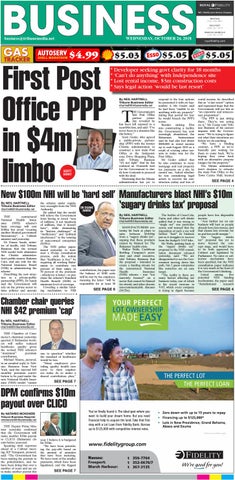
First Post Office PPP in $4m limbo
$5.03
$5.05
$5.05
* Developer seeking govt clarity for 18 months * ‘Can’t do anything’ with Independence site * Lost rental income, $3m construction costs * Says legal action ‘would be last resort’
SCOTT GODET
By NEIL HARTNELL Tribune Business Editor nhartnell@tribunemedia.net
T
HE Government’s first Post Office partner yesterday revealed he has been left exposed to a near-$4m loss, and said: “I’ve never been in a situation like this before.” Scott Godet, who agreed a public-private partnership (PPP) with the former Christie administration to construct a new main Post Office at the Independence Drive Shopping Plaza, told Tribune Business “it’s not right” that he has endured an 18-month wait for the Government to clarify how it intends to proceed with the deal. Disclosing that the Minnis administration has yet to
respond to the four options he presented it with on September 4, Mr Godet said he had been “unable to do anything with my property” during that period for fear he would breach the PPP’s terms. Besides sinking $3m into constructing a facility the Government has now seemingly abandoned, the Bahamian businessman said he had also lost about $800,000 in rental income up to end-August 2018 as a result of evicting other tenants to make way for the Post Office. Mr Godet added that he also continues to incur mortgage and real property tax payments on a site he cannot use. Asked whether he was considering legal action to recover his construction outlay and loss of
rental income, he described this as “a last resort” option and expressed hope that the Government will see this as “an expensive and unnecessary proposition”. “The PPP is just sitting there. They’re not acting on it,” Mr Godet told Tribune Business of his current impasse with the Government. “We’re trying to figure out what their intentions are before we do anything. “We have a binding contract, a PPP, so we’re basically just waiting for them to come back. We’re hoping they come back with an alternative purpose (usage) for the property.” The Minnis administration’s decision to relocate the main Post Office to the Town Centre Mall, located
SEE PAGE 4
New $100m NHI will be ‘hard sell’ Manufacturers blast NHI’s $10m ‘sugary drinks tax’ proposal By NEIL HARTNELL Tribune Business Editor nhartnell@tribunemedia.net
THE restructured National Health Insurance (NHI) scheme’s basic coverage will cost $100m but avoid “creating another bloated government bureaucracy”, a Cabinet minister said yesterday. Dr Duane Sands, minister of health, told Tribune Business that the revised NHI model both eliminates the Christie administration’s public insurer, Bahama Care, and any role for the National Insurance Board (NIB) in administering the scheme. Describing the new structure as a private-public partnership (PPP), Dr Sands said the Government will rely on the private sector to issue policies and operate
the scheme under regulatory oversight from the NHI Authority. He added that the model will relieve the Government from having to invest “tens of millions, if not hundreds of millions, that it doesn’t have”, while eliminating its “historic challenges” of “inefficiency” and “political interference” in the running of state-owned enterprises (SOEs). The NHI policy paper, issued yesterday to kickstart a 45-day consultation process, ends the notion that “healthcare is free” by requiring all working Bahamians to contribute two percent of their salary or 50 percent of the premium - whichever is lower - to purchase the scheme’s Standard Health Benefit (SHB) or minimum level of coverage. Unveiling a similar funding mechanism to NIB
Chamber chair queries NHI $42 premium ‘cap’ By NEIL HARTNELL Tribune Business Editor nhartnell@tribunemedia.net THE Chamber of Commerce’s chairman yesterday queried if Bahamian workers will suffer reduced healthcare quality given the revised NHI scheme’s “maximum” premium contribution. Michael Maura, pictured, in an emailed reply to Tribune Business from New York, said the top-end $42 monthly premium contribution to be paid under the new National Health Insurance (NHI) model “causes
one to question” whether the standard of healthcare would be less. “Many employers providing quality health care cover to their employees today do so under a shared contribution plan,”
SEE PAGE 7
DPM confirms $10m payout over CLICO By NATARIO MCKENZIE
Tribune Business Reporter
nmckenzie@tribunemedia.net THE Deputy Prime Minister yesterday confirmed that the Government will make another $10m payout to CLICO (Bahamas) clients before year-end. Speaking with reporters ahead of a Cabinet meeting, KP Turnquest, pictured, said: “The Government has been making the payouts to the policyholders, and we have been doing that over a number of years and are set to make another payout this
year. I believe it is budgeted for $10m. “We have been prioritising the pay-offs based on the amount of annuities that have been maturing. We have most of the smaller payments, which have been liquidated, and the biggest
SEE PAGE 7
DR DUANE SANDS
By NEIL HARTNELL Tribune Business Editor nhartnell@tribunemedia.net
contributions, the paper says the balance of SHB costs will be met by the employer, meaning the latter “will be responsible for at least 50
SEE PAGE 6
MANUFACTURERS yesterday hit back at plans to raise between $4-$10m from a “sugary drinks tax”, arguing that these products cannot be blamed for The Bahamas’ health crisis. Walter Wells, Caribbean Bottling Company’s president and chief executive, told Tribune Business that the proposal - intended to create a funding stream for the restructured National Health Insurance (NHI) scheme - was “too narrowly focused” on a sector that cannot be blamed for obesity and other chronic non-communicable diseases (NCDs).
The bottler of Coca-Cola, Fanta and other soft drinks added that it was wrong to “single out” one particular sector, and warned that the imposition of such a tax will further “hurt” its business just as it struggles to recover from the budget’s VAT hike. Mr Wells, pushing back at the “sugary drinks tax” proposal in the NHI consultation document released yesterday, said: “We are disappointed to see the Government moving down this path, but I guess companies like ourselves are an easy target. “The reality is there are many factors affecting our business today, one of which is the recent increase in VAT, which every company is trying to digest because
people have less disposable income. “Any further tax on our business will hurt as people already have less money, and that means less revenue for us and less profit margin.” The “sugary drinks tax” proposal has yet to move beyond the concept stage, and would have to be both approved by Cabinet and legislated by Parliament. No rates or collection mechanism have been specified, but the NHI consultation paper indicates it is very much at the front of the Government’s thinking. Listed among five potential NHI funding mechanisms, the paper said: “Jurisdictional research
SEE PAGE 4
PAGE 2, Wednesday, October 24, 2018
THE TRIBUNE
STUDENTS LOSE MATH FEAR VIA WEB-BASED LEARNING THE Bahamas Technical and Vocational Institute (BTVI) has been using Internet-based learning systems to reduce the fear of mathematics among its students. The subject has always been daunting for Darian Smith. Since high school, he always struggled with maths and it was his least favourite lesson. That fear followed him into the classrooms at BTVI. Although Mr Smith has had several maths teachers during his academic career, he always felt he was struggling alone. It was not until he was introduced to the Assessment and LEarning in Knowledge Spaces
(ALEKS) system at BTVI that he began to understand and appreciate the topic. “The idea of having to take math at BTVI really intimidated me. I was like: ‘Ah! I’m going to fail again.’ But after doing my prep classes and being introduced to ALEKS, it was smooth sailing from there”, said the information technology management major. ALEKS is a web-based, artificial intelligent assessment and learning system. It uses adaptive questioning to quickly and accurately determine what a student knows and does not know in a math course. The system allows
BAHAMIANS URGED TO USE TRUSTS IN ESTATE PLANNING MORE Bahamians have been urged to use trusts as a retirement and estate planning tool to avoid costly, bitter fights over succession and family assets. Amanda Ferguson, Royal Fidelity’s trust and estates manager, argued that trusts were “more beneficial” than Wills for avoiding family splits over how a deceased’s wealth and estate are distributed. “It’s better to have a Will than nothing at all,” she said. “Death can result in dissension, and even sometimes irreparable damage to a family structure. It’s kinder, smarter and more beneficial to set up a trust.” She suggested that the best way for individuals to have their last wishes over the distribution of assets granted is to combine a trust with a Will. The latter will direct the distribution of assets that are outside the trust, and therefore form what is known as the individual’s estate. “Often a trust is established by the client (settlor) for estate planning and asset protection purposes, including confidentiality. The trust assets are distributed to specific people chosen by the settlor, called beneficiaries. The settlor can also be a beneficiary of the trust,” Ms Ferguson added. “That’s the beauty of a trust. Once the client
establishes a trust, their assets of choice, which can be made up of cash, stocks and bonds, real estate etc, are transferred into the trust and will only be distributed to the chosen beneficiaries of the trust. “We service Bahamian clients and Bahamian residents. There are many benefits to having a trust, and I wish more people would ring me or come in to Royal Fidelity and get some information. Trusts are not difficult to set up and well worth the effort,” she continued. “Unlike a Will, trust assets can be distributed immediately upon the death of the settlor, as they are not subject to probate. The probate process can often take a year or longer, even if there is a will. The individual’s loved ones must wait until probate is granted in order to begin receiving assets from the individual’s estate. “Probate documents are public records for all to see - who got what. Also, the Will requires an executor of the estate. Oftentimes individuals name a trusted friend or family member as their executor. However, the reality is that the named person may struggle with administering the estate due to grief, lack of knowledge of the probate process and time constraints (especially if the executor is employed).”
instructors to create lessons based on their course outlines. Upon the students’ initial log-in, they are given a knowledge test to assess what topics they have mastered and what topics they need to work on. Based on those results, ALEKS creates a personal learning plan that teaches and assesses students’ mastery of content and skills. The system also regularly tests and retests the same skills to make sure students retain knowledge. Because of ALEKS, Mr Smith says he is much more confident in his math skills and has even become a tutor for BTVI students who face the same struggles he once did. He tutors students from prep math to college algebra. “A lot of the students I tutor don’t understand the fundamentals, and that’s what ALEKS helped me with,” said Mr Smith, who has now completed all levels of math at BTVI. Like Mr Smith, Ashley Wright also had a fear of math that followed her from high school. “With Math, I just completely never understood what was going on. Even after having tutors I didn’t know what was going on,” said the cosmetology student. “ALEKS alleviated some of the pressure in math for me because I actually thought I was going to fail my last math class and I ended up getting an ‘A’ thanks to ALEKS. It’s even still helping me in my current math class,” added the 22 year-old. “I feel as if the foundation is what I was really missing and, because of the constant practice in ALEKS, math is
BTVI’s chair of math, Archilene O’Brien, assisting students with online learning via a tablet. PHOTOS: Shantique Longley easier for me now.” BTVI instructor, Ron Clarke, credits ALEKS for changing his students’ attitudes towards math and making it easier for him to focus on those who need special attention. “I have been teaching Math at BTVI for the past eight years, and ALEKS is the best program that has ever happened to us,” said Mr Clarke. “In ALEKS, I can see every mistake the students make and how many times they’ve made it, so I can then go and give individual attention to students with problems. So everybody moves at their own pace. “Students love technology. They can get on to ALEKS from their smartphones or tablets and sit around campus and just practice math. They love it.”
Mr Clarke said there had been a substantial increase in the percentage of students passing maths during the past two semesters using ALEKS. Since its implementation in spring 2017, the overall math pass rate has steadily increased every semester - with an overall rise of 11 percent. In BTVI’s math prep course, the average knowledge test score rose from an initial 57 percent to 98 percent by the end of the semester. BTVI’s math department chair, Archilene O’Brien, said: “A few semesters ago there were a few students whose math gaps were
so extensive that we contemplated recommending that they be transferred to another institution. “After two semesters on ALEKS, the students have moved from a dismal ‘F’ to ‘C’ average - an achievement that would not be possible without their long hours of persistence and commitment to working on ALEKS.” More than 80 students received awards this April for passing certificates from ALEKS. And, for spring 2018, the math withdrawals decreased by 50 percent compared to the previous year, marking the lowest ever withdrawal rate.
BTVI DEPUTY CHAIR FULFILLS HIS PROMISE THE Bahamas Technical and Vocational Institute’s (BTVI) deputy chairman, Peter Whitehead, has made good on his promise to donate an Apple computer to the institution. The Apple iMac computer is to be used in further improving and maintaining the institution’s brand by way of desktop publishing. “BTVI is a remarkable institution that’s working actively towards preparing its students for the future. With this donation, I hope to help keep BTVI up to date with the ever-changing technological industry,” said Mr Whitehead. As a part of his donation,
Mr Whitehead also pledged to support the training of the iMac recipient to ensure that person takes full advantage of the opportunity. Alicia Thompson, BTVI’s associate vice-president of fund development, said of Mr Whitehead’s investment: “This underscores the importance of public-private donations to help BTVI operate more efficiently and effectively. “We are truly happy to have persons like Mr Whitehead on board to support our vision. FROM left: BTVI’s associate vice-president of fund devel- We hope this donation sparks opment, Alicia Thompson; BTVI’s deputy chairman, Peter the beginning of extended Whitehead; and BTVI’s president, Dr Robert W Robertson. support and investment in Photo: Shantique Longley BTVI from industry.”
THE TRIBUNE
Wednesday, October 24, 2018, PAGE 3
GOVERNANCE REFORMER FEARS ‘DEEPER HOLE’ OVER NEW NHI By NATARIO MCKENZIE
Tribune Business Reporter
nmckenzie@tribunemedia.net A LEADING governance reform campaigner yesterday warned The Bahamas will only dig itself into an “ever deeper fiscal hole” if National Health Insurance (NHI) is not properly funded or managed. Robert Myers, a principal with the Organisation for Responsible Governance (ORG), told Tribune Business that the public should be “very concerned” if NHI’s funding does not come from increased government efficiencies or properly allocated revenue sources. The NHI Authority, the body which will oversee the scheme, said in a consultation paper released yesterday that funding will come from five primary sources, namely government contributions from the budget; an allocation of VAT collected on private health insurance premiums; distributions from a “risk equalisation fund”; direct contributions from “secondary and exempt employers”; and a “surgery drinks tax”. Dr Robin Roberts,
the NHI Authority chairman, yesterday outlined a revised NHI model and the start of a 45-day consultation period with stakeholders to discuss proposed changes to the programme, which currently serves 40,000 beneficiaries. Under the revised NHI programme, primary care services will be expanded to include cancer screening programmes and diagnostic imaging, and feature comprehensive cancer screenings for the most common cancers in The Bahamas. The new diagnostic imaging services will include various x-rays and ultrasounds, such as prenatal ultrasounds. The scheme’s expansion also involves the Government’s long-promised catastrophic care plan. This will include comprehensive coverage for select conditions or treatments, all of which have a high prevalence in The Bahamas, including breast cancer; prostate cancer; colon cancer; rectal cancer; cervical cancer; ischemic heart disease (heart attack); pacemaker needs and end-stage kidney disease. “No one is against the idea
of NHI but it must be responsibly funded and managed, or we will only be digging The Bahamas into an ever deeper fiscal hole from which we may never come out of,” Mr Myers warned. “Our cost of doing business and regional levels of competitiveness are already very weak, due in large part to massive government inefficiencies and corruption. If the monies required for this programme are not coming from existing reallocations of funding, or through savings created by efficiencies in the system, then the public should be very concerned.” The revised NHI model establishes an employer mandate that requires businesses and employees to share the cost of the standard health benefit (SHB) premium, the basic care package, albeit with some exemptions. “It is estimated that employees will pay two percent of their salary to a maximum of $42 per month, with the employer paying the remainder of the premium. The employer mandate will be phased in, starting in January 2021, for businesses with
over 100 employees, then eventually will be expanded to include all employers over the coming years. Employers will be responsible for providing the SHB to full-time and part-time employees working over 15 hours per week.” Mr Myers warned yesterday: “If this programme is managed like NIB or Bank of The Bahamas, or many other government programmes or state-owned enterprises, it is very likely that while some people’s ailments will be remedied, the country’s debt will suck us all down with it. At that point NHI won’t be of value to any one.” Referencing the employer mandate, Mr Myers added: “That’s not great because what happens is it means that we have to push that cost on to the consumer, which makes us a more expensive jurisdiction and less competitive in the region. We are already very high compared to a number of our competing Caribbean nations. “I understand the need but they have got to get some of that money out of the fact that they obtain some efficiencies from the Government,
and not just tax the people. It’s enough already. Over time you increase taxes and services, and the burden of cost for goods and services. All you’re doing is pushing people to more competitive markets.” With the employer mandate being phased in, starting in January 2021 for businesses with over 100 employees, Mr Myers suggested this could create unfair competition. “It’s unfair competition there. There are some problems there with the way they are writing this thing,” he argued. “That’s an unfair bias that you’re going to pick on people that have 100 employees or more. A company with 75 employees that is competing with a company with 100 employees doesn’t have to carry that cost? It’s also unfair to employees. The ones that aren’t contributing are paying for the ones that are.” Mr Myers continued: “As long as it is an added cost to employers and employees, it is going to increase costs of goods and services, which makes us an ever-increasingly expensive jurisdiction. “As we stated previously,
the cost should come from internal budgets and efficiencies gained. When this legislation is passed, what backstop is going to be provided to ensure health costs and fees don’t spiral out of control?” Mr Myers argued that 45 days of consultation was “hardly enough time to understand the complexities of the revised structure, let alone understand how this is to be funded and when”. An April-July 2019 timeline is being recommended for the launch of the SHB benefit and NHI expanded coverage. The latter month is being recommended as the launch period for the “sugary drinks tax” and national wellness programme. The employer mandate for businesses with 100 or more employees is slated for January 2020, and that mandate’s expansion to all employers and the deadline for all grandfathered private insurance plans is January 2021.
NHI changes to end ‘falling through cracks’ By NATARIO MCKENZIE
Tribune Business Reporter
nmckenzie@tribunemedia.net THE Bahamian heath care system “lacks equity”, the National Health Insurance Authority’s (NHIA) chairman lamented yesterday, arguing that the revised scheme will prevent patients “falling through the cracks”. Dr Robin Roberts said: “What we have designed is that no one will be excluded on the basis of their current illness or charged more. We are all sharing in this cost. One of the major problems in our health care system is we lack equity. Those who need care can’t get it, and those who need more care can get anything. They just don’t have the money.” The NHI Authority’s 21-page policy document, released yesterday, noted that about eight percent of Bahamian GDP is being spent on healthcare, but “the Bahamian population is not seeing many of the much-needed benefits from this expenditure” . “Despite the investments made, the previously stated problems of an uninsured and unhealthy population are leading to an inefficient and expensive system with poor health outcomes,” it added, setting out the rationale for NHI. “There are complicated factors in the Bahamian healthcare system that make change hard to achieve. Long wait times due to increasing demand for public sector health services have put significant strain on a system
with limited resources. This places a great burden on our healthcare workforce to find capacity where there is none.” The NHI paper said it had become easy for patients to “fall through the cracks, and fail to access the services that they desperately need”. “The nature of the archipelago also makes delivery of healthcare services expensive. Historically, ineffective use of resources has made The Bahamas one of the least efficient nations in the world when it comes to value-based care,” it added. “Furthermore, without digital health records and interconnected end-to-end service delivery, the cracks that people fall through will continue to widen. NHI plays a key role for the ten percent of the population it currently provides coverage to, serving as an important first step in bringing people into the health system that they would otherwise have difficulty accessing.” The revised NHI model proposes to have a standard health benefit (SHB) as base coverage. “NHI will work with the private health insurance companies to provide cost effective supplemental coverage for the elderly population,” the consultation paper added. “Coverage under this plan may include private services at public hospitals, private providers and overseas care. Eligibility for this coverage will be for those eligible for NHI coverage as detailed below, who are also over the age of 65. Unlike NHI
base coverage, the supplemental coverage will come with an additional premium cost paid by the beneficiaries themselves, and this premium will be affordable, significantly less costly than any alternative. “The legislative requirement will be for employed individuals and their employers to purchase the SHB from private licensed insurance companies in The Bahamas, and this will cause a significant increase in the number of individuals in private insurance plans, and corresponding increase in the health insurance marketplace,” the paper continued. Under the revised NHI model, “risk equalisation” will help to keep premiums affordable. “Since premium prices for the SHB will be regulated to support health insurance affordability and accessibility, reimbursements to insurers are necessary to incentivise coverage of high-risk individuals,” it explained. “The system works by establishing a common pool of resources, collected through contributions as a portion of collected premiums from both the public payer and private insurers. “This pool is then divided among insurance providers, including NHI as a payer, based on their risk profile. At the onset of the employer mandate, 50 per cent of the SHB premium would be considered ‘at-risk’ and used to form a risk equalisation fund that would then be redistributed to insurers based on the relative risk of their entire beneficiary pool.
VACANCY NOTICE
IP NETWORK SPECIALIST Cable Bahamas Limited is seeking to employ an experienced IP Network Specialist. The successful candidate must have IP Network Experience and the ability to lead in a technical environment. JOB SUMMARY The position of IP Network Specialist is a hands-on operational position working within the Network Operations Group. This role is expected to ensure maximum possible service availability and performance, provision customer network services on core equipment; provide IP engineering support to the Network Operations Team and other technical teams. In addition, to provide training, guidance and reporting on the dayto-day operations to the NOC Operations group; assist with IP network design projects and other projects as required which include installing, maintaining and supporting IP related technologies and elements of the Cable Bahamas IP Network Infrastructure; aid in the execution of Disaster Recovery Plans and Procedures; maintain network documentation, policies and procedures. JOB DESCRIPTION • Fault handling and escalation (identifying and responding to faults on CBL’s systems and networks); • Manage and maintain the Monitoring Systems (these report on the status and performance of CBL & Aliv Transport Networks, Cable Modem Network, and other core services and facilities); • Maintain customer premise equipment standards and deployment; • Provision customer’s aggregation links; • Maintain CBL’s Internal network infrastructure; • Develop / maintain network management / monitoring systems; • Maintain network quality of service policy, security standards and configuration; • Troubleshoot and assist in the resolution of problems and issues as they relate to IP related services; • Assist in the maintenance and tracking of hardware and software owned by the company; • Develop reports on a daily, weekly and monthly basis on network performance and trends; • Participate in a 24 x 7 call-out rotation as required; • Escalate to IP Engineers as required after troubleshooting unresolved issues; • Create and manage policies related to DHCP, access-lists, VLANs; • Configure OSPF and BGP protocols; • Work with IP network security team regarding network security standards, policy and configuration; • Develop method of procedures, testing procedures, and proof of concept labs; • Document network faults via the support systems database; • Develop and automate meaningful metric based reports; • Provide root cause analysis and post mortem exercises with a goal to future mitigation of issues; • Perform any other IP Network related duties as determined and assigned by management.
SKILLS, EXPERIENCE & QUALIFICATIONS REQUIRED • A minimum of an Associate Degree in Computer Science, Electrical Engineering or related field; • Industry certifications in Network+ and CCNP an asset; • At least three (3) years’ experience in a technical support or similar role; • Experience in a telecommunications environment a plus; • Good communicator with a natural aptitude for dealing with people; • Good network diagnostic skills; • Work well in a busy team, being quick to learn and able to deal with a wide range of issues; • Strong analytical skills and able to collate and interpret data from various sources; • Must be flexible and work well with team; • Ability to assess and prioritize faults and respond or escalate accordingly; • Experience with switching and internet routing technologies; • Basic understanding of network monitoring concepts and management tools. • Experience with network monitoring tools and protocols (MRTG, Solarwinds SNMP); • Intermediate knowledge of the OSI model, switching and internet routing technologies; • This position interacts with Executives, Department Managers, Network Operations Center (NOC), and Vendors on a daily basis, with regular interaction with the Outside Plant Team and Sales Engineering. Qualified applicants should submit Resumes on or before Wednesday, October 24, 2018, to the Director of Human Resources, PO BOX CB-13050, Nassau, Bahamas or send electronically with Ref: IP Network Specialist to humanresources@cablebahamas.com.
PAGE 4, Wednesday, October 24, 2018
THE TRIBUNE
First Post Office PPP in $4m LIMBO FROM PAGE ONE on the opposite side of the roundabout from the Independence Drive Shopping Plaza, is another clear indication that it has dropped the original intent of the PPP with Mr Godet. The Town Centre Mall move came after the Government dropped previous plans to relocate the Post Office to the former Phil’s Food Services building on Gladstone Road, after discovering that the costs involved in renovating that property were more than the amount it had budgeted. Mr Godet, the principal of Scottdale Bedding and National Fence Company, told Tribune Business he had presented the Minnis administration with four options for his property in a bid to break the deadlock. Recalling his dealings with the Government since last May’s general election, he added: “There was contact initially with the Ministry of Works, which wanted to get an understanding of where we were with the project. We met with the Ministry of Works, and
then nothing happened.” Following “more than a year” without any communication, Mr Godet said he met “a month or two ago” with the Attorney General’s Office before submitting his proposal on September 4. “We thought we were at the point where we needed some kind of answer,” he added. “We said to them: You can do one of four things. Continue with the PPP as written, or change the PPP to facilitate another ministry or department. “The third option was for them to put the building back in order for me to continue with it as a shopping centre, and not worry about having that discussion over damages and loss of income, and the fourth was to buy the property as is. “Do something with it; turn it into a park or bus stop. That would be the fourth option. Just compensate the company for the losses it incurred over the past couple of years. We had tenants we had to evict for this to happen,” Mr Godet continued. “That was sent to them on September 4, and I haven’t had anything since. There’s
been no kind of communication to say they like it or don’t like it, or have another option to go with, or anything like that.” Calculating his losses todate, Mr Godet told Tribune Business: “As far as design, engineering and the work that has been done already, it’s about $3m we’ve already put in. “If the property had been rented by myself [to other tenants], not considering the Government, we’d have probably lost about $800,000 up to the end of August. “In the meantime, the expenses of the building, including real property tax and the mortgage, are not stopping. These things are still going on.” Mr Godet said he had not explored alternative uses for the Independence Drive Shopping Plaza for fear he would breach the PPP’s terms and lose what potential leverage he enjoys with the Government. “If I do anything I’d be in breach,” he added. “I can’t do anything at this point; the onus is on them. If I even try to do anything with my property I’d be giving up on my rights under the PPP.
“I’ve been sitting and waiting. I’m in business to do business. I’m not in business to sit and wait. It’s an odd feeling, not knowing and not getting any real answers. I’ve never been in a situation like this before. “I just feel like it’s not right. We all know it’s not right. It just doesn’t feel good to put so much into something and, for no good reason, it comes to a halt. There’s no good reason.” Asked if he might have to seek redress through the Bahamian courts, Mr Godet replied: “I’m hoping I don’t. That would be a last resort. I’m hoping, with the strength of the PPP, that the Government would realise that would be a more expensive proposition for them, an unnecessary proposition for them. It doesn’t need to go that way.” Mr Godet is already a landlord to the Government, as he rents it the Public Treasury building on East Street through a lease that includes an option to buy. He explained that the Post Office PPP required him to finance and redevelop the shopping plaza, with the Government paying him back over an
eight-year period before ownership of the property was transferred to it for $100. “It was basically maintaining a lot of what was there,” Mr Godet said of the construction project. “The footprint, some of the walls. The superstructure would have remained the same, but the changes would have been more internal with renovations, apart from two parts that would have had to be raised five feet to accommodate a second floor.” However, Mr Godet and his team ran into several unexpected obstacles. The Post Office PPP was initially placed on hold during the final months of the former Christie administration after residents in the adjacent Garden Hills community complained that the increased traffic flow generated by the facility’s presence would disrupt the area’s quality of life. Mr Godet, though, suggested the complaints may have had more to do with construction work cutting off a short-cut that residents were taking through the Independence Drive Shopping Plaza to reach Blue Hill Road. “We gave them what we
thought was a good option,” he explained. “There was a house for sale that connected a back to Blue Hill Road. We said we’d be prepared to acquire that property, demolish the house and put an entry and exit in the neighbourhood to Blue Hill Road, so residents having to go east did not have to drive all the way to the Government High roundabout and turn around. “We thought that would be the fix to the problem, everyone would be happy and the Post Office completed by now. It was scheduled to be completed by December last year. We were eight months away from completion when this was stopped.” Then came the FNM’s general election victory, and the new government’s decision to place all PPPs entered into by its predecessor on hold pending a review. Mr Godet’s was the only one which, at that stage, had already incurred significant expenditure and seen work performed. The Ministry of Finance has subsequently issued a PPP policy document to provide guidelines for such projects in future.
Manufacturers blast NHI’s $10m ‘sugary drinks tax’ proposal NOTICE Pursuant to the provisions of Section 138 (8) of the International Business Companies Act (as amended), NOTICE is hereby given that Alamanda Cay Property Limited has been dissolved and has been struck from the Register with effect from 3rd October, 2018. Lynn Kelly and Halson Ferguson LIQUIDATORS c/o EFG Bank & Trust (Bahamas) Ltd Goodman’s Bay Corporate Centre, 3rd Floor West Bay Street and Sea View Drive P.O. Box CB 10956 Nassau, Bahamas
FROM PAGE ONE indicates that “sin” taxes on particularly unhealthy products, such as sugary drinks, alcohol and cigarettes, are effective revenue sources and create an economic and social incentive to reduce consumption. “Under our proposed plan, a ‘sugary drinks tax’ structure will be developed for sugary drinks and potentially other unhealthy products. The funding generated by this tax will be earmarked and flow directly into health education and outreach programmes.” It is proposed to take effect in July 2019. Mr Wells said that while it was “premature” to assess the likely impact and viability of such a tax, “it certainly will not have a positive effect on our business”. He added: “I do believe
it’s too narrowly focused. I certainly understand the Government’s desire to generate revenue and facilitate improvements in our health profile as a nation, and anything I can do in that regard I will. “But it has to be done in consultation, dialogue, and to single out sugary drinks is too narrow a focus. It doesn’t have any direct correlation to obesity. It’s a cultural issue, it’s a dietary issue. To single out one industry for focus, I think, is mistaken.” Besides the “sugary drinks tax”, the NHI consultation paper lists four other potential revenue sources for a scheme’s whose minimum coverage package will cost around $100m. These are direct government contributions from the budget; the allocation of VAT levied on health insurance premiums; direct contributions to the NHI Authority from so-called “secondary and exempt” employers; and distributions from a “risk equalisation fund” that will compensate private insurers that take on a “higher risk”
patient population. Dr Duane Sands, minister of health, justified the “sugary drinks tax” proposal as a “socially responsible” effort to mitigate NCDs, arguing that there was sufficient scientific evidence to link them to health problems. “There’s a huge amount of momentum around the world, based on the problems of NCDs as outlined in international fora we participate in,” he told Tribune Business. “It’s an evidencebased approach to reducing sugar consumption and mitigating NCDs. “Given our health profile, can we afford not to put a financial barrier to sugary sweet beverage companies? Is it socially responsible for us not to do it when the evidence shows it works? This is clearly not yet policy, but is in the ‘White Paper’ as it’s important to show what we’re thinking.” Dr Sands said current estimates suggested between $4-$10m per annum could be generated for NHI by imposing a “sugary drinks tax”, with the Government
exploring multiple funding mechanisms to ensure the scheme’s viability and sustainability. “We still have to look at where the money is coming from,” he told Tribune Business. “It’s not a matter of continually shifting from existing revenue streams. We have to anticipate some of the push back in the market. “If we’re talking about a programme likely to cost $100m, which is pretty much where it comes in, as we increase the package and what’s included the price tag goes up. At least we acknowledge there’s a cost that’s not coming from nowhere, and we have to determine what the national appetite is going to be. Are you willing to pay this cost for this service?” Dr Sands added that using VAT collected on health insurance premiums to fund NHI might reduce industry “push back” on the levy, as the monies would then “be applied to a product that provides benefits to a greater number of people”.
PAGE 6, Wednesday, October 24, 2018
THE TRIBUNE
New $100m NHI will be ‘hard sell’ FROM PAGE ONE percent of the premium cost”. The SHB package’s initial “regulated premium cost” is expected to be $1,000 per year, or $83 per month, meaning that employee contributions will be effectively “capped” at $500 per month. Its introduction is currently scheduled to begin in April-July 2019, with the wider NHI scheme phasedin over a period lasting until 2021, and containing various exemptions for specific categories of companies and workers. Legislation will be passed mandating that employers, and their workers, acquire the SHB package from private insurance companies, although prices (premium costs) will be “limited to a range” set by an unnamed “independent body” and approved by both the minister of health and NHI Authority. Legal reforms, according to the policy paper, will “guarantee the issuance” of SHB coverage to anyone who applies, meaning that persons with pre-existing illnesses or health conditions cannot be turned away
or rejected for medical insurance. Dr Sands told Tribune Business that the revised NHI model was designed to provide quality healthcare for all Bahamians via a scheme that was financially sustainable, with specific funding sources identified unlike under the Christie administration, which relied solely on the Consolidated Fund and failed to properly allocate the necessary resources from it. Acknowledging that a contributory NHI will still be “a hard sell”, given the need for all employers and workers to help fund it, Dr Sands argued it would enable small and medium-sized businesses to provide coverage for their employees at 20-25 percent of current premium costs. Pointing out that typical medical insurance premiums range from $4,000-$6,000 per annum, compared to the SHB’s $1,000, the minister said: “I think the way this is done will invite some people that would like to provide health insurance but can’t afford it to get into that market to provide some protection for their staff. “The other way to look at this is an additional cost to doing business. When
we look at the studies, healthy employees lead to a more productive business and healthier bottom lines. That’s a hard sell, and I expect to get some push back from some employers. “Some people will say it’s untenable, too much and I can’t afford it. I don’t have a reasonable response. If we believe in Universal Health Coverage (UHC) it comes at a cost.” Dr Sands added that the revised NHI model would “be a game changer” for the Government, and how the trade unions that represent its employees “see their conditions and terms of service, even for those individuals that do not enjoy a major medical insurance plan”. Explaining the shift away from the Christie administration’s government-run NHI, the minister added: “The idea is we want to grow our private sector. Our economy is going to grow on the back of the private sector, not the Government. “Not to make disparaging comments about NIB, but NIB has demonstrated inefficiency in its ability to deliver benefits without extra administrative costs. They’re running at 20-plus percent and ought to be
running at five to six percent based on other entities.” Dr Sands continued: “Our financial sector has been taking a beating recently, and to now take a scheme that provides equity and parity for public patients, but do it through a PPP where the private sector provides the infrastructure with the ability to bill, code and follow these things, it means the Government doesn’t have to invest tens of millions, if not hundreds of millions, which it doesn’t have to get this project off the ground. “It eliminates the historic challenge of government to avoid places of inefficiency. We’ve seen it with Bank of The Bahamas, the Bahamas Mortgage Corporation and Bahamas Power & Light (BPL). “If we have the Government acting as regulator and defining what the product is, you’re less likely to have political interference that results in an increase in accounts receivables because people are not paying for it, whether it’s the Government, employer or employee.” Dr Sands confirmed that the revised NHI structure has no place for the Bahama Care public insurer that
Legal Notice NOTICE
NOTICE
CASPIAN ASSET HOLDINGS LTD.
EXXONMOBIL EXPLORATION AND PRODUCTION FAROE ISLANDS LIMITED
NOTICE IS HEREBY GIVEN as follows: (a)
CASPIAN ASSET HOLDINGS LTD., is in voluntary dissolution under the provisions of Section 138 (4) of the International Business Companies Act 2000.
(b)
The dissolution of the said Company commenced on the 23rd October, 2018 when its Articles of Dissolution were submitted to and registered by the Registrar General.
(c)
The Liquidator of the said Company is Shareece E. Scott of Deltec Bank & Trust Limited, Deltec House, Lyford Cay, P.O. Box N-3229, Nassau, Bahamas.
Pursuant to the provisions of Section 138 (8) of the International Business Companies Act 2000, notice is hereby given that the above-named Company has been dissolved and struck off the Register pursuant to a Certificate of Dissolution issued by The Registrar General on the 12th day of October, 2018
R.W. RICE Liquidator of EXXONMOBIL EXPLORATION AND PRODUCTION FAROE ISLANDS LIMITED
Shareece E. Scott Liquidator
MARKET REPORT MONDAY, 22 OCTOBER 2018
t. 242.323.2330 | f. 242.323.2320 | www.bisxbahamas.com
BISX ALL SHARE INDEX: CLOSE 1,991.49 | CHG -0.03 | %CHG 0.00 | YTD -72.08 | YTD% -3.49 BISX LISTED & TRADED SECURITIES 52WK HI 4.50 20.91 7.50 4.46 1.26 0.19 3.92 9.26 6.60 5.30 12.50 2.74 1.77 8.21 6.30 13.20 7.00 4.50 13.50
52WK LOW 3.50 19.17 7.50 3.32 0.90 0.15 2.30 8.60 6.09 3.54 9.00 2.30 1.40 7.25 6.00 9.75 5.67 3.25 12.50
1050.00 1000.00 1000.00 1000.00
1000.00 1000.00 1000.00 1000.00
PREFERENCE SHARES
1.00 103.00 100.00 106.00 105.00 103.00 100.00 10.00 1.01
1.00 100.00 100.00 100.00 100.00 100.00 100.00 10.00 1.00
SECURITY AML Foods Limited APD Limited Bahamas Property Fund Bahamas Waste Bank of Bahamas Benchmark Cable Bahamas CIBC FirstCaribbean Bank Colina Holdings Commonwealth Bank Commonwealth Brewery Consolidated Water BDRs Doctor's Hospital Emera Incorporated Famguard Fidelity Bank Finco Focol J. S. Johnson Cable Bahamas Series 6 Cable Bahamas Series 8 Cable Bahamas Series 9 Cable Bahamas Series 10 Colina Holdings Class A Commonwealth Bank Class E Commonwealth Bank Class J Commonwealth Bank Class K Commonwealth Bank Class L Commonwealth Bank Class M Commonwealth Bank Class N Fidelity Bank Class A Focol Class B
CORPORATE DEBT - (percentage pricing) 52WK HI 100.00
52WK LOW 100.00
115.92 100.00 100.00 100.00 100.00 100.00 100.00 100.00 100.00 100.00 100.00 100.00 100.00 100.00 ##########
104.79 100.00 100.00 100.00 100.00 100.00 100.00 100.00 100.00 100.00 100.00 100.00 100.00 100.00 100.00
SYMBOL AML APD BPF BWL BOB BBL CAB CIB CHL CBL CBB CWCB DHS EMAB FAM FBB FIN FCL JSJ CAB6 CAB8 CAB9 CAB10 CHLA CBLE CBLJ CBLK CBLL CBLM CBLN FBBA FCLB
SECURITY Fidelity Bank Note 22 (Series B) +
SYMBOL FBB22
Bahamas Note 6.95 (2029) BGS: 2015-1-3Y BGS: 2014-12-5Y BGS: 2015-1-5Y BGS: 2014-12-7Y BGS: 2015-1-7Y BGS: 2014-12-30Y BGS: 2015-1-30Y BGS: 2015-6-3Y BGS: 2015-6-5Y BGS: 2015-6-7Y BGS: 2015-6-30Y BGS: 2015-10-3Y BGS: 2015-10-5Y BGS: 2015-10-7Y
BAH29 BG0203 BG0105 BG0205 BG0107 BG0207 BG0130 BG0230 BG0303 BG0305 BG0307 BG0330 BG0403 BG0405 BG0407
BAHAMAS GOVERNMENT STOCK - (percentage pricing)
LAST CLOSE 3.85 17.43 9.09 4.46 1.01 0.19 2.30 9.25 6.16 3.92 12.42 2.56 1.75 7.42 6.29 13.20 6.35 3.63 13.01
CLOSE 3.85 17.43 9.09 4.46 1.01 0.19 2.30 9.25 6.16 3.92 12.42 2.52 1.75 7.44 6.29 13.20 6.35 3.63 13.01
CHANGE 0.00 0.00 0.00 0.00 0.00 0.00 0.00 0.00 0.00 0.00 0.00 -0.04 0.00 0.02 0.00 0.00 0.00 0.00 0.00
1000.00 1000.00 1000.00 1000.00 1.00 100.00 100.00 100.40 100.00 100.00 100.00 10.00 1.00
1000.00 1000.00 1000.00 1000.00 1.00 100.00 100.00 100.40 100.00 100.00 100.00 10.00 1.00
0.00 0.00 0.00 0.00 0.00 0.00 0.00 0.00 0.00 0.00 0.00 0.00 0.00
CLOSE 100.00
CHANGE 0.00
107.31 100.00 100.00 100.00 100.00 100.00 100.00 100.00 100.00 100.00 100.00 100.00 100.00 100.00 100.00
0.00 0.00 0.00 0.00 0.00 0.00 0.00 0.00 0.00 0.00 0.00 0.00 0.00 0.00 0.00
LAST SALE 100.00 107.31 100.00 100.00 100.00 100.00 100.00 100.00 100.00 100.00 100.00 100.00 100.00 100.00 100.00 100.00
VOLUME 25
5,176
2,000 245
VOLUME
EPS$ 0.214 0.932 -0.306 0.317 0.059 0.000 -0.996 0.700 0.441 0.154 0.627 0.102 0.209 0.000 0.670 0.701 0.719 0.277 0.631
DIV$ 0.100 1.130 0.000 0.230 0.000 0.010 0.000 0.710 0.220 0.120 0.620 0.060 0.070 0.084 0.280 0.500 0.150 0.130 0.590
P/E 18.0 18.7 N/M 14.1 N/M N/M -2.3 13.2 14.0 25.5 19.8 24.7 8.4 N/M 9.4 18.8 8.8 13.1 20.6
YIELD 2.60% 6.48% 0.00% 5.16% 0.00% 5.26% 0.00% 7.68% 3.57% 3.06% 4.99% 2.38% 4.00% 1.13% 4.45% 3.79% 2.36% 3.58% 4.53%
0.000 0.000 0.000 0.000 0.000 0.000 0.000 0.000 0.000 0.000 0.000 0.000 0.000
0.000 0.000 0.000 0.000 0.000 0.000 0.000 0.000 0.000 0.000 0.000 0.000 0.000
0.0 0.0 0.0 0.0 0.0 0.0 0.0 0.0 0.0 0.0 0.0 0.0 0.0
0.00% 0.00% 0.00% 0.00% 6.25% 6.25% 6.25% 6.25% 6.25% 6.25% 6.25% 7.00% 6.50%
INTEREST Prime + 1.75% 6.95% 4.00% 4.25% 4.25% 4.50% 4.50% 6.25% 6.25% 4.00% 4.25% 4.50% 6.25% 3.50% 3.88% 4.25%
MATURITY 19-Oct-2022 ############### 30-Jul-2018 16-Dec-2019 30-Jul-2020 15-Dec-2021 30-Jul-2022 15-Dec-2044 30-Jul-2045 26-Jun-2018 26-Jun-2020 26-Jun-2022 26-Jun-2045 15-Oct-2018 15-Oct-2020 15-Oct-2022
MUTUAL FUNDS 52WK HI 2.17 4.16 2.01 180.30 157.58 1.58 1.70 1.66 1.10 6.99 8.54 6.15 10.52 11.46 10.46 10.00 8.45 11.20
52WK LOW 1.67 3.04 1.68 164.74 116.70 1.52 1.68 1.61 1.08 6.41 7.62 5.66 8.65 10.54 9.57 9.88 8.45 11.20
FUND CFAL Bond Fund CFAL Balanced Fund CFAL Money Market Fund CFAL Global Bond Fund CFAL Global Equity Fund FG Financial Preferred Income Fund FG Financial Growth Fund FG Financial Diversified Fund FG Financial Global USD Bond Fund Royal Fidelity Bahamas Opportunities Fund - Secured Balanced Fund Royal Fidelity Bahamas Opportunities Fund - Targeted Equity Fund Royal Fidelity Bahamas Opportunities Fund - Prime Income Fund Royal Fidelity Int'l Fund - Equities Sub Fund Royal Fidelity Int'l Fund - High Yield Fund Royal Fidelity Int'l Fund - Alternative Strategies Fund Colonial Bahamas Fund Class D Colonial Bahamas Fund Class E Colonial Bahamas Fund Class F
NAV 2.17 4.15 2.01 180.30 155.10 1.58 1.69 1.66 1.09 7.36 8.47 6.53 11.32 11.67 10.54 9.93 8.45 11.20
YTD% 12 MTH% 2.58% 4.11% 0.39% 5.07% 1.47% 2.34% 0.90% 3.44% 1.11% 6.05% 3.22% 4.22% -0.38% 3.34% 2.39% 4.01% -0.38% 0.53% -1.08% 1.77% -5.96% -3.05% 1.90% 4.59% 7.24% 11.96% 2.77% 3.88% 3.94% 4.69% -0.61% 0.75% 1.13% N/A 2.95% N/A
NAV Date 31-Aug-2018 31-Aug-2018 31-Aug-2018 30-Jun-2018 30-Jun-2018 30-Sep-2018 30-Sep-2018 30-Sep-2018 30-Sep-2018 30-Sep-2018 30-Sep-2018 30-Sep-2018 30-Sep-2018 30-Sep-2018 30-Sep-2018 30-Jun-2018 30-Jun-2018 30-Jun-2018
MARKET TERMS BISX ALL SHARE INDEX - 19 Dec 02 = 1,000.00 52wk-Hi - Highest closing price in last 52 weeks 52wk-Low - Lowest closing price in last 52 weeks Previous Close - Previous day's weighted price for daily volume Today's Close - Current day's weighted price for daily volume Change - Change in closing price from day to day Daily Vol. - Number of total shares traded today DIV $ - Dividends per share paid in the last 12 months P/E - Closing price divided by the last 12 month earnings
YIELD - last 12 month dividends divided by closing price Bid $ - Buying price of Colina and Fidelity Ask $ - Selling price of Colina and fidelity Last Price - Last traded over-the-counter price Weekly Vol. - Trading volume of the prior week EPS $ - A company's reported earnings per share for the last 12 mths NAV - Net Asset Value N/M - Not Meaningful
TO TRADE CALL: CFAL 242-502-7010 | ROYALFIDELITY 242-356-7764 | FG CAPITAL MARKETS 242-396-4000 | COLONIAL 242-502-7525 | LENO 242-396-3225
To advertise in The Tribune, contact 502-2394
BRUSSELS Associated Press THE European Union set up a high-stakes battle with Italy, one of the bloc’s biggest economies, over who has final control over a member state’s budget after the executive Commission took the unprecedented step of ordering the country to revise its public spending plans. In a move that escalates a monthlong standoff, the EU said the populist government’s budget for next year is out of line and breaks earlier promises to lower public debt. Italy’s debt load is the second-highest in Europe, after Greece, and there are worries that losing control of spending could rekindle financial turmoil in Europe. The populist Italian government says the sharp increase in spending is needed to jumpstart growth after years of malaise. “We see no alternative but to request the Italian government to revise its draft budgetary plan,” EU Commission Vice President Valdis Dombrovskis said. Italian Deputy Prime Minister Matteo Salvini was quick to warn the EU to keep its hands off. “No one will take one euro from this budget.” The confrontation laid bare the fundamental problem within the eurozone where 19 EU nations share the same currency, yet governments maintain autonomy over spending priorities and the EU has been reluctant to enforce spending limits.
NOTICE Pursuant to the provisions of Section 138 (4) of the International Business Companies Act, (as amended) NOTICE is hereby given that THE RUSSELL SQUARE COMPANY LTD. is in dissolution and the date of commencement of the dissolution is 23rd October, 2018.
Dated the 24th day of October, A.D., 2018.
Dated this 24th day of October, A.D. 2018
the Christie administration planned to create. “The idea of a public insurer falls away,” he told Tribune Business. “We are not interested in there being any public insurer. We’d like to have the public sector, the NHI Authority, to act as the regulator providing oversight, and make sure the private entities do what they are mandated to do. “If we look at the way automobile insurance is provided, home insurance is provided, that model works wonderfully and the Government gets taxes from it. We don’t need to redefine the wheel and create another bloated government bureaucracy.” Dr Sands said the recent exposure of dialysis treatment woes at the Princess Margaret Hospital (PMH) “drives home that the public health system simply does not have the capacity to deal with these issues adequately”. He added that the same concerns applied to heart disease care, while “certain cancers have outstripped the ability of the public sector as they involve therapies we can’t provide”. All this, Dr Sands said, meant that NHI needed a true partnership with the private sector to provide the quality of healthcare demanded by Bahamians.
EU REJECTS ITALY’S BUDGET, RAISING STAKES IN DISPUTE
Lorna Kemp and Magdaline Carey LIQUIDATORS c/o Clairmont Trust Company Limited Pineapple Grove #5 Lyford Cay P.O. Box SP-64284 Nassau, Bahamas
THE TRIBUNE
Wednesday, October 24, 2018, PAGE 7
DPM confirms $10m payout over CLICO By NATARIO MCKENZIE
Tribune Business Reporter
nmckenzie@tribunemedia.net we are paying in stages. We have money in this year’s budget for another stage of payments and this will be done relatively soon.” Tribune Business revealed earlier this month that the Government was working on a fourth CLICO (Bahamas) payout that could come as early as November. This newspaper’s sources, speaking on condition of anonymity, confirmed to this newspaper that the Government was working
with CLICO (Bahamas) liquidator, Craig A “Tony” Gomez, the Baker Tilly Gomez accountant and principal, to determine the mechanism and timing for such a payout. They added that November was the intended timeline to pay further compensation to the insurer’s former annuity holders and pension beneficiaries, with the Government having allocated $12.403m in the 2018-2019 budget to fulfill what are termed “CLICO obligations”. It is unclear whether all, or part, of this sum will be
paid out next month, but the Government has allocated the same $12.403m amount for CLICO in the next two budgets covering the 20192020 and 2020-2021 fiscal years. This indicates an intent to compensate CLICO (Bahamas) clients for their loss as fiscal circumstances and cash flow allow, Back in 2016, former Prime Minister Perry Christie announced that the insolvent insurer’s Executive Flexible Premium Annuity (EFPA) holders, and surrendered pension policies, would receive a cash
payment capped at $10,000. Anything owed above this sum was to be paid off via the issuance to former clients of seven-year promissory notes (government bonds), which will provide them with quarterly insurance payments at the prime rate (4.75 percent). It was also indicated that surrendered insurance policies, death benefits, medical claims and staff pensions would ultimately be paid in full. Mr Turnquest, meanwhile, yesterday said the Government was on track to meet its objectives for the 20182019 fiscal year, with an update on the Minnis
administration’s performance possibly forthcoming in a week or two. He said: “We are about to release an update, as we had promised, that reports on our performance in terms of revenue collection and what we spent to ensure we are keeping them fully abreast of how we are meeting our commitments. “We recognised that the budget asked for some sacrifices from the Bahamian people, and we want to ensure we stay true to our promises to them in terms of how we spent that money.” “Very soon we will be
issuing an update detailing exactly what we have collected, how we spent it and the liquidation of some of the past expenses that we outlined. In a week or two, at the most, we will put out a detailed report on exactly how we are preforming,” Mr Turnquest continued. “I can say that we are satisfied at the moment with the progress we have been making, and we believe that at the current pace we should be able to meet our objectives. We anticipate that we will be able to achieve our expectations for this fiscal year.”
Chamber chair queries NHI $42 premium ‘cap’ FROM PAGE ONE he explained. “The maximum $42 monthly premium (described in the draft document) to be paid by the employee causes one to question whether the quality of the proposed care may be less and/or the employer may be expected to contribute 90 percent of the total premium.” Mr Maura said the Chamber was waiting until its Monday, October 29 meeting with the NHI Authority, the scheme’s regulator, before providing a detailed response to the
restructuring. In the meantime, the private sector organisation also plans to consult fully with its members. “The [Chamber] acknowledges the desire to provide affordable and quality health cover to the residents of The Bahamas,” Mr Maura added. “Furthermore, we share the understanding that this objective is a very complex one, requiring the active engagement and buy in of all stakeholders. “The NHI Authority has been meeting with stakeholders, and they must continue to do so until such
To advertise in The Tribune, contact 502-2394
time that all stakeholders agree that the final plan is acceptable, and to include the funding plan and quality of care provided to both those with existing health cover and those presently without. “Additionally, it is paramount that all those expected to underwrite any new national health plan must also buy in. The Chamber looks forward to productive and meaningful dialogue with all stakeholders over the coming weeks, and will provide a formal position on the NHI programme within the allotted 45-day period.” The revised NHI model unveiled yesterday appears to have embraced a number of recommendations from the private sector, including calls for a greater role for private insurance companies. While private insurance companies will be responsible for issuing and “selling” NHI’s basic coverage package, the Standard Health Benefit (SHB), under the new structure, this will be price-controlled and subject to terms/conditions
imposed by the NHI Authority. It also appears that Bahamian businesses and individuals will be unable to retain their existing coverage and policies, as insurers will have to “restructure existing plans” upon their first renewal after January 1, 2021, “to include the Standard Health Benefit” package. Insurance companies will be allowed to offer “top-up” policies to the SHB, though. Dr Duane Sands, minister of health, yesterday told Tribune Business that insurance companies will have to compete on non-price factors under the new NHI model. He indicated that the health insurance sector would likely shift to a volume-driven, rather than margin-based, business as NHI would give it access to a wider pool of 380,000 potential clients. “It gives people some choice, but also strengthens the private sector,” the Minister argued. “It opens up competition. If company ‘A’ is more efficient on service than company ‘B’ it may find it has a significantly
larger market share. “They may find their product is more attractive because of service provided and turnaround time for the approval of payments to laboratories and diagnostics. What I anticipate is we create a market that allows for competition in the market even though the cost of the product is the same. “I suspect it will have an interesting impact on the willingness of the insurance companies to provide better service. You have the potential for 380,000 people; an unlimited market.” Under the NHI scheme’s proposed contribution rates, if a person earns $5,000 each year, a salary deduction of $8 per month will go into the NHI funding pool. Those with an income of $10,000 will pay $17 every month, and a person that takes home $15,000 every year will contribute $25 per month. Those earning $20,000 each year are expected to pay $33 each month, while those earning the national median income
of $25,000 a year or above will pay $42 per month. The Government aims to have “mandated private health insurance for employed persons, bringing the total population privately insured to approximately 55 percent by 2022”. Self-employed persons will have to pay 100 percent of their SHB premium, which is pegged at $1,000 per year or $83 per month. Yet there are several categories that will be “exempt” from the first phase of the employer/ employee contributions, which will start in January 2020 for businesses with over 100 employees. Among those exempt are persons employed by a company with has less than 100 full-time total employees; part-time employees working less than 15 hours per week; employees who work multiple eligible jobs (15-plus hours) who currently hold mandated minimum health insurance from another employer; grandfathered insurance plans; and businesses with annual revenues of less than $100,000 per year.
PAGE 8, Wednesday, October 24, 2018
THE TRIBUNE
Yahoo to pay $50M, other costs for massive security breach SAN FRANCISCO Associated Press YAHOO has agreed to pay $50m in damages and provide two years of free credit-monitoring services to 200 million people whose email addresses and other personal information were stolen as part of the biggest security breach in history. The restitution hinges on federal court approval of a settlement filed late Monday in a two-yearold lawsuit seeking to hold Yahoo accountable for digital burglaries that occurred in 2013 and 2014, but weren’t disclosed until 2016. It adds to the financial fallout from a security lapse that provided a mortifying end to Yahoo’s existence as an independent company and former CEO Marissa Mayer’s six-year reign. Yahoo revealed the problem after it had already negotiated a $4.83bn deal to sell its digital services to Verizon Communications. It then had to discount that price by $350m to reflect its tarnished brand and the specter of other potential costs stemming from the breach. Verizon will now pay for one half of the settlement cost, with the other half paid by Altaba Inc, a company that was set up to hold Yahoo’s investments in Asian companies and other assets after the sale. Altaba already paid a $35m fine imposed by the Securities and Exchange Commission for Yahoo’s delay in disclosing the breach to investors. About three billion Yahoo accounts were hit by hackers that included some linked to Russia by the FBI. The settlement reached in a San Jose, California, court covers about one billion of those accounts held by an estimated 200 million people in the US and Israel from 2012 through 2016. Claims for a portion
BAHAMAS POWER AND LIGHT COMPANY LTD. VACANCY NOTICE
OFFICE MANAGER A vacancy exists in the Company for the position of Officer Manager, Eleuthera. The incumbent will achieve Company objectives by: • • • • • • • • • •
Monitoring goods and services procurement to ensure value for money; Developing short and long term objectives and plans; Maintaining asset register; Preparing and submitting financial reports to area Managers, Directors and Chief Financial Officer; Managing the office staff for efficient and effective operation of the Accounts Office; Reviewing consumer accounts functions; Investigating consumer grievances; Reviewing accounts payable and receivable functions; Performing reconciliation of bank and general ledger accounts; Monitoring inventory control.
Job requirements include but not limited to: • • • • • • • • •
A Bachelor’s degree in Accounting with CPA certification or equivalent qualifications; A minimum of 5+ years’ experience; Management accounting skills; Good time management skills; Knowledge of GAAP; Good analytical and reporting skills; Good customer relations skills; Knowledge of accounting software packages and computer accounting systems; Knowledge of reconciliation process including bank and general ledger.
Interested persons should apply to Afuture@bplco.com on or before: October 31st, 2018. Only candidates meeting the criteria will be contacted. Blue Hill and Tucker Roads, P.O. Box N-7509, Nassau, Bahamas | T: 242.302.1000 | F: 242.323.6852 |www.bplco.com
Bahamas Power and Light Company Ltd.
BUILDING FOR BETTER
of the $50m fund can be submitted by any eligible Yahoo accountholder who suffered losses resulting from the security breach. The costs can include such things as identity theft, delayed tax refunds or other problems linked to having had personal information pilfered during the Yahoo break-ins. The fund will compensate Yahoo accountholders at a rate of $25 per hour for time spent dealing with issues triggered by the security breach, according to the preliminary settlement. Those with documented losses can ask for up to 15 hours of lost time, or $375. Those who can’t document losses can file claims seeking up to five hours, or $125, for their time spent dealing with the breach. Yahoo accountholders who paid $20 to $50 annually for a premium email account will be eligible for a 25 percent refund. The free credit monitoring service from AllClear could end up being the most valuable part of the settlement for most accountholders. The lawyers representing the accountholders pegged the retail value of AllClear’s credit-monitoring service at $14.95 per month, or about $359 for two years — but it’s unlikely Yahoo will pay that rate. The settlement didn’t disclose how much Yahoo had agreed to pay AllClear for covering affected accountholders.
The lawyers for Yahoo’s accountholders praised the settlement as a positive outcome, given the uncertainty of what might have happened had the case headed to trial. Estimates of damages caused by security breaches vary widely, with experts asserting the value of personal information held in email accounts can range from $1 to $8 per account. Those figures suggest Yahoo could have faced a bill of more than $1bn had it lost the case. But Yahoo had disputed those damages estimates and noted many of its accountholders submitted false information about their birthdates, names and other parts of their lives when they set up their email. The lawyers representing Yahoo accountholders have a big incentive to get the settlement approved. Yahoo will pay them up to $37.5m in fees and expenses if it goes through. Oath, the Verizon subsidiary that now oversees Yahoo, declined to comment. A hearing to approve the preliminary settlement is scheduled for Nov 29 before US District Judge Lucy Koh in San Jose. If approved, notices will be emailed to affected accountholders and published in People and National Geographic magazines.