business@tribunemedia.net
THURSDAY, OCTOBER 22, 2020
$4.10
$4.03
$4.03
$3.95
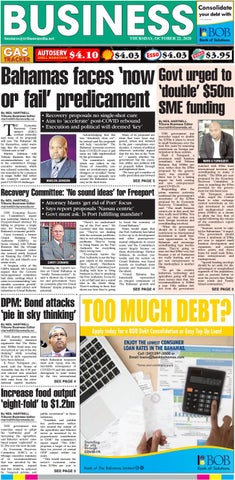
Bahamas faces ‘now Govt urged to ‘double’ $50m or fail’ predicament SME funding By NEIL HARTNELL Tribune Business Editor nhartnell@tribunemedia.net
T
HE Economic Recovery Committee’s (ERC) co-chair yesterday said none of its proposals will cure The Bahamas’ ills by themselves, amid warnings that the country must “reform now or fail”. Marlon Johnson told Tribune Business that the recommendations set out in the committee’s 63-page executive summary, which was released yesterday, were not intended to be a panacea or magic bullet that solves the country’s current and post-COVID-19 challenges.
• Recovery proposals no single-shot cure • Aim to ‘accelerate’ post-COVID rebound • Execution and political will deemed ‘key’
MARLON JOHNSON
Acknowledging that this was “absolutely clear cut”, he instead said the proposals will help “accelerate” The Bahamas’ economic recovery from COVID-19 even if just some are fully implemented by the government. The committee’s report, which was tabled in the House of Assembly, contains no revolutionary game changers or so-called “home runs” that can instantly turn around the Bahamian economy in the short-term.
Many of its proposals are ideas that have been suggested, arisen and debated in the past - sometimes over decades. A variety of political observers yesterday argued that the key lies in the “how to” - namely whether the government has the execution ability and political will to properly follow through and implement them. “We have got a number of really good ideas put forward
SEE PAGE 5
Recovery Committee: ‘No sound ideas’ for Freeport By NEIL HARTNELL Tribune Business Editor nhartnell@tribunemedia.net THE Economic Recovery Committee’s report was yesterday blasted by a Freeport-based attorney for failing to propose a single idea for boosting Grand Bahama’s economic growth. Carey Leonard, a former Grand Bahama Port Authority (GBPA) inhouse counsel, told Tribune Business that the 63-page summary released yesterday seemed solely focused on blaming the GBPA for all the city and island’s economic woes. A frequent critic of the GBPA himself, Mr Leonard argued that the Government-appointed committee had done nothing when it came to recommending “sustainable economic growth” ideas that could attract new industries to Grand Bahama.
• Attorney blasts ‘get rid of Port’ focus • Says report proposals ‘Nassau centric’ • Govt must ask: Is Port fulfilling mandate?
CAREY LEONARD Branding the report’s section on Grand Bahamas as “totally Nassau-centric”, he said it showed the Committee and government “have no economic plan for Grand Bahama” despite praising its potential.
DPM: Bond attacks ‘pie in sky thinking’
By NEIL HARTNELL Tribune Business Editor nhartnell@tribunemedia.net
THE deputy prime minister yesterday slammed arguments that The Bahamas’ $600m bond issue was over-priced as “pie in the sky thinking” while revealing $133m in debt repayments have been delayed. K Peter Turnquest, pictured, told the House of Assembly that the 8.95 percent interest rate attached to the government’s latest debt raise from the international capital markets,
which Bahamian taxpayers must now repay, was the inevitable consequence of COVID-19 and this nation’s downgrade to ‘junk’ status by the two international
SEE PAGE 4
Increase food output ‘eight-fold’ to $1.2bn By NEIL HARTNELL Tribune Business Editor nhartnell@tribunemedia.net THE government was yesterday urged to adopt the “ambitious goal” of increasing the agriculture and fisheries’ sectors’ combined output “eight-fold” to $1.2bn over the next decade. Its Economic Recovery Committee (ERC), in a 60-page executive summary of its recommendations that was unveiled by the prime minister, argued that this could be achieved by “targeted private and
public investment” in these industries. “Establish and publish key performance indicators around the output of the agriculture and fisheries sector as measured by its proportionate contribution to GDP,” the committee’s report urged. “The ERC proposes a target of no less than ten percent of annual GDP output within ten years. “This would increase the sector’s economic value from $150m per year to
SEE PAGE 5
“There’s no understanding of the Port area,” Mr Leonard told this newspaper. “They’re not dealing with the economic problems, they’re not solving economic problems. They’re trying to bring blame on the Port Authority for everything that’s wrong now. “Everybody knows the Port Authority is not the biggest culprit at the moment; that’s clearly Hutchison. They’re [the Committee] not dealing with how to bring business in; they’re attacking the Port Authority. To me it’s a lot of fluff and not a sound idea in the whole thing. There’s nothing in there that shows me how they’re going
to boost the economy of Grand Bahama.” Many would argue that the Port Authority has failed to live up to its development and other quasi-governmental obligations in recent years, and the Committee’s report largely focuses on those shortcomings. Marlon Johnson, its co-chair, yesterday said the section on Grand Bahama was based heavily on feedback from persons and businesses on the island. “Grand Bahama has historically represented an integral component of The Bahamas’ growth and
SEE PAGE 4
By NEIL HARTNELL Tribune Business Editor nhartnell@tribunemedia.net THE government was yesterday urged to double the $250m it plans to invest in small businesses over the next five years by removing restrictions on foreign participation in these entities. Mark A Turnquest, a prominent small business consultant, told Tribune Business that $100m per year, rather than the $50m proposed by the government, was essential if there was to be a lasting impact for both existing and new entrepreneurs post-COVID-19. Responding after the prime minister yesterday confirmed the government’s acceptance of the $250m proposal by its Economic Recovery Committee, he said: “The small business owners are in dire need, but they really need $100m. You won’t get that unless you have foreign investors and crowdfunding involved. “What the government should do is really relax restrictions on international investment in small business opportunities in The Bahamas and encourage crowdfunding type mechanisms. They’re going to max out that $50m very fast because a lot of businesses are really hurting, and to get new entrepreneurs in the marketplace is another thing. “To get the creative industries, technology and agriculture going will need more money than that. My recommendation is $100m a year. Fifty million dollars from the government
MARK A TURNQUEST matched with $50m from international investors and crowdfunding to make it doable.” The $50m per year proposed by the Economic Recovery Committee is close to matching the $55m provided by the government for this fiscal year. Mr Turnquest, meanwhile, urged the Central Bank to relax exchange control restrictions on foreign investment in small and medium-sized enterprises (SMEs) as a means to allow the free flow of capital following the release of the committee’s report yesterday. “Increase access to capital for Bahamians,” it urged. “The government should invest a minimum of $50m per year to support small business development and expansion, and expand micro grants and micro loans for small scale Bahamian entrepreneurs and tradespersons. “Special funding envelops should be set aside for disadvantaged or marginalised segments of the population, such as persons below or near the poverty line; Bahamian youth and Family Island communities.”
SEE PAGE 5
PAGE 2, Thursday, October 22, 2020
THE TRIBUNE
$100M CONDO PROJECT TO START IN SPRING 2021 A
BAHAMIAN developer yesterday said it plans to begin construction on a $100m high-end oceanfront condominium complex at Cable Beach in Spring 2021. Aristo Development and its principal, Jason Kinsale, the developers of the nearby ONE Cable Beach property, described their 11-storey Aqualina property as “the most exquisite jewel in the crown of Aristo luxury residences”. The development will feature just 27 units ranging in size from over 3,100 square feet for a three-bed, 3.5 bath residence to the penthouse with more than 9,400 square feet. Residences start at
$2.55m pre-construction. “We just released the development online on Saturday (October 17), and we have been stunned by the interest,” said Mr Kinsale. “We have already signed contracts for five of the 27 units, including the penthous,e which we believe is the most expensive single condominium ever sold on Cable Beach. “The biggest change we are seeing is greater activity from the US, especially New York, but also the eastern seaboard, the midwest, even California. When we were building ONE Cable Beach next door, we had a lot of interest from Canada, Switzerland, a little bit from the US and, of course, some
ARISTO Development’s $105m oceanfront condominium complex, Aqualina, will begin construction on Cable Beach in Spring 2021.
local interest, but now it’s the US. “People want to get away from the crowds, the coronavirus, the cold winters, and they want some place where they can relax but also know they are in an English-speaking country with a similar culture and they just feel safe and secure.” Mr Kinsale said Aqualina will be the greenest building in Aristo’s portfolio, which includes Balmoral, the gated community of 200 town homes and single
homes, and ONE Cable Beach with its 73 oceanfront residences immediately west of Aqualina. “The Aqualina design was created to generate the greatest air flow. All the refrigeration (air conditioning) systems were reconfigured for maximum air circulation, filtration and ventilation in public indoor spaces as well as in residences,” said Mr Kinsale, adding that every residence has its own private elevator. “We even wanted to ensure that the elevators
to every residence were designed with air flow controls and ease of maintenance to maintain best air quality. Emission friendly construction products were not things we had on our features checklist before. COVID-19 changed all that and our thinking. “We are still offering European-designed kitchens and baths with included sub-zero appliances, nine foot, six inch ceiling heights (11 inches in the beach
villas), porcelain tile floors throughout, custom closets, storm-rated doors and all the finishes that spell the finest available. “But we’re adding all the environmental safety and sensitivity measures we can - from LED lighting right down to electric vehicle charging stations in covered parking areas.” Aqualina’s groundbreaking is set for Spring 2021, with a completion and occupancy date of fall 2023.
Marijuana proposals branded ‘great news’ By YOURI KEMP Tribune Business Reporter ykemp@tribunemedia.net A MAJOR marijuana advocate yesterday hailed as “great news” proposals by the Economic Recovery Committee to develop a legalised hemp industry for The Bahamas’ own benefit. Terry Miller, chairman of the Bahamas Cannabis Research Institute (BACARI), told Tribune Business: “BACARI sent four policy briefs to the Prime Minister about two months ago and suggested how industrial hemp, medicinal marijuana and adult-use marijuana should be legislated, but we never even got a response saying they had received it.” He spoke out after the government-appointed committee, in its 63-page report tabled in the House of Assembly yesterday, called for “a hybrid
approach” to the marijuana issue that includes “decriminalisation for small amounts and legalisation with strict regulatory control offers”. It added that this provides The Bahamas with “an opportunity for economic growth, increased employment, increased revenue from both excise and VAT taxes and a decrease in crime as criminal elements would no longer be suppliers and distributors”. Taking up the suggestion in the House of Assembly, the prime minister said both the ERC and National Commission on Marijuana were united in their belief that the marijuana laws “are outdated and must change”. “The commission recommended allowing medicinal marijuana use. The ERC has recommended the full legalisation of marijuana for medicinal, religious and recreational purposes coupled with an appropriate
but nimble regulatory regime that oversees the production and manufacturing, sale, consumption,and export of marijuana,” Dr Hubert Minnis said. “The global legal cannabis market is already in the billions of dollars with significant projected growth in the years to come. We are reviewing the possible legalization of a hemp industry and will report back to the nation following greater public consultation. “A hemp industry would include variations of cannabis low in THC. Bahamian-owned or majority Bahamian-owned companies must - and will - lead any new hemp industry in The Bahamas. Hemp is used in multiple products from clothing to building materials and even in tea bags, such as some Lipton’s tea bags. There are potentially many opportunities for creative
Bahamian businesspeople to get involved in this new industry.” The ERC committee’s report recommended that all Bahamas-based companies involved in the production, manufacturing, sale and export of cannabis must have a “minimum” of 50 percent Bahamian ownership. It also called for the government to “make crown land available to Bahamians to cultivate cannabis (with special provisions for small-scale farmers and the Rastafarian community), and manufacture cannabisbased products”. “The government should avoid over-regulation of the market, which will have the effect of sustaining a black market for smaller producers or retailers who do not have the means to navigate complex bureaucracies,” the ERC added. It also urged an
exemption of CBD products - hemp and hemp derivative products with minimal or no THC levels “from the regulatory ambit, and permit their trade with minimal restriction”. In response, Mr Miller said: “Here is the most important thing I want to say to the government: It must be done the right way. The legislation must be done properly, and two important factors must be in place. For one, legislation must be guided by standards. “I presented to the minister of health in 2018. A team of us went to the minister of health [then Dr Duane Sand] and presented him with a document that sets out the standards for every aspect of the marijuana industry. The other important factor is that it has to be for Bahamians, and not just for certain sets of Bahamians, but for all Bahamians.”
Mr Miller, echoing the ERC report, added: “The government has to ensure that average Bahamians have a chance to participate in the legalisation of the production of marijuana and hemp in the country. “We created a platform that the government should have jumped on if they are really, really serious about empowering Bahamians in this industry. We created a platform called Green Alternative Investments Network Cooperative Society that will allow any Bahamian who wishes to invest in this industry to do so. “We have no issues with the government giving licenses to their special interest groups, once they are Bahamian, but we want to ensure that you give licenses to this platform where all Bahamians can participate in and benefit from.”
GRANT PLAN’S $450,000 FOR 100 DORIAN VICTIMS MORE than 100 Grand Bahama entrepreneurs have been awarded a collective $450,000 in Dorian restoration funding during a five-month Small Business Recovery (SBR) grant initiative. The Grand Bahama Port Authority (GBPA) and its partner in the effort, the Bahamas Red Cross Society (BRCS), said that had completed an initiative targeting micro and livelihood businesses on the island. Sean Brennen, the Bahamas Red Cross Society’s director-general, said the initiative was the first of its kind instituted by the national society. “As a humanitarian aid organisation, we know how to plan and execute relief efforts exceptionally well following any major disaster,” Mr Brennen said. “We also understood that, post-Dorian, economic recovery for Grand Bahama and Abaco was vital to their future. “Though this type of collaboration was new to our
FROM left: Stephanie Barr, Bahamas Red Cross administrator, Grand Bahama; Yvette O’Conno, director, Access Accelerator SBDC, Grand Bahama; Davinia Blair, executive director, Access Accelerator SBDC; Ian Rolle, president, GBPA; Renaldi Forbes, chairman, Bahamas Red Cross Grand Bahama; Sarah St George, acting chairman, GBPA; Derek Newbold, senior manager of business development, GBPA; Angelique Saunders, livelihoods officer, IFRC; and Adrian Martinez Ferrandis, livelihoods delegate, IFRC. organisation, we are incredibly proud of the work and results of the SBR programme. We are grateful to our partner, the GBPA, for sharing their wealth of knowledge and experience in small business support,
which provided a datadriven approach to reaching businesses most in need. “Likewise, we are appreciative of the support extended from the Access Accelerator (Small Business Development Centre),
which enabled the programme to benefit a greater number of businesses than originally projected.” The SBR team processed nearly 300 applications between May 1 and June 6. Of that number, 103 businesses across Grand Bahama received grants ranging from $3,000 to $6,000. “Based on our data postDorian, and relevant to GBPA’s role in another funding programme, we immediately recognised a gap between small and medium-sized enterprises (SMEs) and micro businesses that our partnership with BRCS addressed,” said Derek Newbold, the GBPA’s senior manager of business development. “More than 90 per cent of companies that applied to the programme were either uninsured or under-insured, resulting in devastating losses and an even more difficult path to post-Dorian recovery. Compounded by the setbacks of a major global pandemic,
the hurdles facing many micro businesses seemed insurmountable. “Nonetheless, in spite of having to resort to virtual meetings for programme development and planning, we were successful in bringing together critical funding, technical expertise, and a wealth of knowledge and experience in humanitarian relief and small business support to execute a highly beneficial and effective programme.” Although the initiative between the GBPA, Red Cross and SBDC focused primarily on rebuilding efforts, the objectives also emphasised the importance of building resiliency to mitigate the impact from future environmental, social, economic or weather-related crises. “In addition to financial support, professional education was an essential component of the SBR programme,” said International Federation of Red Cross and Red Crescent Societies
(IFRC) Livelihoods delegate, Adrian Martinez Ferrandis. “To ensure the funding and technical support were effectively utilised, the programme was designed to foster more robust community and commercial networks, reinforce strategies for continuity planning, and cultivate increased innovation and use of technology-based solutions to everyday challenges. “Programme recipients received mandatory training in financial management, marketing and branding, and disaster preparedness and recovery training. We are incredibly satisfied with the overall outcome of the SBR programme.” The initiative closed on September 26, 2020, having executed two complete rounds of grant funding and three entrepreneurial training groups for small businesses, which were facilitated by Island Dreams Management.
THE TRIBUNE
Thursday, October 22, 2020, PAGE 3
PM ‘disappointed’ over Security and product quality retailers’ online absence vital for Digital Marketplace By NEIL HARTNELL Tribune Business Editor nhartnell@tribunemedia.net THE prime minister yesterday said he was “disappointed” that some major Bahamian retailers have not established an online presence as he pushed back against merchant complaints on curb-side sales. Dr Hubert Minnis, in unveiling the Economic Recovery Committee’s (ERC) executive summary report in the House of Assembly, said he hoped “most if not all” retailers will develop e-commerce platforms so that they can become more globally competitive. “We are in the 21st century,” the prime minister said, recalling how he hailed the potential of tele-medicine and digital healthcare when he was minister of health in the 2007-2012 Ingraham administration. “It disappoints me that some of our major stores still do not have online functionality where one orders equipment, and orders materials, to have them delivered to their respective places or for pick-up,” Dr Minnis added. “I would hope that most, if not all, our stores will move to online purchases and online payments so they can truly compete in the global marketplace.” The prime minister’s comments came in response to opposition voiced by many retailers to the government’s decision to force them back to curb-side sales only as part of the latest restrictions designed to suppress COVID-19’s spread on New Providence. Kelly’s House & Home announced it was closing “until further notice” from 6pm on Friday, October 6, in response to the curb-side restriction, with other retailers predicting that their sales would fall by anywhere from 30 percent to 70 percent compared to in-store levels. Brent Burrows, CBS Bahamas (Commonwealth Building Supplies) general
manager, said in August that curb-side was equivalent to just 20 percent of his firm’s normal sales and “not as easy” to pull-off as many think. And Khrystle RutherfordFerguson, the Bahamas Chamber of Commerce and Employer’s Confederation’s (BCCEC) chairman, previously warned that “retail businesses will be impacted” by the latest lockdowns as there are practical issues regarding limiting their commercial activity to curbside pick-up only without including appointments. “We also acknowledge that many of our members are not able to offer delivery and curbside pick-up due to the nature of the goods and services they offer,” she added. Dr Minnis is correct in that COVID-19’s lockdowns and restrictions have reinforced the value for Bahamian retailers in developing online/e-commerce operations, together with digital payments and ordering systems, which allow customers to still transact business with them electronically for curb-side, pick-up and delivery. However, several merchants earlier this week warned that they were mulling whether to follow Kelly’s lead and close once again until in-store sales were allowed to resume by the government.; Egan Kemp, president of Eunison Company, the Shoe Depot’s parent, told Tribune Business this may be the only way to stem the financial bleeding and conserve dwindling cash resources. Referring to the present weekend lockdowns, he said: “Losing the Saturday is about 40 percent to 50 percent of our sales, and especially during the COVID-19 times because people really can only shop on Saturday as they have to work all week. “We looked at the numbers last week. If you look at our operating expenses, we are losing money. Kelly’s made the right decision. If I had my own building I would shut down, too.” While he has to
“keep some cash in the till, if this goes on indefinitely I may close down to conserve cash. Every retailer I have spoken to is in the same boat; they are either losing money or barely breaking even. “I feel the government is purposely targeting us, because they are obviously choosing winners and losers. They have not given us a medical reason why some can have persons inside and not us. There is none. I feel like a prisoner, and the government only lets us out Monday to Friday to collect the taxes off of our backs, and puts us back into our houses on the weekend.” Mr Kemp added: “I still question all of the medical reasons for the government’s response to a disease that, statistically speaking, only negatively affects 1 percent of the population. I don’t see the sense in doing that to our country. “The cure is much worse than the virus. The only people who are fine with lockdowns are the politicians and the government workers. They are able to draw full salaries, so this shutdown doesn’t affect them.” Clothing (apparel) retailers have been among the hardest hit because curb-side restrictions, which prevent customers from going instore, are a major obstacle to trying garments on before they are purchased. And, especially for those without an online presence, there is a growing concern that the government’s measures are merely driving Bahamians to order products from abroad. Margo Farrington, Lorene’s chief marketing officer, said: “We cannot keep this curbside up. It is ridiculous. For one, customers like to come in and try on things. They like to touch and feel and look at things, especially for women who need bras. They may not know their size, so they have to be fitted. It’s not working for clothing at all. Our customers want to come inside, they want to look.”
By YOURI KEMP Tribune Business Reporter ykemp@tribunemedia.net
A BAHAMAN information technology (IT) provider yesterday backed the proposal to create a National Digital Marketplace, but warned that transaction security and product quality are key issues to address. Philip Darville, SolveIT Bahamas’ managing director, told Tribune Business that the suggestion by the Economic Recovery Committee (ERC) was “a good initiative” that mirrors digital and social media marketplaces springing up throughout the world. Establishing the National Digital Marketplace was among seven proposals the government-appointed committee believes will have an “immediate” impact on The Bahamas’ post-COVID-19 economic growth and recovery prospects. “Provide direct government support for the immediate establishment of a Bahamian national digital marketplace to provide an online platform for the buying and selling of local goods within The Bahamas and internationally,” the ERC said. “This e-commerce platform will not only allow the public to maintain social distancing measures but will also allow for local businesses to benefit from sales even when social movement is restricted. In addition, a digital market will allow for global sales, thereby earning foreign currency inflows for the country.” The prime minister flagged the proposal in his House of Assembly address yesterday, saying: “COVID-19 has sped up the digitisation of our economy, with many services having moved online. We must go even further and faster to build a broader digital economy. “Toward this end, we will promote the development of a National Digital Marketplace. This e-commerce platform can provide
an opportunity for small businesses and Bahamian entrepreneurs to buy and sell goods online across The Bahamas and provide opportunities for global sales.” Mr Darville said the creation of such a facility would enable The Bahamas to keep pace with global e-commerce and digital trends. “I think the shift worldwide has been to deploy marketplaces as you see on social media, like Facebook in particular, with all of the main social media platforms having enabled marketplaces,” he said. “Already, right now, there are marketplaces on Facebook that are primary shopping mediums for a lot of small business owners, vendors and a lot of individuals who want to come and connect with smaller, more personable brands instead of going to a big brand or a big store. “I personally shop on it as well, so it’s a good initiative and in the advent of the introduction of the Sand Dollar project it will create an excellent opportunity to really promote e-commerce within the frame of things from a business standpoint. So I think it is an excellent initiative.” Few details have been released, though, on how this National Digital Marketplace will function, and who will own and.or operate it. Asked whether it would be a Bahamian version of Amazon.com, Mr Darville replied: “So the way Amazon is designed, Amazon is the authority. Amazon doesn’t necessarily always sell products, and they are not always in a competing space. “Amazon is almost a collection of sellers, and what happens is Amazon handles the logistics for these sellers. They have two different strategies. For one they offer their products, and that is why they have built out a massive warehousing infrastructure and distribution centres all over the US, and all over the world, because what happens is when you
decide to become a seller with Amazon, Amazon is handling the logistics for you. “There are surcharges that each seller must pay on every sale, and besides that there are monthly costs associated with Amazon’s logistics. So it depends on how the government implements the marketplace and whether they want to have a nationally-managed warehousing facility for storing all of the sellers’ products, or if they want to be able to allow sellers a ‘B to C’ environment.” Mr Darville said the latter would require a more loosely-arranged system, where if sellers are authorised vendors on the government-provided website, they would have to decide: “Do I have to give my products to the government to re-sell for me, or do I just list my products there and deliver in a safe manner to my end consumers?” Turning to potential issues that will have to be resolved before the National Digital Marketplace launches, he added: “Logistics is going to be a huge issue, and safety is going to be a huge issue, because on a lot of the public platforms like marketplaces on Facebook and Instagram, a lot of people are susceptible to crime. Persons are either getting robbed or you are getting fake or damaged products. “There is going to be some manageability aspects from a logistics standpoint that need to be factored in. I’m leaning more towards the government having some entity created where they have warehousing and so forth, but there has to be a balance where you promote this as an avenue. “You have to factor in that there are a lot of small businesses that have storefronts already, so how do you balance not trying to destroy their traditional footprint but also provide that supplemental support for those that don’t have that storefront.”
PAGE 4, Thursday, October 22, 2020
THE TRIBUNE
DPM: Bond attacks ‘pie in sky thinking’ FROM PAGE ONE
credit rating agencies. Asserting that there was no escape from these realities, Mr Turnquest said the debt servicing costs incurred from this latest bond placement were inevitably higher because investors wanted greater compensation for the increased risk presented by The Bahamas’ reduced creditworthiness and shutdown of its tourism industry due to COVID-19. Pointing out that the international capital markets, not the government, set the price for sovereign bond issues such as The Bahamas’ $600m placement, the deputy prime minister said the interest rate was also a reflection of the price the country’s existing debt was trading at in the secondary market. “Prior to COVID-19, we had Bahamian foreign currency bonds trading on the international exchange. Our most liquid bond had a maturity date of 2028, and at the time of issue, these bonds were priced at six percent. However, the impact of COVID-19 had these benchmark bonds trading at 8.25 percent, a factor dictated entirely by market conditions,” Mr Turnquest said. “The idea that this would be ignored by the investor community when pricing a new issue, with an extended
maturity date, is pie in the sky thinking.” He added that the $600m issue has a clause enabling the government to “roll over the debt early”, indicating that it would seek to refinance at a lower interest rate if The Bahamas’ economic, fiscal and credit rating outlook improves in the near-term. The deputy prime minister was firing back at concerns that the government had paid too much for financing that accounts for some 43 percent of the $1.333bn it has been authorised to borrow by Parliament during the 20202021 fiscal year. Gowon Bowe, Fidelity Bank (Bahamas) chief executive, told Tribune Business that the government could have obtained an interest rate “lower than eight percent” on its $600m bond offering had it unveiled a debt management strategy to improve investor confidence in its ability to repay the debt and meet all other outstanding obligations. And there has been an unrelenting campaign backing a proposal by Public Resources International, a US-based debt advisory firm that has worked on restructurings and other matters with governments before. It had offered the government a $750m foreign currency bond, priced at 3.87 percent interest, which would be placed “with a major international bank” and
funded by the global capital markets. The proposed bond would have carried a “floating” rather than fixed interest coupon. Yet PRI argued this still produced a 3.5 percentage point savings rate for The Bahamas compared to the likely 7.5 percent fixed rate (it obtained 8.95 percent) such a bond would attract, thereby cutting the interest bill for Bahamian taxpayers. It added that The Bahamas would be able to refinance the bond “without penalty” after three years, and said: “There is no floating rate risk for at least three years as the floating rate would have to increase 3.5 percentage points before fixed rate at 7.5 percent [making it] more advantageous than floating rate. No reputable economist considers this to be likely.” Following the government’s decision to go with the rival $600m bond placed by Credit Suisse and Royal Bank of Canada (RBC), Public Resources and its chief executive, Miner Warner, came back to argue that this decision would cost Bahamian taxpayers an extra $90m in debt servicing costs over a three-year period compared to its own offer. This, they added, was because the interest rate on the $600m bond was some five percentage points higher than the coupon attached
to their floating rate proposal. Mr Warner and Public Resources also warned that there may be “consequences on future pricing” of Bahamian foreign currency debt issues because of the 8.95 percent being paid on the latest bond. Their argument is that, via this latest debt placement, The Bahamas may have locked in a much higher interest rate pricing benchmark on all future capital raisings - especially since its “junk” credit ratings, economy and tourism industry are likely to rebound any time soon due to COVID-19. Other sources, speaking to Tribune Business on condition of anonymity, voiced similar pricing fears to those expressed by Public Resources. In particular, they suggested the 8.95 percent bond issue pricing was likely to impact the price investors will demand to buy into Bahamas Power & Light’s (BPL) proposed $535m rate reduction bond (RRB) placement. Mr Turnquest did not respond to Mr Warner and Public Resources International by name, although he was likely referring to them when he said: “There are many noisemakers in the market who wish to muddy the waters. “While they are often motivated by vested personal financial interests, the Government of The
Bahamas always places at the forefront the interests of the Bahamian people and the welfare of this nation.” The deputy prime minister and Ministry of Finance have not explained why they elected not to accept the Public Resources International proposal, although this newspaper has picked up suggestions that they baulked at the up-front fees being charged for arranging the financing. However, Tribune Business was told that Public Resources International has not abandoned hope of working with the government, believing that it will need to come back to it because the economy’s slower-than-anticipated recovery will require more borrowing at lower costs. Meanwhile, seeking to further justify the Ministry of Finance’s decision to proceed with the latest bond issue, Mr Turnquest added: “We had several other options we considered, including a loan priced at nine percent which we outright rejected. “There was also a threeyear offer for $600m which would mean having to come up with a $600m principal payment in year three or before. The short tenor would place substantial strain on the government in the medium-term and not be consistent with proper liability management strategies.” Mr Turnquest said the government had also obtained a one-year extension on the repayment of
$96.8m in debt principal due to mature in the 2020-2021 fiscal year. And it had also exploited extension clauses to defer the repayment of a further $19.6m for six months. “Therefore, principal extensions totaled $116.4m or 16.7 percent of the $696.6m budgeted principal payment for fiscal year 2020-2021,” he said. “The government also secured a 12-month extension of a $17m short-term facility with a domestic bank, which was originally due July 29, 2020.” Summarising the government’s borrowing activities for 2020-2021 to-date, Mr Turnquest said the government has sourced a net $552m in foreign currency borrowings from the $600m bond and $200m via the Inter-American Development Bank (IDB). Some $248m of the bond proceeds were employed to pay off a $248m bridge loan facility, while a further net $110m was obtained in short-term advances from the Central Bank of The Bahamas. While the government intends to seek most of its remaining $400m borrowing requirement this fiscal year from the domestic capital markets, Mr Turnquest conceded there were prudential and regulatory restrictions on how much banks, pension funds and insurance companies can hold on their balance sheets in terms of domestic bonds.
Recovery Committee: ‘No sound ideas’ for Freeport FROM PAGE ONE development model. In recent times, however, the island’s economy has experienced contractions and sluggish growth, which has in turn led to pronounced depopulation and braindrain,” the committee’s report said. “Consequently, addressing the structural issues that have impeded economic growth and job creation on this island is vital, and requires both bold and transformative thinking.” Many of the committee’s proposals appear to be an attempt to reinvent the wheel. A number of them, including Grand Bahama Development Company (DevCo) producing a master plan for its 80,000-acre landholdings, and assessing the Port Authority’s ability to fulfill its mandate, were contained in the 2016 Memorandum of Understanding (MoU) with the then-government which appears never to have been enforced. “Assess the Grand Bahama Port Authority’s suitability to carry out its developmental and promotional mandates, including a review of the entity’s financials. If it is determined that the agency is unable to fulfill its mandate, then the appropriate action on the government’s behalf should be taken to address this issue,” the committee added. The “appropriate action” referred to is not defined by the committee, which then appears to seize on the section of the Hawksbill Creek Agreement, Freeport’s founding treaty, that deals with devolving the Port Authority’s quasi-governmental powers to a local authority if 75 percent of its licensees vote in favour of doing so.
“Gradually devolve the rights, powers and obligations presently held by The Grand Bahama Port Authority to a local authority comprised of current GBPA licensees, Port Group representatives, and central/local government representatives,” the report added. It also called for the government to either pass legislation clarifying that the tax breaks which expired on August 4, 2015, have been extended for the benefit of all GBPA licensees, adding: “The lack of formal legislation evidencing the extension of tax exemptions is creating uncertainty among licensees and prospective licensees of the GBPA, and may serve as a hindrance to future investment.” And, not forgetting the present realities on Grand Bahama, the committee said: “Obtain urgently the governmental ownership and control over the Grand Bahama International Airport via negotiation with the GBPA and other lawful means.” Several of the committee’s recommendations echo those found in the proposals produced by the Port Authority’s own recovery committee and initiative. However, Mr Leonard lamented that the government-led effort had offered no suggestions on areas such as Immigration reform, and what could be done to attract new businesses and industries “a la Grand Cayman”. “What industries should we be going after?” he asked. “There is nothing in there to provide sustainable economic growth for Grand Bahama. I’m extremely disappointed with the lack of understanding as to how the economy of Grand Bahama works. They talk about going after the airport, but everybody knows the Harbour should go with the airport.”
To advertise in The Tribune, contact 502-2394
THE TRIBUNE
Thursday, October 22, 2020, PAGE 5
Bahamas faces ‘now or fail’ predicament FROM PAGE ONE
to the committee, but there is no one single thing this or any government can do to emerge from this,” Mr Johnson told this newspaper. He described the committee’s work, and that of its sub-committees, as being “what are the kinds of things that can make us accelerate faster in terms of recovery?” Echoing Dr Hubert Minnis, who yesterday said Bahamians “must prepare ourselves for the reality” that previously-record tourism numbers will not return for some time, Mr Johnson said the post-COVID recovery will likely take years. “It’s important to temper people’s expectations because the recovery will take some time,” he added. “Every international institution, every commentator has been clear on that. We cannot get back to preCOVID times in a matter of months. “It will take years, but imagine doing so in a way that’s more resilient, more dynamic and more viable. We see this as an opportunity to do some things that have been deferred for some time, and others we can do differently.”
Mr Johnson conceded that proper implementation of the cwommittee’s proposals is now critical, and added: “We have been very clear to the government that the key to the success of any of the recommendations will be the executing capacity. “As far as political will, our job was to supply the recommendations. There is only one government of The Bahamas at any one time, and they have to take the recommendations and see how they fit with their policy priorities and what they deem to be the most critical.” The prime minister yesterday conceded the importance of execution, and how the government and wider Bahamas has lacked in this area for some time, disclosing that a “unit” will be formed with responsibility for overseeing implementation of the recommendations. The proposals were unveiled as some observers suggested that The Bahamas was now in a “do or die” position when it came to transforming its economy and rebounding from COVID-19, as the changes wrought by the pandemic mean it will never have a better opportunity to reform. “It’s not now or never; it’s now or failure,” Robert
Myers, the Organisation for Responsible Governance’s (ORG) principal, told Tribune Business. “It’s that black and white. We always had the headroom before. Now we have no headroom, so it’s do it or fail. “We’re teetering on the edge of fiscal destabilisation, in my view, so getting the economy moving, and foreign direct investment and US dollars into the system are absolutely critical at this point. Everyone knows we’re in a very treacherous position, so I think this administration and, quite frankly, the opposition know we’re on that precipice and inaction will result in failure. “Let’s hope they move rapidly. That’s the only answer. We’ve got to get people back to work, the economy restarted. We have social and economic instability right now. We have got to get things moving.” Branville McCartney, the former DNA leader and exCabinet minister in the last Ingraham administration, also acknowledged the issues surrounding execution. “The ideas, you’re right, have been there before,” he said of the committee’s proposals. “It’s putting them into action and trying to make it work. I totally agree. Having
Increase food output ‘eight-fold’ to $1.2bn FROM PAGE ONE approximately $1.2bn per year, representing an eight-fold increase in the contribution to the economy. To meet this objective, the government should work with stakeholders in the sector to establish a core basket of crops, livestock and seafood products that are best suited for Bahamian commercial cultivation and production. “The incentives and public sector support should align primarily with the agreed basket of items. Once the core basket of items has been determined, the government must establish, publish and monitor output appropriately.” The committee also urged the government to “accelerate the lease of crown land” to genuine farmers through the proposed national sovereign wealth fund or other partnerships. “These arrangements could include the sovereign wealth fund or other vehicles providing land as an equity stake in the venture,” its report said. “In other words, the government should seek a stake in the proposed farming ventures in exchange for the leasing of crown land. Lease arrangements should also be conditional and measured against certain key performance indicators and performance standards.” The committee also recommended that the government “permit greater foreign investment by expanding ‘national’
treatment to firms with up to 50 percent foreign participation in the agriculture and fisheries sector”. It argued: “This would permit these firms to benefit from the available concessions. Pursuing this action will allow more fluid capital flows and the exchange of expertise and skills. Changing this policy is likely to be a stimulus for the sector.” With the COVID-19 pandemic having made food security a policy issue, the committee said an expanded agriculture and fisheries sector would also aid economic diversification and create an increased source of foreign currency export earnings that narrows The Bahamas’ trade deficit. “The output of the agriculture and fisheries sector has historically underperformed, contributing only 1.5 percent to GDP on average since 1984,” the committee said. “For
years, the country has had an ambition to increase the contribution of agriculture and fisheries. However, that ambition needs to be developed into a focused and articulated strategy with set objectives, targets and milestones. “The ERC maintains that a cornerstone of economic sustainability, reliability and dynamism is the recognition that food security is a key component of national security. In addition to this, the ERC also believes that policymakers must take bold steps to ensure that the country is capable of producing a basket of goods which, at a minimum, allows citizens access to essential goods. “It is believed that productivity within these sectors could be much higher if certain foundational issues are addressed.”
the political will to execute upon it is a whole different story. We quite often fall short in that respect.” Dr Minnis yesterday said the government had already rejected one of the committee’s immediate recommendations, which called for the elimination of the $500 customs duty exemption threshold on goods brought back to the country by returning Bahamians and residents. “Suspend the $500 personal border tax allowance for returning residents for a period of six months,” the report had argued. “The border tax allowance of $500 per traveller encourages persons to travel and shop abroad. To discourage shopping trips and to promote domestic purchases, the allowance should be suspended for a period of six months.” Mr Johnson, meanwhile, said the committee had focused much of its immediate attention on speeding up the processing of construction permits plus domestic and foreign direct investment (FDI) applications. It called for all existing building permit applications to be processed within 20 days, while the prime minister yesterday indicated
ROBERT MYERS
BRANVILLE MCCARTNEY
that the government had accepted the committee’s call for a restructuring of the investment approvals process by revealing that all projects valued at $10m or below will not be required to undergo the National Economic Council (NEC) process. This was lower than the $20m threshold suggested by the committee, which also urged the government to “adjust the requirement for classification of a Bahamian owned business from 60 percent of common ownership to 50 percent of common ownership”. “This will allow Bahamians to have greater opportunities to access international capital and expertise for the full range of economic activities,” it added. “Create a new statutory
body called ‘Invest Bahamas’ to facilitate the investment process from conception to implementation. This new independent agency will include the BIA (Bahamas Investment Authority) as the promotional unit. “A New Investment Area Units and Policy and Research Unit will be established for the collection and provision of insight from FDI statistics, and to produce the annual report. Invest Bahamas will increase the staff complement with more diverse staff as it relates to expertise. “The focus of the projects approved under Invest Bahamas should be on high-tech (FinTech, Biotech, Distributed Ledger Technology), alternative/renewable energy and sustainability/ climate adaptability.”
Govt urged to ‘double’ $50m SME funding FROM PAGE ONE
Perhaps more controversially, at least in some quarters, the committee’s report also proposes increasing the fees for economic permanent residency permits but offsetting the impact by “a stipulation/guaranteed processing time of 90 days from the date of submission of a completed application”. And, besides increasing then present $60,000 real property tax ceiling, the committee also recommends levying this tax on “high end” Bahamian-owned properties in the Family Islands - an exemption that has been by some as a “big carve out”. “Expand the reach of real property tax by increasing the tax ceiling on high-end properties, introducing real property tax to higher end Bahamian properties on the
To advertise in The Tribune, contact 502-2394
Family Islands with funding of the same to support Family Island councils in those islands,” the committee urged. Neither suggestion is likely to please realtors and associated industries, but
the committee is likely to find some support for recommending that business licence fees be based on “gross profit” rather than revenue or turnover. “The Bahamas’ historically regressive tax regime is viewed largely as both inequitable and unsustainable,” the report conceded. “Tax contributions are disproportionately higher for lower income citizens/businesses largely because of the regressive nature of the country’s tax regime. “Beyond this, the sustainability of the current regime in light of population growth, the rising cost of living and other factors remains an impediment to its growth and development prospects.”
PAGE 8, Thursday, October 22, 2020
THE TRIBUNE
Nonprofit app aims to help unblock global air travel FRANKFURT Associated Press A NONPROFIT foundation is testing a smartphone app that could make it easier for international airline passengers to securely show they’ve complied with COVID-19 testing requirements. It’s an attempt to help get people back to flying after the pandemic sent global air travel down by 92%. The Switzerland-based Commons Project Foundation was conducting a test Wednesday of its CommonPass digital health pass on United Airlines Flight 15
from London’s Heathrow to Newark Liberty International Airport, using volunteers carrying the app on their smartphones. Officials from the US Centers for Disease Control and Prevention and Customs and Border Protection were observing the test. The system looks forward to the day when travel may be determined not only by testing but by the need to show vaccination records. The World Health Organization says vaccines may start becoming available by mid-2021, though efficacy and availability to broad parts of the global population remain large
NOTICE EXXONMOBIL EXPLORATION AND PRODUCTION SPAIN (MEDITERRANEN) LIMITED
___________________
Creditors having debts or claims against the abovenamed Company are required to send particulars there of to the undersigned c/o P.O. Box N-624, Nassau, Bahamas on or before 30th day of October, A.D., 2020. In default thereof they will be excluded from the benefit of any distribution made by the Liquidator. Dated the 22nd day of October, A.D., 2020. M. Pedercini Liquidator 22777 Springwoods Village Parkway Spring, Texas 77389 U.S.A. NOTICE
EXXONMOBIL EXPLORATION AND PRODUCTION SPAIN (MEDITERRANEAN) LIMITED N O T I C E IS HEREBY GIVEN as follows: (a)
EXXONMOBIL EXPLORATION AND PRO DUCTION SPAIN (MEDITERRANEAN) LIMITED is in dissolution under the provisions of the International Business Companies Act 2000.
(b) The dissolution of the said Company commenced on the 25th day of September 2020 when its Articles of Dissolution were submitted to and registered by the Registrar General. (c)
The Liquidator of the said Company is M. Pedercini, of 22777 Springwoods Village Parkway, Spring, Texas 77389, U.S.A.
Dated the 22nd day of October, 2020 HARRY B. SANDS, LOBOSKY MANAGEMENT CO. LTD. Registered Agent for the above-named Company
NOTICE EXXONMOBIL EXPLORATION AND PRODUCTION GEORGIA LIMITED
__________________________________ Creditors having debts or claims against the abovenamed Company are required to send particulars thereof to the undersigned c/o P.O. Box N-624, Nassau, Bahamas on or before 30th day of October, A.D., 2020. In default thereof they will be excluded from the benefit of any distribution made by the Liquidator. Dated the 22nd day of October, A.D., 2020. Mario Pedercini Liquidator 22777 Springwoods Village Parkway Spring, Texas 77389 U.S.A. NOTICE
EXXONMOBIL EXPLORATION AND PRODUCTION GEORGIA LIMITED N O T I C E IS HEREBY GIVEN as follows: (a)
EXXONMOBIL EXPLORATION AND PRODUCTION GEORGIA LIMITED is in dissolution under the provisions of the International Business Companies Act 2000.
(b)
The dissolution of the said Company commenced on the 25th day of September 2020 when its Articles of Dissolution were submitted to and registered bythe Registrar General.
(c)
The Liquidator of the said Company is Mario Pedercini, of 22777 Springwoods Village Parkway, Spring, Texas 77389, U.S.A.
Dated the 22nd day of October, 2020 HARRY B. SANDS, LOBOSKY MANAGEMENT CO. LTD. Registered Agent for the above-named Company
question marks. Foundation CEO Paul Meyer said the pass is “intended to give people the ability to travel again by documenting that they meet the requirements of the places they want to go... This is a way to get things moving again”. The problem: the pandemic has led to a patchwork of travel bans, quarantines and testing requirements, with each country imposing its own rules. Testing is seen by airlines as a way to reassure passengers and allow people to skip quarantines, but there’s no common approach. When it comes to testing, passengers may
present paper documents in different languages and from labs unknown to authorities in a given country. The CommonPass project, carried out in co-operation with the Switzerland-based World Economic Forum, aims to establish standard ways to verify lab results and, later, vaccination records, even if governments continue to set different health criteria. Scientists warn there are concerns about the accuracy of some rapid tests. People can be infectious for several days before they show symptoms, and these people may also test negative. The project’s chief medical officer,
NOTICE Pursuant to the provisions of Section 138 (4) (a), (b) and (c) of the International Business Companies Act, 2000, notice is hereby given that:(a) DIVIDISK CORP. is in dissolution; (b) The date of commencement of the dissolution is the 20th day of October A.D., 2020 and (c) the Liquidator is C.B. Strategy Ltd., of Sassoon House, Shirley & Victoria Streets.
C.B. Strategy Ltd. LIQUIDATOR
Dr Brad Perkins, said that two tests during long-distance travel — one 72 hours before departure and one on arrival — would cover the incubation period. Testing technology may continue to evolve during the pandemic. Passengers can use the app to find participating labs and testing sites, retrieve lab results and complete health attestations. The app and its associated data platform can confirm their results are in line with the destination’s requirements and generates a QR code that authorities can use to confirm compliance. The foundation says this system protects privacy because people do not need to share their health information, only compliance or noncompliance. Additionally, CommonPass could be deployed by countries without waiting for a broader international agreement. The system is intended to be adaptable whenever requirements change. Meyer said that capability would be important after the arrival of vaccines, which may differ as to number of doses and length of time they’re effective. “Let’s put the foundational infrastructure in place that gives countries the flexibility to adapt those rules over time, and then allows travelers to effectively bring their information with them and demonstrate that they satisfied the rules that are in place at the time they want to travel,” he said.
Ireland focuses on Christmas as it enters new lockdown DUBLIN Associated Press IRELAND is already focused on Christmas. It’s a major national priority. Unless the country can get the COVID-19 pandemic under control, there won’t be much Christmas cheer this year in Galway, Cork or Dublin. With infections on the rise, the government has imposed a tough new lockdown that begins at midnight yesterday, shutting down non-essential shops, limiting restaurants to takeout service and ordering people to stay within five kilometers of their homes for the next six weeks. The restrictions are among the toughest in Europe, and Prime Minister Micheal Martin said he imposed them in part to ensure Ireland can celebrate Christmas “in a meaningful way”. That message has won the support of many business owners, even in the hard-hit hospitality industry which was still recovering from an earlier lockdown that slashed revenue and triggered layoffs in the spring. Paul Cadden, owner of the Saba Restaurant Group, will have to lay off 20 people, but will do takeaway, hampers, anything necessary, to get by until lockdown ends. He hopes the new restrictions will bring the virus under control in time for the allimportant holiday season. “Nobody wants to be closed, but for the greater good, you know,” Cadden told The Associated Press. “It’s all to play for for Christmas. And if everybody takes it seriously and, you know, we all lock down and do what we’re told, hopefully we can get a run into the December period.” Ireland has had little success in slowing the spread of COVID-19 in recent weeks, even as it has slowly ratcheted up restrictions on social and business interactions. The infection rate stood at 279 cases per 100,000 people in the 14 days through Tuesday, compared with 96 per 100,000 in the period through Sept 30. With a population of about five million, Ireland has recorded 1,865 deaths related to COVID-19. In announcing that he was moving the entire country into the highest level of restrictions in the government’s five-tier strategy, Martin appealed for optimism at a time many have experienced loss. “The days are getting shorter and colder, but I ask you to remember this: Even as the winter comes in, there is hope and there is light,” he told the nation on Monday night. “It won’t be the same Christmas that we’ve enjoyed in years past, but if we all pull together and follow the spirit of these new rules, it will be a very special time and will give us all some respite from the hardship of the last seven months.’’ But the measure also makes economic sense to some business owners because it has the potential to save the Christmas season. Cadden, a past president of the Restaurants Association of Ireland, said that between corporate events and family gatherings, Christmas can account for 40% of the annual revenue for some establishments. Sean Collender, co-owner of the Kinara chain of Pakistani restaurants, supports the new measures but says the government needs a long-term strategy to prevent a series of lockdowns and re-openings that will be hard on workers and force some businesses to close permanently. “The government need to come up with a plan, because if we’re just shutting to reopen to shut to reopen to shut we have a major problem ahead for all our businesses,” he said. Even those in retail, who will lose key shopping days before the holiday, are hopeful — although they wish the lockdown had come earlier.
THE TRIBUNE
Thursday, October 22, 2020, PAGE 9
Stocks slip on Wall Street as virus aid deal remains elusive Associated Press
US stocks capped another wobbly day of trading with modest losses yesterday as Wall Street waited for any signs of progress as lawmakers in Washington negotiate over how to deliver more aid for the economy. The S&P 500 slipped 0.2% after shifting between small gains and losses for much of the day. The benchmark index is on track for its first weekly loss after notching gains in each of the past three weeks. Losses in industrial stocks, health care companies and elsewhere in the market outweighed solid gains by communication services stocks. Treasury yields were mixed. Much of Wall Street’s focus has been on Washington, where White House officials and Democrats are negotiating on another round of support to prop up the still-struggling economy, though the prospects for a deal that delivers aid soon remain cloudy. “As long as the parties involved give the market a headline suggesting they’re still negotiating, there’s a kernel of optimism in the market,” said Quincy
Krosby, chief market strategist at Prudential Financial. “But then there’s also concern that this is extreme political posturing and that a deal will not be forthcoming.” The S&P 500 fell 7.56 points to 3,435.56. The Dow Jones Industrial Average lost 97.97 points, or 0.4%, to 28,210.82. The index had briefly been up 141 points. The Nasdaq composite gave up 31.80 points, or 0.3%, to 11,484.69. Stocks of social media companies were among the biggest gainers after Snap reported even bigger jumps in revenue and in the number of Snapchatters using its service each day than analysts expected. Snap surged 28.3% following its quarterly profit report. In its wake, Twitter jumped 8.4%, the biggest gainer in the S&P 500, and Facebook rose 4.2%. Google’s parent company rose 2.3%, adding to its gains from a day before when the Justice Department sued it for antitrust violations. Investors had already been expecting such action, and analysts said Google’s counterarguments mean it will likely take years to reach a resolution.
On the losing end was Netflix, which fell 6.9% for one of the largest losses in the S&P 500 after it said growth in its subscriber rolls slumped by more during the summer than it had forecast. It also reported a weaker quarterly profit than analysts expected, following a surge earlier this year when people were yearning for things to watch amid coronavirus-caused lockdowns. It’s a rare disappointing report in what’s so far been a much better earnings season than Wall Street girded for. Roughly one in six of the companies in the S&P 500 index has reported its results for the July-through-September quarter, and most have topped the low expectations analysts had set. S&P 500 companies are on track to report a decline of a little less than 18% in earnings per share for the quarter from a year ago, which is not as bad as the 21% drop that analysts were forecasting at the end
of the quarter, according to FactSet. Traders have been keeping one eye on corporate earnings, and another on the prospects for more economic stimulus out of Washington. The two sides have been making progress, House Speaker Nancy Pelosi told her Democratic colleagues in a letter late on Tuesday. She said she hopes discussions will continue, past a self-imposed deadline of Tuesday. Markets have been swinging recently with the perceived prospects of such stimulus. Investors have been clamoring for it since the summer, when extra benefits for laid-off workers and other support provided by the last round of aid approved by Congress expired. But even if leaders from the White House and House of Representatives can reach a compromise soon, its fate looks unclear on Capitol Hill due to its growing price tag. Senate
Majority Leader Mitch McConnell told fellow Republicans that he has warned the White House not to divide the party by sealing a relief deal before the election that could cost $2tn. Regardless of the opposition, Jeffrey Halley of Oanda said, “the one lesson we can take is that the US fiscal stimulus package remains the only thing financial markets are concentrating on, to the exclusion of everything else.” While investors focus on government aid prospects, the market is still showing signals that the economy is expected to continue its recovery, said Andrew Slimmon, senior portfolio manager at Morgan Stanley Investment Management. He said smaller company stocks have been gaining ground in a sign of confidence, while bond yields continue rising. The broader market is also seeing more even gains from previously
downtrodden sectors, such as industrial companies and businesses that rely on consumer spending. “There is a lot of focus on Washington, but the market is telling you the economy is coming back very much in a ‘V’ pattern.” The yield on the ten-year Treasury rose to 0.82% from 0.81% late on Tuesday. It’s been generally climbing since dropping close to 0.60% early last month. European markets closed broadly lower, while Asian markets closed higher.
To advertise in The Tribune, contact 502-2394
MARKET REPORT
NOTICE NOTICE is hereby given that LAMERCY SAINVIL of Lower Bogue Eleuthera, Bahamas., is applying to the Minister responsible for Nationality and Citizenship, for Registration Naturalization as a citizen of The Bahamas, and that any person who knows any reason why registration/naturalization should not be granted, should send a written and signed statement of the facts within twenty-eight days from the 15th day of October 2020 to the Minister responsible for nationality and Citizenship, P.O. Box N-7147, Nassau, New Providence, The Bahamas.
AUCTION Caterpillar Forklift – Broken Phone: (242) 352-7606
BISX ALL SHARE INDEX:
Catepillar Forklift P600 – Broken Phone: (242) 698-7402 ************ (2) Tractor truck 2005 Marck – Broken Manlift 1999 JLG - Broken Dodge RAM 1500 2005 - Broken
CLOSE
CHANGE
2055.96
0.05
%CHANGE
YTD
YTD%
0.00 -175.64
-7.87
(242) 323-2330 (242) 323-2320
BISX LISTED & TRADED SECURITIES 52WK HI 4.07 22.65 2.00 1.79 2.46 6.00 6.75 4.70 8.59 4.50 6.16 12.77 3.64 5.60 10.88 8.44 16.99 4.25 9.40 15.21
52WK LOW 3.13 20.91 0.67 1.65 1.67 5.40 5.39 2.70 4.75 3.50 5.60 11.05 2.71 3.85 9.60 7.50 13.04 3.20 8.15 13.90
PREFERENCE SHARES 1.00
1.00
1000.00 1000.00 1000.00 1000.00
1000.00 1000.00 1000.00 1000.00
1.00 10.00 1.00
1.00 10.00 0.90
SECURITY AML Foods Limited APD Limited Benchmark Bahamas First Holdings Limited Bank of Bahamas Bahamas Property Fund Bahamas Waste Cable Bahamas Commonwealth Brewery Commonwealth Bank Colina Holdings CIBC FirstCaribbean Bank Consolidated Water BDRs Doctor's Hospital Emera Incorporated Famguard RF Bank & Trust Limited Focol Finco J. S. Johnson
SYMBOL AML APD BBL BFH BOB BPF BWL CAB CBB CBL CHL CIB CWCB DHS EMAB FAM FBB FCL FIN JSJ
Bahamas First Holdings Preference Cable Bahamas Series 6 Cable Bahamas Series 8 Cable Bahamas Series 9 Cable Bahamas Series 10 Colina Holdings Class A RF Bank & Trust Limited Class A Focol Class B
BFHP CAB6 CAB8 CAB9 CAB10 CHLA FBBA FCLB
CORPORATE DEBT - (percentage pricing) 52WK HI 100.00 100.00
52WK LOW 100.00 100.00
115.92 100.00 100.00 100.00 100.00 100.00 100.00 102.00
104.79 100.00 100.00 100.00 100.00 100.00 100.00 100.00
52WK HI 2.35 4.43 2.12 198.39 168.29 1.69 1.85 1.77 1.24 8.34 10.26 7.08 12.15 12.71 10.81 10.00 8.98 11.79
52WK LOW 2.11 3.30 1.68 164.74 116.70 1.64 1.79 1.73 1.06 6.41 7.62 5.66 8.65 10.54 9.57 9.88 8.45 11.20
SECURITY RF Bank Note 22 (Series B) + Bahamas First Holdings Limited
SYMBOL FBB22 BFHB
BAHAMAS GOVERNMENT STOCK - (percentage pricing)
MUTUAL FUNDS
********
www.bisxbahamas.com
WEDNESDAY, 21 OCTOBER 2020
MARKET TERMS
Bahamas Note 6.95 (2029) BGS: 2014-12-7Y BGS: 2015-1-7Y BGS: 2014-12-30Y BGS: 2015-1-30Y BGS: 2015-6-7Y BGS: 2015-6-30Y BGS: 2015-10-7Y
BAH29 BG0107 BG0207 BG0130 BG0230 BG0307 BG0330 BG0407
LAST CLOSE 4.05 17.43 1.62 1.79 1.67 6.00 6.75 2.99 4.75 3.57 5.99 11.26 2.11 5.60 10.31 8.44 14.30 3.96 8.16 15.20
CLOSE 4.05 17.43 1.62 1.79 1.67 6.00 6.75 2.99 4.75 3.57 5.99 11.26 2.13 5.60 10.35 8.44 14.30 3.96 8.16 15.20
CHANGE 0.00 0.00 0.00 0.00 0.00 0.00 0.00 0.00 0.00 0.00 0.00 0.00 0.02 0.00 0.04 0.00 0.00 0.00 0.00 0.00
1.00 1000.00 1000.00 1000.00 1000.00 1.00 10.00 1.00
1.00 1000.00 1000.00 1000.00 1000.00 1.00 10.00 1.00
LAST SALE 100.00 100.00
CLOSE 100.00 100.00
CHANGE 0.00 0.00
107.31 100.00 100.00 100.00 100.00 100.00 100.00 100.00
107.31 100.00 100.00 100.00 100.00 100.00 100.00 100.00
0.00 0.00 0.00 0.00 0.00 0.00 0.00 0.00
VOLUME
250
0.00 0.00 0.00 0.00 0.00 0.00 0.00 0.00
15
VOLUME
FUND CFAL Bond Fund CFAL Balanced Fund CFAL Money Market Fund CFAL Global Bond Fund CFAL Global Equity Fund Leno Preferred Income Fund Leno Growth Fund Leno Diversified Fund Leno Global USD Bond Fund Royal Fidelity Bahamas Opportunities Fund - Secured Balanced Fund Royal Fidelity Bahamas Opportunities Fund - Targeted Equity Fund Royal Fidelity Bahamas Opportunities Fund - Prime Income Fund Royal Fidelity Int'l Fund - Equities Sub Fund Royal Fidelity Int'l Fund - High Yield Fund Royal Fidelity Int'l Fund - Alternative Strategies Fund Colonial Bahamas Fund Class D Colonial Bahamas Fund Class E Colonial Bahamas Fund Class F
BISX ALL SHARE INDEX - 19 Dec 02 = 1,000.00
NAV 2.35 4.43 2.12 196.40 163.60 1.68 1.81 1.76 1.07 8.30 9.90 7.08 11.27 12.71 10.23 N/A 8.93 11.27
EPS$ 0.239 0.932 0.000 0.000 0.070 1.760 0.369 -0.438 0.140 0.184 0.449 0.722 0.102 0.467 0.646 0.728 0.816 0.203 0.939 0.631 0.000 0.000 0.000 0.000 0.000 0.000 0.000 0.000
DIV$ 0.170 1.260 0.020 0.000 0.000 0.000 0.260 0.000 0.000 0.120 0.220 0.720 0.434 0.060 0.328 0.240 0.540 0.120 0.200 0.610 0.000 0.000 0.000 0.000 0.000 0.000 0.000 0.000
P/E 16.9 18.7 N/M N/M N/M N/M 18.3 -6.8 33.9 19.4 13.3 15.6 20.9 12.0 16.0 11.6 17.5 19.5 8.7 24.1
YIELD 4.20% 7.23% 1.23% 0.00% 0.00% 0.00% 3.85% 0.00% 0.00% 3.36% 3.67% 6.39% 20.38% 1.07% 3.17% 2.84% 3.78% 3.03% 2.45% 4.01%
0.000 0.000 0.000 0.000 0.000 0.000 0.000 0.000
0.00% 0.00% 0.00% 0.00% 0.00% 6.25% 7.00% 6.50%
INTEREST Prime + 1.75% 6.25%
MATURITY 19-Oct-2022 30-Sep-2025
6.95% 4.50% 4.50% 6.25% 6.25% 4.50% 6.25% 4.25%
20-Nov-2029 15-Dec-2021 30-Jul-2022 15-Dec-2044 30-Jul-2045 26-Jun-2022 26-Jun-2045 15-Oct-2022
YTD% 12 MTH% 2.95% 4.23% 1.39% 3.17% 1.60% 2.52% 0.65% 2.50% -1.88% 3.33% 1.10% 2.34% -2.43% 1.49% 0.34% 2.43% -11.07% -9.92% -0.45% 8.36% -3.20% 11.46% 2.10% 5.15% -6.17% 3.54% 2.92% 5.55% -4.66% -3.81% N/A N/A -4.20% 0.20% -8.60% -2.90%
NAV Date 31-Aug-2020 31-Aug-2020 28-Aug-2020 30-Jun-2020 30-Jun-2020 31-Jul-2020 31-Jul-2020 31-Jul-2020 31-Jul-2020 31-May-2020 31-May-2020 31-May-2020 31-May-2020 31-May-2020 31-May-2020 30-Jun-2020 30-Jun-2020 30-Jun-2020
YIELD - last 12 month dividends divided by closing price
52wk-Hi - Highest closing price in last 52 weeks
Bid $ - Buying price of Colina and Fidelity
52wk-Low - Lowest closing price in last 52 weeks
Ask $ - Selling price of Colina and fidelity
Previous Close - Previous day's weighted price for daily volume
Last Price - Last traded over-the-counter price
Today's Close - Current day's weighted price for daily volume
Weekly Vol. - Trading volume of the prior week
Change - Change in closing price from day to day
EPS $ - A company's reported earnings per share for the last 12 mths
Daily Vol. - Number of total shares traded today
NAV - Net Asset Value
DIV $ - Dividends per share paid in the last 12 months
N/M - Not Meaningful
P/E - Closing price divided by the last 12 month earnings
(2) Dump truck (tripper) Phone: (242) 601-5328
TO TRADE CALL: CFAL 242-502-7010 | ROYALFIDELITY 242-356-7764 | COLONIAL 242-502-7525 | LENO 242-396-3225 | BENCHMARK 242-326-7333