MONDAY i’m lovin’ it!
The Tribune Established 1903
24/7 BREAKING NEWS ON TRIBUNE242.COM
HIGH 92ºF LOW 79ºF
Biggest And Best!
VOLUME:114 No.211, SEPTEMBER 25TH, 2017
HO US E & 16 THE PEOPLE’S PAPER: $1
INSIGHT: TIME FOR A RADICAL OVERHAUL OF IMMIGRATION
PAGES
HOME
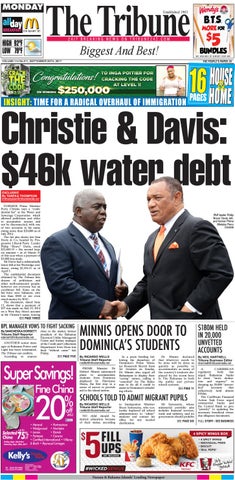
Christie & Davis: $46k water debt EXCLUSIVE By TANEKA THOMPSON tmthompson@tribunemedia.net
FORMER Prime Minister Perry Christie tops a “confidential list” at the Water and Sewerage Corporation which allowed politicians and elites to accumulate arrears and not be disconnected, with one of two accounts in his name owing more than $20,000 as of July 2014. The list also shows law firm Davis & Co, headed by Progressive Liberal Party Leader Philip “Brave” Davis, owed $22,603.33 – the second largest amount – as of March 31 of this year when a payment of $5,000 was made. Mr Davis had a substantially lower bill at his Westridge residence, owing $2,334.21 as of April 5. The confidential document obtained by The Tribune lists dozens of politicians and other well-connected people, however not everyone has an exorbitant bill. Some on the list have zero balances, owe less than $500 or are even owed money by WSC. The document, dated June 13, shows that a payment of $57 was made on July 25, 2014 on a West Bay Street account in Mr Christie’s name, leaving SEE PAGE THREE
PLP leader Philip ‘Brave’ Davis, left, and former Prime Minister Perry Christie
BPL MANAGER VOWS TO FIGHT SACKING By SANCHESKA DORSETT Tribune Staff Reporter sdorsett@tribunemedia.net
ANOTHER senior manager at Bahamas Power and Light has been terminated, The Tribune can confirm. According to sources
close to the matter, former president of the Bahamas Electrical Utility Managerial Union and former manager of the Credit and Collections Department Irvin Dean was fired “without cause” last Friday. SEE PAGE FIVE
MINNIS OPENS DOOR TO DOMINICA’S STUDENTS By RICARDO WELLS Tribune Staff Reporter rwells@tribunemedia.net PRIME Minister Dr Hubert Minnis announced plans to accommodate students from Dominica displaced by Hurricane Maria, the first step in a series of moves to provide aid to the island nation.
NO child should be denied education because of their status, according
By NEIL HARTNELL Tribune Business Editor nhartnell@tribunemedia.net
In a press briefing following the departure of Dominica’s Prime Minister Roosevelt Skerrit from Jet Aviation on Sunday, Dr Minnis also urged all Bahamians to display their “caring” nature, calling it “essential” for The Bahamas to do all it could to assist in Dominica’s rebuilding efforts.
Dr Minnis declared that whatever needs to be done will be done as quickly as possible to accommodate as many of the country’s students displaced by the storm here in The Bahamas in both the public and private school systems. SEE PAGE 11
to Immigration Minister Brent Symonette, who yesterday implored all school administrators to “admit” students and contact his office for any needed clarification.
Mr Symonette, whose ministerial portfolio also includes financial services, trade and industry, said no government should prohibit
A CARIBBEAN regulatory body has urged Bahamian banks to show “more dedication and urgency” in cleaning up 20,000 “unverified” accounts that collectively hold almost $184m. The Caribbean Financial Action Task Force urged commercial banks and the Central Bank to give “priority” to updating the necessary beneficial owner due diligence documents.
SEE PAGE SIX
FULL STORY - SEE BUSINESS
SCHOOLS TOLD TO ADMIT MIGRANT PUPILS By RICARDO WELLS Tribune Staff Reporter rwells@tribunemedia.net
$180M HELD IN 20,000 UNVETTED ACCOUNTS
Nassau & Bahama Islands’ Leading Newspaper
PAGE 2, Monday, September 25, 2017
THE TRIBUNE
THE POLICE officer in the video buying beer.
Policeman in uniform filmed as he buys beer
NASSAU
• • •
LRG. 1-TOPPING PIZZA 8 WINGS 2L PEPSI
25
$
(INCL. VAT)
SAUNDERS BEACH & PRINCE CHARLES SHOPPING CENTRE
TEL: 603-3333 | www.pizzahutnassau.com
By SANCHESKA DORSETT Tribune Staff Repo rter sdorsett@tribunemedia.net A ROYAL Bahamas Police Force officer is under investigation after he was caught on video purchasing alcohol while in uniform, Assistant Commissioner of Police Stephen Dean confirmed yesterday. In the 31 second video, which went viral over the weekend, the officer, who appears to be attached to the Traffic Division of the RBPF, can be heard ordering beers, ice and cigarettes from a local store. The officer ordered “two Bud Lights and two Heineken’s” and 50 cents worth of bidis. A bidi is
a hand rolled cigarette. The video, recorded on cell phone, cuts out as the officer is counting some money, seemingly to pay for the items. It is unclear if he was on duty at the time. “I am sure you are aware of a recent video of a police officer at a local store being circulated on social media,” ACP Dean said in a statement. “I wish to confirm that an internal investigation has been launched into this matter in accordance with the Police Disciplinary Regulations and the Police Act that governs the Royal Bahamas Police Force. Please be reminded that each person deserves the process of natural justice.”
Last month, two RBPF officers caught drinking on video while riding in a police squad car were demoted, according to an order obtained by The Tribune. One officer, a corporal, was demoted to the rank of constable while the other officer who held the rank of constable was also reduced in seniority. The demotions were confirmed by police. The video in question went viral in July. In the video, one officer is seen holding a bottle of Kalik while they appeared to ignore a call from the Police Control Room. The officers also appeared to ride without seatbelts on and they ignored a call from the control room because as one said, they were “(expletive) getting drunk.” The video appeared to be recorded by the driver on his cellphone who said in the expletive laden recording: “Don’t send this video out you know.” It was viewed and shared thousands of times on Facebook, prompting widespread condemnation and calls for the men to be fired. Shortly after the video surfaced in July, Minister of National Security Marvin Dames described it as “disgusting,” and not what anyone should expect from police officers. Investigations continue.
THE TRIBUNE
Monday, September 25, 2017, PAGE 3
Christie & Davis: $46k water debt
from page one a balance of $23,432.51. It is unclear if other payments were made on the account after that. Another West Bay Street account in the former Centreville MP’s name, which he shared with his wife Bernadette, had a balance of $514.55 as of May 1. Several PLP politicians populate the list. The Tribune can reveal former Minister of Agriculture and Marine Resources V Alfred Gray had a balance for a residence at Culbert’s Hill of $7,051.43 as of June 7, after making a payment of $100. Dr Perry Gomez, former minister of health, owed $7,529.64 after a $2,000 payment on July 1, 2015. South Andros MP Picewell Forbes owed $3,270.51 after making a $500 payment in February. Former Tourism Minister Obie Wilchcombe owed the corporation $3,156.22 after making a $1,000 payment on March 20. Former Labour and National Insurance Minister Shane Gibson owed $1,046.50 after making a payment in December 2015 while former National Security Minister in the first Christie administration Cynthia “Mother” Pratt owed just over $1,800 as of April. Another account in her name owed less than $200 as of May. Members of the Free National Movement are also on the list, however on average they did not have high balances. For instance, former Deputy Prime Minister Frank Watson owed nearly $900 as of April 18. Former Prime Minister Hubert Ingraham is also on the list, with a balance of $576.63 in April for an address in Cooper’s Town, Abaco. Former Minister of Works Neko Grant had a negative balance of $46.60 as of April, suggesting he
was owed money by WSC. Minister of Immigration Brent Symonette did not owe any money, and Attorney General Carl Bethel owed less than $200, among others. The list is populated by several former government officials as well. Former Central Bank Governor Julian Francis owed $3,765.79 in June 2016 while former Urban Renewal Co-Chair Algernon Allen had a balance of $3,586.56 in April 10, 2014, after making a payment of just over $200. Several companies are also listed. An entity called June One Ltd owed $3,975.96 after making a payment of $1,000 on March 8. Laverne Holdings Ltd had a balance of $2,290.44 as of October 3, 2013. The Fort Charlotte Community Centre on Boyd Road owed $8,967.44 after making a payment in November 2013. Meanwhile, the American embassy appears on the list several times with multiple accounts, most of which had zero balances or were owed money by WSC. However, one US Embassy account owed more than $1,400 as of April. The headquarters of both major political parties are also on the list - however, neither entity had an overdue balance. Last week, WSC Corporation chairman Adrian Gibson confirmed the existence of a special list populated by scores of elites at the government owned utility provider as he pledged to initiate a crackdown on delinquent accounts. At the time, Mr Gibson told The Tribune the “confidential list” held 221 accounts, with a combined total of $175,000 for the period ending June 2017. The Tribune understands WSC has written to persons holding these delinquent accounts giving them 14 days to pay their debts or
FORMER Prime Minister Perry Christie and current PLP leader Philip ‘Brave’ Davis. Pictured below are some of the sums owed - The Tribune has blacked out telephone numbers and address information.
arrange a suitable payment plan or face disconnection. This revelation comes after The Tribune reported last week about a similar list at Bahamas Power and Light. Persons in
this category owed the cash-strapped electricity provider thousands of dollars, with many owing more than $10,000. Prime Minister Dr Hubert Minnis has ordered
officials to end the list and stop giving special treatment. In the aftermath of the report, some people claimed they never asked to be on BPL’s special list.
Former BEC Executive Chairman Leslie Miller, who was on BPL’s list owing thousands, said a similar policy was also in place at BTC and all government corporations.
ROBERTS: FNM REVELATIONS HIDING LACK OF PLAN FOR BPL By SANCHESKA DORSETT Tribune Staff Reporter sdorsett@tribunemedia.net
BRADLEY Roberts. PLP chairman, accused the Free National Movement of making public portions of a forensic report into Bahamas Power and Light to “deflect” from the fact the government and Works Minister Desmond Bannister have “no plan” for the utility provider. In a statement, Mr Roberts also said the FNM is “hypocritical” for accusing the PLP of handing out no bid contracts, as he accused the government of not using the tender process in certain cases. A forensic investigation into BPL unearthed glaring infractions, revealing a company owned by the father of Jerome Fitzgerald was awarded a contract for brokerage work despite no participation in the tender process and a recommendation that another entity should be given the approval. According to the Ernst & Young audit into BPL, Mr Bannister told the House of Assembly that in one “egregious” instance, Mr Fitzgerald’s father’s business, Bahamas Courier
& Logistics (BCL), was awarded a contract over Pinder’s Customs Brokerage, a company with the best bid. Mr Fitzgerald was minister of education in the last Christie administration. The electricity provider spent $2,626,001 with BCL since 2012. The audit further found in two separate instances, Mr Bannister said last week, J S Johnson was the winning contractor in the bidding process for insurance coverage, but both contracts totaling $14,183,159 were ultimately issued to Sunshine Insurance, the company of Franklyn Wilson, a Progressive Liberal Party supporter and financier. Mr Roberts defended the actions of the former administration saying “trading goods and services for money is not a ‘gift’.” “Former Education Minister Jerome Fitzgerald responded that the inference by Bannister that his familial connection was the reason for the contract award to Bahamas Cargo and Logistics, formerly Global Custom Brokers, or that he influenced or benefitted from the contract were both ‘false and defamatory.’ Fitzgerald said he would file a lawsuit and we
agree,” the statement said. “Sunshine Insurance for its part responded that at no stage did they ever use any political effort or leverage to seek to influence the outcome of any tender process; we believe them. This insurance broker participated in a sealed tender process for the provision of captive insurance coverage for BEC/BPL in 2013; they won the bid and was awarded the contract. In 2017, four years later, Sunshine Insurance again participated in the same process and the contract was renewed in June 2017 to the period June 2018 under the superintendence of FNM Minister Bannister. “The contract award begs the question of why Minister Bannister refused to intervene in the public interest if he had evidence
of impropriety on the part of Sunshine Insurance that he felt corrupted the process. Impropriety is sufficient cause for cancellation and I charge that Bannister has no cause or evidence of impropriety and his posturing and charade in the House were cowardly abuses of parliamentary privilege.” Mr Roberts said if Mr Bannister’s sole aim was to malign the character and reputation of political personalities aligned with the PLP, then “the FNM is fair game.” “We know the FNM has no plans to govern; no plans for BEC and after being scammed out of $2.8 million, we know the prime minister has absolutely no intentions of tabling that letter from CCRIF he promised three
times to table,” Mr Roberts said, referring to the $2.8m premium the Minnis administration paid to the Caribbean Catastrophe Risk Insurance Facility to renew the country’s tropical cyclone policy. “Deflections, however, through... the flagrant abuse of parliamentary privilege are unseemly even for a FNM minister,” he said.
On Thursday, PLP Leader Phillip “Brave” Davis told The Tribune he sees nothing wrong with awarding contracts to party supporters or the justified circumvention of the tender process. The audit has not been tabled in the House of Assembly as police investigation into its findings are continuing.
PAGE 4, Monday, September 25, 2017
THE TRIBUNE
The Tribune Limited NULLIUS ADDICTUS JURARE IN VERBA MAGISTRI “Being Bound to Swear to The Dogmas of No Master”
LEON E. H. DUPUCH,
SIR ETIENNE DUPUCH,
jrolle@tribunemedia.net
Publisher/Editor 1903-1914 Kt., O.B.E., K.M., K.C.S.G., (Hon.) LL.D., D.Litt .
Publisher/Editor 1919-1972 Contributing Editor 1972-1991
EILEEN DUPUCH CARRON,
C.M.G., M.S., B.A., LL.B. Publisher/Editor 1972-
Published daily Monday to Friday
Shirley & Deveaux Streets, Nassau, Bahamas N3207 TELEPHONES
News & General Information Advertising Manager Circulation Department Nassau fax Freeport, Grand Bahama Freeport fax
(242) 322-1986 (242) 502-2394 (242) 502-2386 (242) 328-2398 (242)-352-6608 (242) 352-9348
WEBSITE, TWITTER & FACEBOOK www.tribune242.com
@tribune242
tribune news network
PMH must be brought up to an aceptable standard ALTHOUGH the PLP government seemed to have no difficulty spending $10m in consultancy fees to set up a National Health Insurance scheme, it could not find $642,567.70, part of which was urgently needed to repair the roof of the Princess Margaret Hospital damaged by Hurricane Matthew in October last year. As a result, the Minnis government will now have to spend even more than that because — thanks to lack of repair to the roof — the recent rains have flooded the female medical 1, male medical 2, and damaged the dialysis area and a part of the old administrative building. Urgent repairs have now started on the hospital’s roof. It was not as though the Christie government had not been reminded of the urgency of the repairs. In a letter dated May 26 this year, the PLP government’s attention was again directed to a letter dated November 30 last year “regarding Hurricane Matthew claims totaling $920,733.70 of which $642,567.70 related to critical capital works, including roof repairs for the Princess Margaret Hospital and the Rand Memorial Hospital. This matter is of major concern as we have yet to receive the required funding and we are days away from the commencement of the 2017 hurricane season. Hence, I am again urging that the requested funds be provided, so that we may carry out repairs to our facilities to ensure that they are all in a state of readiness.” Obviously, this urgent reminder was ignored. Princess Margaret Hospital’s roof is only now undergoing repairs after further damage has been done to the hospital. As for the the over stated and much promised National Health Insurance (NHI) — obviously an unworkable scam to win votes – it crashed before it could even get off the ground. So anxious was the Christie government to pin its election win on improved health services that it started patients’ enrolment in the scheme on April 24, just nine days before the May 10 election. Obviously, Bahamians were not fooled this time considering the PLP’s massive defeat at the polls. However, some doctors and patients fell into the medical spider’s web, from which they are now trying to extricate themselves. Recently, we received a couple of calls — doctors wanting to know when and
if they were to be paid for their services rendered to their NIB patients. It is now a question as to whether the set up of the plan had been completed by the PLP government making it possible for the new Board to legally make any payments at all. Last month, the Bahamas Insurance Association pointed out that certain aspects of the NHI, by the time the scheme was launched, had not even been gazetted. The proper corporate structure had to be in place before anyone could be paid anything. Also the scheme was launched without knowing where the funds were coming from to pay for it. If this is so, who is going to pay the bills of the doctors who were sucked into the scheme? A scheme that was not only not properly constituted, but with no plans as to how it was to be funded. Dr Sands has said that no funds will be made under the NHI scheme until a proper structure is in place and even then the Board will take legal advice as to the validity of the contracts entered into by the NHI. As Health Minister, Dr Duane Sands has said, The Bahamas would “absolutely” have suffered another credit rating downgrade if it had gone ahead with NHI, not having identified how it was to be paid for. The IMF also made it clear that the scheme left by the Christie government was “unsustainable.” We hate to be in the “we told you so” chorus, but from the beginning The Tribune has been against the scheme advising that whatever funds government could raise should first go towards upgrading the third rate hospital before putting an elaborate scheme on top of what was already there that could neither be funded nor staffed. Already PMH is understaffed. Recently, we had an opportunity to take a tour of the hospital — not just the new Critical Care Unit, but the old section of the hospital. What a shock! We knew it was bad, but not quite that bad. As Health Minister Sands has said the PLP’s NHI plan was a “pie in the sky” scheme given the fiscal realities of the country. Members of the new Health Board, chaired by Julian Rolle, have a daunting task before them. It is now time for them to roll up their sleeves and get to work. They have much to do in five years and will have succeeded if they only get the PMH up to an acceptable standard.
Don’t shorten the grouper season EDITOR, The Tribune. I WAS astonished to read the minister of agriculture is considering shortening the closed season on the Nassau grouper. The Nassau grouper is identified as endangered on the IUCN Red List, having virtually disappeared from countries where once it was plentiful. Some years ago, legislation was enacted under the FNM government for a closed season to protect the Nassau grouper for future generations.
It is because of this signature law that Bahamian fishermen are today still able to work this industry with a reasonable degree of success. During the full moons of the closed season, the Nassau grouper aggregate to mate and thus, continue the very survival of their species. This is when they are most vulnerable to exploitation. Any thought of allowing for further decimation when the Nassau grouper is engaged in the act of ensuring its very existence must
be rejected outright. To do otherwise would be extremely shortsighted and will likely lead to the collapse of this very important resource here in The Bahamas. If the fishermen are hurting now, what will they do when there are no more grouper to sell? What will their children do? Not only will the fishermen hurt, but one of our few food resources will be placed in peril. ATHENA DAMIANOS Nassau, September 23, 2017
BPL list not in my time Re: Special List of NonPaying Customers of BPL EDITOR, The Tribune. I CAN state categorically that during my time (2007 – 2009) as executive chairman of BEC (now BPL), no policy was implemented or followed by the board which would have exempted persons on a special list from being disconnected for
non-payment of their electricity bills. Indeed, I recollect that the feathers of certain politicians (in both parties) were ruffled when it was made clear to them that their electricity supply would be disconnected for non-payment. As someone who has, like the majority of customers of BEC/BPL, paid his electricity bills when due (whether
he was chairman of BEC or not), I am offended and find it totally unacceptable and deplorable that the individuals who have recently been identified would have been exempted from being disconnected for non-payment of their electricity bills. FRED GOTTLIEB Marsh Harbour, Abaco September 20, 2017.
Faith in the face of the hurricane EDITOR, The Tribune My dear friends, Thanks for your prayers and concern. Prayer can never be underestimated. It is much needed to move the Faith of the people thus preventing despair and despondency which are openings for the enemy’s despicable plans which ultimately is “… to kill steal and destroy...” (John 10:10) Already its said “persons are walking the streets in a daze.” Prayer is also needed to touch the hearts and pockets of those who are capable, to not only give generously, but to move expeditiously to help alleviate the plight of our people. It also restores hope in God and humanity. The mysteries of an incomprehensible God can be fathomed through prayer who always “… works all things good for those who love him…” (Rom 8:28). Yes and prayer (still) opens the flood gates of heaven allowing for direct divine intervention. Intrinsic here is that your prayers are not being taken for granted. I am thankful and appreciative for your prayers. Keep them coming. Rest assured your intentions will be placed at the Altar as I offer the greatest Sacrifice. The news coming from the Dominican Government’s office is bleak, dreadfully bleak. Perhaps
LETTERS letters@tribunemedia.net you may have seen some aspects of the devastation on the TV. Of course the reality is always graver than the images. We watch from the outside in, while its their lived daily reality, and for how long (?) Our salvific history story shows clearly we are a resilient people and we always do emerge victoriously. I love saying, “God’s people can be enslaved for so long…never forever…” Our story from antiquity and even that of our parents and grandparents can attest. Now we will have our story to attest. One can ill talk about knowing God or experiencing God without having a story to tell. What an incredible God! St Paul reassures, “But we have this treasure in jars of clay to show that this all-surpassing power is from God and not from us. We are hard pressed on every side, but not crushed; perplexed, but not in despair; persecuted, but not abandoned; struck down, but not destroyed.” (2 Cor 4:7-9). Unquestionably, we will rise. The end is a given. God’s modus operandi never changes, the crucifixion and resurrection another unequivocal example. The writer of the book of Hebrews asks of us to take some strength
by simply reminiscing, “Remember your leaders, who spoke the word of God to you. Consider the outcome of their way of life and imitate their faith. Jesus Christ is the same yesterday and today and forever.” (Heb 4:7-8). Haven’t heard from my bishop but his expectation is that I would put some mechanism in place to organize relief for the Diocese of Roseau, Dominica. Past experiences show that there is greater accountability when the bishop receives assistance as opposed to the politicians, who unfortunately manipulate these for political gains. I am yet to receive news from my family but presumably like everyone else, they share the same fate, but I’m hopeful they are in the 5% that was untouched – can’t blame me, I’m a person of faith. Yesterday was very sombre, the tears were close but I held back but my stomach bore the brunt of the pain of my people, resulting in my being an athlete throughout the day….I feel much healthier today. Once again thanks for your love, prayers and support. The words of the Psalmist echoes triumphantly, “… My help comes from the Lord, who made heaven and earth…” (Ps. 121:2). God’s peace. FATHER CELSUS (Of Dominica now studying in Florida).
Grouper season folly
EDITOR, The Tribune. I READ with disbelief the government’s announced intention of shortening the closed season on Nassau Grouper ostensibly to compensate fishermen for disruption to the crawfish season due to hurricanes. This Landmark Conservation Legislation passed by the former Ingraham government has been hailed as a huge success and it would be terribly
short sighted of the current administration to reverse it in the face of that evidence. Nassau Grouper populations have been on the decline for decades with The Bahamas having some of the few remaining viable spawning aggregates in the region. Harvesting of Nassau Grouper is prohibited in US waters, including Puerto Rico & USVI, and is heavily regulated in Mexico and other parts of the Caribbean. The species is classified
and red listed as endangered by the International Union for Conservation of Nature (IUCN) the primary reason due to aggregation fishing. Therefore let us not in our haste to appease and enrich a few now further endanger this already fragile resource at the expense of future generations of Bahamians. IAN MABON Nassau, September 23, 2017.
THE TRIBUNE
Monday, September 25, 2017, PAGE 5
BPL MANAGER VOWS TO FIGHT SACKING from page one
The termination came one day after Mr Dean celebrated his 30th anniversary at the company, formerly called the Bahamas Electricity Corporation. Last Thursday in an interview with the press, BPL chairwoman Darnell Osborne confirmed that “at least one more person” would be terminated in connection with a probe into a $2m theft at the utility provider. “We are almost to the end of that (investigation). I believe that there is one last person in the process and that should be done by the end of the week,” Mrs Osbourne said in an interview with TV station Our News. Mr Dean was fired the next day, however it is unclear whether his termination is related to the missing funds investigation. Three employees of BPL were terminated in August following a forensic audit at the company. The workers include an accounts payable clerk, an accounts filing clerk and a financial assistant. BPL’s new board has also fired Pamela Hill, the company’s former CEO. When contacted yesterday, Ms Osborne said she had “no comment” on the termination. The Tribune also attempted to contact Mr Dean but calls were not returned up to press time. However, a source close to the matter said “Mr Dean is not taking this foolishness sitting down”. “He was let go one day after
celebrating 30 years on the job without a reason, without cause,” the source said. “When he got to work on Friday, a representative from the Human Resources Department was waiting on him with the letter of termination. “They just fired him and didn’t give him any reason, they just didn’t want him there anymore,” the source claimed. “I think they are trying to make it seem as though the termination was connected to the (investigation) but they have been trying to fire him for some time because of his former affiliation with the union. The problem they are going to encounter is, you just cannot fire a senior person without cause. So this is going to get interesting.” Police in May announced that an investigation was launched into the alleged theft of a large amount of money at BPL. Both the government and the BPL board have received copies of an audit conducted by Ernst and Young into the discovery of a five-month long scheme, which involved fraudulent cheques paid out to different vendors from December 16, 2016 to May 9. Ms Osbourne confirmed last month that more than $2m was missing as a result of the scheme. She said the company takes the matter surrounding the missing funds very seriously and intends to “go through the necessary channels” to reclaim all money lost, adding that BPL will “follow up” with police to “ensure justice and guard against similar actions in the future”. DARNELL OSBORNE, BPL board of directors chairman.
Photo: Shawn Hanna/Tribune Staff
Roker: Special treatment of elites is nothing new
By RICARDO WELLS Tribune Staff Repo rter r wells @tribunemedia.net
THE revelations that some politicians and others enjoyed special treatment which allowed them to rack up exorbitant utility bills without disconnection is nothing new, former Progressive Liberal Party Cabinet minister Loftus Roker said yesterday, telling The Tribune he faced push back decades ago when he disconnected members of Parliament who owed money to the Bahamas Electricity Corporation. Last week, The Tribune revealed a culture of preferential treatment afforded to politicians and other wellconnected people, which allowed them to be placed on a special list to avoid disconnection of electricity despite exorbitant bills. Subsequently, there were also reports of circumvention of the tender process at Bahamas Power and Light and a similar list at the Water and Sewerage Corporation. Reflecting on the revelations from the past week, Mr Roker said behaviour and actions on display today were nothing more than “a manifestation of things we saw laying root back in my day”. “My boy, there is nothing new under the sun, you hear me? These things been going on and been known, do you hear me? “Why you think these boys like this thing so much? I recall during my time, (former Prime Minister) Sir Lynden held a Cabinet meeting where he told us we were getting a raise, and in that same breath he told all of us pay our utility bills because the practice of non-payment was becoming an issue. “I was the minister responsible for BEC at this time, and a couple of the (Cabinet ministers) went back to Pindling complaining after I turned them off for non-payment.” Mr Roker added: “I was shocked by it because the man (Sir Lynden) told us specifically to pay our bills and these men, about four of them, three still alive today, had gotten so use to the slackness, that they refused to pay their bills.” He continued: “So that’s why I say it like this, while we should be proud of what is going on now with everything coming to light, we have to wait this out and see if they going all the way with it and clean the whole slate because this thing run deep.”
Mr Roker suggested the perks that have enticed so many to pursue careers in politics are “out there for all to see now,” but he asserted wrong still exists on both sides of the political divide. The outspoken Pindling era politician also cautioned those “celebrating” the recent actions of the Minnis administration, warning it is “too early to grade actions” of a party “recently on the ropes”. Mr Roker, who served as immigration and works minister in two separate Pindling administrations, said the Free National Movement, led by Prime Minister Dr Hubert Minnis, had yet to “clarify and make right” a number of significant ordeals. “All we see coming out is great and moving us in the right direction,” Mr Roker said. “But it wasn’t that long ago when these guys were fighting to stay relevant, pushing back against their own problems and wrongdoings. Winning an election doesn’t delete those facts.” Mr Roker, reflecting on Agriculture and Fisheries Minister Renward Wells’ letter of intent (LOI) mishap when he served as parliamentary secretary in the former Christie administration and the management of public health contracts in the Ministry of Health when Dr Minnis was the minister of health in the former
Ingraham administration, said average people still need answers on what exactly happened. He said: “I consider myself an average person, and still have no clue what happened with that LOI with Wells. Yes we can be happy about all of the things that they are doing to air out the former government, but we cannot forget their wrongs in our happiness.” Mr Roker added: “We have to pat them on the back for making public everything they have to date, the light bill foolishness and the water bill thing. Yes, that is great. But we remember the issues under the prime minister when he was in health. We remember - if we are going to clean the slate, can we clean it fully?” Dr Minnis’ company received a contract with the Public Hospitals Authority while he was private citizen in 2005 for a building rental. The contract continued while he was minister of health, although Dr Minnis said he disclosed the matter and had asked for the PHA to find another landlord. The contract reportedly came to an end shortly after Dr Minnis became prime minister. Meanwhile, when asked about the status of the government’s effort to investigate the existence of similar preferential lists throughout
other government entities, Press Secretary Anthony Newbold told The Tribune comprehensive reviews were ordered for all government ministries and departments shortly after the Minnis administration took office, and that all revealed to date came as a result of those reviews. Mr Newbold said the government has taken the approach to “report
on findings already concluded and wait for those still ongoing to conclude.” He said: “There is no rush to bring things to the public. As things are discovered and concluded, they are presented. Everything you have heard to date, came as a result of those reviews and as they continue and conclude, you will hear more.”
AMBROSIL CATERING
“Exceptional pleasing to the taste” ALL SPECIAL OCCASIONS Starting at $8.00
(per person eighty or more) Call: 817-4631
PAGE 6, Monday, September 25, 2017
THE TRIBUNE
Government to review immigration policy over access to education By AVA TURNQUEST Tribune Chief Reporter aturnquest@tribunemedia.net POINTING to a “decided drop” in school enrolment over the last three years, Education Minister Jeff Lloyd stressed on Friday the impact of the country’s immigration policy on public services had the potential of creating “fatal” consequences, and a serious threat to the country’s national security. Mr Lloyd said the government intended to review the policy’s impact on access to education with urgent and immediate advisory at the next Cabinet meeting, suggesting a new policy or amendment was on the horizon. He acknowledged the impact of the policy introduced in November 2014 on school registration, contravened both the domestic Education Act and the United Nations’ Convention on the Rights of the Child (UNCRC). “This has obviously been a very sensitive and emotionally wrought issue,” said Mr Lloyd as a guest on Guardian Radio talk show Real Talk Live with host Carlton Smith. “Our Education Act is very clear; the act prescribes that the minister of education shall provide all persons in the Bahamas an opportunity to receive an
JEFF LLOYD, Minister of Education. education. That’s the act, that’s the law, all persons.” He continued: “Now let me take this outside of the law for the moment and speak to a cosmological, sociological, philosophical understanding that our Bahamian people need to have. It would be fatal and a threat to our national security, and I don’t mince my words. “It would be fatal and a serious threat to our national security for us to have any group of people in our country, particularly young persons of school age who are resident in this country, who are likely to remain resident in this country, who do not benefit
from our own sociological and cultural conditioning, it would be fatal.” Mr Lloyd said: “I cannot be serious about this more than I am right now, and I know that we need to have an adult conversation and Bahamian people have got to grow up and understand.” The November 2014 policy mandates that every person living in The Bahamas has a passport of their nationality with proof to legally reside in this country, among other restrictions, like the requirement for every foreign person enrolled in schools, including children born in The Bahamas to immigrants, to have a student permit. Although the policy was introduced in November 2014, the restrictions did not come into effect until the Fall 2015 school semester. “It’s in contravention of the law,” Mr Lloyd continued, “that’s the policy as it stands today, until the Cabinet of The Bahamas decides otherwise that is the policy. I have to be directed by the Cabinet and the Cabinet of course is taking this right now under urgent and immediate advisory and discussion, and will come forth with a policy.” Mr Lloyd said he fully understood the anger and anxiety many Bahamian parents hold concerning
overcrowding in schools, which he admitted were “bursting at the seams.” He said he sympathised with parents in certain communities who are unable to register their children in area schools because they were full. “The parents, they surmise that [schools] are full with illegal children or children of illegal immigrants have gone in and taken up the spaces that should rightfully be reserved for Bahamians. “I understand the emotions that run on this, I understand the anger, I understand all of that,” he said. He continued: “I’m telling you from a fundamental national sovereignty and national security standpoint that you cannot afford to have in your country persons who are oppressed, marginalised, ostracised, or even feel that way because of actions that are being taken by you.” Activists like Louby Georges and Rights Bahamas have repeatedly raised concerns over the harmful, dehumanising conditions created by the 2014 immigration policy, which they saw as an attempt to legitimise inhumane state practices against unregularised or undocumented persons. Last week, Mr Georges highlighted the plight of an
11-year-old special needs boy, who has been unable to attend school for the past three years because of his Haitian mother’s legal status. Haitians represent the largest migrant group in The Bahamas. However, Mr Lloyd stressed that he did not want to single out an ethnic group because the policy’s impact stretched across the entire demographic profile in the country. “I’m advised that many Bahamians approached the school system without the requisite documentation because they either have no passport or they have no birth certificate,” he said, “especially those coming from certain family islands. They don’t have any birth certificate so how do we know who you are.” Mr Lloyd said: “As a result of this policy back in 2014 there has been a decided drop in the enrolment in some of our schools particularly of children of what you might consider to be foreign nationals. If they’re going to be in The Bahamas they may be five today but in some short period of time they’re going to be 12.” Notwithstanding the critical need to resolve the complex issue of citizenship surrounding persons born in The Bahamas to non-nationals, and illegal
immigration challenges, Mr Lloyd said it was unfortunate that some persons were tying the country’s immigration laws to children’s access to education. “Yes, we need to be very clear about those who are here illegally and they should be dealt with obviously,” Mr Lloyd said, “but we’ve got a big issue, a mountain of a giant of an elephant in the room. “And that is thousands of people who are born in this country, children who according to the constitution have to wait for 18 years before they can make an application (for citizenship) and in that time, they are basically outside of the system, what do you expect them to feel and do? That’s something to be addressed.” Mr Lloyd said: “This issue of denying children who legitimately reside and/or born in The Bahamas a right to education in The Bahamas, that particular policy is going to be reviewed by the Cabinet of The Bahamas and a decision will have to be made. “I’m suggesting to you, without preempting the decision by Cabinet, that we have a law on the books and a Cabinet of The Bahamas must be guided by the law. He added: “You are sworn to uphold the laws of this country.”
their education,” he told The Tribune on Sunday. “If there is a difficulty getting a belonger’s permit or whatever permit it is that they need, the administrators should email me so that we can regularise those persons’ status, so that they can
attend school.” He added: “But children should not be denied access to education because of an apparent immigration issue. We are making sure that persons who apply, receive the appropriate belonger’s permit so that they can attend school. “There is a department that deals with this issue specifically. I am being made to believe that we are doing a very good job at it, but if persons have slipped through the cracks, we urge them to contact the Immigration Department and/or myself.” Last week, The Tribune reported about a Haitian mother who said she was considering placing her 11-year-old special needs son in the care of the state after he was allegedly
denied access to school for three consecutive years because of the country’s immigration policy. Jan Pierre, 36, told The Tribune the grim prospect for her son Watson was one of only two options at her disposal, having exhausted attempts to obtain the required documentation for her child because of her own status. The second would be to send him to Haiti to live with his father, a place he’s never been and a setback that would drastically inhibit his ability to apply for Bahamian citizenship. The 2014 policy mandates that every person living in The Bahamas has a passport of their nationality with proof to legally reside in this country, among other restrictions, like the
requirement for every foreign person enrolled in schools, including children born in The Bahamas to immigrants, to have a student permit. Although the policy was introduced in November 2014, the restrictions did not come into effect until the Fall 2015 school semester. Then Immigration Minister Fred Mitchell explained the school permit rule would help the government keep track of who works and lives in The Bahamas and who attends schools here. When asked if the Minnis administration had attempted to address any of the issues surrounding the controversial policy, Mr Symonette yesterday said the Minnis administration was working to address several key aspects of the policy behind the scenes. However, he indicated that in the interim, no child should be forced outside of the system. Mr Symonette admitted that he was unsure of exactly how many children were being affected by the policy, pointing to the lack of computerised systems in the Department of Immigration. Nonetheless, Mr Symonette said that all was being done to “improve” the processes surrounding the issue. “One of the great problems we have with immigration is that things are not computerised, so we have no way of knowing the number of applicants. But over the year, most of those persons should have gotten their permits,” he said. “So it can’t be that many. Once we know about them, we will deal with them.” Rights Bahamas has repeatedly raised concerns over the harmful, dehumanising conditions created by the 2014 immigration policy, which activists saw as an attempt to legitimise inhumane state practices against unregularised or undocumented persons. In 2015, while out of office, Mr Symonette warned that making it harder for children of immigrants to get an education could create a slippery slope that results in a myriad of long-term social problems for Bahamians. He was appointed minister of immigration after the 2017 general election, a post he held in the previous Ingraham administration.
SCHOOLS TOLD TO ADMIT MIGRANT PUPILS from page one
any student from maintaining their education due to an “apparent immigration issue.” He indicated resources have been allocated in
his ministry to handle all applications in the process of equipping school age children with the adequate permits needed to enrol and attend school. “Principals should admit these students to school so that they can maintain
Isn’t Your Health Worth It?
“
LOOKING FOR A GREAT PLACE TO WORK IN HEALTHCARE?
”
Then join the Doctors Hospital team!
TRAINING OFFICER POSITION SUMMARY • Facilities and coordinates various clinical programs, courses, and in-services • Ensures that the curriculum for various training programs meet the required objectives • Liaises with facilitators when coordinating and scheduling workshops • Observes and conducts education in clinical areas as appropriate • Prepares monthly and annual reports
PERSONAL ATTRIBUTES • Ability to design and instruct clinical training programs (such as BLS and the PCT course) • Ability to pay keen attention to details • Excellent communication and interpersonal skills • Ability to work independently and under pressure • Strong clinical skills
QUALIFICATIONS/EDUCATION • Bachelor’s Degree in Nursing and registration with the Nursing Council of the Bahamas • Two plus years experience • BLS, ACLS, and PALS provider and instructor • Training certification preferred
APPLICATION DEADLINE: FRIDAY, OCTOBER 6TH, 2017 PLEASE SUBMIT RESUME TO: hr@doctorshosp.com with subject line: Training Officer
Doctors Hospital I P.O. Box N-3018 I Nassau, Bahamas Fax us at: (242) 302-4738 I Email: hr@doctorshosp.com Website: www.doctorshosp.com
THE STORIES BEHIND THE NEWS
insight@tribunemedia.net
MONDAY, SEPTEMBER 25, 2017
TIME TO TEAR UP THE RULE BOOK ON IMMIGRATION By FREDERICK R M SMITH QC
T
he Immigration Policy followed by successive governments has failed to produce the desired results. The domestic economy has not flourished as a result of strict control of the labour force. Undocumented migrants, primarily from northern Haiti, continue to arrive on Bahamian shores in significant numbers. Meanwhile, “Immigration enforcement” has devolved into little more than a vehicle for systemic corruption and exploitation; a political tool for the incitement of hatred, anti-foreign sentiment and nationalistic fervor. The consequences of this ill-conceived approach include the loss of hundreds of millions of dollars in annual revenue, the establishment of an entrenched culture of official corruption, the creation of a sub-class of marginalized citizens with all the attendant social challenges, and a myopic, stagnant economy. The time has come to accept The Bahamas must make radical changes to its regressive Immigration Policy, learn from international trends and best practices, and begin to approach migration as not just a challenge but also an opportunity – a chance to effect positive social, economic, political and cultural change. The Immigration Act should be amended to outline detailed, explicit and non-arbitrary procedures for processing all applications, appeals and Review Board petitions as well as firm deadlines for the consideration of citizenship, permanent residency, work permit and other status applications. In particular, everyone who is entitled to be registered as a citizen in accordance with the Bahamas Constitution should receive their certificate of citizenship within three months of application. Such an approach would accord with the provisions of the United Nations 2030 Agenda on Sustainable Development, which names facilitating “orderly, safe, regular and responsible migration and mobility of people” as one of the 10 goals for reducing global inequality. From Bahamianization to a thriving Bahamian economy The policy known as ‘Bahamianization”, in place for more than four decades, is in urgent need of replacement. Whereas once, a lack of access to basic education and the presence of skilled foreign workers were considered the main obstacles to citizens achieving prosperity, today the key challenges are overregulation, a shortage of cutting-edge skills in emerging industries and a stagnant domestic economy. While continuing to encourage and facilitate Bahamian access to domestic employment opportunities, the government should aggressively pursue policies that attract cutting-edge minds from around the world to live and work in The Bahamas. The benefits in terms of skills transfer and economic growth are well documented and various models for achieving this outcome already exist. In addition, a skills boost to industries such as renewable energy and public sector technology could help address some of the key development issues facing the Bahamas today. Such an approach would also accord with Article 29 of the 2030 Agenda, which recognizes the “positive
contribution of migrants for inclusive growth” and the “multi-dimensional reality” of migration. Respect for Human Rights The Bahamas Immigration Act must be revised to explicitly provide for Due Process in all enforcement and punitive procedures in accordance with the provisions of Article 19 of The Bahamas Constitution and the standards established by the Inter-American Commission on Human Rights (IACHR). In cases where migrants must be detained, the conditions of detention and transportation should be drastically improved in every regard – living standards, hygiene, food quality, access to legal representation, etc. – to reflect a commitment to at least the minimum standards of basic human dignity as outlined by the UN Office of the High Commissioner for Human Rights (OHCHR). Attorneys and human rights advocates must be granted regular access to detained migrants and a clear, transparent and easily accessible process for identifying asylum seekers and swiftly processing their claims must be created. De-politcization Successive governments have employed Immigration ‘crackdowns’ with the clear aim of appealing to xenophobic tendencies in certain sectors of the population. It has also been the practice to withhold the grant of citizenship to those who qualify until politically strategic moments - i.e. the run-up to a general election. Standardizing the time frame for consideration of status applications would remedy this problem to some extent, however a great deal more needs to be done to rehabilitate the attitudes that both give rise to and are fed by the politicization of immigration. This includes: • The establishment of a permanent information and resource center for refugees and asylum seekers • Involvement of civil society in the caring for, housing and processing of migrants • Public education campaigns to alleviate fears about the presence of migrants in society / debunk myths about their social impact • Further research into impact of migrants on society in terms of healthcare, education, crime and employment. De-Criminalization Undocumented migration must be decriminalized and re-conceptualized as an administrative challenge rather than a law and order issue, in accordance with trends across the developed world. Offences under the Immigration Act must remain in place, however these should be brought before an Immigration Tribunal which includes at least one member of the judiciary, as well as a qualified expert on asylum issues. Decriminalization of undocumented migration is an approach advocated by the OHCHR. All cases of alleged undocumented migration should be brought before The Tribunal as soon as is practicable for the setting of a hearing date. The Tribunal should also decide on the status and circumstances of the individual in the meantime, with detention considered a last resort in only the most extreme cases. More serious offences, for example obtaining citizenship or other form of
THE CARMICHAEL ROAD DETENTION CENTRE status by means of fraud, should continue to be adjudicated by the Courts. Of utmost importance is bringing an end to the long delays in processing of naturalization cases because of the presumption of fraud with regard to each application. It is inhuman and degrading to keep thousands of people waiting in limbo, unable to seek employment or even open a bank account. Alternatives to detention In order to avoid huge unnecessary expenses and the dehumanization of individuals, migrants suspected of arriving in the country without permission should be paroled into the general population and monitored by Immigration authorities. It has been repeatedly shown that detention does not deter undocumented migration, that is a continual drain on government resources and poses a constant threat to a country’s international reputation through allegations of inhuman conditions, abuse and lengthy detention periods. At its most basic, an alternative system could involve: • The use of ankle bracelet monitoring • Release on bond with sureties from friends or family members More sophisticated alternatives to detention (ATD) are becoming increasingly popular around the world. The trend is based on a growing recognition that human liberty should be the norm and should only be violated when absolutely necessary. Several countries have developed a number of fair, progressive and effective alternatives to incarceration for people who lack regular status. The Bahamas could learn from these examples and become a leader in the region and an example to other small nations around the world. Today there is some form of alternative to detention in more than 60 countries around the world and many are extremely successful with compliance rates well above 90% and voluntary participation by migrants across the board. Renewed focus on border control The politicization of immigration has led to exaggerated focus on the use of roadblocks and night-time raids on existing migrant communities. Both practices contravene the law to the extent they deprive those targeted of their constitutional right to freedom of movement, due process and protection from arbitrary arrest and detention. Many of those whose rights are abused in these illegal exercises qualify for or already enjoy some form of status in The Bahamas, yet thousands of these individuals are deported each year, or else held unlawfully
in detention for extended periods of time. The victims of these exercises are in most cases migrants who have been in the country for some time, have put down roots and are active members of their community. They can be said to pose a negligible threat in terms of either national security or health risks, the two most urgent concerns regarding migrant populations in The Bahamas today. Immigration Enforcement strategies must therefore be updated to focus preponderantly on interdiction at the maritime border, where the reality of security and communicable disease risks is tangible, and far less on members of established communities who have long been domesticated. Certainly, all deportations of longtime residents and their children should cease until the considerable backlog of status applications has been cleared. Revocation of the November 2014 Immigration Policy The immigration policy imposed by Fred Mitchell and adopted by the former Christie Administration was unlawful, regressive and counterproductive, as detailed above. Along with the policy of aggressive raids and roadblocks, the government should immediately repeal two further provisions of this policy: 1. The Belonger’s Permit This instrument was to have replaced the Certificate of Identification, which for decades was relied upon
by individuals born in The Bahamas who have a right to apply for Citizenship at age 18. It served both as an official form of identification and a valid travel document and was issued upon application with relatively little red tape. The Belonger’s Permit, on the other hand, is virtually impossible to qualify for, requiring a host of supporting documents which are often prohibitively expensive and very difficult to obtain. Nor does it qualify as a valid travel document. Indeed, it required children of migrants, born in The Bahamas and entitled to citizenship, to obtain passports of the countries of origin of the parents, even though they had no other connection to such country. This change in policy has left many children in the Bahamas without an official form of identification and placed some of danger of becoming stateless persons. 2. Mandatory proof of status for children The provision that children produce proof of their parent’s immigration status before being allowed to resister for school is a clear violation of the Education Act and the Constitutional right to be protected from discrimination. It is also contravenes the spirit of Goal 4 of the UN’s 2030 Agenda on Sustainable Development, which calls for access to lifelong learning opportunities for all. Benefits of reform A progressive and inclusive Immigration policy would greatly ease the many social challenges created by the alienation of migrant groups and their descendants living in The Bahamas.
As it stands, marginalized populations are unable to contribute effectively to the social and economic life of The Bahamas; they exist as virtual outlaws in a system that is unwilling or unable to accommodate them. The efficient and timely regularization of these groups in accordance with the Constitution would allow them to open bank accounts, complete their education, buy property, open businesses, contribute to government revenue through taxes and the National Insurance Fund, and represent The Bahamas internationally in sports and academics. Meanwhile, creating a welcoming immigration atmosphere for top foreign professionals in emerging industries through the strategic liberalization of the Work Permit regime would do much more than simply create domestic jobs; it would also expand and diversify the basis of the economy while facilitating the transfer of invaluable skills and experience to the next generation of Bahamians. This effect has been thoroughly documented by the IMF, the OECD, and others. The FNM government, with its overwhelming mandate, is today in an ideal position to bring about a paradigm shift in the country’s approach to Immigration, thereby turning what has been a notorious source of internal division, a vehicle for corruption and a fiscal drain on the nation, into a key contributor to social cohesion and economic prosperity for the future.
PAGE 8 MONDAY, SEPTEMBER 25, 2017
INSIGHT
EMAIL: insight@tribunemedia.net
Better safe than sorry by MALCOLM STRACHAN
not, we don’t have to look much further than the past five years, where between hurricanes Joaquin, Matthew, Irma and Sandy (with Irma’s cost yet to be determined), we have easily spent well over a billion dollars in hurricane relief. Now that we can all agree that hurricanes are not going anywhere; nor are they forecasted to get any weaker over time, we must be considering the most effective measures of mitigating damage and ensuring aid is readily available for the families whose lives have been disrupted. Climate change, while singularly cannot cause a hurricane, is certain to take an already bad storm and put it on steroids.
T
HE 2017 Hurricane season was projected to be an active one by many of the top meteorological minds. The National Oceanic and Atmospheric Association predicted this hurricane season would be an “above average” year with 11 to 17 named storms, five to nine hurricanes – two of which being major ones. However, no one would have anticipated that three quarters of the way through the season there would have been this much devastation and loss at the hands of Category, 3, 4 and 5 storms. One meteorologist from forecasting service Weather Underground, Bob Henson, said this season has been an “overachiever” based on predictions from most notable indexes. Families from the locales that were blasted by the season’s most dangerous hurricanes – Harvey, Irma and Maria - are left trying to make sense of it all. Cumulative damage of Harvey and Irma is already upwards of $70 billion, $62.7 billion with Irma’s cost likely to increase after our assessment is complete, and Hurricane Maria’s impact not yet determined. This season has already been recorded as the United States’ most costly in history - $293 billion in damage. While being far from escaping unscathed, The Bahamas, in general, has been fortunate enough to avoid the terror experienced by people from Texas who endured Hurricane Harvey, which dumped record rainfall on the fourth largest city in the US. In less than a week. Hurricane Irma ripped through our chain of island states in the Caribbean before shifting to
CRIFF Controversy
DESTRUCTION on Ragged Island after Hurricane Irma. the north. However, by a stroke of luck or divine favour, the majority of Bahamians were spared the sheer heartache we’ve seen depicted through the media by survivors of this season’s deadliest hurricanes. Some of our brothers and sisters, too, have had their lives turned upside down this hurricane season, as Irma destroyed Ragged Island and caused extensive damage to Salina Point, Acklins and Inagua. While we were relieved we were not victims of the full force Irma was capable of, we, as a nation still have to help our fellow countrymen and women pick up the shattered pieces of their lives. We also are going to be tasked with figuring out how to mitigate against the massive losses that may seem unpreventable. As unnerving as it may be to fathom, research shows it’s likely we will continue to experience stronger, more
devastating hurricanes in the decades to come. That being said, there are a few certainties. For one: we will need to come to grips with the fact our geographic location guarantees continued losses will occur. Second, we will need to have realistic and costefficient ways to rebuild the lives of our people, God forbid, the whole country ever experiences the mass destruction we’ve seen in the United states and throughout the Caribbean. Research done by Massachusetts Institute of Technology (MIT) Professor of Atmospheric Sciences, Kerry Emannuel, contributed to the general consensus that climate change has a great impact on the severity of these storms. For instance, she studied the evolution of 6,000 simulated storms in efforts to compare the evolution of 20th century versus 21st century hurricanes with the condition
that greenhouse gas emissions will continue to rise. What she found was very chilling – especially for countries like ours that have been threatened by more than one extremely dangerous and rapidly growing storm in the space of a week. The revelation her research produced showed a hurricane increased its intensity by 60 knots in the 24 hours leading up to its landfall may have come around once a century in the 1900s. By the end of this century, that may become a regular occurrence – taking place every five to 10 years, perhaps creating unimaginably terrifying circumstances. In examining what made some of the most destructive hurricanes thus far in the season so powerful, the weather conditions must be considered and seen as a real precursor to the level of damage and frequency. Accordingly, when considering our geographic location, one must be minded to pay close attention to the research that exists. Professor Emmanuel states plainly why island nations have much to fear with regards to the future of hurricanes. “Hurricanes are powered by the evaporation of sea water. “Water evaporates faster from a hot surface than a cold surface,” said Emmanuel. The Bahamas’ placement in the world’s warmest ocean, the Atlantic, makes it evidently clear the future of hurricane activity in The Bahamas should not be treated as casually as it has been in the past. The horror stories of our brothers and sisters to the south should be evidence enough. If
CALL 502-2394 TO ADVERTISE IN THE TRIBUNE TODAY!
As the dawn of a new day ushered in a new era of governance, one of the shocks during the budget debate was the previous administration’s decision not to pay the 2016 premium for the Caribbean Catastrophic Risk Insurance Facility (CCRIF) which led to us not being able to receive a $32M insurance payout after Hurricane Matthew. That payment would have been the facility’s largest payout to date and double its cumulative payouts since its inception. We have all heard the former prime minister’s justification for doing so, but I will give you the short version. The brain trust of the PLP thought paying a premium for nine years without ever receiving a substantial payout did not provide a satisfactory enough return on the government’s investment. This error in judgment led to the then government surrendering the opportunity to begin the recovery after Hurricane Matthew in a shorter time period. Some other PLPs, namely Chester Cooper and Brave Davis, both of whom are vying for leadership positions at the party’s upcoming convention, have lashed out at the government for its decision to pay up the CCRIF policy. A few things are wrong with the opposition’s approach. It should be noted the CCRIF policy was not designed to be the cure-all after a devastating storm hits. Rather, it was designed as a cost-effective method for CARICOM countries to pool their resources and receive expedited funds. This is seen as an attractive option for countries that have less liquidity, as there would be no need for a loss assessment to take place as a result of the facility’s parametric insurance format. This means that once a trigger, or a pre-defined hazardous event - which is determined by hazard inputs such as wind speed and storm surge being
applied to the pre-defined government exposure to produce a loss estimate – takes place, the facility will kick in and disburse funds within 14 days to a month. Some who sought the opportunity to politicize the government’s decision to continue with the parametric insurance facility are being disingenuous, to say the least. Considering other Caribbean countries would have suffered direct hits from Hurricane Irma, their payouts, it’s quite natural that the $400K payout dwarfs in comparison to that of other Caribbean countries. However, the very nature of investing insurance is all about risk. You pray you never have to use it, but ‘pity the fool’ caught without it – a valuable lesson we learned last year after the previous administration decided against being safe than sorry. The fact remains the CCRIF alone will not mitigate against the losses that future hurricanes promise to bring with them. While generosity will always be welcomed, we still must come up with creative ways of guarding against a situation where we depend solely on donations or amassing debt to aid in hurricane relief efforts. The government can perhaps consider allocating a fixed percentage of VAT to a hurricane relief fund. In November of last year, $850M had been collected in VAT revenue. The former government claimed to have apportioned some of that revenue towards Hurricane Matthew aid, but a fixed line item would lend itself to more proactive governance. Also, as FDI comes into the country, the government can test the feasibility of negotiating a percentage of foreign company’s earning being directed to a hurricane relief fund as a measure of being a good corporate citizen. Additionally, some of the country’s most profitable industry’s – for example the Web Shop industry, can also pool percentages of their annual earnings to aid in hurricane relief. It won’t be a one size fits all method that will protect us against potential losses in the event of a storm. It will be the concerted effort from all Bahamians working together, hand-in-hand, to rebuild our country if such an unfortunate event ever occurs. Alas, as climate change would have its way, much of the say will not be up to us.
Announcing the Relocation of the Practice of Dr. K. Neil Parker MBBS, MD Rheumatologist and Internist
Dr. Parker has relocated to The Oaktree Medical Center # 2 Fifth Terrace and Mount Royal Avenue (Formerly The Nassau Christion Bookshop)
Phone: 322-1146/7 Fax: 322-1137
Dr. Parker can be consulted in 2 Locations 1.
The Oaktree Medical Center (above) on Mondays, Wednesdays and Thursdays.
2.
Family Medicine Center, Blake Road (702-9310) on Fridays
EMAIL: insight@tribunemedia.net
INSIGHT
MONDAY, SEPTEMBER 25, 2017 PAGE 9
Don’t let bullies ruin your life T
HERE are four basic types of bullying: verbal, physical, psychological, and cyber. Cyber-bullying is becoming one of the most common types. While victims can experience bullying at any age, it is witnessed most often in school-aged children. Bullying is a deliberate and repeated attempt to cause harm to others of lesser power. It is a distinctive pattern of harming and humiliating others, specifically those who are in some way smaller, weaker, younger or in any way more vulnerable than the bully. It’s a very durable behavioural style, largely because bullies get what they want — at least at first. Bullies are made, not born, and it happens at an early age. Bullies do not understand others’ feelings. They typically see themselves quite positively. Those who chronically bully have strained relationships with parents and peers. Bullying has become a significant problem in our country. Bullies couldn’t exist without victims, and they don’t pick on just anyone; those singled out lack assertiveness and radiate fear long before they ever encounter a bully. No one likes a bully, but no one likes a victim either. Increasingly, children are growing up without the kinds of experiences that lead to the development of social skills, and free play has been in decline. Yet, it’s in playing with peers, without adult monitoring, that children develop the skills that make them well-liked by age-mates and learn how to solve social problems. 1. Bullying in the home All families will occasionally argue but changes at home such as a parent losing their job, an illness, a new baby or a marriage breakdown can cause serious conflict. Also, a new marriage creating a stepmother or father, along with stepbrothers or sisters moving into the home will change the dynamics of a family. An adult or sibling can have problems with drugs, alcohol or other substances which may create bullying behaviour. Bullying in the home can be physical violence or verbal and emotional abuse. Sometimes it includes both. Verbal abuse and emotional abuse can include name calling, constant faultfinding or nit-picking, never giving praise or not even acknowledging your existence. The bully may try to set people within the family against each other by telling lies about the other person to provoke arguments. Bullying at home can make you feel very alone and frightened. 2. In the school Many bullies exhibit at least some of the following behaviour and characteristics. The most obvious display of bullying is teasing and ridiculing other students. Bullies may be very open about it, or they may be extremely sneaky. They sometimes choose to instigate rather than act out the bullying; they may have their “followers” actually do their bullying for them. Many bullies are easy to anger. They are impulsive and hot-tempered, even with adults, whom they are often defiant toward. Many bullies have friends. In the past, it was assumed that bullies were loners who harassed their peers out of fear of rejection, but we now know that is not the case. Often, they have many supportive friends, which can greatly strengthen their bullying behaviour. Bullies often have an inflated view of themselves. They are generally not insecure or weak, as once thought. They may use their self-assured attitude to talk themselves out of trouble. Many times, but not always, bullies are physically stronger than their peers and use their physical domination in their bullying.
Police advice
By SERGEANT 3150 NATHALIE RANGER
Bullies are generally not concerned with others’ feelings and do not display empathy toward their peers. Bullies can also be victims. Some kids that have been bullied in the past begin bullying later. 3. In the work place A workplace bully prefers you to be blind to his/ her true nature. Perceptive people are difficult targets. And the better your understanding of a bully and his/ her behaviour, the more effective you will be in applying the techniques for fighting back. Bullies manipulates through seduction A bully encourages others to obey him by offering to meet their emotional and financial needs. He promises friendship, respect, career advancement and financial rewards, hoping you will strive for the success and acceptance that can come through them. However, they only deliver on their promises when it benefits them. A bully is verbally aggressive in order to intimidate others into compliance. He uses angry outbursts as a weapon. He threatens failure, or uses guilt and shame to appeal to your sense of duty. If you resist, he argues intensely. And if he feels you need to be taught a lesson, he embarrasses you in front of others. A bully is constantly building his power base. He builds alliances within the company and undermines anyone who won’t support him. He gathers damaging information on his opponents, or blames them for any failures. He uses subtle, negative phrasing to demean his opponents and weaken them. He also seeks to control more company resources, which means fewer resources are available for his rivals. A bully creates an alternative reality in the minds of those around him. He keeps people off-balance through half-truths, hearsay and misstatements. His distorted version of events is intended to obscure and confuse, or he intentionally misleads you so that you arrive at an incorrect conclusion, and then exposes your mistaken opinion as proof of your ignorance or unreliability. A bully puts on a good act to gain your trust and respect. He never reveals his true intentions, which are self-serving and at times harmful to others. He conceals his innermost attitudes and emotions, which are self-absorbed and disrespectful of others. He maintains an image of strength, vision and leadership, and thus avoids exposing his underhanded, manipulative nature. A skilled bully can achieve a lifetime of success through his deceptions, not just in atypical workplace, but in entertainment, media and politics. 4. Cyber-bullying Cyber-bullying is the use of technology to harass, threaten, embarrass, or target another person. Sometimes it’s easy to spot in the form of a tweet, text or Facebook post, but sometimes it can be hidden away for a victim to battle alone. Most people are reluctant to report bullying, so it’s impossible to know exactly how many have been affected. Cyber-bullying can sometimes happen accidently, with the impersonal nature of text messages, IMs, and emails making it hard to accurately interpret the sender’s tone. But repeated message posts that attack someone directly on a personal level are undeniably online harassment. Examples of cyber-bullying include: • Mean text messages • Harsh emails
• Starting or spreading rumours about someone online • Posting or sharing embarrassing pictures or videos of someone without their permission • Setting up fake profiles and posing as someone else • Creating cruel websites as an attack on someone Mobile phones and computers cannot be solely blamed for today’s cyberbullying trends. Social media sites can be used for positive activities, like connecting with friends and family, education and entertainment, but they can also be used to hurt other people. It has been suggested that cyber-bullying is on the rise because people generally feel safe to say what they want when they’re tucked behind a computer screen or device. As long as a person has access to a phone, computer, or other communication device, they are at risk of cyber-bullying. Signs to look for include: • Being upset or unusually quiet following use of the phone or internet • Emotional withdrawal • Being secretive or protective of a device • Sudden disinterest in social activities or sport • Reluctance to go to school • Slipping in grades or lack of focus on study • Changes in mood, behaviour, sleep or appetite • An increased susceptibility to illness; this could be real or used as an excuse to avoid the source of the bullying • Sudden withdrawal and dislike of social media • Nervous behaviour when getting an instant message, text or email • Avoiding discussions on bullying Kids may not always recognise teasing as bullying, but if you notice signs that your child might be being hassled online or by text, address it with your child. Even if you don’t notice the signs, still have the conversation. It’s never too early to learn how to deal with bullies. Victims of cyber-bullying are in a vulnerable state, so how you respond to them is crucial. Your first task is to listen to your child without judgment, blame, or attempting to “solve it”. Let them know you appreciate them opening up to you, and reassure them that you are there to listen and not out to restrict their online access. This is a fear that holds many children back from opening up about what’s happening to them. Acknowledge your child’s pain. Help them see that the bully’s actions are not a reflection of something they’ve done, but is a fault of the bully. It’s important that you do not do anything to alienate your child further by angering, confusing or embarrassing him or her. Try to refrain from using the words “just ignore them”. It’s not always that easy. Gently ask questions about how long the bullying has been going on for, and how many persons are involved. If they are willing to share with you names then great, but if not, don’t push it until you know exactly what’s going on. Be patient and allow your children to take their time in talking to you about it, as it may be very hard for them to open up about it. Ask your child if they would like to share any of the messages or comments with you. At the very least, encourage your child to print or save hurtful examples and place them in a saved file. Should the situation worsen, or if you need to take further action, you will need the conversations documented. Ask about any retaliation on your child’s part. Ask them to be entirely honest, and remind them that you won’t get angry - we all do
things we regret when we’re scared and confused. Do, however, explain that it’s important that they try to stay calm and not do anything that might get them in trouble. Now you know the scope of the problem, assess what support your child needs and the best way to achieve it. Don’t wait to see if the bullying goes away. Report the bully and any bullying behaviour to the websites where the bullying occurred, and block the bullies from making further contact. Most social media sites and apps have easy ways to report users and harassment. This will help to empower your child, and will reduce the number of attacks. Ask your child to tighten up the security and privacy settings on their social media accounts and encourage them to purge their list of friends or followers. These should be limited to their friends of people whom they know they can trust. If your child is at school, think about contacting their school principal. Staff will be able to provide support for your child, and you’ll be able to familiarise yourself with the school’s bullying policies. If the bully is a student at the same school, they may be able to step in. In the case of severe cyber-bullying (or any bullying, for that matter) away from school grounds, consider speaking with the police. Cyber-bullying can
be a crime and can result in serious consequences in extreme cases. As always, it’s important to ensure that your child feels they have a safe and secure environment in their home. This doesn’t necessarily mean taking their computer away; rather, work with them on ways to make sure their online activity is safe and fulfilling. Distract them with fun activities away from the online world, give them plenty of support and remind them that you are there whenever they need you. Increase the amount of time you spend together as a family, and find ways to strengthen these positive friendships. You may also wish to consult a counsellor. Throughout these processes, monitor your child’s emotional wellbeing and create moments in which your child can feel good about him or herself. Traditionally, we think of bullies as being male, but as online bullying becomes more and more of a problem, we are seeing many girls engage in bullying behaviour. In fact, the majority of cyber bullies are females. 5. How to deal with a bully If the situation seems threatening or dangerous, it’s best to get away from the bully. Even if it is not a dangerous situation, remember that you don’t have to listen to someone say mean things to you. The best thing to do might be
to calmly walk away from the person. This will send the message that you won’t put up with this kind of treatment. It’s important to report bullying right away so that it will stop. By telling someone that you are being bullied, you will be standing up for yourself and showing the bullies that you will not put up with their abuse. Using direct, assertive communication and body language is the best way to address a bully. If a bully continues to harass you even after you have walked away, then let him or her know that you will not put up with their behaviour. Turn and face the bully and tell him or her to stop. It is the bully’s goal to get an emotional response out of you, so do your best to keep calm and avoid showing the bully how you feel. Try your best not to show that you are angry, sad, or frightened. The bully may feed off of these emotions and increase his or her efforts. Bullying has become a huge issue these days, both online and off. Not just for individuals, but also for families and communities. It’s a mentally, emotionally trying experience. Bullying can be stopped by • Parents, Teachers and Community members joining hands in the fight against bullying • Sharing stories on bullying • Hold a National Bullying Prevention Month • Hosting community events against bullying • Donating to events in the fight against bullying • Supporting the fight against bullying LET’S STOP BULLYING TODAY For more information, contact the National Crime Prevention Office on 3028430, 3028431, 3028154 or visit our website @ www. royalbahamaspolice.org.
PAGE 10 MONDAY, SEPTEMBER 25, 2017
INSIGHT
EMAIL: insight@tribunemedia.net
Caribbean bowed but far from beaten
T
HIS week I was asked to provide an answer to a question posed by an influential Washington-based publication regarding the future of tourism in the Caribbean in the wake of the damage wreaked, in quick succession, by two Category 5 hurricanes. The question was disturbing. Its inference was that tourism in the Caribbean could be fatally affected by the recent storms and by more frequent and intense storms in the future, and, further, tourists would now have to consider alternative destinations. I did not regard the question as idle speculation and I pondered whose interests would be served by spreading the notion that tourism to the Caribbean has become dangerous. I provided an answer to the question for the publication. I reproduce below both the question and the answer that I gave. The question was: “How have recent events (the massive earthquake that toppled buildings and killed many in Mexico City) affected the outlook for tourism in Mexico and elsewhere in the region? How badly damaged is the Caribbean basin’s tourism infrastructure, and how
World View
By SIR RONALD SANDERS
long will it take to recover? Will some countries of the region, spared from damage be able to accommodate more visitors, or will trends see tourists choose entirely different parts of the world to vacation altogether?” The answer I gave was as follows: “I am unable to speak for Mexico in this matter, but I would imagine that both the Mexican government and the private sector will act swiftly to correct any impression that the earthquake prohibits the country from welcoming tourists. Tourism to Mexico is not to Mexico City alone. “With regard to the Caribbean, while the tourism infrastructure in some countries in the Caribbean has been damaged by the recent hurricanes, this is not true of the entire area. Many destinations for both air and sea arrivals are open and functioning normally. The countries that were not impacted by the hurricanes recognise that there will be greater demand and they have taken measures
CAVES VILLAGE
Premium Office Space for Lease 1,409 sq.ft. 5 offices, conference room, reception, kitchen, bathroom with shower, IT/filing room. $5,459.88 pm inc. CAM +VAT 572 sq.ft. open plan with conference room, kitchenette, bathroom, IT closet. $2,216.50 pm inc. CAM +VAT Contact Mr. Simon Chappell on 327 1575 or 477-7610 Email: simon@cavesvillage.com
to accommodate this development, such as earlier opening of resorts that had closed for the summer. “Some of them, such as Antigua and Barbuda, have already entered agreements with airlines, cruise ship liners and yachting companies for more calls at their ports. Several cruise ship lines, such as Royal Caribbean and MSC cruises have organised their schedules to allow their clients to proceed seamlessly with Caribbean cruises by increasing the number of their berthings at non-affected ports. Both Caribbean countries and the airlines and cruise ship companies have a vested interest in preserving and promoting the Caribbean. They are already adjusting their marketing campaigns to reflect that reality. Tourists have the entire world from which to choose for their holidays, but the Caribbean has a special appeal whose lustre has not been lost because of the damage caused to a few destinations. The damage is not permanent and the Caribbean has a record of swift recovery.” It is important to note that while territories, such as the British and US Virgin Islands, Anguilla, French/Dutch St Martin/St Maarten, Puerto Rico and Dominica, were damaged as well as the small island of Barbuda (the other island of the State of Antigua and Barbuda), other Caribbean destinations weathered the storm and are operating normally. These include The Bahamas, Jamaica, St KittsNevis, Antigua, St Lucia, Grenada, St Vincent and the Grenadines, Barbados
DAMAGE in Puerto Rico after Hurricane Maria. these countries will require an international response in many ways. But, at the same time, the region must also let the world know that damage to some islands has not closed the area, and the damage is not permanent or irreparable. Tourism now accounts for at least sixty percent of the Gross Domestic Product of the Caribbean. Retaining the region’s share of world tourism is vital to economic growth and development and the well-being of the Caribbean people. We must tell the world that the affected countries – especially those that are not dependencies of the US, Britain, France and the Netherlands – need international help. But, we must also let the world know that the Caribbean is resilient and determined, and remains a little bit of paradise on a planet troubled by terrorism, conflicts and disease. After Hurricanes Irma and Maria ripped through parts of the Caribbean, following basically the same path, there were whispered suggestions that life on
and Tobago. The unimpeded operations of these countries and the readiness of their ports and resorts to welcome visitors are messages that their tourism authorities should be broadcasting in the tourist markets loudly and clearly. In tourism competition, as in all forms of competition, underhand propaganda that hurts contestants is par for the course. The undermining by challengers of contenders for the same prize is subtle, but widespread. The international media coverage of the awful damage done by hurricanes Irma and Maria help unconscionable contestants to try to grab as much business from the Caribbean as possible. In their quest to increase their market share and to benefit at the Caribbean’s expense, few would be privately troubled. Of course, the region wants the international community to recognise the enormous damage that has been done to the gravely affected islands and their peoples. Rebuilding in
these islands was becoming unsustainable, and it might be prudent to abandon them. That fatalistic notion must never be an option for Caribbean societies. Caribbean civilisation must not be made extinct – not even partly. Recognising the increased frequency and intensity of hurricanes, Caribbean countries must rebuild damaged infrastructure and property - and construct new ones - at much more resilient standards. Modern day building materials make the achievement of such standards possible. The region may be bowed, but it does not have to be beaten. • Responses and previous commentaries: www.sirronaldsanders.com The writer is Antigua and Barbuda’s Ambassador to the United States and the OAS. He is also a Senior Fellow at the Institute of Commonwealth Studies at the University of London and Massey College in the University of Toronto. The views expressed are his own.
THE TRIBUNE
Monday, September 25, 2017, PAGE 11
Minnis opens door to Dominica’s students from page one
“There would have been a lot of children that were displaced and therefore we are opening our school system to accommodate them,” Dr Minnis said. “Our immigration minister will deal with that matter so that they can be placed within our school system and, of course, I plead to Bahamians, especially with Dominican roots and Bahamians in general, to assist, and even accommodate these individuals in the private schools.” Dr Minnis added: “I am not sure, (but I think) we have a lot of individuals out there who will assist in accommodating these individuals, both financially and otherwise. “After all, we are a caring nation and this is our time to display and show that. Then there are a lot of Dominicans here who would also have families there, and, therefore, we will accommodate those individuals also.” Hurricane Maria, which made landfall in Dominica on September 18 as a massive category five storm, ripped through that island nation completely destroying communications, infrastructure and critical facilities. That night, Dominica’s prime minister, in a Facebook post said even he had to be rescued from his official residence after the powerful storm ripped the roof off his home. Mr Skerrit has since said the intensive care unit at the island’s main hospital had been destroyed and dialysis machines were down. “It’s worse than in a war zone,” Mr Skerrit said in a
ROOSEVELT SKERRIT, prime minister of Dominica, which was recently ravaged by Hurricane Maria, stopped in Nassau yesterday morning, and met at Jet Aviation with Prime Minister Dr Hubert Minnis; Minister of Financial Services Trade & Industry and Immigration Brent Symonette and Minister of Transport and Local Government Frankie Campbell. Inside the private jet facility, they are pictured discussing the hurricane’s devastation. From left: Prime Minister Minnis, Mr Campbell, Prime Minister Skerrit, and Mr Symonette Photos: Peter Ramsay/BIS live broadcast from Antigua last Thursday. “Everything has to be manual.” Mr Skerrit said the hospital’s dialysis machines had to be powered with solar equipment in order to save patients. Dr Minnis has spoken about the need for the Bahamas to utilise green energy – with plans to rebuild storm ravaged Ragged Island as a green community - and has said the region needs a solar initiative that can be helpful in times of natural disasters when power is knocked out. On Sunday, Dr Minnis noted the role countries such as Dominica played in the development of the Bahamas following its independence in 1973. “A lot of people tend to forget that as we were developing and growing as a nation, it was Dominica
and some of the other Caribbean nations that helped in our development,” Dr Minnis said. “The police force was Dominicans; some of the teachers were Dominicans; land and surveys were Dominicans; a lot of the professional groups who helped in our development, Dominicans. So they are part of our society and for all intents and purposes, they are our brothers and sisters.” He also said: “We have offered assistance via our Defence Force. All of that is done through a network, through CARICOM. We will do all we can to assist because they’ve been devastated and a similar thing could have happened to us. We will help them to (rebuild), to redevelop, to get back on their feet as soon as possible.”
Asked when the country could expect the initial groups of Dominican students in the country, Dr Minnis said the process to enable their arrival had already started. He said he had already held talks with Immigration Minister Brent Symonette, who has assured him that plans were in motion. However, he said he had yet to communicate directly with Education Minister Jeffery Lloyd. On Friday, as a guest on Guardian Radio talk show Real Talk Live with host Carlton Smith, Mr Lloyd said public schools in the country were “bursting at the seams,” implying the public school system could not absorb more students. Despite these ongoing issues, Dr Minnis said he was certain Mr Lloyd would be able to “ensure that it is done,” referring to the accommodation of Dominican students in Bahamian schools. For his part, Mr Symonette, on hand for Sunday’s briefing, said: “The prime minister is not sure (of how many students will travel to the Bahamas), but (Dominica) will do its work through CARICOM to establish those lists and we’ll further the list on in a few days.” In the days following that storm, the Ministry of Foreign Affairs confirmed there were three Bahamians living and working in Dominica: two students and a businesswoman. Dr Minnis on Sunday confirmed that all three of those persons were “safe and sound.” Addressing the steps those persons should take moving forward, Dr Minnis added: “We have a number
of students and Bahamians who live there, those individuals would have called us here for advice on what they should do, they would like to leave, etc.” He continued: “Our advice to them was the Dominican government will
advise them as to what they should do as they would be advising all of their nationals, visitors and guest to their shore. So they are only to follow the direction and the advice of the government, and once they do that they will be safe.”
26 ½” X 26”
$120.00
37” X 38 3/8”
$150.00
37” X 50 5/8”
$170.00
38 3/8” MULLION
$10.00
50 5/8” MULLION
$16.00
1-year limited warranty ~ Same day collection or delivery Available at these fine stores
677-2100
326-4121
393-8165
PAGE 12, Monday, September 25, 2017
THE TRIBUNE
$250,000 jackpot
ISLAND Luck promotion winner Inga Poitier with Island Luck CEO Sebas Bastian.
ISLAND Luck has changed the life of yet another patron with the “smashing success” of the gaming company’s promotion Crack the Code 2.0. According to the company, players had the opportunity to guess a sixdigit code for a chance to win up to $250,000. On Wednesday, September 21, Island Luck customer Inga Poitier took home the grand prize in full. The six-digit code 081087 was a special one to Ms Poitier, who chose the number because it is her brother’s birth date. “I tried a few times and when I was about to play one last time I thought, this better be it,” she
said, according to a press release from Island Luck. “When I entered the number and I saw ‘congratulations, you have won $250,000’ on the screen, I screamed ‘nobody touch the computer’.” The prize money is particularly special to Ms Poitier because she experienced a house fire this year. She says she will use this money to work on the repairs of her home, Island Luck said. Island Luck CEO Sebas Bastian said: “We (Island Luck) are always thinking of ways to give back to our players. We want to provide the best gaming experiences for our patrons while encouraging them to game
responsibly. There will definitely be more exciting and new promotions like this one provided by Island Luck in the future.” The game’s sign up process is an easy and seamless one for Island Luck account holders. After receiving reward and promotion points, players got the opportunity to crack the code. The over the counter experience allowed customers to earn voucher codes by purchasing lottery products. A new game code has been added and Island Luck account holders still have a chance to enter to win up to $250,000. The promotion ends November 13.
$500,000 COST OF HURRICANE FLIGHTS By RASHAD ROLLE Tribune Staff Reporter rrolle@tribunemedia.net
MORE than half a million dollars has been spent on evacuation and repatriation exercises so far this hurricane season, National Emergency Management Agency head Captain Stephen Russell said on Friday. “We may have conducted some 23 flight commissions, bringing people out (of their islands) and returning them. (That’s cost us) just over half a million so far.” Overall, about 1,400 people have been evacuated by the government, and about 1,000 of them have been returned by the government to their island. Some used their own expenses to return home.
As of last week, about 85 people, all but two from Acklins, remained at the Kendal G Isaacs Gymnasium at the expense of the government. They have been reluctant to return to their island out of concern that it is not yet livable. The government plans to transport those remaining evacuees to their homes soon. The government has said restoration efforts following Hurricane Irma will cost the country “tens of millions”. Captain Russell said restoration efforts that involve rebuilding people’s homes is unsustainable, and it may be time to find a new formula. “Over the past three consecutive years we’ve had three major hurricanes (and) it’s costly,” he said. “Is it sustainable for
the government after every hurricane to dish out funds for reconstruction? It’s a very expensive operation. I think The Bahamas is one of the only countries in the Caribbean jurisdiction that really reconstructs houses for persons. It’s not sustainable every year to rebuild homes for people whose homes were destroyed. We have to look at some other formula to provide assistance. A one bedroom house is $71,000. A threebedroom house can go up to almost $115,000. If you have to rebuild over 100 homes in any island that’s almost $10m. It’s a cycle.” As assessments of the cost-burden of this hurricane season continue, forecasters stress the country is not out of the woods yet.
HANDGUN SEIZED BY POLICE OFFICERS OFFICERS from the Mobile Division took two men into custody after they seized another illegal handgun off the streets of New Providence on Sunday. Shortly after 9.30am, police said “alert” officers
were on routine patrol in the area of Anthol Road in the Ridgeland Park area when they intercepted a Nissan Cube vehicle with two male occupants. The two men were accosted and they along with the vehicle
were searched. During the search, a .45 pistol with a loaded magazine containing ten rounds of ammunition was found. The two male suspects were subsequently taken into custody.
THE TRIBUNE
Monday, September 25, 2017, PAGE 13
Wells under fire over grouper season comments
By RICARDO WELLS Tribune Staff Reporter r wells @tribunemedia.net
AGRICULTURE and Marine Resources Minister Renward Wells is under fire for comments he made last week concerning the potential shortening of the Nassau grouper closed season, with local environmental groups and international advocates condemning the proposal as an ill-advised misstep. In a release this weekend, the Bahamas National Trust (BNT) called on Mr Wells to engage with all nongovernmental organisations (NGOs) before making a decision on the matter. BNT in that release noted it had written the minister on the issue to express concern over the potential move and advised against it. The release stated: “The BNT has also reached out to the minister, seeking to engage in dialogue before any decisions are made. We understand he is busy as chair of the 5th Meeting of the ACP Ministers of Fisheries and Aquaculture that the Bahamas is hosting, but we are still hopeful of meeting with Minister Wells to discuss this important matter. It was at the opening of that conferences where Prime Minister (Dr Hubert Minnis) reaffirmed
RENWARD WELLS The Bahamas’ commitment to marine protected areas to secure the future of our marine resources. “As the BNT has been mandated to advise the ministry on environmental impacts and policy, the BNT would advise that this seemingly short-term solution to hardships could have an extremely devastating impact on a species that is already in peril.” Last week, Mr Wells told The Nassau Guardian members of the fishing industry have requested that government extend the grouper season. “Many of the fishermen want us to move in that direction and we are going to take it into consideration,” he said. However, the BNT said the Nassau grouper is listed as endangered. “It has disappeared from many countries where it was previously common, and continues to decline in over 80 per cent of its
range,” the BNT added. “During the full moon between November to February, Nassau grouper travel from all around the Bahamas to join together in specific locations to mate and this pattern is well known. When fishermen exploit these grouper spawning aggregations, in just a few weeks they can capture nearly all of the groupers in a school, making this species vulnerable to being wiped out. Protection of the fish during these months where they are rendered vulnerable is one of the most important measures we can use to help ensure that we can continue to have grouper for many generations to come.” The release added: “Weather events like hurricanes and storms are increasingly threatening to The Bahamas and our economy. It is important to note that marine ecosystems are also severely stressed by these powerful and destructive storms. “In 2008, post-Ike, our Inagua wardens documented vast numbers of baby conch washed up onto shore and killed. “In 1992, post-Andrew, the government of Louisiana estimated that more than nine million fish were killed offshore and an assessment of the
DISASTER ASSESSMENT TEAM TO VISIT BAHAMAS
ECLAC Caribbean has dispatched a team of disaster assessment experts to The Bahamas to conduct a weeklong assessment exercise, in the wake of hurricanes Irma and Maria. In the first instance, during September 24-29, the ECLAC Damage and Loss Assessment (DALA) team will carry out an extensive economic impact assessment on those islands which were affected. Led by the coordinator of the Sustainable Development and Disaster Unit, Omar Bello, the team will take a close look at the impact of these hurricanes
on The Bahamas’ health, education, housing, power, telecommunications, transportation, fishing and tourism sectors. The ECLAC team will visit a number of islands affected, including Ragged Island, Acklins, Inagua, Grand Bahama and Bimini. These islands received damage from Hurricane Irma earlier this month. This assessment exercise is being funded by the Inter-American Development Bank (IDB), and is the third such assessment for The Bahamas. ECLAC Caribbean conducted a similar assessment following
Hurricane Matthew last year, and Hurricane Joaquin in 2015. “The mission to The Bahamas will be the first of many DALA missions that will be conducted across the Caribbean on the request of ECLAC member governments, following the devastation wrought by Irma and Maria on numerous islands, including Antigua and Barbuda, Anguilla, the British Virgin Islands, St Maarten, Turks and Caicos islands and most recently Dominica, Guadeloupe and Puerto Rico,” a press released noted.
Everglades Basin in Florida showed that 182 million fish were killed. “It is therefore not unreasonable to expect ferocious Hurricane Irma, which destroyed thousands of lobster traps and habitats, likely also killed massive numbers of fish, likely including Nassau groupers.” Additionally, executive director of BREEF Casuarina McKinney-Lambert said any move that shortens the Nassau grouper closed season damages the
lives of current and future fishermen. Mrs McKinney-Lambert insisted the Nassau grouper is vulnerable in a region that is slammed with major storms almost every year. “This species is trying to recover following three consecutive years of major storms, to go this route will be devastating,” she said. Her comments were endorsed by international advocate for the Nassau grouper Guy Harvey, who in an interview with The Tribune said he was troubled by
the consideration. “This can’t be followed through,” Mr Harvey, a Jamaican born artist currently living in the Cayman Islands. “Everything that can be done to stop this move, should be done because the fish are already endangered, and to limit spawning time in anyway could limit numbers moving forward.” Mr Harvey called on The Bahamas government, specifically Prime Minister Dr Hubert Minnis, to protect the species.
PAGE 14, Monday, September 25, 2017
THE TRIBUNE
Talks for second GB cruise ship By DENISE MAYCOCK Tribune Freeport Reporter dmaycock@tribunemedia.net PRIME Minister Dr Hubert Minnis said government officials are in discussions with the operators of Grand Celebration Cruise ship for the possibility of a second ship to bring service to the island, which is expected to begin on April 1. During a media briefing at the Office of the Prime Minister in Freeport on Friday, Dr Minnis said he held a “productive meeting” with the Grand Bahama Port Authority and met with the principals of the Bahamas Paradise Cruise, the operators of Grand Celebration Cruise ship. He said they also spoke about the resumption of cruise ferry service in December by the Grand Celebration, which has temporarily ceased cruises to the island. The ship is headed for the US Virgin Islands to assist with recovery efforts in the wake of Hurricane Irma, and will not resume its twonight excursion from Palm Beach to Grand Bahama until December 23. Some on Grand Bahama have called it a “big blow” to the economy. “We understand the circumstances of the Bahamas Celebration assisting the US government in hurricane relief efforts. It was a priority under the circumstances,” said Dr Minnis. In addition to meeting with a number of businesses and potential investment partners in Freeport, the
prime minister also went to Port Lucaya Marketplace to show his support for Grand Bahama. “I hope that others will show just as much interest as I do in Grand Bahama because Grand Bahama cannot grow only through the confines of Grand Bahamians; it’s all one Bahamas,” he said. He also announced that a honey production business is set to come on stream on October 26, as part of the launch of the first in a series of the government’s entrepreneurship programme. The apiary he said guarantees 30 young people the opportunity to start their own business. Dr Minnis indicated that his government is committed to working with the GBPA to eliminate all roadblocks to investment. “We are dedicated to streamlining our investment process with the first step being the creation of an Investment Unit in Grand Bahama,” he said. He noted that the government expects to review its immigration, customs, and exchange control policies with a view to make it easier to invest and do business in Grand Bahama. On the matter of Grand Lucayan Resort, the prime minister did not provide anything new concerning the sale of the property. However, he assured Grand Bahamians that his government is focused on the redevelopment of the hotel strip. “We recognise the urgency of this matter and my colleagues, and I are working diligently to
complete the best deal. Grand Bahama requires more than just the reopening of the hotel strip. We must revive our entire tourism product,” he said. Dr Minnis added: “Our discussion with the owner and potential partners are with a view to transforming the property into the first step of an innovative and unique destination for Grand Bahama.” He added that government is committed to ensuring that the existing jobs on the strip remain. “We will continue our aggressive discussions until we can unveil our plan for a new tourism product and a new destination. “We remain committed and on track to conclude discussions with potential partners, and we are working towards this end,” he stated. The prime minister also indicated that plans are also moving forward for the creation of a Grand Bahama Investment Promotion Board, which will be responsible for marketing Grand Bahama as a destination ready to do business. “This board will send the message to the world,” he said. Dr Minnis also announced plans to open temporary offices in the Family Islands, including Exuma, Eleuthera, and Central Andros to begin monthly visits there. Dr Minnis, who was in Grand Bahama on Friday for his monthly visit, pledged to become “intimately involved” in those island communities as well.
$300,000 MARIJUANA FIND THERE was a significant drug seizure in North Bimini on Wednesday, resulting in the discovery of more than $300,000 worth of suspected marijuana, police reported. According to Assistant Superintendent Terecita Pinder, officers were on routine patrol around 11pm in the area of King’s Highway when they observed a
suspicious vehicle. They stopped and searched the vehicle where they discovered nine nylon bags, each containing suspected marijuana, with an estimated street value of $340,000. ASP Pinder said two male occupants of the car, who are residents of Bimini, were arrested and taken into custody.
PAGE 16, Monday, September 25, 2017
THE TRIBUNE
SEEDING THE SUCCESS OF JUNKANOO MINISTER of Youth, Sports and Culture Michael Pintard (seventh from left) and stakeholders are pictured last week after presenting seed funding to Junkanoo groups and participants in the 2017 parades. Minister Pintard said that it was an honour to serve at a time when so many young Bahamians were making the decision to “step up to the plate” and continue the tradition that was started by “many of the giants who are in this room”. “We are looking forward to playing a pivotal role, as a government, in helping
11
99
N CHICKE PCOR N PO
5
$
EACH (INCL. VAT)
HICKEN S. C C P
W 12
INGS
to revitalise and further expand Junkanoo,” Minister Pintard said. “The Prime Minister in particular is a Junkanooer. He is absolutely committed to culture, in general, and Junkanoo in particular; and that is going to be reflected in the increased allocation to the expansion of Junkanoo in general.” Minister Pintard added that the Government was happy to have as partners the Junkanoo leaders and all of their members, as well as corporate Bahamas. Photo: Shawn Hanna/ Tribune Staff