MONDAY i’m lovin’ it!
HIGH 88ºF LOW 79ºF
The Tribune Established 1903
24/7 BREAKING NEWS ON TRIBUNE242.COM
Biggest And Best!
VOLUME:116 No.167, AUGUST 26TH, 2019
HO US E & 12 THE PEOPLE’S PAPER: $1
SPORTS: SPEEDY KO LEAVES SANDMAN UNDEFEATED PAGES
STRIKE WISHLIST
Doctors’ demands include duty-free car and no property tax By TANEKA THOMPSON Tribune News Editor tmthompson@tribunemedia.net JUNIOR doctors have asked for real property tax exemptions, Crown land for the construction of an office, duty-free exemptions on car imports or the construction of a paid parking lot at Princess Margaret Hospital with the proceeds to be split between the government and the Bahamas Doctors Union. The demands are set out in a document sent by BDU to the government last week, which itemises issues the union wants discussed when it meets with Prime Minister Dr Hubert Minnis, Public Hospitals Authority officials and labour representatives today. This comes as junior doctors continue their strike and public healthcare services remain limited to emergency treatment only.
Among seven items on BDU’s agenda for discussion, the union said a timeline and agreement on one of the following demands must be signed off on. The BDU document states: “Identify one nonmonetary compensation option as proposed in our communique to on March 7, 2019: Increase the current health insurance benefits of junior doctors to that on par with that of police officers, immigration officers. Construct a paid parking facility on the hospital grounds for public use. “The profits are to be shared equally between the government of The Bahamas and the BDU, after construction costs are met. The profits from the venture will be paid out equally to all BDU members in perpetuity.”
By AVA TURNQUEST Tribune Chief Reporter aturnquest@tribunemedia.net
TWO DEAD IN ‘OUT OF CONTROL’ VIOLENCE
SEE PAGE FOUR
doctors’ strike has put a massive strain on senior doctors. “We indicated to the minister that as old people, senior physicians, because many of us are in our late 50s and early 60s, the burden that is being placed on us is not bearable at all and this has been going for nearly a week. We are asking that he bring this situation to a resolution or one that is satisfying to everybody,” he said. SEE PAGE FOUR
JEAN RONY FILES SUIT NEXT PRIVY COUNCIL BAHAMAS-born deportee Jean Rony Jean-Charles has filed his appeal to the Privy Council, arguing to the country’s top court that his constitutional rights were breached notwithstanding purported procedural issues. Mr Jean-Charles is challenging the Court of Appeal’s revocation of a landmark decision concerning his controversial detention and removal from The Bahamas in 2017. The notice of appeal was served on the government on Friday. It represents the final fight in Mr Jean-Charles’ legal battles concerning his expulsion from The Bahamas to Haiti on November 24, 2017, after being detained from September 17 of that year, and Supreme Court Justice SEE PAGE 11
SENIOR MEDICS BEG SANDS ‘END IT NOW’ By RASHAD ROLLE Tribune Staff Reporter rrolle@tribunemedia.net SENIOR doctors pleaded with Health Minister Dr Duane Sands during a hastily arranged meeting last night to quickly resolve its dispute with junior doctors because of what the group’s leader called an “unprecedented crisis” at public healthcare facilities. Dr Locksley Munroe, head of the Consultant Physician Staff Association, which represents senior doctors, said the junior
HOME
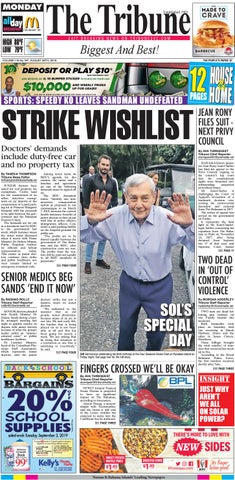
SOL’S SPECIAL DAY SIR Sol Kerzner celebrating his 84th birthday at the Four Seasons Ocean Club on Paradise Island on Friday night. See page two for the full story.
FINGERS CROSSED WE’LL BE OKAY By AVA TURNQUEST Tribune Chief Reporter aturnquest@tribunemedia.net
NEWLY formed Tropical Storm Dorian is projected to have no significant impact on The Bahamas, according to forecasters. Alyson Hoegg, a meteorologist with Accuweather, said the storm is still east of the Lesser Antilles but expected to move into the Caribbean Sea by midweek. SEE PAGE THREE
Nassau & Bahama Islands’ Leading Newspaper
By MORGAN ADDERLEY Tribune Staff Reporter madderley@tribunemedia.net
TWO men are dead following gun violence on two Family Islands this weekend. Both homicides took place on Saturday, with one occurring in Marsh Harbour, Abaco and the other in James Cistern, Eleuthera. These killings brought the total number of murders that occurred last week up to five. According to the Royal Bahamas Police Force, the first incident occurred shortly after 3am. SEE PAGE THREE
INSIGHT JUST WHY AREN’T WE ALL ON SOLAR POWER?
PAGE 2, Monday, August 26, 2019
Celebrating 84 years with Sir Sol STAFF at the Four Seasons Ocean Club on Paradise Island turned out on Friday night to welcome legendary hotelier Sir Sol Kerzner who was celebrating his 84th birthday. Sir Sol is acclaimed for single-handedly turning around The Bahamas’ tourism industry with the creation of Atlantis and the Ocean Club itself. His son, daughter family and friends - including Vanessa Kerzner wife of the late Butch Kerzner all flew into Nassau for the occasion.
To advertise in The Tribune, contact 502-2394
THE TRIBUNE
THE TRIBUNE
Monday, August 26, 2019, PAGE 3
Grandson’s death was senseless
By MORGAN ADDERLEY Tribune Staff Reporter madderley@tribunemedia.net “SENSELESS” is how Sheralyn Anderson described the murder of her grandson, Dimetri Dormeus, who was shot and killed with his best friend, Dion Adderley, one week ago today. With five murders in the last week, Ms Anderson condemned the level of violence in the country, describing it as “out of DIMETRI DROMEUS, pictured right as a child. control”. “It’s an alarming level and Dormeus often spent time. very supportive (network) – families are being hurt,” Ms The young men were play- my sisters, my nieces, my Anderson told The Tribune ing a game of dominoes coworkers, my friends. “They’re all calling and yesterday. “And to me, it’s before the shots were fired. Ms Anderson, who lives they’re all dropping by. senseless. I’m still trying to wrap my head around the on a neighbouring street, The house has been really a described Dormeus, who revolving door since it hap‘why’ of it. “I think the hardest part was a 2014 graduate of CV pened. So that keeps me Bethel High School, as a going. The neighbours, they of it was going to identify kind, helpful grandson who call and come to check on his body,” she continued. was never in trouble. me. “And when I looked at him, She raised both Dormeus “I have supportive just lying there, I’m like and his younger brother people around me, but still, - why was he killed so vioafter their mother’s death my heart is hurting. I had lently? Why was he killed when Dormeus was just five to bury his mother 17 years at all? I don’t understand years old. ago and now I have to bury it. I’m still trying to underDescribing him as a him.” stand it. funny, shy, and humble Since the two men were “The young people, young man who was a lover killed last Monday, three the people of music, Ms other homicides followed with these Anderson said last week. ‘I think the powerful Dormeus was On August 21, Ashton hardest part of weapons, I a “totally” Smith was shot and killed just think it’s it was going to devoted shortly after 10pm off out of congrandson and Cowpen Road. identify his body. trol. At some great-grandson. On August 24, two point, it’s just And when I She also men were shot and killed out of con- looked at him, just recalled that in the Family Islands –trol. I know Dormeus was one in Abaco and one in lying there, I’m the police are integral in the Eleuthera. trying their like - why was he care of his Shortly after 3am on best, but I killed so violently? great-grandSaturday, police found the just think we Why was he killed mother, who lifeless body of a man with need to get died a year multiple gunshot wounds at to the root of at all? I don’t ago. a home in Marsh Harbour, the problem understand it.’ “He was Abaco. Another man was in terms of never in trou- shot in the leg. According trying to deal with it.” ble with the law,” she to police reports, a man had Dormeus, 22, and Adder- said, noting he was often entered this home and fired ley, 23, were killed shortly between his home and shots. before 11pm on August 19. Adderley’s, as the two Shortly before 9pm on According to police, a young men had a very Saturday, a man in James group of men were sitting strong friendship. Cistern, Eleuthera, died in a yard on Maple Street, “Since that unfortunate after being injured by a Pinewood Gardens, when event, I’ve had an outpour- firearm. According to they were approached ing of persons from this police reports, three men by three armed men who corner, the next corner, and were sitting outside a resiopened fired in their direc- everybody just couldn’t dence when they were tion, injuring two of them wrap their head around it to approached by a man with and a woman, who was say why this happened,” Ms a firearm who “opened fire inside the home, before Anderson said. “Because in their direction, injuring running away. The two men everyone said he never one of them, before running were pronounced dead at bothered anyone. He always away”. The injured man the scene while the woman had a smile on his face. He was later pronounced dead was taken to hospital and is would give you his last.” by medical personnel. in stable condition. Regarding how she is This brings the murder Last week, Adderley’s coping with the tragic loss, count to 60 for the year, relatives told The Tribune Ms Anderson said: “I am according to The Tribune’s this incident occurred at his just bursting into tears sev- records; there were 62 murfamily’s residence, where eral times a day, but I have a ders at this point last year.
DIMETRI DORMEUS, described as a funny, shy and humble young man who loved music.
TWO DEAD IN ‘OUT OF CONTROL’ VIOLENCE from page one
Police in Abaco responded to a report of gunshots being fired at a home on Breadfruit Street in Marsh Harbour. “There at the home, they met the lifeless body of a male with multiple gunshot wounds and another male with a gunshot wound to the leg,” police reported. “Initial investigation revealed
that another male would have entered the home and shots were fired.” The condition of the man shot to the leg was not known up to press time. The second incident occurred roughly 18 hours later. “According to reports, shortly before 9pm, three men, were sitting outside a residence in the settlement of James Cistern, when they were approached by a man,
armed with a firearm, who opened fire in their direction injuring one of them, before running away. The island’s medical doctor was called to the scene, where he examined the injured man and pronounced him dead. No one else was injured during the incident.” The Tribune understands the Abaco victim to be Ashton Livingston and the second to be Dwayne Rolle Jr.
On August 19, 22-yearold Dimetri Dormeus and 23-year-old Dion Adderley were killed in a double homicide in Pinewood. On August 21, Ashton Smith was shot and killed shortly after 10pm off Cowpen Road. Saturday’s homicides bring the murder count to 60 for the year, according to The Tribune’s records; there were 62 murders at this point last year.
FINGERS CROSSED WE’LL BE OKAY from page one
If it strengthens, the storm is likely to move more south towards Jamaica and Cuba, Ms Hoegg said. If it crosses Hispaniola towards the Bahamas instead, Dorian is expected to get torn apart as it moves over the terrain with its only projected impact on the country to be enhanced showers. Dorian is the fourth named storm of this year’s Atlantic hurricane season. The third named storm, Chantal, has already dissipated out over the
central Atlantic, Ms Hoegg said. “As we go through the week, we may see (Dorian) move into the Caribbean Sea by midweek. It’s still a concern that maybe it will come northwest across Hispaniola towards The Bahamas late in the week or early over the weekend. “The concern is it’s very weak when it would come across Hispaniola, if it does. It never strengthens a whole lot in the Caribbean Sea, if that were to happen we could see it move more south out towards Jamaica and Cuba. But if it does
cross Hispaniola, it likely gets torn apart as it crosses the hard terrain. “By the time it would get to The Bahamas next
weekend, it would just be an open tropical wave, so enhanced showers and not anything significant for The Bahamas,” she added.
PAGE 4, Monday, August 26, 2019
THE TRIBUNE
Strike wishlist from page one
“As in practice in Jamaica, give doctors dutyfree exemptions on one vehicle every three years. Grant exemption from real property tax. Crown land for the construction of the BDU office.” Other issues the doctors have asked to be addressed at today’s meeting includes the abolition of one and two-year employment contracts; the reinstatement of intern housing allowance and on-premises hospital housing and the removal of the stipulation that doctors ‘swipe in’ prior to receiving holiday pay. Of this latter request, the union has asked that the existing reimbursement method be used, which is the holiday claim form.
JUNIOR doctors and auxiliary staff on strike. Photos: Terrel W Carey Sr/Tribune Staff The union is also asking of Public Health physito be the sole bargaining cians and Public Hospitals’ agent for public dentists; Authority physicians be that the parity in sala- rectified and that doctors ries between Department who have not received a
pay package or allowances during BDU’s last industrial agreement be regularised and receive back pay. In the document, BDU also said it accepts the proposed pay out of approximately $5 million covering the period of June 2014 to October 2018, which is to be paid to junior doctors in two instalments. The first instalment at the end of August and the second in December. “A third payment is to be made for the year 2018 at a date to be determined,” BDU noted. When contacted yesterday about the standoff with the government and BDU, Health Minister Dr Duane Sands said the nation’s leader has been “most flexible and receptive to the concerns of the physicians.” Dr Sands said: “He has
met with them, he has given them assurances that the substantive issue that has lent to this action will be positively resolved in their favour in a timeframe even more rapid than they had hoped for previously so. “This is not an issue where there is an arbitrary position that is held. We can do what it is possible to do, every decision, every intervention has consequences whether those consequences are seen or unseen predictable or otherwise we have to try to make decisions so we don’t get down the road and say collectively as a country well why didn’t you say this could have happened. We didn’t know that this was going to be a potential outcome.” More than 400 junior doctors across the country
went on strike Wednesday, frustrated by longstanding disputes. As the strike stretches on, it is unclear if the government will give in to the union’s demands, reach a compromise or refer the matter to the Industrial Tribunal, which could put an end to the strike without an agreement being reached. Section 72 of the Industrial Relations Act outlines the procedure for a minister to refer a labour dispute to the tribunal when dealing with an essential service. The law states that when a settlement has not been reached within 16 days, then the minister may refer the dispute to the tribunal if in his opinion the public interest so requires. “The provision of any hospital service,” falls under essential services.
to personally discharge his patients and coordinate their follow-ups. “Literally I have to answer the emergency room,” he said, “whereas the SHO (Senior House Officer) or resident would ordinarily answer it.” Dr Munroe said health outcomes have been affected by the work stoppage, though he added this has been difficult to quantify. “Which patient in a home whose diabetes is out of control who probably feels ‘well I can’t go to the hospital?’,” he said. “Which patient is at home whose blood pressure is high and they say, ‘oh, well I can’t go to the hospital?’”
Senior doctors are typically expected to work about 20 hours a week, but Dr Munroe said in the last week 40 to 50 of them have worked on average about ten to 12 hours more. The CPSA has about 130 doctors and the BDU has about 420. Last night’s meeting, which lasted more than two hours, was attended by about 70 people, including the managing director of PHA, the hospital administrator and the permanent secretary of the Ministry of Health, Dr Munroe said. He said he left the meeting with the impression that a resolution to the conflict is not imminent. “Part of the thing is that
the CPSA will try at a different level to speak with the junior doctors to see if there can be some kind of mediation. We’re not telling them what to do because that’s their issues and they have to deal with their issues but the plan is at some point between now and this morning we will speak to them,” he said. Contacted last night, Dr Sands told The Tribune a resolution has not yet been reached. “We are prepared to be as reasonable and to compromise as much as is reasonable and more based on good faith involvement of the prime minister, the cabinet, the Ministry of Health as well as PHA,” he said.
SENIOR MEDICS BEG SANDS ‘END IT NOW’ from page one
Dr Munroe said the CPSA “definitively” supports the junior doctors and is willing to play a mediatory role in the dispute. He said during the meeting Dr Sands expressed concern that if the government capitulates to the demands of the BDU, all other unions will expect similar treatment. “It’s true they will do that,” he said, “but just like with the senior physicians, a lot of these issues from the junior doctors have been outstanding for years, some since 2010. Essentially the issues some of the other unions have are much
more recent so you have to consider the timeline. You could tell the other unions the junior doctors have had these issues since 2010, so please give us time to at least sort out these and we could address your issues at a later date.” A dispute over holiday pay is a major reason why the junior doctors are on strike. The BDU has said doctors have not been paid for working holiday while Dr Sands has said the two sides disagree about how to validate claims of who has worked holiday shifts. Dr Munroe said in the last week, junior doctors have showed up to work but have only provided service in “life or death situations.”
“They kinda took away everything,” he said. “So if you ain’ bleeding to death, they say they are not going to be involved with that. They aren’t gone completely and they will do something when a senior physician asks, but their engagement has significantly diminished.” A BDU source last night characterised their performance differently, saying junior doctors have performed emergency services and have helped at times to prevent emergencies from developing. Describing his workload, Dr Munroe said he has had to see every patient in his service because junior doctors aren’t around; he has
NURSES COULD ADD TO INDUSTRIAL ACTION PROBLEMS By AVA TURNQUEST Tribune Chief Reporter aturnquest@tribunemedia.net
LOOMING industrial action from the Bahamas Nurses Union could further cripple the country’s public healthcare system, with labour officials yesterday urging the government to immediately meet demands. With the Bahamas Doctors Union strike languishing on through the weekend, Labour Director John Pinder told The Tribune further industrial unrest from nurses could
prove critical. Meanwhile, Health Minister Dr Duane Sands yesterday stressed decisions must be made in the best interest of the country – and not an individual special interest group. Dr Sands was responding to criticisms from BDU President Dr Melisande Bassett, who told The Tribune her union was disappointed with the level of concern demonstrated for doctors by Dr Sands. Dr Sands said: “The Bahamian public wants to know that if a loved one is
ill, or if they are sick that they can get the healthcare services that they rightly deserve and that they paid for, and we are going to seek to make sure that that happens. We continue to try to get doctors back to work, and so far they are not back to work. “This is not about me or any allegiance to any particular group,” he continued. “Yes, I am a physician, I’ve been a physician for 40 plus years but I have sworn an oath to defend the interests of the people of The
Bahamas and I put that first. I have a duty to protect the health interests of the people of this country… not the interests of any particular group and as such I don’t believe those two issues are asynchronous. So, protecting the interest of people also protects the interests of physicians.” The government’s ‘showdown’ on Saturday morning with seven public sector unions was said to be frank, candid and revealing, but it is unclear how the informative session will influence negotiations.
“These are challenging decisions,” Dr Sands continued, “I support the right of the (BDU) to stand for the concerns and the benefits of their union members but they are not the only union in the country, or the only people in the country and so while we want to be as generous as possible to them – tomorrow we have the nurses.” He added: “We have to look at this thing holistically, taking the concerns of the entire population and relate it to the ability of the public purse to be able to underwrite any concessions that are made.” For his part, Mr Pinder told The Tribune the BNU outlined “serious, legitimate concerns” in Saturday’s omnibus meeting, adding he did not understand why critical health workers could not be paid in a timely manner. “I would hope that the government recognises the importance of the nurses in the healthcare system,” Mr Pinder said, “and do as best they can to satisfy them. The nurses (union) president had very serious legitimate concerns. I don’t know why is it that these nurses who are so important to the healthcare system (are) not getting paid in a timely fashion.” Mr Pinder added: “I advised the government to deal with that ASAP, that needs to be dealt with immediately. I think the nurses president did a very good case, and I’m sure the minister of health wants to ensure those nurses are properly paid. He is certainly concerned nurses are not being paid in a timely manner.” Nurses overwhelmingly voted to take industrial action during a strike poll held in December, after the government refused to give the BNU a strike certificate for its first strike poll staged several months earlier in June. “She has been very, very restrained,” said Paul Maynard, president of the Bahamas Electrical Workers Union. Mr Maynard served as acting president of the National Congress of Trade Unions (NCTU) in Saturday’s meeting. “As a union president I must admire her,”
Mr Maynard continued, speaking of BNU President Amancha Williams, “she has shown total restraint for what they are going through. In the meeting yesterday (Saturday), she had me close to tears.” A central issue levelled by the BNU on Saturday is the non-payment of nurses – some of whom completed training but had not received salaries for some 18 months. “For me that’s too long,” Mr Pinder said yesterday. “They have a strike certificate. I don’t know what their plan of action would be, but I am sure that the government is quite aware of the threats being made by them and in their wisdom will look at this matter as a matter of urgency to assure they are satisfied.” Ms Williams did not return calls placed up to press time. Junior doctors of the Bahamas Doctors Union (BDU) on New Providence and Grand Bahama withdrew their services on Wednesday, and industrial action remains in effect today. The BNU stood in solidarity with the BDU during Wednesday’s demonstration, alongside representatives from the Bahamas Public Service Union, the Union of Tertiary Educators of the Bahamas, Union of Public Officers and the Trade Union Congress. On Wednesday, Ms Williams threatened related health service unions would coordinate efforts to “shut PMH down” in support of doctors if needs were not met. “We will take a stand, if the nurses have to come off the job, we will do that to take a stand with our congress. We are not playing no jokes. “So those that are in power, please - we don’t want you just to acknowledge, we don’t want you just to call, we want you to make the change today and we will wait patiently and we will stick together like sardines in a can. That’s how we moving,” she said last week.
THE TRIBUNE
Monday, August 26, 2019, PAGE 5
MINNIS: WE’RE TAKING UNIONS SERIOUSLY By AVA TURNQUEST Tribune Chief Reporter aturnquest@tribunemedia.net
PRIME Minister Dr Hubert Minnis has stressed the government takes the concerns of unions seriously after high-ranking officials held “frank” discussions on Saturday with the labour movement on the state of the country’s finances and the need to reduce spending. A press release issued by the Office of the Prime Minister on Saturday night said the important meeting paved the way for discussions to move forward with a factual understanding of the country’s economic outlook and the government’s fiscal constraints, including the need to exercise spending restraint and reach sustainable economic growth targets. “We take the unions’ concerns seriously, which is why we convened the first of its kind high level meeting to discuss the country’s economic and fiscal affairs with all of the unions,” Dr Minnis noted. “Moving forward, these kinds of discussions will be integrated into the budget planning process. “We want to learn from the past and make this kind of citizen dialogue happen in a proactive way,” Dr Minnis said. “Although union members were hoping to resolve individual issues, the purpose of Saturday’s meeting was to facilitate an open and frank discussion about the state of the economy, and to provide context for the government’s position. We recognise that finalising all outstanding industrial agreements with the relevant unions is a pressing concern and those negotiations must be concluded.” At the meeting, a presentation by the Ministry of Finance outlined the country’s economic growth prospects, current employment conditions, the fiscal situation, government debt, the concrete steps being taken to reduce the deficit and debt levels, and strategies to boost growth, OPM said. The release said the government stressed to the
A PRESENTATION at the Paul Farquharson Centre at police headquarters on Saturday. Unions (NCTU) acting it. I believe they will make president during the meet- the deal.” ing, believes it’s clear the Speaking on behalf of the government will move to government, Labour Minismake a deal with public ter Dion Foulkes said both sector unions following Sat- he and Dr Minnis felt the urday’s meeting. meeting was productive and “They showed us the informative. numbers, but the people He declined to provide don’t want to hear that any details on negotiations now,” Mr Maynard said. with the Bahamas Public “They should have involved Service Union and Bahaus in this process a long mas Doctors Union - both time ago. All of these public of whom have been publicly sector contracts was up last agitating for a resolution year. Everybody knew or this past week. should have known, they The BDU strike is still should have start negotiat- ongoing with public hosing a long time ago.” pital services reduced to Mr Maynard continued: emergency care only. “I believe they will make Mr Foulkes said: “What some provisions. They we wanted to do as a govgoing to have to; and from ernment is give our realistic that meeting they under- impressions of the economy stand they have to. and our limitations to the “The unions are going public sector unions, and through the negotiating we accomplished that. The process. The point is they discussions were very frank, knew, they should have had (unions) were very frank in the money but they ignored their positions.”
unions the importance of achieving fiscal sustainability to enhance the social and economic benefits that can be maintained over the medium and long-term. It was also stressed that it is imperative that The Bahamas return to a more sustainable fiscal path. Expenditure restraint is crucial to this objective and if not achieved, it will have adverse implications for the entire economy, the press release said. Dr Minnis noted while the economy is improving, it is still in recovery, adding that the country is still vulnerable to natural disasters and external economic shocks. He also said: “At all times we want to make decisions that are in the best interest of all Bahamians.” For his part, Paul Maynard, who served as National Congress of Trade
He continued: “All of the major unions gave representation with respect to their economic demands the financial secretary and DPM responded to those questions.” Kimsley Ferguson, the BPSU president, said his membership will continue to stand down until this evening, when it will meet to chart a path forward. BPSU members protested outside the Churchill Building last Thursday. Mr Ferguson agreed the meeting was informative, adding it was discovered the government had not made any contingency to address industrial agreements. He noted his union has received a counter offer but did not want to give any further details until it was concrete. Mr Ferguson said on Saturday: “Concerns were aired, and one of the points that we discovered was
that nothing was budgeted to address industrial agreements. The response to that was that they can’t budget for agreements that were not finalised. But our response is that the government is aware of what they want to do, or will do as it relates to increases. It is expected once they knew agreements were expiring they should have done something. “I can state to my members that a counter was made,” Mr Ferguson said. “I can’t express figures but I could say to them that I’m at the view we can meet the government at that point, if the particular figures that (a senior official) gave can be confirmed. The prime minister advised he would give me a call before the weekend is out, so at the latest is Monday. We need something concrete to present (to membership).”
MITCHELL: GOVT DISHONEST IN ITS UNION DEALINGS By AVA TURNQUEST Tribune Chief Reporter aturnquest@tribunemedia.net
SENATOR Fred Mitchell yesterday accused the government of negligence and dishonesty in its handling of trade disputes with public sector unions. The opposition spokesman on labour said former Progressive Liberal Party administrations, in successive terms, have briefed public sector unions on the state of the economy in meetings with government officials, the Ministry of Finance and the Central Bank. “(The government) said they briefed the unions and claimed this was the first time this was done, that is absolutely false. “It’s an invention to cover up their negligence and their dishonesty because the Ministry of Finance officials and minister of finance, the public service minister all knew, and the minister of labour, they all knew or ought to have known that the contract between the Bahamas Public Service Union and the government expired some time ago. “Therefore a prudent Ministry of Finance, or minister that knew what he was doing, would have ensured the government would have set aside provisions.” Mr Mitchell continued: “Instead they are trying to spin a narrative to blame unions for not advancing financial proposals. They did but could get no answer. It was only then they went to the PM who then advanced the financial information we now see before us. “It’s an act of negligence but also an act of dishonesty. They were trying to
fool the public and international agencies about the true state of the finances of the country.” Mr Mitchell also called on Labour Minister Dion Foulkes to review the conduct of Labour Director John Pinder, citing concerns levelled by two unions currently engaged in trade disputes with the government. He pointed to an on-air spat between Mr Pinder and BPSU leader Kimsley Ferguson, and recent comments made by Bahamas Doctors Union President Dr Melisande Bassett. Yesterday, Mr Pinder said he called in to a local radio show, of which Mr Ferguson was a guest, to clarify a statement made about him. He shrugged off criticisms leveled by Mr Mitchell, and underscored any benefits won by the BPSU would trickle down to him as a public servant. Mr Pinder, former BPSU president, said: “When I negotiated for the unions I couldn’t get anything, I was getting paid by the union. So I will never try to get the minimum. The more money the public services get, I get, it will be trickled down to the general public service.” As for the BDU, Dr Bassett told the Nassau Guardian she felt ambushed by the presence of Ministry of Health and Public Hospitals Authority officials at a meeting arranged by Mr Pinder on Friday. The BDU president said she was told the meeting with Mr Pinder was to exchange information ahead of talks with both parties scheduled for today. Mr Pinder said he was only seeking to achieve a resolution in the shortest possible timeframe, adding
that he apologised for this interpretation. “I don’t regard it as being ambushed,” Mr Pinder said. “A meeting was scheduled for them to meet this coming Monday, but because the service at PMH got so bad I thought it was
wise to meet as early as Friday to see if we could get doctors back to work. “I can’t conclude that matter on my own. I need both sides to meet to agree to what is owed, and a payment schedule to get them back to work. I am of the
view it could have been resolved on Friday. The PHA is admitting they owe. I just want to remediate between both sides to agree to the amount and a schedule of payment.” Mr Pinder said: “Maybe I should have (told Dr
Basset), I was trying to resolve the matter as quickly as possible. I apologise if she felt I ambushed her. But it could not have been ambush, for something to be ambush you have to be on a course and someone take it off course.”
PAGE 6, Monday, August 26, 2019
THE TRIBUNE
The Tribune Limited NULLIUS ADDICTUS JURARE IN VERBA MAGISTRI “Being Bound to Swear to The Dogmas of No Master”
LEON E. H. DUPUCH,
SIR ETIENNE DUPUCH,
jamaaltheartist@gmail.com
Publisher/Editor 1903-1914 Kt., O.B.E., K.M., K.C.S.G., (Hon.) LL.D., D.Litt .
Publisher/Editor 1919-1972 Contributing Editor 1972-1991
EILEEN DUPUCH CARRON,
C.M.G., M.S., B.A., LL.B. Publisher/Editor 1972-
Published daily Monday to Friday
Shirley & Deveaux Streets, Nassau, Bahamas N3207 TELEPHONES
News & General Information Advertising Manager Circulation Department Nassau fax Freeport, Grand Bahama Freeport fax
(242) 322-1986 (242) 502-2394 (242) 502-2386 (242) 328-2398 (242)-352-6608 (242) 352-9348
WEBSITE, TWITTER & FACEBOOK www.tribune242.com
@tribune242
tribune news network
Little sympathy for doctors’ demands THERE has been a sense of sympathy for those involved in the latest round of industrial disputes – despite the effects of strike action hitting Bahamians. We’re not sure how much sympathy will remain after the demands of junior doctors were revealed in today’s Tribune. Exemptions to real property tax, duty-free car imports every three years, crown land for the union’s office – goodness, did they also want a free pony for everyone? One of the most remarkable items on the list was the proposal to build a car park for public use on the hospital grounds – the building itself isn’t the issue, that’s a reasonable suggestion – but where do the profits go from parking fees? They would be divided equally between the government and the union, with the profits paid out equally to all BDU members. For how long? “In perpetuity”. Forever. Imagine that – public money to build it, members of the public paying fees to repay those costs, and then the profits forever after going into the union pocket to divide up. Dear union officers, by all means ask the government to give you a better financial deal, but don’t try to set up a way of milking money from the public directly into your coffers forevermore. The doctors are also resistant to having to swipe in to log their hours – wanting a form to be used instead. The issue, say the doctors, is that satellite clinics that doctors attend don’t have
the means to swipe in to log hours there. Well, why not make sure there is rather than toss out the whole system? Or if there is an insurmountable technical problem – which seems unlikely – have a log for the hours at the clinics? This seems a trivial matter that could be resolved easily -but when added to the implausible demands above, one almost starts to feel suspicious about why doctors would be so keen to have forms rather than a proper log. There are genuine issues that the doctors do need to be resolved relating to payments, and issues surrounding housing allowance for interns and parity of health insurance with other professions are worth putting on the table for discussion. But the doctors do themselves no favours by putting forward demands that has little to do with their work. What have tax exemptions got to do with the profession? We are sure that many people would love to have the government turn a blind eye to property tax but that way lies inequality. If you want more money, ask for more money, not a magic wand that wishes away taxes you owe. The public purse is not there to fatten the private purse of employees, or that of the unions. If the doctors don’t want public opinion to turn against them fast, they would do well to drop some of their more outlandish demands, get a deal done with government – and get back to work.
Dean move a blow to the FNM EDITOR, The Tribune.
THE 19th century French diplomat Alexis de Tocqueville said that the power of the periodical press is second only to that of the people. The press in this country influences the political thought processes of the Bahamian people. The media played a massive role in the outcome of the historic 2017 general election. The Free National Movement (FNM) got significant help from social and conventional media, especially from The Nassau Guardian and its erstwhile general manager and editor, Mr Brent Dean, leading up to May 10, 2017. With two and a half years remaining in its current legislative session, the FNM administration is hard-pressed to find a newspaper or conventional media outlet sympathetic to its cause. Dean’s resignation from The Nassau Guardian this past August was a massive blow to the FNM in more ways than one. A close examination of the current editorial staff at The Guardian would reveal not a single FNM sympathiser. Both Candia Dames and Juan McCartney are highly critical of the Minnis regime’s performance, especially its handling of the Bahamas Power and Light (BPL) matter. One only has to peruse the write-ups in the
National Review column to see this. McCartney has been every bit as critical as Dames, particularly in a recent Facebook post about BPL which was published on a PLP Facebook page by party operatives. Even the weekday editorials, which were typically pro-FNM prior to August, are now bludgeoning the party on a frequent basis. At The Tribune, the FNM is faring no better, with Eileen Carron becoming less involved with the editorials. At The Punch, Nicki Kelly is perhaps the harshest critic of the Minnis administration. The FNM cannot look to The Bahama Journal for any journalistic support, seeing that its publisher, Mr Wendell Jones, is reportedly a supporter of the Opposition Progressive Liberal Party (PLP). Looking at the landscape of social media, the only ally that the FNM currently has that is worth mentioning is Blame Dem, amid rumours that another prominent Facebook group has shifted its allegiance to the official opposition. The efforts of the Blame Dem membership are laudable. But its members cannot match wits with Dames and McCartney. This is where the FNM sorely misses the intelligent and informed Brent Dean. Those who underestimate the influence of the fourth estate in politics are
either being naive or are simply grossly uninformed. Small wonder Sir Lynden Pindling stymied the growth of the media during his 25 years in power. Pindling obviously remembered the massive influence of Cyril Stevenson’s Nassau Herald and the PLP’s Bahamian Times in turning the tide against the United Bahamian Party in the 1960s. The appointment of Anthony Ace Newbold as press secretary in May 2017 failed to yield the results the FNM administration was hoping for, in what has been a public relations nightmare. Newbold has since left that post. The FNM has done some good, but you wouldn’t know this by judging from the hundreds of discontented Bahamas Public Service Union and Bahamas Doctors Union members who are currently protesting. With Brent Dean no longer in The Nassau Guardian’s editorial room, the FNM and its chairman, Mr Carl Culmer, must now focus their attention on overhauling their public relations machinery, with the aim of countering the negative assertions of McCartney and Dames. Failure to do this might prove to be catastrophic for the party in 2022. KEVIN EVANS Freeport, Grand Bahama August 22, 2019.
Debunked ideology killing us EDITOR, The Tribune I HAVE been frequenting Lyford Cay since the 1970s. For almost all of that time, the long, winding road to that community has been one of the last reserves of Caribbean Yellow Pine in New Providence - a veritable haven of inactivity, frequented by raccoons and little else. Only in the last two decades, with the proliferation of middle class Bahamian communities in the area has there been sufficient consumer demand to justify a relatively major shopping centre, gas station and a few restaurants. Wealthy people are simply not big consumers. Additionally, many of the wealthiest foreign residents of places like Lyford Cay directly import their foods and other life needs, bypassing the domestic economy. Contrast this with Carmichael. When my grandfather died in February, 1977, his was the only gas station on Carmichael road and there was no electricity. Today, it hosts a John Bull, a Dairy Queen, two Bamboo Shacks, Home Fabrics, Modernistic Gardens, Wendy’s, First Caribbean, the Royal Bank of Canada, Scotiabank, Bank of the Bahamas, Super Value, Meat Max, John’s Department Store, Fourth Terrace Diagnostic Centre, Kelso Lab, Commonwealth Building Supplies, Bristol Wines, Colina Insurance, Walk-in Clinic, Outdoor Sportsman and at least four gas stations. Every major Bahamian retailer that is not there yet is trying to get there. All of this activity results from direct spending from residents in the area, whose wages come either directly or indirectly from large multinational corporations (Atlantis, Baha Mar, Sandals, etc), rather than from wealthy local residents, who increasingly employ Filipinos and Peruvians. This consumer spending of the Bahamian middle class remains the lifeblood of the domestic economy. Sadly, Bahamian policymakers have been taken in by a big lie called neoliberal capitalism. This doctrine which holds that,
LETTERS letters@tribunemedia.net by giving tax breaks and concessions to the rich, this somehow “trickles down” into the economy to all our benefit. It also advocates a globalist approach to economics, dismantling worker protections (‘barriers to trade’) and easing capital flows, while immobile labour is left to adapt. All over the world, this doctrine has now been debunked. In the US, it led directly to the shrinkage of the middle class and the vast gap between rich and poor that fed the rage that brought forth Trump. While the economy supposedly performs well, three individuals (Gates, Bezos and Zuckerberg) have more money than the lower 50% of Americans combined. Relative to prices, average incomes have not increased since the 1970s and 60% of Americans cannot afford a $1,000 emergency. First World inequality is probably at its worst ever, beyond even the horrors of the Victorian age. Meanwhile, capital hunts for new labour markets abroad, funneling money to politicians (like the Clintons) who specialize in transferring sovereign economic policy to unelected global capitalist interests under the guise of “Free Trade Agreements”. Not to be outdone, our government is belatedly (and needlessly) trying to scramble onto the WTO bandwagon, even as its doctrinal basis is coming under increasingly negative scrutiny in the big countries and Trump is ready to jump ship. All in all, neo-liberal capitalism has been one of the costliest disasters in human history, while the only large country to weather its era well (China) has done so by engaging in capitalism strictly on its own terms, while sheltering its population from its ill-effects. This way, in forty years it has lifted almost a billion people out of poverty, while the west has been set back a generation in terms of income equality. Translated into the
Bahamian context, the neo-liberal doctrine is manifested in a revenue policy that has made us one of the most tax regressive countries on earth and has delivered no benefits in terms of growth. It has led us to offering obscene tax-concessions to foreign investors, even though we get levels of foreign investment per capita that would make most of the world dizzy with disbelief – even without trying. Perhaps it is not surprising that neo-liberalist ideology would prove so persistent here in The Bahamas. After all, when it is combined with a colonially-ingrained sense of racial inferiority, it seems to blind its adherents to even the most manifest common sense. Hence, despite the obvious evidence, it has probably never occurred to many of our policy-makers that residents of Carmichael are more important direct contributors to the domestic economy than residents of Lyford Cay (and thus tax breaks to them would produce greater economic benefits) because it simply offends some vague, ingrained notion of hierarchy that lies too deep to be examined. Contrast the indecent speed with which the FNM complied with a single letter by Lyford Cay residents over property tax with their obstinate refusal to consult (much less reconsider) over a 60% VAT hike that very summer. As every economist predicted, the VAT hike has slowed growth, even while our tourism is performing miraculously well (which government keeps reminding us, apparently without irony). By contrast, an increase of property tax on Lyford Cay residents would have had absolutely no affect on consumption or growth and would have boosted revenues. It may even have helped combat the exorbitant real estate prices in New Providence if Mr Henry Cabot Lodge III and some of his friends had left us as threatened (or promised) in their letter. ANDREW ALLEN Nassau, August 24, 2019
n o t h g i l a g n i n Shi w o l s o s e r ’ e w r why a l o s o t n o g n i h c swit
THE STORIES BEHIND THE NEWS
MONDAY, AUGUST 26, 2019
By PHILIP HOLDOM President and Founder Alternative Power Supply
THE BAHAMAS is one of the “solar capitals” of the world with more solar irradiation falling on our land than most other countries. In spite of this, the Bahamas has the least amount of solar integration compared with almost any country. For example, Ireland and Norway have more installed power than The Bahamas. If one Googles how much solar is installed in The Bahamas, in megawatts (1 Million Watts = 1MW), the data shows zero! Fortunately, Bahamian solar companies have, over the past decade, privately installed over 7MW even though it is not recorded on the world stage. With a total state-owned fossil fuel generation capacity of 430MW, this is only 0.016 percent renewable penetration. Nevertheless, it is 7MW of privately-owned solar systems by solar pioneers, despite incredible obstacles to integration. How did one of the sunniest countries in the world, with the world’s highest cost of electricity, have so little solar penetration in an era of expansive worldwide solar integration? The history of solar in The Bahamas really begins 12 years ago, when substantial solar systems began to be installed for the general public. Prior to this period, only NGOs and private island owners were installing significantly sized solar systems, such as The Island School and Over Yonder Cay. Solar integration in any country requires several factors: A governmental will to legislate renewable policy, a non-monopolistic grid, an ease of doing business, a simple inspection process for solar integrators, access to reasonable financing and tax incentives. If you live in The Bahamas, you would invariably be biting your tongue at this point. In the past decade, every leader in The Bahamas has paid lip service to solar. It was only in 2017 that progress became a possibility with a much-needed amendment to the Electricity Act which included legislation on solar systems. Prior to the amended Electricity Act and the National Energy Policy, the integration of solar was met with many governmental obstacles for solar integrators and solar customers. In the past decade, the primary obstacle was the government’s utility monopoly, the Bahamas Electricity Corporation along with the inspection arm, the Ministry of Public Works. This was also not helped by conflicting messages coming from three Administrations overseeing solar. The last three leaders of The Bahamas were typically pro solar and made public pronouncements that Bahamians could install solar, but as usual, the devil was in the details and the implementation at ground level. Solar installation companies and solar customers had three hurdles to traverse:
1. There was no clear legislation on solar integration and the only point of reference was an antiquated Electricity Act, which could be interpreted to have multiple meanings. 2. The government utility company was actively creating obstacles and roadblocks to solar integrators. 3. The Ministry of Public Works made it extremely difficult to complete a solar inspection and created their own varying requirements to get an approval. There are still open solar inspections that have been waiting four years for an approval, with no justifiable reason why they should not be passed. 4. Without a government approval, the Authorities that Have Jurisdiction (AHJs) could pronounce your solar system as “illegal” and the utility company could threaten to cut power off to the residence or business. In the early stages, the higher-up managers of the utility actively blocked the integration of solar systems that would significantly reduce a home or businesses electricity consumption. Customers who installed systems that could reduce their bill in half or more were threatened with having their homes or businesses disconnected and were issued cease and desist orders. BEC acted as most utilities do when their revenue source is threatened. Rather than joining the revolution and benefitting from renewable energy, they opposed it. For nearly a decade, many wellmeaning private customers were turned away or were made to believe installing their solar was illegal. To add to the confusion, during that period there were certain government officials who had solar systems on their homes, but at the same time would pronounce publicly that grid tie systems were “illegal”. The first glimmer of hope was a public solar programme introduced by the Ministry of the Environment and the InterAmerican Development Bank, namely the “IDB Pilot Solar Programme”. This was a government sanctioned and run solar programme where the general public could pay $1,000.00 and receive a “subsidised” 3KW solar grid tie system. This is a system that connects to the utility grid and is intended to slow the customer’s meter down or spin it backwards. Unfortunately, this programme took over two years to be available from the time the public paid their system deposits, and this greatly frustrated the participants. APS was commissioned with the task to “go find out where the solar systems are” and advise what is needed to get the programme going.
Once the systems were the utility during the billlocated and the balance of ing period. As a result, components added, the par- the average Bahamian got ticipants were finally able to minimum gain from their get their systems installed solar system because when and turn their systems on. they were at work all day, Unfortunately, at that point the meter was spinning they discovered something backwards at half cost with very regretful and upset- no VAT credit. When they ting…their BEC bill went up! arrive home near sunset, This was due to the fact their they purchase electricity at meters were to be exchanged the full retail rate plus VAT. for a new “net metering At the same time BEC’s, meter” that would keep newly formed BPL comtrack of the energy being pany was mandated by produced and exported or URCA to create a solar “sold” to the grid. The prom- programme for the instalised net metering meters lation and inspection of were not installed and as a solar systems. This would result their older meters reg- enable the government to istered the negative flow of track how much solar was electricity as a net gain, due being installed so it could to an anti-tampering device record its progress on the within the older meters. All world stage and ensure agencies involved with the the amount of solar being programme were advised installed was limited based of this, but no changes were on a “demand” formula. made to address the issue. Rather than allow busiThe solar installers had no nesses with large utility bills choice but to tell their cus- to produce as much as they tomers to turn their solar needed and to export solar systems off. energy, the Those who ‘BEC acted as most system size kept them was limited on continued utilities do when to 100KW. seeing their their revenue source No approvbills go up. als were given is threatened. It was to any private Rather than joining system over extremely frustrating 100KW and the revolution and for customers benefitting from few if any and Bahawere given at mian solar renewable energy, 100KW. The companies only exception they opposed it. to try and do For nearly a decade, to the 100KW business in limitation was this environ- many well-meaning the National ment. Local private customers Stadium, leading solar which was were turned companies 780KW and then engaged away or were was “assumed a long drawn made to believe by all to be out campaign approved”. installing their to seek to The National amend the solar was illegal.’ Stadium’s Electricity solar power Act, to fight goes directly for duty free status for solar to the BPL grid and to date it systems and to promote solar is unclear how it benefits any integration. In addition, they member of the Bahamian pushed to create a legal pro- public, if benefits are quantified cess whereby solar installers as lower electricity bills. and the public could have an As are result of URCA “approved” solar system. regulating the electricity At this point, URCA sector, the newly formed became the Electricity Reg- Bahamas Power & Light ulator and created the legal (BPL) was mandated to framework for Solar Net create the “Small Scale Billing to occur. The solar Renewable Generation” installers wanted Net Meter- (SSRG) Pilot Programme ing rather than Net Billing, for small residential and because it was a better deal commercial systems. This for the electricity consumer. solved the need for a legal It meant solar electricity approval process for solar produced by the homeowner systems so the public could or business owner would say “I have an approved have the same value as elec- system”. tricity being purchased from The SSRG programme the government utility. was welcomed as a good It is significant to note start for solar installation most countries integrating companies, but once again, solar actually provide the the devil was in the detail. solar customer with a credit The SSRG process greater than their cost of involves three government supply. Nevertheless, the agencies (URCA, BPL, law here was written so that MOPW) with a high level the consumer would only of bureaucratic red tape receive approximately half and as a result long delays the value of solar electric- occur. Solar companies ity “sold” to the utility as have to chase the process what it was purchasing. The every step of the way, at a value of the solar energy significant cost. One of the produced was put on par government agencies does with the cost of the fuel not engage in digital comsurcharge being billed by munication and as a result
forms and documents need to be printed and transmitted around the island by vehicle. This is counterproductive to a “Green” process. The solar process fee is also not digitalised, even though you can pay your bill online from the same corporation. There are between six and seven steps to the programme, depending on whether it is a residential or commercial solar installation. The process could easily be streamlined to two to three steps and this has been documented and submitted to the AHJs. Some of the steps are simply duplication of process and a reproduction of the same documents and schematics in a different form. It is estimated that for a process with an initial fee of $50 it costs the end customer over $750 to complete the process, and that is a conservative figure. Actual costs are likely closer to $1,200. The end result is the SSRG process currently takes over eight months to complete for a solar installation that takes three days. This is not an ease of doing business and seriously slows the expansion of the industry. When solar integrators can only get two to three solar systems approved a year it is an unsustainable business model. This is an irony, since it is a sustainable endeavour! As a consequence of the slow process, customers are not joining the programme because they don’t want to pay the application fee, have their solar system installed in three days and then have to wait eight months to turn it on. It is also preventing solar companies from submitting their vast numbers of existing clients to the process. In the end, the government does not get credit for PV capacity it has not registered and does not march smartly towards the National Energy Policy Goals of 30 percent renewables by 2033. What is the future of solar in The Bahamas? The future of solar in The Bahamas can likely be split into two avenues, what the government will install through RFPs via presumed multinational (Bahamian/Foreign) corporations and what local Bahamian solar companies can install through the limited and untimely SSRG programmes. Currently, the Rocky Mountain Institute, based out of Colorado, is spearheading the Requests for Proposals to provide solar power to the Family Islands, to provide a solar carport at the Prime Minister’s Office and to power two public schools. At the rate of solar integration being made possible to the private sector, it is
assumed by local solar companies that one day a large foreign company will come in and install the majority of the capacity in one installation. It is assumed the Shell deal will result in a large solar farm, once the generation station is stabilised. Shell, the largest oil company realised decades ago what the future was and made - solar panels! The other way of integrating solar, via local solar companies serving local homeowners and businesses is simply not happening at a sustainable rate for local solar companies, who fought a decade for what now exists. Obviously. there is room at the table for large, medium and small players and the foreign companies will need local knowledge and expertise. Assume, however that rapid integration was possible with the wave of a wand, there are significant impediments to integration. Today’s MW utility scale solar systems require modernized distribution and transmission networks and often a Smart Grid. This does not currently exist in The Bahamas and would have to be modernised in step with large-scale solar integration. The world is also moving to a block chain grid, where you can purchase power at the lowest rate from multiple providers in real time. The utility wires are simply a conduit like the world wide web. The best option for The Bahamas would be to allow the free flow of electricity and unbundle the public utility. Look what decentralising telecommunications did for the Bahamian public with just a singular second option. The problem of exorbitant financing must also be addressed and micro loans with reasonable interest rates should be provided to the average Bahamian with a steady job. While the Bahamian public waits for the utility to stabilise their grid, why not allow Bahamians to rapidly integrate solar battery backup systems in their homes and businesses so they don’t have to sit in darkness every day? Generators on a small scale are more costly than generators on a large scale, and have the same environmental issues and back end costs. If government cannot move at the speed of business, it should free up the Bahamian to choose their own destiny and be selfsufficient. Back in the day, in a not too distant past, we made our own power, pumped our own water, grew our own food and had a feeling of accomplishment and community. Now we are forced to rely more and more on designated others to do what we could do better ourselves and at a lower cost. Awake and Lift up our Heads to the Rising Sun, Bahamaland at a lower cost. Awake and Lift up our Heads to the Rising Sun, Bahamaland! • APS has been installing solar systems for three decades in both the United States and the Bahamas.
PAGE 8, Monday, August 26, 2019
THE TRIBUNE
‘Yes’ to a higher minimum wage - but it’s all about timing By MALCOLM STRACHAN WHILE the nation’s power crisis has weighed heavily on the Bahamian people over the past nearly three months, we have somehow been able to shift our focus to another subject - increasing the minimum wage. It is four years since the last increase of the national minimum wage to $210 per week or $11,500 per annum – and since then the government raised value added tax from 7.5 percent to 12 percent. During that same period, The Bahamas went from being ranked the eleventh most expensive place to live to the third highest on the cost of living index. Ranking fifth on the index in 2017-2018, as of mid-year 2019, the country currently ranks third (per World Population Review). Though there have been indicators we are on the cusp of a turnaround, this is not being felt on the ground as low and middle-income families have become wellacquainted with hard times. The furrowed brows of our brothers and sisters at local
grocers is a vivid image Tragically, many of us etched in the minds of most have it much worse. Bahamians. Too many of us Now, as we seek to find live hand-to-mouth, daily answers, many have turned contemplating how we will to what seems like the make ends meet. simple solution. Certainly, we share the Thus, it begs the quesburden of each other’s pain, tion: “Will an increase in as he who feels it knows it. the minimum wage alleviNot only do we agonis- ate the pressure we feel as ingly pay a society?” outrageous Perhaps. ‘For one, to offset that may But light bills for a not defective ser- the increase in be a determivice, we spend wages, businesses nation we can thousands based will likely hike up make on fees and solely on how other expenses prices – absorbing we feel. for our kids’ the additional Nevertheschools. For less, there increment and many of us, are still many by the time we taking us back among us pay our mort- to square one. unconvinced gage or rent, the decision is the BPL bills Second, when as black and and purchase employers feel the white as some groceries, the pinch of statutorily view it to be. majority - if Undernot all - of our having to pay their standing resources are employees more, the coundepleted for it oftentimes leads try’s current the month. economic For some of to decreased hours environment us, once we and lay-offs.’ can serve can at least us greatly ensure our in making a kids are taken care of, we case for whether we should are merely grateful we can support the push for a minilive to fight another day. mum wage increase or not.
Maybe a good starting point would be for us to first consider the current context for this discussion. An estimated 14.8 percent of the populace living beneath the poverty line. A perennial top five country with the highest cost of living in recent years. A nearly 93 percent increase in inflation since 2002 when the minimum wage was $150 and a steep increase since the Minnis administration raised VAT from 7.5 percent to 12 percent last year. Taking these numbers into account, one may say there is a very compelling argument for the government increasing the minimum wage. However, there is still another side to this coin and we must be mindful that timing is everything. There are no doubt scores of Bahamians barely getting by and the government should take measures to ease the burden on average citizens. Still, such a move should be approached logically and methodically. To paraphrase scientist Sir Isaac Newton: “For every action, there’s
a reaction.” Indisputably, there are implications if the government was seriously considering an increase in the minimum wage. Chief among them would be the effect on the small business environment, which the government holds as an area of focus through its small business development and ease of doing business initiatives. Still facing challenges in this arena, the government would essentially be cutting off its nose to spite its face. The recent decrease in unemployment from 10.7 percent to 9.5 percent has been a positive sign for the Bahamian economy. Surely, we should all be grateful to see more Bahamians getting back to work and the economy turning around. However, we are not where we want to be just yet, as there is still some distance to go to ensure more people can support their families and the economy is performing at its best. Moreover, it is no secret an increase in the minimum wage may backfire in a number of ways in the business community. For one, to offset the increase in wages, businesses will likely hike up prices – absorbing the additional increment and taking us back to square one. Second, when employers feel the pinch of statutorily having to pay their employees more, it oftentimes leads to decreased hours and lay-offs. Such implications add more complexity to this discussion. Businesspeople have already been speaking out. Private sector representative of the National Tripartite Council Peter Goudie unabashedly said the “last thing” the business community wants to do is increase the cost of business in the country. Undoubtedly, based on the pressure the government faces from the electorate to do just the opposite, this places them in an uncomfortable position. The populace has on many occasions railed against successive administrations to enact policies and create an environment where the country’s main economic driver can thrive
and in effect, with businesses being able to hire more people, the unemployment rate would be lowered. Sharing similar sentiments, Chamber of Commerce CEO Jeffrey Beckles said: “The subject of increases in salaries in relation to minimum wage can’t be taken in isolation.” He added: “Considerations have to be taken in to context with the medium and long-term impact on companies,” and questioned if companies already fighting to survive would be able to handle another increase in such a short time span. The likelihood is probably not. In an argument such as this one, with stakeholders having diametrically opposed views, perhaps we must consider if there is a right or wrong side in this debate. Rather, it may really come down to an issue of timing. Thus, when we ask the question: “Should the minimum wage be raised?” The answer is unequivocally, yes. Should it be raised right now? Perhaps not. Unfortunately, the reality is that it can potentially do far more damage than good. And in such a fragile economic state where we’re still in recovery mode, it may be more prudent to stand pat and trust the process. While there may be a lot of noise coming from constituents, the government cannot afford to get it wrong on this. They need not pander to the Bahamian people. They need to be direct, but also must help to fill the knowledge gap. Hopefully, the government can collaborate with Central Bank and the business community to undertake a mass public education exercise on this issue so Bahamians can become more informed. More importantly, the must come up with a plan on how to revisit this in the near future. Information may not pay bills or fill hungry bellies, but a plan can at least provide reassurance and hope.
THE TRIBUNE
Monday, August 26, 2019, PAGE 9
How long with Venezuela remain a pawn in the game of global chess?
OPPOSITION leader and self-proclaimed interim president of Venezuela Juan Guaido greets supporters during a rally at the historic centre in Valencia, Venezuela, on Saturday. Photo: Leonardo Fernandez/AP
World View
MICHELLE Bachelet is a torture survivor. She was arrested in 1975 by the late dictator Augusto Pinochet’s political police and detained in the notorious Villa Grimaldi torture centre. So, she knows much about the By SIR RONALD SANDERS suffering of people. She is also an astute politician with a keen implications on the rights understanding of the social, to health and to food in pareconomic and political ticular, in a country where challenges that face Latin there are already seriAmerican countries both ous shortages of essential locally and internation- goods”. ally. She served twice as an The reality of the situelected President of Chile ation in Venezuela is that from 2006 to 2010 and from people are suffering as a 2014 to 2018. She is now result of a combination of the United Nations Human circumstances that started Rights Commissioner. with poor management of Therefore, serious atten- the economy, once among tion should be paid to her the richest in Latin AmerAugust 8 statement that: “I ica, and a political clash with am deeply worried about the United States resulting the potentially severe from Hugo Chavez’s desire impact on the human rights to create a regional block of the people of Venezuela in Latin American and the of the new set of unilateral Caribbean, based on govsanctions imposed by the ernment-arranged trade US this week.” and independent of the US The new sanctions, and Canada. imposed by executive order Since then, the situaof President Donald Trump tion has worsened as forces on August 5, froze all Ven- within the US, motivated ezuelan government assets by political imperatives in the United States and domestically and the desire barred transactions with its to re-enforce US power authorities. internationWhile the ally, have ‘The solution to the sanctions sought to prohibit “the Venezuelan crisis remove making of does not reside in the Chavez’s any contrisuccessor, bution or manoeuvrings which Nicolás provision have been indulged Maduro, of funds, in the OAS. The from office. goods, or The US, services by, organisation has been backed by to, or for the trapped in a struggle Canada benefit of for power between and a handany person ful of Latin whose prop- the opposing political American erty and sides in Venezuela. and Carinterests in Support for one or ibbean property are countries, the other has been blocked”, annointed as well as based on ideological Juan “the receipt Guaidó, positions, historic of any conthe present tribution or geographical enmities President provision or pressure on small of the of funds, National countries in thrall goods, or Assembly, to powerful ones.’ services as “Interim from any President” such person”. They have of Venezuela, promoting caused excessive caution a rivalry within Venezuela across the globe by compa- which occasioned violent nies fearful of being caught clashes, injury and death in its net. but no progress in relieving Ms Bachelet has noted the plight of the majority of that while the latest sanc- Venezuelans. tions technically do not Much of the international apply to “transactions effort to declare Maduro related to the provision of illegitimate and to secure articles such as food, cloth- recognition of Guaidó has ing and medicine intended centred in the Organisation to be used to relieve human of American States (OAS) suffering, they are still where the US and its handlikely to significantly exac- ful of Latin American erbate the crisis for millions and Caribbean supportof ordinary Venezuelans, ers hold sway by virtue of especially as there will cer- an 18-member majority. tainly be over-compliance Resolutions directed at the by financial institutions Maduro government have around the world that have scraped through meetings commercial relations with of the Permanent Council the governments of the US and the General Assembly, and Venezuela”. rending the Organisation “I fear”, she said, “that asunder and adversely they will have far-reaching affecting the bilateral
relations of its member states, including within the Caribbean Community (CARICOM). Another such resolution will be placed before the OAS Permanent Council in the coming days. But, while lofty statements will be made in the name of human rights of the Venezuelan people on the one hand, and respect for the principle of non-interference in the internal affairs of a state on the other, the agony within Venezuela will continue. The solution to the Venezuelan crisis does not reside in the manoeuvrings which have been indulged in the OAS. The organisation has been trapped in a struggle for power between the opposing political sides in Venezuela. Support for one or the other has been based on ideological positions, historic geographical enmities or pressure on small countries in thrall to powerful ones. The right and proper place to discuss the Venezuelan debacle and to try to find a solution is the United Nations – more specifically, the Security Council. It is the right and proper place because it is there the powerful players behind one faction or the other in Venezuela meet as equals – the US, Russia and China. All the efforts at brokering a deal between the Maduro government and the opposition forces, now nominally headed by Guaidó - including the recent commendable effort by Norway - have failed because the two sides have each been given comfort and encouragement by one external power or another. Neither of the Venezuelan rivals will make the significant concessions necessary to end their conflict as long as they are convinced a powerful external force is backing their ambitions for political control of Venezuela. Should the day ever arise when the US, Russia and China collectively lock the representatives of the rival Venezuelan parties in a room and tell them not to emerge until they have devised a solution to whose implementation they are all irrevocably committed, nothing will change. The likelihood of such a development is remote. Their own global rivalry, economically and militarily, as well as their peculiar
interest in Venezuela and its oil and gas resources which, though they are not now being exploited, still exist, dictate that Venezuela will remain a pawn in a big game of global chess. However, both President Trump and President Maduro have recently revealed their two governments have been talking. That is a very helpful development and it could amount to something meaningful if President Trump involves
Russian President Vladimir Putin. It all depends on whether any of them is paying attention to Michelle Bachelet who made a plaintiff call to “those with influence in Venezuela and in the international community to work together constructively for a political solution to the protracted crisis in the country, by putting the interests and human rights of the long-suffering people of Venezuela above all else.”
• Responses and previous commentaries: www. sirronaldsanders.com The writer is Ambassador of Antigua and Barbuda to the United States and the Organisation of American States. He is also a Senior Fellow at the Institute of Commonwealth Studies at the University of London and at Massey College in the University of Toronto. The views expressed are entirely his own.
PAGE 10, Monday, August 26, 2019
THE TRIBUNE
Setting the American slavery record straight By KELLEY FANTO DEETZ Lecturer in American Studies University of Virginia FOUR hundred years after the event, the New York Times has published a special project focusing on the first Africans arriving in 1619 at Point Comfort, Virginia, and the legacy of slavery in the US. “No aspect of the country that would be formed here has been untouched by the years of slavery that followed,” the introduction said. While there has been much praise for the project’s recasting of American history, it has been given a chilly reception by others. These critics, including former top GOP legislator Newt Gingrich, attempt to dismiss the significance of the “20 and odd” Africans who arrived in 1619 and the 12.5 million other African people who were sold into the transatlantic slave trade. “The whole project is a lie,” Gingrich said. Statements such as one in an article by Joshua Lawson – “By AD 1619, slavery had existed for more than 5,000 years, dating back at least to Mesopotamia” – are akin to the recurring social media mantra over recent years that America shouldn’t be blamed, it didn’t invent slavery, and that it’s been around forever. Similarly, social media comments often expresses ideas like: “Who captured them and sold them into slavery in the first place? It was their own people, black people.” These arguments may sound reasonable because they have a sliver of truth. But as a historian of the African diaspora, I know these characterisations oversimplify the complex history of the slave trade and discourage important conversations about, and an understanding of, American history. Selling the enemy First, Africa was not, and is not, a country. Long before the Portuguese made their way to Angola in 1483, to start what became the
transatlantic slave trade, African kingdoms, queendoms and empires had long occupied and ruled different parts of the continent, which is close to 12 million square miles. These centuries-old civilisations were ethnically, linguistically and religiously diverse. Wars were common, as in every other continent, and the people sold to European traders beginning in the 1490s were mostly prisoners of war, not allies. It is true slavery has been around for thousands of years. But the chorus of social media commentary tries to remove any blame from the country’s forefathers for the American version of the institution and its devastating consequences. They are correct in their statement that slavery has been around for millennia, and that America did not invent it. But it lacks context and substance that is critical to understanding our nation’s history. Race-based slavery Moreover, African traders were not aware of the distinct form of slavery that was to develop in the colonies – one that wed skin colour to class in ways never seen before, as it became a distinct product of the trade. That form was drastically different from the African “Old World” models. Old World slavery was characterised by a more fluid status. The enslaved could own property and legally marry, and their children were not automatically enslaved. Slaves were often criminals, or victims of religious wars. More specifically, slavery in Africa was not a life term, nor was it inherited. The Old World models were more like an indenture, where there was a term of labor to be paid, and then freedom would be granted. This was nothing like the race-based chattel slavery that grew with the transatlantic trade, which guaranteed a lifetime term and the further enslavement of one’s children. Almost the entire 12.5 million captured
Africans were brought to the Americas as enslaved, not indentured people. Although there are a few
exceptions, those few are not representative. European criminals and poor people often held indentured status, and most migrated to the Americas by choice. Those first “20 and odd” Africans were captives, and did not choose their destiny. These are some of the striking differences between European and African labourers. The legacy of race-based chattel slavery produced distinct trauma over many generations. Its history and legacy of sustained inequality is exceptional. Race was invented by European colonists to provide an excuse for the
FIVE generations of slaves on Smith’s Plantation, Beaufort, S.C., in 1862. Library of Congress Prints and Photographs Division, Timothy H. O’Sullivan photo systematic oppression of African-descendant people. Race was used to categorise different groups of people based on skin colour, and to stratify the different groups into distinct class structures. The millions of enslaved men, women and children were sold into a land where their skin colour became a brand that kept them, and all of their children, enslaved for generations. “New World” slavery reflected nothing of Old World slavery, and everything of the racial caste system that took hold in the
colonies, all in the effort to build both capitalism and colony. Taking blame from the buyer of slaves, and placing it on the seller, distorts history. Similarly, the history and legacy of Old World slavery and race-based chattel slavery are not parallel. The United States of America was built on grand ideas of freedom, equality and justice for all. It was also built mostly from the unpaid labour of enslaved African and African American people.
THE TRIBUNE
Monday, August 26, 2019, PAGE 11
Jean Rony files suit next Privy Council from page one Gregory Hilton’s subsequent landmark ruling that both his detention and expulsion were unlawful. At the time, Justice Hilton further found that Mr Jean-Charles was deprived of his personal liberty, unlawfully arrested and detained/falsely imprisoned in breach of his rights guaranteed him under the constitution. The matter originated as a writ of habeas corpus, which Justice Hilton later dismissed after it was found Mr Jean-Charles was not in the custody of the state at the time the application for the writ was made. The Court of Appeal set aside the Supreme Court ruling, and in their written ruling, Sir Michael Barnett, with fellow Court of Appeal justices Jon Isaacs, and Hartman Longley, ruled that Mr Jean-Charles’ application for constitutional relief should have been brought separately after the writ of habeas corpus was dismissed. In failing to do so, the Court of Appeal concluded the government had been deprived of a fair hearing on the constitutional application. The appellate justices further stated there could be no finding of a constitutional breach as it related to Mr Jean-Charles’ detention and deportation, due to lack of certainty over his identity. There was much debate during the appeal over the discrepancy surrounding whether the individual immigration authorities said they deported — Jean Charles, and Mr Jean-Charles – are one and the same. However, in his latest appeal, lawyers for Mr Jean-Charles argue the
government did not raise an objection of the hearing of the constitutional objection, nor did they seek an adjournment to bring further evidence of submissions. Mr Jean-Charles also contends the issue over his identity is a red herring as none of Justice Hilton’s findings of fact were appealed. It is further noted that the government issued Mr Jean-Charles a travel document, and conceded before the Court of Appeal that the person they returned was the same persons they had deported. “Their contention on appeal (for which there was no basis) was that there was residual uncertainty about the true name of this person, not that the appellant was not the person whose arrest, detention and expulsion are described in the return,” the appeal read. “The appellant respectfully contends that the Court of Appeal should not have set aside the judge’s order. The Court of Appeal erred in failing to consider whether the defects that it identified in the judge’s approach could be cured on appeal, including by means of variation of the judge’s order. “In the alternative, if (contrary to the foregoing grounds of appeal) the Judicial Committee considers that there were defects in the judge’s approach to the constitutional application, then the committee is respectfully invited to vary the judge’s order so as to correct those defects. “In further alternative, the Judicial Committee is respectfully invited to remit the matter for retrial,” it added. Mr Jean-Charles is represented by Fred Smith QC, of Callenders & Co, and Adrian De Froment of Serle Court Chambers.
JEAN RONY JEAN-CHARLES
BILLBOARD TO STEP UP BID TO STOP DISNEY PROJECT THE Stop Disney - Last Chance for Lighthouse Point campaign took its crusade a bit further, bringing a mobile billboard to The Walt Disney Company’s D23 event on the weekend in Anaheim, CA. The billboard was meant to draw attention to the “growing global opposition to Disney’s current plans to develop a massive cruise ship port” at Lighthouse Point, Eleuthera, organisers of the campaign said in a press released. “The Stop Disney Last Chance campaign has provided a platform for thousands of people across the world to share their concerns about Disney’s current development plan,” the press release noted. “The stopdisney. com petition has attracted nearly 75,000 supporters in just five weeks. The petition calls upon Disney to cooperate with Bahamian groups on a win-win solution, including locating their port to a more suitable site and pursuing a sustainable alternative to preserve the point and provide greater benefits to local communities in South Eleuthera.”
The press release added: “The D23 event brings together Disney fans from across the country to celebrate the company. Disney has stated their commitment to ‘ensuring a world where wildlife thrives and nature is treasured and protected’. The Last Chance for Lighthouse Point mobile billboard calls attention to the contradiction between that promise and Disney’s current plans to develop a cruise ship port, including a half-mile-longpier, in an untouched natural environment and proposed marine protected area. “Many supporters of the Stop Disney - Last Chance campaign have indicated that they are long-standing Disney fans, but they have been shocked to learn that Disney Cruise Lines is planning to develop a cruise port and pier in such a special place surrounded by seas containing endangered coral reefs and rich marine life. Bahamian environmental groups remain eager to cooperate with Disney on a win-win alternative.” In July, Tourism Minister Dionisio D’Aguilar said the petition will have no bearing on the project going forward.
“The government has already made a decision on this. That project is going forward,” Mr D’Aguilar said last month. The Freetown MP doubled down on the government’s confidence in Disney’s ability to proceed with the project in the best way possible, insisting the developer was sure to handle the environment with sensitivity. “I have said before that Disney is a stellar company that is world renowned for its reputation on the environment, on employment matters, on labour issues,” the minister said. “They’ve given us a commitment that they’re going to keep it low density (and) they’re very, very, very mindful of the environment.” Disney has insisted that the company will only proceed with the project if it can be done in an “environmentally responsible manner.” “Our own internal team of animal and conservation experts is working closely with a highly qualified team of Bahamians and an experienced international firm to develop a comprehensive
environmental impact assessment and environmental management
plan that align with our company’s deep and longstanding commitment
to the environment,” Disney noted in a previous statement.
Dr Williamson Chea, National President, The Cancer Society of the Bahamas, along with Mrs. Susan Roberts, Founding President (1976); Dr Christine Chin, Coordinator, Cancer Society’s HALT Healthy Lifestyles Programme and Board Member Mr. Wendell Barry, travelled to Dunmore Town, Harbour Island, 27th July, 2019; and, in a public meeting, held in St. John’s Anglican Church Parish Hall, Certified the Harbour Island Branch and Installed the Officers. Also in attendance: The First Family Island Branch (1985) The Eleuthera Branch President Sherrin Cooper, Treasurer Sue Culmer Culmer, Past President Jackie Gibson and One Eleuthera President Sean Ingraham. This is the 13th Family Island Branch. These Branches are responsible for: Cancer Care, Cancer Education, coordinating annual mammogram screening, arranging cancer patients accommodation at the Cancer Caring Centre and otherwise assistance. The Harbour Island Branch Officers are: President Elouise Saunders-Knowles; Vice President Elaine Aranha; Secretary Cassandra Moss; Treasurer Minnette Kelly; Public Relations Nora Albury and Harvey Roberts; Chaplin Michael Higgs. Photo By: Harvey Roberts
PAGE 12, Monday, August 26, 2019
THE TRIBUNE
Minnis wants more women to become MPs By MORGAN ADDERLEY Tribune Staff Reporter madderley@tribunemedia.net PRIME Minister Dr Hubert Minnis yesterday vowed to assist with more women being elected to office by working with organisations such as the Free National Movement’s Women’s Association. Dr Minnis added more women need to run for the House of Assembly and become Cabinet ministers, describing this as a matter of “great urgency”. The prime minister also outlined the FNM’s long history of promoting gender equality, adding his party has a “better record” of advancing women’s rights compared to the Official Opposition, which Dr Minnis claimed has mostly paid “lip service” to this cause. Dr Minnis made these comments while speaking at the FNM’s Women’s Association installation of executives ceremony yesterday. Addressing the executives, Dr Minnis said: “I want to especially charge you to help to develop a new generation of female leaders within the party. “We especially need more women to run for the House of Assembly and to sit in the Cabinet of The Bahamas. “This is a matter of great
urgency. I will work with the Women’s Association and others to help to identify and to promote more women being elected to office.” Dr Minnis said much like the Torchbearers, the FNM’s youth organisation, the Women’s Association is charged with bringing a “new generation of leaders” to the party. While on this note, he celebrated the “overwhelming success” of the Torchbearer’s convention, which was held August 15-16. “The convention was bigger and more dynamic than the (Progressive Liberal Party) PLP National Convention the week before,” Dr Minnis said. He continued to throw jabs at the PLP as he outlined the advancements in gender equality the FNM made after coming to office in 1992, and ending the PLP’s 25 years of successive terms. “The FNM has a better record of advancing the rights of women than the PLP, who have paid mostly lip service to the advancement of women,” he said. “When we came to office after 1992, we required that male and female officers engaged in the public service be treated equally regardless of marital status. The FNM did that, not the PLP, even though they
had 25 years to promote equality. “The FNM ended the practice, whereby male public officers were routinely promoted over women, and winning higher salaries, because they were seen as the principal ‘bread-winner’, even though it was often a woman who was the main ‘bread-winner’. The FNM did that not the PLP, even though they had 25 years to promote equality. “The FNM abolished the dower and made surviving spouses, regardless of gender, heir to the matrimonial home. The FNM did that not the PLP, even though they had 25 years to promote equality. “Following the 1997 election, both the speaker of the House of Assembly and the president of the Senate were female. The FNM did that not the PLP, even though they had 25 years to promote equality.” Last month, former FNM Deputy Leader Loretta Butler-Turner insisted that that regardless of what female politicians bring to the table they aren’t respected by men who have dominated the political arena. Mrs Butler-Turner made these comments while discussing the state of politics in the country on the television show, Beyond the Headlines.
Asked if women are respected at the Cabinet level, the former Cabinet minister said: “No, absolutely not. “Well, it’s very clear that you know if you have someone who is able to articulate, who is able to process, who is able to start to give a vision, the first thing that people look at is that a man or is that a woman? Well, if it is a woman then she needs to go and sit down. “If it’s a man whether he can articulate or not we rather have him than her.” During her time in the FNM, Mrs ButlerTurner failed twice in her bid to unseat Dr Minnis as party leader. She lost to Dr Minnis during a convention in 2014 and in 2016, she withdrew from the leadership race at the last minute. Last October, statistics presented by Social Services Minister Frankie Campbell revealed women hold the majority of senior leadership positions in nearly every public sector except politics and law enforcement. “In politics, five percent of Cabinet ministers, 12 percent of parliamentarians and 43 percent of senators are women,” he said. In the May 2017 general election, 40 of the 194 nominated candidates were women.
PRIME Minister Dr Hubert Minnis. Photo: Shawn Hanna/Tribune Staff
Hubert Minnis is touting new agreements to spur the economy that will be unveiled this week. These agreements, he
believes, will provide more opportunities for Bahamian businesses and workers as well as spark the “turnaround” of
Grand Bahama. The prime minister made these remarks at the Free National Movement’s Women’s Association Installation of Executives ceremony yesterday. “As I recently noted at the church service commemorating our first election to office in 1992, our economy is finally growing again, after nearly falling off the cliff under the reckless policies and corruption of the PLP (Progressive Liberal Party),” Dr Minnis said. “Unemployment is going down after five years of the wasteful, bankrupt and uncaring policies of the Christie/Davis Government. “And there are more jobs to come. This very Wednesday coming there will be a major agreement signed that will bring more opportunity for Bahamian businesses and more jobs for construction workers and long-term employees.” “Because of our new vision for The Bahamas, the Port of Nassau and downtown Nassau will become the envy of the region. “ Dr Minnis then addressed
Grand Bahama. “We promised to rescue and to restore Grand Bahama after decades of downturn. “Real hope and real help are finally on the way for Grand Bahama. “Next week, there will be an agreement signed in Grand Bahama, that in a few weeks will help to begin the island’s turnaround.” The prime minister went on to praise the FNM’s successes at fulfilling its promises of reducing crime and stopping the “fires and pollutions and problems” at the New Providence Landfill. Dr Minnis also reiterated his concern about the state of Bahamas Power and Light, adding the government is “committed to doing whatever is necessary to alleviate this problem, including further “additional measures”. He called for people not to listen to those who “failed to fix BPL over many decades” but “have all kind of talk today”. “We promised to fix the problems at BPL,” Dr Minnis said. “I am deeply unhappy that our families are suffering.
NEW AGREEMENTS THIS WEEK TO BOOST ECONOMY By MORGAN ADDERLEY Tribune Staff Reporter madderley@tribunemedia.net PRIME
Minister
Dr
“Bahamians and residents want clear and immediate action. The government is committed to doing whatever is necessary to alleviate this problem, including further additional measures. “The frustration and inconvenience experienced by Bahamians and residents, in homes and in businesses throughout New Providence is simply unacceptable. “We are doing all we can to fix this problem long-term, and to ensure that Bahamians and residents receive the consistent power supply that they deserve. “Work has already begun on a 132-megawatt power plant in New Providence as a part of that long-term solution. “In the short-term, BPL is currently carrying out a plan to mitigate its shortfall in generation. It is expected to provide relief to residents as soon as possible. “We are going to fix BPL once and for all. “Don’t listen to those who failed to fix BPL over many decades who have all kind of talk today, but who failed to fix the problem when they had a chance.”
THE TRIBUNE
Monday, August 26, 2019, PAGE 13
Understaning Nygard motion ‘like nailing Jello to the wall’ By AVA TURNQUEST Tribune Chief Reporter aturnquest@tribunemedia.net
AN attorney for Canadian fashion mogul Peter Nygard defended his client’s recusal motion against claims its ulterior motive was to derail proceedings against him. During a hearing on Friday, Carlton Martin, of Martin, Martin and Co, argued that Mr Nygard has been denied his fair right to be heard before Supreme Court Justice Cheryl GrantThompson but offered up a conciliatory provision to support her decision to remain on the case if she could satisfactorily address concerns. Save The Bays attorney Fred Smith, QC, argued the frivolous nature of the recusal motion was an abuse of process, adding that trying to pin down Mr Martin’s position on the motion was like “nailing Jello to the wall”. The QC asked the court not only to dismiss the motion, but to also censure Mr Nygard and his legal counsel Mr Martin and Keod Smith, for bringing a motion that had no basis in fact or law. For his part, Mr Martin submitted the recusal motion’s principal aim should not be seen as seeking the recusal of Justice Grant-Thompson - which he acknowledged was optional - but rather an attempt to highlight Mr Nygard’s rights and seek to have them realised. This position was described as “wishywashy” by Mr Smith who stressed the motion represented a spurious and embarrassing allegation against the court that should be taken in context of the more than 20 recusal motions made in the case over the past seven years. In his submissions on Friday, Mr Martin also referred to a statement made by Justice GrantThompson that represented a “breaking point” in his client’s decision to file for recusal. Mr Martin said Justice
CANADIAN fashion mogul Peter Nygard pictured at court previously. Photo: Shawn Hanna/Tribune Staff Grant-Thompson called Save The Bay’s case against Mr Nygard “formidable” on June 13; however, he noted the court clerk has failed to provide requested transcripts. Nonetheless, Mr Martin said the alleged statement, when paired with Justice Grant-Thompson’s refusal to hear Mr Nygard’s applications on several orders, had cemented his view of his client’s right to a fair trial. Fred Smith maintained STB’s objection to Mr Nygard being heard on any other matter until contempt proceedings were settled. “It’s an abuse of the process of the court,” Mr Smith said, “I have never seen a recusal motion as abusive as this. It contains no grounds or evidence and the opening line of his salvo for recusal is ‘you’re not necessarily seeking the recusal of her ladyship’, well
either you’re pregnant or your not, can’t have it both ways…this motion is neither fish nor fowl hence its abusive nature. “Recusal motion was filed for an ulterior purpose that is to undermine your previous order for a date to hear their leave application. So that they could scuttle off clandestinely and without advising this court to try and get a different judge to try and hear the leave application. That is an abuse of process, judge shopping.” Mr Smith continued: “It has also been filed for the ulterior purpose of preventing this court from concluding the show cause hearing, the sentencing and mitigation hearing, and properly and in an orderly fashion disposing of this case.” On the judge shopping claim, Mr Smith was referring to Mr Martin’s attempt to obtain a date before
Justice Keith Thompson to hear the leave application; however, Mr Martin said this was only done because there was a fastapproaching deadline before the Court of Appeal and all matters before Justice Grant-Thompson, in his understanding, had been halted due to the recusal motion. Mr Martin accused Mr Smith of acting illogically, and seeking to bring irrelevant matters before the court. Mr Nygard’s recusal motion marks the fourth judge he has filed recusal applications against concerning his legal battles with Save The Bays, following motions against retired Justice Rhonda Bain and fellow Justices Indra Charles and Keith Thompson. Notwithstanding two motions that are still outstanding, Mr Smith noted
there has never been a successful recusal motion in the case, nor successful appeal of a motion’s dismissal. Justice Charles recused herself from the matter in her own motion in January. “All of these recusal applications,” Mr Smith said, “they ate up time like a cancer to these proceedings. We need radical surgery at this time. This court cannot continue to be seen to be impotent to a man who refuses to come to court when ordered. Even though he gave excuses about medical conditions those are now over m’lady, long past, even if they were correct he could have come to court and apologised for his failure to appear.” Mr Smith added: “A clear message needs to be sent that the Supreme Court, that the writ of this court means something. There is a duty on this court to maintain the integrity of the administration of justice, a message should be sent that cancerous unmeritorious recusal applications that continue to delay and cost the parties and waste precious judicial time will not be tolerated. It has become a disease in this jurisdiction.” In a supporting affidavit issues last week, Mr Nygard was said to be “a bit elderly” and facing serious health issues. Mr Martin has asked the court to allow Mr Nygard to have his hearings in these matters heard in his absence. This matter stems from a breach of retired Justice Bain’s July 13, 2013, injunction prohibiting Mr Nygard from engaging in dredging activities at his Simms Point/Nygard Cay property. It follows Mr Nygard’s failure on several occasions to attend his own sentencing hearings—as ordered by the court—for breaching the court order. In setting out his case for the recusal motion’s dismissal, Mr Smith called for the judge to ignore Mr Martin’s late submissions which failed to meet filing deadlines set by the court.
He said Mr Nygard’s counsel could have applied for an extension of time, adding Justice GrantThompson has “bent over backwards” to accommodate the parties so that the court is seen as having acted fairly and impartially. In his submissions, Mr Martin argued for Justice Grant-Thompson – if she chose to stay on –- to consider that proceedings hinged on the question of whether the court had the right to make the contempt findings. Mr Martin’s submission read: “How is the court to know or determine whether Nygard is to be given a penalty in respect of ay contempt found against him if the question of irregularity and jurisdiction, or lack of it, is not determined? “There just cannot be a determination of any issue of mitigation and sentencing without the court first dealing with or addressing and determining these questions.” It continued: “It is submitted that once preliminary applications are permitted to be heard and are in fact heard and ruled on, one way or the other, the court would have discharged its duty to Nygard, and he would have no room to complain otherwise than as to whether the court was right or wrong in its decision, which would not be a matter for this court. “These submissions are not trifling in the least. If justice is to be done in this case or these proceedings they must be looked at very seriously. The court must do what it has to do in order to achieve justice to all parties in this case, and must do it with an unbiased mind, without fear or favour, bearing in mind one most paramount factor: the oath to do justice. If in the view of your ladyship this charge cannot be met or is in jeopardy of being met, then, in your ladyship’s own judgment, a recusal should be the right thing to do.” Both parties are expected to return to court on September 13 for a ruling.
BTC HANDS OVER 2,500 TABLETS TO SUPPORT SCHOOLS By RIEL MAJOR Tribune Staff Reporter rmajor@tribunemedia.net THE Bahamas Telecommunications Company donated 2,500 tablets in support of the Ministry of Education’s digital transition for public-school systems. Garfield Sinclair, BTC chief executive officer, stressed education is the foundation for building the country’s future society on the side lines of a MOE conclave last week. Mr Sinclair said: “A digital country requires digitally inspired education so today we’ve announced the fact that we are ahead
of schedule in connecting 127 schools and giving them high speed count activity to the internet. It’s actually an excellent private and public partnership because we are really connecting these schools to the existing government of The Bahamas. “At the end of this, what we’re (going to) have are students who will hopefully be well advanced as part of this digital education process. We know that access to the internet has an inextricable link to GDP growth and it also equips young minds for a digital economy. So, we are talking about eventually hopefully facilitating at schools... smart cities, smart
government and literally driving The Bahamas into the 21st century.” Mr Sinclair said such advances can’t happen without the “connectivity we are providing”. He noted: “It’s not just connectivity as you heard we are also going to provide 2,500 tablets. You (got) to have the devices to connect to the internet and while students…are well advanced with respect to using this technology we have to bring teachers and administrators up to speed.” Bahamas Union of Teachers president Belinda Wilson said the technology goals for the
Ministry of Education are very ambitious. Mrs Wilson said: “...I’m also pleased that BTC is going to donate 2,500 tablets for our schools however, the BTU alone has 4,000 members so we want them to add some more tablets to that grouping. “I must say that the union has been in the forefront pushing and recommending in our various agreements we would have advocated for technology in the schools and ensuring that we have smart schools.” During his remarks at
the Ministry of Education’s conclave, Mr Lloyd said that on September 9, 2018, the ministry launched its $17m technology upgrade with the signing of a contract with BTC for laying of fiber optic cables and capability in a number of schools, satellite offices and other buildings. He said: “Our students and educators will be able to access archives of lessons and global library resources. All of our schools will be fully computerised ‘smart schools.’ Already we committed $2m
to introduce tablets to our preschoolers throughout the country. “Already 2,725 Amazon Fire tablets with the relevant software, 123 laptops, 133 projectors and 123 carts have already been distributed to primary and preschools in New Providence, Grand Bahama, Long Island, Andros, Cat Island, Abaco and Eleuthera. We want to ensure that technologydriven lessons throughout our schools becomes the norm rather than the exception.”
PAGE 14, Monday, August 26, 2019
THE TRIBUNE
MIXED SIGNALS FROM TRUMP ON US-CHINA TRADE WAR BIARRITZ, France Associated Press
INJECTING fresh uncertainty at a time of global economic jitters, President Donald Trump sent mixed messages yesterday on the US-China trade war as leaders at a global summit pushed the unpredictable American president to ease frictions over tariffs and cooperate on other geopolitical challenges. Trump’s head-snapping comments at the Group of Seven summit about his escalating trade fight with China — first expressing regret, then amping up tariff threats — represented just the latest manifestation of the hazards of the president’s go-it-alone mantra. Allies fault his turbulent trade agenda for contributing to a global economic slowdown. Despite Trump’s insistence that reports of US tensions with allies are overblown, fissures between the US and six of the world’s other advanced economies were apparent on trade policy, Russia and Iran as the leaders gathered at a picturesque French beach resort. Two days after the US and China traded a fresh round of retaliatory tariffs and Trump threatened to force US businesses to cut ties with China, the president appeared to harbor qualms about the trade war, which has sent financial markets tumbling. Asked during a meeting with British Prime Minister Boris Johnson if he had any second thoughts about escalating the trade conflict, Trump told reporters, “Yeah. For sure.”
WALSH READY TO CHALLENGE US PRESIDENT JOE WALSH, a former Illinois congressman and tea party favorite turned radio talk show host, announced a challenge yesterday to President Donald Trump for the Republican nomination in 2020, saying the incumbent is unfit for office and must be denied a second term. “He’s nuts. He’s erratic. He’s cruel. He stokes bigotry. He’s incompetent. He doesn’t know what he’s doing,” Walsh told ABC’s This Week. The longshot portrayed himself as a legitimate alternative in party where he said many are opposed to Trump but are “scared to death” of saying so publicly. His campaign slogan: “Be brave.” Polls shows Trump is backed by most Republican voters, and the lone rival already in the race is former Massachusetts Gov Bill Weld, the 2016 Libertarian Party vice presidential nominee who is regarded as fiscally conservative but socially liberal.
A C130 Hercules aircraft dumps water to fight fires burning in the Amazon rainforest, in Brazil, on Saturday.
Nations offer support as Amazon blazes on RIO DE JANEIRO Associated Press LEADERS of the Group of Seven nations said yesterday they are preparing to help Brazil battle fires burning across the Amazon region and repair the damage even as tens of thousands of soldiers got ready to join the fight against blazes that have caused global alarm. French President Emmanuel Macron said the summit leaders were nearing an agreement on how to support Brazil and said the agreement would involve both technical and financial mechanisms “so that we can help them in the most effective way possible”. German Chancellor Angela Merkel said her country and others will talk with Brazil about reforestation in the Amazon once fires there have been extinguished. “Of course (this is) Brazilian territory, but we have a question here of the rainforests that is really a global question,” she said. “The lung of our whole Earth is affected, and so we must find common solutions.”
Pope Francis also added his voice to the chorus of concern over the fires in Brazil, which borders his homeland of Argentina, and urged people to pray so that “they are controlled as quickly as possible.” He told a crowd in St. Peter’s Square that “we’re all worried” about the Amazon fires. He warned that that green “lung of forest is vital for our planet.” Brazilian President Jair Bolsonaro tweeted that he had talked by phone with Israeli Prime Minister Benjamin Netanyahu, who said Israel would send a specialized plane to help in the firefighting operation. Bolsonaro announced Friday that his government send 44,000 soldiers to help battle the fires that are scattered across his nation’s share of the vast Amazon, an overall region 10 times the size of Texas that is seen as a global bulwark against climate change. Only a few hundred troops had been sent so far. The country’s satellite monitoring agency has recorded more than 41,000 fires in the Amazon region so far this year — with more than
FIREFIGHTERS put out fires in the Vila Nova Samuel region, along the road to Jacunda National Forest near the city of Porto Velho, Rondonia state. Photo: Eraldo Peres/AP half of those coming this month alone. Experts say most of the fires are set by farmers or ranchers clearing existing farmland. But the same monitoring agency has reported a sharp increase in deforestation this year as well. Brazil’s federal police agency announced Sunday it would
investigate reports that farmers in the state of Para, one of those most affected by the blazes, had called for “a day of fire” to ignite fires August 10. Local news media said the group organised over WhatsApp to show support for Bolsonaro’s efforts to loosen environmental regulations.
UNITY FOR EFFORTS TO PROTECT SHARKS GENEVA Associated Press
COP LIED OVER BEING SHOT BY SNIPER LOS ANGELES Associated Press A LOS ANGELES County deputy lied when he said he was shot in the shoulder while standing in a sheriff’s station parking lot last week and will face a criminal investigation, authorities said. “The reported sniper assault was fabricated” by Deputy Angel Reinosa, Assistant Sheriff Robin Limon said at a news conference on Saturday. Reinosa, 21, made a frantic radio call Wednesday claiming he’d been shot by someone in a nearby building as he walked to his car outside the Lancaster station, prompting a huge police response. Deputies set up a perimeter and SWAT officers went doorto-door inside a sprawling building complex to search for the shooter.
Photo: Brazil Ministry of Defense/AP
FROM top, a mako shark, a giant guitarfish and a wedgefish.
COUNTRIES have agreed to protect more than a dozen shark species at risk of extinction, in a move aimed at conserving some of the ocean’s most aweinspiring creatures who have themselves become prey to commercial fishing and the Chinese appetite for shark fin soup. Three proposals covering the international trade of 18 types of mako sharks, wedgefishes and guitarfishes each passed with a needed two-thirds majority in a committee of the World Wildlife Conference known as CITES yesterday. “Today we are one step closer to protecting the fastest shark in the ocean, as well as the most threatened,” said Jen Sawada, who directs The Pew Charitable Trusts’ shark conservation work. The measures don’t ban fishing these sharks and rays, but any trade must be sustainable. The move isn’t final but is a key sign before an official decision at its plenary this coming week. Conservationists applauded and exchanged hugs after the tallies. Opponents variously included China, Iceland, Japan, Malaysia and New Zealand. The US voted against the mako shark measure, but supported the other two. Critics variously argued that the measures distanced CITES from its initial mandate to protect endangered
land animals and plants, not marine life, and insisted the science didn’t back up the call to increase protections. They also noted that that millions of Mako sharks exist and even the CITES secretariat advised against the protections. But proponents countered that stocks of sharks are in a deep dive, with tens of millions killed each year, and that measures need to be taken now — with what they call some of the most significant rules ever adopted for trade in shark parts. Rima Jabado, a shark expert and lead scientist of the Gulf Elasmo project, said many of the species included in the CITES proposals are classified as “critically endangered”. Jabado said there has been an 80 percent decline in the number of wedgefishes, based on available data. Like giant guitarfishes, the enigmatic wedgefish has an elongated triangle-shaped head and can be found in oceans in Southeast Asia, the Arabian Sea and East Africa. Makos are the world’s fastest sharks, reaching speeds of up to 80 mph. But they often get caught up in the nets of fishing trawlers hunting for tuna. Several countries with large fishing fleets, including Japan, opposed the measure to protect mako sharks. “Japan has been highly dependent on (live) marine resources from the ancient times,” said Hideki Moronuki, director of fisheries negotiations at
the Japanese Ministry of Agriculture, Forestry and Fisheries. “It’s very, very important for us in Japan to sustainably use all those marine riches,” he said. CITES concluded that “with the possible but uncertain exception of the Mediterranean, the population of (mako sharks) does not seem to have declined below the 30 percent threshold in different ocean regions” and that “it is currently not projected that declines would continue.” Still, Jabado said some species of sharks and rays are becoming so difficult to find in the wild that scientists only often see them when they are on sale at local fish markets. “How are we ever going to save these species if we only see them when fishermen bring them in?” she said, adding that even if actions are taken now, it will be decades before shark populations start to recover. Losing more sharks and rays could also have other unintended consequences since they are top ocean predators and help to balance the ecosystems, Jabado said. Scientists warn that although warming oceans and climate change are also hurting sharks, it is the demand for shark fin soup that is threatening to drive some species to extinction. The Pew Trust estimates that between 63 million and 273 million sharks are killed every year, mostly to feed the shark fin trade centered in Hong Kong.
THE TRIBUNE
TAXI CAB UNION’S NIB DEBT UNPAID SINCE 1973 By RIEL MAJOR Tribune Staff Reporter rmajor@tribunemedia.net THE Bahamas TaxiCab Union expects some resolution to the outstanding payments owed to the National Insurance Board, according to BTCU president Wesley Ferguson. In an interview with The Tribune on Friday, Mr Ferguson said NIB director Nicola Virgil-Rolle has “promised faithfully” to move the matter forward, adding a meeting is set for today. He said: “NIB started a dialogue with us and they required us to provide them with certain information pertaining to our expenditures. The union has been operating since the 1940s and it’s been a whole history of basically them not doing business in the right manner. National Insurance was one of the entities they neglected to keep current. “Although the bill is astronomical, still I fault National Insurance in a way. Why would they allow a bill to run from 1973 until sometime in 2010/2011? Even up to this time the bill is in excess of $700,000.” He added: “At what point in time does National Insurance realise...after a bill becomes $2,000 or $3,000, alert the company and let them know it’s time for you to pay or else we are going to start court proceedings?” Mr Ferguson said his union tried to conduct “business properly” but was “slapped in the face with a $700,000 bill”. “We presented ourselves to them and... was slapped in the face with $700,000.
However, we agreed that we were going to come up with avenues to pay this bill. The only way now we are able to get paperwork to move ahead and reorganise the union,” Mr Ferguson said. “As a result of that we then entered an agreement with National Insurance to get the paperwork done so we can satisfy VAT and buy new equipment so we can elevate ourselves and pull ourselves out of this mess that we found. “Then National Insurance decided they were just going to block us. We negotiated, we ended from the bottom from an inspector up to a director then the Minister (of Public Service) Brensil Rolle then the prime minister trying to get some relief so that we can move ahead and reorganise the business and then begin to pay National Insurance on this astronomical outstanding bill.” The BTCU president said that for the last five months NIB “strong-armed” the union and decided to “choke the union to death.” He said: “It wasn’t (until) after we basically threatened them with lawsuits that they started to (cooperate.) Our position is not that we feel as if we should be able to get away because we inherit the bill. “But if somebody owes you, they come and say, ‘look I don’t have all of the money’ but are willing to pay you in instalments until the debt is satisfied and you refuse to allow that person to do that, then you become the one that is at fault.” NIB has said it will be aggressive in pursuing the millions of dollars in outstanding contributions owed to it.
$10,000 HEROIN SEIZED DRUG Enforcement Unit officers seized more than $10,000 worth of suspected heroin hidden in bushes in Grand Bahama on Friday. According to a police report, shortly after 4pm on Friday, DEU officers, acting on intelligence, went to a dirt road in Lewis Yard where they discovered the drugs, worth $10,800. There were no arrests made in this matter. Police on New Providence are seeking the public’s help in identifying and locating the suspects responsible for several weekend armed robberies. Shortly after 9pm Saturday, a man was walking in Foxdale when he was approached by three males, one armed with a firearm,
who robbed him of cash and cell phone, before running away. And on Friday, shortly before 6pm, a man was in a petty shop that he runs from his home at Alocasia Avenue, Garden Hills #1, when he was approached by two male gunmen. The thieves robbed him of cash and a cell phone before running away. A little earlier, after 4pm, a man was robbed shortly after he arrived at his business on Fire Trail Road and exited his vehicle. As he was walking towards his employees, he was approached by two gunmen who robbed him of his payroll and other personal items, before running away. Investigations into these incidents are ongoing.
Monday, August 26, 2019, PAGE 15