THE TRIBUNE
Thursday, July 28, 2016, PAGE 5
Putin slams discrimination as banned athletes join send-off By NATALIYA VASILYEVA, and ROB HARRIS Associated Press MOSCOW (AP) — Russian President Vladimir Putin hit out at “discrimination” against the country’s banned track and field athletes at a Kremlin send-off ceremony yesterday for its depleted Olympic team. Fencers, triathletes and table tennis players became the latest team of Russians to be cleared to compete in the Olympics by the governing bodies of their sports ahead of the Moscow ceremony, but the IAAF rejected a bid by the bulk of the track and field team to be reinstated. More than 100 Russians from the 387-strong Olympic team have been banned so far from going to Rio de Janeiro. “We can’t accept indiscriminate disqualification of our athletes with an absolutely clean doping history,” Putin said. “We cannot and will not accept what in fact is pure discrimination.” Putin said the athletes banned from the Olympics were victims of a campaign to present Russian sports in a bad light. He spoke with two-time Olympic pole-vaulting champion Yelena Isinbayeva, the most high-profile of the 67 track and field athletes banned from the games, standing beside him. Fighting back tears, Isinbayeva told Rio-bound Russian athletes: “Show them what you’re able to do — for yourself and for us too.” As the athletes walked across Red Square to meet Putin, some posed for selfies with Vitaly Mutko, whose sports ministry was accused by the World Anti-Doping
RUSSIA’s pole vaulter and Olympic champion Yelena Isinbayeva gestures after speaking at the Kremlin, in Moscow, Russia, yesterday during a reception for Russia’s Olympics team. (AP) Agency of orchestrating the doping cover-up. The sports minister has been blocked by the International Olympic Committee from attending the games next month but he remains in Putin’s government. The IAAF is the only sport to impose a near-blanket ban on Russians, only deeming one — long jumper Darya Klishina — eligible for Rio. “The situation went beyond the legal field as well as common sense,” Putin told the audience, which included many of the banned athletes. “It’s a wellplanned campaign which targeted our athletes, which included double-standards and the concept of collective punishment which has nothing to do with justice or even basic legal norms. “Not only have our athletes who never faced any specific accusations been hurt — this is a blow to the entire global sports and the Olympic Games. Clearly, the ab-
sence of Russian athletes who were leaders in some of the sports will affect the competition.” There was positive news, however, from Putin’s ally, Alisher Usmanov, the Russian billionaire who is president of the International Fencing Federation. The governing body said it would allow the 16 Russian fencers who have qualified for the Rio Games to compete and it approved four reserves. The decision came after the FIE said it had re-examined 197 tests taken from Russian fencers in 35 countries over the last two years which all came back negative. The FIE said the fencers heading to Rio were not implicated in the latest report by WADA investigator Richard McLaren, who found that four positive doping tests in Russian fencing disappeared in recent years. Four positive results in Russian triathlon were also covered up,
according to McLaren. The International Triathlon Union said the three men and three women who qualified for Rio are not mentioned in the McLaren report and have not served past doping suspensions. “They have all been tested outside of Russia,” the ITU said in a statement. “Therefore, ITU will recommend to the IOC that these six athletes be permitted to compete in Rio next month.” The Table Tennis Federation also announced that the three Russians who qualified for Rio should be allowed to compete because they were not implicated in the McLaren report, which classified one doping case in their sport as a “disappearing positive.” Russian entries to the Olympics must still be examined and upheld by an expert from the Court of Arbitration for Sport. The International Gymnastics Federation said it has established a “pool of eligible Russian athletes” and is awaiting IOC approval. Individual sports federations were given the task of deciding which athletes should be cleared to compete in Rio by the International Olympic Committee on Sunday. In his native Germany, IOC President Thomas Bach is facing increasing criticism for failing to impose a complete ban on Russia’s team. Germany’s national anti-doping agency chief Andrea Gotzmann said the decision does not follow the IOC’s declared “zero tolerance” policy, saying Bach has missed “a huge chance.” Olympic discuss champion Robert Harting said he was “ashamed of Thomas Bach.”
Usain Bolt’s mom says key to keeping him calm is laughter By LEANNE ITALIE Associated Press NEW YORK (AP) — How does the mom of Usain Bolt help the world’s fastest man keep his cool? “We say things that will make him laugh,” said Jennifer Bolt as her sprinter star offspring faces down what just may be his last Olympics. At nearly 30, Bolt has six Olympic gold medals from the Beijing and London Olympics. Though he withdrew July 1 from Jamaica’s national meet with a slight tear in his left hamstring, the world record holder in the 100- and 200-metre dash proved his fitness July 22 in the 200 at the London Anniversary Games and deemed himself good to go for Rio. A few days before the London event, his mom visited New York and said in an interview that she wasn’t worried, having long ago learned that calming her own nerves was the best way to soothe Usain. “I know he’s going to get well and everything will be OK for the games,” said the soft-spoken Jennifer, who has been cheering him on since his speed first surfaced around 12 or 13. “I tell him just stay focused, remember God, remember to pray and read your Bible,” she said. Usain has come back from injuries before, including left hamstring problems. When it happened in 2004 at what was supposed to be his first Olympics, in Athens, he didn’t make it past the first round. He was just 17. “It was a bit scary because we didn’t really understand and know what it was,” Jennifer said. “He had wanted so much to be at the Olympics and he just couldn’t make it.” Jennifer and Usain’s dad, Wellesley, live in the same village along Jamaica’s northern coast where they ran a general store during Usain’s youth. They’ve been helping him, Jennifer said, “not get nervous” since 2002, when at age 15 he debuted at the World Junior Championships in Kingston. He won the 200-metre — and that was the beginning for the 6-foot-5 sprinter, who had never been away from his parents or his modest village of Sherwood Content in Trelawny Parish before he left for Kingston to train professionally. At 12, when he earned a scholarship to attend a high school known for turning out strong athletes, it all clicked for Jennifer. Bolt loved cricket and football growing up but he has said he settled on track because he was good at it. As a child, she said, “he could not keep still. Even in the bed, you
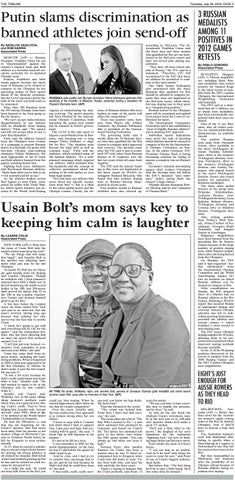
IN THIS file photo, Wellesley, right, and Jennifer Bolt, parents of Jamaican Olympic gold medallist and world record sprinter Usain Bolt, pose after an interview in New York. (AP) could see him tossing. When he started high school, that’s when we see that he’s really competitive.” Over the years, Jennifer said, she has realised her best approach is to remain strong when her son falters. “I learn to cope with it. I cannot feel down when I have to support him. I just pray and hope that everything will be good,” she said. “I know that he still depends on his mother.” It’s just as he did as a teen. “I can remember in 2002 for the world championships. At the time he was 15 and before the games he didn’t want to go. “And he cries, and I had to try to comfort him, encourage him to go out and do his best because he didn’t feel that he could have done it,” she said. “I was really, really, really nerv-
ous and, you know, my legs shake. My heart beat.” Then she listened to the crowd. “The crowd was behind him. From then I don’t feel that nervous,” she said. The scene plays out a bit in “The Boy Who Learned to Fly ,” a new short animated film produced by Gatorade and based on Usain’s life. The advice her animated self gives to her jittery teen before the 2002 junior worlds: “You can always go fast when you keep it light.” Norman Peart, who handles finances for Usain, has been a mentor since he was 15. Peart accompanied him to Kingston when Usain first left home to train. Usain lived with him, and later his wife and kids, for three years. There’s a saying in Jamaica that fits Usain perfectly, said Peart, 13
years his senior. “We say, you have to have crocodile skin to handle the pressure, and he does,” he said. So how do the two think the ebullient Usain’s retirement, maybe in the next year or so, will play out? Jennifer thinks he’d make a great TV analyst. “He’d put a little vibes to the sports,” she laughed of her son’s reputation for his trademark “lightning bolt,” his love of flashing huge smiles and his party spirit. Peart thinks the same of Usain’s future. “I can see him as an analyst. And he’ll do stuff with Puma for years to come for sure,” said Peart of one of Usain’s biggest endorsement deals. But before that: “The first thing he’ll do is take a little break. He’d love some time for himself.”
3 RUSSIAN MEDALISTS AMONG 11 POSITIVES IN 2012 GAMES RETESTS By PABLO GORONDI Associated Press BUDAPEST, Hungary (AP) — Eleven weightlifters, including three Russian medallists, have tested positive for banned drugs in the latest retests of samples from the 2012 London Olympics, the International Weightlifting Federation said yesterday. The IWF said in a statement that all 11 athletes, six of whom were medallists, had been provisionally suspended until their cases are closed. Four of the 11 are Russians, who all tested positive for dehydrochlormethyltestosterone, an anabolic steroid. The positive Russian tests came from Alexandr Ivanov, silver medallist in the men’s 94-kilogram division; Nataliya Zabolotnaya, silver in the women’s 75-kilogram division; Svetlana Tzarukaeva, silver in the women’s 63-kilogram division; and Andrey Demanov, who placed fourth in the men’s 94-kilogram division. Ivanov also tested positive for tamoxifen, a hormone modulator. The three other medal winners in the group were Hripsime Khurshudyan, Armenia (bronze, over75-kilogram division), Iryna Kulesha, Belarus (bronze, 75-kilogram division) and Cristina Iovu of Moldova (bronze, 53-kilogram division). Also testing positive were Turkey’s Sibel Simsek, Almas Uteshov of Kazakhstan, Georgia’s Rauli Tsirekidze and Intigam Zairov of Azerbaijan. Bulgarian weightlifters have been banned from the upcoming Rio de Janeiro Games because of the large number of positive doping tests, while Russian weightlifters also risk being barred from the Olympics. On Monday, the IWF said it had requested “further clarification” from the International Olympic Committee and the World Anti-Doping Agency before its decision on which Russian athletes can be cleared to compete in Rio. After consultations on Sunday, the IOC stopped short of a blanket ban on Russian athletes at the Rio Games, following a WADA report that accused Russia of widespread doping and cover-up. Instead, Olympic selection was left to individual sporting federations, provided the athletes met certain criteria — which included a clean record in anti-doping tests. The IOC stores Olympic doping samples for 10 years, allowing them to be reopened and reanalysed when improved testing methods become available. So far, 31 of the 98 doping positives discovered in the retests of samples from the 2008 Beijing Games and the 2012 London Olympics were weightlifters.
EIGHT’S JUST ENOUGH FOR AUSSIE ROWERS AS THEY HEAD TO RIO MELBOURNE, Australia (AP) — Better late than never for the Australian women’s eights rowing team at the Rio de Janeiro Olympics, even if they’ll have to borrow a boat and oars. The Australian women’s crew had disbanded after failing to qualify when a third placing at a regatta in Switzerland in late May left the team as first reserves for Rio. But they reassembled in Melbourne last weekend after the possibility of an Olympic call-up because of Russian athletes facing expulsion over doping.