business@tribunemedia.net
MONDAY, JULY 13, 2020
$3.72 BISX TARGETS $3.6BN GOV’T DEBT ‘SPRINGBOARD’ By NEIL HARTNELL Tribune Business Editor nhartnell@tribunemedia.net
THE Bahamas International Securities Exchange (BISX) plans to use its capture of the Government’s $3.6bn debt market as “a springboard” to attract further listings. Keith Davies, its chief executive, told Tribune Business that the exchange aimed to attract other government-related securities - such as those issued as part of public-private partnership (PPPs) investments - to broaden and deepen the Bahamian capital markets. He revealed that the 220 separate Bahamas Registered Stock (BRS) issues now being traded over BISX had “more than tripled” the exchange’s total number of listings, while also expanding its market capitalisation by some 40 percent to around $8.872bn. “Every new issue of government debt will be placed on the exchange,” Mr Davies said. “We want to use this as a springboard for other types of securities the Government may be involved with. SEE PAGE FOUR
THE Government was forced to pump “millions” into Bahamas Power & Light (BPL) during COVID-19’s peak due to customers’ inability to pay, it was revealed yesterday. Desmond Bannister, minister of works, justifying the state-owned utility’s decision to resume disconnections, said the monopoly power provider “cannot continue to exist” if households and businesses fail to pay their monthly bills. He told Tribune Business that BPL’s “shaky” financial position means it cannot continue the “across the board” COVID-19 bill deferral initiative that was in place for three months during the lockdown, but will instead treat customers on a “case by case basis” and assist where there is “real hardship”. “The Government has come to some agreements with BPL, and I think the first thing to understand is there’s a tremendous amount of empathy for people that genuinely cannot pay their bills,” Mr Bannister said. “The Government appreciates that. “There’s also the challenge that BPL cannot continue to exist if bills are not paid because the Ministry of Finance had to fill the deficit... At one stage the Ministry of Finance was putting millions of dollars into BPL because of
$3.80
Stuart Cove: ‘I’m no quitter’ By NEIL HARTNELL Tribune Business Editor nhartnell@tribunemedia.net
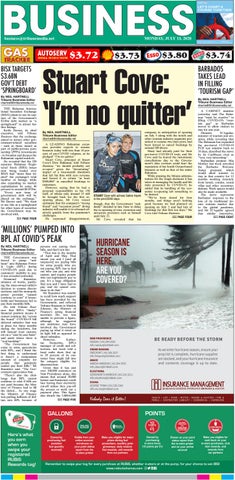
A LEADING Bahamian excursion provider expects to resume business today with less than 10 percent of pre-COVID volumes, as he pledged: “I’m no quitter.” Stuart Cove, principal of Stuart Cove’s Dive Bahamas, told Tribune Business “we should probably not re-open” given the “devastating” impact of a four-month shutdown that left his firm with zero revenue and forced it to return “at least $500,000” in cancelled bookings to customers. However, saying that he had a personal responsibility to his 150 staff, of whom only around 15 will be brought back for the first reopening phase, Mr Cove voiced optimism that his company’s “strong brand” and “recession proof” diving industry will enable it to rebound relatively quickly from the pandemic’s challenges. He expressed disappointment,
‘MILLIONS’ PUMPED INTO BPL AT COVID’S PEAK By NEIL HARTNELL Tribune Business Editor nhartnell@tribunemedia.net
$3.73
persons not paying their bills, and that’s not fair. “That was in the months of April and May. That meant you and I [and all taxpayers] are paying bills for some people who are not paying. BPL has to find out who can pay and who cannot, and require people who can legitimately pay to pay. It’s a huge obligation that you and I have had to pay, and we cannot continue to do that.” Mr Bannister was unable to recall how much support has been provided by the Government, and referred Tribune Business to Marlon Johnson, the Ministry of Finance’s acting financial secretary. He, too, was unable to provide a figure, although he suggested any assistance may have involved the Government paying up what it owed on its light bill as opposed to direct subsidies. However, Katherine Demeritte, BPL’s manager of credit and collections, last week told a local radio show that up to 20 percent of its customer base might fall into the category eligible for disconnection. Given that it has just over 100,000 customers on New Providence alone, this means that around 20,000 homes and businesses could face having their electricity cut-off unless they pay-off the arrears or work out a payment plan. This figure also dwarfs the 5,000-6,000 SEE PAGE FIVE
STUART Cove with actress Salma Hayek in the pre-COVID days. though, that the Government “suddenly” decided in late June to delay the re-opening of tour, excursion and attraction providers such as himself until July 13. Mr Cove revealed that his
company, in anticipation of opening on July 3 along with the hotels and other tourism industry segments permitted to resume two days prior, had been forced to cancel bookings by around 100 divers. Many had already paid for their pre-travel COVID-19 tests, and Mr Cove said he feared the last-minute cancellations due to the Government’s date revision could hurt the reputation of his South Ocean-based business as well as that of the wider Bahamas. While praising the Minnis administration for the tough decisions it has taken in managing the health and life risks presented by COVID-19, he added that its handling of the economic re-opening left something to be desired. “We’ve been closed for four months, and things aren’t looking good because we had planned on opening on July 3 and had lots of bookings for that first ten days,” Mr Cove told Tribune Business. SEE PAGE FOUR
$3.74 BARBADOS TAKES LEAD IN FILLING ‘TOURISM GAP’ By NEIL HARTNELL Tribune Business Editor nhartnell@tribunemedia.net A CABINET minister yesterday said The Bahamas “must be creative” in filling COVID-19’s “tourism gap” as Barbados moves to allow visitors to stay for one year. Dionisio D’Aguilar, minister of tourism and aviation, while revealing that The Bahamas has expanded the pre-travel COVID-19 PCR test window back to 10 days, described the move by its Caribbean rival as “very, very interesting”. Barbadian premier Mia Mottley last week unveiled the Barbados Welcome Stamp proposal, which would allow tourists to stay in that country for 12 months working remotely from hotels, condos, rental villas and other accommodations. Work spaces would also be made available. The move represents Barbados’ response to the loss of its traditional leisure tourism market due to the global pandemic, and Mr D’Aguilar agreed that similar innovative, SEE PAGE EIGHT
PAGE 2, Monday, July 13, 2020
THE TRIBUNE
LAYING OUT THE ROADMAP FOR ECONOMIC RESILIENCE
THE UK-based Centre for Local Economic Strategies (CLES) outlines ten indicators that can be used to determine whether an area, or country, is resilient. The first three of these are the strength of the commercial sector; strength of the public sector; and strength of the social sector. For a resilient economy, each of these sectors must be operating at or near optimal levels, or at least a high level. The commercial (or private) sector must therefore be prepared to innovate and invest in the economy’s growth. Private sector efforts should become the main driver behind all major expansion. On the other hand, as alluded to previously, the social sector must be aligned and operating with significant effectiveness and efficiency. Resilience also demands a strong public sector that is responsive and nimble, inclusive of an administrative machinery that is well-structured with a high level of certainty, discipline and is facilitative to the other two sectors. Without such characteristics, the public sector becomes a significant limiting factor in any advancement and development.
The way forward therefore involves public sector reforms in a substantial way. Consistent performance with transparency and public education will contribute to an improvement in public confidence, which holds implications for investor participation - especially local investors. The next four indicators of resilience identified by CLES are the commercial sector’s relationship with the public sector; public sector relationship with the social sector; social sector’s relationship with the commercial sector and health and wellbeing; and their relationship with the local economy. This is the point made earlier in relation to the Government-appointed Economic Recovery Committee’s (ERC) work - the need to ensure that the interdependencies are actively at play. Faced with a health pandemic that has triggered an economic crisis, the importance of this clearly stands out. The private sector and public sector must have a robust, healthy and vibrant working relationship. While many on both sides tend to default to adversarial roles, and the presence of a healthy tension is
extremely worthwhile, more value is always going to be created when these sectors work as partners towards a common vision. The private sector supports, and needs, the social sector as it undergirds the quality and availability of its workforce. How people live, the level of support when things go wrong, peace of mind and the “natural” environment are all socially important elements which play to the level of resilience an economy can derive. After all, their output directly affects commercial and economic inputs. All remedial efforts going forward should take this into account. The Government’s response to COVID-19’s economic fall-out, with significant emphasis on supporting social programmes, fully explains the third of these four indicators. Safety nets, and the provision of social support, demands active engagement and participation by the public sector. Engagement without the ability to fund what is necessary will render this interaction ineffective. Balance is therefore critical. Finally, The Bahamas’ response - and the extent to which it could
insulate itself against the shocks caused by the COVID-19 crisis - was highly influenced by the state of health and well-being, the state of underlying health infrastructure, and the extent to which the country’s economic affairs could provide new and urgent resources for these areas. Part of the Bahamian reality, for example, is the high level of non-communicable diseases present in the population. This placed many persons at high-risk if they contracted COVID19, and consequently led to stringent decisions aimed at curtailing movement. Reflect on how the state of the health care system would have factored into the early decisions made, and those that continue to be made. Reflect also on how the economic state of The Bahamas influences the reopening decisions despite the surge of COVID-19 cases in our main tourism market of the US. The final three indicators are the relationship between the local economy and working within environmental limits; relationship between the local economy and local identity, history and context; and relationship between
In the latest of his series, Hubert Edwards looks at the indicators that can chart The Bahamas’ progress towards greater economic growth
the local economy and both local and national governance. I view these as identifying the factors that exert limiting influence on economic expansion. Environmental limits play a role in resiliency. Consider, for example, the recently discussed and refuted proposal involving 500,000 acres of land in Andros. The thinking is that this would have a significant negative impact on delicate ecosystems and be detrimental to the way of life for persons on that island. Environment, identity, history. All these factors affect, or contextualise, the potential economic value that such a proposal could bring. Consider further the unequivocal pronouncement of the Prime Minister that there will be no such project. Local and national governance can dictate the economic fortunes of an island. This is why effective governance is critical to economic resilience. The remedial work, adaptation and transformation required today must therefore see governance reforms implemented. As an example, effective local government with the ability to create real economic centres across the archipelago is part of the recipe for deeper national economic resilience. Vulnerabilities can be mitigated if there is greater “economic diversity” throughout the country. Again, whatever is done will have to give due respect to the Bahamian identity, its historical norms and environmental well-being. Resilience takes
all these elements into consideration. This is why the focus has to be broadbased and deep if we are to achieve this objective. A simple return of tourism, and the normal level of commerce and export earnings, will not be sufficient. Having established that resilience is a function of relationships, it becomes clearer what we must anticipate from the Economic Recovery Committee and/ or policy makers, the private sector, society and the public sector going forward. Every solution should be practical and properly designed to move the country forward with more effective and efficient ways of thinking, performing and achieving. Every solution applied should happen against a clearlydefined viewpoint of the future, and the treatments should advance efforts to get there. That future for The Bahamas is one with an economy where there is consistent growth of at least 2 percent annually. It is a future underlined by consistent, robust and effective debt management and fiscal consolidation programnes. A new era of systematic treatments of structural and fiscal reforms. A future economy where there are greater sources of exports, and therefore more diverse means of earning foreign exchange. The stakes are consistently high and demand no less. Business as usual will defeat the effort to secure the resilience we desire and need. • To be continued
THE TRIBUNE
Monday, July 13, 2020, PAGE 3
BAHAMIANS DRIVE OUT ISLAND TOURISM RESTART By YOURI KEMP Tribune Business Reporter ykemp@tribunemedia.net
BAHAMIANS are driving the “slow” resumption of hotel bookings in the Family Islands as the country gradually re-opens following the COVID-19 lockdown. Leslie Kennedy, general manager of the Pigeon Cay Beach Club on Cat Island, told Tribune Business: “It’s quite slow, but that’s OK. I think we should take it slow and gradually get back to taking people. We can only be at 50 percent capacity, and I only have eight cottages.” Ms Kennedy said 12 persons have booked their vacation with her since the July 1 reopening, with domestic tourism leading the way. She added: “I had some folks come in when the domestic travellers were allowed to come after June 15. I did have some come, but just for a couple of houses.
“I still think people are still a little leery of travel, but we have seen more domestic visitors because they don’t want to go to the US, which is totally understandable. “Everybody understands, and we let everybody know what the protocols are prior to coming. We have our signage up that we are required to do, informing people of the importance of wearing face masks and social distancing. Everybody is really respectful of that, which is great.” Albert Archer, owner of the Island Seaside Suites in Eleuthera, said: “Personally, for my place, I’ve had quite a number of bookings, but my bookings are principally Bahamians, or Bahamians principally out of New Providence. This week I have a Bahamian family out of Atlanta. “But based on my experience, the bulk of the tourist business works against Bahamians as the
bulk of the business goes to the winter residents. The winter residents by and large have that market sewn up, and Bahamians like myself are really struggling. But since Eleuthera reopened, my bookings have been relatively good thanks to the Bahamian market.” Mr Archer said his guests are having no problems adjusting to the COVID19 heath protocols, and added: “Generally speaking you are just trying to be careful as far as bacteria is concerned. Now you just have to combine that with a virus. I haven’t found it taxing. “Since I have reopened I have had four bookings, and that is better than what I would normally have. There is a resurgence in domestic tourism.” Janice Tolas, general manager of Greenwich Creek Lodge, Long island, said: “Things are very, very slow. I had a couple of guests come in over the last
weekend and they were all Bahamians. All local. “We had a booking for July 13 from a foreigner, and they cancelled because they said they have to quarantine when they go back home. It is fine coming this way, but when they go back they have to self quarantine they are Americans.” Ms Tolas added: “Everything else is good. It’s just the issue with people having to quarantine when they go back, because when they go back they don’t get paid because they are doing that on their own, they are making the decision to travel on their own. Other than that I don’t have any other issues. “There is a lot of interest in the Bahamian ‘two fly free’ programme that the Bahamas Out Island Promotion Board has out. There are a lot of people calling about that. Not confirmations, but people asking about it. That’s working.”
BORROWERS REASSURED: CREDIT BUREAU ‘WON’T GO BACK IN TIME’ By YOURI KEMP Tribune Business Reporter ykemp@tribunemedia.net THE Central Bank’s governor has promised Bahamian borrowers that the country’s firstever credit bureau will “not go back in time” to look at their repayment history. John Rolle disclosed that the credit bureau, which will be operated and managed by the Italian firm, CRIF SpA, “is up and running” and interacting with the commercial banks and other lenders to determine the process and format for supplying them with information on their borrowers. He added that the muchanticipated credit bureau will initially provide a “snapshot” of borrower creditworthiness, and said: “So, the credit bureau is up and running. We are not getting information from the credit bureau yet because the financial institutions have to go through the first phase of submitting data to the bureau. “That will happen within the first year of the bureau. So there will be an initial snapshot from that data submission that will provide some up-front indication in terms of the creditworthiness of a lot of the borrowers. “Even though we won’t have the historical track record, it will provide the
opening snapshot and, from that point forward, you would be able to track historically what’s going on.” The credit bureau was official launched in January, and Mr Rolle added: “One of the near term things that we have to do is also to make certain that some of the other non-banks, such as the utility companies, are enlisted so that they can prepare to report to the credit bureau. “The consultative process with them has begun, but there is also a regulatory step that will be necessary so that they can be declared as required to report to the credit bureau. “The bureau may not have accurate information in terms of how faithful you were in paying on time, etc,” Mr Rolle continued, “but it will know how much debt you have, and that indicator within itself still says a lot. “Every entity that you interact with that has some credit exposure to you - if it is your bank, they have your history, and now they will have your total view in terms of your debt exposure. “Similarly, for your public corporations where they are also giving you credit, they will have a better picture and understanding as to whether instinctively what they always thought was the case with you is confirmed
by the data,” the governor added. “Some of what is revealed in this initial data exposure is not going to surprise a lot of our financial institutions, depending on the relationship that we have with them. “It’s going to correlate, to some extent, how responsible we have been in terms of the amount of debts we have been taking on and how faithful we have been in living up to those debts. For some of us it will be revealing, but not for the most of us.” The creation of a Bahamian credit bureau has been a decade in the making, with the initiative first unveiled by the Central Bank in 2010. It has long been viewed as a vital ‘missing link’ in The Bahamas’ credit architecture, with its absence depriving lenders of a centralised information repository they can draw on to better understand a borrower’s credit profile and risk of non-repayment. CRIF SpA, which has a presence in providing such services in 30 countries across the Caribbean, Europe, North America, Africa and Asia, was eventually selected as the preferred bidder to operate the credit bureau in late 2018 and finally completed the Central Bank’s licensing process late in 2019. The CRIF-operated credit bureau will now have
to gather information from lending institutions mandated to supply it with all details on existing borrowers, particularly their credit profiles and histories, by the Credit Reporting Act. Among those required to supply information will be the commercial banks, insurance companies, credit unions, financial and corporate services providers, Bahamas Mortgage Corporation and Bahamas Development Bank. Others likely to be added in the future are the utilities, auto dealers and furniture stores that extend credit to customers, and even the government’s revenue agencies. The credit bureau will then compile and organise this information in a credit report provided to lenders, which will help them assess the risk provided by each loan applicant and reject those with poor histories. Its launch means that delinquent Bahamian borrowers are rapidly running out of time to get their affairs in order, and will no longer be able to bounce from bank to bank and obtain multiple loans through not disclosing their past.
PIGEON Cay Beach Club in Cat Island.
EMPLOYMENT OPPORTUNITY FOR FINANCIAL CONTROLLER Establishment information A well-established Retail Company with several locations. Education and Experience • A CPA with strong background in Retail costing • Excellent communications skills and the ability to meet strict deadlines • Preferable age: 30 and older Principal Responsibilities • Timely and accurate preparation of weekly, monthly, and annual financial statements • Preparation of all government required documents which includes Vat returns • Monitoring and improving the Company’s internal controls Interested and qualified persons should submit their resume via email to 242jobnow@gmail.com
PAGE 4, Monday, July 13, 2020
THE TRIBUNE
Stuart Cove: ‘I’m no quitter’ from page one “Then the Government, we learned suddenly, decided we should not open until the 13th. We had to cancel everybody again. It doesn’t look good for The Bahamas, but it’s crazy times. “I think the Government has done a tremendous job in managing the virus, much better than many of the countries around us, but they’ve not done a good job in managing the opening. As the owner of a tourism firm, it’s like a moving target. Things change without notice and without reason. It makes it very difficult,” he added. “I can understand the fear, and how do you juggle the health of the nation against the wealth of the nation. It’s a huge responsibility, but they just need to come up with a date. “When we were told the borders were opening on the 3rd we had all those people booked, and then they came up with the 13th, and that was just not fair. It makes us as an operator and agent look really, really bad, and the country look horrible.” Mr Cove estimated that the loss of the 100 potential divers had likely cost his business around $50,000, adding that the company had received no financial assistance of any type from the Government throughout the pandemic. He also disclosed that the diving excursion provider’s landlord, South Ocean owner, the Canadian Commercial Industry
Workers Pension Plan (CCWIPP), did not provide any rental relief for the lockdown’s duration even though Stuart Cove’s Dive Bahamas “has not made a dollar in four months”. “The rent is very, very expensive. It’s way overpriced,” Mr Cove told this newspaper. “We were in the process of building out a new place in Coral Harbour when COVID shut us down, but we’re keeping a stiff upper lip and talk of the virus is not going to kill us. “We just have to hunker down. We haven’t made a dollar in four months. Zero. I sold one boat just to get through it. It’s been devastating. In all reality we should probably not re-open, but I’m not like that. I’m not a quitter. I feel responsible for my staff. They’ve suffered terribly through this thing.” Mr Cove slammed the National Insurance Board (NIB) as “abysmal at best” in getting unemployment benefit assistance to his furloughed employees during the COVID-19 pandemic, arguing that the social security system was quick to demand contributions “but when it comes to them paying out it’s like pulling teeth”. “I just feel dreadful for them,” he said of his employees in relation to the delayed, partial or absent benefits payments from NIB. “They will think I didn’t make the payments, which is not true. They [NIB] haven’t managed the money well in my opinion.” Mr Cove is far from the only employer complaining about NIB, which has been overwhelmed by the sheer number of unemployment benefits claims it has received despite paying out more than $60m in assistance. The dive excursion principal, meanwhile, said Stuart Cove’s Dive Bahamas will resume business today with himself and his son running the boats,
and a manager and financial controller present at South Ocean. Another six to eight dive and beach staff will be present at Atlantis, and a further four between Lyford Cay and Albany. With 15 out of 150, or around 10 percent, of staff recalled for the first reopening phase, Mr Cove said negative global media coverage suggesting that the entire Bahamas had been devastated by Hurricane Dorian last September had cost the business much of its fall and winter bookings. “We were sucking wind coming into the season,” Mr Cove said of a peak diving period that traditionally begins on March 1. “We had a rich season coming up, and a bunch of money in the book coming into March, and had to give it all - at least $500,000 - back. “It’s been devastating for us as a company, devastating for us as a country, and devastating for the world economy. We were doing a lot of cruise ship business, and that is not going to start up again until September 15 at earliest, which will be very hurtful. Like everyone else we’re going to be competing for the hotel guests. “Our US booking office has been closed because we couldn’t pay those staff with no income coming in. I don’t have too much on the books. It’s pretty grim, I’ll be honest with you, very, very grim. Everybody is on edge. I think we’re going to start down by 90-odd percent.” However, Mr Cove voiced optimism that the “recession-proof” nature of diving would enable his business to rebound fairly swiftly as persons sought to escape soaring COVID-19 infection rates in the US. “That’s all we can afford,” he said of the initial 15 staff that will be brought back, “but as the business grows, and it should grow exponentially, we should be at a full complement in a couple of months. People go out diving no matter what. It’s a drug, and one thing that’s
good is there is no COVID underwater. “That’s a blessing. When we’re outside with the wind blowing we’ll be in pretty good shape... I honestly think it’s going to ramp up pretty quickly once people feel comfortable enough to travel on a plane and overcome their fear.” Mr Cove, though, acknowledged that COVID-19’s impact had “been a lot worse than I thought it would be”, and said he had shifted from January 2021 to March next year as his anticipated timeline for when “people really start travelling again”. Voicing confidence that The Bahamas will enforce its COVID-19 health protocols robustly enough to preserve its initial gains in the virus fight, he added: “We’re not going anywhere. We’ve been around for 40 years and have gone through some rough things, although we’ve never seen anything like this. “One of my mentors in diving said: ‘Stuart, only the strong survive’. We have a strong brand, strong staff and strong management. The difference between this and a hurricane is our infrastructure is still in place. “We’ve taken time to work on the boats, get everything up to speed, compressors. Everything is ready to go. We’re a key switch turn away from running again. We;re a resilient people, a resilient country, and we’ll weather this storm.” Stuart Cove’s buses and boats will be operating at 50 percent of pre-COVID capacity, and the company has appointed a ‘COVID ambassador’ to make sure all necessary standards and procedures are complied with by staff and guests. The company has also obtained a special solvent solution, recommended by the World Health Organisation, for cleaning regulators and equipment that goes in a person’s rough. Social distancing markers and regular cleaning will also be a common operational feature.
BISX TARGETS $3.6BN GOV’T DEBT ‘SPRINGBOARD’ from page one
Vacancy Announcement A service-oriented individual is being sought to work in the private residence of a high-ranking diplomatic official for the following position:
RESIDENTIAL HOUSEKEEPER Who will be responsible for: Sweeping, mopping, vacuuming, dusting, laundry services, ironing, polishing furniture and floors, cleaning windows glass surfaces and other housekeeping duties including but not limited to: -
Cleaning, disinfecting, and deodorizing bathrooms and bathroom fixtures. Cleaning outside porches and identified outdoor extensions. Emptying and cleaning waste containers. Household shopping; maintaining inventory supplies. Washing dishes and utensils. Washing and folding of laundry for Residence and guests; maintaining linen stock. - Setting tables with proper dishes and utensils and clearing and cleaning tables after serving meals. - Notifying supervisors of any damages and deficits in any responsible areas. - Assisting with the serving of meals at receptions and at daily seated meals. The successful candidate for this position will possess/demonstrate the following knowledge, skills, attributes, certifications, and/or qualifications: -
A high school diploma is required. Must have two years’ experience as a residential or commercial Housekeeper. Basic computer skills (for drafting and emailing menus). Time management skills with the ability to work under pressure to ensure deadlines are met. Workplace management skills i.e. ability to multi-task and maintain a clean environment. Flexibility, adaptability, dependability, decorum, and discretion. Willingness to perform duties in multiple residential, recreational, and/or commercial locations as directed. Willingness to work a highly irregular schedule including variety of shifts and many weekends and holidays. An ability to collaboratively work with a diverse workforce. Language: Excellent working knowledge of spoken and written English (Level IV).
Applicants must be a Bahamian citizen or foreign resident who is otherwise eligible for employment in the Bahamas. Please submit resume and three references via e-mail to Nassauhr@state.gov addressed to the Human Resources Office no later than Friday, July 17, 2020. Telephone calls will not be accepted in reference to this advertisement.
“For example, if the Government is involved in a PPP they may find an avenue to facilitate the creation of a particular type of security that is suitable for listing on the exchange and make it available to the average Bahamian, so we will participate in that partnership as well.” The Government has signalled its intention to sell-off its 51.75 percent majority stake in Aliv,
the mobile operator, via an initial public offering (IPO) to Bahamian retail and institutional investors once the company reaches profitability. And the former Ingraham administration also sought to do similar with the Government’s interest in the Bahamas Telecommunications Company (BTC), making both entities candidates for the type of listing Mr Davies is eyeing. The BISX chief, meanwhile, described Thursday’s government debt trading
start on the exchange as “the biggest thing that BISX has done for 20 years”. He added: “In one single move we’ve added $3.6bn to the market. We tripled the amount of listings overnight. The minister was right when he said this was a gigantic step in terms of broadening the market. “It is a bold vote of confidence in the market, a total vote of confidence in BISX. You don’t give an entity $3bn to manage unless they know what they’re doing.”
THE TRIBUNE
Monday, July 13, 2020, PAGE 5
THE STORY BEHIND THE DECISIONS THAT LEAD TO WAR
ACTIVTRADES WEEKLY By RICARDO EVANGELISTA www.activtrades.bs
WHY do nations go to war? The history of mankind, has to a large extent been that of its wars, with the winners of any conflict invariably finding themselves in the privileged position of being able to immortalise their own version of the events. Can you think of any past war where the narrative of what happened hasn’t been told through the pen of the victors? Frequently, the real motives behind a conflict are hidden under the veil of religion, political ideology and righteousness. But, more often than not, those aren’t the real motivations. The actual reasons for most wars tend to be territorial enlargement, access
LEONIDAS, the famous warrior king of Sparta. to resources and economic gain. In 1990, the Iraqis justified the invasion of Kuwait by saying that it was rightfully theirs, illegally carved out by British imperialism. Today it is widely accepted that the real aim of the attack was to gain access to the small state’s immense oil reserves, and to eliminate a large part of
Iraq’s foreign debt, owed to Kuwait. In fact, the two countries previous coexistence under the same administration had only happened because both were part of the Ottoman empire, that had preceded the British domination of the region. In 2003, it was Iraq’s turn to be invaded by a coalition of international forces
spearheaded by the United States. Under the pretext of deposing a regime that kept weapons of mass destruction, the war led to the control of vast oil reserves by Western companies, under the protection of an almighty invasion army. Despite no WMD’s ever being found, the conflict, that caused hundreds of thousands of casualties, hasn’t been the subject of any scrutiny by international courts. Even more recently, in 2016, Russia annexed Crimea, until then a province of Ukraine, claiming they were deploying their troops in order to guarantee the ability of the local population to express itself. However, many see the real motives as being of a geostrategic nature; The control of the peninsula gives the Russian
navy access to a major warm water port. Russia’s overwhelming military supremacy in the region dictated that the occupation became a de facto annexation. It is true that some sanctions were imposed by the international community but lately the political will of western countries to maintain them seems to be less firm; it won’t come as a complete surprise if in a few years’ time Crimea becomes widely recognised as Russian territory. We could also look at the Chinese annexation of Tibet, in 1950, that Beijing
euphemistically calls the ‘peaceful liberation of Tibet’; there are countless such examples. We are living through particularly dangerous times, due to the erosion of the international order that has prevailed since the end of World War II (itself the result of excessive territorial ambition and thirst for resources, all masked under the guise of ideology and nationalism). In the future, like in the past, justifying armed conflict will be easier if the motives can be dressed up as ‘noble’; however, they rarely are.
‘MILLIONS’ PUMPED INTO BPL AT COVID’S PEAK from page one
that were regularly cut-off during the 2008-2009 financial crisis and subsequent global recession. BPL last week announced that it is segmenting delinquent customers into three categories. Those who were were more than $500 in arrears for 90 days prior to April 1, and the disconnection suspension, are the lead candidates for immediate disconnection unless they become current or agree a payment plan. Those who accumulated their 90 days-plus arrears during the COVID-19 lockdown, and customers who
were on the bill deferral initiative, now have 21 days to either become current or work out a payment plan - a period that ends on July 28. Mr Bannister yesterday confirmed that BPL plans to “aggressively pursue” those who were heavily in arrears prior to the COVID-19 lockdown, while those customers in the other two categories are being asked to either clear their debts or work out a payment plan with the utility by July 28. Ruling out any further ‘blanket’ bill deferrals, he told Tribune Business: “After that 21-day period, BPL is going to have to look at the circumstances people are in. If someone
is 90 days in arrears and having challenges because of COVID-19, it would be best for them to go in and make an agreement. “Everything has to be on a case-by-case basis in relation to this. It cannot be across the board. The country is opening back up.... BPL’s finances have always been shaky, and this has been a very shaky time for them.” Mr Bannister again pledged that BPL’s fuel hedging strategy will bring stability and certainty to the fuel charge component of customer bills, and said its implementation - the effects of which should be seen in upcoming bills at 10 cents per kilowatt hour
(KWh) - meant it was even more important to collect on accounts receivables. The minister echoed Dr Donovan Moxey, BPL’s chairman, who last week said BPL would only cut customers off as a last resort. He, too, urged both businesses and residential customers in difficulty to contact the utility and work out a payment plan. “We understand everyone is having a challenging time,” Dr Moxey said.
“We need electricity. It’s a necessity, not a luxury, so we want to work with you. Come in and sit down, and let’s determine what’s an appropriate payment plan. We’re very conscious of that. Don’t leave it to chance and hope you don’t get cut off.” While BPL has unveiled plans to restart disconnecting non-paying customers, Dr Moxey said it was still awaiting a decision from the Government on whether
the COVID-19 Relief Programme will continue. “The Government initially came to us and asked us to put a programme in place for three months,” he added. “We did, and we are certainly more than willing to do what the Government sees as necessary to alleviate the burden on the consumer. We have no problem putting that deferral in place if the Government deems it necessary.”
Vacancy Announcement A service-oriented individual is being sought to work in the private residence of a high-ranking diplomatic official for the following position:
RESIDENTIAL CHEF The position is responsible for: - Planning, preparing, and executing formal dining events using the highest standards of food safety. - Coordinating, ordering, and purchasing supplies related to household operations for private and official events. - Ensuring the proper accounting of funds for food and beverage purchases. - Maintaining accurate and separate inventories of official and private food, beverages, flatware, dishware, cookware, appliances, and crockery. - Planning, preparing, and presenting on a weekly basis daily meal plans for the household. The successful candidate for this position will possess/demonstrate the following knowledge, skills, attributes, certifications, and/or qualifications: - A high school diploma is required. - Must have completed training & certification in culinary arts or equivalent. - Must have current Public Health Certificate for food handling. - Must have three years’ experience as a residential or commercial Chef. - Basic computer skills (for drafting and emailing menus). - Time management skills with the ability to work under pressure to ensure deadlines are met. - Workplace management skills i.e. ability to maintain a sterile environment. - Flexibility, adaptability, dependability, decorum, and discretion. - Willingness to perform duties in multiple residential, recreational, and/or commercial locations as directed. - Willingness to work a highly irregular schedule including variety of shifts and many weekends and holidays. - An ability to collaboratively work with a diverse workforce. - Valid driver’s license. - Must have own transportation suitable for the transport of food items. - Language: Excellent working knowledge of spoken and written English (Level IV). Applicants must be a Bahamian citizen or foreign resident who is otherwise eligible for employment in the Bahamas. Please submit resume and three references via e-mail to Nassauhr@state.gov addressed to the Human Resources Office no later than Friday, July 17, 2020. Telephone calls will not be accepted in reference to this advertisement.
PAGE 6, Monday, July 13, 2020
THE TRIBUNE
AUTHORITIES ‘COMFORTABLE’ ON FOREIGN RESERVES TOOLS
MARKET REPORT
By YOURI KEMP Tribune Business Reporter ykemp@tribunemedia.net
www.bisxbahamas.com
(242) 323-2330
THURSDAY, 9 JULY 2020
(242) 323-2320
ALL SHARE INDEX: CLOSE: 2,092.29 | CHG: -0.24 | %CHG: -0.01 | YTD: -139.31 | YTD%: -6.24 BISX LISTED & TRADED SECURITIES 52WK HI 4.20 22.65 2.00 1.79 2.50 7.00 6.75 5.47 8.59 4.50 6.16 12.77 3.64 5.10 10.88 8.44 16.99 4.25 9.40 15.21
52WK LOW 3.15 20.91 0.67 1.79 1.67 5.50 5.39 2.00 5.32 3.62 5.60 11.05 2.71 2.20 8.00 7.10 13.04 3.20 8.00 13.90
PREFERENCE SHARES 1.00
1.00
1000.00 1000.00 1000.00 1000.00
1000.00 1000.00 1000.00 1000.00
1.00 10.00 1.00
1.00 10.00 0.90
SECURITY AML Foods Limited APD Limited Benchmark Bahamas First Holdings Limited Bank of Bahamas Bahamas Property Fund Bahamas Waste Cable Bahamas Commonwealth Brewery Commonwealth Bank Colina Holdings CIBC FirstCaribbean Bank Consolidated Water BDRs Doctor's Hospital Emera Incorporated Famguard Fidelity Bank Focol Finco J. S. Johnson Bahamas First Holdings Preference Cable Bahamas Series 6 Cable Bahamas Series 8 Cable Bahamas Series 9 Cable Bahamas Series 10 Colina Holdings Class A Fidelity Bank Class A Focol Class B
CORPORATE DEBT - (percentage pricing) 52WK HI 100.00 100.00
52WK LOW 100.00 100.00
115.92 100.00 100.00 100.00 100.00 100.00 100.00 100.00 100.00 100.00 100.00 100.00 102.00
104.79 100.00 100.00 100.00 100.00 100.00 100.00 100.00 100.00 100.00 100.00 100.00 100.00
SYMBOL LAST CLOSE AML 3.17 APD 17.43 BBL 1.62 BFH 1.79 BOB 1.67 BPF 6.00 BWL 6.75 CAB 2.76 CBB 5.32 CBL 3.83 CHL 6.16 CIB 11.26 CWCB 2.51 DHS 4.90 EMAB 9.73 FAM 8.44 FBB 14.50 FCL 3.80 FIN 8.97 JSJ 15.20 BFHP CAB6 CAB8 CAB9 CAB10 CHLA FBBA FCLB
CLOSE 3.17 17.43 1.62 1.79 1.67 6.00 6.75 2.76 5.32 3.83 6.16 11.26 2.44 4.90 9.51 8.44 14.50 3.80 8.97 15.20
1.00 1000.00 1000.00 1000.00 1000.00 1.00 10.00 0.90
1.00 1000.00 1000.00 1000.00 1000.00 1.00 10.00 0.90
CHANGE 0.00 0.00 0.00 0.00 0.00 0.00 0.00 0.00 0.00 0.00 0.00 0.00 -0.07 0.00 -0.22 0.00 0.00 0.00 0.00 0.00
13,272
0.00 0.00 0.00 0.00 0.00 0.00 0.00 0.00
SECURITY Fidelity Bank Note 22 (Series B) + Bahamas First Holdings Limited
SYMBOL FBB22 BFHB
LAST SALE 100.00 100.00
CLOSE 100.00 100.00
CHANGE 0.00 0.00
Bahamas Note 6.95 (2029) BGS: 2015-1-3Y BGS: 2014-12-5Y BGS: 2015-1-5Y BGS: 2014-12-7Y BGS: 2015-1-7Y BGS: 2014-12-30Y BGS: 2015-1-30Y BGS: 2015-6-3Y BGS: 2015-6-7Y BGS: 2015-6-30Y BGS: 2015-10-3Y BGS: 2015-10-7Y
BAH29 BG0203 BG0105 BG0205 BG0107 BG0207 BG0130 BG0230 BG0303 BG0307 BG0330 BG0403 BG0407
107.31 100.00 100.00 100.00 100.00 100.00 100.00 100.00 100.00 100.00 100.00 100.00 100.00
107.31 100.00 100.00 100.00 100.00 100.00 100.00 100.00 100.00 100.00 100.00 100.00 100.00
0.00 0.00 0.00 0.00 0.00 0.00 0.00 0.00 0.00 0.00 0.00 0.00 0.00
BAHAMAS GOVERNMENT STOCK - (percentage pricing)
VOLUME
EPS$ 0.239 0.932 0.000 0.000 0.070 1.760 0.369 -0.438 0.140 0.184 0.449 0.722 0.102 0.467 0.646 0.728 0.816 0.203 0.939 0.631 0.000 0.000 0.000 0.000 0.000 0.000 0.000 0.000
VOLUME
DIV$ 0.170 1.260 0.020 0.000 0.000 0.000 0.260 0.000 0.000 0.120 0.220 0.720 0.434 0.060 0.328 0.240 0.540 0.120 0.200 0.610 0.000 0.000 0.000 0.000 0.000 0.000 0.000 0.000
P/E 13.3 18.7 N/M N/M N/M N/M 18.3 -6.3 38.0 20.8 13.7 15.6 23.9 10.5 14.7 11.6 17.8 18.7 9.6 24.1
YIELD 5.36% 7.23% 1.23% 0.00% 0.00% 0.00% 3.85% 0.00% 0.00% 3.13% 3.57% 6.39% 17.79% 1.22% 3.45% 2.84% 3.72% 3.16% 2.23% 4.01%
0.000 0.000 0.000 0.000 0.000 0.000 0.000 0.000
0.00% 0.00% 0.00% 0.00% 0.00% 6.25% 7.00% 6.50%
INTEREST Prime + 1.75% 6.25%
MATURITY
19-Oct-2022 30-Sep-2025
6.95% 4.00% 4.25% 4.25% 4.50% 4.50% 6.25% 6.25% 4.00% 4.50% 6.25% 3.50% 4.25%
20-Nov-2029 30-Jul-2018 16-Dec-2019 30-Jul-2020 15-Dec-2021 30-Jul-2022 15-Dec-2044 30-Jul-2045 26-Jun-2018 26-Jun-2022 26-Jun-2045 15-Oct-2018 15-Oct-2022
MUTUAL FUNDS 52WK HI 2.31 4.40 2.10 198.39 168.29 1.69 1.85 1.77 1.24 8.34 10.26 7.08 12.15 12.71 10.81 10.00 8.98 11.79
52WK LOW 1.67 3.30 1.68 164.74 116.70 1.64 1.77 1.72 1.07 6.41 7.62 5.66 8.65 10.54 9.57 9.88 8.45 11.20
FUND CFAL Bond Fund CFAL Balanced Fund CFAL Money Market Fund CFAL Global Bond Fund CFAL Global Equity Fund Leno Preferred Income Fund Leno Growth Fund Leno Diversified Fund Leno Global USD Bond Fund Royal Fidelity Bahamas Opportunities Fund - Secured Balanced Fund Royal Fidelity Bahamas Opportunities Fund - Targeted Equity Fund Royal Fidelity Bahamas Opportunities Fund - Prime Income Fund Royal Fidelity Int'l Fund - Equities Sub Fund Royal Fidelity Int'l Fund - High Yield Fund Royal Fidelity Int'l Fund - Alternative Strategies Fund Colonial Bahamas Fund Class D Colonial Bahamas Fund Class E Colonial Bahamas Fund Class F
NAV 2.31 4.39 2.10 192.52 145.55 1.69 1.81 1.77 1.07 8.30 9.90 7.08 11.27 12.71 10.23 N/A 8.31 10.01
YTD% 12 MTH% 1.04% 3.87% 0.61% 2.93% 0.50% 2.50% -1.34% 2.23% -12.71% -5.79% 1.88% 3.90% -2.26% 2.49% 0.76% 3.56% -11.03% -8.03% -0.45% 8.36% -3.20% 11.46% 2.10% 5.15% -6.17% 3.54% 2.92% 5.55% -4.66% -3.81% N/A N/A -10.90% -4.30% -18.80% -12.00%
MARKET TERMS
BISX ALL SHARE INDEX - 19 Dec 02 = 1,000.00
YIELD - last 12 month dividends divided by closing price
52wk-Hi - Highest closing price in last 52 weeks
Bid $ - Buying price of Colina and Fidelity
52wk-Low - Lowest closing price in last 52 weeks
Ask $ - Selling price of Colina and fidelity
Previous Close - Previous day's weighted price for daily volume
Last Price - Last traded over-the-counter price
Today's Close - Current day's weighted price for daily volume
Weekly Vol. - Trading volume of the prior week
Change - Change in closing price from day to day
EPS $ - A company's reported earnings per share for the last 12 mths
Daily Vol. - Number of total shares traded today
NAV - Net Asset Value
DIV $ - Dividends per share paid in the last 12 months
N/M - Not Meaningful
P/E - Closing price divided by the last 12 month earnings
TO TRADE CALL: CFAL 242-502-7010 | ROYALFIDELITY 242-356-7764 | COLONIAL 242-502-7525 | LENO 242-396-3225 | BENCHMARK 242-326-7333
NAV Date
31-Mar-2020 31-Mar-2020 27-Mar-2020 31-Mar-2020 31-Mar-2020 31-May-2020 31-May-2020 31-May-2020 31-May-2020 31-May-2020 31-May-2020 31-May-2020 31-May-2020 31-May-2020 31-May-2020 31-Mar-2020 31-Mar-2020 31-Mar-2020
THE deputy prime minister has reassured that the Government and Central Bank have further “tools” they can deploy to prevent a Bahamian dollar devaluation. K Peter Turnquest said the Bahamas’ foreign currency reserves, which closed June 2020 just below $2bn, remain strong enough to underpin the one:one peg with the US dollar. He added that Dr Hubert Minnis, in his House of Assembly address last Wednesday, had been focusing on the potential long-term threat to the US dollar currency peg if the tourism industry did not rebound in sufficient time and strength to produce ample foreign currency inflows. “Certainly from a government perspective we do not anticipate any difficulties with us being able to meet our foreign exchange requirements,” Mr Turnquest said. “I think that the point that the Prime Minister was making was that the tourism market is a very significant component of our overall economy, and to the extent that they remain closed, our access to natural foreign exchange, or foreign currency, will obviously be impacted. As a result of that we have to be careful that we pay attention to the level of expenditure that we engage in, particularly from a discretionary point of view.” Dr Minnis had last week highlighted the potential Bahamian dollar devaluation risk if the country was unable to earn enough foreign currency inflows to support the peg, but Mr Turnquest explained: “We at the Ministry of Finance have some tools that we can deploy in the event that we foreshadow that we are running into any challenges. “The Central Bank governor can speak more clearly to the management tools and the level of reserves that we have, and why we have relative
comfort that we’re not in any danger at the moment of getting into that kind of territory, but the Prime Minister was speaking to the long-term if we continue with an idle tourism product.” John Rolle, the Central Bank’s governor, added: “The point that I would make is that the foreign reserves are adequate. We will use more of them this year than in an ordinary year, but we have also begun this year with higher inflow levels than in the past. “Countries actively manage their foreign reserves and exchange rate systems, and a part of that active management is anticipating, strategically, how the Government’s role features in that process. “The challenges that we face come across in terms of the deficit that the Government encounters, and the fact that the Government needs to finance that deficit. It also provides the opportunity to identify foreign exchange that will support the expenditures in the economy,” he said. “So, therefore, the debt management strategy of the Government features very prominently in making certain that we have the supplementary foreign reserves given our intention to provide stabilisation and stimulus to the economy.” Mr Rolle said The Bahamas’ balance of payments and foreign exchange flows, were to some extent, selfregulating. “Self-regulating unfortunately means that persons who do not have incomes will not be able to spend unless the Government steps in and provides that support,” he said. “In providing such support throughout the economy, the Government is also ensuring that there is foreign exchange for the expenditure outlet, so that’s very important in terms of managing the reserves and we’re comfortable. We are also comfortable that The Bahamas has the tools to manage if things become more challenging.”
PAGE 8, Monday, July 13, 2020
THE TRIBUNE
BARBADOS TAKES LEAD IN FILLING ‘TOURISM GAP’ from page one
out-of-the-box thinking was required if The Bahamas is to compensate for an anticipated one to twoyear slowdown in its largest industry. He said another possibility lay in The Bahamas offering itself as a nearby offshore base for foreign students attending American universities who are being prevented from remaining in that nation by the US Border Protection regime, but nothing has been determined by the Minnis administration yet. “The What’s App channels have been abuzz about this innovative Barbados approach to attract visitors back to the island on a oneyear annual stay. Very, very interesting,” Mr D’Aguilar told Tribune Business. “We know in countries that are as tourism-dependent as ours that we need to recognise business is going to be down, and the numbers
are going to be lower for a certain period of time, maybe one or two years. “It behooves us to be creative in developing other sources of visitors to our country; in essence, to fill the gap created by this COVID-19 pandemic.” The Barbados initiative, besides boosting the island’s tourism product, also holds out the promise of potentially attracting permanent new businesses and industries if those taking advantage of the Welcome Stamp in initiative - which is due to start on August 1 - find the business climate to their liking. This would potentially aid economic diversification. But anything similar in The Bahamas would have to receive approval from this nation’s Immigration regime, and Mr D’Aguilar said such Barbados-type initiatives would have to create - rather than take away from - local employment as well as generate foreign currency earnings. He suggested another
potential opening for The Bahamas lay in US policies that prevent foreign students, who are taking “a certain portion of classes” online, from remaining in the country during the COVID-19 pandemic. Mr D’Aguilar said The Bahamas can offer itself as a temporary base for these students in close proximity to their universities, so that when they are recalled to the classroom they do not have far to travel, but he added neither this nor anything similar has yet been considered by the Minnis Cabinet. “There are ideas floating around, but the Government has not given consideration as yet to them,” he added. “There are ideas floating around that are quite interesting and attractive, but they require some thought to flesh out. They’ve not been discussed in the upper echelons of the Government. “We have to look at it, think about it, consider it, mull on it and, at some
make a decision on it. It behooves us to be innovative and creative. We have to think about all sorts of new lines of business. “Our usual business lines have been substantially reduced, and it behooves us to explore new lines of business and sources of business. We cannot replace all but every little bit helps.” Mr D’Aguilar revealed the Government has restored the window in which travellers to the Bahamas must take a COVID-19 PCR test back to ten days, having previously reduced it from ten to seven. Revealing the adjustment was made because many potential visitors were unable to take the test, and obtain the results, in time to travel, the minister said it would be “naive” not to expect an increase in The Bahamas’ number of COVID-19 positives given that the borders have re-opened. Bahamians are now able to journey abroad with effect from July 1, as well
as tourists come here, with several of the recent Grand Bahama infections said to involve persons with a “travel history”. Mr D’Aguilar said The Bahamas tourism re-opening has “gone alright”, adding: “When you’re trying to roll-out a completely new way of doing business there are going to be some bumps in the road. “We’ve opened and are requiring everyone to get a COVID-19 test, and that’s something new. Persons have been showing up with the wrong type of test or an expired test, so there’s been frustration in that area. We have to ensure it’s the right type of test and approved in time for them to travel. “Some people are showing up at the [airline] counter and do not know they have to apply for a Bahamas health visa online. There have been bumps in the road. We are 12 days into this. Every day gets better, and we have to find the happy medium on what
THE WEATHER REPORT
5-Day Forecast
TODAY
ORLANDO
High: 93° F/34° C Low: 75° F/24° C
TAMPA
TUESDAY
WEDNESDAY
THURSDAY
FRIDAY
Mostly sunny, a t‑storm in spots
Partly cloudy
Clouds and sun
Clouds and sun, a t‑storm in spots
Mostly cloudy, a t‑storm in spots
Cloudy with a thun‑ derstorm possible
High: 89°
Low: 79°
High: 90° Low: 78°
High: 89° Low: 78°
High: 89° Low: 78°
High: 89° Low: 78°
AccuWeather RealFeel
AccuWeather RealFeel
AccuWeather RealFeel
AccuWeather RealFeel
AccuWeather RealFeel
AccuWeather RealFeel
101° F
88° F
102°-89° F
102°-86° F
100°-86° F
98°-86° F
The exclusive AccuWeather RealFeel Temperature® is an index that combines the effects of temperature, wind, humidity, sunshine intensity, cloudiness, precipitation, pressure and elevation on the human body—everything that affects how warm or cold a person feels. Temperatures reflect the high and the low for the day.
N
almanac
E
W
ABACO
S
N
High: 87° F/31° C Low: 82° F/28° C
7‑14 knots
S
High: 91° F/33° C Low: 77° F/25° C
8‑16 knots
FT. LAUDERDALE
FREEPORT
High: 92° F/33° C Low: 78° F/26° C
E
W S
E
W
WEST PALM BEACH
N
uV inDex toDay
TONIGHT
High: 93° F/34° C Low: 80° F/27° C
High: 91° F/33° C Low: 78° F/26° C
MIAMI
High: 95° F/35° C Low: 78° F/26° C
7‑14 knots
KEY WEST
High: 90° F/32° C Low: 83° F/28° C
ELEUTHERA
NASSAU
High: 89° F/32° C Low: 79° F/26° C
Forecasts and graphics provided by AccuWeather, Inc. ©2020
N
The higher the AccuWeather UV IndexTM number, the greater the need for eye and skin protection.
tiDes For nassau High
Ht.(ft.)
Low
Ht.(ft.)
Today
2:20 a.m. 3:04 p.m.
2.4 2.5
8:43 a.m. 9:20 p.m.
Tuesday
3:10 a.m. 3:56 p.m.
2.3 2.6
9:30 a.m. 0.6 10:18 p.m. 1.0
Wednesday 4:03 a.m. 4:47 p.m.
2.2 2.7
10:17 a.m. 0.6 11:13 p.m. 0.9
Thursday
4:56 a.m. 5:36 p.m.
2.2 2.8
11:05 a.m. 0.5 ‑‑‑‑‑ ‑‑‑‑‑
Friday
5:46 a.m. 6:23 p.m.
2.3 3.0
12:04 a.m. 0.8 11:53 a.m. 0.3
Saturday
6:35 a.m. 7:09 p.m.
2.3 3.2
12:53 a.m. 0.6 12:39 p.m. 0.2
Sunday
7:22 a.m. 7:53 p.m.
2.5 3.3
1:38 a.m. 1:26 p.m.
0.6 1.0
0.4 0.1
sun anD moon Sunrise Sunset
6:29 a.m. 8:03 p.m.
Moonrise Moonset
1:10 a.m. 1:53 p.m.
New
First
Full
Last
Jul. 20
Jul. 27
Aug. 3
Aug. 11
CAT ISLAND
E
W
High: 88° F/31° C Low: 82° F/28° C
N
S
E
W
4‑8 knots
S
7‑14 knots Shown is today’s weather. Temperatures are today’s highs and tonight’s lows.
Statistics are for Nassau through 2 p.m. yesterday Temperature High ................................................... 88° F/31° C Low .................................................... 77° F/25° C Normal high ....................................... 88° F/31° C Normal low ........................................ 75° F/24° C Last year’s high ................................. 86° F/30° C Last year’s low ................................... 73° F/23° C Precipitation As of 2 p.m. yesterday ................................. 0.94” Year to date ............................................... 26.29” Normal year to date ................................... 16.19”
High: 87° F/31° C Low: 82° F/28° C
the requirements are.” Asked whether the recent surge in local COVD-19 cases, especially in Grand Bahama, will impact the re-opening of the tourism industry and wider economy, Mr D’Aguilar said: “You’re constantly walking a fine line between the re-opening of the tourism sector and not doing so to the detriment of the health of your citizens. “It would be naive to think you’re not going to have some cases of COVID19. You’ve got Bahamians coming back from Florida, visitors coming into the country. This is the conundrum we are faced with every day. We can ensure we have no cases by shutting the country down, but can we survive? “We may be in great shape health-wise, but can you survive? We fight that dilemma every day. Are we going to get it right all the time? Probably not, but we will make adjustments as best we can,” he added.
ANDROS
SAN SALVADOR
GREAT EXUMA
High: 87° F/31° C Low: 83° F/28° C
High: 87° F/31° C Low: 84° F/29° C
N
High: 88° F/31° C Low: 80° F/27° C
E
W S
LONG ISLAND
tracking map
High: 87° F/31° C Low: 83° F/28° C
7‑14 knots
MAYAGUANA High: 88° F/31° C Low: 83° F/28° C
Shown is today’s weather. Temperatures are today’s highs and tonight’s lows.
CROOKED ISLAND / ACKLINS RAGGED ISLAND High: 87° F/31° C Low: 82° F/28° C
High: 87° F/31° C Low: 82° F/28° C
GREAT INAGUA High: 89° F/32° C Low: 82° F/28° C
N E
W
N E
W
S
S
6‑12 knots
6‑12 knots
marine Forecast ABACO ANDROS CAT ISLAND CROOKED ISLAND ELEUTHERA FREEPORT GREAT EXUMA GREAT INAGUA LONG ISLAND MAYAGUANA NASSAU RAGGED ISLAND SAN SALVADOR
Today: Tuesday: Today: Tuesday: Today: Tuesday: Today: Tuesday: Today: Tuesday: Today: Tuesday: Today: Tuesday: Today: Tuesday: Today: Tuesday: Today: Tuesday: Today: Tuesday: Today: Tuesday: Today: Tuesday:
WINDS SW at 8‑16 Knots WSW at 7‑14 Knots SW at 4‑8 Knots VAR at 2‑4 Knots SSE at 7‑14 Knots WNW at 2‑4 Knots ESE at 7‑14 Knots ESE at 8‑16 Knots S at 8‑16 Knots SSW at 3‑6 Knots SW at 8‑16 Knots WSW at 6‑12 Knots S at 7‑14 Knots ESE at 3‑6 Knots E at 6‑12 Knots ESE at 8‑16 Knots SE at 6‑12 Knots SE at 6‑12 Knots SE at 8‑16 Knots SE at 8‑16 Knots SSW at 7‑14 Knots SSW at 3‑6 Knots SE at 6‑12 Knots ESE at 6‑12 Knots S at 7‑14 Knots WSW at 2‑4 Knots
WAVES 3‑5 Feet 2‑4 Feet 0‑1 Feet 0‑1 Feet 2‑4 Feet 1‑3 Feet 2‑4 Feet 2‑4 Feet 2‑4 Feet 2‑4 Feet 1‑3 Feet 1‑2 Feet 1‑2 Feet 0‑1 Feet 1‑3 Feet 2‑4 Feet 1‑3 Feet 1‑2 Feet 3‑6 Feet 3‑6 Feet 1‑2 Feet 0‑1 Feet 1‑3 Feet 1‑2 Feet 1‑3 Feet 1‑2 Feet
VISIBILITY 5 Miles 6 Miles 7 Miles 6 Miles 10 Miles 10 Miles 10 Miles 10 Miles 10 Miles 10 Miles 10 Miles 4 Miles 10 Miles 10 Miles 10 Miles 10 Miles 10 Miles 10 Miles 6 Miles 7 Miles 5 Miles 10 Miles 10 Miles 10 Miles 10 Miles 10 Miles
WATER TEMPS. 84° F 84° F 89° F 89° F 85° F 86° F 84° F 85° F 86° F 86° F 85° F 86° F 87° F 88° F 84° F 85° F 85° F 86° F 84° F 84° F 87° F 87° F 85° F 85° F 86° F 87° F