04 | The Tribune | Weekend
Friday, July 6, 2018
interview She is best known as the custodian of Bahamian history. But this weekend, the former director-general of the National Archives will herself be written into the history books when she is presented with a Bahamian Icon Award. She tells Cara Hunt about her love for preserving the past and why it is important to remember those that came before.
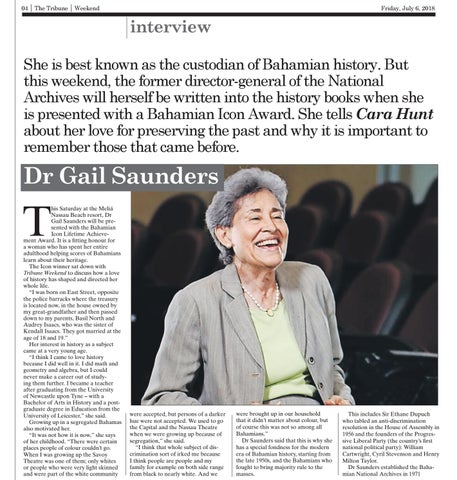
Dr Gail Saunders
T
his Saturday at the Meliá Nassau Beach resort, Dr Gail Saunders will be presented with the Bahamian Icon Lifetime Achievement Award. It is a fitting honour for a woman who has spent her entire adulthood helping scores of Bahamians learn about their heritage. The Icon winner sat down with Tribune Weekend to discuss how a love of history has shaped and directed her whole life. “I was born on East Street, opposite the police barracks where the treasury is located now, in the house owned by my great-grandfather and then passed down to my parents, Basil North and Audrey Isaacs, who was the sister of Kendall Isaacs. They got married at the age of 18 and 19.” Her interest in history as a subject came at a very young age. “I think I came to love history because I did well in it. I did math and geometry and algebra, but I could never make a career out of studying them further. I became a teacher after graduating from the University of Newcastle upon Tyne – with a Bachelor of Arts in History and a postgraduate degree in Education from the University of Leicester,” she said. Growing up in a segregated Bahamas also motivated her. “It was not how it is now,” she says of her childhood. “There were certain places people of colour couldn’t go. When I was growing up the Savoy Theatre was one of them; only whites or people who were very light skinned and were part of the white community
were accepted, but persons of a darker hue were not accepted. We used to go the Capital and the Nassau Theatre when we were growing up because of segregation,” she said. “I think that whole subject of discrimination sort of irked me because I think people are people and my family for example on both side range from black to nearly white. And we
were brought up in our household that it didn’t matter about colour, but of course this was not so among all Bahamians.” Dr Saunders said that this is why she has a special fondness for the modern era of Bahamian history, starting from the late 1950s, and the Bahamians who fought to bring majority rule to the masses.
This includes Sir Ethane Dupuch who tabled an anti-discrimination resolution in the House of Assembly in 1956 and the founders of the Progressive Liberal Party (the country’s first national political party): William Cartwright, Cyril Stevenson and Henry Milton Taylor. Dr Saunders established the Bahamian National Archives in 1971