THURSDAY 20 Pc McNuggets $7 + VAT
i’m lovin’ it!
HIGH 86ºF LOW 75ºF
The Tribune Established 1903
24/7 BREAKING NEWS ON TRIBUNE242.COM
Biggest And Best!
OBITS
VOLUME:117 No.99, APRIL 16TH, 2020
OFFICIA
CLASSIFIED TRADER: CARS, CARS, CARS & MORE CARS
$1
INSIDE
$2BN BLUEPRINT
L SOUR CE
LASHANN SET TO MAKE HISTORY
SEE SPORT
Cooper calls for huge increase in spending to tackle crisis fallout By RASHAD ROLLE Tribune Senior Reporter rrolle@tribunemedia.net DEPUTY Progressive Liberal Party leader Chester Cooper said the Minnis administration’s current budgets for unemployment, food, rental and social assistance during the COVID-19 crisis are “woefully understated” and should be aggressively increased. His assessment features in a personal plan released this week outlining ways to help the country during and after the crisis. Some of the brightest economic minds and members of his parliamentary caucus contributed to the plan, he said. Warning The Bahamas faces a severe recession, he said how the government
responds will determine the severity of the recession or whether it becomes a depression. He expects that public debt will increase dramatically in the next 12 to 18 months, reaching a debtto-GDP ratio of over 100 percent “from the current level”. He further forecasts a funding need of between $1bn and $2bn to keep the economy afloat. “The government should take $250m and invest immediately in real food security. BAMSI is a good model but Andros is primed for growth in agriculture,” he said. He called on the government to encourage BTC and Aliv to boost bandwidth for free for people
SINGLE MUM’S ORDEAL ECHOED BY SO MANY By TANYA SMITH-CARTWRIGHT ts-cartwright @tribunemedia.net
LIFE changed for 22-year-old Cassandra Thompson when she was laid off as a cashier with nowhere to turn. After the COVID-19 emergency orders were issued, Nicole’s Variety Outlet sent its staff home and closed its doors. Ms Thompson, a single mother, took the one week’s pay she received and stepped into the abyss of uncertainty like so many of the country’s workforce. She had just started working at the beauty supply
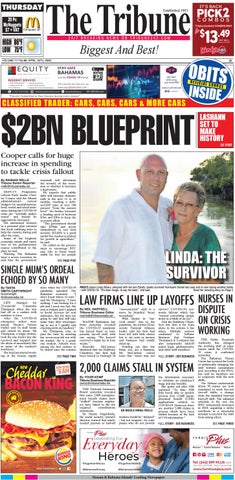
LINDA: THE SURVIVOR
SEE PAGE FIVE
store when the COVID-19 pandemic upended The Bahamas’ economy. “I don’t know where to turn,” said Ms Thompson. “I have nothing. I am looking for a job and I need one fast. My rent is behind and I applied to Social Services for rent assistance, but the days are going by and that will take some time after investigating to see if I qualify and checking with my landlord.” Ms Thompson tries to pass the time by assisting her seven-year-old son with his studies. He is a grade one student. Schools were among the first entities to be closed once the country SEE PAGE TWO
ABACO native Linda Albury, pictured with her son Randy, barely survived Hurricane Dorian last year and is now facing another battle - with COVID-19. “It’s been rough, to say the least,” she said. Read her amazing story on Page 3
LAW FIRMS LINE UP LAYOFFS NURSES IN By NEIL HARTNELL Tribune Business Editor nhartnell@tribunemedia.net
MAJOR Bahamian law firms yesterday revealed the COVID-19 pandemic has forced them to temporarily lay-off staff, with one saying: “We haven’t received a single fee in four weeks.” Branville McCartney disclosed that his Halsbury Chambers law firm had been forced to furlough 20
“non-essential” staff in a move he branded “heart wrenching”. With clients in “survival mode” due to the pandemic, the former Democratic National Alliance leader said his firm had been left with little choice but to cut costs as income and business had totally dried up. Pointing out that law firms, too, are a business, Mr McCartney voiced fears that “some may not
survive” COVID-19’s economic fall-out which has “turned everything upside down in a blink of an eye”. And his Halsbury Chambers law firm is far from alone in the actions it has taken. Multiple sources confirmed to Tribune Business that Graham Thompson & Company has also temporarily laid-off junior legal, administrative and other staff members.
the information necessary to calculate an employee’s wage and due benefits. She spoke out after NIB reported: “To date, NIB [has been] able to quickly process over 12,000 unemployment benefit (UEB) applications related to COVID-19. However, there are another 2,000 claims in process which have been stalled because of the lack of C10 information.”
THE Public Hospitals Authority has changed the working shift of some nurses amid the COVID19 crisis, it confirmed yesterday. The Bahamas Nurses Union has accused the body of unilaterally changing the shift without consultation and, according to the PHA, has told its members not to cooperate with the new shifts. The Tribune understands about 50 nurses are now mandated to work five-on/ two-off shifts, a change from the standard four-on/ four-off shift. The adjusted schedule is the one the BNU vehemently protested in 2018, acquiring a strike certificate in a successful attempt to prevent the shift from taking effect.
FULL STORY - SEE BUSINESS
SEE PAGE THREE
FULL STORY - SEE BUSINESS
2,000 CLAIMS STALL IN SYSTEM By YOURI KEMP Tribune Business Reporter ykemp@tribunemedia.net THE National Insurance Board yesterday revealed that some 2,000 unemployment benefit claims have “stalled” because employers have failed to file the required contributions statements. Dr Nicola Virgil-Rolle, the social security system’s director, warned that muchneeded payouts to laid-off
DR NICOLA VIRGIL-ROLLE workers would be “delayed” - but not stopped - by companies who do not provide
DISPUTE ON CRISIS WORKING
Nassau & Bahama Islands’ Leading Newspaper
PAGE 2, Thursday, April 16, 2020
THE TRIBUNE
CORONAVIRUS CRISIS
22-year-old Cassandra Thompson was laid off as a cashier with nowhere to turn
Single mum’s ordeal echoed by so many from page one recorded its first case of the disease. “I help my son with his school work during the day,” the young mother continued. “I do it because he has to do his school work and also to take my mind off things. I am very worried about my rent, but we also need food.” Since March, non-essential businesses and hotels have closed, sending thousands of Bahamians on to the unemployment line. The workers have been temporarily laid off until the crisis recedes, the businesses have said, however it is unclear how long the ordeal will last.
For Ms Thompson, it has been four weeks without a job. Her weekly rent is past due and she has no words for her landlord. “To survive I have been having to borrow money from people,” she said. “I have to pay those people back somehow. I don’t know when or how, but I will.” She said her child’s father is no help. “My son’s father is giving me a bunch of excuses. I don’t think he has been working either so maybe there is nothing he can do. I really need help for my son. He needs food and that is very scary. When we had to go home from Nicole’s they told us they were going to hire us back when they are allowed
to open back up,” the distressed mother said. “The thing is no one knows when that is. No one knows when they will open. No one is certain.” On Tuesday, National Insurance Board officials said they have paid out more than $5m in unemployment benefits to workers impacted by the coronavirus pandemic. Public Service and National Insurance Minister Brensil Rolle said some 12,000 people who have lost their income due to COVID-19 have already received unemployment payments from NIB. About 30,000 people have applied for NIB assistance.
CARE PACKAGES FOR YOUNG MOTHERS By LEANDRA ROLLE Tribune Staff Reporter lrolle@tribunemedia.net
A LOCAL non-profit organisation is distributing care packages to young mothers in need of essential items to care for their children. Felicia Carey, founder of Teen Life Skills Services, said after seeing a great need within communities due to the Covid-19 pandemic, she knew she had to lend a helping hand to young vulnerable mothers during this difficult time. “Based on our observation from the lockdown and how persons were responding to the lockdown and the lack of needs, we saw it was beneficial for us to go into action and to provide some (things) to those young mothers who may be facing some challenges,” she said. “And we understand the challenges of intimate partner violence, depression, anxiety and a lot of the young mothers don’t know where the next dollar is coming from to provide for
them and not only themselves, but their children.” Having partnered with several charities in the country, Ms Carey said her group was able to distribute 15 packages to young mothers, aged 16 to 21. “So, we partnered with FOAM and Women United and today (Wednesday) was the first day we distributed packages… and we distributed 15 care packages today to mothers, young mothers who are having challenges during this COVID-19 period,” she said. “We gave out diapers, wipes, hygiene packages along with groceries and baby milk. And the highlight of it all was we also had a Creole interpreter for those mothers of Haitian descent because we are here to serve all the communities, especially those communities that are marginalised.” For more information, visit the organisation’s Facebook page (Teen Life Skills Services) or email teenlifeskills242@gmail.com
THE TRIBUNE
Thursday, April 16, 2020, PAGE 3
CORONAVIRUS CRISIS By LEANDRA ROLLE Tribune Staff Reporter lrolle@tribunemedia.net HAVING barely survived Hurricane Dorian in early September, Abaco native Linda Albury did not anticipate she would soon have another battle to face - COVID-19. The 66-year-old told The Tribune yesterday her life has never been the same since the hurricane destroyed her home but on top of that ordeal she has been fighting the potentially deadly coronavirus for more than two weeks. Mrs Albury and her sister, Susan Julie Cates, tested positive for COVID19 in late March, several months after relocating to New Providence from Abaco following Dorian. She does not know how they contracted the virus. While she expects to make a full recovery, her sister died from the disease earlier this month. “It’s been rough, to say the least,” Mrs Albury told The Tribune yesterday. “We don’t know how either one of us contracted it really. I have no idea. We were doing what we were supposed to do, only going to the food store. Only going to the pharmacy… but I started with the low-grade fever around the 25th of March.
Linda survived Dorian only to find herself in a battle with COVID-19 “My sister was already not feeling too well. She had been in the hospital just previously and I was helping to take care of her and then I started not feeling too well, so I isolated myself from her and her son had to take her to the hospital. They tested her there for the virus and it was positive.” Several days later, Mrs Albury’s sister died from the virus. Having already lost several close relatives in the aftermath of Dorian, Mrs Albury said her sister’s death was an unexpected blow to the family. She told The Tribune: “Three weeks after the storm, we lost my mother. She was 92 and in failing
health. I guess it was just too much for her. We lost (her son) Randy’s special daughter in early December. She was seven. “In February, I lost my uncle, my mother’s brother and I lost my sister on April 2 to the virus. My sister was Susan Julie Cates. She passed out of Doctors Hospital, (on) Blake Road. “She had health issues and she was a diabetic and apparently, this COVID-19 can really attack diabetics very badly and it just happened so fast.” Shortly after losing her sister, Mrs Albury said her symptoms started to become more pronounced. This, she said, forced her relatives to contact health officials.
“The day after my sister passed, I was experiencing some shortness of breath,” she said. “And my brother spoke with (Health Minister) Dr Duane Sands and Dr Sands felt like I did have the virus. (And) the ambulance came and got me and carried me to PMH where they did all the tests. “And they carried me to Blake Road on (a) Sunday night and I was there until I think it might’ve been the 11th. I was discharged and brought home on the Saturday evening and I’ve been home ever since.” She is now still in quarantine, away from her family. “I’m quarantined from my family for two weeks but it’s good that I can wave to them, my brother, my
AIMING TO SLOW THE SPREAD
HEALTH Minister Dr Duane Sands tries out the hand sanitizer being developed by John Watling’s Distillery. Photos: Terrel W Carey Sr/Tribune Staff
sister-in law and my sister’s son is here (because) luckily there’s a little cottage in the back where I can be quarantined.” Almost fully recovered from the infectious disease, Mrs Albury says she spends her time cooking, cleaning, watching TV and exercising. She said: “God has been good through all of it. He’s brought me out and I’m home. I feel pretty good. Like yesterday, I ran the electric sweep over the floor here and I made my bed in the mornings. I fixed myself some breakfast and lunch and I’m not doing anything really, really physical.” She added: “I try to get a few walks around the patio every day and of course, TO help slow the spread of COVID-19 John Watling’s Distillery has switched gears to produce a hand sanitizer for The Bahamas. Globally over 600 spirit manufacturers are now making hand sanitizer to combat the pandemic. As the only superpremium spirits manufacturer in The Bahamas, “we see it as a war effort,” said Jose Portuondo, the distillery’s co-founder. “We are lucky to have an inventory of Ethyl alcohol to fight against this virus,” added Mr Portuondo. “For John Watling’s Distillery, there was no question in doing our part. Like the rest of our industry, we shifted our business to meet the needs of our community and those on the front line.” John Watling’s was “designated as an ‘Essential Service’ to facilitate the start-up, manufacture, bottling and distribution of Bahamian made ‘Hand Sanitizer’”, by the Ministry of Health on April 13. “...This does not mean we have stopped making our John Watling’s rums, Red Turtle vodka and Gun Cay rums, it just means we have an additional priority,” said Mr Portuondo. In addition to alcohol from John Watling’s Distillery, hydrogen peroxide was sourced locally through Eugene Cartwright, 8oz. or 275ml bottles through A.R.M.
I’m doing my breathing exercises that I have to do for my lungs, and you know, everybody is different. “Because even though I get, like, shortness of breath, I didn’t have the pain, the chest pains, that a lot of people seemed to have, you know, because I’m so thankful that I haven’t had that. But everybody seems to be so different with their symptoms.” Mrs Albury said it’s important for everyone to take this virus seriously. “It’s really really a serious thing what this virus is doing and not only to The Bahamas, but the whole world,” she said. “Anybody with underlying health problems, it seems to be a lot worse for them.” Bottling & Supplies. “What has become obvious is The Bahamas needs to become more independent,” said Pepin Argamasilla, co-founder of the Distillery. “While most ingredients were found on-island, glycerine was difficult to find. We are actively seeking local glycerine producers.” Jose Portuondo thanked work completed by Bahamas Customs and Tropix Shipping for delivering the glycerine imported from the United States in record time. Further recognition and thanks in assisting with this project go to Robert Carron, Craig Symonette, Rupert Roberts Jr., Suzanne Pattusch (Bahamas Hotel & Tourism Association), Bryan Russell, Andrew Mcfall, Margot Barnett, Christopher Lightbourn, Alex Paine, Esther Neilly, Lil Sam, and the dedicated production staff from John Watling’s Distillery. The first 500 bottles of the distillery’s hand sanitizer will be delivered to the Princess Margaret Hospital; 250 bottles to the Department of Social Services for distribution to facilities housing the elderly and 250 bottles to the office of the Prime Minister. Distribution to grocery stores, pharmacies, clinics, and hospitals will be coordinated through Bahamas Medical & Surgical Supplies Limited or through 242-328-5057 |info@bahamasmed.com.
NURSES IN DISPUTE ON CRISIS WORKING from page one
PHA has cited the government’s emergency powers orders and declaration of a State of Emergency as justifying the shift change. “The PHA noted that during this period of declared emergency, the government and Public Hospitals Authority will exercise emergency authority to ensure requisite staffing in all public health facilities,” PHA said. “While the PHA recognises the industrial agreement with the BNU, our efforts to fight the current COVID-19 pandemic require a high degree of flexibility from all staff. Upon the withdrawal of the Emergency Order by the government, nursing shifts will return to the pre-pandemic schedule.” Defending the need for a new shift system in 2018, PHA said: “(The move would) improve the delivery of healthcare to our
patients and ensure better patient outcomes through better nursing coverage and reductions in nurse related accidents and errors; eliminate inequalities caused by the ‘four nights on/four nights off’ system which resulted in night duty nurses working 157 days per year on average, compared to 234 days per year on average for nurses assigned to day shifts; establish a standardised five-day, 40-hour work week with 8-hour daily shifts; and provide compensation for nurses scheduled to work between the hours of 6pm to 6am by way of a night duty premium of $1.75 per hour which would be paid in addition to their standard hourly pay.” Yesterday, a spokesperson for the BNU declined to comment about this matter. However, The Tribune understands BNU leadership is incensed with the shift changes and says they were made weeks ago without consultation. According to the PHA, the
union issued a letter on April 11 advising its members to reject the shift changes. Last week, the Bahamas Doctors Union raised its own concerns, claiming they have been threatened with non-contract renewal if they chose not to be a part of the COVID-19 response. BDU leader Dr Melisande Basset further said doctors lacked proper training in putting on and removing personal protective equipment. “In addition to these concerns, some physicians have elderly parents and family members with comorbidities,” her letter said. “These physicians have expressed that, if possible, they will assist if they are able to sequester themselves away from home for the period where they are assisting directly with positive patients.” On Tuesday, Health Minister Dr Duane Sands said he was “flabbergasted” to learn of the alleged threats, saying this is “not something that is consistent with the Ministry of Health”.
Dr Sands said: “I can tell you that they were certainly not threatened by me and they certainly were not threatened by anybody who I have given a directive to threaten them. “I find that principal abhorrent and it is certainly not something that is consistent with the Ministry of Health, so I’m flabbergasted by that claim and we’re investigating it.” Other concerns highlighted by Dr Bassett are that some doctors have not received proper training in putting on and removing personal protective equipment (PPE) nor proper N-95 mask fitting. “In addition to these concerns, some physicians have elderly parents and family members with comorbidities,” her letter continued. “These physicians have expressed that, if possible, they will assist if they are able to sequester themselves away from home for the period where they are assisting directly with positive patients.
“Since the beginning of March, the BDU has requested additional sleeping facilities to facilitate social distancing and to provide lodging for persons who wish to sequester themselves away from home. To date, the BDU has not received any official information from the minister on this. We know that this is an impediment to many wishing to volunteer.” Dr Bassett also called for “official documentation” to back up the government’s verbal promise for “compensation and insurance
benefits” for doctors or their family members, if they end up contracting the disease. Dr Sands has said health officials are working to resolve outstanding issues. He said Tuesday: “This is not the time for division. This is the time for us to come together and solve problems, which is not to say that we have to hold hands and sing kumbaya, but we have a nation of people that’s counting on us and we have to be there for them.” Editorial View - Page 6
PAGE 4, Thursday, April 16, 2020
THE TRIBUNE
CORONAVIRUS CRISIS By KHRISNA RUSSELL Tribune Chief Reporter krussell@tribunemedia.net THE Anglican Diocese of the Bahamas has laid off 66 employees and reduced the salaries of remaining employees by half. The move affects schools and churches under its banner. Yesterday, the organisation, which oversees The Bahamas as well as Turks and Caicos, said it has been financially affected by the fallout from COVID-19. As a result the diocese said it regretfully chose to lay off 14 diocesan office staff and a total of 52 employees from three schools - St John’s College, St Anne’s School in New Providence and St Andrew’s School in Exuma. The diocese said this decision will not apply to Bishop Michael Eldon School in Grand Bahama because that island is still recovering from Hurricane Dorian. “All remaining staff in the diocesan office and in the schools will be
Anglican schools and diocese hit by layoffs placed on half pay,” a statement issued by the diocese said yesterday. “This approach was taken in order to allow all entities to be sustained for as long as possible on this challenging landscape where only scarce resources are available but where life must continue. “Based on what is happening in our communities, no one should be surprised by these measures, or fail to understand the rationale behind the same, even though painful.” The news has left some employees in shock. One teacher’s aide said it is “sad” the way she and
several others have been treated by the diocese. After working for the organisation for a number of years, she told The Tribune under condition of anonymity, that to be handled this way was “unacceptable” and “disappointing”. She was informed of the decision in a letter signed by Bishop Laish Boyd dated yesterday, April 15. The letter read: “…As a result of emergency orders, which includes 24 hour curfews and lockdowns, all businesses except essential or expected services have ceased public operations. This includes all of
our schools. We do not know when we will be able to return to our school buildings. Tourism which is responsible for over 60 percent of our economy has shut down and many businesses have reduced activity, laid off staff or closed. “Many of our parents have not paid fees for the trinity term and are now without jobs. The likelihood of our recouping these outstanding fees is very slim. The diocese does not have the funds to sustain our payroll for the remainder of the school year. Against the backdrop of this reality we have had to make some very difficult decisions.”
It continued: “We regret that we have no choice but to lay you off effective April 30, 2020. We will review the situation at the end of June 2020 to determine the way forward and will notify each employee of the decision made.” A teacher, who did not want to be named, said the announcement was a “shock”. “I honestly thought my position was secured, so it was a shocker to learn on Tuesday of my fate,” she told this newspaper. However, she said she understood the rationale behind the move, adding that at this point she had no
MAKING FACE MASKS TO HELP WORKERS
WITH the government now ordering people to wear face masks when they leave their residence to help stop the spread of COVID-19, members of the Inner Wheel Club of East Nassau have started to make them. “When it became clear that wearing a mask, even a homemade one, was important for all of us to do to help in the spread of the coronavirus, our members sprang into action to begin sewing masks,” said president Elizabeth Howard.” “Our efforts are completely voluntary and we are using fabric we all have in our homes and every mask is donated. Other members recruited family, friends and neighbours as well as quilting clubs such as the Stepping Stones Quilting Guild to get involved. Hundreds of masks have been made with more coming. “Our members generously agreed to assist and began making masks in large numbers,” said Robin Symonette, a member of both the Inner Wheel Club of East Nassau and the Stepping Stones Quilting Guild. “To date, the masks made have been donated to family and friends for protection, as well as to the Geriatric Ward at Sandilands, to medical staff at Princess Margaret Hospital, the Princess Margaret’s Children’s Ward, the A&E, as well as The Rand Memorial Hospital in Grand Bahama. Our masks act as a cover for their medical N-95 masks to help protect
choice but to lean on scripture for comfort during this difficult time. “This too shall pass. I still have life so I’m grateful.” The diocese has encouraged those who were laid off to seek assistance from the National Insurance Board, noting that the relevant forms should be sent into its office to ensure receiving aid is not delayed. About 30,000 people have already applied to NIB for unemployment assistance. To date NIB has paid out more than $5m in unemployment benefits to workers impacted by the coronavirus pandemic.
DETAINEES WILL NOT BE SENT HOME FOR NOW
By EARYEL BOWLEG ebowleg@tribunemedia.net
HEALTH care providers at PMH, above, and at the Rand Memorial Hospital, left, wear their donated masks
them a bit more and make them last longer.” The World Health Organization (WHO) has stated it is critical medical masks (such as the N-95) are to be reserved for use only by health care providers and support staff working in the frontlines of the pandemic.
“We are all called to do our part during these trying times,” said Mrs Howard. “It is a simple thing for us to do and I am incredibly proud of our members and friends for rising to the occasion. We have been told that health care workers on the frontline appreciate the effort we
have made and that is gratifying. If the masks help just one person be safe during this pandemic then our united effort was well worth it.” The government has also issued advice on face coverings, saying: * Make sure you can breathe through it
* Wear it whenever going out in public * Make sure it covers your nose and mouth * Wash after using. People are also urged not to use masks on children under the age of two, and not to use surgical masks or other personal protective equipment intended for healthcare workers. The government has also banned the importation of non-medical protective face masks, with Prime Minister Dr Hubert Minnis saying the move was “an effort to protect the local mask manufacturing industry that has sprung up overnight as a result of the COVID-19 virus”. He added: “We are working to protect and encourage small businesses and to create and promote jobs. I am happy to see so many seamstresses and tailors involved in this growing industry.”
REPATRIATIONS are temporarily suspended in light of countries closing their borders and not accepting detainees, according to the officer in charge of the Carmichael Road Detention Centre. “We are temporarily on hold right now,” Superintendent Peter Joseph told The Tribune yesterday. “Of course you know most countries or almost all countries are not taking any detainees and so we have to maintain the persons that we have in custody until such time…. “....So while we may want to continue our exercises we have to refer to the Department of Foreign Affairs relative to any clearance on what we might or might not be able to get.” As for visitations to the centre, he said: “That whole process has been temporarily suspended due to the fact that we cannot expose persons who we already have in custody to persons who may be out in the public domain.” The detention centre has a population of 109 people, but there are no concerns of overcrowding as the centre has a capacity of over 200, he said. Supt Joseph said a group of Cuban nationals who were apprehended recently were placed in a separate area “entirely” from the general population. He said they were quarantined at the facility and are not showing signs of the coronavirus so far.
STRETCHING HIS LEGS COSTS 71-YEAR-OLD MAN $400 By FARRAH JOHNSON fjohnson@tribunemedia.net AN elderly man who told police he went outside to stretch his legs was fined $400 yesterday for violating the recent five-day lockdown. He was among several people who appeared before Magistrate Sandradee Gardiner for curfew and lockdown infractions. Charles Johnson, 71, was charged after police found him near Andros Avenue around 5.25pm on Sunday. The lockdown ended Tuesday morning. Johnson pleaded guilty and was fined $400. Magistrate Gardiner said she took into account the fact he is a senior citizen and gave him until April 24 to pay the fine. Prosecutor Kenny Thompson told the court at the time of his arrest,
Johnson told officers he went outside to stretch his legs. In response, Magistrate Gardiner told Johnson the fact that he was among those most vulnerable to contracting COVID-19 meant he shouldn’t be outdoors. She also said if he felt like he needed to exercise, he should walk around his yard or stretch, and admonished him not to take the risk of going outdoors unnecessarily. Meanwhile a Haitian man who claimed he was arrested while attempting to get a plate of food from his cousin was also fined $400 yesterday. Vilaire Fleurosier, 36, and his cousin Lerdia Henry, 28, were charged after police found them near Cambridge Street around 1pm on Monday. They both pleaded guilty to the charge and were each
fined $400 or one month at the Bahamas Department of Correctional Services. Magistrate Gardiner said the fine was to be paid on or before April 17 at noon. Prosecutor Bridgette Strapp told the court officers found both defendants walking on Cambridge Street on Monday. When stopped for questioning, Sgt Strapp said the pair told officers they were going to hail a cousin. They were subsequently cautioned and arrested. In court yesterday, Fleurosier denied telling police he was going to see his cousin. Through an interpreter, he said he was on the road because he was hungry and his cousin, Lerdia Henry, had brought some food for him. Fleurosier claimed he walked out to the road right in front of his gate when the police came. He said he ran back
in his house, but the officers knocked on his door and took him to the Nassau Street Police Station. In response, Magistrate Gardiner told him the fact he was walking outside the confines of his yard meant he was guilty of breaking the curfew. She explained the 24-hour curfew meant people were only allowed to be at home or in their yard and told Fleurosier that he needed to make sure he had sufficient food at home before the lockdown or curfew. Christopher Colebrooke, 58, and Jammal Goodman, 32, also pleaded guilty to violating the lockdown after they were found near Palmetto Avenue around 9.30am last Friday. They were each fined $400 which they were ordered to pay by April 24. Failure to pay the fines would result in both
defendants spending one month at BDCS. When given an opportunity to speak, Colebrooke and Goodman told Magistrate Gardiner that they took the chance of going outside to get soursop leaves for Colebrooke’s sick girlfriend. Magistrate Gardiner told both defendants that the leaves were not worth the risk, because if they had taken the virus back home to Colebrooke’s sick girlfriend, she could have died. Karen Sands, 42, was also charged after officers found her near JFK Drive around 10pm last Thursday. She pleaded guilty to the charge and was fined $450 or one month in prison. During the hearing, she told Magistrate Gardiner she was on her way home at the time of her arrest. Cordeirro Ferguson, 30, was also charged after
he was found near Eden Street off Farrington Road around 7.30pm on Monday. He pleaded guilty and was fined $450 or one month at the BDCS. McDonalds Fearnlus, 37, was charged after police found him on Saffron Street, Pinewood Gardens around 8.50pm on Monday night. He was fined $600 or two months in prison. Officers found Derek Newton, 30, in the area of Darling Lane around 2.30pm last Friday. He pleaded guilty to the charge and was fined $600 or two months behind bars. When given an opportunity to speak, he told Magistrate Forbes that he was going to a friend who had prepared a food package for him and his father because they had no food in their house and he did not have an opportunity to go to the store.
THE TRIBUNE
Thursday, April 16, 2020, PAGE 5
CORONAVIRUS CRISIS
‘FAMILY ISLANDS LOCKDOWN COULD LAST FOUR MORE WEEKS’
By RASHAD ROLLE Tribune Senior Reporter rrolle@tribunemedia.net
DEPUTY Chief Medical Officer Dr Delon Brennen said it could take another four weeks before the lockdown can end on Family Islands that have not yet recorded a confirmed case of COVID-19. The country had 53 confirmed COVID-19 cases up to press time. Statistics suggest there could be another 250 people “flying under the radar” as asymptomatic or having mild symptoms because 80 to 85 percent of people with COVID-19 fall into these categories, he added.
Some Family Island residents are anxious to head outdoors and carry on with their lives. “We haven’t had any cases yet and it’s been over two weeks and they say the incubation period is 11 to 14 days,” said Ray Lightbourn, owner of Exuma Water Sports, in a Tribune interview yesterday. “We’ve been probably locked down for 20 days so we should be able to open up since we haven’t had a case in 14 days. There is no reason Exuma people shouldn’t go about their business. “And I’m not saying open up to airports or the boats, I think we should keep them closed until this dies down but lots of
people can still work during this time, people can at least go to the hardware store to buy stuff to fix up their homes if they can’t work like me since I’m in tourism, so I can’t work but at least I could fix up my boats and my house instead of just being locked down all the time.” Nelson Ranger, a destination wedding photographer in Exuma, said he wants the freedom to move about now that Exuma has gone longer than 14 days without a case. “Some people want to get out to their farms,” he said. “A lot of people grow onions and watermelons and they want to get out and make sure that’s not
overgrown. I do a limited amount of farming and I haven’t seen my place in a month now and I don’t know, the robbers might have been out while they should’ve been on lockdown so who knows how that’s going to look.” However, Dr Brennen said the country needs more than one incubation period to be satisfied there is no risk of an outbreak on islands that have not yet recorded a case. “You still could have people who are shedding the virus,” he said. “Once you open up all the stores and social activities you would then let asymptomatic people pass it on to others. Ideally, if people had been keeping
themselves in place when we initially implemented the order, more than one cycle could have passed by now but we need more than one incubation period. “Let’s say someone didn’t start shedding but became symptomatic on day 14. If they did, then their disease period could last anywhere from another two weeks to another four weeks, so you’re still dealing with about another four weeks, which is six weeks total. So you would have at least six weeks out to when you could assume that people who got exposed might be completely free of any possibility of sharing the disease.”
Cooper calls for increase in spending from page one who need to work at home for 60 days, offering tax credits and subsidies to facilitate this. He said the government should also immediately facilitate free online interactive courses via BTVI and UB to strengthen the labour force during this time. To attract tourists when the crisis fades, Mr Cooper said the government should offer aggressive incentives, including reduced taxes on airline tickets for a six-month period and the removal of certain VAT and/or hotel room rates. He said the government should cut its recurrent expenditure, eliminating inefficiency and waste in ways that go beyond “lip service to cutting overall expenses by ten percent”. “Low-hanging fruit would to restrict local and international travel over the next year, purchases of new vehicles and eliminate discretionary, non-essential expenditure,” he said. “The savings maybe re-purposed to support an enhanced budget for unemployment benefits, social assistance and support for the domestic economy. Review of all consultant contracts to ensure no double-dipping. That is, collecting a pension and consultant salary at the same time.”
The MP said the government should provide value-added tax and other tax or loan credits to all businesses to retain as many employees as practical and to ensure quick release of money to employees while removing some administrative strain off the National Insurance Board, which can then concentrate on self-employed people. He also wants the government to appoint a debt management committee to review and recommend advice on managing and structuring the country’s debt. Mr Cooper said the government should seek to issue up to $1bn in bonds over the next year that could be called COVID19 relief bonds in order to reduce government cash outflow in the short-term. “These bonds should be targeted to specific projects, for example, food security/ BAMSI expansion or technology and e-commerce to provide efficient management of and service delivery to our citizens,” he said. “Issue mediumterm COVID bonds with a maturity date of up to ten years. These bonds will have a coupon and will be targeted at retirees looking for income to live on. This issuance will be $150-$200m. Issue short-term bonds up to five years, targeted at banks as they invest excess cash in the system. This issuance would be up to $500m.”
He also said the government should borrow $750m in US currency for budget support, using substantial portions to prepay debt that will soon come due. “Use the powers under the Financial Administration and Audit Act to get dividends from cash-rich organisations including the Bahamas Maritime Authority, URCA, Central Bank, the Insurance Commission, etc,” he said. Once the COVID-19 health crisis subsides, Mr Copoer said the government should review loss-making quasi-government enterprises with a view to finding “private sector-styled strategies” for them. “Enterprises such as Bahamas Power and Light, Bahamasair, Water & Sewerage Corporation and ZNS should be scrutinized, thus freeing up over $100m in annual subventions in addition to freeing up over $750m in debt and hundreds of millions in future pension obligations, while allowing for reduced cost to the consumers, which would allow for more discretionary spending, hence increased economic growth for all,” he said. He added a new Sovereign Investment Fund should be created by initially transferring the government’s private sector investments like Aliv, BTC, Cable Bahamas and Bank of the Bahamas.
ANOTHER FOUR CASES CONFIRMED MINISTRY of Health officials yesterday confirmed four additional COVID-19 cases, increasing the nationwide total to 53. All of the new cases are women and residents of New Providence who have no history of travel. Two of them are in hospital, while the others are in home isolation, officials said. The ministry said: “Case #50 is a 38-year-old female of New Providence with no history of travel. This case is hospitalised. Case #51 is a 48-year-old female of New Providence with no history
500 FREE LUNCHES FOR BAIN AND GRANTS TOWN By EARYEL BOWLEG ebowleg@tribunemedia.net WHILE many Bahamians face hunger during the COVID-19 pandemic, the Bain and Grants Town community will not have empty stomachs as 500 free hot lunches are being home delivered daily. Area Member of Parliament Travis Robinson said his constituents can count on full course balanced meals brought to their homes until April 30. Previous projects in the area included helping with grocery assistance for the elderly, but the MP recognised some people did not have the means to prepare
food at home. “... I understand that the grocery meals, the grocery bags would’ve been a challenge to them in the sense that many of them do not have stove to cook the food and those who do have stoves have a portable stove which means that they have to buy the gas can to cook the meal as well..,” he told The Tribune. “And I’ve seen on numerous occasions where persons who are cooking meals, they run out of gas and they don’t have enough funds to purchase another gas can so they end up eating uncooked meals. You also have situations where individuals in the community, who have a
(large) stove to cook, they don’t have the gas to cook the meal on the stove.” He recognised that people coming to him for help a properly cooked meal was a better approach and doing deliveries would help to avoid crowds at his constituency office. The initiative started on Tuesday and it has been “very well received”. He said the demand has been so great, his team had to make changes to accommodate more people in need. Local food vendors are helping with cooking the meals. “So, we have divided among the four local chefs within the community who
normally cook and they prepare the food at their already approved establishment,” Mr Robinson said. On the first day, the MP estimated 420 people called in. There are also people in the community who are already registered on the list, like senior citizens, who do not have to call in and are automatically rolled over on the list each day. Single parents in the community from prior projects were also contacted to confirm interest in receiving assistance. Mr Robinson said the volume of calls for help “surpassed my expectations in terms of persons who would actually even need the assistance.”
THOMPSON: PROGRAMMES HELPING TO EASE PAIN
By DENISE MAYCOCK Tribune Freeport Reporter dmaycock@tribunemedia.net
MINISTER of State for Grand Bahama Kwasi Thompson said Grand Bahamians have benefitted from the national assistance programmes put in place as a result of COVID-19. “Most of the hotels are closed as a result of the shutdown including the Grand Lucayan. Those employees who have lost their jobs have been able to apply for unemployment benefit,” he said. “I am aware of those who are selfemployed in the tourism industry also benefitting from the new assistance programme.”
Mr Thompson, pictured, said people on Grand Bahama affected can apply for assistance online, where applications for both Social Services and National Insurance which can be accessed. Local GB teams at both agencies, he stated are in office on a limited basis doing their best to meet “the unprecedented” demand. Senator Thompson also note steps are being taken to ensure isolation facilities are available in GB including a new unit at the Rand Memorial Hospital. “The government’s focus through its GB COVID-19 Task Force has
been working around the clock to keep us safe, and in partnership with the GB Port Authority have provided additional facilities at the Cancer Association,” he said. He reported most people have been obeying the Emergency Orders, however, he encouraged all in GB to obey social distancing guidelines and stay home when ordered to do so. “While we have suffered our share of unemployment, I commend those industrial companies who have been able to keep their employees on in some form,” the minister said.
of travel. This case is in home isolation. “Case #52 is a 33-year-old female of New Providence with no history of travel. This case is hospitalised. Case #53 is a 38-yearold female of New Providence with no history of travel. This case is in home isolation.” As investigations continue, officials said there was ongoing monitoring of the previously diagnosed positive cases. According to the ministry’s Wednesday dashboard, there are six recovered cases, eight deaths and 712 persons in quarantine.
PAGE 6, Thursday, April 16, 2020
THE TRIBUNE
The Tribune Limited NULLIUS ADDICTUS JURARE IN VERBA MAGISTRI “Being Bound to Swear to The Dogmas of No Master”
LEON E. H. DUPUCH,
SIR ETIENNE DUPUCH,
jamaaltheartist@gmail.com
Publisher/Editor 1903-1914 Kt., O.B.E., K.M., K.C.S.G., (Hon.) LL.D., D.Litt .
Publisher/Editor 1919-1972 Contributing Editor 1972-1991
EILEEN DUPUCH CARRON,
C.M.G., M.S., B.A., LL.B. Publisher/Editor 1972-
Published daily Monday to Friday
Shirley & Deveaux Streets, Nassau, Bahamas N3207 TELEPHONES
News & General Information Advertising Manager Circulation Department Nassau fax Freeport, Grand Bahama Freeport fax
(242) 322-1986 (242) 502-2394 (242) 502-2386 (242) 328-2398 (242)-352-6608 (242) 352-9348
WEBSITE, TWITTER & FACEBOOK www.tribune242.com
@tribune242
tribune news network
This is no time for union squabbles WHEN Prime Minister Dr Hubert Minnis sounded the call for members of the medical profession to come to the front line of the battle against COVID19, it seems he could hardly have met with a less enthusiastic response. In yesterday’s Tribune, we took doctors in private practice to task who were reluctant to come into contact with virus patients, instead seeking to handle phone lines or protesting they had not been trained with protective gear. Today, alas, it is time to question some nurses. The Bahamas Nurses Union has protested about changes in working shifts amid the crisis. There has been a move from five shifts on and two off to four on and four off – a move that affects about 50 nurses. The union has thrown up its arms. In 2018, the union had acquired a strike certificate in a bid to stop such a shift change. Why the change now? The Public Hospitals Authority has pointed out that there is an emergency going on. A national state of emergency. Accordingly, it has changed some shifts around to ensure there is enough staffing in all public health facilities to deal with the disaster that has befallen the world. The union leadership is, apparently, incensed, and – it is alleged – has urged members to reject the shift changes. If so we would urge the union to think again. This is not the time to be combative. You want to fight over changes to working hours that the hospital thinks it needs to keep people healthy? Look at
the unemployment lines where people have no working hours and be thankful. No, more than that, look at the wards where coronavirus patients are fighting for their lives and remember why you became nurses. If you want to have a fight save it until the crisis is over. Until then, show up and try your hardest because your country needs you. When the crisis has passed, by all means remind the country how much we needed you, but until then, don’t pick a fight. Work with management to ensure the best outcome for the patients having to navigate their way through the health system at this time. If you have better ideas for delivering care at this time, suggest them to those in authority – because no one has a monopoly on good ideas. The goal here is to ensure that as many patients as possible recover safely from the virus, and those needing care in other critical areas during this time are able to get that care – all the while keeping medical professionals safe and healthy too. Squabbles about shifts and unions digging in their heels right now will receive little to no public sympathy. As Minister of Health Dr Duane Sands said, “We have a nation of people that’s counting on us and we have to be there for them.” So will you be there? Or will you be sitting at home refusing to work when the hospital says it needs you to work? The choice is yours – the nation expects you to make the right one.
Just let grocery shops open seven days a week EDITOR, The Tribune WE hear a lot these days about flattening the curve but one has to wonder why our leaders think that the only curve to be flattened is COVID 19 infections. Or why they can’t see that in trying to flatten that curve, they are creating other curves that will indubitably increase the COVID 19 infection curve. A three-year-old child can tell you that when you squeeze a balloon on its sides, the top, bottom, and adjacent sides bulge out. And so it is with grocery shopping. When you lock down for three, four or
LETTERS letters@tribunemedia.net five days, you are creating the very COVID 19 Petri dish that you had hoped to empty. And the lock downs have only become necessary because the population at large seem unable to control themselves and the police have been a dismal failure in doing anything about it. During the curfew hours I personally have never seen a police checkpoint where anyone is asked to explain where they are going, or
where they have come from. And if they are not on a route to a pharmacy (with a prescription) or a doctor, or a grocery shop, then they should be turned around and sent back. So the entire country has to suffer because of a police failure? For God’s sake Dr. Minnis, just allow the grocery shops and pharmacies to open seven days a week and whatever hours they normally are open and stop creating curves that do nobody any good. MONKEEDO Nassau, April 15, 2020.
Five steps to battle virus EDITOR, The Tribune IT GOES without saying that we should minimize the loss of life where we can with challenges like Covid-19. But we must be careful to balance what feels good, with actually doing good. Parliament’s most recent response to the Covid-19 dilemma appears to be largely based on emotions and fear, for which neither forms the best framework for developing robust policy or effective measures. We must as a society recognize the fact that there are trade-offs to every policy pursued and no one factor supersedes all others. There must be a considered balancing of sometimes competing interests and an understanding of the outcomes all the various trade-offs entail. Every decision the government makes in response to Covid-19 imposes costs in terms of time, money and lives, as well as, creating a host of new problems and issues, both in the short and long term. It is a balancing act fraught with risks, known and unknown, recognized and ignored. Knee jerk solutions almost always end with a hard kick you didn’t intend to deliver. Take the implementation of grocery shopping time allotments by last name (a form of rationing). It seemed like an expedient move to limit the number of people visiting grocers. But it was a superficial and ineffective measure. In the
first instance, the distribution of last names is not equal across the alphabet, this is especially true where populations are smaller and closely related. The result: an imbalance of people assigned to short windows of time for shopping. This increases the number of people visiting a shop during a short period of time rather than alleviating the numbers of people shopping at any given time. This constriction of available shopping time was made worse by the Government’s arbitrary reduction in grocers’ daily operating hours. If the objective was to reduce the formation of crowds, the government quite literally achieved the opposite, putting vastly more people in danger. Likewise, the Government announced arbitrary extended closures of grocers. Not only will this definitely result in tremendous food wastage as fresh goods rot on shelves during extended shutdowns, but it will also result later in food shortages as responsible grocers will wisely decline to order and bring in food that will go to waste during unpredictable and extensive mandatory closure windows. Both of these conditions are not helpful and both negatively affect the general health of the population. However, the most egregious outcome of the grocer closures is the inducement it creates to have even more people gather to wait in long lines to buy groceries
in constricted time-frames. Because food is a necessity and people must have it, this single act may in fact prove to be the very catalyst for an explosive increase in Covid-19 that the government wanted to avoid. So what should be done? It is clear that one stage thinking won’t benefit anybody (not the public, not grocers and not the battle against Covid-19). And in fact, if the Government doesn’t get serious about taking effective measures to slow the spread of Covid-19, then the situation will quickly spiral out of control. Here is a strategy that will work to slow the spread of Covid-19, while not creating panic, riots, food shortages or economic hardship greater than is absolutely necessary. Step 1: Return grocer operating hours to preCovid conditions. Ideally, ask grocers to extend their operating hours during this crisis even more to at least 7 am until 9 pm, 7 days a week. Step 2: Mandate and then support all grocers with implementation of Point of Sale plastic barriers, PPE (gloves/masks) for working staff (especially cashiers), hand sanitizer at each check out and each store entrance, 100% sanitization of all shopping carts and baskets after each customer use, termination of packing services in store. To be in place prior to re-opening to the public. Step 3: Remove time allotments for grocery
shopping, but strictly limit the number of persons in store based on the facilities overall square footage, with the social distancing queue markers in place. With the extended shopping hours the restriction on number of shoppers in store at any given time can easily service the general public without attracting large crowds. People will naturally avoid crowding and queuing when they know they can come back at other times when queues are shorter or non-existent. For any customer entering a grocery store have a Greeter (wearing PPE) who will ensure each customer immediately uses hand sanitizer upon entry. Step 4: Whether or not open shopping is allowed or if shopping allotment is maintained based on last name, assign Saturday and Sunday as a shopping day for ONLY those segments of society that are the most potent asymptomatic Covid-19 vectors, including medical staff, bank tellers, police, army, grocery employees, gas attendants and any other position(s) construed as high risk given the number of people they come into contact with on a daily basis. This will contain the risk posed by “Super Spreaders”, as the drastically lower numbers of people in grocery stores on Saturday and Sunday will minimize the chance of spread to other shoppers. Likewise those people designated
as being able to shop on Saturday/Sunday, will be barred from shopping during the weekdays. Step 5: As more PPE (masks, gloves) becomes available exceeding the needs of the primary services, grocery cashiers, gas attendants, etc, re-direct the excess to grocery stores first, then banks and gas stations, for distribution to each visiting customer entering the facility. This will enhance the precautionary measures taken on the employee side, by extending them to the customer side. With this plan in place the government can then direct some of its focus on these concrete initiatives that will garner positive results by reducing actual systemic risk. 1. Harden the vector interfaces (install grocery plastic barriers, enhanced sanitization protocols). 2. Spread the hours of operation of grocers and assign shopping days by Essential service description (more hours open, means less shopper density, high risk shoppers limited to Saturday/Sunday) 3. Procure mass quantities of PPE for allotment as outlined above (roll out the PPE in stages depending on the amount of PPE available – first to medical staff, then grocery cashiers, then police/army, and so on), 4. Enhance testing of the High Risk category of essential personnel who come into contact with large numbers of the public
(medical staff, police, grocery cashiers, gas attendants, army and so on). 5 Immediately remove folks working in the Essential industries who are found to be positive for Covid-19 so that they don’t act as Super Spreaders. 6 Move to general PPE distribution at store level upon entry. If this course of action is taken, the Bahamas will be better off. Fewer people will gather at any one time. Food shortages will be avoided. Public nutrition will be maintained. Food inflation will be avoided. Panic and rioting will be minimized. Business on the grocery side can continue as normal. Other essential sectors that have a high number of public contact points will receive greater focus and improved disease mitigation protocols. As well, we will have an effective and sustainable action plan implemented with definable targets and verifiable outcomes. As it stands today we are flying blind, we have action, but it is not sustainable, sensible or effective. If it feels like we are tumbling down the mountain in the middle of the night and at any moment will hit a tree, it is because this is exactly what is happening. Time for change. Time to actually do good, not just feel good about having done something. ANONYMOUS Nassau, April 7, 2020.
THE TRIBUNE A NEW, rapidly spreading outbreak of Stony Coral Tissue Loss Disease (SCTLD) has quietly infiltrated nearly 40 miles of Grand Bahama’s southern coastline, killing a wide range of coral including some that are already endangered. “Corals are the engineers that build the entire marine ecosystem. Without them the ecosystem collapses. The reefs lose their function. It makes a fundamental change in the ecosystem from what we’ve seen in the past,” said Dr Craig Dahlgren, a marine ecologist with the Perry Institute for Marine Science (PIMS) who led the research investigation last month. “The greatest infection rates and greatest amount of mortality were close to Freeport, close to the port. For some species, 90 percent of the corals were either dead or dying. It was very widespread at that point. In those severe cases, there is little you can do to help those corals.” Silent and deadly, if the outbreak goes unchecked scientists believe the fallout could prove worse than the 1930s marine disease which wiped out sponging beds across the country and led to the crash of the Bahama Islands then number one industry, sponging. Although corals typically face a number of threats, including nearly a dozen different diseases, SCTLD poses the single greatest hazard since roughly half of the coral species in the Bahamas are susceptible. Other diseases usually infect maybe two to three species. SCTLD is also more lethal and spreads faster. The report for Grand Bahama submitted to government agencies on March 16, linked the introduction of the disease to The Bahamas with cruise ships and large commercial vessels. “It is more likely that SCTLD reached Grand Bahama through vessel traffic into and out of Freeport. Most likely ballast water from large commercial vessels (cruise ships or cargo ships) coming from Miami or another infected area are the culprit and may present the greatest threat to spread of the disease,” the report read. “Since its introduction, however, the disease has spread over vast areas on shallow reefs, probably due to alongshore currents.” The ballast water ships carry for stability can contain thousands of aquatic or marine microbes, plants and animals, which then gets transported across their route. Untreated ballast water released at the ship’s destination could potentially introduce a new invasive marine species.
Thursday, April 16, 2020, PAGE 7
Grand Bahama hit by new coral disease outbreak
STONY Coral Tissue Loss Disease, a new coral disease outbreak, poses the single greatest threat to roughly half the coral species in The Bahamas. Photos courtesy of the Perry Institute for Marine Science According to the International Maritime Organization (IMO) hundreds of such invasions have already taken place, sometimes with devastating consequences for the local ecosystem. Had the waterborne disease been reported sooner, scientist, marine biologists and environmental protection agencies could have done a better job of removal and containment, potentially saving more reefs around Grand Bahama. At least one dive shop claimed to have seen impacted coral as early as July 2019. However, it wasn’t until late December and January of this year that information began trickling into the relevant authorities. Back in October, PIMS,
the non-profit organization committed to protecting oceans through timely research, conducted reef surveys to assess the impact of Hurricane Dorian to the marine environment. Scientists surmise only a very tiny percentage of corals in Grand Bahama had likely been touched by SCTLD at that time, since no signs of the disease was visible on the reefs surveyed. However, no surveys were conducted near the port area. Dorian may have played a role in transporting the disease through water movement, advancing SCTLD progression to corals already weakened by storm-related stress. “We are already behind. We need to act now,” said Dr Dahlgren, an internationally recognized expert
in a wide range of areas related to tropical marine ecosystems. Over four days, from March 12-15, a team of researchers conducted rapid assessment of 25 Grand Bahama reefs. That number included 18 shallow reefs spread between High Rock in the east and Bootle Bay in the west, one site in Lucayan National Park and one in Peterson Cay National Park. Seven deeper reefs were also assessed – one in Lucayan National Park, two between Lucayan National Park and Peterson Cay National Park, and four sites between the Grand Bahama Waterway and the entrance to Bell Channel. “The highest concentration of dying and dead corals appeared to be
around the port. That’s why I think that transmission in ballast water from shipping, whether it’s Florida or some other place which has the disease already, is the likely culprit of why it got there, versus if it came in on ocean currents. We would have seen a very different pattern if that had happened,” said Dr Dahlgren. “When we were out conducting our surveys in mid-March just a couple of weeks ago, there were boats right off the port that were dumping hundreds of gallons of water out. I don’t know what that water was.” The data suggests the disease may have already spread across shallow reefs of the entire south coast of Grand Bahama from West End to McLean’s Town. “At this point it’s too late to save many of those reefs but we can work on containing it so it doesn’t spread further along the coast of Grand Bahama or make a jump from Grand Bahama to Abaco or to New Providence or the Berry Islands or [see] new infections popping up in other places, transported through other means,” said Dr Dahlgren. Following the release of its report, PIMS has teamed up with the Bahamas National Trust, Grand Bahama Port Authority, the BEST Commission, the Department of Marine Resources and other concerned parties to formulate strategies and provide working guidelines to the government moving forward.
“Nobody has identified the exact pathogen that’s causing the disease. In Florida and other places, they treat individual corals with antibiotic paste. It appears to be slowing the spread of the disease but it’s very labor intensive, not cost effective and lack the success rate scientists hope for,” said Dr Dahlgren. “Like Covid 19, the key to success is to prevent transmission, in this case, from one reef to another. In some places where we only saw one or two corals infected, if we were able to get out there with a team we probably could do something to prevent further spread of the disease there but it would require going out monthly or maybe even more frequently to either treat corals or remove infected corals.” In the meantime, PIMS recommends ships discharge ballast or bilge water where they picked it up or far away from shore to avoid reef contamination. Other preventative measures include treating bilge water to kill all microbes and decontaminating fishing, diving and snorkeling equipment to avoid the spread of SCTLD by humans. “If fishermen or divers see something, like corals dying off, we need them to say something. We don’t have a formal mechanism in place yet, but they can email PIMS. If we catch SCTLD earlier than we did in Grand Bahama we probably can do something about it,” said the marine ecologist. “When cruise ships return there are a lot of places that are at risk just because of the amount of international shipping traffic that exist. Now that SCTLD is in The Bahamas, we have to also be careful with mailboats and inter-island travel as well.” PIMS anticipates a government-led, multidisciplinary task force will be constituted shortly to address this marine crisis.
FOUR CHARGED WITH VARIOUS DRUG OFFENCES
By FARRAH JOHNSON fjohnson@tribunemedia.net
TWO teenagers and two men were charged with drug possession in separate incidents in the Magistrate’s Court yesterday. Rashaun Mackey, 19, and a 17-year-old male appeared before Magistrate Sandradee Gardiner charged with possession of Indian Hemp with intent to supply after officers seized more than one pound of drugs from them around 2.30pm on Tuesday. The estimated street value of the drugs was $1,937. Both defendants pleaded guilty to the charge and each fined $1,200, which they were ordered to pay on or before April 17. Failure to do so would result in them spending six months at the Bahamas Department of Correctional Services. The juvenile, who was accompanied by his father during the arraignment, was also charged with possession of dangerous drugs after officers found one gram of Indian Hemp with a street value of $5 on him that same day. He also pleaded guilty to that
charge and was fined $400 or one month at the BDCS. The teenagers were represented by attorney Ian Cargill who told Magistrate Gardiner that the juvenile had no previous convictions or matters pending before the court. He also noted the young man worked with his father in the electrical industry. After sentencing the defendants, Magistrate Gardiner told them she hoped the experience would serve as a lesson for them. She also said the drugs and money from any sales they made would be confiscated. Christopher Gibson, 33, also appeared before Magistrate Gardiner yesterday, after he was found in possession of 1.5 ounces of suspected marijuana on March 27. The prosecution said the drugs had an estimated street value of $270. Gibson was also represented by Mr Cargill who told Magistrate Gardiner that his client was a father-of-five who was selfemployed. He also noted Gibson had no previous convictions and asked if his client could go to counselling instead of being fined or sentenced to prison.
To advertise in The Tribune, contact 502-2394
In response, Magistrate Gardiner granted Mr Cargill’s request. Still, she warned Gibson if he failed to attend
counselling classes he would spend two months at the BDCS and adjourned the matter to June 23 at 10am.
Jason Atties, 26, was also charged with being in possession of 17 grams of Indian Hemp with a $85 street value on Tuesday.
He denied the allegation and was granted $1,000 bail with one sureter. The matter was adjourned to June 24 at 10am.
THE TRIBUNE
Thursday, April 16, 2020, PAGE 9
WAITING TO GET BACK TO THE SERIOUS BUSINESS OF SPORT LARGELY uncelebrated during the coronavirus pandemic are the hundreds of millions of sports fans around the world who are going crazy with nothing to watch on TV except reruns of events whose outcomes are familiar. In place of sports, we can only watch so many sitcoms and old movies. And even though every Dolphin fan has to be excited about the team’s prospects in the NFL player draft now just a week away, how many mock drafts can you really digest without feeling a bit of pre-draft nausea? Sports Illustrated is now on its 15th mock draft, and there’s time for several more before the actual draft occurs. Amid all this live sports deprivation, there is some news. In Germany, whose national discipline and sense of order are well documented, the Bundesliga top
soccer league has green-lighted a resumption of training and other activities which should lead to a resumption of play sometime next month, without any live audience. Germany has the fourth highest number of people in Europe affected by the coronavirus, but by far the lowest fatality rate, so this decision may make some sense. Still, even Christian Seifert, head of the Bundesliga, figures that at least 240 people are needed to stage a top-level soccer match, even with no fans in attendance. That number includes players and coaches, trainers, referees, TV technicians and grounds staff. Some fans have long wondered when some pro sports events would simply be played for TV audiences, since so much professional league revenue comes from television contracts. Now that situation has arrived, hopefully temporarily.
STATESIDE
No similar decisions have been made about restarting the season in the English Premier League, the world’s most popular. Since the British prime minister just got out of the emergency room in London after a scary bout with the coronavirus, this is not too surprising. Most speculation centers on a possible Premier League resumption of activity by early July at the earliest. Closer to home, WWE has been granted special status as an essential business by Florida Governor Ron DeSantis. This is not a joke. WWE, which used to be known as the World Wrestling Federation, has a big facility near Orlando and had been stockpiling its matches prior to Florida’s shelter in place orders. DeSantis, who arguably made a risky situation much more dangerous by dragging his feet before finally closing the Sunshine State’s
WWE has been granted special status Spring Break beaches last month, has expanded his list of essential services deemed appropriate to resume some activity. The essential services list now includes WWE “employees at a professional sports and media production with a national audience.” The production, the governor’s memo stipulated, “must be closed to the general public.”
We will see how the wrestlers and associated support crew feel about the ramifications of the governor’s decision. Critics are piling on Florida’s chief executive, whose behaviour and judgement seem to fall short in comparison to many of his colleagues in initially much harder-hit states such as New York, California and Washington. DeSantis is a former Republican congressman from Florida’s sixth district (Daytona Beach) who is best known nationally as a strong Trump loyalist. He won both the GOP primary and the general election last November with the active support of the president, who continues to ignore the advice of most health experts and publicly push for a quick reopening of the American economy. Somehow, the governor’s WWE decision is not very surprising.
FROM the top: President Donald Trump Joe Biden and Dr Anthony Fauci
with Charlie Harper
W
ELL, it didn’t have quite the resonance it might have enjoyed if we weren’t all in the middle of a global health pandemic, but Bernie Sanders and then Barack Obama formally endorsed Joe Biden as the Democratic presidential candidate in the past several days. With plenty of Democratic primaries still scheduled for May, June or sometime this summer, the field is now clear for Biden. Very notable is the contrast of these events with the corresponding endorsements by the two men of Hillary Clinton four years ago. It took weeks after Clinton’s nomination became inevitable for Sanders to grudgingly offer his limp endorsement. Obama, though widely tipped to have favoured Clinton from the start of a bitter nomination fight in 2016, did not offer his endorsement until the second week of June. As analysts dissected Clinton’s shocking 2016 defeat in the ensuing months and years, the lack of early, enthusiastic support by Sanders and Obama was often referenced. Of course, things are different now. Instead of competing to battle a seemingly frivolous opponent in Donald Trump, the Democrats are now trying for every ounce of support to cure America’s own peculiar political pandemic. Four years of this administration has everyone but the most committed zealot at least concerned about the nation’s future if Trump were to remain in office. Liberal and many other pundits are wringing their hands over Trump’s bulging campaign war chest compared with the relative pittance remaining in Biden’s coffers after a primary season in which his fundraising prowess was often called into question. Other observers point to the massive edge in visibility for a president who continues to dominate more than an hour of live TV virtually every day in the COVID19 briefings from the White House. And his campaign
doesn’t have to pay a single penny for any of this free television exposure. And now Trump is holding up relief checks so they can have his name prominently emblazoned on them. The notion that the president is responsible for their relief money might be hard for many voters to ignore. On the other hand, Trump’s tardiness in recognizing and then reacting to the pandemic has become more widely acknowledged in the US and the surge in his approval ratings of several weeks ago as a “wartime leader” has subsided. And Trump still, fundamentally, doesn’t show he knows or even much cares what he is talking about. He’s only good in these TV briefings when he sticks to his talking points and yields the floor to Dr. Anthony Fauci and other experts. But of course, Trump cannot step aside and let anyone else shine for very long. And he still lies with dismaying regularity. His wilful ignorance and mendaciousness appear again and again. But he doesn’t care and he doesn’t think his political base cares, either. Speaking of Dr. Fauci, he has come under fire recently for having the temerity to contradict some of Trump’s nonsense about reopening the country in a few weeks. Fauci, who is 79 years young, does not appear fazed by the internet frenzy that followed Trump’s retweet of someone’s opinion that for contradicting the President, Fauci should at least be dismissed from the coronavirus task force, if not fired from his position at the National Institutes of Health. Fauci has been giving TV and newspaper interviews and betrays no concern about being fired. He has also spoken about AIDS and the illusion of youthful impregnability. “There were multiple lessons I learned from dealing with the HIV/AIDS epidemic decades ago,” Fauci said. “A big one is that you cannot have any separation between the people in authority trying to solve the crisis and those who are out there experiencing it and anxious about it.” On younger people, he
Who has better long-term prospects - Trump, Biden or Fauci? said: “I’m now actually pleading with the younger generation that, while you feel you are invulnerable, the fight is not only about yourself. You have a societal, even moral, responsibility to protect yourself so you don’t infect those who are perhaps
more vulnerable.” Most Americans would concede Fauci has proven to be much more trustworthy during the coronavirus pandemic than his boss. Trump might eventually get weary of that and fire him. He might not. He didn’t fire special counsel Robert
Mueller, who was investigating Russian interference in the 2016 US elections, for example. But Trump did fire FBI Director James Comey, Attorney General Jeff Sessions, his first Secretary of State, three Chiefs of Staff and three National Security
Advisers, plus dozens of others. You might not want to put a large bet down on Fauci’s intermediate term prospects of remaining in his job. A bet on Trump staying in his job would likely get you better odds, but November is still six long months away.
PAGE 10, Thursday, April 16, 2020
THE TRIBUNE
WHO HITS BACK AT BLOW TO FUNDING GENEVA Associated Press
CLOCKWISE from far left: An Indonesian soldier wears a face mask in Jakarta, Indonesia; Novice Buddhist monks in Bangkok, Thailand; A worker at a flower farm in Santa Paula, California; Workers disinfect a casket in Charleroi, Belgium.
Trump pushes hard to reopen US economy WASHINGTON Associated Press LEADING Republicans say the coronavirus shutdown cannot go on. Car-honking activists swarmed a statehouse yesterday to protest stay-home restrictions. Capitol Hill staff are quietly drafting bills to undo the just-passed rescue aid and push Americans back to work. Behind President Donald Trump’s effort to accelerate reopening the US economy during the pandemic is a contingent of GOP allies eager to have his back. “It’s very much time to start having that conversation and start figuring that out,” said Sen. Pat Toomey, R-Pa., who has shared his views with Trump. The push to revive the economy is being influenced and amplified
by a potent alliance of big money business interests, religious freedom conservatives and smallgovernment activists, some with direct dial to Trump. They are gaining currency as a counter-point to the health professionals who warn of potentially deadly consequences from easing coronavirus stay-home restrictions too soon. The mobilisation is reminiscent of the tea party rebellion a decade ago, when conservatives roared against federal intervention in recession recovery. It’s drawing a similar band of deficit hawks alarmed by the $2.2 trillion rescue package, religious congregants who say their right to worship is being violated and conservative lawmakers warning of a slide toward big government “socialism” with expanded safety net programs.
“How do you rein in some of the tyrannical enforcement?” said Rep. Andy Biggs, R-Ariz., the chairman of the House Freedom Caucus, in a radio interview. Economist Stephen Moore is leading a new coalition to fire up activists nationwide. The conservative Heritage Foundation put forward a five-point re-opening plan. Republicans discuss options almost weekly on the House GOP’s private conference calls. “It’s about promoting liberty and freedom,” Moore said. “It’s about stopping spending that will bankrupt the country and getting the $20 trillion engine that is the American economy started again as soon as possible — as in tomorrow.” Early on in the crisis, Trump’s instinct to re-open was kept in check by two unlikely forces
— the health professionals on the White House’s coronavirus task force and the Trump campaign, which warned that widespread fatalities would be more damaging to the president’s reelection than the economic fallout, according to a Republican granted anonymity to discuss the private assessment. But as the national stay-home guidelines appear to have limited the virus spread, and the mounting death toll, now beyond 27,000, is less than first envisioned, those political calculations seem to be shifting toward the economic concerns, the person said. “We have to learn to live with this,” said Adam Brandon, president of FreedomWorks, which is holding weekly virtual town halls with members of Congress.
THE head of the World Health Organization yesterday lamented the US decision to halt funding for the UN agency, promising a review of its decisions while sidestepping President Donald Trump’s complaints about its alleged mismanagement, cover-up and missteps. WHO Director-General Tedros Adhanom Ghebreyesus was on the defensive after Trump announced a halt to US funding that has totaled nearly a half-billion dollars annually in recent years. Trump claimed the WHO had parroted Chinese assurances about how the virus is spread, failed to obtain virus samples from China, and made a “disastrous decision” to oppose travel restrictions as the outbreak spread. Countries and health experts around the world expressed alarm at Trump’s move and warned it could jeopardise efforts to fight the coronavirus pandemic. While Trump pointed to a US investigation of the UN agency, Tedros stopped short of addressing his complaints directly and said the WHO’s performance in handling the outbreak would be reviewed as part of a “usual process” to ensure transparency and accountability. “We regret the decision of the president of the United States to order a halt in funding to the World Health Organization,” Tedros said. “WHO is reviewing the impact on our work of any withdrawal of U.S. funding and will work with our partners to fill any financial gaps we face.”
THE TRIBUNE
Thursday, April 16, 2020, PAGE 11
TOM Moore is raising millions for the UK health service
WW2 VETERAN, 99, RAISES MILLIONS FOR UK HEALTH SERVICE LONDON Associated Press
A 99-YEAR-OLD British army veteran who started walking laps in his garden as part of a humble fundraiser for the National Health Service has surprised himself by generating millions of pounds within days. Tom Moore’s family used social media to help him get donations to support health care workers during the coronavirus pandemic as a way to thank the doctors and nurses who took care of him when he broke his hip. Moore, who uses a walker while putting in his paces, is well on his way to completing 100 laps of his 25-metre garden before he turns 100 on April 30. His family thought it would be a stretch to reach the 1,000-pound fundraising goal initially set for Moore’s campaign last week. But the drive clearly captured the public mood at a time of national crisis. By Wednesday, the cause had attracted more than 250,000 supporters pledging close to $10 million. Celebrities, fellow veterans, health workers and many other Britons have
rallied behind Moore after the World War II veteran and his family appeared on national television. Moore said the response was “completely out of this world.” “Thank you so much to all you people who subscribe to the National Health Service, because for every penny that we get, they deserve every one of it,” he told the BBC. Moore trained as a civil engineer before enlisting in the army during WWII. He rose to the rank of captain and served in India and Burma. His daughter described the flood of donations as “beyond our wildest expectations” and a gift for her father. “Whilst he’s had a life full of purpose, he did fall and break his hip and became much less independent than he had been for the preceding 98 years,” Hannah Ingram-Moore said. “What you have done, the British public and everyone who’s supported him, is giving him his next purpose.” England’s chief nursing officer, Ruth May, said Moore’s campaign showed that “everyone has something they can do to support the COVID-19 response.”
CHINA DIDN’T WARN OF LIKELY PANDEMIC FOR SIX KEY DAYS Associated Press IN THE six days after top Chinese officials secretly determined they likely were facing a pandemic from a new coronavirus, the city of Wuhan at the epicentre of the disease hosted a mass banquet for tens of thousands of people; millions began travelling through for Lunar New Year celebrations. President Xi Jinping warned the public on the seventh day, January 20. But by that time, more than 3,000 people had been infected during almost a week of public silence, according to internal documents obtained by The Associated Press and expert estimates based on retrospective infection data. That delay from January 14 to January 20 was neither the first mistake made by Chinese officials at all levels in confronting the outbreak, nor the longest lag, as governments around the world have dragged their feet for weeks and even months in addressing the virus. But the delay by the first country to face the new coronavirus came at a critical time — the beginning of the outbreak. China’s attempt to walk a line between alerting the public and avoiding panic set the stage for a pandemic that has infected more than two million people and taken more than 133,000 lives. “This is tremendous,” said Zuo-Feng Zhang, an epidemiologist at the
University of California, Los Angeles. “If they took action six days earlier, there would have been much fewer patients and medical facilities would have been sufficient. We might have avoided the collapse of Wuhan’s medical system.” Other experts noted that the Chinese government may have waited on warning the public to stave off hysteria, and that it did act quickly in private during that time. But the six-day delay by China’s leaders in Beijing came on top of almost two weeks during which the national Center for Disease Control did not register any cases from local officials, internal bulletins obtained by the AP confirm. Yet during that time, from Jan. 5 to Jan. 17, hundreds of patients were appearing in hospitals not just in Wuhan but across the country. It’s uncertain whether it was local officials who failed to report cases or national officials who failed to record them. It’s also not clear exactly what officials knew at the time in Wuhan, which only opened back up last week with restrictions after its quarantine. But what is clear, experts say, is that China’s rigid controls on information, bureaucratic hurdles and a reluctance to send bad news up the chain of command muffled early warnings. The punishment of eight doctors for “rumor-mongering,” broadcast on national television on Jan. 2, sent a chill through the city’s hospitals.
PAGE 12, Thursday, April 16, 2020
THE TRIBUNE
In COVID-19 world, anti-doping gives in-your-home testing a try By EDDIE PELLS AP National Writer DENVER (AP) — The typical day for Noah Lyles now looks something like this: Drive to park. Unload weights from truck. Sprint on grassy field. Lift. And, every now and then, head home and take a doping test. The world-champion sprinter is one of 15 American athletes who have volunteered to conduct in-home drug tests on themselves as part of a pilot program being run by the U.S. Anti-Doping Agency. With anti-doping collections severely curtailed across the globe because of the coronavirus pandemic, USADA is looking at new options, in this case by asking a group of leading Americans to give urine and small dried blood samples at home. “They asked me to do it, and I wasn’t opposed to doing it,” Lyles said. “It’s a way to get my drug test in.” Athletes are still required to fill out their whereabouts forms, and under this program, a doping control officer will connect with an athlete via Zoom or FaceTime during a prescribed window. Athletes receive test kits at home and head into their bathroom to give urine samples while leaving their laptops outside the room. Under normal circumstances, the officer would come to the house (or wherever the athlete was at the time) and stand outside the bathroom. In this case, the officer looks on via the camera while the athletes are timed and their temperatures are monitored to ensure they are giving the samples in real time.
NOAH LYLES, of the United States, reacts after winning the men’s 4x100 metre relay final during the World Athletics Championships in Doha, Qatar, on October 5, 2019. The world-champion sprinter is one of 15 American athletes who have volunteered for in-home drug testing as part of a pilot programme being run by the US Anti-Doping Agency. (AP Photo/Martin Meissner) The blood test uses a other events are expected pilot project that involved it. ... For the good of the new technology — dry to come back sooner — testing the efficacy of bio- athletes, anti-doping has to blood sampling — in which that much more difficult to logical passports — which reinvent itself in times like athletes prick their arms navigate. allows authorities to track these to stay relevant.” and small droplets of blood “It was going to unnec- athletes’ blood over time Lyles recalled the days funnel into a container. essarily create a question for abnormal changes — not long ago when he Athletes are then respon- when those athletes went the likes of which are in started winning junior comsible for packaging the to Tokyo and won, where common use today. petitions and kept waiting samples and sending them people would say, ‘You Tygart concedes the new for a doping-control officer back to testing labs. won but you weren’t system is far from perfect to show up after the race. USADA CEO Travis tested,’ during the pan- or ideal. “I kept thinking, when Tygart says the program demic,” Tygart said. In short, it depends on am I going to get my first gives clean athletes a “How unfair is it for ath- athletes to do the right drug test, I keep winning chance to prove they have letes who will be in those thing in an industry that gold?” he said. remained clean during a circumstances?” has been rife with cheatNow, drug tests are part time in which anti-doping Others taking part in the ing and manipulation for of his routine — even if the regulators are having a USADA program include decades. routine is changing in ways difficult time reaching the Allyson Felix, Katie Led“The people who play nobody could have imagnumbers of athletes they ecky, Emma Coburn and clean want to be true ined a few months ago. normally would. Sydney McLaughlin. heroes and role models,” “You do your part to It’s an issue that will USADA hasn’t been Tygart said. show you’re clean, and you make the return to play shy about these sort of “We also know there are get to the state where it’s, — the Olympics are test programs in the past. some bad folks out there ‘I’m clean, come test me,’” rescheduled for 2021 but In 2008, it launched a who will attempt to exploit Lyles said.
FIFA BRACED FOR CHALLENGES OVER PLAYER CONTRACT EXTENSIONS By ROB HARRIS AP Global Soccer Writer FIFA is braced for legal challenges over the recommendation that player contracts should be extended until the seasons halted by the coronavirus pandemic can be completed. World football’s governing body made the recommendation in a set of guidelines intended to address the complexities caused by the unprecedented shutdown of the sport, and help preserve the integrity and stability of domestic leagues. Most major European leagues are still hoping to resume at some point, most likely without fans, pushing the domestic seasons well beyond their usual end point — possibly even into August. However, many player contracts are set to expire on June 30, with some expecting to join a new club in July. “You can appreciate the complexity of trying to give some guidelines globally,” Victor Montagliani, the FIFA vice president who leads the body’s coronavirus task force, told The Associated Press. “We fully understand there could be individual circumstances in various legal jurisdictions that may arise to questions being asked or even some challenges. “I guess it’s no different than a system we already had that happens even before we had this COVID-19 issue where if there was any challenge, it would it would go through the proper football judicial bodies. ... We fully understand that that may happen again this time and we’ll deal with that accordingly, whether it be at the national level, confederation level or even at the FIFA level.”
1964 Tokyo Olympics: A man from Hiroshima lights the cauldron By STEPHEN WADE AP Sports Writer TOKYO (AP) — It was the year Cassius Clay won the heavyweight championship and became Muhammad Ali. When Roy Emerson of Australia and Maria Bueno of Brazil took the titles at Wimbledon, when Arnold Palmer claimed his fourth and final Masters, and when the Beatles arrived on a Pan Am flight from London to play their first concert in the United States. It was 1964. And it was later that same year in Tokyo when Yoshinori Sakai — born on August 6, 1945, in Hiroshima, the day the atomic bomb was dropped on the city — ignited the cauldron in the national stadium to open the 18th Olympic Games. Japan was back only 19 years after defeat in World War II, and nothing symbolised its rebirth more
than the Olympics and the Shinkansen bullet trains that began running as the games opened. Japan’s women’s volleyball team — known as the “Witches of the Orient” — won gold in an impassioned final against the Soviet Union. American swimmer Don Schollander took four gold medals, Czechoslovakian gymnast Vera Caslavska won three, and Bob Hayes tied the 100metre world record of 10.0 seconds, the last Olympics run on a cinder track. “They were a beautifully done Olympics and the beginning of my Olympic odyssey,” said Bill Mallon, a former professional golfer, orthopedic surgeon and former president of the International Society of Olympic Historians. “I was 12 years old in 1964, and when I first became fascinated with the Olympics.” They also grabbed Roy Tomizawa. His father Tom, a second-generation
Japanese-American, was an editor working for the television network NBC at the Olympics in Tokyo — the first to be shown internationally using communication satellites. The family connection and curiosity got Tomizawa looking for a history in English of those 1964 Games. He couldn’t find one, so he wrote his own. The English version came out last year, and the Japanese-language edition will be available in May. “Any major book like this didn’t exist,” he said in an interview with The Associated Press. “There’s usually a book on every Olympics, but for some reason on the Tokyo Olympics there was nothing.” The book is titled “1964 — The Greatest Year in the History of Japan: How the Tokyo Olympics Symbolised Japan’s Miraculous Rise from the Ashes.” Tomizawa, who grew up in New York and has
IN this October 10, 1964, photo, Japanese runner Yoshinori Sakai lights the Olympic cauldron during the opening ceremony of the 1964 Summer Olympics in Tokyo. Sakai was born in Hiroshima on August 6, 1945, the day the nuclear weapon destroyed that city. (AP)
THIS October 22, 1964, photo shows crowds and athletes during the running of women’s 400-metre relay at the 1964 Tokyo Olympics. The 1964 Tokyo Olympics are being remembered fondly following the postponement until 2021 of the Tokyo 2020 Games. The ‘64 Olympics were the first to be televised internationally using communication satellites. (AP) worked for 20 years in Japan, interviewed 70 Olympians from 16 nations. Some were famous at the time: Australian swimmer Dawn Fraser or American 10,000-metre gold-medallist Billy Mills. Some made other history, like Bulgarian teammates Nikolai Prodanov and Diana Yorgova, who were married in Tokyo during the Olympics. It was billed as the first Olympic wedding and featured a Shinto priest, sake, traditional Bulgarian dances, and an interpreter to explain what was happening. “I think the Olympians tell more of the story of the games themselves and their reaction to what they saw of Japan,” Tomizawa said. “Some had been to Japan in ‘50s and ‘60s. I think everyone was surprised and shocked when they arrived in Japan thinking it would be a backward economy.” They were also taken aback by the nature of the Japanese. “For the Canadians, the Australians, the Americans, the Brits — it was the brutal enemy,” Tomizawa said. “When they came they were welcomed and given such help and support and cheering. It was a surprise to all of them.”
Tomizawa said his most memorable interview was with Jerry Shipp, who was a shooting guard on the American gold-medal winning basketball team coached by Hank Iba. It lasted for several hours with Shipp recounting a tough childhood growing up in an Oklahoma orphanage. “His teachers told him he was stupid,” Tomizawa recounted. “He struggled with math and everything else. They told him: ‘You’re not going to amount to anything. You’ll probably end up in prison one day.’” Tomizawa recalled Shipp explaining how, at the goldmedal ceremony when the television camera red light went on, he stared straight into the lens and told off a teacher by name, saying: “I hope you’re watching, ‘cause I made something out of myself.” Tomizawa said he sent the book to Shipp, and received a reply from his daughter. “She didn’t know all these stories he had revealed to me,” Tomizawa said. “She sent me a picture of him with the book and I just felt very connected. In the interview he was remembering all the bile and what got him to that point of success.”
Shipp led the Americans in scoring ahead of Bill Bradley on a team that also included Larry Brown and Walt Hazzard. In addition to Shipp, Tomizawa also interviewed Jeff Mullins, Mel Counts and Luke Jackson. Mallon, the historian, told the AP that Tokyo marked the beginning of the expansion of the Olympics, which had barely changed since World War I. Tokyo added judo and volleyball. It was also the beginning of soaring costs. “In fact, Tokyo 1964 remained the most expensive Olympics ever, when corrected for inflation and on a per-athlete basis, until Beijing 2008,” Mallon said. Tomizawa said the oneyear postponement of the 2020 Tokyo Olympics because of the coronavirus was unlikely to dampen enthusiasm in Japan — if the pandemic is controlled by then. The Olympics in 2021 will be held up as a time to celebrate. It also can’t hurt book sales. “I’m not going to make a million dollars from my book, but I was just given another year and several months of marketing,” Tomizawa said. “I can’t complain.”
THE TRIBUNE
Thursday, April 16, 2020, PAGE 13
ATHLETES, TEAMS, CELEBS ARE ‘ALL IN’ TO FEED HUNGRY BAHAMIAN By TOM CANAVAN AP Sports Writer WITH factories closed, tens of millions out of work and a recession looming because of the coronavirus pandemic, athletes, teams, entertainers and business leaders are donating prized possessions in response to a challenge to feed families suddenly in need. The “All In Challenge” was started by Philadelphia 76ers partner Michael Rubin on Tuesday, and some of the biggest names in sports and entertainment have answered the call. After 24 hours, there was already an impressive roster of A-listers offering prizes. They include quarterbacks Tom Brady and Peyton and Eli Manning; musicians Justin Bieber, Meek Mill and Robin Thicke; actors Robert De Niro, Leonardo DiCaprio, Kevin Hart and Matthew McConaughey; director
Martin Scorsese; TV hosts Ellen DeGeneres and Ryan Seacrest; TikTok stars Charli and Dixie D’Amelio; basketball Hall of Famer Magic Johnson; Chicago Cubs infielder Anthony Rizzo and retired baseball star Alex Rodriguez; and several NFL, NHL and NBA teams. This list is growing, said Rubin, who came up with the idea two weeks ago. “I had two goals from the second this popped in my mind,” Rubin told The Associated Press yesterday. “The first was to feed as many people as possible. It was such an important cause and need. The second thing was, I love a good come together ... to have every athlete and actor come together, the sports and entertainment worlds coming together. To me, that is incredibly special.” Rubin said all the money raised will go directly to one of four
organisations that feed the hungry: Feeding America, Meals On Wheels, World Central Kitchen and No Kid Hungry. A billionaire who made his money with an e-commerce company he started in 2011, Rubin has donated what might be the biggest prize. The winner of a digital raffle will receive a Super Bowl experience with 20 friends, along with tickets to the NBA Finals, Stanley Cup Final, World Series, Masters, Final Four, tennis’ US Open, the Daytona 500 and the Olympic opening ceremonies. Entries for Rubin’s prize can be purchased in amounts of $10, $25, $50 and $100. The winning ticket will be selected randomly by computer. Other prizes are being auctioned. Those who answered the challenge were required to post a video about their donation and explain why they chose their prize.
WNBA DRAFT
FROM PAGE 14 but virtual event that appropriately honours these accomplished athletes.” Ahead of the draft, Higgs signed with Sports International Group (SiG). The agency represents some of the biggest names in WNBA basketball, including Angel McCoughtry, Candace Parker and fellow Bahamian Jonquel Jones. “Personally it was a big step for me and them being a well-known agency as well as representing some of the most well-known players in basketball is huge,” Higgs said. Jones offered a testimonial on SIG’s website. “My experience with SIG has been nothing short of exceptional! Everyone within the agency makes you feel welcomed and it is easy to become enveloped within the family atmosphere. While overseas there is always a representative within the country and having that level of access is unprecedented. Though there are many players under the SIG umbrella I have never once felt neglected or misrepresented. This agency is second to none and I’m so happy I signed with the best.” Higgs had her fifth year and senior season cut short when the pandemic forced a cancellation of the NCAA tournament. “As a freshman you think this is going to take forever but then when it finally gets there it’s a bittersweet moment because you want to see what else is out there for you but at the same time this is something you’ve been around for four years and in my case five years. I would consider it to be a very blessed moment because I got to finish what I started and I feel like that’s a big moment for me personally because it’s just something I’m proud of for accomplishing,” she told Longhorn TV. “I would hope that my legacy is not so much to basketball, I would
LASHANN HIGGS, a native of Harbour Island, Eleuthera, in action. (AP) hope I leave one to keep fighting in any area of life and to be that light for others however that may be.” In November 2018, Higgs was diagnosed with a season-ending torn anterior cruciate ligament (ACL) in her left knee. Through three games, she was averaging 16.3 points, five rebounds and 4.3 assists per game on 56 per cent shooting from the field before the season-ending injury. Despite her limited time on the floor, she became the 44th player in Texas history to reach the 1,000-point plateau when she scored 20 points in a 64-54 win over North Texas. In the offseason, The Big 12 approved a hardship waiver for Higgs, making her eligible to return to the Longhorns for a fifth season. Higgs entered her senior season projected to be one of the top players in the Big 12 conference and was named to the 10-member Preseason All-Big 12 Team. She came off a junior season where she claimed All-Big 12 Second Team, Big 12 All-Defensive Team,
USWBA National Player of the Week and Big 12 Player of the Week. “It can be very difficult especially as a person who got injured at the peak of your game, you just begin to realise that this is just life, and it probably won’t be the last time that something difficult will come around. It’s something you have to want and something you have to fight through. Sometimes you’re in the moment and you don’t realise how much a setback can actually be a blessing. That’s how I think of my injury because it allowed me to grow much more mentally and it has prepared me a lot more mentally as well. In the moment you don’t think about what you need to work on as a player, but as a person and this injury allowed me to reflect on that.” Though sidelined, Higgs received her third selection to the Academic All-Big 12 Teams. She was one of just eight student-athletes in the conference to have at least three selections. In 28 games this season, including nine starts, Higgs has averaged
Rubin said donations topped $4 million by midday Wednesday. His goal is to collect donations in the tens of millions of dollars. And his dream objective is $100 million. Brady, who left New England to sign with Tampa Bay after winning six Super Bowls with the Patriots, offered tickets to the Buccaneers’ home opener, his game jersey and shoes, and dinner with him. That package is in the auction with the opening bid at $50,000. Peyton Manning plans to play a round of golf with the winner and two guests, and then go to a restaurant for dinner with the winner and 10 guests. His recently retired brother, Eli, offered the Corvette he received as the MVP of the New York Giants’ Super Bowl win over the Patriots in February 2012. Meek Mill is auctioning his 2018 Rolls-Royce Phantom. Bidding starts at $200,000.
9.3 points and 3.5 rebounds per game. She scored a season high 19 points off the bench in a 66-60 win over the then No. 17 Tenesseee Volunteers, December 8 on the road in Knoxville, Tennessee. As a junior, she started 35 games and averaged 12.8 points per game, which ranked third on the team, 3.3 rebounds per game and was third on the squad with 1.4 steals per game. She scored in double figures on 21 occasions, including four 20-plus point performances. In her sophomore season, Higgs - the Harbour Island native - averaged eight points, three rebounds, 1.5 assists and one steal in just over 17 minutes per game. She built upon the numbers from her freshman season when she averaged 7.2 points, 2.9 rebounds and 1.4 steals per game in 13.2 minutes. She came to the Longhorns heralded as the preseason Big 12 Freshman of the Year, and was consensus All-American at Cedar Ridge High School (Round Rock, Texas). She emerged as the No. 7-ranked player overall and thirdranked guard in the class of 2015, according to ESPN.com. Higgs averaged 27 points, nine rebounds and five assists per game in her senior season for a Cedar Ridge team that reached the third round of the University Interscholastic League’s Class 6A playoffs in Texas. Her list of accolades at the high school level included the USA Today American Family Insurance All-USA First-Team and the Max Preps Girls Basketball All-American Second-Team. Higgs’ list of honours for the 2014-15 season also included a Naismith Trophy top-five finalist, Naismith Trophy All-America First Team, McDonald’s All-American, Women’s Basketball Coaches Association All-American, USA Today ALL-USA First Team, Austin American-Statesman Central, Texas Player of the Year, Jordan Brand Classic, Texas Association of Basketball Coaches Class 6A All-State and University Interscholastic League District 13-6A MVP.
NEWCASTLE TAKEOVER LINK PUTS SPOTLIGHT ON SAUDI HUMAN RIGHTS By STEVE DOUGLAS and ROB HARRIS AP Sports Writers AFTER so many false dawns and collapsed takeover talks, Newcastle could finally have a new owner by the time the Premier League resumes. The end of Mike Ashley’s reign would likely be welcomed by fans, if not by human rights activists. Documents posted to the British company registry show financier Amanda Staveley has entered into a form of loan agreement with Ashley that can facilitate a deal. It is the clearest signal of an imminent takeover at Newcastle since Ashley, a controversial businessman who owns the Sports Direct chain of retail stores, first put the northeast club up for sale in 2008. This 300 million-pound
takeover proposal is reported to be largely funded by Saudi Arabia’s Public Investment Fund, a sovereign wealth fund that is overseen by the country’s Crown Prince Mohammed bin Salman. For Amnesty International, a Saudi purchase of Newcastle would be another case of “sportswashing” by a nation eager to shift the focus from its government’s abuses. Staveley also brokered the 2008 Abu Dhabi takeover of Manchester City, transforming a club with little history of success into the Premier League’s most dominant team over the last decade fueled by the emirate’s wealth. “Saudi Arabia (is) attempting to use the glamour and prestige of Premier League football as a PR tool to distract from the country’s abysmal human rights record,”
said Felix Jakens, who heads campaigns for Amnesty International in Britain. The Public Investment Fund did not respond to messages seeking comment. Amnesty has urged the Premier League to subject the takeover to significant scrutiny. “All businesses need to safeguard against any possible complicity in human rights violations,” Jakens said, “and football is no different.” While global governing body FIFA introduced a human rights policy in 2017, the Premier League does not explicitly mention such violations in its guidelines for who makes a suitable owner of a club. League chief executive Richard Masters said in February that “there are background checks,” but would not elaborate when asked about how new owners are
assessed. The end of the Ashley era will not be lamented by those Newcastle supporters who have grown frustrated with the club’s failure to win a domestic trophy since 1955. Ashley bought the club in 2007 but is widely viewed as a figure of scorn in the one-club city whose St. James’ Park stadium is affectionately dubbed “the cathedral on the hill.” The verdict on Ashley is unlikely to be kind. It will shine a light on what has mostly been a chronic underinvestment in the playing squad, his use of Newcastle as a vehicle to promote his business interests, and of a general lack of ambition at a club that has regular home crowds of more than 50,000 and was ranked 19th in Deloitte’s list of the world’s richest soccer clubs in 2019.
STUDENT ATHLETES NAMED ALLAMERICANS FROM PAGE 14 confident in one part of your race or one part of your training it gives you another year to get back at that. It’s not always a bad thing to have more time to prepare,” Bastian said in a video posted to the Bahamas Aquatics Facebook page. “My plans are to focus on what I can focus on, control what I can control, dry land training until I can get back in a pool. I have a great support system behind me, everything’s been rolling, just focus on my aerobic work, hunker down and hope for the best.” South Carolina senior Albury Higgs was also named an All-American in the 100 Breast and 200 Breast. At the SEC Championships, Higgs’ performance was highlighted by a seventh place finish in the 200 breast. In other individual events, Higgs finished fifth overall in the 100 breast in a time of 59.82 and 19th overall in the 200 Individual Medley in 1:58.18. She was also a member of two record-setting relay times that set new Gamecocks records. Her relay team broke the school record in both the 200 medley relay and the 400 medley relay. The 200 medley team finished in 1:37.44 and Higgs swam a 27.34 seconds split. She swam a 59.50 secs split in the 400 medley as her team finished first in 3:33.75. Her sister, Lilly Higgs, was also named an AllAmerican in the 100 Breast. At the ACC Championships, Lilly concluded her season with a pair of top 10 finishes in both the 100 and 200 breast. In the 100, Higgs finished eighth overall in a time of 1:00.15 in the final. She recorded a time of 59.92 in the prelims. In the 200, she finished 10th overall in a time of 2:10.66. Davante Carey had an historic freshman season for McKendree in NCAA Division II and was named an All-American in the 100 Back, 200 Medley Relay and 400 Medley Relay. The Division II Championships were cut short after day one as the outbreak hit the sports world but not before Carey and his teammates made history with the school’s first ever medal in the 200 Medley Relay when they finished first in 1:26.84. “My future plans don’t really change. Just keep doing what I’m doing and stay on the road to success,” Carey said. “Hopefully I can better myself as a person and athlete during this time and hopefully we can overcome this COVID19 situation.” Tampa junior Jared Fitzgerald had a season where he was named to the Sunshine State Conference First team and was highlighted by All-American honours in the 100 Free, 400 Free Relay, 800 Free Relay and Honourable Mention in the 400 Medley Relay. Tyler Russell, a sophomore at Emory University, was named an All-American in the 100 Breast and Medley Relay.
SPORTS SECTION E
PAGE 12
THURSDAY, APRIL 16, 2020
WNBA Draft: Higgs hopes to make Bahamian history By RENALDO DORSETT Tribune Sports Reporter rdorsett@tribunemedia.net
T
LASHANN HIGGS, of Harbour Island. (AP)
he WNBA Draft will continue as planned amid the COVID-19 pandemic and Lashann Higgs hopes to make Bahamian history by becoming the country’s third woman selected. The WNBA Draft, presented by State Farm, is scheduled for April 17. The league is expected to host the event virtually without players, guests or media. WNBA Commissioner Cathy Engelbert will
announce the draft picks live on ESPN with coverage beginning at 7pm. “My expectations are to just have fun with it and to realise that where God placed me regardless of the outcome is where I’m meant to be,” Higgs said. Like all athletes, the former Texas Longhorns guard and Harbour Island native has struggled to stay active and hone her skills ahead of one of the most important nights in her career. “With the limited resources, I would utilise the mini weight
room that is set up in my garage as well as the basketball hoop that is outside in the front of my house,” she said. “You really are forced to be creative with the workouts and use any and everything that can benefit you.” During the draft, the WNBA will honour Alyssa Altobelli, Gianna Bryant and Payton Chester – who tragically passed away in a helicopter accident on January 26. The WNBA also plans to honour the late Kobe Bryant, a passionate advocate of the league, at the draft and
during the upcoming season. “The WNBA Draft is a time to celebrate the exceptional athletes whose hard work and dreams are realised with their selections in the draft,” said Engelbert. “Safeguarding the health and well-being of our prospects, players, employees and everyone connected to our game as well as the general public is paramount. With that in mind, we will work diligently with our broadcast partner, ESPN, to create a memorable
SEE PAGE 13
Athletes named All-Americans By RENALDO DORSETT Tribune Sports Reporter rdorsett@tribunemedia.net ALTHOUGH their seasons were cut short just before their final meets of the year, several Bahamian student-athletes received postseason awards and were named All-Americans in their respective divisions. The College Swimming and Diving Coaches Association of America announced its All-America award winners last week, and due to the cancellation of the NCAA Swimming and Diving Championships, the CSCAA Board adjusted the selection criteria for each division. Florida State Seminoles sophomore Izaak Bastian was named an All American in the 100 Breast, and 400 Medley Relay. Within the Seminoles programme he was also given the Coaches’ Award. At ACC Championships, Bastian highlighted his performance with a pair of medals, including a bronze medal in the 100 breast. He reached the medal podium in a personal best time of 52.36 seconds. He now stands at second alltime in Seminoles history, several tenths off the record of 52.11 set in 2015. It was the first individual ACC Championship medal of Bastian’s twoyear collegiate career. Bastian also swam the
Get their postseason awards
IZAAK BASTIAN 50 free and finished 25th overall in 20.02. He was also 14th overall in the 200 breast in 1:57.42. He was also a member of the silver medal winning 200 medley team that finished in an NCAA provisional time of 1:24.51. Bastian split 22.93 on his leg of the relay. With the swimming calendar and the sports world on hold during the pandemic, Bastian said athletes are forced to make the most out of a situation beyond their control. “It gives you a little more time to fine tune your skills. If you weren’t
SEE PAGE 13
WWE CUTS WRESTLERS AFTER FLORIDA DEEMS IT ‘ESSENTIAL’ STAMFORD, Conn (AP) — WWE started releasing professional wrestlers yesterday in budget cuts related to the coronavirus pandemic. The moves came even with the company allowed to continue to run live TV shows in Florida after Governor Ron DeSantis deemed WWE an essential business. Pro sports were added to a list of businesses permitted to stay open in an April 9 memorandum to include “employees at a professional sports and media production with a national audience ... only if the location is closed to the general public.” The amendment allows World Wrestling Entertainment, run by CEO Vince McMahon in the Orlando area, to continue putting on shows — without fans. WWE announced Wednesday it made various moves to cut costs and improve cash flow, including: reducing the salaries of executives and board membes; decreasing
operating expenses; cutting talent expenses, third party staffing and consulting; and deferring spending on the construction of the company’s new headquarters for at least six months. WWE cut a slew of performers, including ones known professionally as Karl Anderson and Luke Gallows. Anderson and Gallows were both involved in the WrestleMania card earlier this month that largely included taped matches in an empty arena. DeSantis, a Republican, said at a news conference Tuesday that people are “champing at the bit” for new entertainment to boost morale while housebound. He also would like to see other sporting events, maybe NASCAR races without an audience or a redo of the Tiger Woods-vsPhil Mickelson golf match. “If you think about it, we’ve never had a period like this in modern American history where you’ve had such little new content, particularly in the sporting realm,” the governor said.