TUESDAY MONDAY Shamrock Shake & McFlurry
i’m lovin’ it!
HIGH 80ºF LOW 71ºF
The Tribune Established 1903
24/7 BREAKING NEWS ON TRIBUNE242.COM
Biggest And Best!
VOLUME:117 No.70, MARCH 3RD, 2020
HO US E & 16 THE PEOPLE’S PAPER: $1
WOMAN: GAL PALS IN BUSINESS - CAN IT WORK?
PAGES
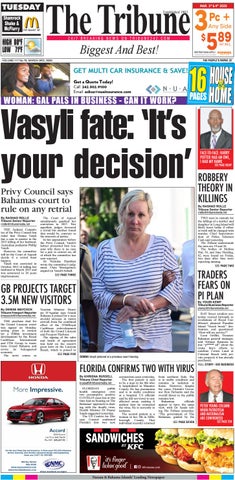
Vasyli fate: ‘It’s your decision’ Privy Council says Bahamas court to rule on any retrial By RASHAD ROLLE Tribune Senior Reporter rrolle@tribunemedia.net THE Judicial Committee of the Privy Council has ruled that Donna Vasyli has a case to answer in the 2015 killing of her husband, Australian podiatrist Phillip Vasyli. However, the committee will let the Court of Appeal decide if a retrial must happen. Vasyli was convicted in October 2015 of killing her husband in March 2015 and was sentenced to 20 years imprisonment.
The Court of Appeal unanimously quashed her conviction in 2017. Two appellate judges favoured a retrial but another found that would be contrary to the interests of justice. In her appearance before the Privy Council, Vasyli’s lawyer presented four reasons why there is no case for a jury to convict on, all of which the committee has now rejected. Sir Nicholas Hamblen wrote the committee’s judgment. Clare Montgomery argued on Vasyli’s behalf. SEE PAGE THREE
Tourism Minister Dionisio D’Aguilar says Grand Bahama is poised for a near six-fold increase in visitor arrivals from the combined effect of the ITM/Royal Caribbean redevelopment of both the Grand Lucayan and Freeport Harbour. The signing of the sales and heads of agreement was held on the resort’s great lawn on the Lucayan Beach, which is poised to SEE PAGE FIVE
FACE-TO-FACE: HARRY POTTER HAD AN OWL, I HAD MY HAWK
SEE PAGE EIGHT
ROBBERY THEORY IN KILLINGS By RASHAD ROLLE Tribune Senior Reporter rrolle@tribunemedia.net
TWO men in custody for the killings of a mother and daughter in Long Island will likely learn today if either or both will be charged with murder, Chief Superintendent of Police Solomon Cash said yesterday. The Tribune understands the men are 19 and 26. The bodies of Melissa Hui, 34, and Jane Harding, 62, were found on Friday, two days after they were reporting missing. SEE PAGE TWO
TRADERS FEARS ON PI PLAN
GB PROJECTS TARGET 3.5M NEW VISITORS
By DENISE MAYCOCK Tribune Freeport Reporter dmaycock@tribunemedia.net THE purchase deal for the Grand Lucayan resort was signed on Monday, setting plans in motion for a $300m investment development by the Royal Caribbean International and ITM Group to transform Grand Bahama and revive its beleaguered economy. The news comes as
HOME
By YOURI KEMP Tribune Business Reporter ykemp@tribunemedia.net
DONNA Vasyli pictured at a previous court hearing.
FLORIDA CONFIRMS TWO WITH VIRUS
By KHRISNA RUSSELL Tribune Chief Reporter krussell@tribunemedia.net
FLORIDA’S public health emergency over two presumptive positive COVID-19 cases has at this time had no bearing on The Bahamas’ approach to dealing with the deadly virus, Health Minister Dr Duane Sands suggested yesterday. The US Centres for Disease Control confirmed Florida’s first two new
coronavirus cases yesterday. The first patient is said to be a man in his 60s who is hospitalised in Manatee County. He has pneumonia and is in stable condition at a hospital. US officials said he did not travel to any affected areas, making it unclear how he contacted the virus. He is currently in isolation. The second patient is a woman in her 20s in Hillsborough County. That individual recently returned
from northern Italy. She is in stable condition and remains in isolation at home. However, despite the cases, Florida’s Governor Ron DeSantis said the overall threat to the public remains low. Bahamian officials appear to have the same view, with Dr Sands telling The Tribune yesterday: “The government of The Bahamas, guided by the
Nassau & Bahama Islands’ Leading Newspaper
SEE PAGE SEVEN
BAY Street retailers yesterday reacted furiously to revelations of Royal Caribbean’s planned Paradise Island “beach break” destination, and questioned: “How will we survive?” Leon Griffin, Treasure Bahamas general manager, told Tribune Business he was “p***** off” about the cruise line’s efforts to combine Crown Land at Colonial Beach with private property it has already purchased. FULL STORY - SEE BUSINESS
PETER YOUNG COLUMN: WHEN PATRIOTISM AND NATIONALISM ARE CONFRONTED
SEE PAGE TEN
PAGE 2, Tuesday, March 3, 2020
THE TRIBUNE
Robbery theory in killings from page one
JANE HARDING
Yesterday, CSP Cash said police believe whoever killed the women intended to rob them but ultimately did not steal anything from their house. Ms Harding’s partially nude body was found on Friday around 10am and Ms Hui’s body was found around 3pm, police said. Ms Hui, 34, worked at the community gas station. She was the breadwinner and her mother, 62, took care of the household needs, washing the clothes, cleaning the house and preparing the meals, residents said. This is the first homicide
in Long Island since 2017. Though murders are rare on the island, the ones that occur are typically gruesome and shocking, happening to people residents least expect. In 2017, Eleanor Dean, 54, was hacked to death. Her husband, Philip Dean, 61, was charged with her murder. In 2015, a retired doctor, Harry Geoffrey Harding, 88, was found stabbed to death in his home. And in 2014, Andrea Carroll, 53, was found dead in her house with her hands and feet bound. There have been 13 murders for the year, according to Tribune records.
MELISSA HUI
WOMAN DETAINED AFTER $80K OF SUSPECTED COCAINE FOUND A WOMAN was arrested at Lynden Pindling International Airport on Sunday after she was found with $80,000 worth of cocaine, police said. The woman, who had
arrived in the country on a flight from Jamaica, was arrested shortly before 2pm. Airport Division officers, acting on information, were at at the customs hall section of the airport when
they conducted a search of the woman’s suitcase. Police recovered two packages of cocaine, which weighed 12 pounds, from her luggage. The woman is expected to be arraigned in
court soon. Police also reported that a man was taken to hospital after he was shot in Grand Bahama on Sunday night. Shortly before 11pm, a man reported that while
at work at a business on Queen’s Highway, he was accosted by three masked gunmen. The gunmen entered his workplace and shot the man in the leg. Police said the man was
able to escape in a company vehicle and call for police assistance. He was seen by a doctor at the Rand Memorial Hospital where his injuries are listed as nonlife threatening.
DEPUTY GOVERNOR GENERAL SWORN IN
LONNIE Emmeline Rolle, former Senator, was sworn in as Deputy to the Governor General by the Hon Senior Justice Estelle Gray-Evans, Acting Chief Justice, during a swearingin ceremony at Government House, Mount Frizwilliam, on Friday. Also present for the swearing in was her husband Cedric Rolle.
Photos: Letisha Henderson/ BIS
THE TRIBUNE
Vasyli fate: ‘It’s your decision’ from page one
The Vasylis were married for 34 years. They lived in the exclusive gated community of Old Fort Bay. The prosecution and defence agreed that Mr Vasyli had an alcohol abuse problem. Among the other facts they agreed on is that on March 23, 2015, Mr Vasyli fell down the stairs while drunk, cutting his back on glass from picture frames as he fell. Later that afternoon the couple entertained three people: Myles Pritchard, Jody Pritchard and Mitchell Matthew. The Vasylis were left alone for about 45 minutes when the guests left. However, at some point Vasyli left her home and went to her daughter’s house. Early the next morning a gardener found Mr Vasyli on the floor of the kitchen at the Vasylis’ residence, dead with a stab wound to his neck. The kitchen gave way to a covered patio behind some patio doors. The gardener arrived by way of the patio where he found blood and a bloody kitchen knife. He opened the locked patio doors with his emergency key to get to the kitchen where he found Mr Vasyli. Lord Hamblen wrote in the judgment that “none of the doors to the house showed any sign of having been damaged or tampered with. Although there were many valuables in the house, nothing had been stolen. Mr Vasyli’s body bore no defensive injuries.” The first officer on the scene found Vasyli in bed, shaking and crying. She allegedly told him she and her husband fought the night before. Small amounts of Mr Vasyli’s blood were found
on the groin area of the blue dress his wife was wearing when police encountered her and blood traces were also found on the front, right sleeve cap of a multicoloured dress found in the room where she spent the night. The prosecution argued Vasyli murdered her husband when their guests left and before she went to her daughter’s home. Their case, based on circumstantial evidence, emphasized how the pair were left alone the evening of the incident, that the knife which appeared to inflict the wound was one of a set of knives kept in the kitchen, that the Vasylis had an abusive relationship, that there was no evidence of an intruder or disturbance within the house and that Mr Vasyli’s blood was found on his wife’s dresses worn around the time he died. Ms Montgomery argued before the Privy Council that there were four fatal weaknesses in the prosecution’s case. The first, she said, was that DNA evidence related to three glasses found on a table on the patio included that of an unknown man, a fact she said undermined the prosecution’s case that Vasyli was the last and only person to see her husband alive. Lord Hamblen, however, said there were countervailing matters for the jury to consider. “…There was no evidence of an intruder,” he wrote. “It was suggested that the blue glass man could have been a guest, but there was no evidence that any guest was due or expected or of anyone being signed in at the front gate. Nor was there any evidence from the CCTV or the security patrol of anyone being seen entering
POLICE IN HUNT FOR LAUNDROMAT ROBBER POLICE on New Providence are seeking the public’s assistance in locating the suspects who tried to rob a laundromat on Sunday. Shortly after 3am Sunday, two armed men entered a laundromat on Charles Saunders Highway and attempted to rob the cashier but was unsuccessful. One of the armed men, while in the laundromat, robbed a woman of
cash and a Bahamian passport before both men escaped on foot. In a later incident, shortly after 5pm, a man was in the area of a liquor store on Alexander Boulevard in Nassau Village, when he was approached by a man armed with a handgun who robbed him of a grey Honda Civic coupe, licence plate number AS1480. Investigations into both incidents are ongoing.
To advertise in The Tribune, contact 502-2394 Since 1892 Bahamians have been protecting the environment with the passage of the Sea Gardens Protection Act, which prohibited dredging or removal of coral, sea fans or other organisms from the seabed.
Donate today to BPAF | 242-698-1152 or 437-2168 | www.bahamasprotected.com
Tuesday, March 3, 2020, PAGE 3
DONNA Vasyli pictured at a previous court appearance. or leaving the property or any other trace of a person being at the property. It was not accepted that the fact that beer bottles were found in the bin showed that the earlier detritus had been cleared away. Mr Pritchard (who, unlike the other two guests, did not give DNA samples) could have drunk beer from the glass. The male DNA found could have been that of Mr Pritchard or left by a visitor from an earlier occasion. In addition, the hypothesis that an unknown male, having arrived after, took a knife from the kitchen and murdered Mr Vasyli, and, before or after the crime, had taken the blue glass from inside, drunk from it and then added it to the detritus left on the table from the earlier gathering, or if it was already there, picked it up from the detritus and used it was so inherently implausible as to be capable of rejection by the jury. In the board’s view, taking the evidence as a whole, the blue glass man as murderer was a hypothesis which a jury could reasonably exclude.” Ms Montgomery also cited the timeline evidence from pathologist Dr Caryn Sands which she said showed Mrs Vasyli was not at home when Mr Vasyli died. In response to a photo showing Mr Vasyli’s right arm position, Dr Sands had testified during the Supreme Court trial that rigor mortis had likely began to set in by the time
the photo was taken. However, Lord Hamblen noted that when Dr Sands was directly asked if she determined his time of death, she said no. “The shifting nature of the appellant’s case highlights its uncertain evidential base,” he wrote. “Whilst part of Dr Sands’ evidence could be said to be consistent with Ms Montgomery’s submission, Dr Sands also said that after four hours you notice rigor mortis and in the next 12 hours it peaks. In any event, all Dr Sands’ timings were approximate. She said in terms that it depended on factors, such as temperature and activity, and that she was only talking about ‘average’ times. What the relevant factors were likely to be in Mr Vasyli’s case was not considered. Nor was there any exploration of what happens after rigor mortis ‘peaks’. “In summary, the appellant’s case on this issue suffers from the fact that it is based on submission and extrapolation rather than evidence. In the Board’s view there are so many uncertainties about the evidence of timing that, taking the evidence as a whole, a jury could reasonably exclude the hypothesis that Mr Vasyli was killed after 9 to 9.10 pm, times that were themselves approximate.” Ms Montgomery also argued that there was no satisfactory evidence that Mr Vasyli’s blood was on Mrs Vasyli’s clothing. She
said an innocent blood transfer could not have been discounted to explain the presence of his blood on the blue dress his wife wore on the morning of March 24, 2015 and on the multicoloured dress found in the room where she had spent the night. Lord Hamblen wrote in response: “Given that this was not an issue at trial and was not raised in the appellant’s written case the board gave permission for the respondent to make written submissions on the issue and for the appellant to respond. Having carefully considered those submissions, the board is satisfied that there was evidence upon which it would be reasonably open to the jury to conclude that Mr Vasyli’s blood was on the dresses. The identification of ‘human/higher primate blood’ on the dresses was made by a forensic biologist, Ms Felicia Blair. The evidence of DI King was consistent with the cuttings being taken from the areas of the dress in which such blood had been identified. The DNA testing was carried out by Ms Samantha Wandzek, whose reports were read. Although she did not state in terms that what she tested was the part of the dress on which blood had been identified, the jury could reasonably infer that this is what she did. Whilst the DNA result did not identify its source, in all the circumstances it would be open to the jury to conclude
that it came from the blood which had been identified.” Ms Montgomery’s fourth argument was that the patio door was locked from the inside, supporting her theory that Mr Vasyli had been attacked on the patio by an unknown assailant and had sought refuge inside the kitchen. However, Lord Hamblen said this attributes an “improbably considered train of thought to a man under lethal attack.” “In so far as Mr Vasyli reasoned the matter through at all, as opposed to operating on instinct, he may well have reckoned that locking the door on the appellant was worthwhile even if it only delayed her. In any event, this is very much a jury point,” Lord Hamblen wrote. It is unusual for the Privy Council to order retrials, Lord Hamblen wrote. “The direction to exercise the power to order a new trial rests with the Court of Appeal rather than the board,” he wrote. “Although the Court of Appeal has indicated how they would be likely to exercise that discretion, that was without the benefit of submissions from the appellant…The board accordingly considers that the issue of whether there should be a retrial should be remitted to the Court of Appeal, whilst emphasizing the desirability that this be dealt with promptly given the delays which have occurred.”
PAGE 4, Tuesday, March 3, 2020
THE TRIBUNE
The Tribune Limited NULLIUS ADDICTUS JURARE IN VERBA MAGISTRI “Being Bound to Swear to The Dogmas of No Master”
LEON E. H. DUPUCH,
SIR ETIENNE DUPUCH,
jamaaltheartist@gmail.com
Publisher/Editor 1903-1914 Kt., O.B.E., K.M., K.C.S.G., (Hon.) LL.D., D.Litt .
Publisher/Editor 1919-1972 Contributing Editor 1972-1991
EILEEN DUPUCH CARRON,
C.M.G., M.S., B.A., LL.B. Publisher/Editor 1972-
Published daily Monday to Friday
Shirley & Deveaux Streets, Nassau, Bahamas N3207 TELEPHONES
News & General Information Advertising Manager Circulation Department Nassau fax Freeport, Grand Bahama Freeport fax
(242) 322-1986 (242) 502-2394 (242) 502-2386 (242) 328-2398 (242)-352-6608 (242) 352-9348
WEBSITE, TWITTER & FACEBOOK www.tribune242.com
@tribune242
tribune news network
A port for all or just for benefit of the cruise lines? THE tensions between different sections of the Bahamian business market have been on show in recent days. Royal Caribbean’s planned beach break destination on Paradise Island has prompted concerns about the company carving out its own extra share of the tourism market at the expense of others. Initially, the Bahamian behind the plan to restore the lighthouse at the end of Paradise Island complained that he was being pressured to accept an “inferior” parcel of land to the one in a lease agreement from just two months ago so Royal Caribbean could be accommodated for its plans. And we can only assume that Royal Caribbean are delighted with the prospect of being handed a prize piece of beach land just a short boat taxi ride away from where their cruise ships pull in. The concern has quickly spread to traders downtown who wonder how can they survive if Royal Caribbean passengers are being pushed towards the company’s own hideaway rather than to spend their money in Bahamian businesses elsewhere. It’s a pattern that we’re seeing regularly now – Disney with its plans for Lighthouse Point, Royal Caribbean’s other site at CocoCay, all seemingly part of a move by cruise lines to keep the visitor business to themselves. They will, of course, argue that they want to provide the best possible experience for their passengers, an experience that is lacking in some of the tourism destinations available at present. But what use is upgrading the port with the goal of helping to revive Bay Street and downtown Nassau, complete with plans for a whole new approach to the waterfront, if no one’s going to be walking through it? As for the Royal Caribbean site on Paradise Island itself, will Bahamians be able to visit? Will it be subject to VAT and business taxes and all the things that rivals for the tourist dime on Bay Street have to pay? Attorney General Carl Bethel says allowing Royal Caribbean to have its own private destination on Paradise Island is essentially a trade-off for the
increased port and tourist fees to pay for the port upgrade – costing $250m – by Global Ports Holding. That begs the question what are the other cruise lines getting as a trade-off, and how much will it cost other Bahamians. When we consider the tourism pot, we think of it as something that everyone can dip into for their share. If cruise lines are keeping the pot to themselves, what is the benefit – apart from fees going into the government pocket – for the rest of the country? Changing the lease agreement a Bahamian has also already received seems inequitable – Prime Minister Dr Hubert Minnis only recently talked about taking the country back from foreign interests, isn’t this an example of taking from a Bahamian for the sake of a foreign interest? What we need is a rising tide to lift all boats – not just Royal Caribbean’s luxury vessel. Visitors come to see The Bahamas, and the whole nation should benefit.
Now the work starts As we raise concern over one development on Paradise Island, we also raise a cheer for Royal Caribbean on another front. The signing of the deal for the Grand Lucayan resort, in association with the ITM Group, and the company’s plans for the development of Freeport Harbour could have a huge affect on tourism in Grand Bahama. Minister of Tourism Dionisio D’Aguilar projects it could mean a near sixfold rise in visitor arrivals. Whatever the final numbers are, this has been a long time coming, and we welcome the deal for one reason more than any other – it’s time to get on with the revival. We wish the new owners the very best, and the greatest speed in completing their plans. Will it prove vindication for the government’s purchase of the Grand Lucayan for $65m? The proof of that will be in the pudding. We hope so, for the sake of the unemployed of Grand Bahama who have suffered too long.
Political pandering EDITOR, The Tribune. CAMPAIGNING for the next scheduled general elections has started in earnest by the major political parties. The DNA seems to have fallen off the proverbial map. So sad but a reality. The FNM and the PLP both have a lot of baggage and must do a lot more to convince voters that either of them has the people’s interests at heart. The FNM is now viewed as arrogant; out of touch and void of a real plan of action for taking the nation forward. The PLP is still reeling from the Christie inflicted turn offs. Fortunately, for the PLP that is, the vast majority of Bahamians appear to have had it with this regime led by the Most Hon Prime Minister. The open pandering by the PM and his team is the eighth wonder of the world. Minnis says that he wants to grant Crown land to Bahamians but that there are not enough qualified land surveyors to prepare appropriate plot
plans! I want to give him the benefit of the doubt, but it is difficult to believe him on this point. If there is a shortage, and I submit that this is not the case in my opinion, all he has to do is to solicit some from Caricom nations like Jamaica where there is an abundance of surveyors. This is a no brainer. Crown land has been and is being used as a political tool by the incumbent administration as has been the case under past administrations. If you are a rabid partisan supporter you will be able, ordinarily, to access some Crown land with little effort. An ordinary Bahamian, however, will languish on the vine while waiting for a simple acknowledgment from the Office of the Prime Minister. The PM, in my view is pandering and is not serious. The PM also said that he’s learned of individuals who were able to access more than 1,000 acres of Crown land while most of you all can’t get a 100’ X 100’. He said that he would get it
back but the PM knows that he cannot unilaterally destabilise a valid Crown Grant. This is political pandering of the highest order. Relative to the unemployment levels, the Most Honourable says that he and his team will reduce the levels to 6% or so within the next year. I pray that his prediction comes true as God knows the ordinary masses need some economic good news. Where, however, will the jobs come from to bring this prediction to pass? Political pandering is a dangerous thing and Dr Minnis will soon discover that he is riding a Chinese paper tiger. The PLP and its stellar leader must come up with realistic alternatives to the lack being demonstrated by the FNM. They must not simply assume that this will be a cake walk. To God then, in all things, be the glory. ORTLAND H BODIE, Jr Nassau, February 26, 2020.
Tough love - is it really love? EDITOR, The Tribune. LAST night in a social setting a video was shown about one of our athletes who has been experiencing the most challenging time one can imagine. While the video was heartbreaking what was most disturbing were the negative comments coming from some of the people in the group. It makes one wonder what happened to us as a people. When did we become so cold and uncaring? I see and talk with him often he wanted me to share his story. As he soared through the air the crowd cheered him on with shouts of “go boy go you gat this one”. When he touched the ground with a record breaking jump he was greeted with hugs and cheers from his coach, family, friends and fans. His name headlined the sports section of every newspaper. And then it happened. One night at a party celebrating his gold medal victory while smoking a joint the champ was introduced to the white lady. On most days you can see him walking between the Esso Service Station and Bamboo Shack on Soldier Road. Sometimes he is pushing a cart but most of the time he is just walking around begging to get something to eat. While some of us respond in a sympathetic way others snub him by either rolling up our car windows or turn up our noses and look the other way. How quickly we forget. Just a few years ago we were at the stadium cheering him on. We used to go to the meets just to watch him participate. Now here we are ignoring and scorning this man whose name was in every track and field fan’s mouth. When cocaine first made its unassuming debut on the party scene in the Bahamas before it hit the streets it was labeled “the chic drug.”
LETTERS letters@tribunemedia.net It was socially acceptable mostly among the elite. So when some young athletes, musicians and other glamorous professionals who had quick rises to fame, were introduced to cocaine’s seductive charm it became the perfect match for an affair. Some were seduced and enamoured by the white lady before they ever reach the top. The outcome of the story is different for each individual. Many managed to free themselves from her embrace and find a way to overcome the addiction and have even helped others get back on track. However, far too often, the story has ended with someone’s career coming to a close at an early stage. Sadly, in some of the more extreme cases, lives are cut short. When you pass him on the streets he looks like someone you know but you are not sure because the person you know who looks like him would never be a street beggar. So you don’t stop because you believe if it is him he could do better. And you are right he could do better but he loves being an addict and would rather beg. He prefers to scrounge through the garbage bins and go to war with the rats over something to eat rather than be some business executive or the track star he used to be. We shuck him out of our lives without looking back. Saying if he wants he can stop his foolishness. He never mentions family and you may ask what about his family. “Right, what about his family? “Well aren’t we all God’s children, isn’t he our brother? “When you’re down and out “When you’re on the street
“When evening falls so hard And pain is all around “I will comfort you “ So we practise tough love. Tough love is supposed to be a strict, but kind way of dealing with someone who has a problem. But more emphasis is placed on tough and not so much on kind. National Institutes of Health noted that “get tough treatments do not work and there is some evidence that they may make the problem worse”. It brings to mind the prodigal son. We all know the story. The prodigal son went off to some distant land and wasted his inheritance. Fell on hard times and even shared swill with the pigs. The brokenhearted father wanting to bring him back home searched all over, but could not find him. So he waited at the street corner praying that his long lost son would return. Our brother who is right on Soldier Road between Esso Service Station and Bamboo Shack....Just a kind word away from our embrace, why aren’t we reaching out to him? We don’t have to go searching for him .Why don’t we bring him home ? This young man, this brother that brought us so much laughter and joy as we cheered him on at the tracks. Will we continue to practise tough love and let him dig through the garbage cans for something to eat until we attend his homegoing celebration where we will tell stories of how great an athlete he was ...Or will we bring him home. “That’s what friends are for “For good times and bad times “I’ll be on your side forever more “That’s what friends are for” ANTHONY PRATT Nassau, March 1, 2020.
THE TRIBUNE
Tuesday, March 3, 2020, PAGE 5
GB projects target 3.5m new visitors from page one be a “world premier tourist destination in the region”. Through this megainvestment, some 3,000 direct and indirect jobs would be created for Bahamians, according to Prime Minister Dr Hubert Minnis. Signing on behalf of the government was Cabinet secretary, Camille Johnson. The purchaser is Holistica Destinations, a joint venture formed between RCI and the ITM Group. Michael Bayley, president and CEO of RCI; Mauricio Hamui, CEO of ITM; and Robert Shamosh, CEO of Holistica Destinations also signed the agreement. The Grand Bahama project is Holistica’s largest development. It comprises two major components – the Lucayan resort property and Freeport Harbour. Mr Shamosh revealed that the hotel property will be transformed into a world-class destination, with water-based entertainment, including a massive water and adventure theme park. Other amenities include a shopping village, that will feature a variety of activities and family entertainment, and a 40,000 sq ft convention centre. The second component involves the redevelopment of the harbour into a new cruise facility, with three new additional berths capable of berthing the largest cruise ships in the world. There will be a harbour village, comprising shopping outlets, restaurants, beach and wellness areas, and a multi-modern transportation hub, with infrastructure for water ferries and ground transportation. Mr Shamosh believes that Grand Bahama will offer “unparalleled experience” in the region, attracting more cruise and land-tourism investments. He said: “This project is about renewal and revival in the face of a natural disaster. This is an opportunity for a new start. Holistica and the government are betting on this project to
THE GOVERNMENT of The Bahamas and Bahamas Port Investments Ltd signed a Heads of Agreement for the purchase of the Grand Lucayan. Prime Minister Dr Hubert Minnis (standing, second right) said the multi-million dollar investment “will go a long way in revitalizing Grand Bahama, with myriad economic and employment opportunities for more Grand Bahamians”. Seated at left are Royal Caribbean International President and CEO Michel Bayley (left) and CEO of ITM Mauricio Hamui, representing the Developer; and at right, Secretary to the Cabinet Camille Johnson (second right) and Director of Investments Candia Ferguson. Standing from left: Minister Iram Lewis, Minister of State Kwasi Thompson, Deputy Prime Minister Peter Turnquest, Dr Minnis, and Minister Dionisio D’Aguilar. Photo: Yontalay Bowe/BIS be the tip of the arrow that will not only be the development of cruise tourism but also boost many investments in Grand Bahama.” For his part, Dr Minnis said the signing marks a “new day” for Grand Bahama after previously failed developments. “This $300m investment will go a long way in revitalising Grand Bahama, with a myriad of economic and employment opportunities for more Grand Bahamians,” he said. “After many false dawns, there is an exciting new horizon for our secondmost populous island and economic centre. “Grand Bahama is at the beginning of a new day. This is even more critical in light of a series of hurricanes over the years, especially
the recent destruction and in some areas of the devastation caused by Hurricane Dorian,’ said Dr Minnis. He believes the benefits to Grand Bahama will be immense, touching various sectors, including tourism, construction, commerce, particularly at Port Lucaya Marketplace, tour operations, as well as increased revenue for the government. “Like many of you, I have seen its (Grand Bahama) ups and downs, its struggles, and its needs. With this major investment and other investments, we are restoring the confidence of Grand Bahama,” Dr Minnis said. Dr Minnis said the government is looking into plans to redevelop the Grand Bahama International airport, which will
require a significant investment. He said the airport facility is vital to building a new Grand Bahama. Mr Bayley said that Grand Bahama will experience major “economic prosperity” due to a tremendous increase of over 2 million visitors a year. “What makes it significant is that…when this project is completed that not only RC, but the cruise industry in its entirety will bring 2.5 million visitors to Grand Bahama every single year,” he said. “Today, around 600,000 tourists come to Grand Bahama, so imagine the economic prosperity that will come with the increase from 600,000 from 2.5 million over the next several years,” he said. “With our partnership
with Holistica, we believe that the redevelopment of Grand Lucayan and the Harbour Village will create a world-class experience for guests and deliver a renewed hope for the rebirth of Grand Bahama, both economically and spiritually. “We are very excited about the potential of this project. And we think it truly would be a transformational project for the creation of a unique destination experience that would be the first in the world, in terms of the totality of its experience.” He is confident that the project will be a success. “I understand over the years there have been a number of instances where projects planned for Grand Bahama have not come
true. Today let’s turn a new page in telling a very different story,” said Mr Bayley. Tourism Minister Dionisio D’Aguilar also said that the sale to Holistica was well worth the wait. He noted that the government faced considerable opposition to acquire the hotel and was castigated for its decision to hold it for a short period of time while it sought a reputable wellfunded purchaser. “Well our plan worked; we purchased it in September (2018) and 18 months later here we are selling it to Holistica Destination. Admittedly, it took a little longer than we had hoped, but Hurricane Dorian was the reason for the delay,” he said. • ‘Near sixfold visitor increase for GB’ - Business
PAGE 6, Tuesday, March 3, 2020
THE TRIBUNE
Parliamentarians seek extension on public disclosures deadline By KHRISNA RUSSELL Tribune Chief Reporter krussell@tribunemedia.net SEVERAL members of Parliament have requested deadline extensions to submit documents disclosing their assets, according to Public Disclosure Commission Chairman Myles Laroda yesterday. The deadline for
disclosing is March 1 each year. However, Mr Laroda explained elected and appointed officials were given until Monday to disclose, as the deadline was a non-business day. However, some officials still have not met the extended deadline and have asked for more time.
Mr Laroda said: “I am unsure how many disclosed but several of them have asked for extensions. We don’t meet again until Thursday so I wouldn’t have a full picture until our board meeting at that time.” Mr Laroda said he intends to write to Prime Minister Dr Hubert Minnis and Leader of the
Opposition Philip “Brave” Davis on Thursday about the status of the disclosures. Early last month, Mr Laroda said officials had shown interest in fully complying with the requirement. “A few weeks ago, I signed off on letters and enclosed declarations to members of Parliament and senators to disclose
their assets of December 31, 2018 and so we await to see what transpires in that period,” he told The Tribune at the time. “I have gotten calls from a few parliamentarians just requesting certain information of what they should do in providing documentary evidence with regards to certain assets. “All of the
parliamentarians submitted their declarations for the year that was outstanding,” he also said when asked about MPs and senators’ compliance with declaring assets. Last year, three members of Parliament requested extra time to disclose assets and liabilities and made their disclosures before the end of an extension period.
RAGGED ISLANDERS FEEL NEGLECTED THREE YEARS ON By LEANDRA ROLLE lrolle@tribunemedia.net
DESTRUCTION on Ragged Island after Hurricane Irma.
NEARLY three years after Hurricane Irma ravaged Ragged Island, many longtime residents there still feel “neglected” and “disappointed” with the lack of progress made to fully restore the island to normalcy. This “blatant” disregard for the island and its residents, according to some locals, is not a new issue, but is a something that has been felt by islanders for several years now. “You know how long Irma hit?” said Rochelle Maycock, a Ragged Island resident. “From that storm, the (prime minister) been over here once and that was it. He wouldn’t even come to see the people of Ragged Island and try say ‘well. let me see what the people of Ragged Island have to say’ because we are a part of The Bahamas. “They can’t even tell you what’s going on in Ragged Island.The government should’ve started something on Ragged Island long time…they neglected us for too long now.” Having lived on the tiny island for some 15 years, Mrs Maycock, said daily living for many is still a struggle. Her husband, Craig Maycock said: “Plenty people over ain’t have nothing to do. Plenty people ain’t even coming back because they ain’t got no house and they ain’t got this or that. “I better off than plenty people because I already get my house together and everything but some people ain’t even get no house.” After the storm devastated the island in September 2017, flattening homes and government buildings, the National Emergency Management Agency (NEMA) deemed the island “uninhabitable.” To help with the redevelopment of the island, Prime Minister Dr Hubert Minnis announced during his national address last May that a new school and teacher’s duplex will be constructed on the island at a cost of $2m. Other developments on the island, he said, will include a new clinic at $2.5m, an administrator’s office, post office and court room at $2.5m and a police station and accommodations for officers for $1m. Still, Mrs Maycock maintains that the rebuilding process has been too slow. “I mean yeah, they’re making progress now (but) I still think they’re too slow. I think they’re too too slow. They need to really move up the process because this really been too long like I said,” she told The Tribune yesterday. “I have two kids. One
16 and one ain’t (in) school but another one is, she only four-years-old and I need that school to be finished for September coming because I ain’t into going Nassau. I want to be over here with her. “…They already started (working) on the school, but they still have other things to do. They have the clinic, the police station (and) they have the local government offices and the post office to finish.” Now with the government’s attention fixed on restoring Grand Bahama and Abaco after Hurricane Dorian, the country’s second and third largest island economies, some fear Ragged Island’s healthcare and governmental services will be pushed aside indefinitely. The small island had a population of 72 in 2010. “They ain’t doing nothing much for us. They ain’t even helping the people here like how they do in Freeport and Abaco,” said Mr Maycock. Another resident, Erica Wallace added: “Yeah, I think they took too long to come and help us because it’s only a small island. We need the clinic and the school but definitely a clinic, but I guess we have to wait and see.” As a part of the government’s plans to further redevelop island, Dr Minnis also said his administration would transform Ragged Island into the “first fully green island in the region.” But, this too has also received criticism from residents. “My thing is why put up a solar plant, if not to make the bill go lower and not to make the bill go higher or stay the same? That don’t make no sense. That’s my thing. Because he is saying that bill won’t go down until they make the whole Bahamas green,” said Mrs Maycock when asked about the matter. “Then the light bill will drop because I was in the meeting when they had it. I thought the whole purpose of the solar plan is the light bill to go down and not go up or stay the same. That’s what I thought.” Dr Minnis recently told American news show 60 Minutes on Sunday his goal “absolutely” remains to convert Ragged Island into a sustainable “green” community, with plans to expand the effort. “After Ragged Island was devastated I made a statement: Let us show the world what can be done. We may be small but we can set an example to the world,” Dr Minnis said on the programme, which aired on Sunday. Asked by 60 Minutes journalist Bill Whitaker if it was his goal to make the island green, Dr Minnis replied: “Absolutely, absolutely. After which we can expand it. We can expand it.”
THE TRIBUNE
Tuesday, March 3, 2020, PAGE 7
Florida confirms two with virus from page one advice of the chief medical officer and the Ministry of Health, is aware of and paying vigilant attention to all the developments. “No changes to our travel restrictions have been made. When they are they will be communicated formally.” This comes as the Ministry of Foreign Affairs urged Bahamians to monitor its regular bulletins and announcements concerning the increasing number of countries and jurisdictions experiencing high risk for exposure to the new strain of the coronavirus. The countries include Italy, Iran and South Korea. The ministry, as a result, advised the public that non-essential travel to these areas is strongly discouraged. Persons who must travel should expect to be routinely screened and tested and, if necessary, quarantined for up to 14 days in those jurisdictions and subject to additional screening on return to The Bahamas. Speaking to this newspaper yesterday, Chief Medical Officer Pearl McMillan said the Florida cases have made the situation a “little but more” concerning. However, she said, The Bahamas has been at risk for some time considering the global picture. There are 89,198 confirmed cases of the coronavirus worldwide with 80,026 of them currently in
AUBREY Holland performs tests at the Bureau of Public Health Laboratories yesterday in Miami, where the COVID-19 virus is being tested at the Bureau of Public Health Laboratories. Photo: Brynn Anderson/AP mainland China. While 45,175 cases are considered as recovered, there have been 3,048 deaths as a result of the virus. She said: “The thing is the risk would have started a while back when we started having cases in a number of countries and in certain countries like in northern Italy and a couple other places. They are having ongoing transmission so when you think about the global picture we are at risk.
“Yes, Florida is at our back door and to some extent a little bit it is more concerning, but we have been at risk…the global picture changed a little while ago when we started having a number of countries (with infections). It’s now 50 plus countries that have cases, so that changed the picture from back then. “If you don’t have to travel to places where they are having active transmission I think it’s about four or five of those places now,
don’t travel if you don’t have to go to those places,” Dr McMillan also said. “If you do travel and if you must travel then you should take the necessary precautions. That’s hand washing, making sure you cover your cough, your sneeze, step away from persons who maybe having respiratory symptoms. “If we practise those things when ayou travel and move about regularly then you decrease the likelihood of you actually getting not
only COVID-19 but influenza and other illnesses.” On Sunday, Prime Minister Dr Hubert Minnis said the government would take no chances with the deadly disease, adding all resources would be used to ensure residents are protected from the disease. He said public health is an absolute priority as he insisted the outbreak was being taken very seriously. The prime minister’s comments came the same day the Caribbean
recorded its first case of the COVID-19: a 62-year-old Italian man who arrived in the Dominican Republic on February 22 without showing symptoms. For now, the Bahamas government is not restricting travel from Italy, but is warning residents against non-essential travel to that country, Iran and South Korea — all countries experiencing outbreaks of the disease. Travel restrictions related to China have been in effect since January 30.
WOMAN ADMITS FORGING NARCOTICS PRESCRIPTION By FARRAH JOHNSON fjohnson@tribunemedia.net
A WOMAN pleaded guilty to forging prescriptions to obtain narcotics from a local pharmacy after being arraigned in Magistrates’ Court yesterday. Tietchka VanderpoolWallace, 54, was arraigned alongside Livingstone Seymour, 54, before Senior Magistrate Carolyn VogtEvans, charged with attempting to commit fraud by false pretence. Vanderpool-Wallace was also charged with being in possession of a forged document, forgery and unlawful possession. She pleaded guilty to all charges against her. Seymour, who was also charged with uttering a forged document, pleaded not guilty for both counts brought against him. His trial was adjourned to May 7 and he has the right to apply to the Supreme Court for bail. According to the facts read by prosecutor Sergeant Kenny Thompson, police were called to Centreville Pharmacy on February 29 after Seymour attempted to fill a fraudulent prescription. Seymour was then arrested and taken to the Wulff Road Police Station. On the same day, Vanderpool-Wallace came to the Wulff Road Police Station to inquire about Seymour. According to the prosecutor, she was arrested for fraud after Seymour pointed her out as the person who gave him the prescription to fill. While searching Vanderpool-Wallace’s vehicle, police discovered a Princess Margaret Hospital (PMH) prescription pad along with a prescription in the name of Mable Walker dated February 29, 2020. When later interviewed by officers in the presence of her attorney, Vanderpool-Wallace admitted to writing the prescription
herself. She further admitted to stealing the prescription pad from PMH where she wrote both medical prescriptions and asked Seymour to help her fill the prescription. Vanderpool-Wallace was subsequently charged for the offences. Noting that Vanderpool-Wallace has no previous convictions or pending matters, her attorney asked the judge to be lenient when imposing any penalties. The defence attorney also said the incident was a result of VanderpoolWallace’s mental health issues and said that she was trying to fill the prescription for personal use and not to sell the drugs. According to her counsel, Vanderpool-Wallace suffers from clinical depression, was a former patient of Sandilands Rehabilitation Centre (SRC) and pays regular visits to a psychiatrist for mental issues. She explained that Vanderpool-Wallace had an addiction to opioids and tried to obtain drugs her psychiatrist no longer prescribed for her. Stating that her client was remorseful and didn’t waste the court’s time, she asked the judge to allow Vanderpool-Wallace to receive medical help, even if she has to be readmitted to SRC. In response, Magistrate Vogt-Evans said she would give the defence an opportunity to provide Vanderpool-Wallace’s medical records. For her part, Vanderpool-Wallace said she was committed to change and being upfront with her medical issues. She was remanded in custody and will return to court on March 9 at 10am to be sentenced. Members of VanderpoolWallace’s family, including her husband former Minister of Tourism Vincent Vanderpool-Wallace, were in court to support her yesterday.
TIETCHKA VANDERPOOL-WALLACE
LIVINGSTONE SEYMOUR
PAGE 8, Tuesday, March 3, 2020
THE TRIBUNE
Harry Potter had an owl, I had my Hawk WHEN I was a high school student attending St Augustine’s College (SAC), I met Alpheus “Hawk” Finlayson. He is an alumni and remains active in the lives of some of the students who came after him. I am one of them. From that time until now, he still checks up on me. During my school days, any time I would win a speech or debate competition, or excel in any sport, a message would come across the PA system: “Felicity Ingraham please report to the front office.” There, I would pick up the phone and he would be on the line with words of encouragement. Back then as a teenager, I couldn’t understand why he would take the time to call me. It was not until many years later I realised how special it was that he made such a gesture over and over for years while I was in school. When we crossed paths later on, he got my cell phone number and made use of it from time to time, checking up on me and my family. This is a testament of a man who truly cares for others. My story is one that can be reiterated by many, and the fact he has been able to touch so many lives just by showing genuine care and concern for others is an indication of how big his heart truly is. To meet Hawk is to meet a man with dignity. His diction is excellent, his voice is distinctive and he always has something positive to say. The St Augustine’s Alumni Association honoured him with the 2018 Lighthouse Spotlight Award for his own accomplishments as well as for
ALPHEUS and his wife, Dawn.
Face to Face
By FELICITY INGRAHAM
pouring into so many the Bahamas Track Meet in SACers along the way. December 1960, where he Alpheus was outstand- ran the 800-metre race, won ing from birth. He was the by Alec Hanna. apple of his father’s eye “St Bernard’s was on because he was born after Boyd Road, and the Priest ten years of marriage. He in charge was Father Marwas born in Nassau in 1947 cian Peters, called the to Alpheus Alexander Fin- ‘Sporting Priest’… I purlayson of Mangrove Cay, chased my first pair of track Andros, and Diana (nee shoes from him,” Alpheus Deveaux) of Moss Town, recalls. Exuma. Diana had three He also remembers children prior to the mar- purchasing his very first riage, so Alpheus did have sweatshirt for running. He siblings. He grew up in the bought it from Artie Notcentral area of tage, who had a New Providence shop at the south known as “The ‘Back in end of Christ Valley”. Church Cathethe 1960s, During his black wasn’t dral, Downtown, early years, he Nassau. It was a attended Sands beautiful. proud moment School with So I chose for him, and he people like Jun- the Hawk had to decide kanoo icon Percy what name he “Vola” Francis, Man… and would put on this former Central I was Hawk shirt. Bank Governor ever since.’ His running James Smith and prowess would entertainer Ray be defined by Munnings. He went on this name. Back then, to attend Eastern Junior comic books were all the School in Palmdale. He rave. First, he thought of ran track and field and had the superhero Flash, but schoolmates like former decided against in. Then, he Parliamentarians Leslie considered Black Hawk. Miller and Malcolm Adder“Back in the 1960s, black ley, who were both great wasn’t beautiful,” he said, 400-metre runners. Alpheus “So I chose the Hawk went on to attend SAC Man… and I was Hawk where he continued to nur- ever since.” ture his passion for running. Hawk found a lot of joy in He graduated in 1966. running. His coach, Charley He started running with Wright, had great influence St Bernard’s Club in 1960. on his life: “Whenever I His very first race with the came home from club meetclub was at the Friends of ings, I would tell mama,
ALPHEUS “Hawk” Finlayson and, pictured right with his siblings Roosevelt, Spence and Viola. Alpheus is on the left of the photo. ‘Coach said do this or don’t do that!’ Mama said, ‘Who is this man anyway?’ I understood the persuasion coach has over athletes.” That may be a skill he picked up along the way because in his latter years, he had a way of persuading young people into doing positive things and making the best of themselves. He also set a good example for others to follow. After SAC, he went on to attend St John’s University in Minnesota, where he obtained a Bachelor of Arts degree in mathematics. He is a financial services representative for Colina Insurance and is lauded as a “tried and trusted” professional in the industry. Also known as “Policy Man”, Alpheus has delivered stellar service to numerous clients in the Life and Health Insurance industry since November of 1980, when he began his insurance career with Imperial Life Assurance. He first qualified for the industry’s prestigious Million Dollar Round Table in 1982 and subsequently qualified five consecutive times, making him a life member. He once served as Vice President of the Life Underwriters Association of The Bahamas. Ambassador A Missouri Sherman-Peter, Permanent Observer of the Caribbean Community of the United Nations recalls the days when “Policy Man” would frequent her neighbourhood. “He always took the time to speak to each client about family life in general” she said. “As my contemporary representative, Alpheus kept an enthusiastic interest in his client, always encouraging me to re-imagine my
insurance and financial needs and providing sound advice on options, from term insurance to retirement planning, to securing and protecting myself, my family and my assets.” Dr Judson Eneas shared: “When I returned home from university in 1986, Alpheus invited me to speak at the West Nassau Rotary Club. He immediately approached me as he knew I was ready to begin a medical practice here in The Bahamas. Upon arrival, I was already married and had three young children. Over the years, I have educated all three children, developed a medical practice and built my dream home. Throughout all this, Alpheus Finlayson had been my insurance agent and has ensured I have been adequately insured throughout all phases of my development. I have enjoyed a beneficial relationship with him.” Alpheus’ love for Rotary began in 1982. He is a past president of the West Nassau Club, and he received the Paul Harris Fellowship in 1994 for his service to Rotary. He now bears the distinction of an honorary Rotarian. Throughout his life pursuits, Alpheus never stopped running, while being an advocate for track and field, which he refers to as “the queen of Olympic sports”. He served as co-captain of the St. John’s University Track Team, President of the Pioneer’s Sporting Club, and of the Bahamas Amateur Athletic Association from 1989 to 1997. He was also elected Vice President of the Central American Central American and Caribbean Athletic Confederation as well as Vice President of the North American, Central American, and Caribbean Area Athletic Associations. He had a euphoric year as Bahamas Amateur Athletic Association (BAAA) president in 1992, when the first Bahamian Olympic medal in track and field was won. That year, triple jumper Frank Rutherford captured a bronze in Barcelona, Spain. Alpheus also presided over the organisation in 1995 and 1997 when the first three World Championship medals were won. Alpheus made history
when he became the first Bahamian elected to the 27-member Council of the IAAF, the World governing body of track & field. He also bears the distinction of being the only Bahamian to attend every IAAF World Championship, from Helsinki in 1983 to London in 2017. He is a Director of Marathon Bahamas and of the Bahamas Athletic Foundation. He bears the honor of being a National Sports Hall of Fame inductee. His book From Vancouver to Athens: Finlayson Fifty Years of Bahamian International Track & Field Competition is a best-seller. Alpheus has also authored weekly columns on “Track World” from 1980 to 1986 in The Tribune. He produced a television show on ZNS called Track World with Alpheus Finlayson and has written international newsletters with the same name. Since February of 2013, he has hosted the weekly radio show Track World with Alpheus Finlayson on Guardian Radio 96.9 FM. This weekly radio show is one of the few in the world dedicated to track and field. Pioneering is a part of Alpheus’ make up. In addition to being a leader in his profession and in his beloved sport, he is a founding member of the local chapter of Sigma Pi Phi Fraternity, the first black Greek letter fraternity founded in 1904 in Philadelphia, USA. For his community building activities, Alpheus has received many accolades, including the RE Cooper Meritorious Award and the Kingdor National Parkinson Foundation Award. He puts just as much gusto into his family as he does every other aspect of his life. He is married to Dawn Finlayson (nee Rolle). They have one daughter, Alexis Hanna; three granddaughters, two grandsons, and two greatgranddaughters. His family worships at St George’s Anglican Church back in his stomping ground in the Valley. He is proud of his elder siblings Roosevelt, a management consultant; Spence, a motivational speaker and author; and Viola Adderley-Wimbish, who has resided in Connecticut since 1948.
THE TRIBUNE
Tuesday, March 3, 2020, PAGE 9
INSIDE the Straw Market prior to its temporary closure.
Photo: Terrel W Carey Sr/Tribune Staff
Straw Market opening was ‘delayed at vendor request’ By FARRAH JOHNSON fjohnson@tribunemedia.net THE Straw Market Authority was “fully prepared” to open the Straw Market as scheduled but did not do so at the vendors request, according to Works Minister Desmond Bannister. On February 13, the SMA issued a letter notifying vendors that it and the Ministry
of Public Works would close the market from February 22-29 to carry out maintenance and repairs. At the time, vendors criticised Mr Bannister and the SMA for only giving them nine days notice of the market’s closure without consultation. Some vendors also expressed concerns over the uncertainty of when the market would re-open.
ROBBERY SUSPECT ESCAPES FROM POLICE STATION A MAN who was being questioned by police in connection to an armed robbery investigation escaped from the Carmichael Road Police Station on Sunday night, police said. According to police, Tomal Bowe, 28, of McKinney Drive was assisting police with an investigation when he escaped from lawful custody shortly after 7pm. A bulletin issued by the Royal Bahamas Police Force described him as having a light brown complexion and being slim built. Chief Superintendent Bruce Arnett, of the Carmichael Road Police Station, was unable to give details about the incident until he was fully briefed, but said this was the first time the station experienced someone escaping while in custody. However, he expressed confidence about the station’s security. “Our station is equipped
to secure any suspect but from time to time you know there are things that go wrong and like I say we’re in the process of establishing what went wrong and as soon as we’re in a position to speak candidly to that, we’ll speak candidly to it,” CSP Arnett said. Last year a prisoner escaped from the Department of Correctional Services but was captured and returned to the Fox Hill compound a short time later, officials said. In early 2016, murder convict Ormand Leon escaped a police bus taking him to the correctional facility causing an islandwide police manhunt. Leon was captured two weeks after his escape. A few suspects, including an accused murderer, escaped police custody at Princess Margaret Hospital in 2012.
To advertise in The Tribune, contact 502-2394
On Sunday, Rev Esther Thompson, president of the Straw Business Persons Society (SBPS), told The Tribune vendors decided to have the market closed for an additional week so that workers could complete their repairs, since only half of the stalls were renovated. Still, Mr Bannister insisted yesterday the SMA was “fully prepared” to open the market as
originally scheduled “on Saturday past”. He sent The Tribune a copy of two separate letters addressed to SMA Chairman Kelli Ingraham, which showed members of the SBPS and the Straw Vendors Advancement Association (SVAA) asking the SMA to “continue with its repairs to stalls”. Both of the letters were sent on February 28 and
stated the organisations agreed and accepted the “Bay Street Straw Market would have to be closed for an additional week.” “We, on behalf of vendors will be grateful if the authority continues with the repairs to the Bay Street market,” the letters read. “We agree and accept that the Bay Street market will now re-open on Saturday 7 March, 2020 at 6am.”
The SBPS’s letter was signed by Rev Thompson and the society’s two vice presidents, while the letter from the SVAA was signed by the association’s president, Celestine Evans. Last month, Mr Bannister said it was necessary to close the Straw Market so that officials could address health and safety issues such as corroded pipes and a termite infestation.
PAGE 10, Tuesday, March 3, 2020
DISSENTERS NEED TO BE HEARD
ON a related subject, a startling headline in the UK press caught my eye the other day – ‘Nation is losing faith in universities due to their sneering attitude to patriotism…’ The article went on to highlight fat cat pay packets and grade inflation as well, but it was the patriotism reference that interested me. The body of the piece was about a report by the respected Policy Exchange think-tank saying that universities must show ‘they speak for and reflect the whole nation’ and leaders in academia should avoid being the voice of critics who actively despise those who have traditional views of patriotism, family, morality, faith and local customs. My initial thought was this might just be the first chink in the hitherto impenetrable armour of political correctness. So could the tide be turning, since the evidence suggests that in our higher institutions of learning – not only in Britain but also in the US – genuine debate about controversial issues that do not pass the politically correct test is being stifled, with students being told what to think by left-leaning lecturers pursuing their own political agenda based on a progressive ideology. Some term it socialist brainwashing which is so effective that the students likewise become aggressively intolerant of opposing views and secure the banning of outside speakers expressing opinions on controversial subjects - or, at worst, inciting violent demonstrations that make such speakers withdraw on safety grounds. But such action is, in effect, a contradiction of what higher education is all about; namely, being exposed to all sides of the debate so that students can make up their own minds on an issue. Generally, schools are for education, polytechnics (like BTVI here in The Bahamas) are for skills training while the role of a university should be to guide and encourage students to explore subjects through study and research and develop the ability to think critically and objectively in forming their own opinions. To achieve that, an intelligent person needs to listen to alternative or conflicting views and counter arguments. People should be able to attend university to develop their intellectual capacity to decide what to stand for; and, in order to do that, they must listen to others even if they conclude subsequently that they disagree with them. So universities should not shy away from uncomfortable new ideas and free speech. Rather, they should encourage provocative debate and the development of thinking skills and stop indulging in political liberal propaganda while suppressing opposing views. Another dimension of this is that in many aspects of life today’s heresy is often tomorrow’s orthodoxy. So dissenters need to be heard because society is constantly changing and it might just be that they have a point but are ahead of their time. It must also be remembered that to ensure robust mental health students need to learn how to deal with the challenges of controversial views, bigotry and extremism because that is what they will have to face in the tough real world.
THE TRIBUNE
When patriotism and nationalism are confronted THE alarming events over the last few days concerning Syrian refugees passing through Turkey in large numbers and trying to enter European Union countries like Greece and Bulgaria hit TV screens over the weekend. As the numbers grow and violence has broken out - with the Greek authorities using force to prevent migrants crossing the border - I am prompted to follow up my piece in this column last week about Germany and mass migration to Europe. The latest developments could rapidly turn into a major crisis. For those unaware of the circumstances, last week there was an attack by Syrian government forces that led to 33 Turkish troops being killed. Turkish President Erdogan then announced his government had now ‘opened the doors’ and were allowing Syrian and other refugees to cross Turkey and try to enter neighbouring countries after having previously prevented them from doing so under a financial aid agreement with the EU in 2016. In response, Greece has already stopped about 10,000 migrants and large numbers are trapped in a noman’s-land between the two countries’ borders. Reportedly, some are managing to cross into Greek territory, particularly landing on the island of Lesbos, which has already been handling large numbers of refugees including many from North Africa. But more and more are arriving at the Turkish/Greek border in the knowledge that once they are inside an EU country there are no more borders. Looking at all this made me reach to my bookshelves for a bestselling work, first published in 2017, entitled ‘The Strange Death of Europe
The Peter Young column – Immigration, Identity, Islam’. The author, right-wing journalist and commentator Douglas Murray, paints a picture of a Europe in crisis through its self-destruction by permitting uncontrolled mass migration to the continent. The right-of-centre Daily Telegraph in London commented that his overall thesis - that a guilt-driven and exhausted Europe was playing fast and loose with its precious modern values by embracing migration on such a huge scale - was hard to refute. Such migration was partly inspired by the Schengen Agreement in 1995 that created a border-free zone for virtually the whole of Europe. So, Germany’s acceptance of 1.5 million refugees from the Middle East in 2015 opened wide a door that was already ajar. An important element in the controversy surrounding immigration is the role of EU member countries in pursuing their own policy so it is worth examining the existence of the nation state together with
A BABY cries as migrants arrive at the village of Skala Sikaminias, on the Greek island of Lesbos, after crossing on a dinghy the Aegean sea from Turkey on Monday, March 2. Photo: Michael Varaklas/AP the related issues of patriot- and nationalism on the state. The former means loyalty ism and nationalism. In his weighty book about and devotion to - and vigChina published in 2012, US orous support of - one’s former Secretary of State, own country, together with Henry Kissinger, talks of the a sense of pride, affection medieval structure of Europe and attachment, resulting in dissolving in the 16th and a willingness to work for it 17th centuries into a group of and defend it. This means a states of approximately equal person views one’s own counstrength and the emergence try as the best in the world of the concept of sovereignty without feeling a compulsion becoming the basis of inter- to force it in any way on to other people. national law and diplomacy. Nationalism, on the other So, from the Treaty of Westphalia in 1648 until hand, is a more unforgiving about the end of the 20th cen- form of allegiance to one’s tury the nation state - with country with a strong national large groups of people shar- identity based on a belief that ing customs and speaking it is superior to others, and the same language gathering that can lead to a desire to together to form independ- impose its will on them. In his ent and unitary states - was famous essay on the subject, generally regarded as the best George Orwell of ‘1984’ and structure for constitutional ‘Animal Farm’ fame noted order and the protection of patriotism is of its nature defensive, both militarily and liberal rights. But certainty about this culturally, whereas nationgradually declined - as evi- alism is inseparable from denced, for example, by the desire for power for the remarks about the EU by nation to which one belongs, Chancellor Kohl of Germany and that can include aggreswho, in 1996, insisted dis- sion towards other countries. European integration solution of European nation states and combining them is based on the idea that into one large integrated nationalism is the worst of political union was essential all political ideals, and the founding principle in order to solve the problems EU’s of the 21st century. Moreover, is that nationalism creates there is a school of thought war. Some people question that maintains the nation that proposition - unless it is state has changed in modern placed in some sort of contimes and should become a text - because in modern formal association capable times it is ideologies like fasof accommodating others cism, communism and Islamic from outside traditional fundamentalism that have borders and with diverse caused the worst wars; though fascism in Germany, which ways of life. Of course, not all began as a response to devasagree with that; and, for tation and economic collapse instance, one of the rea- after the First World War, sons why the UK left became a form of extreme the EU was that many nationalism. Europe remains divided Britons thought uncontrolled immigration had a on the issue of immigration negative effect on public with Hungary and others, for services and housing example, opposed to anything because of overcrowding that weakens nation states as well as harming the which need to be protected from mass migration in order nation’s sense of identity. As for patriotism and to uphold European values. nationalism, the two Thus, this latest crisis on the cannot be used inter- Turkish/Greek border prechangeably for they sents the EU with yet another have taken on differ- serious problem in connecent connotations and, in tion with the issue. Observers practice, there is a world can only hope that wise heads of difference between will prevail before it develops them. Broadly, patriot- into another humanitarian ism focuses on people disaster.
AFGHANISTAN - ANOTHER FALSE START? DESPITE the constraints of space, I should like to comment on the peace deal the US signed with the Taliban last week in Doha aimed at ending the 18-year war and setting the stage for peace talks involving all Afghan factions. In the aftermath of the 9/11 attacks in 2001, few could quarrel with the US-led invasion of Afghanistan and the overthrow of the Taliban which had provided a base for Osama bin Laden and Al-Qaeda. Britain participated on the basis that it was better to fight terrorism at its source rather than on the streets of Western capitals, though this justification later lost credibility when it was discovered after the terror attacks in London in 2005 - and in subsequent similar violence over the years – that this terrorism was largely home-grown insofar as most of the perpetrators were UK citizens. In 2014, the UK ceased all combat operations aimed to dismantle Al-Qaeda and to deny it a safe base for its activity. Now, Britain is part of the NATO-led International Security Assistance Force whose task is to help the new government by training Afghan armed forces and police. To cynics, the new peace agreement is unlikely to
succeed because they doubt whether the Taliban can be trusted to fulfil its commitment under the terms of the deal to prevent the country from being a launch pad for terror attacks on the US or its allies. But if its commitment is honoured – though it may be difficult to monitor this – US troops will be withdrawn. Other critics regard the deal as a foreign policy gamble that gives the Taliban, which now holds sway over half the country, international legitimacy; and a warning sign already is the reported refusal by the Afghan President to release Taliban prisoners in advance of the coming peace talks. Despite all this, the US remains hopeful the deal will turn out to be the best opportunity for peace in a generation. As for Britain, one wonders whether busy policy makers really learn from history and the AngloAfghan wars of the 19th century together with the ultimate failure of the Soviet Union’s invasion of Afghanistan in 1979 - and, as outsiders, do they fully appreciate the extreme difficulty of ever establishing a stable and functioning state in the hostile and dangerous environment of one of the least developed countries in the world?
THE TRIBUNE
Tuesday, March 3, 2020, PAGE 11
LESSONS THAT ADDED UP TO THE LIFE OF NASA MATHEMATICIAN KATHERINE JOHNSON By DELLA DUMBAUGH Professor of Mathematics, University of Richmond KATHERINE Johnson, an African-American mathematician who made critical contributions to the space programme at NASA, died on February 24 at the age of 101. Johnson became a household name thanks to the celebrated book “Hidden Figures: The American Dream and the Untold Story of the Black Women Mathematicians who Helped Win the Space Race”, which later became a movie. Her legacy provides lessons for supporting women and other under-represented groups in mathematics and science. As a historian of mathematics, I have studied women in that field and use the book “Hidden Figures” in my classroom. I can point to some contemporary ideas we can all benefit from when examining Johnson’s life. 1. Mentors make a difference Early in her life, Johnson’s parents fostered her intellectual prowess. Because there was no high school for African-American children in their hometown of White Sulphur Springs, West Virginia, the family relocated to Institute, West Virginia, during the school year. Johnson entered West Virginia State College High School as a pre-teen and enrolled at the age of 14. While at West Virginia State, Johnson took classes with Angie Turner King. King taught at the laboratory high school while she worked to become one of the first African-American women to earn masters degrees in math and chemistry. She would go on to earn a PhD in math education in 1955.
King taught Johnson geometry and encouraged her mathematical pursuits. Thirteen years older than Johnson, she modelled a life of possibility. Johnson graduated from West Virginia State College at the age of 18. While there, she had the good fortune to learn from WW Schieffelin Claytor, the third African American to earn a PhD in mathematics in America. Claytor encouraged Katherine to become a research mathematician. In the 1930s, a little over 100 American women counted themselves as professional mathematicians. 2. High school mathematics adds up Once Johnson completed the standard mathematics curriculum at West Virginia State College, Claytor created advanced classes just for her, including a course on analytic geometry. Mathematics concepts build on one another and the mathematics she learned in this class helped her in her work at NASA many years later. She used these analytical skills to verify the computer calculations for John Glenn’s orbit around the earth and to help determine the trajectory for the 1969 Apollo 11 flight to the moon, among others. 3. Grit matters Long before psychologist Angela Duckworth called attention to the power of passion and perseverance in the form of grit, Katherine Johnson modeled this stalwart characteristic. In 1940, she agreed to serve as one of three carefully selected students to desegregate West Virginia University’s graduate program. She also had to be “assertive and aggressive” about receiving credit for her contributions to
research at NASA. In 1960, her efforts helped her become the first African-American and the first woman to have her name on a NASA research report. Currently, the NASA archives contain more than 25 scientific reports on space flight history authored or co-authored by Johnson, the largest number by any African-American or woman. 4. The power of advocating for yourself When NASA was formed in 1958, women were still not allowed to attend the Test Flight briefings. Initially, Johnson would ask questions about the briefings and “listen and listen”. Eventually, she asked if she could attend. Apparently, the men grew tired of her questions and finally allowed her to attend the briefings. 5. The power of a team In 1940, Johnson found herself among the two percent of all African-American women who had earned a college degree. At that time, she was among the nearly 60 percent of
those women who had become teachers. Later, she joined the West Computing Group at Langley Research Centre where women “found jobs and each other”. They checked each other’s work and made sure nothing left the office with an error. They worked together to advance each other individually and collectively as they performed calculations for space missions and aviation research. 6. The power of women advocating for women Although Johnson started as a human computer in the West Computing Group, after two weeks she moved to the Maneuver Load Branch of the Flight Research Division under the direction of Henry Pearson. When it was time to make this position permanent after her six month probationary period, Dorothy Vaughan, then the West Computing department head and Johnson’s former boss, told Pearson to “either give her a raise or send her back to me”. Pearson subsequently offered Johnson the position and the raise.
7. The legacy of possibility In March of 2014, Donna Gigliotti, producer of Shakespeare in Love and The Reader, received a 55-page nonfiction proposal about African-American women mathematicians at NASA in Hampton, Virginia. “I kind of couldn’t get over the fact that this was a true story and I didn’t know anything about it,” Gigliotti confessed. “I thought well, this is a movie.” Gigliotti’s hunch ultimately led to the movie “Hidden Figures” and an entire generation of young people learning about the possibilities of math and science. The US State Department showed Hidden Figures throughout the developing world to encourage girls and women to consider the possibilities of careers in math and science. Mattel created a Katherine Johnson Barbie in its “Inspiring Women” series to celebrate “the achievements of a pioneer who broke through the barriers of race and gender.” • First published on theconversation.com