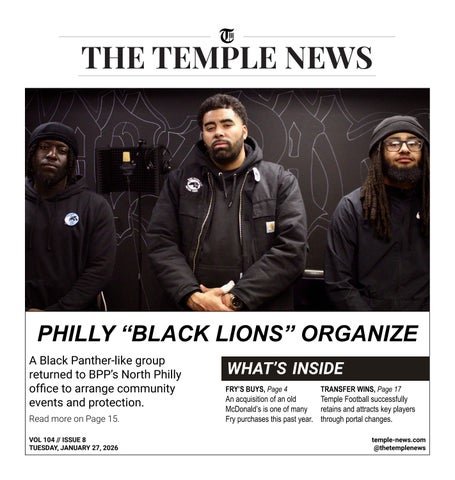
A Black Panther-like group returned to BPP’s North Philly office to arrange community events and protection.
Read more on Page 15.
FRY’S BUYS, Page 4
An acquisition of an old McDonald’s is one of many Fry purchases this past year.
TRANSFER WINS, Page 17
Temple Football successfully retains and attracts key players through portal changes.
Sidney Rochnik Editor-in-Chief
Valeria Uribe Managing Editor
Anna Augustine Managing Editor
Ryan Mack Chief Copy Editor
Bradley McEntee Chief Copy Editor
Nathan Horwitz Co-News Editor
Connor Pugh Co-News Editor
Clarissa Jett Assistant News Editor
Ashley Nteff Opinion Editor
Logan Thompson Assistant Opinion Editor
Madelynne Ferro Features Editor
Chloe Pabon Assistant Features Editor
Sienna Conaghan Co-Sports Editor
Colin Schofield Co-Sports Editor
Jacob Moreno Assistant Sports Editor
Leah Duffy Investigative Editor
Tellicia Walker Investigative Reporter
Julia Anderson Director of Audience Engagement
Nathaniel Thrush Co-Community Engagement Coordinator
Kayla McMonagle Co-Community Engagement Coordinator
Isabella Farrow Audience Engagement Editor
Nalani Chiles Audience Engagement Editor
Brian Nelson Photo Editor
Lillian Prieto Assistant Photo Editor
Aidan Gallo Assistant Photo Editor
Jeremy Shover Multimedia Editor
Dylan Castelluccio Assistant Multimedia Editor
Massah Johnson Print Design Editor
Daniya Eggleston Graphic Design Editor
Chili Ramgolam Data Editor
Ariana Droz Podcast Editor
Sage Spohn Newsletter Editor
Nadia Bodnari Web Editor
Maria Lombana Advertising Manager
Aaliyah Abdur-Rashid Advertising Manager
Calista Aguinaldo Business Manager
The Temple News is an editorially independent weekly publication serving the Temple University community.
Unsigned editorial content represents the opinion of The Temple News.
Adjacent commentary is reflective of their authors, not The Temple News.
The Editorial Board is made up of The Temple News’ Editor-inChief, Managing Editors, Chief Copy Editor, Deputy Copy Editor, News Editor and Opinion Editors. The views expressed in editorials only reflect those of the Board, and not of the entire Temple News staff.
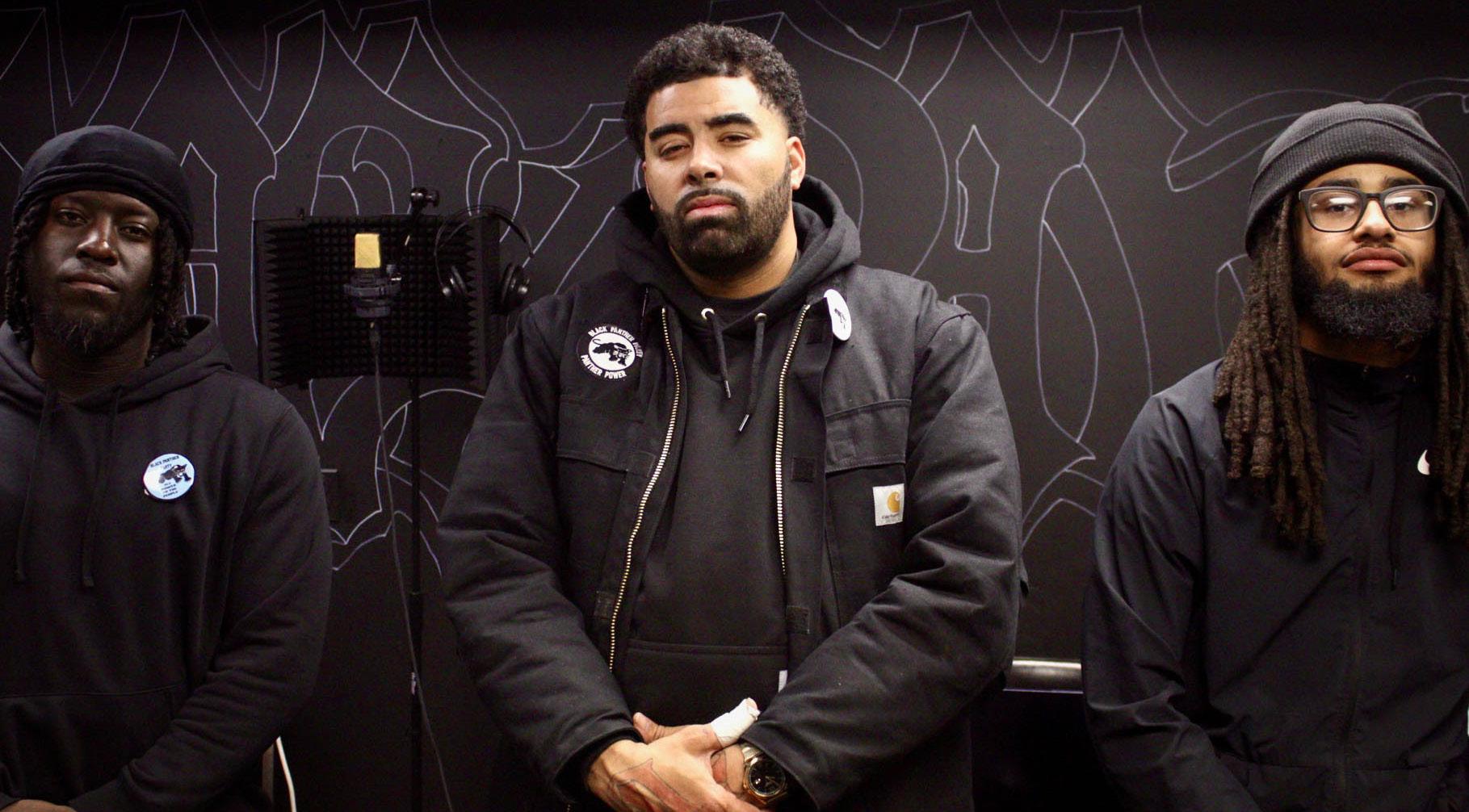
ON THE COVER PAUL BIRDSONG STANDS WITH FELLOW BLACK LIONS.
SAMAJ SCHELL / THE TEMPLE NEWS
Visit us online at temple-news.com
Email section staff ttnnews@temple.edu ttnopinion@temple.edu ttnfeatures@temple.edu tnsports@temple.edu
The Temple News is located at: Student Center, Room 243 1755 N. 13th St. Philadelphia, PA 19122
Accuracy is our business, so when a mistake is made, we’ll correct it as soon as possible. Anyone with inquiries about content in this newspaper can contact Editor-in-Chief Sidney Rochnik at sidney.rochnik@temple.edu.
ADMINISTRATION
Temple is planning how to integrate The Library Company of Philadelphia as they merge.
BY NATHAN HORWITZ Co-News Editor
Temple is preparing to merge with The Library Company of Philadelphia, following affirmative votes from the Board of Trustees and The Library Company’s shareholders in December.
The merger, which awaits approval from the Pennsylvania Attorney General’s Office and the Philadelphia Orphan’s Court, would expand Temple’s collections of rare art and printed materials and could create opportunities for experiential learning and academic programs.
The Library Company, an independent research library founded by Benjamin Franklin in 1731, houses nearly one million books and printed materials, most of which focus on the American colonial period to the late nineteenth century. The LCP also houses photographs, art, manuscripts, broadsides and ephemera not in circulation.
The company would be renamed The Library Company of Philadelphia at Temple University, a division of Temple Libraries, The Temple News previously reported.
LCP’s collections will add to Temple Library’s more than four million physical and digital titles. The collections offer historical items that predate much of the material in Temple’s urban archives at the Special Collections Research Center, which primarily cover 20th century and modern history.
“This will allow us to have a more formal relationship, particularly with the academic programs at Temple,” said Rachel D’Agostino, curator of printed books at The Library Company. “They’ll hopefully get to know a lot more about what we have.”
LCP’s graphic arts collection includes a first edition copy of Thomas
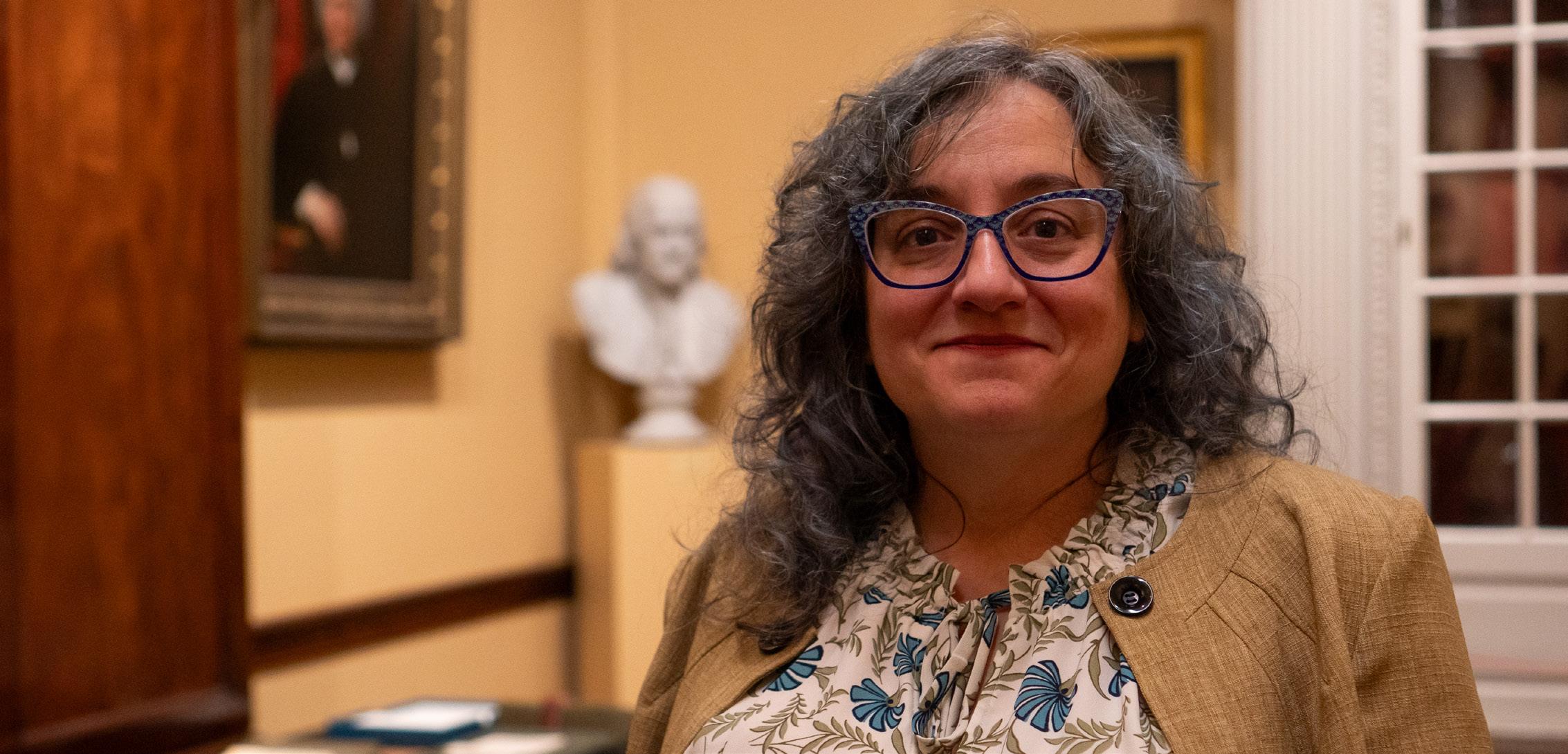
D’Agostino,
Paine’s “Common Sense,” Cotton Mather’s 1692 defense of the Salem Witch Trials, 17th century midwifery books and early examples of photography and lithography.
“There’s no experience more powerful than touching or being in the physical presence of these objects that were contemporary to certain [historical] events,” Lucia said.
Temple hopes the LCP building can eventually serve as a meeting space for classes, with the location on Locust near 13th Street close to the subway. It is also around the corner from Terra Hall, the University of the Arts’ largest instructional building that Temple purchased in February 2025 to serve as the heart of its Center City campus.
Jess Roney, who is helping lead the effort to integrate the institutions, thinks the merger will create more direct learning opportunities for Temple students. She hopes the collections can overlap with a wide variety of academic programs, not just English and history.
President John Fry will be appoint-
ing members to an integration council that Roney will chair which will decide long-term plans for the partnership. In the meantime, key representatives from Temple and The Library Company are meeting weekly to discuss the integration process.
“We’re trying to put as much in place as we can so that whenever the merger is complete, we can transfer into the Temple system and become part of that world as quickly as possible,” Roney said.
Temple is planning a fall course that would combine materials from Temple’s urban archives and The Library Company’s collections from 18th and 19th century America. The course would examine the social history of the area around Terra Hall and The Library Company.
“It makes all of our collections feel more relevant and essential when we’re working with people who are still creating new art, new science, and we can help ground their work in this larger context,” D’Agostino said.
The Library Company has been operating at a deficit since 2017 and
would have needed to raise $23 million to maintain institutional independence, the Philadelphia Inquirer reported.
For now, the LCP will maintain the same programmatic activity, like holding exhibitions, lectures, conferences and public programs. The Library Company will continue to function as a free research library, and access to digital and in-person materials will not be exclusive to Temple students or faculty.
John Van Horne, former director of The Library Company, predicts that LCP will benefit enormously from the merger, especially in internal operations like human resources, insurance, development and fundraising.
“As a small nonprofit, when you’re on your own, it’s really difficult to meet all of those operating expenses and have all those different functions under one roof,” Van Horne said. “Having the resources of a much larger institution will be a huge benefit.”
nathan.horwitz@temple.edu
The empty lot on Broad and Girard comes alongside broader campus plans under Fry.
BY CONNOR PUGH Co-News Editor
Temple purchased a one-acre lot at the corner of Broad Street and Girard Avenue for $8 million, the Philadelphia Business Journal reported Jan. 13. The vacant lot was the site of a McDonald’s location that was demolished in 2023 and lies next to the Temple University Sports Complex.
The lot is the latest in a series of property purchases made by Temple under President John Fry, who began his tenure in November 2024. Since then, the university has acquired multiple properties, including the Oxford Street jazz venue New Barber’s Hall in October 2025 and the former University of the Arts building Terra Hall in February 2025.
All property acquisitions and plans by the university are approved by members of Temple’s Board of Trustees before finalization. These acquisitions are determined based on how they may benefit the goals and priorities of the university, Vice President of Business Affairs Jonathan Reiter said.
“It all relates to what our strategic objectives are,” Reiter said. “We look at things like capacity, we talk to and listen to neighbors and other local organizations. If they complain about a property that’s near campus, we may explore if we want to acquire that property so that we can control its use so that it’s more beneficial to the neighborhood and the community.”
The university plans to request proposals for a new residence hall along Broad and Norris streets to increase on-campus housing capacity, Bisnow reported in December.
By expanding on-campus housing, Temple can better accommodate first and second-year students and reduce community friction from off-campus rental housing, Fry told Bisnow.
Temple prioritizes reserving about 80% of its on-campus dormitory housing for freshmen. This has led to difficulties for many returning students in securing on-campus housing after their first year, The Temple News reported in February.
Approximately 77% of Temple students lived off-campus in Fall 2024, according to US News. Members of the North Central Philadelphia community surrounding Temple have criticized the university for off-campus students’ mistreatment of the neighborhood, The Temple News reported.
Emily Pratt said that while she doesn’t interact much with her neighbors and that on-campus housing could connect students in similar circumstances, there is a mutual agreement between all residents within her neighborhood to remain respectful of each other.
“I think there is just a shared love of Temple and the community that we do live in, both in and out of college,” said Pratt, a senior film and media arts major. “So I think then there are smaller communities that are made within our buildings and on our streets.”
Temple elaborates on its framework for property acquisition and development in their regular campus plans that are published about every ten years, according to the Campus Operations website.
The university’s last campus plan was Visualize Temple, published in 2014. Visualize Temple outlined the plans for numerous campus projects, including the construction of the Charles Library and the renovated Paley Hall.
Some plans by Visualize Temple have yet to be realized, including the demolishment of Beury Hall to create an expanded open quad near the Bell Tower.
A new campus plan is expected to be released sometime in late January or early February, Reiter said.
Fry has continued existing patterns of campus development and expansion from previous administrations in property acquisitions approved during his tenure. Just before Fry took office, Temple purchased a shopping center across
the street from the Kornberg School of Dentistry in October 2024.
The sale of the New Barber’s Hall to Temple in October 2025 also continued Temple’s gradual acquisition of property on the block between Oxford and Jefferson streets after the purchase of the event venue Ego Hall next door in April. Temple already owned property along the block before Fry’s tenure.
Fry has served as a board member of the non-profit group North Broad Renaissance for about a year, said Shalimar Thomas, executive director of the organization. NBR supports vitalization efforts and community development along Broad from Butler Street to City Hall.
Fry initially reached out to them as a way of connecting with development efforts around Main Campus, Thomas said. She believes that an established relationship with the university improves the transparency surrounding property development in the area.
“That we know who the owner is,
who the potential developer is, and that we have a relationship, that’s so important to the work we do,” Thomas said. “Because oftentimes things get developed on North Broad and we don’t have a relationship with the developer or the developer is not local.”
connnor.pugh@temple.edu
CAMPUS
Terra Hall, opening in Fall 2027 and sitting on the street, will benefit from the refresh.
BY NATHAN HORWITZ Co-News Editor
City and arts leaders in Philadelphia unveiled the details of a $150 million redesign project for the Avenue of the Arts on Jan. 14. The project, known as the Avenue of the Arts 2.0, will renovate the 10 blocks along Broad Street between City Hall and Washington Avenue, and includes Terra Hall, which will open its doors to students in Fall 2027.
“It’s a huge opportunity for us to really connect with the arts and cultural institutions in Philadelphia,” said Vicki McGarvey, vice provost for university college. “We’re going to be right on the same block with some of them.”
Terra Hall is in the immediate vicinity of arts hubs like The Wilma Theater, The Academy of Music and the Kimmel Center for Performing Arts.
Temple is partnering with local cultural organizations at Terra Hall, including the Philadelphia Orchestra, the Ensemble Arts, and potentially Opera Philadelphia and the Library Company.
“Long-term, we want to activate Terra and the area around it. To see it full of life and activity and art,” wrote a Center for the Performing and Cinematic Arts spokesperson in an email to The Temple News. “We know that Avenue of the Arts and the AveArts 2.0 project have similar goals, so I’m sure that there are lots of conversations to be had around accomplishing those goals collaboratively and with the community.”
Terra Hall houses professional dance studios, a black box theater, soundproofed practice rooms, a 160-seat auditorium and recording studios.
Music Technology, Dance and the Music Preparatory Division from Temple’s Center for the Performing and Cinematic Arts are slated to move their

operations to Terra Hall.
Temple’s dance spaces are currently located on Main Campus and separated into different buildings. One of Terra’s dance studios faces the corner of Broad and Walnut streets and would be visible to passersby.
“I think dancers come, and they look at it, and they get excited to come dance in that space,” McGarvey said. “It’s going to be really cool for people to be out on the street and be able to see the dancers.”
Terra will also provide expanded facilities for Boyer’s music technology program. Students will have access to a live room for recording instruments and vocals, multiple studios, eight individual production suites, 20 practice and classrooms, two computer labs and a stateof-the-art electronics lab. There are also faculty offices and a large conference room on the ninth floor.
Michael Johnson, a music technology professor at Temple and former UArts professor, was the onsite project manager for the installation of
these facilities in 2019.
“The Temple music technology program is going to move into an already purpose-built facility that fits their needs perfectly and expands massively on what we already have here,” Johnson said.
Tyler’s built environment programs will also be moving to Terra Hall. This includes the master’s in architecture, landscape architecture and community and regional planning.
“Having them train together and work together while they’re still learning is going to be really advantageous for them,” McGarvey said. “As well as the fact that they’re going to be in Center City, which is where the architecture firms and city planners are.”
Temple moves out of its current Center City campus on Market Street near Broad this summer.
The current Center City campus offers classes to complete undergraduate business administration and Bachelor of General Studies degrees. TUCC also offers night courses for the Masters of
Public Policy program and non-credit programs in music prep and enrichment for retirees.
Each of these programs will relocate to Terra Hall, with approximately 2,500 students attending classes in the space in Fall 2027, The Inquirer reported.
CPCA is looking to utilize Terra Hall’s spaces in the 2026-27 academic year for one-time events, classes, recordings or concerts, depending on the progress of the renovations.
Temple is currently conducting a $35-million project that was approved in October to repair elements of the building’s infrastructure, replace windows and upgrade mechanical systems in preparation for its reopening.
“Once those initial repairs and renovations are made, there are lots of exciting ways that [CPCA] can further develop the spaces where our students and faculty will learn, create, and innovate,” the CPCA spokesperson wrote.
nathan.horwitz@temple.edu
Temple Student Government plans ahead for new initiatives after meeting Fall goals.
BY CLARISSA JETT & CONNOR PUGH
For The Temple News
Temple Student Government is entering the spring semester with a focus on commuter student support and campus communication following several operational changes and advocacy efforts in the fall semester.
TSG worked with President John Fry in the Fall to install QR codes near ADA push buttons for automatic doors across campus. The codes allow students to directly report broken or malfunctioning accessibility buttons for repairs.
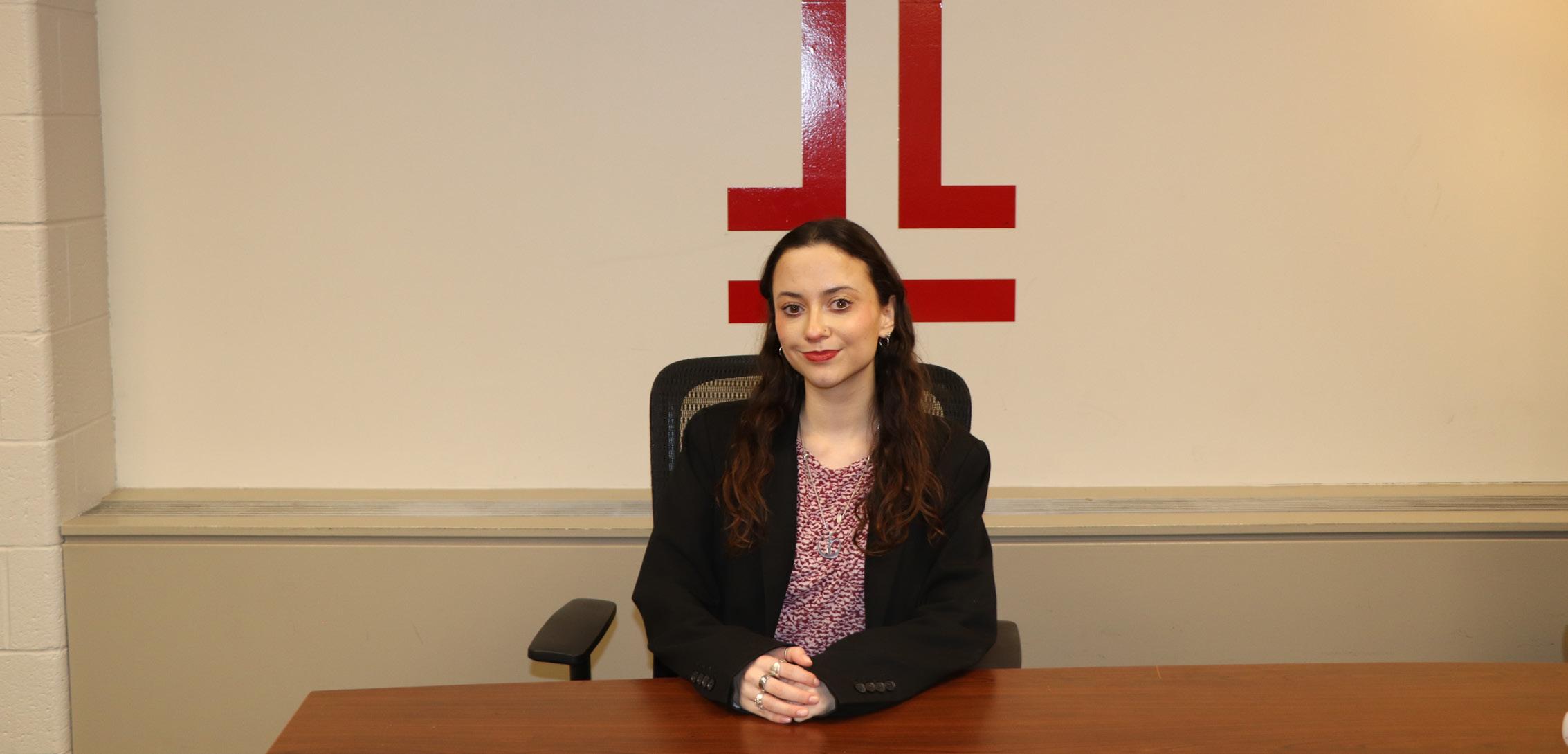
The initiative had to go through multiple student government administrations before finally being implemented, TSG President Lourdes Cardamone said.
“That was something that had been talked about two administrations ago,” Cardamone said. “We really wanted to make sure nothing kept falling off every time leadership changed.”
The TSG organization is divided into six departments––the Executive Office of Leadership, Internal and External Affairs, Department of Communications, Department of Finance and the Department of Equity, Accessibility and Wellness.
Cardamone and Vice President, Janeese Hochstetler, were elected in April as “Temple Tomorrow.”
TSG works with university administration to advocate for the interests of the student body and communicate with the university about the needs of the student community. They also work closely with Student Activities to run or promote student organizations and events.
During the Fall semester, TSG changed the structure of its Town Halls, aiming to reduce pressure on student organizations and increase participation.
In previous years, student organizations were required to attend three
Town Halls and four TSG workshops to maintain a high Student Training and Rewards System rating, which determines the amount of money allotted to the organization, collaboration opportunities with university offices and promotion through Student Activities.
Town Halls now count as workshops within the STARS program, rather than a separate requirement for student organizations, Cardamone said. Student organizations receive STARS credit by attending a Town Hall, allowing groups to choose based on interest instead of attending multiple sessions.
“We wanted these Town Halls to be a space that students can learn and want to come to,” Cardamone said.
Lourdes said she noticed more students asking questions and remaining engaged in the Town Hall activities after the implementation of this change.
TSG is also working to identify and promote Temple programs and initiatives intended to support students, including the Swipe Out Hunger Program.
The Office of Community Impact and Civic Engagement started the Swipe Out Hunger program in the fall to allow students to donate their excess
meal swipes to students experiencing food insecurity. Swipes are distributed by the Division of Student Affairs at the Esposito Dining Center in Johnson and Hardwick Halls by the Division of Student Affairs.
Chelsea Lubbe, Chief of Equity, Accessibility and Wellness for TSG, said that Swipe Out Hunger is still a work in progress, and TSG is considering alternate methods for distributing the swipes, like a voucher system.
Lubbe, who worked for TSG under former president Ray Epstein during the 2024-2025 academic year, also wants to see better TSG staff and better communication between past, present and future administrations.
“When administration changes, we lose a lot of footing and groundwork that we’ve done to implement certain initiatives,” Lubbe said. “And then they get lost, and then the next administration might not find them until another year later.”
TSG also wants to improve the conditions of the Temple commuter lounge and help support relations between off-campus students and their neighbors, Cardamone said.
TSG initiated multiple collaborations with student organizations to make new activities for Temple students, said Chief of Internal Affairs Kiyah Hamilton. This includes a collaboration with the organization Student Activists Against Sexual Assault to host a talk with student athletes to raise awareness on sexual assault in locker rooms.
Hamilton looks forward to making students aware of TSG and the efforts of their administration.
“At the end of this term, I’m hoping that students are really starting to care and realize that student government is here for them,” Hamilton said. “And is here to listen to their concerns and hopefully help fix anything that they might have a problem with.”
Nathan Horwitz contributed reporting.
Chelsea Lubbe has previously freelanced for The Temple News. They were not involved in the writing, reporting or editing of this article.
clarissa.jett@temple.edu connor.pugh@temple.edu
In recent weeks, increased violence and acts of force by Immigration and Customs Enforcement Officers have shocked the nation, sparking protests and dissent on college campuses.
Students at New York University and Georgia State University set up walkouts in protest of the officer’s recent escalations. Students at Temple also staged a similar protest at the Bell Tower last Tuesday, which only saw a crowd of about a dozen demonstrators.
Even though protests have erupted around the nation, people might be wary to participate in demonstrations as they fear they will be targeted by ICE officers. Immigrants are scared to leave their homes for basic needs like grocery shopping and errands. This same fear might prevent them from attending demonstrations or other events to oppose the actions of ICE.
While there have been no reports of ICE presence on Main Campus, it’s time for students to speak up against this blatant abuse of power. The Editorial Board encourages students who have the privilege to engage in protests to do so and reach out to representatives and volunteer at organizations to actively support targeted communities.
Fear about immigration authority has been on the rise since President Donald Trump’s inauguration for his second term last January. However, recent events have caused tensions to explode after ICE fatally shot Renee Good and Alex Pretti in Minneapolis.
Not every student can attend a protest or speak publicly. Concerns about immigration status, policing, employment or family safety make participation a real risk. Staying silent is not a lack of
concern; it is an act of self-preservation. That reality places a responsibility on those who can safely be visible to speak up on behalf of those who cannot.
In moments like these, visibility is not equally accessible to all. Speaking for those who cannot means more than expressing private solidarity. It means showing up publicly, even when doing so draws attention or challenges institutional comfort.
Students, faculty and other members of the Temple community who have the ability to attend protests, organize demonstrations and raise their voices on campus play a critical role in ensuring that fear does not remain invisible.
Besides attending protests, students can also reach out to representatives and actively advocate for change. Students can go online to look up their representative by inputting their zip code. The search engine guides users to their representative’s official website with contact information for both email and phone call correspondences.
There are multiple ways to show support to the communities that are being persecuted, but staying quiet is not one of them. It is paramount for students to use their voice and speak up in any way they can.
A
student argues solitude can strengthen independence and help people grow on their own.
BY LOGAN THOMPSON Assistant Opinion Editor
Iwas always the floater friend growing up. I moved between groups and was included in some moments but in the periphery in others.
I remember sitting on the bleachers during lunch in middle school, scanning tables for a familiar face, wishing someone would wave me over. At first, being alone felt uncomfortable, even awkward, like I was missing some invisible instruction manuals on how to belong.
However, I began to see those quiet stretches as a gift with time. I didn’t always choose to be alone; it started after a friendship ended, and I realized I couldn’t depend on someone else for every plan.
It was strange and isolating at first, yet those moments gradually turned into a source of peace. Solo mall runs, dinners by myself and long walks became opportunities to reclaim my time.
What once felt like isolation gradually became empowerment and a chance to enjoy my own company without waiting for someone else to validate it.
This taught me that learning to enjoy being alone is a skill anyone can cultivate. Independence doesn’t mean rejecting connection; it means discovering that it’s possible to thrive alone.
I remember the first time I went to the movies alone to see “Weapons” last year in a nearly empty theater. I had my popcorn in hand, feeling a quiet pride and an unexpected comfort in being by myself.
Other activities offer similar opportunities for growth. Joining a club or organization can help people explore interests while also building confidence in navigating spaces independently.
Going out for coffee runs, a museum visit or even a solo dinner allows people to reflect and growth. I used to wander through the art museum downtown with my headphones in, notebook in hand, sketching or jotting down
random thoughts.
I never felt lonely during those hours I spent alone; they became little retreats, where I could untangle my thoughts, notice patterns in my life and experiment with new ideas without interruption.
I’ve noticed that when I’m grounded in my own sense of self, I engage with others by listening without distraction, showing up without expectation and appreciating moments of connection without clinging.
The benefits of cultivating your own company go beyond personal enjoyment. People who are comfortable alone can bring more depth to their relationships. They understand that relationships should complement life, not complete it. Instead of seeing being alone a punishment, it’s important to look at it as an opportunity to grow.
Being alone normalizes emotional independence. It teaches that wanting connection does not make you weak, nor does self-sufficiency mean shutting others out. Emotional independence is key as it reflects the ability to hold your own emotions with care, which strengthens relationships with others and fosters balanced connections, according to Focus Forward Counseling, a blog maintained by psychologists.
For many young people in the age of social media, independence is often misunderstood. People mistake solitude for loneliness or distance. I used to scroll through Instagram, seeing friends out in groups, feeling a pang of envy or self-doubt.
Learning to be comfortable alone doesn’t happen automatically. It’s often born from experience navigating moments without a companion, or simply choosing to step away from the crowd.
Being alone doesn’t mean being lonely. It can mean freedom, and clarity discovering that the best company you can keep is sometimes your own. There is a quiet pride in learning to be enough for yourself, a satisfaction that comes from knowing you don’t need someone else to validate your experiences, laughter or thoughts.
logan.thompson@temple.edu
A student argues restrictive standards in dating can limit personal connection.
BY LOGAN THOMPSON Assistant Opinion Editor
Boundaries have become even more important in the current dating world. For many young adults, asserting standards is a way to prevent unhealthy dynamics.
However, excessive standards can lead to rigid expectations, leaving little room for growth, compromise, or genuine connection. Around 60% of Americans feel positively about dating and more than 42% of people aged 18 to 26 meet their partners on dating apps, according to a July 2025 survey conducted by Forbes Health.
It seems like modern dating treats standards as proof of self-worth rather than tools for connection. Dating advice online encourages people to lead with red flags and dealbreakers instead of leading with curiosity or communication. While boundaries are essential, this shift has turned dating standards into a form of performance, that prioritizes control instead of emotional understanding.
Lynn Moreno Buckmon, a licensed professional counselor, believes standards should support connection rather than restrict it.
“Healthy standards are meant to guide connection, not limit it,” Buckmon said. “When people approach dating with curiosity instead of strict expectations, they create space for communication, accountability, and growth. Flexibility doesn’t mean lowering your standards. It means understanding that relationships evolve through dialogue, not perfection.”
Having clear boundaries doesn’t mean young adults should approach dating with a checklist mentality. Even though discernment is essential, when expectations become too rigid, they limit the possibility of growth and mutual understanding.
Approaching romantic endeavors with harsh expectations and unwilling-

ness to negotiate leads to a lack of room for relationships to develop naturally, Psychology Today reported
Dates are not auditions; they are shaped through effort and honesty. Flexibility does not undermine self-respect, reinforces it while also allowing relationships to form.
It may be hard for students to adjust their standards amid changes of dating culture, especially in an era when social media and online apps play such an important role in relationships.
Justin Cave believes social media is a major force in shaping unrealistic dating standards and influencing dating culture.
“I think social media makes dating standards more rigid because a lot of people base what they think their lives should look like off what they see online. And relationships get caught up in that too,” said Cave, a freshman economics major.
But dating apps don’t just influence how people connect. They can also affect how young people see and feel about themselves.
More than 85 percent of studies connect dating apps to negative effects on body image and then approximately 48 percent reflect negative impacts on mental health and wellbeing, according to a 2025 literature review by Computers in Human Behavior, a journal that studies technology and its influence on behavior literature review by Computers in Human Behavior, a journal that studies technology and its influence on behavior.
Standards in dating should be flexible and grounded in real connection, rather than rigid ideals based on other’s behavior or influenced by online perceptions. When expectations are shaped primarily by curated images or viral advice, they risk becoming detached from emotional reality.
Flexibility allows individuals to recognize growth, effort, and communication. Rather than lowering standards, adaptability strengthens them by anchoring expectations in honesty and mutual understanding.
Jadon Wilkin believes there is a dif-
ference between self-respect and perfection when it comes to dating.
“Self-respect comes from knowing yourself and what you do and don’t like,” said Wilkin, a freshman biochemistry major. “Perfection is more about trying to piece others together, and sometimes that can make you lose sight of your own self-worth.”
Standards should not function as immovable gatekeeping tools. Rigid expectations can prevent relationships from developing naturally, especially when growth is treated as a flaw rather than a process.
Boundaries and dating can coexist, but clarity and communication are essential to ensure dating does not become restrictive. When individuals prioritize understanding instead of performance, dating standards become tools for growth and not barriers to connection.
logan.thompson@temple.edu
A student reflects on the natural phenomenon of outgrowing her friends.
BY LOGAN THOMPSON Assistant Opinion Editor
Starting college felt like stepping into a season of excitement and discovery—an experience I had anticipated long before move-in day. The dorms buzz with new energy: the hustle of people moving in and out, the faint smell of instant ramen down the hall.
The hallways echo with conversations that range from the trivial to the transformative, and every corner seemed to promise possibility. I was full of optimism, thinking that this was going to be a time filled with excitement and adventures.
But beneath the thrill of newfound freedom lies a quiet, unavoidable truth: some friendships don’t continue. They may not end because of conflict, but because sometimes people simply grow in different directions.
I noticed the subtle ways my closest high school friends and I had begun to drift apart in the months after moving into my dorm. Previously active group chats slowed down until they turned into notifications I almost forgot to check. Inside jokes that once had us laughing until our stomachs hurt began to feel like echoes from another life.
I spent a quiet Saturday evening scrolling through my phone, noticing the absence of messages that once came in waves, and felt a small, hollow tug at my chest. There was no confrontation, no dramatic argument, no final conversation, just silence.
This wasn’t easy for me. I’ve always needed to know why relationships ended, and I wasn’t able to rest until I understood why they did.
Once in a relationship, infidelity shattered the trust I once thought was unbreakable. I spent nights lying awake, trying to pinpoint the exact moment things went wrong. I needed closure like I needed air. And when it didn’t come, I felt lost, powerless and frustrated with both myself and the other person.

But college and life have taught me I don’t always need to know the reason behind everything; my peace does not depend on someone else’s accountability.
I now know I have the ability to accept and carry forward the parts of the experience that mattered.
My old friends were adjusting to new routines, environments, and versions of themselves. I was also navigating a new environment. While some relationships bend to fit new circumstances, others just quietly unravel. Both are part of growth. Accepting this reality requires maturity, but it also brings clarity and freedom.
Society often teaches us that endings require closure. But some relationships end gradually and fade overtime without a conversation or explanation.
Holding on to the need for explanation or justification only kept me tethered to relationships that had already begun to change. Letting go without understanding is a form of self-respect. I’ve learned peace comes from trusting that some things are simply out of your
control.
My high school friendships shaped who I am. They helped me navigate formative years filled with awkward phases, first heartbreaks, and moments of self-doubt. Their impact didn’t vanish because our paths diverged; I carry that with me every day.
Even though we are not as close, I feel gratitude rather than regret when I reflect on my friendships. I carry forward the lessons, the late-night talks and even the occasional petty disagreements that now seem almost endearing.
Learning to let go of things has allowed me to make space for new connections with people who bring different perspectives, challenges and joy into my life. I’ve met people in college who genuinely support me, inspire me to grow and make every day experiences feel lighter and more fun.
Outgrowing people, whether friends or partners are often quiet and bittersweet, but it is also a powerful marker of growth. Some friendships will stay, some will fade, and some will leave
lasting marks even after they’ve ended.
As the Sex and The City icon Carrie Bradshaw once said, “After all, computers crash, people die, relationships fall apart. The best we can do is breathe and reboot.”
It is a reminder that endings are a part of life, and moving forward peacefully reflects the strength it takes to honor the past while making space for the future.
logan.thompson@temple.edu

local wildlife.
BY BRIAN NELSON & AIDAN GALLO
For The Temple News
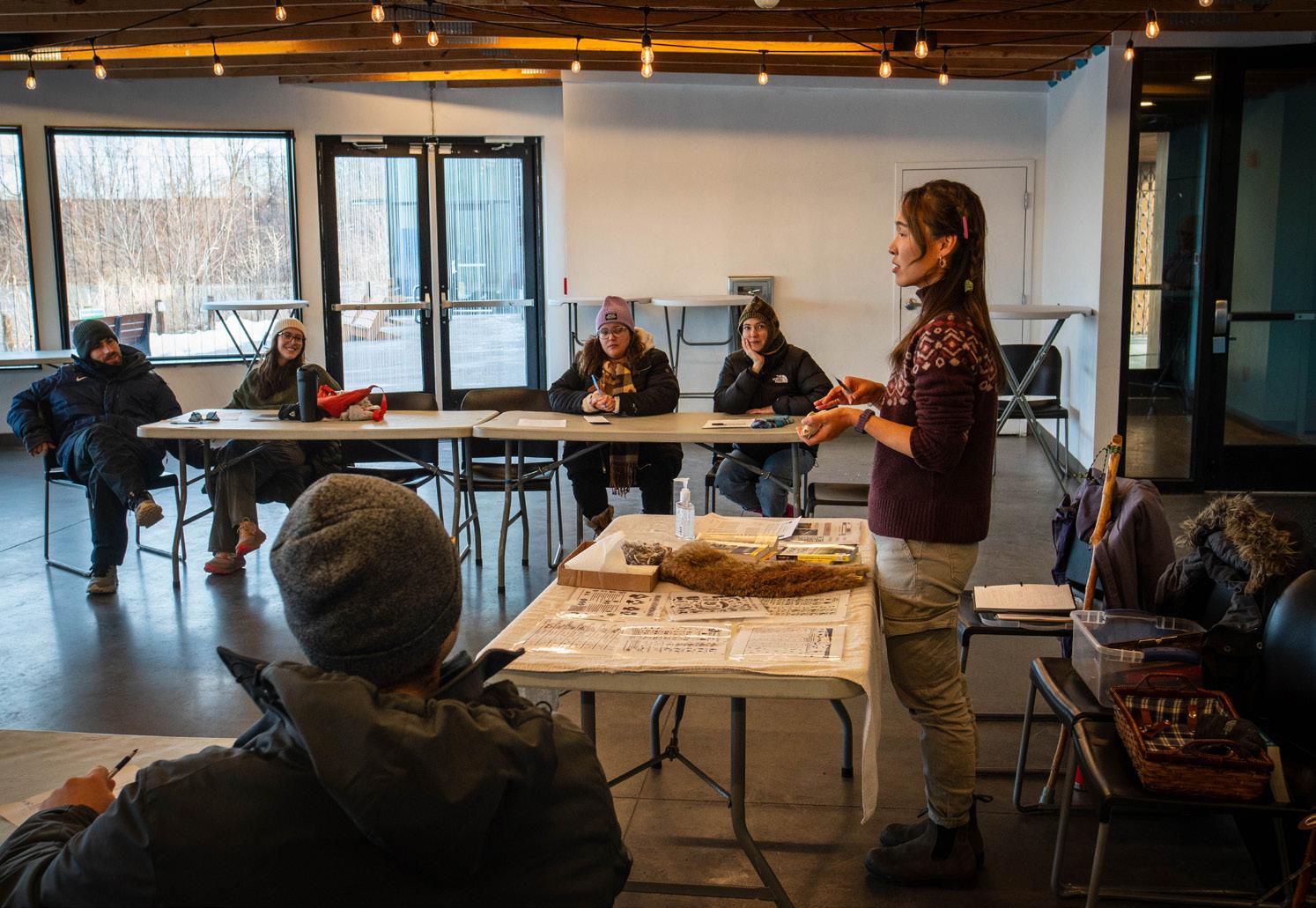
Local wildlife enthusiasts bundled in layers to fend off the winter chill gathered at the Discovery Center in East Fairmount Park to learn about ecological observation on Saturday, Jan. 24.
“A lot of people who live in cities like this don’t realize how busy wildlife activity is,” said Wendi Wu, founder of Philly Animal Trackers Club, a volunteer-led group that organizes community meetups for exploring and tracking
The event commenced in an open space overlooking the iced East Park Reservoir, offering guests a place to settle in and get comfortable with both Wu and Bria Wimberly of the National Audubon Society, a nonprofit environmental journalism organization. Attendees shared their backgrounds and their familiarity with nature and experiences with local wildlife.
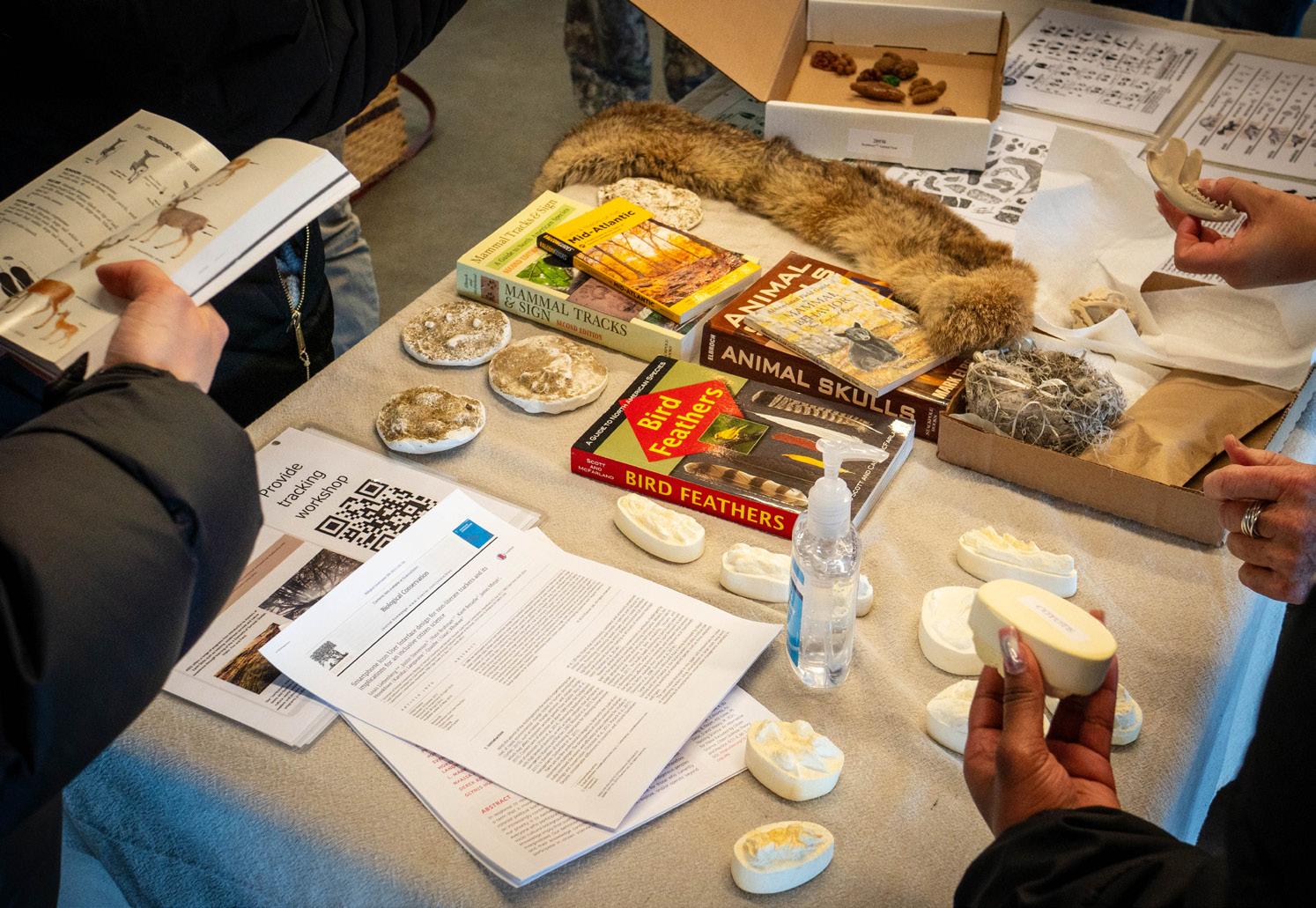
As they settled in, attendees gathered around a table crowded with books, articles and an array of artifacts laid out like quiet invitations to explore. Each participant selected an item, turning it into a personal mystery and a small task of discovery as the program unfolded. Soon, the room filled with overlapping conversations about naturalism, animal tracks and wildlife, voices weaving to-
gether as curiosity took hold.
“I had personal interactions beyond the person I arrived with and left feeling more connected to the community,” said Micheal De La Parra, an intern at Fairmount Waterworks and a senior at Temple.
Wu led attendees through the trails surrounding the East Park Reservoir as they tracked winter mammals’ native to East Fairmount Park. The outdoor session was kept brief but allowed attendees to practice tracking techniques in real conditions, like observing the direction of the tracks or guessing the animal based on its tracks size.
Sebastian Jaramillo, a Philadelphia resident who came to the wildlife walk with his wife and three-year-old son, grew up on a farm in South America and wanted to rekindle his interest in the
outdoors after moving to Philadelphia from New York City three years ago.
“I was raised between Colombia and the United States, so it’s been really important to me to be connected with wildlife,” Jaramillo said.
The event concluded with an indoor Q&A session. Guests shared their observations and questions from the walk, sparking conversations on wildlife conservation that continued well beyond the scheduled end. Many lingered in the multipurpose room, exchanging insights and reflections as time quietly slipped by.
“I hope people bring the skills taught today into their own parks and communities,” Wimberly said.
brian.nelson0003@temple.edu gallo@temple.edu


A student argues that while social media can open professional doors, they also cause anxiety.
BY LOGAN THOMPSON Assistant Opinion Editor
Social media has become a quiet requirement for college success. Platforms like LinkedIn, Instagram and X are no longer just platforms for creating; they are increasingly treated as gateways to job opportunities for today’s students.
Internships, freelance opportunities, brand partnerships and full-time jobs are promoted online. Approximately 70% of recruiters now use LinkedIn in their hiring efforts, and 77% of employers believe candidates with a comprehensive profile have a higher skill set, according to a 2024 report by Product London, a strategic marketing agency.
Even though some platforms can open doors for students, they also quietly raise stakes for people who are trying to keep up. Maintaining a presence on these social media sites adds an unnecessary burden on top of existing academic responsibilities.
Lindsay Marek, director of undergraduate professional development Fox School of Business and Management, believes social media has shifted how students how students initiate professional relationships by lowering intimidation and increasing early exposure to industry professionals.
“Ten years ago, students really relied on personal connections or referrals, career fairs, or any way they could meet people,” Marek said. “Networking online can feel less intimidating, and it allows students to build confidence before meeting professionals face to face.”
As professional networking moves online, students are not only encouraged to gain experience, but to consistently display progress in visible, curated ways. As professional networking becomes increasingly public and performance driven, these platforms can intensify pressure and anxiety for students who feel compelled to constantly demonstrate progress.
Ashley Anani believes that even

with a profile full of accomplishments, the need to post updates creates ongoing anxiety.
“I do a lot of things in college, opportunities, internships, projects, so I have stuff to put on LinkedIn,” said Anani, a sophomore international business major. “But even when I have things on there, it still feels stressed. If you don’t have anything, it’s stressful and even when you do [have accomplishments], it’s stressful because people are analyzing everything,”
Use of social media is often associated with increased stress, anxiety and depressive symptoms among young adults, according to an August 2024 study published in the Worldviews on Evidence-Based Nursing, a peer-reviewed nursing journal.
LinkedIn is one of the most popular platforms students use to network, build connections, and share their achievements. However, it can also be a source of stress as it can trigger social competition between peers and feelings of inferiority, Forbes reported.
Social media has undeniably lowered the barrier to entry for professional networking. As they can reach recruiters directly interact with companies they admire online.
Social media makes it easier to connect with professionals, but it also creates an unspoken expectation to always appear productive and forward moving.
Kristina Decker constantly feels pressure to maintain a prefect LinkedIn profile to impress employers and secure possible job opportunities.
“I feel like there’s so much pressure to be over accomplished on there, especially when it comes to employers and, people scouting for internships,” said Decker, a sophomore film and media arts major. “I feel there is a lot of pressure to have the perfect LinkedIn profile, how many views do you have and how much do you post on it.”
Progress may feel like a performance, blurring the line between genuine connection and self-presentation. As these platforms expand access to opportunity, they also reshape how students
define success, turning networking and professionalism into something to optimize online.
The line between connection and strategic self-presentation may grow thinner. Networking rooted in conversation and mutual interest now feels like self-marketing.
Rather than abandoning these platforms, students are challenged to prioritize curiosity, genuine connections, and long-term personal growth over metrics and visibility and performative professionalism.
This contradiction reflects the core challenge of social media networking today. While these platforms offer unprecedented access and opportunity, they also introduce pressure to constantly maintain and optimize online presence.
Ashley Nteff contributed reporting logan.thompson@temple.edu
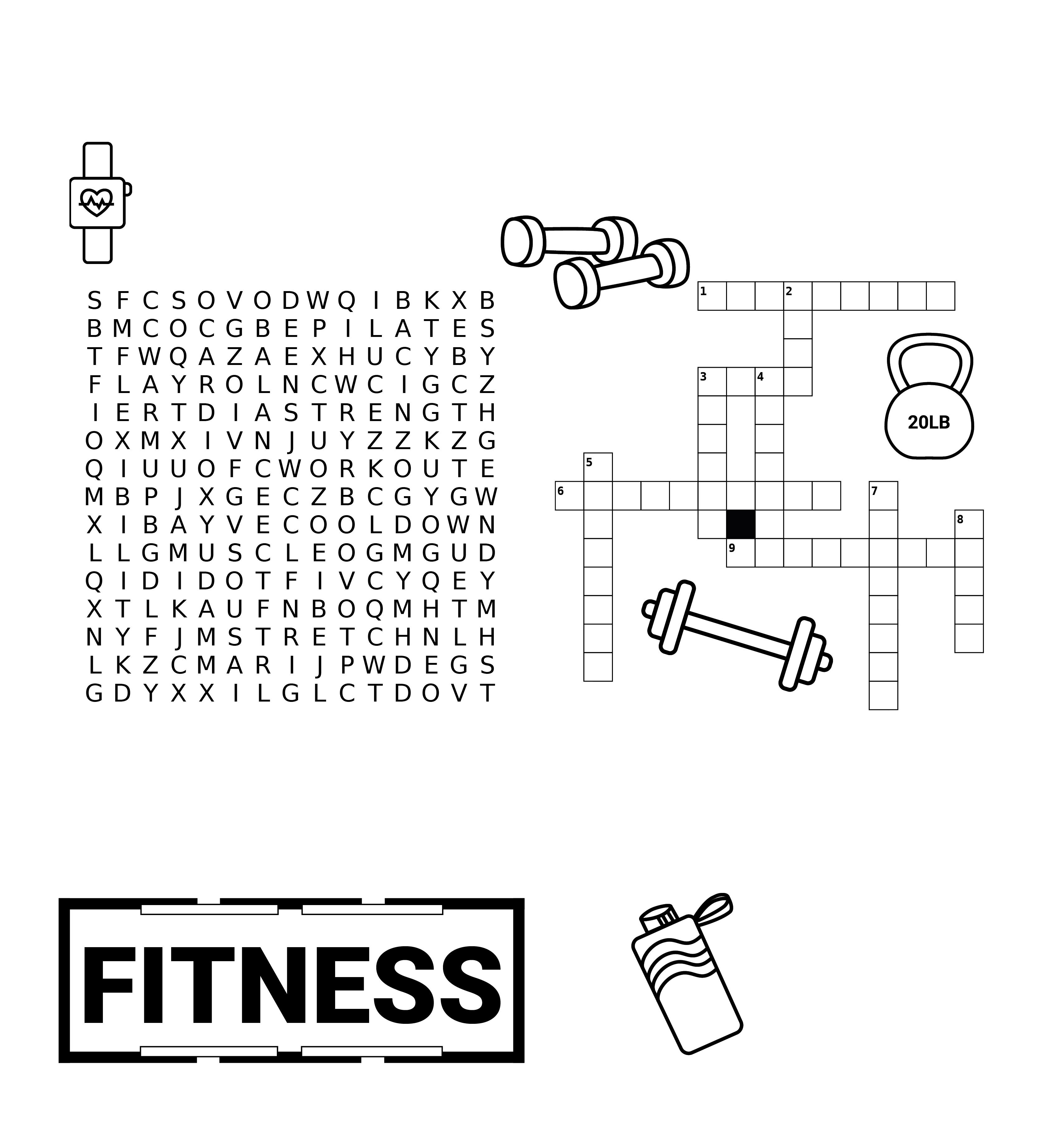
Across
1. Proper water intake to stay healthy during workouts
3. A collection of repetition done in a row before stopping to rest
6. A type of force muscles must work against during workout
9. A machine used for walking or running indoors
2. The count of how many times an exercise is repeated
3. A lower-body exercise that bends the knees
4. A person who helps supports and guides during workouts
5. Rest time that allows the muscles to heal
7. A handheld piece of gym equipment used to lift weights
8. A core exercise held in a straight position
ALUMNI
The alumna’s retrospective exhibit encapsulates her boundary-defying career.
BY MADELYNNE FERRO Features Editor
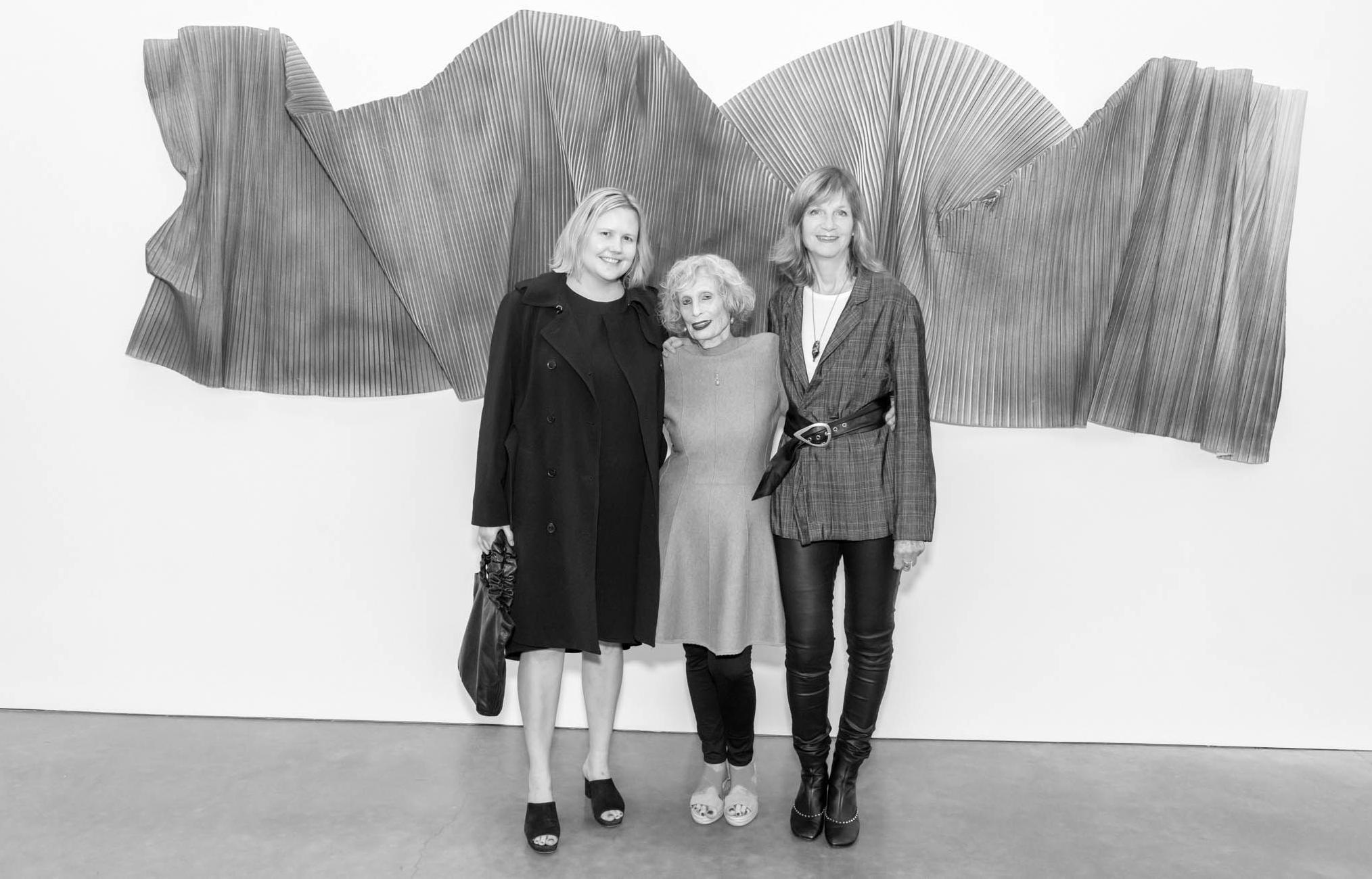
When Nina Yankowitz first broke out into the 60’s New York art scene, Draped Paintings, her series of painted, draped unstretched canvases, earned the artist critical praise and solo exhibits at the Kornblee Gallery. After one of the pieces, “Cotton Duck Thread Reading,” landed a spot in the inaugural Whitney Biannual, it was obvious she had found her ticket to success.
But more than six decades later, Yankowitz has instead pioneered a multidisciplinary career through experimental design and decennial reinvention.
“I am very interested everything, I mean that my palate is everything’s the world,” Yankowitz said. “Before, after, astral, below ground, above ground. For me, it’s always reaching out to the outliers.”
The Parrish Art Museum is displaying Nina Yankowitz: In the Out/Out the In, a retrospective exhibit that telescopes the multidisciplinary artist’s 60 yearlong career, from Oct. 9, 2025, to Feb. 22, 2026.
The exhibit features the alumna’s myriads of mediums and artistic periods beginning with her esteemed Draped Paintings and spanning her entire career through ceramics, written works, experimentation with sound, 3D technology, digital games and more.
The exhibit was organized by senior curator of contemporary art Katherine Pill at The Museum of Fine Arts, St. Petersburg and displayed there from June 21 to Sep. 21, 2025.
“It’s like Nina-land,” Yankowitz said. “I know that sounds narcissistic but it’s my journey that I’m taking people through and it’s not a consecutive thing.”
Corrine Erni, chief curator of art and education at the Parrish Art Muse-
um, accepted the invitation to host In the Out/Out the In at the conclusion of St. Petersburg’s showing. Erni previously featured Yankowitz’s work in Parrish’s 2023 collective exhibition “Artists Choose Parrish.”
Erni curated The Parrish Art Museum’s iteration of the retrospective with collaboration from Yankowitz and site-specific architectural design in mind.
“It was very much a conversation with [Yankowitz], she’s a curator in her own right,” Erni said.
Yankowitz’s multidisciplinary approach lends Nina Yankowitz: In the Out/Out the In as an interactive and multifarious exhibit. In 1980s, Yankowitz produced poetry, ceramics and sculpture — a pivot from the Draped Paintings of the late 1960s and early 1970s.
Early in the 1980’s, she published her
second artist book and opera, “Scenario Sounds,” which used different voices woven together to sound like instruments.
“I wouldn’t choose a discipline,” Yankowitz said about her time at the School of Visual Arts. “I would say, ‘I want them all. I want to take them all.’ And I got them to give me studio in the basement.”
The artist’s recent work in the exhibit infuses interactive technology with artistic vision. Yankowitz’s “Criss~Crossing The Divine” combines mannequins, digital games and a 3D glass cathedral to examine religious intolerance.
Jennifer Samet, senior director of the Eric Firestone Gallery, saw audience interaction as the common thread in Yankowitz’s multimedia work. Samet first met and worked with Yankowitz in 2022 when displaying her draped works from the 1960s-70s.
Even Draped Paintings changed with their environment, Samet realized, and responded to the viewer.
“She’s a very caring and generous person in personal interactions, but I think it’s also an important aspect of her art,” Samet said.
Yankowitz is relishing in her retrospective being exhibited at two museums and has no intentions of slowing down.
“When I stop working or creating, I’m dead. It’s over. I can’t not. It’s just part of who I am,” Yankowitz said.
madelynne.ferro@temple.edu
The Black Panthers-inspired group organizes food drives and armed patrols.
BY CONNOR PUGH Co-News Editor
Bitter winds swept past the facade of the Church of the Advocate Friday night, casting a long shadow on the small isle of activity in the darkened streets. Trays of bagged fluffernutter sandwiches, bright yellow bell peppers and an array of other food were stacked upon card tables and handed out to passerby, supervised by men and women clad in black leather.
A few of them — members of the Pennsylvania chapter of The Black Lion Party for International Solidarity — carried firearms, slung over their shoulders or pointed at the ground, but all were abuzz with conversation, speaking with anyone who stopped by and overseeing the children who ran along the sidewalk.
The Black Lions have held food and clothing drives outside the church every Friday evening, just a block away from their headquarters on Gratz Street near Diamond, since last summer.
“The [Black Lions] offers food with no stipulation, no information, no nothing. You just come grab it, same thing with clothing,” said Paul Birdsong, the national chairman of the party and a West Philly native.
The Black Lions, who originally referred to themselves as the Black Panther Party for Self Defense, received increased attention in Philadelphia for their participation in anti-ICE demonstrations following the shooting of Renée Good in Minneapolis by an Immigration and Customs Enforcement agent on Jan. 7.
Beyond their weekly food and clothing drive outside the Church of the Advocate, the party collaborates with organizations for charity and political efforts across the city, like the New Era Young Lords and the Second Rainbow Coalition, a successor to the collaborative movement established by Fred Hampton in the 1960s to coordinate efforts between several activist groups.
Party members regularly patrol
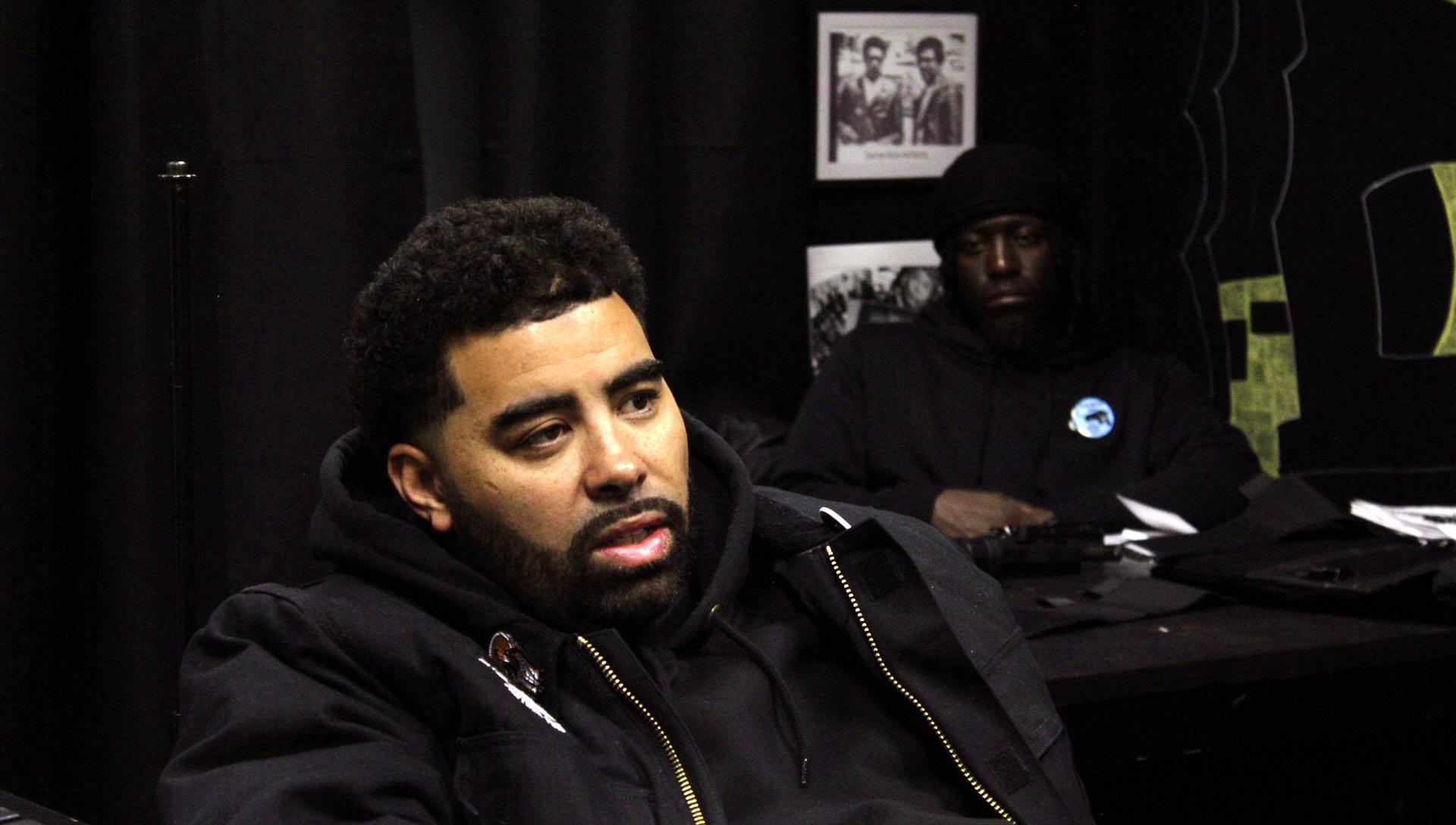
Philadelphia’s neighborhoods to monitor police activity and keep their community safe, Birdsong said.
“The government is systematically designed for us to fail, not for us to succeed. Therefore they also want us to be dependent upon their system,” said Sam, a party member who declined to provide his full name. “This is important because we’re enabling the community to be self-sustainable.”
Sam joined the party after hearing about it on social media and attended its demonstration held on George Floyd’s birthday, where he introduced himself to Birdsong.
Party leadership said they were inspired by the original Black Panther Party for Self Defense, founded in 1966 by Bobby Seale and Huey Newton in Oakland, California. A Philadelphia chapter was founded in 1969 and was active until the mid ‘70s.
The original party faced consistent and coordinated abuse by the police,
who raided multiple Black Panther offices, including the one where the Black Lions now reside, in Philadelphia at the same time in August 1970. Less than a month later, Temple hosted the Revolutionary People’s Constitution Convention and speakers including Huey Newton, garnering national attention with thousands in audience.
The Black Lions follow the 10-point program established by the original Black Panthers as the guiding force for their work, Birdsong said. These points, originally drafted in 1966, establish its socialist values and clear demands for the justice, freedom, health and autonomy of all Black people.
“Someone might ask, ‘Why do we feed the community, clothe the community, patrol the community,’ and it’s because it’s our responsibility,” Birdsong said.
Community building and neighborly love are central to the Lions’ efforts, shown not just through the food drives
and patrols. Neighbors come to chat and check in on those out in the cold, volunteers show up and pitch in regardless of party affiliation, and members stay up late in the night trading stories and joking with one another, forming strong community bonds.
Jordan, a party member who declined to provide his full name and said he joined the party after seeing them stand up against ICE, felt it was important for anyone with the ability to stand up for their rights to the benefit of their community.
“We have to make sure our community has the resources that is needed for it to succeed in such a way where everyone is equal,” Jordan said.
connor.pugh@temple.edu
ALUMNI Kyle Pagan, known for his manon-the-street content, will head social at Buying Sandlot.
BY MADELYNNE FERRO Features Editor
When Kyle Pagan graduated from Temple in 2015, he knew that he had two options as a marketing grad: sales or the creative route. Despite his creative aspirations, he bounced around consulting firms until Comcast underwent COVID-19 layoffs in 2020.
“I got fired from there,” Pagan said. “I think they liked me though because they kept me around, even though I didn’t sell one thing when I was at that company.”
With free time on his hands, Pagan took to an ACME parking lot to film his first man-on-the-street style video in 2021. Eventually, Crossing Broad, a witty Philadelphia sports blog, took notice and offered him his “dream job.”
Pagan thrived at the company for five years, growing a strong following from his interviews. Then, earlier this
V O I C E S
month, Pagan shocked followers and left Crossing Broad to be the head of social at Buying Sandlot, a youth sports newsletter. Pagan is returning to his marketing roots as the head of socials under Kyle Scott, an original founder of Crossing Broad, now creator of Buying Sandlot.
Buying Sandlot targets investors, developers and owners in the youth sports market with new technologies and investment opportunities.
Pagan’s time at Crossing Broad became difficult after the blog changed hands early in 2025 and the new company altered payment policy and cut commission fees, Pagan stated in a video to his followers.
The move leaves Pagan’s audience hanging with his content pivoting from his man-on-the-street interviews. Instead, Pagan will use his talent to market youth sports business content and grow Buying Sandlot’s digital presence.
“I like being an early adopter to things, I think that’s what makes it really exciting,” Pagan said.
When Pagan was brought onto the Crossing Broad team in 2022, he worked
as a Swiss Army knife for the team. On any given day, Pagan could be writing, editing, filming or starring in one of Crossing Broad’s videos.
He quickly became recognized for his work in front of the camera — conducting interviews and celebrating or lamenting with fans.
“[Pagan] found a way to make unique content that really resonated with fans because he was among fans. He literally is the man on the street,” said Kevin Kinkead, senior managing editor at Sportstrader, the owner of Crossing Broad.
On occasion, Pagan has questioned Philly sports elite, including Eagles head coach Nick Sirianni and offensive tackle Lane Johnson during the Eagles Super Bowl LIX media day.
Only a few days prior to the championship, Pagan accompanied Eagles Chief Security Officer Domenico DiSandro, “Big Dom,” to a New Orleans “voodoo house.”
Santiago Ortiz, a senior finance major and founder of “NoShortsUSA” social media and content creation brand, began
HOW DID YOU SPEND YOUR SNOW DAY?
watching Pagan’s on-scene interviews at Crossing Broad in 2022 and cold-called Pagan, proposing the two work together. While hesitant at first, Pagan and Ortiz collaborated occasionally throughout the next year and eventually created the Keystone Podcast together in 2025.
“Kyle was probably one of my first creator friends or partners,” Ortiz said. “It was about a year before my content started to take off. I’m excited to see how his career keeps growing.”
Now, Pagan’s enthusiastic about getting in early to Kyle Scott’s latest venture. He’s grateful for the experience Crossing Broad gave him and is ready to use it at Buying Sandlot.
“There’s a bunch of different things that [Scott] is kicking around right now, and that’s what makes it exciting,” Pagan said.
madelynne.ferro@temple.edu
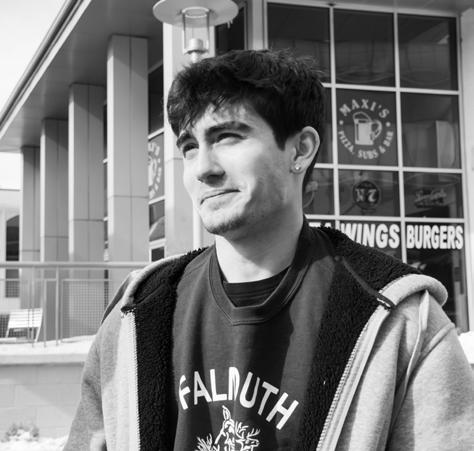
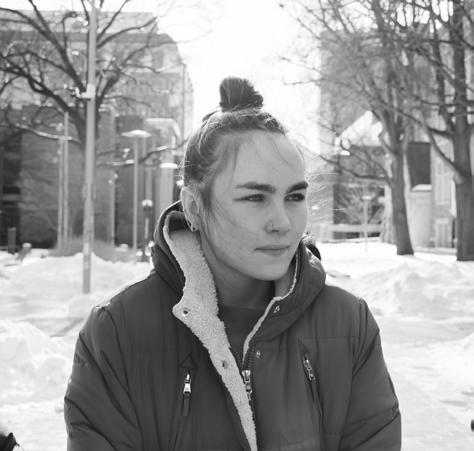
“ I took a big nap all day long. ” “ I played video games with my friends. ”

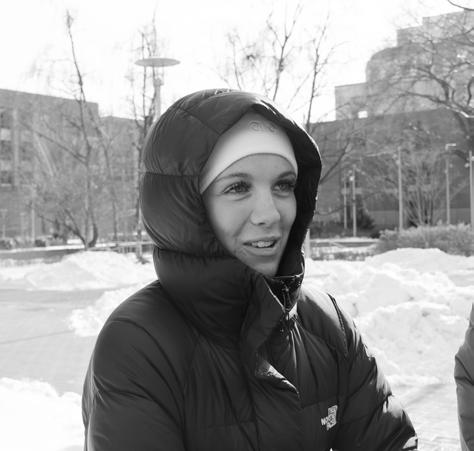
“ I hung out with my friends, and we had a little party in the snow. ” “ Me and my friends hung out with our friends in Pi Kapp. ”
Temple added 22 transfers and retained several key players during the transfer window.
BY COLIN SCHOFIELD Co-Sports Editor
The first two weeks of January were, in Temple head coach K.C. Keeler’s and general manager Clayton Barnes’ own words, the most stressful time of their lives. The NCAA transfer portal window opened from Jan. 2-16, where more than 10,500 student athletes sought new homes.
The stretch created a hectic 14 days of phone calls, campus visits and NIL offers. Temple attacked the portal, trying to retain key players and add to the team.
After the dust settled, the Owls are in a good spot in Keeler and Barnes’ eyes. No starters departed through the portal and they acquired 22 new players to replace graduated players.
“I give so much credit to Clayton for putting together the staff and what the mindset was in terms of how we’re going to attack this thing,” Keeler said. “In our first year of this world of revenue sharing and the one portal window, I thought we did a great job.”
Going from two transfer portal windows in winter and spring to one winter portal was a notable change for the staff. Keeler and Barnes did not have the extra chance to add to the roster as there was only a single period in 2026, making retention a key point for the coaches.
Temple prioritized bringing back crucial pieces leading up to Jan. 2. The Owls retained all four offensive line starters with eligibility from last season, headlined by left tackle Giakoby Hills, who drew interest from bigger schools after week one, according to Barnes. Temple also brought back wide receivers JoJo Bermudez and Colin Chase along with tight end Peter Clarke.
Clarke was arguably Temple’s most impressive player to return due to the interest and offers he got from Power Four schools. The fact that he left money on the table to remain at Temple became its top selling point for other players.
“The ripple effect [Peter Clarke stay-
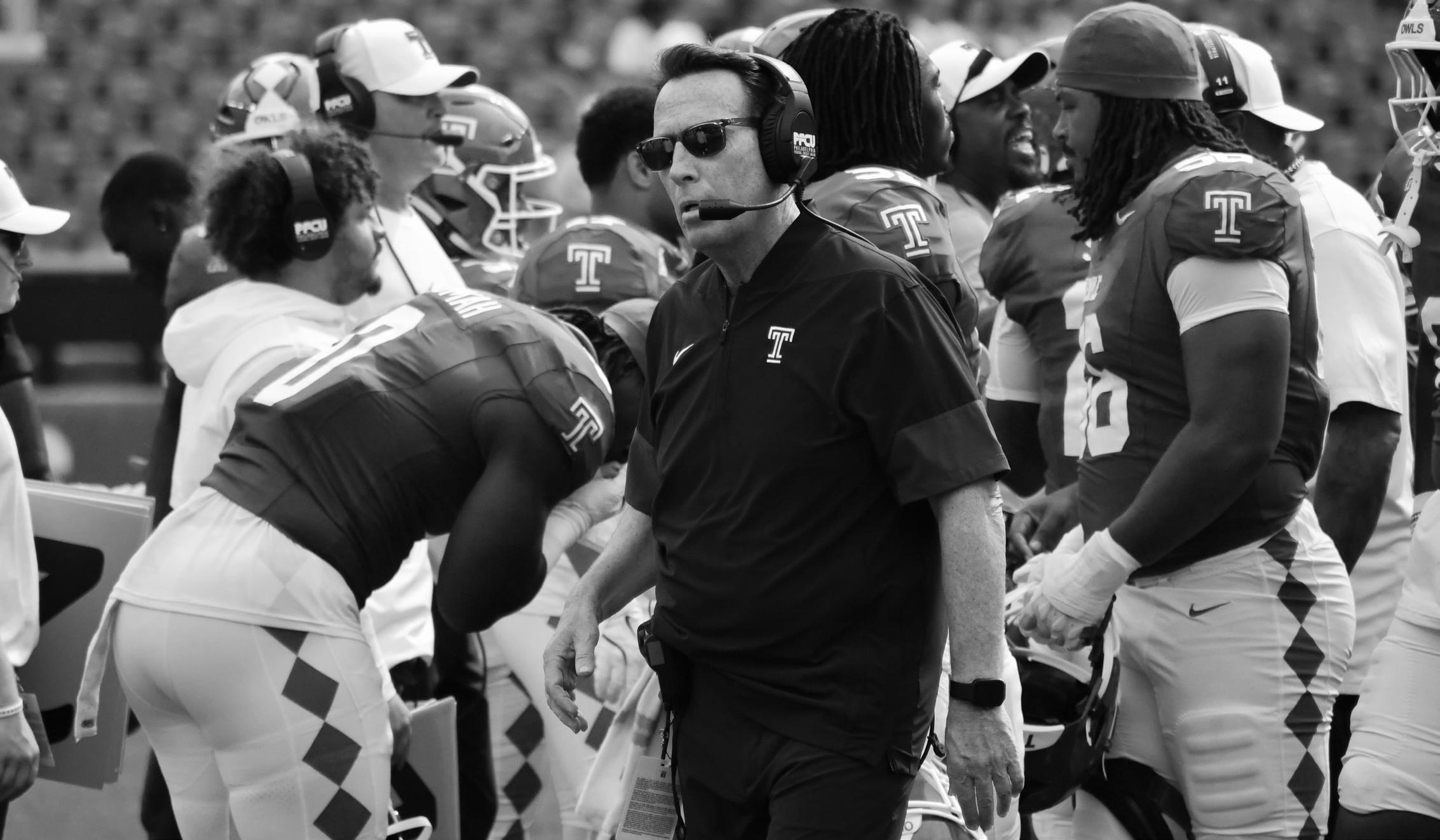
ing] has in your locker room, because now when a guy like that chooses to stay, maybe another guy who could make another $5,000-$10,000 somewhere else, well, when someone’s leaving hundreds of thousands of dollars on the table, that really sends a message to the rest of the locker room,” Barnes said. “‘There’s a reason why I stayed. There’s reason why you should stay.’”
After retaining the locker room, Keeler and Barnes shifted their attention to replace players who are graduating, especially on defense and at quarterback.
Edberg-Olson Hall had a “War Room” where the recruiting staff spent hours evaluating thousands of players. Each person was placed into buckets based on their skill level and fit, from which they reached out to facilitate visits or make offers. Things moved rapidly and the recruiting staff had to adjust for anything. Temple dealt with players committing before a scheduled visit or agents having their client commit on the spot.
“I thought the staff did an amazing job,” Keeler said. “I thought our recruiting department really put on a great presentation of what Temple’s all about and what Philly’s all about. I think we walked away with a class we feel really good about.”
Keeler and Barnes addressed the quarterback position with Penn State transfer Jaxon Smolik and Washington State transfer Ajani Sheppard, who they believe can start right away. They added 10 new defenders, five of which are defensive linemen and five new skill-position players.
The recruiting staff worked hard recruiting the transfer class, but Clarke also played an instrumental role. He hosted transfers on visits, showing them around Philadelphia and displaying what it meant to be an Owl.
“I was a big part in painting the picture of what Coach Keeler’s culture looks like,” Clarke said. “What is Temple gonna build to be? And kind of painting that picture from a player’s perspective,
as a guy who was here with the old stuff, here with the new stuff and had the year that I had.”
The transfer portal was a 14-day whirlwind for Keeler and Barnes, but they have seemingly positioned Temple for success in 2026.
“We were able to recruit like-minded individuals who are gonna drive us towards our common goal, which is gonna eventually drive us towards winning more football games and going to bowl games and playing for championships,” Clarke said. “I’m really excited about the class. I think we’ve got great guys who think alike and time will tell what we can achieve.”
colin.schofield@temple.edu @ColinSchofield9
Demi Washington is juggling being chief of staff while pursuing becoming a therapist.
BY FAIYAAD KAMAL Women’s Basketball Beat Reporter
Demi Washington no longer laces up her shoes or puts on a jersey on gameday, but she hasn’t strayed far from basketball. She became the team’s chief of staff in 2025, now helping the same group of players she was with during the 2023-24 season.
Her tenure as a player at Temple only lasted for one year, but she made it count. Washington was the team’s third-leading scorer where she became a crucial piece in the Owls winning a share of the American Conference regular season title.
After her one-year stint with the Owls, she stayed at Temple, which was the plan from the start. Washington wanted to pursue being a therapist, so she remained a graduate extern last year. The former guard earned her master’s degree in counseling psychology in May 2025, but she remained at the school.
“When I decided to come to Temple, I knew that I wanted to be a therapist,” Washington said. “The counseling psychology program is two years, so I negotiated with [head coach Diane Richardson] and asked if I could be her graduate extern after playing.”
Just two years after playing at The Liacouras Center, Washington is on the sidelines while continuing to work toward her therapist goals. Her journey displays how her leadership and commitment got her to where she is now and where she hopes to land.
Washington spent four years at Vanderbilt before using her graduate season at Temple. One year later, she stepped into a new role off the court where she had to adjust to new circumstances.
Washington handled a heavy workload as a graduate extern and described herself as a Swiss Army knife. She was on the scout team, assisted with budgeting, aided in coming up with plays and helped manage the team on travel days.
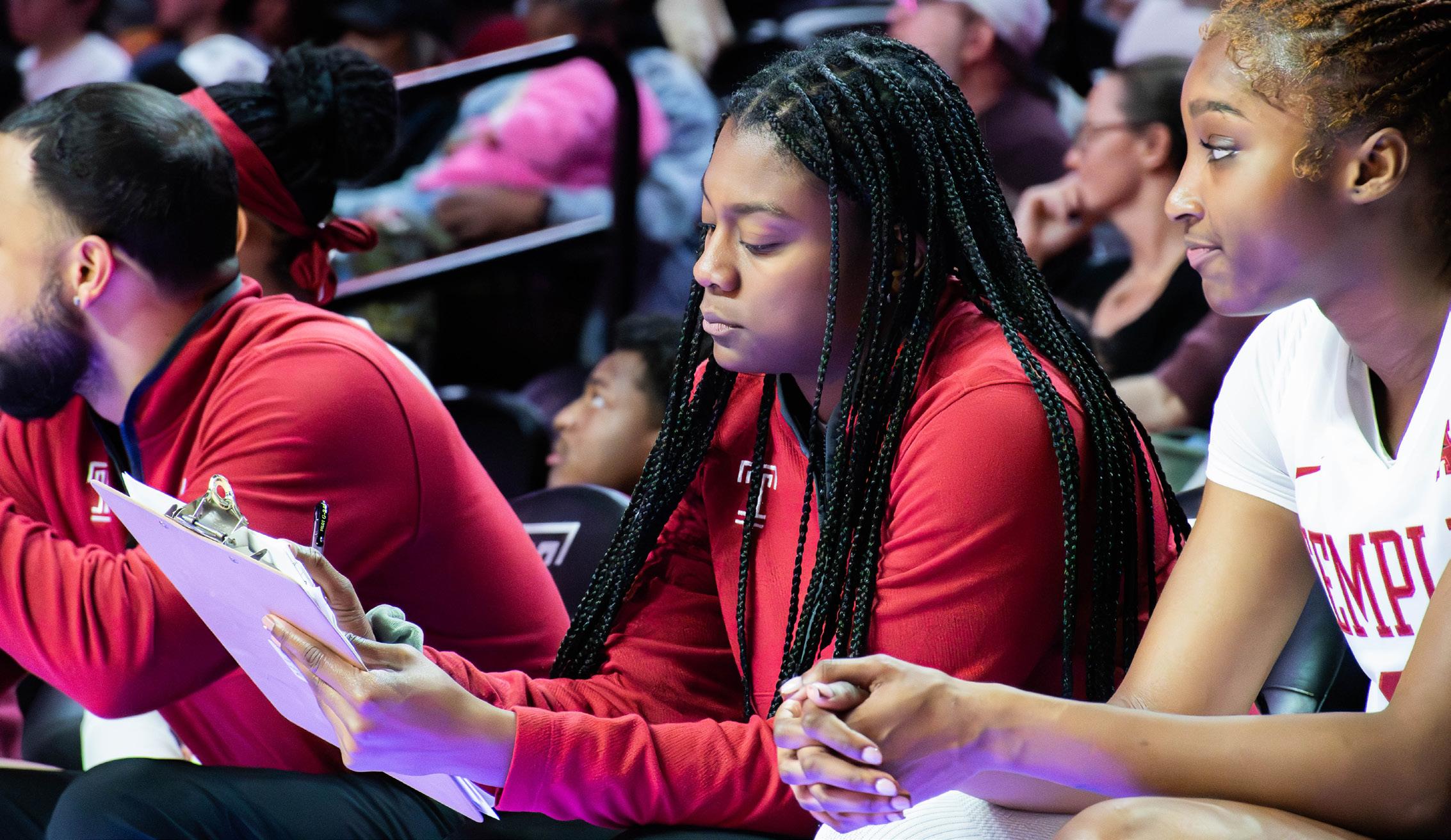
In her new position, Washington had to learn how to draw the line between being friends and colleagues after formerly knowing the Owls as teammates. The learning curve wasn’t steep because her on-court leadership made the transition easier.
Guard Tristen Taylor feels Washington is like a big sister as they instantly became close friends when they joined the team in 2023. Their friendship stayed intact when Washington became a graduate extern, which helped Taylor adjust to Washington’s new position.
“The only thing that changed was her title, to be honest,” Taylor said. “Everything else stayed the same for us, being able to talk, she’d give me advice.”
Washington graduated with a master’s degree in counseling psychology after the 2024-25 season ended. But she was drawn back to basketball once more, securing her role as the team’s chief of staff, a position she may not have pursued if not for Richardson’s encouragement.
“She knows me well, there’s a great
deal of loyalty,” Richardson said. “Watching Demi over the years, I knew that she knew my style, what I wanted and understood what our needs were.”
Some of Washington’s responsibilities now include handling community engagement, player professional development and writing a quarterly newsletter to the players’ parents. She uses her counseling psychology background in her communication approach with the team, mixing encouragement and support.
“I’m very conscious of how I speak to them, depending on the player and who I know can handle what,” Washington said. “There’s a fine line in basketball, where it’s like, ‘You got to keep pushing,’ and ‘I care about you,’ that I pertain to my background.”
Washington is still pursuing her licensure to become a professional counselor alongside her full-time role with the team. She works part-time, supporting underrepresented adults through counseling.
The former guard has long known
she wants to pursue a career where she can help those who really need it. Juggling her duties as chief of staff and a counselor fills her schedule, but Washington’s ambition to do what she believes in never wavers.
“It definitely gets busy, like after work today, I’ll have four clients,” Washington said. “I manage my time well and it does get difficult. But I believe I was meant to do this. I am built for it.”
From Vanderbilt to Temple, Washington made her impact through key minutes and big wins. She’s spreading her influence beyond the hardwood, committing herself to leading and supporting those in need.
“My time here has only fine-tuned the person that I’m going to be,” Washington said. “I have goals and at the end of the day, I have to live this life.”
faiyaad.kamal@temple.edu
Temple is taking a day-by-day approach to reach its 30th NIFWA championship.
BY BRENNAN SCUTT For The Temple News
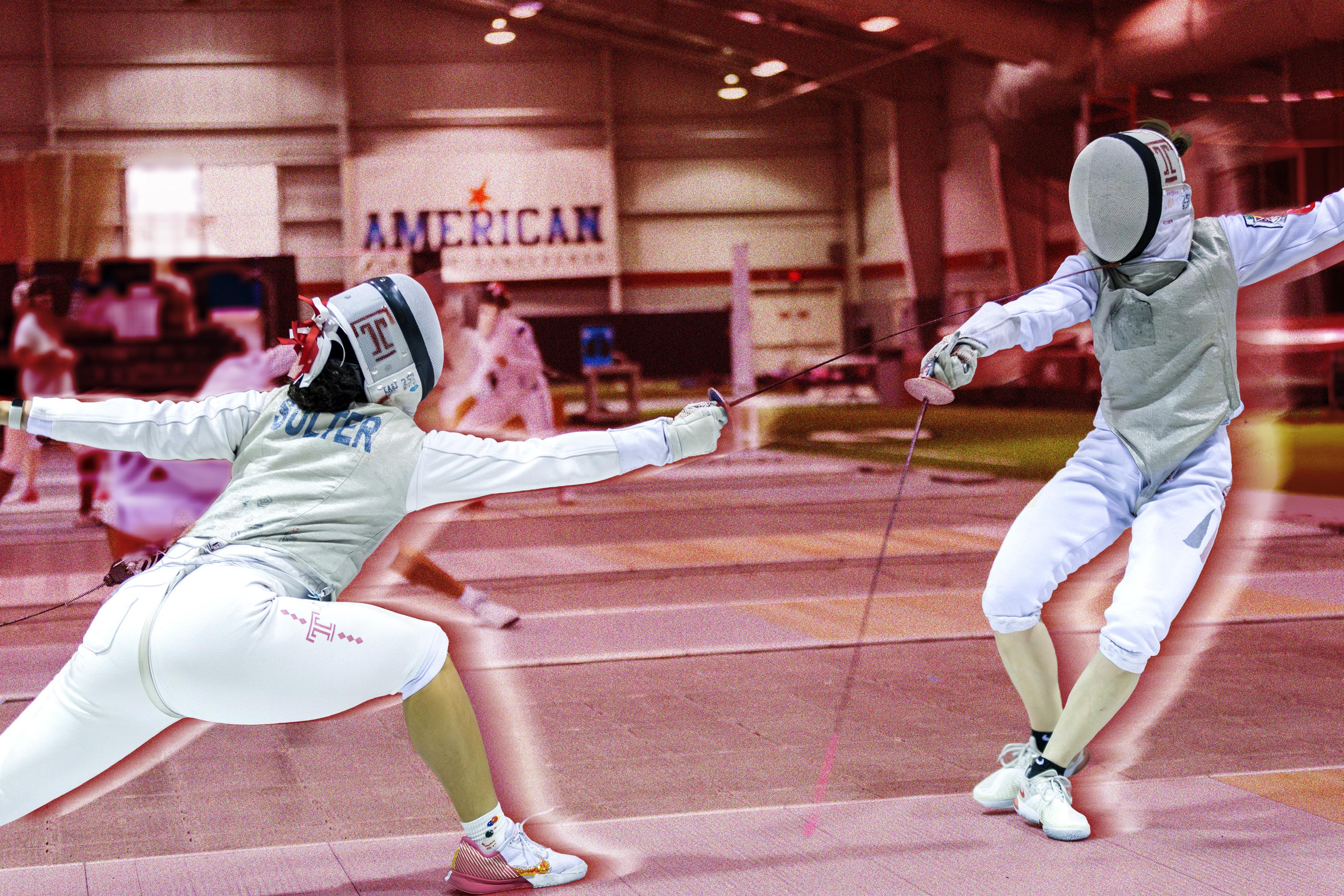
Foilist Anna Novoseltseva finished 19th in the NCAA Championships, ending Temple’s 2024-25 season with the team’s 29th consecutive National Intercollegiate Women’s Fencing Association championship. However, she and six other fencers graduated last spring and a new challenge presented itself.
The Owls needed new faces to step up and continue the program’s winning ways. A handful of key members returned and the freshman class is acclimating to the new environment. Sixteen matches into the season, the retooled roster is on track to find more success.
Temple’s young core produced right away, leading it to a 10-6 start to the 2025-26 campaign. The team is focused on learning their roles by taking a day-
CONTINUED FROM 20 FENCING
Adams-Kim’s commitment to fencing started by watching her older sister, Madeline, practice at the Fencing Academy of Philadelphia before she could participate herself. She joined her sister when she was eight years old and learned what it meant to commit to a sport with both effort and joy from watching Madeline, who later fenced at Penn from 2019 to 2023.
It’s easy for Adams-Kim to put her full effort into her craft, blending hard work and fun.
“She showed up on time, did the work and left late,” said Mark Masters, head coach and founder of Fencing Academy of Philadelphia.
The foilist joined the Owls during the second half of the 2023-24 season, an early start as transfers and freshmen
by-day approach combined with hard work and resiliency. The Owls’ goal is to improve during each bout in their hunt for their 30th straight NIFWA championship.
“I’ve been really pleased with our first-years,” said head coach Jennie Salmon. “They came in super enthusiastic. They really embraced the responsibilities and requirements of the team.”
The Owls’ strong start included wins against competitive programs like NJIT, NYU and Sacred Heart at the Tradition Meet on Dec. 6. While the freshmen have impressed with their skills, Temple’s returners have headlined the success.
Foilist Jara Del Cura went 43-21 as a freshman and she carried her performance into this year. Del Cura’s individual play has been crucial, standing out at the Philadelphia Invitational from Jan. 16-18, where her mindset helped her go 5-2.
“I just try to be in the moment and don’t think too much about the future,”
don’t typically join until the fall. Salmon praised Adams-Kim for how she handled the transition and her dedication continuing with the sport.
“I think that that is something that’s fortunately and unfortunately unique nowadays, that someone doesn’t get exactly what they want the second that they want it and they still pursue it,” Salmon said. “And that made me know this girl needs to be on the team.”
Adams-Kim went 23-15 during her first season as Temple secured its fifth straight foil team championship and its 28th consecutive team title. The next year, she went 50-31 and finished in eighth place at NCAA Regionals.
While Adams-Kim is displeased about the losses on her record, she doesn’t dwell on them. Masters taught her to be mad about losing so she can learn from her mistakes, but to not show it so she can support her team.
She’s brought that mentality to Temple, creating new cheers and bringing hype to the team, even when she isn’t
Del Cura said. “It’s just putting in the hard work and trying my best.”
Other returners like epees Grace Smith and Victoria Doroshkevich and saberist Samantha Nathanson were crucial last season and will have stepped into the graduated contributors’ shoes. Smith posted a 7-4 mark in the Owls’ second meet of the year, but sustaining the success goes beyond the strip, she said.
“I’ve been really trying to prioritize my mental health and recovery,” Smith said. “So, I’ve been focusing a lot on sleep and nutrition, trying to get to bed at a good time and making sure you’re eating well throughout the day.”
Even though the Owls have found success so far, their final three matchups before the NIFWA championships are their biggest tests.
Temple will head to Evanston, Illinois, for the Northwestern Multi Meet on Jan. 31 and Feb. 1 and then to Chapel Hill, North Carolina, for the Tar Heel Duals on Feb 8. Those eventsfeature top teams in the country, providing a chal-
performing her best.
“Whether you notice it or not, your attitude is contagious,” Adams-Kim said. “Why would you waste your energy on being negative?”
Adams-Kim’s roots help define her. She is Temple’s first Philadelphian fencer since at least 2009 and she prides herself in having “Philadelphia” next to her locker room plate. Her high school competitions were often in Ohio or Missouri, so this is the first time many of her childhood friends and family are watching her fence.
Adams-Kim called upon her Philly grit during the Schiller Duals on Feb. 1 and 2 last season. She was preparing to fence Ohio State Dasha Myroniuk, who defeated two of Adams-Kim’s teammates. She was unsure if she was going to face the same onslaught.
Off the strip, Adams-Kim overheard Salmon remark that if anyone could defeat Myroniuk, it was her. Adams-Kim’s focus and intensity immediately increased, feeling the need to prove her
lenge for a young team. However, Temple has already proved it can win against top teams this season and they believe they can do it again.
“We have to keep putting in good work,” Del Cura said. “And just believing in ourselves, tying up close matches and keeping the energy up to fight for every touch.”
The Owls have another NIFWA championship in sight, but they aren’t planning their season to end there. Temple aims to have its last meet of the year in South Bend, Indiana for the NCAA fencing championships from March 1719. Despite the roster turnover and losing highly accomplished fencers, Salmon wants to show her program is still competitive.
“At the end of the season, we want to embrace every day,” Salmon said. “That’s going to bring the results we want in the end.”
brennan.scutt@temple.edu @Brennan_Scutt
coach correct. Inspired by her coach’s confidence and the resolve instilled in every Philly native, Adams-Kim won. It became one of her proudest bouts as an Owl.
Adams-Kim’s fencing career was described as “joyful” and “fun” by those around her. Those traits have been evident, helping keep the program competitive while bringing joy no matter the circumstances.
“One of the things she brought to the team was ‘unimaginable joy,’” Salmon said. “Fencing is hard. You’re getting hit. When you’re getting hit, you’re losing. Everybody’s looking at you and it’s very easy to become frustrated or sad if it’s not going your way. And that unimaginable joy, that’s going to stay with this woman.”
jacob.ponczkowski@temple.edu @Jakeponcho29
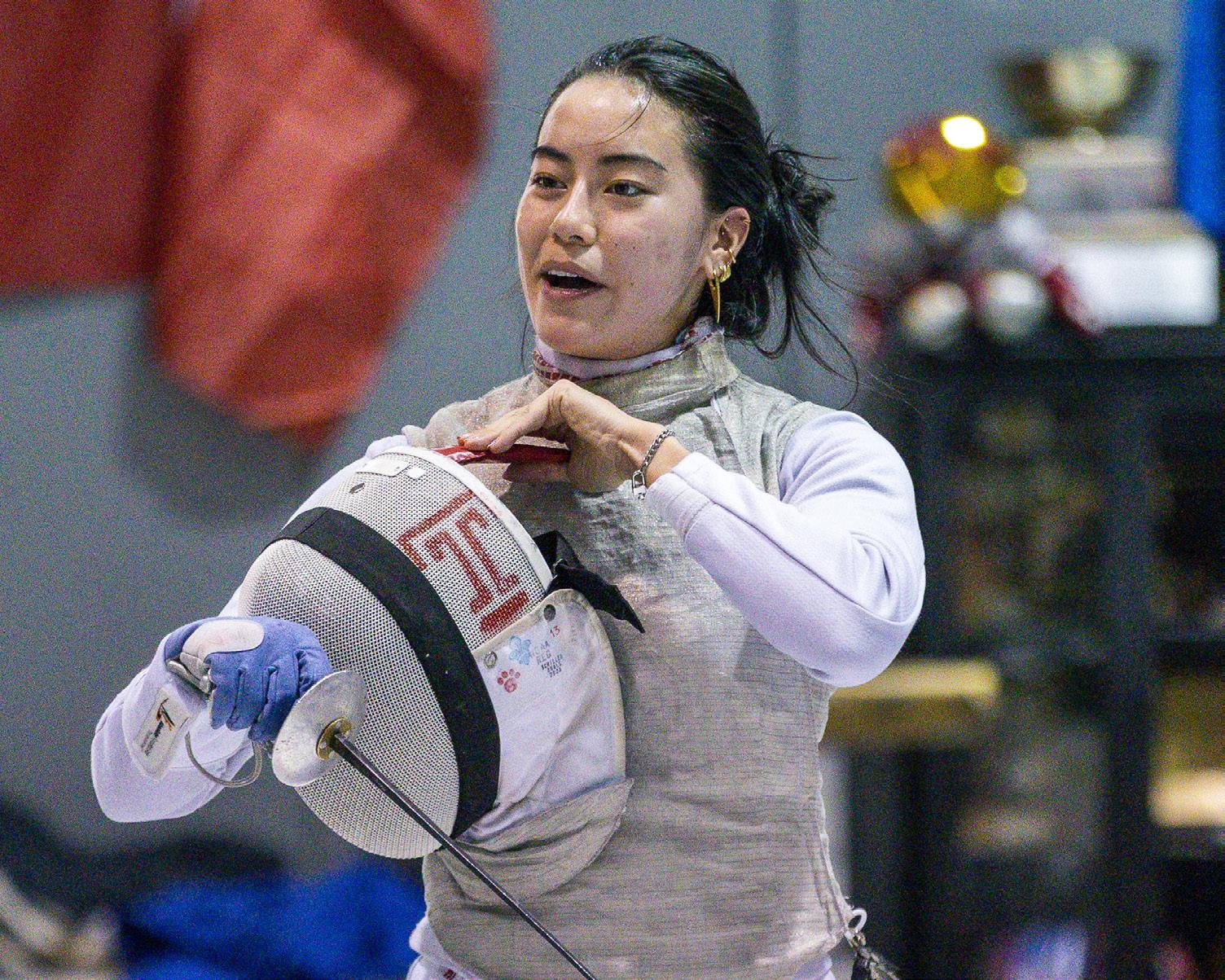
Foilist Natalie Adams-Kim joined the Owls as a walk-on in 2024 and is becoming a leader on their championship program.

BY JACOB PONCZKOWSKI
For The Temple News
Natalie Adams-Kim had planned to represent Philadelphia, her hometown, at Temple as a fencer in 2022 but the roster was finalized when she was a freshman. She later connected with head coach Jennie Salmon, who informed Adams-Kim about Temple’s club team.
Adams-Kim wanted to fence, so she joined the club and dedicated her full effort, even becoming a mentor to some less experienced members. Both Salmon and Adams-Kim bumped into each other at competitions through the year, where Salmon noticed her conviction. Adams-Kim’s dedication led her to become the nineteenth member of a team that usually only fields eighteen in the 2023-24 season.
That devotion turned Adams-Kim from a walk-on to one of the senior leaders on a championship program. Adams-Kim hasn’t just brought skill to the strip, but a fun attitude that connects with the team.
“I really love fencing and not doing it that first year collegiately, I knew I wanted to be fencing all the time and I would email Jenny and she was like, ‘Oh, you could fence at the club,’ while she figured out all the logistics,” Adams-Kim said. “And I did and then I would do all the competitions I could. And so, then when I was finally able to be on the team, it was purely just, ‘I really enjoy doing this sport and no one can really make me not enjoy it.’”
| 19