THURSDAY, MAY 3, 2018 • VOL. 122, ISS. 58
THESUNFLOWER.COM
WICHITA STATE UNIVERSITY’S INDEPENDENT STUDENT NEWSPAPER SINCE 1896.
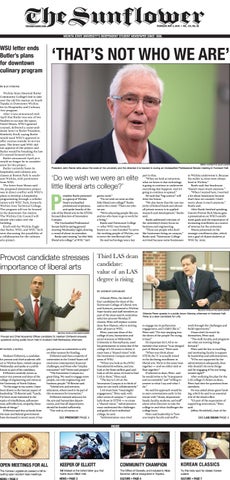
‘THAT’S NOT WHO WE ARE’
WSU letter ends Butler’s plans for downtown culinary program BY RAY STRUNK
Wichita State thwarted Butler Community College’s bid to take over the old fire station on South Topeka in Downtown Wichita for its Hospitality and Culinary Arts program. After it was announced midApril that Butler was one of two finalists to occupy the space, David Moses, WSU’s general counsel, delivered a cease-anddesist letter to Butler President, Kimberly Krull, saying Butler would need WSU’s approval to offer courses outside its service area. The letter said WSU did not approve of the project and Butler would be breaking the law if it moved forward with it. Butler announced April 30 it would no longer be in consideration for the project. Butler currently hosts its hospitality and culinary arts classes at Boston Park in southeast Wichita, with permission from WSU. The letter from Moses said the proposed downtown project was in direct conflict with WSU’s plans to develop a hospitality programming through a collaboration with WSU Tech, formerly Wichita Area Technical College. The program will not be housed in the downtown fire station. The Wichita City Council will decide who takes over the building. Krull told the Wichita Eagle that Butler, WSU, and WSU Tech were discussing the possibility of a collaboration for the culinary arts project.
BRIAN HAYES/THE SUNFLOWER
President John Bardo talks about the state of the university and the direction it is headed in during an Unclassified Professional Senate meeting in Hubbard Hall.
‘Do we wish we were an elite little liberal arts college?’
P
resident Bardo presented to a group of Wichita State’s unclassified professional employees, and spoke heavily of the role of the liberal arts in the STEMfocused direction of Innovation Campus. The Unclassified Professional Senate held its spring general meeting Wednesday night, drawing a crowd of about 110 attendees. Bardo said creating “an elite little liberal arts college” at WSU “ain’t
gonna work.” “Do we wish we were an elite little liberal arts college?” Bardo said to the crowd. “That’s not who we are. “We’re educating people like you and me who have to go to work for a living.” Bardo said Fairmount College — what WSU was formerly known as — was founded “to serve the working people of Wichita, not to serve the intellectual elite.” He said technology was a key
part in that. “When we look at tomorrow, what we know is that technology is going to continue to underwrite everything that happens. And it’s going to continue to spread.” He said that “big science” will drive the future. “We also know that the vast majority of federal funds and almost all private money is in applied research and development,” Bardo said. Bardo addressed criticism of the university’s heavy focus on business and engineering. “There are people who don’t like businesses being on campus,” Bardo said. “Fairmount College survived because some businesses
in Wichita underwrote it. Because the reality is, times were always hard in Wichita.” Bardo said that headcount “doesn’t mean much anymore.” “When I started here, I worried a lot about headcount because that’s how we counted. I don’t worry about it much anymore,” Bardo said. After Bardo finished speaking, Interim Provost Rick Muma gave a presentation on WSU’s enrollment goals and the importance of increasing enrollment as a source of revenue for the university. Muma presented on the strategic enrollment plan, which sets a goal of 18,000 students at WSU by 2020.
Provost candidate stresses Third LAS dean candidate: importance of liberal arts value of an LAS degree is rising BY ANDREW LINNABARY
SELENA FAVELA/THE SUNFLOWER
Provost and Chief Academic Officer candidate Dr. Hesham El-Rewini answers questions during public forum held in Hubbard Hall Wednesday afternoon. BY DANIEL CAUDILL
Hesham El-Rewini, a candidate for provost and chief academic officer at Wichita State, visited campus Wednesday and spoke at a public forum as part of his candidacy. El-Rewini currently serves as senior vice provost and dean of the college of engineering and mines at the University of North Dakota. “At this stage in my career, I have been drawn to the human aspect of leadership,” El-Rewini said. “Lately, I’ve been more interested in the topics of mindfulness, self-awareness, self-reflection, empathy, these kinds of things.” El-Rewini said that as funds from the state and federal governments have decreased in recent years, it has
put pressure on universities to rely on other sources for funding. El-Rewini said that a majority of universities in the United States will overcome contemporary financial challenges, and those who “employ innovation” will “thrive and prosper.” “The Innovation Campus is a great thing. We need to engage more people, not only engineering and business people.” El-Rewini said. “Liberal arts and sciences, education, others need to be part of this movement for innovation.” El-Rewini stressed advocacy for the arts and humanities departments, and that all departments should be funded sufficiently. “Our role is, of course, to SEE PROVOST PAGE 4
Orlando Pérez, the third of four candidates for dean of the Fairmount College of Liberal Arts and Sciences, presented to Wichita State faculty and staff members as part of the dean search committee selection process Monday. If chosen, Pérez will replace current dean Ron Matson, who is retiring after 48 years at WSU. Pérez, associate dean of the college of arts, humanities and social sciences at Millersville University in Pennsylvania, used his presentation to stress that if the college of LAS wants to thrive, it must have a “shared vision” with the Innovation Campus and other areas of WSU. “When you look at the (WSU Foundation’s) website, and you look at the $200 million goal and look at all the areas, it’s hard to find LAS in there,” Pérez said. “The key to LAS on the Innovation Campus is to think of ways we can work collaboratively.” LAS must have “meaningful engagement,” Pérez said, with other areas of campus — particularly those in STEM — to create a “shared vision.” Administration must understand the challenges and goals of each individual college, he said. “Administration once tried
SELENA FAVELA/THE SUNFLOWER
Orlando Perez speaks in a public forum Monday afternoon in Hubbard Hall. Perez is a dean candidate for LAS.
to engage me in perfunctory engagement, and I didn’t like it,” Pérez said. “I’m into stepping into the shoes of the people I’m trying to lead.” It’s important for LAS to remember that science “is an integral part of liberal arts,” Pérez said. “When you think about STEM, the ‘S’ is actually mired in the declining enrollment in liberal arts. We’re in the same boat together — and we either sink or float together.” If selected as dean, Pérez said he would strive to be “transparent and accountable” and “willing to answer to what I say and what I do.” He said his approach would be to start conversations early in his tenure with “chairs, department heads, faculty, students, and staff” about what direction to take the college in and what challenges the college faces. Pérez said leadership is “how you inspire faculty and staff to
work through the challenges and build opportunity.” Deans don’t do much by themselves, Pérez said. “The staff, faculty, and programs are what are moving things forward.” Pérez said the key to excelling and motivating faculty is support by leadership and administration. “If I’m not supported by the administration adequately, then why should I do extra things and be engaging if I’m not being treated right?” After outlining his plan for the LAS college if chosen as dean, Pérez had time for questions from attendees. He was asked about grant funding, which he said is an essential role of the dean’s office. “It’s part of the expectation of supporting newcomers,” Pérez said. Jeffrey Hershfield, chair of the SEE LAS DEAN PAGE 4
INSIDE
KEEPER OF ELLIOTT
COMMUNITY CHAMPION
KOREAN CLASSICS
The Kansas Legislature passed a bill requiring open student fees meetings.
Bill Molash is the tatted biker guy that holds down Elliott Hall.
The Office of Diversity and Inclusion’s Alicia Sanchez will be recognized in Topeka.
Try this tasty spot for classic Korean cuisine.
NEWS • PAGE 2
NEWS • PAGE 3
CULTURE • PAGE 4
CULTURE • PAGE 7
OPEN MEETINGS FOR ALL
NEWS
2 | THURSDAY, MAY 3, 2018
www.thesunflower.com
www.thesunflower.com
THE STAFF EDITORIAL
Editor-in-Chief Chance Swaim Managing Editor Jenna Farhat Culture Editor Marissa Campbell Sports Editor Matt Crow Opinion Editor Evan Pflugradt Design Editor Madeline Deabler Photo Editor Brian Hayes Digital Editor Nicole Byrne
ADVERTISING
Advertising Manager Christian Yost
ADVISING
Faculty Adviser Amy DeVault
BRIAN HAYES/THE SUNFLOWER
The Kansas Capitol Building in Topeka, where the legislature meets. This week, the legislature voted overwhelmingly to forward a budget bill that includes an amendment that would require student fee discussions to take place in the public sphere.
Kansas Legislature passes budget bill requiring open student fees meetings
I
BY CHANCE SWAIM
LETTERS TO THE EDITOR
Send letters to the editor to editor@thesunflower.com or submit at thesunflower.com. Please keep letters to 400 words or less. All letters are edited for clarity and length. Please include your name, WSU affiliation and a phone number for verification purposes.
Our Mission
The Sunflower — both in print and online — will be a timely resource of information about the Wichita State University community. It will report on news, issues, activities, academics and athletics, in addition to offering a forum for discussion, reviews and commentary. It will also be an effective learnig experience for students, who will have the final authority over what is published.
Legal
The Sunflower (published for use by WSU students, faculty and staff) is private property and unlawful removal or use of papers is prosecutable. One copy may be taken for free. Additional copies must be purchased for $1 each. The Sunflower is also partially funded by the Student Government Association at WSU. The opinions expressed in The Sunflower editorials, columns, guest columns, reviews, advertisements, letters and editorial cartoons are not necessarily those of the staff, publications board, student body or university. The Sunflower reserves the right to edit or reject any submission. We also reserve the right to edit or reject any advertisement.
CONTACT THE SUNFLOWER 019 Elliott Hall 1845 N. Fairmount Ave. Campus Box 134 Wichita, KS 67260-0134 ----------
SUNFLOWER OFFICES Front Desk: 316-978-3640 Fax: 316-978-3778 ADVERTISING Christian Yost: 316-978-6906 admanager@thesunflower.com EDITORIAL Chance Swaim: 316-978-6905 editor@thesunflower.com ADVISER Amy DeVault: 316-978-6052 amy.devault@wichita.edu ---------ONLINE www.thesunflower.com FACEBOOK www.facebook.com/sunflowerwsu TWITTER @sunflowernews INSTAGRAM @thesunflowernews
CORRECTIONS This space is reserved for corrections. Spot an error? Call us at 316-978-6905.
CLASSIFIEDS The Sunflower will not knowingly publish advertising that is false or misleading. If you have a question about an ad or a classified, call the Wichita Better Business Bureau at 316-2633146.
Thinking Abortion? Alternatives: Free Testing 265-0134
More classifieds can be found online at www. thesunflower.com/classifieds. Be see in the classifieds by calling 316-978-6906.
f Gov. Jeff Colyer signs the latest budget bill passed by the Kansas legislature, Wichita State will have to open its student fees deliberations next year. The Kansas Legislature sent a budget bill to Colyer with an amendment that will require Wichita State, and five other regent universities receiving state funds, to hold open deliberations and provide access to documents related to student fees. If Colyer signs the bill, Wichita State, Kansas State, Kansas University, Emporia State, Pittsburg State, and Fort Hays State will have to follow the Kansas meeting act next year. Sen. Lynn Rogers (D-Wichita), who drafted the amendment, said in his research he found that the six regents universities collect about half a billion dollars in student fees. “So, we’re talking about a lot of money,” Rogers said. The requirement was originally written in response to The Sunflower and Wichita Eagle being denied entry to student fees
deliberations this spring, Rogers said. The Sunflower and Wichita Eagle were barred entry in late February, where representatives from student government and the university decided how to allocate between $9.5 million and $9.84 million in student fees. Wichita State’s Vice President of Student Affairs Teri Hall, the chair of the student fees committee, and former Student Body President Paige Hungate. The amendment originally part of the Campus Free Speech Protection Act, which the Senate narrowly rejected in March after concerns were raised that the bill would not properly protect LGBT individuals from harassment. When the state budget bill was sent back to fix an $80 million discrepancy, Rogers thought it was the right time to add the amendment. “I thought here was an opportunity where we were talking about higher ed where we could do it. Typically, you don’t add policy to the budget bill,” Rogers said. “It definitely was a response to what happened at WSU in the
spring,” Rogers said. In its closed-door meeting this spring, the WSU student fees committee cut The Sunflower’s funding from the $158,000 it requested to $55,000 closely following aggressive investigative reporting on student government and Innovation Campus developments. WSU President John Bardo later called for the deliberations to be held again, but this time in public. After holding open deliberations, The Sunflower’s allocation increased by $25,000 from the closed-door amount. The Kansas Open Meetings Act allows the public to listen to and record meetings of various government agencies. Student government officials said the university’s attorney advised them that student fees deliberations should be closed. “Every other school board, city council, county commission, if you collect fees of some kind, they have to go through open meetings to allocate those or cut those or increase them,” Rogers said. Rogers said it’s important for
universities to be transparent when making decisions about spending. “It gives the people affected the opportunity to tell the world what the impact of those cuts would be,” Rogers said. “To me, it’s very important that the participants of the different programs at the university get to do that. That that’s not all made behind closed doors.” The amendment is a two-year provisio, so unless the legislature writes it into law within the next two years, it will expire, Rogers said. “But having done it for a year or so, hopefully will let us expand it and make sure all schools do that kind of a thing,” Rogers said. “I hope to do that next year,” he said. At this time, the amendment does not require community colleges to hold open meetings regarding their student fees process, but Rogers said he hopes they follow the same rules as the four-year universities. “We did not include the community colleges,” Rogers said. “I would hope they would follow it, too.”
Former Wichita Mayor Carl Brewer talks education, expresses doubt over Innovation Campus BY RAY STRUNK
Before Carl Brewer served as Mayor of Wichita or began his campaign for Kansas governor, he experienced firsthand the importance of education while working in the private sector. In 1985, Brewer began working as an operations manager for Spirit AeroSystems. His job was to oversee and train employees working on the manufacturing line. An interaction he had with his employees during this time opened his eyes to the flaws of the public education system, Brewer said during an on-campus event hosted by the WSU College Democrats. Brewer’s team was starting a new project, so he asked each of his employees to read the instructions on how to operate the equipment they would be working on. “I wanted to go through each and every step on how their particular job was going to be done,” Brewer said. He then asked each of the employees to complete a trial run as he timed them from start to finish. “Some of them couldn’t get the timing run. Why do you think that was?” Brewer said. “They couldn’t read or write,” Brewer said. “We had tenured employees that didn’t know how to read or write. They had managed to disguise this for many, many years.” This was a problem that needed to be addressed immediately, Brewer said. “So I invested money in reading programs and writing programs,” Brewer said. “They should have learned this in the early stages of their lives, but they didn’t get that.” Brewer said he still sees problems with how the state addresses higher education. He said he will make it a priority to address these problems if elected governor.
“When we look at higher education, we need to create an environment that is desirable — where teachers want to stay here and students want to come here,” Brewer said. “It’s our responsibility to get you the best education, to suit you SEE BREWER PAGE 7
Need
SELENA FAVELA/THE SUNFLOWER
Kansas democratic governor candidate Carl Brewer speaks at Wichita State. Brewer was the mayor of Wichita and knows a thing or two about education.
to catch up?
If your first year of college wasn’t as successful as you’d hoped, you can get back on track over the summer, with a little help from Salina Area Technical College.
Summer
claSSeS:
$99/credit-hour
• College Algebra • English Comp I • General Psych
• Intermediate Algebra • General Psychology • Human Development
claSSeS
traNSfer to
• Human Anatomy • Interpersonal Communication • Technical Writing
WSu!
785-309-3100 | admissions@salinatech.edu Salina Area Technical College does not discriminate on the basis of race, religion, color, sex (including pregnancy and gender identity), sexual orientation, parental status, national origin, age, disability, family medical history or genetic information, military service, or any other non-merit based factor in admission or access to, or treatment or employment in, its programs and activities. Any person having inquiries concerning compliance with the regulations implementing Title VI, Title VII, ADA, Title IX, Section 504, Title II, GINA, is directed to contact the Human Resources Specialist, 2562 Centennial Rd, Salina, KS 67401, 785-309-3100.
NEWS
www.thesunflower.com
THURSDAY, MAY 3, 2018
|3
BRIAN HAYES/THE SUNFLOWER
Bill Molash gets on his Harley Davidson after a day of working at the desk in Elliott Hall.
KEEPER OF
ELLIOTT HALL BY BRIAN HAYES
I
f you’ve ever popped into the second-floor office in Elliott Hall to inquire about a vacant room or to take the GSP test, you were greeted by a 6-foot-tall biker — a Harley Davidson hat covering grey hair, a fading scorpion tattooed on his forearm. Bill Molash, 64, has been with Elliott School of Communication since it was housed in Wilner Auditorium. Six directors and one building later, he is close to retiring. Molash anticipates retiring when he turns 66. Molash credits the students in Elliott Hall with keeping him young. “I always like working with the students,” Molash said. In his current makeshift office, which he calls a “glass case of emotions,” Molash works behind two screens — making sure the classroom schedules are in order and the building’s supplies are stocked. Next to his keyboard adorned with WuShock is a knob that controls the volume of the music. He listens to everything from Dolly Parton to Chicago, The Mavericks to Tanya Tucker, the Doobie Brothers to Elton John. The seemingly surly man is actually a gentle giant who has seen Elton John
in concert 75 times. Aside from helping students succeed, music is what Molash loves. When he’s not ordering the books for communication classes, he’s attending concerts — any concert.
LONG HAIR CONCERT Molash moved around a lot as kid — his dad spent 20 years in the Air Force. He lived in Arkansas until first grade before moving to England for four years. It wasn’t until his family moved to California that he saw his first live performance. Molash’s fifth grade teacher took his class to see the symphony orchestra. He called it a “long hair concert.” “I thought ‘that’s pretty cool,’ I like this,” he said with a smile on his face. “I just thought it was great.” From then on, he was hooked. CIGARETTES IN AN 8-TRACK PLAYER It was in Belleville, Arkansas — a dry county with a population of 300 — that Molash went to his first rock concert. It was Johnny Rivers and Jimi Hendrix performing about 35 minutes northeast of Belleville in Mount Nebo. It was the first time he had a beer — his friend had three.
He doesn’t remember leaving the concert. He remembers being in Jimbo Murphy’s red Pontiac GTO, trying to put a pack of the cigarettes in the 8-track player, wondering why it wasn’t playing. His friend in the backseat, throwing up out the window, but he forgot to roll it down. The previously pristine interior of the GTO was never the same after that. When Molash goes back to his hometown, Jimbo still jokingly tells him to “stay away from my car.” POST ELTON As soon as Molash graduated high school, he joined the Air Force. He first saw Elton John while stationed in Altus, Oklahoma. He was only stationed in Altus for a year and a half before he was ordered to move to England. But before he went, he married his high school sweetheart, Susie. She had her sixteenth birthday on Dec. 14. He married her on Dec. 16. “I had to wait until she was legal, but her parents signed for her,” Molash
said with a chuckle. It still tickles him after 44 years of marriage. In England, Molash was afforded the opportunity to see plenty of concerts for cheap. Any day he had off, he’d hop a train to London, then take the tubes to the venues. Front-row tickets to see the Eagles were $3, and they let him take a cooler. In 1973, Elton John played a weeklong engagement in England — one show a day, from Monday to Saturday. “I stayed in London and went to every one of them.” KNEE SURGERY After decades of concert-going and being the “keyboard operator” in Elliott Hall, Molash realized he needed knee surgery. The Fleetwood Mac concert in the Sprint Center was the final straw. He couldn’t get his knee comfortable, so he went to an empty section of seats to stretch his leg out. He decided it was time to get knee surgery. Now it’s time to get the other knee operated on, and he’s scheduling his surgery around concerts. “It’s going to have to be after June 20, ‘cause I’ve got a concert,” he said. “Chicago and Doobie Brothers. “ He has a list of concerts he wants to go to before his surgery, and hopes he doesn’t have to miss any while he’s rehabbing his knee. “I told my wife, ‘I hope Elton stays away for this year, at least until a few months after my surgery.’” If Elton John decides to stop anywhere within riding distance after his knee surgery, Bill will have tickets. He’ll swing his leg over his Harley-Davidson Road King and hit the yellow brick road to see the Rocket Man.
CULTURE
4 | THURSDAY, MAY 3, 2018
www.thesunflower.com
SHOCK THE YARD SHAKES KOCH ARENA
KYLIE CAMERON/THE SUNFLOWER
LIFE Step Team, a community step team from Colorado, perform during the 9th annual Multicultural Greek Council Shock the Yard Step Show.
KYLIE CAMERON/THE SUNFLOWER
The men of Kappa Alpha Psi Delta Upsilon chapter perform in the 9th annual Multicultural Greek Council Shock the Yard Step Show.
KYLIE CAMERON/THE SUNFLOWER
Above & below, The men of Alpha Phi Alpha Delta Mu chapter perform in the 9th annual Multicultural Greek Council Shock the Yard Step Show.
ODI Director Alicia Sanchez recognized as a ‘community champion’ BY DANIEL CAUDILL
Alicia Sanchez, director of the Office of Diversity and Inclusion, was selected for the Community Champions Award by the Kansas Hispanic and Latino American Affairs Commission. Sanchez will be recognized at the state capitol building in Topeka as a part of Hispanic Day. Sanchez, who earned her bachelor’s and master’s degrees in business, said she had a “unique story” because her field of study did not align with her eventual career. “If you would have told me I would be sitting in this chair today, I would have been like ‘absolutely not,’” Sanchez said. “But it’s been an exciting journey for me because I’ve been able to work with so many students, faculty, staff, and communities.” After working as an insurance agent during and after college, Sanchez decided to pursue a career in higher education. She eventually made her way back to WSU, where she earned her bachelor’s degree, as
PROVOST
FROM PAGE 1
disseminate knowledge, create new knowledge, and to help lift our communities, and to help the economic development of our region and state,” El-Rewini said. “But also more importantly, our role is to help students learn how to think, to help students make meaning of the experiences we observe and encounter … to help the students improve the quality of lives for themselves and others.” “Which part of the university helps people do that?” El-Rewini said. “That’s liberal arts.” With the rise of technology, ElRewini said that the need for critical thinking skills and understanding
an assistant director for the Office of Admissions. That’s where her work with underrepresented populations started. Her work SANCHEZ with admissions involved multicultural recruitment and programs for low-income and underserved students. “A group of students who were in our pre-college programs on campus were selected to receive a full-ride scholarship to Wichita State,” she said. “I helped (those students) go through the admissions process and then get here.” Sanchez said she realized how much work she could do for underrepresented populations, but felt limited in her position at the Office of Admissions. In 2013, Sanchez applied for the position of director for the Office of Multicultural Affairs — ODI’s former name — and has served in the position since.
of human complexities were more important than ever. “I was talking to someone this morning and they said ‘Innovation Campus is a great thing … but liberal arts and sciences cannot contribute there,’” El-Rewini said. “They can, but we need to have the conversation.” Kerry Wilks, associate dean of graduate school and associate professor of Spanish, asked El-Rewini about the biggest challenges he saw at WSU. “What I have heard from people is that they wanted better communication,” El-Rewini said. “Communication is extremely important, and has always played a major role in my leadership style.” El-Rewini said that it was important for the administration to proactively
“I think students think about diversity and they think about race and ethnicity, but not all the other dimensions of diversity,” Sanchez said. “We need all people of all races, religions, sexual orientations, genders, all of those things because we are the one-stop shop when it comes to diversity.” As director of the ODI, Sanchez said she has aimed to create a more inclusive department for all students at WSU where anyone can be comfortable with “difficult” topics. “However you identify, if you feel like our office is a safe space for you, a place for you to feel supported, we want people to come to us,” Sanchez said. Sanchez said she also wanted the ODI to serve as an academic resource for students. “That’s something that we’ve really tried to enhance in terms of making sure students feel like they have the resources, they know how to have good study skills, they know how to interact with their professors,” Sanchez said. Sophomore Jade Mursch works
as a marketing intern at the office. While getting to know Sanchez over the last two years, Mursch said that she has seen Sanchez as dependable and hardworking. “Alicia goes above and beyond,” Mursch said. “Students see that she really puts in a lot of work. With everything she does, a lot of the times, you can’t catch her in the office because she’s so busy working with other people.” As a Mexican-American woman, Sanchez said feels a personal connection to the Latino and Hispanic community in Kansas. Throughout her time working at Hutchinson Community College, she advised the school’s branch of the Hispanic American Leadership Organization and currently advises WSU’s Sigma Lambda Beta fraternity. Off campus, Sanchez serves as the board chair for the Wichita Hispanic Chamber of Commerce, a volunteer organization that promotes and aids Hispanic businesses in the region. “That really has been the most impactful and meaningful work in the (Hispanic) community,” she said.
communicate with faculty because they are often busy with work-related responsibilities. At the University of North Dakota, El-Rewini said he hosts two weekly events for faculty and students to speak with him as well as monthly town halls. “I like to talk, and I like to listen. Communication is a two-way thing,” El-Rewini said. “So if I were your next provost, then expect numerous opportunities for communication both ways, numerous different channels, different methods.” The position for provost at WSU is open after Tony Vizzini, former provost and senior vice president, received paid leave from the university in January.
“We also help our larger corporations. Koch Industries is a member,” she said. “They’re looking at the workforce. How do they attract talent? How do they keep talent? Especially around the Latino populations.” Sanchez said that there are about 68,000 Hispanic-Latinos in the Wichita area, and that they are the fastest-growing demographic. “We have a $2.2 billion purchasing power in this area, so that’s a lot of money,” Sanchez said. “Our job is really to make people aware of that, so it’s kind of two-fold.” Half of the job, she said, is helping already-established Hispanic businesses, and the other half is helping new businesses connect with the Hispanic community. “What I’ve noticed in my time in Wichita is that Hispanics and Latinos are underrepresented when it comes to business opportunities,” Sanchez said. “They’re here, and we’re here, but for some reason, people aren’t aware of what’s happening in the north end, and what’s happening even in the south part of town.”
LAS DEAN
FROM PAGE 1
philosophy department, questioned Pérez’s assumption that the value of an LAS degree is on the rise. “We’ve been talking about this 40 years,” Hershfield said. “I don’t think it resonates with people. What I want in a dean is someone who can help (people to see that value).” Pérez said the fastest-growing link to Silicon Valley work — “digital programming, software development” — is workers with degrees in
philosophy. “The skills in terms of logic and critical thinking are highly sought out,” Pérez said. To Pérez, an LAS degree’s value is rising. He thinks that others outside of LAS are starting to see that as well. “The popular image (of an LAS degree) is that it’s useless,” Pérez said. “Before and after, you’re still working at a pizza joint. “We have to stop being defensive about the value of what we do and what we provide our students.”
OPINION
www.thesunflower.com
I
THURSDAY, MAY 3, 2018
|5
WHAT A YEAR
don’t do goodbyes. If I’m not going to see someone again, it’s probably for good reason. This bunch at The Sunflower — I’ll be seeing them around. I’m thankful for a lot of different people who have come into my life at Wichita State, and I will make sure they all know it before I leave. To the readers who stuck with The Sunflower through this hectic year, thank you. It has been my honor to serve as editor in chief of the student newspaper, and thank you, everyone, for the awesome ride. To my teachers, including my former editors, Shelby Reynolds and Evan Pflugradt, thank you for giving me room to grow as a journalist and a person.
CHANCE SWAIM EDITOR IN CHIEF
To the people who made my job tougher than it had to be, you taught me how to find answers even when no one is willing to talk. What a year. I did the best I could, and I trust that my successor, Matthew Kelly, who I admire big time, will continue the hard, serious work required
of an editor in chief. Kelly: don’t back down, trust your instincts, and keep your composure. The first time I stepped foot on Wichita State’s campus, I was 9 years old. My brother was taking a summer class, mostly for the library access, and one day he took me to Ablah Library. The number of books lining the shelves astounded me, and I remember the healthy but panicked feeling of being completely out of my depth. So many stories — I would never be able to read all of those books, no matter how good I became at reading. That frustrated me, and it made me feel sad. I feel that way now. The hard part about life is that it has to end, and as a corollary to that mortality, the need to discriminate, to choose what books to read, where
to spend time, and the way to live life. That’s also the hard part about journalism. With a limited staff and the clock ticking each second of the year away, The Sunflower had to choose wisely what to cover. That means some important stories went untold, stories I’ll never have the pleasure of writing or reading. If we missed something this year, know that I’m as sorry as anyone. But I’m damn proud of the stories The Sunflower did tell this year. If you took the time to let me or any of my stories in to your life the last few years, thank you. Signing off, Chance Swaim
Love into livelihood – Be proud, be brave, believe It’s weird to realize the past seven years of my life have led up to writing a farewell column for The Sunflower, especially when I’ve only been on staff at the newspaper for two. But it’s impossible for me to consider the conclusion of my time at The Sunflower without reflecting on the past near decade because that’s how long people have been scoffing at my choice to earn two degrees, a bachelor’s of fine arts (UMaine Farmington) and a master’s of fine arts (Wichita State), in creative writing. Seven years of people telling me I was wasting my time and money, that they hoped I enjoyed employment in food service, or just straight up laughing at me. If you’ve ever said some variation
of the above to me, if you’ve ever said some variation of the above to anyone pursuing a “worthless” degree, eat shit. If you’re currently pursuing a “worthless” degree, listen up. I refused to major in something I didn’t love. I refused to allow my passion to be reduced to a hobby in my life. I refused to let anyone’s notion of what my life should be dictate what I would make my life be. I squeezed extra classes into my schedule. I enrolled in classes that I knew I would struggle in, and then barely made it through to finals. I went after internship, after internship—I’ve completed six. I’ve worked jobs I loved and slugged through jobs that I needed to make ends meet. Some of those jobs have
NICOLE BYRNE ONLINE EDITOR
turned out to be the most valuable. I didn’t join The Sunflower as an aspiring journalist. I didn’t join because I wanted career experience. I applied in May of 2016 because I needed an extra paycheck due to the fact that Wichita State decided that my monetary value as an English graduate teaching assistant
was only $8,500 per year. All that work adds up. This past Monday, a full two weeks prior to graduation, I worked the first day of my dream job. The position wasn’t handed to me because of my degrees. I earned it because I took hold of my time in higher education, put my head down, and wrung out every opportunity I could take. If you love a subject hard enough, you’ll find a way to turn it into a livelihood. If you can’t figure out how, the hard truth is maybe you didn’t love it as much as you thought. There’s no shame in realizing that. Rather, you have the responsibility to be honest with yourself. College students hear “be responsible” a lot, but the true
responsibility of earning a degree isn’t about turning in papers on time, taking notes in class, or reading the syllabus (although speaking as an instructor, it is appreciated when you do). It’s about taking charge of your life and the actions that shape it in both the present and the future. Metrics for “success”— GPA, salary, title, degree—are all lies. The concept of success is fluid and unique to every individual. Define personal success however you want and reevaluate it often. Be proud of yourself when you fulfill goals. Be brave enough to admit when you failed. Believe in yourself to change what you need to. The only person who can judge your success is you — tell anyone who says otherwise to eat shit.
‘Damaged goods’ editor speaks truth to power BY MATTHEW KELLY
When Chance Swaim walks across the stage at graduation, Wichita State’s community will lose the voice of one of its most outspoken and dedicated advocates. That’s not to say our fearless leader will be universally missed. Rest assured, authority figures with something to hide will let out a collective sigh of relief to see him go. The truth is a powerful weapon of choice. With Chance at the helm, The Sunflower has forged its own path this year — demanding accountability and persevering in the face of threats to our very existence as a publication.
Under his leadership, our reporting has raised awareness — empowering people to ask questions they never have and challenging the norms that no one else will. Most recently, our refusal to accept that student fees deliberations should be a private process has sparked new legislation requiring it to be open to the public. Scoring wins for transparency and accountability is what will define Chance’s legacy at The Sunflower as a brave and tenacious leader with a propensity for truth-telling. Awards are nice too. Last spring, Chance was named Kansas Collegiate Media (KCM) journalist of the year. He was just getting started.
The ad manager job just got a lot less magical
BY KYLIE CAMERON
When you ask Christian Yost what he learned as ad manager for The Sunflower, he says he learned that he is “a terrible salesman.” Really, it’s quite the opposite. For most of the year, Christian sold almost as much in ads, on his own, as we did last year when we had a few students working on our sales staff. He’s set up multiple long-term contracts with advertisers and stepped up when we had hundreds of people ordering our Sunflower T-shirts (which are still up for sale if you haven’t already bought one). Christian, a music education major and part-time magician, took on a full-time job when he was already a full-time music student doing observations for his teaching program. Because of his busy schedules, he would come into his office at the crack of dawn, before his classes began, to catch up on work. One of my favorite moments with Christian this year was before President Bardo pulled
the original student fee budget recommendation. While we were all in the newsroom panicking about our future, Christian came up with selling ‘efforts.’ For background, during the student fees deliberations, former Student Body President Paige Hungate said that the paper — and namely, Christian —wasn’t putting in enough ‘effort’ to sell ads. So Christian came up with the idea of renaming our classified ads ‘efforts,’ and marketed them to students and community members to show their support for the paper. By doing this, Christian raised thousands of dollars and covered almost an entire page of one of our papers with tiny, one-inch ads. We also had more trickling in after we turned in that paper, and in the next paper, filled about half a page with them. Christian will now be moving on from the paper and focusing on his music education degree and student teaching… And the ad manager job just got a lot less magical.
This fall, The Sunflower took second place in Best of Show at the Associated Collegiate Press conference and won the Kansas Sunshine Coalition for Open Government’s 2018 Above and Beyond Award for “courageous reporting,” despite “heavy hostility” and the “lack of transparency” on campus. Along the way, Chance has done pretty well for himself too — receiving the Society of Professional Journalists Mark of Excellence in news and editorial writing and winning the Kansas Collegiate Media’s copy editing competition and investigative/news and editorial writing categories. And that’s just what he can fit on his resume.
I could go on with his laundry list of awards, but I would do so at the risk of writing a PR piece. Chance has a distaste for such writing. It’s not a glamorous lifestyle — whiling away countless nights in the basement of Elliott Hall with nothing to run on but caffeine, eyes squinting in the glare of a computer screen and deadline looming. That’s not to say it’s thankless work. The abundance of support and recognition we’ve received this year is humbling, but Chance maintains that the most rewarding part of the job is waking up in the morning to a story he knows will hit home. It’s addictive.
Chance is the poster child of Wichita State’s strategic mission — a byproduct of state-of-the-art applied learning opportunities. The administration should be proud. He’ll be a tough act to follow — I take over as editor on May 15. The paper will inevitably face adversity next year in building off of this year’s many successes, but Chance has provided me with a shining example of what it means to be a leader, and I know I can rely on him as I find my way. Some people think of Chance as “damaged goods.” I prefer to think of him as a great friend and the most talented journalist I’ve had the pleasure of working with.
OPINION
6 | THURSDAY, MAY 3, 2018
Film critic: my final act I’ve never been too good at writing about myself. In fact, I loathe it. So, when I was asked to write a farewell column for the last issue of The Sunflower, I was initially hesitant. I still am. But, now I see it as an opportunity to say goodbye to Wichita State, a university I’ve called home for the past three years. I’ve been pursuing a master’s of fine arts in creative wrting during my time here, and while I’m graduating, I still don’t feel like a master of anything (maybe my domain). I’ve been writing movie reviews for this publication for the last year — film criticism being a hobby of mine I picked up since I fell in love with the silver screen and seeing what it was capable of. Most people read reviews to see if something is worth their time or money, and I think that’s a good way of looking
MATT GARNER MOVIE CRITIC
at them. Those two things are finite resources, and the spending of them should be exercised with some amount of prudence. But, I can’t help but feel that movies (and to an extent, all forms of narrative expression) are just more than ways to occupy your time. Movies are magic. Hopefully, one day, you can see them that way too.
Goodbye Yellow Brick Road
I’ve been thinking for weeks about how to write this farewell column. How do I best put into words what working at The Sunflower was like? I’ve never been much of a writer, and I’m having trouble coming up with the words. I could start by talking how grateful I am the opportunities I’ve been given — from March Madness to NBA games. I’ve had more experiences in the last two years than some people get in a lifetime. I could talk about the lifelong friendships I’ve made, that some of these people I’ve barely known for two years are like family to me now. I could thank the people who have taught me so much — Amy, Chance, Brian, and Evan just to name a few. I wouldn’t be anything without these people. I might mention how excited I am to have served as sports editor and that I hope I lived up
MATT CROW
SPORTS EDITOR to the expectations. I could say how valuable my experience has been to me as a professional — the ability to build my portfolio and network put me on a higher level in my search for a job. Above all, I would emphasize that working at The Sunflower has been the honor of my life and that I will cherish all the memories I have made here. If I were a writer, I would say something like that.
EVAN PFLUGRADT/THE SUNFLOWER
The best bathroom on campus is located in the basement of Morrison Hall.
Where to whoop-diddy scoop poop at WSU I need to right a wrong. For a little more than a year now I’ve been sharing my opinion with you, and I strive to deliver you honest and accurate information. But, I admit, I’ve made a mistake. Before I finish out my time as opinion editor of The Sunflower, it’s only fair to you that I revisit something that’s been weighing heavy on my mind. In January 2017, I wrote about the best five places to poop on campus. I thought I knew every crevice of this campus, but I was an ignorant, inexperienced undergraduate then. I used to think the best place to whoop-diddy scoop poop was the Experiential Engineering Building located on Innovation Campus. But the novelty soon wore off and the stalls have lost their new bathroom smell. Then it hit me — who’s going to walk all the way to the Experiential Engineering Building when they need to go? It’s simply unrealistic to think anyone would make the special trip there. I should have considered practicality. Had I done that, I would have known to leave this doo-doo destination off the list. Morrison Hall originally opened as Wichita State’s library. Today, it houses the president’s office and the offices of most university administration. The building is a treasure, and the bathrooms don’t disappoint. You’d be hard out of luck to find a bathroom on the main floor. There’s only one bathroom — marked private — on the first floor. The secret treasure is located in the
EVAN PFLUGRADT OPINION EDITOR
basement. This bathroom features a deluxe wooden door with a shiny, polished door handle. Inside, the tiling leading halfway up the wall is a major upgrade from the typical doom and gloom — this could not be more aesthetically pleasing. Above the tiling are tinted windows that allow some light in, giving the place a nice, homey feel. There’s only one stall in the men’s room, but it’s lightly trafficked and kept clean. This bathroom is clean, private, always smells fresh and is equipped with a solid supply of toilet paper. Simply put, this bathroom is fit for a president. As an added luxury, the women’s room has its own couch to sit and chill out on. Located conveniently near the center of campus, the two bathrooms in the basement of Morrison Hall should be your top choice to stop off at when you need to go No. 2. I vow not to lead you astray again. Take my word for it, these are the bathrooms you need in your life.
www.thesunflower.com
So long, my friends When I first started at WSU, I didn’t know if I wanted to be an involved student like I was in high school, or just go to classes and work. At the end of my freshman year, I realized I wanted more. I wanted to be a part of something. Being a journalism major, I thought, What better way to get involved than check out the campus newspaper? I marched down the stairs to the basement of Elliott Hall where The Sunflower resides, picked up an application and hoped for the best. Little did I know at that very moment, my life would be impacted and changed so greatly. For the last three years, I have covered everything from album reviews, art events, feature stories, guns on campus, deaths of students and more. Each and every story I have written has led me to be not only a better writer, but a more well-rounded person. I’ve interviewed people who were laughing; I’ve interviewed people that were sobbing and everything
MARISSA CAMPBELL CULTURE EDITOR
in between. Every story I have written has become a part of me that I could never forget. Not only have The Sunflower and the Elliott School made me a better reporter, but they have given me valuable friendships with the most astounding co-workers I have ever had. Without The Sunflower, I wouldn’t have met my best friend, Jessica Green. Without The Sunflower, I wouldn’t have had the pleasure of being mentored by the incredible Amy DeVault. The Sunflower has given me opportunities I would not have
otherwise had. From a journalism conference in Tennessee and another in D.C., the memories are endless. These moments and memories include rooming with a stranger in Tennessee who ended up becoming my best friend. Meeting Jenna Farhat for the first time to let her know she overuses ellipses, to seeing her become a phenomenal writer and managing editor. Getting to know Brian Hayes and Matt Crow, who might just be the funniest humans alive. Laughing my ass off with Selena Favela, Madeline Deabler and Kylie Cameron. Watching Evan Pflugradt and Andrew Linnabary chase a squirrel around D.C. Laughing at Chance Swaim’s witty comments and being in awe of his spectacular investigative reporting. I’m beyond thankful for the opportunities, the memories and the journey The Sunflower has given me. Saying goodbye is hard, but I know adventure awaits. So long, my friends.
CULTURE
www.thesunflower.com
THURSDAY, MAY 3, 2018
|7
BRIAN HAYES/THE SUNFLOWER
Yong-Chon cooks stir squid in the kitchen at Manna wok.
BRIAN HAYES/THE SUNFLOWER
The stir squid and rice.
Manna Wok
Celebrating its patrons, serving Korean classics
BRIAN HAYES/THE SUNFLOWER
Above, Manna Wok owner Kye Chon brings a dish to customers in the dining room of the restaurant. Left, Manna Wok owner Kye Chon tells a story about a long time customer. Chon has taken thousands of photos of her customers over the years.
W
ith the sweet pungent garlicy smell of a barbecued squid stir-fry wafting up from a fresh hot plate, local Korean proprietor Kye-Chon emphatically tells stories of 25 years worth of patrons at Manna Wok Oriental Restaurant in south city. At Manna Wok every past customer has a story. Alongside of each one, a photographic record has been kept in the form of snapshots which line every inch of wall space inside the restaurant. Throughout the years since Kye-Chon and her husband Yong-Chon opened for business in 1993, patrons have been consistent and plenty. The likes of the Channel 12 KWCH Weather Team, WSU faculty past and present, Boeing engineers and out-of-towners; all have been regulars here. Between bites of steamed Bakami rice chopsticked into my maw, Kye-Chon nostalgically reminisces of more than a few guests at Manna Wok. “We’re kind of just family and friends,” Kye-Chon proudly remarks as I indulge in a hot serving of deep fried Korean Mandu filled with pork, cabbage, scallions and garlic. “When people visit Wichita, they always seem to
BREWER PAGE 2
up and prepare you so you can go out and we can say ‘we have this person that went to Wichita State University and we know they are the best and the brightest.” To do that, Brewer said, the state needs to generate additional revenue dedicated to funding education. “We’ve got to come up with a tax structure where everybody is paying
MATT COOPER FOOD CRITIC
stop by here.” As I dig into a bite of sweet pickled kim-chi, Kye-Chon points to a photograph of a woman on the western wall of the restaurant. She recounts how the subject of the photograph — a regular customer at Manna-Wok — had since died, losing a battle with heart disease. Kye-Chon remembers one day a few years after the customer’s death, a patron came into Manna Wok with questions about a relative of theirs. They told her their relative had been a regular at Manna-Wok and came in nearly every day for lunch and ordered the Bi-Bim Rice. The kicker happened to be that they had no photographs of their now deceased relative. It turned out the Chon family knew exactly who the customer was talking about. Kye-Chon immediately directed her customer to the photo of the woman who had fallen victim to heart-disease.
their fair share,” Brewer said. The ultimate goal, Brewer said, is for students to get an education “without paying for it for the next 30 years.” Brewer said state universities play a major role in their communities. He said the University of Kansas and Kansas State University are the “anchors” of their respective cities. Because WSU is in a larger city, Brewer said, it plays a smaller, but still significant role.
BRIAN HAYES/THE SUNFLOWER
The photograph was of the customer’s mother. Kye-Chon quickly gave the customer a copy of their mother’s photo and cooked them a meal of Bi-Bim rice. “Every picture has a story,” Kye-Chon said. She also remarked on the, “lots and lots” of photos of customers they have collected at Manna Wok over the years. Aside from the highly palatable brand of Korean cuisine served at Manna Wok, the environment emanates a personality reminiscent of the familial household. It is a hole-in-the-wall, yet not quite Bohemian or overtly underground for the sake of being so. Manna Wok simply feels like a kitchen with an attached and dining room with scattered books and nick-nacks where you might enjoy a hearty bit of beef bulgogi or curried vegetables on a Tuesday afternoon away from work or school.
“They provide us with the resources we need for the future,” Brewer said. “They have the expertise in various different fields that is helpful, whether it’s in the public sector or the private sector.” In 2008, when Brewer served as mayor of Wichita, the city was in need of an interim city manager. That’s when H. Ed Flentje, then the director of the Hugo Wall School of Urban and Public Affairs
Some of the more notable example of Korean fare available at Manna Wok include: Bi Bim Rice ($7.50) - A stirred and steamed amalgamation of savory garlic beef, carrots, cabbage, bean sprouts, boiled murdock root, scallions all served atop steamed Bakami rice. It comes served in a steaming hot pot dish that comes to the table just out of the fiery wok whipped up at the hands of Yong-Chon. Beef Bul Go Kee ($7.50) - A take on the classic Korean staple, Manna Wok’s brand of Beef Bulgogi is served as thin slices of top beef sirloin mixed with vegetables, bean sprouts, sesame seeds and garlic sauce. Stir Squid ($8.50) - A take on grilled calamari, Manna Wok’s attempt at barbecue is a tangy, barbecued squid dish might be the most overriding dish on the menu. Long marinated strips of
calamari squid are grilled with carrots, onions, bean sprouts, bamboo shoots and green onions which are then topped off with a barbecue-like sauce — comparable to teriyaki or oyster glaze. The squid is pleasantly chewy and doesn’t lose its full, savory taste halfway through a bite — something of a rarity in calamari dishes. As with the pattern of neighborhood restaurants south of town, Manna Wok’s prices are slim and the staff — consisting of husband and wife — are personable and pleasant. The tastes there hit you with a nostalgia for home-cooked meals from a childhood long gone. Despite serving food that is distinctly Korean and south-east Asian in recipe, the menu at Manna Wok makes you feel like you’re eating something your mother cooked; simplicity being the example of something agreeable to the stomach. Cheap, quiet, humble and reminiscent of its patrons’ history via photographic record, Kye and Yong-Chon’s Manna Wok is serves as an apt example of where to find blue-collar, savory cuisine that feels like home in an environment celebrating the past.
at WSU, stepped in and served for seven months, a move Brewer said was “very helpful.” “They have all the resources a city could possibly imagine it could need,” Brewer said. After the meeting with the WSU College Democrats, Brewer shared his thoughts on the WSU Innovation Campus with The Sunflower. Brewer said, although he agrees with the “philosophy and theory”
behind Innovation Campus, he is unsure whether the investment will pay off. It’s “certainly an improvement” from Braeburn Golf Course, which originally occupied the space, Brewer said. “I understand the concept and think it’s a good concept,” Brewer said. “But I think the verdict is still out as to how successful it is going to be.”
8 | THURSDAY, MAY 3, 2018
OPINION
www.thesunflower.com
Pharewell from the photo editor
RAY: Thanks for being the best damn cuddle bro ever. There’s no one else I’d rather share a hotel bed with.
KYLIE: You bubbly pitbull, you. Your glorified fanny pack and mom jeans never hid what a badass you are. You walk with authority and speak with passion about everything, especially Parks and Rec. You’re the only person who has more selfies on my phone than I do. Thanks for being the realest.
CHANCE: Thanks for being the proud, stubborn leader we all needed. Your body of work far outweighs that of a student journalist. And you’re not even a journalism major. I know I’m older, but I always looked up to you like my older brother.
KELLY: Who is going to pick you up now? I’d never met a person with such limitless potential before I met you. You’re the smartest person I know. #Kelly4Prez
MATT: Thanks for being my brother. I’ll see you Tuesday for $2 Tuesday at WBC. No, we are not the same person.
MADDIE: Thanks for sharing the same sense of humor as me, you giggly little creative! Never stop pushing the envelope and don’t second-guess yourself. Aye, boy!
EVAN: Ooook. We didn’t always agree on things. We joke with each other so much I don’t know where you actually stand on things, but I still love you, man. You are a damn good friend. I owe you a lot for taking a chance on me.
NICOLE: You still scare me a little, and I like it. The raw, unabashed nature of your poetry inspires my photography. Your sinister chuckle is always a nice punctuation to a joke that we all took too far but you took further.
JENNA: Thank you for being the sweet, precious news angel. You’re a pugnacious little twerp who always makes me laugh. You’re the only person I’d go to Cracker Barrel for. Take care of our newsroom son, Brean.
AMY: The best adviser there ever was. Thanks for putting up with our shenanigans. I didn’t always agree with you, but I learned so much from you. I always took your advice and it’s taken me a lot of places. You’ve taught me real life lessons.
NEWS
www.thesunflower.com
THURSDAY, MAY 3, 2018
|9
My family.
MADELINE DEABLER/THE SUNFLOWER
Underlying issues a problem in ‘Avengers: Infinity War’ Pear-well,
Sunny Flowers
MATT GARNER FILM CRITIC
In all of the mediums afforded to narrative, it’s arguable that films (and to an extent, plays) have the most restrictions when it comes to length. Audiences can only sit in a theater for so long. Television shows, books, and even short stories, can be consumed piecemeal. Films don’t have this option — save the rarely used intermission. Because of this constraint, movies have had to adapt and overcome this restriction. In the past 10 years, Hollywood has also reacted to this phenomenon by introducing the two-part film: a movie whose length is too long for an audience to sit through but also whose narrative is so closely linked that a sequel doesn’t seem to justify the moniker. Think of it as the cinematic equivalent to a semi-colon. “Avengers: Infinity War” is the latest Hollywood franchise to take advantage of this marketing tactic, and while it succeeds more than other franchises, the problems it exhibits are indicative of the two-part structure and the Marvel Cinematic Universe as a whole. “Infinity War” is the culmination of 10 years of Marvel films. Thanos, the mad titan whose purple visage had either briefly appeared or been alluded to in the post credit scenes of most Marvel movies, finally makes his appearance. He desires the six Infinity
CHRISTIAN YOST AD MANAGER
COURTESY
Stones — powerful gems that each embody an aspect of existence. These MacGuffins, which have been driving the overarching plot line for the entire Marvel Cinematic Universe, finally converge in “Infinity War.” Their combined power allows Thanos to accomplish his goal: eliminate half of all life. Thanos, conditioned by his own planet’s demise due to overpopulation, wants to take out cull the galaxies so the remainder of sentient life can avoid being squeezed to death by a resource shortage. It’s a purely logical equation for Thanos, one devoid of emotion and conditioned feeling, though the film takes strides to provide an emotional layer to Thanos’ decision, but it only has some amount of success. His relationship with his daughter, Gamora, provides the foundation for this emotional arc, but it’s rushed and feels hollow, only really providing emotional depth if you agree to it and let the film move on from there (which you have to, because this movie has
a ton of ground to cover — even in its 2 hour and 40 minute running time). However, the real issues with “Avengers: Infinity War” appear underneath the film’s surface, becoming only apparent when you realize almost everything happening on the screen doesn’t have any real dramatic consequence (yet). The massive nature of the Marvel Cinematic Universe doesn’t allow for very consequential things to happen very often. There are future films and spin-offs and other opportunities for franchises to think of. When characters do die, it’s usually because their contracts have run out, and they need to be pushed out of the Marvel ecosystem to make way for fresh blood. This problem is further compounded by the fact that there is a second part to this Avengers film, so anything that happens here (with the exception of a few moments) has the possibility of being undone or “fixed” in the next film. While this has always been
a feature of the Marvel Cinematic Universe, its issues have never been more readily apparent than now. The Marvel films have their formula refined to a science, and it works again here. There are jokes and quips and beautifully rendered action scenes that look like comic book pages brought to life. Josh Brolin’s turn as Thanos is both poignant and menacing, although he’s not nearly as developed as the heroes he’s fighting (a causality of this behemoth’s structure). The interplay between watching all of these different characters meet and interact is as funny and interesting as I hoped it be. If you had told me 10 years ago I’d be watching Doctor Strange and Iron Man deliver pithy insults to one another I would have called you a liar. Yet, when the credits started to roll, I didn’t feel the emotional weight the film wanted to impress upon me. I sat there, in my seat, watching the somber credits flash on the screen, and only had one thought: “none of this really matters until part two.”
I’ve always wanted a few square inches of each paper to be purely dedicated to the mission of spreading joy. Finally, in my farewell column as the departing ad manager, here’s my chance. CHRISTIAN’S TOP 3 FAREWELL FACTS:
• In Michigan, Lake Superior State University offers a unicorn-hunting license. • The “Nutty Narrows Bridge” is a bridge over a road that’s just big enough for squirrels. It’s in Washington. It’s legit. •Paige, I was the one who asked for your hand in marriage. Wherever you go, whomever you come in contact with, smile a bit. Don’t ever forget that! Signing off, Christian “Yost’N’Toast”
10 | THURSDAY, MAY 3, 2018
ADVERTISEMENT
www.thesunflower.com
Thank you, Ron Matson, for your service as dean of the Fairmount College of Liberal Arts and Sciences, department chair, associate professor of sociology, colleague, mentor and friend. Namaste.