MONDAY, APRIL 16, 2018 • VOL. 122, ISS. 53
THESUNFLOWER.COM
WICHITA STATE UNIVERSITY’S INDEPENDENT STUDENT NEWSPAPER SINCE 1896.
‘NO RECOURSE TO SAY NO’
Innovation Alliance attorney fields faculty questions BY CHANCE SWAIM
After giving a brief presentation on the nonprofit managing public-private partnerships on Innovation Campus last month, the nonprofit’s attorney returned to Wichita State’s Faculty Senate to answer questions. Stacia Boden, general counsel for Wichita State Innovation Alliance and associate general counsel for Wichita State, fielded questions Monday from faculty about Innovation Campus development. Questions ranged from where the money comes from to operate the
nonprofit to why there has been no student or faculty input on decisions about the campus expansion project that, according to the latest master plan, will bring 27 new builds on campus. Boden, who is not a member of the Innovation Alliance board and does not have a voting role in decisions about Innovation Campus, provided a few new pieces of information. Betty Smith-Campbell, an at-large senator, asked Boden about a for-profit corporation that’s tied to the Innovation Alliance non-profit, called Wichita State Innovation
Alliance Investments Corporation. Boden said the university was advised by legal attorneys and accountants to establish a for-profit entity so “if we had any for-profit ventures or business, we could run it through that. “There are some things that as a university, as a state agency, and then IA (Innovation Alliance) as a nonprofit agency, we are restricted under tax code from doing.” Boden said the for-profit entity will be “serving as the investment arm of any spin-off intellectual property businesses that come out of the university.”
“Such as, for example, if a faculty member were to invent something here at the campus and a patent was created and a faculty member wanted to do a spin-off business, we have various entities through the university to help facilitate, promote, trade that, including filing for the patents, at which stage there might be a faculty start-up interest. “We might, in exchange for helping them get to that point, take an equity interest in that start-up company, and that would be held by IC, because that’s a for-profit function,” Boden said. Smith-Campbell followed-up by
asking if the board for the for-profit corporation was the same as the board for the nonprofit, because it’s not listed on the university’s website. Boden said she could see if it was on the Innovation Alliance website and if not the two of them “can have a conversation.” “I will tell you it’s only one board member of IC (Innovation Alliance Investments Corporation), though, and that’s Dr. Bardo,” Boden said. Boden then answered a question about a different subject, but several senators were visibly surprised at her
SEE FACULTY SENATE PAGE 3
MATT CROW/THE SUNFLOWER
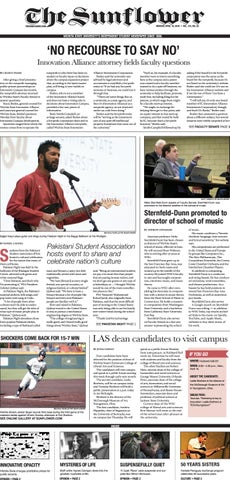
Aleks Sternfeld-Dunn speaks at Faculty Senate. Sternfeld-Dunn was promoted to the director position in the school of music.
Sternfeld-Dunn promoted to director of school of music BY ANDREW LINNABARY
SELENA FAVELA/THE SUNFLOWER
Associate professor Aleks Sternfeld-Dunn has been chosen as director of Wichita State’s school of music, effective in June. He will succeed Russ Widener, who is retiring after 37 years at WSU. Sternfeld-Dunn grew up in the San Francisco Bay Area, was educated on both coasts and wound up in the middle of the country. He joined WSU’s faculty in 2011 and has taught composition, electronic music, and music theory. He came to WSU after completing his doctorate in composition with a minor in music theory from the Hartt School of Music in Connecticut. He holds a masters in composition from Washington State University and a bachelors from California State University East Bay. Sternfeld-Dunn also serves on Faculty Senate as a fine arts senator representing the school
Sajjad Naqvi plays guitar and sings during Pakistan Night in the Beggs Ballroom at the Rhatigan.
S
BY DANIEL CAUDILL
tudents from the Pakistani Student Association (PSA) hosted a cultural celebration for the nation that many of them call home. Pakistan Night was held in the ballroom of the Rhatigan Student Center, adorned with green and white national flags. “I love Pakistan, and that’s why I’m promoting it,” PSA President Zehdan Qidwai said. At Pakistan Night, the Pakistani national anthem, folk songs, and pop tunes were sang in Urdu. “A lot of people from other cultures won’t be able to understand, but they will get the idea of what type of music people play in Pakistan,” Qidwai said. Pakistan Night attendees chose from popular Pakistani dishes, including a type of flatbread called
Pakistani Student Association hosts event to share and celebrate nation’s culture naan and biryani, a spicy rice dish traditionally served with meat and vegetables. “We have [biryani] at every single festival, any special occasion, or religious festival, or cultural festival” Qidwai said. “We have to have a biryani because a lot of people like biryani and even non-Pakistani people are familiar with it.” Born and raised in Pakistan, Qidwai moved to the United States in 2015 to pursue a mechanical engineering degree at Wichita State. “The college of engineering is really good, and I heard really good things about Wichita State,” Qidwai
SHOCKERS COME BACK FOR 15-7 WIN
said. “Being an international student, we pay a lot more fees than people that are paying in-state tuition, and we don’t get any grants or any type of scholarships, so … I thought Wichita would be one of the most cost-effective places to live.” PSA Treasurer Muhammad Rohail Jamil, also originally from Pakistan, said that the most difficult part of moving to the United States was only being able to see his family over winter break during the school year. “Thank God for technology SEE PAKISTAN NIGHT PAGE 2
LAS dean candidates to visit campus BY JENNA FARHAT
SELENA FAVELA/THE SUNFLOWER
Wichita State’s Jordan Boyer rounds third base during the third game of the weekend series against UConn Sunday afternoon at Eck Stadium.
SEE ONLINE GALLERY AT SUNFLOWER.COM
of music. His music combines a “frenetic rhythmic language, lean textures and lyrical sensitivity,” his website says. His compositions are performed in the United States and Europe by groups like Composers Inc., The Kiev Philharmonic, The Conundrum Ensemble, the Contra Costa Chamber Orchestra and the Interlochen Chamber Players. In addition to composing, Sternfeld-Dunn is a conductor and string bassist. He has conducted orchestras, wind ensembles, and theatre productions. As a bassist he has held positions in several San Francisco Bay Area Orchestras, as well as numerous jazz bands. Sternfeld-Dunn also serves A Google search on SternfeldDunn was telling — in addition to WSU links, top results included links to his music on Spotify, YouTube, and Apple Music, websites to buy sheet music of his work.
Four candidates have been selected for the position of dean of Wichita State’s Fairmount College of Liberal Arts and Sciences. The candidates will visit campus and speak at a public forum starting this week through early next month. The second candidate, Leslie Brothers, will be on campus today and Tuesday. Brothers will hold a public presentation at 3 p.m. today in 210 McKnight. Brothers is the director of the McDonough Museum of Art, Youngstown, Ohio. The first candidate, Andrew Hippisley, chair of linguistics at the University of Kentucky, was on campus last Thursday. He will
speak at a public forum Monday from 3:30-4:30 p.m. in Hubbard Hall room 231. Tomorrow, he will meet with students and faculty from the college of liberal arts and sciences. The other finalists are Robert Matz, interim dean of the college of humanities and social sciences at George Mason University; Orlando Perez, associate dean of the college of arts, humanities, and social sciences at Millsersville University of Pennsylvania; and Bessie HouseSoremekun, associate dean and professor of political science at Jackson State University. Current dean of the WSU college of liberal arts and sciences Ron Matson will retire at the end of the school year after 48 years at the university.
IF YOU GO WHERE: Hubbard Hall 231
WHEN: 3:30 - 4:30 p.m., Mon., April 16.
ABOUT THE CANDIDATE: Leslie Brothers is the director of the McDonough Museum of Art in Youngstown, Ohio.
SNEAK PEEK:
Youtube: “Mattering is key to innovation: Leslie Brothers at TEDxYoungstown”
INSIDE
MYSTERIES OF LIFE
SUSPENSEFULLY QUIET
50 YEARS SISTERS
Wichita State charges prohibitive prices for public records.
Staff writer Agnes Corrigan dives into the greatest mysteries of life.
‘A Quiet Place’ uses suspense and surprise like Alfred Hitchcock.
Kansas-Paraguay exchange program celebrates 50 successful years.
OPINION • PAGE 2
OPINION • PAGE 2
OPINION • PAGE 2
CULTURE • PAGE 3
INNOVATIVE OPACITY
OPINION
2 | MONDAY, APRIL 16, 2018
www.thesunflower.com
THE STAFF EDITORIAL
Editor-in-Chief Chance Swaim Managing Editor Jenna Farhat Culture Editor Marissa Campbell Sports Editor Matt Crow Opinion Editor Evan Pflugradt Design Editor Madeline Deabler Photo Editor Brian Hayes Digital Editor Nicole Byrne
ADVERTISING
Advertising Manager Christian Yost
ADVISING
Faculty Adviser Amy DeVault
LETTERS TO THE EDITOR
Send letters to the editor to editor@thesunflower.com or submit at thesunflower.com. Please keep letters to 400 words or less. All letters are edited for clarity and length. Please include your name, WSU affiliation and a phone number for verification purposes.
Our Mission
The Sunflower — both in print and online — will be a timely resource of information about the Wichita State University community. It will report on news, issues, activities, academics and athletics, in addition to offering a forum for discussion, reviews and commentary. It will also be an effective learnig experience for students, who will have the final authority over what is published.
Legal
The Sunflower (published for use by WSU students, faculty and staff) is private property and unlawful removal or use of papers is prosecutable. One copy may be taken for free. Additional copies must be purchased for $1 each. The Sunflower is also partially funded by the Student Government Association at WSU. The opinions expressed in The Sunflower editorials, columns, guest columns, reviews, advertisements, letters and editorial cartoons are not necessarily those of the staff, publications board, student body or university. The Sunflower reserves the right to edit or reject any submission. We also reserve the right to edit or reject any advertisement.
CONTACT THE SUNFLOWER 019 Elliott Hall 1845 N. Fairmount Ave. Campus Box 134 Wichita, KS 67260-0134 ----------
SUNFLOWER OFFICES Front Desk: 316-978-3640 Fax: 316-978-3778 ADVERTISING Christian Yost: 316-978-6906 admanager@thesunflower.com EDITORIAL Chance Swaim: 316-978-6905 editor@thesunflower.com ADVISER Amy DeVault: 316-978-6052 amy.devault@wichita.edu ---------ONLINE www.thesunflower.com FACEBOOK www.facebook.com/sunflowerwsu TWITTER @sunflowernews INSTAGRAM @thesunflowernews
CORRECTIONS This space is reserved for corrections. Spot an error? Call us at 316-978-6905.
CLASSIFIEDS The Sunflower will not knowingly publish advertising that is false or misleading. If you have a question about an ad or a classified, call the Wichita Better Business Bureau at 316-2633146.
Thinking Abortion? Alternatives: Free Testing 265-0134
More classifieds can be found online at www. thesunflower.com/classifieds. Be see in the classifieds by calling 316-978-6906.
www.thesunflower.com
OUTRAGEOUS PRICES FOR PUBLIC RECORDS Quite possibly the most innovative move Wichita State President John Bardo and his league of executives have done this year is charging The Sunflower big money for heavily redacted documents. Under the Kansas Open Records Act, public officials’ work emails — like those of President Bardo, Student Body President Paige Hungate, or any WSU vice presidents — are open records. In November, The Sunflower requested all email communications containing key phrases between April 15, and Nov. 13, to or from, the emails of nine university officials. WSU General Counsel David Moses sent the final bill last week charging The Sunflower $1,605 for the emails. This final number spiked from an estimate Moses initially gave of $409. Universities are allowed to charge for document retrieval on
EVAN PFLUGRADT OPINION EDITOR
the basis that they use the cheapest means possible and provide cost estimates for the retrieval process — that can include redacting sensitive information. The Kansas Open Records Act allows public agencies, like WSU, to “prescribe reasonable fees for providing access to or furnishing copies of public records.” But these quotes are nonsensical and unreasonable.
As journalists, we try to shine a light in dark corners — but charging more than $1,000 for blacked out pages and redacted information blocks the light. Of the 2,102 emails The Sunflower received from their request, 539 were completely blacked out and 928 contained some form of redaction. Also last week, Moses asked for $1,500 — requiring a $750 down payment — to release financial records tracking incoming and outgoing financial transactions by the nonprofit handling Innovation Campus projects. In the last three years, The Sunflower has requested more records than in years past. And up until recently, those requests have been fulfilled without charge. A high-priced bill for public documents is WSU’s latest innovative initiative.
The University of Kansas’ student newspaper, the University Daily Kansan, was charged $132.50 in 2016 in addition to $561 spent on two previous requests to obtain information regarding sexual misconduct cases. The Kansas State Collegian was charged $1,375 to produce similar records; and at the time, WSU produced the records free of charge. Wichita State caught up with the trend — but only on requests that obviously have hidden material that’s vital to the public at large. This week alone, two bills massing over $1,000 were sent to The Sunflower for university records. As a public institution, WSU is bound to Kansas Open Records Laws — meaning they must furnish documents at a “reasonable” rate. So, tell me — what’s “reasonable” about a $750 down payment for a bunch of blacked out pages?
Life’s greatest mysteries, the Corrigan edition Sometimes I forget that the world is a magical and mysterious place. That sentence makes me want to barf, but bear with me. I get so caught up in my day-to-day routine that I forget to be curious and wonder about my surroundings. I was flipping through channels the other day, procrastinating, when I stumbled across this show, Ancient Aliens. Please, do yourself a favor and watch this show—it’s basically a bunch of “experts” explaining that every historical event and monument was built and devised by ancient aliens. You know the Pyramids, the pinnacle of man’s innovation? Those were actually the ancient alien’s power
plants. Duh! After watching this show, however ridiculous, I started to create my own list of the great mysteries of the world. 1. Seriously, what’s the deal with Stone Henge? 2. Why are stop signs octagonal? 3. What is Justin Vernon of Bon Iver actually singing in any of his songs? 4. Why do I always put my right ear headphone in my left ear when there’s a 50/50 chance of doing it correctly? 5. Why do airplanes have such small overhead bins? They always complain about not having enough room. Why not make them three inches wider?
AGNES CORRIGAN COLUMNIST
6. Who invented beer and how did they do it? 7. Why do loose sweaters/ backpack straps always get caught on knobs or handles when the chances of that happening seem
so slim? 8. Who killed JFK? I love a good conspiracy theory. 9. Who was the Zodiac Killer? 10. Why does Trump think that’s a good haircut? 11. Where do all the socks go? 12. Why does Swiss cheese have holes in it? 13. Is Tupac, in fact, dead? Maybe some of these mysteries are solvable, but that’s not always the point. The fact that there is still so much to know or to discover gives me hope when I get stuck in a nihilist rut. There is a point to all of this. There is magic and mystery in the world just waiting to be solved.
Suspense and surprise lurk in ‘A Quiet Place’ Alfred Hitchcock had a story he’d like to tell about the difference between surprise and suspense. Imagine two people are having a conversation and a bomb goes off from underneath the table they’re sitting at. This, he’d say, is surprise. Now, imagine the same scenario but the audience knows there’s a bomb under the table that will detonate in five minutes. This is suspense. The difference is in the parsing out of information. “A Quiet Place,” the latest movie from “The Office” alum John Krasinski, dabbles in both of these elements, but its adherence to this classical definition of suspense is what makes its terror so effective. “A Quiet Place” occurs in a world where humanity is hunted by monsters who track by sound. It’s in this premise where the initial tension is first generated: how does one live without making a sound? It’s impossible. This is the film’s equivalent to the bomb under the table. The audience inherently knows that sound will eventually be made — it’s an element of existence. The question then arises what
PAKISTAN NIGHT FROM PAGE 1
because without it, I wouldn’t be able to communicate with my family,” Jamil said. “You can adjust cultures in a few months, but you can never find a new family. That’s the hardest part.” Jamil moved to Wichita in 2016, and is currently seeking a degree in computer science. Qidwai said hosting events on campus helps Pakistani students feel more at home while also exposing non-Pakistani students to the nation’s culture. “They get to enjoy the food, they get to enjoy the music that they used to listen to back home, and they get to meet people from our country,” Qidwai said. Qidwai said that unity was one of the most prominent aspects of Pakistani culture. “If I see someone who belongs to Pakistan, I’m going to feel proud of them,” Qidwai said. On April 28th, the group will host a kite-flying celebration in honor of the Pakistani holiday, the Basant kite festival, at O.J. Watson Park in Wichita. “We ordered kites from Pakistan, and we had them delivered here, and we decided to hold the event so people can enjoy that type of traditional event,” Qidwai said. “People
MATTHEW GARNER FILM CRITIC
will happen when that rule of silence is eventually broken. To Krasinski’s credit, he wrings all that he can out of this idea. Full scenes are played without sound, either to accentuate the eventual noise that will occur or to let the audience’s own heartbeat become a fatal soundtrack. The rest of the film is wrapped around this harrowing core. John Krasinski and Emily Blunt play husband and wife, trying to protect their children in this apocalyptic nightmare. The film quickly reveals itself as a parable for parenting, and while the themes it develops aren’t particularly complex, there’s a thematic
Need
COURTESY
“A Quiet Place” the latest movie from “The Office” alum John Krasinski, occurs in a world where humanity is hunted by monsters who track by sound.
innocence to them that’s admirable. However, the quieter (no pun intended) scenes in this movie feel like a drag, weighing down the momentum the film has so craftily cultivated up until this point. Exposition is a necessary evil, a pill that must be sugar-coated, but Krasinski’s talents don’t reside in these elements of filmmaking. The film’s magic lies in its brevity: there’s no backstory for this family and no explicit explanation for these monsters. Instead, the
picture is only focused on this small sliver of days the family is trying to get through. This is a sprint of a film and you can almost feel the wind on your face as it flies right by you. “A Quiet Place” is lean and focused and while it falters in the slower moments, the times where the film isn’t actively trying to terrify you, its admiration and adherence for the classical techniques of suspense and tension set it a notch above recent entries to the genre.
to catch up?
If your first year of college wasn’t as successful as you’d hoped, you can get back on track over the summer, with a little help from Salina Area Technical College.
Summer
claSSeS:
$99/credit-hour
• College Algebra • English Comp I • General Psych
• Intermediate Algebra • General Psychology • Human Development
claSSeS
traNSfer to
• Human Anatomy • Interpersonal Communication • Technical Writing
WSu!
785-309-3100 | admissions@salinatech.edu Salina Area Technical College does not discriminate on the basis of race, religion, color, sex (including pregnancy and gender identity), sexual orientation, parental status, national origin, age, disability, family medical history or genetic information, military service, or any other non-merit based factor in admission or access to, or treatment or employment in, its programs and activities. Any person having inquiries concerning compliance with the regulations implementing Title VI, Title VII, ADA, Title IX, Section 504, Title II, GINA, is directed to contact the Human Resources Specialist, 2562 Centennial Rd, Salina, KS 67401, 785-309-3100.
CULTURE
www.thesunflower.com
FACULTY SENATE FROM PAGE 1
answer to that question. Aaron Rife, an education senator, brought the questioning back to that topic. “Can we go back a question?” Rife said. “Did you just say that President Bardo is the only board member of the innovation corporation?” “Yes,” Boden said. “That’s not a board,” Rife said. “By law, it is,” Boden said. Aleks Sternfeld-Dunn, a fine arts senator, asked if Wichita State is putting any of its own resources “towards any aspect of Innovation Alliance.” “To be honest,” Boden said, “you’re asking me to state an absolute that I wouldn’t be comfortable with.” As an example of how that question is hard to answer, Boden pointed to the Law Enforcement Training Center, which exists as a partnership building between the City of Wichita, Sedgwick County, and Wichita State on Innovation Campus. “That’s a university project,” Boden said. “We lease space, or will lease space, after five years, for that criminal justice program in that building. … So the university is going to share in costs associated with that building.” Boden then gave a seemingly contradictory answer to a follow-up question from Sternfeld-Dunn. “So once they (the developers) build the building, we have to lease it from them to use it?” he asked. “No, absolutely not,” Boden said. However, that doesn’t align with what The Sunflower has reported. For example, Wichita State expects to pay more $2.5 million next year to lease space from the developers of The Flats, a private apartment complex on Innovation Campus. Boden also addressed the bidding process for Innovation Campus projects, which has been referred to as a “work-around” by a state lawmaker and a university official. For a typical state building project, the state agency puts out plans for a building and contractors competitively bid on the project. Those submissions are open records available to the public. Bidding for Innovation Campus projects has been described as “open bidding.” But unlike most projects on state property, proposals are submitted by the developers directly to the Innovation Alliance, which decides what projects will be built on public land. The plans for buildings submitted and decided upon by the nonprofit, especially those it turns down, are unavailable to the public. “A lot of what we do on the Innovation Campus is with private buildings, private money, and so those projects are not bid by us. Those projects may be bid by the developers or the private individuals who are supporting those,” Boden said. Boden was asked whether other universities with innovation-type campuses “bypass faculty and student and community input.” “Frankly, I have no idea what they (other universities) do,” Boden said. “There’s about 107ish of them out there in the country right now. … I am confident that there are varying levels of outside input in terms of just processes.” Sternfeld-Dunn asked what expenses Innovation Alliance has. “Again, without stepping out of my comfort zone as far as what I’m privy to, for example once we get utility lights up, there’ll be some utility costs that go on at the Innovation Campus. There’ll be things of that nature. “Snow removal, for example. We turn around and we charge those costs back to the tenants who will be occupying on campus,” Boden said. Boden said it was complicated because the nonprofit could contract with the university physical plant or “have somebody come from external and plow all the roads.” Boden said none of the board members are compensated for their work. “They’re all voluteers,” she said. Boden said much of the money used to operate Innovation Alliance comes from a $2 million appropriation from the state. When pressed on what Innovation Alliance spends each year, Boden could not give an answer. “I don’t review those numbers, so I don’t know,” Boden said. Earlier this month, The Sunflower requested “all documents recording incoming or outgoing financial transactions by the Wichita State Innovation Alliance” in the past year. Wichita State would not provide those records without receiving a down payment of $750 with an estimated total cost of $1,500. “You have some real problems with the IC (Investments Corporation) of a board of one,” said Jay Price, a humanities senator. “I mean, I think that’s a real issue.” “What if the university doesn’t like what’s going on?” Price said. “There seems to be no recourse to say no. That seems to be a problem.”
MONDAY, APRIL 16, 2018
|3
‘A LASTING EXCHANGE OF SISTER STATES’ Kansas-Paraguay student exchange program celebrates 50 years
A
BY MATT COOPER
mid the food, music, and orchestral trio renditions of “Somewhere Over the Rainbow” and “Home on the Range,” the 50th anniversary of the Kansas-Paraguay Partnership was a celebration of cultural exchange above all else. “Let me relate to you,” Paraguayan poet Manuel Ortiz Guerrero wrote in the beginning of the nineteenth century in a nation rebuilding in the wake of the “War of the Triple Alliance.” “The sorrow that oppresses me... only the music can relieve.” Guerrero wrote these lines in Guarani, the indigenous language of Paraguay — which despite the dawn of European colonization survives to this day. The past weekend at St. Vincent de Paul Catholic Church in Andover, the visceral nature of Guerreros words were celebrated. Friday, The Kansas-Paraguay Partners of America (KPP) marked their 50th year as an institutional student exchange program. The KPP is encompassed within the Partners of the Americas Program — a nonprofit student exchange program established under the presidency of John F. Kennedy in 1963. To date, the KPP is responsible for the study abroad opportunities of dozens of students between Kansas and Paraguayan Universities each year. Several KPP alumna attended Friday evening, including Paula Wierman who earned her bachelor’s in Spanish in 2017. In her final semester while taking an elective Spanish course, Wierman had the opportunity to travel to Paraguay as a part of an
MATT COOPER/THE SUNFLOWER
Kansas State University freshmen Lucas Núñez and Gonzalo Rodriguez perform a duet together in celebration of Kansas-Paraguayan Partners’ 50th Anniversary.
agricultural study program in the nation’s capital of Asunción. “It was a blast,” Wierman said. “One of the highlights was just being able to interact with the people of Paraguay.” Aside from her studies, Wierman remembered time spent with her host-mother. By day, the two would shop, attend local pick-up soccer matches and prepare baked goods for one another. Wierman remembered
her host-mother preparing a batch of unforgettably delicious Dulce de Guayaba Jam. Paraguayan ambassador to the United States Germán Rojas also attended the event. “It’s gratifying,” Rojas said. “We’re celebrating 50 years and this is not only related to students, but it is a brotherhood as well.” Paraguay and the state of Kansas are a continent apart,
yet the two share cultural similarities. Both are states landlocked in the heart of their surrounding geography. Both share an economic dependence on agricultural exports. Paraguayan WSU graduate Santiago Vera said Kansas and Paraguay share a taste for one particular cuisine — barbecue. “Paraguay loves barbecue,” Vera said. Vera told his story over a plate of chicken and beef empanadas and Paraguayan bread while taking in the scene of celebration as his four daughters— all dressed in Paraguay flag embroidered dresses and dancing to flamenco music. In 2006, Vera traveled to Kansas and enrolled at WSU as an Intensive English student and a year later earned a bachelor’s in management information systems. But one short stint in Kansas proved insufficient for Vera. “Coming here for one year just wasn’t enough,” he said. “I was ready for a real change.” Through the KPP exchange program Vera stayed in Wichita and continue his education as WSU. He would go on to earn an additional bachelor’s in business administration and a master’s in computer networking. “It changed me for the better,” he said. “When you travel, your ideas change and your perspective is changed for good. You expand your horizons and you become a better person.” “In a lot of ways, the atmosphere and the friendliness of the people is similar to Kansas,” she said. “One of Paraguay’s greatest natural resources are its people.” At the end of the evening, Ortiz Guerrero’s soliloquy feels fitting.Through cultural exchange, the consumption of each other’s customs, languages, music and cuisine, Kansans and Paraguayans have over the past 50 years found a common fabric.
PAID ADVERTISEMENT
Congratulations to the newly elected Fairmount College of Liberal Arts and Sciences Senators Jordan Cao -Chemistry (JR) Jozie Caudillo-Political Science (SO) Sarah Myose-Sociology/Political Science (JR) Jaiden Soupene-Political Science (JR) Student Body President-Elect Kenon Brinkley-Strategic Communication (JR) Vice President-Elect Shelby Rowell-Political Science (SR)
4 | MONDAY, APRIL 16, 2018
ADVERTISEMENT
www.thesunflower.com
EN MAS’
Carnival and Performance Art of the Caribbean On view April 21 – August 12, 2018
IMAGE: Ebony G. Patterson, Invisible Presence: Bling Memories, April 27, 2014. Performance. Location: Kingston, Jamaica. Courtesy of the artist and Monique Meloche Gallery, Chicago. Photograph: Monique Gilpin and Philip Rhoden.
Saturday, April 21
7–9 p.m. | Spring Exhibition Opening Location: Ulrich Museum Free Admission | Public Welcome Music, dance, parade and pageantry fill the evening of our spring feast, the opening of EN MAS’: Carnival and Performance Art of the Caribbean. Explore the galleries and venture amongst the works of the nine exhibition artists as they explore the history of performance art related to the traditions of Caribbean Carnival. Snakettes offer Creole favorites, roadside fare, regional ingredients, and spice blends of the Caribbean with fresh fruit drinks, and rum punch. Interludes of reggae, calypso and soca flow throughout the art center and out onto the plaza. EN MAS’: Carnival and Performance Art of the Caribbean is an exhibition curated by Claire Tancons and Krista Thompson; organized by the Contemporary Arts Center (CAC), New Orleans and Independent Curators International (ICI), New York. The exhibition is made possible by an Emily Hall Tremaine Exhibition Award. Additional support is provided by The Andy Warhol Foundation for the Visual Arts, and by the Institut français in support of African and Caribbean projects. The exhibition debuted at CAC New Orleans in spring 2015, and will tour through 2018. The Ulrich presentation is made possible by contributions from The Gridley Family Foundation, John and Nancy Brammer, Celebrity Cruises, The Khicha Family Foundation, Dr. Sam and Jacque Kouri, Martin Pringle Law Firm, Ron and Lee Starkel, Westar Energy, Clark and Sharon Bastian, Jane McHugh, Louise L. Beren, Eric Engstrom and Robert Bell, Sondra M. Langel, Liz and Bob Workman and an anonymous donor. Additional generous support provided by Denise and Rex Irwin, Marcia and Ted D. Ayres, Charles E. Baker, Laurie and Mark A. Finucane, Justus H. Fugate, George and Eleanor Lucas, Dr. Pat Purvis, Dr. Dennis and Ann Ross, Don and Ellie Skokan, Dorothy Shannon, Stev Overstreet, John and Kay Morse, Bill, Julia and Luke McBride in honor of Bob Workman, and Dasa and Nalini Gangadhar.
Museum Hours
Tuesday – Friday: 11 a.m. – 5 p.m. Saturday – Sunday: 1 – 5 p.m. Closed on Mondays, University & Major Holidays
@ulrichmuseum | ulrich.wichita.edu | Free Admission | 316.978.3664 | 1845 Fairmount <--THERE IS A WHITE ONE