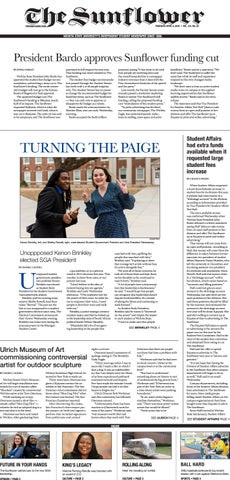
THURSDAY, APRIL 5, 2018 • VOL. 122, ISS. 50
THESUNFLOWER.COM
WICHITA STATE UNIVERSITY’S INDEPENDENT STUDENT NEWSPAPER SINCE 1896.
President Bardo approves Sunflower funding cut BY JENNA FARHAT
Wichita State President John Bardo has approved the student fees budget recommendation, authorizing a steep cut to The Sunflower’s funding. The entire university’s budget will now go to the Kansas Board of Regents for final approval. The approved budget cuts The Sunflower’s funding to $80,000, nearly half of its request. The Sunflower requested $158,000, which is what the newspaper received until 2016, when it was cut to $105,000. The 2016 cut was said to be temporary, and The Sunflower was
promised its full request for next year. That funding was never restored to The Sunflower. The student fees budget recommendation passed through the Student Senate last week with a 21-18 simple majority vote. The Student Senate has no power to change the recommended budget for fixed-line items, such as The Sunflower — they can only vote to approve or disapprove the budget as a whole. Bardo made the announcement via Shocker Blast, sent out early Wednesday morning. Bardo accepted the $9.87 million
proposal, stating “It has more to do with how people are receiving news and the overall steep decline in newspaper industry revenues than it does with the First Amendment freedoms of the speech and the press.” Last month, the Faculty Senate unanimously passed a resolution imploring Bardo to restore The Sunflower’s full funding, calling the proposed funding cuts “intimidation of free student press.” “As print advertising has declined, our community newspaper, The Wichita Eagle, has endured dramatic reductions in staffing, news space and print
deadlines,” Bardo said in a statement. “We don’t want The Sunflower to suffer the same fate while its staff and supporters respond to this very changed media landscape. “We don’t want to lose an active student media voice on campus or the applied learning opportunities that Sunflower staffers receive,” Bardo said in the news release. The statement said that Vice President for Student Affairs Teri Hall “plans to take money from an open staff position in her division and offer The Sunflower up to $25,000 in print and online advertising.”
TURNING THE PAIGE
Student Affairs had extra funds available when it requested large student fees increase BY CHANCE SWAIM
COURTESY
Kenon Brinkley, left, and Shelby Rowell, right, were elected Student Government Preident and Vice President Wednesday.
Unoppposed Kenon Brinkley elected SGA President BY DANIEL CAUDILL
U
nopposed student government presidential candidate Kenon Brinkley was elected as Student Body President for the Student Government Association’s 61st session. Brinkley and his running mate, senator Shelby Rowell, lead their ticket, “Revival.” The pair are the first to run unopposed in a student government election since 2005. The Election Commission announced their victory Wednesday evening. Brinkley was home sick during the announcement in the Rhatigan Student Center.
1,554 students, or 12.3 percent, voted in SGA elections this year. That number is down from 2,601, or 19.7 percent last year. “I don’t believe in the idea of (voters) buying into my agenda,” Brinkley said early Wednesday afternoon. “(The students) vote for the power of their voice. In order for me to empower their voice, I need people to find their voice and walk with me.” Brinkley, a junior strategic communication major, said that he looked up to the leadership style of South African political leader Nelson Mandela. “(Mandela) did a lot of recognizing leadership in the people that
Ulrich Museum of Art commissioning controversial artist for outdoor sculpture BY DANIEL CAUDILL
Wichita State’s Ulrich Museum of Art will begin installation next month for a set of statues called “Shockers” created by controversial Wichita-native artist Tom Otterness. While studying art in 1977, Otterness created a short film — simply called “Shot Dog Film” — wherein he tied an adopted dog to a tree and shot it in the head. Otterness was born and raised in Wichita. After graduating from
marched with him; uplifting the people that marched with him,” Brinkley said. “Explaining to them that courage isn’t action without fear, it’s action alongside fear.” “He took all of those concerns, he took all of those fears and kept them on his shoulder as he continued to march forth,” Brinkley said. “A lot of people have a misconception that leadership is fearlessness,” he said. “I would hope that people can recognize that leadership doesn’t require invulnerability; it’s a matter of taking the blows and continuing to walk forward.” As Student Body President, Brinkley said he wants to “decentralize the power” and inspire the leader in each student at Wichita State. “I want to make sure that people
Wichita Southeast High School, he moved to New York to study art. Thirty years later, Otterness was given a $750,000 contract for an exhibit in San Francisco. The San Francisco Arts Commission did not know about “Shot Dog Film” when the contract was formed, The San Francisco Examiner reported. After discovering the video, San Francisco’s then-mayor put the project on hold and signed a petition that included signatures from politicians and animal
SEE BRINKLEY PAGE 4
rights activists. Otterness issued a statement of apology, stating to The Brooklyn Daily Eagle: “Thirty years ago when I was 25 years old, I made a film in which I shot a dog. It was an indefensible act that I am deeply sorry for. Many of us have experienced profound emotional turmoil and despair. Few have made the mistake I made. I hope people can find it in their hearts to forgive me.” Ulrich Director Bob Workman said that controversy has followed Otterness around. “Unfortunately, there has been reaction to (Otterness’s) work for most of his career,” Workman said. “Any museum worth their salt knows when they work with Tom
Otterness that there are people out there that have a problem with him.” Workman said that he had seen no local concern, “either at the campus level or at the community level.” “You have to understand something about art history to sort of understand the big picture here,” Workman said. “(Otterness) was part of the New York art scene in a time where artists were pushing boundaries.” “In art, some artists began to mutilate themselves,” Workman said. “There was some pretty violent action that would be filmed.” “Tom’s action has to be SEE ULRICH PAGE 4
When Student Affairs requested a more-than-$118,000 increase in student fees for its division this year, it already had extra money in a “shrinkage account” in the division, according to information provided by Vice President for Student Affairs Teri Hall. The extra available money was confirmed Wednesday when Wichita State President John Bardo released a written statement saying Hall “plans to take money from an open staff position in her division and offer The Sunflower up to $25,000 in print and online advertising.” That money will not come from an open staff position. According to Hall, that money will come from the difference in salary between former associate vice president of student affairs Maureen Dasey-Morales, who left the university in December, and incoming assistant vice president for retention and assessment Alicia Newell. Hall said that money exists in a “shrinkage account” within her division, which varies based on “vacancies and filling positions.” Hall could not give an exact amount in the shrinkage account Wednesday, but said there are five open positions in her division. She said those positions should be filled by this summer and estimated the amount in the shrinkage account next year will be about $40,000. She said she’s willing to commit up to $25,000 of that to advertising in The Sunflower. The $25,000 Hall plans to spend on advertising is the amount the paper was cut this year by the Student Fees Committee. Hall is the chair of the student fees committee and abstained from voting to cut The Sunflower. Hall said her offer to spend $25,000 to advertise in The Sunflower next year is “sincere and genuine.” “It is my hope that having the Division of Student Affairs advertise in the Sunflower that other campus departments will begin to do so as well,” Hall said in an email Wednesday. Campus departments, including those in the Student Affairs division, have advertised in The Sunflower for years. Since 2008, groups falling under Student Affairs on the campus organizational chart have bought more than $45,000 in ads in The Sunflower. Since Hall’s arrival at Wichita State last January, Student Affairs SEE STUDENT AFFAIRS PAGE 4
INSIDE
FUTURE IN YOUR HANDS The Sunflower wishes luck to the new SGA leadership.
OPINION • PAGE 2
ROLLING ALONG
BALL HARD
Marché Fleming-Randle was honored with an award in D.C.
Meet the traveling art exhibit.
WSU baseball continues its top knotch season with a win against Oklahoma State.
CULTURE • PAGE 3
CULTURE • PAGE 3
SPORTS • PAGE 4
KING’S LEGACY
OPINION
2 | THURSDAY, APRIL 5, 2018
www.thesunflower.com
THE STAFF EDITORIAL
Editor-in-Chief Chance Swaim Managing Editor Jenna Farhat Culture Editor Marissa Campbell Sports Editor Matt Crow Opinion Editor Evan Pflugradt Projects Editor Ray Strunk Creative Director Madeline Deabler Photo Editor Brian Hayes Digital Editor Nicole Byrne
ADVERTISING
Advertising Manager Christian Yost
ADVISING
Faculty Adviser Amy DeVault
LETTERS TO THE EDITOR
Send letters to the editor to editor@thesunflower.com or submit at thesunflower.com. Please keep letters to 400 words or less. All letters are edited for clarity and length. Please include your name, WSU affiliation and a phone number for verification purposes.
Our Mission
The Sunflower — both in print and online — will be a timely resource of information about the Wichita State University community. It will report on news, issues, activities, academics and athletics, in addition to offering a forum for discussion, reviews and commentary. It will also be an effective learnig experience for students, who will have the final authority over what is published.
Legal
The Sunflower (published for use by WSU students, faculty and staff) is private property and unlawful removal or use of papers is prosecutable. One copy may be taken for free. Additional copies must be purchased for $1 each. The Sunflower is also partially funded by the Student Government Association at WSU. The opinions expressed in The Sunflower editorials, columns, guest columns, reviews, advertisements, letters and editorial cartoons are not necessarily those of the staff, publications board, student body or university. The Sunflower reserves the right to edit or reject any submission. We also reserve the right to edit or reject any advertisement.
CONTACT THE SUNFLOWER 019 Elliott Hall 1845 N. Fairmount Ave. Campus Box 134 Wichita, KS 67260-0134 ----------
SUNFLOWER OFFICES Front Desk: 316-978-3640 Fax: 316-978-3778 ADVERTISING Christian Yost: 316-978-6906 admanager@thesunflower.com EDITORIAL Chance Swaim: 316-978-6905 editor@thesunflower.com ADVISER Amy DeVault: 316-978-6052 amy.devault@wichita.edu ---------ONLINE www.thesunflower.com FACEBOOK www.facebook.com/sunflowerwsu TWITTER @sunflowernews INSTAGRAM @thesunflowernews
CORRECTIONS This space is reserved for corrections. Spot an error? Call us at 316-978-6905.
CLASSIFIEDS The Sunflower will not knowingly publish advertising that is false or misleading. If you have a question about an ad or a classified, call the Wichita Better Business Bureau at 316-2633146.
Thinking Abortion? Alternatives: Free Testing 265-0134
More classifieds can be found online at www. thesunflower.com/classifieds. Be see in the classifieds by calling 316-978-6906.
www.thesunflower.com
Good luck, Kenon and Shelby
K
enon Brinkley and Shelby Rowell won the SGA president and vice president election Wednesday night, and, while they ran unopposed, The Sunflower hopes they’re successful fulfilling their mission of combatting the student body’s apathy. Under Paige Hungate’s leadership, most students did not feel like SGA represented their interests. An SGA survey conducted in the fall found that only 4.17 percent of students felt SGA definitely represented their interests, while 11.54 percent felt SGA definitely did not. Another 17.95 percent felt SGA “probably” represented their interests. More than half of all respondents were unsure, saying SGA might or might not represent their interests, according to the raw data from the survey obtained through a records request. At the end of Hungate’s term, a single ticket ran unopposed for SGA elections for the first time since 2005. At the end of Hungate’s term, just over 12 percent of students voted in this week’s SGA elections — down significantly from last year. Student participation is down at a time when student engagement is desperately needed. It’s up to you to make sure student voices manifest in university decisions. A year is a long time, and things change fast at Wichita State. Enter your term with a strong sense of purpose and stick to your principles. Whatever your priorities are right now, they’re subject to change. Be flexible, but stick to your principles. After running on a platform of
It’s time for what? You may ask. A group of four social work graduate students think it’s time for the Kansas legislature to move forward with the legalization of medicinal marijuana. For the past nine years, bills related to medicinal marijuana have been pushed aside or have sat in committees with no action. Most recently, in 2017, the Kansas Safe Access Act (KSAA), primarily written by patient advocacy group Bleeding Kansas Advocates, was introduced as a bill to both Senate (SB 187) and the House of Representatives (HB 2348). Once again, however, these bills died in committee and were never granted a
COURTESY
Kenon Brinkley and Shelby Rowell were elected Student Government Preident and Vice President respectively.
STAFF
EDITORIAL repairing relations with Wichita State’s administration, Hungate’s cabinet drafted a letter last month calling Bardo’s decision to open the student fees deliberations “the pinnacle of cowardice.” Who could have imagined that statement when Hungate was elected? The Sunflower hopes Brinkley and Rowell assume their posts with a healthy dose of skepticism, balanced out with an even healthier dose of optimism. They should take meaningful steps to represent students’ interests.
LETTER to the EDITOR hearing. If passed, either one of these bills would have allowed Kansas children, adults, and elderly alike access to medicinal marijuana to aid in their chronic pain management and recovery; benefits that for some health conditions cannot be otherwise achieved with traditional medicine. As a result, Kansas is behind 29 states and the
They can do that by demanding answers to questionable decisions. They should communicate those answers to the student body and the student senate without prior-review or coaching by the administration. They should not have closed-door discussions about important decisions that affect the student body. Be open to criticism. Every leader deserves it. Take it in stride. If you actually represent students, they will take note. Student government is tasked with representing students on campus to the administration and the state. That’s not an easy job. Good luck, Kenon and Shelby. Many have come before you, and the future’s in your hands. Be open, be honest, be brave.
District of Columbia who have all enacted laws to allow for the use of medicinal marijuana, according to the National Conference of State Legislatures (NCSL). We think it’s time for Kansas to join these states. It’s time for Kansas to welcome the health, financial, employment and educational advancements that the legalization of medicinal marijuana can bring. I say financial because the revenue from medicinal marijuana sales could be applied to satisfy funding shortages in areas like education, or perhaps the state’s $4.3 billion debt. In order to achieve legalization of medicinal marijuana, it is crucial for supporting constituents
to get their names on voting ballots and run for local office. It’s time to challenge those legislators who have for long dominated powerful seats. As Kansas constituents, it’s time to express we are determined to have our voices heard and our healthcare rights enhanced. If you are interested in supporting or learning more about this public health matter, I invite you to visit the Bleeding Kansas Advocates website, and the WSU social work graduate students’ Facebook and Instagram pages at @ itstimeforkansas.
-Tatiana Munoz Vargas, WSU social work graduate student
LETTER to the EDITOR A small but important book by Timothy Snyder, “On Tyranny/Twenty Lessons from the Twentieth Century,” identifies the dangers the WSU student body has brought upon itself, along with the fine reputation and good standing of the university. Student complacency regarding the funding of the Sunflower, i.e., your refusal to rise up and demand full funding for a resource, an institution, that is/should be indispensible to you, sounds the alarm for the future, for your inaction represents an “heedless act of conformity,” the crucial first step to compromising the values and principles of democracy. The second chapter, “Defend Institutions,” underscores the unequivocal responsibility that citizens, i.e., WSU students, have, not only to themselves, but to the institutions that underpin our freedoms: It is institutions that help us to preserve decency. They need our help. … Do not speak of ‘our institutions’ unless you make them yours by acting on their behalf. Institutions do not protect themselves. They fall one after the other unless each is defended from the beginning. So choose an institution you care about—a court, a newspaper, a law, a labor union—and take its side. If you do not take the side of the Sunflower, do not dismiss this forewarning: “Plato believed that demagogues exploited free speech to install themselves as tyrants.” -Lynn Stephan,‘64/’92
CULTURE
www.thesunflower.com
THURSDAY, APRIL 5, 2018
ART ON WHEELS
|3
Marché FlemingRandle honored with Drum Major Award BY ANDREW LINNABARY
BRIAN HAYES/THE SUNFLOWER
The Artstream Nomadic Gallery’s 1967 Airstream trailer sits outside the McKnight Art Center. Wichita State was the last stop on the 7 university tour that started in Pittsburg.
BRIAN HAYES/THE SUNFLOWER
The Artstream displayed different forms of pottery from artist around the country and also offered demonstrations and lectures from traveling artists. Students enter the Artstream, where pottery is on display from artists around the country. The Artstream has been putting on displays and selling art for 17 years.
Vice President for Diversity and Community Engagement Marché Fleming-Randle was honored Tuesday with FLEMING-RANDLE the Martin Luther King Jr. Drum Major Innovation Service Award, according to a university news release. The award “recognizes volunteers who perform extraordinary everyday acts of service focusing on innovative approaches to serving our students.” The U.S. Department of Education’s Center for Faith-Based and Neighborhood Partnerships, in collaboration with the White House Initiative for Educational Excellence for African-Americans, presented the award to FlemingRandle in Washington, D.C. Tuesday. The name for the award comes from a speech King gave in 1968 called the "Drum Major Instinct." King told churchgoers what he would like said at his funeral: "Yes, if you want to say that I was a drum major. Say that I was a drum major for justice. Say that I was a drum major for peace. I was a drum major for righteousness. And all of the other shallow things will not matter." Fleming-Randle was not available Wednesday to provide details of the work and service she had done to receive the award. Service may include “outreach, mission-driven service, volunteerism, ministry, etc., focused on innovative educational experiences for students,” the news release said. “Fleming-Randle was nominated for upholding the legacy of MLK Jr. and the impact that she has made on students and individuals in our community,” according to the statement. Fleming-Randle, who came to Wichita State in 2007, was appointed as WSU’s first vice president for diversity and community engagement last August. The position “broadly defines diversity to respond to the needs of federally defined minorities, older students, veterans, students with disability, and other variations reflective of the broad society," President John Bardo said in a July news release.
‘Ready Player One’ falls victim to nostalgia Maybe I'm getting old. That's all I could keep thinking while watching “Ready Player One,” Steven Spielberg's latest film, yet, at a spry 71-years-old, it seems that descriptor doesn't apply to him. Taking place 27 years in the future, “Ready Player One” is a dystopian version of the future, one where the vast majority of the world's population has fallen under the spell of OASIS, a virtual reality program designed to fulfill the user's wildest dreams. An amalgamation of pop culture from the last several decades, OASIS is engineered to be inoffensive and virtually perfect. When its creator dies, he leaves behind a treasure hunt leading to the OASIS' total control — a vast economic and cultural resource waiting to be harnessed. (Think if Willy Wonka decided to get into coding instead of confectionery and you're about halfway there.) The film evokes a classic Spielbergian air in parts, but it ultimately feels pointless — a blind worship of the popular culture that permeates our lives instead of an investigation of its ubiquity. “Ready Player One” follows protagonist Wade Watts (Tye Sheridan) as he embarks on a final quest created by the game's creator (an oddly cast Mark Rylance) to determine who gets control of the OASIS upon his death. Standing in Watts' way is Sorrento (Ben Mendelsohn) who wants to win control of OASIS for its great economic potential. It's standard fare from here on out, with the story unfolding in predictable but competently crafted scene after scene of sugary CGI. References are tossed out casually with the same aplomb that describes a good meal. However, it's the film's reliance on
MATT GARNER MOVIE CRITIC
these references in lieu of actual narrative and character development, in addition to its seemingly obstinate adherence to their inherent cultural worth, is where the film first runs astray. Make no mistake, the film is fun sometimes — there's a certain thrill in watching the confluence of these seemingly disparate intellectual properties, but after the initial shock of seeing so many different things on screen, the references become more of a burden than a boon. There's a certain hollowness to the film that seeps through the narrative. The romance between Watts' and his love interest is rushed and feels completely unearned, even after the film makes some insightful points about the nature of their relationship. The artificiality of it all is a hurdle the film can't overcome. It tries to use pop culture as a substitute for actually contributing something to that culture, as if winking and grinning at the audience in a sycophantic head-nod is enough of a reason to sweep its poor script and thinly drawn characters aside. While the film's action scenes are its strong suit, getting from scene to scene is where the film starts to fall apart. It's here, in the connective tissue, where the clichéd story rears its head. Jumping
from clue to clue, each story beat seems to have been lifted from a better film or book “Ready Player One” is referencing. It's an unusual problem to have, one that the author thought due deference might avoid, but the result is still bland storytelling. To his credit, Spielberg finds pieces of a film in here, from the strained relationship Watts' has with his aunt and her boyfriend or the familial sense of camaraderie Watts' feels with his online cohorts, but these moments are few and far between. However, it's the blind worship of the pop culture that the screenwriters so transparently love that leaves the bad taste in my mouth. There's nothing wrong with loving popular culture, or culture in general — I suffer from this same problem. But, when given the opportunity to ask how that culture operates within the context of our lives, especially in this age of inter-connectivity and social media, it seems like a missed opportunity to just wax on about how “great” it is. What even determines what makes certain pieces of pop culture “great?” Why did the world latch onto “Stranger Things” and not some other Netflix series? (I assume nostalgia has a starring role to play in this decision.) Nostalgia is a potent drug, one that makes the past seem more powerful and pertinent than it actually is. “Ready Player One” fully taps into this reservoir of strong emotion, (the nice thing about nostalgia in storytelling is that it does the bulk of the emotional heavy lifting for the author without requiring much skill or talent from the author) but it's ultimately a dangerous and deadly trap. If only “Ready Player One” didn't fall for it.
The Wichita Symphony Presents
THE PLANETS Holst’s THE PLANETS perfectly choreographed with NASA imagery above the Wichita Symphony.
SATURDAY, APRIL 14 @ 8 PM SUNDAY, APRIL 15 @ 3 PM CENTURY II CONCERT HALL.
$20 STUDENT TICKETS starting Monday, April 9 with Student ID, 1 ticket per ID BUY STUDENT TICKETS at 316.267.7658
SPORTS
4 | THURSDAY, APRIL 5, 2018
www.thesunflower.com
CHARGING ON
JOSEPH BARRINGHAUS/THE SUNFLOWER
JOSEPH BARRINGHAUS/THE SUNFLOWER
JOSEPH BARRINGHAUS/THE SUNFLOWER
JOSEPH BARRINGHAUS/THE SUNFLOWER
ULRICH
FROM PAGE 1
it, and as a student doing it,” Workman said. “He subsequently has been, if you read anything, extremely remorseful.” “If you look at his work from then on, it is very humanistic,” he said. “It’s very warm, sensitive, and joyful.” Workman said that he was not defending his actions in the controversial Shot Dog Film. “He doesn’t even defend it,” he said. “It’s like ‘I did something really horrible, and I’m unfortunately living with it my entire life.’ But we do believe in forgiveness.” Shockers is not the first commission between Wichita State and Otterness. In 2007, the sculptor was commissioned to make the Ulrich’s Millipede — often referred to as simply Millie. “As far as we’re concerned, WSU accepted his apology in 2007 when we did Millie,” Workman said. “Tom Otterness is a really major contemporary sculptor, he does work all over the world.” “The real back story is that I’m actually a Shocker,” Workman said. Workman attended Wichita State as an undergraduate student until 1978. He worked at the Ulrich Museum until attending graduate school in 1980. “Since I got here, I’ve always thought about, “Wouldn’t it be great if we could add something to the outside sculpture collection that was a personification of what we are as a school, as shockers?’” he said. In 2015, Otterness helped install Makin’ Hay at Wichita State as part of a campaign to display the exhibit in all fifty states. “This was right at the time they closed Braeburn Golf course,” Workman said. “There was very little going over there, so we pretty much had our pick at the sites and stuff.” “People really enjoyed Makin’ Hay, and there was a real strong relationship,” he said. “We got a lot of really positive feedback about it.” Two years passed, and Makin’ Hay was on its way out of Wichita. Workman reached out to Otterness and asked if the school could obtain an edition of the sculpture. “Usually a major sculpture is in an edition where the artist will go
through a legal process where it can be sold as a multiple,” Workman said. “Some sculptures are multiples, and some are not. Some are unique.” After discovering that Makin’ Hay was one of a kind, Workman asked Otterness if he would be interested in creating a new sculpture inspired by the first. “We like these hay figures,” he said. “They really are about this agrarian history of WSU, and this notion of what a shocker is. Eventually, Otterness submitted his design idea for two statues, collectively called Shockers. Similarly to Makin’ Hay, Otterness’ new exhibit will feature massive, humanoid figures covered in hay. The core material for the statues will be made from cor-ten, a type of steel that “has a red/brown finish to it” according to Workman. “We were asked by the family of Joan Barron, who was a longtime supporter of the university and a big supporter of the outdoor sculpture collection, to come up with some ideas of how to honor Joan with a sculpture,” Workman said. Workman said that the family ultimately liked the idea and decided to fund it. “It is fully supported by a gift from the Barron family,” Workman said. “Our installation costs are gonna be paid for with [The Ulrich]’s private money.” The two statues will be located between the McKnight Art Center and Duerksen Fine Arts Center. Workman said that, starting next month, the ground in the area will be regraded into a slope, and covered in “native grass.” “They’ll look like they’re standing in a hay field,” he said. “It’ll actually look like prairie grass.” Shockers is currently being fabricated in Kansas City, with an anticipated total cost of $250,000. “These things have a tendency to take longer than you think they’re going to, but it’s my hope that it’ll be up by October,” he said. “Every year it’s going to need to have new hay put on it, and we’ve talked about how we can include students in that process,” he said. “We don’t know for sure how all that’s going to roll out, but the idea would be that it could be part of Homecoming, or just something that we do with volunteers.”
BRINKLEY
FROM PAGE 1
considered in the context of when he did it, and as a student doing it,” Workman said. “He subsequently has been, if you read anything, extremely remorseful.” “If you look at his work from then on, it is very humanistic,” he said. “It’s very warm, sensitive, and joyful.” Workman said that he was not defending his actions in the controversial “Shot Dog Film.” “He doesn’t even defend it,” Workman said. “It’s like ‘I did something really horrible, and I’m unfortunately living with it my entire life.’ But we do believe in forgiveness.” “Shockers” is not the first Otterness piece on WSU’s campus. In 2007, the sculptor was commissioned to make the Ulrich’s “Millipede” — often
STUDENT AFFAIRS FROM PAGE 1
reporting lines have purchased $160 worth of ads in The Sunflower. The Sunflower asked if the advertising agreement — which has not been written, signed, or presented to The Sunflower — would come with “strings attached.” Hall said she is “not trying to address or restrict your (The Sunflower’s) content in any way.” In July, closely following The Sunflower’s questions about conflicts of interest and development on Innovation Campus, Hall said she wanted to “begin discussions how the Sunflower could become a true separate entity from WSU.” That was sent in an email to Todd Vogts, the chair of the Publications Board, which governs The Sunflower but does not exercise editorial control over the newspaper. “In a recent correspondence with (WSU Vice President for Strategic Communications) Lou Heldman, you (Vogts) described the Sunflower as a ‘separate entity’ without bias and control from anyone. Currently, the Sunflower receives $100,000 in
Left, Wichita State Baseball huddles together before their game against Oklahoma State University on April 4, 2018 at Eck Stadium. Top right, Wichita State’s Jordan Boyer gets a hit against Oklahoma State University on April 4, 2018 at Eck Stadium. Middle right, Oklahoma State’s Andrew Rosa tags out Jordan Boyer during their game on April 4, 2018 at Eck Stadium. Above, Wichita State’s Preston Snavely pitches to Oklahoma State on April 4, 2018 at Eck Stadium.
referred to simply as “Millie.” “As far as we’re concerned, WSU accepted his apology in 2007 when we did ‘Millie,’” Workman said. “Tom Otterness is a really major contemporary sculptor, he does work all over the world.” Workman attended WSU during the 1970s. During his time as a student, he worked at the Ulrich museum. “Since I got here, I’ve always thought about, “Wouldn’t it be great if we could add something to the outside sculpture collection that was a personification of what we are as a school, as Shockers?’” Workman said. In 2015, Otterness’s “Makin’ Hay” sculptures were exhibited at WSU, and remained for two years. “People really enjoyed ‘Makin’ Hay,’ and there was a real strong relationship,” Workman said.
“We got a lot of really positive feedback about it.” Workman said he reached out to Otterness and asked if the school could obtain a new sculpture inspired by “Makin’ Hay,” and the concept for “Shockers” was born. “We like these hay figures,” he said. “They really are about this agrarian history of WSU, and this notion of what a Shocker is. Similar to “Makin’ Hay,” the new exhibit will feature massive humanoid figures covered in hay. Workman said the sculpture would be funded through a donation from the Beren family in honor of Joan Beren. The two statues will be located between the McKnight Art Center and Duerksen Fine Arts Center. Workman said he anticipated the sculptures would be installed by October.
student fees so it is really not a separate entity. I’d like us to schedule a meeting to begin discussions how the Sunflower could become a true separate entity from WSU,” Hall said. In a November email exchange with Vice President of Technology Transfer John Tomblin obtained through the Kansas Open Records Act, Hall said The Sunflower’s “independen(ce) of oversight” and willingness to “take student fees” was “just one of the many things (she is) working on fixing.” Hall now says she’ll make up for the cut to The Sunflower with extra money from within her division’s budget. The Student Fee Committee initially cut The Sunflower’s student fees allocation to $55,000 in a closed meeting. Before that proposal could be discussed by the Student Senate, Bardo called for the fee committee to reconvene in public due to “First Amendment questions.” After deliberating in public, the committee increased funding to The Sunflower to $80,000. Student Senate voted 21-18 to approve that cut last Wednesday. In the past two years, Student Affairs funding through student
fees has increased by $588,761. During that same time, The Sunflower’s student fees allocation has been cut nearly in half, from $158,000 to $80,000. Student Affairs will receive $2,871,059 in student fees next year, which includes a $200,000 sum of money for student affairs initiatives. That fund did not exist two years ago. When questioned by senators at last week’s senate meeting about her budget, Hall said a cut to student affairs initiative funding would change staffing levels in her division — including a recently created but unfilled position that deals with students threatening suicide. “And so while I appreciate that you’re concerned about fiduciary responsibility, we’ve done whatever we could to request less money than we had last year in the budget,” Hall said. Hall’s division initially requested a $118,719 increase from the Student Fees Committee. Hall also offered up $75,000 from student affairs’ reserves for the fees committee to allocate to different organizations. The fees committee allocated $59,000 of those funds, and the rest went back into the reserve account.