THURSDAY, FEBRUARY 15, 2018 • VOL. 122, ISS. 38
THESUNFLOWER.COM
WICHITA STATE UNIVERSITY’S INDEPENDENT STUDENT NEWSPAPER SINCE 1896.
Bardo to speak to U.S. Congress BY RAY STRUNK
Wichita State President John Bardo will be in Washington, D.C. to testify in front of the U.S. Congress Thursday morning. Bardo was invited to speak to the U.S. House of Representatives Committee on Science, Space, and Technology about STEM research. The hearing will be hosted by the Subcommittee on Energy.
Bardo has prepared a ten page testimony titled “Innovations in STEM Mentoring, Training and Apprenticeships.” His speech will be a shortened version of the written testimony, WSU Director of News and Media Relations Joe Kleinsasser said. The hearing will “shed light on innovative workforce training programs that keep students in the STEM pipeline and create pathways to successful STEM careers,” according to a release from the
congressional committee. Bardo will speak about his goal for WSU to be “internationally recognized as the model for applied learning and research.” Bardo is the only university president testifying. He will be joined by representatives from Morgan State University — a historically black college in Baltimore, Maryland — and Moraine Valley Community College — a community college in Palos Hills, Illinois known for
its STEM Center. The committee is chaired by congressman Lamar Smith, a republican from Texas. Congressman Roger Marshall, a republican, is the only member of the committee from Kansas. He represents Kansas’ first district, which covers the western portion of the state. Bardo was unable to attend the monthly Kansas Board of Regents meeting in Topeka this week because of the trip.
Judge says retaliation lawsuit against WSU can move forward BY CHANCE SWAIM
A federal judge denied Wichita State’s requests to throw out portions of a lawsuit filed by former WSU Vice President ROBINSON of Student Affairs Wade Robinson alleging the university violated Title IX of federal civil rights law. In a ruling released Tuesday, Judge Daniel Crabtree said former Robinson will be allowed to move forward with parts of his lawsuit related to retaliation, denial of due process, and defamation.
The lawsuit, filed by Robinson, alleges WSU and WSU President John Bardo retaliated against Robinson when it demoted him and then terminated his employment in 2015 after he attempted to investigate two student athletes for alleged rapes, including one member of the 2013 men’s basketball team shortly after the Final Four and a track athlete a year later. In the spring of 2013, WSU’s men’s basketball team made it to the Final Four. About a month later, Robinson learned that a player on the team allegedly had committed a rape. Robinson investigated the
PLAY
ON
SEE ROBINSON PAGE 4
RAY STRUNK/THE SUNFLOWER
Paige Hungate, Breck Towner, and Kylen Lawless at Wednesday’s senate meeting.
Transparency questioned following Hungate’s comments BY RAY STRUNK
Student Body President Paige Hungate made a remark that caught some senators off guard and sparked concerns over a lack of transparency in student government during the closing remarks of Wednesday’s student senate meeting. “Senate is not the time for ‘gotcha’ moments,” Hungate said
as senators were preparing to leave. “So if you have questions prepared already, you should ask people for the answers to those questions prior to.” Hungate left immediately following the meeting. The remark came shortly after an extended questioning and debate period over the proposed election equity act.
TANAT MAICHAN/THE SUNFLOWER
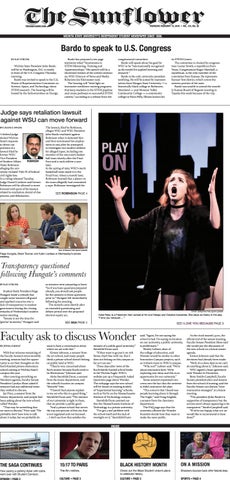
Katie Robu is a Freshmen from school of Art and Design and Creative Industries. She plays as Marcy in the play “I love you because ... ”
SEE SGA PAGE 4
SEE I LOVE YOU BECAUSE PAGE 3
Faculty ask to discuss Wonder
BY JENNA FARHAT
With four minutes remaining of the Faculty Senate’s twice-monthly meeting, senators had the opportunity to air their thoughts on the Koch-funded private elementary school coming to Wichita State’s campus this year. After covering everything on Monday’s agenda, Faculty Senate President Carolyn Shaw asked if senators had any additional items they wished to discuss. Jay Price, a senator from the history department, said people had been asking about the new school, called Wonder. “That may be something that we want to discuss,” Price said. “We probably don’t have time to talk about it today, but we probably do
want to have a conversation about where we are with that.” Kirsten Johnson, a senator from the art school, said many people think a private school doesn’t belong on public land at WSU. “They’re very concerned about Koch money because Kochs tend to be libertarians,” Johnson said. Aleks Sternfeld-Dunn, a senator from the music department, said the school’s location on campus “disturbs” him. “I haven’t had anyone explain to me yet why this is a good thing,” Sternfeld-Dunn said. “The mission of our university is right in there, that we provide a public good. “And a private school that serves the top one percent of this city that is not regulated and not licensed . . . I don’t see how that satisfies the
mission of a public good university,” Sternfeld-Dunn said. “If they want to go put it on 17th Street, that’s fine with me. But it does not belong on this campus as far as I can see.” Three days after news of the Koch-family funded school broke in the Wichita Eagle, WSU’s website put up a Frequently Asked Questions page about Wonder. The webpage says the new school will be based on existing models of “experiential learning” schools, such as NuVu on the Massachusetts Institute of Technology campus. Sternfeld-Dunn pointed out that the Massachusetts Institute of Technology is a private university. “I’ve got a real problem with the school itself and the lack of oversight on it,” Sternfeld-Dunn
said. “Again, I’m not saying the school is bad. I’m saying its location on our university, a public university, is problematic.” Shirley Lefever, dean of the college of education, said Wonder would be similar to other Innovation Campus projects, such as Airbus’s move to WSU’s campus. “Why not?” Lefever said. “We’re about innovation here. We’re exploring new ideas and this is an opportunity for our university.” Some senators expressed concerns over the fact that the university didn’t announce the plan. “The concern that I heard was people learning about it through The Eagle,” said Doug English, a senator from the chemistry department. The FAQ page says that the university allowed the Wonder founders decide how they want to make the news public.
As the clock neared 5 p.m., the official end of the senate meeting, Faculty Senate President Shaw said she would put the discussion of the new school on a future senate agenda. Kirsten Johnson said that the decisions had already been made. “Well, it’s a done deal so we can’t do anything about it,” Johnson said. WSU signed a lease agreement with Wonder in December. Betty Smith-Campbell, Faculty Senate president-elect and senator from the school of nursing, said the Faculty Senate can discuss “communication strategies” at a future meeting. “The president (John Bardo) is supportive of transparency but the actions aren’t always appearing to be transparent.” Smith-Campbell said. “If we’re not happy, what is it we would like to recommend to have done?”
INSIDE
15:17 TO PARIS
BLACK HISTORY MONTH
ON A MISSION
How paying a parking ticket with coins went over with Student Conduct.
This film misfires.
Check out the Black Student Union’s plans to celebrate history.
Shockers bounce back after historic loss.
OPINION • PAGE 2
CULTURE • PAGE 3
CULTURE • PAGE 3
SPORTS • PAGE 4
THE SAGA CONTINUES
OPINION
2 | THURSDAY, FEB. 15, 2018
www.thesunflower.com
THE STAFF
www.thesunflower.com
The saga continues
EDITORIAL
Editor-in-Chief Chance Swaim Managing Editor Jenna Farhat
#JusticeForBrian opens dialogue to the parking garage’s odd class of rules
Culture Editor Marissa Campbell Sports Editor Matt Crow Opinion Editor Evan Pflugradt
EVAN PFLUGRADT
Projects Editor Ray Strunk
OPINION EDITOR
Creative Director Madeline Deabler Photo Editor Brian Hayes Digital Editor Nicole Byrne
ADVERTISING
Advertising Manager Christian Yost
ADVISING
Faculty Adviser Amy DeVault
LETTERS TO THE EDITOR
Send letters to the editor to editor@thesunflower.com or submit at thesunflower.com. Please keep letters to 400 words or less. All letters are edited for clarity and length. Please include your name, WSU affiliation and a phone number for verification purposes.
Our Mission
The Sunflower — both in print and online — will be a timely resource of information about the Wichita State University community. It will report on news, issues, activities, academics and athletics, in addition to offering a forum for discussion, reviews and commentary. It will also be an effective learnig experience for students, who will have the final authority over what is published.
Legal
The Sunflower (published for use by WSU students, faculty and staff) is private property and unlawful removal or use of papers is prosecutable. One copy may be taken for free. Additional copies must be purchased for $1 each. The Sunflower is also partially funded by the Student Government Association at WSU. The opinions expressed in The Sunflower editorials, columns, guest columns, reviews, advertisements, letters and editorial cartoons are not necessarily those of the staff, publications board, student body or university. The Sunflower reserves the right to edit or reject any submission. We also reserve the right to edit or reject any advertisement.
CONTACT THE SUNFLOWER 019 Elliott Hall 1845 N. Fairmount Ave. Campus Box 134 Wichita, KS 67260-0134 ----------
SUNFLOWER OFFICES Front Desk: 316-978-3640 Fax: 316-978-3778 ADVERTISING Christian Yost: 316-978-6906 admanager@thesunflower.com EDITORIAL Chance Swaim: 316-978-6905 editor@thesunflower.com ADVISER Amy DeVault: 316-978-6052 amy.devault@wichita.edu ---------ONLINE www.thesunflower.com FACEBOOK www.facebook.com/sunflowerwsu TWITTER @sunflowernews INSTAGRAM @thesunflowernews
CORRECTIONS This space is reserved for corrections. Spot an error? Call us at 316-978-6905.
CLASSIFIEDS The Sunflower will not knowingly publish advertising that is false or misleading. If you have a question about an ad or a classified, call the Wichita Better Business Bureau at 316-2633146.
Thinking Abortion? Alternatives: Free Testing 265-0134
More classifieds can be found online at www. thesunflower.com/classifieds. Be seen in the classifieds by calling 316-978-6906.
BRIAN HAYES/THE SUNFLOWER
A
The second and the third floors of the green/yellow that are enforced 24 hours-a-day, unlike other green/yellow lots.
ll charges against me and my 600 nickels have been dropped. This is far from a victory lap. I attribute this victory to all of support from local media and supporters from around the country. Thank you all for your support. It means a lot to me throughout this absurd ordeal. I may have won, but the battle is far from over. Parking is still garbage. Parking tickets are still being doled out in the parking garage, thanks to confusing new rules that apply exclusively to the parking garage.
BRIAN HAYES
PHOTO EDITOR What can we do? Start the revolution. Reject their rules. OK, that might be too extreme. Parking on campus is an inconvenient, expensive and often unsafe.
My paying with coins was an act of protest — defeated protest. They’ve taken my money by the thousands. My $30 in nickels and then subsequent $100 for a parking pass and additional parking ticket was a straw too far. Wichita State has lined their pockets with our money from parking. I decided to weigh down their pockets with some change. We all suffer perceived injustices in your life. Mine was parking. I tried to right that injustice in a lighthearted way. I encourage all of you to fight injustices. Create real change.
Braving the cold with beach-ready Ben I’ve just got to ask: Why the hell are people wearing shorts and flip-flops in February? We’ve all seen these people around campus, haven’t we? I found myself walking to Hubbard Hall early one morning before class, when I passed a friend, Ben, wearing a hoodie, flip-flops and a pair of basketball shorts. It was 15 degrees outside, but surprisingly, Ben looked completely unperturbed by the cold. In fact, he looked like he was in his element — flip-flopping towards the building in no real rush. I was gobsmacked. I, on the other hand, was frozen in my three jackets, boots, and jeans. I just don’t understand. I know that there are some people who run hot and some people who run cold, but I’m fairly certain At 28, I’m a bit older than most students. I’ve lived through some crap. I wish I could say that my life is easy, but it’s not. The greatest mistake I made in my college career is trying to be a voice for the voiceless. The hatred from our university, our student leaders, and the insanity of some of our offered degrees is reprehensible. Passionate Americans can’t have a voice at WSU. We can’t criticize ideas that we don’t like. We’re brow-beaten and our lives are ruined because we don’t want to follow the prescribed narrative. My freshman year of college in 2008 was so much different than my return of the last couple of years. President Obama was elected my freshman year. I had issues with him on policy, but
that there aren’t people who run so hot that they are impervious to 15-degree colder-than-a-witch’s-tit cold. So, I took out my headphones and I asked Ben if he was cold, and you know what he told me? “I don’t get cold.” The nerve. I immediately wanted to challenge his statement. I wanted to dunk him in a frozen river in sub-zero temperatures, then pull him out and see if he still “didn’t get cold.” I wanted to take him to Antarctica, still dressed in his flip-flops and shorts, where I would introduce him to a few polar bears and penguins and then see if he still “wasn’t cold.” Instead, I stopped myself. Maybe Ben, with his can of Mountain Dew in one hand and his bean and cheese burrito in
LETTER to the
EDITOR I wasn’t called a racist because I disagreed with him. I could speak up in class and criticize the direction of the nation without worrying about assault. Things are very different in 2018. I’ve been called a white nationalist, alt-righter, racist, homophobe, transphobe, Islamophobe. How easy must it be to insult someone rather than listen to their arguments? It’s so simple to tell someone to check their “privilege” and completely disregard their beliefs. I’ve had
AGNES CORRIGAN COLUMNIST
the other, had achieved a level of zen that I could not comprehend. Ben didn’t worry about things like dressing according to weather or eating a breakfast that was nutritionally sound. He just lived. Maybe he didn’t feel cold, how should I know? Ben wakes up every day and gets dressed for the beach. While there may be a lack of logic in such thinking, there’s also a beauty to it. We don’t always have to be so logical. So, I walked with Ben to class, hoping that some of his magic would transfer to me. two WSU employees tell me that I won’t be able to find a job after I graduate. I’ve been called into a student conduct meeting because my beliefs are so reprehensible. My passion lies in my love for the United States and for every American. I don’t care about race, and I don’t care about anything other than ideas. I’m not ashamed to say that I love this country. I don’t want to ruin someone because they disagree with me… Why do they want to ruin me? I’m still waiting for my privilege to kick in. — Cale Ostby is a senior studying business at Wichita State. To submit a letter to the editor, visit thesunflower.com/letter
Speaking treason fluently Anti-racist and educator Tim Wise spoke at Wichita State two years ago during Black History Month. Impressed enough, I bought one of his books - Speaking Treason Fluently Anti-Racist Reflections from an Angry White Male. Wise’s book helped me understanding racism in greater detail. He explained how deep it goes and how and why white denial and privilege exists. The 359-page book is a collection of essays divided into four parts: Introduction, Challenging White Denial, Confronting White Privilege, and Conclusion. I have read other books about this issue, discussed it during social work classes, talked about it with friends and just living in a multi-cultural community and
attending WSU with the many international students gave me some insight into the topic. Still, after reading the book, I am better at identifying white privilege when it occurs. One day I was in a notso-straight line at a fast food restaurant and a black lady, probably a WSU student, was ahead of me. The cashier looked and gestured to me asking what I wanted to order. I thought this was an example of white privilege happening by the cashier thinking I, being white, expected to be served before the black lady. Of course, I said, “no, she was here before I was.” Just because Separate but Equal was declared unconstitutional after the Brown vs. Board of Education of Topeka decisions in the 1950s (if you don’t know about
ROBERT HITE COLUMNIST
this, look it up) does not mean all of sudden peoples’ attitudes and behaviors change. This is why Wise continues to speak and write books about racism. It requires increased awareness about something we probably do not go around thinking about to change it. One interesting tid bit from the book that stuck with me is how whites and blacks view racism differently. He wrote that African
Photo Editor Brian Hayes created a large buzz this week when he used small change — approximately 600 nickels, 90 crumpled up dollar bills, dimes, and quarters — to pay for two parking tickets he received for parking on campus without a parking pass. Charges were dropped against Hayes in his meeting with Student Conduct Wednesday morning because the university has no policy forbidding the use of small change to pay off an outstanding balance. Paying with 600 nickels is a good fight for justice, but more so, it’s a good entryway into talking about how unclear the parking rules are for the university parking garage. Hayes was assumed to be in the wrong because he thought parking in the parking garage mirrored other campus green and yellow lots, which are open to those without a pass after 5 p.m. and on the weekends. The first violation came after Hayes parked in the parking garage at approximately 5:30 p.m. on a weeknight. The parking garage is monitored all hours of the day — conflicting with just about every lot on campus. In December, Student Body President Paige Hungate revealed a win for students and faculty, announcing that the parking garage would continue to be open to students who owned a green parking pass. Students who purchased an ePermit could continue to park on the second, third, and fourth floors of the garage at no charge, the Parking and Transportation Executive Committee decided. Students and faculty or visitors who didn’t have a parking pass could also park in the garage at a rate of $1.50 an hour. What’s often forgotten is the last line of the document published by SGA on Dec. 20. “All levels of the garage will be designated as such 24 hours a day and seven days a week.” That’s not inherently clear. One could say the safe call would be to only park on campus if you have a parking pass, but the parking garage remains an anomaly. The parking garage was supposed to be pay-to-park for the 2017-18 school year, but due to some delays setting up the pay stations, the university elected to open the garage to those who owned a green or yellow parking permit. The pay stations are now up and running, and signs instruct that you must pay at the pay stations, but it was never revealed when monitoring for this would go into effect. By offering students and faculty with ePermits the opportunity to park in the garage, the university opened up a norm that now many choose to exercise on a daily basis — and that’s hard to back away from. It’s yet to be specified if the university will continue to allow students and faculty with ePermits to park in the garage next school year or if they’ll switch to a full pay-to-park system. After this mess, it’s hard to switch away from the current system without breaking the hearts of students and faculty. When the university announced that they would break ground for a pay-to-park parking garage in arguably the most convenient space on campus, the decision was met with heavy criticism. The garage took away several spaces — and consistent construction on campus has continued to push student parking options farther and farther away. If parking in the garage is a luxury, that’s fine to establish a pay-to-park option — but that option should be the only option. Otherwise, the combination of systems leaves too much room for confusion on where students and faculty can and cannot park without paying the price. If students and faculty are already paying for a space on campus, the university shouldn’t have to ask to dip into our pockets once more. #JusticeForBrian resolved a petty issue over small change, and opened the door to necessary dialogue for what the university should do to fill the parking garage.
CULTURE
www.thesunflower.com
THURSDAY, FEB. 15, 2018
|3
Q&A
I LOVE
YOU BECAUSE
‘Writing Now, Reading Now’ series features poet Sandra Beasley BY JOHN DARR
Poet Sandra Beasley hosts a reading at the Ulrich Museum of Art as part of the “Writing Now, Reading Now” series on Thursday. ARE YOU WORKING ON ANY NEW PROJECTS LATELY, AND WILL WE GET A GLIMPSE OF THEM DURING THE READING?
Right, love action from Jackson and Katie in their roles as Austin and Marcy. Below, Marcy and Diana have a conversation about Marcy’s relationship.
“Yes. I’m working on my next manuscript of poems — my fourth collection. I’m not putting the title in print yet but I will be reading poems from that work and talking about some of the thematic focal points.” WHICH IDEAS ARE DRIVING YOUR CURRENT WRITING? WHICH IDEA OUT OF THESE INTRIGUES YOU THE MOST?
TANAT MAICHAN/THE SUNFLOWER
TANAT MAICHAN/THE SUNFLOWER
“The current manuscript is looking very much at American history, but doing so in a way that is grounded in the person rather than in the event. A couple of access points for that is growing up in and around Washington D.C. Also, looking at food, because I think looking at restaurants and certain eating traditions is a great way to learn about family and history. I also have an anthology that will be published this fall from the University of Georgia press that is published for the Southern Foodways Alliance which covers Southern food traditions. While it’s not my work in the collection, I think editing pieces by other folks about food, I started writing about food too.” IS THERE ANY RECENT DISCOVERY YOU HAVE HAD WITHIN ART OR LIFE THAT HAS SERVED AS AESTHETIC INSPIRATION?
TANAT MAICHAN/THE SUNFLOWER
TANAT MAICHAN/THE SUNFLOWER
Above, Lucas Lowry as Jeff (front) and Brittnee Hill as Diana (back) are performing. Left, Jackson Dorris, a freshman majoring in musical theater. Dorris plays a character named Austin.
The ‘15:17 to Paris’ is a strange, unfortunate misfire
“I just think we’re in a time when people are being reminded of all the ways the personal and the political intersect. I want my work to authentically and organically represent the concerns I have about our political moment — there’s a lot of friction and I think that the friction will ultimately be useful and constructive. I don’t want to ignore it in my poetry any more than I would want to ignore it in my life.” OUT OF WHICH PART OF YOUR LIFE IS A POEM LEAST LIKELY TO APPEAR?
MATTHEW GARNER FILM CRITIC
Clint Eastwood’s latest film in his loose series of dramatizing real-life American heroes, is truly a strange film. Part docudrama, part documentary and part fiction, makes “The 15:17 to Paris” strange, but it’s not just the melding of these elements, though there have been films where that’s worked before. The oddity lies in Eastwood’s bizarre casting decisions, leading him to use the real-life American heroes to play themselves throughout the movie. It feels weird criticizing a non-actor for his acting ability — in fact it almost seems unfair. Yet, Eastwood’s latest opus suffers from some horrendous acting, which sets the film off onto a slippery slope of poor choices. It’s not until Eastwood jumps to the cheesy and poorly written introduction of the three American men who stopped the shooting that the movie begins to fall apart. Getting these men to play themselves is a unique casting move, one that assuredly generates buzz and interest in a would-be relatively safe project. Ethical and moral questions aside (is it wrong to make these men relive the potentially worst day of their lives? What are the PTSD implications at play here?) the movie then jumps to twelve years earlier, following the boys in elementary and middle school, showing the audience how they
COURTESY
became friends and how their interests in war and the military began to develop. The three kid actors Eastwood chose to play these roles are terrible. I wish there was a nicer way to say that, but over and over again throughout the movie they fail to deliver any semblance of authenticity. This perfect storm of inadequacy culminates in something one might see on Saturday Night Live — a parody of what this movie is actually trying to accomplish. Furthermore, the overt and heavy-handed worship of war and the military in general left a sour taste in my mouth. The characters in this movie glorify and deify conflict, glamorizing it in a way as to apply a shiny coat of polish to man’s most terrible creation. Several scenes within the movie show how war is literally a game to these men, something that has winners and losers and not death and destruction, not to mention the complex web of political underpinnings that drives any nation to battle. Eastwood has no doubt been in the public eye of politics in the last decade, and his newfangled emergence onto the American political stage runs through the veins of this film. The simplification of it all works in tandem with what the film is
trying to communicate, but the implications Eastwood suggests belying the true complexity of war in the Middle East. However, it isn’t all bad. The climax of the film, the horrific train scene that every viewer in the theater is there to see, delivers in its own strange way. Eastwood wisely cuts all of the pretense and music from the sequence, leaving the audience to exist in the moment with these men struggling for their lives. For all of the terrible creative decisions leading up to the moment: the odd character choices and narrative structure, the script that has no earthly idea what it’s doing and the terrible acting that constantly dogs any attempt at emotional authenticity, the scene works. The film ends with footage of the then President of France awarding these men the nation’s highest honor. It’s a quietly effective moment, one that solidifies the truly heroic intentions of these young men, and it becomes readily apparent how their “ordinariness” became something extraordinary in the right circumstances. It’s just a shame that the movie capturing the heroism of what they did wasn’t as effective as it could have been.
Black Student Union hosts multiple events for Black History Month February is the month of love but for many students it is also a chance to celebrate and educate. In 1976, February was chosen as Black History Month to annually celebrate the achievements of African-Americans. The Wichita State Black Student Union have organized a series of events to engage, embrace and educate the campus and students about their culture. -Larissa Lawrie HERE ARE SOME UPCOMING EVENTS: “FOR THE CULTURE” JEOPARDY NIGHT
7 p.m. Feb. 15 in Hubbard Hall 211
NEWMAN UNIVERSITY HOSTING THE PANEL “IT’S NOT YOU. IT’S THEM: FACING MICRO AGGRESSION AND UNCONSCIOUS BIAS
6 p.m. on Feb. 21 at the Dugan Conference Center At Newman University.
BSU AND THE EPSILON ALPHA CHAPTER OF ALPHA KAPPA ALPHA SORORITY SHOWING THE DOCUMENTARY “WE ARE RISING”
7 p.m. Feb. 22 in Hubbard Hall 211
BLACK LIVES MATTER BALLOON RELEASE CEREMONY
233
4 p.m. Feb. 25 in the RSC Room
“One of the greatest challenges for any poet, and certainly for me, is to be honest about personal and every day. Things like my marriage, my family, my cat and my daily walks in many ways have to fight their way into a poem. I think you have to be, on one hand, careful of the sentimentality of that, and on the other hand, be wary of passing that over just because it’s familiar to you. So, I think that one of the great challenges of poetry is to wake up to details of our every day life, and not be afraid to mix the surreal and the banal.” IF YOU COULD IMAGINE YOURSELF GIVING SOME AN EPIC, ‘DREAM’ READING, WHERE WOULD IT BE?
“I should say first that as the daughter of one visual artist and the wife of another, reading in art galleries is really one of my favorite things to do. I think that taking the opportunity to present poetry in natural spaces, where you can hear and accept the potential distractions of an animal nearby or the sound of rushing water or the movement of plants around you, that interests me because it reminds us that our reading is dynamic and there’s only so much you can plan. I’ve had the opportunity to read on a beach, for example, and that was a great experience. I will say that in terms of sheer majesty, one of my mentors – Rita Dove – got to read in a stadium in Chile. There was enough interest to justify a stadium. There were pamphlets dropped from overhead that had the poet’s work on them. And I thought, that’s it – to be in another country and having an exchange at that level – to be reminded that there are places where poetry is revered in that way – that would really mean something amazing.”
SPORTS
4 | THURSDAY, FEB. 15, 2018
www.thesunflower.com
ON A
MISSION
Bessard drops career-high 38 points in win over Temple BY ALIYAH FUNSCHELLE
A
fter falling to the No. 1 team in the country by 81 points, Head Coach Keitha Adams said she was the most inspired she had ever been. “Some people look at that game as the worst day of my life in my coaching career. I’ve chosen to look at it as the best day of my life in my coaching career,” Adams said. “We played the best team in the country. It inspired me, it motivated me.” Adams came back from that game with a mission. “Ever since that game and since I’ve been back, I’m on a mission,” Adams said. “We have a lot of hard work to do, and every day I’m really motivated. I think that’s what that game did for me.” Adams channeled that motivation into her team heading into the Temple game. Wichita State bounced back from a four game losing streak with a seven-point win over Temple. The Shockers went on an early 7-0 run by forcing three turnovers and hitting three of their four field goal attempts, forcing Temple to take an early timeout. The Shockers had a double-digit lead by the half, and had three players score double digits. Senior forwards Rangie Bessard and Angiee Tompkins both with 11 and junior forward Sabrina Lozada-Cabbage with 10.
Wichita State was able to maintain their lead for the rest of the game until the final two minutes where Temple cut the deficit to four. Senior guard Keke Thompson said the determining factor when the game gets close comes down to who holds their composure the best. “Being composed...that can be the difference between you and another team,” Thompson said. “Keeping your composure and handling the pressure well...that’s what we did.” Another determining factor was Bessard’s scoring. The Owls weren’t able to completely catch up due to their failed efforts to stop Bessard. She had 11 of the Shockers’ first 18 points in the quarter. Bessard finished with a career-best of 38 points and six rebounds in her 33 minutes. “Rangie was very aggressive as always, she took it to them,” Thompson said. “Coach said ‘Go get it’ and she went and got it.” Bessard said she is motivated to make the most of her final few games at Wichita State. “Our games are becoming shorter, our times with each other are becoming shorter,” Bessard said. “We have to go out there and now we have to take these last games and play our hearts out.” The Shockers head to SMU to go for the season sweep over The Mustangs. Tipoff is at 2 p.m. on Saturday.
SELENA FAVELA/THE SUNFLOWER
SELENA FAVELA/THE SUNFLOWER
Top right, Wichita State forward Angiee Tompkins (40) makes a shot against Temple. Bottom, Wichita State foward Angiee Tompkins (40) attempts to block Temple’s Mia Davis (25)
ROBINSON
SGA
FROM PAGE 1
FROM PAGE 1
The proposed amendment, which would have dissolved the current ticket system in SGA elections in favor of candidates campaigning and being elected individually, was ultimately tabled until after this year’s student government elections. Hungate later said her comment was referring to questions asked by multiple senators to Chief of Operations Kylen Lawless about data he presented over student government elections at comparable universities. Lawless said Wichita State was one of two state universities in Kansas using the ticket system in elections and that most other comparable universities use an individual election system. He was unable to answer many of the questions from senators regarding the specifics of the data. When reached by phone after the meeting, Hungate said she felt senators asked questions in an attempt to undermine Lawless and the rest of the executive committee. She also said that senators need to do their “due diligence” outside of the meetings to learn about legislation. “It wouldn’t have been that senators were just coming to us and we were answering those questions behind closed doors. We would have been able to compile that information and present it to the senate as a whole,” Hungate said over the phone. Senator Shelby Rowell responded to Hungate’s comments during the meeting. “I feel like the opportunity to ask when it’s a public session is important. So I don’t necessarily really appreciate being dictated to on questions when I think it’s important for not only us to know, but for the entire senate to know and the entire student body to know,” Rowell said to Hungate. Rowell said she understands how asking questions before meetings can help streamline the process, but disagreed with Hungate’s comment and felt that she needed to speak up. “Watching other senators’ faces fall at the end of the meeting during announcements quite frankly made me feel like
BRIAN HAYES/THE SUNFLOWER
Shelby Rowell, LAS senator as a question to cabinet member during the SGA meeting on February 7, 2018.
something should be said,” Rowell said. “Many senators were taken aback or hurt by the comments.” Returning adult senator Kathy Bond said the election amendment was a “great opportunity for change, but not the right time. “I want to know. What is the hurry?” Bond said. Former Student Body President Joseph Shepard spoke to the student senate when the amendment was presented, saying it was a “great piece” of legislation. “I do believe that it ends the divides a lot of people have subconsciously when going into the election season,” Shepard said. Still, Shepard urged senators to vote against the amendment. Shepard said that campaigns have already been preparing for election season for months and passing the amendment “so late in the game” would “hinder the progress” of potential candidates. “It just seemed intentional,” Shepard said. “It seems that we are purposely working to hinder the growth and progress of certain people running.” Shepard didn’t mention any specific candidates he felt were being targeted by the legislation. Student Body Vice President Breck Towner said the delay in
proposing the amendment was due to the initial election reform bill taking longer than expected to pass. Towner said that dissolving the ticket system wasn’t brought up until last month. Senator Drew Lampson proposed tabling the amendment until after the election. “Regardless if they wanted to pass it or not, we felt it was the right thing to do to at least talk about it or at least offer the decision,” Towner said. “And, ultimately, tonight they decided to table it.” The senate will address the amendment again during its March 14 meeting. Hungate’s comment is the latest in an ongoing dispute over transparency in student government. When the election equity act was initially discussed during last week’s senate meeting, senators brought up concerns over transparency and being left out as decisions were made “behind closed doors.” “It’s not so much that it was talked about behind closed doors,” Hungate said during last week’s senate meeting. “We were actively telling people we were working on that election bill and those were open meetings.
Nobody attended.” Earlier this month, Hungate announced during her monthly “Engage with Paige” video that the student government discontinued its student-funded College Readership Program. The decision came without a vote from the senate. In an email to The Sunflower, Hungate said it is not a “lack of transparency problem” but “a lack of individuals paying attention at meetings to what we say.” Last semester, the student government stopped livestreaming its monthly meetings due to alleged Americans with Disabilities Act conflicts. Hungate also put an end to the livestream of the monthly “Engage with Paige” videos, opting to field the questions in advance and later upload the videos to YouTube. In the last “Engage with Paige” session, only one student participated — jokingly asking a question about Hungate’s rapping ability, which went unanswered. Hungate said she wants SGA to be efficient while remaining as transparent as possible. “Efficiency is important in SGA,” Rowell said following Wednesday’s meeting. “But not at the price of transparency and trust with our constituents.”
potential violation of Title IX, as part of his responsibilities as vice president of student affairs, and Bardo later threatened Robinson’s employment status, the lawsuit says. Title IX is the federal civil rights law that prohibits schools that receive federal funds, like WSU, from engaging in sex discrimination and protects those who file a complaint from retaliation. After Robinson sued in 2016, alleging WSU and Bardo retaliated against him because of the Title IX complaints against the athletes, defamed him and ruined his reputation, invaded his privacy, denied him due process rights, and violated the Kansas Open Records Act. WSU and Bardo asked the judge to throw out the lawsuit because Robinson wasn’t protected under Title IX, as he was performing his job duties. The judge dismissed Robinson’s assertion that WSU violated the open records law because the federal court does not have jurisdiction over the Kansas Open Records Act. “We are pleased that Judge Crabtree ruled favorably … on several portions of our request to dismiss a lawsuit filed by the former vice president of student affairs alleging he was unfairly terminated from employment,” WSU Attorney David Moses said in a news release about the judge’s order Tuesday night. The court dismissed two claims and partially dismissed two others. “We believe the university and President Bardo acted properly in its dealings with Robinson and in its Title IX actions,” Moses said in the statement. Moses said the university takes its Title IX responsibilities “seriously” and noted that the judge’s opinion was not a judgment on the truth of the claims made by Robinson in the lawsuit. “Accusations made by victims of sexual assault, or in their behalf, are reviewed and assessed by university staff trained in Title IX issues,” Moses said. “An investigation follows, when appropriate, after facts are learned during the review and assessment phase.” Shortly after Robinson’s employment was terminated, a full-time Title IX Coordinator was hired at WSU.