THURSDAY, JANUARY 25, 2018 • VOL. 122, ISS. 32
THESUNFLOWER.COM
WICHITA STATE UNIVERSITY’S INDEPENDENT STUDENT NEWSPAPER SINCE 1896.
Finally.
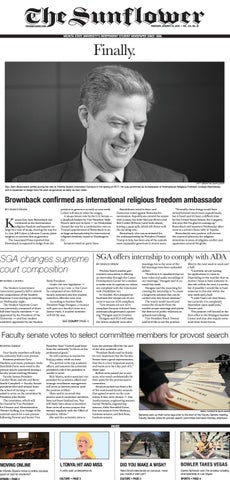
MATT CROW/THE SUNFLOWER
Gov. Sam Brownback smiles during his visit to Wichita State’s Innovation Campus in the spring of 2017. He was confirmed as Ambassador of International Religious Freedom at-large Wednesday, and is expected to resign from his post as governor as early as next week.
Brownback confirmed as international religious freedom ambassador BY CHANCE SWAIM
K
ansas Gov. Sam Brownback was confirmed as the international religious freedom ambassador atlarge by a vote of 50-49, clearing the way for Lt. Gov. Jeff Colyer, a Johnson County plasic surgeon, to succeed him as governor. The Associated Press reported that Brownback is expected to resign from his
position as governor as early as next week. Colyer will step in when he resigns. A 50-49 cloture vote by the U.S. Senate — a deadlock broken by Vice President Mike Pence’s 50th vote in favor — on Wednesday cleared the way for a confirmation vote on Trump’s appointment of Brownback to an at-large ambassadorship for international religious freedom, based in Washington, D.C. Senators voted on party lines.
Republicans voted in favor and Democrats voted against Brownback’s nomination. Republicans control the senate with 51 seats, but John McCain (R-Ari.) and Bob Corker (R-Tenn.) were both absent, leaving a 49-49 split, which left Pence with the deciding vote. Brownback, who was nominated for the ambassadorship by President Donald Trump in July, has been one of the nation’s most unpopular governors in recent years.
“Normally, these things would have moved forward much more expeditiously, but it hasn’t and it’s been a difficult time for the United States Senate, the Congress, this year. But I’m glad it’s coming up,” Brownback told reporters Wednesday afternoon at a school choice rally in Topeka. Brownback’s new position will oversee the country’s advocacy for religious minorities in areas of religious conflict and oppression around the globe.
SGA changes supreme SGA offers internship to comply with ADA court composition meetings, but so far none of the fall meetings have been uploaded online. “Nowhere is it mandated that we have video and audio recordings of our meetings,” Hungate said in an email this week. Hungate said the reasoning for creating the internship is “to create a long-term solution that can be carried over into future sessions.” The intern would record and transcribe all audio from the student senate meetings and advise the director of public relations on uploads and editing. Vice President Breck Towner said he’d like to see the position
BY CHANCE SWAIM
BY DANIEL CAUDILL
The Student Government Association passed a bill to reform the composition of the Student Supreme Court during its meeting on Wednesday night. The Student Supreme Court was previously composed of three full-time faculty members — as appointed by the President of the University — and four student members appointed by the Student
Body President. Under the new legislation — passed by a 33-2 vote — the Court be composed of two full-time faculty members and five student members, effective next year. According to Student Body President Paige Hungate, a vacancy will open as a faculty’s term as a Justice ends. A student nominee will fill the seat. SEE COURT PAGE 4
Wichita State’s student government association is offering an internship through the Career Development Center for a student to make sure its captions on videos are compliant with the Americans with Disabilities Act. In October, SGA dropped its Facebook live stream out of concerns it was not ADA compliant. “Live streams are not ADA compliant because it doesn’t have automatically-generated captioning,” Hungate said in October. Hungate said SGA will make the videos available soon after
filled in the next week to week and a half. “Currently, we are waiting for applications to come in. Depending on the number that we receive I hope to have someone in this role within the next 2-3 weeks, but if possible I would like to have someone in this role within the next week and a half. “I wish I had a set time frame, but currently it is completely dependent upon applicants,” Towner said. This position will housed in the SGA office in the Rhatigan Student Center and may also require some work from home hours.
Faculty senate votes to select committee members for provost search BY JENNA FARHAT
Four faculty members will help the university find a new provost. Business professor Gery Markova and music professor Aleks Sternfeld-Dunn were voted to the provost search committee during a faculty senate meeting Monday. Faculty Senate President Carolyn Shaw said she and Betty Smith-Campbell — Faculty Senate president-elect and senator from the school of nursing — were asked to serve on the committee by President John Bardo. The committee, which will be chaired by Vice President for Finance and Administration Werner Golling, is in charge of the national search for a new provost following Provost and Senior Vice
President Tony Vizzini’s paid leave from the university “to focus on his professional goals.” He will continue to receive his $297,353 salary while on leave. The provost is the top academic officer, and assumes the university president’s role if the president is unable to serve. Rick Muma, senior associate vice president for academic affairs and strategic enrollment management will serve as interim provost until the position is filled. Shaw said in an email that provost search committee members have not been finalized yet, “but will likely have about 15 members from units all across campus that interact regularly with the Office of Academic Affairs.” She said the university aims to
have the position filled by the start of the next academic year. “President Bardo said he thinks it’s very important that the Faculty Senate have a good representation, that this is a very important search, and wants us to be a key part of it,” Shaw said. Ballots were passed out to senators, who voted confidentially for their picks for the provost search committee. Senators picked two from a list of five nominated faculty senators that agreed to serve on the committee if they were chosen — Abu Asaduzzaman, engineering senator; Gamal Weheba, engineering senator; Aleks Sternfeld-Dunn, fine arts senator; Gery Markova, business senator; and Bob Ross, business senator.
BRIAN HAYES/THE SUNFLOWER
Senators pick up their name tags prior to the start of the Faculty Senate meeting. Faculty Senate votes for provost search committee members Monday afternoon.
INSIDE
I, TONYA: HIT AND MISS
DID YOU MAKE A WISH?
BOWLER TAKES VEGAS
Is Wichita State’s move to online courses good or bad for students?
A witty cast underperforms.
Yoko Ono’s idea lands on campus. Have you made a wish yet?
Cortez Schenck won the amateur bowling championship in Las Vegas.
OPINON • PAGE 2
CULTURE • PAGE 3
CULTURE • PAGE 3
SPORTS • PAGE 4
MOVING ONLINE
OPINION
2 | THURSDAY, JANUARY 25, 2018
www.thesunflower.com
THE STAFF EDITORIAL
www.thesunflower.com
NOT SO FAST
Editor-in-Chief Chance Swaim Managing Editor Jenna Farhat Culture Editor Marissa Campbell
Thank Trump for ridding us of Gov. Brownback, ‘real live experiment’
Sports Editor Matt Crow Opinion Editor Evan Pflugradt Projects Editor Ray Strunk Creative Director Madeline Deabler Photo Editor Brian Hayes
EVAN PFLUGRADT
Digital Editor Nicole Byrne
OPINION EDITOR
ADVERTISING
Advertising Manager Christian Yost
ADVISING
Faculty Adviser Amy DeVault
Wichita State online-only degree aspirations might be moving to quickly compared to other universities.
LETTERS TO THE EDITOR
Send letters to the editor to editor@thesunflower.com or submit at thesunflower.com. Please keep letters to 400 words or less. All letters are edited for clarity and length. Please include your name, WSU affiliation and a phone number for verification purposes.
Our Mission
The Sunflower — both in print and online — will be a timely resource of information about the Wichita State University community. It will report on news, issues, activities, academics and athletics, in addition to offering a forum for discussion, reviews and commentary. It will also be an effective learnig experience for students, who will have the final authority over what is published.
Legal
The Sunflower (published for use by WSU students, faculty and staff) is private property and unlawful removal or use of papers is prosecutable. One copy may be taken for free. Additional copies must be purchased for $1 each. The Sunflower is also partially funded by the Student Government Association at WSU. The opinions expressed in The Sunflower editorials, columns, guest columns, reviews, advertisements, letters and editorial cartoons are not necessarily those of the staff, publications board, student body or university. The Sunflower reserves the right to edit or reject any submission. We also reserve the right to edit or reject any advertisement.
CONTACT THE SUNFLOWER 019 Elliott Hall 1845 N. Fairmount Ave. Campus Box 134 Wichita, KS 67260-0134 ----------
SUNFLOWER OFFICES Front Desk: 316-978-3640 Fax: 316-978-3778 ADVERTISING Christian Yost: 316-978-6906 admanager@thesunflower.com EDITORIAL Chance Swaim: 316-978-6905 editor@thesunflower.com ADVISER Amy DeVault: 316-978-6052 amy.devault@wichita.edu ---------ONLINE www.thesunflower.com FACEBOOK www.facebook.com/sunflowerwsu TWITTER @sunflowernews INSTAGRAM @thesunflowernews
CORRECTIONS This space is reserved for corrections. Spot an error? Call us at 316-978-6905.
CLASSIFIEDS The Sunflower will not knowingly publish advertising that is false or misleading. If you have a question about an ad or a classified, call the Wichita Better Business Bureau at 316-2633146.
Thinking Abortion? Alternatives: Free Testing 265-0134
More classifieds can be found online at www. thesunflower.com/classifieds. Be see in the classifieds by calling 316-978-6906.
Wichita State’s transition to onlineonly degrees is moving too quickly
F
o r t Hays State is making news for their success with online-only degree programs added through the launch of their “Virtual College,” which this week was voted No. 1 in Kansas. Online-only degree programs also led to FHSU having the largest increase — 3 percent growth — in student enrollment among Kansas universities, according to fall enrollment numbers reported to the Kansas Board of Regents. FHSU saw an increase in enrollment headcount for the second consecutive year. With this growth, Wichita State fell to fourth in enrollment headcount among four-year Kansas universities — behind the University of Kansas, Kansas State, and FHSU. Jeff Briggs, FHSU interim provost and vice president for academic affairs, said FHSU’s commitment to online degree programs are “made to meet the needs of place-bound students in Kansas, throughout the United States, and around the world. “Citizens can receive a meaningful education from anywhere in the world through our Virtual College programs,” Briggs said in a release. FHSU’s fall enrollment number is 15,100 — 19 more students than WSU’s reported fall headcount. That’s counting 668 non-degree-seeking students in free, half-credit-hour badge courses, WSU added to the enrollment tally
EVAN PFLUGRADT OPINION EDITOR
in the two weeks leading up to the official reporting. With enrollments continuing to drop, WSU has added the emphasis of online education. WSU has developed a Strategic Enrollment Management plan for growth over the next three years — a drive separated into eight goals. The Strategic Enrollment Management plan — specifically Goal 7 — will emphasize more online degree plans due to the decrease in enrollment at junior colleges in the state. As cited in the January newsletter from President John Bardo, authored by Richard Muma, the state’s community college system reported a drop of 1,500 students in fall 2017 enrollment numbers — a reality that conflicts with Goal 8 of the SEM, which is to increase transfer student enrollment 30 students yearly through 2020. Goal 7 calls for an increase of fall students in online programs by 110 percent — an increase of 96 students — by fall 2010. This would push WSU from the 87-student enrollment in fall 2015 to 183 students. Since FHSU’s Department of Continuing Education and Instructional Technology became
the Virtual College in 1997, the Virtual College has expanded to offer 51 degree programs, including 31 undergraduate degrees. WSU isn’t to the point of offering 51 online-degree programs, but they’re picking up the pace. This semester, WSU will offer a four-year online bachelor’s degree in homeland security. This program is offered exclusively online. WSU is spending $670,000 to target students in Kansas who have some college education — and they’re in a race against other state institutions to recruit these students for degree completion, which WSU’s SEM suggests is up to “170,000 people by some estimates.” The goal is for all colleges to add more online degrees, which makes clear sense. Online degree programs is a proven method to push enrollment numbers — and online degree programs can put WSU on the fast track to reaching President John Bardo’s enrollment goals of 22,000. The issue, however, with pushing for more online degrees, is online course options are not often created as an addition, but added as a replacement for on-campus course options. In pursuit of my bachelor’s degree at WSU, twice I ran into the issue of having an elective or required course being offered in one section exclusively online. This prompted me to pay an additional online course fee when I easily could have taken the class in person. Online degree programs are great, but cutting down the on-campus options and replacing them for online-only alternatives doesn’t do on-campus students any favors.
Not too much affiliated with Kansas Gov. Sam Brownback gets the majority Kansans in bright spirits — unless it’s regarding his impending departure. Wednesday evening, Kansans got what they wanted. President Donald Trump appointed the Kansas governor, and the U.S. Senate confirmed him, to serve as a religious freedom ambassador, removing Brownback from his position as the state’s governor for the first time since 2011. Lt. Gov. Jeff Colyer, a plastic surgeon Kansans haven’t had near as high of spirits in regards to Brownback since rumors circulated of his selection as the U.S. ambassador to the U.N. for food and agriculture — a position that would have relocated him to Rome. Months later, we’ve been left with the second-least popular governor in the country. Brownback’s approval rating rivaled that of New Jersey Gov. Chris Christie — the man who was famously taking in some sun on a beach he closed to the rest of the state. Brownback had often led in previous editions of the poll until Christie claimed the honor in April. Every state will debate politics, but none will agree in disapproval the same Kansans have about Gov. Brownback. Mind you he imposed the largest income tax cut in history, resulting in significant budget shortfalls — plaguing the state’s public education system — the state will likely continue to riddle long past his departure. By cutting already low income tax rates — what he so famously called a “real live experiment” on cable news — Brownback put state public services on the brink of death. In June, state legislatures did the unthinkable with an override an emergency tax increase that would end Brownback’s five-year tax experiment that failed to bring prosperity to the state. Should he vacate the office, unnecessary vetoes following him, the need for two-thirds overrides from the House and Senate — a major time expenditure — should dissipate. Reviving the state and its budget from life support; perhaps Colyer can give a facelift to the carnage of this tax experiment gone wrong.
Don’t promise something you can’t deliver BY KYLIE CAMERON
It’s been three months since Student Government Association stopped live streaming their Wednesday meetings and not a single one of them have made it on YouTube with captions like the Association promised. It should go without saying that part of being a representative organization for students is being open with their constituents. There is no excuse for not doing so and it’s now more important than ever for SGA to be transparent with new additions to Innovation Campus and increasing student fees having to be approved by them. With the elections coming up in the next few months, constituents would like to know what their representatives have been saying in meetings. It’s time SGA is more open with the student body and serves as a model for transparency. The issue of transparency was made apparent this month when senators worked on legislation over break behind closed doors, failed to tell their constituents, and confusing non-members into
thinking that SGA passed a bill separating banquets for outgoing and incoming administrations, among other decisions. Putting minutes and bills up on OrgSync and the student government website isn’t good enough to inform the student population. Like we saw last year, things can happen fast during meetings. Constituents have a right to know what their elected representatives say in regards to legislation that concerns their experience at WSU. Before promising to upload meetings on YouTube with captions, SGA should’ve done their research and explore more viable options. The enforced standards SGA is basing their decision on takes effect for the 2018-19 school year, but they settled on a rushed decision that has left us with the opposite of what they promised. In the name of accessibility, SGA pulled a sufficient stream and ensured a promise they simply can’t deliver on. As we approach election season, decisions are likely to be rushed and contentious debates are likely to take place. Students shouldn’t have to wait to hear what their representatives have
SELENA FAVELA/THE SUNFLOWER
Paige Hungate, student body president, presents her officer report during the SGA meeting.
to say. All of that said, The Sunflower would like to applaud SGA for taking steps to become ADA compliant, by setting up an internship for a student to help with the video and audio of the meetings. It would behoove the other representative groups on campus
— from faculty senate to the innovation alliance — to make their meetings more open to the public by video taping meetings. Vague meeting minutes can leave the public un-informed, and it’s useful to be able to go back and watch videos to hold officials accountable.
CULTURE
www.thesunflower.com
THURSDAY, JANUARY 25, 2018
|3
I, TONYA Witty cast coasts through film
H
BY MATTHEW GARNER
ow does one determine the truth? It’s a tough question, one made even tougher when given the context of fame, rivalry, passion and sport, but it’s a concept that “I, Tonya” tries to explain while providing an entertaining and superbly acted narrative focused on the infamous figure skater Tonya Harding. Buffered by strong tonal control and an interesting dramatic structure, “I, Tonya” skates away from the ice almost landing everything, though its thematic purpose and run-time leave a little to be desired. “I, Tonya” runs the full gamut of Tonya Harding’s now famous life, from her poor and self-described “white trash” upbringing in Portland, Oregon under an absent father and cruel mother, all the way to the end of her figure skating career and beginning of her semi-professional boxing one. It’s a stranger-than-fiction type of story, one where every twist and turn teeters on the edge of unbelievable. Yet, it’s a testament to the filmmaking on display (and especially the smart decision to tonally craft the film like the director wanted to) that the narrative never seems to lose hold of the audience. This accomplishment also depends on the truly talented cast, as Margot Robbie (freshly nominated for Best Actress in this role) is magnetic as the eponymous Tonya Harding. She infuses the role with the perfect amount of warmth and humanity while still displaying the drive and determination required to achieve the level of success thrust upon her by her overbearing mother. Robbie is flanked by Sebastian Stan, who plays her duplicitous and violent husband Jeff Gillooly as well as Allison Janney, who (nominated for Best Supporting Actress) portrays Tonya’s terribly demanding mother. These characters are fleshed out somewhat, but they all serve as second fiddle when placed in juxtaposition with Tonya. The film is presented as a dark comedy
laced with tricky questions about the nature of truth and how one arrives there, but this film is more aptly described as a distinctly American tragedy. Given the classical connotation of the word tragedy, “I, Tonya,” has all the hallmarks of the Shakespearean sense of the genre: the rise to fame under harsh circumstances, the inevitable fall from grace, the horrors unleashed (both internal and external) along the way. The film doesn’t shy away from the incredibly tumultuous and tough early life Harding experienced, and how her eventual success and fame didn’t change that. Her marriage to Gillooly is marked by domestic abuse and assault, emotional manipulation and gas-lighting. Conflicting accounts are both given in flash-forward by an older Margot Robbie and Sebastian Stan, but the film’s numerous sequences of domestic violence are brutal and marked by bruises and skin-colored makeup. If it weren’t for the film’s darkly comedic tone, the narrative would have suffocated underneath all of the abuse and regret. Yet, it doesn’t tread on this subject lightly, as the nimble acting quickly inter-cuts these terrible sequences with a gallows-esque humor, never letting the audience linger too long on what’s occurring on screen. I think this is to the film’s detriment, as if it were too afraid to truly investigate the tragic circumstances that leads to the surreal sequence of events that ends in bashing a competitor’s knee in. Furthermore, the film also misses an opportunity to fully examine how quintessentially “American” Tonya is, and how her poor upbringing and roughshod mannerisms clash directly with the upper-class ideals that are intertwined into the fabric of figure skating. These ideas are briefly touched upon, but they are quickly dropped for another catchy pop song or a character talking directly to the camera, as if to tell the audience that they’ll be quickly back to their regularly scheduled programming. “I, Tonya,” is an interesting movie — a “Goodfellas” inspired romp through the apparently cutthroat world of competitive figure skating. Given Tonya’s brief flight into fame and the eventual burning of wax on her wings, there’s a rich deposit of material to be mined from the multitude of ideas that encompass her story, especially its distinctly American roots. For the most part, “I, Tonya” is a successful, funny and incredibly well-acted depiction of this strange narrative. However, I couldn’t shake the feeling that the film “coasted” a bit too much on its (admittedly appropriate) tone and was afraid to fully examine the events that led to the dramatic downfall of this poor woman, including the terribly difficult life that led her there.
MADELINE DEABLER/THE SUNFLOWER
WHEN YOU WISH UPON A TREE ...
Wichita State faculty paid less than peers in Kansas, other states BY JENNA FARHAT
BRIAN HAYES/THE SUNFLOWER
BRIAN HAYES/THE SUNFLOWER
BRIAN HAYES/THE SUNFLOWER
Cameron Eckerman hangs a wish on the Wishing Tree outside the RSC on on Tuesday morning. The Wishing Tree, based on Yoko Ono’s sculpture of the same name, was constructed by the Wichita State University Sculpture Guild.
The average Wichita State faculty member’s salary is more than $20,000 less than the average salary of a faculty member at similar universities. A report from the Kansas Board of Regents shows that faculty members at Regents universities make less than faculty at comparable universities. All six of the Regents schools — University of Kansas, Kansas State University, Wichita State University, Emporia State University, Pittsburg State University, and Fort Hays State University — had average faculty salaries lower than those at other states. Average faculty salary at WSU is also lower than the average faculty salary at other Kansas universities, which is $81,949. But among the six Regents schools, WSU shows the highest disparity. The average faculty member at WSU has a salary of $72,100, compared to $92,996 at similar universities in other states. Rick Muma, interim provost, said some of the peer universities that WSU was compared to are located in higher-cost states. “No adjustments were made for this, thus reporting a larger pay gap,” Muma said in an email. “However, there is still a gap and we are evaluating how to best address it in our current economic environment.” Professors at WSU are paid less than five out-of-state universities that the Regents uses as comparisons, including New Mexico State University, University of Massachusetts Lowell, University of Nevada Reno, University of North Dakota, and Wright State University. Muma said the pay gap makes it difficult to retain and recruit faculty, and that some disciplines are affected more than others. “We are currently working with the faculty to see where there are gaps so a plan can be developed.”
SPORTS
4 | THURSDAY, JANUARY 25, 2018
www.thesunflower.com
GROWING PAINS MATT CROW/THE SUNFLOWER
Wichita State forward Markis McDuffie attempts to block a shot Wednesday
Shockers to see potential starting lineup change after dropping two-straight BY ALIYAH FUNSCHELLE
N
o. 17 Wichita State dropped 10 spots in the AP Poll after their first back-to-back conference losses since the 2012-2013 season. Head Coach Gregg Marshall thinks the games come down to toughness on the court. “We need to be more aggressive. Be on the floor for loose balls, fight harder on the glass, fight harder when you are cutting and not letting people bump you off your cuts,” Marshall said. Marshall said “now would be a good time” for a leader to emerge, which calls for potential changes to the starting lineup. “Once you have some adversity, you lose a couple games, the opportunity, the timing is more suitable for changes in the lineup,” Marshall said. “We’ll determine that by who plays well and who practices well in the next couple days.” The Shockers will meet Central Florida for the first time on Thursday. The Knights were picked to finish third in the conference. Wichita State Assistant Coach Donnie was the UCF head coach from 2010-16 and led the Knights to three 20-wins seasons. The Knights rank third nationally in scoring defense (59.1) and fifth in field goal percentage defense (.378). Although UCF has one of the best defense in The American Athletic Conference, their reigning American Defensive Player of the Year is out for the remainder of the
season. UCF’s 7-foot-6 center, Tacko Fall, is out for the rest of the season due to a shoulder injury. Fall was shooting .767 from the field averaging 11.3 points, 7.3 rebounds and 1.9 blocks per game. Despite The Knights losing Fall, a preseason first team all-conference selection, B.J. Taylor, returned in the middle of January after being out with a foot injury for 16 games. “Taylor is a very good player. I think, first team all-conference last year. The guy makes plays; makes shots,” Marshall said. “We’re seeing more and more teams that have guys that do that on a consistent basis at a very high level, and he is one of those guys.” The Knights are 13-6 overall, and 4-3 in The American. They are most recently coming off of a two-point win at South Florida. UCF averages 63.6 points per game with a +4.5 scoring margin. They average 37.5 rebounds per game with a +4.8 rebounding margin. The Shockers average 83.2 point per game with a 13.9 scoring margin, and average 41.5 rebounds per game with a 10.6 rebounding margin. Regardless of dropping twostraight conference games, Wichita State still leads seven categories in The American: scoring offense (83.2), field goal percentage (.485), rebound margin (+10.6), assists (18.8), assist-to-turnover ratio (1.5), defensive rebound percentage (.778) and three-pointers per game (9.5). Tipoff is at 8 p.m. and will be broadcasted on ESPNU.
MATT CROW/THE SUNFLOWER
Wichita State forward Markis McDuffie attempts to block a shot Wednesday night in Koch Arena.
BOWLIN’, BOWLIN’, BOWLIN’ Schenck’s persistent practice through pain pays off BY ANDREW LINNABARY
Wichita State bowling team member Cortez Schenck used to practice bowling so much that his thumb would rip open. “It’d be ripped open, infected, but I’d just keep practicing, practicing, practicing,” said Schenck, a freshman studying international business. Those days of rigorous practice — bowling at least 10 games a day — landed him first place in January’s five-day United States National Amateur Bowling Championships in Las Vegas. Schenck — who made the finals of the U.S. Amateur in 2017, but fell in the semifinal match — fired five consecutive strikes to start in the title match against defending U.S. Amateur champion Matt Russo. Schenck said after winning he celebrated with his dad, girlfriend, and friends. After, on the four-hour drive home to Arizona, Schenck said he was “in awe” after rolling so well in the tournament.
BRIAN HAYES/THE SUNFLOWER
Cortez Schenck is a first year freshman on the bowling team. That’s the smile of a man who has bowled multiple 300’s.
“I’d put it as probably my best achievement.” His best, but not his only. Schenck has played and placed in many bowling tournaments, and said he thinks that if people unfamiliar with the sport came to some of those, they’d see bowling more as a sport than a game. “Most people think you just go down and get drunk and socialize,” Schenck said. Casual bowlers don’t realize the variation in oil patterns and
layouts of bowling alleys and how each one can affect a ball’s curve, Schenck said. Each round of the 2018 championship was contested on a different World Bowling Pattern, each with a different oil layout affecting the ball’s curvature. The skill involved with curving a ball is what made Schenck fall in love with bowling. A bowling ball’s curve always reminded him of the movie “Wanted,” in which bullets are curved in slow-motion, he said.
But unlike bullets, bowling balls can actually be curved — and curving the ball is a skill that came naturally to Schenck from the first time he bowled at age 10. “My dad was like, ‘How are you doing that?’ … so yeah, I think it’s just fun to see the ball curve.” After coming up short in last year’s championships, Schenck said this year’s win felt like redemption. “It was nice to get some revenge.”
COURT
FROM PAGE 1
Senator Xan Mattek expressed her disapproval of the bill being voted on so soon after being introduced to the senate during its debate portion. “I’ve been talking to somebody I know from [The Supreme] Court, and they haven’t met at all since October,” she said. “I’m just not sure why we’re voting on this now, so I will be voting ‘no’ because I don’t have enough information on this.” According to the Supreme Court’s Policies and Procedures, the Supreme Court hosts private meetings as designated by the court’s Chief Justice. Other rules laid out for the composition of the Supreme Court, such as a required confirmation of each appointee by two-thirds of the Student Senate, will remain the same. The Chief Justice will continue to be selected by a majority vote of sitting Supreme Court Justices. The Supreme Court has jurisdiction in cases arising from the Constitution, Statutes, and Bylaws of the student government association. The court hears appeals from traffic court regarding traffic tickets and library court of appeals regarding library fines, and makes decisions in those cases. The court also has the authority to “render advisory opinions at the written request of the President of the Association, the Senate, or the Student Advocate of the Association.”