WICHITA STATE’S STUDENT NEWS SOURCE SINCE 1896 MONDAY
Volume 125
www.thesunflower.com
Oct. 5, 2020
Issue 6
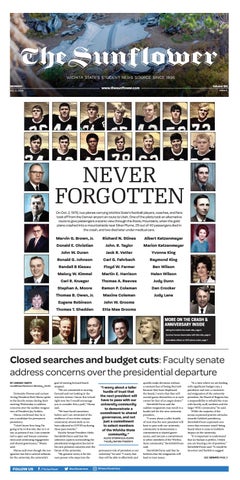
NEVER FORGOTTEN On Oct. 2, 1970, two planes carrying Wichita State’s football players, coaches, and fans took off from the Denver airport en route to Utah. One of the pilots took an alternative route to give passengers a scenic view through the Rocky Mountains, when the gold plane crashed into a mountainside near Silver Plume. 29 out of 40 passengers died in the crash, and two died later under medical care.
Marvin G. Brown, Jr.
Richard N. Stines
Albert Katzenmeyer
Donald E. Christian
John. R. Taylor
Marion Katzenmeyer
John W. Duren
Jack R. Vetter
Yvonne King
Ronald G. Johnson
Carl G. Fahrbach
Raymond King
Randall B Kiesau
Floyd W. Farmer
Ben Wilson
Malory W. Kimmel
Martin E. Harrison
Helen Wilson
Carl R. Krueger
Thomas A. Reeves
Judy Dunn
Stephan A. Moore
Ramon P. Coleman
Dan Crocker
Thomas B. Owen, Jr.
Maxine Coleman
Judy Lane
Eugene Robinson
John W. Grooms
Thomas T. Shedden
Etta Mae Grooms
MORE ON THE CRASH & ANNIVERSARY INSIDE Hiking the trail to the crash site, page 5 Survivor honors teammates with bike ride, page 6 Journalists reflect on 1970 plane crash, page 7
Closed searches and budget cuts: Faculty senate address concerns over the presidential departure BY LINDSAY SMITH news@thesunflower.com / @Lindsay_KSmith
University Provost and current Acting President Rick Muma spoke to the faculty senate during their meeting Wednesday to address concerns over the sudden resignation of President Jay Golden. Muma confirmed that he is not a candidate for permanent presidency. “I don’t know how long I’m going to be in this role. But in it or not, as provost if not, I am committed to open and honest conversations and continuing engagement and shared governance,” Muma said. Muma said even though the resignation has led to several setbacks for the university, the university’s
FOLLOW US
goal of moving forward hasn’t stopped. “We are committed to moving forward and not looking in the rearview mirror, I know this is hard right now but I would encourage you to consider this a path,” Muma said. “We have faced transitions before and I am reminded of the resilience of our entire campus community almost daily as we have adjusted to COVID-19 during these past months.” Faculty Senate President Aleks Sternfeld-Dunn said that the unknown aspects surrounding the presidential resignation has led to his own personal concerns over the future of the university. “My greatest worry is for the next person who steps into the
/ The Sunflower
@sunflowernews
“I worry about a taller hurdle of trust that the next president will have to pass with our university community to demonstrate a commitment to shared governance, and not just a commitment to select members of the Wichita State community.” ALEXS STERNFELD-DUNN Faculty Senate President
permanent role of president at our university,” he said. “I worry that they will be able to effectively and
@thesunflowernews
quickly make decisions without a constant fear of losing their job because they have displeased the board, I worry that they will second guess themselves or at each corner for fear of an angry donor.” Sternfeld-Dunn said the sudden resignation may result in a harder job for the next university president. “I worry about a taller hurdle of trust that the next president will have to pass with our university community to demonstrate a commitment to shared governance, and not just a commitment to select members of the Wichita State community,” Sternfeld-Dunn said. Sternfeld-Dunn said that he believes that the resignation will lead to trust issues.
“At a time where we are dealing with significant budget cuts, a pandemic and now a controversial resignation of the university president, the Board of Regents has a responsibility to rebuild the trust with faculty, staff, students and the larger WSU community,” he said. While the majority of the senate expressed positive attitudes towards Golden’s presidency, Sternfeld-Dunn expressed concerns that everyone wasn’t being heard when it came to Golden’s impact on the university. “It is important to understand that no human is perfect, I think you are hearing a lot of positives,” Sternfeld-Dunn said. “It would be incorrect and foolish to suggest SEE SENATE PAGE 2
2 | MONDAY, OCT. 5, 2020
NEWS
SENATE FROM PAGE 1 that there aren’t people who didn’t have a positive experience.”
CLOSED SEARCHES Members of the senate expressed concerns about the future of the presidential search committee, with many expressing disinterest towards another closed search process. Political Science Chair Neal Allen said that an open search would not only allow for faculty and student input, but could also prove to be more effective. “An open search actually could be more effective,”he said. “One of the reasons is it would allow more feedback to the candidates about what kind of institution we are, it would also allow more people to be involved in seeing the candidate working in something like
the environment they would be working in. “An open process is actually a better process and will give us better outcomes.” When asked if he knew of what the board was thinking, Muma said he was unsure on what direction it would go when it came to the search process. “The options are a closed or open search. . . the search committee typically has representation from the faculty, staff and students on campus and then community leaders [and] business leaders,” he said. “I would assume that would be the case moving forward.” Sternfeld-Dunn said he expressed the concerns over the search process to Regents President Blake Flanders. “I told him that, in my opinion, the board needed to carefully consider an open process versus a closed process because. . . I believe the Board of Regents have to work to sort of rebuild some trust,”
Sternfeld-Dunn said. While Sternfeld-Dunn said that he believed an open search process was better, he understood both sides of the argument. “It’s interesting to sort of see the privacy that these candidates desire because whenever you’re looking for another position, when that gets out, it does put at risk what your standing is at your current university,” SternfeldDunn said. Muma encouraged the senate to voice their concerns to the board, who will make the final decision. “It’s really up to the board … I think it’s a good idea to express these desires to see if there’s a possibility of having them make a different decision going forward,” Muma said.
BUDGET CUTS Another concern brought to the senate was the idea of having a newly appointed interim president
be in charge of the upcoming university budget cuts. “The role of our interim president will shape us in a period of big budget cuts,” Director of the Elliott School of Communication Jeff Jarman said. “Getting a person who is not accountable because they have not been here and won’t be here afterwards enables them to make decisions that are not necessarily in our long term best interest.” Jarman said having someone serve as a placeholder could ultimately hurt the university. “I really think this is a moment where getting a placeholder is not what we need,” Jarman said. “We need somebody who understands where we’ve been, what we’re doing and how to make some of the tough frankly budget decisions. “The idea that we would bring someone in who has no knowledge of the university and then make cuts … doesn’t sound like what any of us would want.”
Here’s what Golden’s transition out of presidency looks like BY LINDSAY SMITH news@thesunflower.com / @Lindsay_KSmith
Jay Golden resigned as president of WSU on Friday, Sept. 25. His resignation was effective immediately. Here’s what his transition out of presidency looks like, according to a letter sent by the Kansas Board of Regents to Golden on the day of his resignation.
SALARY Golden will continue to get paid his salary through June 2021, paid by private funds through the WSU Foundation. Golden has agreed to provide his consulting services to KBOR and the university for the remainder of fiscal year 2021. He will also receive the same benefits he had as president through that time period, which include dental, retirement, and health benefits.
MOVING COSTS KHANH NGUYEN/THE SUNFLOWER
Officer Matthew Feldt rides a bike patrolling campus. The campus police hope this program will grow and make them more approachable for students as well as demonstrate bike safety on campus.
WSU police department starts bicycle patrol BY CALEN MOORE cjmoore3@shockers.wichita.edu
Wichita State campus police began a bicycle patrol on Monday to allow officers to interact more and be able to patrol places vehicles can not get to. Officer Matthew Feldt asked Police Chief Rodney Clark if there was interest in a bicycle patrol program and was the one who led the initiative to bring it to campus. Clark said the bike patrol will add another level of safety. “It’s hard to approach someone in a vehicle, it’s much easier to approach someone on a bike and that’s what I want students to take from the bike patrol, it’s just
“We just want students to know our purpose is safety, and if the bicycle patrol offers another form of safety then it is fulfilling that purpose.” RODNEY CLARK WSU Police Chief
an additional method of safety,” Clark said. Being more visible and more approachable is a goal Clark says the campus police is hoping to
The Sunflower, founded in 1896, is the student-run newspaper covering Wichita State University. The print edition is published Monday during the fall and spring semesters and twice over the summer. The staff publishes daily online at www.thesunflower.com.
MISSION The Sunflower — both in print and online — will be a timely resource of information about the Wichita State University community. It will report on news, issues, activities, academics and athletics, in addition to offering a forum for discussion, reviews and commentary. It will also be an effective learning experience for students, who will have the final authority over what is published.
LEGAL One free copy of The Sunflower is available to members of the WSU community. Additional copies may be purchased for $1 in the newsroom, Elliott Hall 019. The Sunflower is private property and unlawful removal or use of papers is prosecutable. The Sunflower is funded by a combination of print and online advertisment sales and student fees allocated by the Student Government Association. The Sunflower is a member of Kansas Collegiate Media, the Associated Collegiate Press and College Media Association. Copyright © 2020 The Sunflower. This newspaper, its design and its contents are copyrighted.
achieve with this form of patrol. “There is a lot of mystique around law enforcement especially now, but we just want students to know our purpose is safety, and if the bicycle patrol offers another form of safety then it is fulfilling that purpose,” Clark said. The program is currently in the testing stage but with more interest, Clark said he wants to see it grow. As of now there is only one officer patrolling on a bicycle but in the future the campus police are hoping for more. More campuses across the country are utilizing bicycle patrols to demonstrate bicycle safety and become more
EDITOR IN CHIEF editor@thesunflower.com NEWS EDITOR Lindsay Smith news@thesunflower.com OPINION EDITOR Jeromiah Taylor opinion@thesunflower.com SPORTS EDITOR Sean Marty sports@thesunflower.com ARTS & ENTERTAINMENT EDITOR Karen Galindo arts@thesunfower.com COPY EDITOR Julia Nightengale copyeditor@thesunflower.com
personable with students on campus. The bikes are also environmentally friendly and are already prevalent on campus, leading many campus police to invest in bikes. Students on campus often ride bikes to save money and get around quicker within campus. WSU student Arturo DonJuan is interested but has his concerns. “I have a lot of friends who ride their bikes to campus, so having an officer riding around would be cool,” DonJuan said. “I guess my only concern would be with COVID-19, and managing that with this program.”
VISUALS DIRECTOR Morgan Anderson visuals @thesunflower.com PHOTO EDITOR Khanh Nguyen photoeditor@thesunflower.com ASSISTANT PHOTO EDITOR Kaylee Stout photos@thesunflower.com PODCAST DIRECTOR Audrey Korte podcast@thesunflower.com ADVERTISING MANAGER Noah Merrell admanager@thesunflower.com FACULTY ADVISOR Amy DeVault amy.devault@wichita.edu
The letter also offered Golden reimbursements for the “actual and reasonable costs” of his move out of campus, which include the move out of his presidential office and residence. The letter stated that he had to be out by Oct. 4, nine days after his resignation.
‘LIMITED PRESENCE’ According to the letter, Golden agreed to limit his presence on campus and not have any official contact with anyone affiliated to the university “in order to provide an interim or acting president with the space needed to assume leadership of Wichita State University.” The only communication he is allowed to keep is communication related to consulting services he may provide to the interim or acting president. The document provided no further details on the reason behind Golden’s resignation.
Contact Us 019 Elliott Hall 1845 N. Fairmount Ave. Campus Box 134 Wichita, KS 67260-0134 EDITORIAL
316-978-6905 editor@thesunflower.com ADVERTISING
Noah Merrell: 316-978-6906 admanager@thesunflower.com
Corrections
The story “Everything you ned to know about WSU’s Student Government Association” in the Sept. 28 issue was printed with several factual errors. The online version of the story has been edited to reflect the corrections.
NEWS
MONDAY, OCT. 5, 2020 | 3
‘I WANT THEM TO BE HEARD’
Shockers Vote! Coalition aims to encourage young people to vote BY JULIA NIGHTENGALE copyeditor@thesunflower.com / @Julianightengale
With election day quickly approaching, community members are encouraging others to register to vote. Wichita State is joining in on the conversation with the forming of the new Shockers Vote! Coalition. The coalition began with the Assistant Director of Student Involvement Gabriel Fonseca. He noticed the absence of voter engagement and election work on WSU’s campus, and felt that the university missed an opportunity to educate its students on the importance of voting. “The biggest thing was that we wanted to create a culture of voter and election engagement on campus, reestablish the joy of voting instead of people feeling like it’s a chore, and providing opportunities for educational discussion,” Fonseca said. Ella Perkins, the chair of SGA’s Government Relations committee,
said that a big population of eligible photos are not exercising their right to vote. “That is a huge population of voters who are just not engaged in the political process because they vote at the lowest rates,” Perkins said. Perkins said that there are many ways for students to get involved with voting, like engaging with representatives and attending community advisory board meetings. On campus, there are non-partisan ways to get involved, such as the government relations committee. Students can also get involved with the College of Democrats and the College of Republicans. “It’s extremely important for students to be involved in voting because people are making decisions every single day on your behalf,” Fonseca said. “I want them to have a chance to question candidates and make their voice heard and cast their vote for who fights for them and what is important to them.”
The Shockers Vote! Coalition has been busy this year hosting numerous voter registration drives, collaborating with various community organizations, and holding drive-thru registration events. Fonseca said that he wants WSU to become a permanent voting site in the general primary election. The Shockers Vote! Coalition, partnering with the Intercollegiate Athletic Association, is hosting an early voting site at Charles Koch Arena on Oct. 22nd from 10 a.m to 7 p.m. “We chose Charles Koch Arena simply because it is large and we wanted to provide social distancing space to ensure people could be safe when they went to vote,” Fonseca said. “Hopefully with the agreement we worked out we will be able to continue using this site for future elections.” Fonseca said he also wanted to make sure students didn’t have an excuse not to exercise their voting right. By providing a place on
campus, students don’t have to go out of their way to find a polling place. Perkins said she hopes the coalition will inspire more people of color to vote. “I’m really passionate about this,” Perkins said. “Young people of color are the demographic that is the least engaged in political processes which I find incredibly unfortunate. “We are a population that has a lot of power if we are properly engaged and get involved in the political process.” If students are interested in getting involved in the Coalition, they can contact Perkins at sga. govrelations@wichita.edu. After the November election, the coalition is planning on putting out a call to action for anyone on campus who wants to get involved. To keep up with future events, students can follow them at Shockers Vote at Wichita State University page on Facebook.
Fonseca said that it is important to take away the mindset that just because someone is young means that their opinions aren’t valid. “I recognize the apathy of politics in young people, when they talk about if their vote counts or they don’t know how to get involved,” Fonseca said. “For me, I’ve heard it for so long and I haven’t done anything about it and it’s become a personal mission to help young people feel as passionate as I do.”
‘Latinx or Nah’ virtual panel discusses the new gender neutral term BY JULIA NIGHTENGALE copyeditor@thesunflower.com / @Julianightengale
The Office of Diversity and Inclusion hosted the panel “Latinx or Nah” on Tuesday, Sept. 29 to discuss the new gender neutral term “Latinx”. The panelists, who are all part of the Hispanic/ Latinx community, sat down to discuss whether they embrace this new terminology. Gabriel Fonseca, the Assistant Director for Student Involvement, said that his family in Puerto Rico barely uses the term Latinx. He said he uses it more often with people from his generation or younger. “I’m gonna be honest, I rarely use it,” Fonseca said. “I recognize the importance of it and why but having to retrain my mind with the spanish that I’ve learned … it’s been an interesting learning curve.” David Garcia, the current director of public relations for the Student Government Association, said that he uses the term Latinx more often around people who don’t identify with the term Latino or Latina because it is more inclusive. “There is no wrong in using the labels that people want to use,” Garcia said. “It’s that easy to ask what you want to be identified as … I don’t want the term to be used on me but I still want to be inclusive.” The panelists all shared a mutual experience with filling out their race on forms. The panelists said that they don’t usually identify with any of the normal choices given. “A lot of times I just don’t answer because it’s like they just
want you to be something … I feel like the beautiful part of ethnicity and race is that you can be so much more than what people want you to be. I’m biracial and my parents also have so many ethnicities in them so four boxes to choose from just doesn’t cut it,” Reyna Watterson, a WSU student majoring in spanish said. Jennifer Alfero, a WSU student majoring in mechanical engineering, said that the concept of gender roles provides a problem with older generations possibly accepting the new term. “I know that if I go back home and tell my grandparents about Latinx they are going to look at me and think I’m crazy,” Alfero said. Alicia Sanchez, Director of the Office of Diversity and Inclusion at WSU, said that her culture also struggles with gender roles. She is one of the first women in her family to work full-time and be a mother, and is sometimes criticized by her mother and grandmother for not staying at home. “For myself, I wouldn’t identify as Latinx,” Alfero said. “I understand that we are trying to be inclusive but I just feel like [identifying as Latina] is something that I already have in me.” Garcia said that at the end of the day, individuals should work on using the terminology that they feel comfortable with. “I feel like it’s subjective and based on the individual,” Garcia said. “Whatever word makes you proud and empowers you, you should use, and you should ask people to use that word … I think that as latinos and hispanics and latinas, we need to celebrate the spectrum of who we are as people.”
COURTESY/UNITING BOLD SISTERS
Uniting Bold Sisters aims to create a sisterhood of multicultural identities BY JULIA NIGHTENGALE copyeditor@thesunflower.com / @Julianightengale
As WSU students are finding more ways this semester to get involved, a new organization is hoping to invite people of all backgrounds to create a diverse place to build one another up. “Uniting Bold Sisters mission is to welcome, unite and empower sisters through leadership, education, and the celebration of multicultural identities,” Taylin Fox, president of United Bold Sisters said. Fox said that the group formed after conversations about the need of an inclusive multicultural space on campus. The organization’s definition of
multiculturalism is including, but not limited to, race and ethnicity. It also includes the LGBTQ+ community, religion, economic background and ideology. “I am looking forward to this organization becoming strong and unshakeable, so when people join us they know that they are perfect and whole in all that they are and they should celebrate every aspect of their identity,” Fox said. The organization’s main philanthropic cause is youth mentorship and youth development. They believe that it is important to support the youth in the community to ensure that they are empowered and go on to succeed in life. Future activities that they are planning include donation drives
and developing a mentorship program. “With our guiding principle of multiculturalism, we are planning a discussion about the importance of a diverse network,” Fox said. “We want to do more educational events where we can talk about multiculturalism.” For people who are interested in joining the organization, they can reach out to the group on Instagram or Twitter at @boldsisterswsu or email Fox at txfox@ shockers.wichita.edu. “We are going to be a space that anyone can enter and be fully celebrated for all that they are and all that they will be in the context of sisterhood and genuine friendships,” Fox said.
THE SUNFLOWER NEWS PODCAST Listen on Anchor.fm, Spotify, Google Podcast, and Apple Podcast
4 | MONDAY, OCT. 5, 2020
NEWS
FILE PHOTO: SELENA FAVELA/THE SUNFLOWER
The Fairmount neighborhood is located just south of Wichita State’s campus, across 17th Street.
WSU proposes creating a University Village across from campus BY AUDREY KORTE podcast@thesunflower.com / @akorteshares
Wichita State University hosted a discussion about a community initiative that could lead to creating dining, shopping, and entertainment venues adjacent to the WSU campus on Wednesday. The venture is called University Village. If it succeeds, it could offer students and faculty more options to connect with the surrounding neighborhood and ways to engage the local economy. The partnership is between the university, City of Wichita, Sedgwick County, and community members. Through the existing Shocker Neighborhoods initiative, internal discovery, and community feedback, Wichita State identified an initial list of ways to serve WSU and the neighboring community with the University Village. These include: • Dining options with a focus on healthy and ethnic food options • Grocery stores that include international options • A pharmacy • Retail that includes general merchandise, appropriately sized • Mixed-use commercial/retail • Childcare centers • Local businesses, including a bakery, smoothie/juice bar, and apparel In 2012 Dr. John Bardo unveiled the mission of Wichita State, which included goals to improve the student experience and the local economy, acting President of Wichita State University Rick Muma said. “This plan was driven by the
creation of the Innovation Campus located in the development of the Shocker Neighborhood and spurring the economic growth of the surrounding ten-county region,” Muma said. During Bardo’s tenure as president, Fairmount became a focus of WSU. In the wake of the brutal 2014 rape and murder of Letitia Davis in Fairmount Park, WSU launched the Enough is Enough campaign and secured a $250,000 grant from the Kansas Health Foundation. With that grant money, WSU’s Public Policy and Management Center improved lighting in the park, updated tennis, and basketball facilities, and organized a medical mission. The university also conducted a comprehensive survey with a better-than-50% response rate to understand the community’s perceptions and needs. But Wichita State and Fairmount’s histories have overlapped since the beginning. In 1886, Rev. Joseph Homer Parker founded a private congregational prep school known as “Wichita Ladies College” and “Congregational Female College.” It was part of a boom in college and university creation. In early 1887, developers of the adjacent Fairmount neighborhood donated land to this school, and it was renamed Fairmount College. Parker wanted it to be the “Vassar of the West,” so streets around the neighborhood were named after women’s colleges such as Vassar and Holyoke. Fairmount College classes began in 1895. In 1926, the Congregational
Sunflower Archives - Oct. 6, 1989
SGA president, senator fray halts meeting BY GINA SPADE
A physical confrontation between Student Government Association President Steve Cisneros and Se. Larry Easley resulted in the abrupt adjournment of the student senate meeting with only a portion of its business completed Wednesday. The senate was discussing a proposed constitutional amendment which would require an SGA officer to maintain six hours each semester. Cisneros continually mumbled while senators were trying to speak. Easley, who was serving as chairperson of the senate while vice president Linda Starnes was presenting a report for the Operations Committee, banged the gavel on the table and asked Cisneros to remain in order. “President Cisneros you are out of order,” said Easley. “If you are out of order again you will be removed from this room — forcibly if necessary.” Some members of the senate laughed at that remark, but Easley who was seated next to Cisneros, rose from his chair, stood behind Cisneros, and placed his hands on Cisneros’ shoulders, Easley then
pulled back and tipped Cisneros out of his chair. Easley said after the meeting he had only intended to scoot Cisneros’ chair back so that Cisneros could get up to leave, “I wanted him to leave or refrain from interrupting,” said Easley, after the meeting was adjourned. “I was trying to pull him back.” Cisneros said he was in shock immediately after the incident. “I didn’t even know how to react,” he said. “It took me a while to react.” The student senate was also shocked. “What Larry Easley did to President Cisneros was unreasonable, inexcusable and out of order,” said Dani Sellers, an at-large senator. “I am thoroughly embarrassed to be a part of this organization tonight,” said Jess Fast, an at-large senator. Cisneros said the incident was intolerable. He added that he hoped the senators would remove Easley from the senate. “He’s doing SGA a disservice if he doesn’t resign,” said Cisneros. “I’m sorry that something like this even had to happen.”
Education Society gave Fairmount College to the city. By a vote of the people, it became a public, non-denominational institution called The Municipal University of Wichita. It was the first municipal university west of the Mississippi. The common name for the school was Wichita University. And in 1964, the University of Wichita became Wichita State University — an institution governed by the Kansas Board of Regents. Fairmount neighborhood development has been the talk of WSU for years. “I was an undergraduate student serving on the Student Government Association 30 years ago where this very conversation was taking place,” said Interim Vice President for Regional Engagement and Economic Development, Kaye Monk-Morgan. “I think it’s something that lots of presidents have wanted to do. We just haven’t ever had an opportune time to make it happen, and so we’re evaluating whether this is that time.” Monk-Morgan said Jay Golden was a primary advocate of this work. Fairmount Neighborhood Association (FNA) President Darryl Carrington believed Golden was excited about the possibilities that Fairmount offered the university. He said he met with Golden several times. Together they toured the Fairmount neighborhood, and Golden attended an FNA meeting earlier in the year. “The firing of Jay Golden should not put the brakes on this. And Kaye Morgan alluded to that a little bit.
She’s like, you know, ‘He’s one man. He had a lot of passion. But one man wasn’t going to push this through’. It takes a village, and we can push this through,” Carrington said. Monk-Morgan said she’s hopeful that the next university president will help the university move ahead with University Village. The groundwork was laid by Bardo and Golden. “It does say something that the last two leaders have been interested in this. My goal is to begin the conversation, whoever comes along,” Monk-Morgan said. Muma said he’s lived in the area known as the Shocker Neighborhood for two decades. He said he’d sensed a change in the area in recent years. “What I’ve noticed over the last five to six years is a sense of renewal. More young families in the neighborhood, people helping people fix up their houses, people caring for shared greenspaces, bike paths, and more,” Muma said. “I know this is anecdotal information, but I think it’s real, and I think it’s because we’re all working together.” Carrington said so far, all of the FNA’s expectations have been met with WSU in the University Village conversations. “We are defenders of that neighborhood coalition. As we sit here, FNA is positioning itself to lobby WSU to have a presence,” Carrington said. “We thrive on having a presence of Wichita State within the borders of Fairmount.”
New student fees proposal includes three year staggered review cycle BY LINDSAY SMITH news@thesunflower.com / @Lindsay_KSmith
A new student fees proposal includes a three year staggered review cycle, a dollar by dollar individual student breakdown, a process of reviewing increases due to mandatory healthcare, and would disqualify most student organizations from receiving fees through the student fees process. If passed, the proposals would be put in place for fiscal year 2022. The new Student Fees Task Force authored the proposals. The task force was created so to allow a space to hold conversations about every aspect of the student fees process. A listening session was held Thursday, Oct. 1 to hear feedback from receivers of student fees. The first proposal would adopt a three-year staggered review cycle, which would guarantee organizations their funding for three years instead of the current policy that allocates fees yearly. “The first year everyone comes and meets like usual, and after that we start the cycle of people [coming] to meet in three year staggered cycles,” SGA Treasurer Zachary James said. The proposal split different
groups into year A, B, and C categories. “Year A would all come meet the first year, we will hear their budgets and discuss their budgets and determine their amount,” James said. “They will not come to see us for another three years and they will keep that same budget.” If needed, there is a process set in place where groups can break out of their year cycle in the event where they are in need of a possible increase. The second proposal changes the overall allocation to a per-student breakdown so students can see exactly how much of their money is being spent on each group. “Students will be knowing exactly how much of their student fees dollars are going to each category,” Chair of the Maggi Hole said. “This adds a level of realness of what they will be paying. “So instead of us throwing around 25,000 dollar it’s ‘Oh, I will be paying a dollar out of my student fees.” The second proposal also puts a process in place where the Student Fees Committee can review increases to mandatory
healthcare, insurance, or other COI increases. The third proposal recommends adding language that would disqualify student organizations and clubs from receiving student fees through the student fees process, excluding the Student Government Association and The Sunflower. “All other student orgs are going to get funding from SGA’s budget,” James said. “The budget and finance committee will essentially set up the process of how we will get enough money for all the student organizations.” Hole said one of the reasons that this proposal was written was to put all student organizations at the same level when it came to funding. “The reason why we did this is we want all student groups to be on the same level and have the same accessibility to money,” Hole said. The proposals will be sent to the student senate on Oct. 14 for a first read and Oct. 21 for a vote. It will have to be signed by Student Body President Rija Khan and Acting University President Rick Muma to pass.
WWW.THESUNFLOWER.COM
MONDAY, OCT. 5 2020 | 5
Sports
HAVE A STORY IDEA?
contact The Sunflower’s sports editor, Sean Marty sports@thesunflower.com
Hiking to the 1970 plane crash site 1
1
When travelling westbound on I-70, take exit 216 and take a hard right onto a dirt road. Continue up the road for about a quarter mile.
7
7
After about half a mile, you will notice a clearing up ahead displaying pieces of the wreckage. You have made it to the crash site.
6 6 The path will start to level out here but leans to the left. You will start to see more fallen trees as you progess.
2 When you come to a closed gate, park off to the side of the dirt road. Walk to the right of the gate, and take the path around it. Follow the path for about a half mile until you reach a rock pile on your left.
5
2
5
4
After almost a mile of steep hiking, you will see a pile of rocks on your right and a narrow path on your left. Turn left at this point.
3
At this point, the trail moves into a steep incline. There is a pile of walking sticks at the bottom. Taking one will be useful when hiking to prevent yourself from falling.
3
4 On the incline, you will start to see fallen trees. You will have to climb around them.
PHOTOS AND GRAPHIC BY MORGAN ANDERSON/THE SUNFLOWER
What a trip up to the crash site is like 50 years later Sean Marty Sports Editor sports@thesunflower.com
One weekend ago, two members of The Sunflower staff got to visit the site where 29 people lost their lives and two others died in the weeks following. I had some expectations of what the trip would be like but being on the actual site was nothing like I ever imagined. The plane crash site sits on Mount Trelease near Silver Plume, Colorado. On Saturday, Sept. 27, we made the hike up the mountain to go visit the remaining wreckage. For those hoping to see the site, it is something that you must be well prepared for. The hike was very uphill and throughout the process, we took several breaks until we ultimately reached the very important left turn where a pile of stones lay. For those interested in visiting, this turn is crucial as if you miss this left turn, you will also miss the crash site. Despite being unsure of ourselves, we took the left turn and after hiking more we ultimately reached the site of the wreckage. Once you reach the wreckage, it almost startles and surprises you. After 50 years, it’s amazing to see all the parts of the wreckage that have been left over time. It was an eerie feeling when we arrived at the wreckage. It was almost like we didn’t fully grasp how to feel about what we were seeing. There is so much up there that we felt a sense of adventure and never wanted to leave. As the adventure sinked in, we had to stop a few times to remember just how many people lost their lives at that exact location 50 years before. I was scared to move anything
while exploring through the wreckage. The site simultaneously felt like a cemetery and a memorial. As we were looking through the pieces of the plane, we saw different types of buttons and pins that were left for victims who sadly passed away that day. We left with an overarching feeling of sadness. It made me start thinking about how people came off the side of this mountain and survived this horrific incident. Another feeling I got was the sense of weirdness. Throughout the hike up to the mountain, we could hear the sound of cars passing by on Interstate-70 but once we arrived at the wreckage those sounds came to a halt. We almost got a sense that the victims of this horrific event are there with you on the side of the mountain. While we were up there, the Visuals Director Morgan Anderson took photos of all the wreckage and memorabilia that was left there even 50 years ago. While she took photos I was trying to take it all in while also taking notes of anything interesting that I saw. The amount of wreckage that is still left on the side of the mountain is remarkable, especially with the different kinds of things that people have put up there over the years. In my opinion, anyone that is interested in the history of WSU football or WSU sports as a whole should visit this site before the wreckage may be gone completely. The opportunity to go up and visit the wreckage was something that I’ll never forget. Being able to share and capture these moments in WSU’s history was such a vital experience of my journalism career. I’m hopeful that I will get further chances to continue to shine a light on these moments throughout the history of the university.
PHOTOS BY MORGAN ANDERSON/THE SUNFLOWER
Top: Sports editor for The Sunflower, Sean Marty, observes the 1970 Wichita State plane crash site on Sunday, Sept. 27 near Silver Plume, Colorado. Left: A torn Wichita State shirt hangs amoung the twisted metal pieces from the plane crash in 1970. Above: Pieces of twisted metal and plane parts still remain after 50 years at the Wichita State plane crash site. 29 out of 40 passengers were killed in the crash, and two passengers died later under medical care.
6 | MONDAY, OCT. 5, 2020
SPORTS
WSU alum produces documentary on 1970 plane crash BY SEAN MARTY sports@thesunflower.com / @TheSeanMarty
SEAN MARTY/THE SUNFLOWER
Paul Harrison, Kelly Harrison and Rick Stephens address the crowd at the 1970 plane crash memorial on campus before leaving on their eight-day bike ride to the plane crash site near Silver Plume, Colorado.
Stephens to honor his fallen teammates through bike ride to Colorado BY SEAN MARTY sports@thesunflower.com / @TheSeanMarty
Plane crash survivor Rick Stephens has been honoring his late teammates in a creative way. Stephens and two others are bike riding from the memorial all the way to the crash site near Silver Plume, Colorado in honor of the 50th anniversary. Stephens remembers the day of Oct. 2, 1970 vividly. Stephens, a former Wichita State football player, recalls traveling to Logan, Utah for a game about Utah State. Originally, the plane had to stop at Stapleton Airport in Denver due to an issue with the hydraulic hose that was resolved. WSU was traveling with two planes to the game but both took two different routes to get to Logan, Utah. Only one would arrive safely. Stephens remembers noticing that the plane wasn’t gaining much altitude and even entered the cockpit and saw the pilots in an urgent state of chaos. “I got up out of my seat, went to the cockpit and saw the pilots in a state of urgent chaos, trying to figure out how we could make it over 14,000foot elevation,” Stephens said. “It was very impossible to do that. I realized something was amiss, something was wrong. I fell to the floor, I remember trees being clipped by the wings and after that the next thing I remember is waking up outside the aircraft quite the distance away from the airplane.” Unlike the “Black” plane, the “Gold” plane decided to fly over the
Continental Divide which was the fatal mistake that resulted in the crash near Silver Plume, Colorado. “Our plane decided to go straight over I-70 to Loveland Pass which was the ultimate mistake that caused the accident,” Stephens said. “The plane was overweight, they should’ve been aware of that and they didn’t follow the flight plan. There were a lot of questions about how the flight was conducted.” As a result of the crash, 29 people were killed on the scene and two others died in the weeks following the crash. Stephens was one of the nine survivors from the crash and only escaped with some burns and broken bones. For Stephens, the crash has the biggest impact during this time of the year when the anniversary nears. “At this time of the year, I’m constantly reminded of tragic events that happened,” Stephens said. My injuries were not serious or life-threatening. That’s the great sadness of it. My life has gone on, I think fairly productively as a teacher for 30 years in the public school system. Stephens has gone on bike rides to the crash site recently in hopes of keeping the memory of this tragic event alive. “I’ve tried to keep the memory of this event alive over the past ten years doing some fairly extensive bike riding to raise money for the Memorial scholarship,” Stephens said. “I’ve had some physical problems due to injuries but nothing’s that
prevented me from living my life.” Over the years, Stephens has gone on five bike rides in total to raise money for the Football ‘70 Memorial Scholarship which was put in place in honor of those who died in the crash 50 years ago. “The scholarship was set up for those who perished and their children to go to Wichita State and then they expanded it to survivor’s kids,” Stephens said. “Both of my children have gone to Wichita State on that scholarship fund. I think it’s an admirable cause to support that scholarship that they’ve helped us and I felt somewhat obligated to pay back in that manner.” With it being 50 years since the plane crash took place, Stephens said that it’s difficult to realize that half a century has passed since the tragedy. Stephens said this trip will be special knowing that it could be his last trip up. “There was an outpouring of grief and support from the community and the sports world in general,” Stephens said. “I think this a special one myself included as it might be my last hoorah. The university has been very good about paying tribute to the survivors, those who lost children, brothers, sisters, dads, moms. They’ve been good about doing that.” Stephens bike ride will begin on Oct. 3 and will arrive in Silver Plume, Colorado on Oct. 9 before heading up on the mountain the following day.
At the time of the 1970 plane crash, Wichita State alum Jeremy Hubbard was completely unaware. Now as a news anchor, KDVR and KWGN in Denver recently published a documentary called “Overshadowed: The Wichita State Football Plane Crash”. Hubbard said he didn’t know much about the crash besides the memorial on campus and became fascinated as he got further on into the project. “Once you find about how random it was and whether you lived or died depending on which plane you hopped on that day if you were a Wichita State football player,” Hubbard said. “It was fascinating to me. Despite the decisions that were life or death for the team members, boosters and the coaches.” Hubbard was inspired to produce the documentary after talking to former Wichita State football player John Yeros who was on the other plane the day of the crash. Over the years Yeros had suggested that Hubbard join him in visiting the crash site. Hubbard felt it was the right time to create the documentary after reconnecting with Yeros. “I thought this is definitely the time to do this story,” Hubbard said. “We set out to do it and I had no idea how impactful not just for me but all the others that were involved.” As part of the documentary, Hubbard along with family members and survivors of the crash climbed up the mountain where the plane crashed. Hubbard said he was surprised to see how much wreckage is still there after being there for half a century. “I think they see it as hallowed ground for the guys that were killed in the crash,” Hubbard said. “It was really touching. I had heard about the wreck site and I knew people who hiked to it before and they said ‘yeah, there’s still lots of pieces of this plane up there’. “I had no idea until I got there how much is still on the side of that mountain. It’s really something to see.” One of the messages that Hubbard hopes the audience takes away from the documentary is the amount of people that were affected by this tragedy. “I think it’s important to remember it’s not just the guys from the football team, the deaths were tragic,” Hubbard said. “They were teenagers, a lot of them. It’s horrible their lives ended this way. There were a lot of other people on that plane that were a part of the DNA of Wichita State who went down on that plane that day that are often forgotten about.” One of the main things Hubbard addressed throughout the documentary was how overshadowed the crash was over the years. Just 43 days following WSU’s crash, Marshall University’s football team had a similar tragedy which stole the headlines. “I guess just the sheer number of people killed in that crash stole the headlines from Wichita State but I just want to make sure that fifty years later we do remember the darkest day in our university’s history and the people’s lives who were forever changed by it,” he said. Since putting out the documentary, Hubbard has been shocked at the outpouring of support especially coming from family members of the victims. Hubbard has been happy to reach so many people and tell the story of the crash. “Obviously the goal when you put together something like this is to have as many eyeballs view it as possible,” Hubbard said. “I didn’t have any idea that there would be this many people watching it. Honestly, I don’t know if I’ve ever had a reaction to a project that we’ve done quite the reaction we’ve had to this Wichita State special. I think it shows you the level of interest there still is in this crash even though it happened 50 years ago.”
‘My parents would not be coming home:’ Winterbone reflects on the day her world changed BY SEAN MARTY sports@thesunflower.com / @TheSeanMarty
Elizabeth Wilson Winterbone’s life changed on Oct. 2 1970 when, at age ten, she lost both parents in the tragic WSU football team plane crash that killed 31 people. At the time of the crash, Winterbone had arrangements to sleep over at a friend’s house while both parents made the journey to Logan, Utah for the game. Her father, Ben Wilson, was the head coach of the team. Her mother rarely traveled to games. To this day, Winterbone is unsure why she decided to travel to that one game. Following the tragic crash, Winterbone was taken to a family friend’s home, completely oblivious to what had happened. “I had no inkling of alarm, I was just annoyed that my plans of sleep-over fun were abruptly changed,” Winterbone said. “I learned later that they waited to tell me until more certain news had come from Colorado. The next morning I was told that my parents would not be coming home.” Winterbone doesn’t remember much about the memorial ceremony that was held at Cessna Stadium prior to the crash, but does
remember the quick turnaround in attending the different ceremonies. “The only other thing I remember was the service held at the stadium and the singing of Where Have All The Flowers Gone,” Winterbone said. “Ten days after the crash I was at the memorial service for my parents in Ohio.” Throughout her childhood, she was surrounded by people who were unfamiliar with the crash and didn’t really know much about Winterbone’s parents. Winterbone was unfamiliar with many other children who had also been affected by the crash until about 10 years ago. When she moved back to Wichita, Winterbone began to connect with others who had also been impacted by the crash and said she is happy to have supportive friends and family. “I sometimes marvel at how lucky I am to be able to know such loving and supportive people,” Winterbone said. “Facebook has been a great way to get to know the other kids who are rather far-flung, but close to my heart.” To this day, Winterbone has not been up to the crash site but still pays attention to people that decide to make the trip. More recently, Wichita Eagle
“I sometimes marvel at how lucky I am to be able to know such loving and supportive people. Facebook has been a great way to get to know the other kids who are rather far-flung, but close to my heart.” ELIZABETH WILSON WINTERBONE Daughter of Ben and Helen Wilson
photographer Travis Heying shot a photo of a button with her father’s name on it. “I’ve always paid attention to stories of people making the trip to the crash site,” Wishbone said. “I still haven’t been myself but I plan to make the trip before too long. It was bittersweet to see the memento of my dad showing the effects of the years of exposure.” At this point, Winterbone doesn’t have any plans for the anniversary of the crash. She first started attending the memorial back in 2000, but it was hard to attend at first due to the type of relationship and bond the players had built with one another.
MORGAN ANDERSON/THE SUNFLOWER
A Wichita State hat displaying a pin honoring the WSU football head coach, Ben Wilson, sits on a piece of metal from the crash at the site near Silver Plume, Colorado. Wilson died in the crash along with 30 other passengers.
But over time, she has been able to build some connections with them and now looks forward to the memorial whenever she attends. “It took a number of years of attending before I got to know some of them and now I consider some dear friends and I look forward to seeing them,” Winterbone said. “But some years I stay home and just have a quiet day.” Winterbone feels blessed to have the opportunity to attend the ceremonies annually and is grateful
for the messages she receives on the anniversary of the crash. “Having a public ceremony and the ability to acknowledge the deep loss seems almost like a luxury to me and I am so grateful for all the lovely messages I receive,” she said. “I have learned to carry that compassion forward. I am deeply aware that you never know what someone else may have gone through and offering a bit of grace can make the world better for us all.”
SPORTS
MONDAY, OCT. 5, 2020 | 7
JOURNALISTS REFLECT ON THE IMPACT OF WSU FOOTBALL’S PLANE CRASH 50 YEARS LATER BY SEAN MARTY sports@thesunflower.com / @TheSeanMarty
Fifty years ago, tragedy struck the Wichita State football program. A plane carrying 26 student-athletes, athletic officials and some fans traveled to Logan, Utah for a game against Utah State. The group would never make it to Utah. The plane crashed into a mountainside in Colorado, killing 31 people on board. Only eight players and the co-pilot survived the crash. In the days after the crash, then-President Richard Nixon wrote a letter to the WSU community expressing his condolences. “Mrs. Nixon and the members of my traveling party join me in expressing our deepest sympathy to the families of those who were killed in this tragic accident and also to you and to the members of the Wichita State community,” Nixon wrote. Current Shocker radio broadcaster Mike Kennedy remembers the day vividly. At the time, Kennedy was a student and working at KMUW doing broadcasting. Kennedy remembers somebody checking the AP wire machine and seeing a story about
WSU’s plane crashing in Colorado. The story was supposed to be embargoed, according to Kennedy. “It wasn’t supposed to be released yet,” Kennedy said in a phone interview with The Sunflower. “I think we were some of the first people in Wichita to see it or know anything about it. We immediately went into figuring out plans on what do we do now.” As a student at the time, Kennedy felt that this kind of tragedy helped bring students together especially since many people hadn’t experienced a tragedy like this before. “Unfortunately in some ways, a tragedy like that brings people together in a way that’s rare,” he said. “You all have this common purpose and a common bond of grieving for the people involved. I think there was certainly a sense of that on campus.” Despite going through this incredible tragedy, there was still hope from players that the WSU football season would continue. The remaining team members held a vote to decide if they should continue the season without any coaches involved. Only one player voted no. The program struggled in
its return against Arkansas only two weeks later, losing 62-0. The Shockers went on to lose every game for the rest of the season. In the remaining years that followed, the program struggled to stay afloat and find success. Because of financial concerns and a lack of community support WSU’s football program folded in 1986. This came as a shock to Tom Shine, a former Wichita Eagle sports writer and veteran journalist who covered the final two years of WSU football. “I had asked the president, Warren Armstong, maybe less than two weeks earlier directly ‘Will you have a team next year’? He said yes,” Shine said. “I kind of took him at his word and they announced they were folding it and I was not happy.” As the university decided to end the football program, parents became very upset with WSU’s decision. Many felt that it was disrespectful to all of the players that had died in the crash. Shine said he even received a letter from one parent who voiced her displeasure about the university’s decision. “As long as Wichita State played football, they’d kind of live on and she was really upset, as were many
other people, that the folding of the program was a slap in the face for those players and coaches that died,” Shine said. “This was 16 years later but the emotions were still very strong and raw and they were very unhappy about it.” As Shine reflects on that fateful Oct. 2 day, he said he thinks about all the opportunities the players missed and the impact it had on families involved. “It’s sad at a whole ‘nother level,” Shine said. “All the stuff they never got to experience or their families never got to experience. They never got to see their son get married and have children. Kids became orphans that day instead of just the football players that were on that plane. “It’s really a terrible, terrible tragedy on so many levels,” he said. “I still think it touches people in the community.” Today, some of the wreckage still remains along the mountainside next to Interstate-70. This summer, Wichita Eagle photographer Travis Heying visited the plane crash and was shocked by the impact of seeing the plane crash site. “I remember coming upon this part of the path where there were
a lot of new trees and you kind of had to push them aside a little bit and then it’s this big piece of sheet metal lying right in front of you,” Heying said. “It’s pretty jarring when you come upon that.” For Heying, he originally didn’t plan to just visit the plane crash site in Clear Creek, Colorado. As he was on vacation in Colorado he decided to go for a hike near the site. But as he was there, he felt that he needed to stay there and encapsulate the whole experience. “I felt a desire to stay there,” Heying said. “I wanted to explore the area, which I did, but I kind of wanted to just be there and stay there for a while. It was just kind of overwhelming. I felt this desire to really soak it in.” According to Heying, no Eagle photographer had gone up to take photos of the site in his 20-plus years at the paper. But for him having the experience of going to the site was especially powerful. “That really takes the experience of visiting and makes it all the more powerful,” said Heying. “It’s amazing how many people to this day, that tragedy touches.”
Sunflower Archives - Oct. 5, 1970: Football players, coach and dean perished when ‘Gold’ plane fell MARY MITCHELL
Wichita State University fell victim to the worst disaster in the history of American college football Friday as a game-bound plane carrying twenty-six members of the Wichita State football team, head athletic officials and some of the most ardent Shocker fans crashed into a Colorado mountainside while trying to cross the Continental Divide. Of the forty persons aboard who were traveling to Logan, Utah, for the Wichita State-Utah State football game, twenty-nine persons died; eleven survived. Reports indicate that the twin engine plane, a chartered Martin 404, was flying low as it passed over Idaho Springs, Colo., and that the plane crashed and burned on the side of a densely wooded mountain near the Loveland Ski Basin. According to the Federal Aviation Association officials, there was apparently no radio contact before the plane went down. Michael C. Bruce one of the surviving football players, said that after the plane crashed he made his way out of the burning wreckage and went to a nearby construction camp for help. Construction workers and Clear Creek County, Colo. officials then took injured passengers for medical attention in nearby Idaho Springs.
UNIVERSITY RECEIVES NEWS At approximately 3 p.m. Friday Wichita State officials received the message that the “Gold” team plane had gone down. Sports and University officials, worried friends and relatives gathered in Henry Levitt Arena to hear further information as it was reported to the University. Clark D. Ahlberg, president of Wichita State University, directed messages to those waiting in the Arena as news was available. By Friday evening Dr. Ahlberg had obtained a list of persons on board the ill-fated plane, and had arranged through Kansas Governor Robert Docking for an Air National Guard C-54 airplane to fly families and friends of the “Gold” plane passengers to Colorado.
debarked from the plane, and approximately 10 minutes later returned to make a roll call of those passengers aboard the “Black” plane. He then announced that the plane carrying the rest of the team had gone down. Assistant Coaches Seaman and Charles Ramsey left Utah on a commercial flight to Denver shortly after they heard about the crash. Coach Fred Conti called the players on the second flight into a motel room Friday evening and gave them what information was available. “I know this has hit you as hard as it has hit us, but let’s … pray for the best. We need you now more than ever. So please stay with us. In your own way, say a prayer and hope for the best,” Conti said. The players ate box lunches at the motel and then attended church.
SPORTS OFFICE The official list of those aboard the safe plane was then relayed to the Sports Information Office where Ahlberg informed families, friend and football players, who had not made the Logan trip, of the news. At that time Ahlberg announced the names of the 11 persons who had been taken from the wreck for treatment in nearby hospitals. Ahlberg, then not knowing if there were other survivors, made arrangements for the National Guard plane to transport those wanting to go to the scene of the wreck. Leaving the McConnell Air Force Base National Guard Hangar in Wichita were Ahlberg, D. Cramer Reed, dean of the College of Health Related Sciences, and families and friends of “Gold” plane passengers all wondering what they would find in Colorado and hoping for the very best.
BODIES RECOVERED Late Friday night Clear Creek County officials said they had “no hopes” of finding other crash survivors. By Saturday night rescue crews had recovered the bodies of the twenty-nine missing team members, officials and fans.
BLACK PLANE
OTHER PLAYERS RETURN
In Logan, Utah, prior to the landing of the “Black” plane, Assistant Football Coach Robert Seaman was called to the pilot’s cabin and was told that he had a phone call waiting at the Logan Airport from Dr. Ahlberg. Seaman
On Saturday afternoon the passengers aboard the “Black” plane were flown back to Wichita. Arriving at Wichita Municipal Airport the players were transported to Fairmount Towers, “home” for the unmarried
ARCHIVE PHOTO/THE SUNFLOWER
Where have all the flowers gone? The tear-filled eyes of this young lady at memorial services for those killed in last week’s tragedy express the shock and emotion felt by much of the Wichita community. More than 12,000 people came to Cessna Stadium Monday night to pay tribute to those who died. Oct. 9, 1970.
Shockers, where they were reunited with families and friends. The team members met briefly with University officials after returning to Wichita, but no decision on the future of Wichita State football was made. Sunday the remaining members of the football team, both those who safely made the Logan trip and those who were not on the traveling team attended services together at University United Methodist Church, ate lunch with assistant coaches and held meetings with coaches and faculty members. “They’re spending a lot of time together and talking about their future,” said Dr. John B. Breazeale, Wichita State academic vice president and dean of faculties. The future of the 1970 football season is still in doubt. No decision has, as yet, been reached as to whether Wichita State will continue to have varsity football this year. The Shockers still have seven games scheduled. Although their Saturday game with Southern Illinois was cancelled, games
with Cincinnati, Arkansas, Tulsa, Memphis State, North Texas State, and Louisville are still scheduled. A University spokesman said that the first thing to be considered will be whether or not the players themselves want to continue this season. University officials also stated that the National Collegiate Athletic Association has indicated it would have no objection to the use of freshman in games if the Missouri Valley Conference, of wichit the Shockers are members, gave its approval.
INVESTIGATIONS After the “Black” plane reached Logan and the Federal Aviation Administration received work of the “Gold” plane crash, FAA officials impounded the “Black” plane. Investigations of the causes of the crash of the “Gold” plane are in process by both the Federal Bureau of Investigation and the Federal Aviation Agency. A team of federal investigators from the National Transportation Safety Board will also investigate the crash.
The planes, chartered by the Golden Eagle Flying Service of Oklahoma City, Okla., are titled to the Jack Richards Aircraft Co. Letter written by Richard M. Nixon, President of the United States Sent from Air Force One Friday, Oct. 2, 1970 Dear President Ahlberg, It was a great shock to learn this morning that one of the airplanes carrying the Wichita State football teams had crashed yesterday and that so many lives had been lost. Mrs. Nixon and the members of my traveling party join me in expressing our deepest sympathy to the families of those who were killed in this tragic accident and also to you and to the members of the Wichita State community. To those who were injured in the accident, we send our good wishes for a full and rapid recovery. We know that the spirit that characterized your team will live on in your lives and your memories. Our thoughts and prayers are with all of you at this sad hour.
8 | MONDAY, OCT. 5, 2020
SPORTS
Volleyball returns to the court in its second Black and Yellow Scrimmage BY SEAN MARTY sports@thesunflower.com / @TheSeanMarty
KAYLEE STOUT/THE SUNFLOWER
Wichita State freshman Lauren McMahon celebrates after scoring against the black team during the Black and Yellow scrimmage on Oct.1 inside Koch Arena.
Although the Wichita State volleyball program is yet to face any competition this semester, they returned to Charles Koch Arena for the second time this offseason for their second Black and Yellow Scrimmage. The program originally hosted a scrimmage last month. Head Coach Chris Lamb said that being able to get back out on the court in front of fans was an overall great experience. “It was fun to feel like we’re back to normal a bit,” Lamb said. “I think the girls enjoy it so because of injuries we didn’t have it super fair tonight, it wasn’t as balanced. But that’s ok, we’ll do the best we can the next time we play. Got to see some stuff and can’t wait to watch the tape and evaluate it.” In the scrimmage, Team Black was victorious in four sets, winning the match 3-1. Sophia Rohling proved to be one of the bright spots from the scrimmage, tallying game-high 12 kills to go along with a .310 hitting percentage. Freshman Morgan Weber and Mariah Buss were also able to make an impact in the scrimmage for their respective teams. Weber
10 kills and 12 digs for Team Black while Buss was able to add nine kills of her own for Team Yellow. Since the postponement of the season, the program has been primarily left to just practice without much game action. Although the team is able to review some tape from scrimmages during practice, Lamb said that being able to break up those practices with these Black and Yellow Scrimmages will be beneficial in the long run especially for some of the newcomers like Weber and Buss. “I think it’s more breaking up the monotony of being in the practice gym,” Lamb said. “The only difference is not stopping to teach stuff, playing all the way through, girls having to deal with things on the fly and figure stuff out. Really it’s to see them lace them up, put the jerseys on, playing in front of people. It was really was an icebreaker in a trade.” Given the uncertainty throughout the offseason and not knowing what would eventually happen for this upcoming volleyball season, it left the program wondering what they could do next. As a result, the program decided to put on these three scrimmages but Lamb feels excited to be able to slow things down before the final scrimmage
next week. “We were in limbo for the longest time waiting to see what was going to happen,” Lamb said. “November 16 rolls around and we have a ruling. We just decided might as well get three of these things in, we’ll space them out and act accordingly. I’m excited to slow down a bit this coming week and get right back at it next week and finish with one more scrimmage.” As the spring draws closer, Lamb feels that addressing the lineup is something he will think hard about as they begin training for the season and start trying to find a rhythm. “We haven’t solidified any type of lineup to get a rhythm and now that we know our schedule, we’ll probably get to practice January 2 and our first competition around January 22,” Lamb said. “We’ll have 20 days to identify a lineup early in January and train it for another couple weeks and get in a rhythm.” The program will wrap up the Black and Yellow Scrimmages on Friday, Oct. 16 at 6 p.m. inside Charles Koch Arena. As with all the scrimmages, the attendance will be capped at 2,000 fans while masks are required for all who decide to attend.
Ribbon Cutting Ceremony held for new Student-Athlete Center BY SEAN MARTY sports@thesunflower.com / @TheSeanMarty
Wichita State held a ribbon cutting ceremony for the newly formed Student Athlete Center on Wednesday. As part of the project, there were renovations made to Charles Koch Arena over the summer and the Student-Athlete Center that was completed this August. The Student-Athlete Center is a 36,000 foot facility located right next to Charles Koch Arena and is devoted to academic and athletic development for all student-athletes. The center features a 3,000 foot study hall along with tutoring rooms and a computer center. The Wichita State track and field and cross country programs also have a dedicated area in the center which includes locker rooms, a team room, an athletic training facility and a strength and conditioning center. Director of Athletic Development Alex Johnson said that he believes this project will make a great impact on WSU Athletics and help them grow to new heights. “These projects are directly helping to make Shocker Athletics
go to new heights,” Johnson said. “Heights that are sure to ignite our student athletes, our coaches and our staff. Donors at every level have shared the leaderships and visions for a facility that prioritizes academic needs, performance, wellness.” The main focus for the project has been on helping student-athletes while giving them more opportunities to be successful, not only in action but also in academics. “The emphasis on most of this project has been on student-athletes is giving our athletes an opportunity to excel as students and to be prepared for whatever’s ahead in their lifetime,” WSU Foundation President and CEO Elizabeth King said. While the project was primarily focused upon helping the student-athletes and improving their experience, Athletic Director Darron Boatright feels that this project will be helpful for the entire athletic department as a whole. “I’m very excited about this particular project as well as the fact that it touches the experience and lives of every person in our department,” Boatright said. “It also touches just about every staff
MORGAN ANDERSON/THE SUNFLOWER
Contributers to the Student-Athlete Center cut the ribbon to celebrate its opening on Sept. 30 inside Charles Koch Arena
member in our department with new and improved facilities for their working environment as well.” Acting President Rick Muma said that he believes this project is one of the many positive things that are taking place on WSU’s campus currently and can help make an impact on many different students across the campus. “One of the wonderful things
that’s happening across campus and seeing the excitement in this building today only reinforces for me, the vast potential Wichita State has to bring,” Muma said. “Day in and day out we are making a positive impact on the lives of so many students in many different places across campus.” The project also featured renovations of administrative offices which helped create more
space for the men’s and women’s basketball and volleyball programs inside of Charles Koch Arena. The project was entirely funded from private donations and was led by a fundraising campaign WSU Foundation and WSU Athletics. Naming opportunities still remain for the Student-Athlete Center following the donations that previously funded the project.
Pitching shines in WSU softball scrimmage BY WYMAN WHEELER wjwheeler@shockers.wichita.edu
The WSU softball team held their third scrimmage of the year on Saturday. Throughout the game, the scores were close with the black team winning 2-1 in seven innings. The softball team was split into two teams, the black team and the yellow team. Black team’s Bailee Nickerson, junior, made a crucial diving catch in the third inning especially with the yellow team threatening with runners in scoring position. The yellow team was able to take the lead late after sophomore Lauren Mills launched a two-run home run which gave them the lead late in the seventh inning. The scrimmage was a low scoring effort but that is a good sign in regards to the quality of Wichita State’s pitching unit. Head Coach, Kristi Bredbenner, was more than happy with the pitching performance. “I thought we pitched great,” Bredbenner said. “I don’t think our pitchers were uber-happy about how our season went last year. I think they’ve worked really hard since that has happened, especially
Erin McDonald. This was her first time throwing to live batters since we’ve been back. I thought her and Caitlin Bingham both pitched fantastic.” Throughout the game, Bredbenner noticed the adjustments the players made at the plate. They started seeing the ball better and obviously ending the scrimmage with a two-run homer to deep centerfield is a good sign that somethings are going well on offense. While the score was low, the batting was consistent throughout the day. Both teams made key plays on defense to limit the runs. Moving forward, Bredbenner thinks that there is plenty of room for improvement with this team. “We’re never going to stop getting better,” Bredbenner said. “If this is our starting point, I’m happy, but we’ve got a ways to go to really get to the point where we need to be, which is winning the conference, giving ourselves a chance at an at large, and playing against a tough schedule. We’ll take the good days and keep improving.” The softball team will continue to host scrimmages open to the public until their season opener against Maryland on February 6th.
KHANH NGUYEN/THE SUNFLOWER
Top: Wichita State junior Caitlin Bingham makes a pitch during the scrimmage at Wilkins Stadium on Oct. 3, 2020 Left: Wichita State sophomore Sydney McKinney throws to first base during the scrimmage at Wilkins Stadium on Oct. 3, 2020.
MONDAY, OCT. 5, 2020 | 9
WWW.THESUNFLOWER.COM
Opinion
HAVE AN OPINION?
contact The Sunflower’s opinion editor, Jeromiah Taylor opinion@thesunflower.com
What sausage taught me about love Street Jeromiah Taylor Opinion Editor opinion@thesunflower.com
Love is not a feeling; it is an action. That is what I think as I watch him stand over the stove stirring fragrant chorizo. The oily spiced aroma of the sausage fills the kitchen and mingles with the cheap patchouli reek of a nearby package of incense. Afternoon light seeps through the blinds, but we are about to eat breakfast. Love is not a feeling; it is an action. What a blessing and a curse to think in maxims. Lucrative for a writer but unwieldy for a thinker. Which vocation is higher, I wonder. Neither as high as his: designated cook for a small household in the neighborhood. Such essentialness. Such service. A daily sacrifice seemingly small that accrues into a great cross to be forever born. Any home cook knows this. In any given household
the cook is most like Jesus: a Saint or an artist depending on the age, what Sontag called the “exemplary sufferer.” Yet how dare I reduce his vocation to home cook? It is a function yes, important, but not representative. He has aspirations as lofty as any. Though, like mine, they are largely unrealized. The silken singing voice, the indispensable charisma, the hunger for improvement. He is ambitious. I shudder at the thought of ever saying what he will become. It would be hubris. But what he is right now is our cook. And thank heavens. I look down and regard my plate covered with flaky pastry debris. We had pan dulce earlier and the mild sweetness of the bread lingers, melding with the bitter Café Bustelo aftertaste still present in my unbrushed mouth. Love is not a feeling; it is an action. This occurred to me last night as I lay awake next to him. His soft snores a pleasing background to my questing thoughts. Thoughts that push and push themselves to logical extremes. At the precipice,
they stop, knowing they can go no further. I have always been a romantic. Living every moment as if I was in a thick beloved novel. Making even the smallest experience into something beautiful, poignant, memorable. I was born with the basic wisdom that there comes a day, inevitably, when memories are all we have to keep us warm. I do not intend to be cold. This is easy for me to do when I am alone. But when some romantic whim depends on the cooperation of another person very often they disappoint me. Especially if we have intimate knowledge of each other. Ironically romance is the least romantic thing I’ve experienced yet. The truth is other people are incredibly mundane. To be attached, to be bonded, this is no great thing. Attachments lend themselves to a romantic life. To love means to accept the innumerable disappointments, the pedestrian realities that another person foists upon your immaculate visions of a splendid life. To accept something means to live alongside
it with no desire to change it. Why should one do this? Is there a reward? Is a reward necessary? I haven’t lived long enough to know. I haven’t arrived at the peak of this mystery but rather I ascend it by means of a painful though determined crawl. Maybe one undergoes the degradation of loving another to say one has done it. To go before God with the ability to say you did something selfless. Maybe it is to attain the thrill of the ultimate collaboration: living a life not sublime but shared. Co-created. Maybe it is to teach us that perfection is not to be strived for. That it is a trap, a deadly mirage. That our individual efforts to make a life cinematic in its sanitized beauty is foolhardy and not half as fine as helping to make a life where imperfection is robed in dignity and affection. That is what he teaches me. Among other things like how to make love and enchilada sauce, he teaches me that romance always pales in comparison to reality. What could be is not as important as what is.
WHO DO YOU THINK WON THE PRESIDENTIAL DEBATE?
DARIA MOORE
Biological Sciences and Studio Art
“I do not think any of them won the debate. Honestly, it was mostly Trump speaking over Biden and Wallis not being able to actually moderate because of how childish Trump was being although Biden was also not being mature as well. I do not think either of them won because if I was undecided; I do not think the debate would have helped me decide who I wanted to vote for.”
MALACHI NEMITZ
Mechanical Engineering “I think Trump won the debate because I feel like he made his case better but it was very chaotic. He made his case for why his policies work better than Joe Biden’s policies.”
ALEXIS DIAZ
Computer Science “It was very unprofessional how they both acted. I think they definitely have different political beliefs and morals. I think they both lost the debate and it does not matter who you want to win in my opinion.”
EDITORIAL CARTOON BY MORGAN ANDERSON/THE SUNFLOWER
The flavors of family dynamics INTO THE ZEITGEIST Jeromiah Taylor Opinion Editor opinion@thesunflower.com
If I were to ask you who your family is, what would you say? For some it might be simple. Their family is their immediate blood relatives. For many, the answer is more complicated. There are those
who might even say “no one.” My definition of family has fluctuated throughout my life as has the line up of who I call family. There are no mainstays. Every one of my relatives who I have a relationship with today was at some point estranged. And those I loved yesterday are mostly dead. Friends and partners turn out to not be the permanent fixtures you once thought them to be. That is probably the one constant - inconsistency.
Opinion LETTERS TO THE EDITOR Letters should concentrate on issues, not personalities, and must be fewer than 400 words. Letters may be edited for accuracy, clarity and length. Please include your name, WSU affiliation and a phone number for verification purposes. To submit letters, email opinion@thesunflower.com or submit at www.thesunflower.com. The opinions expressed in The Sunflower editorials, columns, guest columns, reviews, advertisements, letters and editorial cartoons are not necessarily those of the staff, publications board, student body or the university. The Sunflower reserves the right to edit or reject any submission. We also reserve the right to edit or reject any advertisement.
Today I define family as those who are committed to understanding and appreciating me. Those who will do the hard work of experiencing and acquiring a taste for my complex entirety. Very few people are ice cream - beloved by everyone. In fact, nobody is ice cream. Pleasing everybody is a fool’s errand. And a prison. I think I am like coffee. I smell good and my reputation precedes me. But damn am I bitter. Those people who douse me in cream and sugar...they don’t really like me. But the people who cannot start their day without a healthy serving of that signature aromatic, tooth-staining bitterness - those people are my family. After all, it’s not easy loving someone who as my friend recently described me as “beautiful, eccentric and bougie.” But there are a precious few who do. If you stick it out past that initial kick of bitterness you might
just find yourself with a rewarding and culturally symbolic, albeit expensive, habit. Funnily enough, I find myself being a little bit less bitter towards those who love me as I am. They are like a layer of steamed milk floating over my silky espresso surface. They compliment me. That doesn’t happen every day, people. And that’s why family matters. It takes a while to find your tribe. And it is likely that you will have several throughout your life. If you feel tribeless, don’t despair. Be patient. And most importantly, never judge a book by its cover. No group of people could be more motley than my family. Frankly, we are dissimilar. Like frothy warm milk and acidic espresso. But together we’re a $5 latte. I’ll take one of those any day.
KENZIE BRANT
Aerospace Engineering “I think Biden definitely won the debate but I do not like either of the candidates. A lot of what Trump did was antagonistic behavior towards Biden. What really hit me the most was when Trump brought up Biden’s sons and their struggle with addiction which was completely unnecessary. Biden was more prepared than Trump in my opinion.”
HAYDEN MOORE Graphic Design
“I think nobody won but the tv ratings because they probably made a lot of money from people watching it. I think America lost.”
10 | MONDAY, OCT. 5, 2020
WWW.THESUNFLOWER.COM
Arts & Entertainment
HAVE A STORY IDEA?
contact The Sunflower’s A&E editor, Karen Galindo arts@thesunflower.com
KHANH NGUYEN/THE SUNFLOWER
James Rico talks to a student after his presentation at Wichita State on Oct. 1, 2020.
Wichita native shares his story of success James Rico is the director of Reel Goats, a video production company, which has and continues to work closely with hip-hop artist DaBaby
BY KAREN GALINDO arts@thesunflower.com
James Rico is the director of a video production company, called Reel Goats, which focuses on short films, pilot shows and, more recently, music videos. Rico has and continues to work closely with hip-hop artist DaBaby, where he and his crew have produced the music videos for fan-favorite tracks such as, “BOP”, “Suge”, and “Rockstar”. Rico’s music videos have been nominated for a BET award and for a Grammy, but before all of this success, Rico had to overcome a journey of confusion and self-doubt. Rico is a Wichita, Kansas native where he attended Bishop Carroll high school. He then received a football scholarship for Butler Community College, but stopped playing soon after the end of his freshman year. He opted instead to edit the school’s football teams highlight reel and to shoot video of their practices and games. “I was still passionate about sports so I just connected both those passions,” Rico said. He then attended Kansas State University and graduated in 2011. After graduation, Rico landed a job
working for the university’s media department. “Eventually, I realized I could freelance and build my name within the community and started to branch out,” Rico said “… My wife graduated college and ended up getting a job in Kansas City so we moved there.” While working as a freelancer in Kansas City, Rico met a rock band and was able to travel outside of Kansas for the first time in his life. “As I travelled, I learned about the country, where I want to live, and the excitement that lives outside of Kansas,” Rico said. After receiving three college degrees and working a variety of jobs, ranging from construction to working for the K-State football department, Rico finally realized his true passion for film. “Film in general is something that over the years I have developed a strong love for,” Rico said. Although Rico says he was doing “okay” as a freelancer in Kansas City, he was aware that it wasn’t exactly what he wanted to do. “[People] would ask me what my goals were and I would tell them about film and they would be like, ‘You need to get out of [Kansas]’,” Rico said. “It was a
hard thing to hear because you are naive. You’re like ‘I can do it, I don’t need to leave.’” Eventually, Rico built a team of three consisting of himself, his brother, and a friend, and they left Kansas and headed for Los Angeles, California. “We went out to Los Angeles with about $1,000, packed up our van full of nothing pretty much, just clothes and we hightailed over there, drove across the country,” Rico said. “…We had a lot of great experiences together. It reminded me of coming-of-age movies where you’re driving across the country and you’re like ‘Man, this is going to be amazing’, but as you get closer you are like, ‘Man, what did I do?” Although Rico was nervous to start in a new city, he and his team continued to work hard and soon saw the fruits of their labor. “In 2016, we met DaBaby and we helped him grow his brand and he went really crazy this past year and had a wild ride touring with him and making all of these videos,” Rico said. “We had a goal to make him a huge superstar and we would talk about it … it all started happening from that, now we are at a new place in our journey … We accomplished the
goals that we sought after and now it’s time to make some new ones.” But then, the COVID-19 pandemic hit. “It was like the floored-up window situation, I never thought I’d live through an apocalypse, but I’m about to,” Rico said. “For about two days, it stunted my brother and my other teammate. I saw them frozen … they could not get their minds off it and our work suffered.” They then decided to pack their bags and drive to Charlotte, Virginia, where they continued to work remotely. “Yes [the pandemic] is serious, but we have to overcome it. I’m not just going to sit here and do nothing,” Rico said. After two or three months, Los Angeles began to open up again and Rico and his team decided it was time to head back. “The filming industry hadn’t started moving yet, but we thought we should get our shit situated before it does … It was about when “Rockstar” came out, it was a really big production [that I] knew was going to advertise our capabilities,” Rico said. “… We only had about five people make that when most projects would have about 20 people in a production crew … it
made me realize that we are capable of doing something really big.” But the grind doesn’t stop there. Rico’s “end goal” is for him and his crew is to win an Oscar. “I have dreams about being on the stage for the Oscars and winning best film and best director [awards],” Rico said. “Actors and actresses are winning awards too, so it’s not just me, but the entire crew.” When asked who played a crucial role in his career ambitions, Rico said his brother and his wife. “Even when we first moved [to Los Angeles], I looked at [my brother] and we had no couch in our living room, so we were just sitting there and we were talking about what we should be doing and how we should grow,” Rico said. “… and because he loves me and trusts me, he sticks through all of the annoyances that comes with wanting something that’s a big goal … As far as people from before that, probably my wife. She always believed in me and she worked while I played. I wasn’t fucking off though, I was just trying to figure it out, but she never gave up on that.” Rico was present at Wichita State in the Rhatigan Student Center third floor ballroom on Thursday.
Clubs and organizations on campus you may not have heard of: The Society of Cosplayers BY KAREN GALINDO arts@thesunflower.com
Cosplay is the act of dressing up as a character from a movie, show, or book. Many cosplayers even create their own characters and go to conventions dressed up as them. The cosplay community has been growing with each passing year, attracting creatives from all around the world. Wichita State has its own community of cosplayers. The Society of Cosplayers is a registered student organization open to anybody interested in learning about cosplay. President Mikayla Haynes said that they hold meetings and workshops about different ways to cosplay. “We are creating a community where people can come together and learn new skills that involve cosplay,” Haynes said. “Leaning stuff about foam work or sewing
can really help someone who is trying to make something from scratch ... It’s a learning environment, but it also has a social and community aspect to it.” Haynes has always loved dressing up for Halloween, but they say that their love for cosplay stems from something more than that. “I was just so enthralled by these characters that I wanted to step into their shoes or into their world and see what it was like,” Haynes said. Near the end of their high school career, they dressed up as the white rabbit from the live-action version of “Alice in Wonderland” to school for Halloween. “The costume was more abstract in a way,” Haynes said. “I did my eye makeup red since the bunny doesn’t get a lot of sleep. I wore these white shoes and puffy pants and wraps around my legs. It was really fun to put together.”
Haynes’ first “full-on, what a character is supposed to look like cosplay” was a gender-bent version of Dipper Pines from the cartoon “Gravity Falls”. “[Mabel and Dipper Pines] are really two easy characters to work with when first getting into cosplay and I would say if you’re barely getting into cosplay then choose a character that’s easy,” Haynes said. “Pick something that you can literally get all the things you need from a thrift store. It builds up your confidence.” Event coordinator Noah Marler says that cosplay is the perfect outlet for creatives. “A lot of people could be interested [in cosplay],” Marler said. “... Any kind of a creative person, whether you’re an artist, seamstress, or in my case an English Literature major, if you’re interested in creativity in general,
[cosplay] is a really good outlet. I feel like a lot of people would be interested, but it’s hard to understand where to start.” Marler, Haynes, club members, and some community members were planning on a group cosplay for Naka Kon, an annual convention celebrating anime, manga, cosplay and more, in Kansas City earlier this year. The convention was cancelled due to COVID-19. “What we were gonna do at Naka Kon was actually going to be my first costume,” Marler said. “I’ve done Halloween costumes in the past and that’s great, but there’s something about the feeling of being up in the workshop and working on the clothes and piecing together different things. It just entranced me. It was me getting creative and it was really disappointing when Naka Kon was cancelled.” They were planning on going as
a “skin line” off the game, “League of Legends”, called Star Guardians. They are currently still wanting to stick with that cosplay for Naka Kon in March 2021, but the group cosplay might involve some different people than originally planned. “We are just a group of people who appreciate the media and we are just artists and creators making tributes to the stuff we love,” says Marler. “...If you feel a bit nervous the first go around, you definitely don’t have to feel intimidated into participating. We are just a group that wants to share these kinds of skills and get people interested in this community.” *Mikayla Haynes identifies as gender non-conforming and uses they/ their pronouns*