By Matthew Parris



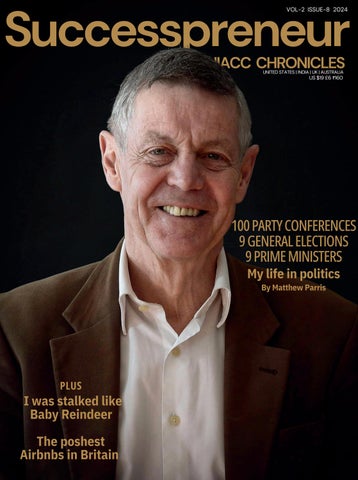
By Matthew Parris
If Lily Allen can make cash from her trotters, why not me? After all, I’m already on WikiFeet
Look, until Labour’s much vaunted “plan for economic growth” kicks in, a girl’s got to hustle how she must to pay that mortgage. And so, when a friend said, “There’s money in feet, women’s feet,
on the internet,” the reply I would have given when interest rates were just 1.4 per cent – “UGH! How disgusting! This is beneath me!” – did not materialise. Instead, I gave a reply that was both thoughtful and mature: “Real talk: the only thing that is actually beneath me is my feet, which aren’t doing much, cashwise, at the moment. So tell me more.”
Last month, Lily Allen opened an OnlyFans account dedicated solely (ha!) to her feet. For those unversed in OnlyFans, it’s a website wherein fans can pay for – and I speak broadly here – titillating content from celebrities who’ve recently had an unexpected VAT bill, and which usually involves lingerie and uncomfortable-looking poses.
Allen, however, wasn’t offering bras, but toes. To meet demand from those “sexually cheered” by feet. “Apparently, my feet are rated quite highly on the internet,” she told her podcast. “I don’t feel like it’s sexual – but how it’s perceived is another thing altogether.” She concluded the matter with the finest logic possible: “Ultimately, it’s just silly and I don’t care.” A subscription to Allen’s contextually ambiguous foot content is £8 a month. Given that she has 1.6 million followers on Instagram, if a mere 1 per cent of them are into her hooves, that’s £1.5 million a year. £1.5 million a year! Just for feet! Basically, the unloved by-product of the whole leg system. It’s like cashback on ankles.
Obviously, this made me wonder: could I monetise my feet too? At first glance, they don’t look like an untapped erotic goldmine – I have flat feet and weak ankles and, as a consequence, have the gait of a penguin. If you think I’m exaggerating, I refer you to the sunny afternoon in 2007 where I was walking down Camden High Street, only to be stopped by a handsome young man.
“Could I take your picture?” he asked. Oh, I thought. Here is my future second husband, so taken with my beauty, he is compelled to capture my fineness on film.
“It’s just,” he continued, as I pouted winningly, “I’m a lecturer in podiatry and you have the most extreme case of overpronation I’ve ever seen. Your ankles simply
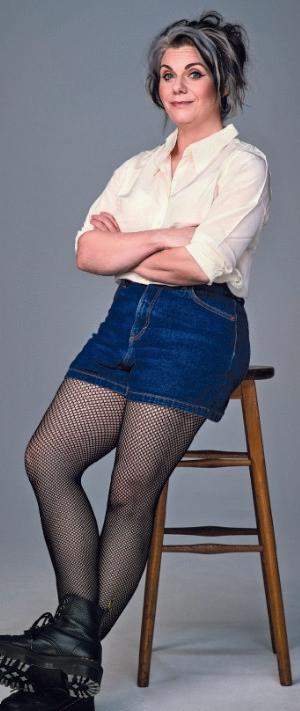
‘Wow,’ I say slowly. ‘Not even fifth wave feminism has made me feel good about my feet. But now perverts have?’
collapse. I need a picture for my students. Doesn’t it hurt terribly when you walk?”
The passage of time has softened the hammer blow to my self-esteem, but I’m still “realistic” about the sexual capital of my trotters. I’ve been in hovercraft-like orthopaedic boots for 20 years – and have to protect the incredibly thin, sensitive skin with extra-thick hiking socks to prevent possible chafing. Oh, the chafing! After ten minutes in a “civilian” sock, I’ve seen strips of foot skin come off that resemble nothing less than wafers of bacon.
What I’m saying is: if someone could be sexually or financially interested in these feet, it would be a miracle on a par with being told that your knackered old Hoover was actually made by Fabergé and collectors the world over are now tense with excitement.
Still, facts: God loves a trier and Halifax Building Society loves charging me every month. So I casually mentioned the whole “feet for cash” thing to my daughter.
“Your feet? Being perved on the internet? Mum, it’s already happened,” she said. “Me and my friends were laughing at it last week. Go on wikifeet.com. You have your own page. People have scored your feet. You have a foot rating.”
Ten seconds later, she was showing me a webpage full of various pictures of me from The Times – in a wetsuit, in heels – all chosen, clearly, because you could see my feet. One of the photos is from a royal wedding shoot, where I am dressed as Kate Middleton and a Prince William lookalike is giving me a pedicure. At the time, it just felt like light-hearted fun. In the context of this website, it now looks like 100 per cent copper-bottomed porn.
“What’s my foot score?” I asked tentatively. I was ready to be crushed. Both life and trained foot professionals have been very “honest” about my podiatric allure.
“Holy hell – you’re four out of five!” my daughter said. “The voting breakdown is that 16 said you were ‘OK’, 14 ‘nice’ – and 13 went for ‘beautiful’.”
There was what I can only describe as “a flabbergasted pause”.
“Wow,” I said slowly. “Not even fifth wave feminism has made me feel good about my feet. But now perverts have? This is a massive challenge to my value system: wikifeet.com has uplifted me more than Germaine Greer. But I guess the ultimate bottom line is: once I remove this verruca, I’m standing on a goldmine.”
FormerfootballerEricCantona,58,grewup in Marseilles, France. He played for Leeds United and Manchester United in the early Nineties, winning five league titles in six years in England. In 1995, he kung-fu kicked a Crystal Palace fan in the crowd and was given community service. Since retiring from football in 1997 he has acted in films and released music. He has four children from two marriages and lives in Lisbon with his second wife, actress RachidaBrakni.
France v England? I’d support England. If I support one country, it’s England. I feel English in terms of football. The passion for the game, the vibes you feel as a player and a fan. I love to feel these vibes when they sing Three Lions. But I do think they could play much better football.
I love the way Spain play. When you are a lover of football like me, you can only like this kind of team and the players they’ve got. I don’t support any team in particular. I support the team who play the best.
I’m pleased the extreme right is not in power in France after the elections. For 25 years, since Jacques Chirac [the former French prime minister], we have voted against extreme right power. But we have to find the real party that people feel close to and want to vote for, instead of just voting against something.
My kids don’t have phones. They are not allowed. They have a computer because they are in an English school and, unfortunately, they have to write on computers. A friend’s son said he liked to write poetry and stories. When I asked, “Are you writing?” he said, “No, my computer is down.” Take a piece of paper and a pen and you can write. They have lost this. Immigration is very important for all countries. Lamine Yamal [the 17-year-old who scored a wonder goal for Spain against France in their Euro 2024 semi-final] is of Moroccan origin. I made a documentary on football and immigration. It’s important. I lost passion for the game. I was still young, 30, when I retired. I didn’t want to watch games. I knew that if I spent too much time in front of the TV watching the game, I would miss it. So I went away from my drug dealer [football].
Sir Alex Ferguson was like a friend. I can only work well with people that I respect and people who respect me. But sometimes they respect me and I cannot respect them because I feel that they are too weak. I need to feel their heart inside, with some emotions, like humility and humanity. I’m a bit nostalgic. So I love classic cars – a legend drives another legend. I remember the time when cars were a lot of colours. Now we see black and dark cars. Every time there is an economic crisis, the first people who are held responsible are immigrants. We see it in many countries
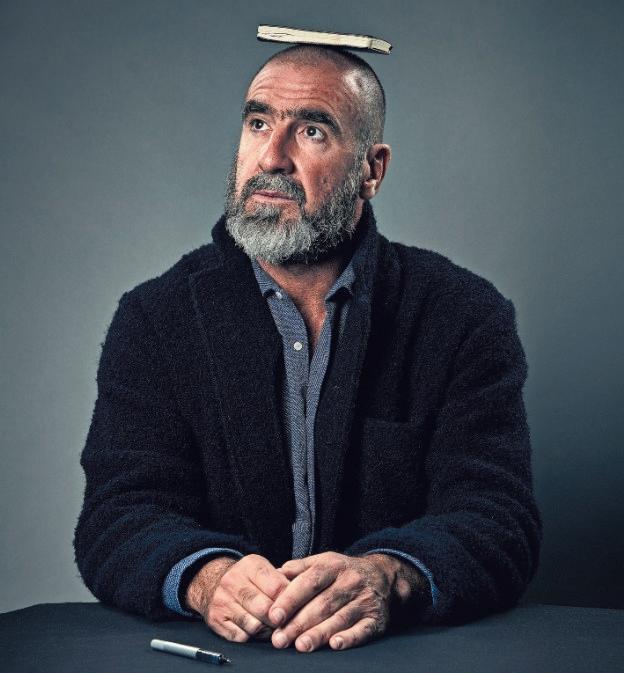
‘If I support one country, it’s England. But I do think they could play much better football’
INTERVIEW Georgina Roberts
now because of the economic crisis. If there wasn’t a crisis in the Twenties, Hitler would never have been elected in 1933. But instead of using history, people reproduce it. I don’t love getting older. But we have to accept it. With more experience, I’m less impulsive, but I’m still a bit impulsive. I feel good. I can still practise sports and I have passions to keep me young. I like to be with young people. Living in the creative world helps me to stay young. Racism in football comes more from the audience than the players. The players are used to playing with people from different origins since they were four years old in a playground. Bellingham and Saka are great players. It’s a new generation. Sometimes you are very good when you are young, but you have to
continue. So for now, of course, they are great players, but a career is very long. Marcel Duchamp was a genius. He had a great vision 100 years ago about how the world works. I’m an art collector. My favourite artists are Antony Gormley, Douglas Gordon and Anish Kapoor. Lisbon is wonderful. It’s a capital, but it’s a small city and you are very quickly outside it. I love to go away from Lisbon, in the south or north, and drive for hours.
I don’t forget the history of my family. I inherited a lot of things from my family; I don’t know what is good and what is bad. But I got this heritage and I’m very proud of it. Sometimes people forget where they come from and their own history. How could I forget? n
Ford has partnered with Eric Cantona for the new all-electric Ford Capri (ford.co.uk/cars/ electric- capri#capri)
‘I’m embarrassed I was rude about Theresa.
Unrepentant about criticising Boris. Ashamed my judgment was clouded about Tony. Unapologetic about admiring Rishi. Don’t get me started on Liz Truss’
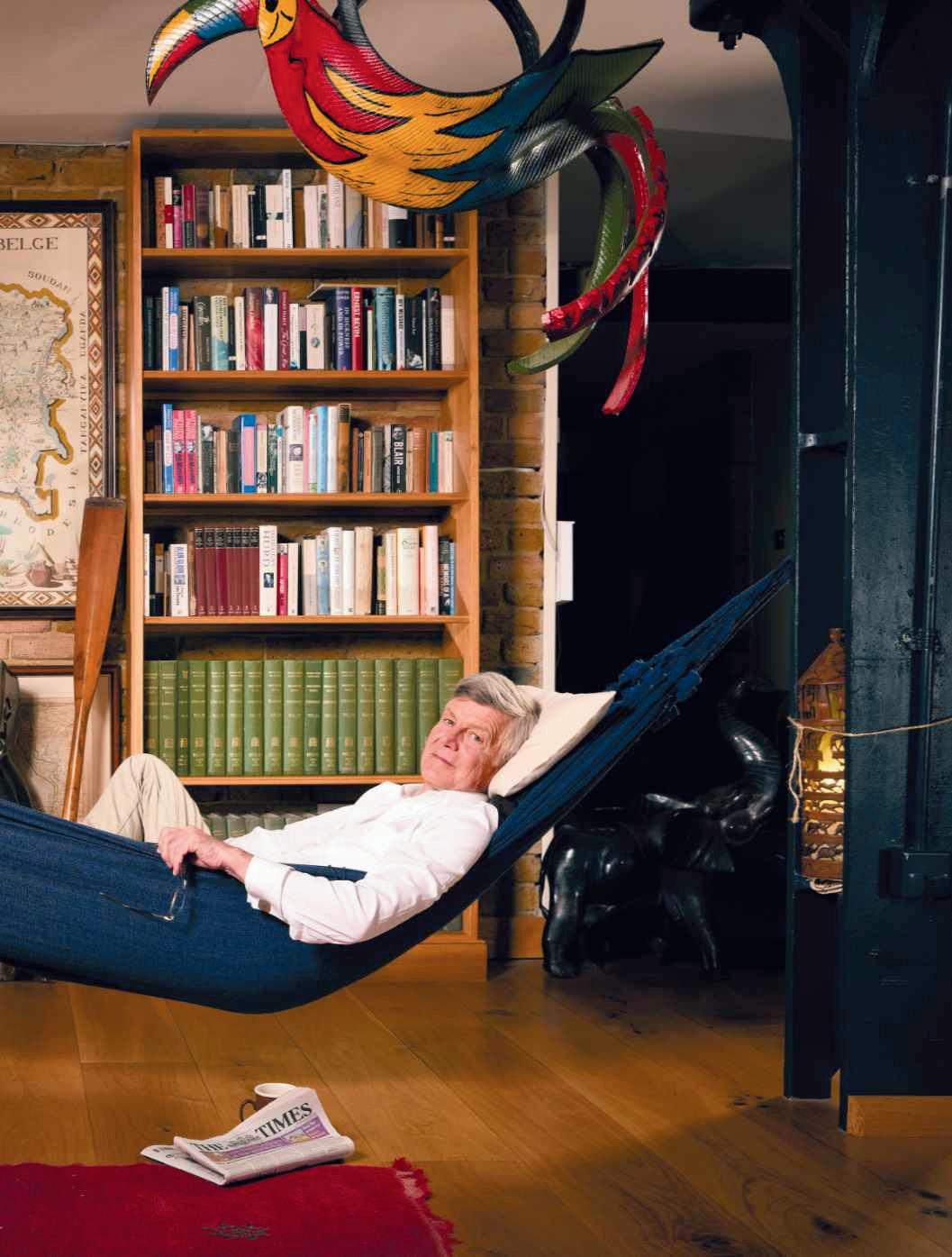
Times columnist Matthew Parris
36 has spent years writing about politics. Regrets? Not many
It was the summer of 1988. The phone rang. Phones really did ring in those days. It was to prove the beginning of a columnist’s career. I was, uncharacteristically, feeling down. At the age of 39 and looking back, I could see only a long series of failures: some gradual, others spectacular.
I’d failed to get an MA at Yale due to too much coffee, Four Roses bourbon, track training to break a five-minute mile and hanging out with interesting people. Returning to Britain, I’d struggled as a trainee diplomat in the Foreign Office and realised diplomacy was not for me. I’d struggled in the Conservative research department: pursuing my own ideas instead of summarising party policy. Next, handling the leader of the opposition’s public mailbag, I let down Mrs Thatcher catastrophically by advising a complaining correspondent to count her blessings (the Labour Party turned my letter into three million election leaflets).
Aged 29, however, I’d got myself a constituency (selecting me on account of my temporary fame for rescuing a drowning dog from the Thames in winter) but, after seven years as an MP, found myself still languishing on the back benches (being gay didn’t help). So I’d chucked it all in to be a TV star: trailed as the new Brian Walden, a star interviewer in his day, on a Sunday morning ITV politics show. And I wasn’t much good at that either. End of programme. And end of me, it seemed. On that forlorn weekday morning in the summer of ’88, as I contemplated the imminent axing of Weekend World, my mind went back to an afternoon at Yale with my fellow postgraduate Peter Ackroyd, always a genius and today a famous writer. “My life’s going nowhere,” I lamented. “What’s wrong with me, Peter?”
A long pause. Ackroyd thought about it. “I can’t tell you,” he said. “It’s too cruel.”
“No, tell me. You must.”
“Too, too cruel. I simply can’t.”
“Please, Peter.”
“No talent, darling.”
Still, there was a glimmer of hope. I’d done some book reviewing for The Sunday Times and, as a politician, penned a handful of columns, mostly about things that stirred my indignation. “Stop Being Beastly to Tatchell”, for The Times, raged about a homophobic by-election campaign against the activist Peter Tatchell. A year later the paper published my lament for Fred Hill, the 74-year-old biker who had died in prison during his 31st sentence for refusing to wear a crash helmet.
After the 1987 fire at King’s Cross London Underground station I’d written an angry appreciation of the gay nurse, Lawrence Newcombe, who died while
With Margaret Thatcher in 1978On
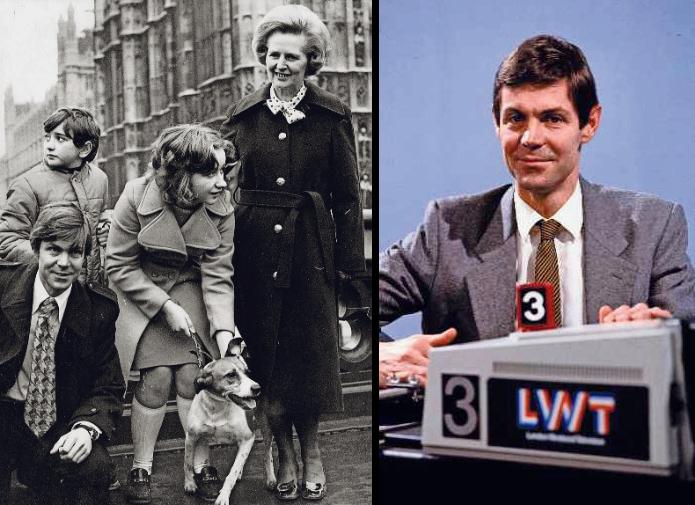
‘My life is going nowhere. What’s wrong with me?’ I asked my friend Peter Ackroyd. ‘No talent, darling,’ he replied
running back repeatedly into the smoke to rescue victims, his own heroism rewarded by a Daily Mail front page about the London Fire Brigade: “Fire-fighting heroes face Aids test after it was revealed last night that a victim carried the deadly virus.”
All these were indignant columns, and indignation comes more easily to the page than quieter analysis or gentler thoughts. But they were my learner slopes, though it had never occurred to me that I could make a career out of it.
It had occurred, however, to the editor of The Times at the time.
This story began with the phone ringing on that morning in 1988. It was the late Charles Wilson. Famous for bawling people out, the editor’s Glaswegian tones were on this occasion softly flattering. Charlie explained that his star columnist, Craig Brown, who’d been writing a brilliant daily parliamentary sketch for the paper, was quitting. So would I take Craig’s place? I heard myself saying yes before I knew that yes was my answer. The paper’s managing editor made contact with a view to a contract.
I said there was no certainty I’d be any good, so better to be a freelancer, then the paper could sack me (or I sack the paper) if it wasn’t working. Bemused, the managing editor offered me a freelance contract and a generous
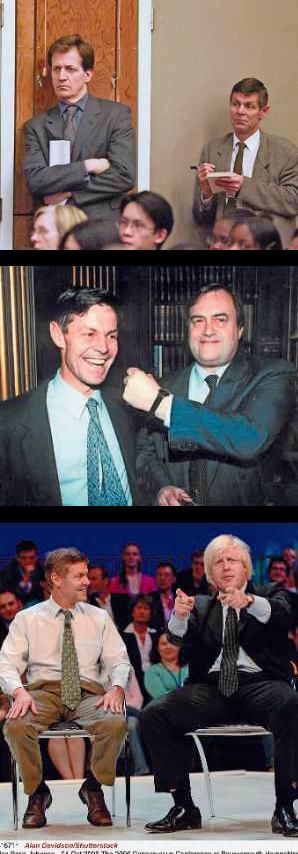
(to me, with a mortgage to pay) fee. And that’s how it remains, 36 years later. No security and a pretty free hand. And despite my fears, the political sketch went well from the start. How couldn’t it? Luck had lent me a behind-the-scenes knowledge of the Commons, the MPs, the chamber, its strange ways. I knew (for example) what that little note being passed along the front bench from a chap in the civil servants’ box to the minister on his or her feet at the dispatch box might say. I knew many of these parliamentarians, their reputations, their weaknesses, their talents and their vanities. My sketch could prick the occasional pomposity of the place and also convey a real respect for the way our representative democracy works, and for the hard work and public-spiritedness of most MPs most of the time. This alloy of impertinence and respect served a Times sketch well.
On my first day, luck sent me to the opening of the 1988 Liberal Party conference, where MPs and delegates spent a whole session debating what their own party’s name should be – utterly absorbed and hilariously self-regarding as they exchanged solemn opinions on nomenclature. My sketch suggested that beyond debating their party’s name, they might debate their own names too. It made a cheeky column. But the following
day’s debate was less interesting – nothing, really, to sketch. At around 5pm, “the desk” called me from our Wapping HQ. Where was my column? “Nothing worth writing about today,” I said. The silence was thunderous. A fundamental truth about journalism was explained to me in a few choice words: there was now a hole in the newspaper where my sketch was supposed to be. Never mind if you have anything to write. Write.
I got the hang. Another early stroke of sketchwriter’s luck was headlined “Bedtime with the Bottomleys”. Mr and Mrs B were both ministers – he for roads, she for national parks. At environment questions, she had described him as “my close and honourable friend”. That was all a sketch needed. Mine took us to the Bottomleys’ marital bed, where in the small hours Peter was suggesting to Virginia that he lay a motorway across her national park. Cheap, yes – but it amused
readers (including the Bottomleys) mightily. And the place is, often unwittingly, such a laugh. I loved teasing, occasionally insulting, sometimes admiring, the strange creatures who inhabit it. MPs have broad shoulders and I only ever had one formal complaint, from a backbencher whom I’d mistaken for another backbencher when reporting the latter’s gaffe. We had to pay him a few hundred pounds, and the coven of national newspapers’ sketchwriters (a daily teatime gathering) resolved to punish the complainant by never mentioning him again. Mostly MPs just want to be mentioned, even in jest. Humorous writing is a hoot and poking fun a glorious duty, so the 13 years of political sketchwriting that followed were a blissful treadmill.
It’s been good to find my sketch followed by a series of sparkling Times political sketchwriters, keeping a splendid media tradition alive – and kicking. As any of them will tell you, the dull days can be the most rewarding. A sentence that sinks a sketchwriter’s heart is, “Gosh, you won’t be short of material for your sketch today.” Big happenings are reports, not sketches. On one of my favourite writing days, there was nothing to write about. It was a hot summer afternoon and both the atmosphere and the debate were stifling. I became transfixed by the Speaker’s battle with her footwear. Betty Boothroyd’s shiny court shoes were too tight and chafing. Seated on her raised throne, she was using the pointed toe of one shoe discreetly to nudge down the heel of the other. Finally, it was off. Then the procedure was reversed. The struggle was riveting and too soon my word limit of 720 was reached.
Occasionally I went too far. I had to apologise to Miss Boothroyd for a sketch that dealt in unnecessary detail with the link (for some politicians) between being on one’s feet and in command of the house, and the engorgement of (in women) nipples and in men (well, you can guess). Sometimes this was visible even from the press gallery.
After a few years of fun, a second column, this one weekly, was added to my repertoire: a more or less wry look at things. If only I could have had £1 for every time I was announced as taking “a wry look at the week’s events”. Had I a daughter or son my career advice would be, “Go, my child, into taking a wry look at the week’s events.” But this went well, and I was enlisted by the Spectator magazine to write a fortnightly column, a sometimes serious, sometimes sideways glance at the world.
Sideways glances came thick and fast, but for me the real honour was to be asked, almost 30 years ago, to write a proper, prominent column for The Times. Within a few years this moved to the Saturday paper: an even greater honour.
A little wistfully I dropped the parliamentary sketch. Not at first sure of being up to maintaining serious commentary on so regular a basis, I grew more confident –perhaps arrogant. But I hope to have kept the standard up, trying to write often enough about politics but broadening the scope.
Looking back, I’ve sometimes been right and sometimes wrong, but tried always to be stimulating and thoughtful. I’m proud to have shown a higher regard for John Major than his era accorded him; proud to have seen early how Iain Duncan Smith’s brand of Conservatism would poison the party; ashamed to have allowed my Toryism (and Iraq) to cloud my judgment of Tony Blair’s great strengths; pleased to have supported David Cameron’s coalition government; embarrassed to have been so rude about Theresa May; unrepentant about my very early rumbling of Boris Johnson; amused that it was even necessary to give Times readers early warning about Liz Truss’s unsuitability; and (still) unapologetic about my admiration for Rishi Sunak’s steadying of the ship of state.
Let me, then, tackle a few frequently asked questions.
“What’s the key to a successful column?” Apparently a columnist I much admire, Sir Simon Jenkins, was once asked this question by a young hopeful. Simon took some time to think about this. Finally: “Avoid the use of the word ‘it’.” I hope I can expand somewhat on this bleak instruction.
Column writing is a trade, not an art or profession: more like bricklaying than composing a symphony. It (sorry, Simon) comes with practice, with advice, with getting it wrong and seeing how you got it wrong and putting it right; not a casting of the eyes heavenward and waiting for your muse. So don’t hang around waiting for anything as fancy as an idea – these often arrive only after you’ve got going. If you already have a strong idea, that’s great; but it doesn’t always happen. In the meantime, the first requirement is to get some words onto the page. You’ve a deadline to meet and, anyway, the argument tends to form itself as you go along. Much (and not only in column writing) comes unbidden from the unconscious. Trying to concentrate the conscious mind on “having an idea” can be stultifying.
Brew yourself a mug of coffee, take a deep breath, type “[BEGINS]” and start. Launch into a founding paragraph as you might lay the first line of bricks. Pause. Take a swig of coffee. Stand back and see if it looks OK. Tweak a bit here and a bit there. Read it out loud, as it were, in your head. And a sense of what should follow will often come. Sometimes you’ll abandon the beginning anyway when you reach






















the end: you realise you were only clearing your throat. A besetting sin of column writing is getting bogged down in the first few sentences. Just jump in, plough on and look back later.
“Do you have any tips as to style?” No. It’s personal, individual and each of us is different. But for myself I like to write for the stage, so to speak: I want it to sound natural if read aloud, and I do read aloud to myself. It’s surprising how, when you speak it rather than write it, the next sentence suggests itself.
“How about humour?” Here’s a warning. Irony and sarcasm are dangerous in written, as opposed to spoken, English. Readers often don’t get it, and it’s easier by voice than in cold print to indicate when you’re joking. I got into terrible trouble once, in one of my occasional diatribes against antisocial cyclists, by suggesting piano wire. It was a joke. Get it? J-O-K-E. But it went right up to the Press Complaints Commission, the complaint finally being rejected only because (said the Commission) cyclists were not a protected or ethnic minority. The debacle is still in my Wikipedia entry.
“Do you get much proprietorial or editorial interference in what you
I have never once, in all my time at this paper, had any indication that the proprietor wishes me to write or not to write anything at all. Nor has any editor of The Times (and I’ve worked under eight) ever instructed me to express or not to express any opinion. The closest I ever came to being steered was about 20 years ago, after I’d submitted a column describing an evening at the White Swan gay pub in east London, and distinguished male stripping, basically “Get ’em off!”, from female stripping, which can be a dance, even an erotic art. My comment editor rang me. “Look,” he said, “Mr Murdoch is in town this weekend, and he really, really doesn’t like this kind of thing. Could we run it next week instead?” If that’s editorial interference, I can take it.
“Does your own Toryism get in the way of straight commentary?” Yes. My inclinations are liberal conservative. They do surface. I don’t try to suppress them. They affect my attitudes to issues and to people in the news. I console myself that a great national newspaper is quite unlike the BBC, which must strive for neutrality. Columnists’ opinions appear in a section entitled “opinion”. A paper like ours wants different perspectives, and readers soon realise where a writer is coming from.
“Has our politics changed over your past half-century?” Yes. A kind of rancour, a curdled quality, has entered 21st-century British politics. There is less give and take. Politics was always boisterous, pugilistic, always rather Punch and Judy, always yahboo-sucks. It was also always very personal, with insults traded. But in
I
former times, as in the old days of the Cold War when two great blocs were in permanent contention, Labour and the Tories each knew where they were and who they were and the divide between them was clear. The battle could be quite cheerful, however robust, and had a kind of simplicity. Now a nastiness has crept in, an anger – especially on the Conservative side and especially within it. Europe, I’m afraid, pulled a trigger. I do wonder whether that souring can ever be reversed.
“Where today are the great men and women, the politicians with stature, the giants, that the older among us
I hesitate to endorse that view, though it’s very widely expressed. An increasingly aggressive news media, and more recently the arrival of social media, pulls people down, and I wonder whether we’d allow any important political figure to acquire the kind of dignity our statesmen and women used to have. I fear we’d call it pomposity. “Stature” and “giant” are two-way streets: deference on the part of the audience, authority on the part of the senior politician. As a man or woman in politics gains confidence, their audience respond with respect; but the respect bolsters the confidence. Today we have less inclination to respect, and this constricts our politicians’ ability to grow.
“Has column writing changed?” In many respects, no, not much in more than a century. It has become a set form. But there’s one newly intrusive element owed, I think, to the rise of social media. I call it “reading the room”. In online comments beneath newspaper columns these days, one often encounters readers who say, in so many words, “Look how many people disagree with you”; “Uh oh, you haven’t read the room”. There’s a stronger impetus among columnists to ask ourselves what most people think and take care not to overstep those invisible marks. That’s a pity. As I always say, sod the room. We should not be dismayed to get more “dislikes” than “likes”: both show we have our readers’ attention.
“Do you get upset or hurt when readers call you names online?” Absolutely not. I love a scrap. I enjoy giving as good as I get, and have often had my own online responses “moderated” (ie removed) when I’ve insulted an insulting reader back. But many columnists do become depressed at personal attacks, and I think women are more averse to verbal fistfights than their male counterparts. As for me, sock it to them!
“What, for you, is the ideal length of a newspaper column?” Mate, I’m just the
hired help. I couldn’t edit so much as a parish magazine. My bosses give me a slot, a space on a page, and my job is to fill it before deadline. I can do 300 words, 800 words, 1,000 or 3,000, according to my brief. But the length of a column does determine its shape, its nature. It’s hard to be thoughtful, relaxed, in a 300-word commentary. It’s hard to be punchy for 3,000 words. Mostly my columns have been from 700 to 1,100 words, and I confess that as I type, a sort of “ping” sounds in my brain as the limit is neared. Maybe our trade inclines us not only to write but to think in bite-sized chunks for butterfly minds. Tant pis. If you can’t make an argument in 1,000 words then you should ask yourself if there’s much point in trying. Luther managed it.
“Is there much to and fro with your editors?” Ideally not. I’ve been blessed with more than a dozen comment editors over the years, all skilful, and the key – which a good editor always gets – is mostly to stand back but to intervene occasionally and strategically, particularly at the outset. More often than not a good intervention takes the form of a question: “How would you answer the objection that…?” A good editor can cause you to reflect (as I often do) on the flaws in your argument. We all hate being asked at 9am what we’re planning to say –but boy, do we need it. Sub-editors too – the professionals who “sub” what we call “copy” after it is “filed” – are desperately important. The Times has brilliant subs, who have saved me from the most appalling errors over the years.
“Does a columnist write the headline?”
No, nor should we. The sub does. They’re better at it. Our own attempts would be lengthy, lugubrious, full of cautious qualifications and unreadable.
Thirty-six years with The Times is a long time: after 9 prime ministers, nearly 100 party conferences and 9 general elections, it all begins to blur. I’ll be carrying on now with the Wednesday notebooks and a monthly column that can stray more often and more widely beyond politics. But that’s for tomorrow. Never look back. Old columns are wrapping paper. Hopefully, the wind of the times once filled their sails, but without that wind the sails flap idly and it all seems so… trivial.
Finally, this: never, never worry about whether in the event you were right. You’ll never type a word if you worry about that. Just take a view, take a deep breath and pile in.
And – hey! – what a ride.