w f r t e ,
d ” e n e a g .
*noise complaints*
Issue 23
Volume CXVI
S
THE
TUTE
HAPPY PRIDE DAY!
/StevensTheStute
@TheStute
WE WRITE STEVENS HISTORY
Friday, April 26, 2019
/TheStute
The Stute The official newspaper of Stevens Institute of Technology, and creator of the Stevens mascot, Atilla the Duck. The Stute Online Subscriptions You can get a PDF of The Stute sent to your email every Friday, free. Never miss a bit of news. Visit thestute.com/subscribe Established 1904
TheStute.com
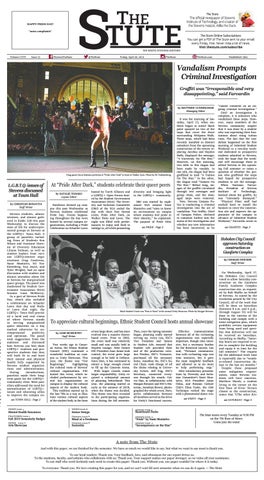
Vandalism Prompts Criminal Investigation Graffiti was “irresponsible and very dissappointing,” said Farvardin by MATTHEW CUNNINGHAM Managing Editor
Drag queen Sucia Bottoms performs at “Pride After Dark” in front of Walker Gym. Photo by Eli Trakhtenberg.
L.G.B.T.Q. issues of
Stevens discussed at Town Hall by CHRISTIAN BONAVITA Staff Writer
Stevens students, administrators, and alumni gathered in Kidde 228 this past Wednesday to discuss the state of life for underrepresented groups at Stevens at the LGBTQ+ Town Hall. A group of panelists including Dean of Students Ken Nilsen and Assistant Director of Diversity Education Liliana Delman, as well as student leaders from various LGBTQ-interest organizations (Ang Contreras, Nasir Montalvo, Eli Trakhtenberg, Izzy Joyce, and Tyler Wright), had an open discussion with student and alumni attendees about life at Stevens for marginalized queer groups. The panel was moderated by Student Government Association (SGA) Senator Liam McMurtry. As a part of Stevens Pride Day, which also included a celebrations on Schaefer Lawn that day and Walker Lawn that night, the LGBTQ+ Town Hall provided a lucid and real vision of where Stevens stands in serving marginalized queer identities on a day marked otherwise by uncompromised positivity and optimism. The panel took suggestions from the audience and discussed how Stevens can best show LGBTQ+ students and prospective students that they will both fit in and have their mental and physical health fully supported by Stevens student organizations and administration. During introductions, panelists made their longterm goals for the LGBTQ+ community clear. Most panelists addressed the need for normalization of LGBTQ+ issues and educating allies to improve the campus ensee TOWN HALL · Page 2
NEWS page
At “Pride After Dark,” students celebrate their queer peers hosted by Torch Alliance and a LGBTQ+ Open Forum hosted by the Student Government Association (SGA). The Diversity and Inclusion Committee (D&I) of the SGA ended the day with their first formal event, Pride After Dark, on Walker Patio and Lawn. The night was filled with performances to enjoy and food to indulge in, all while promoting
by NATALIE TODARO Layout Editor
Rainbows dressed up campus this past Wednesday as Stevens students celebrated Pride Day. Events happening throughout the day were hosted by several campus organizations, including a Pride Celebration on Schaefer Lawn
D&I was started by sophomore SGA senator Nasir Montalvo and “aims to foster an environment on campus where students feel pride in their identity,” he explained. The purpose of Pride After see PRIDE · Page 3
by CHARLES ZWICKER Staff Writer
Black Student Union was “Best in Show” at the annual Unity Showcase. Photo by Morgan Brenner.
To appreciate cultural beginnings, Ethnic Student Council hosts annual showcase of one large show, and has since evolved into a massive themebased event. Prior to 2002, the event itself was relatively small and was usually held in Hayden Lounge. After former ESC President Juan Jaime took control, the event grew large enough to be held in DeBaun. Since then, it has continued to attract a large enough crowd to fill up the Canavan Arena. With larger crowds comes larger responsibility. Unity required a substantial amount of planning beforehand. This year, the planning started as early as the summer of 2018, when the theme was decided. This theme was then revealed to the participating organizations during the fall semester.
by LIAM MCMURTRY Staff Writer
Two weeks ago in Canavan Arena, the Ethnic Student Council (ESC) continued a wonderful tradition on campus — Unity Showcase. This year, the theme was “Our Beginnings,” highlighting the cultural roots of Stevens’ cultural organizations. ESC hosted this event, which included performances by several key organizations on campus to display the cultural aspects of the student body. This tradition started up in the late ’90s as a way to illustrate various cultural aspects of the student body in the form
Then, once the Spring semester began, planning really started revving up. Avery Lau, ESC’s Vice President and liaison to Student Life, ensured that Student Life provided their end of the production crew. Jon Pendon, ESC’s Treasurer, purchased all the necessary items. Jonathan Ho, ESC’s Social Chair, took charge of all the duties relating to University Events. Jeff Ung, ESC’s Secretary, connected everyone through his emails. Calvin Han, in collaboration with Morgan Brenner and ESC’s Historian, Jonathan Brown, photographed the whole event. Here, active collaboration between all members served as the drive for Unity’s functional success.
Senior Design
opinion page
9
Fall 2019 Semesterly Budget
Opinion page
Mind of a Freshman
8
opinion page
11
NEWS page
Opinion page
8
opinion page
11
Mental Health Resources FEATURES page 6
Arts Showcase
5
see GRAFFITI · Page 3
Hoboken City Council approves Saturday construction on Gianforte Complex
NEWS page 6
4
diversity and bringing light to the LGBTQ+ community.
It was the morning of Saturday, April 13, when students began to notice black paint sprayed on two of the tarps that cover the fence surrounding Wittpenn Walk. These tarps, which had been recently installed to distract onlookers from the upcoming construction of the towers replacing Jacobus and Hayden Halls, displayed the message: “A University On The Rise.” However, on this morning, two edits to this slogan had been made by vandals. In one edit, the slogan had been graffitied to read “A Tuition On The Rise.” In the other, the slogan read “Gamers On The Rise.” Before long, images of the graffiti circulated through text messages and group chats, and the damaged tarps were removed. Now, Stevens Campus Police is conducting a criminal investigation into the act of vandalism. Tim Griffin, Chief of Campus Police, declined to comment further into the status of the investigation and whether any new information has been uncovered, as he
“cannot comment on an ongoing criminal investigation.” Until an investigation is complete, it is unknown who vandalized these tarps. However, many members of the Stevens community suspect that it was done by a student who was expressing their frustrations about rising tuition costs. The fact that the vandalism happened on the first morning of Admitted Student Weekend — a two-day weekend dedicated to prospective students admitted to Stevens, with the hope that the weekend will encourage them to attend Stevens in the upcoming Fall semester — raises a question of whether the person who graffitied the tarps had hoped for prospective students to see the message. When Nariman Farvardin, President of Stevens Institute of Technology, learned about the graffiti, he was “extremely dismayed.” “Physical Plant staff had worked hard to install the banners to cover the construction site and improve the appearance of the campus in advance of Admitted Student Weekend,” Farvardin wrote in
Senioritis
Skateboard Decks “Pride” by Nasir Montalvo “Incompetence on the Rise”
Effective communication between all of the co-hosting organizations was especially important, though time intensive, but a necessary burden for the theatrical success. Lau said, “Personal communication with co-hosting orgs was time intensive, but it gave the most insightful feedback and allowed us to do more to help performing orgs.” After introductory presentations by Diversity and Inclusion Committee’s Nasir Montalvo, SGA President Jason Chlus, and Russian Culture Club’s Elina Tuder, the club Technique rocked the stage with a phenomenal dance rousee UNITY · Page 4
On Wednesday, April 17, the Hoboken City Council voted to allow Saturday construction on the Gianforte Family Academic Complex construction site, as requested by Bob Maffia on behalf of Stevens. As stated by the resolution passed by the City Council, all of the work that will be done on Saturdays (between 8 a.m. and 6 p.m., through August 31) will be done to the interior of the building and comply with a noise mitigation plan, which prohibits certain equipment from being used and specifies that deliveries will not be received on Saturdays. According to Maffia, “Saturday hours are required in order to complete the building and equip it in time for the fall semester.” The request for the additional work time is reportedly due to “weather-related construction delays in the last six months.” Despite these proposed noise mitigation requirements, some Stevens students still have concerns. Matthew Marsh, a student living in the corner on the first floor of River Terrace closest to the construction, states that “[The other Rivsee SATURDAY · Page 4
The Stute meets every Tuesday at 9:30 PM on the 7th floor of Howe. Come join the team!
A note from The Stute And with this paper, we are finished for the semester. We have so much we would like to say, but what we want to say most is thank you. To our loyal readers: Thank you. Your feedback, love, and ethusiasm for our report drives us. To the students, faculty, and admins who collaborate with us: Thank you. Your support makes our paper stronger, so we value all your assistance. To our staff who work tirelessly each week to create this paper: Thank you. Without you, our paper wouldn’t be where it is today. To everyone: Thank you. We love creating this paper for you, and we can’t wait till next semester when we can do it again. -- The Stute
STUTE THE
We write Stevens history.
The student-run newspaper of Stevens Institute of Technology since 1904
116th Volume
Executive Board Editor-in-Chief Business Manager Managing Editor Outreach Chair Layout Editor
Audrey Dsouza Mark Krupinski Matthew Cunningham Joseph Dolan Natalie Todaro
Editorial Board Senior Copy Editor Head Photographer Systems Administrator Social Media Coordinator Webmaster Archivist
Angelina Zaccaria Cole Yarbrough Matthew Doto Elina Tuder Andrew Kinney Maryia Spirydonava
Staff & Contributors Alex Murtagh Alyaa Elkhafif Christian Bonavita Dakota Van Deursen Daniel Kang Divya Unnam Elena Malova Eric Londres Koby Garcia
John Horgan Mathew Green Namankita Rana Off Center Sarah Hoogenboom Wei Zheng
Contact Us Office Phone Email Office Location General Body Meetings Advertising Inquiries Mailing Address
(201) 216-3404 eboard@thestute.com Howe Center, 7th Floor Tuesdays at 9:30 p.m. business@thestute.com 1 Castle Point Terrace, The Stute, Hoboken, NJ 07030
Letter to the Editor Policies Letters may not exceed 500 words in length and must be fully attributed with name and title (non-attributed letters will be considered on a case-by-case basis, but the author’s identity must be made known to the Editor-In-Chief). All letters must be emailed to eboard@thestute.com. The Stute reserves the right to not publish any letter submitted for publication. The opinions in letters sent to The Stute with the request to be published are the sole opinions of their author(s) and do not reflect the views and opinions of any member or person involved in the making of The Stute. These opinions are not endorsed by The Stute and the content of all letters are printed in their original, unedited form. A disclaimer will accompany any letter that is published in The Stute stating this information.
Corrections & Clarifications For corrections and clarifications in any of our issues, please email eboard@thestute.com
Disclaimer All opinions, stories and editorials reflect the views of their respective author(s). The Stute reserves the right to edit all letters and articles submitted for publication for clarity and factual accuracy, or not publish them. No part of The Stute may be reproduced in any form, in whole or in part, without the written consent of the Editor-inChief. Cited references of The Stute are permitted.
News
Friday, April 26, 2019 • Page 2
TOWN HALL Continued from front page
vironment. Trakhtenberg, Vice President-Elect of Torch Alliance and founder of new organization Sexual Wellness Education Activism and Training (SWEAT), began this line of discussion by mentioning the need for more visibility and social integration of LGBTQ+ organizations on campus, specifically through cohosting with non-LGBTQ+-focused organizations. Joyce, President of Torch Alliance, echoed this and mentioned the success of Pride Day, an event that Torch cohosted with 10 other organizations, including TranSIT and Lore-El Center for Women’s Leadership. Nilsen agreed, adding that this environment is a necessity because it gives students a place where they can “just be” without presenting themselves in a way aligned with others’ perceptions. All panelists expressed that Stevens could work on this issue but is heading in the right direction. One subset of issues addressed involved necessities for LGBTQ+ students attending Stevens. Under this subset, the panel and attendees discussed the availability of gender-neutral housing and systems of changing names within the Stevens system. With both issues, all present came to the consensus that while these resources are available, hurdles blocking these resources exist too often. Wright, founder of TranSIT, began the discussion by pointing out that documentation for accessing gender-neutral housing is difficult to find, and many don’t know it exists. Joyce echoed this with another hurdle: until very recently, in order to live in gender-neutral housing, one needed fill an entire unit oneself rather than a roommate system similar to non-gender-neutral housing. Trakhtenberg agreed and pointed this out as an issue potentially blocking prospective students from feeling comfortable living
Liliana Delman, Assistant Director of Diversity Education, speaks at the LGBTQ+ Town Hall. | Photo by Matthew Cunningham
at Stevens. Nilsen closed the discussion by addressing the reasons for some of these issues and his distaste for them, and reminded students that the administration is working on the issues. Nilsen often acted as a grounding force for discussion, reminding students of the limitations of college administrations with keeping up with the increasing pace of change in LGBTQ+ issues. However, it was clear that these issues were near to his heart and constantly on his mind, as he appeared wellread on research as well the actions of other universities. He described himself as “in it for the long run,” having served in the Stevens administration for 25 years of rapid change, and committed to learning more about the perspectives of students, since “being LGBTQ+ isn’t the same for everyone.” Another subset of issues handled was the creation of allyship within the Stevens community, leading to discussions of the state of Greek Life and the SGA with regard to LGBTQ+ issues. Most students on the panel agreed that Greek Life, especially fraternities, contributes to heteronormativity, and that inclusivity is the exception, rather than the rule. One alum mentioned that tackling this issue should not pit groups against one another in an “us vs. them” scenario and that LGBTQ+ students should
first educate themselves on the tenets and values of fraternities to find common ground before reaching out to educate fraternity leaders on LGBTQ+ issues. Delman agreed, stressing the education of Greek leaders and promoting interfraternity mixers that would help combat strict binary structure and use of fraternity events to seek romantic interests. Both Nilsen and Delman also suggested reaching out to national chapters to stress LGBTQ+ education. As for the SGA, the panel agreed that although more LGBTQ+ visibility in the student government would benefit the student body, LGBTQ+ organizations are usually treated equally and fairly when budgeting. However, Dean Nilsen made clear the importance of acknowledging the profound powers that the SGA has to influence the student body, and making sure that LGBTQ+ organizations had equal opportunity while LGBTQ+ students were being supported through subtle actions like SGA senators including their pronouns in emails. The only topic that sparked uproar within the LGBTQ+ Town Hall regarded, of course, the Gianforte Family Academic Center and how its impending opening will residually affect the campus. Nearly an hour of deliberations boiled down to a few major points. The immediate concern expressed
by Wright was that the naming will broadcast the wrong values to incoming students, showing LGBTQ+ prospective students that they are not welcome. Nilsen proposed a way of combating the negative situation by adding a positive, namely mobilizing alumni to donate money towards opening an intercultural center on campus. Trakhtenberg then added to all of this by stating that LGBTQ+ students could subvert the naming by refusing to call the building by its full name. It was clear that this issue still stings the LGBTQ+ community, which will continually adapt to address it. The Town Hall was finally wrapped up by panelists giving closing remarks on the state of LGBTQ+ issues and Stevens. Overall, the panelists were optimistic and happy that the administration and students could have such open conversations. Nilsen and Contreras again mentioned the increasing speed of change in the right direction but recognized that Stevens is only beginning this change. Delman finished the conversation by pointing out that as the school progresses, it will hone its path, making its language clearer and naming its issues more effectively, and she hopes that events like this one will help Stevens progress into the realm of the best schools for LGBTQ+ resources.
Torch hosts their annual Pride Day Photos by WEI ZHENG
Copyright © 2019 The Stute
Top left and right: Members of queer-supporting organizations sit at booths to celebrade Stevens Pride Day. Bottom left: Students mingle and walk around to the various booths at the beginning of the event
News GRAFFITI
Continued from front page
a statement. “Many faculty, staff and students also worked many, many hours to prepare for a successful Admitted Student Weekend. Therefore, it was quite disheartening to see that someone deliberately attempted to mar the welcoming impression we wanted to leave on prospective students and their families at these events. Stevens is building new academic facilities, new student spaces, new residence halls, and making many other improvements with one goal in mind—to make Stevens a better place for students. This act, which went against our core values, was irresponsible and very disappointing.” Sara Klein, Assistant Vice President of Student Affairs, wrote in a statement that she was disappointed to see that someone chose to vandalize the campus. “Of course, every student is entitled to have frustrations,” she added, “but there are more effective and
PRIDE
Continued from front page
Dark was to create a sense of community and expose students to elements of the queer community that are heavily stigmatized. Montalvo says, “Essentially, the event’s goal was to show drag/queer party culture is not a form of degeneracy, but a way to uplift those on the very fringes of society.” Amir Mustafa, the Sexuality Advocate for D&I, views the committee as a “physical manifestation of representation.” He felt it was vital for the SGA to have a specialized committee to push for better representation of marginalized students at Stevens, and Pride After Dark was their way of seeing how students reacted to an event of its nature. In order to ensure Pride After Dark was a success, the D&I Committee went through an intensive planning process. Montalvo worked closely with Eli Trakhtenberg and the Committee’s Advocates over the past month to plan
Friday, April 26, 2019 • Page 3
impactful ways to communicate about frustrations. My door is always open to speak with students about their concerns and to help students find an appropriate way to address their frustrations.” The Division of Student Affairs is working closely with Stevens Campus Police to investigate the incident and identify any students involved, Klein said. “If and when the parties are identified, they will be held accountable for their actions.” Jason Chlus, President of the Student Government Association, wrote in a statement that when he saw the vandalism, he was extremely upset. “I was especially upset because it took place on Admitted Students Weekend,” he wrote. “This weekend can be quite magical for your first experience at Stevens and if a student that was excited to go here saw that, it would have put a really sour taste in their mouth.” Chlus expressed that students who are so upset with the University that they feel
compelled to vandalize property should consider switching to another school before damaging the campus of Stevens. “If you have that big of a problem with this school, I’m sure administrators will sign your transfer forms,” he wrote. “A lot of students I talked to were pretty upset with this action as well, stating that if you don’t like the school, leave.” Farvardin added that Stevens Campus Police and other offices continue to work to keep our campus safe and ensure that vandalism doesn’t happen again. “We have a beautiful campus and are building world-class facilities for our community,” he wrote. “We all have a responsibility to uphold our values and maintain the assets we have worked so hard to build.” Students who witness vandalism may report it through the “Report a Concern” link on myStevens, or they may reach out directly to either Campus Police or to the Director of Community Standards and Title IX Coordinator, Xhiljola Ruci, to make a report.
every detail of the night. The exterior decoration on Davis Lawn and Walker Patio was the main area of planning, featuring a balloon arch and colorful lights. Students were also able to take pictures on Walker Patio in front of streamers and balloons spelling out the word “PRIDE.” In addition to the decorations, the performers were a major part of what made the night successful. Several campus organizations amped up audience members by performing dance routines, including performances by the Black Student Union and Lambda Upsilon Lambda, a Hispanic interest fraternity. The Office of Diversity Education and D&I Committee Advocates were also able to book both a drag queen and drag king for the event. Drag queen Sucia Queen stole the show with her exuberant presence and energetic personality. Working around Manhattan and Brooklyn five nights a week, Sucia is passionate about LGBTQ+ youth and immigration equality. She says,
“I can’t stress enough how important education is.” Sucia started her drag career in 2016 to not only express herself, but also to become an activist when she felt it was one of the only things she could do in light of the recent United States Presidential election. Pride After Dark proved to be a huge success, and the D&I Committee is working on more initiatives to develop the sense of diversity at Stevens. Montalvo is working on the Intercultural Center initiative as well as faculty modules concerning student wellness. An American Sign Language class is in the works of being added to the Stevens course offerings within the College of Arts and Letters, as well as future events in collaboration with the Entertainment Committee. The Office of Diversity Education will also be hosting Safe Zone training events for students, and resources to navigate name, gender, and pronoun changes while students are at Stevens can also be found at the Office of Diversity Education, located on the 10th floor of the Howe Center.
Top: One of the tarp was vandalized and changed to read “A tuition on the rise.” Bottom: Another tarp was later vandalized to read “Gamers on the Rise.
Top: LUL performance, Left: Drag King perfomance, Right: Montalvo speaking to audience. Photos by Eli Trakhtenberg.
Stevens Senior Design Team, DryWorks, in the final round of two national competitions by ELINA TUDER Social Media Coordinator
Throughout their years at Stevens, seniors Rami Kammourh, Ali Hameed, Aldin Llolla, and Mitchell Bollettieri had a plethora of experiences with certain areas of campus flooding. Kammourh recalled that “If you go to the CPH parking lot during a large rainstorm, you’ll notice that it’s a disaster. There’s flooding in the parking lot, ponding in the tennis courts, and the runoff is visibly highly polluted. You’ll also notice some other issues like the concrete channel in front of CPH and parking blocks in the lot being eroded. This is the result of poor engineering practice.” This sentiment, along with Professor Leslie Brunell’s suggestion, led the four seniors to sign up for the senior design project that is a part of the Environmental Protection Agency’s (EPA) 2018 Campus RainWorks Challenge. The project aims to develop a conceptual design for the implementation of green infrastructure prac-
tices for the North Tennis Courts, CPH Parking Lot, and the surrounding area. The team, called “DryWorks,” also seeks to showcase the environmental, economic, and social benefits of green infrastructure practices. Team members Kammourh and Bollettieri are Civil Engineering majors, Llolla is a Computer Engineer, and Hammed is in the Engineering Management program. The team is advised by Professor Brunell in the Department of Civil, Environmental, and Ocean Engineering, and has also been advised by Professors Varma and Sarkar (both CEOE), and Professor Hole in the School of Systems and Enterprises. As described in the project’s official abstract, “the design proposes five green infrastructure features: permeable pavement, a permeable walkway, a vegetative swale, deeper-rooted grass, and green bleachers that will increase infiltration and reduce runoff from a single design storm by approximately 30,000 gallons. Data collected on system perfor-
mance will serve to educate students on the benefits of green infrastructure and support research done by professors. A robust cost/ benefit analysis shows the feasibility of the project by considering possible sources of funding from state funds and alumni donations. Finally, comprehensive maintenance protocols and a risk mitigation strategy were developed to increase the likelihood of implementation.” The abstract also explains that due to the positioning of Stevens’ North Tennis Courts and parking lot at the bottom of a steep hill, stormwater flows downhill and causes ponding and eroded asphalt. This runoff then enters Hoboken’s sewer system, which has a high tendency of overflowing. When overflows occur, Hoboken residents, especially residents who are low-income, elderly, or disabled, report issues relating to health and quality of life. The only future plans that are currently in place for the site are gray infrastructure plans (structures made of concrete), however,
From left to right: Rami Kammourh, Mitchell Bollettieri, Ali Hameed, and Aldin Llolla are the members of the Senior Design Team. Photo courtesy of Rami Kammourh. this would not be the most efficient way to solving the problem. DryWorks’ environmentally-friendly concept hopes to remove the need for the gray infrastructure. Although the EPA’s deadline for project submissions was December 14th, 2018, the team is continuing to expand its design this semester. The project was entered into two competitions: the EPA’s
2018 Campus RainWorks challenge and the 2019 Environmental and Water Resources Institute (EWRI) WSP Student Design Competition. The group made it to the final round of the EPA Competition and is one of the top three teams in the EWRI WSP Competition. The team did not win the EPA competition, but is still in the running for the EWRI WSP
Competition. For the latter competition, the team has been invited to Pittsburgh in May to present their project to a panel of industry experts. The team is proud to have made it to the final rounds of both competitions and hopes that Stevens will acknowledge their ideas as worth implementing given the environmental, social, and economic benefits.
News
Friday, April 26, 2019 • Page 4
Left: The Filipino Association at Stevens Tech (FAST) midway through . Right: The Filipino Association at Stevens Tech (FAST) midway through their performance. Photo by Morgan Brenner.
UNITY
Continued from front page
tine. Following that, the Middle Eastern Student Association gave a sobering yet humorous look at current stereotypes of Arab-Americans. Next, the West Indian Student Organization performed significant moments in the West Indies’ his-
SATURDAY Continued from front page
er residents and I] are really fed up with the constant disruption. The addition of Saturday to the schedule is inconsiderate and unfair to students living literally feet from the site.” Additionally, “The construction workers
tory, starting with the exploits of Christopher Columbus. Afterwards, the Chinese Student Association enacted an ancient story from Chinese mythology. Then, the Black Student Union illustrated the trials and tribulations of African-Americans through a rich and visually stimulating musical dance routine. Next up, the Indian Undergraduate Association
told of India’s independence from British rule through a colorful musical performance mixed with dramatic scenes. Going off this, FAST gave a touching and moving performance of a Filipino family’s involvement in Philippine political tensions. Next, the Korean Student Association gave a dramatic and insightful look at the divergence between North
and South Korea in culture and government. Wrapping it all up, the Cultural Greek Council concluded Unity with vivacious dance routines by Nu Alpha Phi, Lambda Upsilon Lambda, and Omega Phi Beta. Capping it all, the judges determined that the Black Student Union was the winner of “Most Relevant to Theme” and “Best in Show,” followed by
also tend to hang around on the sidewalk just below my window and have loud and sometimes obnoxious conversations.” “My biggest concern regarding upcoming construction is finals,” Marsh continues. “It’s already difficult to work with the ongoing noise […] Taking Saturday away from us is just one more thing we have to deal with in
our already-stressful lives.” Councilman Michael DeFusco stated that “Working with Stevens to meet the needs of a growing student population is a priority for me and my council colleagues,” and that “permitting an exception to the city’s prohibition on weekend construction work was a reasonable request to keep the academic
project moving forward.” Jason Chlus, President of the SGA, stated, “The overall vibe I got was ‘I don’t care if they work during Saturdays, I just want them to be done.’ ” Chlus also mentioned that some of the senators live in River themselves, but they believe that the noise reduction plan will sufficiently keep the noise to a minimum.
FAST for “Most Active,” and the Korean Student Association for “Most Improved.” All in all, the event was another stunning success by the Ethnic Student Council, garnering over 400 students and alumni in attendance, and a string of artfully crafted performances by cultural organizations. Looking forward, the E-board members of ESC hope to in-
corporate smaller cultural organizations on campus even if they do not yet have a strong foothold in the student body by co-hosting events in the fall with them and having them present at the showcase. We can expect the Unity Showcase to be happening many more times in the future on its usual date of the Friday night of Accepted Students Weekend.
The Gianforte Family Academic Center is expected to be open by the Fall 2019 semester. Photo by Alex Murtagh.
Stevens community takes steps to improve mental health resources by Audrey dsouza Editor-In-Chief
Stevens unveiled a Mental Health and Suicide Prevention Plan prior to a three-day weekend on April 10, 2019. In the email addressed to all students, faculty, and staff, Marybeth Murphy, Vice President for Enrollment Management and Student Affairs, explained “some of the initiatives we have undertaken during the past year to support our students and enhance their well-being.” The plan, initially presented at the September 2018 Board of Trustees Summit, was created months after several student suicides in the Spring 2018 semester and contains seven key points of focus which are all currently being worked on by Stevens leadership: promote social connectedness, identify students of risk, increase help-seeking behavior, provide mental and substance abuse services, follow crisis management procedures, restrict access to potentially lethal means, and develop life skills. The chart below shows each key focus and changes/action items in recent semesters associated with them. In the past few semesters, students have been very proactive in advocating for improved mental health resources on campus. “Mental health has always been a focal point for the en-
tire SGA,” explained Jason Chlus, President of the Student Government Association. “Students have been using a number of resources on campus to talk about their mental health, ask advice, or simply express a concern. We, the SGA, believe that this can be improved,” he said. “We have been told by many students that CAPS’s hours are not long enough and don’t allow for enough [counseling] time,” said Chlus. And administrators have responded; several of the changes discussed in this plan can be attributed to the SGA, including advocating for a Wellness Educator and co-hosting the traveling exhibit Send Silence Packing, which took place on Palmer Lawn last fall. Ashley Peck, co-founder and President of the Stevens chapter of Active Minds, helped coordinate Send Silence Packing as well as the inaugural and second Hoboken Out of the Darkness walks. In a November 2018 interview with The Stute about the walk, she expressed that the walk should be a community walk (rather than Stevens only) because “it shows that the entire community supports the cause, and the event is a testament that those that suffer personally or through a loved one are not alone.” Additionally, in response to the plan, she commented via direct message, “This transparency that they are showing has helped
calm the nerves of students, but also gives us room to give feedback on what we think the plan should look like. I definitely think this plan is a huge step in the right direction to bettering the mental health of the Stevens Campus.” Another ongoing initiative of the SGA is a review of the CAPS scheduling system. Elina Tuder, a sophomore Senator explained, “I distributed a survey in November 2018 to get feedback about making appointments for CAPS.” The questions on her form investigated how students were booking appointments, if at all, and if an online scheduling option would increase their willingness to go to CAPS for counseling help. Currently, CAPS is open every day from 9 a.m. to 5 p.m. and offers urgent care hours from 2 p.m. to 4 p.m. daily. On this subject, Murphy stated that currently, she is “evaluating the pros and cons” of such a system. Overall, sometimes it may be challenging to acknowledge or seek help for mental health issues. Murphy explained, “We want to encourage students in distress to seek help. Of course, participation is voluntary, but we are doing everything we can to reach out to students to reduce the stigma of getting help for mental health issues. We need students in distress to feel comfortable acknowledging that they need help
Key Focus
Changes (citing the plan if not otherwise stated)
Social Connectedness
The Office of Residence Life split into two departments, Residential and Dining Services (RDS) and Residential Education (ResEd) last Fall. ResEd’s (at the time new) program director Stacy Flowers explained in an interview with The Stute that ResEd’s purpose is to focus on the student’s residential experience and on what happens inside of dormitory halls. With the division of departments, ResEd aims to create a developmental program for residents as well as offer more support to its staff. Additionally, at that point in time, Flowers was looking into developing more learning communities similar to Lore-El and the CARE House. A new specialized involvement fair was implemented by the Office of Undergraduate Student Life at the start of the spring semester, in attempts to spread more awareness about student organizations and “getting involved” on campus.
Identifying at-risk students
A faculty-focused module about Mental Health was released on Canvas, Stevens’ learning platform. Furthermore, all new faculty meet the staff from counseling and disability services to learn about the wellness resources available at Stevens. There are also presentations for faculty and staff about the warning signs of emotional distress and suicidality held at least twice a year. A presidential task force on mental health is being worked on and membership consisting of administrators, faculty, and students will be finalized by May 1st.
Increasing help-seeking The new Wellness Center brings together four key areas of wellbeing: Health Services, behavior Counseling and Psychological Services, Disability Services and Wellness Education. In a stevens.edu article titled, “A New Center at Stevens Supports a Comprehensive, Holistic Approach to Student Wellness” Dean of Students Ken Nilsen stated that the Wellness Center is looking to have “programs and workshops [that] will range from sleep and nutrition to mindfulness and stress reduction.” There are also free depression and anxiety screenings offered throughout the year in order to “raise awareness and encourage students to visit CAPS,” according to VP Marybeth Murphy. Mental and substance abuse services
A new Wellness Educator, Gabrielle Guider, was hired by Stevens in Fall 2018. In an interview with The Stute, Guider said her role consists of “acting as a case manager for the CARE team, which helps students in crisis, and also evaluating their needs to encourage personal growth and help their academic progress.” Additionally, she’s in charge of planning and implementing health promotion programs and services, including but not limited to workshops and presentations for students. Also, a new part-time drug and alcohol specialist was hired in February.
Follow crisis management procedures
Stevens has an Emergency Operations Plan (EOP) which is reviewed and approved by the Board of Trustees every year and filed with the State of New Jersey. The EOP “establishes the structure within which an effective response to emergency situations can occur while providing for the safety and well-being of students, faculty, and staff,” explained Sara Klein, Assistant Vice President for Student Affairs, and “is the basis on which all other university emergency management plans are built.”
Access to potentially lethal means
Stevens’ Risk and Compliance Steering team have commissioned an environmental scan of Stevens. Results will not be made public due to the sensitive nature of the information.
Developing life skills
Office of Counseling and Psychological Services (CAPS), the Career Center, ResEd and the Academic Support Center (ASC), host a variety of programs and workshops year-round on how to adjust to college, manage stress and plan strategies for success.
and reaching out to CAPS.” For urgent concerns about your own or another student’s well-being, please contact
Campus Police at 201-216-5105 or 201-216-3911. For non-urgent concerns, please contact the Office of Counseling and Psycho-
logical Services (CAPS), located in the Student Wellness Center at 201-216-5177 or the CARE Team at care@stevens.edu.
Delta Phi Epsilon raises $18,600 at Castle Point King by Alyaa Elkhafif Staff Writer
Delta Phi Epsilon (DPhiE) held its annual fundraiser event Castle Point King (CPK) and raised $18,600 for its national philanthropies. Nicolas Nuila, Prince of Sigma Phi Epsilon, won the title of Castle Point King.
This year’s Coordinators of Philanthropy, Juliana Gaitan and MariaCristina Todaro, helped plan and organize CPK and their voted-upon theme was “Y2King!: Early 2000s.” Brothers of various fraternities get together with DPhiE sisters and formed teams, led by two DPhiE dance captains and represented by a prince
from each fraternity. Teams have two months to choreograph, practice, and film their performances by the artist or group of their choice. Awards include Prince of Philanthropy, Castle Point King, and first and second runners up. According to Gaitan, $18,600 was raised for their philanthropies, Anorex-
ia Nervosa and Associated Disorders (ANAD) and the Cystic Fibrosis Foundation (CFF), nearly doubling last year’s fundraised amount. Rami Kammourh, representing Alpha Sigma Phi and winner of “Prince of Philanthropy,” explained that recent alumni and the undergraduate student body are motivated to
raise substantial funds for cystic fibrosis research especially because “Patrick O’Brien, an alum from the class of 2014, lives with cystic fibrosis.” He added that, since Alpha Sigma Phi fundraised the most money, they were allowed to donate a $2,800 sum to Home For Our Troops (HFOT), a national orga-
nization that builds homes for post-9/11 veterans. Delta Phi Epsilon wanted to open the event to the entire Greek community and reached out to cultural Greek organizations, which were unable to join due to logistics. The sorority hopes that next year’s event will be even more inclusive and successful.
Friday, April 26, 2019 • Page 5
Percentage of funding allocated by subcommittee
Fall 2019
100 + student organizations... did yours make the cut?! Org Name
Subcommittee
Art Installations
Arts & Music
AEC
Arts & Music
MMM
Arts & Music
Off Center
Arts & Music
Poetry Club
Arts & Music
RGB
Arts & Music
SDS
Arts & Music
SSS
Arts & Music
TECHnique
Arts & Music
SUMAC
Arts & Music
BSU
Culture
CSA
Culture
ESC
Culture
FAST
Culture
IUA
Culture
KSA
Culture
LAA
Culture
MESA
Culture
PACS
Culture
SIA
Culture
SIC
Culture
WISO
Culture
SCDT
Electronics & Gaming
SGDC
Electronics & Gaming
SRC
Electronics & Gaming
C2GS
Electronics & Gaming
SEC
Electronics & Gaming
Chess
Electronics & Gaming
SCSC
Electronics & Gaming
Poker
Electronics & Gaming
RedShift
Media
SITTV
Media
LINK
Media
The Stute
Media
WCPR
Media
AED
Non-RSO
APO
Non-RSO
CGC
Non-RSO
G&T
Non-RSO
GG
Non-RSO
OXE
Non-RSO
OoO
Non-RSO
Spoon
Non-RSO
Honor
Non-RSO
SUPE
Non-RSO
TBP
Non-RSO
ACS
Professional
AIAA
Professional
AIChE
Professional
ANS
Professional
ASQ
Professional
ASCE
Professional
ASEM
Professional
ASME
Professional
BMES
Professional
IEEE
Professional
NSBE
Professional
PBL
Professional
SASE
Professional
SHPE
Professional
SNAME
Professional
SPS
Professional
SWE
Professional
SEEPS
Professional
SHPC
Professional
SAE
Professional
SWiB
Professional
SWiCS
Professional
SAVE
Professional
Archery
Recreation
Badminton Club
Recreation
Intramural Tennis
Recreation
MASD
Recreation
Ski & Snowboard Club
Recreation
CAM
Recreation
Running Club
Recreation
MECA
Religious & Faith Based
NCA
Religious & Faith Based
SCF
Religious & Faith Based
Hillel
Religious & Faith Based
CAC
Service
EWB
Service
Habitat
Service
THON
Service
Active Minds
Special Interests
AI
Special Interests
Anime
Special Interests
AE
Special Interests
CDS
Special Interests
CR
Special Interests
CSU
Special Interests
FAME
Special Interests
Torch
Special Interests
TSA
Special Interests
Total
hi hi hi
Requested Amount
Amount Remaining after Subjective Cuts Percent Change vs S19
($ ($ ($ ($ ($ ($ ($ ($ ($ ($ ($ ($ ($ ($ ($ ($ ($ ($ ($ ($ ($ ($ ($ ($ ($ ($ ($ ($ ($ ($ ($ ($ ($ ($ ($ ($ ($ ($ ($ ($ ($ ($ ($ ($ ($ ($ ($ ($ ($ ($ ($ ($ ($ ($ ($ ($ ($ ($ ($ ($ ($ ($ ($ ($ ($ ($ ($ ($ ($ ($ ($ ($ ($ ($ ($ ($ ($ ($ ($ ($ ($ ($ ($ ($ ($ ($ ($ ($ ($ ($ ($ ($ ($ ($ ($
($ ($ ($ ($ ($ ($ ($ ($ ($ ($ ($ ($ ($ ($ ($ ($ ($ ($ ($ ($ ($ ($ ($ ($ ($ ($ ($ ($ ($ ($ ($ ($ ($ ($ ($ ($ ($ ($ ($ ($ ($ ($ ($ ($ ($ ($ ($ ($ ($ ($ ($ ($ ($ ($ ($ ($ ($ ($ ($ ($ ($ ($ ($ ($ ($ ($ ($ ($ ($ ($ ($ ($ ($ ($ ($ ($ ($ ($ ($ ($ ($ ($ ($ ($ ($ ($ ($ ($ ($ ($ ($ ($ ($ ($ ($
next semester,
1,945.00) 6,968.10) 100.00) 4,482.00) 900.00) 2,588.85) 24,450.00) 8,370.00) 465.00) 8,050.00) 8,022.40) 9,053.00) 15,505.00) 9,387.00) 11,625.00) 9,750.00) 9,600.00) 2,515.00) 1,900.00) 2,315.00) 1,745.00) 1,000.00) 113.16) 2,275.00) 6,742.69) 12,100.00) 950.00) 1,700.00) 1,033.25) 2,030.22) 1,450.00) 6,792.86) 51,000.00) 27,850.00) 7,600.00) 1,079.50) 1,170.00) 1,070.00) 866.32) 200.00) 86.72) 440.00) 1,037.00) 1,125.00) 83.00) 346.00) 1,639.93) 790.00) 3,284.43) 3,400.00) 998.00) 1,600.00) 250.00) 21,516.57) 3,645.70) 3,999.99) 2,655.00) 1,391.05) 10,120.00) 5,400.00) 2,100.00) 2,450.00) 5,005.90) 1,992.00) 971.38) 8,664.74) 800.00) 955.00) 3,458.00) 1,175.00) 397.10) 548.82) 992.00) 10,000.00) 6,940.00) 1,520.00) 700.00) 2,659.00) 998.83) 1,940.00) 1,305.00) 1,065.00) 1,050.00) 1,300.00) - ) 1,982.75) 1,630.00) 1,000.00) 515.00) 800.00) 2,085.00) 350.00) 3,427.00) 1,650.00) 402,995.26)
make sure
1,945.00) 5,768.10) 100.00) 4,342.00) 900.00) 2,423.85) 22,450.00) 8,037.50) 365.00) 3,550.00) 6,245.00) 8,353.00) 10,780.00) 8,988.00) 10,675.00) 9,205.00) 9,500.00) 1,665.00) - ) 2,115.00) 1,070.00) 750.00) 103.16) 2,175.00) 6,742.69) 5,810.00) 874.00) 1,400.00) 1,033.25) 1,155.00) 1,450.00) 3,950.33) 51,000.00) 27,800.00) 6,800.00) 887.00) 1,170.00) 800.00) 866.32) - ) 86.72) 440.00) 749.50) 625.00) - ) 173.00) 1,639.93) 739.00) 2,535.65) 1,150.00) 585.00) 1,225.00) 250.00) 19,365.21) 3,612.35) 3,975.00) 2,655.00) 1,391.05) 8,680.00) 5,000.00) 1,600.00) 1,650.00) 5,005.90) 1,842.00) 971.38) 8,664.74) 800.00) 955.00) 2,858.00) 875.00) 397.10) 548.82) 898.00) 10,000.00) 6,940.00) 1,520.00) 700.00) 2,659.00) 898.83) 1,885.00) 1,225.00) 1,065.00) 1,050.00) 1,300.00) - ) 1,384.53) 1,630.00) 1,000.00) 515.00) 750.00) 1,125.00) 350.00) 2,642.00) 1,575.00) 355,401.91)
-6.71% 74.59% -93.65% 9.29% 0.00% 140.50% -8.24% -5.99% -35.96% -24.47% 101.45% -8.06% -50.21% 35.18% 30.58% 0.19% 78.24% -31.34% -100.00% 4.44% -66.56% -25.00% did not request S18 -5.23% did not request S18 1.48% 40.97% -15.81% -1.47% -20.81% 269.90% -37.22% 2.57% 10.93% 6700.00% 248.18% $0 approved S18 did not request S18 $0 approved S18 did not request S18 -24.95% did not request S18 did not request S18 25.00% did not request S18 did not request S18 -41.28% 34.36% -20.38% -74.16% -33.14% -58.19% did not request S18 31.36% 6.00% 0.63% 56.18% 103.07% 41.81% -18.03% 220.00% did not request S18 83.03% 2.33% -5.69% 5.01% -15.79% -40.31% -43.96% -26.47% did not request S18 did not request S18 -9.48% did not request S18 0.22% 8.57% -39.13% did not request S18 did not request S18 27.36% 13.43% -26.65% -54.35% -73.74% -100.00% did not request S18 0.00% 0.00% did not request S18 -34.78% 89.87% -46.81% -10.63% 142.31%
you join
Spring 2019
($ 2,085.00) ($ 3,303.79) ($ 1,575.00) ($ 3,973.00) ($ 900.00) ($ 1,007.84) ($ 24,466.00) ($ 8,550.00) ($ 570.00) ($ 4,700.00) ($ 3,100.00) ($ 9,085.50) ($ 21,650.00) ($ 6,649.00) ($ 8,175.00) ($ 9,187.50) ($ 5,330.00) ($ 2,425.00) ($ 2,200.00) ($ 2,025.00) ($ 3,200.00) ($ 1,000.00) ($
2,295.00)
The semesterly budgets are decided ($ budget 5,725.00) committee and by the SGA ($ 620.00) Committee on Student Interests
($ 1,663.00) ($ 1,048.63) ($ 1,458.57) Budget Committee ($ 392.00) Jimmy Sweeney ($ 6,292.12) Joesph Insalaco ($ 49,720.00) ($ 25,060.00) Liam McMurtry Mark Krupinski($ 100.00) ($ 254.75)
Olivia Lew Victoria Agaliotis
Elena Malova (VPF) ($ 115.55) Nina Ioanis (VPSI) ($
500.00)
($ ($ ($ ($ ($ ($
2,792.67) 550.00) 3,184.84) 4,450.00) 875.00) 2,929.65)
CSI Mat Green Monica Traupman Allyson Clark Ashley Peck Daniella Magcalas Dante Volpe Fernando Hernandez Morgan Brenner Sam Conte Christina Trinidad
Stevens Dining will accomodate students fasting during Ramadan worked to find meal accommoda-
by SARAH HOOGENBOOM ($ 14,742.05) tions for Stevens students on the Staff Writer ($ 3,407.98) meal plan who observe Ramadan. ($ 3,950.00) Without accommodations, many stuThis year, Ramadan will from dents with meal plans would only be ($ last 1,700.00) sundown on May 5 through June able to eat during times that on-cam($ 685.00) 4, marking 30 days of fasting from pus dining services are closed. ($ 6,121.00) food and drink between sunrise and Stevens Dining has agreed to ($ 6,099.99) sunset for observers. Before dawn, provide Muslim students with to($ 500.00) around 5 a.m., a traditional, mod- go containers when they swipe in
est meal called suhur accompanies a morning prayer. The ($next2,735.00) meal, called iftar (translation: “breaking ($ 1,800.00) fast”), comes after sunset. The 11 to ($ 1,030.00) 16 daylight hours in between con($ is 8,251.52) sist of fasting. Ramadan sched($ 950.00) uled on the 12 month lunar calendar rather than the solar ($ calendar, 1,600.00) meaning that the holiest of ($ month 5,100.00) the year for Muslims does not occur ($ 1,190.00) during the same time each calendar year. Ramadan begins approximately 11 days earlier each year. ($ will 992.00) This year, since fasting occur during the school year and through finals, the Muslim Educational and ($ 6,925.00) Cultural Association (MECA) has
for dinner. These containers can be filled for the next day’s suhur. This decision was made collaboratively between Sara Klein, Assistant Vice President for Student Affairs, Keith Marciniak, Senior Director of Dining Services at Stevens, and the current president of MECA, Iman Alshafie. Accommodations will occur in America’s Cup and Pierce Dining Hall in order to provide students using meal swipes as many options as possible while on campus. More information regarding meal accommodations for Ramadan will be distributed by MECA and Stevens Dining Services.
($ ($
1,400.00) 1,150.00)
($ ($ ($ ($ ($ ($
1,480.00) 1,080.00) 1,452.00) 2,300.00) 4,950.00) 659.39)
($ ($
1,630.00) 1,000.00)
($ ($ ($ ($ ($
1,150.00) 592.50) 658.00) 2,956.30) Image from Stevens MECA Facebook page 650.00)
THE STUTE ! ! ! ! !
! !! ! !
News
Friday, April 26, 2019 • Page 6
Senior Design group builds website to streamline senior design process by ANDREW KINNEY Webmaster
Picking a Senior Design project and team can be a stressful experience for everyone involved. It takes weeks of looking through possible projects, consulting professors, deciding on team members, finding sponsors, and much more. That is why one group of seniors are building a dedicated senior design website to streamline the process. Laura Oliveto, Alyssa Chipelo, Thomas Slook, Caroline Squillante, Nicole Hilden, Michael Gaspari, Kevin Hockenjos, and Robert Weiss, are a team of students in the
School of Systems and Enterprises working on this project. The website is designed to show rising seniors possible projects for which they can sign up. The listed projects will only be ones that professors have already approved and uploaded to the website themselves. It will also allow groups and students to see which projects have already been filled and what is still available. Finally, the team said it could help encourage cooperation between different engineering departments, since right now a large percentage of projects are comprised entirely of students from the same major.
The group said they were inspired to choose this project by their own experience getting organized, and the suggestion of their advisors Professor Gregg Vesonder and Professor Eirik Hole. They had initially set out to work on another project, focused on healthcare, but a few weeks later discovered “Another group from the ECE department was actually assigned to the same exact project as we were and we weren’t even aware of this other team until about 2 weeks into the semester. After our initial sponsor meeting we concluded that there wasn’t enough material for two teams
to need to work on the project,” Hilden said. It was at this point that Vesonder informed them of the previously-attempted goal to centralize the senior design process. They jumped on the idea. Of this experience, Slook said, “There was incentive from us not only to find a new project, but we fell in some of the holes that are in the senior design process, and we jumped on the project realizing we could fix some of these problems.” The project has been tried twice in the past, once by a group comprised entirely of Engineering Management students who strug-
gled with the technical challenges of the task, and again by a group comprised entirely of Computer Science students who struggled with the organizational challenges. In this group, conversely, three of the students are Engineering Management majors, while the other five are all Software Engineering students, providing the healthy mix of skills needed for the task. While the group has made significant progress on building a website from scratch, they said that a few key delays will force them to pass completion of the project onto a group of rising seniors. Specifically, they said that getting the website to
use the universal myStevens username and password, rather than a unique registration system, caused the project to take longer than expected. They also said that they had to spend more time gathering requirements from professors to ensure that the system met all of their needs than they had expected to, since many professors already had established systems for placing students and were skeptical that the website would be more effective. Of the group, Vesonder said, “They’re a terrific team.” The team will be presenting their progress on the website at the Innovation Expo on Friday, May 3, 2019.
WISO Easter Celebration by MARK KRUPINSKI Business Manager
The West Indian Student Organization (WISO) hosted its Easter Celebration to showcase the cultural traditions of the West Indies during Easter. “Everyone celebrates the holidays [in the West Indies],” said Adilah Khan, a founding member and President of WISO. In the West Indies, holidays bring the family together. On Easter, families get together and fly kites and
participate in boat regattas. At the event, students could make their own kites and origami boats. Students also enjoyed popular foods from the West Indies including pholourie, maduros, plantains, empanadas, and chicken patties. At the event, Khan and other members of WISO shared their cultures with other students. Khan was one of the founders of WISO. “When I came to Stevens, I was excited to meet people with different back-
grounds,” said Khan. However, Khan also stated that she wished to meet other students who shared the same West Indian background as herself. She and other founders felt that there was not enough exposure of the West Indies at Stevens. WISO became a Step Four Registered Student Organization (RSO) last semester. Over the next year, Khan hopes to help grow the club. She attributes their growth this year to the Ethnic Student Council (ESC). WISO
was able to gather interest in their organization by participating in ESC events. Next semester, WISO has two events on the horizon. The first event, Folkore Night, will be held in October. This is a new event in which WISO will tell folklore tales from the West Indies. The second event will be Caribbean Christmas. WISO hosted Caribbean Christmas last semester, but hopes to add performers, dancers, and instruments from the West Indies in the future.
Photo courtesy of Mark Krupinski
Refugees Welcome Proclamation passes in SGA by SARAH HOOGENBOOM Staff Writer
On April 14, 2019, the Student Government Association of Stevens Institute of Technology signed into effect a declaration to welcome refugees and support the resettlement of refugees in Hudson County. First proposed by Nasir Montalvo, Head of the SGA Diversity and Inclusion Committee, the Refugees Welcome Proclamation is supported by a series of different clubs on campus, chief among them the Stevens chapter of Amnesty International. Montalvo states, “this proclamation is an important step for Stevens to become a more inclusive community for all…
I can only hope now that after the document makes it through upper-level administration, Stevens will take concrete actions to support the rights of refugees.” As part of the Amnesty International National Week of Student Action from Monday, April 8 to Sunday, April 14, the passing of the proclamation was a rewarding conclusion for the series of events hosted by Amnesty International. The Stevens chapter of Amnesty International worked alongside other campus and community organizations to stand in solidarity with refugees and increase efforts to protect basic human rights. This year, Stevens has “campaigned alongside 130 other campus-based groups across the
nation who also took bold and imaginative action for human rights,” stated the current President of Stevens Amnesty International, Penelope Halkiadakis. Amnesty International President-Elect and current Events Coordinator Madeline Rys emphasizes that the passage of the proclamation by the SGA raises awareness of the current refugee crisis. “This is the first step in our campus becoming more welcoming, aware, and active on issues like this in the future,” said Rys. Stevens will be joining fellow New Jersey school, McNair Academic High School in Jersey City, in efforts to “call upon other New Jersey communities to join in supporting a stronger national
effort to resettle the worlds most vulnerable refugees,” as stated in the Stevens Proclamation. Similar proclamations have been passed at several other U.S. universities and colleges in 10 different states through the efforts of the Amnesty International Longer Table Initiative. As of April 15, 2019, 46 Refugees Welcome Proclamations have been passed by a large array of state, county, city council, high school, and college student governments. Many of these proclamations have been in response to Presidents Trump’s decision to set the number of refugees admitted into the United States to 45,000 for the 2018 fiscal year — the lowest since the U.S. Ref-
ugee Act was passed in 1980. The United Nations High Commissioner for Refugees (UNHCR) has estimated that 1.4 million refugees will be in need of resettlement in 2019 due to the fear of persecution due to their race, religion, nationality, or political opinions. The current political, racial, and religious climate around the world is only increasing the number of refugees that are fleeing their homes in hopes of finding a host country. In the past five years, the global refugee population has increased by 50% and the number of settlement locations has decreased by 54%. Many fleeing refugees are finding the number of countries and locations to flee to are
decreasing and resettlement applications are difficult to come by. As the refugee crisis continues in many countries around the globe, Amnesty International and other similar organizations have continuously raised awareness of the human rights issues occurring during this crisis. By bringing attention to the refugee crisis to a local and college level, proclamations, such as Stevens’, pledge to fight for basic human rights, welcome more refugees, and join the effort to find safety for those who have been forced out of their homes. If you would like to learn more about other Refugee Proclamations, please visit: https:// longertable.amnestyusa.org
Stevens hosts “Come Close” Senior Capstone Exhibition by ANDREW KINNEY Webmaster
For most of last week, a very unique Stevens exhibition was open to the public in Jersey City. It was hosted in a factory complex slightly outside of the denser parts of Jersey city, a structure of brick and glass surrounded by steel wire fencing with the air of an old textile mill. The ambiance shifted immediately upon entering, as visitors were greeted with a clean white lobby and various art pieces on the stairs and hallway walls leading to the exhibition. The “Come Close” exhibition was on the ground floor, and on display were the works of the 8 graduating Visual Arts and Technology students, Kelly McGowan, Koby Garcia, Louis Farfan, SarahGrace Johnson, Jacob Stillman, Rebecca Sass, Ryan Carbone, and Sapna Gera. The projects were scattered around the room, a professional looking scene with clean white walls and descriptions directly on top of the paint in small black lettering. In contrast to the heavily scientific and engineering based senior design expositions typically seen at Stevens, the set up was more akin to an art gallery. While all under the broad scope of Visual arts and Technology, the
works were extremely varied from one another. McGowan’s project, titled Bedroom, was an immersive installation of a bedroom where all of the objects in the room were made of fabric. Visitors had to enter alone, wearing a pair of slippers, since “This experience is individual as to encourage the viewer to reflect on the things they feel and think about when they are alone in their own bedroom, and the vulnerability that comes with that solitude,” McGowan said. Embroidered in the fabric were words meant to convoke feelings of sadness, worry, regret, and fear. Garcia’s project was a short film titled “The Story of Raphael and Riley.” A coming of age story set in West New York, the film places the viewer inside the heads of the two titular characters through meaningful dialogue, close up cinematography, and pacing. To emphasize the themes of the story, the installation was tucked in a shadowy corner of the exhibit and could only be watched by two people at a time as dictated by there only being two pairs of headphones. It featured student actors Paul Gurman as Raphael and Andrew Kinney as Riley. Farfad created a visual novel titled “Ango” about the day to day thoughts of someone with extreme anxiety. The novel was set up on a computer, and consisted of a series of decision
the user needed to make. The decisions made directly game effected how the anxious thoughts develop throughout the day, providing the experience of being inside a severely anxious person’s thought process. As visitors approached Johnson’s display, they were greeted with a long black curtain extending from the ceiling to the floor. Once they parted it and stepped inside, they found a classical white bathtub filled with milky grey liquid. Projecting onto the surface of said liquid was a video playing on loop, the images of which undulated with the waves perforating across the fluids surface. It was titled “Give In” and the video focused on washing away the masks we put on everyday. Stillman’s exhibit was a series of compositions titled “Internal Dissonance” which “discusses the relationship between self-image and the inner battle that results from various social and personal experiences. Self-doubt and the inherent desire for the approval of others lead way to the confusion of what it means to be an individual in today’s landscape. [The piece] depicts a variety of emotional expressions I’ve personally experienced throughout my years as a child and in school.” It was built in Cinema 4D and color graded in Adobe Photoshop. Sass’s exhibit began as a peaceful dining room scene, with every
component coated entirely in a spotless white. About half an hour after the exhibit formally opened, Sass began individually distributing eggs to visitors while only saying, “Please wait.” Without any sort of announcement or introduction, Sass then hurled a egg at the exhibit — it exploded in a flurry of black ink and egg yolk yellow. The visitors quickly followed suit, and soon the once perfect and unblemished scene was completely covered in debris. Carbone’s piece, titled “Forgotten Memories” was a horror video game that discussed themes of isolation, fear, and doubt via environmental storytelling. “My goal was to have the viewer feel tension and unease through the specific arrangement of objects within a scene as well as the environment as a whole, making it an immersive experience. By using Lo-Fi graphic resolution, the environment was displayed similarly to late 90’s video games such as Resident Evil and Silent Hill,” Carbone said. Sapna Gera’s installation, placed in the center of the floor, was titled “Do you see what I see?”, and consisted of 9 CRT TVs looping through coordinated hand drawn animations. “The animations show the physicality of the feeling of anxiety, and prompts the viewer to reflect on their own physical experience with emotion,” Gera said.
Photo courtesy of Andrew Kinney
Photo courtesy of Kelly McGowan
Opinion
Friday, April 26, 2019 • Page 7
The Stute Editorial
Why the School Newspaper Matters Probably biased, as the Editor-In-Chief of a school newspaper, but still! Hear me out. The weekend before last, one of the most eventful days of the semester for student organizations took place: Accepted Students Weekend. But did you see the “Tuition on the rise” vandalism? God, when I first heard about it I was so shocked. It’s true, tuition is on the rise. I hate it as much as the vandal, but geez, how could someone actually do that? That too, the night before Accepted Students Day? I would feel too bad towards the workers and staff that put in the past few weeks to make the school look beautiful. Just for a few minutes, I felt guilty and responsible about it. My column from two issues ago titled “A University on the Rise” ended up becoming my
most read work in my entire Stute career, receiving over 1,000 reads between Facebook and our website. To be honest, it wasn’t supposed to be angry or hostile. It started getting shared and people were adding comments about their own negative experiences; it wasn’t my intention to stir the pot. I really hope that I wasn’t the inspiration because I did get my inspiration from the mecca of all complaints, /r/stevens. It’s during situations like these that I remember how meaningful and unique my position as Editor-In-Chief of the school newspaper really is. Every week, I ruminate over what I want to write just because people do read The Stute these days. It makes me want to write something that can be useful and valuable, whether it be explaining my
experiences or someone else’s. (Also, I want to do our $26,000 semesterly budget justice.) That was the other event on that weekend! The “big beautiful budget meeting,” a.k.a. the semesterly budget meeting. For those of you only casually involved in clubs, this meeting is essentially the one day in the semester where the SGA decides whether or not your club will get money for the next semester. The Stute is almost always asked why we need to publish and why our budget is so big. If we really need that much money and we actually use our equipment. That happened this time too. We were requesting a new computer since we only have about three that work and we were met with personal attacks like “Do you really need this kind of specs” and “Are you sure this isn’t going to be your
personal gaming computer?” I feel like this kind of interrogation was not only unwarranted but also unprofessional. Just because you don’t read The Stute and don’t care about Stevens doesn’t mean the general student body doesn’t deserve that resource. All of us work for The Stute for free. I, and all of the other eboard members, spend a minimum of 10 hours a week at the office, planning and researching articles, writing, designing the paper, and publishing them online. There are also 10 to 15 staff writers who contribute on a weekly or bi-weekly basis. Creating content on a weekly production cycle, working with others, managing a team: all of these are invaluable skills that no classes at Stevens teach. I can say I got my first internship exclusively because of all
the experiences I had in The Stute. To work for a newspaper is just like working for a small business. We need the best technology to be efficient and save every minute we can — not because we want to be fancy. In order to be a platform for student voices, and in order to be well-read and taken seriously, our staff works really hard every week, week after week, all semester long. We do make mistakes and, sometimes, criticisms of us are valid. Sometimes we publish things knowing people are going to be upset with us. But it wouldn’t be fair to only publish the nice stuff. It’s imperative to have student journalists who can hold other students, organizations, faculty, administrators, and even ourselves accountable for what they’re doing (or not doing). Without the media, peo-
ple would just get away with whatever they want and no one would know about it. No one would know about the University towers, how certain academic departments are performing, or President Farvardin’s salary. Sometimes we are childish and we are gossipy, but that doesn’t make the entire publication worthless. If anything, it just shows how much we love working creating the paper, that we like to keep it true to the spirit of the organization and just always keep it real.
Audrey D’Souza
Editor-in-Chief
Senioritis
Approaching the end
by NAMANKITA RANA Senior Engineering Management Major
Time flies when you’re having fun, as the famous saying goes. As overused as that phrase is, it’s the aptest way to describe my Stute journey. It’s been a crazy ride, spanning four years and two unique columns (Girl Talk, which I created, and Senioritis). But like all good things, this, too, has to come to an end. This will be my penultimate column before the graduation issue. For a while, I was stumped as to what topic I should tackle for this particular piece. Seeking inspiration, I turned to my old writ-
ing. And in doing so, I found myself taking a much-needed trip down memory lane. Re-reading my own work made me realize — for all complaints of deadlines, late nights spent editing and revising, writing for The Stute has been a hidden blessing. Thanks to this paper, I have been given a rare gift: a chronicle of my own growth, not just as a writer or student, but as a young person trying to find their way in the world. So in honor of that journey, I want to take this final opportunity to pen some hardearned parting advice to my readers that I’ve gleaned, both from my columns and my time here, in no particular order: Treat your friends like lovers. In other words, treat them with the same respect and priority and joy as the special someone you’re seeing, because you never know how long they’ll be able to stick around, or how long your time is meant to last. Don’t fall into the cult of busyness, and learn how to
draw the line on the #hustle. There’s seemingly constant pressure to work harder, sleep less, grind more. To push ourselves further, and then some more, just because we can. But I’m here to say: take time for yourself, too. Your likes and loves and wants and dreams are just as worthy of your time as your goals and ambitions. You can have both. And that can be enough. It’s okay to not have it all figured out. Or to have it all figured out on paper, but still not feel great. We’re all allowed off days, allowed unreasonable anxieties, allowed to spend too much time inside our own heads. Which leads me to the next bit… Embrace the inherent nonlinearity of life. As much as we’d like it to be, life is rarely a straight path from point A to point B. Yes, life will take you places you didn’t plan. But who knows? You might just end up somewhere you really want to go. Take the time to dissect your feelings of both grief
Mind of a Freshman
Moving forward
by NATALIE TODARO Freshman Music and Technology Major
I can’t help but feel sentimental that this is my last Mind of a Freshman column for the academic year. I swear it was just the other day that I was drafting my sample to send in to be considered as a columnist. It’s both weird and magical looking back at that time and to think about how naïve I was. I remember being so incredibly anxious about starting college, and I couldn’t wrap my head around the thought that high school was over. Now, I can’t even imagine going back to a high school-like setting.
I’ve learned a lot of lessons throughout this year, and I could 100% sit here and explain every single one of them. But instead, I’d like to share what I feel is the biggest lesson I’ve learned: Weaknesses do not make you fall back, but rather lift your feet up for you, and it is your decision whether to step forward or not. I’ve learned to not let my weaknesses weigh me down, and throughout high school I was pretty good at actively working on them rather than just dwelling on them in my head. But college is a lot different from high school in the academic pressure department. When I started my first semester, I found that a lot of Music and Technology students already had previous knowledge on the subject, such as electronic music terminology or how to use certain softwares. Some even had songs up on Spotify that they had written and produced on their own. I, on the other hand, didn’t have much knowledge at all, and in fact I wasn’t expecting any other students to either.
So I started to feel the pressure. The pressure of this new weakness I had discovered that wasn’t there before. I felt like I was somehow academically behind everyone else, or that I was dumber than the rest of my classmates. I ignored it for a while by labeling it as a something that I couldn’t do anything about and almost put myself in a victim-like mindset. Slowly I’ve learned that just because I may not know the answer to a question while everyone else does, it doesn’t mean that I’m less intelligent than others. These so-called weaknesses are just more opportunities to learn and grow, and I’ve learned that they are so monumental, natural, and essential in human evolvement. I believe that we all have a choice. You can either let a low test grade shoot you down, or you can take it for what it is and think about what went wrong or how you can do better next time. Confronting your weaknesses is hard, but you can teach yourself to not let them delay you on your path, but push you to move forward.
and gratitude. Take stock; reflect on where you’ve come, and where you have yet to go. Learn how to do things alone. Your free time is a finite, precious resource. And life is too short to be attached at the hip with someone at all times. Spend time doing stuff solo and get to know yourself all the better for it. When it comes to your career; aim high. It’s not audacious to want something amazing, to not want to settle. Truly, it isn’t. And if you’re stuck between two choices, just remember: you cannot make the “right” decision. You have to make the decision the right one for you. When the going gets rough: it’s important not to become engulfed by one’s distress. What seemed like an ocean of misery one moment looked trivial and silly to me not long after. My peace of mind didn’t need to be the collateral damage. After all, as the saying goes: this too, shall pass. Life is not about avoiding or running away from
the pain. It’s about learning how to face it, head-on. How to deal with it. It requires accepting that pain is a temporary but necessary state of nature for growth. Nothing extraordinary comes out of staying firmly within one’s comfort zone, after all. There’s room in the world for ugly art, awkward sentences, less-thanperfect work. The beauty of creation lies in the act and the way it makes you feel — not simply the outcome. Don’t self-select out of success. Whether it’s taking on a new job or applying for a scholarship, just remember: you don’t have to be 100% qualified to take a leap of faith — you just need to be brave. Your purpose in life is not to love yourself, but to love being yourself. Instead of engaging in internal self-criticism, direct your focus outward towards life, your life. On living it to the fullest, enjoying the present moment, and making decisions that bring you joy and fulfillment. That’s how
you become indestructible. And finally, a piece of advice from the first opinion column I ever wrote: Don’t be afraid to be a ‘Bitch’. When I say to be a “bitch,” I don’t mean to suggest being rude, uncaring, or arrogant, as the original definition implies. But this word, over the years, has morphed into something else entirely. Derogatory terms like “bitch” are labels that are meant to hold you back, meant to subvert positive traits like confidence and decisiveness and make them something to apologize for, something to be ashamed of. I say — enough of that. We should all embrace our confidence, our intelligence, and our talents, and stop shying away from asserting them. Don’t let anyone else’s labels or perceptions of who you are hold you back from fulfilling what’s meant for you. Just do you. And then go kill it. It’s been an honor to write for The Stute for four years. Now, there’s just one issue to go. Until then!
Opinion
Friday, April 26, 2019 • Page 8
Stars of Stevens
Shining Stars
by MIA HILDEBRANT Senior Civil Engineering Major
The Stevens Orchestra Spring 2019 Concert was on Saturday, April 13, in DeBaun Auditorium. For some it was their first spring concert, and for others it was their last. There are five of us seniors in the orchestra who will be graduating this May: Andrew Alvarez, Jacqueline Chi, Jerome Dai, Paul Reilly, and myself. We have all shined as stars of Stevens and have had memorable moments both on the DeBaun stage and in the classroom. After a se-
mester of hard work, dedication, and music, it is important to reflect on the fond memories and friendships made on those pivotal Friday evenings at 6:30 p.m. in the Howe, 4th floor music room — where all the magic happens. A trumpeter, Andrew Alvarez has been involved in the Stevens Orchestra for four and a half years. He is an Electrical Engineering major and plans to continue working at CACI, formerly known as LGS Innovations, and maybe moving to Montclair, NJ, sometime over the summer. One of his most memorable moments being a part of the orchestra was going out for drinks with the conductor at the Mikie Squared Bar after rehearsal one night last spring. “One of the chillest nights I’d had all semester,” he remembers. Jacqueline Chi, a Biomedical Engineering major, plays cello in the orchestra. She has been involved for her last two semesters at Stevens. Her favorite memory of her time in the orchestra was playing in the last concert.
After graduation, Jacqueline plans to stay the summer at Stevens to work on her master’s degree and work at a startup. An Electrical Engineering major, Jerome Dai also plays flute and piccolo in the orchestra. He has been involved for all four years of his undergrad at Stevens. “When we got a difficult piece, we struggled during the first play-through, but after weeks of rehearsal, we started to nail it,” Jerome shares. “For example, [in] Schubert’s Unfinished Symphony, there were a lot of flute solos, especially in the second movement. After practicing [it]
with other orchestra members, I felt more comfortable playing it.” Through experiences like these, Jerome not only achieved musical excellence through hard work and practice, but he also became closer friends with orchestra members. He says, “After graduation, I [will] miss experiences [like these] most because there won’t be many chances to go through that [again].” After graduation, Jerome plans to pursue a master’s degree at Stevens. Paul Reilly, a Chemical Engineering major, plays oboe in the orchestra. He has been involved for all four years at Ste-
Summer Music and Nostalgia
by CHRISTIAN BONAVITA Sophomore Chemical Engineering Major
For a few weeks, I struggled while thinking about what to write for this column. I’ve resisted writing about Beyonce’s brilliant Homecoming live-album and Netflix documentary, or the fact that Lemonade is finally on Spotify (but you should watch/listen to all of that). I’ve even written a failed column about “Old Town Road” that will hopefully never see the light of day. The main reason that these ideas failed, though, is the fact that this column will be my final contribution of the semester, so I’ve felt increasingly drawn to writing about summer and how the time of year affects my music listening. I know that we’re still a long way away from summer, in terms of both break and the hottest weather, but
Stevens Orchestra with such a talented and passionate group of musicians. Fridays have always been fun days — from Sushi at Pierce through rehearsal. I will miss my orchestra friends a lot, but I know they will do great things in the future. Thank you to my amazing violin section and to Mary and Sal for being such great role models for me in music. This summer, I will be doing a Water Resources internship, and then will be completing my Masters in Civil Engineering at Stevens. Stevens Orchestra, you all are stars! Congratulations to the Class of 2019!
The Graduating Seniors: Andrew Alvarez, Jacqueline Chi, Jerome Dai, Paul Reilly, and Mia Hildebrandt. Photos Courtesy of Mia Hildebrant
Put Your Records On
it seems like summer has already hit our campus. Long gone are the winter jackets, replaced by shorts and t-shirts that appear anytime the sun is out. With this warmer weather, Hoboken has erupted in spring colors and I’ve already been hit with a dose of summer nostalgia. To me, things move slower in the summer (the chemical engineer in me would disagree, though), and life just seems more familiar and youthful. By contrast, winter seems unknown, unwelcoming, and offbeat. I struggled to frame these thoughts in terms of music until I listened to Coldplay’s A Rush of Blood to the Head last weekend. For a bit of backstory, Coldplay was my favorite band throughout my childhood and high school. I did all the superfan things — buying merch, crying at their concerts; you know the deal. And even though I listen to them less frequently now, I still hold all of their albums very dearly for many reasons unrelated to nostalgia. However, when listening to Coldplay’s second album for the first time in a year, I was hit with this warm feeling of familiarity that I hadn’t felt when listening to any music for months. Despite the melancholic tone of early Coldplay, characterized by Chris Martin’s voice, the warm instrumentals through most of
vens. He enjoyed playing with a wide range of people during his years as a part of the group. He plans to get a full time job after graduation and is interested in medicine, specifically R&D. I am a 4/4 Civil Engineering major and have played violin in the orchestra for all four years of my undergrad at Stevens. This past year, I served as Concertmaster. Some of my favorite memories include Summer and Holiday Strings and playing chamber music with my friends. Having played violin since the age of 6, I am honored to have had the privilege to play in the
the album reminded me of the careless, lazy days of summer. I was struck by the youthfulness and timelessness of “Clocks” and “The Scientist,” and remembered listening to these songs so many times before. I realized that this feeling might be occurring only because of the changing weather. In the winter, I find it much easier to listen to music that is more experimental and unfamiliar. While I don’t stray into anything really “out there” in the winter, I still find that it has been the best time for me to discover new music. Listening to warm, familiar songs in the winter just doesn’t feel the same. I think that this might have to do with the scramble to define the “song of the summer” every year. With each summer comes the one unescapable song, like “One Dance” or “Despacito,” that brings with it a sense of familiarity and is dominant until the weather starts changing. These songs are almost always upbeat, youthful, and easy to listen to, so I wonder if they would have each seen the same success had they been released at other times of the year. We’ll never know the answer to that, but I challenge you all to keep track of your listening this summer, and enjoy every moment in the sun with the music you love.
Off The Press
Stevens is on the Rise – Into the Atmosphere by OFF CENTER
Exciting news has recently been uncovered as the administration announced the secret meaning behind the iconic slogan “A University on the Rise.” While seemingly a somewhat-truthful tagline regarding the improvement of campus, the phrase was actually a clue as to the final plans for construction on campus: the transformation of Stevens into a self-sustaining, fully-functioning airship capable of staying in the air for several months at a time. The project, worked on in secret by the Mechanical Engineering department, is finally ready to be unveiled to the public. “The idea first came up when President Farvardin watched Pixar’s Up,” one of the spokesmen for the project described. “We got a call at two in the morning; work started the next day.” “Have you seen Up?” Farvardin asked in a private interview. “They lift up a whole goddamn house! With balloons! It’s outrageous! What’s the point of having a school full of engineers at your disposal if you can’t get them to do cool stuff?” Millions upon millions of balloons have been strapped onto every building on campus, all of them in the iconic red and gray Stevens col-
ors. Once Farvardin says the word, these buoyant miracle workers will unleash their magic onto the unsuspecting campus, dragging all of the buildings into the mercy of the skies. Once in the air, students will have to zipline between buildings to get to their destinations, a fact that has unnerved some of the more height-sensitive students, or “wussies,” as they are referred to by the administration. “People are saying that we should strap balloons onto the shuttles, too, and carry students around that way,” one administrator said. “But what’s the point of being in the air if you’re going to hide away in a car? I can’t handle these absolute cowards that are getting in the way of our God-given right of being a University on the Rise. If they fall, they fall.” Though the entire enterprise is undeniably awesome, there are still some naysayers, even within the administration. “If we leave the ground, then we’ll lose the deposit for the flowers we got for Accepted Students Weekend,” the head gardener lamented. “You know how difficult it is to plant hundreds of flowers in like three days? I’ve got dirt all over my good overalls!” The school’s escape to the clouds has also angered some students, who regard “University on the Rise” as little
more than propaganda. “NYU went airborne over seven years ago!” one impassioned student said in an interview earlier this week. “And their mascot isn’t even a bird! How can they expect us to believe that Stevens is the Innovation University when we’re so far behind on the times?” Critics have also expressed concern about how this change is going to affect the ungodly amount of construction currently plaguing campus, with the Gianforte Academic Center nearing completion and Hayden and Davis about to be shamelessly destroyed to make room for the Towers of Innovation. “People act like we don’t know what we’re doing,” said one administrator, “which is completely unfair — obviously we’ve thought about how to continue construction in the air. What we’re doing is we’re going to tie a balloon to each brick and set them loose so that they float up to the construction site. It’s a foolproof plan.” As hundreds of balloons and tanks of helium arrive at campus each day to prepare for take-off, everyone on campus is waiting with bated breath for the day we slip the bonds of this mortal earth and fly unburdened into the great unknown. Once that happens, maybe those fences will actually be true.
Can you find your way through the maze Stevens campus?
Opinion
Friday, April 26, 2019 • Page 9
Scientific Curmudgeon
Was Philosopher Thomas Kuhn Evil?
by JOHN HORGAN CAL Professor
In 1972, Thomas Kuhn hurled an ashtray at Errol Morris. Kuhn, a historian and philosopher of science, was at the Institute for Advanced Study, and Morris was his graduate student. Kuhn was already renowned for his 1962 book The Structure of Scientific Revolutions, which helped propagate the skeptical philosophical perspective known as postmodernism. During a meeting in Kuhn’s office, Morris questioned Kuhn’s views on paradigms, the webs of conscious and unconscious assumptions that underpin, say, Aristotle’s physics, or Einstein’s. You cannot say one paradigm is truer than another, according to Kuhn, because there is no objective standard by which to judge them. Paradigms are incomparable, or “incommensurable.” If Kuhn was right, Morris asked, wouldn’t history of science be impossible? Wouldn’t the past be inaccessible — except, Morris added, for “someone who imagines himself to be God?” Kuhn realized his student had just insulted him. He muttered, “He’s trying to kill me. He’s trying to kill me.” Then he threw the ashtray at Morris and threw him out of the program. Morris went on to become
an acclaimed maker of documentaries. He won an Academy Award for “The Fog of War” (which I show students in my “War and Science” seminar). But Morris never forgot or forgave Kuhn. In his book The Ashtray (Or the Man Who Denied Reality), Morris accuses Kuhn of being a bad person and bad philosopher. “Many may see this book as a vendetta,” Morris writes. “Indeed it is.” Morris blames Kuhn for undermining the notion that there is a real world out there, which we can, with some effort, come to know. Morris despises Kuhn’s postmodernism, which he believes has had insidious effects. The denial of objective truth enables totalitarianism and genocide and “ultimately, perhaps irrevocably, undermines civilization.” I love Morris’s films, and I love The Ashtray, which is an eccentric as well as deadly serious book. I also agree, to an extent, with Morris’s take on Kuhn. I spent hours talking to Kuhn in 1992, when he was at MIT, and he struck me as almost comically self-contradicting. He tied himself in knots trying to explain precisely what he meant when he talked about the impossibility of true communication. He really did seem to doubt whether reality exists independently of our flawed, fluid conceptions of it. But I’d like to offer a few points in Kuhn’s defense. Morris proposes that postmodernism is an attractive ideology for rightwing authoritarians. To support this claim, he notes the scorn for truth evinced by Hitler and the current U.S. President, for whom power trumps truth. Morris suggests that “belief in a real world,
in truth and in reference, does seem to speak to the left; the denial of the real world, of truth and reference, to the right.” That’s simply wrong. Postmodernism has often been coupled with progressive, anti-authoritarian critiques of imperialism, capitalism, racism, and sexism. Yes, postmodernism can become decadent, questioning even the paradigms that underpin proven science, and social justice movements. But it serves as a valuable counterweight to our yearning for certainty and tendency toward dogmatism. Scientists often cling to paradigms for non-scientific reasons. (In fact, that is a major theme of my book Mind-Body Problems: Science, Subjectivity and Who We Really Are.) Kuhn’s model is all too apt for describing modern psychiatry, which often acts like the marketing arm of the pharmaceutical industry, or evolutionary biology, some proponents of which have made excuses for the persistence of racism, sexism, and militarism. Nietzsche once said that “every great philosophy” is a “confession,” a “species of involuntary and unconscious autobiography.” Structureis a great work of philosophy, and so is Ashtray, which helps us see the world with Morris’s obsessive curiosity. For all his faults, Kuhn goaded Morris into writing a strange, brilliant, entertaining book. For that, if for nothing else, Morris and the rest of us should thank Kuhn. John Horgan directs the Center for Science Writings, which is part of the College of Arts & Letters. This column is adapted from one originally published on his Scientific American blog, “Cross-check.”
Spoiler Alert
Questions from Avengers: Infinity War, in preparation for Avengers: Endgame
by KOBY GARCIA Senior Visual Arts and Technology Major
As we all know, it’s Avengers: Endgame (2019) opening weekend, a cinematic event unlike any other. After 20+ blockbuster films over the course of 11 years, this film will mark the end of what we have come to know as the mainstream storyline of the Marvel Cinematic Universe (MCU). With renewed curiosity, and in preparation for Endgame, I revisited Avengers: Infinity War (2018), a film I did not get the chance to write about for The Stute last year. Rewatching Infinity War, especially this close to the release of Endgame, raised a few questions that will definitely be answered upon watching the 3 hour and 1 minute capstone film. While I am a close follower of the MCU, I do not read any of the source material or search for any context outside of the films. As a result of this, my predictions and insights are based solely on the content of the films. The first major question I had came from the very first few minutes of Infinity War:
Is Loki actually dead? Sure, it would be a bit cheesy and a part of me would be a bit frustrated if Loki is still alive since he’s already pulled the fake death trick once before and his character doesn’t necessarily deserve redemption (as a result of being a brilliant villain), but wouldn’t it be such an unexpected and pleasant surprise if he were alive? Loki was always such a captivating character, and Tom Hiddleston’s performance is unmatched. But why would I think Loki is still alive? Thanos (Josh Brolin) chokes him to death and says, “No resurrections this time,” but prior to this moment, Loki had been missing from the scene and suddenly appears from behind some debris, which is suspicious. And even earlier in the scene, Loki looks at Thor (Chris Hemsworth) and says, “I assure you, brother, the sun will shine on us again,” which is oddly profound and seemingly out of character. Another moment I have always loved but made me stop and think upon this last viewing was when Thanos tells Tony Stark (Robert Downey Jr.), “You’re not the only one cursed with knowledge.” I loved this moment since it connected Thanos and Tony Stark as characters, and I always interpreted it as Thanos telling Tony that he isn’t the only one who feels a sense of responsibility to protect others on a large scale. But then I thought, what would Thanos and Tony literally share knowledge about?
Whose movie will Avengers: Endgame be? Infinity War was undoubtedly Thanos’ movie, as we spent the majority of the time with him or seeing other characters discuss him. Also, Infinity War gave us an abundance of character development and insight into Thanos that we never had an opportunity to in the past. I thought this format of the star-studded film worked out very well, and I’m curious as to how the Russo brothers will approach Endgame. The biggest question that has been circling in my head: Will Thanos be defeated? A climactic fight scene doesn’t seem like an ending that would do a character as complex and interesting as Thanos any justice. To me, retreating or conceding to the Avengers also doesn’t seem like something Thanos would do. At the conclusion of Infinity War, we did see him have some emotion that could be interpreted as regret when he tells young Gamora in his vision that it cost “Everything.” Even the closing shot of the film, where Thanos finally gets to “rest and watch the sun rise on a grateful universe,” he doesn’t seem completely satisfied. I believe that if Thanos’ end will come in this film, it will be by his own choice. All of these questions (and my dozens of others) will be answered over the handful of viewings I already have planned for Avengers: Endgame, which I’m sure will leave me with many more. We’re in the endgame now, readers. Enjoy it.
Passion for Fashion
All-Time Supreme Skateboard Decks
by DANIEL KANG Sophomore Biomedical Engineering Major
In case you have forgotten, Supreme will always primarily consider itself a skate shop based out of NYC. As much as the brand’s tees and hoodies have been hyped, skateboard decks are the defining product of the brand. As befitting the brand, many skateboard decks have been released over the years, some that are considered works of art and fetch absurdly high prices which reflect demand similar to the art market. Supreme has a storied history of using skateboard decks as a canvas for prominent artists to showcase their flair. It is amazing how much a piece of wood can impact lives. Whether being hung in the walls of international galleries or grinded on a parking lot (much more likely the former), these skateboard decks have brought a lot of exposure to both Supreme and the artists who have worked with the label.
In January 2019, the full collection of every single Supreme skateboard deck (brought to auction by Laguna Beach resident Ryan Fuller) ever made sold for $800,000 at Sotheby’s. Even though $800,000 is a hefty sum, when you factor in the cuts going to the middleman and Uncle Sam, the payout for Fuller comes out to around $450,000 — not an insignificant sum, mind you, but I still would never spend that much money on a collection. Doing the math for the grand total of 248 decks, and this comes out to approximately $2,000 per deck. The more recently released decks do not sell for anywhere near $2,000, but I suppose you have to factor in the two decades of work that Fuller put into procuring each deck and chasing them across continents when the internet wasn’t fully operational. Anyway, skateboarding is woven into Supreme’s DNA so here you go. The Last Supper (2002) You probably know the story behind the iconic painting. You probably didn’t know that Supreme used the central section of Leonardo da Vinci’s 15th century masterpiece to spread it across five individual boards instead of filling the length of a single board. The sixth individual deck depicting Jesus Christ was only released in Japan. The box logo sticker that re-
leased with the deck is equally rare. As far as Supreme decks go, it is incredibly difficult to find a single deck let alone a full intact set. Supreme at its finest here using religious iconography to highlight its own supremacy in the skatewear game. Or maybe it’s saying Jesus Christ reigns Supreme? 2. Damien Hirst (2009) Damien Hirst is one of the most expensive living artists in the world — with a net worth of $2 billion — and also one of the most controversial. The British artist has displayed dead animal carcasses suspended in formaldehyde as art. Taking inspiration from his spots painting, the five individual Hirst decks each have a distinctive pattern. Although Hirst has said that he wants these skateboards to be used for their intended purpose, the full set alone has fetched upwards of $10,000 on other art auction sites so you probably will not see anyone pushing on these. 3. Nate Lowman (2007) Aside from the bright orange and hot pink color of the decks, you will notice that these bullet hole-ridden skate decks look like they were shot up. The artist’s bullet hole design has graced the walls of the original store in SoHo since its opening. It was only a matter of time before he unveiled something wearable. These decks were only available to a few select employees along with box logo tees also
adorned with the same bullet hole motif. These would form the template for a later release. The bullet hole design was also utilized for Supreme’s Shibuya store opening box logo tee and skate deck in Japan in 2012. 4. Robert Longo (2011) Robert Longo’s photorealistic charcoal drawings of welldressed businessmen writhing in agony from “Men in the Cities” still evoke a deep emotion. The set of three decks depict a visually striking black and white images of a man’s contorted pose with an upturned necktie (think of a noose), contours of a nude body, and a nuclear explosion (Ivy Mike). This haunting series designed by Longo represents a fascination with popular culture and the profound yet elusive meaning behind our society. 5. Jeff Koons (2006) Jeff Koons is another one of the most expensive living artists in the world. His work is pretty ubiquitous and it is highly probable that you have seen his work without realizing it. His most famous pieces are “Ballerina Girl” displayed at Rockefeller Square, “Balloon Dog,” and the cover art for Lady Gaga’s 2013 album Art Pop. His collaboration with Supreme highlighted his work “Monkey Train.” The playful set of three decks with smiling monkeys caught the notice of the art world instead of just skaters. Another interesting fact is that Koons and Supreme both respectively have
Top: The Last Supper Set | Bottom: Damien Hirst Set Photos courtesy of Sotheby’s famous collaborations with French luxury powerhouse Louis Vuitton (both from 2017 as well). Koon’s extensive LV collaboration, titled “Masters,” marked his crossover into the luxury world and featured plastered images of masterpieces throughout art history onto luxury goods: handbags, scarves, and wallets. 6. Supreme Louis Vuitton Bootleg (2000)
I’m not talking about the $54,500 retail Supreme Louis Vuitton official collaboration deck that released in 2017. This is the OG version that caused Louis Vuitton to file a cease-and-desist letter against Supreme. Part of the collection of box logo tees and caps prominently displayed Su-
continued on thestute.com
Opinion
Friday, April 26, 2019 • Page 10
Campus Liberal
It’s not a right if it can be taken away
by JOSEPH DOLAN Freshman Cybersecurity Major
This past Monday at a CNN town hall, Bernie Sanders was asked if he believes that incarcerated felons should have the right to vote, including the Boston Marathon bomber and sex offenders. Sanders said “yes.” He continued to answer the question, explaining, “I do believe that even if they are in jail paying their price to society, that should not take away their inherent American right to participate in our democracy.” It takes a lot of bravery to have that much principle in the face of an openly biased question. Within hours, the articles and thinkpieces came rolling in. “Boston bomber” trended worldwide on Twitter. Bernie Sanders, supporter of the Boston bomber! President Trump’s re-election campaign called Bernie’s statement “deeply offensive.” Senator Sanders couldn’t be more correct. If democracy is truly a fundamental value for America, we should be treating all of our citizens the same, even our prisoners. One of Sanders’ big talking points on the campaign trail was “creating a vibrant democracy.” I wouldn’t call depriving 2.3 million people the opportunity to involve themselves in the democratic process helpful to creating a vibrant democracy.
Giving prisoners the opportunity to participate in politics while in prison creates people who have experience and are ready to participate once their sentence is up. These people were never stripped of their citizenship. When they make money working in prison, they pay taxes on that income. They are absolutely upholding their end of the social contract. While certain constitutional rights may be revoked while in prison, the Fifteenth Amendment is not one of them. The Trump administration may be trying to remove birthright citizenship, but the amendment still grants the right to vote to all people born in the United States, and it never makes any particular exclusions for prisoners. If you’re not convinced by my regular arguments, let’s take a look at some statistics. While America has 4.4% of the world’s population, it contains 22% of the world’s prisoners. As of March 2019, that population consisted of 2.3 million incarcerated people. In 10 states, former felons lose their right to vote permanently. About half a million people are imprisoned for drug offenses, a large portion of them nonviolent drug offenses. People of color run a far higher risk of being imprisoned and having longer sentences than their white peers for drug offenses. Black Americans make up 13% of the American population, but 40% of our prison population. Also, homeless people can be arrested just for the “crime” of sleeping in public. In fact, those particular laws have increased by about 50% since 2006, according to the National Law Center on Poverty & Homelessness. America is incarcerating people at a massive rate and then stripping them of their constitutional rights. These are
the most vulnerable people in America and, more importantly, the people viewed as “enemies” of the Republican Party. Allowing prisoners to vote is just one policy in Bernie’s greater criminal justice reform plan. From increased police accountability to calling for the end of the death penalty to combating racist voter suppression tactics, Sanders plans to fix major issues that have been plaguing this country for years. At the end of the day, if Bernie gets what he wants, the Boston Bomber will be allowed to vote from prison. He is a monster who will be locked in a hole for the rest of his life, and he will also be allowed to vote in local, state, and federal elections. As will murderers, rapists, and terrorists. But so will hundreds of thousands of people who are imprisoned that are not rapists, murderers, and terrorists. People like you and me, people who have made awful mistakes that they regret, even some people who were unjustly imprisoned. These people deserve a chance to make their voice heard and participate in the democratic process. As much as it seems that I’ve diminished it in this column, the idea of letting murderers and other serious criminals vote is a tough choice to make. But Bernie’s answer to that question shows his dedication to his principles, principles that I believe in too. Every citizen over the age of 18 should be able to vote, no matter what. The right to vote is fundamental to living in a democracy. If we are a society built on respecting our constitutional and democratic rights, then this is something we have to take very seriously. At the end of the day, something isn’t a “God-given constitutional right” if it can be taken away from you.
Campus Conservative
Should felons vote?
by ALEX MURTAGH Junior Civil Engineering Major
Restoring voting rights for felons is an issue that typically comes up once every few years around election time. This time, the issue came up in a number of town halls for the now 20 declared Democratic candidates. The issue sparked headlines this past week when Bernie Sanders was asked about this issue during a town hall he appeared on for CNN. The question, asked by a Harvard student, specifically targeted groups of people like terrorists, murderers, and people who have committed sexual assault, which would include the Boston Marathon bomber. Sanders responded by saying, “Yes, even for terrible people, because once you start chipping away and you say, ‘Well, that guy committed a terrible crime, not going to let him vote. Well, that person did that. Not going to let that person vote,’ you’re running down a slippery slope.” In my opinion, and I think most other sane Americans would agree, those convicted of a violent crime, such as those listed in the question by the Harvard student, should not have the right to vote restored. So let’s look at this issue through two perspectives: political and moral.
From a political point of view, while many think that providing voting rights to felons wouldn’t change much, if anything, when it comes to elections, they should think again. Back in 2014, one survey showed that 7 out of 10 felons register as Democrats. While numbers like this would be inconsequential in states like New York and California, they could cause many red states to turn purple, and purple states to turn blue. On a national scale, this would likely have been enough to make the most purple state in the country, Florida, swing to the Democratic side multiple times. In the most recent state election in 2018, both the new Republican governor and senator would have likely lost the election if felons in the state of Florida were able to vote. Specifically, in the governor race, the Democrat lost by less than 40,000 votes. This means that if the 7 out of 10 statistic holds true in Florida, where there are an estimated 100,000 prisoners, this would be enough to turn the election. It will be interesting to see how this plays out in the 2020 elections because felons had their voting rights restored in Florida by a state constitutional amendment in 2018. Additionally, this could have major impacts on local elections as well. From a Republican perspective, this is really bad news. So at this point, unless Republicans can find a way to convince the majority of the prison population to vote Republican, they should do their best to limit the advances of the Democratic party to restore felon voting rights. On the moral side, the issue becomes fuzzier, especially since morals are different from person to person. From my perspective, as I have pre-
viously stated, it is reprehensible that anyone who would seek to harm another person should have any moral standing in society. America is supposed to be the land of second chances, but are we truly willing to give people who intentionally committed violent crimes a second chance? While I do recognize that people can change and truly be remorseful for their actions, I find it hard to believe that this is the case for all or even most convicted violent felons. For non-violent felons, I think we need to take a careful look at their records. For example, while selling drugs is considered a non-violent crime, did people die as a result of consuming the drugs that were sold? Hard drug dealers ruin thousands if not hundreds of thousands of people’s lives every single year. In this particular case, my earlier opinion holds true. However, in the case of drug dealers like those who sell cannabis, they likely did not cause harm to anyone’s life. While they did break the law and need to pay back their debt to society while in prison, I think they might be one of many non-violent groups worthy of having their voting rights restored. So where do I personally land on all of this after looking at it from both sides? I think it would be best to follow the brief moral argument that I have laid out and for Republicans to do their best to convince felons that they should stop supporting the Democratic party. While I don’t want to see the far-left party that the Democrats have turned into take power in this nation, I still believe we have a moral obligation to be virtuous in all of our actions and ultimately do the right thing regardless of the political consequences.
Letter to the Editor
Open Secret: Stevens Has an Insidious, (Graduate) Racism Problem by ANONYMOUS
There’s no conversation on race on this campus. Not really. Not about any hard questions, anyways. For a time, that worked for me. I have been privileged enough to have never had any major issues, anyways. So why would I care? All of that changed. It took one shitty encounter for me to realize that we DO have a racism problem, one that nearly everyone knows about, but no one talks about. It was a regular afternoon. I went up to speak with a staff member. Immediately, I noticed something off about them, in tone and behavior. The staffer in question was outrageously rude, throwing back my words and questions in a way that borderline mocking. I’d never experienced such horrible treatment here before. I was flabbergasted -- what on earth could have triggered their behavior? I couldn’t understand why someone could be so mean to a stranger. And then, they asked me a question that gave it all away. After being ridiculous-
ly combative and evasive, they then proceeded to ask if I even had the identification required to work here. In that moment, it hit me -- to them, I looked like an International student. Oh. Suddenly, all the rudeness made sense. Here’s the thing: I’m a US citizen. But even if I weren’t, nothing I had done warranted the abysmal treatment I received. Period. Nor am I the only one who this has happened to. Two other friends of mine recount similar experiences with other people. For one, a staffer asked similarly accusatory questions, asking if they even knew what a certain portion of a tax form meant, and whether or not they were even authorized to work in the US. The assumption, again, was made based on the student’s race and despite the fact that all the forms had been submitted correctly. Once the staffer realized their mistake, and realized that the student in question was indeed an undergrad US citizen and not an international grad student, however, their tone COMPLETELY shifted. Sud-
denly the staffer was very nice and respectful, and the change, my friend said, was downright horrifying. How must they be treating actual grad students, my friend said, if they treat people who they think are grad students like this. For my other friend, the undergrad versus grad status didn’t come into play as much, but they recounted that once again, the staffer in question treated them incredibly rudely for seemingly no reason other than because they thought, once again, that they were simply not from this country. Stevens’ staff thinks it’s OK to treat international graduate students like crap, often because they don’t know better, don’t understand that they’re being treated like crap, or are literally under financial hostage. None of that makes what’s happening OK. Now, to be clear: I make the difference between the experience of international grad students versus international undergrads separate because the higher % of students who fit that profile at the grad level has also opened them to the kind of subtle
racism I’m talking about. And I say this is an open secret because it is. You see it, in the way students trying to work for the school get treated. Again, when professors or TAs are visibly short on patience when answering the question of students who literally speak a different language. Stevens’ admin needs to step up. Period. The fact that this sort of behavior has been normalized and accepted as ‘the way things are’ is ridiculous. International students are students who are overcoming significant financial, cultural, and language barriers to be here. They make up a substantial portion of the dues Stevens’ makes on the graduate level. So the fact that they are arguably the worst-treated customers in the Stevens’ machine is all types of not OK. Being mistaken for an international student -God, what a radical shift in perspective that was. I’m embarrassed, really. But it opened my eyes to their experience -- and I hope this letter opens the administration’s eyes, too.
Meme corner
Courtesy of Divya Unnam
Courtesy of Dakota Van Deursen
Opinion
Friday, April 26, 2019 • Page 11
Letter to the Editor
Letter to the Editor
Pride
by NASIR MONTALVO
“What does it mean to be a Stevens Duck?” I sat there thinking about my first year experience here for this Peer Leader Application question, and even though it seemed like a routine, standard question, it stuck with me. Most of the obvious answers you’re probably thinking of are to be studious, innovative, a free food event fiend, etc. But when I tried to think of myself as a Duck, I couldn’t. When I first set foot onto this campus, I felt like most others beginning their college career. I was nervous to be somewhere new, to make new friends, to live on my own and to be away from home-cooked meals. Take these, and layer them with the realization of what it’s like to be one of the only people who looked different in a majority of your classes. And in realizing this, having to suppress your personality and effeminate identity to not further stand out. I also learned that one way or another, though I was struggling to acclimate, I’d be used to give the illusion that underrepresented students flourish here. By November of my freshman year, I was ready to drop out of Stevens and off of the face of the planet. And for what? For being different? Something I had once been so proud of now became something I wrestled with. And lamentably enough, it’s the story of many underrepresented students here on campus. The story for many underrepresented students then becomes joining a cultural organization. Yes, these groups aid students to feel comfortable, safe, and surrounded, but this is the beginning of a perpetual cycle called the “singular story” (shoutout to Chimamanda Ngozi Adichie and her TED Talk on “The
dangers of a single story”). The singular story minimizes people to one idea, one truth, one stereotype. Though a major problem with this is that they are usually untrue, they are also incomplete. At Stevens, the story is join one of these organizations, make these people your friends, host free-food events for campus, do well in school and then you’re out of here. That just seemed unfair to me. Of all the opportunities to excel on this campus, why do marginalized students here have to default to making their cultural identity (a very singular one at that) their only college story? And though I take pride in every fiber and facet of my cultural identity, it put a sour taste in my mouth to have to live this single story. To have to live a story where all I could be was black and black only. Nothing more. Enough was enough. Why do I have to make the choice between not only being black or queer through these organizations, but juggling that over my passions poetry and sustainability? And more importantly, why are clubs one of the few resources for underrepresented students here? Why, in order to be surrounded by black and brown students, did I have to join the academic support group, S.T.E.P.? And even after all these experiences, why was I being put in front of a camera saying that Stevens made it “all possible”? So, I wrote some angry emails, hosted some angry meetings, and *bam* the Diversity & Inclusion Committee was formed. But it’s not all sunshine and rainbows just yet. In its inception, I thought, naively, that most people would be in favor of such an empowering movement. And don’t get me wrong, most were. But there’s no ignoring some of the push back that was encountered. The follow-
ing are student statements that were made on the Intercultural Center survey pushed out a couple of months ago: “There is no need to create a problem that does not exist.” “You’re a bomb, you gotta slow down.” “The only thing I could see this generating is resentment towards its organizers and possibly other students.” “Why? Why would you do that? Make snowflakes who are uncomfortable with themselves be spoon fed support...” Four months of these comments while D&I fought for their very first initiative: an inclusive space on campus. A space that would, in theory, make room for solidarity and deepen campus understanding of diversity and inclusion. A space that would hopefully let students experience the term intercultural and interconnectedness, and how these topics affect more than just “snowflakes”. I remember reading the first few negative comments and feeling my heart sink to my stomach. This is when I started to realize how difficult this work would be. And comments came from underrepresented students, too. I understood that change was hard, but what I refused to do was remain complacent in a situation where students couldn’t have a holistic experience of their college career. And to again, be forced to live a single story. Sure, I knew everyone’s passions didn’t lie in diversity work, but I also didn’t think it was fair having organizations turn away from the members who did want a change. Seeing the resistance to change was a challenge, but what really disappointed me (and continues to) was having to make a case time and time again about why basic rights were worth having. To have to argue the needs and worth of your very being is
exhausting and emotionally draining. But it also fuels me to keep going. To continue being vulnerable and showing campus why an inclusive environment is so integral in crafting an “innovative community” and future professionals. I’ve definitely let my passion (and mouth) get the best of me a couple of times, but these are just small sacrifices for the greater goal. So you might be asking yourself now, what exactly is the greater goal here (of D&I and this article)? I can tell you from my viewpoint, this is not something I’m doing for fun, to build my resume, or to get “Stevens famous”. It’s something I’m doing to make the voices of students heard, to help students feel PROUD of their differences, to make each and every community member realize their responsibility in upholding an inclusive environment, and to provide a support system for students who have had historic, social, and demographic barriers placed before them before they could even *think* about stepping foot onto a college campus. And so now when I think back to that question: “What does it mean to be a Stevens Duck?” It means to be dauntless in your identity and to positively challenge the status quo. To be able to exist as multiple, dynamic stories instead of one. In the end, I can only hope that one day the future black, brown, queer, low-income, undocumented, and disabled students who come to this campus will feel this same Duck pride. As always, a shoutout to all those involved in this journey to a more inclusive campus. P.S. keep in mind that these views are my own, and do not necessarily represent the thoughts of every member within the Diversity & Inclusion Committee.
A University in a Metamorphosis by LIAM MCMURTY
Recently, the Stevens administration has sought to connect the current bout of construction on campus with an image of a “University on the rise”, meaning a growing university with high prospects ahead. While I agree that we are on the cusp of significant growth, I feel that a “university in a metamorphosis” would be more appropriate for the ground situation. Even though change for the better is happening all around campus, some long-standing issues still have not been alleviated, while others have even been aggravated. Now, topics of diversity and inclusion are quickly moving to the forefront of the university’s objectives, being reflected in the hiring of our diversity educator, Liliana Delman, the growth to celebrity status of the SGA’s Diversity and Inclusion Committee, and the appearance of Alpha Phi Alpha and Sigma Psi Zeta. Though Stevens proudly states online that a record 10,000 students from all 50 states and 95 countries applied here, we would seem less diverse knowing that half of our students are from New Jersey, our percentage of Pell Grant recipients is well below the national average, underrepresented minorities make up only around 15%, and only 30% are female. Compared to our peer schools, we are still lacking in terms of resources or support services for LGBTQ+ students. Even though record numbers of students are applying to Stevens and accepting their offers, the residence life still copes with frequent overcrowding and will likely only get worse once Hayden will be closed. Our upcoming towers will alleviate many con-
cerns, but until then we are essentially attending school on a construction site. A similar overcrowding effect will be felt in our most understaffed academic departments. If we accept more students, we will also further exhaust our faculty unless we rapidly hire more. Some majors, such as Computational Science, have already been discarded from the curriculum, or are on the brink of extinction. While expansion is underway, our campus culture has to adjust. More students mean more pressure on the faculty, which could augment academic pressure, and in turn exacerbate mental health issues among students. Our recent spike in suicides has made the mental health emergency here more than apparent. Luckily, various initiatives have since materialized, with the President’s Mental Health Task Force being created, and SGA President Jason Chlus making mental health a top priority. Furthermore, the SGA itself has even experienced similar expansion, with three new committees being recently created—Diversity and Inclusion, Auditing, and Government and Community Relations—yet still struggles with filling vacant seats. Greek Life has also undergone change, with “Rounds” being struck from Bid Night activities, the IFC implementing new procedures to handle policy violations, Kappa Sigma recently being added to the IFC, and Lodge receiving a suspension last semester. A sense of this change is becoming more palpable. Some are even calling into question the Pinnacle Scholars Program. Our university is in the midst of rapid change, a metamorphosis of administrative objectives and undergraduate student life, laying the groundwork for expansion while also causing growing pains.
Letter to the Editor
Incompetence on the Rise: The Under(Grad) Conundrum by ANONYMOUS
If you are a graduating senior or soon-to-be graduating senior, you’ve likely experienced or known someone who’s experienced an affliction that I lovingly refer to as Schrodinger’s Under(Grad) -- a situation in which Stevens cannot decide whether to treat said student as a graduate or undergraduate student, and then proceeds to treat them as both or neither at the same time. In the process, transparency is minimal, and literally everything else gets fucked up: financial aid, billing, graduation status, payment plans, loans, and all the fun stuff in between. I’ll be recounting the ACTUAL experiences of Stevens’ students in this past semester alone, trying to navigate this process. The purpose here is to 1) show the real-life stories of students who have been affected and 2) draw attention to how LITTLE transparency exists in the current system, and 3) underscore why that will cause, as the title indicates, incompetence to rise. Ready? OK.
I’m going to ease you into these stories, and then amp up the horror as we go. Let’s start with a simple one. One student, a current undergrad, got a notification from e-billing indicating that they owed the school another $7K … TWO DAYS before tuition was due. They were, naturally, mortified -- where were they going to get that money? Why had no one at Stevens ever warned them about the tuition increase? Why were they being charged as a graduate student, now? This student had to run around the school for two weeks to get these questions answered, in increasingly confounding ways. They broke down in tears at Registrar. After running around in circles, they finally discovered the error: the school, despite knowing they were staying on during the summer for a grad certification, miscalculated their credit and assumed they’d passed the undergrad threshold. They managed to get re-assigned as an undergrad, and no longer owed the school money, but only after a long struggle. Another student has a
struggle that didn’t end so well. Like the previous student, they were charged an additional $3K fee overnight that needed to be paid within days with no warning from the school. The school had switched their status to graduate (which they had known about before)... but the school failed to warn that they’d lost all undergrad fellowships and scholarships in the process. The student paid the $3K fee immediately just to get rid of it, but it drained their savings in the process. Had the school been a little more timely in warning them about the increase in fees, they could have applied for a loan. But when has timeliness ever been the school’s strong suit? Here’s the worst part of that story: the person in question actually still WORKS FOR the school. The catch? Despite being charged as a graduate student, they are still PAID by the school as an undergraduate, and with the undergraduate pay rate (which, unsurprisingly, is lower than the graduate rate). You see, Stevens likes to play hard and fast with those rules...you can charge a kid
as a grad student, but to pay them as grad, too? Nah. Funny how that works… Which segues into one last story. Once again, the student in question? Got their status changed from undergrad to grad without warning, around one week before fees were due. This led to a $14K hike in costs. Unsurprisingly, most people cannot pull $14K out of their ass in a week, so the student managed to arrange taking classes at a community college to reduce costs by $8K -- but not without running in circles between Stevens and the community college in question. The student also had to pay $1.2K upfront to pay for the community college classes. Still -- problem solved, all fine and good, right? Wrong. Two weeks into the start of the semester, the student gets reverted back from ‘grad’ to ‘undergrad’ without warning or reason by Registrar. Confused, they call Registrar, and get told that their account was submitted for a ‘random check’, and their balance was re-assessed. At this point, the student is confused because what the hell? That can-
not be right, and now they owe the school an ADDITIONAL $6K, simply because undergraduate aid has not been re-entered in e-billing. (Why are these manual processes, again?) Half a dozen e-billing status changes later, the school decides, no, actually, we owe the student money. They notify them that reimbursement will be sent soon. The student is more confused than ever -- the school’s now charging them graduate tuition, but giving them undergraduate aid. None of this seems correct. Of course, it wasn’t. Almost as soon as the refunds were processed, they were informed that nope, the school was wrong, they need to return their previously-refunded funds, because they’re ACTUALLY a graduate student. Oh, and they owe the school around $6K. This news came five weeks into the semester. The student managed to resolve the issue in the end, but not without a six-week logistical nightmare, juggling between talking to the registrar, office of undergrad, and offices of financial aid in turn. At its core, this is a trans-
parency problem, plain and simple. No one is saying Stevens’ doesn’t have the right to charge students appropriately, as their status changes. BUT: Stevens doesn’t tell its students what they’ll owe and when in a timely, honest fashion. They just assume (incorrectly) that they’ll figure it out. These offices that are so central to student life here -- Registrar and Undergrad and Financial Aid and Student Accounts -- don’t talk to each other. Or at least, not enough. Finally, the systems used to tabulate and keep track of student info are surprisingly manual and outdated for a supposed ‘Institute of Technology’. Students don’t have easy access to their own information, and the backend is just as murky. All of this has led to problems in getting such matters resolved quickly and sensibly -- and the hellscape is only going to get worse if Stevens doesn’t make changes to fix things. Else, we’re just going to see more incompetence on the rise. And if Stevens wants to indeed be a ‘University on the Rise’ -- and they can be! -- they need to follow up with their actions, too.
Campus Pulse
Friday, April 26, 2019 • Page 12
Roving Reporter Who did you want as the TechFest Headliner?
“Neon Trees.”
“Skrillex.”
“Phoneboy.”
Peter Gallagher
August Leyda
Wyn Barnum
“Khalid.”
“Anyone, maybe Pearl from Pierce.”
“Childish Gambino.”
Georgia Castoro
Garrett Thompson
Francis Borja
We have written “Avengers: Endgame” spoilers in white text below
Sudoku