President Farvardin, Marybeth Murphy... We missed you at the Out of the Darkness Walk!
Volume CXVI Issue 9
Vote delayed at Hoboken Planning Board
S
THE
TUTE
@TheStute
/StevensTheStute
WE WRITE STEVENS HISTORY
Friday, November 2, 2018
The Stute The official newspaper of Stevens Institute of Technology, and creator of the Stevens mascot, Atilla the Duck. The Stute Online Subscriptions You can get a PDF of The Stute sent to your email every Friday, free. Never miss a bit of news. Visit thestute.com/subscribe
/TheStute
TheStute.com
Voting Posters Gone Wrong: The Push for Diversity at Stevens
by MATTHEW CUNNINGHAM Webmaster
This past Tuesday, the Hoboken Planning Board delayed the vote on Stevens’ application to develop two 21- and 19-story towers, which are slated to replace Jacobus and Hayden Halls by August of 2021. This delay, which occurred simply because the meeting ran so long that a vote could not happen, requires Stevens to appear before the Board again sometime in either November or December to receive approval for the project. These towers — which will contain a new fitness center, a conference center, student and faculty lounges, a new food service and dining venue, a convenience store, new space for student organizations, office space, and housing for approximately 1,000 students — are pivotal in Stevens’ 10-year plan. Hoboken City Council approved zoning changes in August that allowed Stevens to pursue the towers project, provided that they first receive approval from several Hoboken municipal boards, including the Planning Board. Stevens first sought approval on the completeness of their application from the Planning Board in early September, where the Board decided Stevens’ application itself was complete. Stevens still needed approval to actually proceed with the project, so the Planning Board arranged that discussion for this see BOARD · Page 3
by JAKE MILLBURN Staff Writer
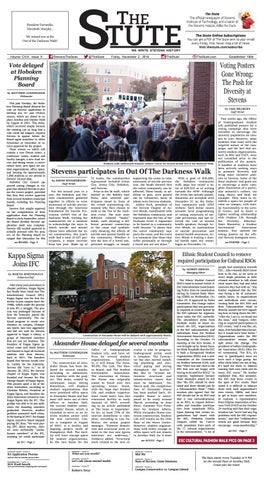
Students walk underneath Schaefer Athletic Center for second annual Out of the Darkness Walk.
Stevens participates in Out Of The Darkness Walk by SARAH HOOGENBOOM Staff Writer
For the second year in a row, the Hoboken and Stevens communities gathered together in efforts to raise awareness of suicide prevention through the American Foundation for Suicide Prevention (AFSP) Out of the Darkness Walk. Uniting the communities for a moment to acknowledge the ways in which suicide and mental illness have affected the local communities, this year’s walk had a total of 625 participants, a major increase from last year. Made up of
52 teams, the communities represented included Union City, Jersey City, Hoboken, and Stevens. Prior to the 5k walk, which started at the Babbio East Patio, nine selected participants stood in front of the crowd representing the reasons why they choose to walk in the Out of the Darkness event. The nine wore different colored “honor” beads, each showing a different personal connection to the cause and symbolically showing the effects of suicide and mental health on the community. Whether it was the loss of a loved one, personal struggle, or simply
supporting the cause to raise awareness of suicide prevention, the beads showed that the entire community can be affected. These beads, in addition to pins, were passed out by volunteers, many of whom were Stevens students. Ashley Peck, president of the Stevens Chapter of Active Minds, coordinated with the Hoboken community and expressed that the Out of the Darkness event is important to be hosted as a community walk because “it shows that the entire community supports the cause, and the event is a testament that those that suffer personally or through a loved one are not alone.”
With a goal of $30,000, the Hoboken community walk page has raised a total of $29,322 as of writing towards the AFSP. Although the event has already passed, donations are accepted until December 31 on the Hoboken community walk AFSP website. Each dollar counts towards local programming of raising awareness of suicide prevention and has relieved the cost of mental health speakers through Active Minds. In continuation of suicide prevention and mental health awareness, Active Minds is hosting a mental health open mic monologue on November 14.
by AUDREY DSOUZA Managing Editor
by MARYIA SPIRYDONAVA Editor-in-Chief
see IFC · Page 2 campus news
· page 2
RA Application Process
Find out what the selection process is like.
Crossword
· page 4
SGA Word Search
Test your SGA knowby completing this word search!
Two weeks ago, the Office of Undergraduate Student Life published posters for a voting campaign that were intended to encourage the minority population on campus to vote. However, some students took issue with the targeted nature of the campaign, and the fact that minority student organizations, such as BSU and FAST, were not consulted prior to the publication of the posters. A handful of students have been actively seeking ways to promote diversity and bring more inclusive policies to Stevens. Some of the these students’ end goals are to encourage a more complete illustration of a particular minority’s culture, via song, dance, and food, for example. They want to establish a space for people of color on campus, with similar functionality to the LoreEl Center, and to foster a tighter working relationship with Student Life through the Diversity Educator. Nasir Montalvo, a Student Government Association senator, first noticed the voting posters on the official Stevens Instagram story. see POSTER · Page 2
Ethnic Student Council to remove required participation for Cultural RSOs
Kappa Sigma Joins IFC After many years and about 14 chapter petitions, Kappa Sigma has finally been voted into The Interfraternity Council (IFC). Kappa Sigma was the first fraternity to join campus since the 1900s, which made the process to join IFC a struggle. The process was prolonged because of how the fraternity joined the Stevens community. The national program to create new chapters on campus, Champions Quest, was very aggressive and did not wait for Stevens approval to begin a colony, a group of interested members that are not yet brothers. The founders of Kappa Sigma ignored cease and desist letters and threats to expel all involved students sent from Stevens, back in 2011. The founders hoped that Stevens would cave in. Luckily for the fraternity, Stevens did “cave in.” As of January 28, 2012, the Stevens chapter of Kappa Sigma was founded and became the Rho Omega chapter of Kappa Sigma. This process upset a lot of the other fraternities, according to Christian Ribeiro, President of Kappa Sigma, and therefore the other fraternities refused to vote Kappa Sigma into the IFC. This grudge was able to be put aside when the founding members graduated. However, another problem presented itself when, in the Spring of 2017, the Kappa Sigma executive board stopped paying IFC dues. “We were paying [IFC dues] anyway, since we were technically “probationary members” of the IFC, meaning we could participate
Established 1904
Construction of Alexander House will be delayed until approximately March.
Alexander House delayed for several months by MATTHEW CUNNINGHAM Webmaster
The construction of Alexander House has been delayed for several months, according to administrators familiar with the project. This delay, caused by unforeseen issues during demolition, will displace student organizations that were promised office space in Alexander House and that must still move out of their offices in Jacobus Hall, the current student center. Alexander House, which is intended to serve as an interim student center until the new University Center is complete in August of 2021, is a facility and ongoing project north of Humphreys Hall. The facility will have storage space for student organizations, be the new home for the
Office of Undergraduate Student Life, and have offices for several student organizations. Specifically, it will house The Stute, WCPR, The Link, The Honor Board, and The Student Government Association. The renovation of Alexander House was originally slated to finish over this upcoming winter break, with the hope that Student Life and student organizations could move into this renovated facility in early January of 2019, according to an article published in The Stute in September. So far, at least 75% of the interior demolition is complete, according to Lisa DeMarco, the senior project manager. “Exterior demolition and structural work related to the two new egress stairways are underway,” DeMarco added. “Structural work related to the new el-
evator is also in progress. Underground utility work is complete. The Contractor has also started installing plumbing and electrical piping and wiring throughout the facility.” But due to “several unforeseen structural and infrastructure issues that must be addressed,” DeMarco said, the completion date of Alexander House has been pushed back. Alexander House is anticipated to be ready around March, according to Sara Klein, Assistant Vice President for Student Affairs. While Alexander House continues construction, Student Life will remain on the 10th floor of the Howe Center. However, student organizations with either storage or office space will not remain in Jacobus Hall, for it must see HOUSE · Page 2
opinion
What are you worth?
· page 7
opinion
· page 8
opinion
Let’s talk about mental health
· page 7
opinion
· page 9
opinion
· page 8
opinion
· page 9
Robyn’s Honey
The Ethnic Student Council (ESC) voted to amend Article X: ESC Subcommittee Good Standing Policy from its constitution during its General Body Meeting (GBM) on Wednesday, October 24. If approved by Rules Committee, this change makes participation that was previously required at events hosted by the ESC optional for organizations under the ESC umbrella. The amendment stems from multiple weeks of issues between the ESC, organizations in the ESC subcommittee, and individuals from the Student Government Association (SGA). According to the October 14 meeting of the SGA Senate, it was brought up by Junior Senator Mark Krupinski that the ESC is both a Recognized Student Organization (RSO) and a subcommittee of the Committee on Student Interests (CSI), and that “there was one club in the ESC that was not happy with having to do stuff for [ESC].” In response, Sophomore Senator Nasir Montalvo stated he felt that “the ESC should be abolished and there should just be a Subcommittee Head.” Other senators also agreed that the ESC should not be an RSO and that it was unconstitutional, as an RSO, to request deliverables and mandate participation from constituent RSOs. Upon hearing that certain organizations had issues with the ESC, President Camilla Vasquez called for 1-on-1s with presidents from each of the 11 cultural organizations in the subcommittee. “A lot of
people had resentment towards ESC... [the e-board] didn’t know how to fix this, so we went to every single president or their e-board members to talk about what issues they had and what concerns they had with us.” She further explained that the ESC was facing a lot of communication issues, as organizations and individuals were circumventing both the ESC RSO and their Subcommittee Head to directly consult the SGA regarding how to bring down the ESC. “After the 1-on-1s, we found out the issue,” said Vasquez, referring to required participation in ESC events, “and it was like, oh, okay, if we had done this a lot earlier it would have been better.” Organizations under the ESC subcommittee remain rather split about the change. The president of Indian Undergraduate Association (IUA) Dhru Patel commented, “For IUA, it’s easy to [participate] since we have such a large group, but other clubs [that] are not as big, it’s hard for them to balance running their own clubs and do every ESC event.” He further explained that, this semester, the ESC had three events in the span of five weeks. Patel noted it is difficult to balance these with each organization’s own events, GBMs, and time to get to know new members. In contrast, a representative from Filipino Association of Stevens Tech (FAST) at the October 24 meeting said that their organization has “never had any big problems with the ESC requirements,” and that “collaborative events are good because they encourage cross-membership.” see ESC · Page 3
ESC CULTURAL FASHION WALK PICS ON PAGE 3
Mid 90s
Stars of Stevens: Grant Simmons Campus Conservative vs. Campus Liberal
The Stute meets every Tuesday at 9 PM on the second floor of Jacobus Hall. Come join the team!
S
THE
TUTE We write Stevens history.
The student-run newspaper of Stevens Institute of Technology since 1904
116th Volume
Executive Board
Editor-in-Chief Business Manager Managing Editor Outreach Chair Webmaster
Editorial Board
Copy Editor Head Photographer Systems Administrator Social Media Coordinator
Maryia Spirydonava Mark Krupinski Audrey D’Souza Alex Murtagh Matthew Cunningham
Angelina Zaccaria Cole Yarbrough Matthew Doto Elina Tuder
Staff & Contributors Andrew Kinney Charles Zwicker Christian Bonavita Daniel Kang Dakota Van Deursen Jason Buckman Jake Millburn John Horgan Joseph Dolan
Koby Garcia Mathew Green Mia Hildebrant Namankita Rana Natalie Todaro Olivia Scott Sarah Hoogenboom
Contact Us
Office Phone Email Office Location General Body Meetings Advertising Inquiries Mailing Address
(201) 216-3404 eboard@thestute.com Jacobus Hall, 2nd Floor Tuesdays at 9:00 p.m. business@thestute.com 1 Castle Point Terrace, The Stute, Hoboken, NJ 07030
Letter to the Editor Policies
Letters may not exceed 500 words in length and must be fully attributed with name and title (non-attributed letters will be considered on a case-by-case basis, but the author’s identity must be made known to the Edior-In-Chief). All leters must be emailed to eboard@thestute.com. The Stute reserves the right to not publish any letter submitted for publication. The opinions in letters sent to The Stute with the request to be published are the sole opinions of their author(s) and do not reflect the views and opinions of any member or person involved in the making of The Stute. These opinions are not endorsed by The Stute and the content of all letters are printed in their original, unedited form. A disclaimer will accompany any letter that is published in The Stute stating this information.
Corrections & Clarifications
In the previous issue of The Stute, Brodie Remington’s title was incorrectly written. His title is Vice President for Development.
Disclaimer All opinions, stories and editorials reflect the views of their respective author(s). The Stute reserves the right to edit all letters and articles submitted for publication for clarity and factual accuracy, or not publish them. No part of The Stute may be reproduced in any form, in whole or in part, without the written consent of the Editor-inChief. Cited references of The Stute are permitted. Copyright © 2018 The Stute
IFC
Continued from front page
in everything but couldn’t vote or hold an eboard position,” explained Ribeiro. Other chapters were angered when Kappa Sigma stopped paying dues because money was being held against the IFC chapters. However, this action made the chapters reconsider their stance on why Kappa Sigma wasn’t in IFC, “as the IFC could barely do anything without our money since we are one of the biggest chapters on campus,” according to Ribeiro. Kappa Sigma had to have another chapter petition in order to be voted into becoming full members of the IFC. After the petition, the president would give a talk and answer any questions, and then at the next IFC meeting, Kappa Sigma’s membership would be voted on. A 7 out of 10 yay vote was needed for Kappa Sigma to get approved. They had a six vote support. When the Kappa Sigma eboard payed back all outstanding dues in good faith, the vote changed to unanimous. Kappa Sigma wanted to join
the IFC to be united with all of the Greek organizations in it, and to be able to work together with them. Now, Kappa Sigma will be able to run for eboard positions. “I would love to have our organization to be able to lead the IFC since they technically are in charge of all social fraternities on campus,” responded Ribeiro in an email correspondence with The Stute. There were many in the Greek community who showed support for the addition to the IFC, “It’s such a relief that Kappa Sigma finally got the votes to become a full member of the IFC. With this being my second term on the IFC eBoard, I can tell you we’ve wasted way too much time on this issue, and it’s great that we can finally put it behind us and move forward as a Greek community,” commented Jake Schozer, president of the IFC. Kappa Sigma will now be paying full IFC dues, and fraternity members will be able to run for council eboard positions. “Getting voted in is a huge milestone for us, and we are excited to become more involved in the IFC from here on out!” exclaimed Ribeiro.
News POSTER
Continued from front page
“It was very strange to me that a post like that wasn’t on the Diversity Education Instagram […] it was on the whole Stevens page. We are such a small percentage of students, I don’t know. I felt targeted.” He directly messaged the Instagram page, requesting that the post be taken down. It was removed but replaced with pictures of women instead. Montalvo screenshotted those pictures, distributed them to several ethnic student organization group chats, and received a large number of voices that agreed with his. “I wrote a huge email to Student Life, Student Affairs, Diversity Education, and just everyone involved with those offices explaining how those ads were not okay, and how the organizations of minorities on campus were upset about that.” In the email, Montalvo raised concerns about the
HOUSE
Continued from front page
still be vacated in preparation for the new University Center and student housing project that will replace Jacobus and Hayden Halls. Student organizations that use Jacobus Hall just as storage space will “experience turbulence as the Office of Student Affairs and Office of Undergraduate Student Life find where and how to store the materials they will be taking with them from Jacobus to Alexander House,” said Dakota Van Deursen, the SGA’s Vice President for Student Interests, who directly oversees all recognized student organizations on campus. The Honor Board, the SGA, The Link, The Stute, and WCPR “will be most af-
Friday, November 2, 2018 • Page 2
pictures posted on the Instagram stories. “I think it is very tasteless, for starters, to use such a photo as this to broadcast to the entire Stevens population,” Montalvo wrote. “This was clearly a target placed on the black population of Stevens, which makes up nowhere NEAR the rest of the population attending here. Why are there not GENERAL initiatives to vote being used?” Some members of the ethnic student organizations disagreed with Montalvo’s vehemence. Anthony Lucero, President of FAST, told The Stute in an email, “It did not seem like it was their intention to single out a minority or make a personal attack against them by using this picture, but I do see how it can be upsetting when taken from a different context.” Lucero pointed out that increased collaboration with Student Life, specifically with a Diversity Educator who shared the students’ beliefs and actively fought for them in Student Life, would be highly profitable, echo-
ing some of the issues Montalvo addressed in his email. Sara Klein, Assistant Vice President for Student Affairs, met with Montalvo last Thursday to further discuss these issues. In a follow-up interview with Montalvo, he said, “She explained their reasoning behind why they posted those advertisements, and it makes a lot of sense now, but the fact remains that it was an issue.” He detailed some of the arrangements that have been made to bring the ethnic student organizations and Student Life closer together in the aftermath of this issue. In a voting rally outside of Pierce Dining Hall, the Black Student Union and the Office of Student Life plan to encourage students to go out and vote. That voting rally came directly from the strife over the voting posters. In an email interview with Klein, she claimed that voting and voter registration did not seem to be something that student organizations were actively encouraging. “We noticed that few,
if any, student organizations were promoting voter registration or encouraging other students to vote. As this is such an important issue of the day, we met that need on our own initiative. If students or organizations have an interest in these topics, they have a means to plan their own events or offer passive education or can absolutely reach out to our team members to collaborate.” Going forward, Montalvo, Klein, and Lucero have high hopes for the new Diversity Educator and for increased collaboration between Student Life and students. When asked about the Diversity Educator specifically, Lucero said, “Even if this is just a small step, it is definitely necessary to making Stevens more diverse.” Montalvo agreed and mentioned some solutions that were put forth during his meeting with Klein. Klein is most excited about students getting active, getting involved, and approaching Student Life to actively promote and nourish diversity at Stevens.
fected [by the delay], as they are the organizations which have been promised [office] space on the third floor of Alexander House,” Van Deursen told The Stute in an email. “These organizations currently have the largest question mark hovering over their heads” in regard to where they will be temporarily relocated. The Stute, which regularly uses its office space for students to write articles and layout its weekly newspaper, is still unsure where it will be relocated. “We don’t know where we are being relocated, all I know is that it is being worked on,” said Maryia Spirydonava, Editorin-Chief of The Stute. “It does worry me that we have no idea where we are going to be. The Stute printed during both world wars, I hope that
this move doesn’t stop us.” The Division of Student Affairs is currently determining what temporary space is needed during the time between the move out of Jacobus Hall and the anticipated March opening of Alexander House. “We are partnering with the Physical Plant team to locate appropriate space on campus, and to allocate space as is needed and appropriate,” Klein told The Stute in an email. “We greatly appreciate everyone’s patience and understanding as we work through the needs of each group.” The Jacobus Hall move-out process is expected to start on November 14 with an event hosted by the Student Government Association called the “Jacobus Purge.” At the Jacobus Purge, with few exceptions, all materi-
als in storage in Jacobus Hall will be brought to the Jacobus Lounge and sorted into two piles: one to take to Alexander House and one to discard. Materials that are not discarded will be sent into storage. On December 12 and 13, during finals period, the SGA will hold “Storage Wars: Jacobus Edition,” which will require student organizations to box up any remaining materials for temporary storage. This will be the final preparation for moving out of Jacobus for good. The Division of Student Affairs and the Division of Facilities and Campus Operations are still reevaluating the timeline of Alexander House and expect to have more information regarding displaced student organizations soon.
ResEd shares details on RA Application Process by ELINA TUDER Staff Writer
With the selection of one of the most sought-after positions on campus – Resident Assistants (RAs) – just around the corner, it is important to understand how the RA selection process works. Each year, roughly 150 to 250 students apply for a position that Area Director for On-Campus Housing Steven Couras describes as “both a job and a great leadership opportunity.” The RA application process consists of four stages: filling out the application on DuckLink, completing the “Knack-It” activities to gauge various attributes and traits, participating in group presentations, and going through an individual interview with Area Directors and Resident Directors. Only those who are able to progress through all four stages have the possibility of being hired as an RA. For the first two stages, on average there are approximately
150 to 250 students, who are then narrowed down to 65 to 70 people. Those students then move on to the group presentation stage, which will take place on one day when all groups will be given a limited amount of time to research a specific topic and create a presentation. All topics deal with higher education and student affairs and are taken from various case studies or recent news headlines. Past topics include the political climate on college campuses, gun violence, and social justice. Couras believes that it is a good stage to observe leadership styles and skills regarding collaboration and teamwork, as well as gauge candidates’ ideas and what they can bring to the Office of Residential Education and our residents. After this stage, the candidate pool is narrowed down to approximately 30 to 35 people, all of whom will sign up for the final stage of one-on-one interviews with Area Directors and Resident Directors. Within a week of the
final stage, applicants are informed of whether they have been hired or placed on a waitlist. On average, 18 to 25 new RAs are hired each year, and 10 to 12 students who make it through the entire process but aren’t hired are placed on the waitlist. The final selection process is a collaboration between all the Area Directors and Resident Directors with final approval by Residence Education Associate Director Kurtis Watkins. Before this process, it is helpful to come to an information session to find out more about the RA position and ask questions. There are two more information sessions being offered this year: one on November 7 at 3 p.m. in EAS 222 and one on November 13 at 10 a.m. in Bissinger. The Office of Residential Education also produces a yearly promotional video, in which current RAs detail the responsibilities of the role, the application process, and the compensation package. The video can be found at this
link: https://youtu.be/GuJvoiOvW8E. Astonishingly, this year’s first information session on October 29 brought a record-breaking number of students. Typically, about 100 students attend, but this year approximately 200 students attended, nearly filling Kidde 228. Current RAs can also reapply, but their application process is completely different. Returning RAs put together binders displaying what they did throughout the year as well as their future plans as an RA. The RA selection process is competitive, but Couras says to not get discouraged if a student is not selected their first or second time applying. There is no limit to how many times a student can apply to be an RA, and in the meantime to improve their application they can get more involved on campus, work as a summer RA, attend Residential Education programs, and join the newly-forming hall councils.
RA APPLICATIONS CLOSE DEC. 7 VISIT DUCKLINK TO APPLY SEE PAGE 6 FOR MORE INFORMATION.
News
Friday, November 2, 2018 • Page 3
BOARD
Continued from front page
past Tuesday. “The purpose of the Oct. 30th meeting was for the Planning Board to review the University Center/Student Housing project, hear expert testimony on various aspects of the project, e.g., the new campus zoning in which this project fits, the building architecture, the engineering, the building operations, and the traffic and parking impacts, and vote on whether the project is approved to proceed or not,” Beth McGrath, Chief of Staff and Vice President for Government and Community Relations, told The Stute in an email. At the meeting, Stevens administrators and representatives explained the need for the towers and gave a detailed overview of how the towers would integrate into the Stevens campus. “The need for on-campus housing was one of the paramount goals [of this plan],” said Keenan Hughes. Creating additional space for student organizations, which is a need frequently expressed by student organizations, was also a primary goal of this project. Some of the members of the Planning Board raised concerns about the overall appearance of the towers. One member asked whether or not students would place items, such as flags or posters, in the glass windows of these towers. Another member asked why Stevens chose to include both brick and glass into the project, contending that this project might not match the
ESC
Continued from front page
David Kim, the President of Korean Student Association (KSA), echoed similar sentiments in an email to The Stute. “Although the change to the constitution has liberated ethnic RSOs from mandatory participation, I feel as though it also weakened the bond that kept the ethnic RSOs on campus unified,” explained Kim. “It’s tough to comment on the changes,” he added, “although the article in the constitution was unconstitutional and there were a lot of commitments that needed to be made for all the ESC events, the way that it was done left an atmosphere of hostility.” However, both presidents agreed on the importance of the ESC. Patel explained, “most of the ESC events, like Unity for example, are good for clubs to participate in, and they re-
A rendering of the two towers presented to the Hoboken Planning Board this past Tuesday. Rendering provided to The Stute by Beth McGrath.
Hoboken aesthetic. For nearly all of these concerns, the members of the Planning Board assured that they only suggest to Stevens to keep these concerns in mind when moving forward with this project and that their vote wouldn’t be contingent on these changes. After the Planning Board listened to the expert testimony provided by Stevens, Frank Magaletta, chair of the Board, informed the attendees that the meeting was nearing its intended end time of 10:45 p.m. “Although Stevens was able to present all its expert witnesses at the Oct. 30th meeting,” McGrath told The Stute in an email after the meeting, “there was
not enough time to complete the review, public comment, Board discussion, and vote. The Planning Board’s practice is not to meet past 10:45 p.m.” Despite the delay of this vote, “Vice President Maffia and his team are committed to staying on schedule to meet the target Fall 2021 opening of the University Center/Student Housing project,” McGrath said in an email. The next meeting where a vote can occur on Stevens’ application for the University Towers is unknown. On Nov. 8, the Planning Board will meet to decide when they will again consider Stevens’ application for the third time.
ally bring clubs together.” Kim also stressed the importance of the ESC, calling it “the central point in which ethnic RSOs can celebrate the diversity that we have on campus,” “a symbol of unity,” and without it there is “nothing that holds us together as ethnic organizations.” On the differing perspectives, Vasquez commented, “Some people are focused on trying to get rid of us, some people are focused on trying to clarify us, and some people are kind of like, why are we even doing this? We’re wasting our time.” Although the cultural organizations themselves seem to be on the same page and content with the ESC’s postconstitutional changes, several SGA senators and Dakota Van Deursen, Vice President of Student Interests (VPSI), are working closely with the ESC and the presidents of the organizations to possibly amend the duality of the
ESC in the coming months. Currently, the ESC is the only SGA entity to have this dual status. Like an RSO, they have an elected executive board comprised of members from different cultural organizations. This executive board plans and coordinates with all the different RSOs to host many events throughout the year, including Chip and Dip, Around the World, and ESC Thanksgiving, as well as the Unity Carnival and Unity Showcase for the student body. Like a traditional subcommittee head, the organization holds regular meetings, assists organizations with budgeting each semester, and passes any messages from the SGA downstream. In addition, President Vasquez attends SGA Senate meetings weekly to provide reports on the subcommittee and serves on the SGA’s CSI, chaired by the VPSI. Sophomore Senator Matthew Cunningham, who is working
Robert Maffia, Vice President for Facilities and Campus Operations, gave testimony. Photo by Matthew Cunningham.
with the ESC, explained his perspective. “My hope with the Ethnic Student Council is to make its bureaucratic structure similar to the other subcommittees of the CSI,” and that the intention is “to clarify its organizational structure.” He added, “I truly hope that with this change, the ESC can continue providing the Stevens community with informative and beneficial programming.” Junior Senator Mark Krupinski added, “with the change to the constitution, the problems that RSOs had with the ESC are likely going to be resolved. The future resolution will clarify internal procedures for the SGA.” Vasquez described the dualstatus of the organization as
“unique,butveryrequired.”She explained,“whattheESChasas anRSO,thatothersubcommitteesdon’t,aretheevents.These arehugeevents,withanywhere from 200 to 300 per event.” Bothmembershipandfunding
wouldbeharderfortheorganizationtoacquireiftheylostRSO status, according to Vasquez. “We all joined because we wantedtorepresentourculture intheESCe-board,”shestated. “Whytakeoutdiversity?Allof thismoneysettogoondiversity.Youdon’tevenknowwhere [themoney’s]goingtogo,Unity would be solely [up] to the discretionoftheVPSIandVPF.” Addressing these concerns, Van Deursen clarified that “the VPF and VPSI have no decidingpower.Theyco-chair the Senate Budget Committee,whichrecommendsbudget changes to the SGA Senate to approve as a whole.” Were the ESC to become a Non-RSO,theywouldreceive lower priority than RSOs for SGAfunding.Thoughthecurrent and previous SGA Cabinets have favored the ESC, there is no guarantee that future administrations would protect the ESC and continue
supporting and funding its events if they lost RSO status. AccordingtoVanDeursen,after a meeting with the ESC on November 1, the ESC would work with the SGA to rename their subcommittee componentasthe“CulturalSubcommittee.” The ESC would exist as an RSO under the Cultural Subcommittee.Discussionon thissubjectisstillongoingand future developments will be closely followed by The Stute. “This issue is more than just constitutional changes, it’s a debate on what should be done with diversity,” explained Vasquez. “And with the ESC storage space going away, we don’t know what’s going on. I’ve gone to talk to Dean Nilsen, and he himself told me he doesn’t know.” The Ethnic Student Council’s next event is ESC Thanksgiving, which will take place on November15at9p.m.inBissinger.
Ethnic Student Council
Students dressed in clothes representing their culture. Photos by Cole Yarbrough
Cultural Fashion Walk
Out of the Darkness Walk
Friday, November 2, 2018 • Page 4
Letter to the Editor If you are a student feeling stressed, anxious or depressed – you are not alone. Across the country, there is a crisis in the emotional wellbeing of today’s college and university students. Stevens is not immune from these trends, and the staff, faculty and administration are working hard to combat this crisis. If there is one thing you remember after reading this letter let it be this: you attend a university that is invested in your emotional well-being, and is constantly seeking ways to adapt to the new realities of university mental health. The national crisis is complex, but let’s review the basics. College and university students are seeking emotional support from their school counseling centers at an unprecedented rate, and this is happening for a number of reasons. University students are less inhibited than in the past about asking for help with their mental health (a good thing) and student populations are more diverse than ever before (also a good thing). A more diverse population needs greater support because it’s stressful being different. However, the increase in demand for counseling stems from more than reduced stigma and increased diversity. Today’s students are suffering. Current university students report higher rates of anxiety and depression than those from prior generations. Even more, the United States’ suicide rate among 15-24 year-olds rose by approximately 30% between the years 2000-2016. And yet, make no mistake:
being enrolled in a university is one of the most significant protective factors in your lives. Compared to your same-aged peers who aren’t attending university, you are all overwhelmingly more likely to be healthy, happy and safe. The combination of support, structure, and promising future is formidable. You are surrounded by a community of people who care about your success and believe in you. Stevens has done a lot to adapt to these changing mental health needs. Ten years ago, there was no CARE Team and Student Counseling had just two full-time staff members who made one-to-one contact with less than 3% of the student body. Today, CAPS is comprised of ten clinical staff and trainees. Last year we had one-toone contact with 6% of the overall student body, and 10% of the undergraduate population. This past year, the CARE Team received 160 reports from members of the community concerned about individual students. We are proactively increasing our presence within the university as well as reaching out to the larger community. We’ve partnered with excellent off-campus treatment providers to help students get care faster. The CARE Team, SpeakUp trainings, the #StigmaFreeStevens campaign all send the message that it’s ok to seek help, and that we need to look out for one another. We’ve strengthened our preventive efforts, and recently hired a new campus wellness educator. We’re focused on helping students
learn resilience skills and tools for coping with distress and setbacks. We are doing more to promote connectedness; orientation leaders now meet with first-year students throughout their first year, and residence hall staffing is increased. We will continue to partner with groups like the American Foundation for Suicide Prevention to provide high impact programming such as the Out of the Darkness Walk. In 2013, Stevens began a partnership with the Jed Foundation, a leader in university suicide prevention. Their expertise has enabled us to review our current practices and identify areas for improvement. We are embarking on an environmental safety scan, to reduce student access to potentially lethal means of self-harm. Another major project is a student survey so that we can hear from you, the students, about your experiences and wishes related to emotional wellness at Stevens. We also plan to start providing formal trainings for faculty and staff on signs and symptoms of student distress. Stevens strives to become a leader and role model for addressing the national university mental health crisis. We urge you to become our partners in making change. If you are suffering, ask someone for help. If you see someone else suffering, don’t be a passive bystander. Let’s tackle this together. Sincerely, Dr. Eric Rose Director of Counseling and Psychological Services
Advice from a student There was a time at the beginning of the semester that was very rough for me. My roommate said some very hurtful things to me, and it made me question what the point was of everything. I was already on pretty rocky ground at the time, and I think it just really hurt that someone I had deemed not
only a friend, but a best friend could say things that were so hurtful. I don’t know if our friendship will ever be the same, let alone recovered. I think the biggest thing that helped me was the support I got from friends and family. I’m still trying to work through living with this person for the next 8
months. One of the most important pieces of advice I got was from my mom, she told me to surround myself with people that made me happy. As trivial as that advice was, I think many of us forget that we should never allow others to treat us so negatively. Sometimes we just need to be reminded of that.
Student registering and walking this past Sunday. Photos by Olivia Scott
World News Roundup by Joe Dolan
Over the last two weeks, a large group of Central American migrants and refugees began to travel through Central America to approach the southern border of the United States. A large percentage of the refugees are currently fleeing Honduras, where violence and poor economic prospects were cited as reasons that they felt the need to flee the country. Over the last month in Honduras, many began organizing on Facebook and other social media to flee the country. Organizers proposed a caravan, so that their fellow migrants could move safely in numbers. The caravan soon reached Mexico, where Mexican immigration officials have tried to convince them to stay and register for asylum and legal citizenship in Mexico. President Trump has been extremely critical of the caravan, attacking them many times in public and on Twitter. He has repeatedly called the caravan an “invasion force.” On October 23 at a rally, President Trump accused Democrats of paying migrants to begin the caravan. As of the time of writ-
ing, 5,000 United States soldiers have been deployed to the border in order to assist ICE officials with securing the border in preparation for the caravan. However, those critical of the move have claimed that the 46day troop deployment is meaningless, as the most liberal projections show the caravan making it to the border in 45 d a y s . On October 19, 2018, the first of a string of suspicious packages was discovered at the New York residence of liberal billionaire George Soros. On Tuesday, October 20, a package was discovered by the Secret Service after it was mailed to the residence of Bill and Hillary Clinton. Hours after the finding, the Secret Service found another suspicious package addressed to Barack Obama. The next morning, the New York City offices of CNN were evacuated due to a similar package in its mailroom; another bomb was found addressed to former CIA Director, John Brennan. Former chairwoman of the Democratic National Committee
Angela Merkel, Chancellor of Germany. Photo from MPR
and current House Representa- sex as either male or female, untive Debbie Wasserman Schultz changeable, and determined by also received a package. It was the genitals that a person is born addressed to former Attorney with. Any dispute about one’s General Eric Holder Jr., using sex would be clarified using geher office as a return address. netic testing. This new definition House Representative Maxine of sex would essentially legally Waters was the recipient of two erase the identities of 1.4 million packages. Another package was transgender Americans. In the found at the office of liberal ac- wake of the publication of the tor Robert De Niro. In the 48 story, there was near immediate hours after the first packages uproar from the LGBT commuwere found, “#MAGABomber” nity. The National Center for became the #1 trend on Twitter, Transgender Equality as well as with many pointing out that ev- the Human Rights Campaign ery single target was a Democrat both condemned the memo unthat had been criticized and at- equivocally. While federal tacked by President Trump. On guidelines have not been October 23, the bomber was ap- changed, they appear to be on prehended by local police. After the docket for the Trump adminthey were arrested, a picture of i s t r a t i o n . their van went viral online. The van was plastered with pro- On that same day, a man who Trump stickers, some of them will not be named entered a depicting crosshairs over people Kroger grocery store in Jefferwho would eventually become sontown, Kentucky, and opened their targets. According to law fire, killing 69-year-old Maurice enforcement sources, the perpe- Stallard. He then walked into trator had a list of 100 names of the parking lot and shot and politicians and members of the killed 67-year-old Vickie Jones. media. The perpetrator is cur- Both Stallard and Jones were rently being held for prosecution African-American. A bystander in Florida, where they live. drew his weapon and confronted the shooter in the parking lot. On October 21, 2018, The New The bystander’s son, Steve ZinYork Times reported on an inter- ninger, was also in the parking nal memo from the Department lot. He reportedly heard the of Health and Human Services shooter tell his father “please that would attempt to redefine don’t shoot and I won’t shoot the legal definition of sex under you, whites don’t kill whites.” Title IX. “The department ar- The shooter was reportedly seen gued in its memo that key gov- trying to gain access to a preernment agencies needed to dominantly African-American adopt an explicit and uniform church prior to the Kroger shootdefinition of gender as deter- i n g . mined ‘on a biological basis that is clear, grounded in science, ob- On October 28, 2018, Jair Bolsojective and administrable.’”(Erica naro made it through the second L. Green, Katie Benner, Robert round of Brazil’s presidential Pear, The New York Times). The elections to become the Presimemo proposed a definition of dent of Brazil. Bolsonaro has
been considered a far-right candidate. Bolsonaro served in the military during Brazil’s former dictatorship and advocated for torture. In 2013, he said he would “rather have a son who is an addict than gay,” and that he is “proud to be homophobic.” In 2014, he told a fellow female lawmaker “I would not rape you because you are not worthy of it.” He is also incredibly critical of Brazil’s conservation efforts, claiming there are too many native reservations in the Amazon. “Our Amazon is like a child with chickenpox, every dot you see is an indigenous reservation [...] and the Brazilian people applaud [demarcation of indigenous land]. Look at these people, no political strategy!” Bolsonaro also claimed that he would give his political opponents the choice of extermination or exile. There is even more controversy surrounding Bolsonaro. Former President Luiz Inácio Lula da Silva, colloquially known as “Lula,” was imprisoned in April and began serving a 12-year sentence for corruption. Despite this, the members of Lula’s party, the Workers’ Party, actually nominated him as their candidate at the beginning of the race in August. Many have claimed that if Lula actually faced Bolsonaro in an election directly, he would have defeated the farright candidate. President Bolsonaro has assuaged complaints, saying his government would be a “defender of the Constitution, democracy, and liberty.” On October 30, 2018, German Chancellor Angela Merkel announced that her fourth term as chancellor would be her last, and she would not be seeking re-
election as chancellor or as chairperson of her party, the Christian Democrats. Her term is set to expire in 2021, and she also said that she would not be running for chancellor if snap elections are called before 2021. In regional German elections this month, the Christian Democrats did not fair as well as they had hoped in two regions, Hesse and Bavaria. Merkel was quoted as saying that those election results were a “clear signal that things can’t go on as they are.” On October 30, 2018, Axios published an exclusive interview with President Donald Trump claiming that he planned to sign an executive order to abolish birthright citizenship in America. In his interview, Trump said, “It was always told to me that you needed a constitutional amendment. Guess what? You don’t.” Birthright citizenship is a right guaranteed by the Fourteenth Amendment, but it has come under fire in recent years as a tool for undocumented immigrants to have “anchor babies,” making it harder for them to be deported. President Trump has railed against “anchor babies” and birthright citizenship in recent years; this appears to be another fulfillment of his campaign promises. Many in the media have claimed that it would be legally impossible for Trump to overturn a constitutional amendment with an executive order, and that any order would be overturned by American courts. However, some have claimed that the Fourteenth Amendment actually does not cover birthright citizenship, and an executive order would be suitable in eliminating it.
Battle of The Bands
Friday, November 2, 2018 • Page 5
Several student groups participated in Battle of the Bands. Photos by Olivia Scott
SGA Quack or Treat by Jake Millburn
Quack or Treat was this past Wednesday, October 31. Upwards of a hundred people showed up to the event dressed in a wide array of costumes. As the Student Government Association’s (SGA) annual Halloween celebration, Lucas Gallo and Dakota Van Deursen handed out bags for people to run around to all 20 of the Goodie Spots and collect candy. Everybody got involved; Goodie Spots were everywhere from the Mail Center to the Office of Residence Life to a handful of the fraternities and sororities. Costumes ranged from Gradarius to Spider-Man to Scooby-Doo. Van Deursen, in a brief statement, was excited for the growth of the event. “I’m glad that turnout was so high, over 200 students. Since it’s just the second year, there’s still a learning curve. We ran out of candy in some places this year but we had enough bags – a nice flip from last year.” About half of the Goodie Spots were in the Howe Center and the other half were scattered across campus. All of the Goodie Spots were asked by Student Life if they would like to be a goodie spot; for those who responded in the affirmative, the SGA bought them candy to distribute. The annual Spooky Day celebration is evidently something that brings the whole campus closer together.
S T E V E
F O R B E S
TRUMP, TRADE, AND TAXES
JOIN WELL-KNOWN CHAIRMAN AND EDITOR-IN-CHIEF OF FORBES MAGAZINE FOR REMARKS AND A Q&A SESSION.
JOIN THE
ALL STEVENS STUDENTS, FACULTY, STAFF, AND FRIENDS ARE WELCOME TO ATTEND THE EVENT.
NOVEMBER 12, 2018 6:15 PM BISSINGER 4TH FLOOR HOWE
S T E V E N S C O L L E G E R E P U B L I C A N S @ G M A I L . C O M
STUTE :)
Campus Pulse
Friday, November 2, 2018 • Page 6
Roving Reporter What’s the tea?
“I have this tea bag in my pocket.”
“The shuttles f**king suck.”
Ryan Gray
Tyler Wright
“It’s a letter in the alphabet.” Jake Dalrymple
“Jessica borrowed my dress and still hasn’t given it back.” Andrew Chesterman
Word Search Find the five Senators in the Student Government Association who were recently impeached!
If you find all five, take a picture and submit it to The Stute either by direct messaging us via Instagram or sending the picture to eboard@thestute.com $15 prize for the first completed and correct wordsearch!
“Trevor stole all the Pop-Tarts from the vending machine.” Caroline Corr
“We’re not actually a farmer/deer/80s dancer.” Micaela Cardile, Claire Korbas, and Audrey Biss
Opinion
Friday, November 2, 2018 • Page 7
The Stute Editorial
Let’s talk about mental health This past Sunday, the Out of the Darkness Walk was held on campus. It was the second annual walk held in Hoboken by the American Foundation for Suicide Prevention and this time Stevens partnered up with the organization. There were a lot of people in attendance, a good number from both the Hoboken community and the Stevens community. Although a lot of students were a bit annoyed about being there so early in the morning, whether they had to be there for athletics or Greek life or any
other club requirement. It’s not that students didn’t think that the cause wasn’t important. A lot were just more annoyed about having to be up in the morning. As someone who asked her residents to sign up for the walk, the 9 a.m. sign in was a hard sell. I want to make it very clear that it is not a matter of students being insensitive to the issue — there were a lot of people who felt very passionate about the walk whether it was because of their own personal struggles or those of friends. I just think that many students had
a short term vision. Yet, it was hard not to be moved by the stories that people shared before the walk. The loss of family, loved ones, or the personal struggle — all the stories were gutwrenching and heartbreaking. It was hard to not be moved just listening to them. One story that stood out to me was a woman sharing about her personal struggles. I remember thinking, “Wow, I can’t imagine sharing something so personal in front of so many people.” It was so brave of her to do so, but most of all it was important.
In her story, she talked about wanting people to know they are not alone. That is why it is so important to share personal struggles. The way our society looks at mental health is extremely unhealthy. A lot of it is cultural and will take a long time and effort to change. I have heard so many friends from Indian families laughing about how much their family needs a therapist, but that would never happen. People talk about having a cold or diabetes. There are support groups for cancer patients. We should be able to
talk about our mental health without being embarrassed or afraid. This is why that women’s story stood out to me so much. I think it is so important that anyone having trouble knows that it is okay and that they are not alone. This way they are not afraid of looking for help, whether that is seeking counseling or telling their friend, “Hey, I’m not doing okay and don’t know what to do.” This is why we need to stop thinking so short term. Yes, it might be annoying to wake up early in the morning but showing even that
small amount of support can change someone’s life. Yes, it might be scary to talk about something uncomfortable, but you might have a tremendous effect on someone. Let’s speak up and talk about mental health, just like we would talk about a cold.
Maryia Spirydonava Editor-in-Chief
Senioritis
What are you worth?
by NAMANKITA RANA Senior Engineering Management Major
For graduating seniors on that full-time job hunt, the above is probably a hard question to answer. Some people have years worth of work experiences or a master’s degree. Still, others have done ground-breaking research or pioneered cool independent projects. Converting that experience into an entry-level salary and position: how does one even begin to answer that question? Two months ago, at the start of my job-seeking journey, I certainly wouldn’t have known the answer. Any job would have done the trick, honestly. Then, a few weeks ago, I more or less got hit in the face with career whiplash. Suddenly, I had a bunch of very different answers, and no idea what to do. Should I take on the job with the most responsibilities? The most interesting work? The best company culture? Just sell myself to the highest bidder, all other considerations be damned? I can’t tell you the amount of sleep I lost, thinking about those questions and countless others. As I said in a post a few weeks ago, I am terrible at making grown-up decisions for myself. I frantically looped in as many people as I could — family, friends, colleagues — into the options I had, the decision I was about to take. They weighed in as best as they could, but all of them admitted to having no strong preference, leaving the final choice to me. I grew frustrated, then tired. Why couldn’t someone just point me to the right answer? But of course, I knew that was a silly thing to expect. After all, it wasn’t a friend or colleague or family member who’d end up actually TAKING the job. I was going to be the one actually working, so, for better or for worse, this was a decision I’d have to make, alone. In the end, I did indeed make a choice. Here are some of the lessons I learned along the way,
in a vaguely-strung series of anecdotes that will hopefully be coherent by the time this is published. Here’s my first piece of advice: don’t focus on compensation. That sounds silly, and I’m fully aware that if you have student loans and debt, that’s not a factor worth ignoring completely. But the truth is, the world is full of employers willing to offer a full range of salaries. I realized that after staring down at offers that were so fundamentally close in compensation that I had to focus instead on what really mattered — the job itself. For a while, I ignored that seemingly-obvious fact. I went so far as to run engineeringeconomics-style calculations on my potential future income, taking into account cost of living and taxes. (Not an entirely unworthy exercise, granted, but it did eventually come to a point of sheer ridiculousness). But the truth is, peace of mind and satisfaction with the actual work you’re doing trumps a few extra thousand dollars any day. That’s just as valid of a reason to decline a job as any other. And, as a counterpoint to what I just said — don’t underestimate your worth either. Early on in my job search, I nearly signed an offer that would have been far below the market rate for my skills, degree, and experience, simply because I was worried that I wouldn’t find another job that I really liked or cared about. I assumed that I would be forced to settle, and that I should get comfortable with that possibility. It was only in hindsight that I realized — it’s not audacious to want something amazing, to not want to settle. Truly, it isn’t. Remember that, while you’re on your job hunt journey. Here’s another thing to remember — the decision to not take a job is not a personal offense, and will not be taken that way by the company that you end up turning down. Still, declining can be tough, especially if you’ve formed a friendly bond with the recruiter or the people you’ve interviewed with. It can be tougher still if you have an emotional attachment to the company, or what it stands for, but again, remember — corporations don’t have feelings. Your decision to accept or decline does not represent a fundamental tipping point for the company. Recruiters are there to help you, and of course they will push hard
for their company and the role it is you’ve been offered, but in the end, the person who will be working the job is you. Not your boss, not the recruiter, you. So you have to make the decision that’s best for you, and do so with grace. Also — you will be working for the vast majority of your life. Closing one door doesn’t mean that company is suddenly shut off from you forever. If there’s a later opportunity that emerges down the road and that’s simply a better fit, you certainly can take it, and do so without hesitation. That was perhaps the hardest pill for me to swallow, admittedly. I wanted so badly to not have to turn anyone down, or risk disappointing someone (even though my dad jokingly reminded me that I couldn’t exactly accept every job offer either). In the end, though, I made my formal declines as cleanly as I could, and I’m happy, knowing I did my best to make sure no bridges were burned. Which brings me to another point: no matter how ‘clean’ you try to be about it, decision-making is inherently messy, and inevitably, you’ll find that you’re hit with more twists and turns than you ever expected. Here was just one of mine: shortly after making a decision to turn down a dream company, a close friend let me know that she had gotten a job offer from them as well, one she intended to take. Believe me — while I was absolutely ecstatic for her, I also went through all five stages of grief again. I spent some time mourning a missed opportunity, both to work for that company and work with someone I consider a very close friend, even though I knew that the job wasn’t quite right for me. And then, I moved on. In a sense, that gave me the closure I needed. Finally, perhaps the single most important thing I learned: you can make a decision matrix, run the numbers over and over, ad nauseam. But in the end, there might not even be a ‘right’ decision. As a mentor told me a few years ago, back when I was trying to decide whether or not to come to Stevens — you cannot make the ‘right’ decision. You have to make the decision the right one for you. And even if you’re wrong — you can always start again. Your life isn’t ending — in fact, it’s just begun.
Mind of Freshman
Allowing yourself time to recharge
by NATALIE TODARO Freshman Music & Technology Major
I think it’s important to make time for hobbies. It’s easy to get stuck in a routine that eliminates doing things that aren’t necessarily relevant to your academics. I’ve found that taking as little as 15 minutes out of my day to do something that brings me joy without having a particular end goal to work towards
has helped my overall mental health. Recently, I’ve reconnected with my love of painting. Last time I went home, I brought my paints and paintbrushes back with me to my dorm. The other day, I spent about 2 hours listening to music and painting. I didn’t even have a goal of what I wanted the painting to be of — I simply allowed myself to be present in the painting rather than worrying about an end goal. I even danced in my room to the music I had blasting: “More Than a Feeling” by Boston, which I’m sure you’ve heard. Carefree and unapologetic, I completely let go of the future and focused on the present. I think it’s a matter of recharging ourselves. Getting stuck in the routine of college can almost make you feel like a robot, and giving yourself these moments of time to your-
Join The Stute - no puns this time
self can clear you. I also want to stress the importance of allowing yourself to take time to be present and not worry about what school assignments you have to do. If you need some inspiration, here are some of the things that I’ve been doing to recharge and stay present: 1) Painting 2) Cutting up magazines and collaging pieces together 3) Learning about a topic you’re interested in (I’ve been reading about Greek mythology!) 4) Walking to Little City Books bookstore on Bloomfield Street 5) Spending a few hours at Bwè Kafe on Washington Street with a warm drink and a berry scone (yum!) 6) Taking a study break to enjoy a cup of hot chocolate at Pierce 7) Discovering new music on Spotify
Opinion Continued
Friday, November 2, 2018 • Page 8
Put Your Records On
Robyn’s Honey is 2018’s Best Pop Album, but that’s not surprising
by CHRISTIAN BONAVITA Sophmore Chemical Engineering Major
When Robyn released “Missing U” in late July, I realized just how long it had been since she last released a proper album. It has been 8 years since Body Talk, her electronic-drenched, career-defining album which brought her universal acclaim and provided the world with “Call Your Girlfriend” and “Dancing on My Own” (the latter of which was more recently thrust into public consciousness thanks to Calum Scott’s acoustic cover). Unfortunately, though, Robyn went through a good amount of personal trauma since Body Talk, facing the death of a close friend and musical collaborator, as well as the end of a long-term relationship. “Missing U,” a master-
ful track, reflected this feeling of loss in the way Robyn invented: a pulsating club beat that rendered more palatable her desperate, longing lyrics and vocals. I fully expected Robyn to dance her pain and insecurity away the way she had in her many previous hits. However, after second single “Honey” was released, it was clear that this album, while still exploring the influence of house music that Robyn is enamored with, would allow Robyn’s vocals more room to breathe and allow listeners to marinate in the emotions created by the swelling synths. If Body Talk showed Robyn dancing in a club, flailing her limbs around, making impulsive decisions and living in the moment, then Honey would show Robyn hours later, sitting on the street as the club is closing, overtaken by emotion as memories of the night’s events surface in her brain. Well, even my second impression wasn’t completely correct, but many tracks from Honey have a reflective mood which seems to come right after an event of intense sadness or euphoria. On the bare “Human Being,” Robyn feels isolated after a relationship dissolves, and begs anyone to fill the void left in her life, singing
“don’t shut me out/you know we’re the same kind/a dying race.” This song perhaps comments on the recklessness of her earlier work and reveals the emotional trauma one can feel from trying to seem indestructible, something Robyn has done many times before. On the next track, the celestial “Because It’s In The Music,” Robyn continues to struggle to move on from a dead relationship, juggling nostalgia with dread and regret, singing, “I remember feeling like/‘this is never gonna end’/ nothing lasts forever/not the sweet, not the bitter.” Honey offers a glimpse into Robyn’s personality more than any of her previous albums; where previously she presented her vulnerability with a façade of carelessness, here she longs for transparency and connection, and dwells in this vulnerability. An interesting fact about this album is that the track list is ordered chronologically – that is, in the order that Robyn wrote each song. This fact makes the album’s ending, uplifting and hopeful, even more powerful, since it seems that Robyn has found happiness again, and has changed for the better through her difficult experiences. When “Baby Forgive
Me,” a pristinely produced track that swallows listeners whole in its melancholy, transitions directly into “Send to Robyn Immediately” and later the title track, “Honey,” Robyn shows that she will no longer allow herself to wallow in her emotions, exchanging the feelings of defeat for those of hope. Singing, “If you’ve got something to say/say it right away/If you’ve got something to do/ do what’s right for you,” we see her shift her worldview. She’s done waiting and sitting in sadness; instead, she urges her former love, or maybe herself, to make a choice and move on. After making this choice, the rest of the album feels so completely free, experimental, and light, snowballing into the pop perfection of “Between the Lines” and “Ever Again.” Again, this is made more powerful knowing that she wrote the album in this order. The blooming of this album after a period of melancholy is reminiscent of “Supercut” towards the end of Lorde’s Melodrama, yet so perfectly crafted as to evade subtracting from the effectiveness of either album. Will Honey influence the pop landscape in the same ways as Robyn’s earlier work? Robyn is widely credited with
Spoiler Alert
by KOBY GARCIA Senior Visual Arts and Technology Major
Jonah Hill’s directorial debut came in the form of a captivating coming-of-age movie by the name Mid90s. The film follows Stevie (played by Sunny Suljic), a thirteen-year-old LA boy who desperately tries to fit in wherever he can, and eventually joins a group of teenagers who spend their time skateboarding, drinking, smoking, and exploring the city. At home, Stevie lives with his single mother, Dabney (played by Katherine Waterston) and an abusive older brother, Ian (played by Lucas Hedges). For the most part, the film feels more like “a day in the life of a 90s teenage skateboarder;” that is to say that there isn’t much of a storyline. Of course, there are significant events that occur between the beginning of the film and the ending as the characters go through changes. The most notable character change is from Stevie, as he goes from being hesitant, considerate, and wanting to fit in, into a more confident drinking, smoking, cursing, skater who feels comfortable in his group of friends. That being said, the film is, at times, tough to watch being that it’s difficult to feel connected to
increasing the individuality of pop and creating the basis for songs that bring vulnerability to dance music. The influence of the latter idea is obvious in the last decade of pop, where songs that juxtapose sadness with a club beat can be found around every corner, especially since the impact of “Call Your Girlfriend” and “Dancing on My Own.” Will the style of Honey be emulated for years to come? Pertaining to the former idea of individuality, can Robyn change the path to pop stardom? Emerging around the same time as
pop-robot Britney Spears, Robyn seems to embody everything against what Spears and future cookie-cutter pop stars established. In fact, in 2005, Robyn started her own record label after disagreeing with her label about the direction of her sound. Will her prolonged success cause more artists to seek alternate pathways to fame? Or has it already done so? The impact of Honey will surely become evident in a few years, but until then, let’s enjoy one of the most compelling pop albums of the year.
Passion for Fashion
Mid 90s the characters as they traverse what could be considered troubling decisions. The relatability in the film comes from the character’s motivations and aspirations, as opposed to their actions. While each character has their own set of unique qualities and traits, they all have a desire to escape their reality and become something more than their environment. You would think the movie was going to be about Stevie’s relationship with his brother Ian based on the opening of the film, however this is not the case by any means. Sure, Ian has a couple of defining character traits (extremely serious, always drinking orange juice, protective of his possessions) and Stevie and Ian have a handful of loaded interactions that could be analyzed, but these interactions are not as telling as the rest of Stevie’s experiences. At one point in the film, Stevie and his friends are hanging out on a sidewalk when F**ks**it (actually one of the character’s names. I’m serious.) accidentally hits a passerby with a skateboard while doing a trick, who is revealed to be Ian. Ian is initially angered by this, but after making eye contact with Stevie, Ian is dumbfounded and remains silent. F**ks**t is not apologetic, but confrontational, attempting to goad Ian into fighting him. After an awkward lengthy amount of time, Ian just silently walks away. Is Ian actually not as aggressive as he pretends to be or is he protecting Stevie’s social life by avoiding putting him in a tough situation? It is unclear. Later in the film, after coming home drunk and feeling “accomplished” after having had a sexual encounter with a girl, Stevie insults Ian and accuses
The album cover of Robyn’s Honey Pitchfork
him of not being as cool as him. Ian reacts as he always does, by aggressively chasing Stevie around the house and eventually beating up on him. Towards the end of the film, after Stevie ends up in the hospital, it seems like Ian softens up to Stevie, evidenced by his sharing of orange juice with Stevie. On the surface, this movie might not be for everyone. Although following the familiar path of most coming of age movies, the pacing is unique which may or may not be your cup of tea. Despite being the title of the film, the movie goes about addressing nostalgia of the 90s in a non-romantic way; the soundtrack, costumes, and locations are reminiscent but there aren’t many, what I’m calling “omg, remember that?!” moments in the film, which I appreciate being that it probably wouldn’t have fit in the context of the movie. Overall, Jonah Hill had a remarkable breakout into writing/directing and I look forward to whatever he might decide to create next.
Photo Courtesy of imdb
Palace Skateboards Making Moves This Year
by DANIEL KANG Sophomore Biomedical Engineering Major
It would be an understatement to say that it has been a great year for Palace Skateboards. Palace got nominated for the 2018 Fashion Awards Urban Luxe category alongside street wear stalwarts Supreme, Off-White, Alyx, and Marine Serre. Palace will finally launch in Shibuya-ku, Tokyo, Japan on Saturday, November 3. There will be an exclusive opening day T-shirt with the iconic tri-ferg as well as a Mount Fuji graphic hoodie, multicolor knitwear, and various leather accessories. Palace also leaked store details such as a tri-ferg shaped staircase and a large neon sign through its Instagram. To promote the store, Palace released a horror-themed short clip featuring Jonah Hill, appropriately timed before Halloween. Jonah Hill’s disembodied head appears twice to assure viewers that all is well, and to encourage people to come to the store opening. Jonah Hill was also featured in Palace’s video promoting the opening of its NYC store last year and is coming off hot after last month’s debut of his
Join The Stute
critically acclaimed 90’s period piece film, Mid90s. Palace also released a look book and video for the much hyped collaboration with Polo Ralph Lauren. Previously, cryptic billboards combining the iconic Polo Ralph Lauren horse logo and Palace logo appeared in cities worldwide. In the video, Palace skate team members are driving classic cars and riding horses while wearing the upcoming collection. So far, the collection seems to include a Polo Bear crew neck, silk shirts, co-branded jacket, corduroy trousers, and loafers. The collaboration, advertised as Palace Ralph Lauren, will release online and in Palace stores in New York City and London on Friday, November 9. The collection will also release through Polo Ralph Lauren’s official channels and Dover Street Market. This might be one of Palace’s best street wear collaborations to date. Palace’s Winter 2018 collection releases tomorrow, November 2. The orange puffer jacket is the most visible part of the cozy and comfortable selection but there are lots of other colorful pieces such as fleeces, hoodies, sweaters, tracksuits, beanies, socks, utility bags, and skateboard decks that merit a closer look and maybe even a purchase. Palace teamed up with Adidas for two new skate footwear designs that dropped on Friday, October 26th. The Campton trainers are simple, coming in black and white with the Palace logo appearing on the heel. Over the summer, what I thought to be the more interesting collaboration was the one between Palace and Adidas
Tennis. Now, you might wonder what a skateboarding brand has to do with tennis but tennis has always been the domain of stylish and skilled players such as Andre Agassi, Arthur Ashe, John McEnroe, Roger Federer, and Serena Williams. Palace’s landmark collaboration with Adidas Tennis caused some people to lament the death of the skateboarding brand but I thought it caused a resurgence of interest in the brand. After all, Wimbledon’s strict all-white dress code has been enforced since 1963 with little room to have fun with one’s outfit… until Palace and Adidas came along. Palace’s unconventional approach to court apparel was worn by 2017 Wimbledon women’s singles winner Garbiñe Muguruza, Alexander Zverev, and the women’s singles champion, Angelique Kerber, (who dethroned reigning queen of tennis Serena Williams) at this year’s Wimbledon. Adidas trusted Palace to represent its top athletes in the world, and the collaboration became one of the the fashion highlights of the summer. There seems to be nothing that can stop street wear from conquering every place imaginable. Palace went back to the basics for its newest skate video called Normcore showing the London skate collective skating in diverse locations. Who could have imagined that the Palace Wayward Boys’ Choir (made up of skateboarders and creatives Lev Tanju, Daniel Kinloch, James Edson, Blondey McCoy, Lucien Clarke, Stu Hammond, and more) would have made it this far? Watch closely because the trailblazing brand will be anything but predictable.
Opinion Continued Campus Conservative
Vote... but only if you’re informed
by ALEX MURTAGH Junior Civil Engineering Major
As an American, I believe that it is our obligation to get out and vote every time there is an election. It is the people who we elect that have the ability to decide what our local, state, and federal governments look like. If you didn’t vote, then your opinions aren’t going to be heard or taken seriously. If you did vote, chances are you’re like the majority of Americans who just vote on party lines. But do you know what your party actually supports? Do you know what every single candidate on that ticket supports? Do they sup-
port the party platform? Or did you just vote because you saw a campaign ad that made the other candidate look bad? I know everyone has heard the generic “you’re vote counts!”, “don’t forget to vote!” and so much more. I think this is great, but I have one big problem with this idea. Any person voting should be informed on the positions of every single candidate in the race as well as the party that they are running under. For example, I don’t always vote for the Republican candidate because they don’t support the same ideas that I do and, instead, I will vote third party or write in a candidate. If I’m being completely honest, I have yet to vote for a Democratic candidate. So far no one on that side of the aisle has reached out to me to prove that they deserve my vote. In addition, I have read large parts of the party platform, and as a conservative, the number one thing I notice is that it doesn’t align with my values or the ideals that I hold important. The reason I bring this up is that I am informed on the Dem-
ocratic party platform as well as the Republican platform. How can I say that I have voted mostly Republican if I haven’t even attempted to understand what positions the party supports? With this said, I am not entirely supportive of the party platform, but I do agree with the vast majority of it. I think its also important to mention, don’t trust all campaign ads. Fact check them and do your homework to understand the full story behind that quick 10-second clip that made the candidate look bad. I want you to vote, I really, really do. But, you need to be informed! And don’t feel bad to go to the voting booth and only vote for positions in the federal government, or just your local government. And don’t think that you’re wasting your time if you vote for the third party candidate. Third party candidates win in local and state elections all the time. There are even third-party senators in the federal government, although they are rare. Don’t be afraid to support them, just make sure your voice is heard!
Friday, November 2, 2018 • Page 9
Campus Liberal
Don’t vote? Don’t complain.
by MATTHEW DOTO Junior Computer Science Major
Those who choose not to vote have no right to complain about any government policy. Those who choose not to vote as a form of protest are choosing to avoid the path towards their goal. Those who are too lazy to vote are making a stupid choice. Those who don’t vote because elections are on a Tuesday have no excuse either - Every state has early or absentee voting. Those who choose not to vote choose to abdicate their opportunity to voice their opinion, and therefore have no right to complain when the government acts in opposition to their opinion.
Having said that, of course don’t just go show up to vote. Get informed. Learn what issues affect your life, look at a sample ballot (NJ sends one to every voter), and decide exactly who you’re voting for and why before you leave for the polls. One of the best resources for this is ontheissues.org -- It lists practically every politician running for office and their positions on the issues in their own words, along with source links so you can get full context. While in my current book voting is always better than not voting, I tend to flipflop on whether I think uninformed people should vote. In any case, deciding who to vote for will take maybe an hour of sitting in front of the computer with a sample ballot researching positions & voting records. Yes, of course it would be nice if election day weren’t a Tuesday. It would be nice if republicans didn’t keep passing voting regulations that unfairly affect minorities in the name of “fighting voter fraud”, an issue that affected a whole 31 of 1 billion ballots between 2000 and 2014. It would be nice if everyone was auto-
matically registered to vote when they turned 18. It would be nice if voter rolls weren’t purged weeks before an election instead of months if ever. There’s a lot to improve about the US voting system. The solution isn’t non-participation. Change is affected in this country by those who participate. Those who stand up and say “this isn’t right.” The absolute easiest way to do that is by voting. By getting your friends and family to vote. By encouraging your community to stay informed. By calling your politicians on their bullshit at the polls. We have the power to say, in the words of our incredible president, “you’re fired.” I really don’t have anything more to say on the subject. If you need to know where to vote, check out vote.org. If you aren’t registered to vote, unfortunately you can’t vote in the election next Tuesday, but go ahead and register now so that you can vote in the next one! It only takes a few minutes and you’re registered forever, or until the voter rolls get purged. Again, check out vote.org and get yourself registered.
Scientific Curmudgeon
Beauty does not equal truth
by JOHN HORGAN CAL Professor
Poet John Keats once said, “Beauty is truth, truth beauty, — that is all/Ye know on Earth, and all ye need to know.” I’ve been brooding over this formula since physicist Sabine Hossenfelder spoke at Stevens last month about her new book
Lost in Math: How Beauty Leads Physics Astray. Many modern physicists have touted beauty — which includes properties such as elegance, simplicity, and symmetry — as a guide to truth. The obvious problem is that beauty is subjective, and ideas about beauty vary across era and cultures. Moreover, allegedly beautiful ideas turn out to be false. Ancient Greeks, to whom the circle embodied geometric perfection, assumed the orbits of heavenly bodies must be circular. Wrong. For decades, string theory has been the leading contender for a unified theory of physics, which unites quantum mechanics and relativity. Advocates of string theory extol its beauty, but after 40 years they have produced no empirical evidence for it. On her blog “BackReaction,” Hos-
senfelder notes that relying on beauty “has sometimes worked, and sometimes not. It’s just that many theoretical physicists prefer to recall only the cases where arguments from beauty did work.” Polymath Douglas Hofstadter raised another objection to the linkage of truth and beauty when I interviewed him for my new book Mind-Body Problems. I had been struck by the artistry of his books Gödel, Escher, Bach and I Am a Strange Loop. During our conversation, he also kept raising aesthetic issues, for example when he explained why he left particle physics in the 1970s. “I became more and more lost and repelled by the ugliness of theories that I was seeing,” Hofstadter said. “I just could not stomach any of it.” I assumed
Hofstadter would be sympathetic to Keats’ “Beauty is truth” line. But when I mentioned it, Hofstadter snorted in disgust. Here is how I describe our subsequent exchange: “That’s nonsense,” Hofstadter said [about truth is beauty]. “Absolute junk. That’s the opposite of what’s true. I hate that phrase.” He was so vehement that I started laughing. “Germany killed six million Jews,” he said, scowling. “That’s true. Does that make it beautiful? Come on. Nonsense.” I wasn’t laughing now. But your writing is so beautiful, I said, to mollify him, and because it is true. “I think we should try to bring as much beauty into the world as we can,” he replied, “since the world is so non-beautiful!” In other words, truth is often repulsive, morally as well
as aesthetically. Elsewhere in Mind-Body Problems, in a chapter on philosopher-novelist Rebecca Goldstein, I suggest that the arts might be a better route to self-understanding than science. But artistic beauty can lead us astray. That is why Plato wanted to exclude poets from his utopia Decades ago I saw Triumph of the Will, the Leni Riefenstahl documentary about a Nazi rally. Rationally, the film repulsed me. Viscerally, Riefenstahl’s beautiful music and imagery stirred me. When Hitler (a former artist!) hailed the hordes of adoring, gorgeous men, women, and children, part of me wanted to jump to my feet and cheer. Humanities professors preach that great art makes you a better person, but that, like many platitudes we professors spout,
is false. Stalin was an avid reader of literature, including poetry. He once told a group of writers, “The production of souls is more important than the production of tanks.... And therefore I raise my glass to you, writers, the engineers of the human soul.” By the time he died, Stalin had slaughtered almost as many people as Hitler. Both these tyrants thought they were creating good, beautiful societies. So what’s my point? Life is ugly as well as beautiful, bad as well as good, and the path to truth — especially the truth about ourselves — is fraught with peril. John Horgan directs the Center for Science Writings, which is part of the College of Arts & Letters. This column is adapted from one originally published on his Scientific American blog, “Cross-check.”
A Minor,” and Gustav Mahler’s “Symphony No. 4.” Grant shares that Tchaikovsky’s first piano concerto is a piece that he finds myself returning to on a regular basis because of its catchy tune, epic finale, and his personal experience playing it. He says, “Before coming to Stevens, I was fortunate enough to play in an orchestra accompanying pianist Ilya Yakushev in his performance of the piece [Tchaikovsky’s first piano concerto]. Experiencing the powerful cadenzas and delicate harmonies just feet from the piano is one of my most cherished memories.” He adds that his favorite composers include Gustav Mahler, Dmitri Shostakovich, and Robert Schumann, as well as more modern tunes by Snarky Puppy, Thomas Enhco, Lamp, Chon, Yotam Perel, and Tennyson. For a musician to answer the question: “What does music mean to you?” may be like asking a philosopher: “What is the meaning of life?” In short, it is a loaded question with no quick, one-word answer. Grant gave a thoughtful response that
deepened what music even is and why we as humans find it so meaningful and emotive. Grant admits, “I’m still struggling to understand how varying sounds or how changing the vibration of a piece of wound up steel can affect a person’s mood. I love creating those sounds and I love hearing them, [but] I have a hard time understanding why they change us on a personal level. Somewhere along our evolutionary timeline we adopted an appreciation for audible harmony, and it didn’t just change my emotions—it changed my life.”
Stars of Stevens
by MIA HILDEBRANDT Senior Civil Engineering Major
Grant Simmons is a star on stage, as well as on the slopes. He is an upright bassist in the Stevens Orchestra, is on the Alpine Ski Team, and is a part of the Institute of Electrical and Electronics Engineers (IEEE). Grant is a second year Computer Engineering major who calls La Crosse, Wisconsin home— also home of the best cheese, haha. In addition to playing bass, Grant also enjoys kayaking, mountain biking, and playing table tennis. In coming to Stevens, Grant learned to value the vulnerability that comes with going to a
smaller school where one is not just another face in a lecture hall. Grant recounts talking to his friends back home and hearing about 200+ person lectures. “Small classes force me to be constantly attentive, and I don’t think that I would be able to thrive in a place where my professors were not able to call me out by name.” He adds, “Being personally recognized by an instructor when I reach out is an aspect of education that I didn’t fully appreciate until I came here.” At the tender age of 3, Grant started playing piano. Grant recalls that there was a Simmons family rule that “everyone must take piano lessons for at least one year.” After learning piano, he went on to play string and electric bass, tuba, and ukulele while dabbling in guitar, drums, nose flute, and sopranino recorder. Grant eventually focused his efforts onto the string bass. The string bass proved to be a versatile instrument allowing him to play in a variety of musical groups, including symphony orchestras, chamber ensembles, jazz bands, wind sym-
All About that Bass! phonies, choirs, church bands, pit bands, folk bands, and perform as a soloist. Having grown up in a musiccentric household, it is not surprising that Grant has decided to continue playing his upright bass at Stevens. Grant says, “I continue to play music in college because I don’t know a life without it. For as long as I remember, it’s been there for me.” He explains. “It’s been fun, rewarding, frustrating, sad, and everything in between, but it has always been there. I still play today because I feel like I have a responsibility to give back to music what it has given, and continues to give, to me. If I were to stop playing today, it would be like ending a 19 year relationship out of nowhere. I have no reason to stop, but dozens of reasons to keep going, so why would I stop?” One of Grant’s biggest musical inspirations is Rinat Ibragimov, a bass teacher at the Guildhall School of Music and Drama who played double bass in the London Symphony Orchestra. After years of playing professionally, a severe stroke
ended his career as a professional bassist. Grant remembers when he heard the sad news. “I had grown as a bassist listening to, and later studying, his renditions of the Bottesini Bass Concerto No. 2 and the Vanhal Bass Concerto. To watch his performances after the incident served as a grim reminder to appreciate every opportunity I have to practice and improve, because one day those opportunities might be gone.” As a Computer Engineering major, Grant finds that music helps him balance his academic pursuits by providing a temporary “out”. Grant explains, “Stressed? Practice it out with an aggressive bass part. Paper due tomorrow? Stall my progress by practicing until I feel guilty enough to go finish the paper.” He adds that these strategies, though not for everyone, helped get him through his formative semesters at Stevens. Grant has an eclectic taste in music. Some of his favorite classical pieces include Tchaikovsky’s “Piano Concerto No. 1 in Bb Minor,” Robert Schumann’s “Piano Concerto in
Photo Courtesy of Mia Hildebrant
n
Friday, October 26 2018 • Page 10