The Stute Online Subscriptions You can get a PDF version sent to your email every Friday, free. Never miss a bit of news. thestute.com/subscribe
STUTE THE
The Stute The official campus newspaper of Stevens Institute of Technology since 1904, and creator of the Stevens mascot, Atilla the Duck.
We write Stevens history.
Volume CXIV • Issue 18
Friday, March 3, 2017
TheStute.com
Trump’s joint address to Congress
/TheStute
@TheStute
Established 1904
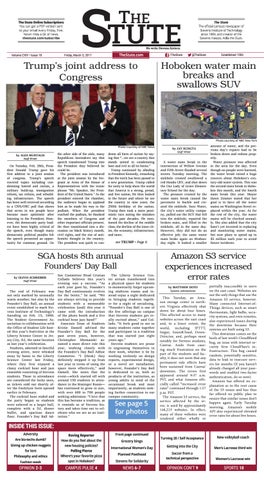
Hoboken water main breaks and swallows SUV
Photo courtesy of NBC New York Photo Courtesy of NBC News
by ALEX MURTAGH Staff Writer
On Tuesday, Feb. 28th, President Donald Trump gave his first address to a joint session of congress. Trump’s speech covered topics including condemning hatred and racism, a military build-up, immigration reform, tax reform, and rebuilding infrastructure. The speech has been well received according to a CNN/ORC poll that shows that seven in ten people have become more optimistic after listening to the President. However, the democratic party leaders have been highly critical of the speech, even though many democratic political pundits felt the speech presented an opportunity for common ground. On
the other side of the aisle, many Republican lawmakers say that speech transformed Trump into the President they believed he could be. The president was introduced at the joint session by the Sergeant at Arms of the House of Representatives with the iconic phrase “Mr. Speaker, the President of the United States.” As the president entered the chamber, the audience began to applaud him as he made his way to the podium. When the president reached the podium, he thanked the members of Congress and other important officials present. He then transitioned into a discussion on black history month, civil rights, and the rise of antiSemitic thought in the country. The president was quick to con-
demn all form of racism by saying that “...we are a country that stands united in condemning hate and evil in all its forms.” Trump continued by alluding to President Kennedy, remarking that the torch has been passed to a new generation. Trump called for unity to help show the world that Amerca is a strong, proud, and free nation. He then looked to the future and where he see the country in nine years, the 250th birthday of the nation. Trump then took a more pessimistic turn noting the mistakes of the past decades. He mentioned the decline of the middle class, the decline of the inner cities, the economy, infrastructure, and more.
see TRUMP • Page 6
SGA hosts 8th annual Founders’ Day Ball hoc Committee Head Cristian Collado believes this year’s evening was a success. “As each year goes by, Founder’s Day Ball continuously evolves for the better,” he said. “We are always striving to provide students with a memorable celebration [and] this year it came with the introduction of the photo booth and a live cocktail hour jazz band!” Associate Dean of Students Kristie Damell advised the Founder’s Day Ball for the past seven years, however, Christopher Shemanski assumed a more direct role this year, working closely with the Founder’s Day Ball Adhoc Committee. “I [think] they definitely stepped it up from last year in terms of using the space more effectively,” said Damell. She notes that the event—which started off with around 150 students in attendance in the Bissinger Room— has continued to grow in size, with over 600 to 700 people seeking admission. “I love that this has become a tradition, as it reminds us of Stevens history and takes time out to celebrate who we are as an institution.”
The Liberty Science Center atrium transformed into a physical space for students to momentarily forget upcoming midterm exams and instead enjoy a night dedicated to bringing students together for a night of socializing. “Founder’s Day Ball is one of the few offerings on campus that Stevens students get really excited about,” said Collado. “It feels good to see so many students come together and participate in a tradition that was started just eight years ago.” Stevens students are prone to engrossing themselves in their work, whether it be by working tirelessly on design reports, experimental design, or a novel art installation; however, Founder’s Day Ball is dedicated to us, both as products of the institution, as young adults in need of the occasional break and most importantly, as students seeking further connection to our campus community.
Front page continued
Fashion week
Roving Reporter How do you feel about the new housing policies? Polling Pierce Where’s your favorite pizza spot in Hoboken?
OPINION 2-3
CAMPUS PULSE 4
NEWS 6-7
by OLIVIA SCHREIBER Staff Writer
The end of February was not only marked by unusually warm weather, but also by the Founder’s Day Ball, an annual event established to mark Stevens Institute of Technology’s founding on Feb. 15, 1890. The Student Government Association in collaboration with the Office of Student Life hosted this year’s festivities at the Liberty Science Center in Jersey City, NJ, the same location as last year’s celebration. Students, adorned in fanciful evening attire, were whisked away by buses to the Liberty Science Center last Friday, where they first enjoyed a classy cocktail hour and jazz ensemble consisting of Stevens students. Those in attendance are considered the lucky ones, as tickets sold out shortly after the DuckSync form opened earlier in February. The cocktail hour ended and the party began as students were ushered to a larger hall, complete with a DJ, dinner buffet, and spacious dance floor. Founder’s Day Ball Ad-
See page 5 for photos
by JAY RUNGTA Staff Writer
A water main break in the intersection of Willow Avenue and Fifth Street flooded several streets Tuesday morning. The sinkhole created swallowed a red Honda CRV, and shut down the Our Lady of Grace Elementary School for the day. The pressure created by the water main break caused the pavement to buckle and created the sinkhole. Suez Water, the city’s water utility company, pulled out the SUV that fell into the sinkhole, repaired the broken main, and filled in the sinkhole, all in the same day. However, they did not do an effective job; the same water main broke again on Wednesday night. It leaked a smaller
amount of water, and the previous day’s repairs had to be broken down and redone properly. Water pressure was affected in the area for the day. Even though no people were harmed, the water break raised a huge concern about Hoboken’s century-old water system. This was the second main break in Hoboken this month, and the fourth main break this year. Mayor Dawn Zimmer stated that her goal is to have all the water mains on Washington Street replaced within the year. As for the rest of the city, the water mains will be checked annually. She also added that the city hasn’t yet invested in replacing and monitoring water mains, but now plans to spend up to $5 million each year to avoid future incidents.
Amazon S3 service experiences increased error rates by MATTHEW DOTO Systems Administrator
This Tuesday, an Amazon storage center in northern Virginia effectively shut down for about four hours. This affected access to many websites across the east coast and, to a lesser extent, the world, including IFTTT, Imgur, SoundCloud, DownDetector, and, perhaps most notably for Stevens students, Canvas. Aside from causing much frustration on the part of the students and faculty, it does not seem that any permanent side effects have been sustained from Canvas’ downtime. The errors first appeared around 9:37 a.m. PST, and what Amazon officially called “increased error rates” continued through 1:57 p.m. PST. The Amazon S3 service, the service affected by the error, is used by approximately 148,213 websites. In effect, many of these websites were rendered either wholly or
partially inaccessible to users on the east coast. Websites are not the only things that use the Amazon S3 service, however. Many connected Internet-ofThings devices, such as smart thermostats, light bulbs, security systems, and even remotes, also experienced issues during the downtime because their systems are built using S3. This downtime comes on the heels of last week’s CloudBleed bug, an issue with internet security firm CloudFlare’s infrastructure. This bug caused random, potentially sensitive, data to leak to insecure servers for months (If you haven’t already changed all your passwords and enabled two-factor authentication, do so now). Amazon has offered no explanation as to the root cause of the S3 issues and has thus far offered no public plan to ensure that similar issues don’t happen again. Early Tuesday morning, Amazon’s mobile API also experienced elevated error rates for about five hours.
INSIDE THIS ISSUE: Adversity Are biz-techs dumb? Giving up chicken nuggets for lent Philosophy and ethics
Turning 20 / Self Acceptance
New volleyball coach
International Women’s Day
Getting into the City
Men’s Lacrosse third win
Planned Poethood
Soccer from a technical perspective
Women’s Lacrosse win
OPINION CON’T 9
SPORTS 10
Grocery bingo
Stevens for Solidarity
STUTE THE
Opinion The Stute Editorial
Dealing with adversity
We write Stevens history.
The student-run newspaper of Stevens Institute of Technology since 1904
114th Volume Executive Board Editor-in-Chief Business Manager Managing Editor Layout Editor Outreach Chair
Tarik Kdiry Victoria Piskarev Maryia Spirydonava Phil Fishbein Mark Krupinski
Editorial Board Systems Administrator Layout Assistant
Staff & Contributors
Alex Murtagh Charles Zwicker Cole Yarbrough David Ovsiew David Rogers Hope Brandes Jay Rungta John Horgan
Matthew Doto Audrey DSouza
Katie Brown Namankita Rana Nicholas Burns Olivia Schreiber Rachel Stern Teny Odaimi Veronica Melikov
You ever have one of those days, weeks, or even months where things just aren’t working out for you. Anything from a bad grade on a test to a failed relationship may seem like the end of the world, but you’ll get through it. Alright, I’m done, can I be real with you now? You and I are both up to here with these “motivational” and “uplifting” strings of meaningless words said to us by people whose lives seem worlds better. You may not be sick of it, but I’m pretty over it. It’s not the one, or two, or even three
Email Office Location General Body Meetings Advertising Inquiries Mailing Address
eboard@thestute.com Jacobus Hall, 2nd Floor Tuesdays at 9:00 p.m. business@thestute.com
Letters to the Editor Policies The opinions in letters sent to The Stute with the request to be published are the sole opinions of their author(s) and do not reflect the views and opinions of any member or person involved in the making of The Stute. These opinions are not endorsed by The Stute and the content of all letters are left in their original, unedited form. A disclaimer will accompany any letter that is published in The Stute stating this information. Letters may not exceed 500 words in length and must be fully attributed with name and title (non-attributed letters will be considered on a case-by-case basis, but the author’s identity must be made known to a member of the Executive Board). They must be emailed to eboard@thestute.com. The Stute reserves the right to not publish any letter submitted for publication.
Disclaimer All opinions, stories and editorials reflect the views of their respective author(s). The Stute reserves the right to edit all letters and articles submitted for publication for clarity and factual accuracy, or not publish them. No part of The Stute may be reproduced in any form, in whole or in part, without the written consent of the Editor-in-Chief. Cited references of The Stute are permitted. Copyright © 2017 The Stute
tention to the bad and ignore the good. This would give off the illusion that nothing is going well for you. To remedy this, I would just constantly remind myself that someone always has it worse. What an easy solution to your problems to just say that someone out there is worse off. I’m all for remaining optimistic about the future but I’m not sure if reminding myself that someone somewhere out there is currently caught in a rainstorm with no umbrella is truly the most uplifting thing I could do. I guess the point is, you
are not the only one that may feel that nothing is going right for you recently and I’m here to tell you that you are probably wrong. You are just prioritizing those bad things over your good things to the point where you may not even notice that good fortune you are experiencing. So hang in there, there’s a prize at the end of this somewhere.
Tarik Kdiry Editor-in-Chief
Are biz-techs dumb?
(201) 216-3404
1 Castle Point Terrace, The Stute, Hoboken, NJ 07030
unfortunate even, it’s the pattern. After a while you begin to lose your confidence in a good day and overall, you become more cynical. Every good thing that happens suddenly becomes less good and every mildly unfortunate even becomes the worst possible thing that could happen at the very moment to you. This is something I can identify with wholeheartedly. You begin to be more aware of the unfavorable scenarios as opposed to being optimistic about the outcome. It’s essentially just a cycle where you pay more at-
Mind of a Freshman
Contact Us Office Phone
Friday, March 3, 2017 • Page 2
by AUDREY DSOUZA
Freshman Business and Technology Major
Yeah. Of course. I’ve been meaning to write about this topic for a while. I tell myself that I don’t have to talk about it; I can just avoid the subject and keep going on with my life, but I’m getting so tired. Tired of my opinions being invalidated because of my major, tired of my intelligence being tested or challenged only because of what I want to study. It’s not like I did bad in high school. I had a good GPA, a much higher SAT score than the Stevens average. I challenged myself just like every engineer, taking tough classes, being a student leader in my extracurriculars, working 20 hours
a week, and even volunteering in my church. I did so much before coming here, and I do just as much here. Writing this column every week, helping out with CPAC, joining APO. But the funny thing is, people will say “Oh you can only do that much because you have so much free time as a biztech.” Stop! I don’t know what I expected at an engineering school. I should have known that most of the engineers consider this place “their territory”. That other majors are inferior, that we’re second class to them, the stars of this school. That they work the hardest, and everyone else has easy classes and are slacking. I didn’t expect to be treated like that from my own peers. I know what I want to major in. “The classic”, my peer mentor called it, Marketing and Information Systems. I’ve had my study plan set since halfway through first semester, multiple schedules mapped out for the next few semesters. I know what I want from my college experience, and what I am working
for outside of my time here. Do even half the engineers have their study plan in? Know what major they want? Won’t most engineers change their major because of a quarter-life identity crisis? It’s not fair that someone can judge my intelligence based off of the classes I didn’t have the choice but to take. I know what I want in a major, and in a career, and it’s not engineering. Just because our mechanics and calculus classes are different doesn’t make us dumb. Sure, call it an easier course with “less work” because less material is covered, but none of that is actually required for our majors. I just don’t understand it! Why do people go out of their way to undermine our efforts and abilities as people who got into Stevens? Sure, I wont take Discrete Structures or Fluid Mechanics, but I don’t need to. It seriously doesn’t align with any of the job requirements for any place I’m looking at. Is it because engineers are jealous? That we can
graduate from here and have 100% job placement and make a lot of money, despite having taken easier classes? That we’ll have the same university printed on our diploma even though the experience was totally different? That all the courses they have to take really suck and that we’re living easily? That doesn’t make sense. Stevens is tough, but if you came here with your heart set in your dream then you should be able to push through and make your dream a reality. I know what my goals are, and many upperclassmen engineers that I’ve met know what theirs are too, but isn’t it always those who don’t, those who are insecure about themselves, those who have nothing better to do than insult people for the things they like the ones that stoop this low? Dear engineers that bully me and people in my major, figure out how you’re gonna get through mechanics first. No one asked for your opinion. If you can’t take it, I guess you can switch to biztech too, granted you have a 3.0.
Senioritis
I’m giving up chicken nuggets for Lent
by KATIE BROWN
Senior Chemical Engineering Major
I’m not the most devout Catholic (sorry, mom). Even though I was born and raised in a super Catholic Irish family, went to church every Sunday growing up, and even graduated from a Catholic high school, my application for sainthood would be denied faster than someone trying to get a seat on the Red Line during peak hours. Despite not being as active in a faith as my
family would like me to be (again, sorry mom), there are still some traditions I observe, one of which being Lent. To keep it short and to prevent me from whipping out a Bible, Lent is the “preparation time” right before Catholics celebrate Easter. The main gist of it is that for 40 long days, and seriously long days, you are supposed to deprive yourself of something. People can take it as seriously or not seriously as possible. I always appreciated my dad giving up chocolate covered socks year after year but I normally choose something that poses a challenge, and I actually stick it out. The decision of what to give up is usually tough but given my current diet and a Spring Break cruise coming up, deciding this year was easy. I’m giving up chicken nuggets for Lent.
Now, those who know me might be quite alarmed. No, this is not a joke. No, I have not gone mad. Yes, I am serious. I can eat a 20 piece Chicken McNugget no problem and still have room for some fries and a soda. Also, I regularly have a box of dinosaur chicken nuggets in my freezer that puts any day care’s stash of the awesome little creatures to shame. Frankly speaking, my diet is that of a six year old and truly unhealthy. As convenient as chicken nuggets are to a busy and starving college student like myself, I’m basically setting myself up for a heart attack. Putting all religious significance aside, 40 days is the perfect amount of time to break and recreate a habit. If I lose the habit of eating deep fried chicken morsels, I’m truly on the road to a better lifestyle. So as long
as I don’t give up chicken nuggets only to excessively start eating french fries instead, I’m developing an unhealthy habit into a healthier one. The other aspect of ditching chicken nuggets for Lent is the growth in my maturity. I am literally twenty two years old, currently talking about what could easily be defined as a chicken nugget addiction. I’m not a psychologist, but this seems a little unusual if you ask me. In general, fast food and frozen food have been quite a convenience for me and not the product of an uncultured palate. If I honestly had the time, I would likely cook for myself way more and not resort to frozen nuggets or a quick stroll to McDonalds. It’s super immature of me to not make time to eat healthier and save so much
money. Not only kicking an addiction, but creating a better lifestyle seems pretty grown up if you ask me. I’m the pro at limiting the amount of adulting I do as much as possible, so my chicken nugget sacrifice is an instant boost to my maturity. So will the next 40 days be a nightmare? Potentially, but I am hopeful for the future. I see my Lenten observance an opportunity to practice what’s remaining of my faith and also to strengthen myself as a per-
son. At the end of the day, the whole goal of Lent is to sacrifice something to strengthen you elsewhere. Granted, your Catholic faith is supposed to be improved upon, but I don’t mind helping out my lifestyle as well. Who knew removing such a basic child’s dish like chicken nuggets could really motivate progress in my life? Nevertheless, over the next couple of week’s I’ll be making my mom happy (is apologizing a third time to her too excessive?) and my body happy too.
COUNTDOWN TO FREEDOM
82 Days until Commencement, May 24th, 2016
Friday, March 3, 2017 • Page 3
Scientific Curmudgeon
Should philosophers stick to ethics?
by JOHN HORGAN CAL Professor
This is the third in a series of posts on philosophy. It must irk philosophers that any idiot thinks he can do what they do. Take Stephen Jay Gould. He wasn’t an idiot, but he wasn’t a philosopher, either. He was an evolutionary biologist who often pontificated on philosophical conundrums, like whether science and religion are compatible. Gould didn’t denounce religion as superstitious claptrap that should be eradicated, like his fellow biologist Richard Dawkins. Gould sug-
gested that science and religion can peacefully co-exist, because they occupy different realms, or “magisteria.” Science addresses what is, religion what ought to be. Gould called his scheme “non-overlapping magisteria,” or NOMA. NOMA never caught on, because each side thought it conceded too much to the enemy. Atheists won’t let religion dictate values, theists won’t allow science to monopolize facts. But perhaps NOMA can answer the question of what philosophy can do in a scientific age. Philosophers should leave facts to scientists and focus on ethics. After all, Confucius, Lao Tzu, Socrates and other philosophical founding fathers aimed at moral selfimprovement. Enlightenment figures such as Locke, Voltaire and Kant sought to wrest morality away from religion and tradition once and for
all. Morality, they contended, should be based on reason rather than whims of Popes and kings. These arguments, which inspired the American and French revolutions, represent one of humanity’s greatest achievements, right? Wrong, according to members of my philosophy salon. During one of our discussions, I proposed that philosophers should get credit for our moral progress. What moral progress? one philosopher asked. Another said glumly that philosophy doesn’t deserve credit for advances like the end of slavery, because it never really alters peoples’ behavior. I mentioned a friend who stopped eating meat after reading Peter Singer’s 1975 manifesto Animal Liberation. My comment was met with shrugs. Philosophers were rejecting their own powers of persuasion!
They were also displaying the self-doubt that riddles moral philosophy. Philosophers resemble Sisyphus with a twist: they roll the stone to the mountaintop and shove it down again. Thus, after Kant, Bentham and others painstakingly constructed their ethical edifices, Nietzsche blew them up. Nietzsche disdained Kantian ethics, which emphasizes our moral intentions, and utilitarianism, which focuses on our actions’ consequences, as much as he disdained Christianity. He urged us to go “beyond good and evil.” Others have continued in this skeptical vein. Last year, my salon mulled over “Morality, the Peculiar Institution,” a chapter in the 1985 book Ethics and the Limits of Philosophy by Bernard Williams. Williams admires Kant but rejects his ethics, just as he dismisses utilitarian, Marxist and Darwinian
accounts of morality. Williams concludes that “we would be better off without” morality. Not that we should behave like sociopaths, but we should abandon the quest for a universal moral system, because any such system fails to do justice to the boundless complexity and contingency of life. Just as diet “experts” keep churning out new diet books although diets invariably fail, so philosophers keep batting around ethical propositions in spite of their doubts. Peter Singer has presented disturbingly persuasive arguments for giving money to the poor instead of spending on stuff you don’t need. Derek Parfit, who died earlier this year, strove to prove the existence of objectively true moral laws. But Parfit is admired less for being right than for being “brilliantly clever and imaginative” (as Bernard Williams put it in a
review of Parfit’s 1984 book Reasons and Persons). In short, Gould’s nonoverlapping-magisteria concept won’t work for philosophy, because too many philosophers would reject it—as would some scientists. Philosophy’s efforts to deduce the Good have yielded what David Chalmers calls “negative progress,” or evermore-sophisticated disagreement. And so we circle back to the question: If philosophy can’t tell us what is or ought to be, what good is it? In my next column, I’ll consider whether philosophy can serve as a form of art. If it can’t reveal the True or the Good, maybe it has a shot at the Beautiful. John Horgan directs the Center for Science Writings. This column is adapted from one originally published on his ScientificAmerican.com blog, “Cross-check.”
Not with Those Shoes
Fashion Week around the world
by HOPE BRANDES Junior Visual Arts & Technology Major
Fashion Week began in New York on February 9 and will end in Paris on March 8. Regardless of whether they’re in NY, London, Milan, or Paris, designers around the world are sharing a sneak peak of what to expect for Fall and Winter in 2017. Though winter is hopefully coming to an end soon, it’s
never too early to start your wardrobe for next season. I’ll take you through my personal favorites for both men and women for Fall 2017. The trends that were spotted across runways included pants suits, long gloves, ruffles, floral, and fun furs. Statement jackets in bold, colored furs, bright patterns, and sparkling textures popped up in many of the collections. Velvet was also quite common, as well as plaid and very saturated primary and secondary colors. My favorite collection was Bally, though they are actually more known for shoes than clothes. The richly colored prints are what caught my eye. Overall the collection used deep, jewel tones with metallic and shiny velvet. One
Photo courtesy of Vogue
of my favorite women’s pieces looks combined a silky emerald green blouse with a mid-calf, cheetah print skirt and black and white accessories, such as a chevron print purse strap. I also loved the men’s matching plaid suits, which came in navy, forest green, and purple. There was a gorgeous, cranberry red, suede moto jacket, a shimmering green, blouse with ruffles down the front and a big bow, and a luxe animal print that took on every shape of clothing. I hope to see department stores playing with similar patterns and colors next fall! Marco de Vincenzo’s ruffles are what really stood out for me. The most memorable piece was a pink sweater with a layer of pink, blue, and orange ruffles stretching from the end of one sleeve, across the breast, to the other. This bold top was paired with a high-waisted, brown leather skirt and tall boots in a splotchy, reddish leopard print. This collection also had tons of short fur jackets in tons of crazy colors and prints. A male model sported a red and blue striped coat over a grey monochrome ensemble, and the first female model wore a deep blue coat depicted the pyramids under a night sky that was vaguely reminiscent of Starry Night. On the opposite end of the spectrum, Victoria Beckham stuck to a minimalist, menswear inspired collection with loose structures and monochrome palettes. She has a perfect sense how to wear and style
a turtleneck, my favorites being a black turtleneck, sweater dress with white, wavy, vertical stripes, and tiny white flecks for texture. I also loved her deconstructed, grey and white button down that tied in the middle and featured a high, collarless neck. Her shirt dresses created long silhouettes, high necks, and drop waists, cut off at mid-calf. See by Chloe had a folksy, boho vibe similar to Anthropologie or Free People for us poorer folk. It also had a slight blue-collar, workman’s feel due to the knee-high combat boots most of the models were wearing. I loved the long, frock dresses, mainly because of their artsy, floral patterns. They also had interesting details for the sleeves. See, among other designers, is also keeping the statement sleeve alive. Two models wore matching floral, lace dresses, one in blue and one in pink, which were layered over shirts with ruffle details and large bell sleeves. The collection also had an adorable pair of skirt overalls that flared at the bottom and had think straps. New York also released new men’s collections by a handful of designers in early February. My favorite of these being BOSS, which had a beautiful, muted palette of gray, burgundy, navy and black. The coats definitely stood out the most. From stylish parks to leather trench coats, classic pea coats, capes and more, there was a coat for every occasion. The coat I liked
the most was a long gray-blue trench, with navy accents inside the labels and on the cuff sand belt. Most of the outfits were sleek and monochrome, including a navy on navy suit and a burgundy suit with a floor length color block scarf. John Elliot’s collection featured easy to wear, athleisure looks for casual day looks. My absolute favorite was a long sleeved, white and black striped turtleneck (shocker), layered under a loose black button down with a gray denim jacket thrown over top. The bottom looked to be black joggers that seamlessly melted into black slip on sneakers. Other looks combined classic and sporty pieces for perfect NYC vibes. Track joggers with sweaters, car coats and sneak-
ers, sweats and blazers, trousers with track jackets… Elliot knows athleisure. Lastly, Fear of God had some interesting focus pieces, also for casual wear. Many of the models wore a top that can only be described as a polo sweatshirt. Loose, thick sweatshirt material with a contrast collar and three buttons makes for a dressier take on the sweatshirt and jeans. Fear of God also knows how to do denim on denim right. One model wore dark denim jeans with a matching zipper, denim jacket over a plain black hoodie with red-laced sneakers. Also… plaid joggers? To be honest, I’m not sure how I feel about the Christmas-y sweatpants some of the models were wearing, but I do like the idea.
Photo courtesy of Vogue
Campus Pulse
Friday, March 3, 2017 • Page 4
Roving Reporter How do you feel about the housing policy changes?
“I think it’s unnecessary.”
“F-ing bureaucrats. Trying to control the proletariat, giving them no choice.”
“It sucks. It’s just awful, they don’t respect people. ”
Caroline Russo
Stephen Opet
Anonymous Office of Residence Life Employee
“I think it’s better than before, with the duck bills. Still wish there were options.“
“I’m not totally sure. I guess you should be able to choose more.”
“I didn’t know there were any new policies.”
Yoohan Ko
Jack Jachan
Matt Gross
Polling Pierce Favorite pizza in Hoboken Other 14 Margarhita’s 8
Benny’s 41
Giovanni’s 28
Join
We meet Tuesdays at 9 p.m. and Thursdays at 6 p.m. Chime in with ideas, articles, literature, opinions, poetry, and for free pizza!
Sudoku
Campus Pulse
Friday, March 3, 2017 • Page 5
Founder’s Day Ball 2017
Photos courtesy of Jeremy Chung
Photos courtesy of ABPD Photography
News Trump
Continued from front page
Trump mentioned all of the promises he kept since taking office. This includes economic progress, like the committed investment of many large corporations, regulation reductions, a reduction in government spending and government hiring, and much more. He has also kept his promise on “draining the swamp” by placing a five-year ban on lobbying of former executive branch officials and a lifetime ban on lobbying on behalf of foreign governments. The president continued to list his many campaign promises and his action on them. Under the President’s order, the Department of Justice was tasked with reducing violent crime and is working to dismantle drug cartels. Along with this dismantle, he called for action to help treat drugs addicts. A major part of the dismantling of cartels is the construction of his southern border wall, his largest campaign promise. The President believes that this will help to make communities safer and more economically prosperous. The president then shift-
Friday, March 3, 2017 • Page 6
ed to the topic of terrorism. Trump claimed that the majority of convicted terrorists have come from outside of the country. He cited the major terror attacks across the world, particularly in France and Germany. Trump has called for a comprehensive strategy to defeat ISIS and their ideology. This defeat includes taking action against state sponsors of terrorism, such as Iran. Trump shifted back to the problems that the country is facing, specifically economic problems. Trump discussed the slow economic growth of the country, the low labor force levels, and the loss of manufacturing jobs due to trade deals. This led to Trump presenting his ideas on how to improve economic conditions. A major part of this plan is to cut taxes on businesses and to renegotiate trade deals. Trump cited Harley Davidson as proof of the need for this change. Trump also cited President Lincoln’s idea that “abandonment of the protective policy by the American Government [will] produce want and ruin among our people.” Immigration policy once again took hold, specifically legal immigration into the country. Trump
called the system outdated and inefficient. He stated the financial burden that many low-income immigrants can have on the economy. This led to a call for a merit-based immigration system into the United States. He believes that this will could be a bipartisan issue where our nation’s lawmakers can come together once again. The President then discussed his infrastructure plans. In order to achieve his one trillion dollar spending goal on infrastructure, he is calling for funding from both the private and public sectors. Trump then took a swipe at past administrations for their spending in the middle east instead of the United States. Trump called for the immediate repeal and replacement of the Affordable Care Act. He is asking congress to keep the benefits that the law provides, but find a cheaper way to do it. As evidence for the need of a repeal, Trump pointed to the states of Arizona and Kentucky, in which the law is imploding. As part of this health care improvement, Trump called on congress to allow the purchase of medications from Canada. Trump then moved to the
Photos courtesy of Office of Residence Life and Tarik KdNew York Daily News
issue of education calling it “the civil rights issue of our time.” Trump believes that school choice will help to reduce future crime and poverty. This transitioned Trump into the issue of violent crime. To achieve the goal of safe and prosperous communities, the President wants to expand community ties with law enforcement. This includes the formation of VOICE - Victims Of Immigration Crime Engagement- which will specifically service those who have been affected by crimes of illegal immigrants. Finally, Trump touched upon military issues. He will send a budget to congress that includes in-
creased military spending. This spending will support both current military activities, and funding for veterans affairs. Trump acknowledged Senior Chief William “Ryan” Owen’s death in a recent mission in Yemen, in which he helped to recover “large amounts of vital intelligence.” This evolved into Trump’s foreign policy stance and support for NATO. Trump continued to use this to outline his foreign policy, which appears to be non-interventionist. The president will look to build relationships with all nations, including old enemies, likely an allusion to Russia. In closing, Trump went
through the great strides that the United States has made since its inception. He ended the speech by asking for the people throughout the nation to believe in a better future for the United States. Trump’s speech is considered to have been well received by the public, and it will likely cause a bump in the approval polls. Prior to the speech, Trump’s poll numbers were hovering around 44%. The democratic response to Trump’s speech was delivered by former Kentucky Governor Steve Beshear. The governor slammed Trump on almost every issue raised during the speech, particularly on health care.
Office of Residence Life hosts Grocery Bingo
Photos courtesy of Office of Residence Life and Tarik Kdiry
News
Friday, March 3, 2017 • Page 7
Women’s Programs and Amnesty International plans Women’s International Day by MARYIA SPIRYDONAVA Managing Editor
International Women’s Day celebrates the progress women have achieved in social, economic, cultural, and political achievements. In celebration of Women’s Day, Stevens is organizing a symposium with Women’s Programs and Amnesty International. The event is meant to “forge a more inclusive, gender equal campus and world” by allowing organizations to come together and voice their opinions on topics that are important to the student body. The event will begin with an introductory speaker. Tables will be set up by volunteers to teach attendees about women’s issues. Amnesty International is currently looking for vol-
unteers from various organizations to host a table. Interested clubs should provide a campaign or topic that they will discuss with the Stevens community. The presenters should be informative, passionate, and well-informed on the topic. “For instance, Amnesty International would not speak about what it means to be women in business, but rather issues that relate to our mission statement that our general body has expressed interest in,” explains Ruthy Levi, Outreach Chair for Amnesty. Levi encourages topics that can open a dialogue. The presenters should tell people how change can be enacted. The goal is not to simply educate faculty, staff, and students, but to provide the means by which a difference can be initiated.
The table should provide pamphlets, informative sheets, or information on how to contact local representatives. Donations are also encouraged at a table, Levi says “...a poster discussing the taboo of periods will also include a collection.” Table displays should be inviting to encourage faculty, staff, and students to discuss the related topic. Clubs that are interested in presenting or has any questions, should contact rlevi@stevens.edu, aquinn3@stevens.edu, or phalkiad@stevens.edu. The deadline to confirm participation is Friday, March 3 at 8:00 p.m. The symposium will be held on Wednesday, March in Babbio Atrium; setup begins at 2:00 p.m. and the event is from 3:00 to 5:00 p.m.
Stevens’ Poetry Club and Theta Phi Alpha host Planned Poethood by MARYIA SPIRYDONAVA Managing Editor
Poetry Club and Theta Phi Alpha co-hosted a charity event, Planned Poethood, a stand-up poetry event. Poetry Club president Jessica Martin opened up the event with a poem. Other Poetry Club members proceeded after Martin. Once the members presented their work, the floor was open to the audience. Both original poems, as well as stand up poems by renowned authors were presented. The poems had different moods ranging from light-hearted, hilarious topics to more serious issues on body issues and sexual abuse. The event raised around $150 for Planned Parenthood.
Victoria Piskarev internationalwomensday.com
SGA organizes Stevens for Solidarity by TENY ODAIMI Staff Writer
Stevens for Solidarity will be held on Walker Lawn on Wednesday, March 22nd from 1:30 p.m. to 3:30 p.m. The goal is to “unify the members of our campus by imploring all to look beyond party lines, see beyond the red and blue, in order to strengthen Stevens’ resolve to stand against discriminatory federal and municipal policies.” They hope to mobilize the Stevens’
community to stand with those affected by the current political climate by initiating a grassroots activism campaign. The event will include speakers, an opportunity to express views through a photo activism campaign called “The America I Believe In,” a peaceful walk around campus, and an opportunity to learn about and take action on human rights issues. Through the walk, they want to show that solidarity and support extends to everyone,
especially every single member of the Stevens community, regardless of gender, race, background, religion, sexual orientation, or national origin. They emphasize that the event is not looking to attack any politician or political party as organizer Soindos Abdah states: “simply put, we are human beings standing together because regardless of our differences we all deserve the same rights, opportunities, support, and sense of security.”
Courtesy of the SGA
Strips
Friday, March 3, 2017 • Page 8
Do you draw comics in your spare time? YOU COULD GET PUBLISHED!
Email a sample to eboard@thestute.com
Opinion Continued
Friday, March 3, 2017 • Page 9
Girl Talk
Turning 20: A two-decade journey to self-acceptance
by NAMANKITA RANA
Sophomore Engineering Management Major
By the time this article publishes, I will have already turned twenty -well, for all of two days, anyways. I expected to be more excited than I actually am, but I’ve also seen that the older that I’ve gotten, the more birthdays have turned into more of an obligatory social commitment and a biological timekeeping mechanism, rather than a real celebration of sorts. Not that there’s anything wrong with that. Commitments shift, and if I can use one calendar date to justify buying myself some shiny, frivolous new things, what’s wrong with that? Still, while the tradition doesn’t exactly excite me, the idea that I have inhabited this earth for two
decades does. It’s quite a marvel how my identity as a girl and yes, as a feminist, has evolved. My earliest girlhood experiences are no longer memories I can just tap into -- rather, they’ve been immortalized through recordings on VCR tapes. If I’m totally honest, when I watch old home videos, I don’t recognize the girl I see on the screen. Or at very least, I have a hard time placing that the girl on screen is actually ME. She seems so different than I -so young, so innocent, and so unabashedly herself, in a way that was equal parts endearing and no doubt frustrating for anyone who was her caretaker. (A home video clip where I’m eagerly climbing up a menacing metal fence with a sign that very clearly states DO NOT CLIMB comes to mind). The girl I see in those clips was a hyperactive tomboy, someone who loved Power Rangers and Legos, and dreamed of being an astronaut. She also wore fluffy frocks, played with Barbies, and rocked a boyish haircut that was just ambiguous enough to confuse strangers (which, in a
way, was probably the best of both worlds for my parents). My young childhood through elementary school were just three words -happy, happy, happy. All heart and no self-preservation, perpetually thrilled with my seemingly oxymoron of an existence. That girl lives on in tapes. And she’s very happy there. The years after that are much more easily remembered. I’ve jokingly referred to my middle school years as The Dark Ages of my life story , but it honestly doesn’t stray too far from the truth. I dealt with body issues, low self-esteem, bad work ethic, and little academic motivation -- and that was along with the hormonal changes and mood swings. I also lived at two polar extremes. On one hand, I was actively rejecting my femininity by refusing girly clothing and dismissing other girls as “too much drama” (#yikes). And yet, somehow, I was also secretly, desperately trying to express it through covert, at-home-only experiments with hair and makeup. I remember once trying to curl my stick-straight hair in secret despite that
fact that it refused to stay curled and nearly burning myself in the process (Hairspray would have helped). I remember putting on a facade of not giving a damn but also wanting so badly to feel beautiful, to feel intelligent, to feel special. No matter that I was aiming for was a manufactured, photoshopped, idealized impossibility. I desperately looked outward for some signs, some validation, and of course, I came up short. Luckily, if middle school was my Dark Ages, high school appeared to be my Renaissance period. I realized, slowly but surely, that it was time to look inward instead. Contrary to every ad aimed at girls that I’d ever seen, confidence and contentment, I realized, had to come from within me, not from outside of me. Not that high school wasn’t without its own moments of darkness -- more battles with insecurity, a sudden and dangerous weight loss that messed with my physical and mental health, and casual, hidden sexism challenged me throughout. And yet, something had changed. I was more willing to get up and fight for
myself, and for other girls. Because the way I saw it: if I didn’t, who would? I raced through high school with a vengeance of sorts. I was determined to shatter every glass ceiling that I had ever put up for myself or had been placed there for me, even if it left me raw and bleeding in the process. After years of believing I wasn’t good enough, I was determined to prove myself and everyone around me wrong. But after graduation and once college started, the cuts reopened and I felt empty again. Lost, if you will. I was moody, anxious, angry, depressed. With college came a distinct loss of identity, one that, if I’m truly honest, I’m still working to rebuild. I didn’t know what to fight for, what I stood for anymore. I still got puzzled looks of concern, even worry, when I mentioned that I was an engineer and not a more “feminine” major. I worried secretly that my instincts about my major had been totally wrong, that I was an impostor of sorts, and that I’d be found out and thrown out. And it sucked. Writing this column became, in a
way, a catharsis of sorts. It opened me up to all the possibilities of what I could be, what I strove to be, as a student, as an engineer, and as a young woman. One year later, I finally have nothing left to prove, nothing to show off to anyone. I have finally become unabashedly, wholeheartedly selfish. Everything I do, from the way I dress to what I eat to what I study, is for myself and myself alone. And it feels great. At twenty, I’m done with not following my gut, living with impostor syndrome, and striving for perfection I cannot achieve. I am done with making myself less of anything that I am, because I know that my power comes from my authenticity. I am done with treating myself like machinery -over stressed, overworked, stretched beyond my limit. I am done with wondering whether I’m seen as a bitch. Finally, I am done with depending on anyone or anything for validation of myself. Because I’m just fine, just as I am. With twenty comes peace. Simple, peace.
Across the Hudson
Technically Speaking
Crossing the Hudson
Data and soccer
minutes. The next problem is that 45 minutes is simply too long to wait in the oversized oven of a train station, even at 3 AM. Second, the 126 bus. If you live in uptown Hoboken and don’t ride a bike in the city, this is probably going to be your preferred way to cross. It stops every two blocks, and I’ve never had to wait more than 10 minutes for a bus. If you live in west Hoboken, there’s the 126L along Willow and Clinton streets that will also bring you to PABT. At $3.50 per ride, it’s more expensive than the PATH, but still relatively cheap. The first downside to the bus is that it brings you to, and leaves from PABT. Sure, there are a lot of subways there, but finding your gate can be a bit of a maze, especially when you use a different entrance than you usually do. The second downside is that you can’t bring a bike over, and I generally like using my bike instead of the subway. It’s free and you have complete control over your own transportation. The final downside is that you’re not immune from traffic jams, particularly at the Lincoln Tunnel approach. Finally, the ferry. This is probably the most easily accessible way to cross if you live in Shipyard or CPH. It’s a pretty quick ride over, and there are no delays of any kind usually. Bikes are allowed 24/7. There are three main downsides to
the 2015 season. As he described during a town-hall meeting with the fans, the club tracks everything from non-soccer specific stats – nutrition, heartbeat – to soccer specific stats – crosses per 90, assists, shots on goal – to help determine which players to utilize. His method was met with success: The New Red Bulls won the league in the 2015 season and topped their conference in the 2016 season. This doesn’t mean that sabermetric approaches are used without controversy. Immediately after Curtis’s hire, he fired current head coach and club legend Mike Petke. As expected, supporters of the club were outraged. Curtis added to this by waiving multiple young, underperforming prospects. From the outside looking in, the club appeared to be mismanaged. It was only by the end of the season in which the Red Bulls locked up the supporter’s shield did the fans realize its success. The Red Bulls are a small example of this data usage in soccer. Clubs in the Premier League such as Arsenal, Liverpool, and Manchester City have gone further and have hired dedicated data scientists – some even with PhD’s – to aid in the coaching of their team. These analysts use game data to help predict everything from which players to purchase to tactics for their next Premier League match. Clubs use this data: Arsenal signed Matheiu Flamini and Liverpool signed Jordan Henderson almost solely based on statistics. In a more recent example, Leicester embraced statistics to find and sign N’Golo Kante, Jamie Vardy,
by DAVID ROGERS
Sophomore Mechanical Engineering Major
I suspect most of my readers know the typical ups and downs of the different ways of getting from Hoboken to the city. The PATH is far from campus and hotter than an oven, the 126 bus subjects us to the misery of Port Authority Bus Terminal, and the ferry is too expensive. I’m going to compare these and throw in some bonus information at the end. First, let’s look at the PATH. At $2.75 per trip, or $2.10 if you buy 10 trips, it’s certainly the cheapest way to cross the river. Another thing going for the PATH is that it has a lot of stops in the city. There are five stops in New York on the 33rd street line and a stop at the World Trade Center. The 33rd street stop is a block away from Penn Station, so it’s easy to get to long-distance trains there. There are also a lot of subways at or near WTC, so that’s a big plus. Its first downside is that if you live in uptown Hoboken or upper campus, it’s the farthest walk. Additionally, it’s simply soul crushing if you barely miss a train and are stuck waiting for another for 5-45
the ferry. First, it brings you to 39th Street near the West Side Highway, and there’s nothing there really. The new 7 train station at Hudson Yards makes it a better situation than it used to be, but it’s still worse than the PATH or bus if you need to use the subway. Second, it’s $9 each way, which is simply too much. The final downside is that it only runs roughly every 20 minutes, so you really don’t want to miss your boat, especially if the weather’s bad. My final verdict is that it depends on where you’re coming from in Hoboken. Uptown residents should almost always go for the bus while downtown residents are probably better off using the PATH. Oncampus residents could really use either. However, unless you live in Shipyard or somewhere else near the water and are willing to pay a lot extra, I’d avoid the ferry unless it’s absolutely necessary. Time for the bonus! If you want a relaxing, pretty Hudson crossing, go to Poughkeepsie. There’s a pedestrian-only Hudson River crossing up there. Another tip for crossing the Hudson upstate is that if it’s not too far out of the way, the NewburghBeacon bridge on I-84 has a lower toll than the crossings through the city, and there usually isn’t as much traffic.
by MARK KRUPINSKI
Freshman Computational Science Major
This week I’m going to take influence from Soccernomics and take a look at a sabermetric approach to soccer. Specifically, why aren’t more clubs embracing the data revolution in soccer? The use of statistics and data in sports originates from the Oakland A’s and their money-ball approach towards building a team. The managers Sandy Alderson and Billy Beane used a sabermetric approach to build a team by determine underutilized and undervalued players. By acquiring these players, Beane was able to build a highly competitive team on one of the lowest budgets in MLB. Beane used their statistics to determine “good” players that were not apparent to most baseball insiders. Due to Oakland’s success, multiple baseball teams began to employ statisticians to use this same sabermetric approach. Now, baseball has a larger amount of statistics and a larger sample size to draw from than soccer, but that doesn’t mean that statistics can’t be used to analyze soccer. In some cases, sabermetrics have already taken influence on soccer. In the MLS, Ali Curtis was hired as the New York Red Bulls’s director of football prior to
and Riyad Mahrez. Using these undervalued players, Leicester was able to pull of a shocking win of the premier league last season. Additionally, with the advent of the internet, data has become more accessible to everyone. Websites like Opta, Squawka and WhoScored provides thousands upon thousands piece of data to soccer fans online. Dedicated fans can try to do their own analysis to improve their “armchair coaching” of their club. Like most things involving technology and soccer, using data analytics to help coach in soccer is controversial. Critics have claimed that statistics ruin the naturalness of the game and cannot track it effectively. Players have chemistry with other players that cannot be represented in statistics. These are the same principles held by the critics of the Oakland A’s implementation of Money Ball; yet, the Oakland A’s succeeded. Chemistry has an effect in baseball, but that was overcome via statistics; so why not in soccer also? Even those that have started using data analytics still aren’t 100% confident in it: Roberto Martinez, head coach of Everton, still believes that the psychological aspect of players are unaccounted for by data. When a skilled player does not perform, as possibly indicated by their “head game”, statistics like chances created or tackles won will go down. Statistics already takes this issue into account. Using data to help coach sports teams is a new frontier, thus the reaction is expected. Coaches, however, need to be ready to embrace this change to help better their team.
Sports
Friday, March 3, 2017 • Page 10
Stevens hires McShea as Head Women’s Volleyball Coach
Men’s Lacrosse third-straight win
ON DECK IN SPORTS
Saturday Stevens Sports Information
SSI - The Stevens Institute of Technology Department of Athletics has announced the hiring of Annie McShea as the new head women’s volleyball coach. McShea spent 2016 as an assistant at Millikin University, under head coach Debbie Kiick. The Big Blue went 28-12 overall and 7-1 in the College Conference of Illinois and Wisconsin, winning the conference’s regular season and postseason championship, and finished ranked No. 16 in the final American Volleyball Coaches Association poll of the season. “We are thrilled to have Annie joining the Stevens community,” Stevens Director of Athletics Russell Rogers said. “During the interview process it became very apparent that she was a perfect fit for our women’s volleyball program. I am excited about the mentorship Annie will provide our student-athletes and the overall leadership and skill set she brings to Stevens.” McShea becomes the fifth head coach in women’s volleyball program history and inherits a Stevens team coming off one of its most
successful periods. Over the last four season, the Ducks have won four straight Empire 8 Conference regular season championships, earned one E8 postseason championship, and made two appearances in the NCAA Regional Finals. Stevens closed out 2016 with a 33-6 record and were a perfect 8-0 in conference play. Senior Mary Tobin, junior Sydni Horner, sophomore Brianna Perez, and freshmen Shelby Stewart and Sara Hain were named AVCA Honorable Mention All-Americans and freshman Casey King earned Empire 8 Conference CoRookie of the Year honors. Tobin and Perez were also selected as Metro All-Stars by the Eastern College Athletic Conference. “I would like to thank Director of Athletics, Russell Rogers, and the entire search committee for the tremendous opportunity to be the next Stevens Head Women’s Volleyball coach,” McShea said. “This program is at an exciting time in its history and I am looking forward to building on its already storied tradition. Stevens is an exceptional institution with driven student-athletes and
I am excited to work with them as a part of the Ducks family.” Prior to her stint at Millikin, the Frederick, Maryland native spent two seasons on the staff at Clarkson University, helping guide the Golden Knights to backto-back Liberty League regular and postseason championships. In each of McShea’s two seasons in upstate New York, Clarkson reached the Elite Eight and finished ranked in the AVCA’s top-15. As a player, McShea played four season at McDaniel College, serving as Team Captain in 2011 and 2012. She was an AllCentennial Conference Selection in 2012 and was a three-time Centennial Conference Fall Academic Honor Roll selection. After graduation, McShea spent one season at her alma mater as a Volunteer Assistant Coach. McShea graduated Magna Cum Laude from McDaniel in 2013 with a Bachelor of Arts in Psychology with a minor in Elementary Education. She completed her Master of Business Administration in 2016, while on the coaching staff at Clarkson.
Stevens Sports Information
SSI - The No. 20 Stevens Institute of Technology men’s lacrosse team outscored Montclair St. 5-1 in the second quarter Wednesday afternoon in a 12-9 non-conference win in Hoboken. The win moved Stevens to 3-0, while Montclair St. fell to 0-3. The 3-0 start is the second in as many seasons for the Ducks. Junior Tommy Dawson led all scorers with four goals in addition to a pair of assists in what was his third-straight game of at least three goals. Senior Connor McKeon scored three times, while senior Tim Leahey added two goals and an assist. Junior Max Bailey tallied two assists in addition to helpers from senior Connor Towne, freshman Kyle Skurchak, and senior Kevin Louie. Defensively Stevens forced 23 Montclair turnovers with four caused by senior Jan Schoonen, and three each by sophomore Daniel Crotty and freshman Alec Caseiro. Sophomore goalie Carson White converted 11 saves in 60 minutes of work. The Red Hawks took an early lead with a score seven minutes in and re-
gained it two minutes later after Leahey’s equalizer, before Schoonen converted his first of the season with under six to play in the second to tie the game at two. Montclair St. again went back in front early in the second, but Stevens responded in a big way with five straight to end the half to take a 7-3 lead. Dawson started the run off a feed from Towne with under 10 remaining, followed by scores from Leahey, sophomore Eric Radbourne, McKeon, and another from Dawson. McKeon added another early in the second to make it 8-3, but Montclair rallied with three unanswered to slice the lead to two with just over five minutes to go in the third. Dawson ended the run with an unassisted score late in the third, before another in the fourth combined with scores from McKeon and junior John Boutureira made it 12-7. Montclair pulled out two more with under a minute to play in the fourth to get to within three, but the damage was already done as one final save from White in the closing seconds closed out the win.
Bednarski plus defense equals Women’s Lacrosse rout SSI - Stevens Institute of Technology women’s lacrosse freshman Kyra Bednarski set a new career high with six goals Wednesday as the Ducks defense shutdown Montclair St. in a 13-3 road win. The win moved Stevens to 2-0 on the young season, while Montclair St. fell to 1-1. Freshman Emily Shanklin scored three goals, while freshman Hannah Condren scored twice to give the Ducks 11 goals out of the rookie trio. Senior Kathleen Kalbian and junior Cami Santor each scored once, while junior Julianna Ricci tallied an assist. Led by starters senior Betsy Crossland, senior
Madison Annitto, and junior Victoria Alvarez, Stevens’ defensive unit forced Montclair into 16 turnovers. Santor gave the Ducks the early lead with an unassisted goal less than two minutes into regulation, before scores from Bednarski and Condren made it 3-0 nine minutes in. Kalbian got into the scoring five minutes later off a feed from Santor, before Condren picked up her second of the day with 13 minutes to go in the half. Shanklin converted her first career goal less than a minute later off a freeposition shot, but Montclair finally broke through with under five to play to cut Stevens’ lead to five heading into the break.
2/25 2/25 2/25 2/25 2/25 2/25 2/25 2/25-26 2/26 2/26 2/26
VS Roger Williams University 4 p.m.
WOMEN’S FENCING
NIWFA Championships 9 a.m. West Point, NY
MEN’S LACROSSE
VS Tufts University 1:30 p.m.
WOMEN’S LACROSSE
VS Rowan University 11 a.m.
MEN’S TENNIS
@ Brandeis University 1 p.m. Waltham, MA
MEN’S TRACK & FIELD
ECAC Championships TBD
WOMEN’S TRACK & FIELD
ECAC Championships TBD
MEN’S VOLLEYBALL
Cairn Tri-Match 11 a.m. Langhorne, PA
Sunday BASEBALL
Stevens Sports Information
Stevens continued to pour it on with three goals from Bednarski over the first 10 minutes of the second, before two more from Shanklin answered Montclair’s goal and made it 11-2.
The Red Hawks broke through once more with under four to play, but Bednarski registered two more to put the finishing touches on her new career high and help Stevens cruise to the
blowout win. Stevens will return home Saturday for an 11 a.m. match against Rowan, before heading west to play two in southern California on March 13 and 14.
Duck Country Scoreboard Date
BASEBALL
Stevens
Opponent/Event
Score
Result
Men’s Basketball Women’s Basketball Men’s Lacrosse Men’s Track & Field Women’s Track & Field Men’s Volleyball Wrestling Men’s Tennis Baseball Men’s Fencing Women’s Lacrosse
@ St. John Fisher College VS Ithaca College VS Endicott College Fastrack Last Chance Invitational Fastrack Last Chance Invitational VS Baruch College NCAA East Region Championship Mary Washington Invitational VS Rowan University Temple Invitational
69-80 74-77 14-11 N/A N/A 3-0 N/A
L L W Complete Complete W 3rd W1-L2
VS St. Joseph's College
N/A 4-7 N/A 17-4
L W1-L4 W
Stevens Sports Information
VS Rensselaer Polytechnic Institute 12 p.m. & 3 p.m.
MEN’S FENCING
MACFA Championships 9 a.m. TBD
MEN’S TENNIS
@ Babson College 12 p.m. Wellesley, MA
FOR MORE INFORMATION, HEAD TO: STEVENSDUCKS.COM STEVENSREC.COM