The official newspaper of Stevens Institute of Technology, and creator of Attila the Duck.
When is the next issue of The Stute publishing?
New Stute every Friday | thestute.com StevenstheStute
Volume CXVII Issue 12
December 6, 2019
Established 1904
Why was Humphreys Hall on fire? BY MATTHEw cunningham
Photo courtesy of the Jersey Journal
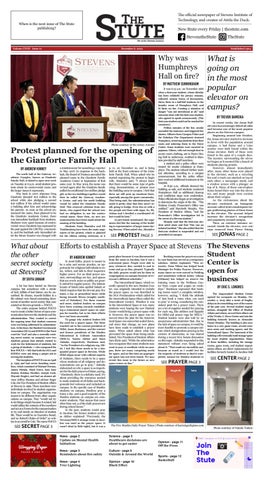
Protest planned for the opening of the Gianforte Family Hall BY ANDREW KINNEY The north half of the Gateway Academic Complex, known as Gianforte Family Hall, is slated to open next week on Tuesday at 6 p.m. amid student protests about its controversial name and the larger issues it represents. Way back in 2017, alumnus Greg Gianforte donated $10 million to the school while also pledging a second $10 million if the school would name a building after him and acknowledge his parents. As soon as the school announced the name, then planned to be the Gianforte Academic Center, there was immediate backlash from students. Students were upset because of controversial views Gianforte has expressed in the past against the LBGTQ+ community, and the backlash only intensified after the future Senator was charged with
What about the other secret society at Stevens? BY DIVYA UNNAM A lot has been buried on Stevens campus, but sometimes with a stroke of luck, tidbits of lost history can be unearthed. By chance, records hidden in a file cabinet were found containing documents of another secret society that once existed on Stevens grounds — FOCUS. The entire purpose behind FOCUS was to create a better forum of open communication between the students and the administration. They wanted to correct the ongoing issue that student concerns were not being addressed by administrators. At the time, the Student Government Association (SGA) and KHODA (the Farsi word for ‘God’ and also a currently existing secret society on campus) were two students groups that already existed to work for the betterment of students, but a group of students — who composed the first FOCUS — felt that both the SGA and KHODA were not doing a proper job in serving the students. The inception of FOCUS was on April 9, 1999 and had seven founding members, which consisted of Michael Ferrara, James Hietala, Mark Greco, Sara Jane Martin, Kristina Henkler, Joseph Cook, Mayush Singhvi, and had an alumni advisor Jeffrey Stanton and advisor Roger Cole, the Vice President of Student Affairs at Stevens in 1999. These members were individuals involved in student organizations on campus. The organization was meant to be different from other organizations on campus. They “would not try to do things simply because it existed, but would utilize the contacts of the members and act as a Forum for the campus leaders to try and decide on direction of student life. There would be no Executive Board, and no Robert’s Rules of Order” as written in an email by Cole. The name FOCUS
SEE SECRET PAGE 3
Wrapping Paper PAGES 6 AND 7!
a misdemeanor for assaulting a reporter in May 2017. In response to the backlash, the Board of Trustees amended the planned name to the Gianforte Family Academic Center in September of that same year. In May 2019, the name was revised again after the Gianforte family pulled its conditional $10 million pledge gift, so the two buildings together would then be called the Gateway Academic Center, and only the north building would be called the Gianforte Family Hall. This renewed criticism from students, who argued that the school now had no obligation to use the controversial name. Since then, no new announcements have been made about the naming of the building. Students Nasir Montalvo and Eli Trakhtenberg have been the main organizers of the protest, which is planned for the ribbon cutting ceremony at 6
p. m. on December 10, and is being held at the front entrance of the Gianforte Family Hall. When asked why he started organizing the protest to begin with, Montalvo said, “I always knew that there would be some type of gathering, demonstration, or protest once the building came to campus. I feel that there are still pent up emotions there, especially among the queer community. That being said, the administration has made it pretty clear that they aren’t really going to budge. Even less so with a few people out there with signs. So, Eli, Adrian and I decided a coordinated effort would be best.” As previously mentioned, the organizers feel like the naming of the building is representative of larger issues facing Stevens. When asked why, Montalvo
SEE PROTEST PAGE 3
TheStute
It was 6:15 a.m. on November 26th when a first-year student, whose identity has been withheld for privacy reasons, collected various forms of firecrackers, threw them in a half-full trashcan in the laundry room of Humphrys Hall, and lit them on fire. Creating a situation of danger “was not intentional at all,” said someone close with the first-year student, who agreed to speak anonymously. (The first-year student could not be reached for comment.) Within minutes of the fire, smoke ascended the stairways and triggered fire alarms. Officers from Campus Police and the Hoboken Fire Department stormed Humphrys, removing students from their room and ushering them to the Howe Center. Some students were escorted in pajamas. Others, with not enough time to secure warm clothing, sat in Pierce Dining Hall in underwear, swathed in blankets provided by staff members. A student and a police officer were treated for smoke inhalation at Humphrys. The student refused further medical attention, according to a campus announcement, but the police officer later received additional treatment at the hospital. At 8:30 a.m., officials deemed the building as safe, and students reentered Humphreys Hall as additional cleanup and ventilation steps were undertaken. Police officials also began an investigation to determine the origin of the fire. “The Hudson County Prosecutor’s Office was notified,” said Marybeth Murphy, Vice President of Student Affairs, “and the Prosecutor’s Office investigation led to the arrest of a Stevens student.” Murphy said that the first-year student acted alone and that “this was an isolated incident.” She also added that the first-year student is suspended and not permitted on campus.
What is going on in the most popular elevator on campus? BY TREVOR DAMEIKA In recent weeks, the Jonas Hall elevator has seemingly defied all odds and become one of the most popular places on the Stevens campus. Beginning around late October, the Jonas elevator started to increase in favor with the population around campus. A bed frame and a Lime scooter were both found within the Jonas elevator. Both of these were found in the span of a couple days. The mystery surrounding the elevator began as it seemed like a bunch of students playing pranks. However, almost immediately after, many other items were placed in the elevator, such as a recycling bin and a trash can stacked on top of each other, a newspaper stand, and a window screen with a plunger on top of it. Many of these out-of-place items found their way into the elevator, and many people were curious about their origins. As the curiousness about the elevator continued, an Instagram account called @stevensshitposts began publicizing photos of these items in the elevator. The account helped increase the elevator’s recognition and popularity around campus. Then, an extreme instance occurred. Inside the elevator, over 100 cups removed from Pierce Dining
SEE JONAS PAGE 2
Efforts to establish a Prayer Space at Stevens The Stevens Student BY ANDREW KINNEY Center is open for business
In most faiths, prayer is meant to be a calm and serene practice, an opportunity for religious individuals to relax, reflect, and talk to their respective higher power. For an ideal prayer session, surroundings are key, and spaces that are overly noisy or public are poorly suited for regular prayer. The Islamic tenant of Salah (also spelled Salaah or Salat) requires that the devout pray five times a day at prescribed times while facing towards Mecca (roughly southwest of Hoboken). For these reasons and more, student leaders on campus have been working towards establishing a communal prayer space on campus for months, but so far their efforts have not been successful. To gauge why student leaders felt the need for a prayer space, The Stute reached out to the current president of Hillel, Jason Buckman, and the current and former presidents of the Muslim Educational & Cultural Association (MECA), Nazrin Akther and Iman Alshafie, respectively. Buckman said, “As the President of a religious org, Hillel, I feel like there needs to be a designated prayer space at Stevens. While Hillel aligns more with cultural aspects of Judaism, there needs to be a space where students of all religions and denominations can go to pray.” Alshafie elaborated on why a space is so important for the daily prayers of Islam, saying, “Absolutely, there is a definite need. It’s about providing the resources needed to make students of all faiths and backgrounds feel welcome and included on campus. In the specific case of Muslim students on campus, Muslims pray 5 times a day, and a good majority of the Muslim students on campus are commuter students. That means that more often than not, 3 of the daily prayers are during school hours.” In the past, students would pray in Jacobus, the former student center, as Akther explained: “Previously, the Newman/MECA storage room in Jacobus was used as the prayer space. It wasn’t ideal (a little tight), but it was a
great place because it was disconnected from the noise in Jacobus, but it was a convenient place. People were able to pray whenever they needed to and to come and go as they pleased. Typically the daily prayers would not be done in congregation on campus because of everyone’s different schedules.” The Intercultural Space, which recently opened in the new Student Center, was originally intended to include the prayer space, as was described in the SGA Proclamation which called for the Intercultural Space (then called the Intercultural Center). Whether it was in the Intercultural Space or not, many students were hoping the new Student Center would bring a prayer space with it. However, the prayer space was removed when the plan for the Intercultural Space was somewhat scaled down, and since that change, no new plans have been made to establish a prayer space. When asked about what has prevented the space from being established, Vice President of Student Affairs Sara Klein said, “While the administration recognizes that some students may want to pray or meditate while on campus, there are many competing needs for space, and at this time an appropriate space has not been found. We may revisit this issue in the future as new space comes on line.”
Booking rooms for prayer on a case by case basis has served as a temporary solution. Akther explained, “This semester, Dean Nilsen has helped book Bissinger for Friday Prayers. However, many times we were moved to Fielding and sometimes without notice. Liliana [Delman] has helped us reserve the training room in the Wellness Center from 1-2pm and 4-5pm on weekdays.” Buckman expressed that booking rooms wasn’t a complete solution, however, saying, “I think the attitude of ‘just book a room when you need to pray’ is wrong, considering the consistent push for a prayer room. There are a lot of supplies needed for praying for each org, like siddurs and kippahs for Hillel and prayer rugs for MECA.” Student leaders were also told by an anonymous administrator that, due to the lack of space on campus, it would be more feasible to promote a campus culture which destigmatizes praying in the corners of classrooms, as was shared during a recent SGA Senate discussion on this topic. Alshafie responded to this statement without even being asked about it: “That made me incredibly sad, because as much as I would love for the majority of students to find it completely normal for Muslim students to
SEE PRAYER PAGE 3
The Five Muslim Daily Prayer Times | Photo courtesy of learningreligions.com
News - page 2 Update on Mental Health Initiatives
Science - page 5 Healthcare decisions are about to get easier
News - page 3 Reminders about fire safety
Culture - page 9 Outside & Around the World
News - page 4 Tree Lighting
Opinion - page 10 Black Effect
Opinion - page 11 Off the Press Sports - page 12 Basketball
BY ERic s. londres The long-awaited Student Center opened for occupants on Monday, December 2, 2019 after a series of lengthy delays in its remodeling over of the course of the past year. Several student organizations, alongside the Office of Student Affairs and others, moved their offices out of the Wesley J. Howe Center and into the building formerly known as Alexander House Monday. The building is also now home to a new game room, several common areas and meeting spaces, and the Intercultural Space. The basement of the building will eventually hold storage space for more student organizations. Many of these facilities, including the storage rooms, game room, and student organization offices, are direct replacements for facilities formerly located in Jacobus Hall
SEE CENTER PAGE 2
Photo courtesy of Natalie Todaro
December 6, 2019
2
News THE STUTE VOLUME CXVII - ISSUE 12 STAFF BOX EXECUTIVE BOARD EDITOR-IN-CHIEF............................................AUDREY D’SOUZA BUSINESS MANAGER......................................MARK KRUPINSKI MANAGING EDITOR.......................MATTHEW CUNNINGHAM LAYOUT EDITOR...............................................NATALIE TODARO OUTREACH CHAIR...........................................ANDREW KINNEY EDITORIAL BOARD COPY EDITOR............................................ANGELINA ZACCARIA HEAD PHOTOGRAPHER..............................COLE YARBROUGH SOCIAL MEDIA COORDINATOR..........................ELINA TUDER SCIENCE EDITOR......................................DYLAN JAMES MOON SPORTS EDITOR..............................................TREVOR DAMEIKA WEBMASTER........................................................JOANA FARDAD SYSTEMS ADMINISTRATOR.........................SERIK CZARNECKI STAFF AND CONTRIBUTORS ALEKSANDER DIMOSKI ALEX MURTAGH BRANDON SEIDMAN CAMILLE SIMON AL-ARAJI CHRISTIAN BONAVITA DAKOTA VAN DEURSEN DANIEL KANG DIVYA UNNAM ERIC S. LONDRES JACK KOSTELNIK JOHN HORGAN JON BROWN JULIA WIERZBICKI LIAM MCMURTRY MADISON DEJONG
MATHEW GREEN MELISSA KOSAR MICHAEL PREFER NASIR MONTALVO OFF CENTER PETER WHITE POOJA RAJADURAI SAMANTA WINTER SIMON PEPA
CONTACT US EMAIL.................................................EBOARD@THESTUTE.COM OFFICE.......................................3RD FLOOR STUDENT CENTER GBM TIME..................................................... TUESDAY @9:15 PM ADVERTISING...............................BUSINESS@THESTUTE.COM
THE STUTE POLICIES LETTER TO THE EDITOR LETTERS MAY NOT EXCEED 500 WORDS IN LENGTH AND MUST BE FULLY ATTTRIBUTED WITH NAME AND TITLE (NON-ATTRIBUTED LETTERS WILL BE ON A CASE-BY-CASE BASIS, BUT THE AUTHOR’S IDENTITY MUST BE MADE KNOWN TO THE EDITOR-IN-CHIEF). ALL LETTERS MUST BE EMAILED TO EBOARD@THESTUTE.COM. THE STUTE RESERVES THE RIGHT TO NOT PUBLISH ANY LETTER SUBMITTED FOR PUBLICATION. THE OPINIONS IN LETTERS SENT TO THE STUTE WITH THE REQUEST TO BE PUBLISHED ARE THE SOLE OPINIONS OF THEIR AUTHOR(S) AND DO NOT REFLECT THE VIEWS AND OPINIONS OF ANY MEMBER OR PERSON INVOLVED IN THE MAKING OF THE STUTE. THESE OPINIONS ARE NOT ENDORSED BY THE STUTE AND THE CONTENT OF THE LETTERS ARE PRINTED IN THEIR ORIGINAL, UNEDITED FORM. A DISCLAIMER WILL ACOMPANY ANY LETTER THAT IS PUBLISHED IN THE STUTE STATING THIS INFORMATION. CORRECTIONS AND CLARIFICATIONS FOR CORRECTIONS OR CLARIFICATIONS FOR ANY ARTICLES IN OUR NEWSPAPER, PLEASE EMAIL THE EBOARD. DISCLAIMER ALL OPINIONS, STORIES, AND EDITORIALS REFLECT THE VIEWS OF THEIR RESPECTIVE AUTHOR(S). THE STUTE RESERVES THE RIGHT TO EDIT ALL LETTERS AND ARTICLES SUBMITTED FOR PUBLICATION FOR CLARITY AND FACTUAL ACCURACY, OR NOT PUBLISH THEM. NO PART OF THE STUTE MAY BE REPRODUCED IN ANY FORM, IN WHOLE OR IN PART, WITHOUT THE WRITTEN CONSENT OF THE EDITOR-IN-CHIEF. CITED REFERENCES OF THE STUTE ARE PERMITTED.
THE STUTE WHY YOU SHOULD JOIN IMPROVE SKILLS AT A SCHOOL LIKE STEVENS INSTITUTE OF TECHNOLOGY, YOU NEED MORE THAN CAL 103 AND 105 TO BOOST YOUR WRITING. THE STUTE PROVIDES TRAINING IN NEWS WRITING AND FOLLOWS AP FOR GRAMMAR AND STYLE, THE STUTE IS A SAFE, NON-JUDGEMENTAL ENVIRONMENT WHERE YOU CAN IMPROVE YOUR WRITING SKILLS AND BECOME MORE CONFIDENT AS A WRITER OVER TIME. PURSUE A PASSION IF YOU LOVE FASHION, MOVIES, STEVENS DRAMA, OR POLITICS, WRITING A COLUMN FOR THE STUTE IS A GREAT OPPORTUNITY TO PURSUE YOUR PASSION. OUR COLUMNISTS GET UP TO A FEW HUNDRED TO THOUSANDS OF CLICKS ON THEIR ARTICLES. SHARE YOUR TAKE WITH THE STEVENS COMMUNITY AND BECOME A COLUMNIST TODAY! RESUME/LEADERSHIP THE STUTE IS WHAT YOU MAKE OF IT. FOR THE EBOARD, WORKING FOR THE STUTE IS LIKE A PART TIME JOB; WEEKLY MEETINGS AND DEADLINES, PLANNING CONTENT, WORKING COLLABORATIVELY WITHOUT KILLING EACH OTHER, ETC. THERES SO MANY SKILLS TO ADD TO YOUR RESUME ONCE YOU JOIN THE STUTE!
JONAS
CONTINUED FROM PAGE 1 Hall were stacked inside the elevator with a pepper shaker on top of them. This subsequently prompted a response from the Office of Residential Education. On November 26, Stacy Flowers, Director of Residential Education on campus, sent an email to all Jonas residents detailing the happenings in the past couple months.
CENTER
CONTINUED FROM PAGE 1 before its late 2018 closure. The building was originally scheduled to reopen in January 2019; this date was pushed back several times until its official reopening on December 2. Organizations which moved into the new building include The Stute, The Link, Castle Point Radio (WCPR), the Honor Board, and the Student Government Association (SGA). All of these organizations were previously housed in Jacobus Hall and had been operating out of temporary office space on the 7th floor of the Howe Center in the interim. Audrey Dsouza, Editor-in-Chief of The Stute, said of the building that “[t]he parts that are complete are wonderful, which is a relief considering how long the building took. We love our new office and are very excited about how it’s like the new Jacobus.” SGA President Jason Chlus said “I think the building is a huge upgrade! I think the building is going to be awesome for students and hopefully they really like it. The move in seems to be going well and I am looking forward to it being open for all.” SGA Vice President of Finance Elena Malova stated that she did not have an opinion on the new building as it is not finished yet, but expects to have one when the student organizations which are slated to have storage space in the basement are able to utilize those spaces. Currently, those organizations are using temporary storage space located in the basement of
Flowers stated, “It has been brought to my attention that there have been on-going ‘pranks’ occurring where students have been placing various items in the Jonas elevator […] First and foremost, we do not want to see any of you get injured while trying to move any of these items from one place and put them in the elevator.” Flowers even gave a list of what had been placed in the elevator. Humphreys Hall. However, this storage space is inconvenient for organizations and has caused personal and operational difficulties for the leadership of several organizations, as previously reported by The Stute. Laina Emmons, General Manager of WCPR, said that they are “super pumped” about the new space. “We’re glad to be back on air and start having shows again so that the Stevens community can be more involved with our club. We’re excited to have a space we can customize-ish because we can now express our personality through it whereas in Howe we were not able to decorate or play music and it really hurt our morale.” Former General Manager Dylan DiGeronimo said that he thinks “it’s great that WCPR is now in a space purpose-built for radio broadcasting, and I’m very optimistic about what this space is going to enable for the future of the club as well as all of the organizations who’ve moved in alongside us.” The Stute reached out to the Stevens administration with regards to the reopening of the building. Assistant Vice President for Student Affairs Sara Klein wrote that “I’m absolutely thrilled with the new Student Center. The team in Student Affairs and the student organizations are happily settling in to their new offices and we’ve already had so many students come to hang out, study, play pool, and socialize. We love all of the new space for students and we already feel that the building will facilitate an even stronger Ste-
Update on Mental Health Initiatives BY LIAM MCMURTRY Given the national trend in suicide among college students, to which Stevens is not immune, administrators outlined goals that Stevens should meet to properly address our mental health crisis, according to an email sent out by Marybeth Murphy, the Vice President of Student Affairs and Enrollment Management, on November 19. Over a year ago, the Stevens administration presented a plan to the Board of Trustees and listed seven points of focus that would serve as a blueprint for addressing the mental health crisis, with the hope to ultimately reduce the stigma around seeking psychological help. The first action item on this list was social connectedness, which centered around improving residential education and providing more opportunities for engaging in campus life. Moreover, this initiative tied into the “No Duck Left Behind” policy that Stevens was implementing. Creating and fostering a safety net for at-risk students made up the section item on the agenda, which focused on recognizing warning signs and providing suicide prevention training. Third on the list was “make seeking help our strength,” which encompassed the creation of the President’s Mental Health Task Force as well as the gathering of various health services provided by the school into the centralized Student Wellness Center. Next on the list was “extend more helping hands,” which referred to both the hiring of a wellness educator in October 2018 and a drug and alcohol specialist in February 2019. For the fifth item, crisis management was the target. Here, the goal was to continue implementing sound crisis management skills by regularly updating the Emergency Operations Plan. After this item, reducing risk or harmful
exposure to potentially lethal means became the area of focus. To accomplish this goal, the Stevens Risk and Compliance Steering Committee commissioned an extensive safety scan of the campus in February 2019. The company hired to conduct this scan will be doing so in the Spring 2020 semester. Last on the list was “Teach our ducks how to swim” where Counseling and Psychological Services, the Career Center, the Office of Residential Education, and the Academic Support Center all hosted workshops to help students cope with the challenges of college life, and prepare them for life after graduation. To implement all these agenda items and properly address the sensitive topic of mental health, the administration has taken steps aimed at reducing the stigma associated with seeking psychological help and enacting suicide prevention measures. Way back in 2013, Stevens became one of the first 30 inaugural schools to be given the JED Seal. This JED Seal is given to schools that have exhibited strong programs aimed at suicide prevention and mental health improvement. The organization behind this award, the JED Foundation, seeks to improve the emotional wellbeing of high school and college students as well as prevent suicide by partnering with schools to administer substance abuse and suicide prevention systems. Since receiving this seal, Stevens has partnered with the organization to expand our emotional health support system. Regarding the effort to reduce the stigma associated with mental illness, Stevens set up the President’s Mental Health Task Force, which is Co-Chaired by Dean Kelland Thomas and Vice President Marybeth Murphy. The formation of this task force was
CONTINUED ONLINE AT THESTUTE.COM
Later on in her email, in a more strict and stern manner, Flowers declared, “If damages are caused and we are unsure who is responsible, each of you as residents of Jonas may be charged to fix those damages.” Now, the Stevens community is left to think about one question — Will these “pranks” continue or will they fizz out with the Residential Education response?
Photo courtesy of Jonah Kramer Richards
Photo courtesy of Natalie Todaro vens community. I want to give a sincere thank you to all of the people at Stevens who came together to make this renovation possible.” Lisa DeMarco, Director of Design and Construction in the Division of Facilities and Campus Operations, wrote “[i]t was a pleasure overseeing the reconstruction of the Alexander House into the new Student Center. While challenging at times, due to the age of the
structure, witnessing the transformation of this building has been a highlight of my tenure at Stevens. As an alumni, I want to extend a warm welcome to the students and staff. Please enjoy the new space. I truly hope it serves you well for years to come.”
CONTINUED ONLINE AT THESTUTE.COM
SGA Big Beautiful Budget Meeting BY AUDREY DSOUZA The Student Government Association (SGA) held its semesterly budget meeting, also known as the “Big Beautiful Budget Meeting (BBBM)”, on Sunday, November 17 in the Fielding Room. For nearly 12 hours, the committee chipped away at the fates of over 90 student organizations that had submitted budgets for the Spring 2020 semester. One of the main responsibilities of the SGA is managing and distributing the Student Activity Fee (SAF). Anticipating $770,000 from the SAF next semester and $50,000 left over from this semester, $841,533.59 was approved by the Senate for club spending at this past Wednesday’s Senate meeting. Of the $841,533.59, $233,750 will go to line items for the Office of Student Life, $189,000 will go to line items for the SGA, $115,707 to Club Sports, and $303,076.59 to student organizations. The breakdown of these line items can be found on the SGA’s Ducklink page as Resolution S-19F-007. Club budgets were decided by the Budget Committee and the Committee on Student Interests (CSI). “Cuts” to budgets are divided into “objective cuts,” based on the rules in the SGA budget policies and the Student Organization Policies Manual written by the Office of Student Life, and “subjective cuts” which are entirely up to the discretion of the
voting members of the BBBM. The SGA updates these policies frequently, as noted in a previous article published by The Stute this semester. One change that affected many clubs this semester is that organizations are now only allowed to request funds for up to four events (they could previously request funding for up to five) and can as for more money through an additional funding request (AFR) for an additional fifth event during the semester in question. Unaware of the changes to the financial policy, many student organizations submitted requests for five or more events. Another change was that projects and performances would also count as events. This affected organizations such as the Stevens Dramatic Society, which receives funding for shows in Debaun as well as small scale events for members, and Stevens Hobby Robotics Club who receives funding for materials. Organizations that saw a huge portion of their budget cut were Stevens Italian Club who received 0 dollars due to organizational management issues within the club and Gear and Triangle who only received 13% of the budget they requested. NSBE and AIAA were organizations that submitted their budgets late, so they also did not receive any of their budgets, but were told they could return to the committee next semester and request the same funds as an AFR.
Follow @thestute on Instagram
AND LOOK OUT FOR SPRING 2020 MEETINGS!
December 6, 2019
3
News Stevens seeks national Reminders about fire safety BY DAN Cunning mental health award BY DAKOTA VAN DEURSEN Active Minds, a national nonprofit dedicated to supporting mental health awareness and education, has awarded campuses with its Healthy Campus Award for four years. The award recognizes “schools that provide access to quality healthcare” and “give equal priority and investment to mental health,” per the Active Minds website. Last year, Active Minds awarded 7 U.S. schools with their award; Stevens is actively pursuing recognition in the 2019 cohort. Entry for this award is welltimed. In 2018, an Active Minds student chapter was formed at Stevens. The school’s Counseling and Psychological Services (CAPS) office was recently moved into the second floor of the newly-minted Student Wellness Center (née Pond House). Stevens’ new President’s Task Force on Mental Health has convened to discuss on-campus awareness. Several members of the Task Force were unavailable for comment. Active Minds student chapter co-founder Ashley Peck understood that “it can be received as [Stevens] being over confident in what they have done so far but I think a lot of things are in the works that the students don’t necessarily see.” She specifically highlighted the CARE team and CAPS walk-in hours as impressive programs Stevens should be proud of. Jason Chlus, President of the Student Government Association (SGA),
said he, among other student leaders, was asked by the Office of Student Affairs “to write a letter of why we deserve this award.” His certainty wavered, so he asked the SGA Senate for their thoughts at a recent meeting. “I mean as a president I would say I am honored that we are recognized for this award but as an SGA … we don’t feel we deserve it yet,” he said. In fact, many SGA Senators were adamantly opposed to Chlus writing such a letter. The minutes show several senators encouraging Chlus to write a letter explaining why Stevens does not presently deserve the award. Samanta Molla, SGA Senator and President-Elect, was present when Chlus mentioned the letter. She shared Chlus’ sentiments. “The University may have a plan for improving mental health, but … I don’t believe that enough students have been exposed to what is offered or can readily claim at this moment that Stevens is doing everything possible to keep its students first.” “I don’t want the efforts on mental health to stop or even slow down [at Stevens].” said Chlus. He encourages Stevens to never stop pushing initiatives which facilitate discussing, treating, and destigmatizing mental health among its students. The Active Minds 2019 Healthy Campus Award recipients will be notified on January 31 and publicly announced in late February. Stevens is currently drafting its Phase II application, due December 30.
Smoking on Campus BY ALEKSANDAR DIMOSKI Gabrielle Guider, the Wellness Educator from Student Affairs, states, “Research demonstrates that cigarette smoking remains the leading cause of preventable disease, disability, and death in the United States […] there is no risk-free level of exposure to secondhand smoke. Secondhand smoke can cause stroke, lung cancer, and coronary heart disease in adults.” Because of the health risks associated with smoking and second-hand smoke, New Jersey issued the New Jersey Smoke-Free Air Act. According to the Tobacco Control Policy and Legal Resource Center of New Jersey website, the New Jersey Smoke-Free Air Act and subsequent laws prohibit all smoking inside public buildings and workplaces and in “exterior area[s] if smoking in the exterior area results in migration, seepage, or recirculation of smoke to an indoor public place or a workplace at which smoking is prohibited.” On September 6, 2016, Senior Advisor of the Office of Human Resources Matt Principe sent out an email stating that, “In order to protect the health and safety of all staff, faculty, students and visitors, and in accordance with the state regulation, the ‘New Jersey Smoke-Free Air Act,’ Stevens will establish a formal policy in the near future regarding smoking on campus, both indoors and outdoors, for all staff, faculty, students and visitors.” In the email, Principe stated that “The current practice which permits smoking just outside of buildings is causing discomfort to a number of staff and guests. Therefore, as a provisionary measure until a formal policy is established, beginning September 1, 2016, smoking will be prohibited within 25 feet of all buildings.” A year later on October 22, 2017, the Student Government Association (SGA) approved proclamation P-17F-003, Recommendation of the Establishment of a Formal Smoking Policy. In the proclamation, the SGA recommended that the administration create a policy which would ban
the use of tobacco products in all buildings, residence halls, balconies, patios, walkways, vestibules, and more. According to the SGA proclamation, “Implementation of this policy is the responsibility of the Departments of Human Resources and Student Affairs.” The proclamation also claims that oversight is the responsibility of administrators, stating, “The Provost and Vice President for Academic Affairs, Vice President for Facilities, Vice President for Human Resources and Vice President for Enrollment Management and Student Affairs are the Stevens Institute of Technology Officials responsible for the administration of this policy,” with enforcement the responsibility of Campus Police. At an SGA meeting on November 17, 2019, SGA President Jason Chlus claimed that he was told that smoking on campus was being dealt with. “I was talking to a few members in OSL, they assured me that this issue was known and that they are working on it. This was my sophomore year, so about a year ago. I showed them the Law [25 feet for academic buildings] and was told that they knew about this and they would be coming out with feedback soon.” The policy currently in place is written in the student handbook, which states, “Smoking is prohibited within 25 feet of all campus buildings, including but not limited to individual offices and rooms; athletic and sporting facilities; spectator areas at outdoor university events; university-owned vehicles; shuttle buses and vans; dining facilities, theaters, and concert halls; partially enclosed areas, such as archways, weather-protected rams and tents; and outdoor dining areas.” However, people on campus continue to smoke. According to Sara Klein, Assistant Vice President for Student Affairs, “Having a policy does not ensure 100% compliance. Some members of our community still smoke within 25 feet of campus buildings. Our staff consistently remind folks of the policy, but it’s ultimately on all of us in the community to remind smokers about the policy.”
STEVENS FIRE SAFETY COORDINATOR
Recent fire-related incidents on campus provide an opportunity to remind the Stevens community about the importance of fire safety as well as efforts being made to protect the community from fire. Stevens employs a combination of engineering, education, and enforcement practices to maintain a successful fire safety program. In accordance with the New Jersey Fire Code, Stevens residence halls are sprinklered and actively monitored by a fire detection system. Fire systems are tested and inspected by a licensed contractor in compliance with the fire code. Educating the Stevens Community about fire safety is critically important to the success of the fire safety program. As the Stevens Fire Safety Coordinator, I conduct multiple fire safety training sessions throughout
PRAYER
CONTINUED FROM PAGE 1
be praying around campus, society isn’t there yet. To have students deal with the worry of thinking “is this the time that someone will stop me and insult me” is unfair. Instead, Stevens should be taking greater steps to establish a place where students can go to express their faiths, while simultaneously educating the general student body about inclusivity and people of different faiths, just like they would educate others about people of different cultures.” Concerns were raised that the space would become overcrowded, or if students of different faiths would be able to effectively share the space, but the student leaders involved were confident that these issues could be overcome. Buckman said, “I don’t think there will be a problem with overcrowding sharing the space with other religious orgs, I think it’ll bring us closer together. It will allow us to share our traditions and customs and prayers with others, and form a more inclusive
SECRET
CONTINUED FROM PAGE 1 was chosen so it wouldn’t seem mysterious or similar to a secret society, thus establishing itself as an open channel. The series of events leading up to the direct creation of FOCUS took over the course of approximately one month in early Spring 1999. On March 8, 1999, Rose Pehrson, dean of the Faculty’s Office at the time, sent an email to seven individuals to arrange a meeting to “discuss Institute policies,” which was known to be a cover for the KHODA tapping ceremony or induction. However, on the date of the intended KHODA tapping, a note was placed on the door cancelling it. Canceling the meeting gave off the impression to FOCUS members that KHODA was rethinking its own position on choosing their inductees among their friends. On March 12, 1999, an editorial written in The Stute made a jab at KHODA with “if the membership taps people who have the same ideas as the current mem-
the year. Working closely with the Offices of Residence Life and Student Affairs, I provide fire safety training for all Resident Assistants (RAs) and for freshmen, as part of the orientation program. Fire safety talks are given during each of the four required evacuation drills in residence halls. I’m available to meet with any Stevens group to discuss the Stevens Fire Safety Program. Enforcement is another important tool that is used in an effective fire safety program. The Stevens Student Handbook provides fire safety information as well as rules regarding fire safety. Students must be familiar with the handbook and understand that these rules have been enacted to protect the Stevens community from fires on our campus. Thankfully, no students were injured as a result of the recent fire incidents. Unfortunately, during the most recent incident, a Stevens Police Officer was seriously injured while evacu-
ating students from the building. This is a sobering reminder of how important fire safety is to the well-being of the Stevens community and that we need everyone to do their part to ensure a safe campus.
and welcoming community with all of our students.” All of the other student leaders expressed similar doubt that there would be any conflict, assuming that it is made clear that the space is open to all people and faiths. The student leaders were asked if they thought the school had handled the many calls for the space well. Buckman said, “I think that it is due time the school has heard our need for a shared prayer space, and I’d like to see it happen.” Alshafie said, “At first, I thought so. In the early stages I felt like myself and my community on campus were being heard, and that the school was working to become a more inclusive environment. But as each month went on, it felt like less and less of a priority. The sad thing is, the Muslim community is used to it. We are used to being put on the back burner because there are issues that involve more students on campus than our minority that needs to be resolved. Issues that are absolutely important, but it pushes students that have religion as a core to their identity aside. I understand there is limited
space on campus, and there are limited funds to direct for this type of work since the administration has told us that Stevens is secular and does not associate with any one religion. But just because the university as a whole doesn’t associate with a particular religion, doesn’t mean they shouldn’t take the steps to make sure that their students who do associate with different religions are supported. For example, I may not be Catholic, but I was shocked when certain members of the administration asked Newman Catholic why they need more resources when there are many churches within walking distance of Stevens that students can turn to. Having these types of resources on campus allows students to create a community at Stevens that connects them beyond just classes, and gives students the opportunity to learn about each other’s faiths and backgrounds while breaking down negative stereotypes.” “We are simply asking for a space that is dedicated to prayer, quiet, and open to everyone. It does not require much else,” Akther concluded.
bers, the organization will quickly grow stagnant. What good is inducting someone who is so weak of character that they are afraid to rock the boat?” They added that “if they are going to be the voice of the student body, they cannot be weak. They cannot fall prey to people who are only trying to protect their best interests. The members of Khoda should be honorable in their pursuits and at all times work for the betterment of the students. They should not be sheep.” In that same issue of The Stute, a letter to the editor was published questioning if KHODA actually represents students and whether the administration should rely on students elected by their classmates to represent them, not secret groups. The criticism of KHODA inflamed its members so severely that members of the secret group were seen stealing 200 copies of this issue from the distribution bin in the Howe Center, restricting freedom of the press. Two weeks later, the FOCUS members met with Roger Cole to discuss their concerns about KHODA, mainly with the fact that the secrecy of the
society prevents students from providing them feedback. During this meeting, Cole was excited about a group that would disseminate information from the students and provide valuable input to the administration. No record of FOCUS exists beyond the last news clip of Cole’s excitement, and the current status of FOCUS is unknown. A random selection of students was asked on their thoughts on FOCUS. Dakota Van Deursen provided a seemingly innocent comment on the matter, “I’ve got nothing to say about FOCUS.” Meanwhile, Eric Londres provided insight on the possible perpetuation of the group on campus by saying “the real FOCUS was not being in KHODA the entire time.” Perhaps FOCUS was silenced, perhaps it was removed from existence, perhaps, as imagined by a columnist in the April 16, 1999 edition of the Stute, the SGA, KHODA, and FOCUS have somehow all combined into the supergroup “Skahodagus” that handles “ALL student concerns.” Or perhaps it still exists somewhere else, somewhere among us.
only for people that feel like this building is a stain on our school’s reputation. This is for everyone who feels like Stevens has fallen short on anything that has to do with catering to the needs of students. May it be about how you feel the hack was handled, the way you feel
about the housing situation, or the way the school has historically been lacking in the mental health department, then this is an opportunity for you to voice that, and we would love to see you come out and support us so you can have your voice heard.”
A FEW REMINDERS ABOUT FIRE SAFETY: • • •
•
Report unsafe conditions or actions to your RA or Stevens Police Familiarize yourself with two ways out of any building you visit In the event of an alarm activation, exit the building immediately and follow the direction of emergency responders If you have information as to the cause of the alarm activation, please inform the Stevens Police Officers at the scene
PROTEST
CONTINUED FROM PAGE 1 said, “I want to make it especially clear here that the Gianforte Family Hall is only a piece to this puzzle. Think of it as the last straw in a continuing fight for student-centricity. We’re addressing three key areas with this protest: Administrative Transparency and Accountability, Student Wellness, and Campus Climate. Underneath these areas are systemic issues that we have continued to fight for to no avail. Examples include sensitivity trainings, STD/ STI testing, furthering Mental Wellness, and much more. GFH is a great example of an issue that has fallen underneath all these three. No matter how administration words it an email or says it in a speech, this building is harmful. It is a clear testament to how much they truly value their community members.” The organizers have also put together a Solution Proposal to explain their stance in detail. Montalvo summarized it as “A broad overview of student-centricity on campus, and the empty promises Stevens has made to its students in response to this building. There are three subsequent sections addressing our ‘Big Three’ (Administrative Transparency, Student Wellness and Campus Climate). Underneath these three will be stats, facts and testimonials about systemic issues on our campus. Finally, there will be a list of key solutions, with the main asks being to remove the ‘Gianforte Family Hall’ sign and to form a task force in addressing these issues, with very definitive guidelines with what we want to see in terms of student representation and deliverables.” In a closing statement, the organizers said, “I think it’s very important to mention that this demonstration is not
December 6, 2019
4
Entertainment Committee Sixth Annual Tree Lighting By Mark Krupinski At approximately 9:30 p.m. on December 4, 2019, the Stevens holiday tree was lit as a part of Entertainment Committee’s sixthannual tree lighting. At the event, attendees could make their own hot chocolate at a hot chocolate bar, enjoy holiday treats, listen to performances by Floctaves, Quackappella, and President’s Ensemble, and watch the first annual Stevens Santa Competition. During the Santa Competition, participants competed in minute-to-win-it style games to win a pizza party for their organization. Brandon Seidman, representing Off Center, took first place, the Student Government Association took second place, and Sigma Phi Epsilon took third place. “We are extremely happy with the success of this year’s Holiday Tree Lighting!” said Olivia Scott. Scott thanked the student performers, Stevens administration, the Santa Competition participants, and anyone who attended for making the event a success. “We’re looking forward to bringing the event back next year and making it even bigger and better,” added Scott. Students gathered on Babbio Patio for student performances, holiday treats, and the lighting of the tree. Photo by Jon Brown.
Clockwise from left: Entertainment Committee memebrs Olivia Scott and Julia Dwight pose in front of the tree, members of the SGA cabinet placed third in the first annual Stevens Santa competition, students participate in the Stevens Santa competition, free ornaments and mugs are distributed to all students at the event, acapella groups and musicians performed at the lighting, students pose with goodies picked up at the event. Photos by Jon Brown and Ethan Che.
Molla and Castellanos win SGA election By aleksander dimoski
From left to right: Christian Bonavita, Andrea Maria Diaz-Gonzalez, Adrian Castellanos, Samantha Molla, Anthony Tesori, and Hailey Tanner. Photo courtesy of Adrian Castellanos.
This November, Samantha Molla and Adrian Castellanos were elected as President and Vice President of Operations by the student body. Soon after the election, the Molla administration selected the members of their cabinet, with Hailey Tanner as the new Vice President of Student Interests, Christian Bonavita as the Vice President of Finance, Andrea Maria Diaz-Gonzalez as Secretary, and Anthony Tesori as the Vice President of Academic Affairs. The election results show Molla and Castellanos in the lead with 343 votes, E.J. Hannah and Jason Buckman with 290 votes, and Brandon Seidman and Simon Pepa with 110 votes. Jason Chlus and Ryan Tom transfer power early next spring. According to the Student Government Association (SGA) constitution, “The President and Cabinet shall assume office at 1:00 PM EST on the first Wednesday of classes of the spring semester following the Presidential election.” However, according to Castellanos, the cabinet has already begun sitting in on meetings with their current counterparts in order to get adjusted to the positions and prepare them to take on those positions in full. The Molla administration hopes to improve life at Stevens by improving the campus atmosphere, creating a smoke-free campus, helping to improve the scheduling process, improving sustainability on campus, and more. Their motto is “Lifting student voices through empowerment and creating a home for all.” For this administration, the election was a learning experience. According to Castellanos, “I feel the campaigning process was an eye opening one. I met so many students and learned so much not just about myself, but about Sam, Stevens, and so many individuals on Campus that I probably otherwise wouldn’t have.” Moving forward, Castellanos wants to ensure that the SGA is running as smoothly as possible, stating, “as the Vice President of Operations I will be doing a lot of internal work. My main goal for the SGA internally is to work with senators and committee chairs to better understand their needs and be able to help them succeed. Also I generally want to make the SGA more of a family so we can work together better, and students will be more willing to approach us with problems and concerns so we can handle those on their behalves the way we are meant to.” Tesori also hopes to make progress on campus as the Vice President of Academic Affairs (VPAA) by improving the co-op program. “My plans moving forward as VPAA include finishing a lot of the work that Alex [Reina] and Marianna [Flemming] worked towards in previous years. Academics move a lot more slowly than other positions on the cabinet, but I have initiatives that I want to bring up because of my own personal experiences at Stevens as a co-op student who is getting a CAL minor. I want to work with the co-op office and implement a system to gather feedback from co-op students to gauge how well their schedules are working for them. I personally find my co-op schedule to work well, but I have met other students who didn’t feel the same way about theirs; I want to gauge how widespread these issues are across other majors.” For those interested, the inauguration ceremony takes place on January 22 at 9 p.m. in Babbio Atrium, and everyone is welcome to attend.
December 6, 2019
5
Science
Healthcare decisions are about to get easier BY Samantha Winter The crossover between artificial intelligence and healthcare has arrived. If the thought of machine learning in healthcare makes you imagine an eerie, Brave New World-esque universe, don’t worry. This technology will help bridge the communication gap between doctors and patients. It could also save lives. Samantha Kleinberg, a computer science professor and researcher at the Stevens Health & AI Lab, was recently awarded three grants from the National Science Foundation (NSF) and the National Institutes of Health (NIH) totaling $2.3 million. Her goal? To develop artificial intelligence that personalizes the information patients receive in order to help them make better-informed health decisions. Kleinberg said she hopes to “improve human health through computing.” Her aim mirrors the growing need for artificial intelligence and big data in healthcare. Though the method is technologically-based, the focus is on the patient. This adds unprecedented personalization to diagnosis, treatment, and prevention. The three diabetes-focused investigations use artificial intelligence and machine learning in their calculation methods to help patients. One $917,879 grant from the NSF is titled “Uniting Causal and Mental Models for Shared Decision-Making in Diabetes.” Kleinberg and her team will create computational methods to
personalize information for patients with diabetes so that they can pick optimal treatment plans. Since the technology combines machine and human input, it uses a collaborative decision-making approach so that the patient and the clinician can work together to develop the best treatment plan. Kleinberg recognizes that each patient, doctor, and caregiver has different beliefs about preferred treatment. With this in mind, she will create training modules to educate clinicians about how patient beliefs influence both trust and decision-making. The next grant comes from NIH. This $864,220 award is put towards “Harnessing Patient Generated Data to Identify Causes and Effects of Nutrition during Pregnancy.” About 9 percent of women develop gestational diabetes during pregnancy. According to March of Dimes, a non-profit focused on mother and baby health, this type of diabetes can result in premature birth or stillbirth. For this investigation, Kleinberg will collaborate with Andrea Deierlein, a researcher at New York University. They will collect patient-generated data through wearable activity monitors. With this technology, patients will log meals in real time using photos that can sense food types and calories. Additionally, the monitors can record symptoms to observe what happens before the illness develops. Kleinberg aims to pinpoint which factors cause this disease, as this
technology could help guide important decisions during pregnancy. The last award, “Moving Beyond Knowledge to Action: Evaluating and Improving the Utility of Causal Inference,” worth $499,454, comes from the NSF. Kleinberg wants to create artificial intelligence that directly benefits patients. “My group’s work aims to potentially prevent people from developing chronic diseases in the first place, and to otherwise help them better manage their illnesses,” she says. “It will hopefully help many people lead healthier lives.” The research will focus on understanding how the output of an algorithm can be useful for human decision-makers. For conclusive results, algorithms should be evaluated based on their ability to be helpful for decision-making rather than their effectiveness (how many causes they find or how fast they accomplish finding them). This investigation will introduce new methods for making such models more personalized, allowing patients to improve their everyday decisions around diet, exercise, and overall treatment. Kleinberg’s research is innovative. However, if you think that overlap between health and AI is an invasion of privacy, you aren’t alone. Public outrage was recently sparked by the revelation that Google quietly partnered with Ascension to collect and analyze patient data. This raised questions about the security of the initiative and if safeguards have
Pictured: Samantha Kleinberg | Photo courtesy of healthailab.org been enacted for consumers. Some critics are worried about the protection of their information. Others think that such technology will eliminate the need for humans in the healthcare community. While Google waits to update the public on the implementation of this service, critics should consider both sides of the matter. Though risky, artificial intelligence and machine
involvement in healthcare could be the newest trend in fostering an innovative and personalized healthcare system. Navigating the world of health can be tricky, but Kleinberg’s work could spark a major shift in personalized healthcare, one that doctors and patients alike appreciate. After all, Kleinberg says, her work is “to aid humans – not replace them.”
“We blew up so many things.” Professor Pastore’s career in an army lab BY Madison DeJong Professor Robert Pastore is a senior lecturer in the Department of Physics. He graduated from Stevens in 1986 with a bachelor’s degree in Engineering Physics. In the following years, he also completed both his masters and Ph.D. in Physics at Stevens. Initially torn between electrical engineering and engineering physics, he decided he preferred the physics route due to his interest in lasers and optics. “I thought that was neat,” said Pastore. When he was close to completing his undergraduate degree, he did an on-campus interview with the U.S. Army and was offered a job at the Fort Monmouth military base here in New Jersey, where he would work for the next twenty-five years. He was employed in the Electronics Technology and Devices Laboratory. The main research done in this laboratory was to develop communications and the electronics needed to support any army mission. Pastore worked specifically in the Pulse Power Branch, where they did research with high voltage and high power systems, specifically high voltage switches and capacitors, handling anywhere from 50,000 to 100,000 Volts. They worked to test specific components and make sure that the capability of the materials was accurate and matched the army’s needs. One project that Pastore worked on centered around the development of a new type of cannon, called an electrothermal-chemical gun. In this new type of gun, a specific combination of capacitors and inductors would create a type of speed ramp for the projectile. The propellant would be burnt in an
increasing fashion, which would maintain the high pressure behind the projectile. This would increase the projectile’s acceleration as it moved down the barrel of the gun. Working on such powerful systems included a certain amount of danger. The largest incident they ever caused was when they were testing a circuit of 50 large capacitors in parallel. Placing capacitors in parallel increases the overall amount of charge in the system. The circuit also contained five spark gap switches. Spark gap switches contain a gas that when exposed to a spark, start the flow of current. This system was connected to a load that simulated the cannon’s propellant. They built the circuit using aluminum bars, which had become worn down from frequent usage. When they flipped the switches, the aluminum bars shattered and dumped 20,000 to 30,000 amps into the ground all at once. A current of 0.1 amps is capable of killing a person. This blew out the power in the entire section of the base and lit the substation on fire. The general’s office lost power and everyone had to be sent home for the day. “So that was fun,” Pastore remarked. Eventually, the high voltage section of the lab was moved to a base in Maryland, and Pastore was moved to the other research group at Fort Monmouth, the Intelligence and Information Warfare Directorate. In this lab they focused on signals intelligence, which involved intercepting radar signals. He worked on designing systems and antennas. He had no experience in designing antennas, however, they told him, “You have a Ph.D., go read a book and figure it out.”
When the second Iraq War began, Pastore was assigned the mission of detecting and neutralizing roadside bombs. This task was challenging because the United States military was designed to fight the Russians in Western Europe. In the Iraq war, the military was fighting people with no formal army. The enemy was also very smart and could make bombs out of anything. Some examples included wireless doorbells and long-range cordless phones. Every bomb was made differently, and the lab would receive bomb analysis results done in the field by FBI and CIA agents. The research lab in New Jersey could recreate the bombs and work to design solutions. The types of bombs that Pastore’s lab was combating were made by placing an explosive inside a fake rock. When the fake rock was covered in sand it looked like any other rock in the desert, and these bombs were impossible to see visually. The bombs were wireless and triggered using a mechanism much like the motion detectors found in home security systems. Pastore’s job was to find a way to set off the bombs before the military trucks got there. There were many constraints on the device they were developing. It had to be able to cause the bombs to detonate at least 50 feet before the Humvee reached the bomb while the truck was driving sixty to seventy miles per hour. This provided a window of only a few seconds for the device to work. Even if the device worked scientifically, there was no guarantee the soldiers would use it unless it met all of their needs. It was important that the device was very simple. The lab was told to
make it have only three buttons: on, off, and it’s working. Additionally, the final device had to run off of an allotted portion of the truck’s power supply, be a certain dimension, maintain its own cooling system, be sand-proof, and be developed within a specific budget. Creating a functioning device is more complicated than just perfecting the science, and Pastore worked with systems engineers to figure out how to put the science into a working and realistic system. The lab also received feedback from members of the army and worked to incorporate that into the final design. Another project that Pastore worked on was a bomb/electronics detection system. The theory was to constantly send out an electronic signal, so when the signal hits an electronic object it bounces back to the truck. This device was beneficial because it looked solely for electronics. According to Pastore, if you are in the desert and you get a response, it means “there’s something there that shouldn’t be there.” The military convoy could then stop and assess the situation. This system utilized the nonlinear response of semiconductor diodes. When two different frequencies enter a diode, they mix. This creates sum and difference frequencies. The diode will reradiate the mixed frequencies. If you know the signal being sent out, you know what to look for when it bounces back. The detection system could be applied to roadside bomb detection as well as in the detection of suicide bombers. Pastore and the research team also considered several other bomb detection strategies. One included using the idea that a buried electronic
device changes the consistency of the dirt. A large speaker mounted on the Humvee would then send out large seismic waves and constantly blast the ground until a laser vibrometer recorded a discrepancy. Another strategy was to consider the concept that a fake rock heats differently from a real rock, so an infrared camera could be used to locate bombs as they cooled at night. Eventually, the United States military became so good at defeating the wireless bombs that the enemy switched to running long wires and using an old fashioned plunger and binoculars. Pastore’s lab was then assigned the task of figuring out how to detect a wire. One strategy used was to consider a wire as an antenna and make it reradiate as well. The enemy was very smart and they were constantly changing their strategies, so the army had to constantly develop new technologies to combat them as well. The military didn’t always care about how things worked—they just cared that they did. Because it was all classified, Pastore could not publish any papers about the work he did. “The reward for working hard was more work,” he said. Pastore enjoyed working for the military because of the real-world impacts and how he could see the project immediately become useful. He retired from his position in the research lab when the team was relocated to a base in Maryland. At that time, already teaching part-time at Stevens, he became a full-time member of the Physics department. Professor Pastore’s career in the military is a great example of how engineering and physics concepts can be applied in beneficial ways.
Crossword courtesy of Brandon Seidman
December 6, 2019
8
Opinion The Stute Editorial
Building community and legacy Somehow, this is my 18th editorial since becoming Editor-In-Chief. I can’t quite figure out where the time went, because it feels like I just started getting used to this job. There are so many memories from this year alone, so many stories captured in our paper, and stories that remain unwritten that I’ve been fortunate enough to be tapped into simply because of my position. When I submitted a writing sample to the e-board back in 2016 to become a columnist, I didn’t even like writing. I was (and still am) a shy and sentimental kid, so the idea of documenting my freshman experience just seemed cool to me. I got lucky and decided to take the opportunity and give it my all. Three years later, I’m humbled to be the President of such a meaningful organization during my time at Stevens. I probably say this in every editorial, but The Stute is more than just a club. It serves as a record of life at Stevens for the past 100 years. We have been with Stevens through it all: natural disasters, world wars, lawsuits regarding parking and presidents; you
name it, The Stute has written about it. Sometimes, though, because of this, I feel pressured about doing more to live up to my predecessors. Don’t get me wrong, we are in a way better place than we were five or ten years ago. Despite two office moves this year alone, the ransomware attack leaving us without office computers for the entire semester, threats to cancel our funding, and people perpetually avoiding us, the paper always prints. We’ve been called so many different names that I’ve lost track of them all. Despite all of these setbacks, we’ve implemented several changes in print design, experimented on several channels online, and even hosted events this semester. Our articles are more legitimate and news-like than ever before, and our opinion columns and letters are increasing in relevancy by prompting campus discussions and changes nearly each week. Being the President of this club has never been about the title. People only enamored by titles can only do so much without giving up; it’s a tireless, thankless job. You need to be incredi-
bly resilient and motivated for reasons other than clout. You’ll become the face of the organization outside, but being the face on the inside isn’t something you get overnight. You have to be professional and hold yourself to a standard that everyone can respect you for. You wouldn’t want to be known for the wrong reasons. In the newspaper club at least, news travels very fast. With such a limited time left in my position, I can’t help but want to do more. The difficult problem with student leadership is the high turnover rate. Just when you start to get good at something, time’s up. That’s why it’s so hard to actually create change at Stevens. Re-reading editorials from 10 or 50 years ago, the EICs back then were also going off about how the school was headed in a downward spiral and criticizing the actions (or inactions) of the student government. Nothing ever changes, right? Wrong! Big changes are coming — to The Stute at least! We have a lot of exciting projects and internal improvements planned out for semester. New decade, new me, right?
There are only eight more issues after break for me to make an impact, before I hand off the torch to another member of our e-board. I get asked “Who’s it gonna be?” at least 10 times a week from both people in the club and outside the club. It’s exciting to know people have their eyes on us, and care about which direction The Stute will be going in after my time is up. When thinking about the most relevant alumni that I know, they all share the same characteristics. Not all of them were club presidents. But, they were passionate and fostered a sense of community in their orgs. They motivated others to push beyond their comfort zones and commit to the causes they believed in. They fought in defense of their people even when they were in the wrong. They were rarely hands off, but rather so hands on that everyone knew that they were within arm’s reach if they needed them at any time. I’ve been the President of CPAC for two years, I know that my kids there are thriving. I’m in the process of training them to become leaders and carry on the show without me. Now, I
want to bring the same to The Stute — how can I leave it in a different place from where I found it? Well, luckily, we’re in a different place by default! Come check us out at our new office on the third floor of Alexander House. Our new office is really cute, if I say so myself. With that, I hope you all have a restful and pleasant winter break, celebrate the holidays with your loved ones, and kick butt on all your finals! We’ll be back and in your face more than ever next semester.
AUDREY DSOUZA
Editor-in-Chief
Mind of a Freshman
Senioritis
It’s burnout season
Dealing with group work
BY JULIA WIERZBICKI FRESHMAN
MECHANICAL ENGINEERING Everyone has experienced burnout — or if you haven’t yet, chances are you’re about to. Although you may not know the exact term, burnout is when you’ve basically worked yourself into the ground and can’t seem to get motivated to do any work. It’s more than just “I’m tired” or “This is boring.” Burnout is pretty serious and can affect your emotional and even physical health. As finals are
approaching and grind season is starting in full swing, it’s important to keep the possibility of burnout in the back of our minds and prepare for what to do when it inevitably hits us. Luckily, I’ve learned of some strategies from both talking to upperclassmen and coping with burnout myself. Hopefully you won’t hit burnout at all, but if you do, here are some tips to cope: My first recommendation is to change location. When I’ve been working on something for a really long time, chances are I’ve been stuck in one place for hours on end. Although it may not seem like it would make a big difference, changing location can actually really help you get yourself out of a work rut. Getting some fresh air and a shift in atmosphere are good distractions from the work you’ve been doing and might make it easier to push forward. Second, I recommend setting mini-goals with rewards. I’ve found this works well for me (especially when the rewards are chocolate-related). Set realistic goals for yourself — “realistic” is key — and then give yourself a treat. Make the reward equivalent to the goal; for example, say that if you write your CAL essay for an hour, you get an
episode of Friends. But don’t set a reward like write for 15 minutes and then binge an entire season of The Office. Make sure that the amount of reward is akin to the amount of work. Otherwise, you’ll spend most of your time on your reward as opposed to getting the work done. The goal is to have your incentive be tempting enough that it’ll encourage you to finish your work completely and efficiently. Lastly, if you can afford to, I recommend taking a break. Now, obviously, this wouldn’t be an extended break, but even just a few minutes spent taking a walk or watching a few YouTube videos can be enough to refresh your mind and bring back some of that energy that you’ve lost. Don’t overdo it, but be kind to your mind and try to take a breather if you get the chance. The most important thing to remember when you hit burnout is that it’s not your fault. Burnout happens to everyone, and you need to be patient with yourself. Sure, it’s frustrating when you know you need to work on something and you just can’t muster up the strength to do it. But the struggle will pass and you’ll make it through. Try these tips and do your best — we Stute writers are rooting for you!
BY MARK KRUPINSKI SENIOR
COMPUTATIONAL SCIENCE Classes were cancelled after 1PM last Monday. Since I have all of my classes on Monday, two of my classes were cancelled. What did I have in my two classes that were cancelled? Presentations. Group Presentations. Group presentations in graduate classes. This is my 3rd semester taking graduate classes and most graduate classes have some sort of project. Most of the time, I try to work on these projects individually. It’s safer. I know what needs to get done, and I know what’s expected. However, this semester, I was in a group for both of my classes.
Usually, someone in the group takes charge of a project. I didn’t take charge. Slowly, the weeks go by under the end of the semester, and – to no surprise – final projects are due. No work done – despite someone claiming responsibility for parts of the project. Two weeks before – nothing. One week before – nothing. Three days before – the same thing. Thankfully, the presentations were postponed because of the “snow storm.” The project is now almost done. Some professors address these problems with group member surveys. People can peg down troubled group members. Other professors don’t. Some of my friends have struggled with groupmates that did one slide in a fifty slide presentation with no remorse. In the real world, group members surveys do not exist. In either group situation, the problems lie down to the same points: communication and dependability. I’ve held leadership positions in multiple organizations on campus, and working together on an executive board is just like a group project. Everyone needs to contribute their individual role to have the organization succeed – and when they cannot contribute their abilities, they need to let the rest of the team know. Everyone wants the organization to succeed; everyone needs to work together as a team.
Scientific Curmudgeon
Is science becoming decadent?
BY JOHN HORGAN CAL PROFESSOR As World War I wound down, German scholar Oswald Spengler argued in The Decline of the West that civilizations, like organisms, pass through a natural life cycle. After an era of vigorous growth, they ossify and die. Each civilization’s science follows this same trajectory. An initial spurt of creativity and discovery gives way to decadence, when truth-seekers become so arrogant and intolerant of other belief systems that they sow the seeds of their own demise. Spen-
gler prophesied that Western science would enter this phase toward the end of the 20th century. I’ve been brooding over Spengler’s prophecy lately, because science, I fear, has entered its decadent phase. Signs of decline abound. First, the productivity of applied science has slumped over the past few decades. In “Are Ideas Getting Harder to Find?,” economists from Stanford and MIT claim that “a wide range of evidence from various industries, products, and firms show[s] that research effort is rising substantially while research productivity is declining sharply.” Then there is the replication crisis, the finding by statistician John Ioannidis and others that many peer-reviewed claims cannot be reproduced. Science has become less reliable, Ioannidis asserts, because competition among researchers for publications, grants, tenure, and other rewards has intensified. “Much research is conducted for reasons other than the pursuit of truth,” Ioannidis writes in “An Epidemic of False Claims.” The health-care industry may be especially susceptible to corruption, because the financial incentives are so
enormous. Supposedly new-and-improved tests and treatments generate huge profits for health-care providers but do not substantially improve patient outcomes. As genuine progress has stalled, hype has surged. A 2015 study of biomedical papers found that between 1974 and 2014 the frequency of terms such as “novel,” “innovative,” and “unprecedented” increased 15-fold. The so-called pure sciences aren’t so pure either. Prominent physicists persist in promoting glitzy but unconfirmable ideas like string theory, inflation, and multiverse theories. As warnings about global warming become more dire, scientists retreat into escapist fantasies. They envision establishing colonies on Mars. They preach the imminence of the Singularity, in which we become superhuman cyborgs or download our psyches into cyberspace, where we can live forever. Some pundits propose that we are already living in cyberspace, a computer simulation constructed by God-like aliens. A few decades ago, these science fictions were fun. But now, as temperatures and sea levels climb, they strike me
as, well, decadent. There is a whiff of end times in the air. The rotten cherry atop this mess is the scandal involving Jeffrey Epstein, the financier and sexual predator, who died in jail last August. Epstein cozied up to leading universities and scientists, who welcomed his attention. They took his cash, rode on his jet, and flocked to his parties and conferences, even after his 2008 conviction for having sex with underage girls. The Epstein scandal is just a symptom of a deeper ethical sickness. Is accepting gifts from a sex offender really worse than taking money from the Pentagon? Or the Koch brothers, who thwarted efforts to combat climate change? Or the Sacklers, whose firm, Purdue Pharma, catalyzed the opioid epidemic? In our hyper-capitalist world, careerism, ambition, and greed trump ethics and the idealistic pursuit of truth for its own sake — or for the benefit of others. Perhaps even more than Spengler, an earlier German prophet foresaw these dismal trends. In The Communist Manifesto, Marx (and Engels) acknowledged that capitalism had
brought about extraordinary advances in the arts and sciences. But Marx prophesied that capitalism, by devaluing everything except profits, would inevitably self-destruct, dragging the rest of bourgeois culture down with it. But unlike Marx and Spengler, I don’t think we’re doomed. In fact, science, in spite of its troubles, can help save us. Ioannidis and other critics have proposed reforms that might rouse science from its malaise. These include making research more transparent and accountable, boosting support for young investigators, and eradicating sexual harassment. My students here at Stevens also keep me from despairing. This semester, they have produced upbeat reports on climate change, inequality, mental illness, and war. They and other up-and-coming researchers will surely bring about an idealistic new era, in which science is dedicated to truth and human welfare. The hope of the young gives me hope. John Horgan directs the Stevens Center for Science Writings. This column is adapted from one originally posted on his Scientific American blog, “Cross-check.”
December 6, 2019
9
Culture Outside And Around The World
Tarantismo: Odyssey of an Italian Ritual
BY JACK KOSTELNIK JUNIOR
MUSIC AND TECHNOLOGY Tarantismo: Odyssey of an Italian Ritual, distributed in the United States by Light in the Attic Records, is the second release from European label, publishing house, and exhibition organizer, FLEE. FLEE is a self-described “cultural engineering platform dedicated to the documentation and enhancement of hybrid cultures.” FLEE is dedicated to socially and politically engaging listeners in musical genres, rather than just observing
trends. Their most recent release, Tarantismo, came out on November 27th and is an educational piece on an ancient style of music called Pizzica. The album is available digitally, and on vinyl with an accompanying book with 9 essays that focus on the ritual of Pizzica and the condition of Tarantism. Originally described in the 11th century in southern Italy, Tarantism is a form of hysteria that many people believe to be the result of a bite from the wolf spider (Lycosa tarantula). The condition was most common in the southern Italian province of Taranto. Francesco Cancellieri, an Italian writer from the 18th century, wrote that “sweat and antidotes relieve the sick,” but that the only real cure to Tarantism is music. This music, in combination with a frenetic style of dance, was used as a therapeutic remedy for Tarantism. The common belief at the time was that the act of dancing is what would keep the afflicted patients alive. It is also believed that this dance therapy has evolved into a popular style of dance in southern Italy called the Tarantella. Hans Schadewaldt, a German physician and medical historian, studied an outbreak of Tarantism
in Apulia, Italy in 1971. He described the music used in tandem with dance as “strange monotonous melodies accompanied by clapping of the hands or stamping of the feet, always ending in a crescendo.” The actual album consists of 6 original field recordings from musician/exorcists Diego Carpi-tella, Ernesto de Martino and Alan Lomax in the late 1950s in Puglia. There are an additional 6 tracks which are unique reworks of the original recordings by contemporary producers. The original recordings are haunting repetitive melodies accompanied in a few cases by just drums and clapping, and other times by a full band which would consist of a tambourine player, a fiddle player, a piper, and a few others. The repetitive nature of the music makes sense in context because the music was theoretically supposed to be played until the patient collapses. The first rework, of “Pizzica Tarantata N 26”, is an ambient take on Pizzica by Norwegian producers Bjørn Torske and Trym Søvdsnes. They sample only the ambient noises and percussion of the original recording, and layer over a hypnotic bassline and additional percussion that stick
Left: Album cover for Tarantismo: Odyssey of an Italian Ritual. Photo courtesy of lightintheattic.net with the monotonous style of Pizzica. My favorite rework on the album is another atmospheric interpretation, this time of “Pizzica Tarantata N 30”, by Kenyan producer Joseph Kamaru who produces under the name KMRU. KMRU uses the string line from the original recording as a foundation to his rework and allows it to sit right in the middle of the piece harmonically. Underneath, he layers a repetitive bassline and above he floats dreamy synths that don’t follow any time measure. By the end of the 3-minute piece,
all of the elements have blended to create a blissed-out listening experience. I would highly recommend FLEE to anyone interested in international music, or the deeper exploration of the context behind certain genres of music. FLEE wasn’t on my radar until this release, but I recommend everyone to keep an eye out for their future releases and to take a look at other work by the other producers who were featured in the 6 reworks at the end of the album.
Put Your Records On
Passion For Fashion
Albums of the decade
The best sneakers of the decade
being at a certain age and in a certain mindset.
with her singles since then, she has become a cultural icon nonetheless. All thanks to the surprising pivot into making her most ambitious and best album so far.
BY CHRISTIAN BONAVITA JUNIOR
CHEMICAL ENGINEERING For the final installation of Put Your Records On of this decade, I decided to discuss some of my favorite albums from the last 10 years. I won’t just look back at these albums in the future because they have and will become cultural and emotional touchstones in their respective genres. I am also extremely cognizant that these are the albums I listened to most when I was growing through my teenage years and into adulthood. These albums challenged my ideals and gave me reassurance and clarity in this extremely formative time. When looking back to the 2010s, we should all think about the music we listened to through the most important years of our lives. This list is filled with my favorites, but I challenge everyone to think about how their own favorite music accompanied them throughout this decade.
Lorde – Melodrama (2017) Lorde arrived in 2013 with the game-changing Pure Heroine . Her debut album put the feelings of the young generation of high schoolers into words, bringing a bit of edge and challenging pop-artists to stop telling her to “throw my hands up in the air.” Pop music responded to that message, abandoning club-ready radio hits and ushering in a new acceptance of a bare, indie-leaning sound. Between Pure Heroine and 2017’s Melodrama, Lorde matured as her listeners did, which resulted in an album centered around a breakup and anchored in the zeitgeist of the late-teenage experience. Melodrama is huge and personal at the same time, best exemplified on songs like “The Louvre,” “Hard Feelings,” and “Supercut.” When Lorde returns, she will undoubtedly have changed her outlook on the world, but Melodrama will always be remembered as an album that so perfectly described
Sufjan Stevens – Carrie & Lowell (2015) Sufjan Stevens’ early works, specifically 2003’s somber Michigan and 2005’s sprawling Illinois, excelled at revealing snippets of his personal life within vast American epics. However, on 2015’s Carrie & Lowell, events in Stevens’ personal life were thrust front and center, most prominent of all being the death of his mother, Carrie, who suffered from depression, schizophrenia, and alcoholism, and was largely absent from his life. Throughout the album, listeners can feel Stevens’ yearning to come to an understanding of his conflicting feelings regarding his mother. Piecing together memories from a few childhood summers spent in Oregon with Carrie and his stepfather, Lowell, Stevens created a masterpiece stricken with grief and confusion. I could write an essay about this album and how deeply affecting its sadness, confusion, and glimmers of hope are, but that wouldn’t fit on the page. This album taught me that it is so difficult to know exactly what you want from life, and that regrets are unavoidable, but all we can do is move forward and cherish the moments that bring us joy.
Beyoncé – Beyoncé (2013) Think of Beyoncé before her self-titled album as a current Ariana Grande — that is, certainly one of the most adored artists, and always on the radio, but still with a legacy to write. With Beyoncé, though, her image shifted in every way. I will never forget the “world, stop” moment caused by the surprise release of a completely visual album, and the album — experimental, expansive, and honest — was a complete left turn; even its deeper tracks like “Mine” and “Superpower” would never have found a space on an earlier Beyoncé record. The album and its successor, Lemonade, may have had a polarizing effect on the general public, but while Beyoncé has not had as much of a commercial impact
BY DANIEL KANG Rosalía – El Mal Querer (2018) El Mal Querer, translated roughly as “the bad desire,” was Flamenco singer Rosalía’s second album, and blew me away last year when I first heard it. Based loosely on the story of a 13th century novel about a toxic relationship, this album’s greatest accomplishment is fusing the old and the new. Flamenco clapping and rapidly strummed guitar back an industrial soundscape featuring motorcycle samples and trap-beats. This album has no loose end; Rosalía’s voice is powerful and triumphant, the lyrics, though in Spanish, are pure poetry, and the many supporting music videos released by Rosalía show her immense stage presence and creativity. Last month, she took home the Latin GRAMMY for album of the year for El Mal Querer, and I was delighted to see such a unique body of work get recognition.
Radiohead – A Moon Shaped Pool (2016) The perfect rainy-day album, A Moon Shaped Pool finds lead singer Thom Yorke in the wake of the breakup with his longtime partner. As always with Radiohead, the album features extremely emotionally-charged lyrics and vocals, except cynicism and anger are exchanged for helplessness and sadness here. With beautiful strings and piano adding to the mood, this album masterfully builds a world without Jonny Greenwood’s arrangements ever being overly indulgent. These strings and piano, like on “Glass Eyes,” were then directly referenced in Greenwood’s score for 2017 movie Phantom Thread, one of my favorite scores — just another reason I love the album so much. Thank you for reading, and I hope you all have a healthy and successful end to the semester (and decade)! Album covers courtesy of Pitchfork.
JUNIOR
BIOMEDICAL ENGINEERING This decade has been a huge one for sneakers, if not the biggest time of advancement for sneakers in general. I understand the shoes listed below make up a very small percentage of the total shoes companies sell annually but I chose each shoe not only for how they looked but also considering the history they drew upon and the impact they made on the culture at that time and up until now. Secondary marketplaces such as StockX and GOAT make it easier than ever to quantify the demand for a shoe but I tried to stay away from pure numerical metrics as much as possible. Next to each shoe, I listed the year of release and official retail price of the shoe. At some point, I’ll have to make a list of my top 10 ever, which will definitely include at least three sneakers from this list. Without further ado, here are my top 10. 1. Nike Air Yeezy 2 Red October (2014, $245) Often imitated, never duplicated. These ultra-hyped shoes were teased on Instagram by Kim Kardashian, mentioned on Kanye’s sixth studio album Yeezus, and worn by Kanye during a live performance on ‘Saturday Night Live’ and his Yeezus tour. Then, Kanye started trash talking Mark Parker, CEO of Nike, which did not bode well for the shoe until the sudden online drop which sold out in minutes. Nothing has been the same. The follow up to the Air Yeezy 1, the Air Yeezy 2 went above and beyond with its attention to detail and bold tonal colorway. Kanye West designed these shoes, a hybrid of the Air Trainer 1, Air Foamposite One, and the Air Tech Challenge II. The details are the highlight of the shoe: the mesh appearing on the front, the suede on the mudguard, the scales on the back panel, the reptile-like ridges on the heel. These were Kanye’s last collaboration with Nike before he moved on to work with adidas and marked the end of a legendary era. No adidas Yeezy will ever compare with the air Yeezy lineup, especially the Red Octobers. The bright red colorway is its most distinctive feature and has withstood the test of time. DJ Khaled’s all-red Jordan 3 is one of many that tries to live up to the hype of these. The Air Yeezy 2 silhouette released before in Solar Red and Pure Platinum colorways but the Red Octobers are the shoes that cemented Kanye’s status as a trendsetter and in the pantheon of all-time great creatives.
2. Nike Air MAG Back To The Future (2016, N/A) Released on October 4, 2016, only 89 pairs exist in the world. These also differ from the Nike Air MAGs released in 2011 in that the 2016 ones have self-lacing abilities. One of the few shoes that lies at the intersection of pop culture and sneakers, it successfully captured the imagination of fans around the world. These futuristic shoes are the closest you can be to becoming Marty McFly from Back to the Future II when he time travelled to October 21, 2015. On that same day in real life, 30 years after the release of the film, Michael J. Fox wore the very first pair of the 2016 Air MAG sneakers and the rest is history. All the money raised through eBay auctions and raffles went to the Michael J. Fox Foundation for Parkinson’s disease. The Air MAG looks almost identical to the 1989 film version with accents that light up on the sole, heel, and ankle. The actual movie prop (just the left shoe, which is crumbling!) was auctioned and sold for a staggering $92,100. The Hyperadapt 1.0 and the Adapt BB models are the next generation shoes that continue the technological legacy of the Air MAG. This one’s a keeper. 3. Jordan 1 Retro High Off-White Chicago (2017, $190) Hard to believe these only dropped in late 2017 as part of “The 10” collection. I recognized an instant classic when I first saw these deconstructed shoes. More than 30 years later, the design of the Air Jordan 1 still looks amazing and comfortable. The first Air Jordan 1 was released in 1985 as Michael Jordan’s signature shoe but it inspired an entire generation of creatives and designers, including fellow Chicago resident Virgil Abloh. The Jordan 1 is the pinnacle of the best Jordan Brand has to offer and Virgil somehow made it better. Further increasing the hype was the fact that Virgil distributed the extremely limited sneaker to select celebrities such as Drake, Wiz Khalifa, and Ian Connor. At this point in time, Virgil and Nike have already released White and University Blue colorways but the red, white, and black Chicago colorway pays homage to Michael Jordan’s hometown and team base for the Chicago Bulls. The success of this shoe most likely gave rise to Travis Scott, Union LA, CDG putting their own spins on the shoe, further contributing to the GOAT’s legacy. 4. NikeCraft Mars Yard Shoe Tom Sachs Space Camp (2017, $200) The first version of this shoe dropped on May 16, 2012. You may be more familiar with the second iteration of this shoe, which dropped on June 8, 2017. Regardless, this model is unique among sneakers for its creator (an artist who gained fame as a sculptor and now works with a variety of media) and updated material design, including more breathable polyester mesh, inverted outsole tread, and two insoles. This is the closest you will be to being in space, as materials normally used for NASA astronauts was put into this shoe. The release method was unique as well. The shoe was
continued online at thestute.com
December 6, 2019
10
Opinion The Friday Observer
Eternity lies ahead of us, and behind. Have you drunk your fill?
BY ERIC S. LONDRES JUNIOR
COMPUTER SCIENCE 2019 is drawing to a close. That means it is time for reflection, retrospection, inflection, and introspection. How did your 2019 go? If you made any New Year’s Resolutions, did you accomplish them? Are you a better person and in a better place than you were 365 days ago? Don’t tell me; I don’t want to know. I don’t make New Year’s Resolutions and I don’t measure my life in year-long sprints. However, 2019 has been a notably turbulent time almost since its onset for me, so I feel more than vindicated in taking a quick look in life’s rear-view mirror before somersaulting into 2020. 2019 was the year life I unscrewed the brake pedal from my metaphorical car and threw it out the window. I began the year by starting my term on ΑΦΩ’s executive board in a position that ended up taking way more of my free time than I expected or really wanted. Then in March, I became President of SITTV — a position I had been instrumental in creating through my involvement in an ambitious constitutional rewrite that came to a dramatic conclusion the week before SITTV nominations were slated to open. Just after the spring semester ended in May, my friend
group became engulfed in scandal and I stopped talking to some of my oldest friends at Stevens. I worked remotely on campus over the summer in a job that was actually a lot of fun. My entire fall semester has been spent trying to juggle the responsibilities of my two executive board positions with my job and classes. The end of 2019, then, is going to come with a big sigh of relief. This winter break will be a highly needed one. Next semester, hopefully, will bring me more free time. But, right now, I’m not too worried about the future. I’m more worried about the past — how I can best understand and learn from it, to hopefully not repeat its mistakes nor ignore its successes. First, the mistakes. I’m just going to shotgun off most of my current complaints about Stevens. Most of these warrant their own column entirely, and will most likely get them eventually. This semester was the second in a row in which I was not able to register for classes that I am required to take. This semester, I was completely unable to sign up for any humanities courses. As a Computer Science major graduating in four years, I am required to take one humanities class per semester. This is the second time now where I have been unable to register for a humanities course. Last semester there were simple none which fit in my schedule. This semester, however, there were many that fit perfectly in my schedule and aligned with my interests, but were closed by restriction. To date I have emailed three professors asking to be signed into these courses and have not received a response from any of them. I am starting to be concerned that I will be forced, with nothing I reasonably could have done to avoid, to take summer/intersession classes at a steep cost. I’m not even sure if I would be able to afford that at this point. The Student Government Association Budget Committee continues
to completely drop the ball on the job they are assigned to do. In my dealings with them on behalf of SITTV, throughout this semester I have constantly had to deal with committee members being completely ignorant of how the school and its organizations operate. Naturally not every committee member has perpetrated this, but the amount of times I or those I know have had to explain even basic aspects of how financing works for campus clubs only for those explanations to be ignored is annoyingly high. Certain aspects of the Stevens administrative bureaucracy astound me in how even basic operational tasks don’t get done for extraordinary amounts of time, if they get done at all. For example, I have been waiting since April 8 for members of the Division of Facilities and Campus Operations to find me a couch SITTV is allowed to purchase — a restriction placed on us specifically because the Office of Environmental Health & Safety raised concerns in March that our current furniture was unsafe. We still haven’t heard anything new from Stevens regarding reimbursing the money they admit they improperly took from students, which I previously wrote about on September 27. There’s my laundry list of complaints. Now, here’s what I think is really going right so far. The Student Center finally opened on December 2, which means I can finally stop putting money into my friends’ when-is-Alexander-House-actually-going-to-open betting pool and start diverting most of my earned income into our far more risky when-is-Alexander-House-going-to-be-summarily-demolished pool. For the record, my current bet is 2027. I still very much like the pedestrian walkway that was built on upper campus. I live bordering the river near 13th Street, so it has become an integral and pleasant part of my
daily commute to and from campus. During my freshman year when I lived in Castle Point Hall, I would often walk on the grass hills where the walkway is currently located and would occasionally muse to my friends (who never cared as much as I did) about how they should really build a sidewalk precisely where I was walking. Somehow, I think they managed to get the subtle curvature of my average path just right. I’m almost suspicious. The Gateway Academic Complex (at least the south building, which is to date the only one I have entered) is absolutely fantastic, and a breath of fresh air after two years of cramped floor-sitting in classes in North. I have 6 hours per week of class in GS 216, and I really do believe that, from both a design and functional standpoint, the building is great enough to justify the extended delay this semester in its construction and availability. Probably most importantly, nothing else has gone horribly wrong this semester. I only had one class canceled due to campus construction this semester, and was only almost run over by a truck driving between Babbio and Morton once (for the record, whoever controls those barricades, please put the barricade on the street side of the exterior Babbio stairwell. Someone could really get hurt there). The clubs I am most involved in, such as The Stute and SITTV, haven’t collapsed or even really been harmed in any permanent way by the cataclysmic fallout from the early-August hack or ongoing issues with post-Jacobus office life. Considering how loudly I would be willing to yell if things were worse, I’m fairly comfortable sitting back now and giving minor applause to all the things that didn’t break this year. I guess that about sums up my strongest 2019 feelings about Stevens. Some of them, as I’m sure anyone who is heavily involved on campus can readily see, are thoughts that
are repeated over and over again by students here. I was briefed on the horrors of registration by my Peer Mentor during orientation (some of you probably haven’t even heard the term Peer Mentor – the position was abolished years ago and combined with Orientation Leader to become what is now known as “Peer Leader”). Meanwhile, the Babbio Center for Technology Management was so well-received that SITTV produced a 28-minute long tour of it when it first opened. Something I have often heard repeated during late nights at the Stute office is that “Stevens…Stevens never changes.” It wouldn’t surprise me in the slightest if somewhere deep in the Stute archives was written the complaints of then-students about the ongoing construction of the Jacobus Center, a building whose widely anticipated (and, in some circles of the student body, greatly appreciated) demolition last year itself led to very negative feelings from some affected groups. What does that mean for 2020, and for those of us who are still here? Well, from my point of view, not much. Most of us only have three to five years here, and despite how cyclical the history of this university may seem to those who spend all year in the archives, it really is in our best interests as paying students to advocate for anything that will reasonably give us a better experience before we graduate and lobby against anything that will reasonably cause more harm than good. Also, I feel that we have an obligation to those students 60 years from now who’ll spend their nights in old Stutes to try and give them the best Stevens experience they can. That’s it. That’s my New Year’s Resolution for you all. I’ll end the 2019 series of The Friday Observer with this quote that I said half out of exhaustion to a friend of mine over Thanksgiving break: Life sucks, but at least it’s life.
Passion for Fashion
Black Effect
Why you need FAME
“Something New”
BY MELISSA KOSAR SOPHOMORE
BUSINESS & TECHNOLOGY Some exciting news for the fashionistas of Stevens Tech, I know you are out there somewhere! If you have not already heard of the somewhat new club on campus that deals with all things fashion and beauty, you better listen up. There are tons of exciting opportunities to be enlightened on in the world of fashion and to express yourself creatively through clothes. The Fashion Association of Marketing and Entrepreneurship has been on campus for about four semesters now. However, it just recently has gained in popularity. As an active member and editor-in-chief of this club, how can I not shamelessly plug it? The Fashion Association of Marketing and Entrepreneurship, or FAME as we call it, is a chance for Stevens students to explore the world of fashion. This semester we have held two photoshoots to display the fire fits of our impressively styling members.
In addition, we held a mood boards general body meeting in which we cut up our favorite pictures and words from all sorts of fashion magazines and collaged them strategically on posters in order to create a beautiful mess of a masterpiece. This club is sure to help get you creative juices flowing and release some energy in a productive and expressive way. Not only does FAME hold many exciting and artistic events, but it is also a great chance to gain professional business perspectives from representatives in the beauty and fashion industries. This semester we were able to host a panel in which two speakers from L’Oréal came in and gave our members real world advice. And last semester we did the same thing with a representative from Kate Spade! There is always something exciting going on and someone new to meet. Whether you are a business student with your mind on the fashion industry, or a chemical engineer dreaming about combining ingredients for the perfect foundation one day, FAME has something to offer everyone. This semester we have been working especially hard in order to grow this club into everything it can be. Our biggest project has been planning a fashion show. This process has been stressful yet extremely exciting. The show is called “Lights, College, Style” and consisted of several different sets of styles that all college students can learn from. Whether it’s combo ideas to wear on your internship interviews, or how to flex on all your friends on just a regular class day, style tips and tricks are coming your way.
BY NASIR MONTALVO JUNIOR
BUSINESS & TECHNOLOGY When I started this column, my intention was to broadcast experiences, stories, and opinions of Black community members here to the rest of campus. To get the rest of campus thinking, and to start a dialogue. I do think it had the success I wanted at first (especially “The N-Word” — thank you Miss Zharee), but I think I’ve come to realize something that has made me take a step back from this. I’ve realized that I need to be more selfish. Being selfish does not always have to be a bad thing, and I think it’s important people are more sparing with the time and energy they leave to themselves. But what does that mean to Black Effect?
Featuring! Floctaves & Quackapella Fame e-board posing for the camera. Photo courtesy of Melissa Kosar.
It means several things. The first thing is the community of this column. Though the column has showcased a range of Black people on campus, having one interviewee per issue has often disseminated a one-sided story. I don’t regret any of the pieces I put out. In fact, I am very proud of my work, and am even prouder knowing people learned a thing or two from them. But if the community will not cosign the messages, I think it’s in their best interest to tell “fuller” stories of their views and observe how their words permeate campus. It is not fair to them for me to be the representative of their voices, and it’s not fair to me to be restricted to those viewpoints. The second thing is the nature of this column. I chose to focus on Black experience because, although being as inclusive as possible is important, there is also strength in highlighting certain voices. Universities across the country have Historically Black Houses, Blackowned magazines, Black social justice organizations, etc. A Black-specific column, to me, was the start of this. But there is much more I have to say beyond that voice. The Black voice is what I wanted to uplift, and now that I have done it for a semester, I think it is time for me to pivot to other voices that need to be heard. The last thing is me. My work on campus requires a lot of listening and acting based on others’ requests. This is, truly, the only way social work can be effective: by listening to the people.
Though it is my pride and joy, it can be draining. Being open is something that requires a lot of letting your guard down (and holding your tongue). It’s something I’m still learning how to do, but something I cannot be open to is malicious ideas. So when I chose Zharee to speak about the N-word or Ang to speak about intersections, it was not meant to deliver a certain “agenda,” but to prevent people from saying hurtful shit. But I know now that’s not something I have control over when it comes to written work like this. So what now? I will be starting a new column this Spring that is meant to be more of a “soap-box” moment for myself and other key members on campus. It’s going to be called (you guessed it) Soap-Box. I’m going to free the column from any restraint of having to serve an identity or community, and give members the chance to make their voices heard, and to spew raw, hard-to-hear, but beneficial information. I love writing, but the most joy I had with writing this year was not through my column, but through my Letter to The Editor, “Mind of a Junior.” A piece where I got to share my own feelings. A piece where I got the chance to speak freely about issues on campus. I need to hear us. Our campus needs to hear us. You need to hear us. And we’re going to yell until you do. Until then, I wish you blessings in the new year, and a decade full of something new.
Listen to tunes and enjoy warm cocoa!
December 6, 2019
11
Opinion Campus Liberal
Campus Conservative
Escape the party system
Will we ever find common ground?
BY PETER WHITE FRESHMAN
MECHANICAL ENGINEERING Over the past 50 years, American politics has become more and more divided. The phenomenon, known as political polarization, has led to decreased collaboration between the two parties. As a direct result, campaign ads have become more negative and volatile, while political progress has come to a halt. For example, the current Senate Majority Leader, Mitch McConnell, has not allowed any of the Democrat-dominated House’s bills to even see a vote in the Senate. Of course no one stands to benefit from this division, so what causes it and how can we fix it? As mentioned above, the political spectrum has become more polarized since the 1960s. To quantify the problem, let us look at some data. According to the Pew Research Center, in 1976, just 28% of Americans lived in “Landslide Counties.” This phrase means that these voters cast their ballot in a district where the vast majority of voters agreed with them. Just over one quarter of the nation fell into this category in the ’70s, which is to be expected with the historically liberal city dwellers and conservative country population. However, this share of the population, living within their own echo chambers, has grown significantly. In 2012, according to Pew, half
of all Americans lived in a landslide county, while in 2016 that number grew to 60% of the population. When this connection between geography and party affiliation is explored further, the relationship becomes stronger. The Pew Research Center also conducted a survey asking members of both political parties to share their opinions on the opposing group. In 1994 just 16% of Democrats and 17% of Republicans had “very unfavorable” attitudes toward the opposing party. In 2016 this number grew to 55% and 58% respectively. Clearly, the parties are running in opposite directions, right? Well, not necessarily. These data points certainly suggest that the nation’s divide is only broadening and the hope for collaboration is lost. However, the Pew Center failed to account for a huge, and growing, population: the Independents. According to GenForward Polling, only 28% of young adults think that the two major parties do a good job of representing the American people. Additionally the Pew Research Center found that 39%, the largest share of the American population identify as Independent. This fact changes the way that we can view the previous data. Perhaps America’s population is not becoming more divided, perhaps it is just the parties. The youth of this great nation are attempting to abandon this polarizing system that is in place. Instead of just picking one side for every election, young people choose to think critically and refuse to choose just one side in such a complicated world. It is undeniable that the two parties are drifting further and further apart, but this does not mean that American citizens are. Perhaps, in order to solve this apparent problem, the political machine should pay attention to the future generations which see no representation in government. The solution, as I see it, is to abandon the two-party system. This
institution has been engraved into our politics since the times of George Washington, even though he warned against exactly that. However, there are exciting new ideas which may lift the burden of this system from our shoulders. A resolution has already been passed and utilized in local Maine elections to experiment with a ranked voting system. A ranked voting system allows voters to rank their preferred order between at least three candidates, and their votes will effectively be distributed between their choices. The nuances are complex but very interesting; I recommend checking out CGP Gray’s YouTube series on the matter. This system, instead of forcing a decision between two poles, allows voters to choose what is successful. By enforcing numerous parties, the domination of two opposites becomes less likely as people will be drawn toward the compromise candidates. The candidates which work to connect the spectrum will get the most votes allowing for some collaboration. Finally, solutions like this, allowing both sides of the spectrum to influence the middle, would likely counteract the recent rise in extremism. Extremists oftentimes feel isolated and underrepresented, so they will act drastically to be heard. Of course we see the headlines when this turns violent. In a system of many political parties, their ideology is still unlikely to win, but it can now be heard. If the ideas are bad, they will not be implemented, just like Congress today, but if they are good, the middle will shift towards them. Overall, the American two-party system has become more and more polarized. The American people, however, wish to change this. We want to work together, and there are avenues which we may explore to increase the desired collaboration. They are viable and have been tested; now it is your turn and my turn to bring them into the mainstream discourse. Oh yeah, one more thing… abolish the electoral college.
BY ALEX MURTAGH SENIOR
CIVIL ENGINEERING For years, I have seen random infographics come across my Facebook feed showing me the growing political divide. It was typically something that shocked me, but I never really gave it much thought after I scrolled past it. But recently, I’ve begun to wonder more — will this political divide that we have created continue to grow? Or is there hope that we can bridge the gap and actually get some work done around here? So what sparked this curiosity in my mind? A combination of lessons that I have learned as a student leader, some YouTube videos from Professor Jonathan Haidt, and a new book called The Infinite Game by Simon Sinek. Now I’m sure you’re wondering how the heck these three things go together — and it’s not obvious until you dive into the material at hand. I really don’t have the space (or time) to talk about this in detail, but let me do my best to sum it up as succinctly as possible. I have been a part of multiple organizations throughout my college career, each with different leaders, members, and challenges. Professor Haidt talks about the political divide, common
problems, and how to bring us together. The Infinite Game sheds light on the key challenges in leadership and what leaders must do to advance their cause, bring a team together, and help their organization ultimately survive. Together, this shows me why we have come to the point in society where our leaders no longer know how to work together and solve problems for the benefit of the people they serve, on both local and national levels. But, there is hope. Here at Stevens, we join clubs in which we have interests, and we seek to advance a common cause. We share the same ideals and values, come together to celebrate what we are passionate about, and share it with our community. The club system here, and probably at any university, is a great model for the way we should want our leaders acting and working together. Now on a national political scale, we see the exact opposite. People who run for national office claim to run to unite us and help the people, but at the end of the day, they are there only to advance their own interests. These interests can be either of their political party or personal power and monetary gain. We cannot trust our leaders to go and advance the causes we believe in because they are afraid to step out of line and be courageous leaders. They do not allow us to trust them to do the jobs we have sent them to do, and we can never be certain that any of them will have our backs if the choice comes down to us or them. I know I’m writing in a more anecdotal style here, but when you think about the political divide, it has less and less to do with our beliefs and more to do with our leaders. Even here on campus, the College Republicans and College Democrats had a debate in which they found a lot of common ground. Why can’t our national leaders do the same?
continued online at thestute.com
Stevens Spoon
The Stevens Pizza Showdown: A Ranking of the Closest Campus Eats BY Michael Prefer As a fan of all-things-pizza, and a now experienced pizza reviewer (check out my Artichoke Basille’s Pizza review in a previous issue), I’ve taken it upon myself this holiday season to treat you all with the gift of Hoboken Pizzeria Showdown. Obviously, there is a lot of pizza to eat in the Mile Square City so I’ve narrowed it down to those few places right around Stevens Campus. We’ve got three familiar names today: Benny Tudino’s, H&S Giovanni’s, and Mario’s. Obviously, some great places a bit further from the main campus have been left out (Napoli’s, Grimaldi’s) but we’ll take those up in a later pizza showdown or review. The evaluations of each of the locations will be brief and straight to the point, with the score being based on: Taste of a Plain Slice, Quantity, and Atmosphere. Now that the guidelines have been set, let’s figure out which pizzerias are on our naughty or nice list this holiday. Benny Tudinos’s Taste: I’m sure that many of the older students may know this, but for
freshman, here is a valuable lesson. Benny’s is not great pizza. The flavors and consistency are all very disconnected, with none of the different components really coming together as a unified whole. The cheese, sauce, and crust are all pretty much mediocre but feel very distinct. Overall it’s not the worst slice in the world, but there is a lot of room for improvement. Quantity: The first thing anyone will notice about a Benny’s slice is the size, it can be difficult to even eat two plain slices with each being about the size of an infant. There is some decent bang for your buck factor here. Atmosphere: On Wednesdays, this place is sure to be crowded (for obvious reasons) but outside of that the restaurant receives some pretty normal traffic and is tame. Benny’s has decent seating in the interior and definitely has a comfy vibe. Staying open super late into the night provides a huge boost in this category H&S Giovanni’s Taste: Gio’s is great at providing your run of the mill slice. If you live in the NY/NJ area you’ve definitely had
a lot of pizza just like this. The cheese, sauce, and crust are all fine, nothing really special. The key factor here is that everything does fit together very well and the consistency of a classic slice is surely upheld. Solidly average to above average. Quantity: Gio’s is certainly not Benny’s when it comes to size, but you won’t be jipped in the size department. The plain slice is a little bit larger than your average slice, but nothing really noticeably hefty. The price does seem to be a bit on the high side for the amount you’re getting, though. Atmosphere: Honestly very run of the mill pizzeria vibe here. It is the largest of the restaurants with the most seating, but nothing significant to note beyond that really. Mario’s Taste: This is surprisingly flavorful for a plain pizza. This has a lighter and nicer taste starkly in comparison to the other pizzerias, but it definitely packs the most punch. Each of the components is pretty decent in its quality, although not world-class. Yet, they work together in a really great way. Nothing
Off The Press
Nothing happened BY Off center In a remarkable turn of events, made all the more so by the fact that there were no events to turn nor be remarked upon, absolutely nothing of consequence occurred since our last article. That’s right, literally nothing of any importance has happened for several weeks, and we are starting to freak out. Only because we are contractually obligated, Off the Press is releasing this pseudo-article to alert you of this non-event. We hope that our readers will somehow manage to glean some semblance of information from this otherwise useless bit of journalistic desperation. Believe us, the team is just as surprised as you are — as beings constructed of pure journalism and unbridled truth, we are shaken to our very core to not have any news to report to our fine readers. Our top-notch researchers have scoured every source of news they could: birthday lists, man-onthe-street pieces, even cute animals doing funny things. Unfortunately, none of these panned out: no one was born recently, the street was temporarily closed to reporters, and Jer-
emy, our animal correspondent, is allergic to dogs. So if anyone is really to blame for this journalistic disaster, it’s Jeremy. Now, a number of our more skeptical readers might be under the false assumption that something, in fact, happened since our last article. These people, dear readers, are wrong. While they may in fact think that something newsworthy or even mildly interesting occurred to them, this is unfortunately not the case. Believe us, we desperately wish that something had happened that we could write an article about, and we would take any event, no matter how small or inconsequential, to satisfy our pangs of journalistic hunger. As much as we would wish otherwise, literally nothing of any amount of importance happened, and anyone who tells you otherwise is either lying or delusional. While we’re sure that the edition of The Stute for whatever godforsaken week this article will be published will contain a fair number of important and high-quality news stories, unfortunately these articles will all be complete fabrications, as, of course, there has to be something newsworthy for
news to be written about it. We will now take this time in the article to mention some honorable mentions of — we hesitate to call them “events,” and even “occurrences” is too strong a word — things that happened during the week that might qualify as something important if only they were much more important. This is partly to fill out our mandated amount of words required by the Stute and partly because the entire Off the Press staff will suffer debilitating migraines if they don’t report on something. The list is as follows: our producer Emily kicked a small rock that was in her way as she walked in front of Burchard. Our intern Marshall saw a flock of geese fly above his head and wondered about how they did that for about 25 minutes before continuing with his day. Jeremy discovered that he was allergic to dogs, which was rather unfortunate. Somewhere in the world, a penguin was saddened to learn that their wings are largely decorational. A baby learned to walk for the first time, and then immediately forgot how. The Earth
continued online at thestute.com
really sticks out, instead, the slice does act as a unified whole taste. Quantity: Marios is very typical in its slice size, virtually identical to most other places and the size you’d imagine in your head when thinking about pizza. The price is fine, if not very slightly expensive. Atmosphere: Atmosphere also usually does win out here. The inside vibe feels the most nostalgic of the bunch and acts as a great place to hang out with friends and watch some of the games while eating. The only slight knock is sometimes the back section is filled with mothers and children, if you’re not into a bunch of noise and kids TV. It seems apparent that Mario’s is the true pizza king, at least when it comes to these classic style pizzerias close to campus. That is understandably a pretty narrow range of restaurants though so there are many more options to consider, but let’s save that for another time. Up Next: I’m not technically a Pizza-Only Reviewer, so I’ll make a point of covering some other kind of food come next semester. Have a good break folks.
PIZZA RANKINGS Benny Tudino’s 5/10 Giovanni’s 7/10 Mario’s 8.75/10 *** Disclaimer *** These rankings do not neccessarily represent the views of The Stute. For the record, H&S Giovanni’s the official pizza of The Stute and we are very big fans of their pizza.
12
December 6, 2019
Sports
ON DECK IN SPORTS SAT, DEC 7 WOMEN’S BASKETBALL vs Trinity College 1 PM Hartford,CT
SWIMMING vs MIT and Bowdoin Open ALL DAY Worcester, Mass.
MEN’S AND WOMEN’S TRACK & FIELD
Photo courtesy of stevensducks.com
vs Lions Indoor Open 6 PM New York, NY
Men’s basketball gets their sixth win in a row and stay undefeated BY TREVOR DAMEIKA Away from home, Junior Alec DiPietrantonio posted his second double-double of the season with 11 points and a season-high 15 rebounds to lead the Stevens men’s basketball team over Rutgers-Newark 62-58 Sunday. Senior Spencer Cook scored fourteen points and freshman Matt Crowley filled the stat sheet with nine points, four rebounds and three steals as the Ducks improved to 6-0. The six straight wins are a pretty astounding accomplishment as the basketball
playing Ducks look like they are improving as the days continue. Leading by five with 80 seconds left in the game, the Ducks were in a bit of a scramble after a jump ball interrupted their possession with just 10 seconds left on the shot clock. DiPietrantonio found Spencer Cook in the left corner for a three with just one second left on the 30-second clock. As Cook converted the shot, a Rutgers-Newark player crashed into him and was called for a foul. Cook completed the four-point play to give Stevens a nine-point advantage.
Rutgers-Newark would hit a pair of threes to keep it close. However, freshman Matt Crowley sank four free throws in the final seconds to preserve the victory. The Ducks converted each of their last nine attempts from the line. These free throws were required for the Ducks to conquer over Rutgers-Newark. Other factors also made sure Stevens won. Stevens had 34 rebounds and really looked to dominate the glass and their second chance opportunities. DiPietrantonio collected his 12th career double-double and added a pair of
MEN’s FENCING
blocks in the contest. The Ducks lead the MAC Freedom and are undefeated on the season. This team has been on fire and all players are meshing in the best way. This is the best possible way the basketball team could have started the season. As a result, the team will want to continue to dominate and play their best basketball. Their momentum does not look like it will slow. Their next game is Sunday, December 8 against Middlebury College in Canavan Arena.
vs Alumni Meet 2 PM Hoboken, NJ
SUN, DEC 8 MEN’S BASKETBALL vs Middlebury College 6 PM Hoboken, NJ
Men’s wrestling earns 2-1 record at Worcester Polytechnic Institute BY TREVOR DAMEIKA
Photo courtesy of www.stevenswrestlingcamps.com
Senior Thomas Poklikuha earned his 100th career victory as he lead No. 8 Stevens wrestling to a pair of victories Saturday at the Worcester Polytechnic Institute (WPI). Sophomore Michael Dooley earned three wins, whereas junior Brett Kaliner, senior Dylan Van Sickell, freshman Hunter Gutierrez and sophomores Robert Gennat and Akhil Vega each won twice for the Ducks, who began the day with a 26-23 setback to Castleton University, but ended it with convincing wins over Roger Williams (37-12) and WPI (33-12). A very contrasting group of wrestlers looked united as they came together to give the Ducks two wins. However, to begin the competition, Stevens suffered a defeat to Castleton. The Ducks began by winning four of ten bouts against Castleton. Freshman Kyle Slendorn earned his first collegiate victory with a pin. Then, senior Troy Stanich and junior Brett Kaliner scored consecutive first-period pins to extend Stevens’ lead to 18-6. Castleton’s comeback began now.
They then scored decision victories to trim the Ducks’ lead to 18-17. With the last few matches coming up, the Ducks hoped to extend their lead, but Castleton seemed to carry their momentum and make sure the Ducks did not win. Alternatively, after this defeat, the Ducks did not want to lose again. They earned their first victory of the WPI competition by winning seven of the ten bouts against Roger Williams. Sophomore Akhil Vega kicked things off in a big way with a technical fall for his first victory of the season. Similarly, freshman Gutierrez followed with his first win of the day with a pin. Senior Dylan Van Sickell followed with his fifth win of the year with a 9-0 major decision to extend Stevens’ lead to 21-3. This is a huge lead and Stevens looked as if they erased the first Castleton match from their heads. Sophomore Michael Dooley secured the Ducks’ final win of the matchup against Roger Williams with a pin to give the Ducks a 37-6 advantage. The Ducks closed out the day by winning seven bouts out of the ten for the second consecutive dual. The vic-
tory was Stevens’ win over WPI. Vega opened with a pin. Gutierrez followed with a technical fall. Then, Van Sickell won by a major decision to claim a commanding 21-6 margin. The Ducks secured the result when sophomore Robert Gennat earned his second victory of the day with an exciting 3-2 decision. Dooley completed his perfect afternoon with a 6-1 decision to push Stevens’ lead to 33-12. Additionally, Ziccardi and Medina each earned an exhibition victory to close out the competition and a second win for the wrestling team.
FOR MORE INFORMATION ON STEVENS SPORTS VISIT STEVENSDUCKS.COM
DUCK COUNTRY SCOREBOARD DATE SAT NOV 23 SAT NOV 23 SAT NOV 23
TEAM MEN’S WRESTLING WOMEN’S SOCCER WOMEN’S BASKETBALL
OPPONENT WPI WILLIAM SMITH COLLEGE OCCIDENTAL COLLEGE
SCORE W (33-12) L (2-3) W (61-53)
SUN NOV 24 SUN NOV 24 SUN DEC 1 WED DEC 4
MEN’S FENCING WOMEN’S FENCING MEN’S BASKETBALL WOMEN’S BASKETBALL
DREW HOLIDAY INVITATIONAL DREW HOLIDAY INVITATIONAL RUTGERS-NEWARK COLLEGE SPRINGFIELD COLLEGE
UNDEFEATED UNDEFEATED W (62-58) L (60-43)
Love sports? The Stute is looking for Sports Writers and Photographers to attend games and write about #StevensDucks ! Contact us at eboard@thestute.com if you’re interested in joining the team.