The official newspaper of Stevens Institute of Technology, and creator of Atilla the Duck.
Join us at The Stute’s AMA (“Ask Me Anything”) at BC 219 at 9:00 p.m. on October 1st. See you there!
New Stute every Friday | thestute.com StevenstheStute
Volume CXVII Issue 4
TheStute
September 27, 2019
Established 1904
Conditions for commuters at Stevens By ANDREW KINNEY
a small lounge on the first floor of the Alexander House. “In considering the priority of our students, we have decided to convert the smaller lounge space to an Intercultural Space,” said Klein. The Space will resemble a lounge or living room area. The programs, decor, and resources will represent different cultures. Diversity Education will assist the Intercultural Space by providing resources and support to Stevens students, and staff will
Stevens is a relatively small school in a relatively dense and expensive town, so in a recent issue of The Stute an article was published detailing the many ways housing options have changed for students. However, there is a significant population of students who subvert the challenges of Hoboken housing by avoiding it entirely; the commuters. So, in the interest of thoroughness, The Stute reached out to the Commuter Student Union for an update on commuting conditions at Stevens. When students who live on or near campus have unstructured time, they always have the option of going home to rest, study, socialize, etc. However, when going home involves gas, money, time, loss of a parking space, or considerable use of any other resources, doing so in between classes or commitments becomes much less feasible. Therefore, common areas have always had a higher degree of importance for students who commute. The recent construction projects, especially the destruction of both Hayden and Jacobus, have significantly reduced the available amount of such common space, and here is some of what commuters had to say about the matter: “There are barely any spots around campus to wait for the next class besides the Burchard lounge and library, both of which get very crowded some days. Many days I have an 8 hour gap between classes, so I’ve found that places to rest peacefully or work productively are scarce.” – John MacAuliffe “I come to campus by train and I have to plan what to bring on any given day. On occasion, if I want to workout on campus I have to bring a gym bag as well as my regular bag. Having less places to store these things or even sit forces me to carry these things everywhere and that’s pretty annoying”. – Jonathan Melamed
CONTINUED ON PAGE 2
CONTINUED ON PAGE 2
From left to right: Chase Kahn, Kesha Shah, Adrian Castellanos, Nasir Anthony Montalvo, Amir Mustafa, Zharee Richards; Photo from Nasir Montalvo
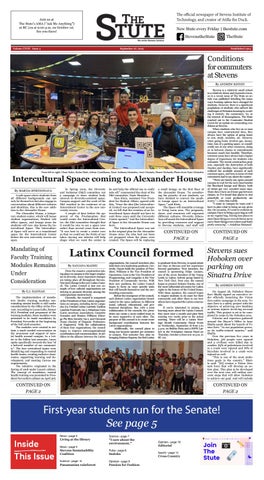
Intercultural Space coming to Alexander House By MARYIA SPIRYDONAVA A safe space where students from all different backgrounds can not only be themselves but also engage in conversation about different cultures and identities, this is the new addition to the Alexander House. The Alexander House, a temporary student center, which will house student organizations, Student Life office spaces, and lounge areas for students will now also house the Intercultural Space. The Intercultural Space will serve as a transitional space for the Intercultural Center before the new university towers are open.
Mandating of Faculty Training Modules Remains Under Consideration By E.J. HANNAH The implementation of mandatory faculty training modules surrounding mental health is still under consideration by the Office of the Provost. According to Lucas Gallo, former SGA President and proponent of the training modules, these modules were promised to be made mandatory by President Farvardin at the beginning of the Fall 2018 semester. The modules were created to initiate a much needed conversation on the awareness and support of mental health around campus. In a Letter to the Editor last semester, Lucas spoke specifically towards the loss “of a beloved member of our community”. The four centralized topics were identifying and responding to mental health issues, creating inclusive classrooms, supporting learning and development, and meeting Canvas use requirements. The initiative originated in the Spring of 2018 under Lucas’s cabinet. The concept of mandatory mental health training was presented to President Farvardin’s cabinet on April 3rd,
In Spring 2019, the Diversity and Inclusion (D&I) committee ran a campaign to show student body interest in diversity-oriented space. Campus support and the work of the D&I resulted in the existence of an Intercultural Center in the new university towers. A couple of days before the approval of the Proclamation that would create the Intercultural Center, the D&I committee thought that it would be nice to see a space now rather than several years from now. “It was best to create a center now so that we could see the fruits of our labor…having one interim will help shape what we want the center to
be and help the official one to really take off,” commented the chair of the D&I committee, Nasir Montalvo. Sara Klein, Assistant Vice President for Student Affairs, agreed with this, “Once the idea [the Intercultural Center] was proposed and accepted, we felt that the creation of an Intercultural Space should not have to wait three years until the University Center opened.” And the Intercultural Space in the Alexander House was born. The Intercultural Space was not in the original plan for the Alexander House since the idea had not been yet proposed when the plans were created. The Space will be replacing
Latinx Council formed By SANJANA MADHU From the massive construction taking place on campus to the larger emphasis on diversity, many important changes are taking place all throughout Stevens. One such change is the new Latinx Council. The Latinx Council is just one example of how cultural organizations are striving to promote diversity among the undergraduate student body. Currently, the council is comprised of the Presidents of four Latinx organizations on campus, including Kevin Largacha (La Unidad Latina Lambda Upsilon Lambda Fraternity Inc.), Sebastian Cano (Latin American Association), Casandra Gonzalez and Monica Williams (Omega Phi Beta Sorority Inc.), and Giovanni Duran (Society of Hispanic Professional Engineers). With the collaboration of these four organizations, the council hopes to improve intra-organizational coordination and communication. In addition to the alliance between the Latinx
organizations, the council members also hold their own leadership positions. Currently, Duran holds the position of President, Williams is the Vice President of Operations, Cano is the Vice President of Programming, and Largacha is the Vice President of Community Service. With their new positions, the Latinx Council hopes to focus on more specific tasks that will benefit themselves and the surrounding community. Before the emergence of the council, each distinct Latinx organization broadcasted to the same audience in different social, cultural, educational, and professional disciplines. But, with a joint collaboration of the councils, the presidents can create a more unified team to be more supportive of each other. The purpose of this council is to create more background coordination between the Latinx organizations. Additionally, the council plans to bring one keynote speaker per semester to campus. This semester they plan on bringing Malena Higuera, the first Latina
to graduate from Stevens, to speak about her time at Stevens and her experience beyond graduation. Next semester, the council is sponsoring Felipe Luciano, one of the seven founders of the Young Lords (a Latino Activist group based in New York City). Next year, the council hopes to present Dolores Huerta, one of the most influential advocates for Latinx rights in the history of the United States. With these speakers, the council hopes to inspire students to do more for their community and allow them to see how others have impacted the Latinx community. If you’re interested in joining or learning more about the Latinx Council, they meet once a month and plan their meeting two weeks prior to the actual meeting. There will be a Latinx Heritage Month Community Mural Event on Wednesday, September 18 from 3 to 5 p.m. on Babbio Patio and a SHPE LatinX in the Workplace Alumni Panel on Thursday, October 3 from 9 to 10 p.m. in BC 122.
CONTINUED ON PAGE 2
Stevens sues Hoboken over parking on Sinatra Drive By ANDREW KINNEY On August 28, Hoboken Mayor Ravi Bhalla signed an executive order officially launching the Vision Zero safety campaign in the area. Vision Zero is a safety project with the objective of achieving zero fatalities or serious injures involving on-road traffic. This project is set to be completed in 2030 in the Hoboken area. Citizens and reporters gathered around the Mayor’s Office to hear Bhalla speak about the launch of Vision Zero. “As our population grows, so do traffic-related injuries,” said Bhalla. Over the previous five years in Hoboken, 376 people were injured and 3 civilians were killed due to crashes. 83% of pedestrians involved in a crash were injured and 76% of bicyclists involved in a crash were injured as well. “This is one of the most ambitious goals in the country,” Bhalla said. “[It] creates a Vision Zero task force that will develop an action plan. This plan to be developed over the next year will outline concrete steps that will allow Hoboken to achieve our goal. And will include
CONTINUED ON PAGE 2
First-year students run for the Senate! See page 5
News - page 3 Living at the library News - page 4 Stevens Sustainability Coalition Science - page - 6 Panamanian rainforest
Science - page 7 “I care about the environment.” Pulse - page 8 Sudoku Opinion - page 9 Passion for Fashion
Opinion - page 10 Editorial Sports - page 12 Cross Country
2
September 27, 2019
News Intercultural CONTINUED FROM PAGE 1 host events in the space. This will be the heart of continuous efforts to building a diverse, inclusive, and engaged community. Cross-cultural connection, community-building, allyship, and ongoing learning will all be promoted here. Outside of Diversity Education programming, all students will be able to utilize the space as a lounge area. Additionally, student organizations will be able to reserve the space for relevant programming events. It appears there is a lot of excitement about this new addition to the Stevens community. Liliana Delman, Assistant Director for Diversity Education, and Veronika Paprocka, Graduate Coordinator for Diversity Initiatives, are receptive to ideas for the space
Sinatra Drive CONTINUED FROM PAGE 1 new ways for people to identify traffic safety concerns on their block.” When straightforwardly asked about how Vision Zero will directly impact the Stevens community, the Mayor was quick to ensure that “[Stevens] is an integral and valuable part of the city of Hoboken and our community.” He further continued, “We encourage Stevens students and faculty to become involved in our Vision Zero initiative.” Many students from Stevens use the roads as pedestrians, so students have as much skin in the game as anyone else, and Bhalla welcomes any Stevens students who would like to apply to become a part of the Vision Zero task force or to serve as a Stevens ambassador as a part of the ambassador program. “That way we can identify particular issues or challenges that are particular to Stevens itself; whether that be on campus issues or intersections. The Stevens campus can ultimately be considered in the Vision Zero plan. We want to improve conditions,
and have plenty of their own. Delman will be overseeing the space on a daily basis. Susan Metz, Executive Director of Diversity and Inclusion, Maria Ouckama, Assistant Vice President for Human Resources, and Klein will be a part of an advisory group to assist with any events that students are interested in hosting. The Space is meant to be an inclusive space for all and has the goal to meet the needs of different groups on campus. For instance, religious organizations’ will be able to utilize this for prayer. The hope is to allow the space and in the future, the Intercultural Center, to be malleable to fit the needs of the Stevens community. Montalvo excitedly states, “The Space will clearly articulate our goals [D&I] in being a more unified and inclusive campus. I encourage each and every single member of the Stevens community to visit once it is opened and relish in this moment in Stevens history.” so let us know of any,” Bhalla reassured. When asked about why he choose to implement this specific order to execute over others, the Mayor corrected the question, saying, “I have actually signed four executive orders. The first one was declaring Hoboken as a fair welcoming city, another was an executive order implementing a climate action plan. This specific executive order just reflects major priority of the administration.” The task force developed through the Vision Zero safety project will continue to develop an action plan and outline strategies over the next year to get Hoboken steps closer to making the streets safer for everyone. Currently, the task force includes a variety of departments from City Hall, school administration, advocates for safe streets, and many more. Jersey City has also become a partner with Hoboken’s Vision Zero Program. They too launched their own Vision Zero Program just last year. “We want to leave our city in a better place for our children, and future generations,” Bhalla wisely adds. The time for change in the safety of Hoboken’s streets has been brewing for awhile, but that time has finally come.
Commuters CONTINUED FROM PAGE 1 “I don’t mind because I still have lots of places.” – Youssef Mohamed “I’m not entirely sure about what other people think, but I feel it really sucks. I was a big fan of hanging out in Hayden lounge because I could heat up my food but also socialize with other commuters as well and people who live on campus. I made a bunch of friends that way and now it’s more difficult. I eat now in Burchard lounge and the feeling is not the same. It’s not really a social environment and it bums me out.” – Randiel Zoquier “Its horrible. I didnt even use the other lounges that got closed and mainly staying in babio but now I pray that I can find one of the desks let alone a space in the babio lounge.” – Kerim Karabacak “I’m sure it is a very frustrating experience to look for space to study or hang out. I’ve generally been fortunate because I do not have large gaps between classes that would necessitate finding a space to lounge.” – CSU Vice President Rachel Kim When asked about this reduction in space, Assistant Vice President for Student Affairs Sara Klein said “Commuter students will find that in the coming weeks, many more public spaces will open for their use. First, the Gateway Academic Center will have some public seating and socializing areas, in addition to the Gateway Café that will open inside the Center. Second, Alexander House should also open this fall, with a nicely sized multipurpose spaces for student use, as well as a game room and 2 conference rooms. I also strongly encourage commuter students to explore existing on-campus spaces – there are many times during the day when plenty of seats are open in Pierce Café, America’s Cup, and Red & Gray Café, as well as in the library and other campus lounge spaces in academic buildings.” As mentioned in some of the above quotes, one of the major spaces still available is the Burchard Lounge. Sometimes called the commuter lounge, it has become more crowded as an affect of the construction previously detailed. Due to the delays in the opening of the Gateway Academic Complex, there have even been reports of classes being held in the space, though not all students experienced this: “in my observation it has been the graduate or senior programs that tend to meet there, it drastically lowers the space and the room gets very crowded and somewhat noisy because they take the group study room. Classes have not ‘supposedly’ been
meeting there, they have, I have seen them there, they have even put up flyers announcing that they are meeting there.” – John MacAuliffe “It has been difficult finding space at certain times because of class meetings there as well as that lounge generally being stuffed like it never has been.” – CSU President Asim Qureshi “This has inconvenienced me to an extent because now there’s increased foot traffic in burchard lounge and more students than ever before aren’t living on-campus. So, the lounge isn’t exclusive for commuters because there are different classes of “commuters.” – CSU SGA Representative Alyaa Elkhafif “I have never experienced any classes being held in this location.” – CSU Vice President Rachel Kim Sara Klein responded to the inquiry about classes in Burchard lounge by saying “There are no classes scheduled in Burchard Lounge. The Quiet Room and the general study area in Burchard Lounge 127 are non-reservable, though the Team Room (127-B) is reservable by students, staff and faculty for events and meetings.” Commuters were then asked about if the many recent street closures and parking complications had affected them, and whether they had been adequately notified about these potential roadblocks: “I was not even aware that there were supposedly street closing notifications in the first place, I was never made privy to this. Though, a few weeks back I tried to park in Babbio (after missing my train and having to drive down) only to be met with the fact that Sinatra Dr was closed. Needless to say, finding another lot while also finessing my way away from the closed Sinatra Dr was somewhat stressful.” – Jonathan Melamed “I have not received reports about street closures, it has not greatly affected me though.” – John MacAuliffe “I’ve had little issues with street closures. My only issue is with parking as many of my classes this semester aren’t held until the afternoon and it’s not easy to find parking at that time. I’ve been forced to come to campus at least two hours before my first class to ensure that I’ll find parking.” – CSU Vice President Rachel Kim “No. I take the train and walk to campus.”- Anonymous The next question was: Have you ever had any difficulties with professors, classes or clubs because of an issue related to commuting? No students reported any issues with classes or professors, stating that they tended to be very understanding, but many expressed difficulty with attending most club meetings: “Some of the club meetings that I really want to attend are on weekdays and start/end late (8:30pm – 11pm). As someone
who’s commute is up to an hour, it’s really dissuading me to participate in such events.” – Ankit Patel “Most clubs meet late at night at around 9PM when most commuters have to be home, so it gets difficult maintaining commitment. Professors are usually understanding and accommodating for me when I talk to them about it.” – CSU President Asim Qureshi “No, in fact I was once late to class because my train got cancelled (after the train in front of it collided with a car) and the TA teaching my Calculus recitation was very understanding.” – Jonathan Melamed The Stute also asked about a few other previously reported concerns, such as Babbio Garage closing early or specific issues related to commuting by bus or train, but these were left largely unsubstantiated by the commuters who responded. Finally, the commuters were asked if there was anything else they would like to add: “Stevens really needs to add more parking before bringing more students than ever. After 11:00 am parking is NON EXISTENT and it takes me and other sometimes over half an hour to find some one that leaves the lot so that we can park. And they want to add a giant skyscraper of a dorm to bring in even more students? Can they think of the commuters that already Get shafted by stevens in a bunch of different ways already and not add to their troubles. Like I’m sorry weren’t not giving you $15k a year just to stay in a bunch of run down hoboken apartments but COME ON. My and most other commutes already take 30min to 1.5 hours depending on traffic and when I get to Steven’s I can’t even find a spot to sit down. I say we protest by bringing 20+ folding tables and setting them up on the Hayden construction area and hanging a giant sign saying “NEW COMMUTER LOUNGE.””- Kerim Karabacak “Commuting is hard, but I deal with it because I love this school. The only regret I have is I lose a lot of social interaction because of it and wish there were a few more opportunities for me to interact on campus.” – Randiel Zoquier “Quite often, it seems like the commuter voices are either too soft to hear or just plain ignored. We need to make sure that the Stevens community recognizes its large commuter population and help each other to make student life more accessible and worthwhile. We at the Commuter Student Union strive to do this through events, meeting with administrators to ask for more benefits, and speaking out when necessary because we are at an immediate disadvantage compared to others. So next time you see a commuter, talk to them – ask them how their commute was, how their day is going – but
Photos courtesy of Andrew Kinney and the City of Hoboken
Modules CONTINUED FROM PAGE 1 2018. After a positive reception, a second meeting was scheduled for later in the month with the Office of the Provost. There, the Provost supported the idea of faculty members only receiving their annual raise after completing the training. With the mutual agreement amongst all parties for mandating the trainings, the plan was set forth to release the modules sequentially over the course 2018-2019 academic year. Finally, in March 2019, Provost Pierre notified the entire Stevens community of the implementation of the modules on a voluntary basis.
Provost Christophe Pierre responded in a letter, saying that “after having time to think further and consult with our professional colleagues, we have decided to offer these trainings as a continuous resource rather than a mandatory training”. The understanding was that mandation the modules as a one-time thing would make it feel far too much like a task, rather than an educational resource. The Provost also explained that if they felt there was a need for the modules going forward, they would reconsider. Lucas then urged administration to release information regarding the number of faculty members who have completed the training shortly after. Several weeks later, the student body, upset by the decision of the administration to step back on their word, pushed a proclamation urging for the
most of all, ask them what can be done to improve their college life. Hear us out. Believe me, we’ll be worth your time to listen to.” – CSU President Asim Qureshi “I would want commuters to get priority for scheduling next year. It does not make sense that someone who dorms can get a 9 am class and someone who commutes with a train for an hour has to deal with an 8 am to 8 pm classes. I thankfully changed my schedule but many others were not able to.” – Youssef Mohamed “Many of the review sessions that I want to attend are held on Sunday nights (almost always after 8pm), which is quite possibly the most inconvenient time to hold a review session on a weekend.” – Ankit Patel “As Vice-President of the Commuter Student Union, I just want to say that we are always open to co-hosting events during the day with other organizations. We view such collaboration as a great opportunity to increase commuter involvement on campus.” – CSU Vice President Rachel Kim “Commuting can be pretty hard and cause a lot of stress so I just recommend people be nice to each other to help alleviate that.” – Jonathan Melamedthe heart of continuous efforts to building a diverse, inclusive, and engaged community. Cross-cultural connection, community-building, allyship, and ongoing learning will all be promoted here. Outside of Diversity Education programming, all students will be able to utilize the space as a lounge area. Additionally, student organizations will be able to reserve the space for relevant programming events. It appears there is a lot of excitement about this new addition to the Stevens community. Liliana Delman, Assistant Director for Diversity Education, and Veronika Paprocka, Graduate Coordinator for Diversity Initiatives, are receptive to ideas for the space and have plenty of their own. Delman will be overseeing the space on a daily basis. Susan Metz, Executive Director of Diversity and Inclusion, Maria Ouckama, Assistant Vice President for Human Resources, and Klein will be a part of an advisory group to assist with any events that students are interested in hosting. The Space is meant to be an inclusive space for all and has the goal to meet the needs of different groups on campus. For instance, religious organizations’ will be able to utilize this for prayer. The hope is to allow the space and in the future, the Intercultural Center, to be malleable to fit the needs of the Stevens community. Montalvo excitedly states, “The Space will clearly articulate our goals [D&I] in being a more unified and inclusive campus. I encourage each and every single member of the Stevens community to visit once it is opened and relish in this moment in Stevens history.”
Photo courtesy of Andrew Kinney
modules to be mandated. When The Stute reached out regarding an update on the status of modules this past week, they responded by saying that they “do not have accurate completion rate data available at this time”. Despite this, they also mentioned that they are exploring “different modes of delivery for the trainings, and our goal is for the information to be available through as many channels as possible to reach the broadest audience”. One such method includes in-person training regarding student mental health and counseling, which is being presented by Dr. Eric Rose from C.A.P.S. at the Faculty Meeting next week. Also worth noting is the newly formed President’s Task Force on Mental Health, which was designed with the purpose of finding ways to reduce stigma associated with mental
health and hopefully encourage students to reach out for support. The Office of the Provost is waiting to “see how well the different modes of training are received and which are the most effective” before they re-evaluate their decision to mandate the training modules. new ways for people to identify traffic safety concerns on their block.” When straightforwardly asked about how Vision Zero will directly impact the Stevens community, the Mayor was quick to ensure that “[Stevens] is an integral and valuable part of the city of Hoboken and our community.” He further continued, “We encourage Stevens students and faculty to become involved in our Vision Zero initiative.” Many students from Stevens use the roads as pedestrians, so students have as much skin in the game as
anyone else, and Bhalla welcomes any Stevens students who would like to apply to become a part of the Vision Zero task force or to serve as a Stevens ambassador as a part of the ambassador program. “That way we can identify particular issues or challenges that are particular to Stevens itself; whether that be on campus issues or intersections. The Stevens campus can ultimately be considered in the Vision Zero plan. We want to improve conditions, so let us know of any,” Bhalla reassured. When asked about why he choose to implement this specific order to execute over others, the Mayor corrected the question, saying, “I have actually signed four executive orders. The first one was declaring Hoboken as a fair welcoming city, another was an executive order implementing a climate action plan. This
specific executive order just reflects major priority of the administration.” The task force developed through the Vision Zero safety project will continue to develop an action plan and outline strategies over the next year to get Hoboken steps closer to making the streets safer for everyone. Currently, the task force includes a variety of departments from City Hall, school administration, advocates for safe streets, and many more. Jersey City has also become a partner with Hoboken’s Vision Zero Program. They too launched their own Vision Zero Program just last year. “We want to leave our city in a better place for our children, and future generations,” Bhalla wisely adds. The time for change in the safety of Hoboken’s streets has been brewing for awhile, but that time has finally come.
3
September 27, 2019
News Living at the library BY CHARLES ZWICKER “It all started with a crime,” Richard Widdicombe, a librarian at the S.C. Williams library from 1966 to 2006, serving as director for many years, stated in an email to The Stute. Indeed, on March 12, 1972, it was discovered that two “state-of-theart” Wang calculators had been stolen from the library, among other items. According to an article written in The Stute on March 17, 1972, the total value of the stolen items was $9,367, equal to approximately $58,000 today. These calculators “had been donated by Bill McClean, a VP at Stevens and board member of the Wang corporation” (Widdicombe), and had been used by students to “shorten the tedious process of solving lab and problem calculations” (The Stute, Vol. 67, Issue 22). Widdicombe tried preventing further theft in the library by asking a senior math student
to live in the third floor of the Williams Library, in the Staff Room for library employees. He stated, “From 1972 – 2004 various students (and one employee of the Physical Education Department) stayed in the library.” Eventually, Room 317 on the third floor became the more permanent dorm room, as they were “fixed up with bunk beds, study desks, etc.” Even to this day, Room 317 is still there, serving as the office of Ms. Leah Loscutoff, the University Archivist and Special Collections Librarian. Loscutoff recalled that when she moved into the office in 2013 there was still a mattress on the bunk bed that remains attached to the wall. The handful of people that lived in the library had all of the typical amenities as the other dorms: “Where the ELC is now, across the way on the third floor […] there was a little kitchenette and a shower,” Loscutoff stated. Widdicombe recalled that “the
many residents over the years also had fun in the library […] they played hide and seek in the stacks, whiffle [ball] in the Great Hall, while also being able to let the piano tuner in when the building was closed.” Mr. Widdicombe seems to think that his idea of housing students in the library worked, and “gave the library extra security,” citing three examples. The first was one incident in which “someone threw a firecracker into the book drop […] This set fire to the Library’s paper storage room.” The second was a case where a urinal fell off the bathroom wall, causing “cascades of water flowing into the library vault (where the DaVinci collection was then stored).” Finally, as Mr. Widdicombe recalls, a student resident “caught a security guard breaking into the coin box of a copy machine.” In all three cases, the student resident was able to mitigate the damage done to the library.
Photo courtesy of Andrew Kinney
Where’s the time gone? BY LIAM MCMURTY Being a senior in college, you may feel like you have a wealth of knowledge and experiences that you just want to share with every newcomer you see. That is exactly what senior Julian Hernandez had in mind when he started his podcast titled Where’s the Time Gone? During his time at Stevens, Hernandez has helped lead students of all class years, not only within his major of Music and Technology, but also as Vice President of Lambda Upsilon Lambda, Editor-in-Chief of RedShift, an SGA Senator, and a flurry of other memberships. All of his activities inspired him to bring together student leaders in one conversation in the form of this podcast. The goal of his podcast is to join seasoned student leaders on campus who have valuable insight about the Stevens student experience that they would like to share with everyone. In the first three installments, titled “Breaking the Ice,” these students
who are wrapping up their college careers reminisce on the highlights of their Stevens journey and give advice to anyone in the audience. So far, this new podcast has featured veteran student leaders Maryia Spirydonava, Mariachristina “MC” Todaro, DuJuan Kirk, Jon Darlak, Pujan Shah, Jake Meiskin, Grant Fowler, Matthew Colacino, and Hernandez himself. Outside of advice for any newcomers, this podcast also serves as a way for the guests to “have deep, impactful conversations that they wished they could have had before,” says Hernandez. He emphasized that there are “so many different realms at Stevens” that he wanted to bring together for each to recognize their shared Stevens identity. Each installment of “Breaking the Ice” starts off with a set of questions the guest of the podcast can answer. Some of these questions include fun ones like “What is your favorite experience so far at Stevens?” and “What is
your favorite spot in Hoboken?” but the podcast also dives deeper with questions such as “Who is one person who has been a key part of your Stevens experience?” or “What do you wish you knew your freshman year?” that allow the guests to reflect on their time at college and cultivates a deeper conversation. Furthermore, the podcast enables the guests to look ahead to their futures with questions like “What are your post-graduation plans?” So far, the podcast has had four installments, with the first being a short introduction to the podcast on September 3 of this year, and three installments of “Breaking the Ice” every Thursday since. All recordings are done on the third floor of Kidde, as the space provides a great environment for a podcast recording. Anyone can find this podcast at anchor.fm/wheresthetimegone and on all major streaming platforms. New episodes will continue to be released every Friday, so please stay tuned!
Photo courtesy of Maryia Spirydonava
Perspectives
Jake Schozer BY MARK KRUPINSKI “That was nothing short of a life-changing experience,” said Jake Schozer on his recent Tragos Quest to Greece experience. Tragos Quest to Greece is a Sigma Phi Epsilon program that helps undergraduates change the way they view the world, their fraternity, and themselves. Schozer continued, “It’s baffling how much of a full perspective shift happens in 12 hours, but when I say it literally changed my perspective on life, that is an understatement.” Schozer was selected as one of 20 Sigma Phi Epsilon brothers to participate in this experience last semester, and can point to the exact moment of his experience that changed his perspective. Throughout his time at Stevens, Schozer has played a role in transforming multiple areas of campus, including the Pinnacle Scholars Program, Sigma Phi Epsilon, and the Interfraternity Council. Schozer initially took on the role of Vice President of Recruitment for the Interfraternity Council (IFC) during his sophomore year, and then took the role of Vice President of Programming during his junior year. Schozer held roles in the IFC during the transition period from Thea Zunick, previous Associate Director of Student Life, to Malcolm McDaniel, current Assistant Director of Fraternity & Sorority Life. “We definitely grew a lot in 2 years. When I first started, we weren’t even having e-board meetings. We would just meet at our General Body Meetings, now [we have] weekly e-board meetings, biweekly general body meetings. We tried to make ourselves a more established organization. We still have a long way to go, but they’ve done a lot, and we’ve continued to do a lot now,” said Schozer. In the first year, the IFC laid a lot of the groundwork for establishing itself as an organization including clarifying the attendance policy, and bylaws changes. In his
second year on the e-board, the IFC worked to get its name out there by hosting new events such as the Greek Leadership Awards Dinner (GLAD) and the IFC Chili-Cookoff. “I was very proud,” said Schozer about the cook-off. “We were able to raise money for homes for our troops, and it was just a great bonding event and a fun lighthearted competition.” Aside from internal growth, the IFC gained a stronger perception from the school’s administration. The IFC legitimized itself with the creation of the IFC Standards Board — an internal body within the IFC which carries out investigations of infractions by fraternities. “We did things that showed that we could function as an organization which allowed people in the Office of Student Life to give us more things that we could take on,” said Schozer. For example, anytime a Greek organization registers a social event, the IFC President, Vice President of Standards, and Vice President of Risk all receive notifications and can provide feedback on needed criteria. Even with the growth, Schozer was not able to accomplish everything he desired for the IFC. “I mean there was a lot that I wanted to do, but I’m also very optimistic and idealistic,” he said. “I personally I wanted to host a big community service event.” While he coordinated smaller community service events under his role as Vice President of Programming, he envisioned a large-scale Greek community service event similar to the events for freshmen that occur during orientation. In an ideal world, Schozer hopes for Greek life to be as independent as possible from the Office of Student Life. At other schools, such as the University of Louisville, the IFC President oversees enforcing sanctions, not the Office of Student Life. However, he acknowledges that this would be difficult to reach at Stevens. “[The University of Louisville] probably has 30-something IFC chapters and
a Greek full-time staff [of] 10 to 12 Employees. It’s a very different dynamic from what we have here with one full-time, and one part-time employee,” said Schozer. “The ideal vision is where IFC and Student Life work more horizontal than vertical, where they’re partners playing off each other, as opposed to IFC reporting to Student [Life],” he added. Schozer sees Greek life growing at Stevens within the next five years. “It’s gonna be a lot bigger, just maybe not percentage-wise, but just pure quantity of students because if you continue on the trend of having 37% of students and you increase the number of students… we’re all good at math,” he said. “I’m seeing it in my own chapter; I know some other chapters that tend to be smaller have taken in some large classes recently.” He said this might prompt more chapter forming in the future. Going forward, Schozer hopes to share his experiences of leadership after college. For one year after graduation, he will be working as a regional director for Sigma Phi Epsilon. “I’ll be assigned one region that will have about 20 chapters in it. I’ll spend 10 weeks [between] June and August at our headquarters training, and then spend the following 9 months traveling between those chapters advising their executive committees, helping them set goals, and helping those chapters improve a little bit,” said Schozer. Afterwards, Schozer said that he is unsure if he will continue to work at his fraternity’s national headquarters full-time, but he will give back regardless. “I can’t see myself not at least making myself an available resource to anybody at Stevens who might be able to utilize that,” said Schozer. “After I have that year of leadership and training experience from that position, if I could come back and just give talks and leadership trainings seminars or whatnot about my experience specifically on the Stevens campus and then also
Jake Schozer, above and left, is the president of his fraternity and an active member of the Stevens community. Photos courtesy of Schozer. other outside trainings that I’ve had, I would love the opportunity to do that.” Still as a current undergraduate, he does provide a few pieces of advice on leadership. “When you’re young, cast a wide net,” said Schozer. “Find your passion and then narrow down on that […] If you’re trying to do something, you’re trying to make change that you don’t care about, that you don’t have a purpose behind, you’re
not gonna have fun doing it.” Oh — and his math reviews? It’s the same focus. Giving back. “Teaching has always been something that I enjoy doing because it’s my way of giving thanks that I understand things well. I grab the concepts, especially math, well and I almost feel an obligation to give that back,” said Schozer. He’s a “role model” for a cohort of students as they take MA 123/ MA 124 followed by Differ-
ential Equations — and he is recognized on the streets for it — whether on campus or in Hoboken. “I’m not gonna lie, it’s kind of cool. But at the same time, it makes me feel so happy that I’ve been able to help so many people by doing something that I just love doing,” he said. Schozer isn’t paid for his reviews. He does it so he can give back and help guide students through the beginning of their college career.
September 27, 2019
4
News
ACES Program to pass through NJ Assembly in the upcoming months By JOANA FARDAD New Jersey Accessing Careers in Engineering and Science (ACES) program passed through the New Jersey Senate, and is expected to pass through the New Jersey Assembly within the upcoming months. ACES is a scale-up of a program that is designed to increase the participation of underserved and underrepresented minority students in both degrees and careers that are aligned with New Jersey’s innovation economy. After the kick-off on Stevens’ campus in the Fall of 2018, impressive data has been gathered and put into a document about the ACES program that was published by the Office of the President. The university has been able to engage 10 schools and a number of corporations and foundations as partners in the program. ACES has resulted in a 60% increase in both underserved and underrepresented minority (URM) students participating in Pre-College STEM summer programs and a 46% increase in the freshman cohort. Currently, the core elements of the Stevens ACES program are being pushed to be adopted at New Jersey institutions of higher education, so “that it can be funded equally by higher education partners, New Jersey corporations, and the State of New Jersey.” With hopes of achieving this goal, the program is planned to produce “200 high school students and 100 college graduates” per year of underserved and underrepresented minorities that are in the STEM fields. This goal is currently
set to be accomplished in four years. But who is behind the big push for ACES here on Stevens’ campus? One main name is Beth McGrath, Vice President for Government and Community Relations. Alongside her are colleagues Thania Benios, the Director of Public Relations, and others in the Division of Communications and Marketing. When asked what gave the idea to implement ACES on campus, McGrath gave credit to alumnus Nate Davis. “Mr. Davis is passionate about Stevens expanding its efforts and programming to make a Stevens education accessible to underserved but academically talented youth,” McGrath said, “In May 2017, Mr. Davis facilitated a discussion on this topic, then helped to engage other alumni and some of his corporate contacts in supporting the effort.” Currently, the legislation for ACES has completed the process of being passed by the Senate Higher Education Committee, the Senate Budget Committee, and the full New Jersey State Senate with an impressive and “positive bi-partisan vote of 37-0,” commented McGrath. The next step is to get the program’s goals cleared with the “Assembly Appropriations Committee, be put to a vote before the full Assembly, and then finally be signed by the Governor,” McGrath explained. It might seem like a long process, but the final results will be worth the wait. Alongside this lengthy list, a budget resolution will also need to be passed by both houses and signed by the Governor. When McGrath was asked about the future she views for ACES and where she
saw it going in 10 years, she simply replied, “over time, we hope to increase the number of scholarships that are offered to the pre-college program for academically talented URM and underserved youth to 20% of all pre-college students.” The team would also love to see a double in the number of scholarships that ACES could offer to its students. Finally, throughout this process, the feelings of advocating for these goals can
be a mixture of overwhelming, frustrating, and exciting. The team is “working aggressively,” McGrath ensures, to include both corporate and foundation partners, as well as individual alumni to continue to expand this push. Currently organizations such as ADP, Altice USA, American Council on Education, AT&T, Bristol-Myers Squibb, Carnegie Corporation of NY, The A. James Clark & Alice C. Clark Foundation, Community Foun-
Photo courtesy of Andrew Kinney dation of NJ, Mukilteo Investment Management, LLC., PSEG, and the Ruesterholz Family Foundation have supported the ACES program. McGrath concluded the interview by saying, “We are immensely grateful for their support. There are lots of people throughout the university who are working hard to make ACES successful, thank you.”
The Stevens Sustainability Coalition plans for a better campus By ALEKSANDAR DIMOSKI
JOIN THE STUTE
A university on the rise, Stevens is growing rapidly to handle its housing shortage and to create physical space for more classes. But with any institution, there is always something else that can be improved. For a group of three aspiring graduate students, the Stevens Sustainability Coalition is taking on another challenge: sustainability on our campus. The Stevens Sustainability Coalition (SSC) is a student-led initiative whose vision is to create a culture of sustainability on campus. Both an organization and a movement, it was started by Alex Dubro, Francesco Accurso, and Angelo Falabella with the three students consulting Dr. Dibyendu Sarkar as their faculty advisor. While Falabella graduated last spring with his M.S. in Sustainability Management, Dubro and Accurso, also in the Sustainability Management program, continue to lead the initiative. The SSC plans to hold forums that promote open, transparent, and collaborative discussion among students, staff, faculty, and administration alike on sustainability issues on campus. While these forums will focus on topics pertinent to the Stevens campus, Dubro and Accurso hope that they will motivate individuals to bring innovative thoughts, attitudes, and perspectives to their communities and continue bringing about positive impact. Other events include panels on environmental and social-environmental issues, held by on and off campus experts, as well as innovation (“incubation”) expos that challenge people to arrive at solutions to sustainability problems, in a format similar to the Business School’s case competitions. According to Lead Co-facilitator Dubro, the goal of the SSC is not to become an established student organization. “The SSC is not a club, nor is it an administrative body. It is a student-led initiative and nontraditional networking organization. We generate and develop innovative ideas at our forums, provide a space for stakeholders to give input to the administration, create a directory of subject matter experts (SMEs) and hold panel discussions on relevant topics. Our vision is to make sustainability a fabric of Stevens’ culture. Sustainability is a lifestyle, not a choice.” Since they are not bound by the standards that clubs or administrative offices usually follow, the SSC has greater potential to connect people from different groups on and off campus. The movement already has both administrative and student support and seeks to continue gathering support by connecting the two. According to Accurso, “I think it’s an exciting time at Stevens […] we can be a support structure for
communication between students and the administration.” The movement helps to aid and promote efforts made by the administration and the student body in order to help Stevens attain an AASHE STARS rating. STARS (Sustainability Tracking, Assessment & Rating System) is a self-reporting framework that measures sustainability performance. This rating is given to involved campuses that fulfill certain sustainability benchmarks, and to earn one would demonstrate increased progress in this regard. The SSC hopes to bring Stevens closer to this goal by continuing to promote the Sustainability Management Plan (SMP), a recommended framework and organized collection of guidelines for sustainability landmarks. Made by Falabella as his capstone project along with Cole Liguori, Ziren Qi, and Wesley Cheung, the plan focuses on four different aspects of sustainability management on Stevens, namely Campus Energy Usage; Waste, Water, and Land Management; Social Engagement; and Financial Responsibility. The SMP includes an addendum by Falabella proposing the founding of an Office of Sustainability, which would aid and direct efforts on campus. Dr. Sarkar served as Advisor, and, as with the SMP, students should feel free to consult Dr. Sarkar regarding similar projects on-campus. At their kickoff event this previous Wednesday, the SSC stayed true to their word: Dubro led a breakout session, inviting attendees to tackle a common sustainability challenge. The session developed into an open dialogue on what could be done to improve conditions at Stevens. Attendees included members from the SSC, as well as students, faculty, and staff. The meeting started with Dubro presenting the foundational goals of the SSC and ended with a discussion by attendees on how the movement could grow and improve. Unique to the SSC is its approach to change. Rather than generate ideas and implement them via a top-down approach, the organization gives everyone involved an open-ended sense of autonomy to tackling various problems on campus. Dubro argues that this is yet another element that will foster a culture of sustainability. The kickoff meeting was a promising start to a new organization, and it already seems to be fulfilling its mission statement of bringing people together. Despite not being an official campus organization, the group has the support of the administration and is hoping to gain the support of other organizations on campus, in Hoboken, and in surrounding localities. The organization seems to have a bright future, and we look forward to seeing how it will assist students, staff, faculty, and the administration in accomplishing increased sustainability on and off campus.
September 27, 2019
5
News
First-year students run for the Senate BY MATTHEW CUNNINGHAM Voting for Student Government Association’s election will begin this upcoming Wednesday, said SGA Secretary Madison Gemma. This election, which includes candidates from first-year students and vacancy seats, will fill at least ten open seats. Elections for first-year students happen each year, and the election helps fill out the empty seats that are currently in the Senate, said Elena Malova, Vice President of Finance for the Student Government Association. “Right now, we have a lot of committees, a lot of initiatives going on, but not enough people to help out,” said Malova. “It’s hard, but there’s a lot of things we want to get them done. But with the new Senators, we can get more accomplished — it will be a fresh perspective.” Twenty eight people have sub-
mitted interest to run in the election. First-year students will need 75 digital signatures to be eligible to vote, and upperclassmen who will fill vacancy seats will need 50 digital signatures. This past Wednesday, the Student Government Association hosted an information session and forum for the freshman candidates. Twelve first-year students arrived and discussed the most important issues that affect students. Topics ranged from the need for a prayer room to the want for language courses to count toward humanities credits. Cabinet members of the Student Government Association are excited for the new members. “It will be fun,” Malova said. “It will be more people. It will be more people that will follow after us, that will continue being in the SGA.” Nominations close on Monday, and voting will open on Wednesday.
Photo courtesy of Matthew Cunningham
September 27, 2019
6
Science
Stevens faculty want to bring the Panamanian rainforest to you Left: Gamboa Rainforest; Top-right: Corrugated metal-roofed bus stop; Bottom-right: Container ship in the Panama Canal.
BY CAMILLE SIMON-AL-ARAJI This past August, in the dense rainforest of Gamboa, Panama, assistant professors Christopher Manzione and Nancy Nowacek set out on a trip to attend a unique conference involving science, research, technology, and art. In the Visual Arts & Technology program at Stevens, Manzione runs the Moving Image concentration, which includes video, animation, virtual and augmented reality, motion graphics, 3D modeling, and 3D animation. He has a background in sculpture, virtual environments, and mobile augmented reality. Nowacek, also in Visual Arts & Technology, runs the Design concentration curriculum, and has a background in design, conceptual art, and interdisciplinary art. Manzione and Nowacek received notice of a convention taking place in Panama called the Digital Naturalism Conference (otherwise known as Dinacon), an experimental conference that explores new ways of interacting with nature, a key goal being to share knowledge. This year, groups of field biologists, interaction designers, engineers, and art-
ists were invited to convene in Gamboa, “one of the world’s major hubs for biological field research.” Groups and individuals were able to experience the Gamboa Rainforest while talking about the intersectional space between their respective domains. In order to attend the conference, groups and individuals had to apply with a project, whether it be a sculpture, a biological experiment, a movie, a journal article, etc. Manzione and Nowacek decided to apply together with a project: how to use digital technologies to begin to understand Panama as a place and a space. They focused particularly on the rainforest, an emblem of the nation of Panama and an important factor in climate change. During their one-week stay in the rainforest, the two collected several different kinds of content, including audio captures, videos, and still images. Manzione collected a series of 3D scans that he plans to process through the use of photogrammetry, the “art and science of extracting 3D information from photographs.” The output of photogrammetry is typically “a map, a drawing, a measurement, or a 3D mod-
el of some real-world object or scene.” Nowacek, for her part, used a motion capture system, placing sensors on her joints while using Notch (an iOS and Android app) that collects movement data from various sensors. With this, she captured the motion of a walk through the rainforest. The equipment they used to capture content included their personal phones, a digital camera, a Zoom audio recorder, and a GoPro Fusion that captures 360° video. While in Panama, the two also found time to visit the Panama Canal. They thought of it as a place of transience, with consumer products constantly coming and going. They noticed the slowness of the transportation of materials and the slowness of the place in general, a huge contrast to our daily lives in New York. “There’s only one family-run bodega. There’s no grocery store. It’s a really remote place,” said Nowacek. Despite the remote location, Nowacek and Manzione met several other Dinacon attendees, or fellow “Dinasaurs.” One woman from Australia was taking audio recordings of the canal with a waterproof
Photos taken by Nancy Nowacek
microphone. Another man was taking material out of different mushrooms from the rainforest and identifying the mushrooms by their genetic sequence, a process called barcoding. In the humid rainforest, Nowacek described a feeling of familiarity. “A lot of the house plants that get sold to us are plants that like dark, low-light environments like the rainforest. It was like we were staring at layers and layers of giant house plants.” “It’s an alive, intense place,” she added. “If you just hold your eyes still for just a moment, you realize that there is life and activity at the tiniest levels.” Expanding on one project idea, the two recalled the corrugated metal-roofed bus stops near where they were staying in Gamboa. “We want to recreate one of these as a place of transition, departure, and waiting and use it as a structure to install some audio and video components,” said Manzione. Manzione and Nowacek expect their final projects to be completed by January, when they will share their work with fellow Dinasaurs, the Stevens community, and the world.
September 27, 2019
7
Science “I care about the environment.” Opinion
BY DYLAN JAMES MOON It was clear in 2015 that the Paris Agreement on climate change needed a rulebook to help countries meet their obligations under the accord. When diplomats crowded Katowice, Poland, last December to draft this rulebook, they ate like kings. The menu sported beef with smoked bacon, pork and beef dumplings, pork tenderloin, codfish in butter-wine sauce with mussels, barbecue chicken, burgers, and assorted cheeses. Amnesty International’s yearly conference is the same story. Aspiring defenders of humanity celebrate with ornate meat dishes on silver platters. I attended a workshop at this year’s conference titled “Humanity at Risk.” To Amnesty, climate change is a human rights issue since it creates food and water shortages and threatens vulnerable communities. One expert spoke about the importance of clean energy and transportation. But when asked about the impact of animal agriculture, she deflected the question, calling diet a “personal choice” and therefore not a focus of her work. At Stevens, too, I have listened to one climate change presentation after another. All manage to ignore that 14.5% of all greenhouse gas emissions come from animal agriculture. That includes direct emissions from livestock, feed production and
processing, and manure processing and disposal. This quantity exceeds all combined emissions from transport. They also ignore that about a third of all our freshwater consumption is through animal agriculture, and that plant-based foods are dozens of times more water-efficient. They ignore that beef is the single largest driver of deforestation worldwide, followed by soy, half of which we feed to livestock. They ignore the toxic runoff from these farms, its creation of vast ocean dead zones, and the desertification of once-fertile land. They offer recommendations for daily activities: take shorter showers, use alternate forms of transport, eat local foods to avoid shipping. They ignore that a 10-minute shower takes about 20 gallons of water, whereas a single egg takes over 50 gallons to produce. A pound of chicken takes about 500 gallons. A gallon of milk 900. A pound of beef 1,800. You could shower for seven hours straight and use less water than it takes to make a single eight-ounce burger—without cheese. They lament humanity’s progress on climate goals, America’s withdrawal from the Paris Agreement, and the destructive power of corporations and their cargo ships. They do not mention, though, that the average American eats 200 pounds of meat per year, four times the world aver-
age, and that 97% of Americans consume animal products regularly. They ignore the worldwide consequences of feeding, raising and slaughtering 56 billion animals per year, not counting fish. And they ignore the fact that the global demand for meat and milk will keep rising, increasing 73% and 58%, respectively, by 2050. I want to ask the diplomats who drafted the Paris Agreement rulebook if they understood the irony. Over that 12-day conference, the food court had a carbon footprint of 4,500 metric tons, roughly that of burning half a million gallons of gasoline. I wanted to ask Amnesty’s climate expert, too, what battle are you fighting? If food scarcity is a human rights issue, why ignore that we lose 97% of the protein we feed cows, and that milk and eggs are hardly better at 70% of protein wasted? Food waste and emissions aside, high-protein plants like legumes improve soil health for sustained food production and are adaptable to varying climates. Models show that if the U.S. transitioned to a legume-based diet, it could healthily feed 190 million more people using the same land area. And if Amnesty fights for quality of life improvements elsewhere, why not also mention the fecal miasma that envelopes towns near pork and beef farms, as farmers dispose of animal waste in mist? For a climate activist, ignoring livestock is like trying to
contain a fire without permitting yourself the use of water. The same goes for environment lovers. If you say you care for the environment, one should expect to find you among the 3% of Americans that have boycotted animal agriculture, right? No? Why not? I want to say it’s the ag-gag laws, which in several states intend to hide livestock farm operations from the public. I want to say it’s the government subsidies that mask the true cost of animal products. I want to say it’s the corporations that have crafted the image of healthful beef and chicken-heavy diets. I want to regurgitate every fact I heard in the film Cowspiracy about the armor-plated empire forged by Tyson Foods, JBS, Cargill, and other corporations. I want to say that if people just knew better, they would eat more plants. But when 15,364 scientists advocated for plant-based diets by signing the 2017 “World Scientists’ Warning to Humanity: A Second Notice,” vegetarianism in the U.S. didn’t budge. Despite movies like Food, Inc. and Cowspiracy, and despite countless academic papers on the harmful impact of animal agriculture, and despite ever more meat substitutes, veganism has risen only a few percent since 2012. In fact, when I mention the climate impact of meat, I often hear a sharp response. “I’ve heard all the vegan facts,” as if I were beating a dead horse. Short-
ly thereafter, as every vegan has probably heard, come the words, “I could never be vegan.” Or even worse, “I just don’t care.” Ask many of these people their thoughts on transport, coal, and gas-belching factories and you would get a different impression. You would see them as environmentally-conscious and genuinely concerned. “We are the ones who will bear the brunt of climate change,” I often hear students my age say. Even regarding the treatment of animals: ask their opinions on SeaWorld, animal testing, and poaching, and you’d think they wouldn’t hurt a fly. Somewhere in our reasoning about climate change, logic ends. Sure, it is deeply cultural. We are taught from youth that meat makes the dish. But at a certain point, it just becomes ironic. It is ironic that world leaders, questing to save humanity from climate disaster, indulge in beef tenderloin. It is ironic that a climate expert would refuse to acknowledge a leading cause of climate change. It is ironic that when thousands of experts do expose the destruction caused by livestock, no one cares. It is ironic that environmental engineers at Stevens recoil from vegan baked goods. It is ironic that our dining hall is armed with an infographic on sustainability and food waste yet serves meat six days a week. This is the part of the article where I should offer a solution, a way out of our predicament, or
words of hope. But having been vegan for a few years, I am too jaded for that. The best I can say is that you don’t have to be vegan to make a difference. Any reduced meat intake helps. In terms of emissions, if Americans ate even a hundred pounds of meat per year, it would be the equivalent of 26 million people switching exclusively to bicycle transportation. How hard is that? I could direct you to videos of the rape and slaughter of animals, of feces mist covering communities, and of arid, trampled land that used to host abundant life. I could also mention that, in affluent countries like the U.S., we consume far more protein than is necessary for good health. You can even be a vegan bodybuilder. But until climate change no longer seems abstract to us, and maybe even then, the odds of you going vegan from reading this article are next to none. You might, though, as a classmate said after hearing what you just read, go for chicken lo mein tonight instead of beef. If you do decide to avoid meat, you will have made progress in logical consistency. You will be able to back your claims of environmental awareness with a level of action. You might even understand that people don’t go vegan to feign moral superiority. Just remember to get enough protein and vitamins. Missing those can really get you down.
The secret ingredient of the human diet: phosphorus BY ABBY MEOLA
Photo from Stevens.edu
Stevens researchers grow a greener future BY SAMANTHA WINTER In case you didn’t know, green is the new black. Oil-rich green microalgae could power cars, factories, buildings, and other technologies in the not-so-distant future, and Stevens researchers are finding out how. Yanxia Lin, an Environmental Engineering doctoral candidate at Stevens, is using algae plants to generate renewable biofuel. With the support of a student committee, Dr. Agamemnon Koutsospyros from the University of New Haven, and Christos Christodoulatos, Director of the Center for Environmental Systems, Lin specifically studies how varying amounts of light shone upon algae can maximize fuel production. Why algae? It turns out that the microscopic, photosynthetic plant can grow in recycled wastewater and produce algal oil, which can be extracted using green solvents. It can then be converted into a liquid biofuel which could someday replace petroleum. Algae also produces most of the oxygen we breathe. It’s pretty important. Lin’s research focuses heavily on testing for variables. The team has expanded its design to include two different algal growth environments, including both a liquid setup
(called suspension growth) and a surface setup (called attached growth). The team accounts for the growth of the algal biomass, cost efficiency, and energy efficiency when comparing the two systems. “Once we have the system for culturing the microalgae,” says Lin, “the next step is to find out the best conditions for culture. Then we can apply the real wastewater to assess the treatment effect.” It is a meticulous process that has been somewhat downsized to accommodate low costs and the smaller lab environment. “If you do this in the field, you have a pond. But this is our system,” said Professor Christodoulatos as he showed me the team’s newest installment: a suspension growth research area in the busy Nicoll Laboratory. The setup contains algae samples in two bioreactor tubs full of water. Paddles that resemble watermills stir the algae in the nutrient-enriched water. According to Christodoulatos, the group has tried both freshwater and marine algae to determine which is better suited for cultivation in industrial wastewater. The marine algae are “more tolerant” because they are accustomed to a sodium-rich environment. The researchers have also varied light exposure and water samples.
After the most ideal conditions have been found, the team plans to “scale up” the system. Scaling up is synonymous with making the project applicable in the real world as the global thirst for renewable biofuel increases. According to BP’s prediction on World Energy Day in 2014, “the Earth has enough oil left for about 53 more years at current production levels.” If this prediction is correct, we have mere decades left to continue our petroleum-guzzling. The clock is ticking. Biofuel is needed, but its use has taken a while to catch on. According to a 2018 Forbes article by Robert Rapier, this slowness is partly due to a lack of credible research on algal biofuel production. Many companies “received both private investments and taxpayer dollars based on claims for algal biofuels that just weren’t credible,” wrote Rapier. Without substantial results, the field cannot be taken as seriously as it should be. However, when talented teams like Lin’s produce fruitful results, perspectives can shift. According to algal biology expert Kris Niyogi, “the good news is that algae are starting to get a lot more attention these days, even from big oil compa-
nies that are now putting tens and even hundreds of millions of dollars into algal biofuel research.” This investment could prove invaluable as funding for sustainable energy is costly. One big investor is the Department of Defense (DOD), a Stevens research partner on this particular project. Professor Christodoulatos calls Stevens’ association with the DOD a “friendly twenty-five-year relationship.” How cool is that? The DoD aims to increase sustainability efforts to achieve a “net zero” impact in energy, water, and waste at U.S. defense facilities. Eventually, the idea of a “net zero” could be one of our country’s environmental values. The idea especially excites Lin and Christodoulatos because it encourages valorization, or the conversion of waste into a valuable product. In other words, our waste could become our main energy source. Although the cost of sustainable energy is high, Lin is hopeful about its potential role in our future. “What we can do,” she says, “is produce energy in a sustainable way. That is our only option for the future.” Who knows? Maybe Lin’s biofuel will inspire a more eco-friendly world. Maybe it will power our cars one day. In fact, don’t be surprised if it does.
Glancing over the periodic table that hangs in the chemistry laboratory, it is hard to see any one element as more or less important than the others. But zoom in on the chart’s individual boxes, and some elements jump out: Oxygen, the reason we can breathe. Gold, the metal in your earrings and chains. Carbon, the element that both differentiates life and is rapidly changing the world as we know it. For Stevens Environmental Engineering professor Dr. David Vaccari, phosphorus keeps him up at night. Simply put, we need phosphorus to grow food. And as the population grows, that demand will only increase. Historically, the use of phosphorus was cyclical. When humans grew their own food, phosphorus was taken from the soil and returned to the same soil in the form of manure. Now, phosphorus is lost to the environment by transporting food long distances, funneling waste into sewers, and consuming large quantities of animal products. For this reason, phosphorus is in high demand. Yet the finite resource is mined and utilized in an unsustainable way. Dr. Vaccari first inquired into phosphorus pollution 10 years ago. He has since become aware, in his words, of the “resource sustainability side of the problem.” His team, comprised of himself and researchers Stephen Powers and Xin Liu, has conducted extensive research on the use of phosphorus and recently published the findings in Environmental Science and Technology. The team developed a model to describe how phosphorus flows through the global food system. “The model allows us to answer specific ‘what if’ questions to see how certain changes in human behavior could significantly improve the conservation of this resource and, by extension, help sustain the world’s food production,” said Vaccari. The team’s research focuses on variables that lead to unsustainable phosphorus use: certain animal products in the diet, the management of food and human waste, and the efficiency of manure use. They then manipulate these parameters to predict the outcome of controlling each piece in society. The outcomes corre-
spond to a proposed intervention and its potential efficacy. The research suggests some surprising results. Dietary changes could reduce the demand for phosphorus substantially but not completely. As people consume less meat, the increased need for plant-based food would again require phosphorus to be mined. Recycling was another piece of the inquiry. Although recycling is a helpful step, reducing waste in consumption is 80% more effective. Among the hypotheticals addressed in the model, perhaps the most striking is the impact on global diet resulting from a total halt in phosphorus mining. Using only non-mined phosphorus, agriculture could support only onethird of the world’s current population. If Vaccari had to choose one of his “possible sustainability pathways” to put into action, he would choose to increase manure recycling in animal feeding. This would decrease phosphorus loss and also reduce water pollution. According to Vaccari, unsustainable manure use causes huge algae blooms in local areas and beyond, from Lake Hopatcong to Lake Erie and the coast of Florida. Dr. Vaccari notes that there is another “master variable” at play: population. “I think we need to talk more about controlling population growth. This is driving so many of our environmental and sustainability problems,” said Dr. Vaccari. Phosphorus sustainability is a large-scale issue, but Dr. Vaccari assures that individuals, even Stevens students, can contribute to positive change. “The best thing that individuals could do is to reduce their consumption of meat, especially beef,” Vaccari said. “That doesn’t mean to stop eating meat entirely, but consider cutting your consumption or switching to more sustainable meat products such as chicken.” Vaccari and his colleagues hope to expand their phosphorus research to include economic implications and local recommendations so that their ideas are more specific. “Phosphorus is essential for life,” said Vaccari. “So the plan is to keep it around for a long time by mining phosphate sustainably and responsibly.”
September 27, 2019
8
Campus Pulse
THE STUTE VOLUME CXVII - ISSUE 4 STAFF BOX EXECUTIVE BOARD EDITOR-IN-CHIEF.................................................AUDREY D’SOUZA BUSINESS MANAGER......................................MARK KRUPINSKI MANAGING EDITOR............................MATTHEW CUNNINGHAM LAYOUT EDITOR.....................................................NATALIE TODARO OUTREACH CHAIR...............................................ANDREW KINNEY EDITORIAL BOARD ARCHIVIST....................................................MARYIA SPIRYDONAVA COPY EDITOR..................................................ANGELINA ZACCARIA HEAD PHOTOGRAPHER..................................COLE YARBROUGH SOCIAL MEDIA COORDINATOR...............................ELINA TUDER SCIENCE EDITOR...........................................DYLAN JAMES MOON SPORTS EDITOR...................................................TREVOR DAMEIKA WEBMASTER..............................................................JOANA FARDAD SYSTEMS ADMINISTRATOR...........................SERIK CZARNECKI STAFF AND CONTRIBUTORS ABBY MEOLA ALEKSANDER DIMOSKI ALEX MURTAGH ALONZO KONSTANTINDIS CAMILLE SIMON-AL-ARAJI CHARLES ZWICKER DAKOTA VAN DEURSEN DIVYA UNNAM E.J. HANNAH ERIC LONDRES JACK KOSTELNIK JULIA WIERZBICKI LIAM MCMURTRY MELISSA KOSAR PETER WHITE RACHEL STERN SANJANA MADHU SIMON PEPA CONTACT US EMAIL..................................................EBOARD@THESTUTE.COM OFFICE...................................................................7TH FLOOR HOWE GBM TIME......................................................... TUESDAY @9:30 PM ADVERTISING...............................BUSINESS@THESTUTE.COM
Kristen Williams
“In my dorm room.”
Estevan Lopez
“Low key, at Humps because of the A/C.”
ROVING REPORTER
Malcolm Renker
“At my house because I’m a commuter.”
Thomas Obiedzinski “In my bed.”
Where’s the best place to take a nap on campus?
Napping student “Zzz...”
Peter Damianov
Elizabeth Cone
“My girlfriend’s place.”
“In my bed.”
Rankings of Best places to sleep on campus - by Joe Gaidos
THE STUTE POLICIES LETTER TO THE EDITOR Letters may not exceed 500 words in length and must be fully attributed with a name and title (non-attributed letters will be accepted only on a case-by-case basis, but the author’s idenity must be made known to the Editor-In-Chief. All letters must be emailed to eboard@thestute.com The Stute reserves the right not to publish any letter submitted for publication. The opinions in letters sent to The Stute with the request to be published are the sole opinions of their author(s) and do not reflect the views and opinions of any member or person involved in the making of The Stute. These opinions are not endorsed by The Stute and the content of the letters are printed in their original, unedited form. A disclaimer will accompany any letter that is published in The Stute state this information. DISCLAIMER All opinions, stories, and editorials reflect the views of their their respective author(s). The Stute reserves the right to edit all letters and articles submitted for publication for clarity and factual accuracy, or not publish them. No part of The Stute may be reproduced in any form, in whole or in part, without the written consent of the Editor-In-Chief. Cited references of The Stute are permitted.
THE STUTE CORRECTIONS Last week, we had to retract two articles from The Stute: - Relaxation garden is coming to campus - Preparing for the next new building: The Academic Wraparound Building due to errors containing misinterpreted information. In the interview with Jake Schozer, we forgot to add Associate Director of Fraternity and Sorority Life, Malcolm McDaniel’s official title. We apologize for the inconvenience. For corrections and clarifications regarding any of our articles, please email us at eboard@thestute.com.
S T U D E N T
S U D O K U
James Morris
“On the bench on the stairs at Babbio Patio.”
M E M E S
September 27, 2019
9
Opinion Passion for Fashion
Five pieces your wardrobe needs
Melissa Kosar Sophomore
Business and Technology As we head into fall and begin to shift our wardrobes from light, bright summery pieces to fall feels, several essential wardrobe pieces will smooth this transition. There are some specific articles of clothing that are key pieces to have this fall and pre-winter. Here I will outline for you five key wardrobe essentials that will be helpful in having a hot girl/boy semester, month, year, and even life. When growing your wardrobe this season, keep these five things in mind. The first piece of clothing that is important for everyone to own is a denim jacket. A denim jacket, no matter what wash, is a staple in any wardrobe. The best thing about denim jackets is that they go with just about anything! Not only that, but they come in all different sizes and styles. You can look for a denim jacket that suits your style, and I can assure you it will not be hard to find! Whether you prefer a rogue, edgy style with rips, an oversized comfy look, or a clean cut white… there is a style denim jacket for everyone. Which also means that there are different types of denim jackets for just about every outfit choice. (Say, if you are like me and want them all). Denim jackets are truly iconic and necessary in your ward-
robe. They will never let you down! Okay… white sneakers, white sneakers, white sneakers, people! I am telling you, get yourself a pair of white sneakers. If you have not already, what are you waiting for? Now I know what you are thinking, “Isn’t there some rule about wearing white past labor day?” No! Actually, honestly, I don’t know, but who cares! White shoes are possibly THE most essential piece you need in your wardrobe. This might just be my white shoe addiction talking… but seriously, they go with everything! You can use them to dress down an outfit, or keep it casual yet comfy for a day on the town. I have been begging my boyfriend to get himself a pair of white shoes ever since I met him and he FINALLY just received his own pair of lowtop white converse. Let me tell you, he has not stopped wearing them, and talking about them… and how good he thinks he looks in them. So guys, please just help yourself and your wardrobe out! Whether you get white Vans, Converse, Adidas, Nike Air Force 1’s, something cheap from Target, or, my personal favorite, Keds, get yourself to the store and get a pair of white shoes. Thank me later. On the topic of white clothes, a few plain white tees are great to have on hand. Especially in the fall, a plain white tee is perfect to layer with. For example, you could pair your favorite white t-shirt with your denim jacket! Now that’s what I’m talking about: Essentials on essentials. But seriously. A plain white tee, while it doesn’t seem all that valuable, it will definitely up your wardrobe. They go with just about any outfit and can be paired with many pieces to switch it up. The white tee is underrated and honestly, a necessary shirt to stock away in your closet. You might find yourself falling back on the plain white tee time and time again because it is such a simple and versatile piece. I have a couple, yet I still am always looking for new ones since I wear them so often. If you weren’t on the market for a good quality plain white tee before, you had better be now.
Everyone has their favorite pair of denim, but what wash is it? While I definitely do think that having a good pair of both light and dark wash jeans is very important; having a good pair of black jeans is very, very important! It is not so much that one wash is more important than another, however most people do not hesitate to buy blue denim. Black jeans, on the other hand, are different. They are the in-between of leggings and black trousers. They are more formal than leggings but less formal than trousers, making them perfect for everyday casual wear. You can also get away with black jeans when going out somewhere nice since they give off a fancier vibe than blue wash denim. My personal favorites are the ones with two holes, one on each knee. This style works on both girls and guys. Black jeans are perfect for the fall and winter too. In the fall, you can pair it with your autumn aesthetic, and in the winter wear them with other dark colors, or even black on black (which is totally allowed by the way). To me, these are, without a doubt, a staple. Finally, the last essential piece I want to discuss is a comfy f lannel. First off, f lannels are great for fall. They are great to spice up some of your more simple outfits and they are so comfortable! My suggestion to you is to invest in a cute, comfy f lannel that matches most of the colors in your closet. Oftentimes, I will wear f lannels on my bum days to keep it even more comfortable. Usually with a pair of leggings, a t-shirt and maybe moccasins or white sneaks (wink), and I usually tend to try to match a color in the shirt to a color in my f lannel just to make it seem like it works together. Flannels are great, they are perfect for layering in the fall, and they usually come in hues that suit all of our autumn desires. If you absolutely hate f lannels and think they are too closely resemblant of farmers, you might still be able to benefit from them. If this is you, my suggestion is to get a f lannel that consists only of very neutral colors such as just black and white. I have plenty of f lannels but my favorite by far is one I stole
Off The Press
Stevens announces new lemon scooter initiative OFF THE PRESS Off Center
Speculations abound as the administration recently announced the release of their newest fundraising initiative: a set of rentable e-scooters that work exclusively on campus. Lemon, the school’s alternative to the popular e-scooter rental Lime, is set to release next month all around campus. The announcement came just weeks after the administration banned all forms of personal travel on campus, including the use of Lime scooters, Lemon’s eventual future competitor. While nominally for the good of public safety, some people are speculating that the school made the change purely to undercut Lime’s market. “While some may spread rumors about our intentions,” said one Stevens official, “Stevens wants to make it very clear that we care deeply for the safety and care of our students. And let’s be honest, with their low fuel mileage and their exorbitant price, Lime scooters are certainly a public hazard. Unlike our newest Lemon scooters, which are both comfortable and affordable! In fact, I’m giving everyone at this press release a complimentary $20 Lemon gift card just for attending!” The campus ban also applies to all personal transport devices, including skateboards and hoverboards, giving Lemon a virtual monopoly on the personal transport market. It is rumored that the school is considering banning the action of walking on campus, making renting a Lemon scooter the only possible choice for students trying to move anywhere on campus. “Over five hundred million walking accidents happen each year in the U.S. alone,” said Lemon’s head coordinator, Matthew Citrus, in a leaked
memo to the administration. “How can Stevens say it cares for its students’ well-being when it won’t even regulate the most dangerous method of transportation: legs?” Many students are outraged at the ban of personal transportation, as they feel that their favorite method of transportation is being threatened. “How am I supposed to feel superior to everyone else if I have to walk to class like a common pleb?” asked one student wavering precariously on an expensive-looking hoverboard. “You think riding this thing is easy? I literally only bought this thing to go up and down campus repeatedly and make everyone jealous of my cool hoverboard!” The student then rolled away in a huff, getting a good 20 feet away from our reporter before accidentally falling into a bush and angrily walking home. Unfortunately, Off the Press is not a business column — that particular honor goes to our now-defunct sister column “Off Wall Street,” the head reporters of which were recently arrested for 27 counts of tax evasion — so we are unable to consult an expert opinion on this latest development. However, we at Off the Press are nothing if not stubborn, hungry for the truth, and completely willing to make absolute fools of ourselves in our own column. That is why I am about to write a scathing editorial about the predatory business practices of Stevens— Apologies, dear readers, but I am momentarily distracted from my hard-hitting, Pulitzer Prize-winning essay because someone in a nice suit and dark sunglasses just stepped up to my typewriter and is motioning me to stop writing. Obviously, I cannot stop writing, but I am currently gazing thoughtfully at them while I am typing to indi-
cate interest. They are currently handing over a comically large burlap sack with a large dollar sign and the words “From Stevens” printed on the side. I’m currently looking in — yes, it is indeed filled with an inordinate amount of $100 bills. The person is now looking between the bag and I meaningfully, their eyebrows raised but their eyes still hidden behind their glasses. Years of journalism training are leading me to conclude that they are leaving all of this money for me. Now they are pointing at my typewriter, upon which I am still clattering away at with the practiced ease of a professional journalist. Their eyebrows are raising even more; at this point they are threatening to become lost in the person’s fashionable bangs. They are currently doing the thing where they point two fingers at their eyes, then at me, in a repeating pattern. At this point, I can confirm that their eyebrows have been entirely consumed by their bangs, like a pair of hairy caterpillars that have been eaten by a large wall of compacted, equally hairy caterpillars. The person is now walking backwards out of the newsroom, their eyes presumably locked on mine. Now they are closing the door, and they have left — wait, no, they just popped their head back into the room to give me a final solemn glare before finally closing the door with a stern-sounding slam. Now I’m alone in the newsroom, with a large sum of money by my typewriter. Anyways, as I was saying, Off the Press is not a business column, and as such does not have an official stance on this new development in campus business. We can only assume that everything is going to be fine and that the new Lemon scooters are going to be at least net-neutral for the campus as a whole. Um, I’m going to go now. Thank you for reading. Bye.
Photos courtesy of Melissa Kosar from my boyfriend’s closet. It is better quality than all of mine, oversized, and just a tad bit more cozy! So ladies, don’t be afraid to browse the men’s section… You never know! Do be on the lookout for a solid f lannel to snag though, it will be worth it as we head into fall. I do believe that, with these five essential wardrobe pieces, you will be on the fast track to fashion success. As we head into fall, these are
articles that you will not want to be missing in your closet. I know I am more than ready to whip out my denim jacket, maybe even pair it with a white tee, or f lannel, some black jeans… And you already know about the white shoes. If you do not have one or all of these pieces already I suggest keeping your eyes peeled! You are sure to f lex this fall if you can master an outfit with some of these wardrobe necessities.
Outside and Around The World
Slayyyter’s self titled debut
Jack Kostelnik Junior
Music and Technology Slayyyter, a St. Louis-based pop artist who has been releasing singles since 2018, released her first full-length project on September 17, and it has quickly become one of my favorite pop projects in a very long time. Slayyyter has a post-internet aesthetic but at the same time uses the imagery of early internet culture like Myspace and flip phones. Her self-titled mixtape is representative of this multi-faced image. She is capable of sounding like Britney Spears on songs like “Alone,” but also embodies the style of a Kesha song, like the opener, “BFF.” It is also worth mentioning that just like the band from my previous article, Slayyyter is another of the first prominent bubblegum bass projects released in the United States and marks its introduction as a genre of prominence in U.S. pop music. One of the reasons I became hooked on this project after my first
listen is because of the potent, chaotic energy. Songs like “BFF,” “Alone,” and “Daddy AF,” which incorporate elements of bubblegum bass, give the mixtape the push from a solid electropop album to a beautiful, genre-fusing project. Channeling the chaotic, sexual energy of early-’10s Kesha (known then as Ke$ha), Slayyyter makes an attempt at, and is successful in, digging out her niche in the vast pop landscape of 2019. The first song on the tape, “BFF,” which features Ayesha Erotica, is a perfect introduction to what you are to expect of Slayyyter. Catchy melodic hooks and a blend of post-internet style with early-internet culture have built her career. “Mine,” the second song on the tape, is as far from electropop as Slayyyter goes on the project. This dance-pop club banger leads into what is in my opinion the best track on the album, “Alone.” “Alone” is, without a doubt, Slayyyter’s best song to date and has some of the best production value on the tape. Ayesha Erotica, who hasn’t released any music since 2018, is responsible for the production on “BFF,” “Alone,” and “Candy,” which is the next song on the tape. “Candy” exudes sexual energy, which is 50/50 split between the production and the vocal performance. There is no doubt in my mind that, by the end of 2019, Slayyyter’s fanbase will be one of the fastest growing in modern pop music. She’s already completed her first tour, with more shows announced and a possible second tour coming soon as well. Her NYC show sold out extremely quickly, and fans are begging for more concerts on the East Coast. With her popularity online on the rise, I think Slayyyter will become a known name in modern pop music very soon.
September 27, 2019
10
Opinion The Stute Editorial
Coping with insecurities This summer was the craziest summer of my life thus far. I had done two phone interviews for a job, both early on Friday mornings right after layout, delirious and out of my mind. Summoning all the luck in my lifetime (how I explained it to myself), I got this “Big-N” internship that was paying me crazy money to work on a real company problem and present it to really important people. But why was this so crazy? For months after I got this internship, I couldn’t tell anyone. I told my close friends and parents, just so they would stop asking if I had found anything yet. But for anyone else, I really struggled to answer the most simple question ever, “Where are you working?” I couldn’t say it with confidence that I was working at Venmo; I danced around the question, gave vague responses like “at a financial company in the city.” Not because I wanted to hide the company, but because I
desperately wanted to hide myself. I didn’t believe I was good enough or qualified, and that people were going to realize it. After asking Google how to cope with my feelings of perpetual self doubt and anxiety, I found out that this kind of mindset is not just common for women, but very common for women in tech. It’s called “imposter syndrome.” It’s when someone thinks they don’t deserve the success or great things they have, that they have to work twice as much to prove their value and make up for it, and that their accomplishments are no big deal and something anyone could do, if they could do it. For months, maybe even years, I told myself I couldn’t be the Editor-In-Chief. I knew how much I loved this club, I knew how much work I put in throughout the years, and I knew I had big goals that couldn’t get done otherwise. Still, I hesitated so much be-
fore running, because I didn’t know if I would be good enough. I couldn’t believe in myself. My friends even offered to run if I didn’t want to, which I found preposterous, so I decided I had to stop listening to my fears and just do it. I think the way you’re raised affects everything. The fact that I don’t feel comfortable writing a statement without the disclaimer, “I think,” at the beginning, is one example. Another is when people (mainly men come to mind, from my experience) run for some sort of position of power on a whim, just because they can. Someone with imposter syndrome, even if they are certainly qualified, will contemplate 1,000 times whether or not they should even run, whether they are good enough, and what people would say if they decide to give it a chance. I’m not sure if I’m doing a good job as Editor-In-Chief. I grew up learning that wom-
en should be nice, pretty, unassuming, soft-spoken. Smart, but not too smart, and to just do what you’re told. Being in charge is turning out to be the exact opposite. I don’t have the time to be pretty. I’m always low on sleep and eating cheap fast food just to save time and get everything I need to done. I have to be assertive and call the shots, otherwise I’m wishy-washy and too emotional. I have to be firm and confident, resolute in my beliefs when they are questioned. Essentially, I have to be everything I was taught not to be. Those who follow The Stute closely know that last week was rough; not just administrators, but also students were upset with us, upset with me. As the person in charge, I couldn’t help but feel like all these things were all my fault, that I shouldn’t have assumed the position after all, and that someone else could have done a better job. These kind of thoughts only
snowball until friends shake you out of it. It took a lot of support from the people around me to realize which criticisms were valid and needed fixing, and which were unwarranted and out of line. I needed other people to help me stop beating myself up over things that weren’t my fault, because I’ve been taught to take the blame and apologize, even if it isn’t my fault. Everyone has a different journey, some definitely more difficult than others. We can hide our true selves and be afraid of sharing our insecurities. This is so meta, but I never talked about my low self esteem and anxieties because I didn’t think it was worth mentioning. As president of two clubs, people ask me how I handle it all and if I ever get stressed or cry. I’m still only 20, so of course I do. But without having more honest conversations, there’s no way I, or you, can surpass those weakness-
es. There’s no way the people that care about you will know if you don’t tell them. You need to surround yourself with people that you care about and that care about you. People that want you to succeed and achieve your dreams, people that constantly remind you that you deserve everything that you have and more.
Audrey Dsouza
Editor-in-Chief
Mind of a Freshman
Scientific Curmudgeon
Why donating blood is a lot like going to college
Averting the Climate Apocalypse
Julia Wierzbicki Freshman
Mechanical Engineering A few weeks ago, I donated blood for the first time at the church on the edge of campus, St. Peter and Paul. Overall, it was a very fulfilling experience, but it didn’t go exactly the way I hoped. The actual taking of the blood wasn’t that bad. Besides a little pinch when they were testing for iron and feeling kinda weird when they were actually taking the blood, it was fine. Afterward, they gave me a bag of pretzels and some juice. I stayed at the snack table for about 15 minutes, and once I thought I had stayed
long enough, I got up to leave. I had to climb a flight of stairs to get to the front of the church, which didn’t seem like that big of a deal since it wasn’t that many steps. But once I had walked down the steps and gotten to the crosswalk in front of the road, my vision started getting dark. Flashes appeared like fireworks, and my head felt really light. I stayed at the crosswalk for a few more seconds, trying to decide whether or not I could make it back to my dorm safely. But once it was pretty clear that my vision wasn’t about to get better any time soon, I made the smart decision not to cross the busy street and instead walk back into the basement. I stumbled down the stairs and walked as calmly as I could to the lady sitting at the snack table where I proceeded to mumble, “I feel a little dizzy.” I was immediately swarmed by two doctors and four volunteers. Someone pressed an ice-pack to the back of my neck, someone else shoved a bag of cookies and an apple juice into my hands, and one of the doctors picked me up and full-on bridal-car-
ried me to one of the beds. All the while, I was half-heartedly telling them that “All this isn’t necessary” and “I just feel a little light-headed.” But they were having none of it, and I was closely monitored for another 45 minutes before they finally allowed me to leave. Looking back at the situation, I find myself drawing a lot of parallels between my experience with donating blood and the college experience. I know, it sounds a little far-fetched, but let me explain what I mean. When we all first arrived at Stevens, we had an idea of what we were getting into. We knew about the heavy course load, the tons of clubs and activities offered, the threatening Freshman 15 that comes with having unlimited swipes into Pierce. But there was no way we could know exactly what we were dealing with until we were actually living it. Just like I thought I knew how I would feel after I gave blood, I didn’t know exactly how I was going to be affected. And even when I thought I was doing fine, I was actually still very weak. This is a concept that a lot of us struggle with in college. We’re con-
stantly pushing ourselves to keep going, work harder, study longer, sleep less. But at some point, our body is going to push back. And that’s the time that we need to get ourselves some doctors and volunteers to give us ice-packs and juice — a.k.a. a good group of friends. The best way to cope with the moments when it truly feels like you’re being completely run into the ground is to have a solid group of people behind you. Good friends will know when to give you chocolate, when to give you a hug, and when to give you space. All of these help us cope when we just want to give up and refuse to go any further. Friends can be the difference between having a difficult day and a downright impossible one. My biggest recommendation for surviving college (and donating blood) is to know your limits and surround yourself with good people that will help you when you stumble. It’s important to push yourself during this time, but it’s also important to stay healthy. Because though college may seem like it’s literally sucking the life out of you, it doesn’t always have to.
Senioritis
The boys are back in town
Mark Krupinski Senior
Computational Science Known to many within the Greek community, last Friday was Fall Bid Night. Bid night is one of two nights per year that IFC fraternities can take in new members. As a brother of the Lodge, bid night is one of my favorite nights of the year. All of us enjoy welcoming new men
to our community — and all of our traditions that occur that night. This year, we were proud to welcome six men. I was very happy with the number and quality of men that decided to join us. This is the first time that we have welcomed new members in the Fall. I only expected a small change in the formula by having a fall class. Typically, we’d continue doing the same recruitment events, same social events, and same philanthropy events. I didn’t expect much of that to change a week ago, but this week I feel differently. Wednesday, we hosted Michael Ayalon, the former Executive Director of Sigma Pi, for a discussion on hazing prevention, dinner, and general discussion on improving our chapter. Ayalon was a great presenter and did not devolve into the typical “Greek life is bad” mantra; instead, he stated that Greek
life is the best thing ever — if it’s done right. Part of his discussion included how tradition is never an excuse. I never want to forsake all of our traditions. I absolutely love putting on a suit for dinner every day of the week at 6 p.m. sharp, eating some delicious food cooked by our chef, then enjoying a nice cup of coffee outside with everyone before each one of us goes on with the rest of our respective days. We’ve done formal dinners for years upon years — well before I had even heard of Stevens before. Some of my fondest memories are at dinner with my brothers. In fact, my favorite dinner memory was when I was invited to Thanksgiving dinner my freshman year. During dinner, one of the brothers stopped his conversation while waiting for dinner and asked me, from the front of the table in front of all 35 people, “Mark, what
JOIN THE STUTE :) we r cool and fun 7th floor howe | 9:15 p.m. every Tuesday
are you thankful for?” It made me feel accepted. It made me feel a part of everything. So when I received my bid to join the Lodge at the beginning of the Spring semester, my answer was 100% “yes.” Dinner is one of our strongest traditions here at the Lodge — and I never want to forsake that. Traditions are a strong glue that binds our brotherhood together. However, I think it’s important to deeply examine the why. Why are we doing this? As a senior, I’ve seen and heard a lot of different things that happen across Greek organizations. I know that we are going to be thinking about everything we do. But what about other organizations? I can’t speak for what goes on elsewhere. Examining the why can only make us better — and with the boys back in town — there isn’t a better time for all of us to grow.
John Horgan Professor CAL
Climate change is like death. The larger it looms, the less I want to think about it. Recently, however, I’ve made an effort to face global warming squarely. One goad is the protests of Greta Thunberg and other young activists. Another is The Uninhabitable Earth: Life After Warming, by journalist David Wallace-Wells. It is a nonfiction horror story that, paradoxically, left me feeling more hopeful about the future. Wallace-Wells came to the topic of climate change late, and reluctantly. He was never particularly green. He likes meat, doesn’t like camping. He cares much more about humanity than about “nature,” whatever that is. He was once skeptical of “the Environmental left,” but after delving into climate change a few years ago, he got scared. “Alarmist” is a derogatory term, but Wallace-Wells embraces it. “I am alarmed,” he says, and we should be too. “It is worse, much worse, than you think.” Wallace-Wells notes that we are pumping carbon into the atmosphere 10 times faster than the volcanic eruptions that precipitated the Great Permian Extinction 250 million years ago, which “ended with all but a sliver of life on Earth dead.” Our emissions are already wreaking havoc. Since 1980, annual storms have doubled, coastal floods have quadrupled, life-threatening heat waves have surged fiftyfold. The melt rate of Antarctic ice has tripled just in the last decade. As many as 2.1 billion people already lack safe drinking water, and shortages are growing more severe. Things will surely get worse. How much depends on us. If “the next thirty years of industrial activity trace the same upward arc as the last thirty years have, whole regions will become unlivable by any standard we have today as soon as the end of the century.” Wallace-Wells packs bad news into chapters titled “Heat Death,” “Hunger,” “Drowning,” and “Climate Conflict.” The latter explores the likelihood that migrations and other climate consequences will trigger wars over water and other resources. I have written critically about this prophecy, which I fear might become self-fulfilling, but the analysis of Wallace-Wells strikes me
as awfully credible. He emphasizes that wars exacerbate scarcity as well as vice versa. This is just one of many negative feedback effects that can compound the effects of climate change. He writes, “Higher temperatures means more forest fires means fewer trees means less carbon absorption, means more carbon in the atmosphere, means a hotter planet still—and so on.” Despair is understandable, given the fractious state of politics in the U.S. and elsewhere. We are “recoiling into nationalistic corners and retreating from collective responsibility,” Wallace-Wells points out, precisely when we need global cooperation. But noting that he and his wife just had a child, he rejects “climate nihilism.” We have all the tools we need, technological and political, to save ourselves. We just need to use them. The scale of climate change itself should be empowering. “If humans are responsible for the problem,” he writes, “they must be capable of undoing it.” This can-do rhetoric reminds me of a 1963 speech in which President John Kennedy envisioned a world without war. “Our problems are manmade,” JFK declared, “therefore they can be solved by man.” And that brings me to hopeful vision. Over the past decade I have written much more about war than about climate change, because I believe that “war is our most urgent problem.” After reading Uninhabitable Earth, I would amend that claim. I now see war and climate change as equally urgent. They are also intertwined, and not just because warming might trigger resource wars. As the antiwar group World Beyond War points out, the world spends about $2 trillion a year on arms and armies, money that would go far toward countering climate change. The U.S. accounts for more than a third of this spending, and it is the world’s biggest arms innovator, manufacturer, and dealer. The American military is also the world’s single biggest consumer of fossil fuels. I’d like to see more acknowledgement of these linkages by green activists and politicians. By calling for reductions in military spending as well as fossil-fuel emissions, they might catalyze a powerful, positive feedback loop. The global cooperation we need to solve global warming can also help us solve war. Imagine what we could do with just half the resources dedicated to “defense”! A green antiwar movement would not only avert the worst catastrophes depicted by Wallace-Wells. It would also create a more peaceful, prosperous, just world. John Horgan directs the Center for Science Writings at Stevens. This column is adapted from one originally published on his Scientific American blog, “Cross-check.”
September 27, 2019
11
Opinion Campus Conservative
Campus Liberal
Is it time for affirmative action to end?
The case for inclusion
Alex Murtagh Senior Civil Engineering Affirmative action has a long and complicated history that is difficult to address in an article of this size. However, it is worth briefly discussing the history and impact that affirmative action was intended to have versus the impact that it actually has. Back in the 1960s when affirmative action was first introduced by President John F. Kennedy, it was intended to eliminate discrimination against historically disadvantaged groups on the basis of race, creed, color, or national origin. Over the years, this policy would be amended to include other minority groups and eliminate discrimination in hiring practices and workplace behavior. As time went on, these policies would find their way into the university system. Universities began to take race into consideration during the application processes in order to help increase the diversity of their institutions. However, this practice would go to what some people noted as extremes and become the subject of multiple court cases. Most notably in the 2003 Supreme Court case Grutter v. Bollinger, the Supreme Court upheld allowing universities to consider the race of applicants on an individual basis for admissions, but they could not have quotas of any kind. This is what led to new court cases, most notably against Harvard, on the basis of discriminating against Asian students.
Based on this information, a few things stand out to me. The intent of this law is good and practical in the workplace environment. This is a practice that should be continued from a workplace perspective because racial quotas rarely (if ever) exist in those environments since employers typically want to only hire the best possible candidate regardless of immutable characteristics. However, affirmative action appears completely different in the university system. While I agree that diversity is important in any institution, there are many factors to take into account when admitting students to colleges, including their personal history in conjunction with SAT scores and academics. To say that someone deserves to enter any institution based on academic credentials alone is bad policy. How does a student like that fair outside of the classroom? Will they get involved on campus? Will they help to shape the world around them and ultimately the future of the world we all share, just through academics? Probably not. Someone who strictly displays one good quality does not make a qualified candidate. At the same time, it is critical that students are up to the merit standards of the institution, and can handle the same level of work as their peers. Many universities have hurt historically disadvantaged students by lowering their admissions standards. When this happens, students are less capable of competing with their peers who were admitted on normal standards. There are multiple studies showcasing this exact situation. For example, in California when the state constitution was amended, the University of California System was barred from discriminating against students on the basis of race, sex, color, ethnicity, or national origin. While minority enrollment dropped at the more elite schools in the UC system, enrollment and academic
success rates amongst disadvantaged students increased at other schools. Prior to this constitutional amendment, 15% of African-American and 17% of American-Indian students were in danger of failing, as compared with 4% of white students. This case and many others are well-detailed in an article from the Heritage Foundation titled “How Affirmative Action at Colleges Hurts Minority Students.” In a similar fashion, legacy enrollment has the same negative effects. White students who are admitted on a legacy basis perform at lower levels as compared to their white peers who were not enrolled on a legacy basis. This policy is discriminatory to historically disadvantaged students, and harmful to those who are advantaged by it. I am in support of programs that support historically disadvantaged students going to schools that they qualify for but cannot financially afford. For example, I think Stevens has done a good job instituting the Clark Scholars Program and the ACES program to help those students. It is also encouraging to hear that Stevens and many other institutions of higher learning have joined the American Talent Initiative, which aims to “substantially [expand] opportunity and access for low- and moderate-income students.” I guess what I’m really trying to say here is that it is up to each student to perform as best as they can during their high school careers given their individual circumstances, and college administrators need to take those circumstances into account during the admissions process in order to create a more level playing field for everyone. This level playing field will help students to succeed in an environment that is more conducive to them and their goals. So affirmative action can be a good thing, but it needs to be reworked to do the job it was intended to do.
Peter White Freshman Mechanical Engineering Universities are meant to create an environment that promotes creativity, while providing training necessary to succeed in the real world. Affirmative action is policy that has been implemented to aid in the achievement of this mission. The policy involves providing additional resources or opportunities to underrepresented groups. It is often critiqued as being discriminatory against high-achieving individuals, because it favors a student who may have lower test scores but belongs to a group that is not proportionally represented at the institution. However, a blind admission process effectively discriminates against lower classes, as well as other underrepresented groups, because of biases in testing. A system without affirmative action would judge applicants based purely on test scores and other accolades. This seems like the most intuitively fair process on the surface, but it quickly falls apart upon deeper analysis. The problem
with this intuition is the assumption that standardized tests are unbiased. The SAT, for example, is written in favor of wealthy white communities. It offers prompts that are likely to be encountered in the daily routines of upper-class households but are unlikely to ever be encountered by less wealthy students. In numerous studies, it has been shown that students with equal reading levels will earn drastically different scores dependent on the median income of their neighborhood. This means that wealthy children are able to get higher test scores not just because of higher-quality education, or access to tutoring, but because the test implicitly favors them. Affirmative action offers the solution to this discriminatory practice. Schools will take an individual’s cultural and economic background into account. By balancing test scores with these factors, the school can gain a more complete understanding of a student’s aptitude for success, which is what the SAT is meant to do. The general conservative argument is that colleges should only care about test scores and grades because these represent the intellect of applicants. The truth is actually quite different. By only considering scores and grades, not the circumstances that surround them, universities would fail to recognize generations of oppression and discrimination that has left poor communities permanently disadvantaged. The blind application process also fails to consider the importance of diversity within an educational community. Numerous studies have shown that creativity within a group
is most dependent on diversity of backgrounds between those group members. In many college classes, there is a focus on collaboration and creativity. These skills translate well to professional life, so this makes sense. It is, therefore, in the best interest of the college to create a diverse population, so their students will learn to appreciate views originating in different backgrounds than their own. If a school admitted without affirmative action, their population would include significantly less economic diversity. This forces alternate backgrounds to become more rare, leaving students with less understanding of the world outside of their own class. Clearly, students and universities benefit from affirmative action. Students are able to be measured on a more balanced scale, which understands that we cannot control the circumstances we are born into, and therefore the opportunities we are afforded. Universities are able to utilize differing views to accomplish their mission of creating an inclusive and creative culture. Affirmative action is the best way to allow these developments in education. It may be by allocating more scholarship money to African-Americans or by reserving more spots for women in STEM programs. With proper implementation, these policies will open the door to high-quality education for many disenfranchised communities. Higher access to education increases the knowledge of our nation and will directly lead to an increase in quality of life.
Interested in writing an opinion column? Join The Stute! email eboard@thestute.com if you want to write for us.
The Friday Observer
Symbols of avarice
Eric S. Londres Junior Computer Science When Stevens was hit by the late-summer ransomware attack, it was obvious from the get-go that certain aspects of campus operations would have to be prioritized for re-engagement over others. This is naturally unavoidable in a large-scale emergency situation such as the one Stevens faced, as the breadth of what Stevens does on a daily basis is too vast to fully reinitialize within a short amount of time after a catastrophe. That being said, I have
to wonder just how the prioritization for each aspect of the university was decided. Stevens President Nariman Farvardin was asked this question during last Sunday’s Pancakes with the President event, to which he responded that neither was he the proper person nor the event the proper time to ask such a question. He did, however, offer this: the decisions were made by a team of people working together, not an individual. Teams are great for efficiency, but when teams err it is usually difficult to determine a root cause. That is especially true when your team consists of every Vice President at Stevens and a whole host of other administrators. In March of this year, The Stute revealed that many Stevens students were being charged lab fees for labs in which no services were provided to them from these fees. These labs include the courses CS 115, E 120, CS 135, and CS 306. Astute observers will
notice that this means every single Engineering, Computer Science, and Cybersecurity student (as well as many others) have essentially paid for air. To make matters worse, these courses require students to use a personal laptop, which is something that Stevens does not provide anymore. Also, at least one of these courses (at least when I took it two years ago) requires purchasing a digital homework system for around $40. The lab fees that students have paid did not help cover any of these expenses. Okay. So, this comes to light in March. Students had known about it for a lot longer than that, but whatever. The Stute published it in March. Great. The school will just stop charging the lab fees, reimburse every current student they can clearly verify was improperly charged, and spend a long time tracking down alumni who were also charged and try to reimburse them to the best of their ability. This is the course of action
any reasonable person would take. This is not the course of action that Stevens took. It is now September 2019. As of the date this column publishes, it has been 203 days since The Stute published the initial story about these lab fees. Not a single penny has been reimbursed to a single student. No progress has been made on this front at all. An entire year of students has already graduated after the article was published, and they have heard nothing. In the last 203 days, I have accepted two job offers, been elected President of SITTV, signed a lease on an apartment and moved in, and drank about 300 cups of coffee. During that time, as The Stute reported on September 13, Stevens has not done anything to help right the wrong they created. (What have YOU done in the last 203 days while Stevens has sat on wrongfully acquired money? Send your answer to eboard@ thestute.com)
When The Stute asked for comment, Provost Christophe Pierre said (according to The Stute) that, “due to the cyberattack, [they] are delayed in finalizing [their] review” and that “no changes could be made to address the situation in time for the 2019-2020 academic year.” These are truly profound claims to make. If I found a wallet on the ground with $98 in it and the person who owned the wallet approached me and asked for their money back, and I then responded by saying I needed more than 203 days to “review” the situation, I would probably be going home with a black eye. Furthermore, the claim that the cyberattack has delayed any decision-making process is completely insulting to the students affected by Stevens’ malpractice. The attack happened in late August. It had already been six months after The Stute’s first article before the attack occurred. From my point of view, that is already a frankly ridiculous delay when the
error is so obvious and the solution so apparent. The fact that Pierre has said that there will be no changes for this academic year means that Stevens will see yet another entire class of students graduate without seeing any justice. This situation is completely unacceptable and downright embarrassing for Stevens. I can think of absolutely no legitimate reason why it should take this long for Stevens to return money that they wrongfully took from students, especially when the Division of Finance had known about the situation “a while” before the March article was published. I am sure of one thing, however: this is not something I will readily forget when Stevens knocks at my door asking for donations after I’ve graduated, and I hope the same is true for every other student who was charged double my monthly utilities payment for nothing and then completely ignored when asking for recompense.
Letter to the Editor
The Stute’s coverage on The Wraparound Building is misleading By Robert Mafia Vice President for Facilities and Campus Operations
The Sept. 20 piece, “Preparing for the next new building: The Academic Wraparound Building,” misleads readers about the construction timeline of this project. Here are the facts: During my written interview with The Stute, I explicitly
shared that we were granted a two-year extension to start construction on the project, which was originally slated to begin spring 2020. Given that we are just completing the Gateway Academic Center and construction has just started on the Student Hous-
ing / University Center, we put the Wraparound Building on hold. I was disappointed to see that instead of including this context, the article said construction “might begin as soon as May 2020 or as late as May 2022.”
We requested the extension so that we can continue to balance the needs of our current students with those of our growing university. We are planning to wait until all other construction is complete or nearing completion to ensure we are creating as
little disruption as possible for our campus community. Going forward, I would appreciate it if The Stute would stick to the facts, rather than omitting information that would paint a clear and accurate narrative of the construction boom on campus.
12
September 27, 2019
Sports
ON DECK IN SPORTS FRI, SEPT 27 WOMEN’S VOLLEYBALL VS University of Scranton 5 PM Selinsgrove, PA
SAT, SEP 28 WOMEN’S TENNIS Photos from stevensducks.com
Women’s volleyball Ducks dominate SUNY New Paltz By TREVOR DAMEIKA Hosted by Stockton University on September 21, the Osprey Open took place in Galloway, NJ, where the male Ducks had a phenomenal day. In a eight kilometer (8km) race, Stevens had 17 runners all out to do their best. Leading the Stevens men’s cross country team to a fourth-place finish Saturday, senior Jake Catalano set an 8km best, finishing fifth out of 210 runners. With a 5:19 (minute:second) mile pace, Catalano completed the 8km course in a time of 26:25 to lead the way for the Ducks. Stevens’ first and fifth place run-
ners were only separated by 1:17 and the first and seventh runners were only separated by 1:29 in the first race of the season. All runners outperformed with how close they were in the timed section of the race. Senior Dylan Peters was the second Duck to reach the finish, crossing the line in 27:05. He finished just 13.8 seconds outside of earning a top-15 medal. Next was junior PJ Gunther used a 5:29 mile pace to finish 23rd overall. Sophomores Trevor LaDue (27:31) and Robby Russo (27:43) were the conclusion of the top five. This led the Stevens entire team to take fourth place out of twenty one schools in the Osprey Open. On the same day, in Galloway,
NJ, the women Ducks had a six kilometer (6km) course and were ready to conquer the best they could. Leading the Ducks was sophomore Trinity Lundemo, who finished fifth out of the 210 runners. She lead the Stevens Institute of Technology women’s cross country team to a sixth-place finish Saturday at the New Jersey Association of Intercollegiate Athletics for Women Championships. This was absolutely outstanding as there were also twenty one schools participating. At a 6:36 mile pace, Lundemo completed the 6km course in a time of 24:36 to lead Stevens’ seven runners. Freshman Rachel Pinho, at a 6:43 mile pace, completed the course
in 25:04 and finished 13th. She qualified to earn a top-15 medal. Sophomore Erin Miceli finished third for the Ducks, reaching the line in 25:32 to finish 20th as Stevens collected three top-20 finishes. Senior Claire Tantillo finished fourth for Stevens reaching the finish in 26:08. Then, sophomore Caroline Corr hit the line in 26:29 to finish 51st. Stevens’ first and fifth place runners were separated by 1:52, which extremely helped the Women’s team climb the standings. The 17 male runners finished fourth over-all, with an average of 27:13 per 8 km, whereas the 7 female runners finished sixth over-all with an average of 25:34 per 6 km. A fantastic day for all runners and partic-
VS Day One MAC Championship 9 AM Wilkes-Barre, PA
MEN’S GOLF VS FSC Invitational 9:40 A.M. Farmingdale, NY
WOMEN’S VOLLEYBALL VS Susquehanna University 11 A.M. Selinsgrove, PA
MEN’S SOCCER VS New York University 4:30 PM Riverdale, NY
FIELD HOCKEY VS Kings College 5 PM Wilkes-Barre, PA
Men’s and women’s XC both have spectacular runs By TREVOR DAMEIKA
Photos from stevensducks.com
The Stevens women’s volleyball team grabbed a 3-0 victory over SUNY New Paltz last Saturday inside Canavan Arena. It was a matchup that had “Ducks” written all over it. Casey King, a senior, posted her second straight double-double with 10 kills and 10 digs to help Stevens move to 5-6 on the year. Stevens have won three out of their last four matches and look to be on their way to many more. In the first set, Stevens seemed to pull away and established a 14-6 lead, but New Paltz was resilient and did not want to lose. As a result, they clawed their way back into the set. However, thanks to some great plays from freshman Ava Smithing, the Ducks shut them down, 25-21, in the first set. When Stevens led 21-18 in the second set, New Paltz tried to get back into it, but failed again. Sophomore Kathleen Reigner had a wonderful save which saved the second
set for the Ducks to win it, 25-19. As the third set began, Stevens truly showed their hitting power and their capabilities. The Ducks jumped out to a 15-3 lead in a nice third set. The Ducks, with the help of seniors Sara Hain and Casey King, were able to cruise to a third set victory and a victory on the day (25-21, 25-19, 2513). In total, Stevens had 37 kills and improved their record to 5-6. The Ducks also did a lot of work at the service line in the win, posting a total of 10 service aces led by three from freshman Enkhsanaa Enkhbayar. It was a picture-perfect match for the Ducks, and they look like they are hitting their stride. They have important conference matches upcoming and they will need performances like these to continue improving their record. Everyone must keep an eye on the scoreboard because I have a feeling this women’s volleyball team is ready to win and keep on winning. They are Ducks, after all!
FOR MORE INFORMATION ON STEVENS SPORTS VISIT STEVENSDUCKS.COM
CHECK OUT THE DUCKS ON INSTAGRAM!
@STEVENSDUCKS #ALLRISE
DUCK COUNTRY SCOREBOARD DATE SAT SEPTEMBER 21st SAT SEPTEMBER 21st TUES SEPTEMBER 24th TUES SEPTEMBER 24th WED SEPTEMBER 25th WED SEPTEMBER 25th
TEAM WOMEN’S VOLLEYBALL MEN’S SOCCER WOMEN’S SOCCER WOMEN’S VOLLEYBALL MEN’S SOCCER FIELD HOCKEY
OPPONENT STOCKTON UNIVERSITY STEVENSON UNIVERSITY VASSAR COLLEGE KING’S COLLEGE THE COLLEGE OF NEW JERSEY DREW UNIVERSITY
SCORE W (3-1) D (1-1) W (4-1) W (3-1) L (1-2) W (7-0)
Love sports? The Stute is looking for Sports Writers and Photographers to attend games and write about #StevensDucks ! Contact us at eboard@thestute.com if you’re interested in joining the team.