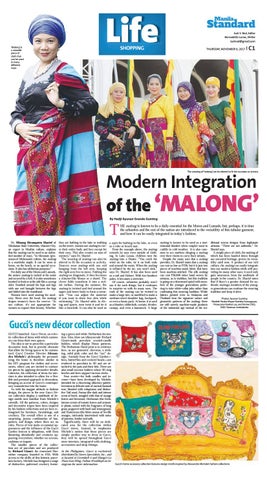
‘Malong’ is a versatile piece of cloth that can be used in many different ways
Life shopping
Isah V. Red, Editor Bernadette Lunas, Writer isahred@gmail.com thuRsday, noVemBeR 9, 2017
c1
The wearing of ‘malong’ can be altered to fit the occasion or activity
Modern integration of the ‘maLong’ By Hadji Ayunan Grande Gunting
T Dr. Minang Dirampaten Sharief of Mindanao State University, Marawi City, an expert in Muslim culture, explains that the malong can be used in an unlimited number of ways. “In Meranaw (pronounced Muhranaw) culture, the malong is a wardrobe staple. It can be worn at home, on the beach, or on special occasions. It also has utilitarian purposes.” For daily use of the Moros and Lumads, the unisex malong is tucked at the waist and secured by a belt. It is also sometimes knotted in front or at the side like a sarong skirt. Swathed around the hips and legs with one end brought between the legs and folded into the waistband, Women have used malong for modesty. Worn over the head, the malong drapes women’s faces for reserve. “In our culture, it’s not appropriate for women to expose their beauty. Whether
they are bathing in the lake or walking on the street, women use malong to cover their entire body and face except for their eyes. This also creates an aura of mystery,” says Dr. Sharief. The wearing of malong can also be altered to fit the occasion or activity. Dancers wear malong with one end hanging from the left arm, keeping the right arm free to move. Folding the malong on diagonals, it then becomes a kimono-like blouse or a shawl. The clever folds transform it into a stylish turban. During the summer, the malong is twisted and tied around the upper and lower body to form a swimsuit. “You can adjust the material if you want to show less skin while swimming,” Dr. Sharief adds. In diving and sports, men twist it and tie it like a loincloth. It can also be used as
HE malong is known to be a daily essential for the Moros and Lumads, but, perhaps, it is time the urbanites and the rest of the nation are introduced to the versatility of this tubular garment, and how it can be easily integrated in today’s fashion.
a tapis for bathing in the lake, or even as a robe or beach mat. From the example above, the malong extends its uses even outside of clothing. In Lake Lanao, children turn the malong into a floater. “You catch the wind on the tube; tie it on both ends and around the waist. When the malong is inflated by the air, you won’t sink,” says Dr. Sharief. It has also been used as a sail and fishnet. With two bamboo poles, it becomes a stretcher. Of course, urbanites probably won’t use it for such things, but it continues to surprise us with its many uses. The ends of the malong can be twisted to make a large tote, or modified to make a medium-sized shoulder bag, backpack, or even a fanny pack. At home, it is used as a blanket, tablecloth, curtain, divider, canopy, and even a hammock. A large
malong is known to be used as a matrimonial blanket when couples want to cuddle in cold weather. It is also common to see mothers slinging a malong over their chests to carry their infants. Despite the many uses that a malong provides, Dr. Sharief states that a malong can cost as low as P250, but it is just two pieces of machine-made fabric that have been machine-stitched. The silk malong can cost P10,000 when hand woven by artisans, as is tradition, but this tradition is going on a downward spiral with members of the younger generations preferring to take white-collar jobs rather than continuing this weaving tradition. While fabrics printed even in Malaysia and Thailand bear the signature nature and geometric patterns of the malong, these are still merely machine-made products of the industrial age instead of the tra-
ditional woven designs from legitimate artisans. “These are not authentic,” Dr. Sharief says. A simple piece of cloth, the making of which has been handed down through our ancestral heritage, proves its versatility until now. A product of our rich culture, the malong can easily integrate into our modern fashion while still providing its many other uses; it need only gain awareness from the multitude of people in the country. Dr. Sharief notes that if there’s a greater demand for authentic malongs, members of the younger generations can continue the weaving tradition and keep it alive. Photos: Ayunan Gunting Models: Taraka Mayor Nashiba Sumagayan, Prosecutor Kookai Lao, and former DILG ASEC Nariman Ambolodto
Gucci’s new décor collection GUCCI launched Gucci Décor, an eclectic collection of items with which customers can dress their own spaces. The idea is not to prescribe a particular decorative look, but to provide elements that allow for living spaces to be customized. Gucci Creative Director Alessandro Michele’s philosophy for personalizing the home is therefore similar to his DIY program for clothes and accessories, where you are invited to customize pieces by applying decorative details. Likewise, his collection of items for interiors is also intended to allow for a flexible and personal approach to decoration, bringing an accent of Gucci’s contemporary romanticism into the home. As with his magpie attitude to fashion design, the pieces in the new Gucci Décor collection display a multitude of design motifs now familiar from Michele’s catwalk. All the patterns, colors, designs and decorative tropes have been inspired by his fashion collections and are here reimagined for furniture, furnishings, and crockery. The overall effect is one of a surprising, joyous combination of hue, pattern, and design, where there are no rules. Pieces of text make occasional appearances and the influence of the Gucci Garden lexicon is ubiquitous, with flora blooming abundantly and creatures appearing everywhere, whether on screens, cushions or teapots. The smaller pieces of the collection are of porcelain and are produced by Richard Ginori, the renowned Florentine company founded in 1735. With access to the skills of this historic porcelain factory, Michele has designed a range of distinctive, patterned crockery featur-
ing a green and white Herbarium decoration. Also, there are idiosyncratic Richard Ginori-made porcelain scented-candle holders, which display House patterns. The Herbarium floral print is in evidence here, as are geometric chevrons, a striking, solid pink color and the “eye” design. Animals from the Gucci Garden— bees, butterflies and cockerel heads—are rendered in porcelain in 3D and are attached to the pots and their lids. There are also small incense holders where 3D stag beetles and bees support incense sticks. Four scents—for both candles and incense—have been developed by Michele, intended for a discerning olfactory palette: Inventum (a delicate note of ancient damask rose, blended with voluptuous and distinctive Taif rose); Fumus (the dark and intense scent of birch, mingled with that of orange leaves and beeswax); Herbosum (the fresh, intense scents of tomato leaves and aromatic plants, mixed with the fragrance of long grass peppered with basil and lemongrass); and Esotericum (the bitter aroma of Seville oranges, intricately intertwined with notes of jasmine, leather and salt). Significantly, there will be no dedicated area for the collection within Gucci stores. Instead, to emphasize Michele’s notion that these pieces are simply another way to dress in Gucci, they will be spread throughout Gucci store interiors, integrated with clothing, accessories and shop fittings. In the Philippines, Gucci is exclusively distributed by Stores Specialists, Inc., and is located at Greenbelt 4 and Shangri-La Plaza East Wing. Follow @ssilifeph on Instagram for more information.
Gucci’s home accessory collection features design motifs inspired by Alessandro Michele’s fashion collections