MPIC’s core income increased by 15% to P27.1b in 2025
By Jenniffer B. Austria
INFRASTRUCTURE conglomerate Metro Pacific Investments Corp. (MPIC) posted a 15 percent increase in consolidated core net income to P27.1 billion in 2025, up from P23.6 billion in 2024, on the back of stronger contributions from its power and water businesses.
Contribution from operations rose 13 percent to P32.1 billion, driven by improved financial and operational performance across its portfolio.
The growth was supported by robust expansion in the power generation business of Manila Electric Co. (Meralco), the implementation of higher tariffs at Maynilad Water Services Inc. and higher patient volumes across the Metro Pacific Hospitals network.
MPIC chairman, president and chief executive Manuel Pangilinan said in a statement that the company would remain focused on financial discipline and operational efficiency amid global uncertainties.
“The global environment remains uncertain, with ongoing geopolitical conflict in the Middle East and other external pressures affecting energy markets and investor sentiment. In times like this, our approach is to stay disciplined — manage our balance sheet carefully, focus on operational efficiency, and continue investing where the country needs infrastructure the most,” Pangilinan said.
Among MPIC’s core businesses, the power segment remained the largest contributor, accounting for P22.1 billion, or 69 percent of net operating income. The water and toll roads units
contributed P7.2 billion and P6.1 billion, respectively.
Despite the strong operating performance, reported net income grew at a slower pace of 5 percent, as the previous year’s results included a one-time gain from a subsidiary that tempered year-on-year comparisons.
Manila Electric Co. booked consolidated core net income of P50.6 billion, up 12 percent year over year, supported by stronger contributions from both power generation and distribution businesses.
Maynilad Water Services Inc. saw its core net income increase 19 percent to P15.2 billion, driven by higher revenues and improved network efficiency.
Toll road operator Metro Pacific Tollways Corp. (MPTC) reported a 4 percent decline in net income to P6.2 billion, as the previous year included the reversal of contingent considerations related to the Jakarta-Cikampek Elevated Toll Road acquisition.
Toll revenues rose 17 percent to P36.9 billion, supported by toll rate adjustments and traffic growth across its expressway network.
Average daily vehicle entries increased 2 percent in the Philippines to 719,396 and 1 percent in Indonesia to 1.65 million, while traffic in Vietnam declined 7 percent to 70,850.

The Pawikan
conservation effort at
PSEi rises for 2nd day as oil prices ease, peso depreciates
PHILIPPINE shares rose for a second straight trading day after a decline in global oil prices eased concerns about a possible spike in the inflation rate.
The 30-company Philippine Stock Exchange index jumped 31.67 points, or 0.52 percent, to close at 6,158.33, while the broader all shares index added 20.42 points, or 0.60 percent, to 3,428.03.
After hitting more than $100 a barrel, crude oil prices fell on hopes that the International Energy Agency could authorize the largest-ever release of oil reserves.
“The PSEi ended higher as the market extended its recovery, with investors taking advantage of bargain prices following recent declines, while sentiment slightly improved after a mixed finish on Wall Street,” Regina Capital Development Corp. head of sales Luis Limlingan said.
Despite market gains, Limlingan said buying remained selective
Maharlika Highway rehab: another game changer

ROADS that connect the rest of the countryside to urban centers are the hallmarks of an inclusive economy.
They speed up the transportation of goods and services, bring farm produce closer to the market, raise productivity and income, and ultimately reduce prices.
Keeping the roads in tip-top shape or rehabilitating them is a must to pave the way for higher economic growth that leads to increased employment.
The rehabilitation of the Maharlika Highway this year is one example that can unlock long-overdue economic opportunities, especially for Western Samar and the broader Eastern Visayas region.
Public Works Secretary Vince Dizon’s decision to prioritize the highway job speaks of national economic integration.
Stretching over 3,000 kilometers from Luzon through the Visayas to Mindanao, the Maharlika Highway is the backbone of land transport, connecting people, goods and services across the archipelago.
The Department of Public Works and Highways (DPWH) estimates the rehabilitation could cost around ₱16 billion, making it one of the country’s most significant infrastructure initiatives. For Western Samar, the stakes are high. Roughly 200 kilometers of the highway run through the province, one of the longest continuous stretches nationwide.
This corridor positions the province as the linchpin of the eastern land route linking Luzon, the Visayas and Mindanao. Cargo trucks carrying agricultural products from Mindanao to Luzon and manufactured goods moving south depend on these segments.
Mr. Dizon personally inspected the province’s highway stretch in a recent visit to Western Samar and made a firm commitment to the provincial government that rehabilitation will include all critical sections in Western Samar.
He assured local officials that work would proceed without delay. This explicit pledge strengthens accountability and underscores the national government’s dedication to connecting Luzon, the Visayas and Mindanao efficiently.
Years of heavy traffic, flooding and typhoons have left the road in poor condition. Travel is slow, vehicle maintenance is high and transportation costs are expensive.
Mr. Dizon’s commitment to a full rehabilitation, not patchwork fixes, is timely. It would restore structural strength and improve logistics efficiency, benefiting both producers and consumers.
Road transport dominates domestic logistics in the Philippines. Eastern Visayas produces tens of billions of pesos annually in agricultural output, including coconuts, abaca fiber, rice, fisheries and root crops.
Western Samar is a leading abaca producer, supplying global markets. Poor road conditions eat into profits and raise prices. Fixing the highway could cut inefficiencies, lower logistics costs and boost regional competitiveness.
—“—
Vince Dizon’s decision to prioritize the highway job leads to national economic integration.
and cautious as lingering global uncertainties kept overall market sentiment guarded.
Sectors ended mixed, with mining and oil advancing by 4.26 percent and services by 2.37 percent. Industrials climbed 1.28 percent and property by 0.24 percent.
On the other hand, holding firms dropped 0.79 percent, while financials went down by 0.43 percent.
Trading was active, with value turnover reaching P7.95 billion. Market breadth was positive as advancers outnumbered decliners 131 to 66, while 57 stocks ended unchanged.
Foreign investors remained net sellers, with outflows at P219.4 million.
The peso depreciated to 59.17 to the U.S. dollar on Wednesday from 58.896 on Tuesday.
Asian equities rose Wednesday while oil resumed its gains as traders weighed growing supply concerns against a report that the International
Tourism in the province also stands to gain. Western Samar has invested heavily in eco-tourism and community-based projects.
The Ulot River Torpedo Boat Extreme Ride in Paranas, for one, offers a unique eco-adventure experience, while the Sohoton Caves and Natural Bridge Park in Basey and Lulugayan Falls showcase the province’s dramatic natural beauty.
Cultural tourism is growing. Initiatives like the “Secret Kitchens of Samar” highlight heritage cuisine and Basey draws visitors as the Banig Capital of the Philippines, renowned for centuries-old handwoven mats.
Recent developments are elevating Western Samar’s profile. The San Juanico Bridge Aesthetic Lighting Project has turned the landmark into a nighttime attraction, and cruise tourism is emerging. In 2025, the Heritage Adventurer cruise ship docked in Daram town, prompting the provincial government to develop shore excursions linking visitors to local attractions.
But deteriorating road segments slow travel, affecting transport providers and tour operators. A rehabilitated Maharlika Highway would make movement smoother and encourage tourism growth that benefit hotels, restaurants, transport services and community enterprises.
Infrastructure improvements also strengthen disaster preparedness.
Eastern Visayas is highly vulnerable to typhoons. During emergencies, the highway is a lifeline that enable relief agencies to deliver food, medicine and reconstruction materials efficiently
The Maharlika Highway is more than a road—it is a strategic economic artery connecting Luzon, Visayas and Mindanao. Cargo from Mindanao moves north, while goods from Luzon travel south. Western Samar’s long stretch is essential to maintaining this nationwide logistics chain.
Infrastructure investments of this scale rarely come along. When executed properly, they can reshape regional development and unlock new economic opportunities.
For Western Samar and Eastern Visayas, the opportunity is significant. With 200 kilometers of the country’s most important highway, Western Samar occupies a strategic position in the movement of goods, travelers and commerce.
Strengthening this corridor can reduce logistics costs, support agriculture, expand tourism and spur investment in communities long on the margins of growth.
If implemented as promised, the Maharlika Highway rehabilitation will do more than link Luzon, the Visayas and Mindanao.
It can catalyze Western Samar’s next phase of economic development and boost Eastern Visayas’ connectivity and competitiveness, a clear victory for the provincial government, local communities and the national economy.
E-mail: rayenano@yahoo.com or extrastory2000@gmail.com
Energy Agency was considering the release of a record amount of its reserves.
The crude market has been hit by wild volatility since the United States and Israel began striking Iran at the end of last month, with Tehran retaliating by attacking targets across the oil-rich Gulf and effectively shutting down the crucial Strait of Hormuz.
Fears that the conflict could drag on for some time -- choking off energy supplies -- sent both main crude contracts soaring on Monday to within a whisker of $120 a barrel, the highest since 2022. Gas prices also rocketed.
However, prices tanked on Tuesday after US President Donald Trump said war on Iran was “going to be ended soon” and it emerged that the Group of Seven leading industrialised nations would discuss tapping stockpiles. Jenniffer B. Austria with AFP
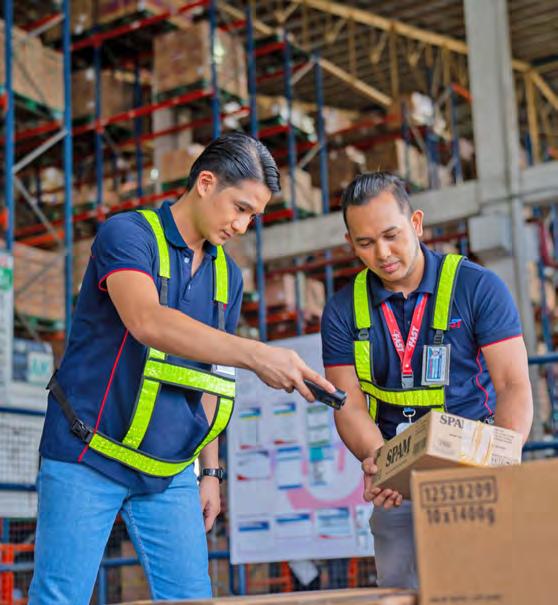
Maynilad upgrades key facilities to strengthen West Zone supply
By Othel V. Campos
WEST Zone concessionaire
Maynilad Water Services Inc. is finalizing several key water and wastewater infrastructure projects to boost system reliability, operational resilience and environmental protection across Metro Manila and Cavite.
Among the projects is the upgrade of the 205-millionliter-per-day CAMANA Water Reclamation Facility in Dagat-Dagatan, serving Caloocan, Malabon and Navotas.
“These projects reflect our focus on disciplined execution and system readiness. By upgrading critical facilities and strengthening our primary distribution network, we are reinforcing the reliability and resilience of our water and wastewater systems,” Maynilad president and chief executive Ramoncito Fernandez said.
The company is also completing upgrades at La Mesa Treatment Plant 2, a critical component of the West Zone water supply system. Modernized facilities will enhance operational reliability and ensure stable water delivery across the concession area. Complementing the upgrades is the ongoing installation of primary distribution pipeline segments along Daang Hari in Las Piñas, linked to the Poblacion Water Treatment Plant in Muntinlupa. Once integrated, the pipeline will improve water distribution and pressure management in southern service areas. The initiatives form part of Maynilad’s multi-year capital investment program, which also targets water security, wastewater services and non-revenue water reduction across its service area.