B1
SUNDAY, AUGUST 6, 2017 Adelle Chua, Editor
Opinion
Joyce Pangco Pañares, Issue Editor
mst.daydesk@gmail.com
EDITORIAL
POP GOES THE WORLD JENNY ORTUOSTE
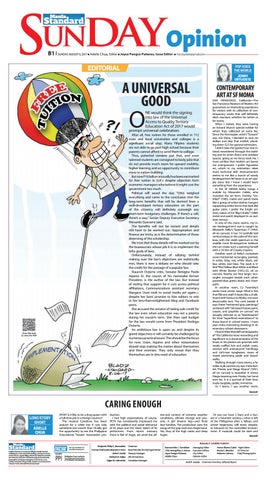
A UNIVERSAL GOOD
CONTEMPORARY ART AT SF MOMA
SAN FRANCISCO, California—The San Francisco Museum of Modern Art guarantees an interesting experience for visitors with its collection of contemporary works that will definitely elicit reactions whether for better or for worse. When I visited, they were having an Edvard Munch special exhibit for which they collected an extra fee. Since the Norwegian artist’s “Scream” was not there, I decided to save six dollars and skip that exhibit, plunking down $25 for general admission. I didn’t take the guided tour but instead meandered through the building and its seven floors and outdoor spaces, going as my fancy took me. I must confess that modern art leaves me unimpressed. I prefer figurative art, which in my estimation takes more technical skill. Abstractionism seems to me like a bunch of rowdy kindergartners let loose in an art supply store. But I knew I would learn something from the experience. In the SF MOMA lobby hangs a mobile by Alexander Calder, who invented the art form. Frankly, “Untitled” (1963, metal and paint) looks like a group of white clothes hangers supporting white forms that look like guitar picks. I prefer the bright primary colors of his “Big Crinkly” (1969, metal and paint) displayed in an outdoor terrace. In one of the many rooms, my inner kindergartner’s eye is caught by Ellsworth Kelly’s “Spectrum I” (1953, oil on canvas). It has 14 carefully laid vertical stripes in the color of the rainbow, with the violet spectrum in the middle. Inner Kindergartner believes she can create such a painting herself with a 24-box of Crayola crayons. Another work of Kelly’s comprises seven horizontal rectangles, painted, in order, blue, red, white black, yellow, white, and blue. The work is titled “Red Yellow Blue White and Black with White Border (1952-53, oil on canvas). Nearby are four larger rectangles arranged beside each other, painted blue, green, black, red. I facepalm. In another room, Cy Twombly’s works have center stage. What is this that fills one wall? It looks like a chalkboard with furious scribbles, not even discernable text. The card beside it says these “restrained gray paintings” rendered with “oil-based house paint, crayon, and graphite on canvas” are actually referred to as “blackboards” for their “superficial resemblance” to those found in school rooms. I have seen more interesting drawings in elementary school classrooms. I found Mike Mandel’s photographs of ‘70s California more rewarding and significant as a documentation of the times. In his photos are grannies with neatly coiffed hair and stylish coats, women with animal-print handbags and cat’s-eye sunglasses, views of motel swimming pools and boardwalks. Walking through more rooms, a familiar style catches my eye. Frida Kahlo’s “Frieda and Diego Rivera” (1931, oil on canvas) is beautiful. It shows Diego towering over Frieda, her hand over his. It is a portrait of their love, made tangible, public, immortal. As I leave, I spy another room,
O
NE would think the signing into law of the Universal Access to Quality Tertiary Education Act of 2017 would prompt universal celebration.
After all, free tuition for those enrolled in 112 state and local universities and colleges is a significant social step. Many Filipino students are not able to go past high school because their parents cannot afford to send them to college. Thus, potential remains just that, and even talented students are consigned to lowly jobs that do not provide much room for upward mobility, higher learning and an opportunity to contribute more to nation building. But now P16 billion annually has been earmarked for free tuition in SUCs despite objection from economic managers who believe it might cost the government too much. Political will saved the day: “[We] weighed everything and came to the conclusion that the long-term benefits that will be derived from a well-developed tertiary education on the part of the citizenry will definitely outweigh any short-term budgetary challenges. If there’s a will, there’s a way,” Senior Deputy Executive Secretary Menardo Guevarra said. The benefits will not be instant and details still have to be worked out. Appropriation and finance are tricky, as is the determination of those deserving of the scholarship. We trust that these details will be worked out by the bureaucrats whose job it is to implement the lofty goals of laws. Unfortunately, instead of rallying behind making sure the law’s objectives are realistically met, there is now a debate on who should take the credit for the passage of a popular law. Staunch Duterte critic, Senator Benigno Paolo Aquino IV, the cousin of his namesake former President, is the author of the law. But instead of noting that support for it cuts across political affiliations, Communications assistant secretary Margaux Uson took to social media yet again— despite her boss’ promise to hire editors to rein in her less-than-enlightened blog and Facebook posts. She accused the senator of taking sole credit for the law even when education was not a priority during his cousin’s term. She then said budget for the law would come from President Rodrigo Duterte. An ambitious law is upon us, and despite its grand objectives it will certainly be challenged by numerous practical issues. This should be the focus for now. Uson, Aquino and other noisemakers should stop making the matter about themselves and their enemies. They only reveal that they themselves are in dire need of education.
Scan this icon to view the PDF
Turn to B2
CARING ENOUGH LONG STORY SHORT ADELLE CHUA
WHAT is it like to be a drag queen with a full-time job in a foreign country? The musical Caredivas has been around for a while but it was only sometime last month that I finally got the opportunity to see this Philippine Educational Theater Association pro-
duction. I had high expectations, of course. PETA has consistently impressed me with the political and social relevance of its plays and the sheer talent of its performers. From recent memory there is Rak of Aegis, set amid the all-
too-real context of extreme weather conditions, climate change and poverty. A girl dreams big—and finds love besides. The production uses the songs of the pop-rock icon Aegis band. Yes, they of the high notes and deep hugot.
Or you can have 3 Stars and a Sun, set in a futuristic society—what is left of the Philippines after a fallout, and where hegemony still exists despite, or because of, the controlled environment. If musicals could be dark and Turn to B2
Rolando G. Estabillo Publisher ManilaStandard
Published Monday to Sunday by Philippine Manila Standard Publishing Inc. at 6/F Universal Re Building, 106 Paseo de Roxas, corner Perea St., Legaspi Village, Makati City. Telephone numbers 832-5554, 832-5556, 832-5558 (connecting all departments), (Editorial) 832-5554, (Advertising) 832-5550. P.O. Box 2933, Manila Central Post Office, Manila. Website: www.thestandard. com.ph; e-mail: contact@thestandard.com.ph
ONLINE
can be accessed at: manilstandard.net
MEMBER
PPI
Philippine Press Institute The National Association of Philippine Newspapers
Benjamin Philip G. Romualdez Former Chief Justice Reynato S. Puno Anita F. Grefal Baldwin R. Felipe Edgar M. Valmorida
Chairman Board Member & Chief Legal Adviser Treasury Manager OIC-Ad Solutions Circulation Manager
Ramonchito L. Tomeldan Chin Wong/Ray S. Eñano Joyce Pangco Pañares Adelle Chua
Managing Editor Associate Editors City Editor Opinion Editor
Emil P. Jurado
Honor Blanco Cabie Night Editor Romel J. Mendez Art Director Roberto Cabrera Chief Photographer
Chairman Emeritus, Editorial Board
Opinion
B2
SUNDAY, AUGUST 6, 2017 mst.daydesk@gmail.com
CARING...
A SAVAGE BATTLE
From B1
disturbing this—in rap, mind you— this would be it. It’s song and dance all right but not in a cheery way. And this is exactly why it works. Earlier this year, there was Game of Trolls—about a group of Internet trolls working for a politician who does not have much respect for accuracy, and the ghosts of martial law. And now, these five queens. Chelsea, Kayla, Shai, Jonee and Thalia are Filipino caregivers in Israel. All of them saw working abroad as a solution to the grinding poverty they experience at home. Chelsea is lucky because she gets along with the old man she takes care of. Kayla—not so much. She has problems with her papers and the wife of his employer treats her like a slave. Shai is forever haunted by the words of her mother, alive and well back in the Philippines, always nagging her to send more money back home to take care of the extended family, including able-bodied siblings. They try to put together a performing group—seeing how they all love to sing, dance, and doll themselves up—but encounter difficulties along the way: Chelsea’s patient becomes sick and eventually dies, leaving her hard pressed to find a new job before she is deported. She also falls in love with a Palestinian man who is evading authorities. Kayla does get sent home to the Philippines upon the discovery of her illegal status. Shai, the leader of the group, harbors resentment when they score a gig at a Tel Aviv bar but is prevented from performing. Chelsea’s boyfriend also drives a wedge between her and her friends, as does the infighting and envy among them. In the end, Shai’s employer takes her to New York, the rest stay put where they are, and they manage to keep in touch through technology. Caredivas is directed by Maribel Legarda and written by Liza Magtoto. Music and lyrics are by Vincent de Jesus, who also plays Shai. The July 9 staging was produced by lawyer Roy Allan Magturo. *** From popular culture, social media, and the experiences of family and friends, we know much about how it is to work abroad. The most common threads are stories of dire loneliness— everything is foreign, the old life seems so far away, and working conditions are difficult at the very least. But not all employers are evil slave drivers, and not all Filipino workers are ill-treated. Chelsea’s Isaac, for instance, even teaches her Hebrew when he feels up to it. This is why she mourned his passing. Even in a foreign land, Filipinos are able to form connections with their employers, colleagues and other compatriots. Over time, these relationships can seem better than the ones they leave behind in their home countries, and provides all the more reason for them to stay. “Home” and “family” over time become relative. The social and political situation of their host countries is also something we need to consider. Israel is a good example of how people have become accustomed to living amid conflict; curfews and searches are a fact of life and they carry on notwithstanding these. But just because you get used to such situations does not mean they become less threatening. Finally, whatever the situation, one always needs an avenue to express oneself—it can be through a hobby, fellowship among compatriots, music, literature, art. The drag queens of Caredivas are no different. They take overseas jobs as a matter of survival, but they also need to achieve their potential and truly live. *** PETA will stage again, in September, Game of Trolls. I highly recommend it to millennials who will no doubt learn much, and be inspired much about what it was like during martial law, and how those memories and lessons spill over to where we are now. Indeed theater is a reflection of who we are and what we aspire to be, individually and as a society. Carry on, PETA, and congratulations on the welldeserved Ramon Magsaysay Award! adellechua@gmail.com
CONTEMPORARY... From B1 tucked beside the baggage counter. It holds the museum’s older artworks. Now these are more to my liking. Andre Derain’s oil painting “Paysage du Midi (Midi Landscape)” (1906) evoke a place with shape and color. Looking to be in a similar style are two seascapes by Henri Matisse, painted the same
Iraqi federal police members celebrate in the Old City of Mosul on July 9, 2017 after the government’s announcement of the liberation of the embattled city. AFP
By Ahmad Al-Rubaye MOSUL—I have covered nearly the entire nine months that Iraqi forces spent retaking Mosul from Islamic State jihadists. I would spend weeks at the front with the soldiers, witnessing the killing, smelling the stench of death. I was gone so much that when I would come home for a few days of rest, my two-year-old daughter no longer recognized me. Why go through all that? I am Iraqi and I saw it as my duty to show to the outside world what was happening here. To me, the battle for Mosul was the most important over the past 14 years, since the fall of Saddam Hussein, because I think it is the beginning of the end of the Islamic State, the brutal extremists who at one point took over two-thirds of Iraq and were threatening the capital Baghdad. Covering the battle took its toll on me psychologically. I saw so much killing. The smell of death was always present, sometimes for days on end. Mosul was an especially savage battle. The militants were surrounded in an area where they had been entrenched for several years. The presence of civilians made it even
more bloody. Often I would witness fighting between Iraqi forces and IS forces in small alleyways. I would see bodies of IS fighters still wearing their suicide belts, bodies of civilians starting to decompose. Fear was ever present during the fighting. Fear is natural. You’re in the middle of the battle, so there’s always a danger that you will be killed. The journalists were always on alert to avoid snipers, who were highly trained and very skilled and seemed to target journalists. Then there was the danger of improvised explosive devices planted in alleyways, buildings and cars. On some days I imagined myself going home wounded or dead. Once in the Old City, we were trapped by IS fighters in a spot for seven hours. We all faced the fact that we may not come out alive, but thank God reinforcements eventually came and the IS militants fled. You saw and felt the fear when civilians would flee their homes and walk toward Iraqi forces. Those poor people. They hadn’t seen government forces in more than three years. During those years, they were living under the cruelty of the Islamic State militants, who were telling them that
the government forces would come and kill them and rape their women. So obviously they were afraid. Of everyone and everything. When you cover so much carnage, there are so many scenes that stick in your mind long after you’ve lived through them. I will never forget the Yazidis when IS got to Sinjar mountain in 2014, trapping thousands on the mountain top and forcing scores to flee. I saw some heartbreaking scenes in Dohuk, where women and children were sleeping in the open. One woman gave birth under a bridge, with her husband standing over her, holding her IV solution. That scene always pops into my head now every time I’m in a hospital or medical center. Another scene is of a man carrying a six-year-old boy who had been hit by a sniper’s bullet in Ein Jahesh area west of Mosul. He walked up to us, put his son on the ground and started to sob. After he calmed down a bit, he told us his story. “I live in a village nearby. I was fleeing IS fighters with my wife and two boys. They shot and killed my wife. I left her body where it was and went back to our house. When night fell, I decided to try to escape again with
my two children. On the way, a sniper shot and killed one of my children, so I buried him in a dark place on the road.” Trouble was he buried the son who was alive. Both of the boys were covered in blood and the one alive was in a deep sleep. The father was so tired and so scared, and it was so dark, that he chose the wrong son. He didn’t realize his mistake until it was too late. We later learned that he had gone mad. Scenes like this still haunt me. Especially when I am sitting alone with my thoughts. Although the IS had been driven out of most of Mosul, they still control pockets in the city, and in the rest of Iraq, like the Anbar province. I will cover battles to retake these places. And once there is no more IS in Iraq, I will go back to my normal coverage of the country. I have been covering what has been happening in Iraq since the fall of Saddam Hussein in 2003. And the Mosul battle was just one chapter, albeit an important one, in this story. The battle was a chapter of a bigger war and it is with sadness that I think that this war is not yet over; there will be more chapters. AFP
TRUMP’S IMMIGRATION PLAN HURTS WORKING FAMILIES By Therese Raphael WHATEVER part of America President Donald Trump was making great again when he set the goal of reducing immigration by half, it wasn’t the part with working parents. It’s great to have immigrants with advanced degrees who can program in five coding languages. But his proposal to slash legal immigration and admit applicants based on skills instead of family ties leaves out a lot of useful workers—among them, people who take care of young children. Access to high-quality, affordable and flexible child care is already inadequate in much of the US for all but the well-off, and government spending on child-care and early education is among the lowest of all developed nations. These failings have huge costs: Decades of research have established the link between quality child care and lifelong benefits from academic performance to health outcomes and earning potential. Not only does high-quality child care benefit children and families, it also brings wider economic benefits, as former Fed Chairman Ben Bernanke once
noted: Economically speaking, early childhood programs are a good investment with inflation-adjusted annual rates of return on the funds dedicated to these programs, estimated to reach 10 percent or higher. Very few alternative investments can promise that kind of return. Trump’s ideas would only make the situation for working parents worse— and poorer families would lose the most. In 2015, 1.8 million people worked in early-childhood care and education in the US compared to 1.1 million in 1990, an increase of 56 percent, according to the Migration Policy Institute. Nationally, 18 percent of those workers are immigrants; in California, it’s one in four. I have spent most of my adult life in Europe and the UK, where child-care options are more plentiful and often more affordable than in the US. In part due to an abundance of European migrants—but also more government spending in the area—the UK in particular has enjoyed fairly high standards of child care. And yet, thanks to Brexit, Britons may soon get their own taste of the kind of medicine Trump is proposing for the US.
The consequences of inadequate child-care provisioning can already be seen in London. While UK parents generally have more options than American parents, child-care costs in London are a third higher than the national average and there is a chronic undersupply, with only 32 places for each 100 children under five. For those who can afford to pay, London offers a wide range of options at every price point, from basic mother’s helpers to uber-nannies with advanced degrees. But costs are also growing faster than wages. That’s one reason that maternal employment in London is the lowest of any region in the UK—with 40 percent of mothers citing child care as a key barrier. A study by the Institute for Public Policy Research concluded that if London could bring maternal employment up to the UK average of 69 percent, then there would be a net gain of 90 million pounds ($106 million) to the Exchequer and 2,200 families would be lifted out of poverty. Trump’s policies would probably reduce already belowaverage levels of maternal employment in the US, too. There are no hard figures yet on how
many EU migrants are deterred from coming to Britain to take up nannying or child-care jobs, but if the number of EU nurses applying to work in the UK is any guide, there is going to be a dropoff. And the effect will be felt across the sector: Almost six percent of the UK’s 300,000 nursery care workers (not including managers and teachers) are EU migrants. Non-UK nationals make up nearly 9 percent of the total workforce. Neither in the UK nor the US is anything set in stone. While Brexit may well be irreversible, Prime Minister Theresa May could recognize that ensuring adequate child-care provisions, like ensuring that the National Health Service has access to sufficient numbers of nurses, doctors and other staff, will require higher levels of immigration and at different skill levels, and adjust her hard-line policy to reflect that. In the US, it’s unlikely that Congress will pass Trump’s plan. Plenty of lawmakers in the president’s own Republican Party oppose such strict limits on legal immigration. But lawmakers should do more than simply reject the proposal: They should explain to American families why it would leave them worse off. Bloomberg
year. Dabs, flecks, lines, call to mind a beach and leave the rest to the viewer’s imagination. Matisse has two figural works here, both oils—“Femme au chapeau (Woman with a Hat)” (1905) and “La fille aux yeux verts (The Girl with Green Eyes)” (1908). Both are modernist works that were considering “disquieting” to viewers back then. The latter, a portrait, is described by critics of the day as “a face crazed by
absinthe drinking.” Diego Rivera is represented by “Indian Girl with Coral Necklace” (1926, oil on canvas) and “The Flower Carrier” (1935, oil and tempera on Masonite). The former depicts a little girl in native dress, clutching her necklace, tiny bare feet on a red tile floor. The latter shows two campesinos (peasant farmers): a male in white kneeling on the ground as a woman adjusts a heavy basket of flowers on
his back. The image depicts the backbreaking work of agricultural laborers. There is much more to see at SF MOMA, including sculptures—Marcel Duchamp’s famed urinal “Fountain” is here, although a refabrication, one of several. I might not have appreciated the abstract works, preferring those that outright tell stories rather than evoke feelings. But
those who enjoy the genre will have much to admire. For me, it was worth the price of admission to see the lone Kahlo work. SF MOMA has something for everyone to enjoy, and as a destination it is one of the must-sees in San Francisco. Dr. Ortuoste is a California-based writer. Follow her on Facebook: Jenny Ortuoste, Twitter: @jennyortuoste, Instagram: @jensdecember, @artuoste
World
B3
SUNDAY, AUGUST 6, 2017 mst.daydesk@gmail.com
UHURU KENYATTA: MILLIONAIRE PLAYBOY TO KENYAN PRESIDENT NAIROBI, Kenya—The son of Kenya’s founding president and a man who epitomizes the country’s elite, Uhuru Kenyatta hopes to win a second and final five-year term in elections on August 8. The 55-year-old US-educated multimillionaire, whose family owns an array of businesses, properties and tracts of land, followed in his father’s footsteps when he defeated his rival Raila Odinga in 2013. Kenyatta won that poll despite being indicted by the International Criminal Court (ICC) along with his running mate, William Ruto, for alleged roles in orchestrating violence that left over 1,100 dead after the previous election in 2007. Foreign powers, including Britain and the US, warned at the time that Kenya, under an ICC-indicted president, would be a pariah, but the threats proved empty. In 2014 the ICC dropped charges against Kenyatta—and Ruto later—citing the disappearance of witnesses and lack of evidence. Since then Kenya has welcomed President Barack Obama, British Foreign Secretary Boris Johnson and Pope Francis and hosted a string of international gatherings and conferences. AFP
ROUHANI STARTS NEW TERM FACING REFORM CRITICISM TEHRAN, Iran—Iranian President Hassan Rouhani was set to be inaugurated in front of foreign guests on Saturday, but already faces criticism for reportedly bowing to conservatives in forming a new government. Rouhani, a 68-year-old cleric considered a political moderate, began his second term on Thursday when he was sworn in by supreme leader Ayatollah Ali Khamenei. But Saturday’s ceremony in parliament is the glitzier affair, with guests including EU foreign policy chief Federica Mogherini, who has vowed to continue building ties with Iran despite mounting pressure from the United States to keep the Islamic republic isolated. Some of Iran’s older friends also arrived in Tehran, including Zimbabwean President Robert Mugabe. The emir of Qatar, which has fallen out with its Gulf allies in part over ties to Iran, was notably absent despite attending Rouhani’s last inauguration in 2013. But among Iranians, the real attention was on who would be named to Rouhani’s new cabinet. He has already been barraged with criticism over indications that women would again be entirely absent and that his reformist allies would barely be represented. AFP
MOB ATTACKS INDIA OPPOSITION LEADER GANDHI IN GUJARAT AHMEDABAD, India—Indian opposition leader Rahul Gandhi’s car was hit by a stone-throwing mob as he visited a flood-hit region of Gujarat state, with leaders of his party blaming supporters of Prime Minister Narendra Modi. A mob carrying black flags tried to stop Gandhi’s convoy Friday and although he was unhurt in the attack, the windows of his car were smashed, television images showed. Police have detained one man and are investigating the incident, the Press Trust of India reported. Gandhi himself took to Twitter, saying he was undeterred by the attack. Scion to the Nehru-Gandhi dynasty that ruled India for decades through its Congress party, the 47-year-old Gandhi is seeking to revive the party’s fortunes after its ouster in 2014 general elections and a string of defeats in state polls since then. Several senior Congress leaders accused Modi’s ruling Bharatiya Janata Party (BJP) of orchestrating the attack on Gandhi, who is the Congress vice president. Gujarat, Modi’s home state, goes to the polls in December with the BJP seeking to retain power. “Windowpanes of Cong VP’s car broken in an organized attack by goons, security staff injured. BJP must know truth can’t be silenced,” tweeted Randeep Surjewla, a Congress spokesman. Ghulam Nabi Azad, another Congress leader, said the attack was carried out deliberately by the BJP to create an atmosphere of fear in Gujarat ahead of the polls. AFP
FRENCH PANDA. People look at male giant panda Yuan Zi, eating bamboo inside its enclosure at Beauval zoo in Saint-Aignan-sur-Cher, central France, on Saturday. There was joy and pain for French zookeepers on Friday as their female panda gave birth to twins, but one died soon afterwards. Nine-year-old Huan Huan and her male partner Yuan Zi arrived at Beauval zoo in January 2012 on a 10-year loan from China after intense, high-level negotiations between Paris and Beijing. Huan Huan (meaning ‘happy’) and Yuan Zi (‘chubby’) are the only giant pandas living in France. AFP
CHINA IN HIGH-ALTITUDE STANDOFF WITH INDIA B EIJING—China has stepped up its rhetoric in an increasingly tense border row with India, hinting at the possibility of military action in a propaganda push that analysts are calling “genuinely troubling.” For more than a month, Indian and Chinese troops have been locked in a standoff on a remote but strategically important Himalayan plateau near where Tibet, India and Bhutan meet. On Thursday, Chinese defense ministry spokesman Ren Guoqiang warned that Beijing had shown restraint but had a “bottom line.” “No country should underestimate the Chinese forces’... resolve and willpower to defend national sovereignty,” he said in a post on the ministry website. It is a line that has been echoed almost word for word this week by the foreign ministry, the official Xinhua news agency, the ruling Communist Party mouthpiece the People’s Daily, the official military news website of the Chinese armed forces, and other
outlets. On Wednesday, the foreign ministry released a 15-page document of “facts” about the border dispute, which included a map of alleged intrusions and photographs of what it stated were Indian troops and military vehicles on China’s side of the frontier. Calling for the “immediate and unconditional” withdrawal of Indian troops, it warned Beijing would “take all necessary measures” to safeguard its interests. Chinese foreign ministry spokesman Geng Shuang said Thursday that India was building roads, hoarding supplies and deploying many troops in the area. “This is by no means for peace,” Geng said. Mistrust between the giant neigh-
bors goes back centuries and the pair fought a brief war in 1962 in India’s border state of Arunachal Pradesh. The recent escalation of China’s rhetoric was “genuinely troubling,” Rory Medcalf, head of Australian National University’s National Security College, told AFP. “It suggests that diplomatic conversations, including among highlevel national security advisers, are failing to find a face-saving way for the two powers to withdraw their forces,” he said. The plateau is strategically significant as it gives China access to the so-called “chicken neck” -- a thin strip of land connecting India’s northeastern states with the rest of the country. Despite the heated war of words, other analysts played down the possibility of an armed clash. “The point of these statements isn’t that war is imminent; rather, they’re an attempt to figure out how to not go to war without losing face,” Shen Dingli, vice dean of Fudan University’s Institute of In-
ternational Studies, told AFP. “Neither side wants to go to war, but China and India are acting like two unhappy little children.” China has rolled out a massive new global infrastructure programme known as the “One Belt, One Road” initiative, which it presents as a peaceful development policy to connect Chinese companies to new markets around the world. Critics see it as a geopolitical powerplay. President Xi Jinping is set to meet Indian Prime Minister Narendra Modi at a summit of BRICS nations in the Chinese city of Xiamen in early September and has said he hopes for greater cooperation within the bloc. But he is also gearing up for a key party congress later this year, at which he is expected to further consolidate his grip on power -making him unwilling to appear weak by backing down in the current dispute, said politics professor Yvonne Chiu, who researches China’s military at Hong Kong University. AFP
NEW ASSEMBLY DIVIDING VENEZUELA BEGINS WORK
An opposition activist throws a gas canister at riot police in Caracas on Friday. Venezuelan President Nicolas Maduro installed a powerful new assembly packed with his allies, dismissing an international outcry and opposition protests saying he is burying democracy in his crisis-hit country. AFP
CARACAS, Venezuela—A new assembly packed with allies of unpopular President Nicolas Maduro and with sweeping powers was to begin work on Saturday, deepening divisions in a crisis-wracked Venezuela. The Constituent Assembly, headed by a former foreign minister, Delcy Rodriguez, is tasked with rewriting the 1999 constitution into a charter Maduro has promised will end the turmoil rocking his impoverished yet oil-rich nation. On Friday, the body took over an ornate chamber under a golden dome in the Legislative Palace in Caracas—at the far end of a building shared with the opposition-run legislature, the National Assembly. Elected a week ago amid bloody protests and international objections, the Constituent Assembly has powers to override every branch of government, and can dissolve the legislature. Its detractors say the 545 loyalist members—among them the president’s wife and son—amount to a rubber-stamp entity extending Maduro’s “dictator”-like grip on power. The United States, the European Union, the Vatican and major Latin American nations including Mexico, Argentina and Chile have all condemned
the new body, saying it undermines democracy and stokes tensions in Venezuela. Mercosur, a South American trading bloc, was meeting on Saturday in Brazil to decide whether Venezuelan should be suspended from it for “breaching democratic order.” The legitimacy of the Constituent Assembly has been thrown into question by claims of fraud, most notably by a British-based firm, Smartmartic, which was involved in supplying the technology for the July 30 vote. Smartmatic said the official turnout figure had been “tampered with” and exaggerated by at least one million voters. The opposition has vowed to maintain street protests against the assembly, despite being increasingly sidelined and despondent. Maduro’s security forces have stepped up pressure on dissenters. The Vatican has urged them to show restraint after a death toll from four months of unrest of 125. A prominent opposition leader, Leopoldo Lopez, was thrown back in military prison after the intelligence service roughly ended a brief spell of house arrest granted last month. AFP
B4
SUNDAY, AUGUST 6, 2017 Cesar Barrioquinto, Editor / Jimbo Gulle, Issue Editor
World
mst.daydesk@gmail.com
UN VOTES ON TOUGHER NORTH KOREA SANCTIONS U
NITED NATIONS—The UN Security Council will vote Saturday (Sunday in Manila) on a United States-drafted resolution toughening sanctions on North Korea, diplomats said Friday, a proposed ban on certain exports that could deprive Pyongyang of $1 billion in annual revenue. After a month of negotiations, the United States reached a deal with China, North Korea’s main trading partner and ally, on the measures aimed at ratcheting up pressure on Pyongyang to halt its missile and nuclear tests. The Security Council was scheduled to vote at 3 p.m. (1900 GMT) Saturday on the new raft of sanctions, diplomats confirmed. The draft resolution calls for a ban on all exports of coal, iron and
iron ore, lead and lead ore, as well as fish and seafood by the cashstarved state, according to the text seen by AFP. If implemented by all countries, the ban would strip Pyongyang of roughly a third of its export earnings estimated at $3 billion per year, according to a diplomat familiar with the negotiations. The diplomat, who briefed reporters on the content of the draft, said he had “high confidence” that
China and Russia would support the proposed sanctions. Backed by its European allies, Japan and South Korea, the United States has been leading the push at the United Nations for tougher sanctions in response to North Korea’s launch of an intercontinental ballistic missile on July 4. A second test on July 28 further raised alarm about Pyongyang’s drive to develop a missile capable of hitting the US mainland. The draft text would also prevent North Korea from increasing the number of workers it sends abroad, prohibit all new joint ventures and ban new investment in the current joint companies. North Korea is blamed for a “massive diversion of its scarce resources” toward the development of “nuclear weapons and a number of expensive ballistic missile programs,” the draft resolution said.
The new raft of measures would be the seventh set of UN sanctions imposed on North Korea since it first carried out a nuclear test in 2006, but these have failed to compel Pyongyang to change its behavior. Two resolutions adopted last year however have introduced economic sanctions with more bite. The United States has put heavy pressure on China, which accounts for 90 percent of trade with North Korea, to enforce the sanctions. The proposed resolution would add North Korea’s Foreign Trade Bank, the primary foreign exchange bank, to a UN sanctions blacklist, which provides for an assets freeze. It would also tighten trade restrictions on technology to prevent North Korea from acquiring items that could be used for its military programs. AFP
US TO JOIN CLIMATE DISCUSSIONS DESPITE PARIS ACCORD EXIT WASHINGTON—The United States announced Friday it would still take part in international climate change negotiations to protect its interests, despite its planned withdrawal from the Paris accord on global warming. Two months after President Donald Trump announced the United States would abandon the 2015 global pact, his administration confirmed it had informed the United Nations of its “intent to withdraw from the Paris Agreement” a process that will take at least until 2020. But in a statement, the State Department said Washington was still committed to reducing its greenhouse gas emissions and engaging with the international community on combating climate change. “We will continue to reduce our greenhouse gas emissions through innovation and technology breakthroughs, and work with other countries to help them access and use fossil fuels more cleanly and efficiently and deploy renewable and other clean energy sources,” said the statement. AFP
PROFESSOR, OXFORD EMPLOYEE ARRESTED IN CHICAGO MURDER CHICAGO—US authorities have arrested employees of two prestigious universities accused in the grisly stabbing death of a Chicago hairstylist, following Friday’s nationwide manhunt. Wyndham Lathem, 42, of Northwestern University in Chicago and Andrew Warren, 56, of Oxford University in England, were in police custody in Oakland, California, according to a tweet from a Chicago police spokesman. The pair had been named as suspects in the attack that was so brutal the blade of the knife used in the murder had broken off, police said. Trenton Cornell-Duranleau, a 26-year-old hairstylist, was found dead in a Chicago apartment last week with multiple stab wounds. Authorities revealed Friday that Lathem had sent a video message to friends and family members apologizing for the crime. AFP
VLAD THE IMPALER. Russian President Vladimir Putin spearfishes in the remote Tuva region in southern Siberia. The picture, released by Russian authorities, was taken between August 1 and 3. AFP
AS TROUBLES BREW, TRUMP GOES ON 17-DAY VACATION BEDMINSTER, New Jersey—Donald Trump, who once asked “what’s the point” of vacations and often admonished his presidential predecessor for taking them while in office, embarked Friday on a 17-day holiday to one of his golf resorts. Arriving in Bedminster, New Jersey for an extended break, the president left behind a capital grappling with a Russia scandal and buffeted by extraordinary leaks from government officials. He has also failed to seize any major legislative victories in his first seven months in office, and is at odds with several Republican lawmakers on multiple fronts. The White House said Trump’s Bedminster stay would be a “working vacation,” and cited scheduled upgrades of the West Wing’s creaky heating and cooling system during the steamy Washington summer as a reason why Trump was leaving town. “The President will continue to work over the next two weeks,” said White House spokeswoman Lindsay Walters. A president taking time off from a hectic schedule is nothing new. But Trump’s down
time is in the spotlight largely because of his relentless criticism of Barack Obama’s breaks from the White House. He ripped into Obama in 2011 for playing golf and then heading to a 10-day vacation in Martha’s Vineyard. “Nice work ethic,” Trump tweeted at the time. “Pres. Obama is about to embark on a 17 day vacation in his ‘native’ Hawaii, putting Secret Service away from families on Christmas. Aloha!,” Trump posted two years later. Not only did Trump attack Obama, he routinely told supporters he would eschew time off if he were elected because he would be swamped with work. “I would not be a president who took vacations,” he said in 2015. “I would not be a president that takes time off.” In late 2012 he tweeted his own apparent aversion to vacations: “What’s the point? If you’re not enjoying your work, you’re in the wrong job.” Despite his comments, Trump has taken considerably more time off than Obama in their respective first seven months in office. AFP
COLORFUL. Netflix’s ‘Sense8’ cast member Toby Onwumere (left) poses with a street performer as he attends the Davie Street Block Party on Friday in Vancouver, Canada. AFP
AVALANCHE KILLS WOMAN AS ALPS SUFFER HEATWAVE ROME, Italy—One woman died after her car was swept away by an avalanche of water and mud as a heatwave broke into storms in the Italian Alps, police said Saturday. The incident occurred overnight near the top ski resort of Cortina d’Ampezzo in the Dolomites range in the northeast of the country. The car was recovered in a river bed covered in detritus but emergency services were unable to resuscitate the woman. The tragedy follows the deaths on Thursday of two pensioners, a 79-year-old woman and an 82-year-old man, who were caught up in wild fires in, respectively, the central region of Abruzzo and near Matera in the south of the country. Fires have been breaking out across Italy because of a heatwave which has seen peak daytime temperatures top 40 degrees Celsius (104 Fahrenheit) across most of the country for over a week. Humidity and other factors are making it feel much hotter with the so-called ‘perceived’ temperature in Campania, the region around Naples, estimated at a broiling 55 Celsius (131 Fahrenheit) on Friday. Hospital admissions are running 15-20 percent above seasonal norms and food producers are forecast to suffer billions of dollars in losses because of reduced crop yields. AFP